



Community hub
Recent from talks
Contribute something
Nothing was collected or created yet.
Wolfenstein 3D
View on Wikipedia
| Wolfenstein 3D | |
|---|---|
 Cover art of the mail order DOS version | |
| Developer | id Software |
| Publishers |
|
| Director | Tom Hall |
| Designers |
|
| Programmers |
|
| Artist | Adrian Carmack |
| Composers | Robert Prince (DOS) Brian Luzietti (Macintosh) Todd Dennis (3DO) |
| Series | Wolfenstein |
| Platforms | |
| Release | May 5, 1992
|
| Genre | First-person shooter |
| Mode | Single-player |
Wolfenstein 3D is a 1992 first-person shooter game developed by id Software and published by Apogee Software and FormGen for DOS. It was inspired by the 1981 Muse Software video game Castle Wolfenstein, and is the third installment in the Wolfenstein series. In Wolfenstein 3D, the player assumes the role of Allied spy William "B.J." Blazkowicz during World War II as he escapes from the Nazi German prison Castle Wolfenstein and carries out a series of crucial missions against the Nazis. The player traverses each of the game's levels to find an elevator to the next level or kill a final boss, fighting Nazi soldiers, dogs, and other enemies with a knife and a variety of guns.
Wolfenstein 3D was the second major independent release by id Software, after the Commander Keen series of episodes. In mid-1991, programmer John Carmack experimented with making a fast 3D game engine by restricting the gameplay and viewpoint to a single plane, producing Hovertank 3D and Catacomb 3-D as prototypes. After a design session prompted the company to shift from the family-friendly Keen to a more violent theme, programmer John Romero suggested remaking the 1981 stealth shooter Castle Wolfenstein as a fast-paced action game. He and designer Tom Hall designed the game, built on Carmack's engine, to be fast and violent, unlike other computer games on the market at the time. Wolfenstein 3D features artwork by Adrian Carmack and sound effects and music by Bobby Prince. The game was released through Apogee in two sets of three episodes under the shareware model, in which the first episode is released for free to drive interest in paying for the rest. An additional episode, Spear of Destiny, was released as a stand-alone retail title through FormGen.
Wolfenstein 3D was a critical and commercial success and is considered one of the greatest video games ever made. It garnered numerous awards and sold over 250,000 copies by the end of 1995. It has been termed the "grandfather of 3D shooters", and is widely regarded as having helped popularize the first-person shooter genre and establishing the standard of fast-paced action and technical prowess for many subsequent games in the genre, as well as showcasing the viability of the shareware publishing model at the time. FormGen developed an additional two episodes for the game, while Apogee released a pack of over 800 fan-created levels. Id Software never returned to the series, but did license the engine to numerous other titles before releasing the source code for free in 1995, and multiple other games in the Wolfenstein series have been developed by other companies since 2001.
Gameplay
[edit]
Wolfenstein 3D is a first-person shooter presented with rudimentary 3D graphics. The game is broken up into levels, each of which is a flat plane divided into areas and rooms by a grid-based pattern of walls and doors, all of equal height.[1] Each level is themed after Nazi bunkers and buildings. To finish a level, the player must traverse through the area to reach an elevator.[2] Levels—ten in the original episodes—are grouped together into named episodes, with the final level focusing on a boss fight with a particularly difficult enemy.[3] While traversing the levels, the player must fight Nazi guards and soldiers, dogs, and other enemies while managing supplies of ammunition and health. The player can find weapons and ammunition placed in the levels or can collect them from dead enemies; weapons include a knife, a pistol, a submachine gun, and a rapid-fire chain gun.[2] The player can also find keys that allow them to pass through locked doors. While the levels are presented in a 3D perspective, the enemies and objects are instead 2D sprites presented from several set viewing angles, a technique sometimes referred to as 2.5D graphics.[4]
The player's health is represented by a percentage starting at 100, which is diminished when they are shot or attacked by enemies.[5] If the player's health falls to zero, they lose one life and start the level over with a knife, a pistol, and eight bullets.[2] The player begins each episode with four lives and can gain more by finding extra-life tokens or by earning enough points. Points are scored by killing enemies or collecting treasures scattered throughout the levels.[5] Points can also be scored by killing all enemies in a level, collecting all treasure, finding all secret areas, or completing a level under a par time; the player's completion ratio and speed is displayed when a level is completed. Secret areas containing treasure, health refills, or ammunition can be found in hidden rooms revealed by activating certain wall tiles that slide back when triggered.[3] The original version of the game allows the player to save their progress at any point, though in many of its ports the player can only save between levels.[2][3]
Plot
[edit]Wolfenstein 3D is divided into two sets of three episodes: "Escape from Castle Wolfenstein", "Operation: Eisenfaust", and "Die, Führer, Die!" serve as the primary trilogy, with a second trilogy titled The Nocturnal Missions including "A Dark Secret", "Trail of the Madman", and "Confrontation". The protagonist is William "B.J." Blazkowicz, an American spy of Polish descent, and the game follows his efforts to destroy the Nazi regime. In "Escape", Blazkowicz has been captured while trying to find the plans for Operation Eisenfaust (Iron Fist) and imprisoned in Castle Wolfenstein, from which he must escape. "Operation: Eisenfaust" follows his discovery and thwarting of the Nazi plan to create an army of undead mutants in Castle Hollehammer, while in "Die, Führer, Die!" he infiltrates a bunker under the Reichstag, culminating in a battle with Adolf Hitler in a robotic suit equipped with four chain guns.
The Nocturnal Missions form a prequel storyline dealing with German plans for chemical warfare. "A Dark Secret" deals with the initial pursuit through a weapons research facility of the scientist responsible for developing the weaponry. "Trail of the Madman" takes place in Castle Erlangen, where Blazkowicz's goal is to find the maps and plans for the chemical war. The story ends in "Confrontation", which is set in Castle Offenbach as he confronts the Nazi general behind the chemical warfare initiative.
Spear of Destiny
[edit]An additional episode, titled Spear of Destiny, was released as a retail game by FormGen. It follows Blazkowicz on a different prequel mission, trying to recapture the Spear of Destiny from the Nazis after it was stolen from Versailles. FormGen later developed two sequel episodes known as "mission packs", Return to Danger and Ultimate Challenge, each of which feature Blazkowicz as he fights through another Nazi base to recover the Spear of Destiny after it has been stolen again as part of a plot to build a nuclear weapon or summon demons.
Development
[edit]
In October–December 1990, a team of employees from programming studio Softdisk calling themselves Ideas from the Deep developed the three-part video game Commander Keen in Invasion of the Vorticons, the first game in the Commander Keen series. The group, who worked at Softdisk in Shreveport, Louisiana, developing games for the Gamer's Edge video game subscription service and disk magazine, was composed of programmers John Romero and John Carmack, designer Tom Hall, artist Adrian Carmack, and manager Jay Wilbur. After the release of the game in December through shareware publisher Apogee Software, the team planned to quit Softdisk and start their own company. When their boss, Softdisk owner Al Vekovius, confronted them on both their plans and their use of company resources to develop the game—the team had created it on their work computers, both in the office after hours and by taking the computers to John Carmack's house on the weekends—the team made no secret of their intentions. After a few weeks of negotiation, the team agreed to produce a series of games for Gamer's Edge, one every two months.[6]
Ideas from the Deep, now formally established as id Software, used some of these to prototype ideas for their own games.[7] Adrian Carmack used them to push his preferred, dark art style, while John Carmack began to experiment with 3D computer graphics, which until then was largely the purview of flight simulators such as Wing Commander (1990) and slower adventure games such as Mercenary (1985). Carmack found that this was largely due to the limitations of personal computers of the time, which had difficulty displaying a fast action game in 3D due to the number of surfaces it needed to calculate, but felt that the increasing computational power of PCs meant that it may be possible.[6][8] During 1991, he experimented with limiting the possible surfaces the computer needed to display, creating game levels with walls designed only on a flat grid rather than with arbitrary shapes or angles. He also took the unusual approach of creating the displayed graphics through ray casting, in which only the surfaces visible to the player were calculated rather than the entire area surrounding the player. After six weeks of development, Carmack had created a rudimentary 3D game engine that used animated 2D sprites for enemies. Id Software then used the engine for the April 1991 Softdisk game Hovertank 3D, in which the player drives a tank through a plane of colored walls and shoots nuclear monsters.[1][6] In the fall of 1991, after the team—sans Wilbur—had relocated to Madison, Wisconsin, and he had largely finished the engine work for Commander Keen in Goodbye, Galaxy, Carmack decided to implement a feature from Ultima Underworld: The Stygian Abyss, a role-playing game in development by Blue Sky Productions.[9] Ultima Underworld was planned to display texture-mapped 3D graphics without Hovertank's restrictions of flat walls and simple lighting.[9][10][11] Deciding that he could add texture mapping without sacrificing the engine's speed or greatly increasing the system requirements as Underworld was doing, Carmack enhanced the engine over six weeks from Hovertank 3D for another Softdisk game, the November 1991 Catacomb 3-D.[1][9] Upon seeing it, Scott Miller of Apogee began to push the team to make a 3D shareware action game.[9]
_(cropped).jpg)
In November 1991, with the second Commander Keen trilogy of episodes nearing completion and their contractual obligations to Softdisk almost finished, id Software sat down to plan out their next major game. Designer Tom Hall, who initially wanted to do a third Keen trilogy, recognized that Carmack's programming focus had shifted from the 2D side-scrolling platform game series to 3D action games. After an initial proposal by Hall of a sci-fi project, "It's Green and Pissed", Romero suggested a 3D remake of the 1981 Castle Wolfenstein. The team was interested in the idea, as Romero, Hall, and John Carmack all had fond memories of the original title and felt the maze-like shooter gameplay fit well with Carmack's 3D game engine, while Adrian Carmack was interested in moving away from the child-friendly art style of Keen into something more violent. Encouraged by the reception to his idea, Romero expounded on it by proposing a "loud" and "cool" fast action game where the player could shoot soldiers before dragging and looting their bodies. The core of the gameplay would be fast and simple, for Romero believed that due to the novelty of a 3D game and control scheme, players would not be receptive to more complicated, slow gameplay.[12] He felt the game would occupy a unique place in the industry, which was then dominated by slower simulation and strategy games. Adrian and John Carmack were excited by the prospect, while Hall felt that it was enjoyable enough, and that since he was the company's designer that they could return to his ideas at a later date.[4]
Initially the team believed that they would be unable to use the Wolfenstein name due to trademark issues, and came up with multiple possible titles.[13] They contacted Castle Wolfenstein developer Silas Warner, but learned that Muse Software had shut down in 1986, with all rights to Wolfenstein sold.[14] The rights last belonged to someone in Michigan,[15] and the team was able to purchase the trademark around mid-April 1992 for US$5,000.[16] Thus they were free to use the name Wolfenstein 3D.[17] The game concept met with immediate approval from Scott Miller of Apogee, who considered id Software his star developer, and he guaranteed id a US$100,000 payment on the project.[9] Mark Rein, who had been brought on a few months prior as id's probationary president, also sold the idea of doing a retail Wolfenstein project to FormGen, which had published id's December 1991 Commander Keen in Aliens Ate My Babysitter, overcoming the publisher's concerns over Wolfenstein's proposed content. This put id in the unique position of selling simultaneously to the shareware and retail markets.[13]

The project officially began on December 15, 1991.[15] Romero and Hall designed the gameplay and aesthetics. Romero wanted the goal to be "to mow down Nazis", with the suspense of storming a Nazi bunker full of SS soldiers and Hitler himself, as well as dogs, blood "like you never see in games", and straightforward, lethal weapons. He also composed the general storyline for the game.[18] Hall designed the levels while also adding collectible objects in the form of treasure and food for health items.[13] He also did sketches for the bosses and the title screen.[19] Carmack programmed "the core" of the game's engine in a month; he added a few features to the Wolfenstein 3D engine from Catacomb 3-D, including support for doors and decorative non-wall objects, but primarily focused on making the game run smoother and faster with higher-resolution graphics.[1][13][20] The game was programmed chiefly in ANSI C, with its scaling and ray casting routines written in assembly.[15] The graphics for the game were planned to be in 16 color EGA, but were changed to 256 color VGA four months before release, which also enabled the game to have higher resolutions.[21][22] Romero in turn worked on building a game with the engine, removing elements of the initial design, like looting enemy bodies, that he felt interrupted the flow of fast gameplay.[13] The sprites for the enemies and objects were hand drawn at eight different angles by Adrian Carmack using Electronic Arts's Deluxe Paint II.[22][23][24] Initially the team had an external artist who assisted him and created animated wall textures, but the team felt that the quality was poor and did not use it in the game.[25] The level design, by Romero and Hall, due to the grid-based level design, took some inspiration from Pac-Man, and paid homage with a hidden Pac-Man level.[26] Romero later said in 2017 that making the levels was uninteresting compared to those from Commander Keen and had to prompt Hall to finish the maps with the promise of being able to buy himself a brand new car.[27][28] The team was going to include some anti-fascist references and Nazi atrocities, but left them out to avoid controversies.[29] They ensured that the presentation of the game created the atmosphere that they wanted, adding violent animations by Adrian Carmack for enemies being shot and music and sound effects by Keen composer Bobby Prince to make the guns sound exciting.[13] Prince took some inspiration from his days as a platoon soldier in the US Army.[30] With the aid of a 16-bit sampler keyboard and cassette recorder, he composed realistic sounds from a shooting range in addition to Foley sounds. The development team along with Scott Miller did the voicing for the enemies.[31] Some of the enemy shouts were based on the original Castle Wolfenstein game.[14]
As development continued, id Software hired their former Softdisk liaison Kevin Cloud as an assistant artist, and moved the company out to Mesquite, Texas, near where Apogee was located.[13] Scott Miller of Apogee was pleased to have his star developers nearby, and agreed to not only increase their royalty rate to 50 percent, but have Apogee create their next game for Softdisk, ScubaVenture, so that id could focus on Wolfenstein. The game was intended to be released using Apogee's shareware model of splitting it into three episodes and releasing the first for free, with ten levels per episode.[32] The level maps were designed in 2D using a custom-made program called Tile Editor (TEd), which had been used for the entire Keen series as well as several other games.[33] Upon finding out that the team was able to create a level in a single day using the program, Miller convinced them to instead develop six episodes, which could be sold in different-sized packs.[1][32] Around the same time, the team changed members and structure: id fired probationary president Mark Rein and brought back Jay Wilbur, who had stayed in Shreveport, to be both their CEO and business team; Bobby Prince moved into the office temporarily to record sound effects, while Adrian Carmack moved out of the office to get away from the noise.[32]
As the game neared completion, FormGen contacted id with concerns over its violence and shock content. In response, id increased these aspects; Adrian Carmack added skeletons, corpses, and bloody wall details, and Hall and Romero added screams and cries in German, along with a Death Cam that would show a replay of the death of the final boss of an episode. The team also added "Horst-Wessel-Lied", the anthem of the Nazi Party, to the opening screen. John Carmack, meanwhile, added in walls that moved when triggered to hide secret areas, a feature that Hall had been pushing for months but which Carmack had objected to for technical reasons. Hall also added in cheat codes, and wrote a back story for the game. The team did a month of playtesting in the final stage of the game's development.[15] In the early morning of May 5, 1992, the first episode of the shareware game was completed and uploaded by Apogee and id to bulletin board systems. The other episodes were completed a few weeks later. The total development time had been around half a year, with a cost of around US$25,000 to cover the team's rent and US$750 per month salaries,[34] plus around US$6,500 for the computer John Carmack used to develop the engine and the US$5,000 to get the Wolfenstein trademark.[14]
The following summer, most of the id Software team developed Spear of Destiny. The single-episode game was a prequel to Wolfenstein 3D and used the same engine, but added new audio, graphics, and enemies. It was created in two months, and was published commercially by FormGen in September 1992.[35][36][37] The publisher was concerned that the material would be controversial due to holy relics associated with World War II, but Romero felt it was similar to the Indiana Jones films.[38] Instead of working on the game, John Carmack experimented with a new graphics engine that was licensed for ShadowCaster and became the basis of the engine for id's next game, Doom (1993).[35]
Release
[edit]The first episode was released as shareware for free distribution by Apogee and the whole original trilogy of episodes made available for purchase on May 5 as Wolfenstein 3D, though the purchased episodes were not actually shipped to customers until a few weeks later. The second trilogy that Miller had convinced id to create was released soon after as an add-on pack titled The Nocturnal Missions.[34] Players were able to buy each trilogy separately or as a single game.[39] In 1993 Apogee also published the Wolfenstein 3D Super Upgrades pack, which included 815 fan-made levels called "WolfMaster", along with a map editor titled "MapEdit" and a random level generator named "Wolf Creator".[40][41] A retail Wolfenstein episode double the length of the Apogee episodes, Spear of Destiny, was released through FormGen on September 18, 1992. FormGen later published two mission packs titled "Return to Danger" and "Ultimate Challenge", each the same length as Spear of Destiny, in May 1994, and later that year published Spear of Destiny and the two mission packs together as the Spear of Destiny Super CD Package. Id released the original six Apogee episodes as a retail title through GT Software in 1993 and produced a collection of both the Apogee and FormGen episodes released through Activision in 1998.[42]
There were two intended promotions associated with the original Apogee release, both of which were cancelled. A pushable wall maze led to a sign reading "Call Apogee and say Aardwolf" ("Snapity" in beta versions);[15][43] it was intended that the first person to find the sign and carry out its instructions would win a prize (consisting of US$1,000 or a line of Apogee games for life),[15][43] but the quick creation of level editors and cheat programs for the game soon after release led id and Apogee to give up on the idea. Additionally, after completing an episode the player is given a three-letter code in addition to their total score and time. This code was intended to be a verification code as part of a high-score contest, but the sudden prevalence of editor programs resulted in the cancellation of the contest without ever being formally announced.[44]
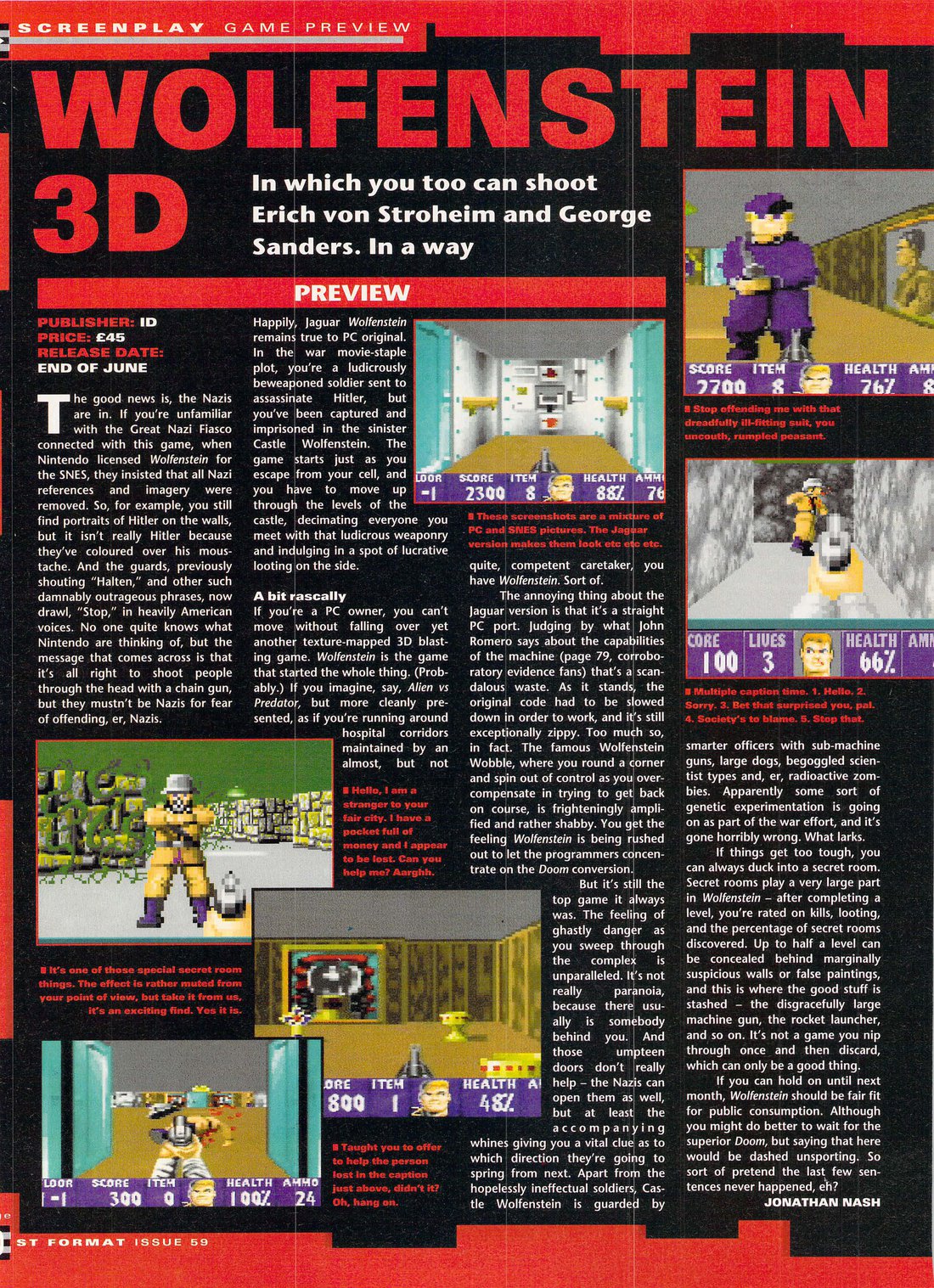
Imagineer bought the rights for the game,[45] and commissioned id to port the game to the Super Nintendo Entertainment System (SNES) for a US$100,000 advance. The team was busy with the development of Doom, plus their work on Spear of Destiny,[46] and ignored the project for seven or eight months, finally hiring Rebecca Heineman to do the work.[47][48][49] She made no progress on the port, however, and the id team members instead spent three weeks frantically learning how to make SNES games and creating the port by March 1993.[47] This version was written in C and compiled in the 65816 assembly language, making use of binary space partitioning rather than raycasting in order to give it speed.[46][50] Carmack had to resize existing images to fit the SNES resolution.[46] Nintendo insisted on censoring the game in accordance with their policies; this included first making all blood green and then finally removing it, removing Nazi imagery and German voice clips, and replacing enemy dogs with giant rats.[47][51] The port was released in Japan on February 10, 1994, under the name Wolfenstein 3D: The Claw of Eisenfaust before being released in North America and Europe later that year.[52] Using the source code of the SNES port, on a whim John Carmack later converted the game to run on the Atari Jaguar. Atari Corporation approved the conversion for publication and Carmack spent three weeks, assisted by Dave Taylor, improving the port's graphics and quality to what he later claimed was four times more detail than the DOS version. He also removed the changes that Nintendo had insisted on.[20] The game itself, however, had to be slowed down to work properly on the console.[51]
Wolfenstein 3D has also been ported to numerous other platforms.[53] In 1993, Alternate Worlds Technology licensed Wolfenstein 3D and converted it into a virtual reality arcade game.[54][55] The 1994 Acorn Archimedes port was done in UK by programmer Eddie Edwards and published by Powerslave Software.[56][57] By 1994, a port for the Sega Mega Drive was under development by Imagineer, who intended to release it by September, but it was cancelled due to technical problems.[58][59] The 1994 Classic Mac OS version of the game had three releases: The First Encounter, a shareware release; The Second Encounter, with 30 exclusive levels; and The Third Encounter, with all 60 levels from the DOS version.[60] An Atari Lynx version of the game was offered earlier by Atari for id, but work on the port was never started, save for a few images.[46][61][62] A 3DO version was released in October 1995.[63][64] The Apple IIGS port was started in Fall 1994 by Vitesse with Heineman as the initial developer, with later graphics assistance by Ninjaforce Entertainment, but due to licensing problems with id it was not released until February 1998.[65][66][67] An open source iOS port programmed by John Carmack himself was released in 2009.[1][68][69][70] An unofficial port for the Game Boy Color was made in 2016.[71] An Android port titled Wolfenstein 3D Touch (later renamed ECWolf) was released and published by Beloko Games.[72] Other releases include the Game Boy Advance (2002), Xbox Live Arcade, and PlayStation Network.[73][74][75] These ports' sound, graphics, and levels sometimes differ from the original. Many of the ports include only the Apogee episodes, but the iOS port includes Spear of Destiny, and a 2007 Steam release for PC, macOS, and Linux includes all of the FormGen episodes.[68][76] Bethesda Softworks, whose parent company bought id Software in 2009, celebrated the 20th anniversary of Wolfenstein 3D's release by producing a free-to-play browser-based version of the game in 2012, though the website was removed a few years later.[77]
Reception
[edit]The developers had no clear expectations for Wolfenstein's commercial reception, but hoped that it would make around US$60,000 in its first month; the first royalty check from Apogee was instead for US$100,000.[34] The game was selling at a rate of 4,000 copies a month by mail order.[78] PC Zone quoted a shareware distributor as saying Wolfenstein 3D was the top shareware seller of 1992.[79] By the end of 1993, sales of the Apogee episodes of Wolfenstein 3D as well as Spear of Destiny had reached over 100,000 units each, with the Apogee game still selling strongly by the end of the year as its reach spread without newer retail titles to compete with it for shelf space.[80] By mid-1994 150,000 shareware copies were registered and id Software had sold another 150,000 retail copies of Spear of Destiny; the company estimated that one million shareware copies were distributed worldwide.[17] Over 20 percent of its sales were from outside of the US, despite the lack of any marketing or non-English description and despite the game being banned from sale in Germany due to its inclusion of Nazi symbols by the Federal Department for Media Harmful to Young Persons in 1994, and again in 1997 for Spear of Destiny.[34][80][81] Japanese gaming magazine Famitsu reviewed the game five months after release, describing it as: "View from the character's point of view: It's a real shooter. The game is easy to play, and it runs well ... This is the only game of its type."[82] The Apogee episodes' sales vastly exceeded the shareware game sales record set by the developer's earlier Commander Keen series and provided id with a much higher profit margin than the sales of its retail counterpart; where Commander Keen games were bringing Apogee around $10,000 a month, Wolfenstein 3D averaged $200,000 per month for the first year and a half.[80][83] The game sold 250,000 copies by 1995 and grossed $2.5 million in revenue.[84]
Wolfenstein 3D won the 1992 Best Arcade game award from Compute!, the 1992 Most Innovative Game and Best Action Game awards from VideoGames & Computer Entertainment, the 1992 Reader's Choice — Action/Arcade Game award from Game Bytes, the 1993 Best Action/Arcade Game, Best Entertainment Software, and People's Choice awards at the Shareware Industry Awards, the 1993 Best Action Game award from Computer Gaming World, and a Codie award from the Software Publishers Association for Best Action/Arcade Game.[40][85][86][87][88] It was the first shareware title to win a Codie, and id (with six employees) became the smallest company to ever receive the award. Wolfenstein 3D was noted as one of the top games of the year at the 1993 Game Developers Conference.[89]
Wolfenstein 3D was well received by reviewers upon its release. Chris Lombardi of Computer Gaming World praised the "sparse [but] gorgeous", "frighteningly realistic", and "extremely violent" graphics, as well as the immersive sound and music. Noting the violence, he warned "those sensitive to such things to stay home". Lombardi concluded that Wolfenstein 3D, alongside Ultima Underworld released two months prior, was "the first game technologically capable of creating a sufficient element of disbelief–suspension to emotionally immerse the player in a threatening environment", stating that they knew of no other game that could "evoke such intense psychological responses from its players".[90] Wolfenstein twice received 5 out of 5 stars in Dragon in 1993; Hartley, Patricia, and Kirk Lesser termed it "definitely one of the best arcade games ever created for PC", highly praised the graphics and sound, and said that the "fast-paced action" could keep players enthralled for weeks if they were not concerned about the violence.[5] Sandy Petersen, in the first "Eye of the Monitor" column, claimed that "there is nothing else quite like Wolfenstein" and that it had "evolved almost beyond recognition" from the original 1981 game. He enthusiastically praised the speed and gameplay, calling it "a fun game with lots of action" and "a fun, fairly mindless romp", though he did note that at higher difficulty settings or later levels it became extremely hard.[2] The Spear of Destiny retail episode was also rated highly by Computer Gaming World's Bryan A. Walker, who praised the added enemy types, though he noted that it was essentially the same game as the shareware episodes.[91] Formgen's Spear of Destiny mission packs "Return to Danger" and "Ultimate Challenge" were reviewed by Paul Hyman of Computer Gaming World, who praised the updated graphical details and sound, as well as the smooth gameplay, but noted its overall dated graphics and lack of gameplay changes from the original game.[92]
The early ports of the game also received high reviews, though their sales have been described as "dismal".[93] The four reviewers of Electronic Gaming Monthly called the Super NES version a good conversion that retained the good music, huge levels, and overall fun of the original game and dismissed the censoring in the version as inconsequential.[94] In 1995, Total! ranked the game 84th on their "Top 100 SNES Games" list.[95] Electronic Gaming Monthly rated the Jaguar version similarly to the Super NES version, commenting that the graphics and audio were superior to other versions of the game, but criticizing the faster movement of the player character as making it less fun to play.[96] A GamePro review of the Jaguar port was highly complimentary, saying Wolfenstein 3D "set a new standard for PC gaming" and that the Jaguar version was the best to date, and better than the original due to its increased graphics and sound capabilities.[97] A Next Generation review of the Jaguar version was less enthusiastic, terming it good but not up to the standards of newer games.[98] Its review of the Macintosh version of the game was also mild, stating that "there isn't a staggering amount of freshness here, but the action is fast, deadly, and (surprise) addictive".[99]
Major Mike of GamePro commended the 3DO version's complete absence of pixelation, fast scaling, "rousing" music, and high quality sound effects, but criticized the controls as overly sensitive. He concluded that the game, then over three years old, "still packs a punch as a first-person shooter".[100] Wolfenstein 3D won GamePro's Best 3DO Game of 1995 award, beating the acclaimed The Need for Speed and D.[101] Maximum, on the other hand, while stating that the 3DO port was better than the original and as good as the Jaguar version, felt that it was so aged compared to recent releases like Hexen: Beyond Heretic and the PlayStation version of Doom that a new port was pointless, with the game now "somewhat tiresome and very, very repetitive".[102] A reviewer for Next Generation asserted that Wolfenstein 3D was "still as addictive as it ever was" but essentially agreed with Maximum, contending that anyone interested in first-person shooters would have either already played it on another platform or "moved on" to more advanced games in the genre.[103] More modern reviews include one for the Xbox 360 port in 2009 by Ryan McCaffrey of Official Xbox Magazine, who heavily criticized it for non-existent enemy AI and bad level design and found it notably inferior to Doom, and one that same year by Daemon Hatfield of IGN, who gave the PlayStation Network release of the game a warm reception, saying that while it was "dated and flawed", it was "required playing for any first-person shooter fan".[104][105]
Legacy
[edit]| Publication | Score |
|---|---|
| AllGame | 4.5/5 (DOS)[106] 4/5 (Macintosh)[107] 4/5 (3DO)[108] 2.5/5 (SNES)[109] 2.5/5 (Jaguar)[110] |
| Famitsu | 9/10, 8/10, 7/10, 8/10 (SFC)[111] |
| GamePro | 3.5/5 (XBLA)[112] |
| IGN | 8/10 (PSN)[114] |
Wolfenstein 3D has been called the "grandfather of 3D shooters",[115] specifically first-person shooters, because it established the fast-paced action and technical prowess commonly expected in the genre and greatly increased the genre's popularity.[115][116][117][118] It has also been called "the Citizen Kane of shooters".[119] Although some prior computer shooting-based games existed, they were generally scrolling shooters, while Wolfenstein 3D helped move the market towards first-person shooters. It has also been credited with confirming shareware distribution as a serious and profitable business strategy at the time;[80][115] VideoGames & Computer Entertainment claimed in September 1992 that the game "justified the existence of shareware", and in July 1993 Computer Gaming World claimed that it "almost single-handedly" demonstrated the viability of shareware as a method of publishing, leading to a wave of other shareware first-person shooters.[89][120][121] The game's high revenue compared to prior, smaller 2D titles led Apogee as well as others in the shareware games industry to move towards larger, 3D titles built by larger development teams.[83]
During development, id approached Sierra Entertainment, then one of the biggest companies in the industry and employer of several of their idols, with the goal of seeing if they could make a deal with the company. After viewing Commander Keen and an early version of Wolfenstein 3D, CEO Ken Williams offered to buy id Software for US$2.5 million and turn it into an in-house development studio. The team was excited by the deal, but had felt there was a large culture clash between the two companies during their visit to Sierra and were hesitant to accept; Romero proposed asking for US$100,000 in cash up front as part of the deal rather than solely accepting payment in Sierra stock as a measure of Williams's seriousness. Williams refused, which id interpreted to mean that Williams did not truly recognize the potential of Wolfenstein 3D and the company, and the deal fell through, causing id to decide to remain an independent company for the foreseeable future.[13] By the end of 1993 just before the release of their next game, Doom, the success of Wolfenstein 3D led id to receive multiple calls every month from investment companies looking to make id a publicly traded company, which were all turned down.[80] In 1996, Computer Gaming World declared Wolfenstein 3D the 97th-best computer game ever released.[122]
The game is also recognized as the principal cause for Germany banning video games that contain certain types of symbols and imagery from extremist groups like Nazis under its Strafgesetzbuch section 86a up through 2018. Section 86a had "social adequacy" allowances for works of art, but in 1998, a High District Frankfurt Court case evaluating the Nazi imagery within Wolfenstein 3D determined that video games did not fall under this allowance. The court ruled that because video games drew younger audiences, "this could lead to them growing up with these symbols and insignias and thereby becoming used to them, which again could make them more vulnerable for ideological manipulation by national socialist ideas".[123] Up through 2018, the Germany software ratings board, the Unterhaltungssoftware Selbstkontrolle (USK) refused to rate any game that included inappropriate symbols and imagery, effectively banning the game for sale within the country. By May 2018, a new court ruling was made in response to a parody web browser game, in which the Public Prosecutor's Office confirmed there were no breaches of the law in the game's content.[124][125] Following this, the ban was reversed by the German government in August, having determined that the Wolfenstein 3D decision was outdated since the USK now included age ratings alongside other content warnings, and that video games should be considered as art under the social adequacy allowance.[123][126] In November 2019, Wolfenstein 3D was formally struck from the "Index", the list of games banned from sale in Germany.[127]
After the game's release, id Software licensed the engine to other developers, like the Commander Keen engine before it, as part of a series of engine licensing deals that id has made throughout its history; games using the Wolfenstein 3D engine or derivatives of it include Blake Stone, the Capstone Software games Corridor 7 and Operation Body Count, as well as Super 3D Noah's Ark.[128][129] Apogee intended to produce an expansion pack in 1993 titled Rise of the Triad: Wolfenstein 3D Part II, designed by Tom Hall using the Wolfenstein 3D engine, but during development the game was changed into a stand-alone title with an enhanced engine, Rise of the Triad.[130] Additionally, Softdisk produced Catacomb Abyss using the prototype Wolfenstein 3D engine from Catacomb 3-D as part of the Catacomb Adventure Series trilogy of sequels.[131] Although Wolfenstein 3D was not designed to be editable or modified, players developed character and level editors to create original alterations to the game's content.[1][34] John Carmack and Romero, who had played numerous mods of other games, were delighted, and overrode any concerns about copyright issues by the others.[34] The modding efforts of Wolfenstein players led id Software to explicitly design later titles like Doom and Quake to be easily modifiable by players, even including the map editing tools id Software used with the games.[1][132][133] The source code for the original Wolfenstein 3D engine was released by id in 1995; when making the 2009 iOS port, Carmack used some of the enhancements to the engine made by fans after its release.[1][42] The game's technical achievements also led to numerous imitators such as Ken's Labyrinth, Nitemare 3D, The Terminator: Rampage, Terminal Terror and The Fortress of Dr. Radiaki, among others.[134]
Although id Software did not develop another Wolfenstein game, as their development focus shifted to Doom shortly after release,[34] and has never returned to the series, multiple Wolfenstein titles have been produced by other companies, sometimes using game engines developed by id. The first of these newer Wolfenstein games was Return to Castle Wolfenstein in 2001, a reboot of the series, and the most recent titles are the 2019 games Wolfenstein: Youngblood and Wolfenstein: Cyberpilot.[135][136]
References
[edit]- ^ a b c d e f g h i Carmack, John (May 9, 2012). Wolfenstein 3D Director's Commentary with John Carmack (Video podcast). Bethesda Softworks. Archived from the original on January 5, 2017. Retrieved July 28, 2016.
- ^ a b c d e Petersen, Sandy (September 1993). "Eye of the Monitor: Share and Share(ware) Alike" (PDF). Dragon Magazine. No. 197. TSR. pp. 57–58. ISSN 1062-2101. Archived (PDF) from the original on March 20, 2016.
- ^ a b c Brence, Corwin (April 2, 2012). "Wolfenstein". Hardcore Gaming 101. p. 2. Archived from the original on September 12, 2016. Retrieved February 6, 2017.
- ^ a b Kushner, pp. 87–93
- ^ a b c Lesser, Hartley; Lesser, Patricia & Lesser, Kirk (April 1993). "The Role of Computers" (PDF). Dragon Magazine. No. 192. TSR. pp. 57–63. Archived (PDF) from the original on March 21, 2016.
- ^ a b c Kushner, pp. 66–76
- ^ Fahs, Travis (September 23, 2008). "The Early Years of id Software". IGN. IGN Entertainment. Archived from the original on April 26, 2016. Retrieved June 10, 2016.
- ^ "Next Generation — Wolfenstein 3D". Next Generation. No. 51. Imagine Media. March 1999. p. 105.
- ^ a b c d e Kushner, pp. 77–86
- ^ Mallinson, Paul (April 16, 2002). "Games that changed the world: Ultima Underworld". Computer and Video Games. Future Publishing. Archived from the original on December 12, 2007. Retrieved July 22, 2016.
- ^ "The evolution of 3D games". PC Plus. TechRadar. July 11, 2010. Archived from the original on March 2, 2016. Retrieved July 22, 2016.
- ^ Romero, John; Barton, Matt (March 6, 2010). "Matt Chat 52: Wolfenstein 3D with John Romero" (Video). YouTube. Archived from the original on November 25, 2016. Retrieved July 28, 2016.
- ^ a b c d e f g h Kushner, pp. 94–104
- ^ a b c Griliopoulos, Dan (September 21, 2012). "The Dawn of the FPS: inside the making of Wolfenstein 3D". PCGamesN. Network N. Retrieved April 12, 2020.
- ^ a b c d e f "An Interview with ID Software". Game Bytes. No. 4. August 10, 1992.
- ^ Campbell, Colin (December 24, 2019). "The man who made Wolfenstein". Polygon. Vox Media, LLC. Retrieved July 17, 2020.
- ^ a b Lombardi, Chris (July 1994). "To Hell and Back Again". Computer Gaming World. No. 120. pp. 20–24. ISSN 0744-6667.
- ^ "Presenting...ID Software". ST Format. No. 59. Future plc. June 1994. p. 79.
- ^ Sanglard, Fabien (June 24, 2019). "How id built Wolfenstein 3D using Commander Keen tech". Gamasutra. Retrieved April 12, 2020.
- ^ a b "id Software". Edge. No. 9. Future. June 1994. pp. 30–33. ISSN 1350-1593.
- ^ Edwards, Benj (August 21, 2009). "20 Years Of Evolution: Scott Miller And 3D Realms". Gamasutra. UBM. Archived from the original on May 12, 2014. Retrieved August 15, 2017.
- ^ a b Shahrani, Sam (April 25, 2006). "Educational Feature: A History and Analysis of Level Design in 3D Computer Games - Pt. 1". Game Developer. UBM. Retrieved January 9, 2022.
- ^ Halfacree, Gareth (May 10, 2012). "Wolfenstein 3D goes free for 20th birthday". Bit-Tech. The Media Team. Retrieved November 27, 2018.
- ^ "John Carmack on Twitter: "Deluxe Paint II was the pixel tool for all the early Id Software games."". Twitter. July 12, 2019. Retrieved September 14, 2019.
- ^ Irwin, Jon (May 5, 2017). "Tom Hall: 5 key design lessons I learned directing Wolfenstein 3D". Gamasutra. UBM. Archived from the original on May 5, 2017. Retrieved July 21, 2018.
- ^ Bailey, Kat (March 9, 2012). "These games inspired Cliff Bleszinski, John Romero, Will Wright, and Sid Meier". Joystiq. AOL. Archived from the original on February 2, 2017. Retrieved February 15, 2017.
- ^ Romero, John. John Romero's Irish Adventure (Video). Noclip – Video Game Documentaries. Retrieved April 16, 2022.
- ^ Dransfield, Ian (April 28, 2018). "The history of Wolfenstein". PC Gamer. Future. Retrieved November 8, 2022.
- ^ Wolfenstein 3-D Hint Manual. id Software. 1992. p. 40.
- ^ Cyber Den (July 23, 2018). "Bobby Prince Interview (Extended Version)". YouTube. Archived from the original on November 14, 2021. Retrieved July 16, 2020.
- ^ Prince, Bobby (March 1996). "Tricks and Techniques for Sound Effect Design". Gamasutra. UBM. Archived from the original on January 21, 1998. Retrieved January 22, 2018.
- ^ a b c Kushner, pp. 105–112
- ^ Lightbown, David (February 23, 2017). "Classic Tools Retrospective: John Romero talks about creating TEd, the tile editor that shipped over 30 games". Gamasutra. UBM. Archived from the original on July 1, 2017. Retrieved November 28, 2017.
- ^ a b c d e f g Kushner, pp. 113–117
- ^ a b Griliopoulos, Dan (April 8, 2016). "The Making of Doom: id's shooter masterpiece". PCGamesN. Retrieved July 8, 2018.
- ^ Romero, John (September 18, 2002). "Spear of Destiny's Birthday!". rome.ro. Retrieved July 8, 2018.
- ^ "5 Years of Doom — John Romero Interview". Doomworld. Retrieved November 18, 2018.
- ^ "John Romero explains why you shoot Nazis in Wolfenstein and why it's "more relevant now"". PCGamesN. July 22, 2019. Retrieved September 16, 2021.
- ^ Kent, Ch. 24
- ^ a b "3D Realms Site: Wolfenstein 3D". 3D Realms. Archived from the original on August 15, 2016. Retrieved July 27, 2016.
- ^ Scott Miller (1992). Super Wolf Upgrade. Apogee Software.
- ^ a b Stoddard, Samuel. "The Apogee FAQ: Wolfenstein 3D and Spear of Destiny". The Apogee FAQ. Samuel Stoddard. Archived from the original on March 3, 2016. Retrieved July 22, 2016.
- ^ a b Siegler, Joe (August 17, 2016). "Call Apogee and Say Aardwolf". Joe Siegler Blog. Agency Pro. Retrieved February 18, 2020.
- ^ Stoddard, Samuel. "The Apogee FAQ: "Call Apogee and say Aardwolf"". The Apogee FAQ. Samuel Stoddard. Archived from the original on March 5, 2016. Retrieved July 22, 2016.
- ^ "La Super NES se prend pour un PC!" [The Super NES thinks it's a PC!]. Player One (in French). No. 38. Média Système Édition. January 1994. p. 35.
- ^ a b c d "Apollo 11 Situations: John Romero on Porting Doom and Wolfenstein 3D". Shacknews. Shacknews LTD. March 18, 2020. Retrieved September 16, 2021.
- ^ a b c "Terraform: The Making of Doom 64". Shacknews. Shacknews LTD. April 3, 2020. Retrieved April 10, 2020.
- ^ Romero, John; Hall, Tom (2011). Classic Game Postmortem – Doom (Video). Game Developers Conference. Archived from the original on August 6, 2017. Retrieved February 6, 2018.
- ^ Romero, John (2016). The Early Days of id Software (Video). Game Developers Conference. Archived from the original on July 7, 2017. Retrieved February 5, 2018.
- ^ Pinchbeck, pp. 43-44
- ^ a b "Screenplay Game Review - Wolfenstein 3d". ST Format. No. 59. Future plc. June 1994. p. 60.
- ^ ウルフェンシュタイン3D [スーパーファミコン] [Wolfenstein 3D [Super Nintendo]]. Famitsu (in Japanese). Enterbrain. Archived from the original on August 17, 2018. Retrieved August 17, 2018.
- ^ "The Schedule May 1994". GameFan. Vol. 2, no. 6. DieHard Gamer's Club. May 1994. p. 141. ISSN 1092-7212.
- ^ Rice, Robert (December 13, 2013). "My first tech job was creating virtual reality". curiousraven.com. Archived from the original on September 25, 2018. Retrieved August 17, 2018.
- ^ Wolf, p. 139
- ^ Fountain, Tim (November 6, 2000). "Interviews: Eddie Edwards". Acorn Arcade. Archived from the original on June 26, 2016. Retrieved January 17, 2012.
- ^ "Wolfenstein 3D". Acorn User. No. 149. Europress. December 1994. pp. 50–51.
- ^ "Up 'N' Coming" (PDF). Mega. No. 22. Future Publishing. July 1994. p. 85. ISSN 0966-6206. Archived (PDF) from the original on August 7, 2018.
- ^ "Welcome To The Next Level: 1994 And Beyond... - Sega Genesis". Sega Force. No. 5. Sendai Publishing. July 1994. pp. 8–26. Archived from the original on December 5, 2020. Retrieved December 4, 2020.
- ^ "Meet MacDoom". Electronic Entertainment. No. 12. Dennis Publishing. December 1994. p. 61.
- ^ "Reportaje - Lynx - La mejor portátil que Atari no supo vender" [Feature - Lynx - The Best Laptop That Atari Couldn't Sell]. Última Generación (in Spanish). No. 6. MV Editores. September 1995. pp. 68–73.
- ^ Wallett, Adrian (April 30, 2018). "Podcast 61 – April (5 of 5) 2018 – Bill Rehbock – Interview". Arcade Attack. Retrieved August 7, 2018.
- ^ "Wolfenstein 3-D – 3DO Press Release". Interplay Entertainment. Archived from the original on July 10, 1998. Retrieved July 21, 2018.
- ^ ウルフェンシュタイン3D [3DO] [Wolfenstein 3D [3DO]]. Famitsu (in Japanese). Enterbrain. Archived from the original on August 18, 2018. Retrieved August 17, 2018.
- ^ "3D Realms Site:Wolfenstein 3D for the Apple IIgs". 3D Realms. Retrieved July 22, 2018.
- ^ "Haben Sie Führerschein?". February 13, 2000. Retrieved April 22, 2020.
- ^ Eric "Sheppy" Shepherd. "SheppyWare Online News". Archived from the original on December 3, 1998.
- ^ a b Gibson, Rob (March 25, 2009). "Wolfenstein 3D Hits the iPhone". PC Magazine. Ziff Davis. Archived from the original on March 6, 2016. Retrieved February 27, 2012.
- ^ Silva, Vladimir (December 27, 2009). Pro Android Games. Apress. p. 63. ISBN 978-1-4302-4797-5.
- ^ James Ransom-Wiley (March 24, 2009). "Carmack releases open source Wolfenstein for iPhone". Engadget. Verizon Media. Retrieved April 10, 2020.
- ^ Danny Cowan (December 19, 2016). "Retro gaming fan gets 'Wolfenstein 3D' up and running on a Game Boy Color". Digital Trends. Designtechnica Corporation. Retrieved April 10, 2020.
- ^ "ECWolf on Android". Beloko. X-Raiders Design. 2016. Retrieved July 24, 2018.
- ^ "Wolfenstein 3-D – Game Boy Advance". IGN. Ziff Davis. Archived from the original on April 28, 2016. Retrieved February 24, 2016.
- ^ "Wolfenstein 3-D – Xbox 360". IGN. Ziff Davis. Archived from the original on August 1, 2016. Retrieved February 25, 2016.
- ^ "Wolfenstein 3-D – PlayStation 3". IGN. Ziff Davis. Archived from the original on August 4, 2016. Retrieved February 25, 2016.
- ^ "Legendary id Software games now on Steam". Steam. Valve. August 3, 2007. Archived from the original on June 1, 2016. Retrieved July 27, 2016.
- ^ Hachman, Mark (May 9, 2012). "Free, Browser-Based 'Wolfenstein 3D' Released by Bethesda". PC Magazine. Ziff Davis. Archived from the original on April 7, 2016. Retrieved May 9, 2012.
- ^ "Interview with Daikatana Creator John Romero, Part 2". Prima Games. Prima Communications, Inc. Archived from the original on December 5, 2000.
- ^ "Off the Boards". PC Zone. No. 1. Dennis Publishing. April 1993. p. 102. ISSN 0967-8220.
- ^ a b c d e Antoniades, Alexander (January 15, 2009). "The Game Developer Archives: 'Monsters From the Id: The Making of Doom'". Game Developer. UBM. Archived from the original on January 20, 2012. Retrieved July 26, 2016 – via Gamasutra.
- ^ Kreimeier, Bernd (August 27, 1999). "Killing Games: A Look At German Videogame Legislation". Gamasutra. UBM. Retrieved July 21, 2018.
- ^ "Wolfenstein3D". Weekly Famitsu. No. 198. October 2, 1992. p. 160.
- ^ a b Edwards, Benj (August 21, 2009). "20 Years Of Evolution: Scott Miller And 3D Realms". Gamasutra. UBM. Retrieved November 30, 2017.
- ^ "Games". Fort Worth Star-Telegram. October 29, 1995. p. 93. Retrieved January 7, 2022 – via Newspapers.com.
- ^ "2000-1992 Shareware Industry Awards winners". Shareware Industry Awards. Shareware Industry Awards Foundation. Archived from the original on February 14, 2010. Retrieved June 7, 2012.
- ^ Pinchbeck, p. 11
- ^ "Awards — Thy Name Is Controversy". Computer Gaming World. No. 106. May 1993. p. 146. ISSN 0744-6667. Archived from the original on July 2, 2014.
- ^ "Computer Gaming World's Game of the Year Awards". Computer Gaming World. No. 111. Ziff Davis. October 1993. pp. 70–74. ISSN 0744-6667. Archived from the original on March 16, 2016.
- ^ a b "The 7th International Computer Game Developers Conference". Computer Gaming World. No. 108. July 1993. pp. 34–38. ISSN 0744-6667. Archived from the original on July 14, 2014.
- ^ Lombardi, Chris (September 1992). "Id Software Puts New Perspective On A Classic". Computer Gaming World. No. 98. pp. 50–52. ISSN 0744-6667. Archived from the original on July 2, 2014. Retrieved July 26, 2016.
- ^ Walker, Bryan A. (January 1993). "Call of the Wild". Computer Gaming World. No. 102. pp. 100–101. ISSN 0744-6667. Archived from the original on July 2, 2016. Retrieved July 26, 2016.
- ^ Hyman, Paul (September 1994). "A Thorn in Hitler's Side". Computer Gaming World. No. 122. Ziff Davis. pp. 66–68. ISSN 1059-2938.
- ^ "75 Power Players". Next Generation. No. 11. Imagine Media. November 1995. p. 76. ISSN 1078-9693.
In light of Castle Wolfenstein's [sic] dismal performance on the Atari Jaguar and Nintendo's Super NES ...
- ^ "Review Crew: Wolfenstein 3D". Electronic Gaming Monthly. No. 55. Sendai Publishing. February 1994. p. 36. ISSN 1058-918X.
- ^ "Top 100 SNES Games". Total!. No. 43. Future. July 1995. p. 48. ISSN 0964-9352.
- ^ "Review Crew: Wolfenstein 3D". Electronic Gaming Monthly. No. 63. Sendai Publishing. October 1994. p. 38. ISSN 1058-918X.
- ^ "ProReview: Wolfenstein 3D". GamePro. No. 72. IDG. September 1994. p. 106. ISSN 1042-8658.
- ^ "Finals". Next Generation. No. 1. Imagine Media. January 1995. p. 93. ISSN 1078-9693.
- ^ "Finals". Next Generation. No. 6. Imagine Media. June 1995. pp. 109–110. ISSN 1078-9693.
- ^ "ProReview: Wolfenstein 3D". GamePro. No. 88. IDG. January 1996. p. 102. ISSN 1042-8658.
- ^ "Editor's Choice Awards 1995". GamePro. No. 89. IDG. February 1996. p. 26. ISSN 1042-8658.
- ^ "Maximum Reviews: Wolfenstein 3D". Maximum: The Video Game Magazine. No. 2. Emap International. November 1995. p. 161. ISSN 1360-3167.
- ^ "Wolfenstein 3-D". Next Generation. No. 12. Imagine Media. December 1995. p. 186. ISSN 1078-9693.
- ^ McCaffrey, Ryan (August 2009). "History we've been Doomed to repeat". Official Xbox Magazine. No. 99. Future. p. 74. ISSN 1534-7850. Retrieved November 20, 2018.
- ^ Hatfield, Daemon (June 15, 2009). "Wolfenstein 3-D Review". IGN. IGN Entertainment. Archived from the original on May 13, 2016. Retrieved July 27, 2016.
- ^ Williamson, Colin. "Wolfenstein 3D". AllGame. Archived from the original on November 15, 2014. Retrieved August 3, 2023.
- ^ Scoleri III, Joseph. "Wolfenstein 3D". AllGame. Archived from the original on November 14, 2014. Retrieved August 3, 2023.
- ^ Smith, Geoffrey Douglas. "Wolfenstein 3D". AllGame. Archived from the original on November 15, 2014. Retrieved August 3, 2023.
- ^ Scoleri III, Joseph. "Wolfenstein 3D". AllGame. Archived from the original on November 14, 2014. Retrieved August 3, 2023.
- ^ Scoleri III, Joseph. "Wolfenstein 3D". AllGame. Archived from the original on November 14, 2014. Retrieved August 3, 2023.
- ^ Tsūshin, Hamamura; Uchisawa, Goro; Watanabe, Miki; Chuji, Giorgio (February 18, 1994). "New Games Cross Review". Weekly Famicom Tsūshin (in Japanese). No. 270. ASCII Corporation. p. 38.
- ^ Ramsey, Andrew. "Wolfenstein 3D". GamePro. Archived from the original on June 17, 2009. Retrieved August 3, 2023.
- ^ Provo, Frank. "Wolfenstein 3D". GameSpot. Retrieved August 3, 2023.
- ^ Hatfield, Daemon (June 16, 2009). "Wolfenstein 3D". IGN. Retrieved August 3, 2023.
- ^ a b c Computer Gaming World. "CGW's Hall of Fame". 1UP.com. Ziff Davis. Archived from the original on July 27, 2016. Retrieved July 27, 2016.
- ^ Williamson, Colin. "Wolfenstein 3D DOS Review". AllGame. All Media Network. Archived from the original on November 15, 2014. Retrieved July 27, 2016.
- ^ "IGN's Top 100 Games (2003)". IGN. IGN Entertainment. Archived from the original on April 19, 2016. Retrieved July 27, 2016.
- ^ Shachtman, Noah (May 8, 2008). "May 5, 1992: Wolfenstein 3-D Shoots the First-Person Shooter Into Stardom". Wired. Condé Nast. Archived from the original on October 25, 2011. Retrieved July 27, 2016.
- ^ Williamson, Colin. "Wolfenstein 3D". AllGame. All Media Network. Archived from the original on November 15, 2014. Retrieved August 3, 2023.
- ^ "Wolfenstein 3-D". VideoGames & Computer Entertainment. No. 44. LFP. September 1992. p. 113. ISSN 1059-2938.
- ^ Langshaw, Mark (May 12, 2012). "Retro Corner: Wolfenstein 3D". Digital Spy. Hearst. Archived from the original on March 29, 2016. Retrieved July 27, 2016.
- ^ "150 Best (and 50 Worst) Games of All Time". Computer Gaming World. No. 148. November 1996. pp. 63–98. ISSN 0744-6667.
- ^ a b Grosso, Robert (November 17, 2019). "Germany says games with Nazi symbols can get "artistic" exception to ban". Ars Technica. Condé Nast. Retrieved August 10, 2018.
- ^ Orland, Kyle (August 10, 2018). "Wolfenstein 3D Removed from German Ban List". TechRaptor. Insticator. Retrieved June 17, 2021.
- ^ Taylor, Haydn (May 15, 2018). "Unprecedented move by German prosecutors over Nazi imagery in satirical game". Gameindustry.biz. Christopher Dring. Retrieved June 17, 2021.
- ^ Schwiddessen, Sebastian (May 8, 2018). "German Attorney General: Video game with Swastika does not violate the law; constitutes art". Lexology. Globe Business Media Group. Retrieved August 26, 2019.
- ^ Fröhlich, Petra (November 22, 2019). "Wolfenstein 3D: Bundesprüfstelle hebt Indizierung auf" [Wolfenstein 3D: Federal Department lifts indexation]. GamesWirtschaft (in German). Retrieved November 24, 2019.
- ^ Gestalt (June 26, 2000). "The Engine Licensing Game". Eurogamer. Gamer Network. Archived from the original on March 2, 2016. Retrieved July 28, 2016.
- ^ Matulef, Jeffrey (January 24, 2014). "How Super 3D Noah's Ark Came to Be Reprinted on SNES in 2014". Eurogamer. Gamer Network. Archived from the original on March 4, 2016. Retrieved June 14, 2015.
- ^ "ROTT Original Design Spec". 3D Realms. Archived from the original on August 15, 2016. Retrieved May 10, 2011.
- ^ Stoddard, Samuel. "The Apogee FAQ: What's Apogee's relationship with Softdisk?". The Apogee FAQ. Samuel Stoddard. Archived from the original on March 13, 2016. Retrieved July 28, 2016.
- ^ Kushner, p. 166
- ^ Bainbridge, p. 21
- ^ Bowen, Kevin (July 1997). "ROTT in Hell". Planet Quake. GameSpy Industries. Archived from the original on April 21, 2009. Retrieved August 23, 2016.
- ^ Bramwell, Tom (December 21, 2001). "Return to Castle Wolfenstein". Eurogamer. Gamer Network. Archived from the original on March 4, 2016. Retrieved July 28, 2016.
- ^ Roberts, Samuel (October 26, 2017). "Wolfenstein 2: The New Colossus review". PC Gamer. Future plc. Archived from the original on October 27, 2017. Retrieved October 27, 2017.
Sources
[edit]- Kushner, David (2004). Masters of Doom: How Two Guys Created an Empire and Transformed Pop Culture. Random House. ISBN 978-0-8129-7215-3.
- Bainbridge, William Sims, ed. (2009). Online Worlds: Convergence of the Real and the Virtual. Springer Verlag. ISBN 978-1-84882-824-7.
- Pinchbeck, Dan (2013). Doom: Scarydarkfast. University of Michigan Press. ISBN 978-0-472-05191-5.
- Kent, Steven L. (2010). The Ultimate History of Video Games. Three Rivers Press. ISBN 978-0-307-56087-2.
- Wolf, Mark J. P. (2008). The Video Game Explosion. Greenwood Press. ISBN 978-0-313-33868-7.
External links
[edit]- Wolfenstein 3D at MobyGames
- Wolfenstein 3D engine source code
- Wolfenstein 3D can be played for free in the browser at the Internet Archive


| Main series | |
|---|---|
| Other games | |
| Characters | |
| Companies | |
| Related | |

| International | |
|---|---|
| National | |
| Other | |


Wolfenstein 3D
View on GrokipediaGameplay Mechanics
Core Combat and Navigation
Core combat in Wolfenstein 3D revolves around real-time first-person shooting against Nazi soldiers, guard dogs, officers, elite SS troops, and mutants that patrol levels or react to the player's presence by pursuing and firing hitscan projectiles.[5] The player, controlling Allied spy William "B.J." Blazkowicz, starts each episode with a knife for silent melee attacks and a pistol for single-shot fire, both requiring close range and risking counterattacks that deplete health from an initial 100 points.[6] Upgrades include the machine gun for rapid fire and the chaingun for sustained bursts, both consuming shared ammunition picked up as clips or boxes, with no reloading mechanic but finite reserves necessitating conservation.[6] [7] Navigation emphasizes swift traversal of multi-floor labyrinths constructed from textured walls, doors, and pushable secret panels, using keyboard inputs for forward/backward movement, left/right turning, and strafing, augmented by a run toggle for faster pacing essential against alerting foes.[8] Objectives per level involve locating colored keys—silver and gold—to unlock corresponding doors blocking progress to silver elevators that descend to subsequent floors, often requiring backtracking through enemy-infested corridors while monitoring a status bar for health, ammo, and collected treasures.[8] Secret areas, revealed by pressing against suspicious walls, yield extra ammunition, health cross packs restoring 10 points or full medkits for 100, and points-boosting items like silverware or gems, though finding all secrets is optional for completion.[6] Enemy AI employs basic behaviors: dogs charge for melee bites, standard guards wield pistols with deliberate aim, while officers and SS use machine guns for quicker volleys, and mutants fire rapid projectiles; bosses like Hans Grösse or armored Adolf Hitler demand focused chaingun fire to expose weak points after depleting protective mechsuits.[5] Combat strategy prioritizes corner-peeking to exploit hitscan accuracy—projectiles travel instantly without projectile drop—and ammo efficiency, as overuse leads to fallback on the weaker pistol, heightening vulnerability in denser enemy placements on higher difficulties.[9] No advanced maneuvers like jumping or crouching exist, making positioning and speed key to evading fire while clearing paths, with death resetting to level start and six difficulty tiers scaling enemy count, damage, and treasure from "Bring 'em On!" (easiest) to "Death Incarnate" (hardest).[6]Level Design and Progression
Wolfenstein 3D structures its gameplay across six episodes, with the first three included in the original 1992 release and the latter three added in a 1993 expansion. Each episode consists of nine primary levels—eight standard floors followed by a boss level—plus a tenth secret level unlocked by activating a hidden switch, typically in the eighth level.[10] Progression advances episodically, with Episode 1 ("Escape from Castle Wolfenstein") starting the player in a prison cell and building through castle interiors, Episode 2 ("Operation: Eisenfaust") shifting to a bunker laboratory, Episode 3 ("Die, Führer, Die!") culminating in a confrontation with Adolf Hitler, and the added episodes introducing varied Nazi strongholds with escalating threats.[11] Levels are designed as single-floor mazes on a maximum 64x64 tile grid, rendered via ray-casting to simulate 3D navigation without true height variation or slopes. Core progression mechanics require players to explore corridors and chambers, defeat enemies to secure silver and gold keys for unlocking corresponding doors, and locate the exit elevator—often guarded or concealed—to descend to the next floor. Enemy placements emphasize ambushes in tight hallways and open rooms, forcing resource management of ammunition and health packs amid backtracking for missed keys or items. An in-game automap, accessible via a button, displays the 2D layout to aid navigation, though it reveals only explored areas and does not mark secrets.[12] Secret areas, averaging four per level, are concealed behind pushable walls identifiable by subtle texture mismatches or isolated placements, yielding bonus treasures (crowns, gems, chalices) that boost the score, alongside extra weapons or supplies. Level designers, led by Tom Hall, prioritized compact layouts to sustain momentum, ensuring fair challenge through logical key-door puzzles and enemy density that ramps up without overwhelming the grid's visibility limits. Boss levels deviate with expansive, arena-like designs featuring fewer obstacles, armored super-soldiers, and the episode's unique antagonist—such as Hans Grösse in Episode 1, armed with a chain gun and requiring targeted hits to expose vulnerabilities. Difficulty modes alter enemy health, count, and damage output, with higher settings demanding precise strafing and conservation to progress.[13]Technical Features
Ray-Casting Engine
The ray-casting engine powering Wolfenstein 3D rendered pseudo-3D environments by projecting a 2D grid-based map into a first-person perspective view, a technique pioneered by programmer John Carmack at id Software during 1991 and 1992.[14] For each of the 320 vertical columns in the 320x200 VGA display resolution, the engine cast a ray from the player's viewpoint at a specific angle, traversing the map's 64x64 tile grid to detect the nearest wall intersection.[15] This distance calculation determined the wall's apparent height on screen, with closer walls appearing taller and textured vertical strips scaled accordingly, enabling efficient software-based rendering without dedicated 3D hardware.[16] Ray traversal employed a step-wise algorithm similar to the Digital Differential Analyzer (DDA), incrementing the ray's position cell-by-cell along the x and y axes until hitting a solid tile, which minimized computational overhead on 386 and 486 processors of the era.[15] Upon intersection, the engine sampled the wall's texture at horizontal coordinates derived from the fractional part of the ray's endpoint, applying a simple affine mapping that approximated perspective correction while prioritizing speed over precision.[15] To mitigate fisheye distortion inherent in angular ray spacing, distances were measured perpendicular to the wall rather than radially, ensuring straighter visual lines in corridors.[16] This approach supported only vertical, axis-aligned walls in maze-like levels, forgoing sloped surfaces or overhangs, but achieved playable frame rates—often exceeding 10 frames per second on a 33 MHz 386—by limiting polygon complexity and leveraging assembly-optimized inner loops in the codebase.[17] The engine's innovations, including runtime texture scaling and dynamic lighting via distance-attenuated shading, marked a shift from earlier wireframe or vector-based 3D games, establishing real-time textured FPS rendering as feasible on consumer PCs upon the game's release on May 5, 1992.[14]Audio and Visual Implementation
The visual rendering of Wolfenstein 3D operated at a resolution of 320 × 200 pixels, utilizing VGA mode 13h for efficient access to the display memory. This mode supported direct pixel manipulation, enabling real-time updates essential for the game's performance on 286 and 386 processors.[18] Graphics employed a fixed 256-color palette, with image data stored as byte indices referencing palette entries rather than direct RGB values, optimizing storage and rendering speed.[17] Wall surfaces consisted of 64 × 64 pixel textures mapped vertically during rendering, providing the illusion of height through scaled projection without true polygonal modeling.[19] Objects, including enemies and items, were implemented as billboard sprites—flat, two-dimensional images oriented to perpetually face the player's viewpoint, with size scaled inversely to their calculated distance for depth simulation.[19] These sprites were drawn post-wall rendering, clipped against walls to prevent overlap artifacts and sorted by distance to ensure proper layering.[20] Audio implementation prioritized compatibility across era-typical hardware, supporting the built-in PC speaker for basic tonal beeps and simple effects generated via direct waveform output.[21] For enhanced output, the game utilized AdLib cards employing FM synthesis for both music tracks and sound effects, leveraging OPL-2 chips to produce polyphonic scores and synthesized noises within the AudioT archive format.[22] Sound Blaster compatibility introduced digitized samples for effects like gunfire and footsteps, played via 8-bit DMA transfer for higher fidelity, while music remained FM-based to conserve resources; this hybrid approach allowed seamless fallback to lower-end setups without halting playback.[23] All audio assets, including 10 primary tracks evoking wartime tension, were composed by Robert "Bobby" Prince, who delivered them remotely during mid-1992 production to align with the game's episodic structure.[1][24]Narrative and Expansions
Primary Plotline
In Wolfenstein 3D, the player assumes the role of William "B.J." Blazkowicz, a United States Army captain and spy captured by Nazi forces during a mission to obtain plans for Operation Eisenfaust, a secret project involving advanced weaponry.[6] Imprisoned in Castle Wolfenstein, Blazkowicz must navigate nine levels of the dungeon-like fortress, combating Nazi guards, attack dogs, and experimental mutants with limited ammunition and weapons scavenged along the way, before ascending via elevators to confront the episode's boss, Hans Grösse, a massive SS officer armed with a chaingun.[6] Successful escape leads into subsequent episodes expanding the campaign against the Nazi regime. The second episode, "Operation: Eisenfaust," shifts focus to infiltrating Castle Hollehammer, where Blazkowicz allies with underground resistance fighters to halt Dr. Schabbs, a scientist developing an undead mutant army through unethical experiments.[25] Levels depict laboratory complexes filled with enhanced enemies, culminating in a battle against Schabbs, who deploys syringe-wielding mutants and electrified defenses.[25] The third episode, "Die, Führer, Die!", culminates in an assault on Adolf Hitler's fortified bunker amid the crumbling Third Reich, requiring Blazkowicz to traverse militarized bunkers and eliminate elite guards before facing Hitler twice: first in a mechanical exoskeleton equipped with dual chainguns, then in unarmored form.[25] This narrative arc frames the game's action as a lone operative's improbable push to decapitate Nazi leadership and avert total Allied defeat, though presented with minimal cutscenes or dialogue beyond textual briefings.[6]Spear of Destiny Add-On
Spear of Destiny is a standalone commercial expansion to Wolfenstein 3D, developed by id Software and published by FormGen Corporation for MS-DOS on September 18, 1992.[26] It functions as a prequel to the events of the original game, extending the first-person shooter gameplay with a dedicated narrative centered on the recovery of a legendary artifact.[27] The title draws its name from the Spear of Destiny, a biblical relic reputed to grant supernatural power to its wielder, which Nazi forces seek to harness in the game's alternate-history World War II setting.[27] In the storyline, protagonist William "B.J." Blazkowicz, an American operative, infiltrates a fortified Nazi castle in Germany to retrieve the spear after intelligence reveals its theft from a United Nations convoy.[27] The plot progresses through 21 levels divided into three episodes, featuring maze-like castle interiors, secret areas, and escalating confrontations with Nazi guards, officers, and mutants.[28] New boss encounters include Trans Grosse, an armored chaingun-wielding brute depicted as the elder sibling of enemies from the original Wolfenstein 3D, alongside other enhanced adversaries like a rocket-firing Death Knight variant.[27][26] The campaign concludes with B.J. securing the artifact, thwarting Nazi occult ambitions, though the spear's mystical implications remain largely atmospheric rather than mechanically integrated.[27] Technically, the add-on employs the same ray-casting engine as Wolfenstein 3D, with minor modifications for additional textures and enemy behaviors, but retains identical core mechanics including weapon selection, health pickups, and key-based progression.[26] Approximately double the length of the original's shareware episodes, it was marketed as a full retail product without a free demo, emphasizing polished level design and replay value through hidden treasures and alternate paths.[27] FormGen later commissioned two mission pack sequels—Return to Danger and Ultimate Challenge—released in 1994 as total conversions with 20 levels each, introducing new weapons like a flamethrower and heat-seeking missiles while preserving the base game's framework.[29] These expansions maintained id Software's involvement in oversight but were primarily developed externally, reflecting the add-on's role in bridging Wolfenstein 3D toward the studio's later projects like Doom.[27]Development Process
Precedents and Team Formation
Wolfenstein 3D drew narrative inspiration from Castle Wolfenstein, a 1981 Apple II game developed by Silas Warner and published by Muse Software, which featured top-down 2D gameplay centered on stealthily navigating and escaping a Nazi-occupied castle while avoiding guards and collecting items.[30] The id Software team sought to revive the Wolfenstein property by acquiring its lapsed trademark from a broker for $5,000 in 1992, after Muse Software's bankruptcy in 1987 left the name available at low cost.[31][32] Technically, the game built directly on id Software's prior experiment Catacomb 3-D, released in November 1991 as part of Softdisk's Catacomb Adventure Series, which introduced ray-casting with wall texturing and first-person enemy sprites in a fantasy dungeon-crawling context, forming the foundational engine prototype later refined for Wolfenstein 3D.[33] This followed id's even earlier Hovertank 3D (1991), a vehicular combat game that first implemented basic 3D wireframe rendering on MS-DOS systems.[12] The core development team coalesced from employees at Softdisk's Gamer's Edge division in Shreveport, Louisiana, where John Carmack, John Romero, Tom Hall, and Adrian Carmack collaborated on monthly games under tight constraints.[34] Dissatisfied with Softdisk's limitations, the four resigned and founded id Software on February 1, 1991, to independently pursue shareware releases via Apogee Software, capitalizing on the success of their side project Commander Keen: Episode One - Marooned on Mars (December 1990), which sold over 20,000 copies in its first two months.[12] For Wolfenstein 3D, Carmack handled engine programming, Romero led level design and co-programming, Hall contributed story and design elements, and Adrian Carmack provided artwork, with the project commencing in earnest in late 1991 after Catacomb 3-D's completion.[34]Programming Breakthroughs
The primary programming breakthrough in Wolfenstein 3D was John Carmack's adaptation of ray-casting techniques to render pseudo-3D environments in real-time on early 1990s personal computers lacking dedicated graphics hardware. This tile-based engine, retrospectively termed id Tech 0, projected a 2D grid map into a first-person perspective by casting rays from the player's viewpoint for each vertical screen column, enabling efficient traversal via a digital differential analyzer (DDA) algorithm that stepped through map cells rapidly.[17] The approach achieved rendering speeds sufficient for 35 frames per second on a 20 MHz Intel 286 processor with VGA output, a feat accomplished through precomputed lookup tables for wall height scaling and texture column mapping, avoiding costly division operations during runtime.[12] Further optimizations distinguished the engine, including compiled scalers for vertical wall stretching—where assembly code snippets were generated and executed for each scaling factor—and a simplified lack of floor or ceiling texturing, replaced by solid colors to minimize computational overhead.[35] Enemy and object rendering utilized billboarded sprites sorted by distance and scaled proportionally, with basic occlusion handled via depth buffering per column rather than full scene geometry, allowing fluid animation without intersecting visuals dominating closer ones.[36] These techniques built upon prior 2D parallax scrolling from id Software's Commander Keen series but innovated by integrating variable-height walls and dynamic viewpoints, fundamentally shifting from planar sprites to volumetric simulation within hardware constraints of 320x200 resolution and 256-color palettes.[12] The engine's modularity facilitated tool development, such as Romero's TED5 level editor and asset packers, streamlining iteration from prototype to full game in under six months starting May 1992.[12] This efficiency, combined with assembly-language optimizations for Intel x86 architecture, not only enabled Wolfenstein 3D's commercial viability but also laid groundwork for subsequent id titles like Doom, proving software rasterization's viability for immersive action games.[36]Design Iterations and Constraints
Development of Wolfenstein 3D began in late 1991 as a prototype leveraging technology from id Software's earlier titles, including the ray-casting engine from Catacomb 3-D (1991) and level editing tools adapted from Commander Keen.[2] [1] The initial design incorporated stealth elements, such as dragging enemy bodies and picking locks, but playtesting revealed these slowed pacing; by March 1992, the team iterated toward a "running and gunning" focus to emphasize fast-paced action as the core appeal.[2] This pivot simplified mechanics, prioritizing immediate combat over tactical evasion to align with the engine's strengths in rendering dynamic movement.[1] A key iteration occurred in April 1992 with the addition of pushable walls for hidden areas and secrets, proposed by designer Tom Hall despite programmer John Carmack's initial concerns over complicating the ray-casting renderer.[2] [13] These features broke up the monotony of uniform maze navigation, encouraging exploration while fitting the grid-based structure; levels were built using the TED5 editor, originally for Commander Keen, which represented maps as 2D matrices of tiles for walls, enemies, and items.[13] [1] Originally planned for three episodes with 10 levels each, the game expanded to six episodes in two additional months to support retail distribution, with designs emphasizing cinematic flow—progressing from open areas to tight corridors and boss arenas.[2] Hardware constraints of 1992-era PCs heavily shaped the design, mandating a 320×200 resolution in 256-color VGA mode, with no support for variable heights, sloped surfaces, or multi-story rooms due to the ray-casting algorithm's reliance on orthogonal grids and flat floors/ceilings.[37] [1] The engine optimized for 286/386 processors without floating-point units, using integer math to achieve 35 frames per second on modest hardware, which necessitated maze-like, non-overlapping layouts to avoid visibility sorting issues.[37] Audio was limited to PC speaker beeps, AdLib MIDI, or Sound Blaster digital effects, influencing sparse sound design to prevent performance hits.[2] Time and resource limits further constrained iterations: the six-person team completed the project in six months alongside other titles, forgoing advanced features like animated wall textures after rejecting subpar external art.[13] [1] Licensing the Castle Wolfenstein name cost $5,000 in April 1992, secured only after development advanced without it initially.[2] These factors enforced simplicity—enemies with basic AI patrols in "sound zones," treasure and health pickups tied to level grids—yet enabled rapid prototyping, as the tile-based system allowed quick adjustments without full rebuilds.[2]Commercial Release
Shareware Distribution Strategy
id Software partnered with Apogee Software to distribute Wolfenstein 3D using the shareware model, releasing the first episode, "Escape from Castle Wolfenstein," consisting of 10 levels, as a free download on May 5, 1992, via bulletin board systems such as Software Creations BBS.[1][38] This approach, proposed by Apogee's Scott Miller, provided players with a complete but limited gameplay experience to demonstrate the game's innovative 3D graphics and fast-paced action, encouraging them to register and purchase the full version containing episodes 1 through 3 for $35, with additional bundles including a strategy guide for up to $60.[1] The strategy leveraged viral sharing among PC users, who copied and distributed the shareware episode on floppy disks and early online networks, building anticipation without traditional retail dependency.[38] By the end of May 1992, this generated 4,000 registration orders, yielding $250,000 in revenue and quintupling id Software's prior profits from earlier titles like Commander Keen.[1] By the end of 1993, approximately 100,000 copies of the full game had sold, far surpassing expectations and validating shareware as a viable alternative to boxed retail distribution for PC games.[38] This model not only accelerated Wolfenstein 3D's adoption but also set a precedent for future id Software releases like Doom, influencing the broader industry's shift toward episodic free-to-try distribution to maximize reach and conversions in an era of limited marketing budgets and fragmented PC hardware.[1][38]Multi-Platform Ports and Adaptations
Following the initial MS-DOS release on May 5, 1992, Wolfenstein 3D was ported to several other computer platforms to expand its market reach. The Macintosh version, developed by Logicware and published by MacPlay, launched in 1994 and included all three episodes from the original along with additional content such as new weapons like the flamethrower and rocket launcher.[39][40] This port retained much of the original's fidelity but adapted to the platform's hardware, enabling smoother performance on systems like the Macintosh Quadra. An Apple IIGS adaptation, derived from the Macintosh codebase, followed around the same period, though it suffered from slower framerates due to the system's limitations.[41] Other computer ports included versions for the Acorn Archimedes and NEC PC-9801, the latter tailored for the Japanese market with localized elements.[42] Console ports began with the Super Nintendo Entertainment System (SNES) version, released in Japan on February 10, 1994, as Wolfenstein 3D: The Claw of Eisenfaust, followed by North American and European launches later that year.[43] This adaptation, handled by Interplay under a rushed three-week development timeline, featured substantial deviations from the PC original: only 30 levels (with two secrets), redesigned maps, original music compositions, and censored violence where enemy deaths produced dust clouds instead of blood to comply with Nintendo's content guidelines.[44][45][46] Despite these compromises, it introduced the game to console audiences and sold moderately well. Subsequent console adaptations included the Atari Jaguar port in 1995, which built on the SNES foundation with improved graphics resolution, restored save functionality anywhere in levels, and minor level tweaks but retained some directional limitations like the absence of full 360-degree rotation.[47] The 3DO Interactive Multiplayer version, also released in 1995 and derived from the SNES code, stood out for its technical prowess on the more powerful hardware, offering sharper visuals, larger sprites, fluid animation, and inclusion of extra episodes and weapons from the Macintosh port, making it among the most faithful early console renditions.[48][49] Later, a Game Boy Advance port arrived in 2002, preserving core gameplay with handheld optimizations but omitting advanced features from prior versions.[42] These ports collectively broadened accessibility, though hardware constraints often necessitated graphical and content alterations that diluted the original's intensity.[50]Contemporary Reception
Critical Evaluations
Critics in 1992 lauded Wolfenstein 3D for its pioneering use of raycasting to render pseudo-3D environments at high frame rates, enabling fluid first-person navigation through maze-like levels that felt immersive for the era's hardware.[51] Peter Olafson in Computer Gaming World described the game as "drop-dead gorgeous" and the best release of the year to date, highlighting its visual fidelity and responsive controls on systems like the 386 processor.[51] Reviewers emphasized the addictive loop of combat against Nazi guards, where precise aiming and quick reflexes rewarded players with escalating difficulty across six episodes, each culminating in boss fights against figures like Hans Grösse or Adolf Hitler.[52] The game's shareware model was also praised for democratizing access, with the first episode's free distribution drawing millions of downloads and converting players to full purchases, though some outlets like Compute! noted the episodic structure required additional payments for later content.[51] Sandy Petersen in Dragon magazine commended id Software for transforming the 1981 Castle Wolfenstein framework into a "wonderful first-person, three-dimensional action game," crediting its tight level design and weapon progression from knife to chaingun for sustaining engagement despite minimal puzzle elements.[51] Critiques focused on technical and design constraints inherent to the engine, such as the absence of vertical aiming, jumping, or destructible environments, which limited tactical depth and resulted in corridor-heavy maps prone to disorientation without an automap.[53] Enemy AI was simple, with guards exhibiting basic patrol and alert behaviors but no advanced pathfinding, leading to predictable encounters that some reviewers, including those in PC Games, found repetitive after initial episodes.[54] Audio was basic, featuring digitized gunfire and death screams but lacking dynamic music beyond menu tracks, which contributed to a sense of uniformity across levels; nevertheless, these shortcomings were often excused as trade-offs for the 35 Hz refresh rate on VGA displays.[52] Overall, the title received near-universal acclaim for establishing core FPS mechanics, with outlets like Computer Gaming World later inducting it into their Hall of Fame for shaping the genre's trajectory.[55]Sales Performance and Player Feedback
The shareware model, distributing the first episode free via bulletin board systems and disks, generated significant registrations for the paid full version comprising episodes 2-6. Apogee Software, the distributor, estimated sales of approximately 200,000 copies of the complete game by the mid-1990s, with mail-order registrations reaching 4,000 units per month shortly after launch on May 5, 1992.[36] [38] By the end of 1993, Apogee's episodes alone had sold over 100,000 units, contributing to id Software's royalties and funding subsequent projects like Doom.[56] This performance validated the episodic shareware approach, yielding higher per-unit revenue than traditional retail without marketing costs, as registrations converted at rates driven by word-of-mouth among PC enthusiasts.[57] Players in 1992 overwhelmingly praised the game's fluid first-person perspective and rapid pacing, which created an immersive sense of speed and empowerment absent in prior 2D shooters like Catacomb 3-D.[51] Feedback from early adopters emphasized the thrill of raycasted "3D" environments and enemy encounters, with many describing sessions as compulsively replayable due to the dopamine hit from efficient combat loops.[58] However, some registered complaints about repetitive level designs resembling static mazes, simplistic AI patterns, and the absence of features like jumping or looking up/down, which limited tactical variety and led to frustration in later episodes.[52] Despite these constraints rooted in hardware limitations, the title's accessibility and novelty fostered a dedicated following, with shareware downloads numbering in the millions and inspiring community mods even in the 1990s.[49]Controversies and Debates
Violence Mechanics and Moral Panics
In Wolfenstein 3D, violence is enacted through first-person shooter mechanics where the player wields progressively powerful firearms, including a pistol, machine gun, and chaingun, to eliminate enemies such as Nazi guards, officers, dogs, and mutants.[59] Combat operates on hitscan principles, registering instant damage upon firing in line-of-sight, with enemy health depleting until death triggers an animation of the foe collapsing backward amid pixelated blood splatters and auditory cues of screams or growls.[60] Melee attacks via knife are possible but weak, typically used for silent approaches or ammo conservation, while the game's design emphasizes relentless forward momentum and high enemy density to simulate intense, unyielding combat.[59] The depiction of violence, though rendered in low-resolution 2D sprites overlaid on raycasted 3D environments, was noted for its brisk pace and accumulation of kills, often totaling dozens per level, fostering a sense of glib, consequence-free slaughter.[61] Contemporary reviews highlighted this as "fast, violent, brutal," distinguishing it from prior games' slower or abstract portrayals, yet some likened the effect to cartoonish exaggeration rather than realism.[51] Such mechanics contributed to early scrutiny within broader 1990s debates on interactive media, positioning Wolfenstein 3D as a precursor to moral panics over video game violence.[4] By 2000, empirical studies invoked the game to argue short-term causal links to heightened aggression; for instance, participants playing Wolfenstein 3D administered longer aversive noise blasts to competitors in a lab task compared to those playing non-violent alternatives, alongside self-reported increases in aggressive thoughts and affect.[62][63] Real-life exposure to violent games like it correlated with delinquent behavior in surveys, though effect sizes were modest and debated for confounding variables such as prior aggression.[62] These findings fueled concerns of desensitization, yet the game's pixelated stylization prompted counterarguments that its violence lacked visceral impact, resembling animated farce over mimetic horror.[51] The title's release amplified calls for content regulation, aligning with 1993 U.S. Senate hearings on interactive violence—though focused on successors like Doom and Mortal Kombat—which cited first-person shooters' immersive killing as potentially habituating youth to brutality.[64] This scrutiny hastened the Entertainment Software Rating Board's (ESRB) establishment in 1994, retroactively rating Wolfenstein 3D "Mature" for blood, gore, and violence, reflecting industry self-policing amid fears of legislative overreach.[65] While no direct bans targeted the game, its Nazi-themed carnage exemplified the era's tension between technological novelty and societal unease over simulated lethality.[4]Censorship Responses to Nazi Themes
In Germany, strict prohibitions under Section 86a of the Strafgesetzbuch against displaying Nazi symbols led to significant censorship of Wolfenstein 3D. Swastikas were replaced with generic crosses or removed entirely, Adolf Hitler was depicted without his mustache and renamed "Staatführer" (state leader), and the game's use of the Horst-Wessel-Lied as background music was excised.[66][67] Even with these modifications, the game was deemed illegal for sale, distribution, and possession, as courts classified it as prohibited propaganda rather than artistic expression until policy shifts in the late 2010s.[68][69] A 2018 Federal Administrative Court ruling relaxed these restrictions by recognizing video games as a form of art, permitting Nazi imagery when used contextually to criticize or depict historical events, such as combating Nazis in Wolfenstein 3D.[70][71] This enabled official uncensored releases; for instance, the game became available without alterations on platforms like Steam in Germany by 2022, following prior delistings due to unresolved symbol issues.[72] Similar measures affected ports beyond PC. The 1993 Super Nintendo Entertainment System version, developed under Nintendo's stringent content policies, omitted all swastikas and substituted German voice samples with English equivalents to mitigate Nazi thematic elements. In Austria, akin to German law, the game faced bans on Nazi iconography, contributing to its removal from digital storefronts like iOS App Stores in 2011 alongside Switzerland for comparable regulatory reasons.[73] These responses prioritized legal compliance over unaltered historical depiction, though no widespread international bans occurred outside Nazi-symbol-sensitive jurisdictions.Enduring Legacy
Pioneering FPS Genre Standards
Wolfenstein 3D, released on May 5, 1992, is widely recognized as the game that formally established the first-person shooter (FPS) genre through its implementation of core mechanics that became industry standards.[74][75] It introduced fast-paced, real-time combat in a first-person perspective, where players navigated maze-like levels filled with enemies that actively engaged in combat, setting the template for direct confrontation and spatial awareness in subsequent titles.[76] The game's engine employed raycasting techniques to render pseudo-3D environments efficiently on 286 and 386 PCs, enabling smooth movement and wall texturing without true polygonal modeling, which influenced engine design for years.[77] Gameplay features such as collecting keys to progress through episodes, scavenging for health and ammunition, and discovering hidden rooms via pushable walls established conventions for progression, resource management, and exploration in FPS titles.[78] Limited weapon options, primarily a pistol, machine gun, and chaingun, emphasized upgrade progression and sustained fire, norms echoed in later games like Doom.[76] The absence of verticality or jumping focused attention on horizontal navigation and enemy encounters, prioritizing intensity over complexity, which defined early FPS pacing.[75] Its shareware model, while not unique, amplified the genre's reach, but the core innovation lay in synthesizing prior experiments—like those in Maze War or Catacomb 3-D—into a polished, accessible package that demonstrated commercial viability, directly paving the way for id Software's Doom in 1993.[74][77] These elements collectively standardized the FPS as a genre of immediate, visceral action, influencing design paradigms across the 1990s and beyond.[76]Technological and Cultural Ripples
Wolfenstein 3D introduced raycasting as a core rendering technique, casting multiple rays from the player's viewpoint across a 2D grid map to calculate wall distances and simulate three-dimensional corridors on hardware limited to 286 and 386 processors.[79] This method achieved real-time updates at 320x200 resolution with 256 colors, enabling fluid first-person traversal without dedicated 3D acceleration, a constraint that shaped early PC gaming engines.[1] John Carmack's implementation optimized for speed by precomputing textures and minimizing calculations, influencing subsequent id Software titles like Doom, which evolved the approach into sector-based rendering for sloped floors and variable heights.[80] The engine's efficiency democratized immersive gameplay, proving software-based pseudo-3D viable for mass-market PCs and inspiring competitors to adopt similar rasterization shortcuts before hardware polygons became standard in the mid-1990s.[79] Raycasting's legacy persists in educational recreations and constrained environments, underscoring its role in bridging 2D maze games like Catacomb 3-D to full polygonal shooters.[81] Culturally, the shareware model—releasing the first episode free via bulletin board systems—propelled Wolfenstein 3D to over 200,000 registered copies by 1993, validating Apogee's distribution strategy and foreshadowing digital virality in gaming.[38] This bypassed traditional retail, empowering indie developers and contributing to the PC's rise as a gaming platform amid console dominance.[78] The game's unapologetic Nazi combat theme normalized historical antagonists in interactive media, embedding fast-paced shooting and level progression as FPS archetypes that permeated genres and sparked debates on violence without yielding to early moral pressures.[82] Its success catalyzed id Software's ascent, fostering a design ethos prioritizing technical prowess over narrative depth, which echoed in multiplayer innovations and modding communities of later eras.[83]Availability in Modern Contexts
Wolfenstein 3D remains commercially available for digital purchase on personal computers through platforms such as Steam and GOG.com, where it is offered as a standalone title or bundled in collections like the Wolf Pack on Steam, typically priced at around $4.99.[84][85] These versions, managed by Bethesda Softworks following their acquisition of id Software, include the original 1992 DOS release with compatibility enhancements for modern operating systems, preserving the game's raycasting engine and six-episode structure.[84] On consoles, the game is accessible via the Microsoft Store for Xbox platforms, including backward compatibility for Xbox One and Series X/S from the 2013 Xbox 360 re-release, allowing play on current hardware without native ports.[86] That 2013 digital re-release by Bethesda also extended to PlayStation 3 via PSN, priced at $4.99 in North America, though it is not natively supported on PlayStation 4 or 5 as of 2025, limiting access to legacy hardware or emulation.[87] No official releases exist for Nintendo Switch, PlayStation 5, or other contemporary consoles beyond these backward-compatible options. Beyond paid distributions, the game's source code, released by id Software in 1995, enables community-driven ports and emulations, with browser-based versions playable via DOS emulators on sites like DOS.Zone, though these rely on shareware or user-provided assets rather than official licensing.[88] Mobile availability has lapsed since early iOS ports, with no active App Store listings in 2025, shifting reliance to PC and Xbox for legal modern play.[86]References
- https://doomwiki.org/wiki/Wolfenstein_3D