


Community hub
Recent from talks
Contribute something
Nothing was collected or created yet.
Zabul Province
View on WikipediaZabul (Pashto[a], Dari[b]: زابل), is one of the 34 provinces of Afghanistan, located in the south of the country. It has a population of 249,000.[4] Zabul became a separate province from neighbouring Kandahar in 1963. Historically, it was part of the Zabulistan region. Qalat serves as the capital of the province. The major ethnic group are Pashtuns. Primary occupations within Zabul are agriculture and animal husbandry.
Key Information


Geography
[edit]
Zabul borders Uruzgan in the north, Kandahar in the west and in the south, Ghazni and Paktika in the east. It borders Pakistan in the east.
The province covers an area of 17293 km2. Two-fifths of the province is mountainous or semi mountainous terrain (41%) while more than one quarter of the area is made up of flat land (28%).
The primary ecoregion of the province is the central Afghan mountains xeric woodlands. Common vegetation is listed as dry shrub-land and pistachio. The high mountains of the northern portion of the province are in the Ghor-Hazarajat alpine meadow ecoregion, which is characterized by meadows, willows, and sea buckthorn.[5]
Transportation
[edit]In 2006, the province's first airstrip was opened near Qalat, to be operated by the Afghan National Army, but also for use by commercial aviation. Twice weekly service was scheduled by PRT Air between Qalat and Kabul. The airstrip is not paved.[6] The ANA Chief in Zabul is Major General Jamaluddin Sayed[7]
Zabul Province is bisected by Highway 1 and travelers going between Kandahar and Kabul via road typically pass through the province.[8]
On 4 September 2016, at least 38 people were killed and 28 were injured during the September 2016 Afghanistan road crash.
Healthcare
[edit]
The percentage of households with clean drinking water increased from 0% in 2005 to 32% in 2011. The percentage of births attended to by a skilled birth attendant increased from 1% in 2005 to 5% in 2011.
Education
[edit]
The overall literacy rate (6+ years of age) increased from 1% in 2005 to 19% in 2011.[citation needed] The overall net enrollment rate (6–13 years of age) fell from 31.3% in 2005 to 5% in 2011.[citation needed]
Demographics
[edit]

As of 2021, the total population of the province is about 391,150,[4] which is mostly a rural tribal society. According to the Naval Postgraduate School, the population is primarily Pashtuns, sprinkled throughout around 2,500 remote villages. Major tribal groups include the Tokhi, Hotak, Nasar, Kharoti, Taraki, Ghilji and the Noorzai and Panjpai Durrani.
Pashto is the dominant language in the area. The people of Zabul are overwhelmingly Sunni Muslim. Primary occupations within Zabul are agriculture and animal husbandry.[9]
60.8% of the population lived below the national poverty line, one of the highest figures of all of Afghanistan's provinces.[10]
Zabul is by many indications one of Afghanistan's most religious conservative provinces.[11]
Districts
[edit]| District | Capital | Population (2021)[4] | Area | Pop. density |
Notes |
|---|---|---|---|---|---|
| Arghandab | 36,934 | 1,490 | 25 | 100% Pashtun.[12] Sub-divided in 2005 | |
| Atghar | 14,059 | 458 | 31 | 100% Pashtun.[13] | |
| Daychopan | 44,508 | 1,491 | 30 | 100% Pashtun.[14] | |
| Kakar | 27,234 | 981 | 28 | 99% Pashtun, 1% Hazara.[15] Created in 2005 within Arghandab District Also known as Khak-e-Afghan Province. | |
| Mezana | 21,623 | 1,079 | 20 | 100% Pashtun.[16] | |
| Naw Bahar | 24,534 | 1,137 | 22 | 100% Pashtun.[17] Created in 2005 from parts of Shamulzayi and Shinkay Districts | |
| Qalat | Qalat | 44,928 | 1,914 | 23 | 95% Pashtun, 5% Tajik.[18] |
| Shah Joy | 79,889 | 1,878 | 43 | 100% Pashtun.[19] | |
| Shamulzayi | 36,515 | 3,295 | 11 | 100% Pashtun.[20] | |
| Shinkay | 31,911 | 1,861 | 17 | 100% Pashtun.[21] | |
| Tarnak Aw Jaldak | 22,214 | 1,434 | 15 | 100% Pashtun.[22] | |
| Zabul | 384,349 | 17,472 | 22 | 99.4% Pashtuns, 0.6% Tajiks, <0.1% Hazaras.[note 1] |
- ^ Note: "Predominantely" or "dominated" is interpreted as 99%, "majority" as 70%, "mixed" as 1/(number of ethnicities), "minority" as 30% and "few" or "some" as 1%.
Sports
[edit]The province is represented in Afghan domestic cricket by the Zabul Province cricket team.
Gallery
[edit]-
 Children in Arghandab
 -
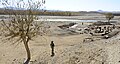 Near a bridge on the Kabul–Kandahar Highway


Notable people
[edit]See also
[edit]Notes
[edit]- ^ Pashto pronunciation: [zɑˈbəl]
- ^ Dari pronunciation: [zɑː.bʊ́l]
References
[edit]- ^ a b "د نږدې شلو ولایاتو لپاره نوي والیان او امنیې قوماندانان وټاکل شول". 7 November 2021. Archived from the original on November 7, 2021.
- ^ Provinces of Afghanistan on Statoids.
- ^ "Afghanistan's Provinces – Zabul at USAID". USAID. Archived from the original on July 27, 2007. Retrieved 2 April 2018.
- ^ a b c d "Estimated Population of Afghanistan 2021-22" (PDF). National Statistic and Information Authority (NSIA). April 2021. Archived (PDF) from the original on June 24, 2021. Retrieved June 21, 2021.
- ^ World Wildlife Fund, ed. (2001). "Central Afghan Mountains xeric woodlands". WildWorld Ecoregion Profile. National Geographic Society. Archived from the original on 2010-03-08.
- ^ First Airstrip in Zabul Province, USAID
- ^ Online, Asia Time. "Asia Times Online :: South Asia news, business and economy from India and Pakistan". www.atimes.com. Archived from the original on 3 December 2009. Retrieved 2 April 2018.
- ^ "The Back of Beyond: A Report from Zabul Province". worldaffairsjournal.org. Archived from the original on September 8, 2012. Retrieved 2 April 2018.
- ^ "Zabul Province". Program for Culture & Conflict Studies. Naval Postgraduate School. Retrieved 2013-06-16.
- ^ Giustozzi, Antonio (August 2012). Decoding the New Taliban: Insights from the Afghan Field. Hurst. ISBN 9781849042260.
- ^ "Conservative of Zabul Province" (PDF). reliefweb.int. Retrieved 17 Dec 2022.
- ^ "UNHCR Sub-Office Kandahar - DISTRICT PROFILE Arghandab" (PDF). Archived from the original (PDF) on 2005-10-27. Retrieved 2023-06-18.
- ^ "UNHCR Sub-Office Kandahar - DISTRICT PROFILE Atghar" (PDF). Archived from the original (PDF) on 2005-10-27. Retrieved 2023-06-18.
- ^ "UNHCR Sub-Office Kandahar - DISTRICT PROFILE Daychopan" (PDF). Archived from the original (PDF) on 2005-10-27. Retrieved 2023-06-18.
- ^ "UNHCR Sub-Office Kandahar - DISTRICT PROFILE Kakar" (PDF). Archived from the original (PDF) on 2005-10-27. Retrieved 2023-06-18.
- ^ "UNHCR Sub-Office Kandahar - DISTRICT PROFILE Mezana" (PDF). Archived from the original (PDF) on 2005-10-27. Retrieved 2023-06-18.
- ^ "UNHCR Sub-Office Kandahar - DISTRICT PROFILE Naw Bahar" (PDF). Archived from the original (PDF) on 2005-10-27. Retrieved 2023-06-18.
- ^ "UNHCR Sub-Office Kandahar - DISTRICT PROFILE Qalat" (PDF). Archived from the original (PDF) on 2005-10-27. Retrieved 2023-06-18.
- ^ "UNHCR Sub-Office Kandahar - DISTRICT PROFILE Shah Joy" (PDF). Archived from the original (PDF) on 2005-10-27. Retrieved 2023-06-18.
- ^ "UNHCR Sub-Office Kandahar - DISTRICT PROFILE Shamulzayi" (PDF). Archived from the original (PDF) on 2005-10-27. Retrieved 2023-06-18.
- ^ "UNHCR Sub-Office Kandahar - DISTRICT PROFILE Shinkay" (PDF). Archived from the original (PDF) on 2005-10-27. Retrieved 2023-06-18.
- ^ "UNHCR Sub-Office Kandahar - DISTRICT PROFILE Tarnak Aw Jaldak" (PDF). Archived from the original (PDF) on 2005-10-27. Retrieved 2023-06-18.
External links
[edit]
Places adjacent to Zabul Province | ||||||||||||||||
|---|---|---|---|---|---|---|---|---|---|---|---|---|---|---|---|---|
| ||||||||||||||||


| Districts |  | |
|---|---|---|
| Populated places | ||
| Other | ||
| National | |
|---|---|
| Other | |

Zabul Province
View on GrokipediaZabul Province is a province in southern Afghanistan, bordering Pakistan to the southeast as well as the Afghan provinces of Kandahar, Uruzgan, Ghazni, and Paktika, with its capital at Qalat.[1] The province covers an area of 17,343 square kilometers and has an estimated population of approximately 300,000, predominantly Pashtun tribes such as the Tokhi and Hotaki Ghilzais along with Noorzai and Panjpai Durranis.[1] Geographically, Zabul consists of 28% flat terrain, 29% hilly areas, and 23% mountainous regions, with the Arghandab and Tarnak rivers providing vital water resources for agriculture, the mainstay of the local economy alongside animal husbandry, trade, and limited manufacturing.[1] The province is divided into 11 districts, including Arghandab, Day Chopan, Kakar, Mizan, and Qalat.[1] Its strategic position along the Kabul-Kandahar Highway has historically made it a key transit route, recently enhanced by reconstruction efforts that have boosted local tourism and connectivity.[2] Since the Taliban's capture of Afghanistan in August 2021, Zabul has been administered as part of the Islamic Emirate, with ongoing infrastructure developments such as the completion of the Omari Dam in 2024 to support irrigation for agricultural lands.[3][4] The region experiences high levels of multidimensional poverty, affecting over 87% of its population according to recent assessments.
History
Ancient and Medieval Periods
The region encompassing modern Zabul Province hosted significant Bronze Age settlements, notably the site of Mundigak, which flourished from approximately 3000 to 1500 BCE as a semi-sedentary village mound with evidence of early urban development and carbon-14 dated artifacts indicating peak activity during this period.[5][6] By the 6th century BCE, the area formed part of the Achaemenid satrapy of Arachosia, centered around the Arghandab River and inhabited by Iranian tribes, serving as an eastern frontier province linking Persia to the Indus Valley through trade and military routes.[7] Zoroastrian practices likely prevailed among these populations, given the satrapy's Iranian ethnic composition and proximity to core Zoroastrian heartlands, though direct archaeological evidence of fire temples in Zabul remains limited.[7] In 330 BCE, Alexander the Great incorporated Arachosia into his empire following the conquest of Persian territories, establishing garrisons and possibly initiating fortifications such as the ancient citadel at Qalat, which local tradition attributes to his campaigns and which archaeological assessments date to over 2,000 years old.[8][9] Subsequent Hellenistic influences persisted through the Greco-Bactrian kingdom (circa 250–125 BCE), with remnants of Greek administrative and cultural elements evident in southern Afghan artifacts and coinage along trade paths from Kandahar toward the Indian subcontinent.[10] The 7th-century CE Arab invasions targeted Sasanian-held territories in southern Afghanistan, but Zabulistan—encompassing Zabul—resisted full incorporation, governed by the Zoroastrian-influenced Zunbil dynasty until its defeat by the Saffarids in 870 CE, marking the region's delayed transition to Islamic rule.[11] During the medieval era, the Ghaznavid Empire under Mahmud (r. 998–1030 CE) asserted control over Zabulistan, integrating it into a polity that facilitated trade caravans along the Kandahar-to-Indus corridors, bolstering economic links with India through fortified outposts. The Ghurid dynasty (circa 1148–1215 CE), originating from central Afghanistan, extended influence southward into Zabul as a frontier buffer against incursions, though primary power centered in Ghor.[12] By the early 13th century, Mongol forces under Genghis Khan devastated the region during the 1219–1221 invasion of Khwarazmian territories, sacking settlements and disrupting trade routes, with Zabul serving as a vulnerable passage for nomadic raids into the Afghan-Persian borderlands.[13] Ancient fortifications, such as those at Qalat and along the Helmand valley, underscore the area's role as a defensive crossroads amid these repeated conquests.[9]Emirate, Kingdom, and Early Modern Rule
Zabul Province, situated in southern Afghanistan adjacent to Kandahar, was incorporated into the Durrani Empire following its establishment by Ahmad Shah Durrani in 1747, as the empire's core territories encompassed Pashtun tribal heartlands used to counter Persian threats from the west.[14] The Pashtun confederation under Durrani rule relied on loose alliances with local tribes, including those in Zabul such as the Tokhi and Andar, granting them significant autonomy in exchange for military support during campaigns against Safavid Persia and Mughal India.[15] This structure preserved tribal governance structures, with central authority limited to tribute collection and levies, reflecting the empire's character as a military federation rather than a tightly administered state. In the 19th century, during the Emirate of Afghanistan under rulers like Dost Mohammad Khan (r. 1826–1863 and 1863–1869), Zabul remained a frontier zone of tribal semi-independence amid the British-Russian "Great Game," where Afghanistan served as a buffer state to contain Russian expansion toward India.[16] The Second Anglo-Afghan War (1878–1880) saw British forces advance through southern routes, including operations near Kandahar that involved skirmishes with local Pashtun fighters in provinces like Zabul, as Emir Sher Ali Khan's resistance collapsed and British troops occupied key southern positions to install a pro-British emir.[17] Abdur Rahman Khan (r. 1880–1901) later consolidated control by subduing southern tribal leaders, but Zabul's Pashtun groups retained de facto autonomy through customary law and militias, resisting full centralization. The 1893 Durand Line agreement, demarcating the Afghan-British frontier, bisected Pashtun tribal territories affecting Zabul's border communities, fostering cross-border kin networks that undermined state efforts to enforce sovereignty and taxes.[18] Under the Kingdom of Afghanistan proclaimed by Habibullāh Khan (r. 1901–1919) and continued by Amanullah Khan (r. 1919–1929), Zabul experienced heightened tensions from modernization reforms, including compulsory military service, land taxation, and secular education, which clashed with tribal norms and provoked revolts linking central overreach to erosion of customary privileges.[19] Amanullah's 1920s initiatives, such as promoting women's education and reducing clerical influence, elicited backlash from Zabul's conservative Pashtun elders, who viewed them as threats to Islamic traditions and tribal authority, contributing to broader southern unrest that weakened the monarchy's grip without full-scale rebellion in the province itself.[20] This resistance underscored causal patterns where top-down reforms ignored local power dynamics, perpetuating Zabul's role as a semi-autonomous Pashtun enclave amid the kingdom's fragile unification efforts.[21]Soviet Invasion, Mujahideen Resistance, and Civil War
The Soviet invasion of Afghanistan on December 27, 1979, rapidly encompassed Zabul Province, a Pashtun-majority area astride the vital Kabul-Kandahar Highway, which Soviet forces prioritized for logistics amid early resistance from local tribes opposing communist land reforms and secular policies. Pashtun fighters in Zabul, drawing on tribal networks and religious motivations against perceived atheistic imposition, formed mujahideen units that conducted ambushes on convoys and outposts, leveraging the province's rugged terrain for guerrilla tactics such as hit-and-run attacks detailed in U.S. military analyses of resistance methods. These operations disrupted Soviet supply efforts, with Zabul's proximity to Pakistan facilitating infiltration routes for fighters and initial arms, though systematic smuggling corridors developed later; nationwide, such provincial engagements contributed to Soviet combat losses estimated at over 14,000 dead by declassified intelligence assessments.[22][23][24] Zabul's role intensified as a conduit in the U.S.-orchestrated Operation Cyclone, which from 1980 allocated approximately $3 billion in aid—matched by Saudi contributions—channeled via Pakistan's Inter-Services Intelligence to mujahideen factions, including Pashtun groups like those under Yunus Khalis, emphasizing anti-communist jihad rooted in defense of Islamic governance. Local commanders exploited the province's position on southern smuggling paths from Pakistan's Balochistan border through Kandahar into Zabul, transporting weapons and volunteers to northern fronts, while ambushing Soviet patrols on the highway to impose attrition; this proxy dynamic armed tribal militias with advanced weaponry like Stinger missiles from 1986, enabling downing of over 250 Soviet aircraft and helicopters overall, per declassified reports, but also entrenched heavy armament among Zabul's Pashtun tribes, fostering dependency on external patrons. Empirical data from the era highlight how such aid sustained resistance—inflicting roughly 75,000 mujahideen casualties nationwide—but prioritized ideological warfare over unified command, with Zabul exemplifying decentralized tribal mobilization against Soviet consolidation.[25][23][24] Soviet forces withdrew on February 15, 1989, leaving the Najibullah government reliant on residual aid until its fall in April 1992, after which Zabul descended into factional strife among mujahideen alliances, with Pashtun warlords affiliated with Hezb-e-Islami and other groups vying for district control amid eroded central authority. This civil war phase (1992-1996) saw localized clashes over resources and tolls on trade routes, amplifying tribal feuds without broader coordination; warlord dominance, a direct outgrowth of proxy-era arming, yielded no stable order, as heavily equipped commanders prioritized personal fiefdoms, contributing to an estimated 50,000 deaths across Afghanistan from inter-factional violence and displacing thousands in southern provinces like Zabul. Foreign aid's legacy thus transitioned from anti-Soviet utility to causal enabler of fragmentation, where empowered militias rejected power-sharing pacts like the 1992 Peshawar Accords, perpetuating instability through unchecked local armament rather than fostering reconstruction.[26][27][28]Taliban Rise, U.S. Intervention, and Insurgency (1990s-2021)
In the aftermath of the Soviet withdrawal and ensuing civil war, Zabul Province experienced widespread lawlessness, including rampant banditry along Highway 1 connecting Kabul and Kandahar. The Taliban, emerging in neighboring Kandahar Province in 1994, extended control into Zabul by mid-decade, capitalizing on rural Pashtun discontent with mujahideen warlords' extortion and feuds.[1] The group imposed strict Sharia law, curtailing highway robberies and establishing parallel courts, which garnered initial support despite harsh hudud punishments like amputations for theft and public executions for adultery.[29] By 1996, the Taliban dominated Zabul as part of their nationwide consolidation, ruling until the U.S.-led invasion.[1] Following the September 11, 2001, attacks, U.S. forces invaded Afghanistan, ousting the Taliban regime by December 2001 through rapid operations involving Northern Alliance proxies and airstrikes. In Zabul, coalition efforts cleared Taliban holdouts, but insurgents retreated to Pakistan border sanctuaries, preserving networks for resurgence.[29] The subsequent Karzai (2001–2014) and Ghani (2014–2021) governments centralized power amid endemic corruption, with officials siphoning aid and favoring urban elites, exacerbating rural neglect in Zabul where services remained minimal.[30] This governance vacuum, compounded by U.S. empowerment of local warlords, fueled Taliban revival by providing alternative dispute resolution and protection rackets, drawing recruits from impoverished Pashtun tribes.[31] Zabul emerged as a Taliban safe haven and infiltration corridor from Pakistan's Balochistan, facilitating ambushes and improvised explosive device (IED) attacks on Highway 1 convoys. Insurgent violence peaked during the U.S. surge (2009–2014), with coalition forces conducting repeated raids against IED cells, detaining militants and destroying caches, yet failing to dismantle networks.[32] Provincial Reconstruction Team (PRT) Zabul operations emphasized counterinsurgency via infrastructure projects and shuras, but empirical outcomes showed persistent Taliban influence, with the group contesting 90% of districts by 2018.[33] Nation-building efforts faltered in deradicalization, as night raids and airstrikes inflicted civilian casualties—estimated at thousands nationwide—eroding legitimacy and bolstering Taliban narratives of foreign occupation.[34] SIGAR assessments highlighted how corruption and ineffective Afghan National Security Forces eroded territorial control, culminating in Taliban advances by 2021.[30]Taliban Restoration and Post-2021 Developments
Following the Taliban's rapid offensive in mid-2021, provincial authorities in Zabul surrendered to Taliban forces on August 9, without significant resistance, enabling the group to consolidate control over the province as part of their nationwide takeover.[35] This swift transition marked the end of the Afghan National Defense and Security Forces' presence in Zabul, a Pashtun-majority southern province that had been a Taliban stronghold during the insurgency.[36] Post-restoration security dynamics in Zabul reflected broader national trends of diminished factional violence between Taliban elements and former government-aligned militias, with UNAMA documenting a sharp decline in overall civilian casualties from over 5,000 in the first half of 2021 to fewer than 1,000 annually by 2022-2024, attributed to the cessation of inter-Afghan conflict.[37] However, this stability came amid reports of increased arbitrary detentions and mistreatment by Taliban security forces, including in southern provinces, where UNAMA recorded at least 20 instances of physical abuse against civilians in early 2024 alone.[38] Tribal mechanisms have played a role in dispute resolution, with local elders mediating land and water conflicts in Zabul's rural districts, reducing reliance on formal Taliban courts, though enforcement remains inconsistent.[39] The Taliban's April 2022 nationwide opium poppy cultivation ban led to a 95% reduction in cultivated area, from 233,000 hectares in 2022 to 10,800 hectares in 2023, severely impacting Zabul's rural economy where poppy had been a key cash crop alongside traditional agriculture.[40] This shift forced farmers toward lower-yield alternatives like wheat, exacerbating poverty in southern provinces including Zabul, with household incomes dropping by up to 60% in affected areas and contributing to food insecurity for an estimated 15 million Afghans nationally by 2023.[41] Despite these strains, national economic indicators showed modest recovery, with GDP contracting less severely after an initial 2021-2022 plunge and stabilizing amid frozen foreign reserves and aid suspension, though Zabul's arid districts faced heightened vulnerability without alternative livelihoods.[42] Taliban governance in Zabul has prioritized order restoration through strict enforcement, including public executions for crimes like murder, with at least five such events documented nationally in 2022-2023, though provincial specifics remain underreported.[43] Women's exclusion from secondary education and most public employment persists, aligning with decrees banning girls' schooling beyond primary levels since March 2022, limiting access in Zabul's conservative tribal areas and drawing criticism for entrenching gender apartheid without empirical justification from Taliban sources.[44] These measures, while reducing overt insurgency, have not addressed underlying humanitarian costs, including elevated malnutrition rates in Zabul's opium-dependent villages post-ban.[45]Geography
Physical Geography and Topography
Zabul Province exhibits a rugged topography dominated by arid plateaus, vast desert plains, and semi-mountainous regions, with elevations ranging from a minimum of 1,127 meters to a maximum of 4,160 meters above sea level.[46] This varied terrain, averaging around 2,083 meters in elevation, includes high plateaus and broken hills that contribute to the province's physical isolation, limiting connectivity across its 17,293 square kilometers.[46] The landscape transitions from flat, arid expanses in the south to more elevated, hilly areas northward, forming natural barriers that have shaped settlement patterns around accessible valleys and ridges.[47] The Arghandab River flows through the province, carving defensible valleys that enable limited irrigation in an otherwise dry environment, concentrating human activity along its course where water supports agriculture amid surrounding plateaus.[48] Elevations between 1,000 and 3,000 meters predominate in these central areas, fostering narrow, elevated corridors ideal for defensive positioning due to steep slopes and limited approach routes, which have causally influenced historical conflict dynamics by favoring ambush over open engagement.[46] The province's southeastern border with Pakistan and northern adjacency to Uruzgan feature terrain-induced chokepoints, such as constricted passes amid hilly expanses, enhancing strategic defensibility.[47] Geologically, Zabul hosts significant mineral deposits, including copper-gold skarn formations at the Kundalan site in Mizan District, embedded within metamorphic host rocks extending to depths of at least 115 meters.[49] These resources, part of broader porphyry and skarn systems, underlie the province's plateaus and valleys but remain geologically underexploited, with measured reserves at Kundalan including 21,400 metric tons of copper and 1.6 metric tons of gold.[51] The presence of such deposits reflects tectonic influences from regional Afghan block formations, contributing to the area's mineral-rich but topographically challenging profile.[52]Climate and Environmental Conditions
Zabul Province features a hot desert climate (Köppen BWh), marked by scorching summers exceeding 40°C and cold winters dipping below freezing, with annual precipitation averaging approximately 130 mm, concentrated in sparse winter and spring showers that fail to sustain reliable surface water.[53] This scant rainfall, often below 200 mm in drought years, imposes severe hydrological constraints, amplifying vulnerability to food shortages as groundwater depletion outpaces recharge.[54] Frequent environmental hazards compound the aridity, including summer dust storms that reduce visibility and degrade air quality, alongside flash floods from irregular heavy downpours that erode unstable soils despite the overall dryness.[55] Satellite observations from NASA and allied datasets reveal intensified drought cycles in southern Afghanistan, including Zabul, from 2022 to 2024, with below-average precipitation and elevated evapotranspiration rates depleting soil moisture reserves and hindering vegetative recovery.[56][57] Overgrazing by expansive livestock herds has accelerated deforestation and soil erosion across rangelands, stripping vegetative cover and promoting desertification in an already fragile ecosystem prone to wind and water runoff.[58][59] International aid-funded reforestation and soil conservation efforts, while well-intentioned, have demonstrated negligible sustained impact in such hyper-arid zones, undermined by persistent drought, communal land pressures, and insufficient monitoring amid security disruptions.[60]Administrative Divisions
Districts and Local Governance Structure
Zabul Province is administratively subdivided into 11 districts, serving as the primary units of local governance.[61] These districts are Arghandab, Day Chopan, Kakar, Mezana, Mizan, Naw Bahar, Qalat, Shah Joy, Shamulzai, Shinkay, and Tarnak wa Jaldak.[62] Qalat District functions as the provincial capital, encompassing the main urban center with an estimated population of around 45,000 residents as of recent projections. The remaining districts are predominantly rural, characterized by low population densities due to the province's expansive arid landscapes covering approximately 17,343 square kilometers.[1] Under Taliban administration since August 2021, each district is led by a woleswal (district governor) appointed directly by the provincial governor, who in turn is selected by the central Taliban leadership in Kabul. This hierarchical structure maintains centralized control while incorporating local tribal shuras—councils of elders—for resolving disputes, collecting zakat taxes, and implementing administrative directives in alignment with Sharia law. Tribal shuras provide a mechanism for local input, often drawing on customary practices to facilitate governance in remote areas, though ultimate authority rests with Taliban appointees to ensure ideological conformity.[63] This integration of tribal mechanisms with appointed officials has reportedly streamlined local administration and curbed the widespread corruption endemic to the pre-2021 Afghan Republican system, where district-level graft was rampant due to patronage networks. However, it enforces strict suppression of dissent, prioritizing security and compliance over pluralistic participation, as evidenced by the Taliban's consolidation of power without elections or opposition parties. Rural districts exhibit particular sparsity, with populations thinly distributed across nomadic and agrarian communities, necessitating reliance on mobile shuras for effective reach.Demographics
Population Statistics and Ethnic Groups
Zabul Province has an estimated population of approximately 304,000 residents, reflecting low population density of around 22 persons per square kilometer across its 17,343 square kilometers.[1] This sparsity is attributable to extensive nomadism, particularly among Kuchi pastoralists numbering about 50,000 in southern districts during winter, as well as historical conflict-induced displacement that has scattered settlements into over 2,500 remote villages.[1] The ethnic composition is predominantly Pashtun, comprising the vast majority of the population, with smaller minorities including Baluch groups.[1][61] Post-2021 Taliban restoration has seen broader Afghan returnee movements, with UNHCR documenting millions repatriating from neighboring countries, contributing to provincial population stabilization amid ongoing emigration pressures, though Zabul-specific return figures remain limited in public data.[64] Less than 10% of the population resides in urban areas, with the provincial capital Qalat and other centers hosting minimal concentrations amid overwhelmingly rural settlement patterns. High fertility rates, consistent with national averages exceeding four children per woman, have sustained demographic growth despite outflows from insecurity and economic hardship.[1]Tribal Composition and Social Dynamics
The tribal landscape of Zabul Province is predominantly shaped by Pashtun groups, with the Tokhi and Hotak (also known as Hotaki) sub-tribes of the Ghilzai confederation holding significant influence, alongside the Suleiman Khel, another Ghilzai branch.[1] These tribes maintain social cohesion through Pashtunwali, the unwritten Pashtun code emphasizing hospitality (melmastia), asylum (nanawatai), revenge (badal), and honor, which causally underpins resistance to external impositions by prioritizing tribal autonomy over state authority.[65] Anthropological analyses of Pashtun societies highlight how Pashtunwali fosters self-reliance in remote, kin-based networks, enabling survival amid geographic isolation and historical invasions, as evidenced in tribal genealogies and customary practices documented in U.S. military ethnographic studies.[66] Jirgas, assemblies of tribal elders, enforce Pashtunwali by mediating disputes and upholding customary law, playing a causal role in conflict resolution that preserves intra-tribal stability and deters escalation into broader vendettas.[67] In Zabul's Ghilzai-dominated areas, these mechanisms have historically resolved feuds over resources or honor killings through negotiated compensation (diyah) or oaths, reducing cycles of retaliation that empirical tribal histories attribute to unchecked badal obligations.[68] Post-2001, amid insurgency, Taliban-aligned mediators often integrated into jirgas, facilitating resolutions in Hotak and Tokhi strongholds by blending sharia with tribal norms, which curtailed prolonged intra-tribal violence compared to civil war-era anarchy, per field accounts from local witnesses.[69] Gender dynamics adhere empirically to purdah, the seclusion of women from public male gaze, rooted in Pashtunwali's honor (nang) imperatives, with rural Zabul surveys showing near-universal veiling and restricted mobility outside kin groups to safeguard family reputation.[70] Western aid initiatives from 2001-2021, aimed at liberalizing roles through education and employment programs, yielded limited uptake due to cultural backlash and perceived threats to tribal cohesion, as documented in gender impact assessments revealing persistent low female workforce participation (under 20% in southern provinces) and program abandonment amid resistance.[71] This adherence causally reinforces social order by aligning with first-principles of kin protection, though it limits women's public agency, contrasting with urban or non-Pashtun adaptations.[72]Economy
Agriculture, Livestock, and Natural Resources
Agriculture in Zabul Province centers on subsistence farming, with wheat as the primary crop, alongside barley, maize, potatoes, melons, and watermelons.[48] The province's arid conditions and reliance on rainfed cultivation limit yields, typically aligning with national averages of around 2.2 tons per hectare for irrigated wheat and lower for rainfed areas, underscoring the precarious nature of food production.[73] [74] Groundwater from wells and seasonal rivers like the Arghandab supports limited irrigation, but over-extraction and variable precipitation exacerbate vulnerabilities in this predominantly rainfed system.[48] Livestock rearing, particularly sheep and goats, forms a critical component of the rural economy, with households traditionally maintaining 10-20 animals per family, supplemented by camels, donkeys, and fewer cattle.[48] Nomadic Kuchis rely heavily on these herds for milk, meat, wool, and transport, integrating pastoralism into the subsistence framework across Zabul's rugged terrain. This sector supports livelihoods for a significant portion of the rural population, contributing to local self-sufficiency amid limited arable land.[75] Natural resources in Zabul include untapped deposits of coal, natural gas, and minerals such as copper and gold, as identified in geological surveys.[52] [76] [77] However, persistent insecurity and lack of infrastructure have hindered extraction and development, leaving these reserves largely unexploited despite their potential economic value.[78]Opium Cultivation, Narcotics Trade, and Economic Impact
Prior to the Taliban's 2022 ban, opium poppy cultivation in Zabul Province constituted a minor portion of Afghanistan's national output, with approximately 980 hectares under cultivation in 2021, representing less than 1% of the country's estimated 179,000 hectares total.[79] This production, though limited, generated significant local revenue through high farm-gate prices—often exceeding those of alternative crops like wheat by factors of 10 to 20—and funded insurgent groups via taxation on cultivation, processing, and transport, with the Taliban imposing levies equivalent to 10-20% of output value in southern and eastern provinces including Zabul.[80] Opium from Zabul contributed to heroin processing labs in adjacent provinces, with refined products smuggled southeastward through Paktika Province border crossings into Pakistan's Balochistan region, forming part of the broader southern trafficking corridor that accounted for over 80% of Afghan opiates entering Pakistan annually pre-ban.[81] The Taliban's April 2022 nationwide decree prohibiting opium poppy cultivation and related narcotics activities led to near-total eradication in Zabul by the 2023 season, with provincial cultivation dropping to negligible levels amid aggressive enforcement including crop destruction and penalties.[40] This resulted in acute economic hardship for rural households, as UNODC village surveys indicated that opium-dependent farmers in southern provinces like Zabul experienced income losses of 60-90%, prompting increased rural-to-urban migration, land sales, and reliance on high-interest debt or remittances.[40] Alternative crops such as wheat yielded far lower returns—typically one-tenth of opium's value per hectare—and faced market saturation and insufficient irrigation infrastructure, exacerbating food insecurity without viable substitutes emerging at scale.[41] The ban disrupted Taliban revenue streams previously derived from narcotics taxation, estimated at tens of millions annually province-wide through ushr fees and convoy protection, shifting emphasis to licit sources like customs duties on cross-border trade with Pakistan, which reportedly increased via heightened enforcement at southeastern checkpoints.[82] While the policy reduced fresh opium supply—potentially curbing downstream addiction in consumer markets by elevating global prices fivefold from pre-ban levels—critics, including UNODC analysts, highlight sustained smuggling of pre-2022 stockpiles sustaining trade volumes and local poverty traps without compensatory development aid.[40] Proponents within Taliban circles cite moral and health imperatives, noting diminished local opium availability, though empirical data shows persistent heroin precursor flows and no net decline in provincial instability from economic contraction.[83]Infrastructure Development and Trade
The Kabul-Kandahar Highway, designated as National Highway 1 and part of Afghanistan's Ring Road network, traverses Zabul Province and serves as a primary artery for regional trade, connecting the province to Kandahar and facilitating access to Pakistan's border crossings.[84] This corridor has enabled increased movement of goods, including agricultural products and consumer items, following the Taliban's 2021 takeover, though security concerns and poor maintenance from prior decades continue to hinder efficiency.[85] Pre-2021 international aid expenditures exceeding $3 billion on Afghan roads often resulted in substandard construction and rapid deterioration due to corruption, inadequate oversight, and diversion of funds, causally undermining long-term connectivity in areas like Zabul.[85][86] Local trade in Zabul relies heavily on bazaars in Qalat and emerging markets in districts like Shahjoy, where private initiatives have driven construction of commercial facilities valued at over 300 million Afghanis as of September 2025, reflecting Taliban emphasis on domestic economic activity amid restricted foreign engagement.[87] Cross-border trade via the Highway 1 corridor to Kandahar has sustained exports of local dried fruits and imports, but Taliban-imposed taxes and checkpoints have imposed additional burdens, occasionally disrupting flows such as in Zabul's dried fruit sector.[88] Foreign direct investment remains negligible, with World Bank assessments in 2024 attributing this to international sanctions and banking restrictions that limit transactions and deter external projects, including stalled Chinese interests in Afghan minerals elsewhere that have not materialized in Zabul.[42] Under Taliban governance, infrastructure development prioritizes self-reliance through domestically funded repairs and small-scale projects, as foreign aid inflows plummeted post-2021, compelling a shift from dependency on inefficient prior assistance to localized efforts despite persistent challenges like non-performing loans and trade deficits.[89][90] This approach has stabilized some trade routes but highlights causal gaps from earlier aid models, where billions were wasted on unsustainable builds without local capacity building, leaving Zabul's trade infrastructure vulnerable to environmental wear and conflict legacies.[91]Governance and Security
Provincial Administration under Taliban Rule
The provincial administration in Zabul operates under the Taliban regime's centralized theocratic structure, with the governor appointed directly by Supreme Leader Hibatullah Akhundzada in Kabul, often bypassing ministerial consultation to ensure loyalty to hardline interpretations of Sharia. Mullah Sher Mohammad Sharif was appointed as Zabul's governor on April 26, 2025, succeeding prior officials like Mawlawi Qudratullah Abu Hamza, who held the post from October 2022 to June 2023.[92][93] This appointment process reflects the Taliban's emphasis on ideological conformity over technocratic expertise, with governors tasked with disseminating and enforcing fatwas on moral conduct, dress codes, and public behavior through local vice and virtue commissions.[94] Sharia courts form the backbone of judicial administration at the provincial level, handling civil, criminal, and moral cases with swift rulings based on Hanafi jurisprudence and supreme leader decrees, often resolving disputes within days rather than the protracted delays of the prior republic's system. In Zabul, these courts, overseen by the governor's office, prioritize hudud punishments for offenses like theft or adultery, while mullahs mediate family disputes such as inheritance and marital conflicts at the community level, bypassing formal bureaucracy. Women remain entirely excluded from judicial roles or court participation without male guardians, aligning with Taliban policies that limit female public engagement to domestic spheres.[95][96] Administrative efficiency has reportedly improved in areas like revenue collection and checkpoint operations along the Kabul-Kandahar Highway traversing Zabul, with anecdotal accounts from traders citing reduced bribery and extortion compared to the Islamic Republic era's pervasive graft, where officials demanded payoffs at multiple points. This stems from the Taliban's ideological discipline, which imposes severe penalties for corruption among officials, enabling streamlined tax enforcement and trade facilitation despite the regime's overall economic constraints. However, such gains coexist with persistent internal kleptocracy allegations, including resource diversion by loyalists, though petty-level extortion has declined due to centralized oversight.[97][98][94]Historical Insurgencies and Conflict Dynamics
During the Soviet-Afghan War from 1979 to 1989, tribal groups in Zabul Province, predominantly Ghilzai and Durrani Pashtuns, aligned with mujahideen factions to resist Soviet occupation and the central government's centralization efforts, which threatened local autonomy and customary governance.[1] These alliances enabled attrition warfare through ambushes, raids, and sabotage, exploiting the province's rugged terrain of mountains and valleys that hindered Soviet mechanized operations and supply lines.[23] State-tribe frictions intensified as Soviet-backed forces imposed conscription and land reforms, provoking widespread rebellion; mujahideen tactics inflicted steady casualties on Soviet troops, contributing to over 15,000 Soviet deaths nationwide, though province-specific figures remain undocumented in available records.[99] Following the 2001 U.S.-led invasion and Taliban ouster, Zabul reemerged as a Taliban stronghold due to its position in the Pashtun heartland, where insurgents leveraged tribal networks for recruitment and logistics.[100] The Taliban established shadow governance structures, imposing taxes such as ushr (one-tenth of agricultural produce) on locals while offering parallel justice and dispute resolution, which gained traction amid perceived corruption and ineffectiveness of the Afghan government and ISAF forces.[101] This eroded ISAF legitimacy, as foreign presence and allied operations often resulted in civilian collateral damage, fueling local grievances and Taliban support; by 2010, Taliban taxation systems mimicked state functions, sustaining insurgency finances estimated at millions annually from rural levies.[102] Insurgent effectiveness in Zabul hinged on improvised explosive devices (IEDs) and ambushes tailored to the terrain, particularly along Highway 1 connecting Kabul to Kandahar, a vital supply artery vulnerable to hidden emplacement in arid, sparsely populated areas. IED attacks caused disproportionate casualties relative to conventional engagements, with UNAMA documenting thousands of nationwide IED-related civilian and security force deaths from 2009 onward, many in southern provinces like Zabul where patrols faced constant threats from roadside bombs and complex attacks.[103] Military analyses noted that the province's mountainous districts facilitated insurgent mobility and evasion, amplifying tactical advantages over coalition forces reliant on road networks, thereby sustaining low-intensity conflict through asymmetric attrition.[104]Current Security Realities and Stability Factors
Since the Taliban's consolidation of power in August 2021, Zabul Province has seen markedly reduced incidences of inter-group armed violence, with the primary threats limited to sporadic remnants of anti-Taliban resistance rather than sustained insurgency. Conflict monitoring data indicates low event counts in southern provinces like Zabul, where Taliban dominance aligns with ethnic Pashtun tribal structures, enabling effective territorial control without the elevated clash rates observed in northern or eastern regions.[105] This shift reflects the cessation of large-scale civil war dynamics, as the Taliban transitioned from insurgents to de facto governors, prioritizing internal order over external confrontation.[4] Taliban security forces conduct routine patrols along key routes, including the Kabul-Kandahar Highway traversing Zabul, which have curtailed pre-2021 highway robberies and banditry that previously disrupted commerce. Checkpoints enforce tolls and deter opportunistic crime, fostering safer travel conditions despite occasional reports of extortion, contributing to local perceptions of improved predictability on major thoroughfares.[106] Threats from Islamic State Khorasan Province (ISKP) remain minimal in Zabul, with the group's operations concentrated in eastern provinces like Nangarhar and Kunar or urban centers such as Kabul, rather than Taliban heartlands in the south.[107] The end of U.S.-led drone strikes post-withdrawal has lowered civilian fatalities from aerial operations, previously a source of collateral damage in counterterrorism efforts, though Taliban purges target suspected ISKP affiliates and former regime holdouts through arrests and executions to preempt internal threats. Tribal acquiescence bolsters stability, as local Pashtun elders participate in shuras and benefit from shared revenues at trade points, aligning incentives against disruption in this agriculturally vital but arid province.[4] While human rights-focused reporting highlights repressive enforcement, security metrics underscore a baseline order that contrasts with media portrayals emphasizing chaos, grounded in the causal reality of monopolized force under Taliban rule.[39]Society and Infrastructure
Healthcare and Public Health Challenges
Zabul Province, like much of rural Afghanistan, suffers from a scarcity of healthcare facilities, with primary health centers typically limited to one per district in operational areas, supplemented by a single provincial hospital in Qalat that handles basic surgeries but lacks advanced capabilities.[108] Maternal mortality remains alarmingly high, estimated at around 500 deaths per 100,000 live births nationally, with rural provinces such as Zabul facing exacerbated risks due to inadequate prenatal care and emergency obstetric services.[109] This gap is widened by prevalent reliance on traditional remedies, including herbal treatments and folk healers, which over 75% of Afghans use regularly for common ailments, often delaying access to modern interventions in remote districts.[110] Taliban policies since 2021 have intensified challenges by restricting female health workers, including bans on midwifery training and limits on women's employment in medical roles, severely curtailing care for female patients who require same-gender providers under cultural norms.[111] [112] In Zabul's conservative Pashtun-majority areas, this has led to reduced clinic staffing and closures, forcing women to forgo treatments or travel long distances under male guardianship rules, contributing to higher untreated conditions like obstetric complications.[113] Following the Taliban takeover in August 2021, international aid cuts—prompted by frozen development funding and Taliban abuses—have crippled healthcare delivery, with donor withdrawals leaving facilities understaffed and undersupplied, as seen in national drops in operational clinics and medicine availability.[114] [115] Zabul has experienced medicine shortages, relying heavily on imports from Pakistan for essentials, amid a polio resurgence with ongoing wild poliovirus type 1 cases linked to vaccination gaps in insecure southern provinces.[116] These factors perpetuate a cycle where traditional practices fill voids but risk complications from unverified treatments, underscoring the province's vulnerability to preventable outbreaks and chronic undercare.[117]Education System and Literacy Rates
Literacy rates in Zabul Province remain among the lowest in Afghanistan, estimated at 20-30% for adults, reflecting broader rural Pashtun trends where national adult literacy stood at 37% in 2021, with female rates significantly lower at around 27%.[118][119] These figures underscore persistent challenges in a conservative, agrarian region historically underserved by formal schooling, with pre-2021 international aid failing to substantially elevate rates despite billions invested, as systemic issues like corruption and cultural disconnect limited impact. Under Taliban governance since August 2021, the education system in Zabul emphasizes madrassas, with religious schools expanding fourfold nationally and dominating local instruction through Quran-centric curricula tailored to Pashtun Islamic traditions.[120] Boys' enrollment has increased in these institutions, as Taliban policies prioritize religious education over secular models, though overall quality suffers from teacher shortages and reduced instructional hours.[121] This shift critiques pre-2021 Western-influenced curricula, which incorporated subjects like arts and human rights deemed irrelevant to local tribal realities, contributing to high dropout rates and minimal literacy gains in areas like Zabul.[122] Girls' access is restricted to primary education (up to grade 6), with secondary schooling banned nationwide, including in Zabul, depriving over 1.4 million adolescent girls of further learning as of 2024.[123] This policy, rooted in the Taliban's interpretation of Sharia, contrasts with prior secular expansions that Western sources claimed would curb radicalization, yet empirical outcomes in stable post-2021 Zabul—marked by reduced conflict without such programs—question the causal efficacy of those models in culturally conservative contexts.[124] Madrassa dominance for boys thus aligns more closely with local norms, potentially fostering greater adherence than mismatched secular imports, though long-term literacy impacts remain unproven.[125]Transportation and Connectivity
The principal road network in Zabul Province centers on the segment of Afghanistan's national Ring Road linking Ghazni Province to the north with Kandahar Province to the south, passing through the provincial capital Qalat and Shah Joy District. This highway serves as a critical conduit for vehicular movement across southern Afghanistan, though its condition has varied due to the province's rugged topography.[1] Under Taliban administration since August 2021, maintenance efforts have notably enhanced road quality in Zabul, with previously deteriorated sections through the province showing significant improvements by 2025, facilitating more reliable transit.[126] Zabul Province lacks any railway infrastructure, consistent with Afghanistan's overall limited rail network, which totals approximately 400 kilometers of operational lines concentrated in the northern and western regions connecting to international borders but not extending into Zabul.[127] Air transport options are constrained, with Qalat Airport functioning primarily as a military airstrip located about 2.5 miles north of the city center, supporting limited flights rather than commercial civilian operations.[128] Cross-border connectivity with Pakistan occurs via the Badini crossing in southern Zabul, linking to Pakistan's Balochistan Province, though it operates as a minor checkpoint without round-the-clock international status and has faced intermittent closures amid security tensions.[129] The Taliban regime has imposed stricter oversight on border activities to curb smuggling, aligning with broader efforts to regulate informal trade flows across the Durand Line.[130]Culture
Pashtun Traditions and Islamic Practices
Pashtunwali, the unwritten ethical code guiding Pashtun social conduct, emphasizes principles such as melmastia (hospitality and asylum), badal (revenge or justice), and nanawatai (protection of those seeking refuge), which collectively foster tribal cohesion and dispute resolution in Zabul's predominantly Pashtun communities.[65] In regions like Zabul, where central authority has historically been weak, jirgas—assemblies of tribal elders—apply Pashtunwali to mediate conflicts over land, honor, or resources, often achieving resolutions through compensation or reconciliation rather than prolonged violence, thereby maintaining order without reliance on formal state mechanisms.[131] This customary system demonstrates resilience under Taliban governance, as the group, largely Pashtun itself, tacitly integrates Pashtunwali elements with Sharia interpretations, allowing it to persist as a functional alternative to statutory law despite not being formally endorsed.[65] Islamic practices in Zabul adhere predominantly to Sunni Hanafi jurisprudence, the dominant school among Afghanistan's Pashtun majority, which shapes daily rituals, mosque attendance, and moral conduct while coexisting with Pashtunwali's tribal norms.[132] Sufi influences, including veneration at ziarats (shrines) dedicated to local saints, remain embedded in folk piety, though Taliban enforcement of austere Deobandi-influenced Islam has curtailed overt shrine-based rituals perceived as bid'ah (innovation), leading to subdued expressions of mysticism amid minimal sectarian tensions due to the province's overwhelming Sunni demographic and sparse Shia presence.[133] Traditional festivals like Nowruz, marking the Persian New Year with communal gatherings and symbolic rites, have been effectively subdued since the Taliban's 2021 return to power, as public celebrations are prohibited nationwide under decrees deeming them un-Islamic, with enforcement in provinces including Zabul prioritizing piety over pre-Islamic customs.[134] This suppression reflects the Taliban's broader campaign to align cultural expressions strictly with Hanafi orthodoxy, yet underlying Pashtunwali values of communal solidarity endure, adapting to coexist with imposed religious rigor in Zabul's tribal fabric.[135]Notable Individuals and Local Contributions
Zabul Province has a history of tribal leadership in resisting foreign incursions, with figures such as Baba Hotak, Malikyar, and Sultan Malukhi renowned for mobilizing local forces against invaders, thereby preserving regional autonomy and Pashtun tribal structures. These leaders exemplified the province's tradition of decentralized defiance, drawing on kinship networks to coordinate defenses without reliance on central authority. The province's Hotak subtribe of the Ghilzai Pashtuns, present in districts like Day Chopan and Shamalzai, shares ethnic ties with Mullah Mohammed Omar, the Taliban founder whose origins trace to nearby Nodeh village—debated as either Uruzgan or Kandahar Province—though Zabul served as a critical operational base and gateway for Taliban fighters between southern and eastern Afghanistan during the insurgency.[1] This association reinforced Zabul's role as an early Taliban stronghold, where local commanders facilitated cross-border movements and ambushes along Highway 1, contributing to the group's expansion from 1994 onward.[100] Following the Taliban's 2021 takeover, Mullah Sher Mohammad Sharif was appointed provincial governor in April 2025 by supreme leader Hibatullah Akhundzada, focusing on administrative consolidation, dispute resolution via tribal shuras, and infrastructure maintenance to enhance local stability despite economic constraints and residual factional tensions.[92] His tenure emphasizes religious enforcement and security coordination, aligning with broader Taliban efforts to integrate Zabul's pastoral economy into the Islamic Emirate's framework.References
- https://www.[mindat.org](/page/Mindat.org)/loc-226422.html