Hubbry Logo
MundigakMundigakMain
Open search
Mundigak
Community hub
Mundigak
logo
8 pages, 0 posts
0 subscribers
Be the first to start a discussion here.
Mundigak
Mundigak
from Wikipedia

Mundigak (Pashto: منډیګک) is an archaeological site in Kandahar province in Afghanistan. During the Bronze Age, it was a center of the Helmand culture. It is situated approximately 55 km (34 mi) northwest of Kandahar near Shāh Maqsūd, on the upper drainage of the Kushk-i Nakhud River.

Key Information

History

[edit]
Vessel from Period IV

Mundigak was a large prehistoric town with an important cultural sequence from the 5th–2nd millennia BCE. It was excavated by the French scholar Jean Marie Casal [de] in the 1950s.[1] The mound was nine meters tall at the time of excavation.[2]

Pottery and other artifacts form the later 3rd millennium BCE, when this site became a major urban center, indicate interaction with Turkmenistan, Baluchistan, and the Early Harappan Indus region.

Mundigak flourished during the culture of the Helmand Basin (Seistan), also known as the Helmand culture (Helmand Province).[3]

With an area of 21 hectares (52 acres), this was the second largest centre of the Helmand Culture, the first being Shahr-i-Sokhta which was as large as 150 acres (60 hectares), by 2400 BCE.[4]

Bampur in Iran is a closely related site.

Earlier, it was thought that around 2200 BCE, both Shahr-i-Sokhta and Mundigak started declining, with considerable shrinkage in area and with brief occupation at later dates.[5]

Excavations

[edit]

During the French Archaeological Mission (MAI)[6] excavations from 1951 to 1958 in ten campaigns under the direction of Jean Marie Casal[7] with the support of the DAFA,[8] different levels of settlement could be distinguished. The excavations took place in eleven places in the excavation area. On Tépé (hill) A, the highest point in the city, remains of a palace were excavated in Period IV, level 1 and Period V. Urban areas from almost all periods of the place were found here. Area C is northwest of Area A. Only a small area has been excavated here, with the remains reaching back to Period III. In the other parts of the city, various, larger or smaller areas were exposed (areas B, D to I and P and R), whereby mainly remnants of Period IV came to light, which is therefore the best documented layer. In area P, remnants of Period V came to light, which is otherwise only documented in area A. The upper layers in particular had completely disappeared as a result of erosion. In area A, a large palace was uncovered in Period V on the remains of the older palace. Otherwise, however, Period V is not easy to cover in the city.[9] Most of the finds are now in the National Museum in Kabul and in the Museum Guimet in Paris. The excavator Jean Marie Casal had been employed in the latter museum since 1957.

New Research

[edit]

The new research shows the site of Mundigak presents four periods of occupation from its early days till its urban development:[10]

Period Chronology Phase
I (~4000–3800 BCE) Ph. 1-2
I (~3800–3400 BCE) Ph. 3-4
II (~3400–3200 BCE)
III (~3200–2900 BCE)
IV (~2900–2400 BCE)

On the other hand, archaeologists Jarrige, Didier, and Quivron considered that Periods III and IV in Mundigak have archaeological links with Periods I, II, and III in Shahr-i Sokhta.[11]

Period I to III

[edit]
Mundigak, Plan of Period I, layer 5
Ceramic from Period III (third vessel from the left), and from Period IV

The lowest layer of Period I in Mundigak was only excavated in the central mound (area A). It probably dates to the fifth millennium BC.[12] Period I was divided into five layers by the excavator (Period I, layers 1–5). The first evidence of permanent buildings comes from layer 3. House floor plans have only been preserved for layers 4 and 5. In these layers the buildings were rather simple. These are rectangular adobe residential buildings that consisted of one to three small rooms.[13] The ceramic from Period I is mainly made by open forms. In particular, shell fragments have been found. The ceramic is partly painted, with simple geometric patterns predominating. Painted animals are also very rare.[14] Period I.5 and the following Period II were separated by a thick layer of ash, which suggests that the place was uninhabited for a long time, at least in this area.[15]

Period II was divided into four layers by the excavator: II.1, II.2, II.3a and II.3b. The population density in area A increased. Various multi-room buildings could be excavated. There was a deep well in one courtyard. Compared to layer I, however, the quality of the ceramic decreases. There are a lot less painted types. Many pots are rather roughly worked.[16]

Period III is again mainly known from area A, where six layers were distinguished. From area C come the remains of a cemetery that was still occupied by Period IV. The dead lay here in a crouched position. There were hardly any additions. Only in one case were pearls used as a bracelet. The development in area A is now even more dense. They are mostly smaller houses with two or three rooms. Seals with geometric patterns also come from this layer.

Period IV

[edit]
Clay figure from Period IV
Stone seals, Mundigak, Period IV, c. 2700 BC. Musée Guimet.

In Period IV, Mundigak developed into a fully developed city with a palace and temple. It can be concluded that there is an advanced social structure. However, there is no evidence for the use of writing. The excavator distinguished three layers: IV.1, IV.2 and IV.3.

Palace

[edit]

In the center of the city is hill A, on which extensive remains of a palace complex were found. It is uncertain whether it was really a palace as the excavator suspected, but the construction undoubtedly served a public function. The building was extensively surrounded by a wall. To create a platform for the construction, older houses standing on the hill were leveled. The north facade of the palace was decorated with a row of pilasters that were stuccoed and painted white. At the top, these pilasters were bordered by a decorated tile strip. Some of them were still two meters high when they were excavated. The actual palace consisted of various rooms and a courtyard. The east, south and west facades of the building were not preserved, but they may also have been decorated with pilasters. It was possible to distinguish between three renovation phases, all of which date to Period IV, layer 1. The later palace from Period IV, layer 2 and Period IV, layer 3 had completely fallen victim to the renovation work in Period V.

Temple

[edit]

About 200 m east of the palace stood a monumental building that was probably a temple built on virgin soil. It stood on a flat, approximately 2.5 m high hill and had a monumental outer wall, which was decorated on the outside with mighty buttresses, triangular in plan. The foundations were made of stone. Inside the complex was a courtyard with the actual temple in the middle.[17]

About 350 m south of hill A, parts of another large adobe building were excavated (excavation area F), which certainly also had a public function. There was a courtyard with a large water basin and various rooms arranged around it.[18]

Wall and residential city

[edit]

The residential quarters have only been partially excavated. To the west of the palace the remains of a wall could be traced in various places. It consisted of two outer walls. The interior was divided by partitions; this created a series of interior rooms that were accessible through doors on the inside of the wall. There were supporting pillars on the outer facade. A corner of the wall has been found. Here stood a tower with four interiors and once with perhaps four support pillars on each side. Only on the north side are all four preserved. Even in Period IV, layer 1, the area around the wall was densely built on both sides with simple houses, mostly consisting of a few rooms. The function of this wall is uncertain; it may have enclosed the palace extensively. About 90 m to the west (excavation area E) were again the remains of a second wall, which was constructed similarly and could be traced over a length of about 120 m. This was probably the actual city wall. Residential buildings were mostly found in excavation area D, where the city wall still stood in Period IV.1; on the other hand, the area in Period IV.2 was built on with simple residential buildings.

Periods V

[edit]
Arrow heads from Mundigak, Tajikistan, early 3rd millennium BCE

Period V was very poorly preserved due to the erosion of the excavation area. On the main hill, on the remains of the old palace, a large building was erected (called the Monument Massif by the excavators), with the old structures buried and partially preserved under the new and very massive building. A monumental ramp that led to a platform was still preserved during the excavations. This consisted of a number of rooms that could not be entered, so they had a pure support function. The actual building on this platform has completely disappeared. In other parts of the city there is also evidence of development during this period, but the remains are very poorly preserved. It is clear, however, that Mundigak continued to be an important city in Period V, but the remains of it have largely disappeared.[19] After that, the place appears to have been abandoned. After 2500 BCE there was no longer a city here. This is particularly noteworthy as there is no chronological overlap with the Indus culture.[20]

Periods VI and VII

[edit]

No structural remains have been preserved from Period VI. In addition to fireplaces, there were primarily numerous ceramics that have similarities with that of the earlier layers. The excavator suspects that these remains came from nomads.[21] It seems that the population gave up their lifestyle in permanent settlements and moved to nomadism. This can also be observed in other places in Afghanistan and India. The last development is called Period VII. These are various agricultural storehouses, which probably date back to the 1st millennium BCE.

[edit]

Mundigak has some material related to the Indus Valley civilization. This material consists in part of ceramic figurines of snakes and humped bulls, and other items, similar to those found at other Indus Valley sites.[22]

Pottery found at Mundigak had number of similarities with such material found at Kot Diji.[23] This material shows up at the earliest layer of Kot Diji.

Architecture

[edit]
Remains of the town of Period IV.1
Plan of temple

Remains of a "palace" have been found in one mound. Another mound revealed a large "temple", indicating urban life.[22]

An extensive series of mounds marks the site of a town. The chronology is still uncertain, but it has tentatively been divided into seven main periods with many subdivisions. The main period seems to be Period IV, which saw a massive rebuilding after an earlier destruction. Both the "palace" and the "temple" and possibly the city walls as well date from this period. Another destruction layer and a marked ceramic change indicate a gap of abandonment between Periods IV and V, followed by a period of further building and construction of new monuments, including the "massive monument". Periods VI and VII saw only periodic occupation on a small scale.

Mundigak and Deh Morasi provide early developments in what may be now called religious activities. A white-washed, pillared large building with its door way outlined with red, dating around 3,000 BC is related to religious activities.[2]

Early houses were constructed at Mundigak (during Period I.4) in the form of tiny oblong cells with pressed earth walls. In the following layer (Period I.5) larger houses with square and oblong houses with sun dried bricks were found. Ovens for cooking and wells for water storage were found during later phases.[24]

Artifacts found

[edit]
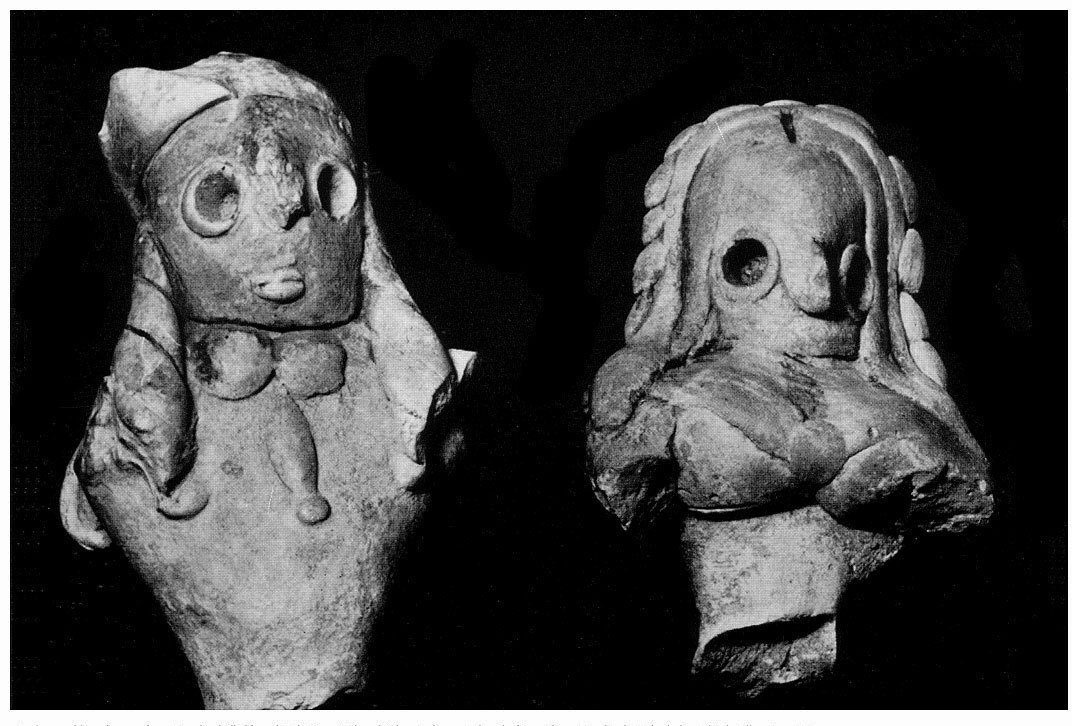
Mother goddess figures from Mundigak (left) and Deh Morasi Ghundai (right). 3rd millennium BCE.
Example of a vessel from Nal. Comparable ceramics were also found in Mundigak
Painted vessel

The finds include numerous terracotta figures, which often represent people, mostly women, but also men. There are also frequent depictions of cattle. In addition, in the remains of Period IV, the head of a limestone man's statue was found.[25] It is the only object that can be called a work of art in the narrower sense. The face is rather roughly worked. The eyes and eyebrows are heavily stylized. The man has short hair and a headband that ends in two falling strips of fabric on the back. Statues were also found sporadically in the Indus culture, in the oasis culture spread around the same time in the north and in Shahr-i Sukhta, which is also attributed to the Helmand culture. The statues show a man kneeling on the floor, often described as a priest-king. It has been suggested that Mundigak's head also belonged to such a figure,[26] but this cannot be proven.

Pottery is particularly important for small finds. Most of the ceramics are painted, some of them polychrome. Various decoration traditions can be proven that are also known from other places and thus help to locate Mundigak in the context of other cultures and thus also in time. The excavation report largely focuses on decorated forms, so the undecorated pottery is less well known. There were hand-formed vessels, but also those that were made on the potter's wheel. Periods I and II are dominated by simple, painted geometric patterns, often on the upper edge of bowls; in Period III the painting becomes more complex. There are still predominantly geometric patterns that belong to the so-called Quetta style. Others are painted in the style of the Nal culture or have similarities with ceramics of the Amri culture. In Period IV there are also isolated figurative representations, especially cattle.[27] Various clay chalices come from Period IV, decorated with rows of animals painted in black, but also with individual plants. A group of these chalices was found in room XXII in the palace. The goblets exposed there were intact.[28]

From Period IV there are two larger ceramic vessels with a sliding lid that may have served as mouse traps.[29] Comparable mouse traps are known from Mohenjo-Daro in the Indus Valley. The corresponding finds from Mundigak are probably several centuries older.[30]

Spinning whorls are from Period I.4. attested, of which there were two types: one is conical in shape and made of clay, the other is disc-shaped and carved from stone.[31] Stone vessels are attested in almost all layers.[32]

From Period I, level 2 onwards, bronze objects are attested. Initially, they are simple tools such as needles and weapons. However, the remains of a mirror also come from Period IV. An investigation showed that these artifacts were mostly made of bronze with a low tin content.[33] Five objects with iron elements from Period IV are noteworthy.[34] The iron always served as a decoration for bronze objects; there were no artifacts made entirely of iron.[35]

Apart from pottery and painted pottery, other artifacts found include crude humped bulls, human figures, shaft hole axes, adzes of bronze and terracotta drains.[22] Painting on pots include pictures of sacred fig leaves (ficus religiosa) and a tiger-like animal.[36] Several stone button seals were also found at Mundigak.[37] Disk Beads and faience barrel beads,[38] copper stamp seals, copper pins with spiral loops were also found.[39]

The female-looking human figurines (5 cm (2.0 in) in height) found at Mundigak are very similar to such figurines found at another archeological site in Afghanistan, Deh Morasi Ghundai (circa 3000 BCE).[2]

Collection:

Field work:

  • 1951-58 Casal, MAI – excavations.[40]

Finds in the Musée Guimet, mainly from Period IV

[edit]

See also

[edit]

References

[edit]
[edit]
Revisions and contributorsEdit on WikipediaRead on Wikipedia
from Grokipedia
Mundigak is a major archaeological site in southern , consisting of a series of mounds spanning approximately 21 hectares and representing an urban center that was occupied from around 4000 BCE, flourishing until ca. 1500 BCE with later reoccupations. Situated about 55 kilometers northwest of modern in the upper drainage of the Kushk-i Nakhud River, a tributary of the system, the site evolved from a small agricultural village in its early phases to a fortified with monumental architecture. Excavations conducted between 1951 and 1958 by French archaeologist Jean-Marie Casal under the Délégation Archéologique Française en Afghanistan (DAFA) uncovered stratified remains across multiple periods, including mud-brick structures, fortifications, and artifacts that highlight its role in regional trade and cultural exchange. The site's chronology is divided into several phases: Period I (ca. 4000–3500 BCE) marks initial settlement with basic pottery; Period II (ca. 3500 BCE) shows continuity; Period III (ca. 3500–2800 BCE) features expanded architecture; Period IV (ca. 3000–2000 BCE) represents the peak of urbanization with a palace complex and advanced ceramics; Period V (ca. 2000–1500 BCE) indicates decline, followed by sporadic reoccupation in Periods VI and VII. Key discoveries include polychrome pottery, such as Togau and Faiz Mohammad Grey Ware, terracotta human figurines of type, imported Kot Diji-style jars from , and a notable stone sculpted head possibly depicting a local elite figure. Mundigak's significance lies in its position within the Helmand Civilization, bridging cultural interactions between the Indus Valley, eastern Iran (e.g., Shahr-i Sokhta), (e.g., and Nausharo), and during the and early , as evidenced by shared ceramic styles and motifs that predate the mature Indus phase around 2500 BCE. As of 2025, the Mundigak Historical and Cultural Foundation has been established to support preservation and study of the site.

Overview and Location

Site Description

Mundigak is an situated at coordinates 31.9039°N 65.5246°E, approximately 55 km northwest of in southern . The site encompasses a total area of 21 hectares, establishing it as the second largest center of the after Shahr-i-Sokhta, which spans about 150 hectares. The mound structure rises to a maximum height of 9 meters and is divided into multiple hills labeled A through I, P, and R, featuring varying elevations across the terrain. As a center of the , Mundigak reveals a prehistoric town layout indicative of , with distinct zones for palaces, temples, residential areas, and cemeteries.

Geographical and Environmental Context

Mundigak is located in southern Afghanistan's , approximately 55 kilometers northwest of the city of , in a mountainous region that bridges the arid steppes of the to the southeast and the fertile river valleys of the Helmand Basin. This strategic positioning facilitated connections between desert trade routes and riverine pathways, enhancing the site's role as a regional hub. The site lies on the upper drainage of the Kushk-i Nakhud River, a within the broader system, which provided essential for settlement and early agricultural activities in an otherwise arid . The Helmand Basin, encompassing Mundigak, features a semi-arid to arid with low annual , typically below 250 millimeters, supporting limited dry farming but necessitating for sustained crop production such as and . Evidence of early precursors, including wells and canal-like features in the vicinity, indicates adaptive environmental strategies that leveraged seasonal river flows to mitigate aridity. Natural resources in the region were pivotal to Mundigak's development, with abundant alluvial clay deposits from the Kushk-i Nakhud River enabling widespread mud-brick construction for dwellings and infrastructure. Local stone, particularly sourced from nearby outcrops, complemented these materials for foundational elements, while the basin's , enhanced by river sediments, offered agricultural potential in a otherwise dominated by expanses like the . These environmental factors collectively influenced the site's occupation by providing both challenges and opportunities for resource exploitation and settlement resilience.

Discovery and Excavations

Initial Identification

Mundigak was first noted in 19th-century travel accounts by British explorers and officers traversing southern Afghanistan, who documented numerous ancient mounds and ruins in the region as potential sites of historical significance. These observations, often incidental during expeditions, highlighted the prevalence of prehistoric tells amid the arid landscape, though systematic recording was limited until later efforts. In the early , more structured surveys by British and French explorers began to assess such sites, with the establishment of the Délégation Archéologique Française en Afghanistan (DAFA) in 1922 marking a pivotal advancement in Afghan archaeology. British archaeologist Beatrice de Cardi conducted surface surveys in and Farah provinces in 1950, identifying Mundigak as a prominent among others based on its substantial size—spanning approximately 21 hectares—and scattered surface remains. Pre-1950s assessments positioned Mundigak as a key prehistoric site during regional reconnaissance, distinguishing it from contemporary settlements due to visible pottery sherds suggesting occupation. The site's prioritization for further investigation stemmed from the early involvement of French scholars affiliated with DAFA, including directors Alfred Foucher and Joseph Hackin, whose foundational work in Afghan from the 1920s onward emphasized the potential of southern sites like Mundigak to reveal connections to broader regional cultures, such as the Helmand tradition. This groundwork facilitated the subsequent formal excavations led by Jean-Marie Casal starting in 1951, underscoring Mundigak's role as one of Afghanistan's earliest recognized urban precursors.

Major Excavation Campaigns

The major excavation campaigns at Mundigak were carried out by the French Archaeological Mission in Afghanistan (DAFA), directed by Jean-Marie Casal, spanning ten field seasons from 1951 to 1958. These efforts systematically explored the site's multiple mounds through stratigraphic trenching and the careful exposure of architectural features, enabling the recovery of a wide range of artifacts including ceramics, metal objects, and structural remains. The work concentrated on key areas such as hill A, which yielded evidence of monumental buildings interpreted as a palace complex, and hill C, revealing a cemetery with burials spanning several periods. The campaigns employed standard mid-20th-century archaeological methods, including excavations to delineate settlement layers and reconstruct urban development sequences. Over the course of these seasons, approximately 20% of the site was investigated, uncovering stratified urban deposits that provided the foundation for defining Mundigak's seven chronological periods. Key immediate outcomes included the identification of advanced mud-brick , sophisticated traditions, and of a proto-urban center in southern , highlighting connections to broader regional cultures. These excavations represented a collaborative endeavor between French and Afghan authorities, facilitated by bilateral agreements that allowed for the shared custody of finds. Artifacts were divided between Afghanistan's National Museum in , where they formed the basis of dedicated exhibits, and France's Musée Guimet in , which houses significant collections supporting ongoing . The joint nature of the project ensured local involvement in fieldwork and preservation, while funding primarily came from the French government through DAFA.

Post-Excavation Analysis and Challenges

Following the primary excavations in the 1950s, post-excavation analyses have refined Mundigak's chronology through recalibrated radiocarbon dating and stratigraphic reassessments, confirming occupation from approximately 4000 to 2000 BCE. Early radiocarbon samples from Periods III and IV, originally dated using uncalibrated methods, yielded results of 3130 ± 110 BP (Gif-100) for Period III and 3850 ± 110 BP (Gif-101) for Period IV; post-1950s calibrations adjusted these to roughly 1520–1130 cal BC and 2470–2140 cal BC at 95.4% probability, respectively, aligning with broader Helmand Basin sequences. Additional samples from related strata, such as Period I (e.g., TF-1131: 4568 ± 102 BP, calibrated to 3360–2910 cal BC), further support a foundational phase around 4000–3500 BCE, with stratigraphic correlations emphasizing gradual urban development through Period IV. These refinements, incorporating Bayesian modeling where possible, have resolved inconsistencies in earlier uncalibrated data and enhanced comparisons with neighboring sites. In the , comparative studies by Jean-François Jarrige and colleagues reexamined Mundigak's assemblages alongside those from Shahr-i Sokhta, updating period linkages within the . Their analysis highlighted shared motifs, such as canister pots with decorations, linking Mundigak Period IV (ca. 3000–2500 BCE) to Shahr-i Sokhta Period IV (ca. 2800–2600 BCE), suggesting intensified regional interactions during urban flourishing. However, ongoing Afghan conflicts have severely limited new fieldwork since the , restricting analyses to archival materials and preventing systematic reexcavations. As of 2025, political instability has continued to hinder access. Preservation challenges at Mundigak have intensified since 1979, driven by looting, natural erosion, and war-related damage amid successive conflicts including the Soviet invasion, civil war, and post-2001 instability. Looting pits and illicit excavations have scarred the site, contributing to the loss of countless artifacts, many of which ended up in exile collections abroad; for instance, the National Museum of Afghanistan lost approximately 70% of its holdings (around 140,000 objects) during the 1989–1996 civil war alone, with Mundigak materials among those affected or smuggled via Pakistan and the UAE. Erosion has further degraded upper strata, while military activities have caused direct structural damage, complicating future conservation efforts. Significant gaps persist in understanding Mundigak, particularly for Period V (late 3rd to early BCE), where poor preservation due to heavy erosion and disturbed has left limited architectural and artifactual evidence, possibly influenced by earthquakes or abandonment phases. This has hindered assessments of cultural continuity post-Period IV, with no direct parallels in southern . Recent calls for surveys, exemplified by a 2021 study using to map 138 new mounded sites near (including references to Mundigak as a benchmark), underscore the potential for non-invasive methods to address these issues amid access restrictions.

Chronology and Settlement Phases

Periods I-III: Foundations and Growth

Mundigak's Periods I-III represent the foundational phases of settlement at the site, marking a transition from rudimentary village life to more organized proto-urban development in southern during the fourth and early third millennia BCE. These periods, excavated primarily by Jean-Marie in the , reveal a gradual buildup of population and infrastructure, supported by agricultural practices and basic . places Period I around 4000–3500 BCE, Period II circa 3500 BCE, and Period III approximately 3500–2800 BCE, though calibrations vary slightly across studies. In Period I, the site consisted of a small agricultural village characterized by simple structures, including oblong mud-brick houses measuring about 3 by 2 meters, often with buttresses and associated ovens. These dwellings indicate sedentary occupation by farming communities cultivating crops like and , alongside herding domesticated sheep, goats, and . Ceramics from this phase feature buff-red ware, predominantly wheel-made (around 90%), decorated with black geometric motifs such as lines and triangles on bowls and jars; collared jars appear toward the end of the period. No burials or seals have been reported, suggesting a relatively egalitarian society focused on subsistence. Period II shows increased density and complexity, with multi-room mud-brick buildings, possible functional zones like pens, and infrastructure such as a well (1 meter in diameter and 8 meters deep) and large potter's ovens, pointing to and specialized activities. Pottery styles simplify, with handmade vessels rising to about 97% initially before declining, featuring plain bowls and jars in buff-red ware. Agricultural evidence persists, including remains, while the introduction of crude flat stone seals with geometric designs and two perforations for suspension hints at emerging administrative or symbolic practices. By Period III, habitation expanded significantly, with higher structure density, shared walls suggesting socio-cultural units, and features like retaining terrace walls for stability on the mound. Turned pottery dominates (up to 85%), including Quetta Ware with intricate geometric motifs, reflecting technological advancement. Burials appear, including flexed or crouched inhumations in a cemetery on Mound C, some in ossuaries with multiple individuals and grave goods like bronze axes, indicating evolving mortuary practices. Geometric stone seals become more numerous and elaborate, further evidencing social complexity and possible trade or administrative functions. Overall, these periods illustrate a shift from isolated farmsteads to a burgeoning town with basic infrastructure, laying the groundwork for later urbanization. Dates are approximate and subject to revision based on ongoing radiocarbon calibrations.

Period IV: Urban Flourishing

Period IV at Mundigak, spanning approximately 3000–2000 BCE, represents the pinnacle of the site's development as a major urban center within the Helmand Civilization. This era is subdivided into three main layers—IV.1, IV.2, and IV.3—each marked by progressive enhancements in and , transforming the earlier village settlement into a sprawling . Excavations by Jean-Marie Casal revealed that the site expanded dramatically to occupy the full extent of its approximately 21 hectares across multiple mounds (A through I) with integrated residential and public zones. Social organization during this period indicates a hierarchical society capable of mobilizing significant labor for large-scale projects, as evidenced by the construction of monumental buildings like a and temple, alongside specialized crafts such as and copperworking. Although no has been found, the presence of multi-chambered public structures and water management features, such as basins, suggests centralized authority and administrative functions supporting a growing of full-time artisans and traders. networks flourished, linking Mundigak to regions in and the Indus Valley through exchanges of lapis lazuli, , and ceramics, underscoring its role as a caravan hub. The city's defenses included robust walls with quadrangular buttresses and towers, enclosing residential areas that indicate peak and economic activity around 2600–2400 BCE. In IV.1, known as the "Epoch of the Palace," initial fortifications and elite structures emerged, followed by refinements in IV.2 and IV.3 that enhanced urban cohesion. By the close of Period IV, signs of gradual abandonment appeared circa 2000 BCE, potentially linked to environmental shifts or external pressures, leading to a contraction of settlement before reoccupation in later phases. Dates are approximate and subject to revision based on ongoing radiocarbon calibrations.

Periods V-VII: Decline and Reoccupation

Period V, dated approximately to 2000–1500 BCE, represents a phase of significant decline at Mundigak, with layers heavily damaged by that obscure much of the architectural record. The primary surviving feature is the "Monument Massif," a large structure constructed atop the ruins of the earlier Period IV on the central mound (Tepe A), accessed via a monumental ramp. This building, while monumental in scale, suggests a reduced level of activity compared to the preceding urban phase, with no evidence of integration or overlap with contemporary Indus Valley . Following this period, the site experienced full abandonment around 1500 BCE, marking the end of sustained urban occupation and a shift away from the region's earlier in the Helmand Civilization. Environmental factors, such as and shifting river courses in the Helmand basin, likely contributed to this depopulation, as evidenced by broader regional patterns of settlement contraction. Dates are approximate and subject to revision based on ongoing radiocarbon calibrations. Period VI, post-dating 1500 BCE, shows sparse evidence of transient human activity rather than permanent settlement, characterized by nomadic traces including scattered fireplaces and fragments of imported ceramics from regions like and the Indus periphery. These finds indicate occasional visits by mobile groups, possibly pastoralists, who left minimal structural impact and no signs of organized community life, underscoring the site's transformation from a bustling urban center to an intermittent waypoint. Artifacts from this phase are limited, primarily consisting of coarse local wares alongside the exotic imports, which highlight continued but tenuous connections to wider trade networks. By Period VII in the BCE, during the , Mundigak saw limited reoccupation as a rural outpost, evidenced by the construction of agricultural storehouses on the periphery of the earlier mounds. These simple structures, likely used for grain storage, point to small-scale farming communities exploiting the surrounding fertile plains without reviving the site's former urban character. The scarcity of artifacts and absence of monumental further emphasize this phase's modest scale, reflecting a broader pattern of decentralized settlement in southern . Overall, Periods V-VII illustrate Mundigak's marked trajectory from prosperity to abandonment and sporadic reuse, with the site's role diminishing as nearby centers like emerged.

Architecture and Urban Planning

Monumental Buildings

The monumental buildings at Mundigak primarily date to Period IV (c. 2900–2400 BCE), when the site flourished as an urban center on Hill A, featuring elite and possibly ritual structures that highlight advanced organizational capacity. These edifices, constructed atop terraced mounds for elevation, underscore the site's role in the Helmand Civilization's architectural traditions. The palace on Hill A, a multi-room complex spanning approximately 35 meters along its northern facade, served elite administrative and ceremonial functions. Its exterior featured pilastered walls with engaged columns and a frieze, coated in white that was periodically renewed, along with a red-painted frame for emphasis. Inside, the structure included small elevated rooms with , offering tables, and a drain system, adjacent to an oval in a containing ash deposits, suggesting activities integrated with . Adjacent to the palace on Hill A, the temple—a large rectangular building with buttressed walls and stone foundations—likely functioned as a ritual space. The eastern section comprised small rooms, while the western part opened into a with a central elevated basin, white-plastered benches, and a red-painted rectangular accessed by steps, all indicative of ceremonial use. A ceramic drain and L-shaped complex further supported its non-residential, possibly sacred purpose, though direct evidence of worship remains interpretive. In Period V (c. 2000–1500 BCE), following abandonment, limited reoccupation is evident in the Monument Massif built atop the on Hill A, comprising a large terraced platform with ramps built in two stages. This mud-brick structure, akin to Mesopotamian ziggurats, points to continued monumental activity as a cult center. across these periods relied on mud-bricks (raw sun-dried) for walls and platforms, often reinforced with stone foundations and buttresses for stability, while fired bricks appeared sparingly in critical elements like drains. Terraced mounds elevated structures, requiring substantial labor and reflecting sophisticated engineering in a semi-arid environment.

Residential and Defensive Structures

The residential at Mundigak evolved significantly from its foundational phases through Period IV, reflecting growing complexity in domestic life and urban organization. In the early stages of Periods I-III, houses took the form of small oblong cells constructed with pressed walls, serving as basic shelters likely used for storage or simple habitation. By the subsequent subphases, these developed into larger structures comprising square or oblong rooms built from sun-dried bricks, indicating improved techniques and possibly increased household sizes. During Period IV, residential buildings became more sophisticated multi-room units, often featuring specialized domestic elements such as interior ovens for cooking and drainage systems to manage wastewater. These houses were typically clustered in organized residential quarters, particularly in excavation area , where networks of interconnected rooms suggested communal living arrangements and efficient space utilization. Public features within these areas included multi-chambered complexes, enhancing the community's adaptive . Defensive structures reached their peak in Period IV, when the expanded residential city was enclosed by massive walls reinforced with square towers, providing protection against external threats. These fortifications incorporated gateways for controlled access, underscoring a deliberate strategy that integrated defense with daily life. The layout in this phase accommodated the undulating of the settlement mounds while maximizing defensibility and circulation.

Artifacts and Material Culture

Ceramics and Pottery

The ceramics of Mundigak represent a key element of the site's material culture, evolving from rudimentary handmade vessels in the early phases to more sophisticated wheel-thrown forms during the urban period, reflecting technological and stylistic developments within the Helmand region. Excavations by Jean-Marie Casal revealed a sequence of pottery types that trace the settlement's growth, with painted decorations shifting from simple geometrics to complex figurative motifs, often using local clays and evolving firing methods. These artifacts, primarily functional vessels like bowls, jars, and goblets, provide insights into daily life and trade connections without overlapping into representational objects. In Periods I-II (ca. 4000–3500 BCE), consisted mainly of handmade wares featuring painted geometric patterns and occasional figurative motifs, such as stylized animals including in the Togau style. These vessels, comparable to those from III-IV and sites, included simple bowls and jars with monochrome or bichrome decorations in black and red on a buff or red slip, indicating early coil-building techniques and open firing. The paste was coarse, sourced from local alluvial clays along the nearby rivers, suggesting initial experimentation with ceramic production in a village context. During Periods III-IV (ca. 3500–2000 BCE), ceramics transitioned to buff-colored, wheel-thrown pots, marking a technological advancement associated with urban expansion. Common forms included tall chalices or pedestal beakers, large storage jars, and shallow bowls, often decorated with incised designs or painted motifs such as pipal leaves, , and stepped geometrics in schemes of red, black, and white. jars with perforated lugs and elaborate figurative elements, akin to influences, appeared in Period III, while Period IV featured imports like Kot Diji-style jars and Faiz Mohammad wares alongside local productions with finer pastes and improved pigment adhesion using fired steatite. Firing techniques advanced to controlled kilns, achieving higher temperatures for denser bodies, with clay likely derived from the sediments for consistency. In Periods V-VII (ca. 2000–1000 BCE), pottery styles simplified, with a reversion to handmade forms and duller finishes, including mat-impressed purple-red wares and imported Kot Diji-like vessels indicating reduced local production during decline and reoccupation. Storage jars and basic bowls dominated, featuring minimal incised or painted geometrics, often with coarser pastes from the same riverine sources but lower firing quality, reflecting economic contraction. Overall, these changes highlight a progression from geometric simplicity to ornate urban expressions and back to utilitarian wares, underscoring Mundigak's role in regional ceramic traditions.

Figurines, Seals, and Sculptures

Among the small finds at Mundigak, terracotta figurines from Periods III and IV represent key examples of anthropomorphic and zoomorphic . Anthropomorphic figurines, predominantly , are highly stylized in a standing position with prominent breasts, pinched faces, eyes, broad lips, and sometimes winged arms or flat profiles. In Period IV, two such figurines were modeled in the round, exhibiting similarities to the "" style known from nearby sites. Zoomorphic forms include humped bulls, often adorned with painting or collars, likely serving ritual or votive roles in proto-urban contexts. Stamp seals, primarily of stone, emerged in crude flat forms with perforations during Period II but proliferated in Period III, featuring geometric motifs that suggest administrative functions. These seals display local iconographic themes, such as simple incised lines and grids, without evidence of a developed script, pointing to early symbolic systems in the Helmand region's urban development. Sculptural works include a white limestone male head from Period IV (c. 2700 BCE), discovered near a monumental terraced building possibly serving as a temple or palace. Architectural sculptures featured stuccoed pilasters on the palace facade, painted white to enhance structural elements during the site's urban peak. Overall, these artifacts emphasize stylized local motifs—human forms evoking fertility, animals symbolizing power, and geometric patterns denoting organization—reflecting a distinct proto-urban aesthetic without reliance on writing.

Tools, Metals, and Other Objects

Excavations at Mundigak revealed a progression in tool technologies from bone and stone implements in the early phases to more advanced metalworking by Period IV, indicating growing metallurgical expertise within the Helmand Civilization. In Period I, bone awls served as primary piercing tools, often alongside cold-worked copper blades and simple flat blades with hafting tangs, reflecting initial experimentation with metal for utilitarian purposes. These early bone and copper items supported basic activities like crafting and animal processing, with bone tools gradually supplemented by metal alternatives as techniques advanced. By Period III, alloying emerged, with copper-tin tools such as shaft-hole axes and adzes containing up to 5% tin, likely cast in molds and influenced by western Iranian technologies. In Period IV, the urban peak, production intensified, yielding functional tools like tanged lozenge- and oval-shaped arrowheads (points), sickles for harvesting, punches, and blades, alongside adzes for . These implements facilitated through sickles and adzes, via arrowheads and heads, and craft production with punches and blades, underscoring Mundigak's role as a regional hub for metal-based economies. Ornaments like double-volute pins, buckles, and concave disc mirrors, also in low-tin (around 1-5% tin), complemented these tools, suggesting specialized workshops. Metallurgical evidence points to local at Mundigak, with tin likely imported due to its scarcity in the region, enabling the shift from cold-hammered to alloyed by the late third millennium BCE. Traces of iron appear in Period IV as smelted decorative buttons on objects, marking an early transition, though no purely iron tools were identified. Some studies propose that ironworking may date to around 2300 BCE, based on artifact analyses linking Mundigak's metal catalogs to Indus Valley traditions, though this remains debated among archaeologists. Beyond metals, other utilitarian objects included terracotta drains for managing in residential structures, disk and barrel beads of stone and for personal adornment, and lingering bone implements like eyed in transitional phases. These non-metal items supported daily , , and crafting, complementing the metal tools in sustaining Period IV's urban lifestyle.

Cultural and Historical Significance

Role in the Helmand Civilization

The Helmand Civilization represents a cultural network in southwestern and southeastern , centered on the basin and flourishing approximately from 3300 to 2000 BCE, with its urban phase most prominent in the third millennium BCE. While the site was occupied from ca. 4000 BCE, the Helmand Civilization's urban network is dated to ca. 3300–2000 BCE. This civilization is characterized by early urban settlements that developed independently in the region, featuring interconnected sites along river valleys that supported proto-urban economies and . Mundigak served as one of the central urban hubs of the Helmand Civilization, standing as the largest settlement in southern alongside Shahr-i Sokhta in , with its expansive mounds covering approximately 21 hectares and evidencing organized . As a core site, it exemplified the civilization's regional cohesion through shared architectural and traditions, contributing to the of complex societies in the Helmand basin during Periods III and IV. Its prominence underscores Mundigak's role in fostering inter-site networks that defined the civilization's extent and vitality. The economic foundation of the Helmand Civilization, as reflected at Mundigak, relied on sustained by riverine , complemented by and specialized crafts such as production and bead-making. Evidence of appears in the distribution of like vessels and elaborate burials, indicating emerging hierarchies and craft specialization that supported within the basin. Culturally, Mundigak embodied the Helmand Civilization's indigenous development, with minimal external influences until Period IV around 2600 BCE, relying on local mud-brick construction techniques and distinctive ceramic styles that linked it to other basin sites. These traits highlight an autonomous evolution of in the region, marked by shared traditions and architectural forms that reinforced internal cultural unity.

Connections to Neighboring Cultures

Mundigak exhibited significant cultural connections to the Indus Valley Civilization, particularly during its Period IV (ca. 3000–2000 BCE), which aligns with the phase of the Early Harappan period. Similarities in pottery include Kot-Dijian style jars with distinct shapes and paddle-and-anvil techniques, as well as shared motifs such as pipal leaves, bulls, and snakes on ceramics and figurines. Urban planning features at Mundigak, including monumental structures and organized layouts, parallel those in Indus sites, suggesting potential exchanges in architectural practices during this era. The site also maintained ties with regions in Baluchistan and , notably the Namazga culture. In Baluchistan, shared ceramics like Nal-style vessels and Zhob-like figurines indicate interactions, while connections to Early Harappan sites are evident through comparable seals from Rehman Dheri. Links to Turkmenistan's Namazga-depe (ca. 3000–2500 BCE) are reflected in parallels of painted pottery, figurines, and seals, including concentric circle designs widespread in the Indo-Iranian borderlands. These exchanges highlight shared glyptic and ceramic traditions across southeastern Afghanistan and southern . Trade evidence underscores Mundigak's role in regional networks, with imported from mines processed into ornaments and beads, facilitating routes to the Indus Valley, , , and by the late fourth millennium BCE. Although no direct writing systems connect the sites, iconographic parallels—such as kneeling stone statues resembling Indus "Priest-King" figures—point to without textual evidence. As part of broader interaction spheres (ca. 3000–2500 BCE), Mundigak participated in networks exchanging pottery, metallurgy, semiprecious stones, and glyptics with , Pakistani Baluchistan, , and the steppe world, laying foundations for later developments. These early connections influenced the region's integration into the (ca. 550–330 BCE), where ancient trade routes and administrative structures in satrapies like built upon preexisting Chalcolithic pathways.

References

Add your contribution
Related Hubs
User Avatar
No comments yet.