Hubbry Logo
Terrorism in EgyptTerrorism in EgyptMain
Open search
Terrorism in Egypt
Community hub
Terrorism in Egypt
logo
8 pages, 0 posts
0 subscribers
Be the first to start a discussion here.
Terrorism in Egypt
Terrorism in Egypt
from Wikipedia

Islamic Terrorism in Egypt
Part of Terrorism in Egypt, the Egyptian Crisis, the War on terror, and the Arab Winter, and the Sinai insurgency

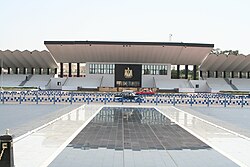
Platform where Anwar Sadat was assassinated.
Date6 October 1981 – present
Location
Status Ongoing
Belligerents

Egypt

Islamists:


Islamic State[14] (from 2014)

Commanders and leaders

Abdel Fattah el-Sisi
Egypt Mostafa Madbouly
Mahmoud Tawfik
Abdel Mageed Saqr
Ahmed Fathy Khalifa
Ashraf Ibrahim Atwa
Mahmoud Foaad Abd El- Gawad
Mohamed Hegazy Abdul Mawgoud

Abu Hafs al-Hashimi al-Qurashi
Abu Hajar al-Hashemi
Abū al-Muḥtasib al-Maqdisī
Mohammed Badie

Strength
Total: 25,000 (41 battalions)[31]

Total: ≈12,000[32]


IS: 1000-1500
Casualties and losses
3,277 killed
12,280 Injured[33]
IDF: 1 killed[34]
Thousands killed, Arrested, captured, or surrendered
[35][36][37]
Civilian fatalities: 1,539+ Egyptian,[38][39] 219 Russians, 4 Ukrainians, 1 Belarusian,[40] 3 South Koreans,[41] 3 Vietnamese, 2 Germans,[42] 1 Croatian[43]
Total: 5,853–7,353+ killed

Terrorism in Egypt in the 20th and 21st centuries has targeted the Egyptian government officials, Egyptian police and Egyptian army members, tourists, Sufi Mosques and the Christian minority. Many attacks have been linked to Islamic extremism, and terrorism increased in the 1990s when the Islamist movement al-Gama'a al-Islamiyya targeted high-level political leaders and killed hundreds – including civilians – in its pursuit of implementing traditional Sharia law in Egypt.[44]

Ayman al-Zawahiri, an Egyptian doctor and leader of Egyptian Islamic Jihad group, was believed to be behind the operations of al-Qaeda. As of 2015,[needs update] four of 30 people on the United States Federal Bureau of Investigation "most wanted" terrorist list are Egyptian.[45]

Muslim Brotherhood (1940s–50s)

[edit]

In 1943 the Islamist Muslim Brotherhood group—a very large and active organization at that time—was thought to have established "a 'secret apparatus'" i.e. "a separate organization for paramilitary activity under the direct authority" the Brotherhood's head, Sheikh Hassan al-Banna."[46] In 1948, the group is thought to have assassinated appellate judge Ahmad El Khazindar in retaliation for his passing a "severe sentence" against another member of the Brotherhood.[47]

After the 1948 victory of the Jewish state of Israel over Muslim Arab armies the group is believed to have set fire to homes of Jews in Cairo in June 1948 in retaliation. In July, two large department stores in Cairo owned by Jews were also burned.[46] A couple of months later police captured documents and plans of the 'secret apparatus. 32 of its leaders were arrested and its offices were raided,[46] and shortly thereafter Prime Minister Mahmoud El Nokrashy Pasha ordered the dissolution of the Brotherhood.[48]

On 28 December 1948, Prime Minister Mahmoud El Nokrashy Pasha was shot and assassinated by Abdel Meguid Ahmed Hassan, a veterinary student and member of the Brotherhood. The country was shocked and traditionalist clergy condemned the act. The Grand Mufti, Imam of Azhar mosque and the Council of Ulema all condemned the perpetrators as kuffar.[46]

Less than two months later the head of the Brotherhood, Hasan al-Banna, was himself victim of an assassination, the perpetrators thought to be supporters of the murdered premier.[46]

After a nationalist military coup led by Gamal Abdel Nasser overthrew the Egyptian monarchy, the Brotherhood was very disappointed to find the officers were secular in orientation and the Brotherhood did not gain influence. On 26 October 1954 a member of the brotherhood attempted to assassinate President Nasser[49] and a general suppression of the Brotherhood followed, including imprisonment of thousands of members and the execution of six of its most prominent leaders.[50]

Lavon affair (1954)

[edit]

A covert operation under the direction of Israeli military intelligence attempted to destabilize the Nasser government in the summer of 1954 through terrorist bombings of Egyptian, American and British government facilities. The operation was unsuccessful and the Israeli-trained Egyptian Jewish operatives who planted the bombs were all captured, although all of their Israeli handlers escaped. The Lavon Affair, so named because Israeli Defense Minister Pinhas Lavon was later implicated and forced to resign, was a false flag operation with evidence planted at the bomb sites implicating the Muslim Brotherhood.[51] The State Security was responsible for the interrogation of the Jewish suspects and managed to gather important information by torture.

Influence of Sayyid Qutb (1980s–2000s)

[edit]

In the 1980s, 1990s, and 2000s, terrorist attacks in Egypt became more numerous and severe, and began to target Christian Copts and foreign tourists as well as government officials.[44] This trend surprised some foreigners who thought of Egypt as a country that "embraced" foreigners "with suffocating affection" and preferred a "tolerant brand of Islam".[44] Some scholars and authors have credited Islamist writer Sayyid Qutb[52][53] as the inspiration for the new wave of attacks.

Qutb was author of Ma'alim fi al-Tariq (Milestones), a manifesto for a jihad of "physical force" to eliminate "the kingdom of man", and bring about "the kingdom of God on earth".[52][54] According to his theory, sometimes referred to as Qutbism, Islam was not just in need of revival but had actually ceased to exist. "The Muslim community has been extinct for a few centuries, having fallen back into a state of pagan ignorance" known as jahiliyyah because of the failure of the world Muslim community to obey Shariah law.[55][56] To rectify the situation, "the organizations and authorities of the jahili system"[57] would have to be abolished by "physical power and Jihad",[57] by a "vanguard"[58] movement of true Muslims, distinct from that Jahili society.[59] Qutb emphasized the all-encompassing irredeemable awfulness of jahili society,[60] the wickedness and cruelty of those opposed to the movement of true Muslims,[61] and the utter worthlessness of Western civilization.[62] His book has been called "one of the most influential works in Arabic of the last half century".[63] It became a best seller, went through many editions and strongly influenced Islamists in prison in Egypt. Qutb, who had been executed in 1967 after another purported plot to assassinate of Abdel Nasser, became a shahid to his supporters.

Military Technical College attack (1974)

[edit]

On 18 April 1974, 100 members of the Islamic Liberation Organization (or Shabab Muhammad Group) stormed the armory of the Military Technical College in Cairo, seizing weapons and vehicles. Led by Salih Sirriya[64] they hoped to kill President Anwar El Sadat and other top Egyptian officials – who were attending an official event nearby in the Arab Socialist Building – seize radio and television buildings (also nearby) and announce the birth of an Islamic State under the leadership of Hizb ut-Tahrir.[65] 11 were killed and 27 wounded in the attempt as security forces were able to intercept conspirators before they left the academy. 95 ILO members are arrested and tried. 32 were convicted. Two were executed.[66]

Takfir wal-Hijra (1977)

[edit]

On 3 July 1977, a group known to the public as Takfir wal-Hijra (excommunication and exile), kidnapped former Egyptian government minister Muhammad al-Dhahabi. The group was led by a self-taught Islamic preacher Shukri Mustafa, and called themselves Jama'at al-Muslimin. Among their demands in exchange for al-Dhahabi's release were the release of 60 of Takfir wal-Hijra members from jail, public apologies from the press for negative stories about the group, the publication of a book by Mustafa, and 200,000 Egyptian pounds in cash.[67] Instead of complying, the press publicized "a long list of offenses and crimes attributed to the group."[68] Four days after the kidnapping, al-Dhahabi's body was found.[67] The murder provoked indignation among the Egyptian public[69] and extensive police raids led to the arrests of 410 of the group's members.[50]

Salvation from Hell (1980s)

[edit]

Salvation from Hell sought to establish an Islamic state using force.[70] The Egyptian government broke off ties with Iran following allegations that Iran funded the group.[71] Yasser Borhamy was detained for a month in 1987 due to his alleged connection with the assassination attempt against interior minister Hassan Abu Basha.[72] The group was also responsible for an assassination attempt on former interior minister Nabawi Ismail.[70]

Tanzim al-Jihad movement (1981)

[edit]

Targeting Christians

[edit]

In spring of 1981, Sheikh Omar Abdel-Rahman agreed to become the mufti of the shura (council) of underground Egyptian group Tanzim al-Jihad, the forerunner of Egyptian Islamic Jihad and al-Gama'a al-Islamiyya. He issued a fatwa sanctioning "the robbery and killing of Copts in furtherance of the jihad".[73]

Sadat assassination and uprising

[edit]

By 1981 President Anwar Sadat had become unpopular among some Egyptians and enraged Islamists by signing of a peace treaty with Israel. On 6 October 1981, Sadat and six diplomats were assassinated while observing a military parade commemorating the eighth anniversary of the October 1973 War. Lieutenant Colonel Khalid Islambouli and two other members of the Tanzim al-Jihad movement fired machine guns and threw grenades into the reviewing stand.[74]

In conjunction with the assassination of Sadat, Tanzim al-Jihad began an insurrection in Asyut in Upper Egypt. Rebels took control of the city for a few days on 8 October 1981 before paratroopers from Cairo restored government control. 68 policemen and soldiers were killed in the fighting, but sentences of arrested militants were relatively light, with most of them serving only three years in prison.[75]

Attacks on Israelis (1985–2024)

[edit]

The Ras Burqa massacre was a shooting attack in October 1985 on Israeli vacationers in Ras Burqa, a beach resort area in the Sinai peninsula, in which seven Israelis were killed, including four children. Egypt refused to allow the victims to be treated by Israeli doctors or transferred to hospitals in Israel.[76]

On 4 February 1990, a bus carrying tourists in Egypt was attacked by members of the Palestinian Islamic Jihad. Eleven people were killed, including nine Israelis, and 17 wounded (sixteen of whom were Israelis). This was the fourth attack on Israeli tourists in Egypt since the signing of the peace treaty.[77]

In November 1990, an Egyptian border guard crossed the border into Israel and opened fire with his AK-47 on vehicles on the Eilat-Kadesh Barnea road killing four people.[78]

Twelve of the people killed in the 2004 Sinai bombings were Israeli.

The Sinai bus crash in August 2006, in which 11 Arab Israelis were killed, may have been premeditated[citation needed]. Families of the victims allege that evidence collected, including the driver's derogatory and threatening remarks attacking them for being Arabs and Israeli, indicate they were targeted by a cell.

On 3 June 2023 an Egyptian police officer killed 3 Israelis soldiers in border shootings.[79]

On 8 October 2023 an Egyptian police officer murdered 2 Israeli tourists and an Egyptian tourist guide in Alexandria,[80]

On 8 May 2024 a group calling themselves "Vanguards of Liberation - the Martyr Mohammad Salah group" killed an Israeli man in Alexandria describing him as an Israeli agent and saying that his killing was in retaliation for the massacres in Gaza[81]

Attacks during the 1990s

[edit]
Terrorism deaths in Egypt (1970–2015)

The violent Islamic insurgency during the 1990s targeted police and government officials but also civilians including tourists. Al-Gama'a al-Islamiyya was the primary perpetrator of the attacks, but Egyptian Islamic Jihad also was involved.

Rifaat el-Mahgoub assassination

[edit]

In October 1990, Egyptian Islamic Jihad attempted to assassinate Egyptian Interior Minister Abdel Halim Moussa, but ended up killing parliamentary Speaker Rifaat el-Mahgoub.[82]

Daylight ambushes

[edit]

1993 was a particularly severe year for terrorist attacks in Egypt. 1106 persons were killed or wounded. More police (120) than terrorists (111) were killed that year and "several senior police officials and their bodyguards were shot dead in daylight ambushes."[83]

Cairo attacks

[edit]

On 18 April 1996, gunmen opened fire on Greek tourists who were about to board a bus outside Cairo's Europa Hotel, near the pyramids. Seventeen Greeks and an Egyptian were killed, and 15 Greeks and an Egyptian were also wounded.[84]

On 18 September 1997, gunmen attacked tourist buses parked outside the Egyptian Museum in Tahrir Square, killing nine tourists, including seven Germans, and wounding 19.[85]

Luxor massacre

[edit]
Djeser-Djeseru

The Luxor Massacre took place on 17 November 1997, at Deir el-Bahri, an archaeological site and tourist destination located across the River Nile from Luxor, Egypt. In the mid-morning attack, Islamic terrorists from Al-Gama'a al-Islamiyya ("The Islamic Group") and Talaa'al al-Fateh (Vanguards of Conquest), both of which are suspected of having ties to al-Qaeda, massacred 58 tourists at the attraction. The six assailants, armed with automatic firearms and knives, were disguised as members of the security forces. They descended on the Temple of Hatshepsut at around 08:45 and massacred 62 people, their modus operandi including beheadings and disembowellings. The attackers then hijacked a bus, but armed Egyptian tourist police and military forces arrived soon afterwards and engaged in a gun battle with the six terrorists, who were later killed or committed suicide.

Attacks during the 2000s

[edit]

2004 Sinai bombing

[edit]

The 2004 Sinai bombings were three bomb attacks targeting tourist hotels in the Sinai Peninsula, Egypt, on 7 October 2004. The attacks killed 34 people and injured 171. The explosions occurred in the Hilton Taba in Taba and campsites used by Israelis in Ras al-Shitan. In the Taba attack, a truck drove into the lobby of the Taba Hilton and exploded, killing 31 people and wounding some 159 others. Ten floors of the hotel collapsed following the blast. Some 50 kilometers (31 mi) south, at campsites at Ras al-Shitan, near Nuweiba, two more bombings happened. A car parked in front of a restaurant at the Moon Island resort exploded, killing three Israelis and a Bedouin. Twelve were wounded. Another blast happened moments later, targeting the Baddiyah camp, but did not harm anyone because the bomber had apparently been scared off from entering the campground by a guard.

Of the dead, many were foreigners: 12 were from Israel, two from Italy, one from Russia, and one was an Israeli-American. The rest of the dead were believed to be Egyptian. According to the Egyptian government, the bombers were Palestinians who had tried to enter Israel to carry out attacks there but were unsuccessful. The mastermind, Iyad Saleh, recruited Egyptians and Bedouins to gain explosives to be used in the attacks.

April 2005 attacks

[edit]

The April 2005 attacks in Cairo were three related incidents that took place in Cairo on 7 April and 30 April 2005. Two incidents caused no loss of life other than those of the perpetrators and appear not to have been planned in advance; in the first attack, however, three bystanders were killed. Two groups claimed responsibility – the Mujahedeen of Egypt and the Abdullah Azzam Brigades. In its statement, the latter group said the attacks were in retaliation for the government's clampdown on dissidents in the wake of the Sinai Peninsula bombings. In the early hours of 1 May, security forces arrested some 225 individuals for questioning, mostly from the dead three's home villages and from the area where they lived in Shubra. Particularly keenly sought was Muhammad Yassin, the teenage brother of Ehab Yousri Yassin, whom the police described as the only remaining suspect in the bazaar bomb attack and a material witness to the shooting. Over the course of the weekend, it also emerged that all the attackers were relatives of Ashraf Said, a suspect in the 7 April bombing who was taken in for questioning and died in police custody on 29 April.[citation needed]

2005 Sharm el-Sheikh attacks

[edit]
Sharm el-Sheikh is located on the coast of the Red Sea, at the southern tip of the Sinai Peninsula.

The 2005 Sharm el-Sheikh attacks were a series of bomb attacks on 23 July 2005, targeting the Egyptian resort city of Sharm el-Sheikh, located on the southern tip of the Sinai Peninsula. 88 people were killed and over 150 were wounded by the blasts. The bombing coincided with Egypt's Revolution Day, which commemorates Nasser's 1952 overthrow of King Farouk.

The attacks took place in the early morning hours, at a time when many tourists and locals were still out at restaurants, cafés and bars. The first bomb blast, at 01:15 local time (22:15 UTC), was reported in a market in downtown Sharm; shortly after, another was reported to have hit the Ghazala Gardens hotel in the Naama Bay area, a strip of beachfront hotels some 6 km from the town centre.

While the official government toll a few days after the blast was 64, hospitals reported that 88 people had been killed in the bombings. The majority of dead and wounded casualties were Egyptians. Among those killed were 11 Britons, two Germans, one Czech, six Italians, one Israeli, and one American. Other casualties, dead and wounded, included foreign visitors from France, Kuwait, the Netherlands, Qatar, Russia, and Spain.

A group calling itself the Abdullah Azzam Brigades (a reference to militant Islamist ideologue Abdullah Yusuf Azzam) was the first to claim responsibility for the attacks. On a website the group stated that "holy warriors targeted the Ghazala Gardens hotel and the Old Market in Sharm el-Sheikh" and claimed it has ties to Al-Qaeda. Additional claims were later made by two other groups calling themselves the "Tawhid and Jihad Group in Egypt" and "Holy Warriors of Egypt".

2006 Dahab bombings

[edit]
The seaside town of Dahab is located on the Gulf of Aqaba

The Dahab bombings of 24 April 2006 were three bomb attacks on the Egyptian resort city of Dahab. The resorts are popular with Western tourists and Egyptians alike during the holiday season.

At about 19:15 local time on 24 April 2006 – a public holiday in celebration of Sham Al-Nasseim (Spring festival or Easter) – a series of bombs exploded in tourist areas of Dahab, a resort located on the Gulf of Aqaba coast of the Sinai Peninsula. One blast occurred in or near the Nelson restaurant, one near the Aladdin café (both being on both sides of the bridge), and one near the Ghazala market. At least 23 people were killed, mostly Egyptians, but including a German, Lebanese, Russian, Swiss, and a Hungarian.[86] Around 80 people were wounded, including tourists from Australia, Denmark, France, Germany, Israel, South Korea, Lebanon, the Palestinian Territories, United Kingdom, and the United States.[87]

The governor of South Sinai reported that the blasts might have been suicide attacks, but later Habib Adly, the interior minister of Egypt said that the devices were nail bombs set off by timers, and Egyptian TV also reported that the bombs were detonated remotely. Later investigations revealed the blasts were suicide attacks, set off by Bedouins, as in earlier attacks in the Sinai.[88]

These explosions followed other bombings elsewhere in the Sinai Peninsula in previous years: in Sharm el-Sheikh on 23 July 2005 and in Taba on 6 October 2004.

Egyptian security officials have stated that the attacks were the work of an Islamic terror organisation called Jama'at al-Tawhīd wal-Jihad (Monotheism and Jihad).[89]

2008 Sudan kidnapping

[edit]

In September 2008, a group of eleven European tourists and eight Egyptians were kidnapped during an adventure safari to one of the remotest sites in Egypt deep in the Sahara desert and taken to Sudan. They were subsequently released unharmed.[90]

2009 Khan el-Khalili bombing and February 2009 Cairo terrorist attacks

[edit]

In February 2009, the Khan el-Khalili bombing killed a French schoolgirl on a class trip in Cairo. It is often discussed as the first of the February 2009 Cairo terrorist attacks.

2009 Hezbollah plot

[edit]

In April 2009, Egypt said it had uncovered a Hezbollah plot to attack tourist sites in the Sinai, causing tension with the Shia group from Lebanon.

Attacks since 2010

[edit]

Al-Qidiseen church bombing (2011)

[edit]

A car bomb explosion outside a church in the north Egyptian city of Alexandria killed at least 23 people and injured 43 following the evening service held at the church causing clashes between Coptic church members at the scene and the surrounding policemen.[91] The attack saw governments around the world warn international travellers of the dangers of visiting the country, highlighting a likelihood of further terrorist attacks and possibility of kidnappings in Sinai.

On 23 January 2011, the Egyptian minister of interior Habib El Adli stated that Ahmed Lotfi Ibrahim Mohammed confessed to monitoring Christian and Jewish places of worship and sending pictures of the Qideseen church in Alexandria to the Army of Islam. He confessed that he had visited Gaza several times and was involved in planning the attack.[92] British intelligence revealed that Muhammad Abd al-Hadi, leader of Jundullah, recruited Abdul Rahman Ahmed Ali who was told to park the car, which would be exploded by remote control.[93]

Sinai insurgency (since 2011)

[edit]

The Sinai insurgency comprises a series of actions by Islamist militants in the Sinai peninsula, initiated in early 2011 as a fallout of the 2011 Egyptian Revolution. The actions of those Islamist elements, largely composed of tribesmen among the local Bedouins, drew a harsh response from interim Egyptian government since mid-2011 known as Operation Eagle. However, attacks against government and foreign facilities in the area continued into 2012, resulting in a massive crackdown by the new Egyptian government nicknamed Operation Sinai. In May 2013, following an abduction of Egyptian officers, violence in the Sinai surged once again. Following the 2013 Egyptian coup d'état, which resulted in the ousting of Mohamed Morsi, "unprecedented clashes" have occurred.[94]

2014 attack on border guards

[edit]

On 20 July 2014, at least 21 Egyptian soldiers were killed, and 4 injured in the Al-Wadi Al-Gedid attack when gunmen attacked a border checkpoint in the New Valley Governorate .[95]

Terrorism in Egypt since 2013 transition

[edit]

Since the 2013 military coup, more than 500 persons have been killed in a new wave of terrorism.

2015 downing of Metrojet Flight 9268

[edit]

On 31 October 2015 Metrojet Flight 9268 mysteriously dropped out of the sky over the Sinai Peninsula killing all 224 passengers on board. It was an international chartered passenger flight, operated by Russian airline Kogalymavia (branded as Metrojet), following departure from Sharm el-Sheikh International Airport, Egypt, en route to Pulkovo Airport, Saint Petersburg, Russia. The aircraft, an Airbus A321-231, was carrying mostly tourists, there were 219 Russian, four Ukrainian, and one Belarusian. With its death toll of 224 people, the crash of Flight 9268 is the deadliest both in the history of Russian aviation and within Egyptian territory. It is also the deadliest air crash involving an aircraft from the Airbus A320 family, and the deadliest plane crash of 2015. IS has now several times claimed responsibility for the incident, and authorities from several countries now agree that the most plausible scenarios is bomb smuggled on board at the airport. Pictures are circulating on the internet showing internally caused ruptures[citation needed]. Many countries race to upgrade airport security measures over fears that IS plans more such attacks.[96]

Church of Saints Peter & Paul bombing (2016)

[edit]

On 11 December 2016, an explosion occurred next to the Saint Mark's Coptic Orthodox Cathedral complex in Cairo, at the Church of Saints Peter & Paul. The cathedral is the seat of the Coptic Orthodox Pope, in Cairo's Abbasia district. The explosion killed as many as 29 people, mostly women and children, and injured many more. The Islamic State claimed responsibility. President Abdel Fattah el-Sisi declared a national period of mourning for three days.

Red Sea resort attacks (2016–17)

[edit]

On 8 January 2016, two suspected militants, armed with a melee weapon and a signal flare, allegedly arrived by sea and stormed the Bella Vista Hotel in the Red Sea city of Hurghada, stabbing two foreign tourists from Austria and one from Sweden.[97][98] (Early reports incorrectly stated that the victims were one German and one Danish national.[99]) One of the attackers, 21-year-old student Mohammed Hassan Mohammed Mahfouz, was killed by the security personnel. The other attacker was injured.[100] The Islamic State claimed responsibility.[101]

On 14 July 2017 Abdel-Rahman Shaaban, a former university student from the Nile Delta region, swam from a public beach to each of two resort hotel beaches at Hurghada on the Red Sea and stabbed five German and one Czech tourists, all women, killing two German women. One Czech tourist was in clinical death as of 26 July and died a day later in a hospital in Cairo. The perpetrator shouted that the Egyptian hotel personnel who gave pursuit after that stabbings at the second beach should "Stay back, I am not after Egyptians." Nevertheless, hotel personnel pursued and captured the attacker.[102][103]

Palm Sunday 2017 church bombings

[edit]

On Palm Sunday 9 April 2017, explosions occurred in St. George's Church in Tanta and St. Mark's Cathedral in Alexandria. 30 people were killed at St. George's and 17 at St. Mark's.[104][105] The attacks were carried out by a security detachment of ISIS.

Minya Coptic Christian bus attack (2017)

[edit]

On 26 May 2017, masked gunmen opened fire on a convoy carrying Egyptian Coptic Christians in Minya, Egypt, killing at least 28 and injuring 26.[106] No group took immediate responsibility for the attack, although analysts suspected that ISIS was responsible.[107]

Arish attack 2017

[edit]

On 24 November 2017, approximately 40 gunmen attacked the al-Rawda mosque near El-Arish Sinai during Friday prayers, killing 311 people and injured at least 122. While no group claimed responsibility for the attack,[108] the Islamic State's Wilayat Sinai branch was strongly suspected.[109] On 25 November, the Egyptian public prosecutor's office, citing interviews with survivors, said the attackers brandished the Islamic State flag.[110][111] In an interview in the Islamic State magazine Rumiyah (January 2017 issue five) an insurgent Islamic State commander condemned Sufi practices and identified the district where the attack occurred as one of three areas where Sufis live in Sinai that Islamic State intended to "eradicate."[112]

Saint Menas church attack 2017

[edit]

On 29 December 2017, in Helwan, Cairo, Egypt, a gunman opened fire at the Coptic Orthodox Church of Saint Menas and a nearby shop owned by a Coptic man, killing ten citizens and a police officer and injuring around ten people.[113][114] He was wounded by police and arrested. Investigators said he had carried out several attacks in the last year.[115][114] According to Amaq News Agency, the perpetrator of the attack belonged to the Islamic State group.[116]

Bombing in Giza region (2018)

[edit]

On 28 December 2018, three Vietnamese tourists and an Egyptian tour guide were killed after a roadside bomb struck a tourist bus in the Giza region near Cairo. At least 11 people were wounded.[117] On 29 December, 40 alleged terrorists were killed by the Egyptian security personnel during raids in the Giza and North Sinai regions.[118]

Cairo bombing (2019)

[edit]

On 4 August 2019, at least 20 people were killed and 47 injured after a car, heavily loaded with a bomb, collided with other vehicles, causing an explosion outside National Cancer Institute in Cairo. The interior ministry stated that the car was on its way to a location, where the explosives were to be used to carry out a terrorist operation.[119]

Giza shootout (2025)

[edit]

On 20 July 2025, Egyptian police engaged in a shootout against members of the hasm movement, 2 of the militants were killed, one civilian was killed by stray fire during the shootout and one police officer was injured[120][121]

See also

[edit]

References

[edit]
Revisions and contributorsEdit on WikipediaRead on Wikipedia
from Grokipedia
Terrorism in Egypt consists primarily of ideologically driven attacks by Salafi-jihadist organizations, including , al-Gama'a al-Islamiyya, and the in the Sinai Province (ISIS-SP), aimed at destabilizing the secular government, targeting security forces, Coptic Christians, and economic assets like tourism sites to impose sharia governance. These groups, often emerging from the Muslim Brotherhood's ideological milieu, have conducted assassinations, bombings, and ambushes since the , resulting in thousands of fatalities among civilians, police, and military personnel, with intensified campaigns in the , , and after the revolution. The phenomenon traces to early attempts by jihadists to eliminate perceived apostate leaders, exemplified by the 1981 assassination of President by militants during a , which galvanized subsequent insurgencies blending doctrine with anti-Western grievances. In the 1990s, al-Gama'a al-Islamiyya orchestrated a wave of assaults on and tourist hubs, culminating in the 1997 attack that killed 62 people, mostly foreigners, prompting internal renunciation of violence by some factions amid public backlash and economic losses exceeding billions in revenue. Post-2013, following the ouster of Islamist President , attacks resurged in the under ISIS-SP (formerly Ansar Bayt al-Maqdis), employing IEDs, suicide bombings, and beheadings against Egyptian forces, with over 660 security personnel killed since then amid cross-border ties to global networks. Egypt's countermeasures, including large-scale military operations like Comprehensive Sinai Province 2018 and designations of groups like the as terrorist entities, have reduced mainland incidents but sustained a low-level in Sinai, where ISIS-SP claimed responsibility for 2022 strikes near the —the first west of the canal since 2019. By 2024, Egypt's terrorism index had declined from a 2017 peak, reflecting fortified borders, reconstruction efforts, and international cooperation, though persistent threats to and minorities underscore unresolved ideological drivers rooted in rejection of secular . Foreign travel advisories continue to warn of indiscriminate risks, particularly in North Sinai, where jihadist safe havens challenge state control despite billions invested in .

Ideological Foundations

Roots in Islamist Thought and Muslim Brotherhood

The was established on March 22, 1928, in , , by , a schoolteacher influenced by Wahhabi principles and Salafi revivalism, with the aim of countering Western secular influences and promoting as a total system encompassing politics, , and . Al-Banna's emphasized gradual societal Islamization through education, social services, and da'wa (proselytization), but also advocated defensive against perceived threats to Muslim sovereignty, viewing 's secular and British colonial remnants as incompatible with Islamic governance. By the late , the Brotherhood's rejection of secular nationalism intensified, as it prioritized (global Muslim community) over Egyptian nation-state loyalties, labeling rulers who enforced non-Sharia laws as obstacles to divine order. This stance culminated in the formation of a clandestine "Secret Apparatus" for activities, which carried out the of on December 28, 1948, shortly after he ordered the Brotherhood's dissolution for its violent tendencies, including prior attacks on state officials. The act exemplified early religious justification for targeting Muslim leaders deemed apostate for suppressing Islamist agendas, setting a precedent for viewing state institutions as (pre-Islamic ignorance). This foundational emphasis on takfir-like declarations against "un-Islamic" Muslim rulers and prioritization of over provided ideological continuity to subsequent Egyptian jihadist factions, as evidenced by the Brotherhood's influence on thinkers who radicalized its doctrines into offensive violence against the "near enemy" of apostate regimes rather than distant infidels. Empirical links include early members' migration to groups like Gamaa al-Islamiyya, whose manifestos echoed al-Banna's calls for through confrontation, underscoring causal roots in Brotherhood thought over mere political grievance.

Influence of Sayyid Qutb and Jihadist Doctrines

(1906–1966), an Egyptian author and prominent theorist, articulated a radical reinterpretation of Islamic governance in works like Milestones (1964), positing that modern Muslim societies, including Egypt under Nasser, embodied —a condition of barbaric ignorance akin to —due to their subjugation to human laws over divine hakimiyyah (sovereignty of God). He prescribed offensive led by a disciplined vanguard of pious Muslims to dismantle such systems through revolutionary violence, rejecting gradualist reforms or electoral participation as capitulation to . Qutb's execution by hanging on August 29, 1966, following a for plotting against the regime, cemented his martyrdom and amplified the doctrinal appeal of his blueprint for establishing a via uncompromising confrontation. Qutb's advocacy of —excommunicating fellow Muslims for upholding un-Islamic authority—supplied jihadists with a rationale for targeting state apparatuses, security forces, and civilians as legitimate enemies, diverging from traditional Islamic constraints on intra-Muslim violence. This framework directly informed Egyptian groups like (EIJ), whose leader integrated Qutb's disdain for and into calls for transnational , later fusing EIJ with in 2001 to pursue caliphal restoration globally. Unlike the Brotherhood's initial non-violent organizational model, prioritized immediate, purifying warfare, influencing doctrines that viewed compromise with "jahili" rulers as warranting and assault. Biographical data on Egyptian jihadists reveal a preponderance of educated professionals from middle-class origins—such as al-Zawahiri, a —rather than the destitute, indicating ideological immersion in Qutb's vanguardist ethos as the decisive motivator over economic marginalization or social grievances. Qutb's texts emphasized doctrinal rigor and , attracting adherents with intellectual and operational capacities for sustained , as evidenced by the strategic sophistication of EIJ operations in the , independent of widespread indicators in during that era. This causal primacy of theology aligns with patterns where radicalization stemmed from interpretive commitments to jahiliyyah eradication, not material redress.

Early Violent Incidents (1940s–1980s)

Muslim Brotherhood Assassinations and Uprisings

The established a clandestine militant wing known as the Secret Apparatus in the 1940s to conduct aimed at overthrowing secular Egyptian authorities and advancing Islamist governance. This apparatus was responsible for several high-profile assassinations, including the killing of 's police chief in late 1948, which prompted Mahmoud Fahmi al-Nuqrashi to dissolve the organization on December 8, 1948. Just weeks later, on December 28, 1948, Abdel Meguid Ahmed Hassan, a member of the Secret Apparatus, assassinated al-Nuqrashi outside a , firing shots at close range and marking a direct challenge to the government. Following the 1952 revolution led by the Free Officers Movement, the Brotherhood initially supported the new regime under but soon clashed over issues of secular nationalism and power-sharing. Tensions escalated amid allegations of Brotherhood infiltration and plotting, culminating in an assassination attempt on Nasser himself on , 1954, during a public speech in . Mahmoud Abdel Latif, identified as a Brotherhood member, fired eight shots at Nasser from the crowd but missed, an event captured in audio recordings that amplified Nasser's popularity while justifying a severe crackdown. The failed attempt uncovered extensive Brotherhood networks involved in subversion, including arms caches, assassination lists targeting officials, and plans for broader uprisings against the state. Nasser responded by arresting approximately 4,000 suspected members, dissolving the organization anew, and conducting mass trials that resulted in the execution of six Brotherhood leaders, such as Abdel Qader Awdah, by hanging in December 1954 and early 1955. These revelations of organized plots underscored the Brotherhood's willingness to employ targeted killings and paramilitary preparations to destabilize secular rule, despite public denials from some leaders.

Takfir wal-Hijra and Early Jihadist Groups

In the early 1970s, radical Islamist splinter groups began to diverge from the more politically oriented Muslim Brotherhood by embracing extreme takfiri doctrines, which declared vast segments of Muslim society as apostates deserving excommunication (takfir) and physical withdrawal (hijra) into isolated communities for purification. These groups viewed the Egyptian state and mainstream Islamic institutions as irredeemably corrupt, advocating initial seclusion over immediate political engagement, in contrast to the Brotherhood's emphasis on gradual societal reform through activism and elections. This apocalyptic worldview posited that only after societal collapse could true Islamic governance emerge, laying groundwork for later violent confrontations without the Brotherhood's pragmatic alliances. A pivotal precursor to organized takfiri violence occurred on April 19, 1974, when approximately 50 armed radicals, led by Saleh Siriyya—a former member disillusioned with its non-violent stance—stormed the Military Technical College in Cairo's Heliopolis district. The attackers sought to seize weapons and spark an Islamic revolution by assassinating officers and cadets, resulting in 11 deaths (including six guards, one cadet, and four assailants) and the capture of Siriyya, who was later executed. This incident highlighted the shift toward direct paramilitary action among jihadist fringes, distinct from the Brotherhood's focus on ideological propagation rather than armed coups. Takfir wal-Hijra, formally Jama'at al-Muslimin, coalesced around this radical ethos under Shukri Mustafa, an agronomist and former Brotherhood affiliate who preached total disengagement from "impure" society in hidden desert communes near Assiut. By 1977, the group numbered several hundred adherents who lived ascetically, rejecting state authority as jahiliyya (pre-Islamic ignorance). Their first major violent act came on July 3, 1977, when militants abducted former Minister of Religious Endowments Muhammad al-Dhahabi from his home in Helwan, south of Cairo, demanding the release of imprisoned members and criticizing al-Dhahabi's alleged deviations from pure Islam. Al-Dhahabi was murdered four days later, prompting a nationwide crackdown that dismantled the group's core, executed Mustafa, and imprisoned over 400 followers, though its isolationist ideology persisted underground.

Sadat Assassination and Immediate Aftermath

On October 6, 1981, Egyptian President was assassinated during a in commemorating the 1973 victory. The attack was carried out by five members of (also known as Tanzim al-Jihad), an Islamist militant group, who infiltrated the parade in a military vehicle and fired upon Sadat's viewing stand with rifles and grenades, killing him and seven others while wounding 28. The lead assailant, army lieutenant Khalid al-Islambouli, shouted "I have killed the !" as he approached, invoking jihadist rhetoric framing Sadat as a tyrannical apostate akin to biblical oppressors. Tanzim al-Jihad's motivations stemmed from an ideological rejection of Sadat's with in 1978-1979, which they viewed as a betrayal of Islamic duty to wage against non-Muslims and a capitulation to "Zionist" influence. The group, influenced by radical interpretations of (declaring Muslims apostates), condemned Sadat's secular governance and failure to impose law, seeing his regime as illegitimate and deserving violent overthrow to establish an . A by cleric , later linked to the , sanctioned the plot as religiously obligatory. This marked a tactical success for jihadists, demonstrating their ability to penetrate state security and eliminate a leader perceived as obstructing global Islamist aims. In the immediate aftermath, Vice President assumed the presidency per Egypt's constitution, with the transition occurring without significant institutional disruption. Coordinated with the assassination, al-Gama'a al-Islamiyya militants launched an uprising in on October 8, seizing a military base and attempting to spark a broader revolt, but Egyptian forces suppressed it within hours, killing around 100 insurgents and civilians in clashes. The event underscored jihadist ambitions for nationwide destabilization but highlighted their organizational limits, as the revolt failed to gain traction beyond . Mubarak's regime responded with intensified security measures, arresting over 1,500 suspected Islamists in the following weeks and conducting mass trials that resulted in hundreds of convictions, including the execution of Islambouli and four accomplices in April 1982. This crackdown dismantled Tanzim al-Jihad's core leadership and networks temporarily, reducing overt threats by channeling resources into repression rather than reform, though it deferred rather than eliminated underlying ideological grievances. The thus achieved short-term jihadist notoriety but catalyzed a causal backlash of state consolidation, delaying large-scale for nearly a decade.

Escalation in the 1990s

Gamaa al-Islamiyya Campaigns Against the State

Gamaa al-Islamiyya, an Egyptian Islamist militant group formed in the 1970s, intensified its campaigns against the state in the early through urban guerrilla tactics designed to undermine government authority and provoke its collapse. The group's strategy emphasized assassinations of high-profile officials and ambushes on to erode the state's control, particularly in southern governorates such as , Minya, , and , while extending operations to urban centers like and . These efforts were rooted in a ideology that declared the Egyptian regime apostate, justifying violence to establish an Islamist governance. A landmark escalation occurred on October 12, 1990, when Gamaa al-Islamiyya gunmen assassinated Rifaat el-Mahgoub, the Speaker of Egypt's Parliament, in a daylight attack outside a hotel; assailants on motorcycles fired dozens of rounds at him and his bodyguards, killing the target and wounding others. This bold operation signaled the group's intent to target symbols of state power directly, following earlier sporadic violence. Throughout the decade, Gamaa al-Islamiyya executed frequent ambushes on police patrols and convoys, often in broad daylight, resulting in dozens of security personnel deaths per incident and contributing to a pattern of sustained . For instance, in January 1995, militants disguised as officers ambushed and killed eight policemen in , while in October 1997, attackers bound and executed 11 police and security officials. From 1992 to 1997, the group perpetrated over 900 attacks, inflicting approximately 1,200 fatalities, with the vast majority directed at state targets including police, , and officials rather than civilians. These operations, concentrated in rural and semi-urban areas of , aimed to overload security resources and demonstrate the regime's vulnerability, though they often provoked harsh counterinsurgency responses that weakened the group's operational capacity by the late 1990s. Empirical assessments indicate that while Gamaa al-Islamiyya's tactics inflicted significant localized disruption, they failed to achieve , as state forces adapted with mass arrests and village-level sieges.

Attacks on Tourism and Foreign Targets

In the 1990s, Gama'a al-Islamiyya (IG) systematically targeted Egypt's sector to inflict economic damage on the government, viewing foreign visitors as symbols of Western cultural intrusion and sources of revenue sustaining the secular regime. These attacks aimed to deter international travel, which accounted for a significant portion of Egypt's GDP, thereby pressuring authorities to release imprisoned militants and implement governance. Early incidents included ambushes on buses transporting foreign tourists, such as those in the area where IG gunmen opened fire on vehicles carrying European sightseers, killing several and wounding dozens to signal vulnerability in popular routes. IG also selectively attacked Israeli tourists, framing them as "Zionist occupiers" in line with broader jihadist anti-Israel ideology; for instance, in 1995, militants fired on a carrying Israeli visitors in , killing eight and one Egyptian driver. These operations extended to beach resorts in the , where assailants targeted groups perceived as Israeli-linked, aiming to exploit regional tensions for while amplifying economic disruption. The campaign peaked with the on November 17, 1997, when six IG gunmen attacked tourists at the Hatshepsut Temple, killing 62 people—58 foreigners from countries including , , the , and , plus four Egyptians—and mutilating bodies with machetes as a deliberate warning to potential visitors. The brutality shocked global audiences, slashing arrivals by over 30% in subsequent years and costing billions in lost revenue, which forced temporary closures of key sites and heightened security measures. While intended to coerce policy shifts, the attacks backfired tactically by eroding domestic sympathy for IG—even among some supporters—and galvanizing international condemnation that bolstered Egypt's efforts, including enhanced and against militants. This backlash contributed to IG's internal ideological revisions, with imprisoned leaders publicly renouncing violence against civilians by the late 1990s, though splinter elements persisted briefly.

Government Crackdown and Ideological Rejections

In the early 1990s, the Egyptian government under President escalated its response to Islamist violence by invoking emergency laws to conduct mass arrests of suspected members of groups like Gamaa al-Islamiyya. Thousands were detained without trial, with targeting urban cells and rural strongholds, disrupting operational networks through widespread and raids. This approach, defended by the regime as essential to counter protracted civilian court delays, resulted in over 10,000 arrests by mid-decade. A pivotal policy shift occurred in October 1992 when Mubarak issued decrees referring civilians accused of terrorism to military courts, bypassing standard judicial procedures. These tribunals expedited proceedings, leading to rapid convictions; by late 1993, they had issued 39 death sentences for terrorism-related offenses. The 1997 Luxor massacre, perpetrated by Gamaa al-Islamiyya and killing 62 people, intensified this crackdown, prompting further emergency measures and operations that neutralized key militant leaders through targeted killings and captures. Concurrently, imprisoned Gamaa al-Islamiyya leaders initiated a theological reevaluation, culminating in the group's "Corrective Initiative" announced in the late 1990s and formalized through fatwas and publications between 2002 and 2006. These documents explicitly rejected (declaring fellow Muslims apostates) and violence against the state, arguing that such tactics contradicted Islamic principles and had failed empirically, as evidenced by the group's military defeats and internal backlash post-Luxor. Leaders like Najih Ibrahim critiqued radical interpretations of , redefining concepts to prioritize nonviolent while affirming the legitimacy of Egypt's political order. The ideological shift, driven by doctrinal introspection rather than mere concessions, facilitated ; the government responded by releasing thousands of adherents who publicly endorsed the revisions, with estimates exceeding 20,000 by the mid-2000s. This process demonstrated that sustained pressure combined with intellectual defeat of extremist doctrines—contrasting superficial amnesty approaches—proved effective in curtailing violence, as Gamaa al-Islamiyya ceased operations and distanced itself from ideologies.

Resurgence in the 2000s

Sinai Peninsula Bombings and Al-Qaeda Ties

The Sinai Peninsula experienced a series of bombings targeting tourist resorts in the early 2000s, beginning with the October 7, 2004, attacks on the Taba Hilton hotel and nearby sites at Ras al-Satan and Nuweiba, which killed 34 people, including 12 Israelis, and injured over 170 others. The perpetrators, identified as members of the al-Tawhid wal-Jihad group led by Egyptian militant Muhammad al-Maghribi, used vehicle-borne improvised explosive devices detonated by suicide bombers, explicitly framing the operation as retaliation against Egypt's cooperation with Israel and the United States in the global "war on terror." This group drew ideological inspiration from al-Qaeda's doctrine of attacking "apostate" regimes and their foreign allies to advance a transnational jihad aimed at establishing an Islamic caliphate, rather than addressing localized Bedouin socioeconomic grievances, as evidenced by their rejection of ceasefires and focus on high-profile foreign targets to maximize economic disruption. Subsequent attacks reinforced these transnational ties. On July 23, 2005, coordinated bombings in Sharm el-Sheikh, including a at the Ghazala Gardens hotel and blasts in a commercial area, resulted in 88 deaths and over 150 injuries, primarily among Egyptian civilians and tourists. The , an -affiliated group operating from and , claimed responsibility, praising the strikes as part of 's broader campaign against Egyptian support for Western interests and urging further violence to sever Egypt's ties with . Similarly, the , 2006, suicide bombings in killed 23 people and wounded approximately 80, with the attackers—locals affiliated with -inspired cells—detonating explosives at beachfront cafes frequented by European and visitors. leader , an Egyptian national, publicly endorsed these operations in video statements, linking them to the global against "Crusaders and " and Egypt's secular government. In 2006, al-Zawahiri escalated efforts to formalize connections by issuing calls for Egyptian jihadist factions, including remnants of Gamaa al-Islamiyya and , to merge under al-Qaeda's banner, proposing the creation of an "al-Qaeda in the Sinai Peninsula" to coordinate attacks from the region as a launchpad for broader operations against and beyond. These appeals reflected al-Qaeda's strategic view of Sinai as a porous for weapons and fighters, aligning local militants with the core organization's emphasis on perpetual warfare to unite against perceived enemies, evidenced by shared motifs of religious purification and anti-Western fatwas. Egyptian authorities responded with intensified security measures, including mass arrests, border fortifications, and targeted killings of cell leaders, which empirically reduced the frequency of major bombings; recorded terrorist incidents in Sinai dropped sharply from 2006 to 2010, with no comparable resort attacks until post-Arab Spring instability. This decline stemmed from disrupting operational networks rather than ideological shifts, as surviving militants retained al-Qaeda's globalist framing in clandestine communications intercepted by intelligence agencies.

Urban and Resort Attacks

On February 22, 2009, a detonated in 's , a popular tourist site, killing one French national and injuring at least 18 others, including Egyptians and foreigners. The attack, carried out with a crude hidden in a bag, marked a rare urban bombing in the capital after a decade of relative decline in mainland terrorism following the 1990s campaigns. Egyptian authorities attributed it to jihadist elements, with a little-known group claiming responsibility, though investigations linked it to broader al-Qaeda-inspired networks seeking to revive anti-tourism violence despite ideological repudiations by former militants. Two additional low-casualty bombings occurred in later that week—one injuring two in and another wounding a policeman near —highlighting a brief spike in urban targeting aimed at foreigners and economic hubs. Urban attacks persisted into the early 2010s amid political upheaval. On January 1, 2011, a bomb exploded outside the al-Qidiseen Church in during New Year's celebrations, killing 23 people—mostly Coptic Christians—and injuring over 70 in Egypt's second-largest city. The interior ministry described it as a targeted device rather than a vehicle , with no group immediately claiming responsibility, though affiliates praised it as retaliation against perceived Christian alliances with the state. This incident underscored jihadist efforts to exploit sectarian tensions in densely populated coastal urban areas, contrasting with the tourism-focused strikes of prior decades but sharing the goal of undermining government legitimacy through civilian casualties. Resort attacks reemerged on Egypt's coast, distinct from Sinai operations, with knife assaults emphasizing low-tech disruption of vital revenue. In January 2016, two ISIS-aligned militants entered a hotel, stabbing three European tourists—two and a Russian—though none died; the attackers pledged allegiance to the during the assault. A year later, on July 14, 2017, a single assailant swam ashore in and stabbed tourists on a , killing two German women and wounding four others from , , and Finland; ISIS claimed the attack via its Amaq agency. These incidents reflected ongoing jihadist ideology viewing Western-style resorts as centers of moral corruption—echoing 1990s fatwas from groups like Gamaa al-Islamiyya that condemned for promoting alcohol and unveiled women—while prioritizing economic pressure on the regime over mass bombings. Such strikes, though sporadic, inflicted disproportionate harm on Egypt's sector, which accounts for over 10% of GDP, by deterring visitors and amplifying perceptions of insecurity beyond isolated insurgencies.

Plots Involving Hezbollah and External Actors

In early 2009, Egyptian authorities foiled a -orchestrated plot targeting Israeli tourists and infrastructure, arresting 49 individuals over the preceding five months, including Egyptian recruits directed by Lebanese operatives. The scheme, coordinated from under 's direction, aimed to bomb sites frequented by Israeli visitors in resorts such as Sharm El-Sheikh and Taba, as well as to attack vessels in the and scout Egyptian military facilities. Prosecutors formally indicted nine suspects with direct ties in April 2009, charging them with espionage, sabotage, and plotting attacks on both Israeli and Egyptian assets to sow instability amid regional tensions over Gaza. Hezbollah leader publicly admitted dispatching operatives for reconnaissance in but rejected allegations of intent to strike Egyptian targets, framing the activities as support for in Gaza, including potential arms smuggling via Sinai tunnels. Egyptian officials, however, presented evidence of broader sabotage plans, linking the cell to Iranian-backed efforts to undermine Cairo's alignment with moderate Arab states against ’s regional ambitions. This operation underscored 's extraterritorial tradecraft, leveraging local proxies for deniability, distinct from contemporaneous Sunni jihadist threats like affiliates in Sinai, which prioritized ideological caliphate-building over Shiite Iran's geopolitical proxy warfare. The plot's exposure strained Egypt-Iran relations, prompting to label a terrorist entity and highlight Iranian meddling as a counter to domestic Islamist narratives. While no executions or bombings materialized, the prevented potential casualties among and disrupted a vector of external influence amid Egypt's post-2005 recovery. Verifiable Iranian orchestration remained tied to conduits, with Egyptian claims of direct involvement unconfirmed by independent forensics but consistent with patterns of Tehran's proxy deployments elsewhere.

Post-2011 Instability and Sinai Insurgency

Arab Spring Fallout and Group Reemergence

The created a security vacuum that facilitated the mass escape of jihadist prisoners, enabling the revival of militant networks previously suppressed under Hosni Mubarak's regime. On January 30, 2011, protesters stormed Wadi al-Natrun prison, freeing over 1,000 inmates, including leaders from al-Gama'a al-Islamiyya and such as Tharwat Salah Shehata and Muhammad al-Hukaymah. Similar breakouts occurred at other facilities like Abu Zaabal and Al-Aqrab, releasing thousands more militants who had been incarcerated for attacks in the and . These escapes allowed dormant cells to reconstitute, with escapees leveraging the post-revolutionary chaos to recruit, rearm, and propagate Salafi-jihadist ideology, marking the initial phase of jihadist reemergence beyond isolated Sinai skirmishes. Mohamed Morsi's presidency from June 2012 to July 2013, under auspices, further enabled this resurgence through a perceived leniency toward Islamist hardliners amid institutional disarray. Morsi's administration pardoned several former jihadists and integrated Salafi elements into governance, while security forces remained weakened by purges and reluctance to prioritize over political consolidation. This tolerance, coupled with Brotherhood rhetoric framing the state as an extension of Islamic rule, emboldened groups to test boundaries with low-level attacks on police outposts and Coptic sites, fostering an environment where jihadist propaganda gained traction among disillusioned youth. Critics, including security analysts, argue this period represented a strategic opportunity lost, as Morsi prioritized Brotherhood consolidation over dismantling nascent threats, allowing networks to expand operations into urban areas like and the . The military coup on July 3, 2013, ousting Morsi and installing , triggered a jihadist backlash that accelerated group reconsolidation and attack frequency. The ensuing crackdown, including the Rabaa massacre on August 14, 2013—where security forces dispersed Brotherhood sit-ins, killing over 600—framed the interim government as (apostate tyranny) in jihadist narratives, drawing recruits radicalized by Brotherhood suppression. New formations like Ajnad Misr and remnants of al-Gama'a al-Islamiyya shifted from ideological renunciation to armed resistance, conducting bombings against security targets in mainland . Data from the indicate a sharp escalation, with terrorist incidents rising from fewer than 20 annually pre-2011 to over 200 by 2014, reflecting a surge linked directly to post-coup grievances and prison-break legacies. This backlash culminated in high-profile operations, such as the October 31, 2015, downing of over Sinai, killing all 224 aboard in a bomb attack claimed by emerging Sinai affiliates, underscoring the broadened threat from reemerged networks.

Rise of ISIS-Sinai Province

Ansar Bayt al-Maqdis, a Salafi-jihadist group active in Egypt's since 2011, pledged allegiance to the on November 10, , rebranding as the Islamic State-Sinai Province (ISSP), also known as Wilayat Sinai. This affiliation aligned the group with the Islamic State's global ambitions, positioning Sinai as a strategic foothold for territorial control and cross-border operations due to its proximity to and Gaza. Following the pledge, ISSP escalated its insurgency, conducting over 500 attacks between and 2022 primarily targeting Egyptian security forces. In the immediate aftermath, ISSP demonstrated enhanced capabilities, including a October 16, 2014, ambush on an convoy near close to the Gaza border, killing at least 31 soldiers in one of the deadliest strikes against the military. The group sought to govern northern Sinai territories, exerting de facto control over smuggling tunnels in for arms procurement and fighter movement from Gaza, which facilitated sustained operations. Tactics evolved to mirror methods, incorporating improvised explosive devices (IEDs), vehicle-borne improvised explosive devices (VBIEDs), and suicide bombings alongside small-arms assaults. Propaganda videos highlighted brutal executions, such as beheadings of alleged collaborators in as early as August 2014, pre-pledge but intensified thereafter to instill fear and recruit. By 2017, ISSP maintained pressure through ambushes in and surrounding areas, including coordinated assaults on checkpoints using VBIEDs and gunmen. These efforts peaked territorial ambitions, with fighters imposing taxes and in controlled zones, though logistical strains from tunnel dependencies limited expansion. ISSP's operational tempo contributed to its self-proclaimed role in the but faced attrition; by 2023, U.S. assessments described the group as significantly degraded and contained within northern Sinai, with reduced capacity for large-scale attacks. Despite this, the province retained a persistent insurgent presence, leveraging IEDs for asymmetric hits on patrols.

Attacks on Coptic Christians and Civilians

Jihadist groups, particularly the Islamic State Sinai Province (IS-SP), have conducted a series of targeted attacks on Egypt's Coptic Christian minority since the mid-2010s, framing them as infidels or "crusaders" in line with Salafi-jihadist ideology that mandates violence against non-Muslims refusing conversion or submission. , who constitute approximately 10 percent of Egypt's population of over 100 million, have borne a disproportionate share of casualties, with attacks escalating amid post-2011 instability and IS-SP's on Egyptian Christians in 2016-2017 . These operations included suicide bombings, drive-by shootings, and ambushes on pilgrims, often claimed by IS-SP to deter Coptic resilience and assert territorial control in and beyond. On December 11, 2016, a bomber detonated explosives inside St. Peter and St. Paul's Church (Botroseya Chapel) adjacent to St. Mark's Coptic Orthodox Cathedral in , killing 25 worshippers—mostly women and children—and injuring 47 others during a Sunday service. IS-SP claimed responsibility via its , stating the attack aimed to target "worshippers of the cross" as part of an ongoing campaign against . The deadliest incident occurred on April 9, 2017, when coordinated suicide bombings struck St. George Coptic Church in and St. Mark's Coptic Orthodox Cathedral in during services, killing at least 45 people and wounding over 125. IS-SP again claimed the attacks, releasing videos of the bombers pledging allegiance and vowing further strikes to "conquer" Christian sites, reflecting a doctrinal escalation after earlier threats to "liberate" from perceived infidel presence. Targeted assaults extended to mobile Coptic communities, exemplified by the May 26, 2017, ambush in , where masked gunmen fired on a of buses carrying over 100 pilgrims to the Monastery of Saint Samuel the Confessor, killing 28—primarily families—and wounding 25. IS-SP claimed the operation as retribution against for alleged support of Egypt's government, highlighting jihadist tactics to disrupt religious travel in Coptic heartlands. A similar attack on November 2, 2018, targeted buses en route to the same monastery, killing seven pilgrims and injuring 14 in a hail of gunfire. Additional strikes included the December 29, 2017, attack outside Mar Mina Coptic Church (St. Menas) in near , where a gunman killed nine —seven at the church entrance and two nearby—before being killed by police; IS-SP claimed it as part of its anti-Christian crusade. Since 2013, jihadists and affiliated mobs have perpetrated over 100 documented attacks on Coptic churches and communities, including a wave of 42 arson and demolition incidents in August 2013 alone following political upheavals, resulting in hundreds of deaths and underscoring the minority's vulnerability despite comprising a small demographic fraction. These patterns reveal a causal link between jihadist ideological imperatives—prioritizing sectarian purification—and tactical choices exploiting Egypt's security gaps in rural and urban Christian enclaves.

Counterterrorism Efforts

Military Operations in Sinai and Beyond

The Egyptian Armed Forces initiated sustained counterinsurgency operations in North Sinai starting in 2013, targeting ISIS-affiliated militants following the escalation of attacks after the 2011 revolution. These efforts intensified with the launch of the Comprehensive Operation - Sinai Province (COM-SIP) on February 9, 2018, aimed at dismantling terrorist infrastructure through coordinated ground assaults, airstrikes, and raids. Operations focused on clearing militant strongholds in areas like Rafah and Sheikh Zuweid, with Egyptian forces employing armored units, Apache helicopters, and special forces to neutralize fighters and destroy weapons caches. A key tactical measure involved establishing a 5-kilometer along the Gaza-Sinai in 2014-2015, involving the of thousands of homes and structures to eliminate cover for insurgents and networks. This zone facilitated the destruction of over 1,900 cross-border between 2011 and 2015 alone, severing supply lines for weapons and fighters from Gaza-based groups. Further tunnel demolitions continued into the 2020s, with Egyptian engineering units flooding, bombing, or filling passages to prevent resurgence. Beyond Sinai, military actions extended to monitoring and striking residual cells in the and Western Desert, though primary focus remained on the peninsula. These operations yielded measurable successes, including the deaths of thousands of militants—Egyptian reports cited over 4,000 insurgents killed by 2021—and the degradation of ISIS-Sinai Province's operational capacity. By 2023, U.S. assessments described ISIS-Sinai as significantly degraded, with the group reduced to low-level and estimated fighters numbering fewer than 500, down from peaks of 1,000-1,500. Attack frequency plummeted, with Sinai fatalities from dropping sharply between 2023 and 2025, reflecting empirical containment of the threat. While enforcements displaced tens of thousands of civilians and drew accusations of , the net gains—evidenced by sustained reductions in militant-initiated violence—outweighed costs in stabilizing the region. Ongoing patrols and intelligence-driven strikes maintained pressure, preventing reconstitution of large-scale insurgent formations as of October 2025. In response to heightened terrorist activity following the July 2013 ouster of President , Egypt's interim government designated the a terrorist organization on December 25, 2013, citing its role in orchestrating violent protests and attacks that killed security personnel. This classification, upheld by subsequent court rulings, enabled the seizure of Brotherhood-linked assets and prosecution of members for financing or abetting violence, disrupting networks that had proliferated under Morsi's rule. Law No. 8 of 2015 formalized the process for compiling lists of terrorist entities and individuals, allowing specialized courts to designate groups or persons for five-year periods based on evidence of involvement in attacks or support, with provisions for asset freezes, travel restrictions, and international notifications. Complementing this, Law No. 94 of 2015, ratified by President Abdel Fattah el-Sisi on August 17, 2015, expanded the legal definition of terrorism to include acts intimidating the state or public, imposing penalties up to death for leaders planning operations and life sentences for accomplices. These statutes prioritized preemption by empowering intelligence agencies to monitor and dismantle cells before execution, as evidenced by arrests targeting Sinai-based militants. To counter intensified ISIS bombings, including the April 9, 2017, church attacks that killed 45 , Sisi declared a nationwide , initially for three months but extended repeatedly until October 25, 2021. This granted military and police authority for warrantless arrests, property seizures, and media censorship, facilitating rapid interventions that foiled urban plots linked to and affiliates. The framework's emphasis on swift judicial processing, including specialized terrorism courts, correlated with a measurable reduction in large-scale incidents, from peaks exceeding 200 attacks in 2014 to sporadic operations by 2021, underscoring the causal role of centralized authority in preempting decentralized threats over fragmented governance.

Deradicalization Programs and International Aid

Egypt's efforts draw from the al-Gama'a al-Islamiyya's (IG) ideological revision initiative, launched in the late 1990s, where imprisoned leaders publicly renounced violence against civilians and the state, emphasizing reinterpretation of jihadist doctrine through theological debate. This model influenced state-sponsored programs, including prison-based rehabilitation involving religious scholars who provide counter-narratives to extremist interpretations of Islam, focusing on disengagement from militancy rather than mere incarceration. Al-Azhar University has played a central role, issuing fatwas and establishing the Observatory for Combating Extremism to refute radical ideologies, including online campaigns against recruitment by groups like . These efforts prioritize ideological rebuttals, training imams to disseminate moderate teachings and partnering with institutions like Dar al-Ifta' to counter terrorist propaganda. International cooperation, particularly through the Global Counter-Terrorism Forum (GCTF)—where co-chairs initiatives with the —facilitates technical assistance in preventing , including best practices for rehabilitation and community engagement. The has provided over $1 billion in assistance since , encompassing training for Egyptian security personnel in countering (CVE) and intelligence sharing to support , distinct from direct military grants. programs similarly emphasize capacity-building for ideological countermeasures. Reported success metrics highlight rates below 10% among participants in Egypt's rehabilitation programs, attributed to sustained ideological engagement and post-release monitoring, though independent verification remains limited. These outcomes underscore the emphasis on theological and psychological interventions over punitive measures alone.

Recent Developments (2013–2025)

Post-Sisi Transition Attacks

Following the military ouster of Islamist President on July 3, 2013, Egypt witnessed a sharp escalation in terrorist violence, as militant groups including remnants of the and emerging jihadist cells launched retaliatory strikes against the interim government and subsequent Sisi administration. This surge, peaking between 2015 and 2017, resulted in over 800 fatalities from attacks nationwide, with urban centers like and increasingly targeted alongside aviation assets to undermine state authority and economic stability. Groups such as (later ISIS-Sinai Province) and Hasam (a Muslim Brotherhood-affiliated cell) exploited the political vacuum, conducting bombings and shootings that killed security personnel, civilians, and tourists, framing the violence as resistance to the "coup" regime. Notable urban incidents underscored the shift toward high-impact hits in densely populated areas. On December 28, 2018, a roadside bomb detonated under a tourist bus near the pyramids, killing three Vietnamese tourists and the Egyptian driver while injuring several others; Egyptian authorities attributed it to ISIS-linked militants aiming to disrupt tourism. Similarly, on August 4, 2019, a exploded outside Cairo's , killing 20 people—including doctors, patients, and passersby—and wounding 47; the interior ministry classified it as a terrorist act by Hasam operatives targeting state symbols, with subsequent raids eliminating 17 suspects. Aviation strikes included the October 31, 2015, bombing of , which exploded mid-air after departing , killing all 224 aboard (mostly Russian nationals); ISIS claimed responsibility via a Sinai affiliate, highlighting vulnerabilities in transport infrastructure despite the blast occurring over Sinai. By late 2019 into 2020, attack frequency declined amid intensified military operations and legal crackdowns, though the early post-transition phase had entrenched urban as a tactic for political destabilization, with perpetrators often drawing ideological motivation from anti-Sisi narratives propagated by exiled Brotherhood elements. Egyptian security data indicated a drop in mainland incidents, reflecting partial containment of threats originating from the upheaval, even as Sinai remained a persistent base.

Decline in Frequency and Shifts in Tactics

Egypt experienced a marked decline in the frequency of terrorist incidents following intensified campaigns post-2020, with activity levels dropping substantially by 2023. The U.S. State Department's Country Reports on Terrorism for 2023 noted a significant decrease in terrorist operations compared to prior years, attributing this to sustained military pressure that degraded capabilities of groups like ISIS-Sinai Province (ISIS-SP). No major attacks occurred on the Egyptian mainland during this period, a continuation of trends since 2019 where mainland operations had already become rare outside isolated vicinity strikes. In response to operational losses, ISIS-SP and residual militants in the Sinai shifted tactics from high-profile, mass-casualty assaults—such as coordinated vehicle-borne IED attacks in earlier years—to lower-intensity methods including improvised explosive devices (IEDs), ambushes, and sporadic small-arms engagements. This adaptation reflects the group's degradation, with leadership disruptions and territorial constraints forcing reliance on asymmetric rather than sustained offensives. By 2024–2025, Egyptian military statements asserted the was effectively contained, corroborated by minimal reported incidents and the absence of large-scale coordinated attacks in verifiable data from monitoring bodies. reported neutralizing key ISIS-SP cells through targeted operations, further limiting the group's capacity for escalation, though intermittent IED threats persisted in remote areas. This containment aligns with broader metrics showing Egypt's impact ranking low in global indices, underscoring the efficacy of prolonged pressure despite ongoing low-level risks.

Persistent Threats and 2025 Incidents

Despite a marked decline in large-scale terrorist operations since the mid-2010s, Egypt faces ongoing low-level threats from Islamist extremist groups, including remnants of and affiliates of the such as the . Security assessments indicate that while these groups maintain ideological persistence and occasional through online channels, their operational capacity in Egypt remains constrained by sustained and efforts. Transnational connections, often facilitated by digital , continue to pose risks of , though localized disruptions have limited their impact. In 2025, a notable incident underscored these persistent but contained threats when Egyptian security forces engaged in a shootout with suspected militants in on July 20, resulting in the deaths of two individuals affiliated with the . The , designated a terrorist organization by the and for its violent activities linked to the , had reportedly released propaganda indicating a potential resurgence prior to the raid. This operation disrupted a suspected cell planning attacks, highlighting the effectiveness of proactive policing in urban areas outside traditional hotspots like Sinai. ISIS-Sinai Province, while issuing global calls to action from its central leadership, has demonstrated localized weakness in during 2025, with no major attacks reported amid intensified measures. Egyptian authorities' focus on monitoring online networks has helped transnational influences that could bolster domestic cells. These incidents reflect a shift toward sporadic, small-scale disruptions rather than coordinated assaults, maintaining 's status as a high-risk environment for despite reduced frequency.

Societal and Economic Impacts

Effects on Tourism and Economy

Terrorist groups in , including al-Gama'a al-Islamiyya and later affiliates of the , explicitly targeted the sector to inflict economic damage on the and , viewing attacks on foreign visitors as a means to provoke boycotts and erode revenue streams critical to national stability. This approach mirrored broader jihadist tactics aimed at imposing sustained financial strain, with —accounting for up to 11% of GDP—serving as a high-impact vulnerability despite the relative infrequency of attacks. The November 17, 1997, , in which al-Gama'a al-Islamiyya militants killed 62 people (58 foreign tourists), triggered an immediate contraction in the sector, with revenues declining from $4.05 billion in 1997 to $2.94 billion in 1998 amid widespread cancellations and travel advisories. Comparable disruptions occurred in the and 2010s; for instance, following the 2015 Metrojet bombing over Sinai and subsequent ISIS claims, combined with earlier instability, tourist arrivals fell from a peak of 14 million in 2010 to around 9 million by 2015, contributing to estimated losses of $65 billion in revenues alone between 2011 and 2015 due to terrorism-related disruptions. Counterterrorism operations, particularly intensified military efforts in Sinai after 2013, facilitated partial recovery by containing threats to peripheral areas and restoring confidence in core destinations like the resorts and ; by 2019, arrivals rebounded to 14 million, yielding approximately $14 billion in revenue, though persistent Sinai instability maintained buffer zones excluding much of the peninsula from itineraries.

Persecution of Minorities, Especially Copts

Coptic Christians, comprising approximately 10% of Egypt's population, have faced disproportionate targeting by jihadist groups, particularly the Islamic State's Sinai Province (IS-SP), which explicitly frames attacks as religiously mandated warfare against "crusaders" and polytheists under Salafi-jihadist doctrine. This ideological imperative, rooted in interpretations of Islamic texts enjoining violence against non-Muslims who do not submit or pay jizya, distinguishes such persecution from generalized sectarian strife, as IS-SP propaganda routinely vows elimination of Coptic presence in Egypt. Between 2016 and 2018, these groups claimed responsibility for multiple high-casualty operations, resulting in over 100 documented Coptic deaths from bombings and shootings, with broader Islamist violence contributing to higher tolls often underreported due to source discrepancies. Prominent incidents include the December 11, 2016, suicide bombing at Botrosiya Church in , which killed 25 and injured 49 during a Sunday service, with IS-SP praising the attacker as a "soldier of the ." On , April 9, 2017, coordinated suicide bombings struck St. George Church in and St. Mark Cathedral in , killing 44 and wounding over 100, as IS-SP sought to disrupt Christian worship and instill fear. The May 26, 2017, ambush in Minya targeted buses escorted by police carrying to the Monastery of St. Samuel, killing 28 and injuring 23, with gunmen executing victims at close range; IS-SP released videos justifying the assault as retribution against "" (tyrannical) Coptic supporters of the Egyptian state. Egyptian authorities have responded with enhanced security protocols, including mandatory police-escorted convoys for Coptic pilgrims and worshippers in vulnerable areas like Minya, which have prevented some mass-casualty attempts by deterring ambushes through armed presence. However, Coptic leaders have criticized lapses, such as inadequate perimeter checks at churches preceding the and bombings, attributing them to intelligence failures amid broader overload. Restrictions on church construction—enforced via stringent permit laws predating recent attacks—have left many congregations in makeshift or unguarded venues, heightening exposure, though post-2013 regulations under President Sisi aimed to liberalize approvals but faced implementation delays. These measures reflect a state prioritization of kinetic responses over doctrinal counter-narratives, amid debates on whether framing attacks as mere "terrorism" obscures the supremacist driving jihadist recruitment.

Broader Security and Political Ramifications

The Egyptian military's intensified counterinsurgency efforts, particularly in the since 2013, have significantly reinforced its dominant role in and . Operations against ISIS-affiliated groups have transitioned from police-led to army-centric strategies, embedding the armed forces deeper into internal stability maintenance and justifying expanded budgetary and political influence. This shift has correlated with a measurable decline in terrorist incidents, enhancing state resilience against fragmentation observed during the 2011-2013 period. President has derived substantial legitimacy from these security achievements, framing counter-terrorism as a cornerstone of restoring order post-Muslim Brotherhood rule. Empirical indicators, such as 's improvement in the from 13th most impacted in 2014 to 32nd in 2025, underscore the stabilizing outcomes of sustained military operations and legal crackdowns. Political stability metrics have also trended upward, with the World Bank's index rising from -1.639 in 2013 to -0.87 in 2023, reflecting reduced violence and bolstered regime durability. The suppression of the has prevented potential pathways for jihadist entrenchment through electoral means, as evidenced by the Brotherhood's historical offshoots turning violent when marginalized and the post-2013 stability absent under its prior governance. This approach has empirically curtailed organized Islamist opposition, minimizing risks of hybrid electoral-violent transitions seen in other contexts, thereby fostering long-term regime consolidation. These dynamics have lowered the risk of military coups by aligning institutional interests with security successes, reducing internal factionalism that plagued earlier transitions. However, persistent low-level threats necessitate ongoing vigilance to prevent complacency, as localized insurgent networks could exploit any governance lapses in marginalized areas.

Controversies and Debates

Ideological vs. Socioeconomic Causation

Empirical profiles of Egyptian jihadist perpetrators frequently contradict attributions of terrorism primarily to socioeconomic deprivation, revealing instead a pattern of involvement by individuals from middle-class or educated backgrounds motivated by ideological imperatives. For instance, the 1981 assassination of President was executed by members of , including Khalid Islambouli, a in the Egyptian Army who had received military training and came from a stable rural family in Kafr El-Sheikh , not indicative of acute or marginalization. Broader studies of Islamist radicals, including those in , document an overrepresentation of and other technical graduates among perpetrators, suggesting access to and professional opportunities rather than desperation as a common trait. Foundational jihadist ideologies in Egypt, as articulated in Sayyid Qutb's Milestones (1964) and subsequent Gama'a al-Islamiyya texts, emphasize theological concepts like jahiliyyah (pre-Islamic ignorance applied to modern Muslim societies) and the religious obligation of offensive to establish divine sovereignty, with minimal reference to economic grievances as causal drivers. Qutb's framework posits societal corruption under un-Islamic rule as the core affliction requiring revolutionary violence, framing as a doctrinal vanguard movement independent of material conditions. This prioritization of ideology over socioeconomic factors is evident in the groups' manifestos, which invoke scriptural interpretations of (declaring Muslims apostates) and global restoration, rather than localized poverty or . While some analyses, particularly from development-focused institutions, attribute Egyptian jihadist recruitment to marginalization and inequality—citing youth unemployment rates exceeding 25% in the as a push factor—these claims are undermined by cross-national data showing jihadist mobilization in affluent contexts, such as European foreign fighters to (many from middle-class suburbs) and native radicals in oil-rich Gulf states. Global indices reveal no strong between national levels and jihadist attack frequency; for example, high-income countries have produced disproportionate per capita jihadist exports relative to low-income peers, indicating 's role in transcending economic barriers. Psychological profiles further distinguish from poverty-driven unrest, noting that the former demands ideological commitment enabling complex operations, unlike riots more common among the economically disadvantaged. This evidence supports causal primacy of religious-political in Egyptian cases, where socioeconomic stressors serve at best as secondary enablers rather than root causes.

Effectiveness of Authoritarian Countermeasures

Following the 2013 ouster of President Mohamed Morsi, Egypt under President Abdel Fattah el-Sisi implemented stringent authoritarian measures, including large-scale military operations in the Sinai Peninsula and nationwide crackdowns on Islamist networks. These efforts correlated with a marked decline in terrorist incidents; for instance, U.S. State Department assessments noted a decrease in terrorist activity in 2022 compared to prior years, attributing this to sustained counterterrorism commitments. Data from think tank analyses indicate that jihadist attacks diminished substantially after peaks in 2013-2015, with operations like Comprehensive Operation Sinai (2013 onward) and the Comprehensive Sinai Initiative (2018) degrading insurgent capabilities through targeted killings and infrastructure control. In contrast, Morsi's tenure (2012-2013) saw a permissive environment that facilitated rising militancy in Sinai, with attacks escalating post-Arab Spring as state authority waned. The effectiveness stems from preemptive strategies that prioritize force projection and deterrence, such as integrating tribal militias into security frameworks to disrupt jihadist recruitment and logistics. Reports highlight how these tactics reduced attack frequency by limiting operational space for groups like ISIS-Sinai Province, whose leadership and fighters suffered heavy losses—over 3,000 militants reportedly killed by 2021. While critics from human rights-oriented sources decry associated extrajudicial actions, empirical outcomes show net reductions in civilian and security force casualties from , with fewer high-profile bombings and ambushes post-2018 compared to the chaotic early years of the . This aligns with patterns where robust state coercion fills vacuums, preventing the proliferation of non-state actors observed in fragmented polities. Causally, authoritarian centralization under Sisi averted the jihadist entrenchment seen in after Muammar Gaddafi's 2011 fall, where weak institutions enabled territorial gains by affiliates of and . Egypt's unified command structure enabled sustained resource allocation to , yielding utilitarian gains: attacks that once numbered in the dozens annually dropped to sporadic incidents, preserving lives and stability at the expense of liberties. Though and academic sources, often biased toward liberal critiques, emphasize failures in development or , the primary metric—diminished —validates the approach's pragmatic success in a high-threat context.

International Narratives and Human Rights Critiques

and have frequently accused Egyptian authorities of misusing counter-terrorism legislation to target peaceful dissidents and critics rather than genuine terrorist threats. For instance, in August 2024, documented a series of prosecutions against journalists and activists under terrorism-related charges for expressing dissenting views, arguing that such laws enable broad suppression of free speech. Similarly, in January 2025, the UN Special Rapporteur on counter-terrorism and expressed concern over the application of anti-terrorism laws to imprison human rights defenders, citing cases where vague definitions of terrorism encompassed non-violent advocacy. has echoed these critiques, highlighting in 2019 how state security prosecutions under terror statutes served as tools for repressing thousands accused of vague "terrorism-related" offenses, often without evidence of plots. These organizations contend that Egypt's 2015 counter-terrorism law, with its expansive definitions of terrorist acts—including those disrupting "national unity or social peace"—facilitates arbitrary detentions, distinguishing such cases from verified Islamist plots like those by Sinai Province affiliates. Critiques from these Western-leaning bodies and aligned media outlets often prioritize allegations of authoritarian overreach while minimizing the ideological drivers of Egypt's , primarily rooted in Salafi-jihadist groups like Islamic State-Sinai Province, which have claimed responsibility for attacks killing hundreds since 2013. This selective focus aligns with broader patterns in left-leaning international institutions, where systemic biases lead to underemphasizing Islamist motivations—evident in jihadist manifestos invoking religious grievances—and overemphasizing state repression as the primary causal factor, despite empirical data showing a marked decline in attack frequency post-2018 due to military operations. For example, while HRW reports from 2024-2025 spotlight cases, they rarely contextualize these against the hundreds of foiled plots annually, as verified by Egyptian security forces, potentially conflating legitimate counter-terrorism with political suppression. Such narratives risk undermining recognition of causal realities: in Egypt stems predominantly from transnational jihadist networks, not alone, with repression serving as a response rather than the origin. Despite rhetorical condemnations, practical international partnerships acknowledge Egypt's counter-terrorism achievements, including reduced operational capacity of groups in Sinai. The Department's 2023 Country Reports on Terrorism noted Egypt's budgetary commitments to Sinai reconstruction and legal frameworks enabling sustained operations, continuing military aid flows exceeding $1.3 billion annually despite reservations. In October 2025, the EU-Egypt Summit joint statement affirmed strengthened collaboration on countering terrorism, including through the EU-Egypt Counter-Terrorism and co-chairing the Global Counter-Terrorism Forum since 2023, signaling pragmatic alignment on security threats over ideological critiques. These engagements reflect a divergence between public advocacy and geopolitical necessities, where Egypt's verifiable progress—such as dismantling ISIS-Sinai leadership—outweighs isolated misuse claims in bilateral relations.

References

Add your contribution
Related Hubs
User Avatar
No comments yet.