Hubbry Logo
AMC 35AMC 35Main
Open search
AMC 35
Community hub
AMC 35
logo
8 pages, 0 posts
0 subscribers
Be the first to start a discussion here.
AMC 35
AMC 35
from Wikipedia

The AMC 35 (from Automitrailleuse de Combat Renault modèle 1935), also known under a manufacturer's designation Renault ACG-1, was a French medium cavalry tank of the later Interwar era that served in the Second World War. It was developed as a result of the change of the specification that had led to the design of the AMC 34, calling for a vehicle that was not only well-armed and mobile but also well-armoured. Due to technological and financial problems production was delayed and limited. The AMC 35 was one of the few French tanks of the period featuring a two-man turret.

Key Information

Development

[edit]

Renault had developed the AMC 34 according to the specifications of the Plan 1931. On 26 June 1934 these were changed: it was now demanded that the vehicle attain a maximum speed of 50 km/h (31 mph) and be immune to anti-tank guns. On 7 March 1936 a changed prototype was delivered by Renault, who requested that the vehicle would be accepted if it met the new specifications; after all the AMC 34 had already been accepted for production and this was nothing but a slightly changed variant. The French materiel commission, the Commission de Vincennes, became suspicious however by the fact that the factory designation had been changed from Renault YR to Renault ACG. When the commission inspected the prototype on 9 March it transpired that it was actually a completely new design. Accordingly, a complete test programme was ordered, which was finished on 27 November. At that date the commission judged that despite many changes the type was still unfit for service due to its mechanical unreliability. However already in the spring the Cavalry, worried by the German remilitarization of the Rhineland, had first ordered seventeen vehicles and later expanded that order to fifty. For political reasons the commission did not dare to cancel the order; it accepted the type, noting that it would be highly advisable to test types in future before ordering them. The first vehicle was received by the Cavalry on 1 November 1938.

Description

[edit]
Side view of the AMC 35

The AMC 35 had about the same dimensions as the AMC 34, but the hull was longer at 4572 mm to install a shortened 11.08 litres V-4 180 hp version of the V-6 engine used in the Char B1. There were five road wheels. The suspension used horizontal rubber cylinders as springs. At 42 km/h the vehicle was slower than the specified speed. A three hundred litre fuel tank[1] allowed for a range of 160 kilometres. The wading capacity was sixty centimetres and it could cross a trench of two metres.[1] The 25 mm armour plates, riveted and bolted onto the chassis, did not offer the demanded protection.

The prototype had a two-man APX2 turret, with the commander/loader on the left and the gunner on the right, fitted with a 25 mm SARF fortress gun and a 7.5 mm Reibel machine gun. As the 25 mm antitank guns were needed in the Maginot Line, in the production series the 47 mm SA 35 gun was used. The roughly octagonal APX2 turret consisted of cast sections, welded, riveted and bolted together. The tank carried 120 gun rounds and 5250 machine gun rounds.

Production and export

[edit]
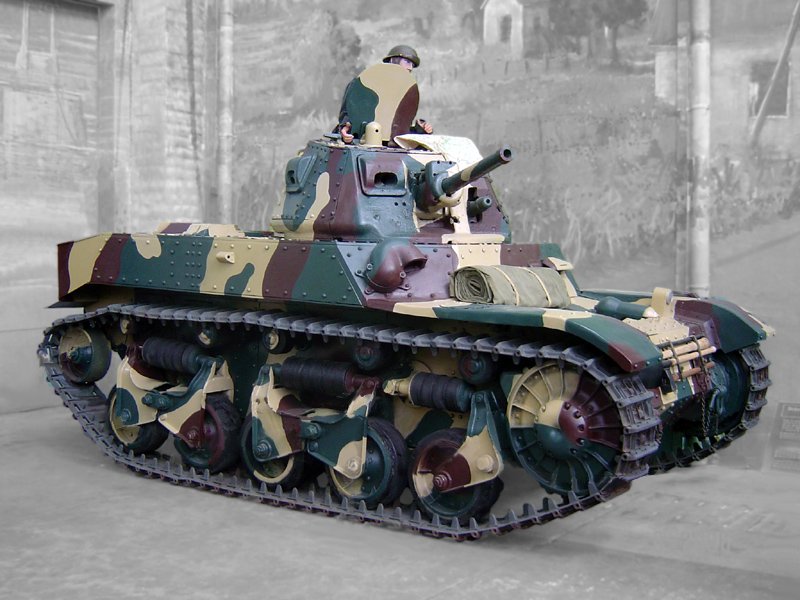
AMC 35 on display at the Musée des Blindés in Saumur

The Belgian Army had ordered 25 AMC 34 hulls with Renault on 13 September 1935 at a unit price of 360,000 French francs, together with a matching number of APX2 turrets to be delivered by Batignolles-Châtillon, for a total project budget of 18.5 million Belgian francs.[1] The hulls were indicated to be of a "second series", an improved AMC 34 — referring to the same line of development that would result in the AMC 35. Their delivery was supposed to commence in October 1935. However, that month Renault started production of the original AMC 34; it was as yet unable to manufacture the improved version. Technological, financial and social problems — in December 1936 the military division of Renault was nationalised and restructured into the new AMX-factory — ensured that for 1936 also, delivery would be delayed. As large orders had become unlikely, the project had a low priority.[2]

On 3 June 1937 the Belgian minister of defence, General Henri Denis, demanded that the single prototype be sent to Belgium; it was transported on 4 June. After testing between 23 and 27 August showed that its climbing abilities were poor, the Belgians decided that the seven tanks intended for the Chasseurs Ardennais were unnecessary and reduced the order accordingly to eighteen. The arrival of the prototype had caused a political row however: politicians from the right feared it would antagonise Hitler and so endanger Belgian neutrality; those from the left wanted only purely defensive weapons. As deliveries failed to materialise, in December 1937 it was decided to annul the order completely, to accept a contractual fine of four million franc and to redirect the remaining budget to the production of home-made T-13 tank destroyers.[3]

This outcome however, embarrassed the French government: it pressured Renault to accept a new arrangement. Early in 1938 it transpired that the Renault factory had in its possession the materials to build the original total of 75 tanks; out of these stocks parts sufficient for about sixty tanks had already been manufactured; assembly had started on about fifty vehicles. It was agreed on 21 April 1938 to complete 35 vehicles, ten to be delivered to Belgium including the prototype, the countervalue of its contractual fine. Belgium also was to receive five sets of reserve parts and eight armour sets. The new contract was signed on 15 June; it stipulated that the Belgian tanks would be delivered prior to 31 July. At that moment the French Cavalry no longer itself intended to use the type (but the SOMUA S35 instead) and advised that priority should be given to the Belgian order. Renault had asked permission for this on 6 May, but on 2 June the French Ministry of Defence responded that the terms of the original agreements should be followed; these entailed a split delivery of batches of ten at a time: first seven tanks for France, followed by three for Belgium.[4]

Series production only started in November 1938 and actual delivery of the first three vehicles to Belgium was delayed till 30 March 1939, the second batch was exported in May and the final three vehicles arrived on 7 August.[4]

In 1938 the turrets also were delivered. As there was now a surplus of fifteen, these were used on fortifications: thirteen of these on coastal defence pillboxes; another two turrets were installed on pillboxes at Remouchamps where a fortress was initially intended to be built, but due to the lack of funds only two casemates were constructed. The turrets were equipped by Belgium with a different armament: instead of the French SA 35 gun, a Belgian FRC 47 mm gun was fitted; this closely related type had a barrel that was 15 mm shorter.[5] Also the machine gun was different: an optionally coaxial 7,65mm rechambered Hotchkiss (Maxim) 08/15 MG.[6] The Belgian turrets were produced at Nantes as the APX2 B, which had the diascope on the left side moved to the facet behind, because the drum magazine for the 7.65mm Maxim 08/15 machine gun made it impossible to look through it in the original position. Older sources incorrectly[7] claim that a 13.2 mm Hotchkiss machine gun was fitted. An armour plate was welded over the hole. They were rebuilt at Ghent by the SEM (Société d'Électricité et de Mécanique Van den Kerckhove & Carels) between September 1939 and February 1940.[8]

For France also, production continued after 1 November 1938, with final assembly at AMX; in March 1939 the original order of seventeen was finished; at the beginning of the Second World War a number of 22 had been reached. Production then accelerated: three were built in September, nine in October, eight in November. For this production all remaining materials were used, apparently to fulfill the original order:[9] when in December the Belgian Army asked for the delivery of the spare parts, as it needed some tanks in working order to allow a single platoon to take part in the winter manoeuvres, Renault was unable to provide these. In January 1940 five were produced. Production was then discontinued for a total of 57. Ten had been exported to Belgium, 47 remained in France where they are listed in this number in the spring of 1940. It is unclear whether this includes prototypes and project tanks and how the number can be reconciled with the total order of fifty.[9]

After the war it has for some time been thought that the total production had been a hundred: 75 for France, 25 for Belgium. This mistake had its origins in the events during the infamous process of Riom where the Vichy regime indicted many for their presumed failure in preparing the French Army for war. The accused, eager to show that French tank production was in fact much higher than that of Germany, estimated the AMC 35 production at 75, apparently adding the number of the Belgian AMC 34 order to the order for France. Later writers, assuming that 75 was the number of tanks intended for France, repeated this mistake and added another 25 Belgian tanks.

Operational history

[edit]

Belgium

[edit]
One of the Belgian vehicles burning in May 1940

When all nine hulls had at last arrived in Belgium, it was soon discovered that engine, transmission and suspension wear was excessive. In January 1940 the two tanks that were in the worst condition were selected for transport to the arsenal of Etterbeek, to be cannibalised to keep the others running; one was used for driver training.[10]

The eight remaining tanks were concentrated in the Escadron d'Auto Blindés du Corps de Cavelerie, literally the "Armoured Car Squadron of the Cavalry Corps", which was created on 1 September 1939 at Watermael-Boitsfort. The term Auto Blindé Lourd/ Zware Pantserwagen, or "Heavy Armoured Car," was used to avoid the politically sensitive char or "tank".[1] The unit then moved to Ghent for its first training, gradually receiving more vehicles from Carels.[8] Later it moved back to Brussels. The squadron had three platoons: one platoon "Staff and Services" (hors rang) and two platoons of four tanks each. The personnel were a mixture of soldiers of the 2nd Lancers Regiment (the Dutch-speaking 2e Lansiers) and the francophone 1st Guides Regiment, both units sharing the same barracks (Caserne de Witte-de Haelen) at Etterbeek.[11]

When war broke out on 10 May, the driver training tank was united with the seven others to bring the squadron to its organic strength of eight. These fought against the German Army between 17 and 27 May 1940. Four were destroyed by 37 mm PAK fire when counter-attacking, two broke down and two were surrendered to the German on 28 May 1940 when the Belgian army put down its weapons.[10]

The Museum of the Army in Brussels shows a single turret taken from one of the two pillboxes that defended the harbour of Zeebrugge or Port of Bruges-Zeebrugge. The turret is property of the city of Bruges which loaned it to the Army Museum at Brussels for 99 years.[12]

France

[edit]
The APX2-B turret from Zeebrugge, preserved in the Army Museum of Brussels

At first no French units were equipped with the AMC 35; no crews were trained on the type. After the German breakthrough at Sedan it was decided on 15 May to send the entire tank materiel reserve to the frontline. Several ad hoc-units were hastily formed. First twelve AMC 35s were used to equip the 11e Groupement de Cavalerie; then five even more informal Corps-francs Motorisés were formed, each to be equipped with seven tanks, but only five AMC 35s could at first be made ready for them; seven more were later delivered. The crews reported that the materiel was unreliable, and suffered from an extremely short range in rough terrain. The CFMs fought a delaying battle between the rivers Seine and Loire.

In the anglophone literature the AMC 35 is often portrayed as a major failed chance for France to turn the tide against Germany: its two-man turret is then seen as better adapted to the demands of modern manoeuvre warfare. E.g. armour historian Brian Terence White judged the type very favourably:

... one of the most advanced French tanks for its size in that as well as being equipped with a good gun it had a two-man turret ... with all the advantages in command it conferred. ... somewhat surprisingly, for in retrospect this seems to have been one of the best prewar French light tank designs, only 100 were built.[13]

The type can, however, be interpreted as an excellent example of the design constraints that forced France to adopt one man-turrets on its other tanks: the price for the AMC 35's roomy turret was an unreliable and, for the medium tank rôle, woefully underarmoured vehicle.[14]

The wreck of an AMC 35 has been salvaged and restored at the Musée des Blindés at Saumur, where it has been displayed since 2006.

Germany

[edit]

Vehicles captured by Germany during the Fall of France were used by the Wehrmacht as the PzKpfw AMC 738 (f) or (b) - depending on whether captured from French or Belgians respectively - for driver training.[10]

Projects

[edit]

One prototype was built of a smoke-laying vehicle; an AMC 35 hull was rebuilt and fitted with nineteen containers, each with 165 litres of smoke fluid, that could be sprayed into the air by a compressor.

One AMC 35 hull was built as a 75 mm tank destroyer, the Renault ACG-2. The original AMC 35 was therefore[citation needed] in French sources of the period often called the Renault ACG-1.

See also

[edit]

Notes

[edit]

Literature

[edit]
  • Georges E. Mazy, 2008, "Les Autos Blindés Lourds du Corps de Cavalerie Belge 1940", Histoire de Guerre, Blindés & Matériel, N°84, pp. 18–29
[edit]
Revisions and contributorsEdit on WikipediaRead on Wikipedia
from Grokipedia
The AMC 35, officially designated as the Automitrailleuse de Combat modèle 1935 and also known as the ACG-1, was a French medium cavalry developed during the as an evolution of the earlier . It was designed to meet requirements for a fast capable of reaching speeds up to 42 km/h on roads, featuring a compact hull and a pioneering two-man APX-2 turret that housed the and gunner separately to improve . With a weight of approximately 14.5 metric tons, dimensions of 4.57 m in length, 2.24 m in width, and 2.34 m in height, the was armed with a 47 mm SA 35 L/32 main gun (or a 47 mm FRC variant for Belgian models) and a 7.5 mm , supported by armor thickness up to 25 mm. Powered by a 180 hp four-cylinder gasoline engine, it had a operational range of about 161 km, though its mechanical reliability was hampered by frequent breakdowns and a lack of radios. Production of the AMC 35 began in November 1938 and concluded in January 1940, with only 57 units manufactured by and the AMX company due to delays from turret development issues, of the , and low priority amid broader rearmament efforts. Of these, 47 were delivered to the and 10 to the Belgian Army (designated ACG-1), reflecting its role as a cavalry support vehicle intended for rapid maneuvers rather than frontline assaults. The tank's development was accelerated in response to the German remilitarization of the Rhineland in 1936, but ongoing teething problems, including underpowered suspension and spare parts shortages, limited its effectiveness. In combat, the AMC 35 saw limited action during the German invasions of and in , where French units employed it in reconnaissance and delaying tactics, while Belgian examples suffered heavy losses—four destroyed, two mechanical failures, and two captured intact. Its thin armor and vulnerability to German anti-tank weapons contributed to high attrition rates, and many surviving vehicles were captured by and repurposed as training or police units under the designation PzKpfw AMC 738(f). Despite its innovations, such as the two-man turret—which was rare among contemporary French designs—the AMC 35 exemplified the doctrinal and technical shortcomings of French armored forces on the eve of , influencing post-war evaluations of interwar tank design.

Development

Origins and Specifications

The development of the AMC 35 stemmed from the shortcomings of its predecessor, the Renault , which had been designed to meet the French Army's modernization plan for armored vehicles. The plan outlined requirements for a designated as the Automitrailleuse de (AMC), intended for and roles within cavalry divisions, emphasizing a maximum road speed of 50 km/h and protection against 37 mm anti-tank guns to enhance mobility and survivability on the battlefield. However, the AMC 34 proved underpowered and exceeded the weight limits, leading to limited production and a decision to revise the design rather than pursue further orders of the original model. In response to these issues, initiated work on a new design in , retaining the AMC designation for what would become the Automitrailleuse de Combat Renault modèle 1935, or AMC 35, specifically tailored for French cavalry reconnaissance missions. This project aimed to address the infantry support limitations of contemporary light tanks like the by providing a more agile and heavily armed vehicle capable of independent operations. The evolving geopolitical tensions, particularly Germany's remilitarization of the Rhineland in March 1936, heightened the urgency of French Cavalry demands for modernized equipment, accelerating interest in advanced prototypes to bolster defensive postures along the frontier. Key revisions to the specifications, formalized on 26 June 1934, included a mandate for a two-man turret to improve crew efficiency during engagements, armament centered on a 47 mm main gun for enhanced anti-tank capability, and a strict weight limit under 15 tons to maintain the desired speed and transportability. These changes reflected French doctrine's emphasis on tanks as fast, versatile platforms for exploitation and screening, distinct from slower support vehicles. Renault's redesign incorporated these elements into the ACG-1 (Automitrailleuse de Cavalerie de Guerre modèle 1) prototype, marking a shift toward more robust engineering to meet the revised performance thresholds.

Prototyping and Acceptance

The first prototype of the AMC 35, designated ACG-1 by , was delivered on March 7, 1936, and underwent initial trials at the testing ground shortly thereafter on March 9. These early evaluations by the Commission de highlighted the vehicle's departure from the preceding design, incorporating a new two-man APX-2 turret and an elongated hull to accommodate enhanced components. However, the prototype's performance fell short of expectations, prompting extensive scrutiny over the following years. Between 1936 and 1938, rigorous testing revealed significant mechanical flaws, including frequent transmission failures that hindered mobility, persistent overheating from the under load, and unreliable turret mechanisms that affected aiming and reloading efficiency. These issues were exacerbated by the vehicle's ambitious specifications for speed and agility, leading to evaluations deeming it initially unfit for service by late 1936. To address these shortcomings, implemented key modifications, notably upgrading the engine to a shortened version of the Renault B1 V4 petrol unit producing 180 horsepower, which aimed to improve power output while fitting the compact . Additional adjustments to the suspension and hull length further sought to mitigate wear and thermal problems observed in trials. Despite lingering concerns over reliability, the AMC 35 was formally accepted by the on November 1, 1938, amid escalating geopolitical tensions following Germany's remilitarization of the Rhineland. This approval triggered an initial order for 17 vehicles, which was rapidly expanded to 50 to bolster capabilities in response to the mounting European crisis. The decision prioritized rapid deployment over full resolution of prototyping defects, reflecting the urgent rearmament needs of the period.

Design

Structure and Mobility

The AMC 35 featured a compact measuring 4.572 meters in length, 2.235 meters in width, and 2.336 meters in height, with a combat weight of 14,500 kilograms, optimized for the rapid maneuverability required of French forces in the . This design emphasized a low silhouette to enhance tactical flexibility on the , though the internal layout imposed notable space constraints on operations. The vehicle's suspension employed a horizontal rubber-sprung scissors system with five road wheels per side, enabling high-speed cross-country performance while maintaining stability over varied terrain. This setup, combined with front-mounted drive sprockets and rear idlers, supported the tank's role as a fast and exploitation platform for armored units. Propulsion was provided by a 4-cylinder delivering 180 horsepower, which propelled the AMC 35 to a maximum speed of 42 kilometers per hour and an operational range of 161 kilometers on a full load. The three-member —consisting of a , gunner, and —was positioned in a tightly integrated layout, with the driver forward and the commander and gunner in the two-man turret, where limited space often complicated coordination during . The hull's structure accommodated this arrangement while allowing for the mounting of the main armament in the , though mobility remained the primary design priority over expansive crew accommodations.

Armament and Armor

The primary armament of the AMC 35 consisted of a 47 mm SA 35 L/32 low-pressure gun mounted in the turret, with a standard load of 120 rounds of ammunition. This weapon provided effective anti-tank capability, capable of penetrating up to 25 mm of armor at a range of 1,000 m. Complementing the main gun was a coaxial 7.5 mm , supplied with 2,400 rounds for against infantry and light targets. The tank's turret, designated APX-2 and constructed from with bolted and riveted elements, represented an innovative step in French tank design as the first to feature a two-man turret with dedicated positions for the and gunner to improve fire control and coordination; it offered full 360° manual traverse. Armor protection was provided by riveted steel plates up to 25 mm thick; the turret featured sloped surfaces to enhance ballistic resistance.

Production

Manufacturing Process

The manufacturing of the AMC 35 tank involved between and the Atelier de Construction d'Issy-les-Moulineaux (AMX), following the of 's military division in December 1936. Production involved and AMX, with AMX handling assembly after , and turrets produced by Batignolles-Châtillon. This aimed to leverage expertise in automotive and armored components, but it introduced coordination challenges in integrating the complex APX-R turret system with the hull structure. Production commenced in November 1938 and continued until January 1940, resulting in a total of 57 units, including prototypes and test vehicles. Each cost approximately ₣360,000, with the turrets adding significantly to the expense due to their intricate featuring hydraulic assistance and a two-man crew configuration. Output was limited by the need for precision machining of components like the 162 engine and the mechanical transmission, which required extensive testing to meet mobility specifications. Significant challenges arose from the tank's advanced yet unproven features, particularly the complex turret mechanism and the multi-speed transmission, which caused persistent delays in fabrication and integration. The APX-R turret's hydraulic and electrical systems proved difficult to manufacture at scale, leading to frequent reworks and slowed progress, while transmission components suffered from alignment issues during assembly. These technical hurdles, compounded by wartime resource shortages, resulted in incomplete deliveries by early 1940, with many units lacking finalized armaments or undergoing prolonged quality checks. The design's emphasis on high mobility and firepower, including the 47 mm SA 35 gun, further exacerbated build complexity by demanding lightweight yet durable materials. Quality issues emerged prominently due to the rushed pace of wartime production, leading to frequent mechanical breakdowns in the transmission and suspension systems shortly after assembly. Only about 50 units were deemed operational by May 1940, with the remainder sidelined for repairs or incomplete. These problems stemmed from inadequate testing under field conditions and shortcuts in component finishing to meet urgent demands, ultimately limiting the tank's reliability in service.

Orders and Deliveries

The French Army placed an initial order for 17 AMC 35 tanks in 1936 as an emergency measure following the remilitarization of the Rhineland, which was later expanded to 50 units to bolster cavalry reconnaissance capabilities. Production commenced in November 1938, with the first seven vehicles delivered to French forces between November 1938 and March 1939; the remaining deliveries continued slowly, resulting in 47 tanks retained for French service by early 1940. These allocations followed a contractual arrangement where, for every batch of ten tanks produced, seven were directed to France and three to export commitments. Belgium placed an order for 25 tanks in after the cancellation of an earlier order, but due to production issues and payment disputes, only 10 vehicles were delivered by early 1940. These Belgian-designated ACG-1 tanks arrived without turrets initially and were assembled locally with modifications, including the installation of 47 mm FRC guns by SEM in , completed by February 1940; the first three were received on 30 March 1939, but failed to provide requested spare parts by December 1939. No further exports were fulfilled, including unconfirmed interest from , which did not materialize into any deliveries. Overall production totaled 57 vehicles, including prototypes, from November 1938 to January 1940, accounting for the 47 held by France and 10 exported to Belgium. Production delays, stemming from turret supply issues and mechanical refinements, significantly impacted delivery timelines for both nations.

Operational History

Belgian Campaign

During the German invasion of Belgium beginning on 10 May 1940, eight operational ACG-1 tanks (the Belgian designation for the AMC 35) were deployed with the Escadron d'Auto Blindés du Corps de Cavalerie near Watermael-Boitsfort to bolster defensive lines. These vehicles, part of a limited armored contingent, were positioned to counter advancing German armored units amid the rapid advance through the Low Countries. The ACG-1 tanks engaged in defensive actions primarily between 17 and 27 , facing elements of German panzer forces including and III models supported by infantry. The tanks' 47 mm SA 35 gun provided effective initial firepower in close-range encounters, allowing some successful hits on enemy vehicles before vulnerabilities became apparent. However, the engagements exposed significant performance flaws, with reliability issues such as engine stalls and transmission failures occurring frequently due to prior excessive wear, inadequate maintenance, and the demands of uneven terrain. Of the eight deployed tanks, four were destroyed by concentrated 37 mm PaK anti-tank gun fire from German positions, while two broke down mechanically and were abandoned. The remaining two were captured intact by advancing German forces. The short-lived combat role of the ACG-1 underscored Belgium's acute shortages in modern armor, with only a handful of these medium tanks available against a numerically superior and better-equipped adversary; the surviving units surrendered alongside the Belgian Army on 28 May 1940, marking the end of organized resistance.

French Deployment

Due to persistent production issues, only a limited number of AMC 35 tanks reached the by the onset of the in , with approximately 47 vehicles available for deployment in ad-hoc formations. These were hastily assigned to provisional units, including the 11e Régiment de Cavalerie, which equipped 12 tanks, and five Corps Francs Motorisés (CFM) groups, each intended to field seven vehicles, though only two achieved full operational status owing to mechanical deficiencies and untrained crews. The tanks saw limited action primarily in roles across northern , deployed in response to the German Ardennes breakthrough at Sedan. Further south, AMC 35-equipped units conducted delaying operations along the and rivers, often alongside the Cadets de cadet school forces, engaging advancing German columns without adequate infantry or air support. In these skirmishes against Panzer units, the 47 mm SA 35 gun demonstrated effectiveness in penetrating light and medium German armor at close range, but the tanks' poor mobility—exacerbated by unreliable engines, bolted armor prone to spalling, and absence of radios—severely limited tactical flexibility and coordination. Most losses stemmed from mechanical breakdowns and abandonment during the rapid French retreat, rather than direct destruction, reflecting the tanks' low operational readiness and the small fleet size that precluded significant battlefield impact. While the AMC 35 offered some utility in and initial engagements, its deployment underscored broader strategic shortcomings in French armored production, as delays prevented mass issuance and left cavalry divisions under-equipped against the Wehrmacht's . Belgian forces employing parallel AMC 35 units reported comparable issues with reliability during their defensive campaign.

German Employment

Following the Fall of and the Battle of in 1940, German forces captured approximately 20-25 AMC 35 tanks from abandoned French and Belgian stocks. These vehicles were redesignated as Pz.Kpfw. AMC 738 (f) for those originating from French inventories and Pz.Kpfw. AMC 738 (b) for Belgian-captured examples. Under German control, the AMC 35s were assigned primarily to the Ersatzheer, the Wehrmacht's replacement and training organization, for instructional duties in occupied and other territories. Their thin armor and limited mobility rendered them obsolete for combat by mid-1940, confining their role to driver training and basic crew familiarization without any frontline deployment. Captured examples underwent minor adaptations to align with German standards. By 1943-1944, as resource demands intensified and newer equipment became available, most were decommissioned, scrapped for parts, or repurposed into non-combat roles such as supply tractors. In their training capacity, the AMC 35s offered brief exposure to advanced turret mechanics, underscoring the French design's strengths in gunnery ergonomics compared to contemporaneous German light tanks.

Derivatives

Experimental Variants

Overall testing outcomes for these experimental variants revealed limited success, with the smoke-laying prototype deemed impractical for roles due to its reduced combat utility and logistical demands in mobile operations. The turret adaptations and transmission fixes improved baseline performance marginally but could not overcome inherent design vulnerabilities, such as the vehicle's bolted armor and mechanical fragility, leading to no further development beyond prototypes amid the rapid escalation of conflict in 1940.

Proposed Upgrades

In 1939, proposed the ACG-2 as a variant derived from the AMC 35 platform, utilizing one of the hulls intended for the Belgian order. It featured an elongated chassis to accommodate a 75 mm SA 35 in a fixed superstructure rather than a rotating turret. This design aimed to enhance anti-tank capabilities while maintaining mobility, with the hull completed but lacking the intended armament due to ongoing development of the gun by APX. The single was ultimately repurposed as an experimental smokescreen vehicle, fitted with nineteen containers each holding 165 liters of smoke fluid to provide tactical screening for units, and abandoned following the German of in May 1940, as wartime priorities shifted away from further prototyping. Belgium's order for 25 AMC 35 tanks in 1935 was limited to just 10 deliveries by early 1940 due to production delays and financial constraints, with the remaining hulls repurposed for other projects like the ACG-2. The incomplete fulfillment of the order stemmed from Renault's inability to scale manufacturing, leading to the cancellation of remaining units amid escalating tensions. The overall AMC 35 program ended due to persistent technical issues, resource shortages, and a strategic pivot toward heavier infantry support tanks like the bis in anticipation of demands.
Add your contribution
Related Hubs
User Avatar
No comments yet.