


Community hub
Recent from talks
Contribute something
Nothing was collected or created yet.
African National Congress
View on Wikipedia
The African National Congress (ANC) is a political party in South Africa. It originated as a liberation movement known for its opposition to apartheid and has governed the country since 1994, when the first post-apartheid election resulted in Nelson Mandela being elected as President of South Africa. Cyril Ramaphosa, the incumbent national president, has served as president of the ANC since 18 December 2017.[15]
Key Information


Founded on 8 January 1912 in Bloemfontein as the South African Native National Congress, the organisation was formed to advocate for the rights of black South Africans. When the National Party government came to power in 1948, the ANC's central purpose became to oppose the new government's policy of institutionalised apartheid. To this end, its methods and means of organisation shifted; its adoption of the techniques of mass politics, and the swelling of its membership, culminated in the Defiance Campaign of civil disobedience in 1952–53. The ANC was banned by the South African government between April 1960 – shortly after the Sharpeville massacre – and February 1990. During this period, despite periodic attempts to revive its domestic political underground, the ANC was forced into exile by increasing state repression, which saw many of its leaders imprisoned on Robben Island. Headquartered in Lusaka, Zambia, the exiled ANC dedicated much of its attention to a campaign of sabotage and guerrilla warfare against the apartheid state, carried out under its military wing, uMkhonto weSizwe, which was founded in 1961 in partnership with the South African Communist Party (SACP). The ANC was condemned as a terrorist organisation by the governments of South Africa, the United States, and the United Kingdom. However, it positioned itself as a key player in the negotiations to end apartheid, which began in earnest after the ban was repealed in 1990. For much of that time, the ANC leadership, along with many of its most active members, operated from abroad. After the Soweto Uprising of 1976, the ANC remained committed to achieving its objectives through armed struggle. These circumstances significantly shaped the ANC during its years in exile.[15]
In the post-apartheid era, the ANC continues to identify itself foremost as a liberation movement, although it is also a registered political party. Partly due to its Tripartite Alliance with the South African Communist Party (SACP) and the Congress of South African Trade Unions (COSATU), it had retained a comfortable electoral majority at the national level and in most provinces, and has provided each of South Africa's five presidents since 1994. South Africa is considered a dominant-party state. However, the ANC's electoral majority has declined consistently since 2004, and in the 2021 local elections, its share of the national vote dropped below 50% for the first time ever.[16] Over the last decade, the party has been embroiled in a number of controversies, particularly relating to widespread allegations of political corruption among its members.
Following the 2024 general election, the ANC lost its majority in parliament for the first time in South Africa's democratic history. However, it still remained the largest party, with just over 40% of the vote.[17] The party also lost its majority in Kwa-Zulu Natal, Gauteng and Northern Cape. Despite these setbacks, the ANC retained power at the national level through a grand coalition referred to as the Government of National Unity, including parties which together have 72% of the seats in Parliament.[18]
History
[edit]Origins
[edit]
A successor of the Cape Colony's Imbumba Yamanyama organisation, the ANC was founded as the South African Native National Congress in Bloemfontein on 8 January 1912, and was renamed the African National Congress in 1923. Pixley ka Isaka Seme, Sol Plaatje, John Langalibalele Dube, and Walter Rubusana founded the organisation, who, like much of the ANC's early membership, were from the conservative, educated, and religious professional classes of black South African society.[19][20] Although they would not take part, Xhosa chiefs would show huge support for the organisation; as a result, King Jongilizwe donated 50 cows to it during its founding.[citation needed] Around 1920, in a partial shift away from its early focus on the "politics of petitioning",[21] the ANC developed a programme of passive resistance directed primarily at the expansion and entrenchment of pass laws.[20][22] When Josiah Gumede took over as ANC president in 1927, he advocated for a strategy of mass mobilisation and cooperation with the Communist Party, but was voted out of office in 1930 and replaced with the traditionalist Seme, whose leadership saw the ANC's influence wane.[19][21]

In the 1940s, Alfred Bitini Xuma revived some of Gumede's programmes, assisted by a surge in trade union activity and by the formation in 1944 of the left-wing ANC Youth League under a new generation of activists, among them Walter Sisulu, Nelson Mandela, and Oliver Tambo.[19][20] After the National Party was elected into government in 1948 on a platform of apartheid, entailing the further institutionalisation of racial segregation, this new generation pushed for a Programme of Action which explicitly advocated African nationalism and led the ANC, for the first time, to the sustained use of mass mobilisation techniques like strikes, stay-aways, and boycotts.[20][23] This culminated in the 1952–53 Defiance Campaign, a campaign of mass civil disobedience organised by the ANC, the Indian Congress, and the coloured Franchise Action Council in protest of six apartheid laws.[24] The ANC's membership swelled.[21] In June 1955, it was one of the groups represented at the multi-racial Congress of the People in Kliptown, Soweto, which ratified the Freedom Charter, from then onwards a fundamental document in the anti-apartheid struggle.[21] The Charter was the basis of the enduring Congress Alliance, but was also used as a pretext to prosecute hundreds of activists, among them most of the ANC's leadership, in the Treason Trial.[25] Before the trial was concluded, the Sharpeville massacre occurred on 21 March 1960. In the aftermath, the ANC was banned by the South African government. It was not unbanned until February 1990, almost three decades later.
Exile in Lusaka
[edit]After its banning in April 1960, the ANC was driven underground, a process hastened by a barrage of government banning orders, an escalation of state repression, and the imprisonment of senior ANC leaders pursuant to the Rivonia trial and Little Rivonia trial.[26] From around 1963, the ANC effectively abandoned much of even its underground presence inside South Africa and operated almost entirely from its external mission, with headquarters first in Morogoro, Tanzania, and later in Lusaka, Zambia.[27] For the entirety of its time in exile, the ANC was led by Tambo – first de facto, with president Albert Luthuli under house arrest in Zululand; then in an acting capacity, after Luthuli's death in 1967; and, finally, officially, after a leadership vote in 1985.[28] During the period there was an extremely close relationship between the ANC and the reconstituted South African Communist Party (SACP), which was also in exile.[28]
uMkhonto weSizwe
[edit]In 1961, partly in response to the Sharpeville massacre, leaders of the SACP and the ANC formed a military body, uMkhonto weSizwe (MK, Spear of the Nation), as a vehicle for armed struggle against the apartheid state. Initially, MK was not an official ANC body, nor had it been directly established by the ANC National Executive; it was considered an autonomous organisation until the ANC formally recognised it as its armed wing in October 1962.[29][26]
In the first half of the 1960s, MK was preoccupied with a campaign of sabotage attacks, especially bombings of unoccupied government installations.[29] As the ANC reduced its presence inside South Africa, however, MK cadres were increasingly confined to training camps in Tanzania and neighbouring countries – with such exceptions as the Wankie Campaign, a momentous military failure.[30] In 1969, Tambo was compelled to call the landmark Morogoro Conference to address the grievances of the rank-and-file, articulated by Chris Hani in a memorandum which depicted MK's leadership as corrupt and complacent.[31] Although MK's malaise persisted into the 1970s, conditions for armed struggle soon improved considerably, especially after the Soweto uprising of 1976 in South Africa saw thousands of students – inspired by Black Consciousness ideas – cross the borders to seek military training.[32] MK guerrilla activity inside South Africa increased steadily over this period, with one estimate recording an increase from 23 incidents in 1977 to 136 incidents in 1985.[33] In the latter half of the 1980s, a number of South African civilians were killed in these attacks, a reversal of the ANC's earlier reluctance to incur civilian casualties.[34][33] Fatal attacks included the 1983 Church Street bombing, the 1985 Amanzimtoti bombing, the 1986 Magoo's Bar bombing, and the 1987 Johannesburg Magistrate's Court bombing. Partly in retaliation, the South African Defence Force increasingly crossed the border to target ANC members and ANC bases, as in the 1981 raid on Maputo, 1983 raid on Maputo, and 1985 raid on Gaborone.[28]
.jpg)
During this period, MK activities led the governments of Margaret Thatcher and Ronald Reagan to condemn the ANC as a terrorist organisation.[35][36] In fact, neither the ANC nor Mandela were removed from the U.S. terror watch list until 2008.[37] The animosity of Western regimes was partly explained by the Cold War context, and by the considerable amount of support – both financial and technical – that the ANC received from the Soviet Union.[38][28]
Negotiations to end apartheid
[edit]From the mid-1980s, as international and internal opposition to apartheid mounted, elements of the ANC began to test the prospects for a negotiated settlement with the South African government, although the prudence of abandoning armed struggle was an extremely controversial topic within the organisation.[28] Following preliminary contact between the ANC and representatives of the state, business community, and civil society,[33][39] President F. W. de Klerk announced in February 1990 that the government would unban the ANC and other banned political organisations, and that Mandela would be released from prison.[40] Some ANC leaders returned to South Africa from exile for so-called "talks about talks", which led in 1990 and 1991 to a series of bilateral accords with the government establishing a mutual commitment to negotiations. Importantly, the Pretoria Minute of August 1990 included a commitment by the ANC to unilaterally suspend its armed struggle.[41] This made possible the multi-party Convention for a Democratic South Africa and later the Multi-Party Negotiating Forum, in which the ANC was regarded as the main representative of the interests of the anti-apartheid movement.
However, ongoing political violence, which the ANC attributed to a state-sponsored third force, led to recurrent tensions. Most dramatically, after the Boipatong massacre of June 1992, the ANC announced that it was withdrawing from negotiations indefinitely.[42] It faced further casualties in the Bisho massacre, the Shell House massacre, and in other clashes with state forces and supporters of the Inkatha Freedom Party (IFP).[43] However, once negotiations resumed, they resulted in November 1993 in an interim Constitution, which governed South Africa's first democratic elections on 27 April 1994. In the elections, the ANC won an overwhelming 62.65% majority of the vote.[44] Mandela was elected president and formed a coalition Government of National Unity, which, under the provisions of the interim Constitution, also included the National Party and IFP.[45] The ANC has controlled the national government since then.
Breakaways
[edit]In the post-apartheid era, several significant breakaway groups have been formed by former ANC members. The first is the Congress of the People, founded by Mosiuoa Lekota in 2008 in the aftermath of the Polokwane elective conference, when the ANC declined to re-elect Thabo Mbeki as its president and instead compelled his resignation from the national presidency. The second breakaway is the Economic Freedom Fighters, founded in 2013 after youth leader Julius Malema was expelled from the ANC. Before these, the most important split in the ANC's history occurred in 1959, when Robert Sobukwe led a splinter faction of African nationalists to the new Pan Africanist Congress.
uMkhonto weSizwe rose to prominence in December 2023, when former president Jacob Zuma announced that, while planning to remain a lifelong member of the ANC, he would not be campaigning for the ANC in the 2024 South African general election, and would instead be voting for MK.[46] In July 2024, Jacob Zuma was expelled from the ANC, because of campaigning for a rival party (MK party) in the 29 May general election.[47]
Current structure and composition
[edit].jpg)
Leadership
[edit]Under the ANC constitution, every member of the ANC belongs to a local branch, and branch members select the organisation's policies and leaders.[48][49] They do so primarily by electing delegates to the National Conference, which is currently convened every five years. Between conferences, the organisation is led by its 86-member National Executive Committee, which is elected at each conference. The most senior members of the National Executive Committee are the so-called Top Six officials, the ANC president primary among them. A symmetrical process occurs at the subnational levels: each of the nine provincial executive committees and regional executive committees are elected at provincial and regional elective conferences respectively, also attended by branch delegates; and branch officials are elected at branch general meetings.[48]
Leagues
[edit]The ANC has three leagues: the Women's League, the Youth League and the Veterans' League. Under the ANC constitution, the leagues are autonomous bodies with the scope to devise their own constitutions and policies; for the purpose of national conferences, they are treated somewhat like provinces, with voting delegates and the power to nominate leadership candidates.[48]
Tripartite Alliance
[edit]The ANC is recognised as the leader of a three-way alliance, known as the Tripartite Alliance, with the SACP and Congress of South African Trade Unions (COSATU). The alliance was formalised in mid-1990, after the ANC was unbanned, but has deeper historical roots: the SACP had worked closely with the ANC in exile, and COSATU had aligned itself with the Freedom Charter and Congress Alliance in 1987.[50] The membership and leadership of the three organisations has traditionally overlapped significantly.[51] The alliance constitutes a de facto electoral coalition: the SACP and COSATU do not contest in government elections, but field candidates through the ANC, hold senior positions in the ANC, and influence party policy. However, the SACP, in particular, has frequently threatened to field its own candidates,[52] and in 2017 it did so for the first time, running against the ANC in by-elections in the Metsimaholo municipality, Free State.[53][54]

Electoral candidates
[edit]Under South Africa's closed-list proportional representation electoral system, parties have immense power in selecting candidates for legislative bodies. The ANC's internal candidate selection process is overseen by so-called "list committees" and tends to involve a degree of broad democratic participation, especially at the local level, where ANC branches vote to nominate candidates for the local government elections.[55][56] Between 2003 and 2008, the ANC also gained a significant number of members through the controversial floor crossing process, which occurred especially at the local level.[57][58]
The leaders of the executive in each sphere of government – the president, the provincial premiers, and the mayors – are indirectly elected after each election. In practice, the selection of ANC candidates for these positions is highly centralised, with the ANC caucus voting together to elect a pre-decided candidate. Although the ANC does not always announce whom its caucuses intend to elect,[59] the National Assembly has thus far always elected the ANC president as the national president.
Cadre deployment
[edit]The ANC has adhered to a formal policy of cadre deployment since 1985.[60] In the post-apartheid era, the policy includes but is not exhausted by selection of candidates for elections and government positions: it also entails that the central organisation "deploys" ANC members to various other strategic positions in the party, state, and economy.[61][62]
Ideology and policies
[edit]
The ANC prides itself on being a broad church,[63] and, like many dominant parties, resembles a catch-all party, accommodating a range of ideological tendencies.[64][65][66] As Mandela told The Washington Post in 1990:
The ANC has never been a political party. It was formed as a parliament of the African people. Right from the start, up to now, the ANC is a coalition, if you want, of people of various political affiliations. Some will support free enterprise, others socialism. Some are conservatives, others are liberals. We are united solely by our determination to oppose racial oppression. That is the only thing that unites us. There is no question of ideology as far as the odyssey of the ANC is concerned, because any question approaching ideology would split the organization from top to bottom. Because we have no connection whatsoever except at this one, of our determination to dismantle apartheid.[67]
The post-apartheid ANC continues to identify itself foremost as a liberation movement, pursuing "the complete liberation of the country from all forms of discrimination and national oppression".[48] It also continues to claim the Freedom Charter of 1955 as "the basic policy document of the ANC".[68][48] However, as NEC member Jeremy Cronin noted in 2007, the various broad principles of the Freedom Charter have been given different interpretations, and emphasised to differing extents, by different groups within the organisation.[66][69] Nonetheless, some basic commonalities are visible in the policy and ideological preferences of the organisation's mainstream.
Non-racialism
[edit]The ANC is committed to the ideal of non-racialism and to opposing "any form of racial, tribalistic or ethnic exclusivism or chauvinism".[48][65][70]
National Democratic Revolution
[edit]The 1969 Morogoro Conference committed the ANC to a "national democratic revolution [which] – destroying the existing social and economic relationship – will bring with it a correction of the historical injustices perpetrated against the indigenous majority and thus lay the basis for a new – and deeper internationalist – approach".[71] For the movement's intellectuals, the concept of the National Democratic Revolution (NDR) was a means of reconciling the anti-apartheid and anti-colonial project with a second goal, that of establishing domestic and international socialism – the ANC is a member of the Socialist International,[14] and its close partner the SACP traditionally conceives itself as a vanguard party.[65] Specifically, and as implied by the 1969 document, NDR doctrine entails that the transformation of the domestic political system (national struggle, in Joe Slovo's phrase) is a precondition for a socialist revolution (class struggle).[65][72] The concept remained important to ANC intellectuals and strategists after the end of apartheid.[73][74] Indeed, the pursuit of the NDR is one of the primary objectives of the ANC as set out in its constitution.[48] As with the Freedom Charter, the ambiguity of the NDR has allowed it to bear varying interpretations. For example, whereas SACP theorists tend to emphasise the anti-capitalist character of the NDR, some ANC policymakers have construed it as implying the empowerment of the black majority even within a market-capitalist scheme.[65]
Economic interventionism
[edit]We must develop the capacity of government for strategic intervention in social and economic development. We must increase the capacity of the public sector to deliver improved and extended public services to all the people of South Africa.
Since 1994, consecutive ANC governments have held a strong preference for a significant degree of state intervention in the economy. The ANC's first comprehensive articulation of its post-apartheid economic policy framework was set out in the Reconstruction and Development Programme (RDP) document of 1994, which became its electoral manifesto and also, under the same name, the flagship policy of Nelson Mandela's government. The RDP aimed both to redress the socioeconomic inequalities created by colonialism and apartheid, and to promote economic growth and development; state intervention was judged a necessary step towards both goals.[75] Specifically, the state was to intervene in the economy through three primary channels: a land reform programme; a degree of economic planning, through industrial and trade policy; and state investments in infrastructure and the provision of basic services, including health and education.[75][76] Although the RDP was abandoned in 1996, these three channels of state economic intervention have remained mainstays of subsequent ANC policy frameworks.
Neoliberal turn
[edit]In 1996, Mandela's government replaced the RDP with the Growth Employment and Redistribution (GEAR) programme, which was maintained under President Thabo Mbeki, Mandela's successor. GEAR has been characterised as a neoliberal policy,[77][78] and it was disowned by both COSATU and the SACP.[79][80] While some analysts viewed Mbeki's economic policy as undertaking the uncomfortable macroeconomic adjustments necessary for long-term growth,[65] others – notably Patrick Bond – viewed it as a reflection of the ANC's failure to implement genuinely radical transformation after 1994.[81] Debate about ANC commitment to redistribution on a socialist scale has continued: in 2013, the country's largest trade union, the National Union of Metalworkers of South Africa, withdrew its support for the ANC on the basis that "the working class cannot any longer see the ANC or the SACP as its class allies in any meaningful sense".[82] It is evident, however, that the ANC never embraced free-market capitalism, and continued to favour a mixed economy: even as the debate over GEAR raged, the ANC declared itself (in 2004) a social-democratic party,[83] and it was at that time presiding over phenomenal expansions of its black economic empowerment programme and the system of social grants.[84][85]
Developmental state
[edit]As its name suggests, the RDP emphasised state-led development – that is, a developmental state – which the ANC has typically been cautious, at least in its rhetoric, to distinguish from the neighbouring concept of a welfare state.[86][85][76] In the mid-2000s, during Mbeki's second term, the notion of a developmental state was revived in South African political discourse when the national economy worsened;[76] and the 2007 National Conference whole-heartedly endorsed developmentalism in its policy resolutions, calling for a state "at the centre of a mixed economy... which leads and guides that economy and which intervenes in the interest of the people as a whole".[86] The proposed developmental state was also central to the ANC's campaign in the 2009 elections,[76] and it remains a central pillar of the policy of the current government, which seeks to build a "capable and developmental" state.[87][88] In this regard, ANC politicians often cite China as an aspirational example.[63][89] A discussion document ahead of the ANC's 2015 National General Council proposed that:
China['s] economic development trajectory remains a leading example of the triumph of humanity over adversity. The exemplary role of the collective leadership of the Communist Party of China in this regard should be a guiding lodestar of our own struggle.[90]
Radical economic transformation
[edit]Towards the end of Jacob Zuma's presidency, an ANC faction aligned to Zuma pioneered a new policy platform referred to as radical economic transformation (RET). Zuma announced the new focus on RET during his February 2017 State of the Nation address,[91] and later that year, explaining that it had been adopted as ANC policy and therefore as government policy, defined it as entailing "fundamental change in the structures, systems, institutions and patterns of ownership and control of the economy, in favour of all South Africans, especially the poor".[92] Arguments for RET were closely associated with the rhetorical concept of white monopoly capital.[93][94] At the 54th National Conference in 2017, the ANC endorsed a number of policy principles advocated by RET supporters, including their proposal to pursue land expropriation without compensation as a matter of national policy.[95][96][97]
Foreign policy and relations
[edit]The ANC has long had close ties with China and the Chinese Communist Party (CCP), with the CCP having supported ANC's struggle of apartheid since 1961.[98] In 2008, the two parties signed a memorandum of understanding to train ANC members in China.[99]
President Cyril Ramaphosa and the ANC have not condemned the Russian invasion of Ukraine, and have faced criticism from opposition parties,[100][101][102] public commentators,[103][104] academics,[105][106] civil society organisations,[107][108][109] and former ANC members[110] due to this. The ANC youth wing has meanwhile condemned sanctions against Russia and denounced NATO's eastward expansion as "fascistic".[111][112] Officials representing the ANC Youth League acted as international observers for Russia's staged referendum to annex Ukrainian territory claimed during the war.[113] In February 2024 ANC Secretary-General Fikile Mbalula attend a "forum on combating Western neocolonialism"[114] hosted by Russia, thereby drawing further criticism for the party's perceived support for Russia's invasion.[114][115]
The ANC had received large donations from the Putin linked Russian oligarch Viktor Vekselberg, whilst the party's investment arm, Chancellor House, has a joint investment with Vekselberg in a South African manganese mine.[116][117]
Symbols and media
[edit]
Flag and logo
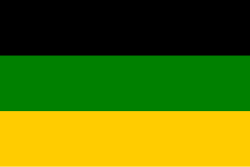
[edit]The logo of the ANC incorporates a spear and shield – symbolising the historical and ongoing struggle, armed and otherwise, against colonialism and racial oppression – and a wheel, which is borrowed from the 1955 Congress of the People campaign and therefore symbolises a united and non-racial movement for freedom and equality.[118] The logo uses the same colours as the ANC flag, which comprises three horizontal stripes of equal width in black, green and gold. The black symbolises the native people of South Africa; the green represents the land of South Africa; and the gold represents the country's mineral and other natural wealth.[118] The black, green and gold tricolour also appeared on the flag of the KwaZulu bantustan and appears on the flag of the ANC's rival, the IFP; and all three colours appear in the post-apartheid South African national flag.
Publications
[edit]Since 1996, the ANC Department of Political Education has published the quarterly Umrabulo political discussion journal; and ANC Today, a weekly online newsletter, was launched in 2001 to offset the alleged bias of the press.[119] In addition, since 1972, it has been traditional for the ANC president to publish annually a so-called January 8 Statement: a reflective letter sent to members on 8 January, the anniversary of the organisation's founding.[120] In earlier years, the ANC published a range of periodicals, the most important of which was the monthly journal Sechaba (1967–1990), printed in the German Democratic Republic and banned by the apartheid government.[121][122] The ANC's Radio Freedom also gained a wide audience during apartheid.[123]
Amandla
[edit]"Amandla ngawethu", or the Sotho variant "Matla ke arona", is a common rallying call at ANC meetings, roughly meaning "power to the people".[118] It is also common for meetings to sing so-called struggle songs, which were sung during anti-apartheid meetings and in MK camps. In the case of at least two of these songs – Dubula ibhunu and Umshini wami – this has caused controversy in recent years.[124]
Criticism and controversy
[edit]The ANC has received criticism from both internal and external sources. Internally Mandela publicly criticized the party, following the conclusion of his presidency, for ignoring instances of corruption and mismanagement, whilst allowing for the growth of a culture of racial and ideological intolerance.[125][126]
Corruption controversies
[edit]The most prominent corruption case involving the ANC relates to a series of bribes paid to companies involved in the ongoing R55 billion Arms Deal saga, which resulted in a long term jail sentence to then Deputy President Jacob Zuma's legal adviser Schabir Shaik. Zuma, the former South African President, was charged with fraud, bribery and corruption in the Arms Deal, but the charges were subsequently withdrawn by the National Prosecuting Authority of South Africa due to their delay in prosecution.[127] The ANC has also been criticised for its subsequent abolition of the Scorpions, the multidisciplinary agency that investigated and prosecuted organised crime and corruption, and was heavily involved in the investigation into Zuma and Shaik. Tony Yengeni, in his position as chief whip of the ANC and head of the Parliaments defence committee has recently been named as being involved in bribing the German company ThyssenKrupp over the purchase of four corvettes for the SANDF.[citation needed]
Other corruption issues in the 2000s included the sexual misconduct and criminal charges of Beaufort West municipal manager Truman Prince,[128] and the Oilgate scandal, in which millions of Rand in funds from a state-owned company were funnelled into ANC coffers.[129]
The ANC has also been accused of using government and civil society to fight its political battles against opposition parties such as the Democratic Alliance. The result has been a number of complaints and allegations that none of the political parties truly represent the interests of the poor.[130][131] This has resulted in the "No Land! No House! No Vote!" Campaign which became very prominent during elections.[132][133] In 2018, The New York Times reported on the killings of ANC corruption whistleblowers.[134]
During an address on 28 October 2021, former president Thabo Mbeki commented on the history of corruption within the ANC. He reflected that Mandela had already warned in 1997 that the ANC was attracting individuals who viewed the party as "a route to power and self-enrichment." He added that the ANC leadership "did not know how to deal with this problem."[135] During a lecture on 10 December, Mbeki reiterated concerns about "careerists" within the party, and stressed the need to "purge itself of such members".[136]
In May 2024, the International Consortium of Investigative Journalists in association with amaBhungane showed in documents that R200 million in the ANC's election fund was siphoned off to the church of controversial archbishop Bheki Lukhele in Eswatini; the Chief Financial Officer of the ANC, Bongani Mahlalela along with the Ambassador of Eswatini to Belgium, Sibusisiwe Mngomezulu, were implicated in the scheme.[137][138][139]
Condemnation over Secrecy Bill
[edit]In late 2011, the ANC was heavily criticised over the passage of the Protection of State Information Bill, which opponents claimed would improperly restrict the freedom of the press.[140] Opposition to the bill included otherwise ANC-aligned groups such as COSATU. Notably, Nelson Mandela and other Nobel laureates Nadine Gordimer, Archbishop Desmond Tutu, and F. W. de Klerk have expressed disappointment with the bill for not meeting standards of constitutionality and aspirations for freedom of information and expression.[141]
Role in the Marikana killings
[edit]The ANC have been criticised for its role in failing to prevent 16 August 2012 massacre of Lonmin miners at Marikana in the Northwest. Some[who?] allege that Police Commissioner Riah Phiyega and Police Minister Nathi Mthethwa gave the go ahead for the police action against the miners on that day.[142]
Commissioner Phiyega of the ANC came under further criticism as being insensitive and uncaring when she was caught smiling and laughing during the Farlam Commission's video playback of the massacre.[143]
In 2014, Archbishop Desmond Tutu announced that he could no longer bring himself to vote for the ANC, as it was no longer the party that he and Nelson Mandela fought for. He stated that the party had lost its way, and was in danger of becoming a corrupt entity in power.[144]
Financial mismanagement
[edit]Since at least 2017, the ANC has encountered significant problems related to financial mismanagement. According to a report filed by the former treasurer-general Zweli Mkhize in December 2017, the ANC was technically insolvent as its liabilities exceeded its assets.[145] These problems continued into the second half of 2021. By September 2021, the ANC had reportedly amassed a debt exceeding R200-million, including over R100-million owed to the South African Revenue Service.[146]
Beginning in May 2021, the ANC failed to pay monthly staff salaries on time. Having gone without pay for three consecutive months, workers planned a strike in late August 2021.[147] In response, the ANC initiated a crowdfunding campaign to raise money for staff salaries.[148] By November 2021, its Cape Town staff was approaching their fourth month without salaries, while medical aid and provident fund contributions had been suspended in various provinces.[149] The party has countered that the Political Party Funding Act, which prohibits anonymous contributions, has dissuaded some donors who previously injected money for salaries.[150]African National Congress failed to pay Ezulweni investments R150 million rand historic debt.[151]
State capture
[edit]In January 2018, then-President Jacob Zuma established the Zondo Commission to investigate allegations of state capture, corruption, and fraud in the public sector.[152] Over the following four years, the Commission heard testimony from over 250 witnesses and collected more than 150,000 pages of evidence.[153] After several extensions, the first part of the final three-part report was published on 4 January 2022.[154][155]
The report found that the ANC, including Zuma and his political allies, had benefited from the extensive corruption of state enterprises, including the South African Revenue Service.[156] It also found that the ANC "simply did not care that state entities were in decline during state capture or they slept on the job – or they simply didn't know what to do."[157]
Election results
[edit]

National Assembly elections
[edit]| Election | Party leader | Votes | % | Seats | +/– | Position | Result |
|---|---|---|---|---|---|---|---|
| 1994 | Nelson Mandela | 12,237,655 | 62.65% | 252 / 400
|
 252 252
|
1st
|
ANC–NP–IFP coalition |
| 1999 | Thabo Mbeki | 10,601,330 | 66.35% | 266 / 400
|
14
|
 1st 1st
|
ANC–IFP coalition |
| 2004 | 10,880,915 | 69.69% | 279 / 400
|
13
|
1st
|
Majority | |
| 2009 | Jacob Zuma | 11,650,748 | 65.90% | 264 / 400
|
 15 15
|
1st
|
Majority |
| 2014 | 11,436,921 | 62.15% | 249 / 400
|
15
|
1st
|
Majority | |
| 2019 | Cyril Ramaphosa | 10,026,475 | 57.50% | 230 / 400
|
19
|
1st
|
Majority |
| 2024 | 6,459,683 | 40.18%[a] | 159 / 400
|
71
|
1st
|
National Unity coalition |
- ^ From 2024, seats in the National Assembly are determined by a combination of the national ballot, and the nine regional ballots. Only the national ballot figures are shown here.
National Council of Provinces elections
[edit]| Election | Party leader | Seats | +/– | Position | Result |
|---|---|---|---|---|---|
| 1994 | Nelson Mandela | 60 / 90
|
60
|
1st
|
ANC–NP–IFP coalition |
| 1999 | Thabo Mbeki | 63 / 90
|
3
|
1st
|
ANC–IFP coalition |
| 2004 | 65 / 90
|
2
|
1st
|
Majority | |
| 2009 | Jacob Zuma | 62 / 90
|
3
|
1st
|
Majority |
| 2014 | 60 / 90
|
2
|
1st
|
Majority | |
| 2019 | Cyril Ramaphosa | 54 / 90
|
6
|
1st
|
Majority |
| 2024 | 43 / 90
|
11
|
1st
|
National Unity coalition |
Provincial legislatures
[edit]| Election[158] | Eastern Cape | Free State | Gauteng | KwaZulu-Natal | Limpopo | Mpumalanga | North-West | Northern Cape | Western Cape | |||||||||
|---|---|---|---|---|---|---|---|---|---|---|---|---|---|---|---|---|---|---|
| % | Seats | % | Seats | % | Seats | % | Seats | % | Seats | % | Seats | % | Seats | % | Seats | % | Seats | |
| 1994 | 84.35 | 48/56 | 76.65 | 24/30 | 57.60 | 50/86 | 32.23 | 26/81 | 91.63 | 38/40 | 80.69 | 25/30 | 83.33 | 26/30 | 49.74 | 15/30 | 33.01 | 14/42 |
| 1999 | 73.80 | 47/63 | 80.79 | 25/30 | 67.87 | 50/73 | 39.38 | 32/80 | 88.29 | 44/49 | 84.83 | 26/30 | 78.97 | 27/33 | 64.32 | 20/30 | 42.07 | 18/42 |
| 2004 | 79.27 | 51/63 | 81.78 | 25/30 | 68.40 | 51/73 | 46.98 | 38/80 | 89.18 | 45/49 | 86.30 | 27/30 | 80.71 | 27/33 | 68.83 | 21/30 | 45.25 | 19/42 |
| 2009 | 68.82 | 44/63 | 71.10 | 22/30 | 64.04 | 47/73 | 62.95 | 51/80 | 84.88 | 43/49 | 85.55 | 27/30 | 72.89 | 25/33 | 60.75 | 19/30 | 31.55 | 14/42 |
| 2014 | 70.09 | 45/63 | 69.85 | 22/30 | 53.59 | 40/73 | 64.52 | 52/80 | 78.60 | 39/49 | 78.23 | 24/30 | 67.39 | 23/33 | 64.40 | 20/30 | 32.89 | 14/42 |
| 2019 | 68.74 | 44/63 | 61.14 | 19/30 | 50.19 | 37/73 | 54.22 | 44/80 | 75.49 | 38/49 | 70.58 | 22/30 | 61.87 | 21/33 | 57.54 | 18/30 | 28.63 | 12/42 |
| 2024[159] | 62.16 | 45/73 | 51.87 | 16/30 | 34.76 | 28/80 | 16.99 | 14/80 | 73.30 | 48/64 | 51.31 | 27/51 | 57.73 | 21/38 | 49.34 | 15/30 | 19.55 | 8/42 |
Municipal elections
[edit]| Election | Votes | % | Change |
|---|---|---|---|
| 1995–96 | 5,033,855 | 58% | |
| 2000 | None released | 59.4% | 1.4%
|
| 2006 | 17,466,948 | 66.3% | 6.9%
|
| 2011 | 16,548,826 | 61.9% | 4.4%
|
| 2016[160] | 21,450,332 | 55.7% | 6.2%
|
| 2021 | 14,531,908 | 47.5% | 8.2%
|
See also
[edit]

References
[edit]- ^ Harper, Paddy (18 December 2022). "Existential crisis-ANC membership drops by more than one third in five years". Mail and Guardian. Retrieved 18 December 2022.
- ^ "South Africa • Africa Elects".
- ^ "How Democratic is the African National Congress? | Request PDF". Retrieved 16 February 2024.
- ^ [2][3]
- ^ Lissoni, Arianna; Soske, JON; Erlank, Natasha; Nieftagodien, Noor; Badsha, Omar, eds. (2012). One Hundred Years of the ANC. doi:10.18772/22012115737. ISBN 978-1-77614-287-3. JSTOR 10.18772/22012115737.
- ^ Fatton, Robert (2 February 1984). "The African National Congress of South Africa: The Limitations of a Revolutionary Strategy". Canadian Journal of African Studies / Revue Canadienne des Études Africaines. 18 (3): 593–608. doi:10.1080/00083968.1984.10804082. JSTOR 484771.
- ^ [5][6]
- ^ De Beus, Jos; Koelble, Tom (2001). "The Third Way diffusion of social democracy: Western Europe and South Africa compared". South African Journal of Political Studies. 28 (2): 181–194. doi:10.1080/02589340120091646.
- ^ "South Africa" (PDF). European Social Survey. Archived (PDF) from the original on 9 October 2022. Retrieved 12 March 2019.
- ^ Winning, Alexander; Roelf, Wendell; Toyana, Mfuneko (6 May 2019). "South Africa's Ramaphosa faces obstacles to reform". Reuters. Retrieved 30 August 2025.
- ^ Gumede, William. "How the EFF has shifted SA politics to the left". University of the Witwatersrand, Johannesburg. Retrieved 28 May 2019.
- ^ a b Burke, Jason (18 December 2017). "Cyril Ramaphosa chosen to lead South Africa's ruling ANC party". The Guardian. ISSN 0261-3077. Retrieved 19 December 2017.
- ^ Cele, S'thembile (4 November 2021). "ANC Support Falls Below 50% for First Time in South African Vote". Bloomberg. Retrieved 25 July 2022.
- ^ "In a historic election, South Africa's ANC loses majority for the first time". NPR. 1 June 2024. Retrieved 1 June 2024.
- ^ Chothia, Farouk; Kupemba, Danai Kesta; Plett-Usher, Barbra (14 June 2024). "ANC and DA agree on South Africa unity government". BBC News. Retrieved 14 June 2024.
- ^ a b c Lodge, Tom (1983). "Black protest before 1950". Black Politics in South Africa Since 1945. Ravan Press. pp. 1–32. ISBN 978-0-86975-152-7. Archived from the original on 31 December 2021. Retrieved 27 December 2021.
- ^ a b c d Butler, Anthony (2012). The Idea of the ANC. Jacana Media. ISBN 978-1-4314-0578-7. Archived from the original on 31 December 2021. Retrieved 27 December 2021.
- ^ a b c d Suttner, Raymond (2012). "The African National Congress centenary: a long and difficult journey". International Affairs. 88 (4): 719–738. doi:10.1111/j.1468-2346.2012.01098.x. ISSN 0020-5850. JSTOR 23255615. Archived from the original on 27 December 2021. Retrieved 27 December 2021.
- ^ Clark, Nancy L.; Worger, William H. (2016). South Africa: The Rise and Fall of Apartheid (3rd ed.). Abingdon, Oxon: Routledge. ISBN 978-1-138-12444-8. OCLC 883649263.
- ^ "38th National Conference: Programme Of Action: Statement of Policy Adopted". African National Congress. 17 December 1949. Archived from the original on 27 December 2021. Retrieved 27 December 2021.
- ^ Lodge, Tom (1983). "The creation of a mass movement: strikes and defiance, 1950-1952". Black Politics in South Africa Since 1945. Ravan Press. pp. 33–66. ISBN 978-0-86975-152-7. Archived from the original on 31 December 2021. Retrieved 27 December 2021.
- ^ Lodge, Tom (1983). "African political organisations, 1953-1960". Black Politics in South Africa Since 1945. Ravan Press. pp. 67–90. ISBN 978-0-86975-152-7.
- ^ a b Ellis, Stephen (1991). "The ANC in Exile". African Affairs. 90 (360): 439–447. doi:10.1093/oxfordjournals.afraf.a098442. ISSN 0001-9909. JSTOR 722941. Archived from the original on 26 December 2021. Retrieved 26 December 2021.
- ^ African National Congress (1997). "Appendix: ANC structures and personnel". Further submissions and responses by the African National Congress to questions raised by the Commission for Truth and Reconciliation. Pretoria: Department of Justice. Archived from the original on 14 December 2021. Retrieved 26 December 2021.
- ^ a b c d e Ellis, Stephen (2013). External Mission: The ANC in Exile, 1960–1990. Oxford University Press. ISBN 978-0-19-933061-4. Archived from the original on 31 December 2021. Retrieved 27 December 2021.
- ^ a b Stevens, Simon (1 November 2019). "The Turn to Sabotage by The Congress Movement in South Africa". Past & Present (245): 221–255. doi:10.1093/pastj/gtz030. hdl:1814/75043. ISSN 0031-2746.
- ^ Houston, Gregory; Ralinala, Rendani Moses (2004). "The Wankie and Sipolilo Campaigns". The Road to Democracy in South Africa. Vol. 1. Zebra Press. pp. 435–492. Archived from the original on 31 December 2021. Retrieved 27 December 2021.
- ^ Macmillan, Hugh (1 September 2009). "After Morogoro: the continuing crisis in the African National Congress (of South Africa) in Zambia, 1969–1971". Social Dynamics. 35 (2): 295–311. doi:10.1080/02533950903076386. ISSN 0253-3952. S2CID 143455223. Archived from the original on 31 December 2021. Retrieved 26 December 2021.
- ^ Ellis, Stephen (1994). "Mbokodo: Security in ANC Camps, 1961–1990". African Affairs. 93 (371): 279–298. doi:10.1093/oxfordjournals.afraf.a098712. hdl:1887/9075. ISSN 0001-9909. JSTOR 723845. Archived from the original on 27 December 2021. Retrieved 27 December 2021.
- ^ a b c Lodge, Tom (1987). "State of Exile: The African National Congress of South Africa, 1976–86". Third World Quarterly. 9 (1): 1, 282–310. doi:10.1080/01436598708419960. ISSN 0143-6597. JSTOR 3991845. PMID 12268882. Archived from the original on 27 December 2021. Retrieved 27 December 2021.
- ^ Williams, Rocky (2000). "The other armies: A brief historical overview of Umkhonto We Sizwe (MK), 1961–1994". Military History Journal. 11 (5). Archived from the original on 4 October 2018. Retrieved 27 December 2021.
- ^ Waxman, Olivia B. (18 July 2018). "The U.S. Government Had Nelson Mandela on Terrorist Watch Lists Until 2008. Here's Why". Time. Archived from the original on 27 December 2021. Retrieved 27 December 2021.
- ^ McSmith, Andy (10 December 2013). "Margaret Thatcher branded ANC 'terrorist' while urging Nelson Mandela's release". The Independent. Archived from the original on 27 December 2021. Retrieved 27 December 2021.
- ^ Windrem, Robert (7 December 2013). "US government considered Nelson Mandela a terrorist until 2008". NBC News. Archived from the original on 27 December 2021. Retrieved 27 December 2021.
- ^ Shubin, Vladimir (1996). "The Soviet Union/Russian Federation's Relations with South Africa, with Special Reference to the Period since 1980". African Affairs. 95 (378): 5–30. doi:10.1093/oxfordjournals.afraf.a007713. ISSN 0001-9909. JSTOR 723723. Archived from the original on 27 December 2021. Retrieved 27 December 2021.
- ^ Brits, J. P. (2008). "Thabo Mbeki and the Afrikaners, 1986–2004". Historia. 53 (2): 33–69. ISSN 0018-229X. Archived from the original on 27 December 2021. Retrieved 27 December 2021.
- ^ Ottaway, David (3 February 1990). "S. Africa Lifts Ban on ANC, Other Groups". The Washington Post. Retrieved 1 July 2016.
- ^ Simpson, Thula (2009). "Toyi-Toyi-ing to Freedom: The Endgame in the ANCs Armed Struggle, 1989–1990". Journal of Southern African Studies. 35 (2): 507–521. doi:10.1080/03057070902920015. hdl:2263/14707. ISSN 0305-7070. JSTOR 40283245. S2CID 145785746.
- ^ Keller, Bill (24 June 1992). "Mandela, Stunned by Massacre, Pulls Out of Talks on Black Rule". The New York Times. ISSN 0362-4331. Retrieved 23 July 2022.
- ^ Van Baalen, Sebastian (2014). "The Microdynamics of Conflict Escalation : The Case of ANC-IFP Fighting in South Africa in 1990". Pax et Bellum Journal. 1 (1): 14–20. Archived from the original on 31 December 2021. Retrieved 28 December 2021.
- ^ "Elections '94". Independent Electoral Commission. 28 June 2008. Archived from the original on 28 June 2008. Retrieved 23 July 2022.
- ^ Drogin, Bob (7 May 1994). "Ex-Guerrillas, Exiles Named to Mandela Cabinet". Los Angeles Times. Retrieved 23 July 2022.
- ^ ""The battle for the soul of uMkhonto weSizwe"".
- ^ "South Africa's ex-President Jacob Zuma expelled from ANC". www.bbc.com.
- ^ a b c d e f g "African National Congress Constitution, as amended and adopted by the 54th National Conference" (PDF). African National Congress. 2017. Archived (PDF) from the original on 9 October 2022.
- ^ Darracq, V. (18 August 2008). "The African National Congress (ANC) organization at the grassroots". African Affairs. 107 (429): 589–609. doi:10.1093/afraf/adn059. ISSN 0001-9909.
- ^ Twala, Chitja; Kompi, Buti (1 June 2012). "The Congress of South African Trade Unions (COSATU) and the Tripartite Alliance: a marriage of (in)convenience?". Journal for Contemporary History. 37 (1): 171–190. hdl:10520/EJC133152. Archived from the original on 31 December 2021. Retrieved 28 December 2021.
- ^ Buhlungu, Sakhela; Ellis, Stephen (1 January 2013). "The trade union movement and the Tripartite Alliance: a tangled history". Cosatu's Contested Legacy: 259–282. doi:10.1163/9789004214606_013. ISBN 9789004214606. Archived from the original on 28 December 2021. Retrieved 28 December 2021.
- ^ Bandile, Dineo (15 July 2017). "SACP resolves to contest state power independently of the ANC". The Mail & Guardian. Retrieved 25 July 2022.
- ^ Mailovich, Claudi (29 November 2017). "SACP breaks alliance ranks in local election". Business Day. Retrieved 25 July 2022.
- ^ "SACP governs its first municipality". News24. 21 December 2017. Retrieved 25 July 2022.
- ^ Mac Giollabhui, Shane (18 August 2018). "Battleground: candidate selection and violence in Africa's dominant political parties". Democratization. 25 (6): 978–995. doi:10.1080/13510347.2018.1451841. ISSN 1351-0347. S2CID 218523954.
- ^ Giollabhuí, Shane Mac (2013). "How things fall apart: Candidate selection and the cohesion of dominant parties in South Africa and Namibia". Party Politics. 19 (4): 577–600. doi:10.1177/1354068811407599. ISSN 1354-0688. S2CID 145444345.
- ^ Booysen, Susan (2006). "The Will of the Parties Versus the Will of the People?: Defections, Elections and Alliances in South Africa". Party Politics. 12 (6): 727–746. doi:10.1177/1354068806068598. ISSN 1354-0688. S2CID 145011059.
- ^ McLaughlin, Eric (2012). "Electoral regimes and party-switching: Floor-crossing in South Africa's local legislatures". Party Politics. 18 (4): 563–579. doi:10.1177/1354068810389610. ISSN 1354-0688. S2CID 143948206.
- ^ Myburgh, James (6 March 2009). "The ANC's secret premier candidates". PoliticsWeb. Retrieved 25 July 2022.
- ^ "Cadre Policy and Deployment Strategy" (PDF). Umrabulo. 6. 1999. Archived (PDF) from the original on 9 October 2022.
- ^ Twala, Chitja (2014). "The African National Congress (ANC) and the Cadre Deployment Policy in the Postapartheid South Africa: A Product of Democratic Centralisation or a Recipe for a Constitutional Crisis?". Journal of Social Sciences. 41 (2): 159–165. doi:10.1080/09718923.2014.11893352. ISSN 0971-8923. S2CID 73526447.
- ^ Swanepoel, Cornelis F. (14 December 2021). "The slippery slope to State capture: cadre deployment as an enabler of corruption and a contributor to blurred party-State lines". Law, Democracy and Development. 25: 1–23. doi:10.17159/2077-4907/2021/ldd.v25.15. S2CID 245698431.
- ^ a b Duarte, Jessie (30 October 2018). "ANC policy remains the broad church for all South Africans". Daily Maverick. Retrieved 26 July 2022.
- ^ Southall, Roger (2005). "The 'Dominant Party Debate' in South Africa". Africa Spectrum. 40 (1): 61–82. ISSN 0002-0397. JSTOR 40175055.
- ^ a b c d e f Butler, Anthony (2005). "How Democratic Is the African National Congress?". Journal of Southern African Studies. 31 (4): 719–736. doi:10.1080/03057070500370472. ISSN 0305-7070. JSTOR 25065043. S2CID 144481513.
- ^ a b Darracq, Vincent (2008). "Being a 'Movement of the People' and a Governing Party: Study of the African National Congress Mass Character". Journal of Southern African Studies. 34 (2): 429–449. doi:10.1080/03057070802038090. ISSN 0305-7070. JSTOR 40283147. S2CID 143326762.
- ^ "'We'll never fold our arms in the face of the evil of... apartheid'". The Washington Post. 27 June 1990. ISSN 0190-8286. Retrieved 26 July 2022.
- ^ "Who We Are". African National Congress. Retrieved 25 July 2022.
- ^ Suttner, Raymond (2015). "The Freedom Charter @ 60: Rethinking its democratic qualities". Historia. 60 (2): 1–23. doi:10.17159/2309-8392/2015/V60N2A1. S2CID 148443043.
- ^ Ndebele, Nhlanhla (1 November 2002). "The African National Congress and the policy of non-racialism: A study of the membership issue". Politikon. 29 (2): 133–146. doi:10.1080/0258934022000027763. ISSN 0258-9346. S2CID 154036222.
- ^ "Report on the Strategy and Tactics of the African National Congress" (PDF). African National Congress. 26 April 1969. Archived (PDF) from the original on 9 October 2022. Retrieved 25 July 2022.
- ^ Slovo, Joe (1988). "The South African Working Class and the National Democratic Revolution" (PDF). Umsebenzi Discussion Pamphlet. South African Communist Party. Archived (PDF) from the original on 9 October 2022.
- ^ Netshitenzhe, Joel. "Understanding the tasks of the moment". Umrabulo. 25. Archived from the original on 22 June 2008.
- ^ Marwala, T. "The anatomy of capital and the national democratic revolution". Umrabulo. 29. Archived from the original on 18 October 2011.
- ^ a b "The Reconstruction and Development Programme: A Policy Framework" (PDF). African National Congress. 1994. Archived (PDF) from the original on 9 October 2022.
- ^ a b c d Seekings, Jeremy (2015). "The 'Developmental' and 'Welfare' State in South Africa: Lessons for the Southern African Region" (PDF). Centre for Social Science Research Working Paper (358). Archived (PDF) from the original on 9 October 2022.
- ^ Adelzadeh, Asghar (1996). "From the RDP to GEAR: The Gradual embracing of Neo-liberalism in economic policy". Occasional Paper Series No. 3. Johannesburg: National Institute for Economic Policy. Retrieved 15 September 2021.
- ^ Narsiah, Sagie (2002). "Neoliberalism and privatisation in South Africa". GeoJournal. 57 (1–2): 3–13. Bibcode:2002GeoJo..57....3N. doi:10.1023/A:1026022903276. S2CID 144352281. Retrieved 15 September 2021.
- ^ Ngonyama, Percy (16 October 2006). "The ideological differences within the Tripartite Alliance: What now for the left?". Independent Media Centre. Archived from the original on 24 June 2008.
- ^ Southall, Roger J.; Wood, Geoffrey (1999). "COSATU, the ANC and the Election: Whither the Alliance?". Transformation: Critical Perspectives on Southern Africa (38): 68–81.
- ^ Bond, Patrick (2000). The Elite Transition: From Apartheid to Neoliberalism in South Africa. London: Pluto Press. p. 53.
- ^ Polgreen, Lydia (20 December 2013). "South Africa's Biggest Trade Union Pulls Its Support for A.N.C." The New York Times. Archived from the original on 1 January 2022.
- ^ The Mail & Guardian A-Z of South African Politics by Barbara Ludman, Paul Stober, and Ferial Haffagee
- ^ Seekings, Jeremy (2021), "(Re)formulating the Social Question in Post-apartheid South Africa: Zola Skweyiya, Dignity, Development and the Welfare State", in Leisering, Lutz (ed.), One Hundred Years of Social Protection: The Changing Social Question in Brazil, India, China, and South Africa, Global Dynamics of Social Policy, Cham: Springer International Publishing, pp. 263–300, doi:10.1007/978-3-030-54959-6_8, ISBN 978-3-030-54959-6, S2CID 230608172.
- ^ a b Bundy, Colin (6 September 2016). "The ANC and Social Security: The Good, the Bad and the Unacknowledged" (PDF). Poverty & Inequality Initiative. University of Cape Town. Archived (PDF) from the original on 9 October 2022.
- ^ a b "52nd National Conference: Resolutions". African National Congress. 20 December 2007. Retrieved 26 July 2022.
- ^ Ramaphosa, Cyril (14 February 2022). "To grow our economy we need both a developmental state AND vibrant private sector". News24. Retrieved 26 July 2022.
- ^ Khambule, Isaac (2021). "Capturing South Africa's developmental state: State-society relations and responses to state capture". Public Administration and Development. 41 (4): 169–179. doi:10.1002/pad.1912. ISSN 0271-2075. S2CID 236273471.
- ^ "My Chinese dream: ANC brass put ideas to work". The Mail & Guardian. 23 August 2015. Retrieved 26 July 2022.
- ^ "International Relations: A Better Africa In A Better And Just World" (PDF). Umrabulo. 2015. p. 161. Archived from the original (PDF) on 27 August 2015. Retrieved 27 August 2015.
- ^ Merten, Marianne (29 June 2017). "ANC policy, radical economic transformation and ideological proxy battles for control". Daily Maverick. Retrieved 12 January 2022.
- ^ Paton, Carol (7 December 2017). "Foreign investors in energy sector will have to partner with locals, Zuma says". Business Day. Retrieved 12 January 2022.
- ^ Rudin, Jeff (25 April 2017). "Zuma's plan for radical economic transformation is just BEE on steroids". Mail & Guardian. Retrieved 12 January 2022.
- ^ Desai, Ashwin (2 October 2018). "The Zuma moment: between tender-based capitalists and radical economic transformation". Journal of Contemporary African Studies. 36 (4): 499–513. doi:10.1080/02589001.2018.1522424. ISSN 0258-9001. S2CID 158520517.
- ^ "Zuma 'reminds' ANC what they 'resolved' about the Reserve Bank at Nasrec". The Citizen. 6 June 2019. Retrieved 7 December 2021.
- ^ Merten, Marianne (31 May 2021). "Expropriation without compensation: ANC & EFF toenadering on state land custodianship — it's all about the politics". Daily Maverick. Archived from the original on 31 May 2021. Retrieved 7 December 2021.
- ^ Madia, Tshidi (30 June 2019). "ANC resolutions on Sarb, land and other matters will be my legacy – Ace Magashule on party policies". News24. Archived from the original on 7 December 2021. Retrieved 7 December 2021.
- ^ "How the political seeds of China's growing Africa ties were planted long ago". South China Morning Post. 25 December 2022. Retrieved 15 March 2023.
- ^ Sun, Yun (5 July 2016). "Political party training: China's ideological push in Africa?". Brookings. Retrieved 15 March 2023.
- ^ "Ukraine: Someone needs to speak for SA". Democratic Alliance. Retrieved 28 September 2022.
- ^ Tonder, Anthony van (23 March 2022). "SA Government's Position on Russia's Invasion of Ukraine Does Not Reflect the Views of ALL South Africans". ActionSA. Retrieved 28 September 2022.
- ^ Makhafola, Getrude (15 March 2022). "'Yes, I studied in Russia' – MPs heckle during debate on Russia war in Ukraine". The Citizen. Retrieved 28 September 2022.
- ^ Feldman, Howard. "Howard Feldman | Ukraine crisis: The ANC is standing on the wrong side of history". News24. Retrieved 28 September 2022.
- ^ Polakow-Suransky, Sasha; McKaiser, Eusebius (18 March 2022). "South Africa's Self-Defeating Silence on Ukraine". Foreign Policy. Retrieved 28 September 2022.
- ^ Nathan, Laurie (13 April 2022). "Russia's war in Ukraine: how South Africa blew its chance as a credible mediator". The Conversation. Retrieved 28 September 2022.
- ^ Hamill, James (16 March 2022). "South Africa Has Clearly Chosen a Side on the War in Ukraine". World Politics Review. Retrieved 28 September 2022.
- ^ Mills, Ray Hartley and Greg (6 March 2022). "WAR IN EUROPE OP-ED: Cries of pain and anguish — why the ANC is on the wrong side of history over Ukraine". Daily Maverick. Retrieved 28 September 2022.
- ^ Fritz, Nicole. "ANC mirrors Poland's Law & Justice party in flirting with tyranny". BusinessLIVE. Retrieved 28 September 2022.
- ^ Jurgens, Richard (4 July 2022). "Russia in Ukraine: South Africa's unprincipled stance". Good Governance Africa. Retrieved 28 September 2022.
- ^ Jurgens, Richard (5 July 2022). "Foreign Relations Op-Ed: ANC government's position on Ukraine invasion unprincipled, inconsistent with SA values". Daily Maverick. Retrieved 28 September 2022.
- ^ "German Embassy slaps down Russian claim its troops are fighting Nazism". The Independent. 7 March 2022. Retrieved 17 April 2022.
- ^ Fabricius, Peter (6 March 2022). "INTERVIEW WITH US DEPUTY SECRETARY OF STATE: United States slaps down Ramaphosa's criticism of Biden's pre-war Russia diplomacy". Daily Maverick. Retrieved 17 April 2022.
- ^ Fabricius, Peter (25 September 2022). "WAR IN EUROPE: ANC Youth League lends credibility to sham Moscow referendums in Ukraine". Daily Maverick. Retrieved 28 September 2022.
- ^ a b Masuabi, Queenin (13 February 2024). "Fikile Mbalula off to Moscow for forum on combating Western neocolonialism". Daily Maverick. Retrieved 17 February 2024.
- ^ Capa, Siyamtanda. "Senior ANC delegation jets off to Moscow to join fight against 'new manifestation of colonialism'". News24. Retrieved 17 February 2024.
- ^ Gerber, Jan. "Lady R's cargo manifest is 'classified' claims ANC as opposition wants answers". News24. Retrieved 17 March 2024.
- ^ "South African ties to Russia shadow Ukraine peace mission". France 24. 15 June 2023. Retrieved 17 March 2024.
- ^ a b c "The Logo, Colours and Flag of the African National Congress". African National Congress. Archived from the original on 24 March 2017. Retrieved 8 January 2017.
- ^ Fourie, Pieter J. (2008). Media Studies Volume 2: Policy, Management and Media Representation (2nd ed.). Cape Town: Juta and Company. p. 44. ISBN 978-0-7021-7675-3.
- ^ "ANC January 8th Statements". South African History Online. Retrieved 25 July 2022.
- ^ "Editorial: A Friend to Sechaba". Sechaba. 24 (12). 1990.
- ^ "Quoting the A.N.C." The New York Times. 29 December 1987. ISSN 0362-4331. Retrieved 25 July 2022.
- ^ Uhlig, Mark A. (12 October 1986). "Inside the African National Congress". The New York Times. ISSN 0362-4331. Retrieved 25 July 2022.
- ^ Langa, Retha (2 January 2018). "A 'Counter-Monument' to the Liberation Struggle: The Deployment of Struggle Songs in Post-Apartheid South Africa". South African Historical Journal. 70 (1): 215–233. doi:10.1080/02582473.2018.1439523. ISSN 0258-2473. S2CID 149388558.
- ^ "Mandela accuses ANC of racism and corruption". The Telegraph. 3 March 2001. Retrieved 23 March 2024.
- ^ "Mandela says ANC racist and corrupt". Irish Independent. 3 March 2001. Retrieved 23 March 2024.
- ^ "Opposition hails challenge to ANC rule". 9 October 2008.
- ^ Bester, Ronel (5 May 2005). "Action against Prince 'a farce'". Die Burger. Archived from the original on 7 May 2005.
- ^ "Special Report: Oilgate". Mail & Guardian. Archived from the original on 14 August 2007. Retrieved 27 April 2007.
- ^ "DA councillor's role in Delft is 'criminal'". Cape Argus. 20 February 2008.
- ^ "DA's Delft councillor denies claims". Cape Argus. 28 February 2008.
- ^ "The 'No Land, No House, No Vote' campaign still on for 2009". Abahlali baseMjondolo. 5 May 2005.
- ^ "IndyMedia Presents: No Land! No House! No Vote!". Anti-Eviction Campaign. 12 December 2005. Archived from the original on 25 April 2009.
- ^ Norimitsu Onishi; Selam Gebrekidan (30 September 2018). "Hit Men and Power: South Africa's Leaders Are Killing One Another". The New York Times. Retrieved 2 October 2018.
"If you understand the Cosa Nostra, you don't only kill the person, but you also send a strong message," said Thabiso Zulu, another A.N.C. whistle-blower who, fearing for his life, is now in hiding. "We broke the rule of omertà," he added, saying that the party of Nelson Mandela had become like the Mafia.
- ^ Maphanga, Canny; Gerber, Jan (29 October 2021). "ANC has failed to keep people seeking 'self-enrichment' out of party". News24. Retrieved 30 October 2021.
- ^ Maphanga, Canny (11 December 2021). "Many see their ANC membership as a ticket to power and resources – Thabo Mbeki". News24. Retrieved 11 December 2021.
- ^ Tshwane, Tebogo (30 April 2024). "The ANC, the megachurch and the mystery of the R200-million money flows". amaBhungane. Retrieved 29 May 2024.
- ^ Tshwane, Tebogo (8 May 2024). "The ANC, the megachurch, and the mystery money flows – Part Two: 'God's Laundry'". amaBhungane. Retrieved 29 May 2024.
- ^ "Millions in suspicious transactions tie South Africa's ruling party to a controversial Swazi archbishop, documents show – ICIJ". 26 May 2024. Retrieved 29 May 2024.
- ^ du Plessis, Charl (22 November 2011). "Secrecy bill opposition reaching fever pitch". Times Live.
- ^ AFP (22 November 2011). "Mandela's office comments on S Africa's secrecy bill". Dawn.
- ^ "Who gave permission to kill?: Bizos". Business Report. IOL. 22 October 2012.
- ^ "Marikana families horrified at Phiyegas behaviour". M&G. 24 October 2012.
- ^ Smith, David (25 April 2014). "Desmond Tutu: why I won't vote ANC". The Guardian. Retrieved 30 June 2016.
- ^ Paton, Carol (20 December 2017). "ANC is technically insolvent, financial report shows". BusinessLIVE. Retrieved 13 September 2021.
- ^ Mahlaka, Ray (12 September 2021). "The ANC, a tax evader? Massive debt, unpaid salaries, dry donation taps". Daily Maverick. Retrieved 13 September 2021.
- ^ Madisa, Kgothatso (25 August 2021). "ANC offices shut down as unpaid staff go on 'wildcat strike'". Times LIVE. Retrieved 13 September 2021.
- ^ Mthethwa, Cebelihle (28 August 2021). "ANC resorts to crowdfunding to raise money to pay staff". News24. Archived from the original on 13 September 2021. Retrieved 13 September 2021.
- ^ Ludidi, Velani (15 November 2021). "ANC staff picket over unpaid salaries". IOL. Weekend Argus. Retrieved 16 November 2021.
- ^ Tebele, Karabo (28 July 2022). "ANC staff members to continue picket at Nasrec over unpaid salaries". CapeTalk 567AM. Archived from the original on 4 August 2022. Retrieved 4 August 2022.
- ^ Mavuso, Sihle (11 August 2025). "ANC 'breaches' agreement to pay Ezulweni Investment's R150m historic debt". Sunday World. Retrieved 11 August 2025.
- ^ "Judicial Commission of Inquiry Into Allegations of State Capture (Call for evidence/information)". PMG. 22 June 2018. Archived from the original on 8 June 2019. Retrieved 6 January 2022.
- ^ Amashabalala, Mawande (21 December 2020). "'He was the president': Zondo says there's no place to hide for Zuma". Sunday Times. Archived from the original on 21 December 2020. Retrieved 6 January 2022.
- ^ Mahlati, Zintle (31 December 2021). "Zondo to hand deliver State Capture Inquiry report to Ramaphosa on Tuesday". News24. Retrieved 6 January 2022.
- ^ "Judicial Commission of Inquiry into State Capture Report: Part 1" (PDF). 4 January 2022. Archived from the original (PDF) on 5 January 2022. Retrieved 6 January 2022.
- ^ Ferreira, Emsie (6 January 2022). "Zondo: ANC was either incompetent or asleep on capture". Mail & Guardian. Retrieved 6 January 2022.
- ^ Hunter, Qaanitah (6 January 2022). "ANC 'did not care or they slept on the job or they had no clue what to do' – Zondo Commission report". News24. Retrieved 6 January 2022.
- ^ "Results Dashboard". elections.org.za. Retrieved 11 May 2019.
- ^ "NPE Results Dashboard 2024". results.elections.org.za. Retrieved 11 June 2024.
- ^ "Results Summary – All Ballots p" (PDF). elections.org.za. Archived (PDF) from the original on 9 October 2022. Retrieved 11 August 2016.
External links
[edit]

- Official website

- Sechaba archive at JSTOR
- Mayibuye archive at JSTOR
- Attacks attributed to the ANC on the START terrorism database
- List of articles & videos about the ANC Archived 15 January 2021 at the Wayback Machine
- Response by the ANC General Secretary to COSATU's assessment, 2004
- Finding aid for the African National Congress Oral History Transcripts Collection at the University of Connecticut Archives and Special Collections
| |||||||||
| National Conferences | |||||||||
| Structure and wings | |||||||||
| History | |||||||||
| Allied organisations | |||||||||


| By province |  | ||||
|---|---|---|---|---|---|
| Political movements | |||||
| Trade unions and Social movements | |||||
| Law | |||||
| Political culture |
| ||||
| Other | |||||
| International | |
|---|---|
| National | |
| Artists | |
| Other | |
African National Congress
View on GrokipediaHistory
Founding and Pre-Apartheid Activism (1912–1948)
The South African Native National Congress (SANNC) was established on 8 January 1912 in Bloemfontein by African chiefs, educators, and professionals responding to the political exclusion embedded in the 1910 Union of South Africa constitution, which denied voting rights to most Africans and entrenched white dominance.[4] Key founders included John Langalibalele Dube, elected as the first president; Pixley ka Isaka Seme, a Columbia-educated lawyer who organized the inaugural conference and served as treasurer; and Sol Plaatje, appointed secretary.[4][1] The organization sought to consolidate elite African voices from tribal, mission, and urban backgrounds to advocate for civil rights, focusing initially on uniting fragmented groups rather than mobilizing the broader populace.[5] Early SANNC strategies emphasized constitutional petitions to South African authorities and deputations to Britain, aiming to leverage imperial ties for redress against laws like urban pass requirements and rural land restrictions.[6] A 1914 delegation to London protested the impending Natives Land Act, which limited African land ownership to 7% of the territory, but received no substantive concessions from the British government.[6] Renamed the African National Congress (ANC) in 1923 to broaden its appeal beyond "native" connotations, the group maintained a moderate, petition-based approach through the 1920s and 1930s, submitting memoranda on issues like the Colour Bar Bill and achieving minor adjustments, such as exemptions for certain educated Africans from pass laws.[1] Membership remained small, numbering around 3,000 by the mid-1920s, reflecting its elite character and limited grassroots penetration.[4] The ANC's advocacy yielded partial reforms but failed to avert deepening segregation. The Representation of Natives Act of 1936 removed approximately 20,000 qualified African voters from the Cape Province's common roll— a franchise dating to 1853—and substituted indirect representation via three white MPs and a Natives Representative Council with advisory powers only.[7] Despite ANC-led protests and alliances with Indian and Coloured groups, the Act passed with Hertzog's National Party support, entrenching separate development and diminishing African parliamentary influence.[8] In the 1940s, amid World War II urbanization and labor shortages, ANC leaders like J.B. Marks—a mineworkers' union organizer—pushed for expanded alliances with the Communist Party of South Africa (CPSA) and non-European trade unions, such as the Council of Non-European Trade Unions, which Marks chaired from 1941.[9] These ties, involving CPSA members infiltrating ANC branches, introduced class-oriented tactics and prepared the ground for mass-oriented strategies, though the organization still prioritized legalism over confrontation by 1948.[10][11] This shift reflected growing frustration with petition failures but retained the ANC's non-violent framework during the pre-apartheid era.[6]Mass Resistance and Defiance Campaigns (1949–1960)
In December 1949, the ANC adopted the Programme of Action at its 38th National Conference, marking a strategic shift from petitions to mass mobilization through non-violent methods such as strikes, boycotts, and civil disobedience aimed at challenging discriminatory laws.[12][13] This policy, influenced by the ANC Youth League's advocacy for assertive African nationalism, sought national liberation by withdrawing cooperation from state institutions enforcing racial segregation.[14] The Programme guided the 1952 Defiance Campaign, launched on 26 June in coordination with the South African Indian Congress, where over 8,000 volunteers deliberately violated apartheid regulations like pass laws and segregation rules, courting arrest to overwhelm the judicial system.[15][16] The campaign, peaking with more than 2,000 arrests in October, spurred ANC membership growth from around 20,000 to 100,000, particularly in the Eastern Cape, demonstrating the efficacy of mass action in expanding organizational reach despite government suppression.[17][18] By 1955, the ANC, through the Congress Alliance—a coalition including the South African Indian Congress, Coloured Congress, and white Congress of Democrats with underground ties to banned communists—convened the Congress of the People in Kliptown on 25–26 June, where approximately 3,000 delegates adopted the Freedom Charter.[19][20] The Charter demanded universal suffrage, land redistribution, and economic equality, including nationalization of key industries, but its multiracial framework and collectivist provisions fueled internal ideological friction, as African nationalists in the Youth League viewed the alliance with Marxist-oriented elements as compromising pure African self-determination.[21] These tensions manifested in the 1959 formation of the Pan Africanist Congress by ANC dissidents rejecting the Congress Alliance's influence, yet mass defiance persisted into 1960 with protests against pass laws.[22] The Sharpeville shootings on 21 March, where police killed 69 unarmed demonstrators, triggered a national crisis, leading to the ANC's banning on 8 April alongside the PAC, curtailing legal non-violent operations and prompting a reevaluation of strategy.[22][23]Banning, Exile, and Internal Underground (1960–1970s)
Following the Sharpeville massacre on March 21, 1960, the South African government banned the ANC on April 8, 1960, under the Unlawful Organizations Act, declaring it unlawful and driving its activities underground or into exile.[24][1] Oliver Tambo, appointed acting president in the absence of imprisoned leaders, escaped to establish an external mission, initially based in Bechuanaland (now Botswana) and later relocating to Tanzania and Zambia.[25] By 1964, the ANC headquarters shifted to Lusaka, Zambia, where Tambo coordinated operations amid host country support from President Kenneth Kaunda.[26] In exile, the ANC prioritized diplomatic isolation of the apartheid regime, lobbying the Organization of African Unity (OAU) and United Nations for economic and arms sanctions, though comprehensive measures faced resistance from Western powers in the 1960s.[27] Efforts included establishing missions in Europe and Africa to garner international solidarity and funding, while navigating rivalries with the Pan-Africanist Congress (PAC) for limited liberation movement resources.[28] Internally, post-Rivonia Trial arrests in 1963–1964 decimated visible structures, but clandestine networks facilitated recruit exfiltration for training abroad, with over 300 cadres sent by mid-1963, primarily to Soviet-aligned countries and African states.[29] The 1970s saw gradual rebuilding of domestic underground cells amid severe repression, focusing on political mobilization rather than overt action, as state security dismantled early sabotage units.[30] Resource scarcity in exile exacerbated tensions, with dependence on Soviet military aid and OAU logistics straining the ANC's non-aligned stance and fostering internal debates over strategy, though Tambo's leadership maintained organizational cohesion.[31] The 1976 Soweto uprising, sparked by Afrikaans-language education policies, radicalized youth and swelled exile ranks, injecting new energy into Lusaka operations despite logistical strains from regional instabilities.[32] Factional undercurrents persisted, including SACP influence on policy, but did not fracture the core exile apparatus during this period.[33]Intensified Struggle and uMkhonto weSizwe (1970s–1980s)
Following the Soweto uprising on June 16, 1976, which resulted in hundreds of deaths primarily among black youth protesting Afrikaans-language instruction in schools, the African National Congress (ANC) experienced a significant recruitment surge into its armed wing, uMkhonto weSizwe (MK). Thousands of students and activists fled into exile, forming groups like the "June 16th Detachment" to join MK training camps in Angola, Mozambique, and Zambia, revitalizing the organization's military capacity after a period of dormancy in the late 1960s and early 1970s.[34] By the late 1970s, MK cadres numbered in the thousands, with operations shifting from sporadic sabotage to more frequent attacks on economic infrastructure, though apartheid security forces' infiltration—via agents and informants—led to numerous arrests and operational disruptions.[35] MK's intensified campaign in the 1980s focused on sabotage to disrupt the apartheid economy and state apparatus, with annual operations rising from approximately 20 in 1980 to 61 by 1984, targeting power stations, oil refineries, and military sites. Notable actions included the June 1, 1980, bombing of the Sasol oil refinery in Secunda, which damaged facilities but caused no immediate fatalities, and the May 20, 1983, Church Street car bomb in Pretoria near South African Air Force headquarters, which killed 19 people (including civilians of both racial groups) and injured over 200.[36][29][37] These attacks aimed to impose economic costs and signal vulnerability, but empirical assessments reveal limited strategic military success; MK achieved no territorial gains or conventional victories against the South African Defence Force, with most efforts confined to hit-and-run sabotage hampered by high infiltration rates and internal mutinies in exile camps.[35][38] The civilian toll from MK operations drew criticism for indiscriminate elements, as Truth and Reconciliation Commission findings later indicated that ANC attacks disproportionately affected non-combatants, including black workers and bystanders, despite directives to minimize such losses. For instance, landmine campaigns in rural areas from 1985–1987 resulted in at least 23 deaths, mostly civilians, while urban bombings like Church Street blurred lines between military and populated targets, fueling debates over proportionality.[39] Although MK actions correlated with escalating township unrest—such as the widespread 1984–1986 uprisings that rendered some areas ungovernable—and contributed to international isolation through heightened violence visibility, causal analysis suggests internal mass mobilization and economic grievances played larger roles in sustaining pressure on the regime than MK's tactical outputs, which suffered from logistical failures and a low success rate in evading security countermeasures.[40]Negotiations, Unbanning, and Transition to Democracy (1980s–1994)
In the late 1980s, preliminary secret contacts between African National Congress (ANC) representatives and apartheid government officials laid the groundwork for de-escalation, driven by mutual recognition of unsustainable stalemate amid intensifying internal unrest and external isolation. These discreet engagements, involving figures such as ANC prisoners and intelligence intermediaries, evolved amid economic strain on the regime from international sanctions, including the U.S. Comprehensive Anti-Apartheid Act of 1986 and Commonwealth measures, which restricted investments and trade, contributing to fiscal pressures and capital flight.[41] The apartheid government's pragmatic shift under President F. W. de Klerk reflected calculations that continued confrontation risked collapse, prompting concessions like the unbanning of the ANC and other organizations on February 2, 1990.[42] This was followed by Nelson Mandela's unconditional release from Victor Verster Prison on February 11, 1990, after 27 years of incarceration, symbolizing a pivotal break from isolation.[43] The ANC responded by suspending its armed struggle on August 6, 1990, as part of the Pretoria Minute agreement with the government, committing to a peaceful transition while demanding prisoner releases and indemnity processes.[44] However, negotiations unfolded against a backdrop of heightened violence, particularly clashes between ANC supporters and the Inkatha Freedom Party (IFP) in KwaZulu-Natal and Gauteng, where thousands died between 1990 and 1994, exacerbated by allegations of a "third force" involving state security elements fueling black-on-black conflict to undermine the ANC.[45] Formal multi-party talks commenced with the Convention for a Democratic South Africa (CODESA) on December 20, 1991, at Kempton Park, involving 19 delegations including the ANC, National Party, and IFP, focusing on interim constitutional arrangements.[46] Stalemates, including disputes over power-sharing and violence, led to bilateral ANC-government negotiations in 1992–1993, where the ANC demonstrated adaptive realism by conceding on immediate nationalization of industries and respecting existing property rights in the interim constitution to secure stability, prioritizing democratic transition over ideological demands for radical redistribution.[47] These efforts culminated in the first universal suffrage elections from April 26–29, 1994, where the ANC secured 62.65% of the national vote, translating to 252 of 400 National Assembly seats, enabling Mandela's inauguration as president on May 10, 1994.[48] The lifting of sanctions post-unbanning facilitated economic reintegration, underscoring how external pressures had compelled the regime's reforms, though domestic violence persisted with over 14,000 political deaths recorded from 1990 to 1994 per official estimates. The ANC's strategic pivot from armed resistance to negotiated compromise reflected a causal prioritization of ending apartheid through verifiable power transfer rather than prolonged attrition, despite internal debates over concessions.[49]Post-Transition Internal Divisions and Breakaways
Following the end of apartheid and the ANC's assumption of power in 1994, internal factionalism intensified, driven by contests over leadership succession, access to state patronage, and diverging views on economic policy and anti-corruption measures. These divisions, often rooted in personal loyalties rather than strict ideological splits from the ANC's non-racialist and national democratic revolution principles, led to high-profile expulsions and the formation of rival parties that siphoned support from the ANC's base, particularly among disillusioned black voters frustrated with governance failures and corruption scandals.[50][2] A pivotal early fracture emerged during Thabo Mbeki's presidency, culminating in 2008 when ANC recall of Mbeki as president sparked dissent among his supporters. Mosiuoa Lekota, a former ANC chairperson, and Mbhazima Shilowa, ex-Gauteng premier, announced the formation of the Congress of the People (COPE) on October 16, 2008, in Bloemfontein, citing the ANC's shift toward Jacob Zuma's leadership as a departure from principled governance. COPE positioned itself as a moderate alternative emphasizing ethical leadership and economic pragmatism, securing 7.42% of the national vote (1.3 million votes) in the April 2009 general election, primarily drawing from urban ANC voters opposed to Zuma's populist style. However, internal COPE disputes over leadership eroded its momentum, reducing its support to 0.67% by 2014.[51][52] Factional tensions escalated under Zuma's ANC presidency (2009–2018), particularly involving the ANC Youth League (ANCYL). Julius Malema, ANCYL president from 2008 to 2012, was expelled on February 29, 2012, after the ANC's national disciplinary committee found him guilty of sowing divisions and undermining the party's authority through public attacks on Zuma and calls for regime change in Botswana. Malema, who advocated aggressive land expropriation without compensation and nationalization of mines—positions diverging from the ANC's post-1994 market-oriented shifts—launched the Economic Freedom Fighters (EFF) on July 26, 2013, in Mankweng, Limpopo. The EFF rapidly gained traction among youth and the unemployed, achieving 6.35% (1.4 million votes) in 2014, rising to 10.79% (1.8 million votes) in 2019, by framing itself as a radical corrective to ANC "betrayal" of economic liberation promises.[53][54] The most recent and disruptive split occurred amid Cyril Ramaphosa's efforts to purge Zuma-era corruption following his December 2017 election as ANC president. Jacob Zuma, facing over 700 corruption charges and barred by the Constitutional Court from standing as an MK Party candidate due to prior contempt conviction, endorsed the uMkhonto weSizwe (MK) Party, launched on December 16, 2023, in Johannesburg by former ANC members aligned with his faction. MK invoked the ANC's defunct armed wing name, criticizing Ramaphosa's leadership as elitist and corrupt while appealing to Zulu nationalism in KwaZulu-Natal, where Zuma retains strongholds. In the May 29, 2024, general election, MK captured 14.58% (2.4 million votes), contributing to the ANC's vote share plummeting to 40.18% (down from 62.65% in 1994 and 57.5% in 2019), forcing the ANC into a coalition government for the first time since democratization. This erosion reflected voter punishment for state capture scandals under Zuma, yet MK's rise underscored persistent patronage rivalries, with analysts attributing its gains to Zuma loyalists defecting en masse rather than broad ideological rejection of ANC foundations.[55][56][57]Organizational Structure
Leadership Organs and Decision-Making
The African National Congress (ANC) operates through a hierarchical structure outlined in its constitution, with the National Conference serving as the supreme decision-making body, convened every five years to elect leadership and set policy directions.[58] The National Executive Committee (NEC), comprising the top six officials (President, Deputy President, National Chairperson, Secretary-General, Deputy Secretary-General, and Treasurer-General) plus 80 elected members, acts as the central authority between conferences, responsible for implementing resolutions, overseeing organizational discipline, and directing national strategy.[59] The National Working Committee (NWC), a subcommittee of the NEC, handles day-to-day operational decisions and policy coordination.[60] While branches form the base of the structure, conducting local elections for delegates to regional and provincial conferences, the process often features top-down influence, with national leadership exerting control over candidate lists for key positions, including mayoral selections centralized by the NEC in preparation for local government elections.[61] National Conferences, such as the 55th held at Nasrec in December 2022, involve voting by delegates from branches, but these events have frequently been characterized by factional slate voting—pre-arranged groupings of candidates—despite a 2015 resolution attempting to prohibit the practice to curb corruption and patronage.[62] [63] Allegations of vote-buying and undue influence have persisted, as evidenced by scandals surrounding the 2022 conference, where leadership contests unfolded amid probes into state capture and procurement irregularities involving billions of rand.[64] This dynamic fosters centralized control, where loyalty to dominant factions overrides broader democratic input from the roughly 4,000 branches. The NEC's authority extends to intervening in provincial and local disputes, often dissolving or restructuring underperforming structures to enforce discipline, as seen in its oversight of caucuses for accountability and its role in resolving infighting, such as in Buffalo City Metro in August 2025.[65] [66] Empirical instances reveal a pattern of prioritizing political loyalty over competence, exemplified by the September 2025 intervention in Free State, where Secretary-General Fikile Mbalula halted suspensions of seven mayors amid redeployment disputes, underscoring tensions in deployment policies that favor alignment with national directives.[67] Such actions, while justified by the NEC as necessary for unity, have been critiqued for eroding local accountability, as provincial executives and branches possess limited autonomy to challenge national impositions under the constitution's framework.[58] This centralization contributes to perceptions of diminished internal democracy, with decisions cascading downward rather than aggregating upward from branch-level consensus.Affiliated Leagues and Auxiliary Bodies
The African National Congress operates affiliated leagues as auxiliary bodies to mobilize targeted constituencies, including youth, women, and military veterans, thereby extending its organizational reach beyond core membership. These leagues facilitate grassroots activism and policy advocacy but have frequently amplified factional rivalries, serving as bases for challenging party leadership or orthodox positions. Membership in these bodies often overlaps with the ANC but includes non-voting affiliates, contributing to inflated participation claims while exposing dissenters to disciplinary actions such as suspensions or expulsions. The African National Congress Youth League (ANCYL), founded on 21 September 1944, functions as the party's radical mobilizing arm for members aged 14 to 35. It historically influenced the ANC toward militancy, exemplified by its role in drafting the 1949 Programme of Action, which emphasized mass defiance against racial segregation laws. Under Julius Malema's presidency from 2008 to 2012, the ANCYL intensified demands for nationalization of key industries like mining and expropriation of land without compensation, positions that clashed with the ANC's economic pragmatism and led to Malema's expulsion on 8 April 2012 for sowing division. Such radicalism has perpetuated the league's reputation as a factional hotbed, with internal purges targeting leaders perceived as disloyal to prevailing ANC directives. The ANC Women's League (ANCWL), established on 14 August 1943 as the Bantu Women's League and restructured in 1948, targets female ANC members to advance gender-specific mobilization and policy influence. It has championed affirmative measures, successfully pressuring the ANC to adopt a 30% gender quota for party and electoral lists during the 1990s transition negotiations, later escalating to a 50/50 parity rule at the 52nd National Conference in Polokwane on 21 December 2007. This advocacy, rooted in demands for substantive representation, has secured higher female participation in ANC structures but drawn criticism for enforcing quotas that prioritize demographic targets over competence, fostering resentment among male cadres and occasional league-led lobbying against merit-based selections. The ANC Veterans' League, formalized with its inaugural conference in 2011, encompasses former combatants from uMkhonto weSizwe (MK), the ANC's armed wing operational from 1961 to 1990, and serves to harness their historical prestige for loyalty enforcement and succession oversight. It has wielded influence in leadership transitions, notably through the MK Military Veterans' Association's (MKMVA) vocal opposition to Jacob Zuma's tenure, including calls for his recall amid corruption allegations in 2017–2018 that aligned with broader anti-corruption pushes within the party. Factionalism has fractured veteran ranks, with pro-Zuma elements in the MKMVA accused of subverting democratic processes to protect patronage networks, prompting ANC interventions like the 2021 disbandment of the association for failing to represent all veterans impartially and expulsions of dissenting figures, underscoring the league's dual role in mobilization and internal conflict resolution.Tripartite Alliance Dynamics
The Tripartite Alliance, uniting the African National Congress (ANC), the South African Communist Party (SACP), and the Congress of South African Trade Unions (COSATU), originated from anti-apartheid collaborations dating to the 1950s Congress Alliance but took its modern form after COSATU's establishment on November 30, 1985, as a federation of 14 unions representing over 1.5 million workers committed to non-racialism and socialism.[68] [69] The partners formalized electoral cooperation in the early 1990s, agreeing to campaign jointly under the ANC banner without independent SACP or COSATU candidacies, enabling the ANC to capture 62.6% of the vote in the April 1994 national elections while drawing on allied organizational networks for mobilization.[70] This arrangement preserved ANC electoral dominance, as dual membership allowed SACP cadres—estimated at around 250,000 members in the 1990s—to influence ANC leadership, with figures like Chris Hani and later Jacob Zuma holding key roles, yet the SACP's separate vote share remained negligible due to its non-contest strategy.[71] Tensions surfaced early in governance, notably with the ANC's June 1996 adoption of the Growth, Employment and Redistribution (GEAR) macroeconomic framework, which emphasized deficit reduction to 3% of GDP by 2000 and export-led growth, diverging from the Reconstruction and Development Programme's (RDP) redistributive focus.[72] COSATU condemned GEAR as neoliberal, arguing it prioritized capital over workers by endorsing fiscal austerity amid 23% unemployment, leading to protests and a 1997 central executive committee resolution demanding revisions; the SACP offered initial tacit support but grew critical, viewing it as a betrayal of socialist commitments.[73] [74] These disputes highlighted the alliance's dual nature: SACP ideological leverage through embedded members in ANC structures versus ANC prioritization of investor confidence, resulting in restrained privatization and rigid labor laws that analysts link to sustained high unemployment exceeding 30% by the 2010s.[75] The alliance has functioned as a veto mechanism against market-oriented reforms, with COSATU's opposition—rooted in protecting union density of about 1.8 million members—blocking amendments to labor legislation like the Labour Relations Act of 1995, which mandates centralized bargaining and hampers small business hiring.[71] SACP influence, while amplifying socialist rhetoric in ANC policy discourse, has not translated to electoral gains for the partners, as evidenced by the ANC's consistent majorities until 2024, but has delayed efficiency-enhancing changes amid empirical evidence of policy rigidity correlating with GDP growth averaging under 2% annually from 2000 to 2020.[70] Following the ANC's decline to 40.2% in the May 29, 2024, national elections—its lowest since 1994—the formation of the Government of National Unity (GNU) on June 14, 2024, incorporating parties like the Democratic Alliance, exacerbated fractures, with COSATU and SACP decrying it as a concession to "white monopoly capital" and neoliberalism.[76] The SACP's August 2025 decision to contest the 2026 local government elections independently, citing the GNU's deviation from National Democratic Revolution goals, prompted ANC secretary-general Fikile Mbalula to retort that the SACP "never brought numbers" to ANC victories, underscoring the alliance's asymmetry where ideological cohesion masks the ANC's pragmatic adaptations.[77] [78] These strains reveal the partnership's role in perpetuating veto dynamics, constraining post-2024 reforms like fiscal consolidation amid a 75% public debt-to-GDP ratio, as allied resistance prioritizes short-term constituency appeasement over long-term economic causality.[79]Cadre Deployment and State Influence Practices
The African National Congress (ANC) formalized its cadre deployment policy in the post-apartheid era as a mechanism to place party loyalists—termed "cadres"—in key positions within government, state-owned enterprises (SOEs), and public administration to advance transformation objectives. Originating from resolutions at the ANC's 1985 Kabwe consultative conference and elaborated in the 1997 50th National Conference, the policy was actively implemented after 1994 under President Nelson Mandela's administration to ensure ideological alignment and redress historical inequalities.[80][81] Proponents argue it facilitates racial and socioeconomic redress by prioritizing politically reliable individuals over merit alone, yet empirical assessments reveal systemic skills mismatches, where appointees often lack requisite technical expertise for complex roles.[82] Audits and inquiries have documented how cadre deployment contributes to maladministration by enabling patronage networks that prioritize loyalty over competence, fostering inefficiencies in SOEs. The Judicial Commission of Inquiry into Allegations of State Capture (Zondo Commission), reporting in 2022, determined that the ANC's deployment committee exerts influence over senior appointments in entities like Eskom and Transnet, blurring party-state boundaries and contravening constitutional principles of independent public administration under sections 195 and 197. This has been linked to unqualified placements, as evidenced by executive testimonies revealing interference in procurement and operations, which exacerbated operational failures.[83][84] For instance, at Eskom, the deployment of cadres without engineering or managerial acumen has been cited in internal reviews and former CEO accounts as a factor in maintenance backlogs and procurement irregularities, directly contributing to the utility's collapse into chronic blackouts.[85][86] The policy's ramifications are quantifiable in SOE deteriorations and broader economic tolls, outweighing redress rationales when causal links to poor outcomes are examined. Eskom's load-shedding crises, intensified since 2018, have imposed annual economic costs exceeding R2.8 trillion in 2023 alone, through lost production, damaged infrastructure, and heightened operational expenses across sectors—figures derived from econometric models accounting for GDP contractions of 1.8-3.2 percentage points.[87][88] While defenders invoke transformation imperatives, the Zondo findings and bailout demands totaling billions for failing SOEs—such as Eskom's R400 billion+ debt—underscore how loyalty-driven selections enable corruption vectors and technical shortfalls, rather than resolving apartheid legacies through effective governance.[89][83]Ideology and Policy Evolution
Foundational Principles: Non-Racialism and National Democratic Revolution
Non-racialism emerged as a core principle of the African National Congress through the Freedom Charter, adopted on June 26, 1955, at the Congress of the People in Kliptown, which declared that "South Africa belongs to all who live in it, united in our diversity" and affirmed equal rights for all citizens regardless of race, color, or creed.[90][91] This doctrine positioned the ANC as committed to a society transcending racial divisions, rejecting apartheid's segregation while incorporating alliances with white, Indian, and Coloured anti-apartheid activists, in contrast to more exclusivist Africanist movements.[92] Post-1994, however, ANC-led policies such as Broad-Based Black Economic Empowerment (B-BBEE), legislated via the Broad-Based Black Economic Empowerment Act of 2003, have prioritized economic participation based on racial classifications—defining "black people" as Africans, Coloureds, and Indians disadvantaged by apartheid—through mandatory scorecards for ownership, management, and skills development targets favoring these groups.[93] Critics, including the Democratic Alliance and Institute of Race Relations, contend this institutionalizes race as a criterion for opportunity, effectively reversing discrimination rather than eliminating it, in direct tension with the Freedom Charter's vision of race-blind equality and the Constitution's non-racial foundational value under section 1.[94][95] ANC defenders, drawing from party documents, argue such measures redress apartheid's enduring material inequalities to achieve substantive non-racialism beyond formal equality, though empirical data shows benefits disproportionately accruing to a politically connected elite rather than broad upliftment.[92][96] The National Democratic Revolution (NDR), formalized in ANC strategy documents like the 1969 Morogoro Conference and reiterated in the 52nd National Conference's Strategy and Tactics, frames South Africa's transformation as a two-stage process: first, national liberation to dismantle colonial and apartheid structures via democratic political power transfer, enabling deracialization and redistribution; second, progression to socialist economic ownership to resolve class contradictions.[92][97] This Marxist-influenced framework, influenced by alliances with the South African Communist Party, posits the NDR as a "revolution of the whole oppressed people" advancing toward communism, with the democratic phase laying groundwork for state-led economic control.[98] In practice since 1994, the NDR has advanced the political stage through majority rule but stalled empirically in the socioeconomic phase, manifesting in redistribution efforts like land reform and equity laws without achieving broader socialist transformation, amid persistent low growth rates averaging under 2% annually from 2000–2023 and rising state dependency.[99][95] Conservative analysts, such as those from the Institute of Race Relations, attribute this to NDR's inherent bias toward state intervention over market-driven growth, fostering dependency and deterring investment, while liberal perspectives within ANC circles praise its inclusivity in expanding access to services, though acknowledging implementation shortfalls due to corruption rather than doctrinal flaws.[95][100] Critics from free-market viewpoints highlight causal disconnects, where racial quotas under NDR policies exacerbate skills shortages and inefficiency, contradicting non-racial merit-based advancement.[99]Economic Policy Shifts: From Socialism to Interventionism
The African National Congress (ANC), influenced by its alliance with the South African Communist Party, initially pursued socialist-oriented economic policies rooted in the 1955 Freedom Charter, which advocated nationalization of mines, banks, and monopoly industries to restore wealth to the people.[101] [102] Post-1994, the Reconstruction and Development Programme (RDP) echoed these principles with state-led redistribution and public works, but fiscal pressures from inherited apartheid debt—peaking at 37% of GDP in 1994—prompted a pivot.[103] By 1996, the ANC government adopted the Growth, Employment and Redistribution (GEAR) strategy, emphasizing deficit reduction to below 3% of GDP, interest rate liberalization, and private sector-driven growth over expansive nationalization.[104] [105] GEAR achieved short-term macroeconomic stability, lowering the budget deficit from 5.6% of GDP in 1994 to 1.2% by 2000 and stabilizing inflation around 5-6%, which facilitated foreign investment inflows averaging $5-10 billion annually in the late 1990s.[103] [104] However, it fell short of its 4.2% annual GDP growth target, delivering only about 2.5% on average from 1996-2008, while formal employment stagnated and the Gini coefficient remained above 0.65, reflecting entrenched inequality.[105] [106] Critics attribute this to GEAR's austerity measures crowding out public investment and rigid labor regulations, which preserved union power but deterred job creation in a context where small business formation lagged due to bureaucratic hurdles.[107] Under Jacob Zuma's presidency from 2009, the ANC shifted toward "Radical Economic Transformation" (RET), promoting expropriation of land and assets without compensation and expanded state intervention to accelerate black ownership, formalized in policy discussions by 2012 and peaking in ANC conference resolutions around 2017.[108] [109] This correlated with GDP growth averaging roughly 1% annually from 2010 to 2023, hampered by policy uncertainty, state-owned enterprise inefficiencies, and credit rating downgrades to junk status by 2017.[106] [110] Unemployment surged above 30% by 2010, reaching 32.1% in 2023, with youth rates exceeding 60%, as interventionist measures like procurement preferences and ownership quotas raised business costs without commensurate productivity gains.[111] [112] Empirical analyses link persistent interventionism—through ownership mandates and regulatory barriers—to South Africa's structural unemployment, contrasting with counterfactual scenarios where deregulation and reduced state dominance could mirror faster growth in less regulated emerging peers like Vietnam (averaging 6% GDP growth post-2010).[107] [113] Causal factors include labor market inflexibility, where minimum wage hikes outpaced productivity, and state capture under RET eroding investor confidence, perpetuating a low-growth trap despite resource endowments.[109] [104] These shifts highlight the ANC's oscillation between ideological commitments and pragmatic retreats, with state-led models empirically underperforming market-liberal alternatives in fostering sustainable employment and reducing inequality.[103][107]Social Policies: Affirmative Action, Land Reform, and Racial Quotas
The African National Congress (ANC) has implemented social policies aimed at redressing apartheid-era disparities through targeted interventions favoring black South Africans in economic ownership, land access, and employment. Broad-Based Black Economic Empowerment (B-BBEE), legislated in 2003, mandates scorecards for companies to achieve higher black ownership, management control, and skills development to facilitate broader economic inclusion.[114] However, empirical outcomes reveal limited progress, with black ownership of JSE-listed firms averaging around 34% in recent years but declining overall to below 30% by 2021 amid compliance burdens and deal reversals.[115] [116] Evidence points to elite capture, where benefits concentrate among politically connected individuals; for instance, over R1 trillion in empowerment deals since 1994 has flowed to fewer than 100 elites, often recycled through fronting schemes rather than generating widespread job creation or poverty reduction.[117] [118] Land reform under ANC governance has focused on restitution for dispossessions and redistribution to achieve equitable access, initially via a willing seller-willing buyer model that prioritized market transactions over compulsion.[119] This approach yielded sluggish results, redistributing only about 25% of white-owned farmland by 2024—far short of the 30% target set for 2014—due to fiscal constraints, high prices, and post-transfer project failures, with 70-90% of beneficiaries unable to sustain agricultural viability.[120] [121] Critics attribute the delays to policy timidity and corruption, arguing the model entrenched white ownership while enabling elite land grabs by ANC allies.[122] In response, the ANC's 2017 national conference endorsed expropriation without compensation (EWC), leading to a 2018 parliamentary motion to amend the constitution; however, the amendment failed to secure required support by 2021, stalling radical shifts.[119] A 2025 expropriation bill signed by President Ramaphosa permits nil compensation in limited "just and equitable" public-interest cases, such as unused land, but lacks broad application, sustaining debates over its potential to deter investment without resolving tenure insecurity.[123] [124] Racial quotas form a core of ANC affirmative action via the Employment Equity Act (1998, amended 2024), requiring demographic proportionality in hiring, promotions, and education admissions to reflect national population ratios (e.g., ~80% black representation in senior roles).[125] The 2024 amendments enforce binding sectoral targets for firms with over 50 employees, with penalties for non-compliance.[126] Proponents, including ANC officials, justify quotas as essential for historical redress, citing persistent disparities like black unemployment at 37% versus 8% for whites.[127] Detractors, drawing on economic analyses, warn of merit erosion and market distortions; for example, quota-driven exclusions have accelerated skills flight, with over 1 million skilled professionals (predominantly white and Indian) emigrating since 1994, exacerbating shortages in engineering and management.[125] These policies correlate with FDI declines—net inflows dropping 40% from 2010-2020 peaks— as investors cite regulatory uncertainty and talent mismatches as barriers, though causation remains debated amid broader governance issues.[125] [126] Overall, while intended to foster inclusion, the policies have disproportionately benefited connected elites, with causal links to reduced productivity and investor confidence evident in firm-level data and emigration trends.[128]Foreign Policy Stances and International Alignments
Following the end of apartheid, the ANC-led South African government transitioned its foreign policy from Cold War-era alliances with the Soviet Union and its proxies to a multipolar framework emphasizing South-South cooperation, particularly through BRICS (Brazil, Russia, India, China, and South Africa, expanded in 2024). This shift retained historical affinities with Russia and China, which had provided military and ideological support to the ANC during its armed struggle against apartheid, while pursuing declarative diplomacy in forums like the United Nations to promote African interests and challenge Western dominance.[129][130][131] In the context of Russia's 2022 invasion of Ukraine, the ANC government adopted a stance of ostensible neutrality, abstaining from multiple UN General Assembly votes condemning Russian aggression and hosting joint military exercises with Russian naval forces in 2023, actions interpreted by critics as tacit support for Moscow despite limited bilateral trade volumes of approximately $3 billion annually. Such alignments have exposed South Africa to secondary sanctions risks from Western powers, contributing to strained relations with the United States and European Union, where ideological commitments appear to prioritize historical solidarity over pragmatic economic diversification. Public opinion polls indicate majority South African preference for non-involvement, with only 18% favoring support for Russia compared to 23% for Ukraine and 59% advocating neutrality.[132][133][134] The ANC's foreign policy also features pronounced solidarity with Palestine, framed through analogies to South Africa's apartheid experience, leading to actions such as filing a genocide case against Israel at the International Court of Justice in December 2023 and reaffirming commitments to Palestinian self-determination in party resolutions. This position has deepened ties with non-Western actors but downplays empirical trade advantages from Western partners; while China emerged as South Africa's largest bilateral trading partner with volumes exceeding those of the US or EU individually, aggregate Western trade (including intra-EU flows) sustains critical sectors like manufacturing and services, yet alignments risk alienating investors wary of perceived instability.[135][136][137] A counterpoint to persistent foreign policy challenges came on October 24, 2025, when the Financial Action Task Force (FATF) removed South Africa from its grey list after two years of scrutiny over anti-money laundering deficiencies, signaling progress in governance reforms that could ease capital inflows and lower borrowing costs. However, ongoing ANC rhetoric around land expropriation without compensation, enshrined in the 2024 Expropriation Act, continues to erode investor confidence by threatening property rights, with agricultural stakeholders warning of disrupted productivity and foreign direct investment declines amid fears of arbitrary state seizures.[138][139][140][141]Electoral Performance
National and Provincial Election Results (1994–2024)
The African National Congress (ANC) dominated South Africa's national elections following the end of apartheid, securing absolute majorities in the National Assembly from 1994 to 2019 before experiencing a sharp decline in 2024. In the inaugural democratic election on 27 April 1994, the ANC obtained 62.65% of the valid votes, translating to 252 of 400 seats. Support peaked in the 26 April 2004 election at 69.69%, yielding 279 seats, amid post-apartheid goodwill and economic recovery hopes. Subsequent elections revealed erosion, with 65.90% (264 seats) in 2009, 62.15% (249 seats) in 2014, and 57.50% (230 seats) in 2019, as voter turnout dropped and dissatisfaction grew over unemployment, power outages, and graft scandals. The 29 May 2024 election marked a watershed, with the ANC receiving 40.18% of votes (12,698,759 ballots) and only 159 seats, ending its unchallenged control and necessitating coalitions.[142] This national trajectory underscores a voter verdict on governance, where empirical declines correlated with metrics like the World Bank's governance indicators showing worsening control of corruption (from 0.59 in 2004 to -0.42 in 2023 on a -2.5 to 2.5 scale) and rising service delivery protests, peaking at over 2,000 incidents annually by 2018 per data from the South African Civil Society Information Service.[2]| Election Year | Valid Votes for ANC | Vote Percentage | Seats in National Assembly (out of 400) |
|---|---|---|---|
| 1994 | 12,237,655 | 62.65% | 252 |
| 1999 | 12,237,655* | 66.35% | 266 |
| 2004 | 12,392,421 | 69.69% | 279 |
| 2009 | 11,436,923 | 65.90% | 264 |
| 2014 | 11,436,923* | 62.15% | 249 |
| 2019 | 10,026,475 | 57.50% | 230 |
| 2024 | 12,698,759 | 40.18% | 159 |
Municipal Elections and Local Governance
The African National Congress (ANC) achieved 65% of the vote share in the 2006 municipal elections, securing control over the vast majority of local councils.[144] This declined to 63.7% in 2011, reflecting early signs of voter dissatisfaction with service delivery in urban areas.[145] By 2016, the party's support fell to 54%, marking its first failure to win outright majorities in metropolitan municipalities like Tshwane (Pretoria) and Johannesburg, where it garnered 43% and 44% respectively.[146] The 2021 elections saw a further drop to 46%, with the ANC losing control of several metros and failing to achieve 50% nationally for the first time in local polls.[147]| Year | ANC Vote Share (%) |
|---|---|
| 2006 | 65 |
| 2011 | 63.7 |
| 2016 | 54 |
| 2021 | 46 |