


Community hub
Recent from talks
Contribute something
Nothing was collected or created yet.
Antares
View on Wikipedia

Antares is the brightest star in the constellation of Scorpius. It has the Bayer designation α Scorpii, which is Latinised to Alpha Scorpii. Often referred to as "the heart of the scorpion", Antares is flanked by σ Scorpii and τ Scorpii near the center of the constellation. Distinctly reddish when viewed with the naked eye, Antares is a slow irregular variable star that ranges in brightness from an apparent visual magnitude of +0.6 down to +1.6. It is on average the fifteenth-brightest star in the night sky. Antares is the brightest and most evolved stellar member of the Scorpius–Centaurus association, the nearest OB association to the Sun. It is located about 170 parsecs (550 ly) from Earth at the rim of the Upper Scorpius subgroup, and is illuminating the Rho Ophiuchi cloud complex in its foreground.
Classified as spectral type M1.5Iab-Ib, Antares is a red supergiant, a large evolved massive star and one of the largest stars visible to the naked eye. If placed at the center of the Solar System, it would extend out to somewhere in the asteroid belt. Its mass is calculated to be 13 or 15 to 16 times that of the Sun.[10] Antares appears as a single star when viewed with the naked eye, but it is actually a binary star system, with its two components called α Scorpii A and α Scorpii B. The brighter of the pair is the red supergiant, while the fainter is a hot main sequence star of magnitude 5.5. They have a projected separation of about 79.1 Tm (529 AU).
Its traditional name Antares derives from the Ancient Greek Ἀντάρης, meaning "rival to Ares", due to the similarity of its reddish hue to the appearance of the planet Mars.
Nomenclature
[edit]
α Scorpii (Latinised to Alpha Scorpii) is the star's Bayer designation. Antares has the Flamsteed designation 21 Scorpii, as well as catalogue designations such as HR 6134 in the Bright Star Catalogue and HD 148478 in the Henry Draper Catalogue. As a prominent infrared source, it appears in the Two Micron All-Sky Survey catalogue as 2MASS J16292443-2625549 and the Infrared Astronomical Satellite (IRAS) Sky Survey Atlas catalogue as IRAS 16262–2619. It is also catalogued as a double star WDS J16294-2626 and CCDM J16294-2626. Antares is a variable star and is listed in the General Catalogue of Variable Stars, but as a Bayer-designated star it does not have a separate variable star designation.[16]
Its traditional name Antares derives from the Ancient Greek Ἀντάρης,[17] meaning "rival to Ares", due to the similarity of its reddish hue to the appearance of the planet Mars.[18] The comparison of Antares with Mars was once thought to have its origin with early Mesopotamian astronomers.[15] This is now considered an outdated speculation, because the name of this star in Mesopotamian astronomy has always been "heart of Scorpion" and it was associated with the goddess Lisin.[19] Some scholars have speculated that the star may have been named after Antar, or Antarah ibn Shaddad, the Arab warrior-hero celebrated in the pre-Islamic poems Mu'allaqat.[15] However, the name "Antares" is already proven in the Greek culture, e.g. in Ptolemy's Almagest and Tetrabiblos. In 2016, the International Astronomical Union organised a Working Group on Star Names (WGSN)[20] to catalog and standardise proper names for stars. The WGSN's first bulletin of July 2016[21] included a table of the first two batches of names approved by the WGSN, which included Antares for the star α Scorpii A. It is now so entered in the IAU Catalog of Star Names.[22]
Observation
[edit]
Antares is visible all night around May 31 of each year, when the star is at opposition to the Sun. Antares then rises at dusk and sets at dawn as seen at the equator.
For two to three weeks on either side of November 30, Antares is not visible in the night sky from mid-northern latitudes, because it is near conjunction with the Sun.[24] In higher northern latitudes, Antares is only visible low in the south in summertime. Higher than 64° northern latitude, the star does not rise at all.
Antares is easier to see from the southern hemisphere due to its southerly declination. In the whole of Antarctica, the star is circumpolar as the whole continent is above 64° S latitude.
History
[edit]
Radial velocity variations were observed in the spectrum of Antares in the early 20th century,[25] and attempts were made to derive spectroscopic orbits.[26] It became apparent that the small variations could not be due to orbital motion, and they were actually caused by pulsation of the star's atmosphere. Even in 1928, it was calculated that the size of the star must vary by about 20%.[27]
Antares was first reported to have a companion star by Johann Tobias Bürg during an occultation on April 13, 1819,[28] although this was not widely accepted and dismissed as a possible atmospheric effect.[29] It was then observed by Scottish astronomer James William Grant FRSE while in India on 23 July 1844.[30] It was rediscovered by Ormsby M. Mitchel in 1846[31] and measured by William Rutter Dawes in April 1847.[32][33]
In 1952, Antares was reported to vary in brightness. A photographic magnitude range from 3.00 to 3.16 was described.[34] The brightness has been monitored by the American Association of Variable Star Observers since 1945,[35] and it has been classified as an LC slow irregular variable star, whose apparent magnitude slowly varies between extremes of +0.6 and +1.6, although usually near magnitude +1.0. There is no obvious periodicity, but statistical analyses have suggested periods of 1,733 days or 1650±640 days.[4] No separate long secondary period has been detected,[36] although it has been suggested that primary periods longer than a thousand days are analogous to long secondary periods.[4]
Research published in 2018 demonstrated that Ngarrindjeri Aboriginal people from South Australia observed the variability of Antares and incorporated it into their oral traditions as Waiyungari (meaning 'red man').[37]
Occultations and conjunctions
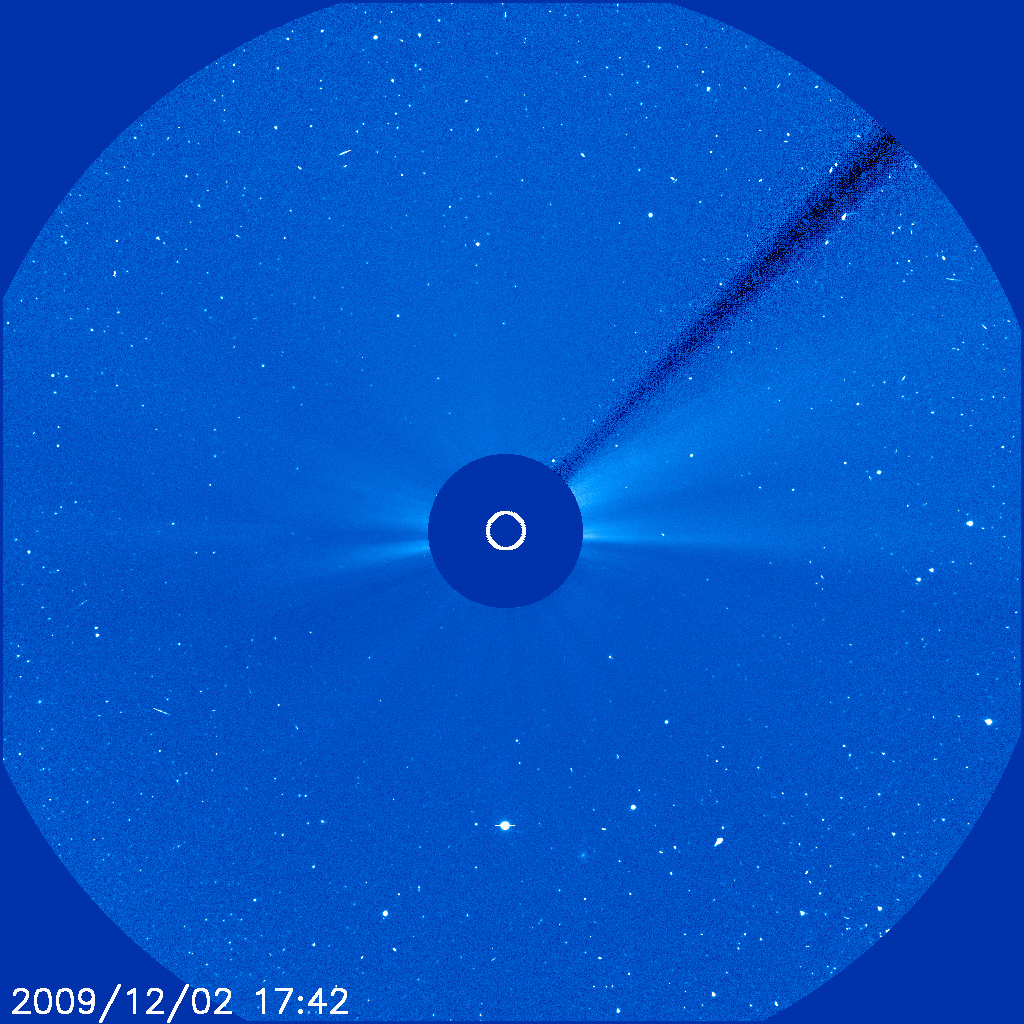
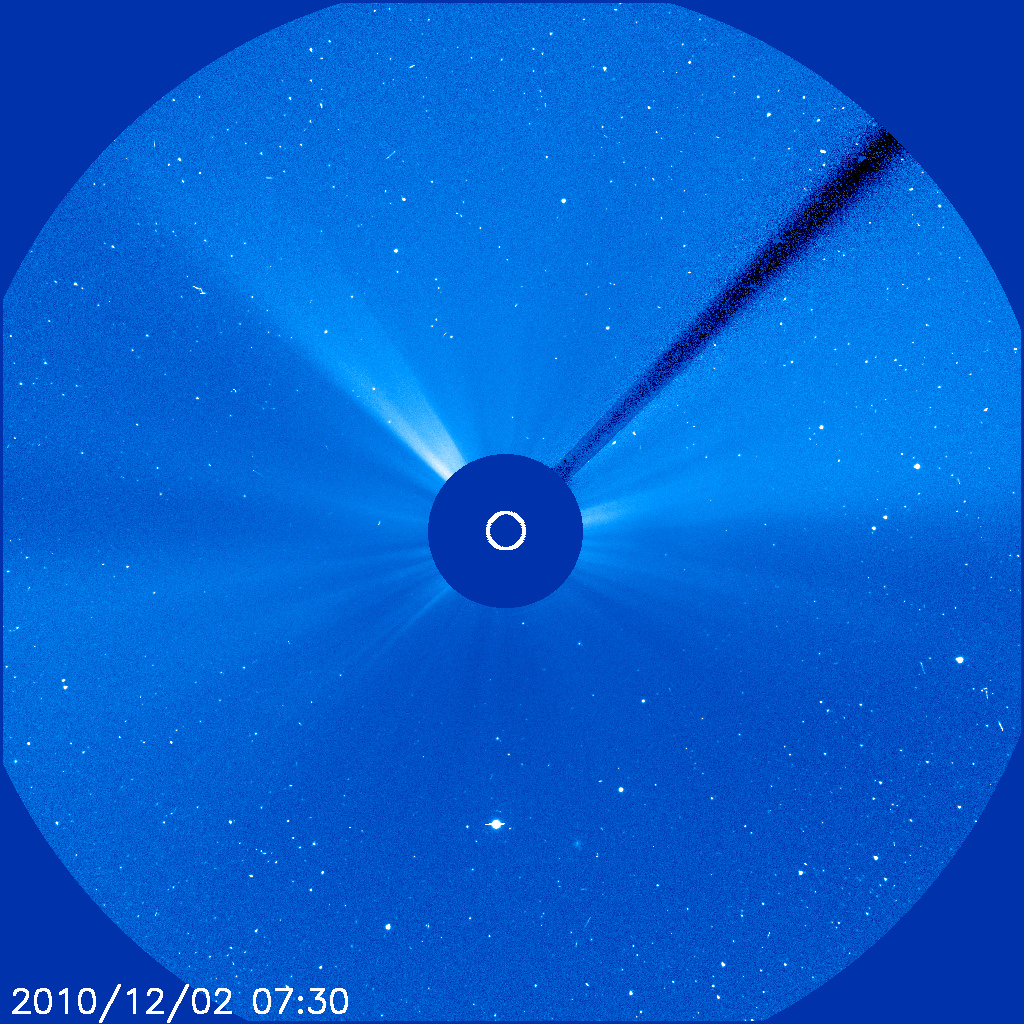
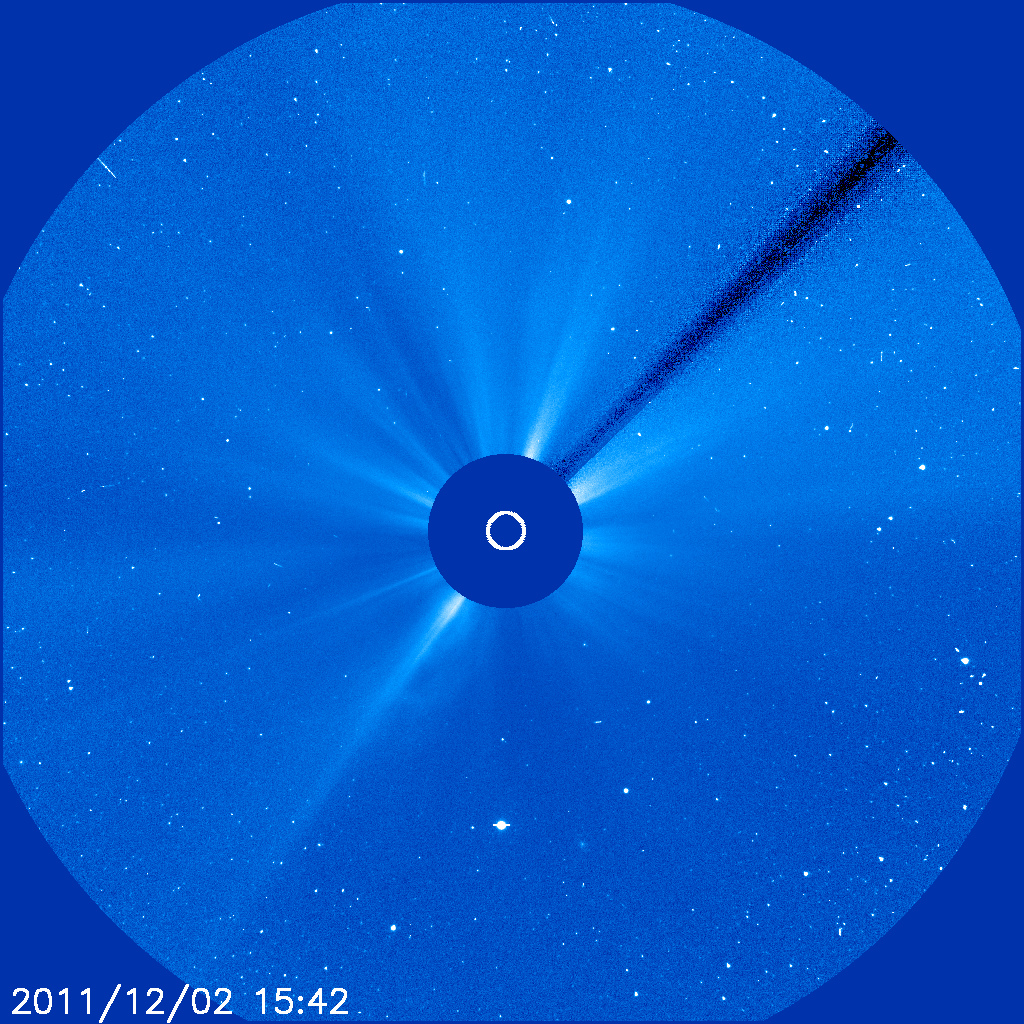
[edit]Antares is 4.57 degrees south of the ecliptic, one of four first magnitude stars within 6° of the ecliptic (the others are Spica, Regulus and Aldebaran), so it can be occulted by the Moon. The occultation of 31 July 2009 was visible in much of southern Asia and the Middle East.[38][39] Every year around December 2 the Sun passes 5° north of Antares.[24] Lunar occultations of Antares are fairly common, depending on the 18.6-year cycle of the lunar nodes. The current cycle began in 2023 and the last cycle ended in 2010. Shown at right is a video of a reappearance event, clearly showing events for both components.
Antares can also be occulted by the planets, e.g. Venus, but these events are rare. The last occultation of Antares by Venus took place on September 17, 525 BC; the next one will be November 17, 2400.[40] Other planets have been calculated not to have occulted Antares over the last millennium, nor will they in the next millennium, as most planets stay near the ecliptic and pass north of Antares.[41] Venus will be extremely near Antares on October 19, 2117, and every eight years thereafter through to October 29, 2157, it will pass south of the star.[42]
Illumination of Rho Ophiuchi cloud complex
[edit]Antares is the brightest and most evolved stellar member of the Scorpius–Centaurus association, the nearest OB association to the Sun. It is a member of the Upper Scorpius subgroup of the association, which contains thousands of stars with a mean age of 11 million years. Antares is located about 170 parsecs (550 ly) from Earth at the rim of the Upper Scorpius subgroup, and is illuminating the Rho Ophiuchi cloud complex in its foreground.[43] The illuminated cloud is sometimes referred to as the Antares Nebula or is otherwise identified as VdB 107.[44]
Stellar system
[edit]α Scorpii is a double star that is thought to form a binary system. The best calculated orbit for the stars is still considered to be unreliable.[45] It describes an almost circular orbit seen nearly edge-on, with a period of 1,218 years and a semi-major axis of about 2.9″.[46] Other recent estimates of the period have ranged from 880 years for a calculated orbit,[47] to 2,562 years for a simple Kepler's Law estimate.[48]
Early measurements of the pair found them to be about 3.5″ apart in 1847–49,[33] or 2.5″ apart in 1848.[31] More modern observations consistently give separations around 2.6″ – 2.8″.[49][50][51][52] The variations in the separation are often interpreted as evidence of orbital motion,[7][31] but are more likely to be simply observational inaccuracies with very little true relative motion between the two components.[46]
The pair have a projected separation of about 529 astronomical units (AU) (≈ 80 billion km) at the estimated distance of Antares, giving a minimum value for the distance between them. Spectroscopic examination of the energy states in the outflow of matter from the companion star suggests that the latter is over 220 AU beyond the primary (about 33 billion km).[7]
Antares
[edit]
Antares is a red supergiant star with a stellar classification of M1.5Iab-Ib, and is indicated to be a spectral standard for that class.[6] Due to the nature of the star, the derived parallax measurements have large errors, so that the true distance of Antares is approximately 550 light-years (170 parsecs) from the Sun.[3]
The brightness of Antares at visual wavelengths is about 10,000 times that of the Sun, but because the star radiates a considerable part of its energy in the infrared part of the spectrum, the true bolometric luminosity is around 100,000 times that of the Sun. There is a large margin of error assigned to values for the bolometric luminosity, typically 30% or more. There is also considerable variation between values published by different authors, for example 75,900 L☉ and 97,700 L☉ published in 2012 and 2013.[12][11]
The mass of the star has been calculated to be about 12 M☉,[12] or 11 to 14.3 M☉.[11] Comparison of the effective temperature and luminosity of Antares to theoretical evolutionary tracks for massive stars suggest a progenitor mass of 17 M☉ and an age of 12 million years (Myr),[12] or an initial mass of 15 M☉ and an age of 11 to 15 Myr.[11] Comparison of observations from antiquity to theoretical evolutionary tracks suggests an initial mass of 15 to 16 M☉, or the possibility that Antares is on a blue loop with an initial mass of 13 M☉ (while excluding 14 M☉ as a possible mass estimate). These correspond to ages from 11.8 to 17.3 Myr.[10] Massive stars like Antares are expected to explode as supernovae.[53]
Like most cool supergiants, Antares's size has much uncertainty due to the tenuous and translucent nature of the extended outer regions of the star. Defining an effective temperature is difficult due to spectral lines being generated at different depths in the atmosphere, and linear measurements produce different results depending on the wavelength observed.[54] In addition, Antares pulsates in size, varying its radius by 19%.[12] It also varies in temperature by 150 K, lagging 70 days behind radial velocity changes which are likely to be caused by the pulsations.[55]
The diameter of Antares can be measured most accurately using interferometry or observing lunar occultations events. An apparent diameter from occultations 41.3 ± 0.1 milliarcseconds has been published.[56] Interferometry allows synthesis of a view of the stellar disc, which is then represented as a limb-darkened disk surrounded by an extended atmosphere. The diameter of the limb-darkened disk was measured as 37.38±0.06 milliarcseconds in 2009 and 37.31±0.09 milliarcseconds in 2010. The linear radius of the star can be calculated from its angular diameter and distance. However, the distance to Antares is not known with the same accuracy as modern measurements of its diameter.
An estimate obtained by interferometry in 1925 by Francis G. Pease at the Mount Wilson Observatory gave Antares a diameter of 400 to 430 million mi (640 to 690 million km), equal to approximately 463-497 R☉, making it the then largest star known.[57][58] Antares is now known to be somewhat larger;[59] for instance, the Hipparcos satellite's trigonometric parallax of 5.89±1.00 mas[60] with modern angular diameter estimates lead to a radius of about 680 R☉.[11] Older radii estimates exceeding 850 R☉ were derived from older measurements of the diameter,[55] but those measurements are likely to have been affected by asymmetry of the atmosphere and the narrow range of infrared wavelengths observed; Antares has an extended shell which radiates strongly at those particular wavelengths.[11] Despite its large size compared to the Sun, Antares is dwarfed by even larger red supergiants, such as VY Canis Majoris, KY Cygni, RW Cephei or Mu Cephei.
Antares, like the similarly sized red supergiant Betelgeuse in the constellation Orion, will almost certainly explode as a supernova,[61] probably in 1.0 to 1.4 million years.[10] For a few months, the Antares supernova could be as bright as the full moon and be visible in daytime.[53]
Antares B
[edit]Antares B is a magnitude 5.5 blue-white main-sequence star of spectral type B2.5V; it also has numerous unusual spectral lines suggesting it has been polluted by matter ejected by Antares.[7] It is assumed to be a relatively normal early-B main sequence star with a mass around 7 M☉, a temperature around 18,500 K, and a radius of about 5 R☉.[13] As it falls short of the mass limit required for stars to undergo a supernova, it will likely expand into a red giant before dying as a massive white dwarf similar to Sirius B.[62][63]
Antares B is normally difficult to see in small telescopes due to glare from Antares, but can sometimes be seen in apertures over 150 millimetres (5.9 inches).[64] It is often described as green, but this is probably either a contrast effect,[62] or the result of the mixing of light from the two stars when they are seen together through a telescope and are too close to be completely resolved. Antares B can sometimes be observed with a small telescope for a few seconds during lunar occultations while Antares is hidden by the Moon.[28] Antares B appears a profound blue or bluish-green color, in contrast to the orange-red Antares.[29][28][31]
Etymology and mythology
[edit]
In the Babylonian star catalogues dating from at least 1100 BCE, Antares was called GABA GIR.TAB, "the Breast of the Scorpion". In MUL.APIN, which dates between 1100 and 700 BC, it is one of the stars of Ea in the southern sky and denotes the breast of the Scorpion goddess Ishhara.[65] Later names that translate as "the Heart of Scorpion" include Calbalakrab from the Arabic قَلْبُ ٱلْعَقْرَبِ Qalb al-ʿAqrab.[66] This had been directly translated from the Ancient Greek Καρδία Σκορπίου Kardia Skorpiū. Cor Scorpii was a calque of the Greek name rendered in Latin.[15]
In ancient Mesopotamia, Antares may have been known by various names: Urbat, Bilu-sha-ziri ("the Lord of the Seed"), Kak-shisa ("the Creator of Prosperity"), Dar Lugal ("The King"), Masu Sar ("the Hero and the King"), and Kakkab Bir ("the Vermilion Star").[15] In ancient Egypt, Antares represented the scorpion goddess Serket (and was the symbol of Isis in the pyramidal ceremonies).[15] It was called ṯms n ẖntt "the red one of the prow".[67]
In Persia, Antares was known as one of the four "royal stars". In India, it with σ Scorpii and τ Scorpii were Jyeshthā (the eldest or biggest, probably attributing its huge size), one of the nakshatra (Hindu lunar mansions).[15]
The ancient Chinese called Antares 心宿二 (Xīnxiù'èr, "second star of the Heart"), because it was the second star of the mansion Xin (心). It was the national star of the Shang dynasty, and it was sometimes referred to as (Chinese: 火星; pinyin: Huǒxīng; lit. 'fiery star') because of its reddish appearance.
The Māori people of New Zealand call Antares Rēhua, and regard it as the chief of all the stars especially the Matariki. Rēhua is father of Puanga/Puaka (Rigel), an important star in the calculation of the Māori calendar.[68] The Wotjobaluk Koori people of Victoria, Australia, knew Antares as Djuit, son of Marpean-kurrk (Arcturus); the stars on each side represented his wives. The Kulin Kooris saw Antares (Balayang) as the brother of Bunjil (Altair).[69]
The Hawaiian name of Antares is Hōkū-‘ula; it forms a line of three stars with Au-haele (σ Scorpii, Alniyat) and Paikauhale (τ Scorpii).[70] In the Marshall Islands this star, with σ and τ Scorpii, is Tūṃur, the first of the ten sons of Lōktañūr (Capella).[71]
In culture
[edit]Antares appears in the flag of Brazil, which displays 27 stars, each representing a federated unit of Brazil. Antares represents the state of Piauí.[72]
The 1995 Oldsmobile Antares concept car is named after the star.[73]
Antares is one of the medieval Behenian fixed stars.
References
[edit]- ^ "Antares". Merriam-Webster.com Dictionary. Merriam-Webster.
- ^ Kunitzsch, Paul; Smart, Tim (2006). A Dictionary of Modern star Names: A Short Guide to 254 Star Names and Their Derivations (2nd rev. ed.). Cambridge, Massachusetts: Sky Pub. ISBN 978-1-931559-44-7.
- ^ a b c d e f van Leeuwen, F. (November 2007). "Validation of the new Hipparcos reduction". Astronomy and Astrophysics. 474 (2): 653–664. arXiv:0708.1752. Bibcode:2007A&A...474..653V. doi:10.1051/0004-6361:20078357. S2CID 18759600.
- ^ a b c d Kiss, L. L.; Szabo, G. M.; Bedding, T. R. (2006). "Variability in red supergiant stars: pulsations, long secondary periods and convection noise". Monthly Notices of the Royal Astronomical Society. 372 (4): 1721–1734. arXiv:astro-ph/0608438. Bibcode:2006MNRAS.372.1721K. doi:10.1111/j.1365-2966.2006.10973.x. ISSN 0035-8711. S2CID 5203133.
- ^ a b c d Hoffleit, D.; Warren, W. H. (1995). "VizieR Online Data Catalog: Bright Star Catalogue, 5th Revised Ed. (Hoffleit+, 1991)". VizieR On-line Data Catalog: V/50. Originally Published in: 1964BS....C......0H. 5050. Bibcode:1995yCat.5050....0H. Vizier database entry CDS. Accessed on line September 07, 2012
- ^ a b Keenan, Philip C; McNeil, Raymond C (1989). "The Perkins catalog of revised MK types for the cooler stars". Astrophysical Journal Supplement Series. 71: 245. Bibcode:1989ApJS...71..245K. doi:10.1086/191373. S2CID 123149047.
- ^ a b c d Baade, R.; Reimers, D. (October 2007). "Multi-component absorption lines in the HST spectra of α Scorpii B". Astronomy and Astrophysics. 474 (1): 229–237. Bibcode:2007A&A...474..229B. doi:10.1051/0004-6361:20077308.
- ^ Evans, D. S. (June 20–24, 1966). "The Revision of the General Catalogue of Radial Velocities". In Batten, Alan Henry; Heard, John Frederick (eds.). Determination of Radial Velocities and their Applications, Proceedings from IAU Symposium no. 30. Determination of Radial Velocities and Their Applications. Vol. 30. University of Toronto: International Astronomical Union. p. 57. Bibcode:1967IAUS...30...57E.
- ^ Buick, Tony (2010). "Classification of the Stars". The Rainbow Sky. Patrick Moore's Practical Astronomy Series. pp. 43–71. doi:10.1007/978-1-4419-1053-0_4. ISBN 978-1-4419-1052-3. ISSN 1431-9756.
- ^ a b c d Neuhäuser, R.; et al. (July 2022). "Colour evolution of Betelgeuse and Antares over two millennia, derived from historical records, as a new constraint on mass and age". Monthly Notices of the Royal Astronomical Society. 516 (1): 693–719. arXiv:2207.04702. Bibcode:2022MNRAS.516..693N. doi:10.1093/mnras/stac1969.
- ^ a b c d e f g h i Ohnaka, K; Hofmann, K.-H; Schertl, D; Weigelt, G; Baffa, C; Chelli, A; Petrov, R; Robbe-Dubois, S (2013). "High spectral resolution imaging of the dynamical atmosphere of the red supergiant Antares in the CO first overtone lines with VLTI/AMBER". Astronomy & Astrophysics. 555: A24. arXiv:1304.4800. Bibcode:2013A&A...555A..24O. doi:10.1051/0004-6361/201321063. S2CID 56396587.
- ^ a b c d e f Pecaut, Mark J.; Mamajek, Eric E. & Bubar, Eric J. (February 2012). "A Revised Age for Upper Scorpius and the Star Formation History among the F-type Members of the Scorpius-Centaurus OB Association". Astrophysical Journal. 746 (2): 154. arXiv:1112.1695. Bibcode:2012ApJ...746..154P. doi:10.1088/0004-637X/746/2/154. S2CID 118461108.
- ^ a b c d e f Kudritzki, R. P.; Reimers, D. (1978). "On the absolute scale of mass-loss in red giants. II. Circumstellar absorption lines in the spectrum of alpha Sco B and mass-loss of alpha Sco A". Astronomy and Astrophysics. 70: 227. Bibcode:1978A&A....70..227K.
- ^ Schröder, K.-P.; Cuntz, M. (April 2007). "A critical test of empirical mass loss formulas applied to individual giants and supergiants". Astronomy and Astrophysics. 465 (2): 593–601. arXiv:astro-ph/0702172. Bibcode:2007A&A...465..593S. doi:10.1051/0004-6361:20066633. S2CID 55901104.
- ^ a b c d e f g Allen, R.H. (1963). Star Names: Their Lore and Meaning (Reprint ed.). New York, NY: Dover Publications Inc. pp. 364–366. ISBN 978-0-486-21079-7.
{{cite book}}: CS1 maint: ignored ISBN errors (link) - ^ Samus, N. N.; Durlevich, O. V.; et al. (2009). "VizieR Online Data Catalog: General Catalogue of Variable Stars (Samus+ 2007-2013)". VizieR On-line Data Catalog: B/GCVS. Originally Published in: 2009yCat....102025S. 1. Bibcode:2009yCat....102025S.
- ^ ἀντάρης in Liddell, Henry George; Scott, Robert (1940) A Greek–English Lexicon, revised and augmented throughout by Jones, Sir Henry Stuart, with the assistance of McKenzie, Roderick. Oxford: Clarendon Press. In the Perseus Digital Library, Tufts University.
- ^ Gettings, Fred (1990). The Arkana Dictionary of Astrology. Penguin Publishing Group. ISBN 978-0-14-019287-2.
- ^ Hunger, Hermann (2019). The Babylonian astronomical compendium MUL. APIN. Routledge. ISBN 978-1-138-05047-1. OCLC 1054505486.
- ^ "IAU Working Group on Star Names (WGSN)". Archived from the original on 10 June 2016. Retrieved 22 May 2016.
- ^ "Bulletin of the IAU Working Group on Star Names, No. 1" (PDF). Archived (PDF) from the original on 2022-10-09. Retrieved 28 July 2016.
- ^ "IAU Catalog of Star Names". Retrieved 28 July 2016.
- ^ Marici, Ed; Guinan, Edward (February 2025). "Antares: Variability of the Nearby M Supergiant and Core Collapse Type II Supernova Progenitor". Research Notes of the AAS. 9 (2): 31. Bibcode:2025RNAAS...9...31M. doi:10.3847/2515-5172/adb3a1.
- ^ a b Star Maps created using XEphem (2008). "LASCO Star Maps (identify objects in the field of view for any day of the year)". Large Angle and Spectrometric Coronagraph Experiment (LASCO). Archived from the original on 2015-02-24. Retrieved 2011-12-01. (2009, 2010, 2011)
- ^ Wright, W. H. (1907). "The variable radial velocity of Antares". The Astrophysical Journal. 25: 58. Bibcode:1907ApJ....25...58W. doi:10.1086/141419.
- ^ Lunt, J. (1916). "On the orbits of the spectroscopic binaries alpha Orionis and alpha Scorpii". The Astrophysical Journal. 44: 250. Bibcode:1916ApJ....44..250L. doi:10.1086/142291.
- ^ Spencer Jones, H. (1928). "The Radial Velocity Variations of a Orionis and a Scorpii". Monthly Notices of the Royal Astronomical Society. 88 (8): 660–679. doi:10.1093/mnras/88.8.660.
- ^ a b c Burnham, Robert Jr. (1978). Burnham's Celestial Handbook. New York: Dover Publications. p. 1666.
- ^ a b Johnson, S. J. (1879). "Occultation of Antares". The Observatory. 3: 84. Bibcode:1879Obs.....3...84J.
- ^ Darby, William Arthur (1864). The astronomical observer. Hardwicker. pp. 85–.
- ^ a b c d Crossley, Edward; Gledhill, Joseph; Wilson, J. M. (6 February 2018). A Handbook of Double Stars, with a Catalogue of Twelve Hundred Double Stars and Extensive Lists of Measures. with Additional Notes Bringing the Measures Up to 1879. Creative Media Partners, LLC. p. 329. ISBN 978-1-376-84608-9.
- ^ Reference Catalogue of Southern Double Stars. H. M. Stationery Office. 1899. p. 161A.
- ^ a b Dawes, W. R. (1856). "On an Occultation of Antares by the Moon". Monthly Notices of the Royal Astronomical Society. 16: 143. Bibcode:1856MNRAS..16..143D. doi:10.1093/mnras/16.6.143.
- ^ Cousins, A. W. J. (1952). "Bright variable stars in southern hemisphere (second list)". The Observatory. 72: 86. Bibcode:1952Obs....72...86C.
- ^ "Antares: Betelgeuse's Neglected Twin". Retrieved 2019-06-08.
- ^ Percy, John R.; Sato, Hiromitsu (2009). "Long Secondary Periods in Pulsating Red Supergiant Stars". Journal of the Royal Astronomical Society of Canada. 103 (1): 11. Bibcode:2009JRASC.103...11P.
- ^ Hamacher, D.W. (2018). "Observations of red–giant variable stars by Aboriginal Australians". The Australian Journal of Anthropology. 29: 89–107. arXiv:1709.04634. Bibcode:2018AuJAn..29...89H. doi:10.1111/taja.12257. S2CID 119453488.
- ^ "Occultation of Antares on 31 July 09". The International Occultation Timing Association. Archived from the original on 5 July 2009. Retrieved 2 August 2009.
- ^ "Sky watchers report occultation of Antares by moon". The Times of India. 2 August 2009. Archived from the original on 4 November 2012.
- ^ Journal of the British Astronomical Association – Volume 2. BiblioBazaar. 29 October 2015. p. 155. ISBN 978-1-345-66291-7.
- ^ Dickinson, Terence (2006). NightWatch: A Practical Guide to Viewing the Universe. A & C Black. p. 46. ISBN 978-0-7136-7939-7.
- ^ "Interactive sky chart". Sky & Telescope. Retrieved 2022-08-27.
- ^ Melnik, A. M.; Dambis, A. K. (2020). "Distance scale for high-luminosity stars in OB associations and in field with Gaia DR2. Spurious systematic motions". Astrophysics and Space Science. 365 (7): 112. arXiv:2006.14649. Bibcode:2020Ap&SS.365..112M. doi:10.1007/s10509-020-03827-0. S2CID 220128144.
- ^ Mamajek, E.E. (2008). "On the distance to the Ophiuchus star-forming region". Astronomische Nachrichten. 329 (1). Wiley: 10–14. arXiv:0709.0505. Bibcode:2008AN....329...10M. doi:10.1002/asna.200710827. ISSN 0004-6337. S2CID 14027548.
- ^ Malkov, O. Yu; Tamazian, V. S.; Docobo, J. A.; Chulkov, D. A. (2012). "Dynamical masses of a selected sample of orbital binaries". Astronomy and Astrophysics. 546: A69. Bibcode:2012A&A...546A..69M. doi:10.1051/0004-6361/201219774.
- ^ a b Pavlovic, R.; Todorovic, N. (2005). "Orbits of Seven Edge-On Visual Double Stars". Serbian Astronomical Journal. 170 (170): 73–78. Bibcode:2005SerAJ.170...73P. doi:10.2298/SAJ0570073P.
- ^ Baize, P.; Petit, M. (1989). "Etoiles doubles orbitales a composantes variables". Astronomy and Astrophysics Supplement Series. 77: 497. Bibcode:1989A&AS...77..497B.
- ^ Reimers, D.; Hagen, H. -J.; Baade, R.; Braun, K. (2008). "The Antares emission nebula and mass loss of α Scorpii A". Astronomy and Astrophysics. 491 (1): 229–238. arXiv:0809.4605. Bibcode:2008A&A...491..229R. doi:10.1051/0004-6361:200809983. S2CID 18620644.
- ^ Mason, Brian D.; Wycoff, Gary L.; Hartkopf, William I.; Douglass, Geoffrey G.; Worley, Charles E. (2001). "The 2001 US Naval Observatory Double Star CD-ROM. I. The Washington Double Star Catalog". The Astronomical Journal. 122 (6): 3466–3471. Bibcode:2001AJ....122.3466M. doi:10.1086/323920.
- ^ Dave, Gault; Brian, Loader (September 2006). "Determining the Separation and Position Angle of Antares A–B during Lunar Occultation". Southern Stars. 45 (3): 14. Bibcode:2006SouSt..45c..14G. ISSN 0049-1640.
- ^ Anton, Rainer (2015). "Double Star Measurements at the Southern Sky with a 50 cm Reflector and a Fast CCD Camera in 2014". Journal of Double Star Observations. 11 (2): 81. Bibcode:2015JDSO...11...81A.
- ^ McAlister, Harold; Hartkopf, William I.; Franz, Otto G. (1990). "ICCD Speckle Observations of Binary Stars. V. Measurements During 1988–1989 from the Kitt Peak and the Cerro Tololo 4 M Telescopes". The Astronomical Journal. 99: 965. Bibcode:1990AJ.....99..965M. doi:10.1086/115387.
- ^ a b Hockey, T.; Trimble, V. (2010). "Public reaction to a V = −12.5 supernova". The Observatory. 130 (3): 167. Bibcode:2010Obs...130..167H.
- ^ Ireland, M. J.; et al. (May 2004). "Multiwavelength diameters of nearby Miras and semiregular variables". Monthly Notices of the Royal Astronomical Society. 350 (1): 365–374. arXiv:astro-ph/0402326. Bibcode:2004MNRAS.350..365I. doi:10.1111/j.1365-2966.2004.07651.x. S2CID 15830460.
- ^ a b Pugh, T.; Gray, D.F. (2013). "On the Six-year Period in the Radial Velocity of Antares A". The Astronomical Journal. 145 (2): 4. Bibcode:2013AJ....145...38P. doi:10.1088/0004-6256/145/2/38. 38.
- ^ Richichi, A. (April 1990). "A new accurate determination of the angular diameter of Antares". Astronomy and Astrophysics. 230 (2): 355–362. Bibcode:1990A&A...230..355R.
- ^ "Science News". Science. 61 (1576): x–xiv. 1925. ISSN 0036-8075. JSTOR 1650052.
- ^ Pease, F. G. (1921). "The Diameter of Alpha Scorpii by the Interferometer Method". Publications of the Astronomical Society of the Pacific. 33 (194): 204–205. Bibcode:1921PASP...33..204P. doi:10.1086/123081. ISSN 0004-6280. JSTOR 40671460.
- ^ Wing, R. F. (2009-09-01). Luttermoser, Donald G.; Smith, Beverly J.; Stencel, Robert E. (eds.). The Biggest Stars of All. The Biggest, Baddest, Coolest Stars. Proceedings of the workshop held 16-18 July 2007, at the Millennium Centre, Johnson City, Tennessee, USA. ASP Conference Series. Vol. 412. p. 113. Bibcode:2009ASPC..412..113W.
- ^ Perryman, M. A. C.; Lindegren, L.; Kovalevsky, J.; Hoeg, E.; Bastian, U.; Bernacca, P. L.; Crézé, M.; Donati, F.; Grenon, M.; Grewing, M.; van Leeuwen, F.; van der Marel, H.; Mignard, F.; Murray, C. A.; Le Poole, R. S.; Schrijver, H.; Turon, C.; Arenou, F.; Froeschlé, M.; Petersen, C. S. (July 1997). "The HIPPARCOS Catalogue". Astronomy and Astrophysics. 323: L49 – L52. Bibcode:1997A&A...323L..49P.
- ^ Firestone, R. B. (July 2014). "Observation of 23 Supernovae That Exploded <300 pc from Earth during the past 300 kyr". The Astrophysical Journal. 789 (1): 11. Bibcode:2014ApJ...789...29F. doi:10.1088/0004-637X/789/1/29. 29.
- ^ a b Kaler, James (June 26, 2009). "Antares". STARS. Retrieved 13 August 2008.
- ^ Whittet, D. C. B. (1999-12-01). "A physical interpretation of the 'red Sirius' anomaly". Monthly Notices of the Royal Astronomical Society. 310 (2): 355–359. Bibcode:1999MNRAS.310..355W. doi:10.1046/j.1365-8711.1999.02975.x. ISSN 0035-8711.
- ^ Schaaf, Fred (2008). The Brightest Stars: Discovering the Universe Through the Sky's Most Brilliant Stars. John Wiley and Sons. p. 218. ISBN 978-0-471-70410-2.
- ^ Rogers, J. H. (February 1998). "Origins of the ancient constellations: I. The Mesopotamian traditions". Journal of the British Astronomical Association. 108 (1): 9–28. Bibcode:1998JBAA..108....9R.
- ^ Kunitzsch, P. (1959). Arabische Sternnamen in Europa. Wiesbaden: Otto Harrasowitz. p. 169.
- ^ Lull, José; Belmonte, Juan Antonio (2009). The constellations of ancient Egypt (PDF). p. 162. Bibcode:2009iscc.book..155L. Archived (PDF) from the original on 2022-10-09.
- ^ Matamua, Rangi (2018). Matariki. Wellington: Huia Publishers. pp. 22–24. ISBN 978-1-77550-325-5.
- ^ Mudrooroo (1994). Aboriginal mythology : an A-Z spanning the history of aboriginal mythology from the earliest legends to the present day. London: HarperCollins. p. 5. ISBN 978-1-85538-306-7.
- ^ "IAU Catalog of Star Names". Retrieved 14 May 2025.
- ^ "Leepwal". All Skies Encyclopaedia. IAU Working Group on Star Names. Retrieved 12 May 2025.
- ^ "Science in Portugal - The Star of Cabral". Instituto Camões. Archived from the original on July 16, 2011. Retrieved November 14, 2022.
- ^ "Oldsmobile Antares". ACI. Retrieved 2024-07-26.
Further reading
[edit]- Cannon, E.; et al. (March 2021). "The inner circumstellar dust of the red supergiant Antares as seen with VLT/SPHERE/ZIMPOL". Monthly Notices of the Royal Astronomical Society. 502 (1): 369–382. arXiv:2101.02785. Bibcode:2021MNRAS.502..369C. doi:10.1093/mnras/stab018.
- Johnson, Daniel (September 3, 2020). "Meet Antares: the star that is not Mars". Sky & Telescope. Retrieved 2022-08-27.
- O'Gorman, E.; et al. (June 2020). "ALMA and VLA reveal the lukewarm chromospheres of the nearby red supergiants Antares and Betelgeuse". Astronomy & Astrophysics. 638: A65. arXiv:2006.08023. Bibcode:2020A&A...638A..65O. doi:10.1051/0004-6361/202037756. S2CID 219484950. A65.
- Ohnaka, K.; et al. (August 2017). "Vigorous atmospheric motion in the red supergiant star Antares". Nature. 548 (7667): 310–312. arXiv:1708.06372. Bibcode:2017Natur.548..310O. doi:10.1038/nature23445. PMID 28816248. S2CID 4458627.
- Ohnaka, K. (August 2014). "Imaging the outward motions of clumpy dust clouds around the red supergiant Antares with VLT/VISIR". Astronomy & Astrophysics. 568: A17. arXiv:1407.0715. Bibcode:2014A&A...568A..17O. doi:10.1051/0004-6361/201423893. S2CID 62795432. A17.
- Percy, John (2014). "Antares: Betelgeuse's Neglected Twin". AAVSO. Retrieved 2019-06-01.
- Pugh, T.; Gray, David F. (November 2013). "Short Timescale Variations in the Atmosphere of Antares A". The Astrophysical Journal. 777 (1): 10. Bibcode:2013ApJ...777...10P. doi:10.1088/0004-637X/777/1/10. S2CID 120406829. 10.
- Sanad, M. R.; Bobrowsky, M. (October 2010). "Spectral variability of the α Sco AB binary system observed with IUE". New Astronomy. 15 (7): 646–651. Bibcode:2010NewA...15..646S. doi:10.1016/j.newast.2010.04.002.
- Marsh, K. A.; et al. (February 2001). "Mid-Infrared Images of the Circumstellar Dust around α Scorpii". The Astrophysical Journal. 548 (2): 861–867. Bibcode:2001ApJ...548..861M. doi:10.1086/319035. S2CID 120293812.
- Justtanont, K.; et al. (May 1999). "Atomic fine-structure lines in the ISO-SWS spectra of the supergiants alpha Orionis and alpha Scorpii". Astronomy and Astrophysics. 345: 605–610. Bibcode:1999A&A...345..605J.
- Jennings, Donald E.; Sada, Pedro V. (February 1998). "Water in Betelgeuse and Antares". Science. 279 (5352): 844–847. Bibcode:1998Sci...279..844J. doi:10.1126/science.279.5352.844. PMID 9452380.
- Bester, M.; et al. (May 1996). "Measurement at 11 Micron Wavelengths of the Diameters of alpha Orionis and alpha Scorpii: Changes in Effective Temperature of alpha Orionis and Very Recent Dust Emission". Astrophysical Journal. 463: 336. Bibcode:1996ApJ...463..336B. doi:10.1086/177246.
- Bloemhof, E. E.; Danen, R. M. (February 1995). "Direct Measurement of the Inner Radius of the Dust Shell around the Cool Supergiant Star alpha Scorpii". Astrophysical Journal Letters. 440: L93. Bibcode:1995ApJ...440L..93B. doi:10.1086/187769.
External links
[edit]
- Antares on WikiSky: DSS2, SDSS, GALEX, IRAS, Hydrogen α, X-Ray, Astrophoto, Sky Map, Articles and images
- Best Ever Image of a Star’s Surface and Atmosphere – First map of motion of material on a star other than the Sun


Antares
View on GrokipediaNomenclature
Traditional Names
Antares holds the Bayer designation α Scorpii, or Alpha Scorpii, signifying its status as the brightest star in the constellation Scorpius.[7] This designation, introduced by Johann Bayer in 1603, reflects its prominent position and luminosity, outshining all other stars in the scorpion-shaped asterism.[1] The traditional name Antares originates from the Ancient Greek term Ἀντάρης (Antarēs), meaning "rival of Ares" or "like Ares," referring to the Greek god of war, Mars, due to the star's distinctive reddish hue that mimics the planet's appearance.[7] This name was adopted in Western astronomy from Ptolemy's second-century works, where it appears as a transcription of the Greek designation for the star.[8] In Arabic astronomical tradition, Antares was known as Qalb al-ʿAqrab, translating to "the heart of the scorpion," emphasizing its central location within the constellation's body.[7] This name, later Latinized as Cor Scorpii or Calbalakrab, was used in medieval star catalogs and reflects the star's role as the metaphorical heart of the celestial scorpion.[9] Ancient Chinese astronomers referred to Antares as the "Fire Star" (Huǒxīng, 火星), a name highlighting its fiery red color and associating it with elemental fire in their asterism of the Blue Dragon (Qing Long).[10] Among Indigenous Australian cultures, such as the Wotjobaluk and Wergaia peoples of Victoria, the star was called Djuit, personified as a figure—often a son or a red-rumped parrot—with flanking stars representing companions or wives in their oral traditions.[11] Historically, Antares featured prominently in Ptolemy's Almagest (c. 150 CE), where it was cataloged as the principal star of Scorpio, described as the middle of the three bright stars in the body of the scorpion and noted for its reddish color, marking its enduring significance in early Greco-Roman astronomy.[8]Catalog Designations
Antares holds the Flamsteed designation 21 Scorpii, assigned based on its position within the constellation Scorpius ordered by right ascension.[12] It is also cataloged under several other standard astronomical identifiers, as summarized in the following table:| Catalog | Designation |
|---|---|
| Harvard Revised (HR) | 6134 |
| Henry Draper (HD) | 148478 |
| Smithsonian Astrophysical Observatory (SAO) | 184415 |
| Hipparcos (HIP) | 80763 |