Hubbry Logo
logo
Anopsia
Community hub

Anopsia

logo
0 subscribers
Read side by side
from Wikipedia
Anopsia
Other namesAnopia
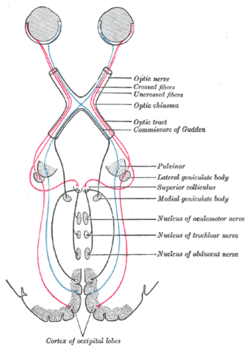
Scheme showing central connections of the optic nerves and optic tracts. (Lesions at different locations relate to different types of anopsias.)
SpecialtyNeurology

An anopsia, or anopia, (from Ancient Greek ἀν- (an-) 'without' and ὄψις (opsis) 'sight') is a defect in the visual field. If the defect is only partial, then the portion of the field with the defect can be used to isolate the underlying cause. It is particularly used to describe the lack of sight in one eye.[1]

Variants

[edit]

References

[edit]
[edit]
Revisions and contributorsEdit on WikipediaRead on Wikipedia
from Grokipedia
Anopsia, also spelled anopia, is a defect in the visual field due to damage along the visual pathway, including the retina, optic nerve, optic chiasm, optic tract, or visual cortex in the brain, resulting in partial or complete loss of vision in specific parts of the visual field in one or both eyes, distinguishing it from total blindness which affects the entire visual field.[1] This condition arises from various underlying causes, including glaucoma, macular degeneration, stroke (most common neurological cause, disrupting blood flow to the brain's visual processing areas), brain tumors that compress neural structures, traumatic head injuries leading to direct damage, optic neuritis often associated with multiple sclerosis, infections such as meningitis or encephalitis, and congenital abnormalities present from birth.[1][2][3] Anopsia manifests in several types depending on the location and extent of the lesion; monocular anopia affects vision in a single eye, typically from optic nerve damage; bitemporal hemianopia involves loss of the outer (temporal) halves of both visual fields, commonly due to pituitary tumors pressing on the optic chiasm; homonymous hemianopia results in the same half of the visual field being lost in both eyes, such as the right or left side, often from strokes in the occipital lobe; and quadrantanopia entails the absence of vision in one quarter of the visual field, caused by partial lesions in the visual cortex.[1][2][4] Symptoms vary by type but generally include missing portions of the visual world, such as tunnel vision in advanced bitemporal cases or bumping into objects on one side, and may be accompanied by headaches, eye pain, or neurological deficits if the underlying cause affects other brain areas.[1] Diagnosis typically involves a detailed patient history, comprehensive eye and neurological examinations, and specialized visual field testing like perimetry to map the extent of the defect, often supplemented by imaging such as MRI or CT scans to identify lesions.[1] Treatment focuses on addressing the root cause—for instance, thrombolytic therapy or surgery for strokes and tumors, corticosteroids for optic neuritis, or antibiotics for infections—while permanent vision loss may require rehabilitation strategies including visual aids, prism glasses, scanning training to compensate for field defects, and occupational therapy to adapt daily activities.[1]

Overview

Definition

Anopsia, also spelled anopia in some medical contexts, is a clinical term denoting a defect or absence of vision within specific portions of the visual field, resulting in partial or complete loss of sight in defined areas without affecting the entire visual capability of the eye or both eyes.[1] This condition arises from disruptions in the visual pathways beyond the eye itself, leading to localized blind spots or scotomas that impair perception in particular sectors of the field of view.[5] Unlike total blindness, anopsia preserves central or peripheral vision in unaffected regions, allowing for functional sight despite the deficit.[6] The terms anopsia and anopia are often used interchangeably in medical literature to describe visual field defects along the visual pathway. Examples include homonymous hemianopsia, where the same half of the visual field is lost in both eyes, often linked to lesions in the optic tract or occipital cortex.[6] This focus is on topographic vision loss rather than global ocular failure.[7] Anopsia commonly manifests in neurological disorders, with prevalence varying by underlying condition; for instance, it affects approximately 8% of stroke patients in the form of complete homonymous hemianopsia, though broader visual field defects occur in up to 20-57% of cases acutely.[8][9] The incidence fluctuates based on lesion location and severity, emphasizing its association with central nervous system insults rather than primary eye diseases.

Terminology and Etymology

The term anopsia derives from Ancient Greek roots: the prefix an- (ἀν-), meaning "without" or "absence of," and opsis (ὄψις), meaning "vision" or "sight." This linguistic construction underscores the condition as a lack or defect in visual perception, distinguishing it from complete blindness. The word entered English medical terminology in 1842, as documented in the writings of Robley Dunglison, an influential American physician and author of medical dictionaries, who used it to describe visual impairments in his lexicon.[10][11] In the mid-19th century, anopsia became established in neurological literature to characterize visual field losses following brain lesions, reflecting growing insights into the anatomy of the visual pathways during that era. Its adoption in ophthalmology texts around the 1850s helped standardize descriptions of partial visual deficits, evolving from broader terms for sightlessness to more precise categorizations of field-specific defects. This historical development facilitated clearer communication in clinical and research contexts, avoiding ambiguity with unrelated forms of visual impairment.[10][12] Related terminology clarifies nuances in visual field defects and prevents overlap in medical usage. Anopia denotes total absence of vision, often linked to structural eye defects or complete optic nerve failure, sharing the same Greek roots but emphasizing outright sightlessness. Hemianopsia specifies loss of half the visual field, incorporating the prefix hemi- (ἡμι-), meaning "half," and was first attested in the late 19th century to describe hemispheric deficits. Quadrantanopsia (or quadrantanopia) refers to vision loss in one quarter of the field, derived from Latin quadrans ("quarter") combined with anopsia, with early uses appearing in early 20th-century neurological descriptions. In contrast, scotoma indicates a discrete, localized blind spot, originating from Greek skotoma (σκότωμα), meaning "dizziness" or derived from skotos (σκότος), "darkness," and has been used since the 16th century for focal visual interruptions. These distinctions ensure accurate delineation of defect scope and location in diagnostic practice.[13][14][15][16]

Classification

Hemianopsia

Hemianopsia, also known as hemianopia, is a subtype of anopsia characterized by the loss of half the visual field in both eyes. This defect affects vision symmetrically across both eyes, dividing the field along the vertical midline. It can manifest as partial or complete loss, impacting daily activities such as reading, navigation, and object recognition.[17] The primary subtypes are homonymous hemianopsia and bitemporal hemianopsia. Homonymous hemianopsia involves the loss of the same half of the visual field in both eyes—either the left or right side—resulting from damage to the post-chiasmal visual pathways. In contrast, bitemporal hemianopsia refers to the bilateral loss of the temporal (outer) halves of the visual fields, typically due to lesions at the optic chiasm. These distinctions arise from the anatomical organization of the visual pathways, where fibers from corresponding retinal regions converge.[18][17] A common clinical example of homonymous hemianopsia is right homonymous hemianopsia, where the right half of the visual field is lost in both eyes, often stemming from a stroke in the left occipital lobe. This presentation frequently includes macular sparing, preserving central vision up to 5°–10° due to the dual blood supply from the posterior and middle cerebral arteries to the macular representation in the occipital cortex. Such sparing is particularly noted in vascular etiologies, allowing partial retention of fine visual acuity despite the field defect.[17][19]

Quadrantanopsia

Quadrantanopsia, also known as quadrantanopia, is a type of visual field defect characterized by the loss of vision in one-quarter of the visual field in both eyes, typically affecting the same quadrant and referred to as homonymous quadrantanopsia.[4] This defect divides the visual field into four quadrants—superior nasal, superior temporal, inferior nasal, and inferior temporal—and involves partial disruption of the retrochiasmal visual pathways.[20] Unlike complete hemifield losses, quadrantanopsia spares three-quarters of the visual field, allowing for preserved peripheral vision in the unaffected areas.[21] Subtypes of quadrantanopsia are distinguished by the affected quadrant and underlying anatomical involvement. Superior quadrantanopsia, often termed "pie in the sky," results in loss of the upper visual field quadrant contralaterally and is commonly associated with lesions in the temporal lobe.[21] In contrast, inferior quadrantanopsia, known as "pie on the floor," involves loss of the lower visual field quadrant and arises from damage in the parietal lobe.[20] Less common variants include binasal or bitemporal quadrantanopsia, which affect nasal or temporal quadrants respectively, though these are rarer and often linked to prechiasmal or chiasmal pathologies rather than postchiasmal ones.[4] The anatomical correlation of quadrantanopsia stems from the organization of the optic radiations, which carry visual information from the lateral geniculate nucleus to the primary visual cortex. Superior quadrantanopsia typically occurs due to interruption of the inferior fibers of the optic radiations, known as Meyer's loop, which loop through the temporal lobe and represent the contralateral superior visual field.[21] These fibers originate from the inferior retina and travel anteriorly before ascending to the inferior bank of the calcarine sulcus in the occipital lobe.[20] Conversely, inferior quadrantanopsia results from damage to the superior optic radiations passing through the parietal lobe, which convey information from the superior retina to the superior calcarine cortex.[20] Such lesions are often incongruous, meaning the field defects in each eye may not perfectly align, reflecting the dispersed nature of the radiating fibers.[21]

Other Visual Field Defects

A scotoma represents a localized area of diminished or absent vision within an otherwise intact visual field, often appearing as a blind spot surrounded by areas of normal sight.[22] Central scotomas, which affect the macular region around the fixation point, lead to substantial central vision impairment and are commonly associated with conditions such as age-related macular degeneration, where photoreceptor or ganglion cell loss in the macula creates a gap in the visual field.[23] These defects can vary in size and shape, with visual field testing essential for mapping their extent and monitoring progression.[24] Monocular anopsia involves complete visual field loss confined to a single eye, typically arising from lesions or disorders affecting the ipsilateral eye or optic nerve rather than central visual pathways.[2] Common ocular causes include retinal detachment, severe glaucoma, or advanced cataract, which disrupt light transmission or retinal function unilaterally, resulting in total blindness in the affected eye without impacting the fellow eye's field.[25] This form contrasts with binocular defects by its isolated nature, often prompting urgent evaluation to rule out treatable intraocular pathologies. Tunnel vision, characterized by progressive constriction of the peripheral visual field while sparing central vision, manifests as a narrowed tunnel-like perception and is frequently linked to advanced glaucoma or retinitis pigmentosa, where peripheral retinal damage leads to ring-like scotomas encroaching inward.[26] Cecocentral scotomas, a specific subtype extending from the central field to the physiologic blind spot, commonly occur in optic neuropathies such as optic neuritis or toxic optic neuropathy, creating a wedge-shaped defect along the papillomacular bundle.[27] Altitudinal defects, involving loss of the upper or lower half of the visual field across both eyes (or monocularly in ocular cases), typically result from ischemic optic neuropathy, where vascular compromise affects hemifields divided by the horizontal meridian.[28] Among rare variants, cortical blindness arises from bilateral damage to the occipital cortex, producing total anopsia despite intact ocular structures and pupillary responses, with causes including posterior cerebral artery stroke.[29] In some instances, this leads to Anton syndrome, where patients exhibit denial of their blindness (visual anosognosia) and confabulate visual experiences, confiding the impairment due to parietal-occipital lesions disrupting self-awareness of deficits.[30]

Pathophysiology

Visual Pathway Anatomy

The visual pathway transmits visual information from the retina to the primary visual cortex, involving a series of interconnected structures that ensure precise representation of the visual field. The pathway begins in the retina, a multilayered neural tissue at the back of the eye, where photoreceptor cells (rods and cones) detect light and initiate signal transduction through bipolar and ganglion cells. The axons of retinal ganglion cells converge to form the optic nerve (cranial nerve II), which carries approximately 1.2 million fibers from the eye, exiting via the optic canal to reach the intracranial space.[2][31] At the optic chiasm, located at the base of the brain above the pituitary gland, partial decussation occurs: nasal retinal fibers from each eye (about 53% of total fibers) cross to the contralateral side, while temporal fibers remain ipsilateral, creating a binocular representation of the visual field in the subsequent structures. Beyond the chiasm, the optic tracts emerge, each containing crossed nasal fibers from the opposite eye and uncrossed temporal fibers from the ipsilateral eye, conveying information primarily from the contralateral visual hemifield. These tracts terminate mainly in the lateral geniculate nucleus (LGN) of the thalamus, a six-layered structure with retinotopic organization where layers 1, 4, and 6 receive input from the contralateral eye, and layers 2, 3, and 5 from the ipsilateral eye.[2][31][32] From the LGN, third-order neurons project via the optic radiations through the retrolenticular part of the internal capsule to the primary visual cortex in the occipital lobe. The optic radiations divide into two main bundles: the inferior temporal fibers, known as Meyer's loop, which loop anteriorly around the temporal horn of the lateral ventricle before ascending to the lingual gyrus (representing the contralateral superior visual quadrant); and the superior parietal fibers, which travel more directly through the parietal lobe to the cuneus gyrus (representing the contralateral inferior visual quadrant). The primary visual cortex, or striate cortex (Brodmann area 17), lies along the calcarine sulcus of the medial occipital lobe, where the upper bank (cuneus) processes the inferior visual field and the lower bank (lingual gyrus) processes the superior visual field, with macular vision represented at the posterior pole.[2][31][32] In terms of field mapping, the nasal retina perceives the temporal visual field, while the temporal retina perceives the nasal field; the crossing of nasal fibers at the chiasm ensures that each optic tract and subsequent structure carries a complete representation of the contralateral hemifield from both eyes. The binocular visual field is divided into four quadrants (superior and inferior nasal/temporal), with anatomical organization such that lesions at specific sites, such as the chiasm, predict corresponding field disruptions like bitemporal defects due to the crossing pattern. This topographic arrangement allows for detailed spatial encoding throughout the pathway.[2][31]

Mechanisms of Field Loss

The mechanisms of visual field loss in anopsia arise from disruptions along the visual pathway, with the pattern of defect determined by the lesion's location relative to key anatomical structures. Pre-chiasmal lesions, affecting the optic nerve or retina in one eye, result in monocular visual field defects confined to the ipsilateral eye, as these occur before the optic chiasm where fibers from both eyes converge.[6] Chiasmal lesions, typically involving compression of crossing nasal retinal fibers at the optic chiasm, produce bitemporal hemianopsia, sparing the nasal fields of each eye but affecting the temporal fields bilaterally.[6] Post-chiasmal lesions, distal to the chiasm in the optic tract, lateral geniculate nucleus, optic radiations, or visual cortex, lead to homonymous visual field defects, where the same half or quadrant of the visual field is lost in both eyes, reflecting the shared representation of contralateral visual information.[6] Following a lesion, physiological changes contribute to the persistence and extent of field loss through axonal degeneration. Wallerian degeneration occurs anterogradely distal to the injury site, involving the breakdown of axons and myelin, which leads to the death of retinal ganglion cells and subsequent optic atrophy, manifesting as irreversible visual field defects detectable via perimetry within days to weeks.[33] This process amplifies the initial disruption by reducing neural transmission along affected pathways, with retrograde degeneration potentially extending the damage proximally to the neuronal cell bodies.[33] In post-chiasmal cortical lesions, macular sparing often preserves central vision due to the dual blood supply to the occipital pole from both the posterior cerebral artery and collateral branches of the middle cerebral artery, preventing complete infarction of the macular representation despite occlusion of the primary visual supply.[19] Neural plasticity offers potential for partial recovery, particularly in younger patients where the developing visual system exhibits greater adaptability. In cases of early-life lesions, subcortical rerouting of visual pathways—such as thalamo-cortical fibers bypassing periventricular damage via alternative trajectories—can restore some functional connectivity to the visual cortex, as evidenced by neuroimaging showing preserved visual fields despite structural anomalies.[34] This reorganization, most pronounced in the perinatal period, leverages axonal guidance cues and synaptogenesis to mitigate field loss, though outcomes vary with lesion timing and extent.[34]

Causes

Neurological Causes

Neurological causes of anopsia primarily involve disruptions to the central visual pathways, including the optic chiasm, tracts, radiations, and occipital cortex, leading to various visual field defects such as homonymous hemianopsia or bitemporal hemianopsia.[17] These etiologies are the most prevalent, accounting for the majority of cases in adults, with lesions often resulting in permanent or transient field losses depending on the extent of damage.[6] Stroke, particularly ischemic or hemorrhagic events in the posterior cerebral artery territory, is the leading neurological cause of homonymous hemianopsia, responsible for 52-70% of cases.[35] Such strokes typically affect the optic radiations in the parietal or temporal lobes or the occipital cortex, producing contralateral homonymous field defects that may be congruent if cortical involvement predominates.[36] Recovery potential varies, with partial improvement possible in the first few months post-event, though many deficits persist.[37] Brain tumors represent another significant category, with pituitary adenomas being a classic example that compress the optic chiasm, resulting in bitemporal hemianopsia due to involvement of crossing nasal fibers.[38] These benign tumors often present with progressive superior temporal field loss that evolves into full bitemporal defects as the adenoma enlarges.[39] In contrast, occipital gliomas can cause homonymous hemianopsia by infiltrating the visual cortex or radiations, leading to quadrantanopsia or complete hemifield loss, and surgical resection carries risks of exacerbating these deficits.[40] Traumatic brain injury (TBI) frequently induces anopsia through shearing forces that damage the optic pathways, particularly the radiations or tracts, resulting in homonymous field defects.[41] This diffuse axonal injury occurs in moderate to severe TBI, often from acceleration-deceleration mechanisms in falls or vehicular accidents, and may manifest as persistent visual impairment alongside other neurological sequelae.[42] Inflammatory conditions like multiple sclerosis contribute via demyelination of retrochiasmal pathways, such as the optic tracts or radiations, producing homonymous visual field defects in a subset of patients.[43] These lesions are typically multifocal and may cause incongruous hemianopsia, distinguishing them from vascular etiologies.[44] Migraines with aura can provoke transient anopsia, characterized by scintillating scotomas or hemifield defects lasting 5-60 minutes, attributed to cortical spreading depression in occipital regions.[45] Such episodes resolve spontaneously but may recur, occasionally leaving subtle persistent field changes in chronic cases.[46] Infectious processes, such as meningitis or encephalitis, can also cause anopsia by inducing inflammation of the meninges or brain tissue, leading to direct damage to visual pathways or secondary effects like increased intracranial pressure compressing the optic nerve or chiasm. These conditions may result in monocular or binocular field defects, including scotomas or hemianopsia, depending on the site of involvement.[47]

Ocular and Other Causes

Ocular causes of anopsia primarily involve damage to the retina or optic nerve, leading to monocular visual field defects such as scotomas or peripheral loss, distinct from the binocular patterns seen in neurological etiologies. Retinal diseases, including detachment and macular degeneration, disrupt photoreceptor function and can produce localized blind spots or sectoral field losses. For instance, retinal detachment often results in a curtain-like scotoma corresponding to the detached area, while age-related macular degeneration causes central scotomas due to degeneration of the macula, impairing fine vision but sparing peripheral fields.[48][49][50] Optic neuritis, an inflammation of the optic nerve often associated with multiple sclerosis or infectious processes, leads to acute monocular vision loss with typical central or cecocentral scotomas due to demyelination or edema affecting nerve conduction. This condition can also present with pain on eye movement and color vision deficits, and while many cases recover partially, residual field defects may persist.[51] Glaucoma represents a leading ocular cause of progressive anopsia through chronic optic nerve damage, typically manifesting as peripheral visual field constriction known as tunnel vision. This occurs via elevated intraocular pressure or vascular factors leading to retinal ganglion cell apoptosis, with characteristic arcuate or nasal step defects on perimetry. Early detection is crucial, as untreated glaucoma can advance to central field involvement, though it remains primarily monocular until bilateral progression.[52][53][54] Congenital conditions contribute to innate anopsia by impairing optic nerve or retinal development from birth. Optic nerve hypoplasia, a common congenital optic neuropathy, features underdevelopment of the optic disc and nerve fibers, resulting in variable visual field defects such as generalized constriction, bitemporal hemianopsia, or inferior altitudinal loss, often combined with nystagmus and reduced acuity. Similarly, albinism disrupts melanin production in the retina and optic pathways, causing foveal hypoplasia and abnormal decussation at the chiasm, which leads to irregular visual field deficits including enlarged blind spots and peripheral irregularities, alongside reduced contrast sensitivity.[55][56][57][58] Toxic and metabolic factors induce anopsia through direct retinal or optic nerve toxicity, often reversible with intervention. Vitamin A deficiency impairs rod photoreceptor function, primarily causing nyctalopia but also peripheral field constriction and scotomas due to retinal pigment epithelium dysfunction, as seen in malnutrition or malabsorption syndromes. Methanol poisoning, conversely, produces acute toxic optic neuropathy via formic acid accumulation, leading to bilateral central or cecocentral scotomas and severe field loss from mitochondrial damage to retinal ganglion cells, with potential for permanent deficits if untreated.[59][60][61][62]

Clinical Presentation

Symptoms

Patients with anopsia commonly report subjective visual complaints, such as bumping into objects or people on the affected side due to unperceived obstacles in the blind portion of their visual field.[63] This loss manifests as a dimmed, dark, or blacked-out area, leading to challenges in activities like reading—where words or lines are skipped—or driving, where peripheral gaps hinder detection of hazards.[64] In more severe cases, patients may describe frustrating attempts to perceive "nothingness" in the affected field, resulting in fatigue during visual tasks.[65] To cope with these deficits, particularly in hemianopsia, individuals often adopt compensatory behaviors, such as habitually turning the head or making large eye movements to scan the blind side and bring stimuli into the intact field.[63] However, in cortical forms of anopsia, some patients experience anosognosia, a profound denial or lack of awareness of their visual impairment, which can delay recognition of the problem.[6] The subjective experience of anopsia varies with onset patterns; sudden field loss leads to acute awareness of the defect, often described as an abrupt "curtain" falling over part of the vision, while gradual progression allows insidious adaptation, with patients sometimes unaware of the accumulating gaps until significant impairment occurs.[63] In binocular homonymous defects, the symmetric loss across both eyes can further reduce unilateral awareness, as the preserved fields do not highlight the anomaly as starkly as in monocular cases.[6]

Associated Signs

In anopsia resulting from post-geniculate lesions, such as those affecting the optic radiations or visual cortex, the pupillary light reflex remains intact and symmetric, as the afferent pathways for pupillary responses are spared.[6] Conversely, pre-chiasmal lesions involving the optic nerve often produce a relative afferent pupillary defect (RAPD) in the affected eye, detectable via the swinging flashlight test, due to asymmetric input to the pretectal nucleus.[6] These pupillary findings help localize the lesion during the ocular examination, distinguishing central from peripheral causes of visual field loss.[17] Neurological signs frequently accompany anopsia depending on the underlying etiology; for instance, homonymous hemianopsia from cerebrovascular stroke in the middle cerebral artery territory may present with contralateral hemiparesis, sensory deficits, or facial weakness, reflecting involvement of adjacent motor and sensory pathways.[17] In cases of pituitary adenomas causing chiasmal compression and bitemporal hemianopsia, endocrine abnormalities are common, including hypopituitarism with deficiencies in gonadotropins leading to amenorrhea or erectile dysfunction, thyroid-stimulating hormone resulting in fatigue and weight gain, or adrenocorticotropic hormone manifesting as hypotension and nausea.[66] These systemic signs arise from mass effect on the pituitary gland and require multidisciplinary evaluation.[66] Behavioral signs, particularly in right parietal lobe lesions producing left homonymous hemianopsia, often include visual neglect, where patients systematically ignore stimuli on the contralesional (left) side of space despite intact primary visual processing on that side.[67] This neglect syndrome, observed in up to 80% of right hemispheric strokes involving the parietal lobe, manifests as deviations in line bisection tasks toward the ipsilesional side and failure to attend to left-sided objects during bedside testing.[67] It stems from attentional deficits rather than the field defect alone and can exacerbate functional impairment.[67]

Diagnosis

Visual Field Testing

Visual field testing is essential for diagnosing anopsia, which encompasses various patterns of visual field loss such as hemianopia and quadrantanopia, by directly assessing the extent and location of defects in the patient's peripheral and central vision. These tests quantify the boundaries of vision in degrees from the fixation point, helping to differentiate between ocular and neurological causes without relying on subjective reports alone. Common methods range from simple bedside techniques to sophisticated automated perimetry, with the choice depending on clinical setting and suspected defect severity.[22] Manual methods provide a quick screening for gross field defects and are particularly useful in initial evaluations or when automated equipment is unavailable. Confrontation testing involves the examiner and patient facing each other at about 1 meter, with the patient fixing gaze on the examiner's nose while one eye is covered; the examiner then presents fingers or a small object in each of the four quadrants (superior nasal, superior temporal, inferior nasal, inferior temporal) and asks the patient to count the fingers or identify the stimulus. This technique detects large defects, such as homonymous hemianopia, but has limited sensitivity for smaller or central scotomas. The Amsler grid complements this by targeting central scotomas; patients view a 10 cm × 10 cm grid of squares with a central fixation dot at 33 cm distance, one eye at a time, and report any missing, distorted, or blurry areas, which indicate relative or absolute scotomas within the central 20° of vision. It is especially effective for macular-involved defects but misses peripheral losses and has low repeatability due to perceptual filling-in phenomena.[24][68][69] Automated perimetry represents the gold standard for precise mapping of anopsia-related defects, offering objective quantification superior to manual techniques in reproducibility and detail. The Humphrey Visual Field Analyzer, a widely adopted static perimeter, presents light stimuli of varying intensities (0-50 dB, where 0 dB is the brightest) at predefined points within a hemispheric bowl, typically testing the central 24° or 30° of the visual field using programs like 24-2 (54 points) or 30-2 (76 points). Patients respond by pressing a button when detecting a stimulus, with fixation monitored via the Heijl-Krakau method (projecting lights in the blind spot); the "4-2-1" bracketing algorithm determines sensitivity thresholds at each location, mapping defects in angular degrees from the center. This allows visualization of field loss patterns, such as a homonymous hemianopia sparing the macula or a quadrant defect respecting the vertical meridian, essential for localizing lesions along the visual pathway.[27][70] Interpretation of automated perimetry results focuses on deviation plots and global indices to characterize anopsia defects while assessing test validity. Total deviation and pattern deviation maps highlight areas of reduced sensitivity relative to age-matched norms, with grayscale representations showing scotomas or hemifield losses; for instance, a sharp vertical midline defect confirms homonymous hemianopia, often quantified by the extent in degrees (e.g., complete loss beyond 0° nasal to 30° temporal). Isopters, lines connecting points of equal sensitivity derived from threshold data, help delineate the boundaries of defects like quadrantanopia, though in static perimetry they are inferred rather than directly plotted as in kinetic methods. Reliability indices ensure accurate results: fixation losses (stimuli detected in the physiologic blind spot, >20% indicates unreliability), false positives (responses without stimuli, <15% ideal), and false negatives (missed seen stimuli, <15% ideal) measure patient cooperation and attention, with unreliable tests often repeated to avoid artifactual defects mimicking anopsia progression. These metrics, combined with the Glaucoma Hemifield Test for asymmetry, provide a comprehensive profile of field integrity.[27][70]

Neuroimaging and Laboratory Tests

Neuroimaging plays a central role in identifying the underlying etiology of anopsia by visualizing structural abnormalities along the visual pathway. Magnetic resonance imaging (MRI) of the brain is the preferred modality for detecting lesions such as strokes, tumors, or demyelinating plaques that cause field defects like homonymous hemianopsia.[17] MRI provides superior soft tissue contrast to localize retrochiasmal lesions, distinguishing congruous defects from posterior occipital involvement versus incongruous ones from anterior optic tract or radiation disruptions.[17] In acute settings, computed tomography (CT) may be used initially for rapid assessment of hemorrhagic strokes or masses, though it is less sensitive for ischemic or demyelinating changes.[17] For suspected chiasmal compression, such as from pituitary adenomas or meningiomas leading to bitemporal hemianopsia, contrast-enhanced MRI with gadolinium is essential to highlight enhancing tumors and assess optic chiasm involvement.[71] This technique delineates the extent of compression and aids in surgical planning, with coronal T1-weighted post-contrast images showing tumor enhancement.[72] Optical coherence tomography (OCT) is a non-invasive tool particularly valuable for evaluating optic neuropathies contributing to anopsia, by quantifying retinal nerve fiber layer (RNFL) thickness as a surrogate for axonal loss.[73] In conditions like optic neuritis or compressive neuropathies, OCT detects RNFL thinning (e.g., global average reduction to below 85 μm in chronic cases), which correlates with visual field sensitivity and helps differentiate etiologies such as multiple sclerosis from neuromyelitis optica spectrum disorder based on quadrant-specific patterns.[73] Macular ganglion cell-inner plexiform layer (GCIPL) analysis via OCT provides earlier detection of dysfunction, often within weeks of onset, and monitors progression in idiopathic intracranial hypertension or gliomas.[73] Laboratory tests complement imaging by screening for systemic causes of anopsia. In suspected giant cell arteritis (GCA), which can produce ischemic optic neuropathy and altitudinal field defects, elevated erythrocyte sedimentation rate (ESR >50 mm/h) and C-reactive protein (CRP >2.45 mg/dL) are key inflammatory markers prompting urgent biopsy.[74] For toxic etiologies, such as methanol poisoning leading to optic toxicity and central scotomas, blood assays for toxin levels (e.g., methanol >20 mg/dL) confirm exposure and guide detoxification. These tests, combined with field testing results, refine the diagnostic workup without directly mapping defects.[17]

Management

Treatment of Underlying Causes

The treatment of anopsia primarily involves addressing the underlying etiology to potentially restore or preserve visual function, with interventions tailored to the specific cause such as stroke, tumors, inflammatory conditions, or ocular disorders.[17] For anopsia resulting from ischemic stroke, acute management focuses on reperfusion therapies to limit neuronal damage in the visual pathways. Intravenous thrombolysis with alteplase is recommended for eligible patients within 4.5 hours of symptom onset, as it can improve outcomes including visual field recovery in cases of posterior circulation strokes affecting the occipital lobe.[75][76] For secondary prevention of recurrent strokes that could exacerbate visual deficits, antiplatelet therapy with aspirin (75-325 mg daily) or clopidogrel is standard, reducing the risk of further ischemic events by approximately 20-25%.[77][78] In cases of compressive anopsia due to brain tumors, surgical resection is the cornerstone of treatment to relieve pressure on the optic radiations or chiasm, often leading to partial or full visual field improvement if performed before irreversible damage occurs.[79][80] For non-resectable or residual tumors, adjuvant radiation therapy or chemotherapy is employed based on tumor histology, with stereotactic radiosurgery showing efficacy in preserving or improving vision in a high percentage of cases, with rates up to 95% reported in some studies for optic nerve sheath meningiomas.[81][82] Inflammatory causes, such as optic neuritis often linked to multiple sclerosis (MS), are managed with high-dose corticosteroids to accelerate recovery and reduce inflammation. Intravenous methylprednisolone (1 g daily for 3-5 days) followed by oral prednisone taper hastens visual improvement, though it does not alter long-term outcomes.[83][51] For MS-associated optic neuritis, disease-modifying immunosuppressants like interferon-beta or monoclonal antibodies (e.g., ocrelizumab) are initiated to prevent relapses and cumulative visual loss.[84][85] Ocular etiologies contributing to anopsia, such as retinal detachment, are treated with laser photocoagulation or cryotherapy to seal retinal tears and reattach the retina, preventing progression of field defects in over 90% of uncomplicated cases when addressed promptly.[86] For glaucoma-induced visual field loss, topical medications including prostaglandin analogs (e.g., latanoprost) or beta-blockers (e.g., timolol) lower intraocular pressure, slowing optic nerve damage and field progression by 20-30%.[87][88]

Vision Rehabilitation Strategies

Vision rehabilitation strategies for anopsia, particularly homonymous hemianopsia, emphasize adaptive techniques to enhance daily functioning despite persistent visual field defects. These approaches focus on training patients to utilize remaining vision more effectively, incorporating both compensatory methods that work around the deficit and restorative efforts that aim to optimize oculomotor control. Such interventions are typically multidisciplinary, involving ophthalmologists, occupational therapists, and neurorehabilitation specialists, and are tailored to individual needs following the stabilization of underlying conditions. Compensatory techniques form the cornerstone of rehabilitation, teaching patients to actively explore blind fields through systematic visual scanning training. This involves exercises where individuals practice directing gaze toward the affected hemifield using cues like lights or targets, which improves search efficiency and reduces obstacle collisions during mobility tasks.[89] For hemianopsia, prism glasses—typically Fresnel prisms of 15–30 prism diopters mounted on spectacles—shift images from the blind side into the seeing field, effectively expanding the perceived visual field by up to 20 degrees and aiding navigation and reading.[89] These prisms have demonstrated enhanced functional mobility in clinical settings, though adaptation may require time to avoid diplopia.[89] Restorative approaches target the expansion of the effective visual field through targeted oculomotor training, such as saccadic eye movement therapy. This therapy trains rapid, voluntary eye shifts toward the blind hemifield using computer-based programs or real-world tasks, promoting neuroplastic changes that improve detection accuracy and overall visual exploration.[90] Unlike passive methods, it leverages residual vision at the field border to foster adaptive saccades, potentially shifting the functional boundary by several degrees over repeated sessions.[90] Emerging techniques, such as non-invasive interareal cross-frequency brain stimulation, have shown promise in enhancing visual recovery in stroke-related hemianopia as of 2025.[91] Studies on vision restoration therapy, sometimes augmented with techniques like transcranial direct current stimulation, have shown improvements in visual field sensitivity and daily task performance compared to controls.[92] Assistive devices play a vital role in supporting reading and daily activities, with magnifiers—such as hand-held or stand models with integrated lighting—enabling better access to printed materials by enlarging text in the intact visual field.[93] Software tools, including optical character recognition (OCR) apps on smartphones or video magnifiers, convert text to speech or adjustable high-contrast displays, facilitating independent reading for those with hemianopsia.[93] Occupational therapy integrates these devices into practical training for activities like meal preparation or dressing, emphasizing compensatory strategies to build confidence and autonomy in home environments.[94] Evidence from clinical studies supports the efficacy of these strategies in stroke patients with hemianopsia, where rehabilitation has yielded measurable functional gains. A majority of patients report subjective improvements in navigation and quality of life following rehabilitation training.[90]

Prognosis

Factors Influencing Recovery

The recovery from anopsia, particularly homonymous hemianopsia, is significantly influenced by the location and extent of the underlying lesion. Smaller lesions confined to the occipital cortex tend to exhibit better potential for partial spontaneous recovery due to neuroplasticity in cortical regions, whereas damage to white matter tracts such as the optic radiations or optic tract often results in more persistent deficits, as axonal regeneration in these areas is limited.[95][90] For instance, occipital lobe lesions, which account for approximately 45% of hemianopsia cases, show higher rates of improvement compared to optic radiation involvement in 32% of cases, where recovery is constrained by the severity of disruption to visual pathways.[35] Patient age plays a critical role in recovery outcomes, with individuals under 50 years demonstrating greater brain plasticity and higher likelihood of visual field restoration, especially following posterior circulation infarctions. Younger patients benefit from enhanced neural reorganization, leading to measurable improvements even beyond the initial recovery phase. In contrast, older age is associated with reduced plasticity and poorer prognosis, as evidenced in rehabilitation studies where age negatively correlated with the extent of visual field sparing post-injury.[96][97] The timing of onset and intervention critically affects reversibility, with the highest rates of spontaneous recovery occurring within the first few weeks to months after lesion formation; for example, over 50% of patients show improvement within the first month, dropping to around 20% by six months. Early therapeutic interventions, such as within weeks of injury, enhance outcomes by capitalizing on the brain's acute plasticity window, while chronic cases exceeding six months exhibit substantially less reversal, often stabilizing with residual defects.[90][98] Comorbid conditions like diabetes and hypertension adversely impact prognosis in vascular-related anopsia by exacerbating ischemic damage and impairing overall stroke recovery. These systemic vascular risk factors contribute to poorer spontaneous resolution of hemianopsia, as they promote ongoing endothelial dysfunction and reduced cerebral perfusion, limiting neural repair in affected visual pathways.[99][100]

Potential Complications

Individuals with anopsia, particularly homonymous hemianopsia, face significant safety risks due to undetected obstacles in the affected visual field, which can lead to falls, collisions, and other accidents. Impaired balance and spatial awareness exacerbate these hazards, increasing the likelihood of injury in daily activities such as navigating environments or performing routine tasks.[6] In cases of homonymous hemianopsia, driving is often prohibited or severely restricted in many jurisdictions because of the elevated risk of motor vehicle collisions, as affected individuals may fail to detect vehicles or pedestrians on the blind side.[101][102] The psychological consequences of anopsia are profound, frequently resulting in depression and anxiety stemming from the chronic visual impairment and its impact on independence. Patients may experience heightened emotional distress, including fear and social isolation, as the loss of visual field disrupts normal functioning and quality of life.[6][103] Additionally, anopsia can be associated with spatial neglect, a condition causing unilateral inattention to stimuli on the affected side, which further compounds attentional deficits and contributes to frustration and reduced self-confidence.[67][104] If the underlying causes of anopsia, such as brain tumors, remain untreated, the condition can progress to more severe visual deficits, potentially leading to total blindness through continued compression of optic pathways. For instance, untreated pituitary adenomas often cause progressive bitemporal hemianopsia that deteriorates into complete vision loss if not addressed surgically or medically.[105][106] Beyond visual decline, progression of these etiologies may result in broader neurological deterioration, including increased intracranial pressure and cognitive impairments.[107]

References

User Avatar
No comments yet.