Community hub
Apple I
View on Wikipedia
 | |
![A large, rectangular circuit board with mostly uniform chips arranged neatly in a grid. The rows are labeled A through D and the columns are numbered 1 to 18. Printed between rows of chips is the text, "Apple Computer 1", "Palo Alto, [California] Copyright 1976". There are three large cylindrical capacitors laying sideways in the corner. The board is sprinkled with small components including ceramic resistors and jumper wires.](https://en.wikipedia.org/wiki/File:CopsonApple1_2k_cropped.jpg) | |
| Also known as | Apple I, Apple-1 |
|---|---|
| Developer | Steve Wozniak |
| Manufacturer | Apple Computer Company |
| Type | Motherboard-only personal computer kit |
| Release date | July 1976 |
| Introductory price | $666.66 (equivalent to $3,700 in 2024)[1] |
| Discontinued | September 30, 1977 |
| Units sold | c. 175 to 200 |
| Operating system | Custom system monitor[2] |
| CPU | MOS 6502 @ 1 MHz |
| Memory | 4 or 8 KB[3] |
| Storage | 256 B ROM[2] |
| Removable storage | Cassette tape |
| Graphics | 40×24 characters, hardware-implemented scrolling (Signetics 2513 "64×8×5 Character Generator"[4]) |
| Marketing target | Early hobbyist |
| Successor | Apple II |
The Apple Computer 1 (Apple-1[a]), later known predominantly as the Apple I (written with a Roman numeral),[b] is an 8-bit personal computer electrically designed by Steve Wozniak[5][6] and released by the Apple Computer Company (now Apple Inc.) in 1976. The company was initially formed to sell the Apple I – its first product – and would later become the world's largest technology company.[7] The idea of starting a company and selling the computer came from Wozniak's friend and Apple co-founder Steve Jobs.[8][9]
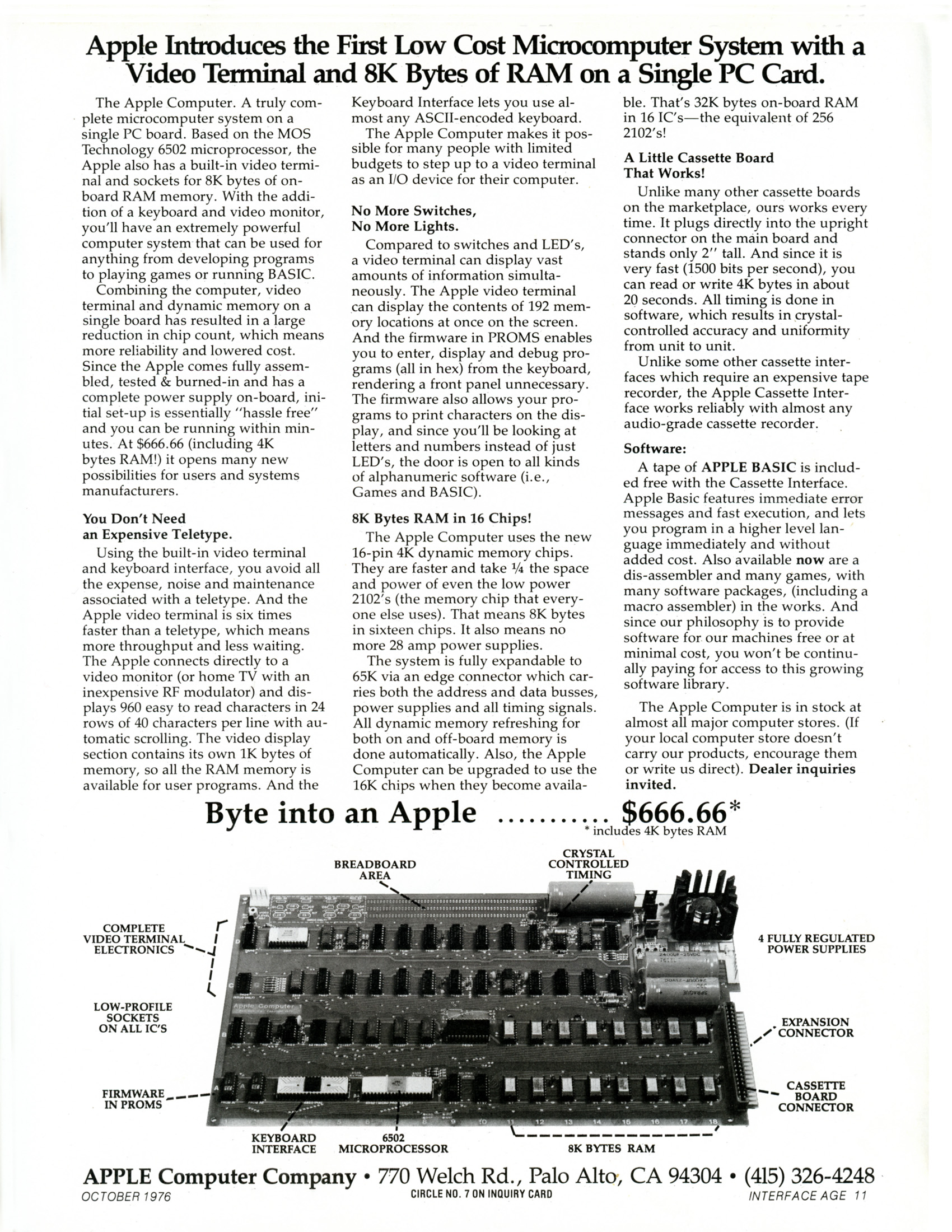
The key differentiator of the Apple I was that it included video display terminal circuitry, allowing it to connect to a low-cost composite video monitor and keyboard instead of an expensive accompanying terminal such as the Teletype Model 33 commonly used by other early personal computers. The Apple I and the Sol-20 were some of the earliest home computers to have this capability.
To finance the Apple I's development, Wozniak and Jobs sold some of their possessions for a few hundred dollars.[10] Wozniak demonstrated the first prototype in July 1976 at the Homebrew Computer Club in Palo Alto, California, impressing the Byte Shop, an early computer retailer.[11] After securing an order for 50 computers, Jobs was able to order the parts on credit and deliver the first Apple products after ten days.[12]
The Apple I was one of the first computers available that used the MOS Technology 6502 microprocessor. An expansion included a BASIC interpreter, allowing users to utilize BASIC at home instead of at institutions with mainframe computers, greatly lowering the entry cost for computing with BASIC.
Production was discontinued on September 30, 1977, after the June 10, 1977 introduction of its successor, the Apple II, which Byte magazine referred to as part of the "1977 Trinity" of personal computing (along with the PET 2001 from Commodore Business Machines and the TRS-80 Model I from Tandy Corporation).[13] As relatively few computers were made before they were discontinued, coupled with their status as Apple's first product, surviving Apple I units are now displayed in computer museums.[14]
History
[edit]Development
[edit].jpg)
In 1974, while visiting famous phone phreak John Draper in California, Steve Wozniak watched him connect a modem to the ARPANET – the precursor to the internet – and use a teleprinter to play chess with someone from Boston; this inspired him to make a cheap terminal that used an inexpensive keyboard from Sears and a standard TV.[16] Later in March 1975, Wozniak started attending meetings of the Homebrew Computer Club, which was a major source of inspiration for him.[17][18][19] New microcomputers such as the Altair 8800 inspired Wozniak to build a microprocessor into his video terminal circuit to make a complete computer.[20] At the time the only appropriate CPUs available were the Intel 8080 and the Motorola 6800. Of these options, Wozniak preferred the 6800, though he was financially unable to obtain either. Instead, he began designing computers on paper until he could afford a CPU.[21]
When the $25 MOS Technology 6502 was released in late 1975,[c] Wozniak wrote a version of BASIC for it, then began to design a computer for it to run on. The 6502 was developed by many of the same engineers that designed the 6800, as many in Silicon Valley left employers to form their own companies. Wozniak's earlier 6800 computer design needed only minor changes to run on the new processor.
By March 1, 1976, Wozniak completed the basic design of his computer.[22][23] Wozniak originally offered the design to HP while working there, but it was rejected by the company on five occasions.[24] When he demonstrated his computer at the Homebrew Computer Club, his friend and fellow club regular Steve Jobs was immediately interested in its commercial potential.[25] Wozniak intended to share schematics of the machine for free; however, Jobs advised him to start a business together and sell bare printed circuit boards (PCBs) for the computer, without any components soldered on.[26][27][28] Wozniak, at first skeptical, was later convinced by Jobs that even if they were not successful they could at least say to their grandchildren that they had had their own company. To raise the money they needed to build the first batch of the circuit boards, Wozniak sold his HP-65 scientific calculator while Jobs sold his Volkswagen van.[26][27]
| External images | |
|---|---|
 Byte Shop storefront Byte Shop storefront | |
| The prototype shown to Terrell | |
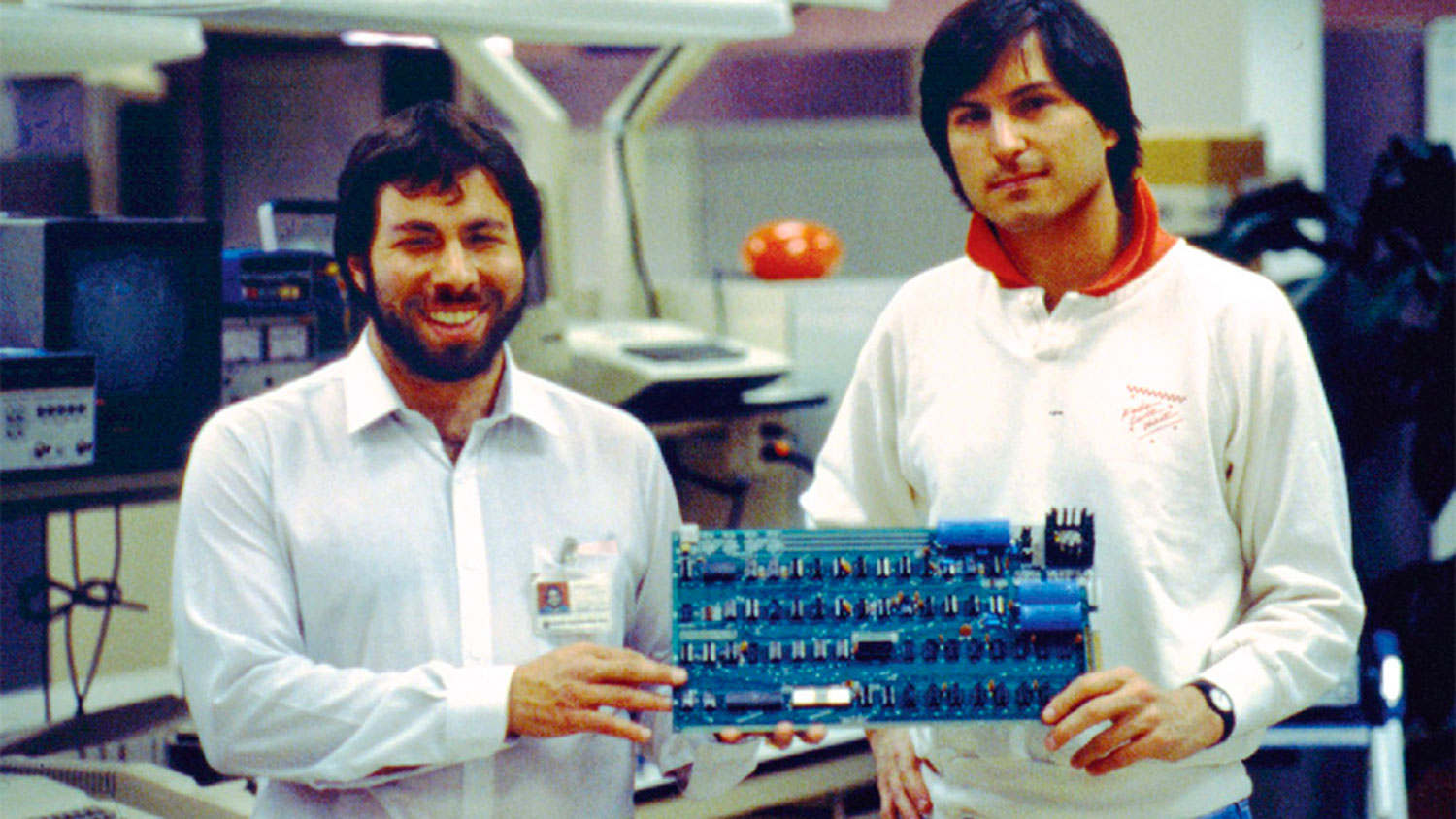
| Wozniak and Jobs with an Apple I |
After the company was formed a month later, Jobs and Wozniak gave a presentation of the fully assembled "Apple Computer A" at the Homebrew Computer Club.[29][30][31] Paul Terrell, who was starting a new computer shop in Mountain View, California, called the Byte Shop,[32] saw the presentation and was impressed by the machine.[33][34] Terrell told Jobs that he would order 50 units of the Apple I and pay $500 each[d] on delivery, but only if they came fully assembled – he was not interested in buying bare printed circuit boards with no components.[35][33][36][35][34]
Wozniak had designed the electrical circuit, but the board design for the Apple 1 was done by Howard Cantin, a PCB layout engineer at Atari.[37][38]
Jobs took the purchase order from the Byte Shop to national electronic parts distributor Cramer Electronics, and ordered the components needed. When asked by the credit manager how he would pay for the parts, Jobs replied, "I have this purchase order from the Byte Shop chain of computer stores for 50 of my computers and the payment terms are COD. If you give me the parts on net 30-day terms I can build and deliver the computers in that time frame, collect my money from Terrell at the Byte Shop and pay you."[12][39]
To verify the purchase order, the credit manager called Paul Terrell, who assured him if the computers showed up, Jobs would have more than enough money for the parts order. The two Steves and their small crew spent day and night building and testing the computers, and delivered to Terrell on time. Terrell was surprised to receive a batch of assembled circuit boards, as he had expected complete computers with a case, monitor and keyboard.[40][41] Nonetheless, he kept his word and paid the two Steves the money promised.[42][40][41][43]
Announcement and sales
[edit]
The Apple I went on sale in July 1976 at a price of US$666.66.[e] Wozniak later said he had no idea about the relation between the number and the number of the beast, and that he came up with the price because he liked "repeating digits"[42][44] and because it was a one-third markup on the $500 wholesale price.[45] Jobs had managed to get the inventory into the nation's first four storefront microcomputer retailers: Byte Shop (Palo Alto, California), itty bitty machine company (Evanston, Illinois), Data Domain (Bloomington, Indiana), and Computer Mart (New York City).[46]
The first unit produced was used in a high school math class, and donated to Liza Loop's public-access computer center.[47] About 200 units were produced, and all but 25 were sold within nine or ten months.[39]
In April 1977, the price was dropped to $475.[f][3] It continued to be sold through August 1977, despite the introduction of the Apple II in April 1977, which began shipping in June of that year.[48] In October 1977, the Apple I was officially discontinued and removed from Apple's price list.[49] As Wozniak was the only person who could answer most customer support questions about the computer, the company offered Apple I owners discounts and trade-ins for Apple IIs to persuade them to return their computers.[50] These recovered boards were then destroyed by Apple, contributing to their later rarity.[51]
Both Steve Jobs and Steve Wozniak have stated that Apple did not assign serial numbers to the Apple l. Several boards have been found with numbered stickers affixed to them, which appear to be inspection stickers from the PCB manufacturer/assembler. A batch of boards is known to have numbers hand-written in black permanent marker on the back; these usually appear as "01-00##". As of January 2022, 29 Apple-1s with a serial number are known. The highest known number is 01–0079. Two original Apple-1s have been analyzed by Professional Sports Authenticator in Los Angeles, concluding that the serial numbers had been hand-written by Steve Jobs.[52]
Hardware
[edit]


The Apple I used a MOS Technology 6502 microprocessor running at 1.022727 MHz, and its design was based largely on Wozniak's previous work centered around a Motorola 6800.[53] The unconventional clock speed was chosen to be a fraction (2⁄7) of the NTSC color carrier, which simplified video circuitry. 4 KB of memory was included on the base machine, which was expandable to 8 KB on-board and up to 64 KB by using an add-on card. On-board memory utilized newly available 4Kbit DRAM chips, and was designed to be upgradeable to the next generation of 16Kbit chips for a maximum of 32 KB on-board memory.[54] An optional $75 plug-in cassette interface card allowed users to store programs on ordinary audio cassette tapes. A BASIC interpreter, originally written by Wozniak, was provided with the cassette interface that let users easily write programs and play simple games. An onboard AC power supply was included.
The Apple I did not come with a case. It could be used bare, although some users chose to build custom (typically wooden) enclosures.[55]
Memory map
[edit]| Address | Size | Description | |
|---|---|---|---|
| 0x0000 - 0x0023 | 36 Bytes | RAM | 4K systems
(minimal system, cannot load wozbasic) |
| 0x0024 - 0x002B | 8 Bytes | wozmon variables | |
| 0x002C - 0x00FF | 212 Bytes | RAM | |
| 0x0100 - 0x01FF | 256 Bytes | 6502 processor stack | |
| 0x0200 - 0x027F | 128 Bytes | wozmon keyboard input buffer | |
| 0x0280 - 0x0FFF | 3456 Bytes | RAM | |
| 0x1000 - 0xC027 | Unused | User expandable RAM / IO | |
| 0xC028 | 1 Byte | ACI port to write to cassette | |
| 0xC029 - 0xC0FF | Unused | User expandable RAM / IO | |
| 0xC100 - 0xC1FF | 256 Bytes | ACI ROM | When ACI card is inserted |
| 0xC200 - 0xD00F | Unused | User expandable RAM / IO | |
| 0xD010 - 0xD013 | 4 Bytes | PIA (Peripheral Interface Adapter) | Keyboard and Display |
| 0xD014 - 0xDFFF | Unused | User expandable RAM / IO | |
| 0xE000 - 0xEFFF | 4Ki (4096 Bytes) | RAM | 8K systems
(standard system, can load wozbasic) |
| 0xF000 - 0xFEFF | Unused | User expandable RAM / IO | |
| 0xFF00 - 0xFFFF | 256 Bytes | PROM (wozmon) | Programmable read-only memory |

Video and Input
[edit]The Apple I included built-in computer terminal circuitry with composite video output. To use the computer, a user-supplied composite monitor and ASCII-encoded keyboard needed to be connected. If a monitor was not available, a standard television set could be used along with an RF modulator. In comparison, competing machines generally required an expensive dedicated video display terminal or teletypewriter. This, combined with its single-board construction, made the Apple I an elegant and inexpensive machine for its day, though competitors such as the Sol-20 and Sphere 1 offered similar feature sets.


The computer generated its video output using a shift register memory and a Signetics 2513 64×8×5 Character Generator.[56] It was capable of displaying uppercase characters, numbers and basic punctuation and math symbols with a 5x8 pixel font:[57]
| 0 | 1 | 2 | 3 | 4 | 5 | 6 | 7 | 8 | 9 | A | B | C | D | E | F | |
| 0x 0 |
@ | A | B | C | D | E | F | G | H | I | J | K | L | M | N | O |
| 1x 16 |
P | Q | R | S | T | U | V | W | X | Y | Z | [ | \ | ] | ^ | _ |
| 2x 32 |
SP | ! | " | # | $ | % | & | ' | ( | ) | * | + | , | - | . | / |
| 3x 48 |
0 | 1 | 2 | 3 | 4 | 5 | 6 | 7 | 8 | 9 | : | ; | < | = | > | ? |
Apple Cassette Interface expansion
[edit] The Apple Cassette Interface expansion card. There are two phone connector ports for reading and writing programs to a connected cassette deck. | |

A cassette interface was available in the form of an optional add-on for the Apple I's expansion slot. A cassette deck plugged in to the expansion's phone connector ports could be written to and read from as a form of removable storage. The only alternative to the interface for loading programs was typing machine code by hand, making the add-on "ubiquitous".[58]
The expansion came with a free cassette tape containing Steve Wozniak's Integer BASIC interpreter. Other software tapes were supplied "at minimal cost"[54] including ported video games such as Hamurabi, Lunar Lander and Star Trek.[3]
Conservation
[edit]
Only about 200 Apple I boards were produced,[39] and as of August 2022[update] the whereabouts of 62 to 82 are known.[59] After the success of the Apple II, and of Apple broadly, the Apple I was recognized as an important historical computer.[60][61] According to the 1986 Apple IIe Owner's Guide, an Apple I was then worth "between $10,000 and $15,000"[g][63] and a board was reportedly sold for $50,000 in 1999.[h][64]
In November 2010, an Apple I with a cache of original documents and packaging sold for £133,250 ($170,000)[i] at Christie's auction house in London. The documents included the return label showing Steve Jobs's parents' address, a personally typed and signed letter from Jobs (answering technical questions about the computer), and the invoice (listing "Steven" as the salesman). The computer was brought to Polytechnic University of Turin for restoration.[66][67][68]
In October 2014 the Henry Ford Museum purchased an Apple I at a Bonhams auction for $905,000.[j] The sale included the keyboard, monitor, cassette decks and a manual.[14] In 2017, an Apple I removed from Steve Jobs's office in 1985 by Apple quality control engineer Don Hutmacher was placed on display at Living Computers: Museum + Labs.[69]
On May 30, 2015, an elderly woman reportedly dropped off boxes of electronics for disposal at an electronics recycling center in the Silicon Valley of Northern California. Included in the electronics (removed from her garage after the death of her husband) was an original Apple I computer, which the recycling firm sold for $200,000. When a discarded item is sold, it is the company's practice to give 50% of the proceeds to the original owner,[70][71] but the woman has not been identified.[72]
Apple I computers with original documents and memorabilia have frequently been auctioned for over $300,000 throughout the 2010s[73][74][75][76] and 2020s.[77][78] The production prototype for the Apple I survives in a badly damaged state and was itself auctioned in 2022 for $677,196.[79][30][80][81]
Replicas
[edit]Several Apple I clones and replicas have been released in recent years. These are created by hobbyists and marketed to the hobbyist/collector community. Availability is usually limited to small runs in response to demand.[82][83][84][85][86][87]
Emulation
[edit]Emulation software for the Apple I has been written for modern home computers[88][89][90] and for web browsers.[91] It has also been emulated on 1980s era computers including the SAM Coupé[92] and Commodore 64.[93]
See also
[edit]Notes
[edit]- ^ The name is abbreviated as Apple-1 in original manuals and documentation.[2]
- ^ Apple retroactively refers to the computer as Apple I, beginning with catalogs from 1977.[3]
- ^ a price equivalent to $150 in 2024[1]
- ^ equivalent to $2,800 in 2024[1]
- ^ equivalent to $3,700 in 2024[1]
- ^ equivalent to $2,500 in 2024[1]
- ^ equivalent to between $24,000 and $36,000 in 2024[62]
- ^ equivalent to $88,000 in 2024[62]
- ^ equivalent to £184,000 ($235,000) in 2023[65]
- ^ equivalent to $1.18 million in 2024[62]
References
[edit]Citations
[edit]- ^ a b c d e 1634–1699: McCusker, J. J. (1997). How Much Is That in Real Money? A Historical Price Index for Use as a Deflator of Money Values in the Economy of the United States: Addenda et Corrigenda (PDF). American Antiquarian Society. 1700–1799: McCusker, J. J. (1992). How Much Is That in Real Money? A Historical Price Index for Use as a Deflator of Money Values in the Economy of the United States (PDF). American Antiquarian Society. 1800–present: Federal Reserve Bank of Minneapolis. "Consumer Price Index (estimate) 1800–". Retrieved February 29, 2024.
- ^ a b c "Apple-1 Operation Manual" (PDF). Archived (PDF) from the original on May 11, 2018. Retrieved May 10, 2018 – via Apple Fritter.
- ^ a b c d "April 1977 Price List - Applefritter". www.applefritter.com. Archived from the original on April 25, 2009. Retrieved March 27, 2018.
- ^ "Datasheet Archive 2513 datasheet download". Archived from the original on June 17, 2022. Retrieved April 22, 2022.
- ^ "Co-founder tells his side of Apple story". Reuters. September 27, 2006. Archived from the original on October 22, 2014. Retrieved January 15, 2012.
- ^ "A Chat with Computing Pioneer Steve Wozniak". NPR.org. Archived from the original on March 27, 2019. Retrieved March 27, 2018.
- ^ Chen, Liyan (May 11, 2015). "The World's Largest Tech Companies: Apple Beats Samsung, Microsoft, Google". Forbes. Retrieved May 24, 2017.
- ^ Linzmayer, Owen W. (2004). Apple Confidential 2.0: The Definitive History of the World's Most Colorful Company. No Starch Press. p. 5. ISBN 9781593270100.
- ^ O'Grady, Jason D. (2009). Apple Inc. ABC-CLIO. p. 3. ISBN 9780313362446.
- ^ "Ventura County Star". Ventura County Star. Archived from the original on October 6, 2013. Retrieved March 27, 2018.
- ^ Freiberger, Paul; Swaine, Michael (2000). Fire in the Valley: The Making of the Personal Computer (2nd ed.). New York, NY: McGraw-Hill. pp. 265–267. ISBN 0-07-135892-7.
At a Homebrew meeting in July 1976, Woz gave a demonstration of the Apple 1. Paul Terrell, one of the industries earliest retailers, was in attendance.
- ^ a b Wozniak, Steve; Smith, Gina (2007). iWoz: The Autobiography of the Man Who Started the Computer Revolution. Headline Publishing. p. 189. ISBN 978-0-7553-1408-9.
- ^ "Most Important Companies". Byte. September 1995. Archived from the original on June 18, 2008. Retrieved June 10, 2008.
- ^ a b "Apple-1 computer sold at auction for $905,000". Fox News. Archived from the original on October 24, 2014. Retrieved October 22, 2014.
- ^ Karabus, Jude. "Apple-1 prototype hand-soldered by Woz under the hammer". www.theregister.com. Retrieved June 1, 2024.
- ^ Retro Hack Shack (July 17, 2021). Apple 1 History And Build Guide. YouTube. Retrieved December 10, 2024.
- ^ Wozniak, Steve (2006). iWoz. W.W. Norton & Company. p. 150. ISBN 978-0-393-33043-4.
After my first meeting, I started designing the computer that would later be known as the Apple I. It was that inspiring.
- ^ Linzmayer 2004, pp. 4–5.
- ^ ColdFusion (March 18, 2016). The PC That Started Microsoft & Apple! (Altair 8800). YouTube. Retrieved December 10, 2024.
- ^ "Computer Technologies and Cyberterrorism" (PDF). Retrieved June 1, 2024.
- ^ "History of AppleBefore Apple Computer, Inc. - History of Apple". historyofapple.com. Retrieved June 1, 2024.
- ^ Freiberger, Paul; Swaine, Michael (2000). Fire in the Valley. McGraw-Hill. ISBN 0-07-135892-7.
- ^ Linzmayer 2004, pp. 5–6.
- ^ "Apple co-founder offered first computer design to HP 5 times". AppleInsider. December 7, 2010. Archived from the original on August 3, 2020. Retrieved April 17, 2020.
- ^ O'Grady, Jason D. (2009). Apple Inc. ABC-CLIO. p. 3. ISBN 9780313362446.
- ^ a b Linzmayer 2004, pp. 4–6.
- ^ a b Schlender & Tetzeli 2016, pp. 35–38.
- ^ Isaacson 2011, p. 62.
- ^ Schlender & Tetzeli 2016, pp. 39–40.
- ^ a b Szondy, David (July 24, 2022). ""Lost" Apple computer prototype goes on the auction block". New Atlas. Archived from the original on July 25, 2022.
- ^ NationSquid (August 21, 2024). Apple 1: The Computer That Started Everything. YouTube. Retrieved December 13, 2024.
- ^ Wozniak, Steve; Smith, Gina (2006). iWoz: Computer Geek to Cult Icon: How I Invented the Personal Computer, Co-Founded Apple, and Had Fun Doing It. W. W. Norton & Company. ISBN 0-393-06143-4. OCLC 502898652.
- ^ a b Isaacson 2011, pp. 66–67.
- ^ a b Swaine 2014, pp. 336–338.
- ^ a b Linzmayer 2004, p. 7.
- ^ Young, Jeffrey; William L. Simon (2005). iCon Steve Jobs: The Greatest Second Act in the History of Business. Hoboken, New Jersey: John Wiley & Sons. p. 35. ISBN 978-0-471-72083-6.
- ^ Butcher, Lee (1990). Accidental Millionaire: The Rise and Fall of Steve Jobs at Apple Computer. Knightsbridge. ISBN 978-1-877961-09-0. Retrieved August 9, 2025.
- ^ Moritz, Michael (1984). The Little Kingdom: The Private Story of Apple Computer. W. Morrow. ISBN 978-0-688-03973-8. Retrieved August 9, 2025.
- ^ a b c Williams, Gregg; Moore, Rob (December 1984). "The Apple Story / Part 1: Early History". BYTE (interview). pp. A67. Retrieved October 23, 2013.
- ^ a b Isaacson 2015, pp. 67–68.
- ^ a b Linzmayer 2004, pp. 8–10.
- ^ a b Blazeski, Goran (November 25, 2017). "Apple-1, Steve Wozniak's hand-built creation, was Apple's first official product, priced at $666.66". The Vintage News. Archived from the original on July 26, 2020. Retrieved November 24, 2019.
- ^ Young, Jeffrey; William L. Simon (2005). iCon Steve Jobs: The Greatest Second Act in the History of Business. Hoboken, New Jersey: John Wiley & Sons. p. 36. ISBN 978-0-471-72083-6.
- ^ "Video: Wozniak: $500.66 seemed like a good idea". CNET News. November 7, 2005. Archived from the original on October 8, 2011. Retrieved February 19, 2009.
- ^ Wozniak 2006, p. 180.
- ^ Dr. Webster (August 27, 2012). "Chapter 1: Apple History (Ray Borrill interview)". applefritter. Archived from the original on September 22, 2022. Retrieved September 22, 2022.
- ^ Turner, Daniel (May 1, 2007). "MIT Technology Review". MIT Technology Review. Archived from the original on April 13, 2015. Retrieved April 16, 2015.
- ^ "Bill of Sale - Applefritter". www.applefritter.com. Archived from the original on April 26, 2009. Retrieved March 27, 2018.
- ^ "October 1977 Price List - Applefritter". www.applefritter.com. Archived from the original on April 25, 2009. Retrieved March 27, 2018.
- ^ "The Apple II, cont". Apple II History. December 2008. Archived from the original on May 22, 2015. Retrieved February 27, 2011.
- ^ "The Huston brothers' Apple-1 Back Story". Archived from the original on October 5, 2013. Retrieved June 25, 2013.
- ^ "The Apple 1 Registry - THE SOLVED RIDDLE OF THE SERIAL NUMBER". Archived from the original on February 11, 2022. Retrieved February 10, 2022.
- ^ Starr, Michelle (June 29, 2016). "10 facts about the Apple-1, the machine that made computing history". cNet. Archived from the original on February 9, 2022. Retrieved February 9, 2022.
- ^ a b Apple I advertisement Oct 1978
- ^ "The Apple 1 Case". The Geek Pub. September 16, 2021. Archived from the original on September 18, 2021. Retrieved September 18, 2021.
- ^ Shirriff, Ken. "Inside the Apple-1's shift-register memory". Ken Shirriff's blog. Archived from the original on June 6, 2023. Retrieved August 4, 2023.
- ^ "Datasheet Archive 2513 datasheet download". Archived from the original on June 17, 2022. Retrieved April 22, 2022.
- ^ Owad 2005, p. 3.
- ^ "The Apple 1 Registry". Archived from the original on February 16, 2022. Retrieved February 16, 2022.
- ^ Starr, Michelle (June 29, 2016). "10 facts about the Apple-1, the machine that made computing history". CNET. Retrieved June 2, 2024.
- ^ Thompson, Clive (March 2016). "Steve Wozniak's Apple I Booted Up a Tech Revolution". Smithsonian Magazine. Retrieved June 2, 2024.
- ^ a b c Johnston, Louis; Williamson, Samuel H. (2023). "What Was the U.S. GDP Then?". MeasuringWorth. Retrieved November 30, 2023. United States Gross Domestic Product deflator figures follow the MeasuringWorth series.
- ^ "Apple IIe Owner's Guide" (PDF). Apple Computer. p. 112. Archived (PDF) from the original on October 9, 2022.
- ^ "The Apple Revolution: 10 Key Moments". Time.com. New York: Time USA, LLC. Retrieved August 14, 2025.
- ^ United Kingdom Gross Domestic Product deflator figures follow the MeasuringWorth "consistent series" supplied in Thomas, Ryland; Williamson, Samuel H. (2024). "What Was the U.K. GDP Then?". MeasuringWorth. Retrieved July 15, 2024.
- ^ BBC News (November 23, 2010). "First Apple computer fetches £130,000 at auction". BBC News. Archived from the original on June 17, 2012. Retrieved June 16, 2012.
- ^ "Christie's Sale 7882 / Lot 65". Christie's. Archived from the original on March 16, 2014. Retrieved June 16, 2012.
- ^ Heater, Brian (May 10, 2011). "$211,000 Apple-1 up and running, wants to know what this 'cloud' thing is all about". engadget. engadget.com. Archived from the original on May 29, 2012. Retrieved June 16, 2012.
- ^ "Rare Apple I exhibit in the heart of Microsoft country". seattlepi.com. April 13, 2017. Archived from the original on February 11, 2018. Retrieved March 27, 2018.
- ^ "Mystery Woman Dumps Rare, Collectable Apple Computer Worth $200K At Recycling Center". CBS News. Milpitas. May 30, 2015. Archived from the original on June 2, 2015. Retrieved May 31, 2015.
- ^ "Apple 1 computer worth $200K left at recycling centre". CBC News. Associated Press. May 31, 2015. Archived from the original on May 31, 2015. Retrieved May 31, 2015.
A recycling centre in the Silicon Valley is looking for a woman who dropped off an old Apple computer that turned out to be a collectible item worth $200,000 US.
- ^ Rodriguez, Joe (June 2, 2015). "Global search for mysterious Apple I woman ropes in company co-founder Steve Wozniak". Mercury News. Retrieved October 23, 2023.
- ^ Austin, Scott (June 15, 2012). "Original Apple 1 Computer Sells for $374,500 in Auction". The Wall Street Journal. Archived from the original on June 17, 2012. Retrieved June 16, 2012.
- ^ "How much?! Working Apple-1 sells at auction for record-breaking $671,400". digitaltrends.com. May 27, 2013. Archived from the original on December 21, 2016. Retrieved March 27, 2018.
- ^ "Vintage Apple computer auctioned off for $668,000". Yahoo News. Archived from the original on June 8, 2013. Retrieved May 25, 2013.
- ^ Lee, David (September 25, 2018). "Original working Apple I computer fetches $375,000 at auction". BBC News. Archived from the original on September 25, 2018. Retrieved September 26, 2018.
- ^ "Rare functional Apple-1 computer sold at auction for $458,711". Apple Insider. March 13, 2020. Archived from the original on March 14, 2020. Retrieved March 13, 2020.
- ^ "Apple's original computer fetches $400,000 at US auction". BBC News. November 10, 2021. Archived from the original on November 10, 2021. Retrieved November 10, 2021.
- ^ Associated Press (August 19, 2022). "Jobs' Apple-1 computer prototype auctioned for nearly $700K". KKTV.com. Gray Television, Inc. Archived from the original on August 24, 2022. Retrieved August 24, 2022.
- ^ "'Production prototype Computer A' Apple-1 - number 2 in the Registry". Apple-1 Registry. July 2022. Archived from the original on July 23, 2022.
- ^ Staff writer (July 23, 2022). "Steve Jobs' original Apple computer prototype up for auction". KKTV.com. Gray Television, Inc. CNN. Archived from the original on July 23, 2022.
- ^ replica I – the apple I(c) clone Archived May 7, 2009, at the Wayback Machine, retrieved August 15, 2009
- ^ replica I Archived January 20, 2010, at the Wayback Machine at official Briel computers web site, retrieved August 15, 2008
- ^ Gagne, Ken (August 14, 2009). "Image gallery: Building an Apple-1 replica from scratch". Computerworld. Archived from the original on August 16, 2009. Retrieved August 15, 2009. story with pictures for assembling a Briel replica I from a kit
- ^ Owad 2005.
- ^ "Apple I (реплика)" [Apple I (replica)]. mdesk.ru (in Russian). Archived from the original on July 17, 2019. Retrieved March 8, 2019.
- ^ "Apple1clone Spartan". Apple1clone. Justin McDermid. Archived from the original on December 6, 2022. Retrieved December 6, 2022. Retrieved December 1, 2022
- ^ Pom1 Apple 1 Emulator Archived August 26, 2013, at the Wayback Machine, retrieved July 17, 2013
- ^ CocoaPom Apple 1 Emulator Archived June 4, 2013, at the Wayback Machine, retrieved July 17, 2013
- ^ Sim6502 Apple I emulator Archived November 14, 2013, at the Wayback Machine retrieved July 17, 2013
- ^ "Apple 1js: An Apple 1 Emulator in JavaScript". Archived from the original on April 7, 2015. Retrieved January 28, 2015.
- ^ Apple 1 Emulator - SAM Coupé Archived November 27, 2013, at the Wayback Machine, retrieved July 17, 2013
- ^ "Green Delicious Apple-1 Emulator". Archived from the original on February 28, 2018. Retrieved February 28, 2018.
Sources
[edit]- Isaacson, Walter (2011). Steve Jobs. New York, NY: Simon & Schuster. ISBN 978-1-4516-4853-9.
- Isaacson, Walter (2015). Steve Jobs. Simon and Schuster. ISBN 9781501127625.
- Owad, Tom (2005). Apple I Replica Creation: Back to the Garage. Rockland, Mass.: Syngress Publishing. ISBN 1-931836-40-X. Archived from the original on April 30, 2009.
- Price, Rob (1987). So Far: The First Ten Years of a Vision. Cupertino, Calif.: Apple Computer. ISBN 1-55693-974-4.
- Schlender, Brent; Tetzeli, Rick (2016). Becoming Steve Jobs: The Evolution of a Reckless Upstart into a Visionary Leader. Crown Business; Reprint edition. ISBN 9780385347426.
- Swaine, Michael (2014). Fire in the Valley: The Birth and Death of the Personal Computer. Pragmatic Bookshelf. ISBN 9781680503524.
External links
[edit]
- Apple I Owners Club
- Apple I Operational Manual (browse)
- German making-of article to recreate the Apple I Operational Manual
- Apple I project on www.sbprojects.com Archived April 27, 2009, at the Wayback Machine
- Apple 1 Computer Registry
- John Calande III blog – Building the Apple I clone, including corrections on the early history of Apple Computer
- Apple 1 | Cameron's Closet – includes display of the Apple 1's character set on real hardware, compared to on most emulators
- Shirriff, Ken (March 2022). "Inside the Apple-1's unusual MOS clock driver chip".
| Products and projects |  | |
|---|---|---|
| Companies |
| |
| Awards | ||
| Films |
| |
| TV appearances |
| |
| Related | ||