


Community hub
Recent from talks
Contribute something
Nothing was collected or created yet.
Christ lag in Todes Banden, BWV 4
View on Wikipedia
| Christ lag in Todes Banden | |
|---|---|
BWV 4 | |
| Chorale cantata by J. S. Bach | |
 Soprano part from opening chorus with text in Bach's own hand, St. Thomas Church, Leipzig, 1724/1725 | |
| Key | E minor |
| Occasion | First Day of Easter |
| Chorale | "Christ lag in Todes Banden" by Martin Luther |
| Performed | 24 April 1707[1] |
| Published | 1851 |
| Duration | About 20 minutes |
| Movements | 8 |
| Vocal | SATB |
| Instrumental |
|
Christ lag in Todes Banden (also spelled Todesbanden;[a] "Christ lay in death's bonds"[2] or "Christ lay in the snares of death"),[3] BWV 4, is a cantata for Easter by German composer Johann Sebastian Bach, one of his earliest church cantatas. It is agreed to be an early work partly for stylistic reasons and partly because there is evidence that it was probably written for a performance in 1707. Bach went on to complete many other works in the same genre, contributing complete cantata cycles for all occasions of the liturgical year. John Eliot Gardiner described it as Bach's "first-known attempt at painting narrative in music".[4]
Christ lag in Todes Banden is a chorale cantata, a style in which both text and music are based on a hymn. In this instance, the source was Martin Luther's hymn of the same name, the main hymn for Easter in the Lutheran church. The composition is based on the seven stanzas of the hymn and its tune, which was derived from Medieval models. Bach used the unchanged words of a stanza of the chorale in each of the seven vocal movements, in the format of chorale variations per omnes versus (for all stanzas), and he used its tune as a cantus firmus. After an opening sinfonia, the variations are arranged symmetrically: chorus–duet–solo–chorus–solo–duet–chorus, with the focus on the central fourth stanza about the battle between Life and Death. All movements are in E minor, and Bach achieves variety and intensifies the meaning of the text through many musical forms and techniques.
Christ lag in Todes Banden is Bach's first cantata for Easter – in fact, his only extant original composition for the first day of the feast – and his earliest surviving chorale cantata. It was related to his application for a post at a Lutheran church at Mühlhausen. He later twice performed it as Thomaskantor in Leipzig, beginning in 1724 when he first celebrated Easter there. Only this second version survives. It is scored for four vocal parts and a Baroque instrumental ensemble with two components, an instrumental "choir" of cornetto and three trombones doubling the choral voices (only in the 2nd Leipzig performance in 1725 were these used), and a string section of two violins, two violas, and continuo. While this scoring reflects the resources at Bach's disposal (the cornetto and brass players would have been available because of the city band tradition in Leipzig),[5] it was old-fashioned and exemplifies a 17th-century Choralkonzert (chorale concerto) style; the lost scoring of the earlier performances was perhaps similar.
Gardiner calls Bach's setting of Luther's hymn "a bold, innovative piece of musical drama", and observes "his total identification with the spirit and letter of Luther's fiery, dramatic hymn".[4]
Composition history
[edit]Background
[edit]
Bach is believed to have written Christ lag in Todes Banden in 1707. He was a professional organist aged 22, employed from 1703 in Arnstadt as the organist of the New Church (which replaced the burned Bonifatiuskirche, and is today known as the Bach Church).[6] At age 18, he had inspected the new organ built by Johann Friedrich Wender, was invited to play one Sunday, and was hired. The organ was built on the third tier of a theatre-like church.[6] Bach's duties as a church musician involved some responsibility for choral music, but the exact year he began composing cantatas is unknown. Christ lag in Todes Banden is one of a small group of cantatas that survive from his early years.[7] According to the musicologist Martin Geck, many details of the score reflect "organistic practice".[8]
In Arnstadt, the Kantor (church musician) Heindorff was responsible for church music in the Upper Church and the New Church where Bach was the organist. He typically conducted music in the Upper Church and would appoint a choir prefect for vocal music in the New Church. Musicologist Christoph Wolff notes that "subjecting his works to the questionable leadership of a prefect"[7] was not what Bach would have done. Therefore, most cantatas of the period are not for Sunday occasions, but restricted to special occasions such as weddings and funerals. Christ lag in Todes Banden is the only exception, but was most likely composed not for Arnstadt but for an application to a more important post at the church of Divi Blasii in Mühlhausen.[9]
Bach's early cantatas
[edit]
Bach's early cantatas are Choralkonzerte (chorale concertos) in the style of the 17th century, different from the recitative and aria cantata format associated with Neumeister that Bach started to use for church cantatas in 1714.[11] Wolff points out the relation of Bach's early cantatas to works by Dieterich Buxtehude, with whom Bach had studied in Lübeck.[7] Christ lag in Todes Banden shows similarities to a composition of Johann Pachelbel based on the same Easter chorale.[11] Although there is no evidence that Bach and Pachelbel met, Bach grew up in Thuringia while Pachelbel was based in the same region, and Bach's elder brother and teacher Johann Christoph Bach studied with Pachelbel in Erfurt.[12] Another of Pachelbel's works appears to be referenced in the early Bach cantata, Nach dir, Herr, verlanget mich, BWV 150, and there has been recent speculation that Bach wanted to pay tribute to Pachelbel after his death in 1706.[13]
The texts for Bach's early cantatas were drawn mostly from Biblical passages and hymns.[14] Features characteristic of his later cantatas, such as recitatives and arias on contemporary poetry, were not yet present,[15] although Bach may have heard them in oratorios by Buxtehude, or even earlier.[14] Instead, these early cantatas include 17th-century elements such as motets and chorale concertos.[16][17] They often begin with an instrumental sinfonia or sonata (sonatina).[14] The following table lists the seven extant works composed by Bach until 1708, when he moved on to the Weimar court.[18]
| Date | Occasion | BWV | Incipit | Text source |
|---|---|---|---|---|
| 1707? | Penitence | 150 | Nach dir, Herr, verlanget mich | Psalm 25, anon. |
| 1707? | Easter | 4 | Christ lag in Todes Banden | Luther |
| 1707? | Penitence | 131 | Aus der Tiefen rufe ich, Herr, zu dir | Psalm 130 |
| 1 Jan 1708? | New Year's Day | 143 | Lobe den Herrn, meine Seele | mainly Psalm 146, two stanzas of Jakob Ebert's hymn "Du Friedefürst, Herr Jesu Christ" |
| 4 Feb 1708 | Inauguration of the town council | 71 | Gott ist mein König | mainly Psalm 74, with added biblical quotations |
| 5 Jun 1708? | Wedding? | 196 | Der Herr denket an uns | Psalm 115:12–15 |
| 16 Sep 1708? | Funeral | 106 | Gottes Zeit ist die allerbeste Zeit (Actus tragicus) | compilation of seven biblical quotations, three hymns and free poetry |
Bach uses the limited types of instruments at his disposal for unusual combinations, such as two recorders and two viole da gamba in the funeral cantata Gottes Zeit ist die allerbeste Zeit, also known as Actus Tragicus. He uses instruments of the continuo group as independent parts, such as a cello in Nach dir, Herr, verlanget mich and a bassoon in Der Herr denket an uns.[14] The cantata for the inauguration of a town council is richly scored for trumpets, woodwinds and strings.[19] Wolff notes:
The overall degree of mastery by which these early pieces compare favourably with the best church compositions from the first decade of the eighteenth century ... proves that the young Bach did not confine himself to playing organ and clavier, but, animated by his Buxtehude visit, devoted considerable time and effort to vocal composition. The very few such early works that exist, each a masterpiece in its own right, must constitute a remnant only ... of a larger body of similar compositions.[14]
The Bach scholar Richard D. P. Jones notes in The Creative Development of Johann Sebastian Bach:
His remarkable flair for text illustration is evident even in the early cantatas, particularly the two finest of them, the Actus tragicus, BWV 106, and Christ lag in Todes Banden, BWV 4. We already sense a powerful mind behind the notes in the motivic unity of the early cantatas, in the use of reprise to bind their mosaic forms together ...[20]
Readings and chorale
[edit]
The prescribed readings for the feast day were from the First letter to the Corinthians ("Christ is our Easter lamb" – 1 Corinthians 5:6–8) and from the Gospel of Mark (the Resurrection of Jesus – Mark 16:1–8).[21][22]
The reformer Martin Luther wrote several hymns in German to be used in church services. His hymn "Christ lag in Todes Banden"[23] was based on the Latin hymn "Victimae Paschali Laudes", and first published in 1524.[24] It became a main Easter hymn in German Lutheranism. The hymn stresses the struggle between Life and Death. The third stanza refers to the "sting of death", as mentioned in 1 Corinthians 15. The fifth stanza relates to the "Osterlamm", the Paschal Lamb. The sacrificial "blood" ("Its blood marks our doors")[11] refers to the marking of the doors before the exodus from Egypt. The final stanza recalls the tradition of baking and eating Easter Bread, with the "old leaven" alluding again to the exodus, in contrast to the "Word of Grace",[25] concluding "Christ would ... alone nourish the soul."[25] In contrast to most chorale cantatas that Bach composed later in Leipzig, the text of the chorale is retained unchanged, which he did again only in late chorale cantatas.[26]
Performances
[edit]
Christ lag in Todes Banden survives in a version from the 1720s when Bach held the position of Thomaskantor (director of church music) in Leipzig. There is documentary evidence suggesting that this Easter Sunday cantata was premiered in 1707. It is known that Bach performed a cantata of his own composition at Easter in 1707 as a part of his application for the post of organist of Divi Blasii in Mühlhausen, and this may have been Christ lag in Todes Banden.[1][14] By this time, Bach was already demonstrating ingenuity in keyboard music, as known from the early works in the Neumeister Collection. Christ lag in Todes Banden is a significant milestone in his vocal music. It was completed seven years before his sequence of Weimar cantatas, begun in 1714 with Himmelskönig, sei willkommen, BWV 182,[27] and 17 years before he started a complete annual cycle of chorale cantatas in Leipzig in the middle of 1724 with O Ewigkeit, du Donnerwort, BWV 20.[28]
Bach would have been attracted to Mühlhausen for its status as a free imperial city and the tradition of vocal music in its churches. Wolff notes that Bach possibly sent two other cantata scores with his application, and once he knew the date of the audition may have composed Christ lag in Todes Banden in addition. A month after Easter, on 24 May 1707, an agreement was reached to hire Bach, who seems to have been the only candidate considered seriously.[29]
Bach performed the cantata again while Thomaskantor in Leipzig, notably at his first Easter there on 9 April 1724.[30] He also performed it the following year on 1 April 1725,[30] in his second cycle of Leipzig cantatas, a cycle of chorale cantatas based on Lutheran hymns. It followed in the cycle some forty newly composed cantatas. This early work fits the cycle in the sense that it is based on a chorale, but its style is different from the others.[11]
Music
[edit]Structure and scoring
[edit]Bach structured the cantata in eight movements: an instrumental sinfonia and seven vocal movements corresponding to the stanzas of the hymn. The duration is given as 22 minutes.[3]
The title of the original parts of the first Leipzig performance is (in Johann Christoph Altnickol's handwriting): "Feria Paschatos / Christ lag in Todes Banden / a.4. Voc: / Cornetto / 3 Trombon. / 2 Violini / 2 Viole / con / Continuo / Di Sign. Joh.Seb.Bach",[31][b] In this late version, Bach scored the work for four vocal parts (soprano (S), alto (A), tenor (T), and bass (B)), and a Baroque instrumental ensemble consisting of strings, brass and continuo.[30][32] The brass parts, a choir of cornetto (Ct) and three trombones (Tb) playing colla parte with the voices at times, may have been added in the 1720s. They may also possibly represent the original scoring, in the style of the 17th-century polychoral tradition.[11]
The scoring of the cantata Christ lag in Todes Banden has been described as "archaic"[33] and its style "medieval":[22]
- The string section consists of two violin parts (Vl) and two viola parts (Va); this indicates an older practice as for instance found in 17th-century church cantatas by Bach's ancestors (see Altbachisches Archiv), and in Jesus Christus ist um unsrer Missetat willen verwundet, a Passion setting from the early 18th century (or older) which Bach had performed a few years after composing the cantata Christ lag in Todes Banden. In the first half of the 18th century the standard for a string section soon evolved to two violin parts, one viola part and continuo.
- The cornett used in the cantata was an instrument that belonged to an earlier age: by the second quarter of the 18th century it had almost entirely disappeared from Bach's compositions.
- The brass instruments were only used for the 1 April 1725 version of the work. The other performances (24 April 1707, 8 April 1708, and 9 April 1724) were performed without brass instruments (i.e., Cornetto and three Trombones).
- The first version (1707 and 1708) concluded with the words of Verse 7 of the Chorale, but the music was that of Movement 2 (Verse 1 of the Chorale). In 1724 and 1725, Bach changed this out to the now-used 4-part Chorale setting.
- There is relatively little distinction between choral sections of the cantata and sections for vocal soloists;[22] one editor commented that the "whole cantata may be sung as chorus".[34] This compares to the clearer demarcation between choral movements and movements for vocal soloists in Bach's later works. However, the number of voices the composer intended per part remains somewhat contentious, and recordings of the work differ considerably in the configurations deployed.
- The harmony is often modal, instead of the modern tonal system.[22]
In the following table of the movements, the scoring and keys follow the Neue Bach-Ausgabe. The keys and time signatures are taken from the book on all cantatas by the Bach scholar Alfred Dürr, using the symbol for common time (4/4) and alla breve (2/2).[3] The continuo, played throughout, is not shown.
| No. | Title | Type | Vocal | Brass | Strings | Key | Time. |
|---|---|---|---|---|---|---|---|
| 1 | Sinfonia | 2Vl 2Va | E minor |  | |||
| Versus 1 |
|
Chorus | SATB | Ct 3Tb | 2Vl 2Va | E minor | |
| Versus 2 | Den Tod niemand zwingen kunnt | Aria Duetto | S A | Ct Tb | E minor | | |
| Versus 3 | Jesus Christus, Gottes Sohn | Aria | T | 2Vl | E minor | | |
| Versus 4 | Es war ein wunderlicher Krieg | Chorus | SATB | E minor | | ||
| Versus 5 | Hier ist das rechte Osterlamm | Aria | B | 2Vl 2Va | E minor | 3/4
| |
| Versus 6 | So feiern wir das hohe Fest | Aria Duetto | S T | E minor | | ||
| Versus 7 | Wir essen und leben wohl | Chorale | SATB | Ct 3Tb | 2Vl 2Va | E minor | |

Hymn tune
[edit]Luther's hymn is based on the 12th-century Easter hymn "Christ ist erstanden" (Christ is risen), which relies both in text and melody on the sequence for Easter, Victimae paschali laudes.[24][35] A new version was published by Luther in 1524 and adapted by Johann Walter in his Wittenberg hymnal for choir, Eyn geystlich Gesangk Buchleyn (1524). A slightly modified version appeared in 1533 in a hymnal by Kluge.[24] This chorale tune would have been familiar to Bach's congregations. Bach composed other arrangements during his career, including the two chorale preludes BWV 625 and BWV 718, and the "Fantasia super Christ lag in Todes Banden", BWV 695. Bach's organ works and the version in the cantata (see below) use the passing notes and regular rhythmic patterns of the 1533 version.[24]

Movements
[edit]Unlike in Bach's later cantatas, all movements are in the same key. The cantata begins with an instrumental sinfonia. The seven stanzas are treated in seven movements as chorale variations per omnes versus (for all stanzas), with the melody always present as a cantus firmus.[35] All stanzas end on the word Halleluja.[36]

The symmetrical sequence of the seven stanzas is a feature more often found in Bach's mature compositions: chorus – duet – solo – chorus – solo – duet – chorus.[16] The musicologist Carol Traupman-Carr notes the variety of treatment of the seven stanzas, while retaining the same key and melody:[35]
- Polyphonic chorale fantasia
- Duet, with "walking bass" in continuo
- Trio sonata
- Polyphonic and imitative, woven around chorale melody
- Homophonic with elaborate continuo line
- Duet, using trio sonata texture with extensive imitation
- Four-part chorale setting (Leipzig version)
John Eliot Gardiner, who conducted the Bach Cantata Pilgrimage in 2000, calls Bach's setting of Luther's hymn "a bold, innovative piece of musical drama", observing that Bach was "drawing on medieval musical roots (the hymn tune derives from the eleventh-century plainsong Victimae paschali laudes)", and noting Bach's "total identification with the spirit and letter of Luther's fiery, dramatic hymn".[4] Bach could follow "Luther's ideal in which music brings the text to life".
Sinfonia
[edit]
The cantata begins with an instrumental sinfonia a work in the style of an overture to a contemporary Venetian opera, with chordal passages and occasional polyphony.[11] It introduces the first line of the melody.[37] The mood is sombre, recalling the "Death's bonds" of the first line of the hymn: Christ's death on the cross and burial.[35]
Versus 1
[edit]The opening stanza, "Christ lag in Todes Banden" (Christ lay in death's bonds)[2] is treated as a chorale fantasia. Without instrumental opening, the movement starts with the chorale tune sung by the soprano in very long notes, with all other parts entering soon after the soprano begins each choral statement.[35] The alto line is derived from the chorale tune, while the viola parts principally reinforce the alto and tenor voices. The violin parts are independent and, as Traupman-Carr notes, "further activate the texture with a virtually continuous exchange of sixteenth-note snippets".[35] The figure in the violins known as suspiratio (sigh) reflects "Christ's suffering in the grip of death".[4]
The final Halleluja is faster, giving up the fantasia format for a four-part fugue in motet style, with all instruments doubling the voices.[35][38] The style of the movement recalls the 16th-century stile antico, although the style is still unmistakably Bach's.[33]
Versus 2
[edit]![<< <<
\new Staff { \clef treble \time 4/4 \key e \minor
\set Staff.midiInstrument = "choir aahs"
\new Voice = "Sopran" { \relative c'' {
r1 | r1 | r4 b ais r | r b ais r | r
} }
}
\new Lyrics {
\lyricsto "Sopran" {
Den Tod, den Tod,
}
}
\new Staff { \clef treble \time 4/4 \key e \minor
\set Staff.midiInstrument = "choir aahs"
\new Voice = "Alt" { \relative c'' {
r1 | r1 | r2 r4 g | fis r r g | fis
} }
}
\new Lyrics {
\lyricsto "Alt" {
Den Tod, den Tod,
}
}
\new Staff { \clef bass \key e \minor
\set Staff.midiInstrument = "cello"
r8 e[ d d'] c'[ c b, b] | a[ a, g, g] fis[ g16 a b8 b,] |
e,[ e d d'] cis'[ cis b, b] | ais[ ais, d d'] cis'[ cis b, b] | ais4
}
>> >>
\layout { indent = #0 }
\midi { \tempo 4 = 56 }](http://upload.wikimedia.org/score/i/b/ib569q6ko3nuuqtblv4ky2m41uepn1a/ib569q6k.png)
The second stanza, "Den Tod niemand zwingen kunnt" (No one could defeat death),[2] is set as a soprano and alto duet, over an ostinato continuo.[38] It deals with "humanity helpless and paralysed as it awaits God's judgement against sin". Bach has the music almost freeze on the first words "den Tod" (death), and the word "gefangen" (imprisoned) is marked by a sharp dissonance between the soprano and alto.[39] In the Halleluja, the voices imitate each other in long notes in fast succession, creating a sequence of suspensions.[35]
Versus 3
[edit]![<< <<
\new Staff { \clef treble \time 4/4 \key e \minor
\set Staff.midiInstrument = "violin"
\relative c' {
e16^"mes. 5" e' dis e e, e' d e cis b ais gis fis fis' e fis |
b, b' a b b, b' a b b, d fis b, g' b, e ais, |
d fis e fis b, b' a b g fis e d cis a' g a | dis,8
}
}
\new Staff { \clef "treble_8" \key e \minor
\set Staff.midiInstrument = "choir aahs"
\new Voice = "Tenor" { \relative c' {
r4 b ais b8 (cis) | d4 e d cis | b4 r r2 | R8
} }
}
\new Lyrics {
\lyricsto "Tenor" {
Je -- sus Chris -- tus, Got -- tes Sohn,
}
}
\new Staff { \clef bass \key e \minor
\set Staff.midiInstrument = "cello"
\relative c, {
e4 g'8 cis, fis[ e d ais] |
b4 g'8 e b'[ d, e fis] |
b,4 d8 b e cis fis fis, | b8
}
}
>> >>
\layout { indent = #0 }
\midi { \tempo 4 = 56 }](http://upload.wikimedia.org/score/2/s/2sinuc9laos4zw2a1zaa4nce9c6szdx/2sinuc9l.png)
The third stanza, "Jesus Christus, Gottes Sohn" (Jesus Christ, God's Son),[2] is a trio of the tenor, two obbligato violins and continuo. The tenor sings the chorale melody almost unchanged.[38] The violins illustrate first how Christ slashes at the enemy. The music stops completely on the word "nichts" (nothing). The violins then present in four notes the outline of the cross, and finally the tenor sings a joyful "Halleluja" to a virtuoso violin accompaniment.[39]
Versus 4
[edit]
"Es war ein wunderlicher Krieg, da Tod und Leben rungen" (It was a strange battle, that death and life waged),[2] is the center of the symmetrical structure. It is sung by the four voices, accompanied only by the continuo. The alto sings the cantus firmus, transposed by a fifth to B-Dorian,[38] while the other voices follow each other in a fugal stretto with entries just a beat apart until they fall away one by one. In the final Halleluja in all four voices, the bass descends nearly two octaves.[40]
Versus 5
[edit]![<< <<
\new Staff { \clef bass \time 3/4 \partial 4 \key e \minor
\set Staff.midiInstrument = "choir aahs"
\new Voice = "Bass" { \relative c {
r4 | R2. | r4 r e | dis2 e4 | g2 a4 | g2 fis4 | e2
} }
}
\new Lyrics {
\lyricsto "Bass" {
Hier ist das rech -- te O -- ster -- lamm,
}
}
\new Staff { \clef bass \key e \minor
\set Staff.midiInstrument = "cello"
\relative c {
e4 | dis2 d4 | cis2 c4 | b8[ c b a g fis] |
e[ b' e d c d] | e[ d c g a b] | e,[ g' fis e]
}
}
>> >>
\layout { indent = #0 }
\midi { \tempo 2. = 36 }](http://upload.wikimedia.org/score/9/8/98p21ozwz4sf3jqesvqrl9vmuqz9m0d/98p21ozw.png)
Stanza five, "Hier ist das rechte Osterlamm" (Here is the true Easter-lamb),[2] is sung by the bass alone, accompanied at first by a descending chromatic line in the continuo which has been compared to the Crucifixus of the Mass in B minor, but changing to "a dance-like passage of continuous eighth notes" when the voice enters.[35] For every line of the stanza, the bass sings a chorale tune, then repeats the words in counterpoint to the part of the tune repeated in the strings, sometimes transposed.[38] Taruskin describes this: "With its antiphonal exchanges between the singer and the massed strings ... this setting sounds like a parody of a passacaglia-style Venetian opera aria, vintage 1640".[33] The bass sings the final victorious Hallelujas, spanning two octaves.[41]
Versus 6
[edit]![<< <<
\new Staff { \clef treble \time 4/4 \key e \minor
\set Staff.midiInstrument = "choir aahs"
\new Voice = "Sopran" { \relative c' {
r2 r4 e | dis e g a | g fis e r8 e' | fis2. \autoBeamOff b,8 b | \autoBeamOn b4 ais b
} }
}
\new Lyrics {
\lyricsto "Sopran" {
So fei -- ern wir das ho -- he Fest, das ho -- he, das ho -- he Fest
}
}
\new Staff { \clef "treble_8" \time 4/4 \key e \minor
\set Staff.midiInstrument = "choir aahs"
\new Voice = "Tenor" { \relative c' {
r1 | r1 | r2 r4 b | ais b d e | d cis b
} }
}
\new Lyrics {
\lyricsto "Tenor" {
So fei -- ern wir das ho -- he Fest
}
}
\new Staff { \clef bass \key e \minor
\set Staff.midiInstrument = "cello"
\relative c {
e8.[ e16 fis8. fis16] g8.[ e16 c'8. c16] |
b8.[ a16 g8. fis16] e8.[ d16 c8. a16] |
b8.[ g16 a8. b16] e8.[ e16 g8. g16] |
fis8.[ e16 d8. cis16] b8.[ a16 g8. e16] |
fis8.[ d'16 e8. fis16] b,4
}
}
>> >>
\layout { indent = #0 }
\midi { \tempo 4 = 80 }](http://upload.wikimedia.org/score/h/h/hhtug5lmfitb5xms1w1wzlhne235sez/hhtug5lm.png)
"So feiern wir das hohe Fest" (So we celebrate the high festival),[2] is a duet for soprano and tenor accompanied only by the ostinato continuo.[38] The chorale is shared by the voices, with the soprano singing it in E minor, the tenor in B minor.[35] The movement is a dance of joy: the word "Wonne" (joy) is rendered in figuration that Gardiner finds reminiscent of Purcell.[41] Bach incorporates the solemn rhythms of the French overture into this verse, reflecting the presence of the word "feiern" (celebrate) in the text. It may be the first time that Bach used these rhythms.[33]
Versus 7
[edit]![<< <<
\new Staff { \clef treble \time 4/4 \partial 4 \key e \minor \set Staff.midiInstrument = "choir aahs" \relative c''
<< {
\set Score.tempoHideNote = ##t
b4 | ais b8 cis d4 e | d4 cis b\fermata
b | g a b a8 g | fis e fis4 e\fermata \bar "||" \break } \\
{ g4 | fis fis fis fis | fis fis8 e dis4
fis | e d d8 dis e4 | e dis b }
>>
}
\new Lyrics \lyricmode {
Wir4 es -- sen und2 le4 -- ben wohl
in rech -- ten O -- ster -- fla2 -- den,4
}
\new Staff { \clef bass \key e \minor \set Staff.midiInstrument = "choir aahs" \relative c'
<< { e8 d | cis4 d8 ais b4 cis | b ais fis
b | b8[ c] b[ a] g[ a] b4 | c fis,8 a g4 } \\
{ e4 | fis8[ e] d[ cis] b4 ais | b fis b
dis | e fis g8 fis e4 | a,8 b16 c b4 e, }
>>
}
>> >>
\layout { indent = #0 }
\midi { \tempo 4 = 80 }](http://upload.wikimedia.org/score/3/x/3x2djn7242dg62fyj0ptyrhc25lfjp4/3x2djn72.png)
Bach's original setting of the final stanza, "Wir essen und leben wohl" (We eat and live well),[2] is lost; it may have been a repeat of the opening chorus.[1][33][38] In Leipzig, he supplied a simple four-part setting.[41]
Manuscripts and publication
[edit]Bach's original score is lost. A set of autograph parts has survived and is kept in the Bach-Archiv Leipzig. The parts were copied from the autograph score by six scribes, four of them known by name, including the composer.[31]
A manuscript score by Franz Hauser, dating from c. 1820–1839, is held by the Staatsbibliothek zu Berlin – Preußischer Kulturbesitz. It bears a comment on page 178: "Nach den auf der Thomasschule befindlichen / Original / : Autograph: / Stimmen in Partitur gebracht. / Lp. d 16. Oct. 33. / fHauser" (After the original autograph parts in the Thomasschule, rendered in a score, Leipzig, 16 October 1833).[42]
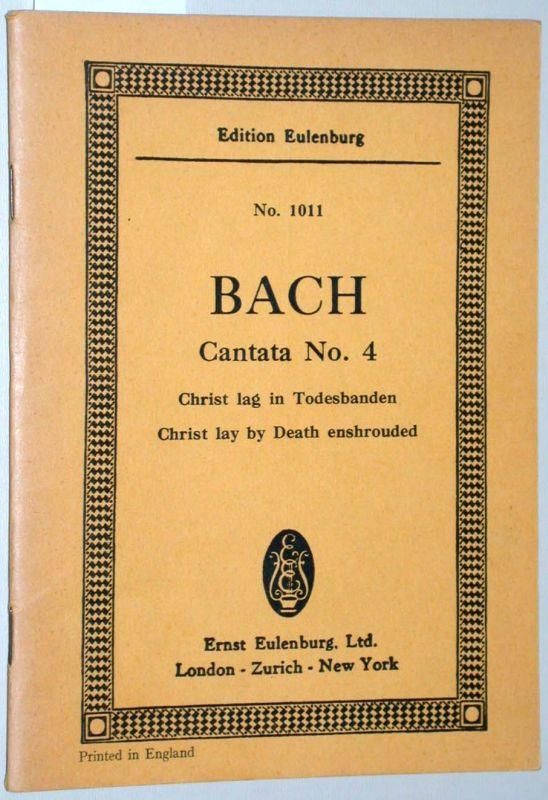
The cantata was first published in 1851 as No. 4 in the first volume of the Bach-Gesellschaft Ausgabe (BGA), edited by Moritz Hauptmann.[43] Half a century later a vocal score of the cantata appeared in Novello's Original Octavo Edition, under the title Christ Lay in Death's Dark Prison. The piano reduction was by John E. West, and the translation of the cantata's text by Paul England.[44] In 1905 this vocal score was republished in the United States by H. W. Gray.[45] Henry S. Drinker's translation Christ lay by death enshrouded appeared in a score edited by Arnold Schering and published by Eulenburg in 1932.[46] In 1967 Schering's score edition was republished by W. W. Norton with an extended introduction and bibliography by Gerhard Herz.[47] Breitkopf & Härtel, the publisher of the BGA, produced various editions of the cantata separately, for instance in 1968 a vocal score with Arno Schönstedt's piano reduction and Charles Sanford Terry's translation (Christ lay in Death's grim prison).[48]
The New Bach Edition (Neue Bach-Ausgabe, NBA) published the score in 1985, edited by Alfred Dürr, with the critical commentary published the next year.[49] In 1995 Carus produced a revised edition of Hänssler's 1981 Christ lag in Todes Banden, edited by Reinhold Kubik. Both the Hänssler and the Carus edition contained Jean Lunn's Christ lay in death's cold prison translation. Carus followed the NBA's ... in Todes Banden spelling for the German title. In 2007 Carus republished their score edition with an introduction by Hans-Joachim Schulze.[50] Bach Digital published high-resolution facsimile images of the autograph manuscript parts and of Hauser's score.[31][42] Also in the 21st century, Serenissima Music published a vocal score of Christ lag in Todes Banden compatible with Kalmus' performance material based on the BGA.[51][52]
Recordings and performances
[edit]Bach's cantatas fell into obscurity after his death and, in the context of their revival, Christ lag in Todes Banden stands out as being recorded early and having been recorded often; as of 2016, the Bach Cantatas Website lists 77 different complete recordings, the earliest dating from 1931. The first recording was a Catalan version arranged by Francesc Pujol with Lluís Millet conducting the Orfeó Català: this 1931 performance was released on three 78 rpm discs by the label "La Voz de su Amo" (His Master's Voice) in 1932.[21] The cantata was recorded twice under the direction of Nadia Boulanger, a 1937 version recorded in Paris and a 1938 version recorded in Boston.[21]
There are several recordings from the decades immediately after the war. Robert Shaw recorded the cantata in 1946 and again in 1959. Günther Ramin conducted the Thomanerchor in 1950, the anniversary of Bach's death. The same year, Fritz Lehmann conducted the choir of the Musikhochschule Frankfurt with soloists Helmut Krebs and Dietrich Fischer-Dieskau. Karl Richter and his Münchener Bach-Chor first recorded it in 1958.[21]
Nikolaus Harnoncourt recorded Christ lag in Todes Banden in 1971 in a historically informed performance with original instruments and male singers (the upper two parts are sung by boys and the countertenor Paul Esswood). This was at the start of the first project to record all Bach's sacred cantatas, "J. S. Bach – Das Kantatenwerk" on Teldec.[21] Christ lag in Todes Banden has since been included in the other "complete sets", conducted by Rilling, Gardiner, Koopman, Leusink, and Suzuki (details of these recordings are given in the discography article).[21]
Music from the cantata was performed as early as 1914 at the Proms (at that time held in the Queen's Hall), although the complete work was not heard in this concert series until 1978, when it was given at St Augustine's church, Kilburn.[53]
Transcriptions
[edit]In 1926 Walter Rummel published a piano arrangement of the cantata's fourth movement, "Jesus Christus, Gottes Sohn".[54] George Copeland recorded this transcription in 1938 (re-issued on CD 2001),[55] and Jonathan Plowright recorded it in 2005.[56]
After he had recorded his orchestration of the chorale prelude Christ lag in Todesbanden, BWV 718, in 1931,[57] Leopold Stokowski recorded his arrangement for symphonic orchestra of BWV 4's fourth movement in 1937.[58] As Chorale from the Easter cantata Christ lag in Todesbanden the arrangement's score was published by Broude Brothers in 1951.[59][60] Later the arrangement was also recorded by José Serebrier and Robert Pikler.[61]
Notes
[edit]References
[edit]- ^ a b c Bach digital 1707 2014.
- ^ a b c d e f g h Dellal 2012.
- ^ a b c Dürr 2006, p. 262.
- ^ a b c d Gardiner 2007, p. 15.
- ^ Geck 2006, p. 286.
- ^ a b Gardiner 131 2007, pp. 12–13.
- ^ a b c Wolff 2002, p. 99.
- ^ Geck 2006, p. 285.
- ^ Wolff 2002, pp. 99–100.
- ^ Towe, Teri Noel. "The Portrait in Erfurt Alleged to Depict Bach, the Weimar Concertmeister". The Face of Bach. Archived from the original on 16 July 2011. Retrieved 28 April 2014.
- ^ a b c d e f Dürr 2006, p. 264.
- ^ Jones 2007, p. 5.
- ^ Geck 2006.
- ^ a b c d e f Wolff 2002, p. 100.
- ^ Dürr 2006, p. 11.
- ^ a b Dürr 2006, p. 12.
- ^ Wolff 2002, p. 158.
- ^ Wolff 2002, pp. 162–163.
- ^ Bischof 2016.
- ^ Jones 2007, p. 131.
- ^ a b c d e f Oron 2015.
- ^ a b c d Zwang & Zwang 2005.
- ^ Browne 2005.
- ^ a b c d Braatz & Oron 2011.
- ^ a b Dürr 2006, p. 263.
- ^ Dürr 2006, p. 266.
- ^ Dürr 2006, p. 258.
- ^ Dürr 2006, p. 387.
- ^ Wolff 2002, pp. 102–103.
- ^ a b c Bach digital 1724 2014.
- ^ a b c D-LEb Thomana 4 at Bach digital 2014.
- ^ Bischof 2015.
- ^ a b c d e Taruskin 2010, pp. 343–347.
- ^ Bach, Johann Sebastian (composer), Luther, Martin (author), West, John E. (editor) and England, Paul (translator). Christ lay in death's dark prison. Novello & Co. (Plate No. 12053), c.1900–1905. OCLC 678916151
- ^ a b c d e f g h i j Traupman-Carr 2002.
- ^ Dürr 1971, p. 232.
- ^ Dickey 2015.
- ^ a b c d e f g Dürr 2006, p. 265.
- ^ a b Gardiner 2007, p. 16.
- ^ Gardiner 2007, pp. 16–17.
- ^ a b c Gardiner 2007, p. 17.
- ^ a b D-B Mus. ms. Bach P 1159/XI, Fascicle 5 at Bach digital 2014.
- ^ Heidelberg 2014.
- ^ Novello.
- ^ Gray 1905.
- ^ Schering 1932.
- ^ Herz 1967.
- ^ Schönstedt 1968.
- ^ Dürr NBA 1985.
- ^ Carus 2007.
- ^ Kalmus 1933.
- ^ Serenissima 2012.
- ^ "All Performances of Johann Sebastian Bach: Cantata No. 4, 'Christ lag in Todes Banden', BWV 4 at BBC Proms". BBC. Retrieved 24 November 2018.
- ^ Rummel 1926.
- ^ Naxos Historical.
- ^ Hyperion 2006.
- ^ Stokowski prelude.
- ^ Stokowski cantata.
- ^ Published 1951.
- ^ Broude Brothers 1951.
- ^ Serebrier.
Cited sources
[edit]General sources
- "Christ lag in Todes Banden (early version) BWV 4; BC A 54a / Chorale cantata (1st Easter Day)". Bach digital website, managed by Bach Archive, SLUB, SBB and Leipzig University. 2014. Retrieved 21 December 2014.
- "Christ lag in Todes Banden (Leipzig version) BWV 4; BC A 54a / Chorale cantata (1st Easter Day)". Bach digital website. 2014. Retrieved 21 December 2014.
- "D-LEb Thomana 4". Bach digital website. 2014. Retrieved 8 February 2016.
- "D-B Mus. ms. Bach P 1159/XI, Fascicle 5". Bach digital website, managed by Bach Archive, SLUB, SBB and Leipzig University. 2014. Retrieved 8 February 2016.
Editions in English
- West, John E., ed. (1900–1905). Christ lay in death's dark prison. Translated by England, Paul. Novello & Co. hdl:1802/29490. OCLC 678916151.
- West, John E., ed. (1905). Christ Lay in Death's Dark Prison (Christ lag in Todesbanden): Easter Cantata. Translated by England, Paul. New York, NY: The H. W. Gray Co., Inc.
- Schering, Arnold, ed. (1932). Cantata No. 4: Christ lag in Todesbanden – Christ lay by death enshrouded. Translated by Drinker, Henry S. New York, NY: Eulenburg. OCLC 12938956.
- Hauptmann, Moritz, ed. (1933). Cantata No. 4: Christ lag in Todesbanden, BWV 4. Kalmus.
- Herz, Gerhard, ed. (1967). Cantata No. 4: Christ lag in Todesbanden: an authoritative score, backgrounds, analysis, views and comments. W. W. Norton. OCLC 2869218.
- Schönstedt, Arno, ed. (1968). Kantate Nr. 4 am Osterfest: "Christ lag in Todesbanden" – Cantata No. 4 for Easter: "Christ lay in Death's grim prison". Translated by Terry, Charles Sanford. Breitkopf & Härtel.
- Schreck, Gustav; Marissen, Michael, eds. (2012). Cantata No. 4: Christ lag in Todesbanden – BWV 4. Serenissima. ISBN 978-1-932419-48-1.
Editions
- Dürr, Alfred, ed. (1985). "Kantaten zum 1. Ostertag". Kantaten (PDF) (in German). Vol. 9. Bärenreiter. Archived from the original (PDF) on 5 June 2016.
- Kubik, Reinhold, ed. (2007). Christ lag in Todes Banden – Christ lay in death's cold prison – BWV 4 (PDF). Translated by Lunn, Jean. Carus. OCLC 762198060.
Books
- Dürr, Alfred (1971). Die Kantaten von Johann Sebastian Bach (in German). Vol. 1 (4 ed.). Deutscher Taschenbuchverlag. ISBN 3-423-04080-7.
- Dürr, Alfred (2006). The Cantatas of J. S. Bach: With Their Librettos in German-English Parallel Text. Translated by Richard D. P. Jones. Oxford University Press. ISBN 978-0-19-929776-4.
- Geck, Martin (2006). Johann Sebastian Bach: Life and Work. Translated by John Hargraves. Harcourt. ISBN 978-0-15-100648-9.
- Jones, Richard D. P. (2007). The Creative Development of Johann Sebastian Bach, Volume I: 1695–1717: Music to Delight the Spirit. Oxford University Press. ISBN 978-0-19-816440-1.
- Taruskin, Richard (2010). Music in the Seventeenth and Eighteenth Centuries. The Oxford History of Western Music. Vol. 2. New York: Oxford University Press. ISBN 978-0-19-538482-6.
- Wolff, Christoph (2002). Johann Sebastian Bach: The Learned Musician. Oxford University Press. ISBN 978-0-393-32256-9.
- Zwang, Philippe; Zwang, Gérard (2005). Guide pratique des cantates de Bach (Second revised and augmented edition.) (in French). L'Harmattan. pp. 43–44. ISBN 978-2-296-42607-8.
Online sources
- Bischof, Walter F. (2015). "BWV 4 Christ lag in Todes Banden". University of Alberta. Archived from the original on 10 May 2010. Retrieved 13 September 2015.
- Bischof, Walter F. (2016). "BWV 71 Gott ist mein König". University of Alberta. Archived from the original on 7 August 2011. Retrieved 20 January 2016.
- Braatz, Thomas; Oron, Aryeh (2011). "Chorale Melodies used in Bach's Vocal Works / Christ ist erstanden". Bach Cantatas Website. Retrieved 13 September 2010.
- Browne, Francis (2005). ""Christ lag in Todesbanden", Text and Translation of Chorale". Bach Cantatas Website. Retrieved 13 August 2010.
- Dellal, Pamela (2012). "BWV 4 – Christ lag in Todesbanden". Emmanuel Music. Retrieved 20 August 2022.
- Dickey, Timothy (2015). "Cantata No. 4, "Christ lag in Todes Banden", BWV 4 (BCA 54)". Allmusic. Retrieved 23 September 2015.
- Gardiner, John Eliot (2007). Johann Sebastian Bach (1685-1750) / Cantatas Nos 4, 6, 31, 66, 134 & 145 (Media notes). Soli Deo Gloria (at Hyperion Records website). Retrieved 22 April 2019.
- Gardiner, John Eliot (2007). Johann Sebastian Bach (1685-1750) / Cantatas Nos 24, 71, 88, 93, 131, 177 & 185 (Media notes). Soli Deo Gloria (at Hyperion Records website). Retrieved 22 April 2019.
- Oron, Aryeh (2015). "Cantata BWV 4 Christ lag in Todesbanden". Bach Cantatas Website. Retrieved 23 September 2015.
- Rummel, Walter (1926). "Jesus Christus, Gottes Sohn" (PDF). Bach—Rummel Adaptations (No. 7). London: J. & W. Chester. Retrieved 30 May 2016.
- Serebrier, José. "Leopold Stokowski Transcriptions". stokowski.org. Retrieved 30 May 2016.
- Traupman-Carr, Carol (2002). "Cantata BWV 4, Christ lag in Todes Banden". The Bach Choir of Bethlehem. Retrieved 23 September 2014.
- "Chorale from the Easter cantata Christ lag in Todesbanden". Broude Brothers. 1951. Retrieved 30 May 2016.
- "Joh. Seb. Bach's Kirchencantaten; Bd. 1 / No. 1 – 10". Universitätsbibliothek Heidelberg. Retrieved 8 April 2013.
- "BACH Piano Transcriptions Rachmaninov, Cortot, Christie, Bartlett, Samaroff, Copeland, Cohen, Kelberine, Gieseking, Backhaus, Janis, Rubinstein (Rare Rec.1930-47) Naxos Historical". Naxos Historical. Archived from the original on 17 June 2016. Retrieved 30 May 2016.
- Timbrell, Charles (2006). "Bach: Piano Transcriptions – 6 (Walter Rummel / Jonathan Plowright (liner notes)" (PDF). Hyperion. Retrieved 30 May 2016.
- "Catalog of Copyright Entries: Third series; Part 5A: Published Music". Washington, D.C.: Library of Congress. 1951. p. 10. Retrieved 30 May 2016.
- "Bach – Cantata No 4 Jesus Christus, Gottes Sohn (Christ lag in Todes Banden) BWV 4 – orch. Stokowski". publicdomain.lafauniere.info. Archived from the original on 17 August 2016. Retrieved 30 May 2016.
- "Bach – Chorale Prelude Christ lag in Todesbanden BWV 718 (orch. Stokowski)". publicdomain.lafauniere.info. Archived from the original on 17 August 2016. Retrieved 30 May 2016.
Further reading
[edit]- Church, Michael (2012). "The Emperor of Atlantis/Christ lag in Todesbanden, English Touring Opera, Linbury Studio, London". The Independent. Retrieved 3 May 2015.
- Hewett, Ivan (2013). "Bach Marathon, Albert Hall, Review". The Telegraph. Retrieved 4 May 2015.
- Wolff, Christoph, ed. (1997), The World of the Bach Cantatas: Early Selected Cantatas, W. W. Norton, ISBN 0-393-33674-3
External links
[edit]- Christ lag in Todes Banden, BWV 4: performance by the Netherlands Bach Society (video and background information)
- Christ lag in Todes Banden, BWV 4 on YouTube, performed by Ensemble Orlando Fribourg, Laurent Gendre (conductor), 2016
- Christ lag in Todes Banden, BWV 4: Scores at the International Music Score Library Project
- English translation by Z. Philip Ambrose, hosted at University of Vermont
- Mincham, Julian (2010). "Chapter 42 BWV 4 & BWV 42, each commencing with a sinfonia". jsbachcantatas.com. Retrieved 16 April 2010.

| International | |
|---|---|
| National | |
| Other | |

Christ lag in Todes Banden, BWV 4
View on GrokipediaComposition and History
Historical and Liturgical Background
In the early 18th century, Easter liturgical practices in Lutheran churches centered on celebrating Christ's resurrection as the pivotal event of Christian faith, marking the defeat of sin and death. Services typically included the Easter Vigil on Holy Saturday evening, featuring the lighting of the Paschal candle to symbolize the risen Christ as light overcoming darkness, followed by baptisms that echoed the renewal of life through resurrection. The season extended for seven weeks, known as Eastertide, with worship emphasizing joy through hymns, sermons, and scriptural readings from the historic lectionary that recounted post-resurrection appearances, reinforcing themes of hope and eternal life.[6][7][8] Martin Luther's hymnody profoundly shaped Lutheran church music, promoting vernacular German texts set to familiar melodies to foster congregational participation over Latin choral traditions. A key example is Luther's Easter chorale "Christ lag in Todes Banden", composed in 1524 and first published in the Enchiridion hymnal, which drew its melody from the medieval Easter sequence "Victimae paschali laudes". This hymn, with its seven stanzas portraying Christ's triumph over death's bonds, became a cornerstone of Lutheran Easter observance, embodying theological motifs of redemption and eucharistic victory while encouraging active singing among the laity.[9][10] In the Thuringian imperial city of Mühlhausen during 1707–1708, post-war recovery from the Thirty Years' War (1618–1648) drove efforts to rebuild churches and revitalize sacred music as part of broader Protestant reforms. The conflict had devastated the region, prompting restorations of Gothic structures like St. Mary's and Divi Blasii churches around 1700, which prioritized liturgical enhancements to affirm Lutheran identity amid ongoing confessional tensions. These developments created opportunities for commissioning music that integrated chorales into worship, aligning with the era's emphasis on edifying Protestant devotion.[11][12] The church cantata genre arose in late 17th-century Lutheran Germany as an evolution from polyphonic motets and Italianate concertos, serving as an extended musical exposition of the day's Gospel reading after the sermon. By the early 18th century, it had matured into a multi-movement form with recitatives, arias, and chorale settings, often incorporating Lutheran hymns to blend scriptural narrative with personal devotion, thus becoming the primary elaborate vocal work in Sunday liturgies.[13][14]Bach's Early Career and Cantatas
Johann Sebastian Bach began his professional career in August 1703 at the age of 18, when he was appointed organist at the Boniface Church in Arnstadt, a position that provided him with access to a newly built organ by Johann Christoph Fescher.[15] During his four years there (1703–1707), Bach developed his reputation for virtuoso organ playing, particularly through elaborate improvisations that often extended services and drew criticism from church consistory for being overly complex and unfamiliar to the congregation.[16] This period also marked his initial compositional experiments, including chorale preludes that elaborated on Lutheran hymn tunes, foreshadowing his mature sacred works.[17] In June 1707, following tensions in Arnstadt, Bach relocated to the larger town of Mühlhausen, where he succeeded Johann Georg Ahle as organist at St. Blasius Church after a successful audition.[18] Mühlhausen boasted a rich musical heritage as an imperial free city, fostering a competitive environment for sacred music roles amid rival organists and composers vying for positions in its churches and collegium musicum.[19] Bach's appointment allowed greater scope for his talents, including organ maintenance consultations and contributions to the town's liturgical music, though political unrest soon prompted his departure.[20] Bach's earliest surviving cantatas emerged during his Mühlhausen tenure around 1707–1708, reflecting his nascent approach to the genre. Works such as BWV 150 Nach dir, Herr, verlanget mich and BWV 196 Der Herr denket an uns exhibit straightforward structures with alternating movements of chorus, aria, and recitative, heavily dependent on chorale elements for coherence and devotional impact, setting the stage for the more integrated designs in BWV 4.[21] These pieces, likely composed for unspecified occasions, demonstrate Bach's reliance on biblical texts and hymn adaptations to convey Lutheran piety without elaborate orchestration. Bach's development of cantata styles during this transitional phase drew from key influences, notably Dietrich Buxtehude's free-form organ compositions and vocal works, which Bach studied during his 1705 pilgrimage to Lübeck, absorbing techniques of improvisation and sectional variety.[22] Similarly, Johann Kuhnau's structured sacred cantatas from Leipzig provided models for contrapuntal rigor and textual fidelity, informing the Weimar-era advancements where Bach refined these elements into a more unified, dramatic form.[23]The Chorale Text and Melody
"Christ lag in Todes Banden" is a chorale text composed by Martin Luther in 1524, published in the Erfurt Enchiridion, consisting of seven stanzas in German that form the textual foundation for Johann Sebastian Bach's cantata BWV 4. The hymn follows a stanzaic form typical of Lutheran chorales, with each stanza structured in bar form (Stollen AAB), comprising two identical or similar sections (Stollen) followed by a contrasting section (Bogen), and concluding with "Halleluja" to emphasize the Easter resurrection theme. The text celebrates Christ's triumph over death and sin, portraying the resurrection as the liberation of humanity from bondage, drawing on biblical imagery to convey joy and gratitude.[24][25] The full original German text is as follows: Strophe 1Christ lag in Todes Banden
Für unser Sünd gegeben,
Er ist wieder erstanden
Und hat uns bracht das Leben.
Des wir sollen fröhlich sein
Und dankbar ihn verehren.
Der Tod ist hin, der Sünd ist aus.
Halleluja! Strophe 2
Den Tod niemand zwingen konnt
Bei aller Macht so groß,
Bis endlich Christus anfing,
Sein Macht zu unterdrücken,
Durch sein bitter Leiden
Hat er uns erlöst von der Sünd,
Hat den Tod geschwächt und zerstört.
Halleluja! Strophe 3
Jesus Christus, Gottes Sohn,
An unser Statt gekommen,
Und hat die Sünd all weggethan,
Durch sein bitter Leiden
Hat er uns erlöst,
Hat den Tod geschwächt und zerstört,
Hat das Leben uns gebracht.
Halleluja! Strophe 4
Es war ein wunderlicher Krieg,
Da Tod und Leben rungen,
Das Leben behielt den Sieg,
Es hat den Tod verschlungen.
Der Tod hat wohl zuletzt
Noch für einen kleinen Augenblick
Sein Nachgericht an uns vollzogen.
Halleluja! Strophe 5
Hier ist das rechte Osterlamm,
Jedes Pißa preiset es;
Der HERR hat's geschlachtet,
Das hilft uns ganz frei von der Sünd.
Das Blut zeichnet unser Tür,
Der Glaub’ will es dran haben,
Der Tod kann uns nicht mehr anrühren.
Halleluja! Strophe 6
So halten wir nun hoch das Fest,
Durch den das Licht erstanden,
Und wollen fröhlich sein im Geist,
Denn unser Erlöser ist erstanden.
Er hat den Tod verschlungen,
Hat das Leben uns gebracht,
Hat die Sünd all weggethan.
Halleluja! Strophe 7
Wir essen und leben wohl
Im Namen des Herrn,
Denn er hat uns erlöst
Von der Sünd und vom Tod.
Er ist unser Brot des Lebens,
Der uns speiset mit seinem Wort,
Der Glaub nimmt es an und lebt davon.
Halleluja! An English translation by Richard Massie (1854, alt.) renders the text as: Stanza 1
Christ Jesus lay in death's strong bands,
For our offenses given;
But now at God's right hand He stands
And brings us life from heaven.
Therefore let us joyful be,
And praise the Father thankfully
With songs of Alleluia!
Alleluia! Stanza 2
No one could overcome the grave,
Sin's mighty power so strong;
Till He, the Lord of glory, came
And broke the bonds ere long.
Through His deep woe our souls are free,
From sin and death's captivity;
Praise God who wrought this!
Alleluia! Stanza 3
Jesus Christ, God's only Son,
To our lost world is given;
He bore the cross, the prize He won,
And brought us peace from heaven.
The foe was conquered, death and hell
Were under His strong arm to fell;
All praise to Him be given!
Alleluia! Stanza 4
It was a strange and wondrous war
When life and death engaged in it;
The pow'r of death prevailed no more,
The sting of death was mitigated.
Life's blood the Lord outpoured,
And death's fierce rage was thus abhorred;
All praise to God in highest.
Alleluia! Stanza 5
Here the true Paschal Lamb is found,
The Word of grace from heav'n,
Who at the font of life doth stand,
And to the world is giv'n.
The blood that marks our dwelling door
Shields us from death forevermore;
Faith claims the Lamb's protection.
Alleluia! Stanza 6
So let us keep this festival
Unto our God with joy;
Man will not yield to God his will,
But Christ our souls will satisfy.
Now sin's night is done away,
By Jesus' rising dawns the day;
Thanks be to God forever.
Alleluia! Stanza 7
Then let us feast this Easter day
On the true Bread of Heaven;
The Word of Grace hath purged away
The old and evil leaven.
Christ alone our souls will feed;
He is our Meat and Drink indeed;
Faith lives upon no other!
Alleluia[26] The chorale's Easter themes center on Christ's resurrection conquering death and sin, with stanza 5 explicitly employing typology by paralleling Christ as the Passover lamb from Exodus, whose blood protects believers from death, thus linking Old Testament prefigurations to the New Testament fulfillment in Jesus' sacrifice. This typological interpretation underscores Lutheran soteriology, emphasizing justification by faith in Christ's atoning work.[27][28] The melody for "Christ lag in Todes Banden" derives from the 12th-century Easter sequence "Victimae paschali laudes," a medieval Latin chant praising the Paschal victim, which Luther and Johann Walter adapted in 1524 into a metrical tune suitable for congregational singing in the bar form (AAB), characterized by two repeated phrases (AA) followed by a contrasting conclusion (B). This adaptation preserved the chant's modal character while making it accessible for Lutheran hymnody. In Lutheran pedagogy and worship, the chorale served as a singable vehicle for doctrinal instruction, enabling congregations to internalize key tenets of the Reformation such as the resurrection's victory and sacramental imagery through repeated communal performance, thereby fostering both liturgical participation and theological education.[28][29]