


Community hub
Recent from talks
Contribute something
Nothing was collected or created yet.
Russian Turkestan
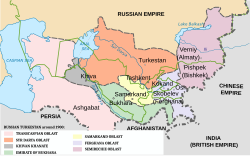
View on WikipediaRussian Turkestan[a] was the vast region of Central Asia governed by the Russian Empire, often described by historians as a colonial possession.[1] It was formally organized as the Turkestan Governorate-General[b] in 1867, and was also known as the Turkestan Krai[c] from 1886 onward. For administrative and military purposes, its territory was managed as the Turkestan Military District.
Key Information


It comprised the oasis regions south of the Kazakh Steppe but excluded the Russian protectorates of the Emirate of Bukhara and the Khanate of Khiva. While these states retained internal autonomy, their independence was largely nominal, as Russia controlled their foreign relations and military affairs.[2] The population consisted primarily of speakers of Uzbek, Kazakh, Kyrgyz, and Tajik, with a significant Russian settler minority.[3]
History
[edit]| History of Central Asia |
|---|
 |


Establishment
[edit]Although Russia had been pushing south into the steppes from Astrakhan and Orenburg since the failed Khivan expedition of Peter the Great in 1717, a more systematic conquest began in the 1850s. After subjugating the Kazakh hordes, Russian forces captured key Kokandi forts, including Ak-Mechet in 1853. However, the most decisive phase of the conquest began in 1865. That year the Russian forces took the city of Tashkent[4] under the leadership of General Mikhail Chernyayev, who expanded the territories of Turkestan Oblast (part of Orenburg Governorate-General). Chernyayev had exceeded his orders (he only had 3,000 men under his command at the time) but Saint Petersburg recognized the annexation in any case. This was swiftly followed by the conquest of Khodzhent, Dzhizak and Ura-Tyube, culminating in the annexation of Samarkand and the surrounding region on the Zeravshan River from the Emirate of Bukhara in 1868.
An account of the Russian conquest of Tashkent was written in Urus leshkerining Türkistanda tarikh 1262–1269 senelarda qilghan futuhlari[d] by Mullah Khalibay Mambetov.[5][6]
Expansion
[edit]In 1867, Turkestan was made a separate Governorate-General, under its first Governor-General, Konstantin Petrovich von Kaufman. Its capital was Tashkent and it initially consisted of two oblasts (provinces), Syr-Darya Oblast and Semirechye Oblast. In 1868, the Zeravshan Okrug was formed from annexed Bukharan territory; it was reorganized in 1887 into the Samarkand Oblast. To these were added in 1873 the Amu Darya Division (Russian: отдел, romanized: otdel), annexed from the Khanate of Khiva, and in 1876 the Fergana Oblast, formed from the remaining rump of the Kokand Khanate that was dissolved after an uprising in 1875. In 1897, the Transcaspian Oblast (which had been conquered in 1881–1885 by generals Mikhail Skobelev and Mikhail Annenkov) was incorporated into the Governorate-General.[7]
Colonization
[edit]The administration of the region had an almost purely military character throughout. Following Von Kaufman's death in 1882, a committee led by Fedor Karlovich Giers (or Girs), brother of the Russian Foreign Minister Nikolay Karlovich Giers, toured the region and drew up reform proposals, which were implemented after 1886. In 1888 the new Trans-Caspian railway, begun at Uzun-Ada on the shores of the Caspian Sea in 1877, reached Samarkand. Nevertheless, Turkestan remained an isolated colonial outpost. Its administration preserved many features from the previous Islamic regimes, such as Qadis' courts. Russia implemented a system of indirect rule, devolving much power to a "native" administration of local Aksakals (elders or headmen), which created a sharp distinction from the direct governance systems in European Russia. In 1908, Count Konstantin Konstantinovich Pahlen led another reform commission to Turkestan, which produced in 1909–1910 a monumental report documenting administrative corruption and inefficiency. The Jadid educational reform movement originated among Tatars and spread to Central Asia. This modernist Islamic movement advocated for adapting to modernity through new methods of teaching (usul-i jadid), emphasizing secular education and cultural renewal alongside religious studies.
The Russian administration, particularly under von Kaufman, adopted a policy of "disregard" or benign neglect towards Islam. They avoided state support for Islamic institutions while limiting external influences, intending for traditional Islamic society to stagnate and eventually decline without active persecution, thereby keeping the population isolated from Pan-Islamist or Pan-Turkist movements.[8][9]
Russian administrative classifications, which often categorized the sedentary population as "Sarts" regardless of language, contributed to the statistical Turkification of Tajiks in Fergana and Samarkand. This categorization favored the Uzbek identity over the Tajik Persian identity, which had historically been dominant in Samarkand.[10]
Revolt of 1916 and aftermath
[edit]In 1897, the railway reached Tashkent, and in 1906, a direct rail link with European Russia was opened across the steppe from Orenburg to Tashkent. This led to much larger numbers of ethnic Russian settlers flowing into Turkestan than had hitherto been the case, and their settlement was overseen by a specially created Migration Department in Saint Petersburg (Russian: Переселенческое Управление, romanized: Pereselencheskoye Upravleniye, lit. 'Resettlement Administration'). This caused considerable discontent amongst the local population as these settlers took scarce land and water resources away from them. In 1916, discontent boiled over in the Central Asian revolt of 1916. It was sparked by a decree issued on 25 June 1916, that conscripted the native population, previously exempt from military service, into labour battalions for work on the Eastern Front of World War I.[11] Thousands of settlers were killed, which triggered brutal Russian reprisals, particularly against the nomadic population. To escape the Russian reprisals, many Uzbeks, Kazakhs, and Kyrgyz fled to China, with the Xinjiang region becoming a key sanctuary for fleeing Kazakhs.[12][8] The Turkmen, Kyrgyz, and Kazakhs were all impacted by the 1916 insurrection caused by the conscription decreed by the Russian government.[13][14] Order had not fully been restored by the time the February Revolution took place in 1917. This ushered in a still bloodier chapter in Turkestan's history. In early 1918, the Bolsheviks of the Tashkent Soviet launched an attack on the Kokand Autonomy, leaving an estimated 14,000 local inhabitants dead.[15] Resistance to the Bolsheviks by the local population (dismissed as "Basmachi" or "bandits" by Soviet historians) continued well into the early 1930s.
Economy
[edit]The economy of the Turkestan Governor-Generalship was fundamentally transformed under imperial rule, evolving from traditional pastoral and oasis agriculture to a colonial economy focused on cotton production and integration with Russian markets.
Cotton cultivation
[edit]Cotton cultivation became the dominant economic sector following supply disruptions during the American Civil War. By the 1850s, Russia's cotton industry had relied on American imports; the 1861–1865 Union blockade made Central Asian cotton a strategic priority. The administration promoted "import substitution," expanding production from local consumption to a major export commodity. The Department of Agriculture established experimental stations, distributed seeds, and provided technical assistance to encourage expanded cultivation.[16]
Irrigation
[edit]Major waterworks projects were undertaken to expand arable land, particularly in the Hungry Steppe and the Zeravshan oasis. Late-imperial irrigation planning linked water control to imperial authority, though projects often exceeded administrative and fiscal capacity.[17]
Trade and transport
[edit]The completion of the Trans-Caspian Railway (1888) and Orenburg–Tashkent Railway (1906) fundamentally altered regional trade patterns. Traditional caravan routes declined as railways captured long-distance trade. By the 1910s, Russia's trade with Central Asia reached approximately 400 million rubles annually, with cotton forming the largest component of exports.
Administration and demographics
[edit]By 1897, the Turkestan Governorate-General was divided into five oblasts (provinces). The population was overwhelmingly rural, with detailed figures recorded in the 1897 Russian Empire census.[18]

Population by oblast
[edit]The 1897 census provides a detailed breakdown of the population across the five oblasts.
| Oblast | Population | Area (km²) | Capital |
|---|---|---|---|
| Fergana Oblast | 1,572,214 | 125,978 | New Margelan (Skobelev) |
| Syr-Darya Oblast | 1,478,398 | 197,883 | Tashkent |
| Semirechye Oblast | 987,863 | 442,778 | Verny |
| Samarkand Oblast | 860,021 | 110,812 | Samarkand |
| Transcaspian Oblast | 382,487 | 829,552 | Ashgabat |
| Total | 5,280,983 | 1,707,003 | — |
Ethnic composition
[edit]| Ethnic group | Population | Percentage | |
|---|---|---|---|
| Uzbeks[e] | 1,995,847 | 37.8% | |
| Kazakhs[f] | 1,283,351 | 24.3% | |
| Kyrgyz[g] | 689,274 | 13.1% | |
| Tajiks | 350,397 | 6.6% | |
| Turkmen | 281,357 | 5.3% | |
| Russians | 199,594 | 3.8% | |
| Other groups[h] | 481,163 | 9.1% | |
| Total | 5,280,983 | 100% | |
Governors-General of Turkestan
[edit]
The governorate-general was administered by a series of military generals appointed by the Tsar.[19]
| Name | Tenure | Military Rank |
|---|---|---|
| Konstantin von Kaufman | 1867–1882 | General of Infantry |
| Mikhail Chernyayev | 1882–1884 | General of Infantry |
| Nikolai Rozenbakh | 1884–1889 | General of Infantry |
| Alexander Vrevsky | 1889–1898 | General of Infantry |
| Sergei Dukhovskoi | 1898–1901 | General of Infantry |
| Nikolai Ivanov | 1901–1904 | General of Infantry |
| Nikolai Tevyashev | 1904–1905 | Lieutenant General |
| Dejan Subotić | 1905–1906 | Lieutenant General |
| Nikolai Grodekov | 1906–1908 | General of Infantry |
| Pavel Mishchenko | 1908–1909 | General of Cavalry |
| Alexander Samsonov | 1909–1914 | General of Cavalry |
| Fedor Martson | 1914–1916 | Lieutenant General |
| Aleksey Kuropatkin | 1916–1917 | General of Infantry |
Legal and judicial system
[edit]The Turkestan judicial system operated through a dual structure that reflected the broader tensions of imperial governance. The administration maintained separate judicial institutions for different populations:
- Imperial courts (established 1898) handled cases involving Russian subjects, utilizing district courts, prosecutors, and justices of the peace based on the Russian judicial statutes of 1864.
- "Native" courts preserved traditional justice under imperial oversight. These included Qadi courts for sedentary populations (applying Islamic law or sharia) and Biy courts for nomadic populations (applying customary law or adat).
However, these traditional institutions operated under significant restrictions. Russian authorities appointed and dismissed judges rather than allowing religious communities to select them independently. All decisions required review by district chiefs or military governors, who could overturn verdicts. This coexistence enabled "forum shopping," where litigants could choose between different legal systems depending on which offered more favourable procedures for their case.[20]
Urban planning and architecture
[edit]After 1865, urban development in Turkestan was characterized by the creation of "new cities" (russkii gorod) laid out by military engineers next to the pre-conquest "old cities." In Tashkent, the new city was spatially separated from the old city by the Ankhor Canal.
The new districts featured regular grid plans, tree-lined boulevards, and parade squares, contrasting with the winding streets of the traditional quarters. This urban form encoded spatial segregation between the colonial and indigenous communities. Public architecture relied on fired-brick construction, creating a style sometimes labelled "Turkestan modern," encompassing buildings such as the State Bank, the Treasury Chamber, and gymnasiums.[21]
Soviet rule
[edit]
After the Russian Revolution of 1917, a Turkestan Autonomous Soviet Socialist Republic (Turkestan ASSR) within the Russian Socialist Federative Soviet Republic was created in Soviet Central Asia (comprising modern Uzbekistan, Turkmenistan, Tajikistan, Kyrgyzstan, and the southern regions of Kazakhstan). After the foundation of the Soviet Union, as part of the national delimitation in Central Asia, it was split into the Turkmen Soviet Socialist Republic (Turkmenistan) and the Uzbek Soviet Socialist Republic (Uzbekistan) in 1924. The Tajik ASSR was established at that time as part of the Uzbek SSR, and was upgraded to a full Soviet Socialist Republic in 1929. In 1936, the Kyrgyz SSR (Kyrgyzstan) was formed from the Kirghiz ASSR, which had been part of the Russian SFSR. After the collapse of the Soviet Union, these republics gained their independence.
See also
[edit]Notes
[edit]- ^ Russian: Русский Туркестан, romanized: Russkiy Turkestan
- ^ Russian: Туркестанское генерал-губернаторство, romanized: Turkestanskoye general-gubernatorstvo
- ^ Russian: Туркестанский край, romanized: Turkestanskiy kray
- ^ The conquests made by the Russian army in Turkestan in the years 1262–1269
- ^ The 1897 census used the term "Sart" for the sedentary Turkic-speaking population, who are largely identified as modern Uzbeks.
- ^ The census termed Kazakhs as "Kirghiz-Kaisaks" to distinguish them from the Kyrgyz people.
- ^ The census used the term "Kara-Kirghiz" (Black Kirghiz) for the people now known as Kyrgyz, to differentiate them from the Kazakhs.
- ^ Including Ukrainians (42,238), Tatars (55,815), Jews (12,343), Germans (8,526), Armenians (4,862), Poles (3,897), and other minorities.
References
[edit]- ^
- Khalid, Adeeb (2009). "Culture and Power in Colonial Turkestan". Cahiers d'Asie centrale (17/18): 416–418.
- Schlotter, Antonina (September 18, 2024). ""Wherever the Russian settles in Asia, the country immediately becomes Russian." (Dostoevsky): The "civilizing mission" of the Russian Empire in Central Asia in the 19th century". Copernico: History and Cultural Heritage in Eastern Europe. Retrieved April 1, 2025.
- Brower, Daniel (2003). Turkestan and the Fate of the Russian Empire (1st ed.). London, New York: RoutledgeCurzon. pp. 19–21. ISBN 0-415-29744-3.
- Zajicek, Taylor C. (2022). "The seismic colony: earthquakes, empire, and technology in Russian-ruled Turkestan, 1887–1911". Central Asian Survey. 41 (2): 322–346. doi:10.1080/02634937.2021.1919056 – via Taylor & Francis Online.
- ^ Becker, Seymour (1968). Russia's Protectorates in Central Asia, Bukhara and Khiva 1865–1924. Cambridge, Massachusetts: Harvard University Press.
- ^ "Первая всеобщая перепись населения Российской Империи 1897 г. Распределение населения по родному языку, губерниям и областям". Demoscope Weekly (in Russian). Retrieved October 17, 2025.
- ^ Daniel Brower (November 12, 2012). Turkestan and the Fate of the Russian Empire. Routledge. p. 26. ISBN 978-1-135-14501-9.
- ^ Thomas Sanders (February 12, 2015). Historiography of Imperial Russia: The Profession and Writing of History in a Multinational State. Routledge. pp. 451–. ISBN 978-1-317-46862-2.
- ^ Edward Allworth (1994). Central Asia, 130 Years of Russian Dominance: A Historical Overview. Duke University Press. pp. 400–. ISBN 0-8223-1521-1.
- ^ Morrison, Alexander (2008). Russian Rule in Samarkand 1868-1910: A Comparison with British India. OUP Oxford. p. 20. ISBN 978-0-19-954737-1.
- ^ a b Andrew D. W. Forbes (October 9, 1986). Warlords and Muslims in Chinese Central Asia: A Political History of Republican Sinkiang 1911–1949. CUP Archive. pp. 16–. ISBN 978-0-521-25514-1.
- ^ Alexandre Bennigsen; Chantal Lemercier-Quelquejay; Central Asian Research Centre (London, England) (1967). Islam in the Soviet Union. Praeger. p. 15.
- ^ Kirill Nourzhanov; Christian Bleuer (October 8, 2013). Tajikistan: A Political and Social History. ANU E Press. pp. 22–. ISBN 978-1-925021-16-5.
- ^ ÖZTÜRK, SELİM (May 2012). THE BUKHARAN EMIRATE AND TURKESTAN UNDER RUSSIAN RULE IN THE REVOLUTIONARY ERA: 1917 - 1924 (PDF) (A Master’s Thesis). Department of International Relations, Bilkent University, Ankara. p. 56-57. Archived from the original (PDF) on October 22, 2016.
- ^ Sydykova, Zamira (January 20, 2016). "Commemorating the 1916 Massacres in Kyrgyzstan? Russia Sees a Western Plot". The Central Asia-Caucasus Analyst.
- ^ Sébastien Peyrouse (January 2012). Turkmenistan: Strategies of Power, Dilemmas of Development. M.E. Sharpe. pp. 29–. ISBN 978-0-7656-3205-0.
- ^ Sebastien Peyrouse (February 12, 2015). Turkmenistan: Strategies of Power, Dilemmas of Development. Routledge. pp. 29–. ISBN 978-1-317-45326-0.
- ^ Khalid, Adeeb (1998). The Politics of Muslim Cultural Reform: Jadidism in Central Asia. University of California Press. p. 296. ISBN 978-0-520-21356-2.
- ^ Pierce, Richard A. (1960). Russian Central Asia, 1867–1917: A Study in Colonial Rule. Berkeley: University of California Press.
- ^ Peterson, Maya Karin (2019). Pipe Dreams: Water and Empire in Central Asia's Aral Sea Basin. Cambridge University Press. ISBN 9781108475471.
- ^ a b c "Первая всеобщая перепись населения Российской Империи 1897 г. Распределение населения по родному языку, губерниям и областям". Demoscope Weekly (in Russian). Retrieved October 17, 2025.
- ^ Kassymova, Didar; Kundakbayeva, Zhanat; Markus, Ustina. Historical Dictionary of Kazakhstan. p. 228.
- ^ Sartori, Paolo (2008). "Judicial Elections as a Colonial Reform". Cahiers du monde russe. 49 (2–3).
- ^ Sahadeo, Jeff (2007). Russian Colonial Society in Tashkent, 1865–1923. Indiana University Press. ISBN 9780253222794.
Further reading
[edit]- Pierce, Richard A. Russian Central Asia, 1867–1917: A Study in Colonial Rule (1960)
- Sokol, E. D. The Revolt of 1916 in Russian Central Asia (Baltimore: 1954).
- Brower, Daniel. Turkestan and the Fate of the Russian Empire (London: 2003)
- Wheeler, Geoffrey. The Modern History of Soviet Central Asia (1964).
- Schuyler, Eugene. Turkistan (London: 1876) 2 Vols.
- Curzon, G.N. Russia in Central Asia (London: 1889)
- Pahlen, K. K. Mission to Turkestan (Oxford) 1964
- Khalid, Adeeb. The Politics of Muslim Cultural Reform: Jadidism in Central Asia (Berkeley) 1997
- Beisembiev, T.K. The Life of Alimqul (London) 2003
- Komatsu, Hisao. "The Andijan Uprising Reconsidered: Symbiosis and Conflict in Muslim Societies: Historical and Comparative Perspectives", ed. by Tsugitaka Sato, Londres, 2004.
- Erkinov, Aftandil. Praying For and Against the Tsar: Prayers and Sermons in Russian-Dominated Khiva and Tsarist Turkestan. Berlin: Klaus Schwarz Verlag, 2004 (=ANOR 16), 112 p.
- Erkinov, Aftandil S. (2009). The Andijan Uprising of 1898 and its leader Dukchi-ishan described by contemporary Poets. TIAS Central Eurasian Research Series. Tokyo. p. 118.
{{cite book}}: CS1 maint: location missing publisher (link) - Malikov, Azim. "Russian policy toward Islamic 'sacred lineages' of Samarkand province of Turkestan Governor-Generalship in 1868–1917" in Acta Slavica Iaponica no 40. 2020, p. 193-216.
External links
[edit]
| Authority control databases: National |
|---|

Russian Turkestan
View on GrokipediaGeography and Demographics
Territorial Extent and Physical Features
Russian Turkestan comprised the directly administered territories of the Russian Empire in Central Asia, bounded by the Caspian Sea and Aral Sea to the west, the frontiers of China to the east, the Siberian steppes and Kazakh territories to the north, and the borders of Persia and Afghanistan to the south.[3] The governorate-general included five principal oblasts: Syr-Darya, Samarkand, Ferghana, Semirechye (also known as Zhetysu), and Transcaspian (Zakaspiskaya).[3] These divisions encompassed an area of approximately 721,000 square miles (1,870,000 km²), excluding the semi-autonomous khanates of Bukhara and Khiva which fell under Russian protection but retained internal autonomy.[3] The physical landscape of Russian Turkestan varied markedly from west to east. Western areas consisted primarily of arid plains and vast deserts interspersed with desiccated lake beds, forming part of the greater Turan lowland.[3] In contrast, the eastern regions were dominated by high mountain ranges, including extensions of the Tian Shan and Pamir systems, which rose to elevations exceeding 5,000 feet in northern sectors and supported alpine valleys and glaciers.[3] [4] Key hydrological features included the Amu Darya (Oxus) and Syr Darya (Jaxartes) rivers, both originating in the eastern mountains and flowing westward to empty into the Aral Sea, providing vital irrigation for oases and settled agriculture amid the surrounding aridity.[3] Significant inland lakes such as Balkhash in the northeast and Issyk-Kul in Semirechye oblast further defined the terrain, with Issyk-Kul noted for its depth and saline waters.[3] The overall topography facilitated a continental climate with extreme temperature variations, hot summers in the lowlands, and harsh winters in elevated zones, underscoring the region's challenges for settlement and transport.[4]Population Composition and Ethnic Dynamics
The population of Russian Turkestan comprised a mosaic of predominantly Muslim ethnic groups, with Turkic-speaking peoples forming the majority alongside Iranian-speaking Tajiks. Sedentary communities in fertile oases and cities, such as those in the Zeravshan Valley and Fergana, were largely Uzbeks—contemporarily classified as "Sarts" to denote urban or agricultural Turkic Muslims—and Tajiks, who engaged in irrigation-based farming, trade, and craftsmanship. In contrast, nomadic and semi-nomadic pastoralists, including Kazakhs, Kyrgyz, and Turkmen, predominated in the vast steppe, desert, and highland peripheries, relying on livestock herding and seasonal migrations. The 1897 Imperial census enumerated over 900,000 Sarts and around 350,000 Tajiks across Russian Central Asian territories, though these figures underrepresented Tajiks due to classificatory ambiguities and exclusion of semi-autonomous khanates like Bukhara and Khiva.[5] Russian colonial policies from the 1880s onward spurred demographic shifts through subsidized settlement of Slavic peasants, Cossacks, and urban administrators, primarily in the northern Syr Darya and Semirechye oblasts. These Europeans, numbering in the low hundreds of thousands by century's end, established fortified villages and railways, converting marginal lands to grain cultivation and displacing nomadic grazing routes.[6] Such influxes intensified ethnic stratification, with Russians dominating military outposts, bureaucracy, and commerce in Tashkent and other hubs, while locals retained autonomy in customary law and tribal governance. Interethnic dynamics remained tense, marked by resource competition—exemplified by land reallocations that curtailed Kyrgyz and Kazakh mobility—and sporadic resistance, culminating in the 1916 uprising against conscription and settlement encroachments.[7] Minorities, including Dungans (Muslim Chinese), Persians, Afghans, Armenians, and Jews, clustered in trading enclaves, contributing to urban diversity but facing discriminatory taxation and limited rights under Russian extraterritorial privileges for Europeans. Overall, native Muslims exceeded 90% of the estimated 5-6 million inhabitants circa 1900, with ethnic boundaries reinforced by linguistic, religious, and livelihood divides rather than assimilation.[5]Pre-Russian Context
Khanates and Tribal Structures
Prior to Russian expansion, the region encompassing modern Uzbekistan, Turkmenistan, Tajikistan, Kyrgyzstan, and southern Kazakhstan was politically fragmented into three principal Uzbek khanates—Kokand, Bukhara, and Khiva—each characterized by centralized monarchies under hereditary khans or emirs, often of Turkic-Mongol origin, ruling over a mix of sedentary agriculturalists and tributary nomads. These states emerged from the decline of earlier Timurid and Shaybanid polities in the 18th century, with Kokand founded around 1709 by the Ming dynasty and expanding to control the Ferghana Valley and surrounding steppes by the mid-19th century, incorporating Kyrgyz, Kazakh, and Karakalpak tribes as far west as the Aral Sea under rulers like Muhammad Ali Khan (r. 1822–1842).[8] The Emirate of Bukhara, established in 1785 by the Manghit dynasty, functioned as an absolute monarchy divided into 10 provinces and 25 bekstvos (districts) by the late 19th century, with the emir wielding autocratic power supported by a military elite and religious clergy, extending influence over Tajik and Uzbek populations in Transoxiana.[9] Similarly, the Khanate of Khiva, centered in the Khorezm oasis since the early 16th century but revitalized under the Qungrat dynasty from 1804, relied on Turkmen tribal levies for defense and raiding, maintaining a hierarchical structure with the khan at the apex, overseeing irrigation-based agriculture and slave-based economy in the Amu Darya delta.[10] Nomadic tribal structures predominated among the Kazakh, Turkmen, and Kyrgyz populations across the steppes and deserts, organized into confederations (zhuzes for Kazakhs) that emphasized kinship, pastoral mobility, and loose alliances rather than fixed hierarchies, often paying tribute to khanates while resisting full incorporation. Kazakh society divided into three zhuzes—the Great (Senior) in the east, Middle along the Syr Darya, and Little (Junior) in the south—each comprising clans (ru) led by biys (judges) and sultans, with weakening khanly authority by the 18th century due to internal feuds and raids from Jungars, fostering a decentralized system of customary law (adat) and exogamous marriages across tribes.[11] Turkmen tribes, such as the Teke and Yomut, operated with minimal overarching political structure, forming endogamous kin groups focused on camel herding and oasis raiding, exerting influence on Khiva's politics through military service while maintaining autonomy in the Kara Kum Desert.[12] Kyrgyz tribes, pastoralists in the Tian Shan mountains, were segmented into right (ong) and left wings under local manaps (chiefs), absorbing remnants of declining eastern khanates and relying on clan-based assemblies for decision-making, with frequent migrations and feuds shaping their pre-conquest social order.[11] These khanates and tribes interacted through tribute, warfare, and trade, with sedentary khanate cores extracting resources from nomadic peripheries via forts and tax collectors, yet chronic instability—marked by succession disputes, as in Kokand's 20 khans between 1800 and 1876, and slave raids affecting up to 1-2 million captives annually across the region—prevented unified resistance to external powers. Tribal loyalties often superseded khanate allegiance, enabling Russian divide-and-conquer tactics, as nomadic groups like Kazakhs sought alliances against khanate overlords.[8][13]Economic and Social Conditions Prior to Conquest
The economy of the Central Asian khanates—primarily those of Bukhara, Khiva, and Kokand—in the early to mid-19th century relied heavily on sedentary oasis agriculture supported by ancient irrigation systems, supplemented by pastoral nomadism and overland caravan trade. In fertile valleys like the Fergana region under Kokand and the Amu Darya basin in Khiva, farmers cultivated grains such as wheat and barley, fruits, and limited cotton, with production constrained by rudimentary techniques and variable water supply from rivers and qanats. Pastoral groups, including Turkmen tribes and Kazakh clans, sustained herds of sheep, horses, and camels, which provided wool, meat, and transport animals essential for mobility and exchange. Transregional trade, though diminished from Silk Road peaks due to shifting routes, centered on Bukhara as a hub for exporting silk, cotton textiles, embroidered fabrics, and livestock to Persia, India, Russia, and China, while importing metals, dyes, and luxury goods; northern expansion by Khiva and Kokand into steppe areas intensified competition over these routes with emerging Russian interests.[14][15] Slavery formed a cornerstone of both economic labor and social hierarchy across the khanates, with captives from raids serving in agriculture, domestic roles, military service, and as status symbols for elites. Primary sources included Persian villagers, Russian Cossacks, and Kalmyks seized in cross-border incursions by Turkmen and Uzbek tribes; for instance, in 1737, Nader Shah of Persia liberated approximately 12,000 slaves during his campaign in Khiva, resettling many and highlighting the scale of Persian captives integrated into local households and estates. Slaves, often non-Muslim infidels under Islamic jurisprudence, comprised a significant portion of the workforce in rural areas and urban workshops, sustaining textile production and herding without wages, while elite ownership reinforced patrimonial power structures. This system persisted amid declining international trade, exacerbating economic stagnation as raids diverted resources from productive investment.[14] Social organization emphasized tribal and clan loyalties over centralized ethnic identities, within despotic monarchies where khans or emirs wielded absolute authority, supported by a bureaucracy of officials and military forces drawn from Turkmen, Kipchak, and Uzbek tribes. In Bukhara, the Manghit dynasty enforced the most autocratic rule, with sedentary Sarts (town-dwelling Uzbeks and Tajiks) handling commerce and administration alongside nomadic warriors; Khiva under the Qongrat dynasty achieved relative centralization by the 19th century, blending pastoralism with agriculture and fostering a distinct Turkic literary culture. Society stratified into ruling dynasties, aristocratic beks and mirzas, Islamic clergy (ulama) influencing law and education, merchants in bazaars, artisan guilds, peasant cultivators, and a servile underclass, with frequent intertribal feuds and tax exemptions for elites undermining stability—evident in urban depopulation, such as Samarkand's abandonment and Bukhara's contraction to two quarters by the 1730s amid wars. Daily life revolved around Islamic practices, extended family networks, and seasonal migrations, but chronic insecurity from internal strife and external raids fostered a conservative, inward-looking ethos resistant to innovation.[14]Conquest and Establishment
Initial Russian Advances (1850s-1860s)
In the early 1850s, Russian forces focused on securing the Syr Darya river valley against incursions from the Khanate of Kokand, which had established outposts threatening Russian settlements and trade routes in the Kazakh steppes. The siege of Aq-Mosque (modern Atyrau region outpost, but key Kokand fortress) from July 5 to 28, 1853, marked a pivotal early advance, where an expedition under Orenburg Governor-General Vasily Perovsky, comprising about 2,500 troops and artillery, overcame a garrison estimated at over 1,000 defenders after mining the walls and storming the breach, resulting in heavy Kokandi losses and minimal Russian casualties.[16][17] This victory allowed Russians to rename the fort Perovsk and extend control southward along the river, disrupting Kokand's raiding networks that had persisted despite earlier failed expeditions like the 1839-1840 Khiva campaign.[18] Simultaneously, advances in the Semirechye region (eastern Kazakh-Kyrgyz frontier) aimed to counter Kokand's footholds in the Ili Valley. In 1854, a Russian detachment under Lieutenant Colonel Johann Carl von Zimmerman founded the Verny fortress (modern Almaty) amid nomadic Kazakh territories, initially housing 470 Cossacks and settlers to anchor imperial presence against tribal unrest and Kokandi influence; the site was chosen for its strategic elevation and defensibility near the Tian Shan mountains.[19] By the late 1850s, further consolidation included the 1859 capture of Julek fortress from Kokand, followed by construction of a Russian fort there in 1861 and seizure of Yani Kurgan (Zhanakorgan) 80 kilometers upriver, extending the defensive line and facilitating settlement.[17] The mid-1860s saw accelerated offensives as Russian detachments, often outnumbered but leveraging artillery and disciplined infantry, targeted core Kokandi strongholds. In June 1864, General Nikolay Veryovkin's column of approximately 2,000 men captured Hazrat-i-Turkestan (the city of Turkestan), bombarding its mausoleum to hasten surrender and linking Syr Darya forts into a cohesive frontier.[20] This paved the way for the siege of Tashkent from May 9 to June 17, 1865, where General Mikhail Chernyaev's force of 2,300 troops, facing a reported 30,000 defenders, exploited internal divisions within the city—Uzbeks and Kipchaks clashed with the ruling emir—culminating in a breach assault that secured the oasis after street fighting, with Russian losses around 170 dead and 400 wounded.[21] Tashkent's fall, driven by both preemptive security against Kokandi raids and opportunistic expansion amid khanate instability, established a major administrative base, though it strained Russian logistics amid the ongoing Crimean War aftermath.[17] These operations reflected a pattern of incremental fortification and opportunistic strikes, enabled by superior firepower against fragmented khanate defenses, though Russian commanders like Chernyaev acted semi-autonomously, prompting debates in St. Petersburg over the pace of expansion versus risks of overextension.[22] By 1866, the advances had neutralized key Kokandi threats in the Syr Darya and Semirechye, setting the stage for deeper penetration into Transoxiana, with garrisons totaling several thousand troops enforcing tribute and curbing nomadic incursions.[20]Formation of the Governorate-General (1867)
Following the Russian seizure of Tashkent in June 1865, which secured a key urban center in the Syr-Darya valley, imperial authorities moved to institutionalize control over the expanding Central Asian territories acquired from the Khanate of Kokand.[1] This conquest, led by General Mikhail Grigoryevich Chernyaev, highlighted the need for a centralized administrative apparatus to manage military garrisons, local alliances, and nascent economic exploitation amid ongoing tribal resistance.[21] On July 11, 1867, Emperor Alexander II promulgated an imperial decree establishing the Governorate-General of Turkestan as a distinct military-civil province, incorporating the existing Syr-Darya and Semirechye oblasts previously under the Orenburg Governor-Generalship.[23] [24] Tashkent was designated the headquarters, leveraging its position as a fortified hub with a population exceeding 100,000, predominantly Uzbeks and Tajiks under recent Russian suzerainty.[1] The decree endowed the Governor-General with sweeping authority over civil administration, military operations, judicial oversight, and fiscal policy, as codified in the Svod Zakonov Rossiiskoi Imperii, to streamline governance detached from distant Siberian or Orenburg bureaucracies.[23] Konstantin Petrovich von Kaufmann, a seasoned Baltic German general with experience in Orenburg frontier affairs, was appointed to the post on July 14, 1867, serving until his death in 1882.[23] Under his leadership, the Governorate-General adopted a policy of indirect rule, designating native inhabitants as inorodtsy (aliens) exempt from general conscription but subject to special land taxes and corvée labor, while preserving local Islamic courts and clan elders for routine disputes to minimize administrative costs and unrest.[1] This framework prioritized strategic defense against potential British encroachment from India and internal stabilization, setting the stage for further campaigns into Bukhara and Khiva.[23] The establishment represented an experimental departure in Russian imperial administration, blending autocratic oversight with pragmatic tolerance of indigenous customs to foster loyalty through economic incentives like cotton cultivation rather than coercive Russification.[1] Initial challenges included integrating disparate oblast administrations and quelling sporadic revolts, but the structure enabled rapid infrastructure development, such as telegraph lines linking Tashkent to European Russia by 1870.[23]Administrative and Governance Structure
Organizational Framework and Divisions
The Turkestan Governorate-General, established on July 11, 1867, by Emperor Alexander II, functioned as a unified military-administrative entity under the direct authority of a Governor-General based in Tashkent, who exercised both civil and military command over the territory.[1] This structure emphasized centralized control to manage the vast, ethnically diverse region, with the Governor-General reporting initially to the Ministry of War and later coordinating with the Ministry of Internal Affairs for civilian matters.[25] Subordinate officials, including military governors of oblasts, implemented policies while maintaining Russian oversight amid local customary laws. The Governorate-General was divided into oblasts (provinces), each administered by a military governor responsible for local governance, taxation, and security. By the late 19th century, the core divisions comprised five oblasts, reflecting conquest phases and administrative consolidation:- Syr-Darya Oblast, centered in Tashkent, formed in 1867 from territories around the Syr-Darya River, encompassing urban centers and agricultural lands.[26]
- Semirechye Oblast, with Verny (modern Almaty) as its center, transferred from the Steppe Governor-Generalship in 1882, covering eastern steppe and mountain regions.[26]
- Fergana Oblast, established in 1884 following the annexation of the Kokand Khanate in 1876, centered in New Margelan (later Skobelev), focusing on the fertile Fergana Valley.[26]
- Samarkand Oblast, created in 1887 from the Zeravshan Okrug, with Samarkand as the administrative hub, incorporating historic urban areas of the former Bukhara Emirate.[26]
- Transcaspian Oblast, formed in 1881 after the conquest of the Akhal-Teke oasis, centered in Ashkhabad, extending to the Caspian Sea and arid southern frontiers.[26]
Role of Governors-General and Key Figures
The Governor-General of Turkestan wielded autocratic authority over the Governorate-General, combining supreme military command with civil administration, judicial oversight, and diplomatic prerogatives, as formalized by imperial decree on July 11, 1867. This position, unique among Russian provincial structures, granted the appointee direct accountability to the Tsar, bypassing intermediate ministries, and empowered them to negotiate treaties with local khanates and neighboring powers like Persia and Britain to secure borders and trade routes. Responsibilities extended to suppressing rebellions, managing taxation and corvée labor, and directing infrastructure projects, all while balancing Russian imperial interests against local ethnic and religious dynamics to maintain stability in a vast, heterogeneous territory spanning over 1.5 million square kilometers.[27][28] Konstantin Petrovich von Kaufman (1818–1882), a career engineer and administrator, assumed the role on July 14, 1867, and held it until his death on May 16, 1882, overseeing the transition from conquest to governance after the 1865–1868 campaigns that secured Tashkent, Samarkand, and the Zeravshan Valley. Kaufman's policies emphasized pragmatic consolidation over rapid Russification, adopting a doctrine of non-interference in Muslim religious practices—famously encapsulated in his 1868 circular prohibiting proselytism and new clerical appointments—to avert jihadist uprisings, while subordinating Islamic courts (qadi institutions) to Russian oversight and restricting pilgrimage routes to Mecca that could foster pan-Islamic sentiment. He prioritized economic integration by expanding irrigation canals, which increased cultivable land by approximately 200,000 dessiatins (about 540,000 acres) between 1867 and 1882, fostering cotton exports that rose from negligible levels to over 100,000 tons annually by the 1880s, thereby linking Turkestan's agrarian base to Russian industrial demands. Critics, including military officers, faulted his tolerance as overly conciliatory, arguing it perpetuated local elite influence at the expense of imperial loyalty, though empirical outcomes showed reduced major revolts during his tenure compared to pre-conquest volatility.[23][6][1] Kaufman's immediate successor, Mikhail Grigoryevich Cherniaev (1822–1898), commanded from August 1882 to July 1884, advocating a harder line that included confiscating waqf lands from recalcitrant clerics and accelerating settler colonization, though his brief term ended amid conflicts with St. Petersburg over fiscal mismanagement. Aleksandr Borisovich Vrevskii (1834–1910), serving from 1889 to 1898, shifted toward institutional reforms, establishing the first Russian-native schools (by 1897, enrolling over 1,000 pupils) and codifying land tenure to curb nomadic encroachments on sedentary agriculture, while contending with Anglo-Russian border tensions in the Pamirs. Later appointees like Aleksei Nikolaevich Kuropatkin (1848–1925), who governed from 1898 to 1903 and briefly in 1916 amid World War I mobilizations, grappled with escalating ethnic frictions, imposing martial law during the 1898 Andijan uprising that claimed over 500 lives and enacting conscription policies that precipitated the 1916 revolt, killing tens of thousands. These figures, often drawn from the "Turkestan generals" cadre with steppe frontier experience, exemplified the tension between coercive stabilization and developmental imperatives, with their tenures marked by centralized decree powers that prioritized imperial extraction over local autonomy.[23][6][29]Legal and Judicial Systems
The judicial system in Russian Turkestan maintained a dual structure, with Russian imperial courts handling cases involving Russian subjects, military personnel, and major criminal matters, while native courts adjudicated personal, family, inheritance, and minor civil disputes (typically under 100 rubles) for the indigenous Muslim population using Sharia for settled groups and adat customary law for nomads.[30] [2] This separation preserved local legal traditions to minimize resistance following conquest, though Russian oversight ensured alignment with imperial interests.[2] The framework originated in the Provisional Statute for the Administration of Turkestan of July 11, 1867, which regulated native courts by mandating local elections of qadis (Islamic judges) for settled populations in qadi-khana district courts and biys (elders) for nomadic tribunals, while limiting penalties such as prohibiting death sentences without Russian approval and allowing appeals to imperial courts.[30] Qadis derived authority from Hanafi fiqh, often consulting texts like al-Hidaya, but operated under the district chief (uezdnyi nachal'nik), a Russian official who supervised proceedings and could intervene in serious cases.[30] For nomads, biy courts resolved disputes through collective assemblies, reformed similarly in 1867 to integrate Russian procedural elements like witness oaths, though these were frequently undermined by professional witnesses (mutavakkils) who exploited social ties for bias.[2] Governor-General Konstantin P. von Kaufman (1867–1882) enforced a policy of limited non-intervention in native justice to stabilize rule, banning external influences like the Orenburg Spiritual Assembly in 1880 and negotiating treaties with Bukhara (1868, 1873) that retained semi-autonomous courts there.[30] [2] Subsequent reforms intensified control: the 1886 Statute reaffirmed 1867 provisions while introducing people's courts (narodnye sudy); Governor-General G.G. Vrevskii's 1892 edict standardized judge qualifications and elections; and post-1898 Andijan uprising measures under officials like Dukhovskoj imposed stricter monitoring, including codified Hanafi rulings in Palen's 1906 project, though corruption, discretionary qadi power, and local subversion persisted, limiting full integration with Russian law.[30] [2] Appeals assemblies (s'ezd narodnykh sudei) provided oversight, but native courts retained significant autonomy in daily matters, reflecting tsarist prioritization of administrative efficiency over comprehensive judicial uniformity.[2]Economic Policies and Development
Agricultural Reforms and Cotton Monoculture
The Russian administration pursued agricultural reforms in Turkestan to capitalize on the region's irrigation-dependent oases, prioritizing cotton as a cash crop to feed the empire's expanding textile industry, which required over 400,000 tons annually by the early 20th century.[31] These efforts accelerated after the American Civil War disrupted global supplies, positioning Turkestan as a strategic alternative source; by the 1880s, cotton cultivation expanded rapidly, with the region supplying the majority of the empire's raw cotton and devoting much of its arable land to the crop at the expense of grains and other foodstuffs.[32] Key reforms included fiscal incentives, such as land tax reductions for areas sown with cotton, implemented from the late 1880s through at least 1908, which shifted local farming from mixed subsistence to intensive cash-crop production under Russian oversight.[33] The Ministry of State Domains' Agriculture Department intervened in the 1890s, supplanting earlier mining-focused initiatives and establishing experimental stations like the Emperor's Plantation to test higher-yield varieties, mechanized ginning, and soil management techniques adapted from European models.[34] Irrigation infrastructure was bolstered through state-funded canals along the Syr Darya and Amu Darya rivers, enabling year-round cultivation but straining water resources traditionally allocated to diverse crops.[35] This pivot to cotton monoculture drove output surges—Turkestan's production rose 3.7-fold from 1902 levels by 1914—integrating the region into imperial trade networks via rail links to Orenburg and fostering exports worth tens of millions of rubles annually by the 1910s.[34] [36] However, the reforms engendered dependency: arable land skewed heavily toward cotton reduced domestic food output, exacerbating bread shortages that peaked in 1917 amid wartime disruptions and compelling reliance on Russian grain imports, which locals often could not afford.[37] [32] Local Uzbeks, Tajiks, and Kazakhs, compelled by tax structures favoring export crops, faced economic coercion without ownership of processing facilities, yielding profits primarily to Russian merchants and mills while fostering soil exhaustion and vulnerability to pests like boll weevil analogs.[35]Infrastructure Projects and Trade Integration
The Trans-Caspian Railway, constructed by the Russian Empire starting in 1880 after military conquests in the region, reached Samarkand by 1888 and was renamed the Central Asian Railway in 1898.[38] [39] This narrow-gauge line spanned from the Caspian Sea through key oases and cities, initially serving military logistics but rapidly enabling civilian commerce by linking isolated Turkestani markets to Russian ports.[40] Its extension to Tashkent and beyond reduced caravan travel times from weeks to days, fundamentally altering overland trade routes that had previously favored Persian and Afghan intermediaries.[41] Complementing this, the Orenburg-Tashkent Railway was initiated in autumn 1900 and completed by 1905, forging a broad-gauge connection from European Russia directly to Turkestan's administrative center.[38] [42] Spanning over 1,900 kilometers, it bypassed the Caspian and integrated northern steppes with southern irrigated valleys, allowing efficient bulk transport of raw materials northward.[43] Construction overcame arid terrains and temporary flooding from the Aral Sea basin, with strategic imperatives driving its prioritization despite high costs estimated at millions of rubles.[44] Irrigation infrastructure expanded concurrently to underpin export agriculture, with Russian engineers rehabilitating ancient canals and constructing new ones, such as those diverting the Amu Darya and Syr Darya rivers for cotton fields.[45] By 1909, the Turkistan Hydrological Service was established to systematize water management, supporting increased arable land under perennial irrigation systems that boosted yields in the Ferghana Valley and Zarafshan region. These projects, often funded through extraordinary imperial credits, aimed to mitigate famine risks while prioritizing cash crops, though they sometimes exacerbated soil salinization due to uneven maintenance.[35] Rail and water networks drove trade integration by channeling Turkestan's cotton output—reaching over 200,000 tons annually by the 1890s—toward Russian mills, supplanting imports from the United States amid global shortages.[35] Export controls and tax incentives on cotton lands funneled revenues into imperial coffers, while inbound shipments of textiles, machinery, and grains from Russia displaced local artisans and traditional bazaar economies.[46] This shift fostered dependency on metropolitan markets, with railways handling freight volumes that grew exponentially post-1905, yet local merchants retained niches in intra-regional caravans until World War I disruptions.[47] Overall, infrastructure bound Turkestan economically to the empire, prioritizing raw material extraction over diversified industrialization.[48]Taxation and Fiscal Management
The fiscal system in Russian Turkestan emphasized self-sufficiency, with local revenues intended to cover administrative costs and generate surplus for the imperial treasury, reflecting a policy of minimal initial disruption to native economies while extracting resources. Under Governor-General Konstantin Petrovich von Kaufman (1867–1881), direct taxation was limited to avoid alienating the Muslim population; instead, reliance was placed on indirect levies such as customs duties on trade routes to Afghanistan, Persia, and China, excises on salt, alcohol, and tobacco, and monopolies on certain goods, which formed the bulk of early revenues without imposing a universal poll tax akin to European Russia's capitation.[49][23] Land taxation emerged as the primary direct levy, adapting pre-conquest systems like the kharaj (tribute on cultivated land) while introducing Russian-style assessments. Following the 1876 conquest of Kokand, land surveying and tax evaluations were conducted in Fergana, setting rates based on soil fertility and irrigation, often exceeding local norms and disregarding Islamic traditions of zakat (alms) or customary exemptions, which burdened sedentary farmers on irrigated plots and compelled food imports.[50][51] The zemskii sbor, a supplementary village-level land levy calculated at approximately 10% of annual crop value and collected communally without elected zemstva assemblies, functioned as an ad hoc "taxation without representation," predating formalized state land taxes and amounting to about 6% of the kibitochnaia podat' (state document tax) by 1897.[52][53] Fiscal management centralized under the Governor-General's chancellery, which oversaw revenue collection through native officials (volost elders and qazis) under Russian supervision, compiled annual statistics, and remitted funds to St. Petersburg after local expenditures. Reforms in the 1880s, including the 1886 Turkestan Statute, standardized land tax procedures, while incentives like reduced rates on American cotton acreage (introduced from the late 1880s) spurred monoculture but exacerbated fiscal pressures on non-cotton lands, with assessments shifting by 1900 to surface area for bahari (perennial) irrigation plots.[54][55][56] These measures prioritized revenue extraction over equity, yielding significant imperial contributions—estimated in millions of rubles annually by the 1890s—though inefficiencies in collection and resistance led to periodic arrears and reliance on military enforcement.[51]Social and Cultural Transformations
Modernization Initiatives and Education
The Russian administration in Turkestan pursued modernization through selective educational reforms, primarily via the establishment of Russian-native schools designed to impart imperial loyalty, basic literacy, and practical skills while prioritizing Russification over widespread cultural transformation. These initiatives, commencing shortly after the 1867 formation of the Governorate-General, emphasized non-confessional primary education accessible to indigenous Muslim children alongside Russians, reflecting Governor-General Konstantin von Kaufmann's policy of indirect rule that avoided overt religious interference but sought administrative integration. Russian-native schools focused on curricula including Russian language, arithmetic, and history, with the language introduced as compulsory even in traditional maktabs and madrasas to erode local autonomy in education.[57] Quantitative expansion was gradual and regionally uneven; in the Syr-Darya oblast alone, 134 Russian-native schools operated by 1885, serving as primary vehicles for imperial propaganda through literature and language instruction. Across Turkestan, Russian-style primary schools numbered 17 in Syr-Darya, 10 in Fergana, and 67 in the Semirechye region by 1880–1881, with the latter enrolling 3,355 students. Growth accelerated in the early 20th century, reaching 45 such schools in 1901 and 82 by 1905, alongside 89 by 1911, though enrollment remained limited relative to the population, concentrating in urban centers like Tashkent and among elites who increasingly viewed Russian education as a pathway to bureaucratic opportunities.[57][58][59] Secondary and vocational education supplemented these efforts, with gymnasiums established in major cities—such as Tashkent's, which grew from 585 students in 1886 to 716 by 1893—and specialized institutions like the 1887 agricultural school in Kopet-Dag and Tashkent's 1896 craft school. By 1917, 29 secondary schools (excluding cadet corps) served 9,577 students, aiming to cultivate a cadre of Russified intermediaries for governance and economy. These reforms, framed as a civilizing mission, faced resistance from entrenched Islamic educational networks and yielded uneven penetration, as traditional maktabs persisted for religious instruction, underscoring the limits of coercive modernization amid local cultural resilience.[58][60][61]Interactions with Islamic Institutions and Local Customs
The Russian administration in Turkestan adopted a policy of pragmatic tolerance toward Islam, prioritizing administrative stability over aggressive secularization or Christianization, as articulated by Governor-General Konstantin Kaufman (1867–1882), who implemented a "policy of ignorance" that deliberately avoided interference in Muslim religious practices to prevent unrest.[62] This approach preserved Islamic institutions such as mosques and madrasas, which continued to function autonomously under local clerical oversight, with Russian officials exerting minimal direct control except in cases of perceived sedition.[30] Islamic courts, known as qadi courts, were permitted to adjudicate personal status matters—including marriage, divorce, inheritance, and waqf (religious endowments)—in accordance with Sharia and local adat (customary law), while Russian imperial courts handled criminal cases involving Muslims or disputes with Europeans.[30] This dual legal system, formalized in the 1867 Provisional Statute for Turkestan, reflected a colonial strategy of indirect rule, where qadis were often co-opted as intermediaries, receiving stipends from Russian authorities in exchange for loyalty, though corruption and inconsistent application persisted due to limited oversight.[63] The administration recognized the socio-political influence of Islamic elites, such as sayyids and khojas (descendants of the Prophet Muhammad), granting them privileges like tax exemptions to secure their cooperation and mitigate resistance.[64] Local customs intertwined with Islamic norms, such as polygamy, veiling, and nomadic pastoral practices, faced limited reform efforts, as Russian officials refrained from imposing European norms on private life to avoid alienating the population, a stance reinforced by the 1886 Turkestan Statute that upheld customary dispute resolution in rural areas.[2] However, selective interventions occurred, particularly in urban centers like Tashkent and Samarkand, where the Pahlen Commission (1908–1910), under Count Konstantin Pahlen, sought to codify Sharia elements into a standardized "colonial Sharia" drawing from British Indian models like the Hidaya, aiming to curb clerical arbitrariness and align with imperial fiscal interests, though these reforms achieved only partial implementation amid local opposition.[65] By 1917, this interplay fostered a hybrid legal landscape, where Islamic institutions retained cultural authority but were increasingly subordinated to Russian surveillance, contributing to tensions that later fueled anti-colonial sentiments.[66]Russian Settlement and Demographic Shifts
Russian settlement in Turkestan commenced following the military conquests of the 1860s, initially comprising soldiers, officials, and traders who established administrative control in conquered cities such as Tashkent and Samarkand.[6] These early settlers concentrated in newly constructed "European" quarters, segregating themselves from the indigenous population and prioritizing urban governance over widespread rural colonization.[6] From the 1880s onward, imperial policy promoted Slavic peasant resettlement to bolster territorial security, economic development, and cultural influence, targeting the steppe fringes of Semirechye and Syr Darya oblasts where arable land and water resources supported grain cultivation.[7] Cossack hosts were deployed along frontiers for defense, forming fortified villages that doubled as military outposts, while peasant families received land allotments, tax exemptions, and subsidies to encourage permanent habitation.[7] By 1908, official settler numbers reached 100,536, with Semirechye hosting 46 rural colonies and approximately 188,016 Russians by 1910; however, unauthorized migrants added thousands more households, straining resources.[7] Demographically, Slavic influx remained modest relative to the indigenous majority, comprising roughly 6% (407,000 individuals) of the Governor-Generalship's 6.5 million residents by 1911, with concentration in northern oblasts and cities amplifying local influence.[7] In Tashkent, Russians and other Europeans constituted up to one-third of the population by the early 1900s and 20% overall by 1917, dominating commerce and administration while indigenous Uzbeks and Tajiks predominated in the old city.[6] [7] This uneven distribution fostered ethnic enclaves rather than broad assimilation, as settlers often rented or purchased land from locals, leading to competition over pastures and irrigation in Semirechye that exacerbated tensions with Kazakh and Kyrgyz nomads.[7] The policy's causal effects included heightened interethnic friction, culminating in the 1916 Central Asian revolt where 3,709 settlers perished in Semirechye alone, underscoring the fragility of demographic engineering amid resource scarcity and cultural divides.[7] Overall, Russian settlement transformed urban power structures and select agricultural zones but failed to achieve the mass colonization seen in Siberia, preserving native majorities while introducing Slavic minorities that shaped colonial hierarchies.[7] [6]Military Affairs and Security
Conquest Campaigns and Key Battles
The Russian Empire's conquest of Turkestan unfolded through targeted campaigns against the Central Asian khanates and nomadic groups, driven by strategic imperatives to secure southern frontiers and counter British influence in the "Great Game." Beginning in the mid-19th century, Russian forces established the Syr Darya line of forts in the 1850s, facilitating advances into the Khanate of Kokand. By the 1860s, operations escalated under generals like Mikhail Cherniaev and Konstantin Kaufmann, culminating in the subjugation of Kokand, Bukhara, and Khiva by 1873, with further expeditions against Turkmen tribes extending into the 1880s. These efforts involved numerically superior local forces but were marked by Russian advantages in artillery, discipline, and logistics.[20] A cornerstone battle occurred during the campaign against Kokand, with the siege of Tashkent in June 1865. General Cherniaev, commanding a detachment of approximately 1,300 Russian soldiers and Cossacks, assaulted the fortified city defended by an estimated 30,000 Kokand troops under Alimqul. After three days of intense fighting from June 28 to 30, Russian forces breached the walls using artillery and infantry assaults, compelling the defenders to capitulate and resulting in the city's incorporation as a Russian base. This victory disrupted Kokand's control over the Fergana Valley and paved the way for further incursions.[67] In 1868, Russian forces under General Kaufmann targeted the Emirate of Bukhara to secure the Zeravshan Valley. The decisive engagement unfolded at the Battle of Zerabulak on June 2, where Kaufmann's 3,000 troops routed a larger Bukharan army of about 20,000 on elevated terrain, inflicting heavy casualties while sustaining fewer than 100 losses through effective rifle and cannon fire. This triumph enabled the rapid capture of Samarkand shortly thereafter, as Bukharan defenses collapsed; the city fell after minimal resistance on May 1 following the defeat at nearby Chupan-Ata heights. Bukhara subsequently accepted protectorate status, ceding direct control over key territories.[68] The 1873 expedition against the Khanate of Khiva represented a major logistical undertaking, involving coordinated advances from multiple columns totaling over 13,000 troops under Kaufmann. Departing from Russian bases in late spring, the forces traversed deserts and overcame initial Turkmen resistance, reaching Khiva by early June. The khanate's capital was stormed on June 10 after brief fighting, with Russian artillery overwhelming mud-brick fortifications; Khiva's ruler fled, and the khanate was annexed as a protectorate, though the campaign exacted high costs in supplies and manpower due to harsh terrain. Later campaigns focused on the independent Turkmen tribes, particularly the Teke around the Akhal oasis. The climactic Battle of Geok Tepe in January 1881 saw General Mikhail Skobelev besiege the fortress, defended by 25,000-30,000 Turkmens including civilians. After mining operations and bombardment, Russian infantry stormed the walls on January 12, overrunning the position in hand-to-hand combat; estimates place Turkmen fatalities at 8,000-15,000, while Russian losses numbered around 1,100. This brutal victory facilitated the annexation of Merv in 1884 through a combination of military pressure and diplomacy, completing the core conquest of Russian Turkestan.[69]Suppression of Internal Resistance
The Russian administration in Turkestan responded to internal resistance with swift military interventions, prioritizing overwhelming force to deter future unrest and maintain administrative control over diverse ethnic and tribal groups. Troops from the Turkestan Military District, equipped with rifles, artillery, and later machine guns, were deployed to crush uprisings, often executing ringleaders and imposing collective punishments such as village burnings and forced relocations to break networks of opposition. This approach reflected a doctrine of exemplary severity, informed by prior experiences in the Caucasus, where leniency had prolonged conflicts.[70] A prominent example was the Andijan uprising on May 30, 1898, when roughly 2,000 poorly armed followers of the Naqshbandi Sufi leader Dukchi Ishan (Muhammad Ali Madali) launched a night assault on the Russian garrison in Andijan, part of the former Kokand Khanate. The attackers killed 22 Russian soldiers and wounded 18 before being repelled; simultaneous strikes occurred in Margilan and Osh but failed similarly. Russian forces under Colonel Dalberg quickly suppressed the revolt within days, executing Dukchi Ishan and 18 other leaders by hanging, exiling hundreds of participants to Siberia, and razing the village of Ming-Tube, the uprising's epicenter, to the ground as a warning. Official Russian reports estimated 500 rebels killed, though local accounts suggested higher casualties; the event reinforced perceptions among administrators of pan-Islamic threats, prompting tighter surveillance of Sufi orders.[71][72] Smaller tribal revolts persisted into the early 20th century, such as the 1910 and 1913 disturbances in Ferghana Valley settlements, where local clans resisted land expropriations and tax hikes; these were quelled by detachments of Cossacks and infantry, with leaders summarily tried and shot to prevent escalation. In eastern Bukhara, a peasant revolt in 1886 against emirate taxes allied with Russian interests was dispersed by joint Russo-Bukhara forces, resulting in dozens of executions and the imposition of stricter Russian oversight on the protectorate.[73] The most widespread internal challenge came during the 1916 Central Asian revolt, triggered by Tsar Nicholas II's June 25 decree conscripting Turkestani Muslims for non-combat rear-echelon duties amid World War I shortages. Uprisings erupted in Semirechye, Ferghana, and Syr Darya regions, with mobs killing Russian officials, settlers, and soldiers—estimated at over 200 in Semirechye alone—while Kyrgyz and Kazakh nomads fled en masse toward China, suffering heavy losses from pursuing troops and starvation. Russian reinforcements, including Siberian and Orenburg units totaling around 20,000 men, employed scorched-earth tactics, machine-gun fire, and punitive expeditions, suppressing the main violence by late 1916 at a cost of 100,000 to 270,000 indigenous deaths from combat, reprisals, and famine, per contemporary estimates. General-Kuropolatov oversaw operations in Semirechye, where entire auls (tribal villages) were destroyed; the brutality stemmed from fears of German-Turkish agitation but also exacerbated ethnic tensions, foreshadowing post-revolutionary instability.[74]Frontier Defense Against External Threats
Russian administrators in Turkestan focused on fortifying southern borders against Afghan forces backed by British interests, viewing potential incursions as the principal external threat during the late 19th century amid the Anglo-Russian rivalry known as the Great Game.[75] Military garrisons and frontier posts were established along the Amu Darya River and in Transcaspia to deter raids and secure strategic oases, with forces including Cossack units patrolling vulnerable stretches.[76] A pivotal clash occurred on March 30, 1885, during the Panjdeh Incident, when Russian troops under General Mikhail Komarov assaulted Afghan positions at the Panjdeh oasis, resulting in over 600 Afghan casualties and Russian occupation of the disputed territory south of the Kushka River.[77] This action, aimed at preempting British-aligned Afghan expansion, escalated tensions to the brink of war, prompting diplomatic interventions that ultimately affirmed Russian control over Panjdeh while averting broader conflict.[78] In response, Russia reinforced border defenses with additional forts, such as those near Merv, to consolidate gains and monitor Afghan movements.[79] Eastern frontiers in the Pamir Mountains faced competing claims from Britain and China, prompting Russian expeditions from the 1870s onward to map and occupy highland passes. By 1895, following surveys and small-scale military detachments, Eastern Pamir was annexed to the Fergana Oblast, with posts like the Pamir Post established to assert sovereignty and block rival advances.[80] These efforts, supported by the Imperial Frontier Guard formed in the 1890s, extended from the Caspian Sea to the Pamirs, emphasizing mobile cavalry for rapid response to nomadic incursions or foreign probes.[81] Diplomatic resolution came with the Anglo-Russian Convention of August 31, 1907, which demarcated spheres of influence, designating Afghanistan a neutral buffer zone and recognizing Russian preeminence north of the Afghan border while Britain held sway in the emirate's foreign affairs.[82] This agreement diminished immediate military threats, allowing Russia to maintain garrisons of several thousand troops across Turkestan's 2,000-kilometer southern perimeter without active hostilities, though vigilance persisted against residual tribal raids from Persian or Afghan territories.[83] Overall, frontier defense blended proactive seizures, infrastructural buildup, and eventual accords to safeguard Turkestan's integrity against great-power encroachments.[84]Resistance Movements
Early Tribal and Religious Uprisings
The Andijan uprising of 1898 represented the most significant early religious revolt against Russian administration in Turkestan, erupting in the Fergana Valley on 30 May 1898 (9 Muharram 1316). Led by Muhammad Ali Madali, known as Dukchi Ishan, a Naqshbandi Sufi leader from Milliy Saw, the rebellion drew approximately 2,000 poorly armed followers, primarily local Muslims aggrieved by Russian land policies, taxation, and perceived cultural encroachments. Dukchi Ishan, claiming spiritual authority and visions of divine support against the "infidel" Russians, framed the action as a jihad, attracting adherents through promises of paradise for martyrs and messianic deliverance; his followers attacked Russian military outposts near Andijan, killing around 22 soldiers before being repelled.[71] Russian forces, numbering about 3,000 under local command, swiftly suppressed the uprising within days, inflicting heavy casualties on the rebels—estimates suggest up to 500 killed—and capturing Dukchi Ishan, who was tried and executed by hanging on 12 June 1898 in Skobelev (modern Fergana). The revolt's rapid failure stemmed from the rebels' lack of coordination, inferior weaponry, and absence of broader tribal alliances, though it highlighted underlying tensions from Russian settlement expansion and fiscal exactions that disrupted traditional agrarian and nomadic economies. Subsequent investigations by Russian authorities attributed the spark to Dukchi Ishan's propagation of pan-Islamic ideas and anti-colonial sentiments, amplified by unchecked Sufi networks, leading to tightened surveillance of religious figures but no wholesale policy reversal.[71] Sporadic tribal unrest complemented these religious episodes, particularly among semi-nomadic Kyrgyz and Kazakh groups in the Syr Darya and Semirechye regions during the 1870s–1890s, manifesting as raids on Russian outposts and caravans rather than coordinated revolts. These actions, often clan-based responses to pasture encroachments and corvée demands, lacked the ideological cohesion of Andijan's jihadist call but reflected causal frictions from imperial boundary enforcement and Cossack colonization, which displaced herding routes; Russian records document dozens of such incidents annually, quelled through punitive expeditions without escalating to full-scale rebellion. Unlike later movements, these early disturbances remained localized, underscoring the fragility of Russian control amid uneven pacification post-conquest.[38]The Basmachi Revolt: Origins and Character
The Basmachi revolt emerged in the chaotic aftermath of the 1917 Russian Revolution, as Bolshevik forces moved to consolidate control over Turkestan amid the collapse of imperial authority. Its immediate precursors traced to the widespread 1916 uprising across Central Asia against Tsarist decrees imposing conscription and forced labor on Muslim populations for World War I support, which resulted in tens of thousands of deaths from suppression and famine but left enduring grievances over Russian exploitation and disregard for local customs.[85] By early 1918, with the Soviet dissolution of the short-lived Alash Orda and Kokand autonomies—attempts by Muslim leaders to establish self-rule—the revolt crystallized in the Fergana Valley, where local mullahs, tribal chieftains, and former imperial officers organized armed bands to resist Red Army incursions and requisitions of grain and livestock that exacerbated famine conditions.[86][87] Underlying causes combined long-term resentment of Russian settler colonialism, which had displaced indigenous farmers through land seizures since the 1860s conquests, with acute Bolshevik policies perceived as assaults on Islamic identity: the promotion of atheism, suppression of sharia courts, and exclusion of Muslims from political power under the guise of class struggle.[85] Economic desperation fueled recruitment, as Soviet grain procurements in 1918–1920 stripped regions of food supplies, prompting peasants and nomads to join basmachi (self-designated as "fighters" or "raiders," a term later weaponized by Soviets as "bandits") for protection and retaliation.[88] Soviet historiography systematically minimized these factors, framing the revolt as feudal reaction or criminality to justify repression, a portrayal contradicted by contemporary accounts from participants and neutral observers documenting widespread popular support among Uzbeks, Kyrgyz, and Turkmen.[89] In character, the Basmachi operated as a decentralized network of autonomous guerrilla detachments rather than a centralized army, comprising 10,000–20,000 fighters at its 1920 peak across Fergana, Bukhara, and Khiva, coordinated loosely through tribal alliances and religious appeals but plagued by internal rivalries and lack of unified command.[87] Their tactics emphasized hit-and-run ambushes, sabotage of supply lines, and control of mountainous and desert terrains, evading conventional Soviet forces while drawing sustenance from rural sympathy; this asymmetry prolonged the conflict until the mid-1920s, when Red Army reforms under Frunze integrated armored units and local militias. Ideologically, the movement blended pan-Turkic aspirations for independence with jihadist rhetoric against "infidel" Bolsheviks, as articulated by leaders invoking Quranic calls to defend dar al-Islam, though pragmatic elements focused on restoring emirates and customary law over abstract nationalism.[90][91] While some factions allied temporarily with White Russians or British agents for arms, the core remained indigenous resistance to cultural erasure, distinguishing it from mere brigandage despite Soviet claims that exaggerated looting to delegitimize it.[87] This religious-nationalist fusion galvanized broad participation but hindered cohesion, as ulema fatwas condemned collaboration with secular reformers like the Jadids, who favored modernization under Muslim rule.[85]Transition to Soviet Era
Impact of World War I and 1917 Revolution
The entry of the Russian Empire into World War I in August 1914 intensified economic exploitation of Turkestan as a peripheral supplier of cotton, raw materials, horses, camels, and cattle to support the war effort, with the region's cotton production prioritized for military textiles amid disrupted imports from external sources.[92] [93] This focus exacerbated food shortages, as arable land shifted toward cash crops, contributing to local impoverishment through forced requisitions, taxes, and crop seizures by imperial authorities.[32] [93] A pivotal escalation occurred with the imperial decree of 7 July 1916 (Gregorian calendar), mandating the conscription of approximately 250,000 Muslim males aged 19-43 from Turkestan and steppe regions for non-combat labor battalions to meet wartime demands for 500,000 men per month; ultimately, 123,000 Central Asians were mobilized across the empire.[92] The edict, announced during Ramadan and the harvest season, ignited widespread fears of forced Christianization and was marred by administrative corruption in assessing exemptions, sparking the Central Asian revolt beginning in Jizakh in July 1916.[92] Violence targeted Russian officials and settlers, with nomadic unrest in Semirechye persisting until January 1917; martial law was declared on 30 July 1916, and Russian forces—comprising 13 companies of cavalry, infantry, and artillery—suppressed sedentary areas by early August, though nomadic regions saw delayed pacification involving field burnings and infrastructure damage.[92] Suppression resulted in fewer than 5,000 direct deaths among Russians, natives, and settlers, but the Semirechye province suffered 53,000 native fatalities alongside the loss of 220,000 migrants, equating to a 29% population decline from violence, famine, disease, and mass flight (known as urkun).[92] [32] Governor-General Aleksei Kuropatkin responded with plans for ethnic segregation and land redistribution to settlers in October 1916, but these were abandoned amid the empire's collapse.[92] The revolt's devastation—disrupting postal, telegraph, and rail networks—left Turkestan politically fragile, priming it for the 1917 revolutions. News of the February Revolution reached Turkestan via telegraph, prompting the formation of the Turkestan Committee under the Provisional Government in Tashkent, which promised reforms but struggled with ethnic tensions and post-revolt anarchy.[94] The October Revolution further eroded central authority, enabling local Muslim reformers (Jadids) to proclaim the short-lived Turkestan Autonomy on 27 November 1917 in Kokand, seeking self-governance amid clashes between armed Russian settlers and indigenous groups.[95] This autonomy, secular and presidentially led, reflected revolutionary ideals of national self-determination but faced immediate Bolshevik opposition in urban centers like Tashkent, where soviets seized power by late 1917, ushering in a power vacuum that fueled ethnic conflicts and foreshadowed the region's dissolution into Soviet structures.[95] The combined wartime strains and revolutionary upheavals thus transitioned Turkestan from imperial periphery to a contested zone of civil strife.[92]Bolshevik Takeover and Dissolution of Russian Turkestan
Following the October Revolution in Petrograd on October 25, 1917 (November 7 New Style), Bolshevik-aligned forces in Tashkent, led by the local Soviet of Workers', Soldiers', and Peasants' Deputies, overthrew the Turkestan Committee—a provisional body established after the February Revolution—and seized administrative control over key urban centers in Russian Turkestan on the same day.[96] This coup, supported primarily by Russian settlers, railway workers, and garrison troops numbering around 5,000, marginalized the committee's leadership, which included moderate socialists and Muslim representatives, and marked the initial Bolshevik foothold in the region despite limited indigenous support.[97] Rural areas, dominated by Muslim Turkic and Persian populations, largely rejected Bolshevik authority, contributing to fragmented control and the outbreak of anti-Soviet insurgencies.[98] Bolshevik consolidation intensified during the Russian Civil War (1918–1921), as Red Army units reconquered tsarist provinces in Turkestan from White forces, Cossack atamans, and local warlords, incorporating the territories into the emerging Soviet structure by mid-1920.[97] On April 30, 1918, the Bolsheviks formalized governance by establishing the Turkestan Autonomous Soviet Socialist Republic (Turkestan ASSR) within the Russian Soviet Federative Socialist Republic, with Tashkent as capital, encompassing the former imperial governorate-general minus the emirates of Bukhara and Khiva, which were treated as separate people's republics until their sovietization in 1920.[96] This entity, spanning approximately 1.8 million square kilometers and home to over 7 million people, primarily Turkic-speaking Muslims, served as a transitional administrative unit amid ongoing requisitions, famines, and the Basmachi rebellion, which tied down up to 100,000 Soviet troops by 1922.[99] The Turkestan ASSR's dissolution occurred on October 27, 1924, as part of the Soviet Union's broader national-territorial delimitation policy, approved by the Central Committee of the Russian Communist Party (Bolsheviks) on June 12, 1924, to carve ethnically delineated republics from the undifferentiated Central Asian territories.[100] This restructuring divided the ASSR into the Uzbek Soviet Socialist Republic (initially including Tajik areas), Turkmen Soviet Socialist Republic, Kara-Kirghiz Autonomous Oblast (later Kyrgyz ASSR), Kara-Kalpak Autonomous Oblast, and adjustments to the Kazakh ASSR, affecting borders for roughly 8 million inhabitants and prioritizing sedentary Uzbek and Turkmen majorities over nomadic groups.[96] The policy, rooted in Leninist principles of promoting "national self-determination" to undermine pan-Turkic or pan-Islamic unity, facilitated korenizatsiya (indigenization) by cultivating loyal native elites, though it involved arbitrary ethnographic mappings and suppressed cross-ethnic ties, as evidenced by protests in Tashkent over its assignment to Uzbekistan.[99] By 1925, these new units were integrated into the USSR, ending the unified Turkestan framework and enabling centralized Soviet control through divided loyalties.[101]Legacy and Historical Assessments
Positive Impacts: Modernization and Stabilization
Russian rule in Turkestan established centralized administration that curtailed endemic intertribal warfare and raiding, which had characterized the khanates of Kokand, Bukhara, and Khiva prior to conquest. By 1876, following the annexation of Kokand, the region was consolidated under imperial governance, reducing chronic conflicts that disrupted trade and agriculture.[1] Population in Turkestan expanded steadily from the late 19th century to 1916, reflecting improved security and economic integration, with growth attributed partly to European settlement and reduced mortality from violence.[102] The conquest of Khiva in 1873 directly terminated the region's prominent slave trade, liberating approximately 29,000 Persian slaves held by Turkmen raiders and enforcing abolition through military enforcement.[12] This intervention dismantled a system that had sustained thousands in bondage, primarily Persians and other non-Turkic groups, thereby stabilizing social structures and redirecting labor toward productive agriculture.[103] Infrastructure development advanced modernization, exemplified by the Trans-Caspian Railway initiated in 1880 and extending to Samarkand by 1888, which spanned over 1,400 kilometers by the early 20th century and facilitated rapid troop deployment while boosting commerce.[104] Complementary irrigation initiatives, including the establishment of the Turkestan Hydrological Service in 1909, enhanced water management techniques, expanding arable land in arid oases and supporting cash crop cultivation. Economic transformation centered on cotton, indigenous to the region, whose output surged post-conquest; by 1914, Russian cotton production, dominated by Turkestan, had quadrupled from 1902 levels, positioning it as a key supplier comprising up to 80 percent of imperial needs and surpassing global competitors like China.[34] This shift integrated Turkestan into the all-Russian market, with state-backed irrigation and transport enabling export-oriented farming that generated revenue and employment.[35] Educational reforms introduced Russian-native schools to impart literacy and technical skills; between 1867 and 1885, over 130 such institutions opened in the Syr Darya region alone, with totals reaching 89 across Turkestan by the early 1900s, fostering a cadre of bilingual administrators despite resistance from traditional madrasas.[59] http://www.tufs.ac.jp/ofias/caas/Jasur%20KHIKMATULLAEV.pdf Healthcare progressed with the founding of modern medical facilities from the 1870s, including hospitals and training programs that introduced Western diagnostics and sanitation, marking an advance over prevailing folk remedies and contributing to public health amid urban growth.[105] These measures, though limited in reach, laid foundations for epidemiological control and professional medical staffing in the territory.[106]Criticisms: Exploitation and Cultural Imposition
The Russian administration in Turkestan levied substantial taxes on land and trade to sustain its military garrisons and administrative apparatus, with land taxes rising from approximately 6.9 million soums in 1914 to 14.3 million soums by 1916 amid wartime pressures, straining local agrarian economies already recovering from conquest disruptions.[107] These fiscal demands, collected often in kind from cotton and grain, prioritized imperial revenue over local investment, contributing to peasant indebtedness and sporadic famines in regions like the Fergana Valley.[108] Land policies further fueled grievances, as fertile plots were periodically confiscated for Russian military colonies and limited settler agriculture, displacing sedentary farmers and nomadic herders despite official restraints on mass colonization due to arid conditions.[109] In Semirechye and Syr-Darya oblasts, such reallocations—totaling thousands of desyatins by the 1890s—privileged Orthodox settlers with tax exemptions, while natives faced heightened scrutiny over waqf endowments and communal holdings, eroding traditional tenure systems.[110] Corvée labor, enforced for irrigation canals, roads, and fortifications, echoed pre-colonial obligations but under centralized Russian oversight, compelling thousands of locals annually without compensation and amplifying perceptions of extractive rule.[111] Cultural policies embodied a selective Russification, mandating Russian as the language of governance and courts by the 1880s, which sidelined Turkic-Persian and Arabic in official domains and disadvantaged illiterate natives in legal proceedings.[57] Secular Russian-native schools, numbering over 100 by 1910, emphasized Orthodox-inflected curricula and Cyrillic literacy, drawing criticism from Muslim reformers for undermining madrasa networks that preserved Islamic jurisprudence and local scholarship.[112] While outright religious persecution was rare—unlike in European borderlands—administrative edicts curtailed pilgrimage funding and monitored ulema appointments, framing Islam as an obstacle to "civilization" in official rhetoric, thereby imposing a hierarchical cultural order that privileged Russian norms over indigenous pluralism.[113] These measures, justified as modernizing, provoked intellectual backlash, as seen in Jadidist writings decrying the erosion of native autonomy without commensurate benefits.[6]Long-Term Geopolitical Consequences
The national-territorial delimitation conducted by Soviet authorities in 1924–1936, which subdivided the former Russian Turkestan into five union republics—Kazakhstan (elevated 1936), Kyrgyzstan (1936), Tajikistan (separated from Uzbekistan in 1929), Turkmenistan (1924), and Uzbekistan (1924)—imposed borders that often cleaved ethnic groups and nomadic territories, embedding sources of interstate discord that persist today. These lines, drawn amid Bolshevik efforts to consolidate control and promote "national in form, socialist in content" entities, created fragmented demographics, with titular ethnicities like Uzbeks forming minorities in neighboring states despite comprising 80% of Uzbekistan's population, and generated over 30 cross-border enclaves.[114][115] This artificial cartography has fueled post-1991 border volatility, particularly in resource-scarce zones like the Fergana Valley, where Soviet divisions allocated fertile lands across Uzbekistan (55%), Kyrgyzstan (34%), and Tajikistan (11%), splitting irrigation systems and communities. Clashes have included the April 2021 Kyrgyz-Tajik skirmishes (dozens killed over water access), May 2020 Kyrgyz-Uzbek disputes injuring 25 amid a spring resource claim, and September 2022 fighting displacing 130,000 Kyrgyz residents and killing 37 civilians, including children, often centered on enclaves such as Vorukh. These episodes, rooted in mismatched borders and Soviet-era resource pacts favoring upstream-downstream inequities, have strained trilateral ties and prompted partial demarcations, yet full resolution remains elusive due to ethnic intermixtures and weak central authority in some states.[116] Russian imperial precedents, including the 1867–1868 establishment of Turkestan's governor-generalship and infrastructure like the Trans-Caspian Railway (initiated 1880, reaching Ashgabat by 1888), locked Central Asia into Moscow-centric logistics and extraction, a vector reinforced by Soviet central planning and yielding enduring transit dependencies—Russia handles over 80% of the region's rail freight to Europe. Post-Soviet, this facilitates Russian leverage via bodies like the 1992 Collective Security Treaty Organization, where Kazakhstan and others host bases amid shared threats, but also spurs hedging: the railway's integration into the Middle Corridor (Trans-Caspian International Transport Route) has boosted volumes by 65% since 2022, enabling diversification from Russian routes amid Ukraine-related sanctions and positioning the region as a pivot between China, Europe, and the Caucasus.[117][115] Strategically, Turkestan's pacification by 1885 neutralized khanates as conduits for British or Persian influence in the Great Game, cementing Russian dominance over steppe buffers and prefiguring Soviet containment of pan-Turkic or Islamist vectors, which indirectly stabilized the area against external irredentism. In the 21st century, this inheritance manifests in hybrid threats—Russian military presence counters extremism spilling from Afghanistan, yet eroding influence (e.g., 2022 CSTO hesitancy in Kazakhstan unrest) invites Chinese Belt and Road investments exceeding $40 billion by 2023, while ethnic border frictions deter fuller integration into pan-regional blocs like the Shanghai Cooperation Organisation.[118]References
- https://en.wikisource.org/wiki/The_Russian_Review/Volume_1/May_1916/Cotton_in_Russia