


Community hub
Recent from talks
Contribute something
Nothing was collected or created yet.
Banderite
View on Wikipedia

| Part of a series on |
| Ukrainian nationalism |
|---|
 |

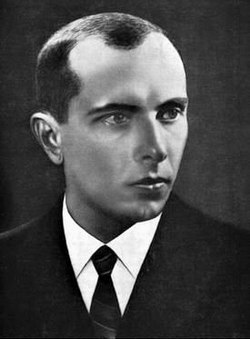
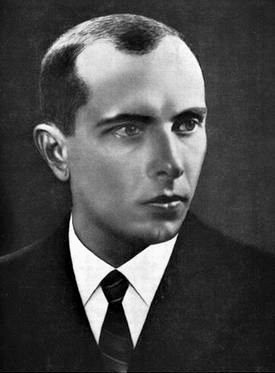
A Banderite or Banderovite (Ukrainian: бандерівець, romanized: banderivets; Polish: Banderowiec; Russian: бандеровец, romanized: banderovets; Slovak: Banderovec) is a name for the members of the OUN-B, a faction of the Organization of Ukrainian Nationalists.[1] The term, used from late 1940 onward,[2] derives from the name of Stepan Bandera (1909–1959), the ultranationalist[3][4] leader of this faction of the OUN.[5][6][7] Because of the brutality utilized by OUN-B members, the colloquial term Banderites quickly earned a negative connotation, particularly among Poles and Jews.[2] By 1942, the expression was well-known and frequently used in western Ukraine to describe the Ukrainian Insurgent Army partisans, OUN-B members or any other Ukrainian perpetrators.[2] The OUN-B had been engaged in various atrocities, including murder of civilians, most of whom were ethnic Poles, Jews, and Romani people.[8][9]
In propaganda the term has been used by Soviets after 1942 as a pejorative term for Ukrainians, especially western Ukrainians[10][11] or Ukrainian speakers.[12] As Bandera had been officially declared a national hero, after Euromaidan, the term was used in Vladimir Putin-ruled Russia as a pejorative for Euromaidan activists[13] and Ukrainians who support sovereignty from Russia.[10]
OUN-B
[edit]The Organization of Ukrainian Nationalists (OUN) was a Ukrainian nationalist organisation founded in 1929 in Vienna. Bandera joined it that year, and quickly climbed through the ranks, becoming the second in command of OUN in Galicia in 1932–1933,[14]: 18 and the head of the OUN national executive in Galicia in June 1933.[2]: 99
The OUN carried out the June 1934 assassination of Bronisław Pieracki, Poland's Minister of the Interior. The then 25-year-old Bandera provided the assassin with the murder weapon, a 7.65 mm calibre pistol.[15] His subsequent arrest and conviction turned Bandera into an instant legend among the militant Ukrainian nationalists of the Second Polish Republic.[16] During his five years in prison, Bandera was "to some extent detached from OUN discourses" but not completely isolated from the global political debates of the late 1930s thanks to Ukrainian and other newspaper subscriptions delivered to his cell.[17]: 112
Bandera escaped from prison after the German invasion of Poland in September 1939 and moved to Kraków, the capital of Germany's General Government in the German-occupied zone of Poland, where he established close connections with the German military.[1][17] Since August 1939, the OUN had been led by Andriy Melnyk, a founding member. He had been chosen for his more moderate and pragmatic stance with his supporters favouring Vyacheslav Lypynsky's conservatism and admiring Mussolini's fascism but publicly distancing themselves from Dmytro Dontsov's contemporary writings, which were by the late 1930s significantly influenced by Nazism.[18] However, a younger and more radical faction of the OUN heavily influenced by Dontsov's works were dissatisfied, leading Bandera to make a challenge to Melnyk in February 1940 by setting up a 'Revolutionary Leadership' (OUN-R) in Kraków.[18][19][2] At a congress of the OUN-R leadership in Kraków on 10 February 1941, the radical contingent refused to accept Melnyk's leadership and named Bandera as providnyk (leader) of the OUN, finalizing the fracturing of the organization in the spring of that year into two groups: OUN-B (Banderites or Banderivtsi), who were more militant, younger and supported Bandera, and OUN-M (Melnykites), who were generally older and more ideological.[1][19][16]
After the start of the Axis invasion of the Soviet Union on 22 June 1941 (Operation Barbarossa), Yaroslav Stetsko, an OUN-B leader in occupied Lviv, declared an independent Ukrainian state on 30 June 1941, although the region was under the control of Nazi Germany,[20] pledging to work closely with Germany, which was presented as freeing Ukrainians from Russian oppression.[21] In response to Stetsko's declaration, the Nazi authorities suppressed the OUN leadership. In July 1941, Bandera himself was arrested and sent to Sachsenhausen concentration camp in Germany. He was imprisoned there until 1944.
The vast majority of anti-Jewish pogroms carried out by the Banderites occurred in Eastern Galicia and Volhynia, but also in Bukovina.[2]: 237 The most deadly of them was perpetrated in the city of Lviv by the people's militia formed by OUN at the moment of the German arrival in the Soviet-occupied eastern Poland.[22] There were two Lviv pogroms, carried out in a one-month span, both lasting for several days; the first one from 30 June to 2 July 1941, and the second one from 25 to 29 July 1941.[23] The first pogrom took the lives of at least 4,000 Jews.[24]
In October 1942, during Bandera's imprisonment, the OUN-B established the Ukrainian Insurgent Army (UPA).[25][6][1] The OUN-B formed Ukrainian militias that carried out pogroms and massacres, both independently and with support from the Germans.[2][1] The OUN-B spread antisemitic and racist propaganda among the ordinary peasants and other Ukrainians.[2]: 236
In late 1944, Bandera was released by the German authorities and allowed to return to Ukraine in the hope that his partisans would unite with OUN-M and harass the Soviet troops, which by that time had handed the Germans major defeats. Germany sought to cooperate with the OUN and other Ukrainian leaders. According to Richard Breitman and Norman Goda in Hitler's Shadow, Bandera and Stetsko refused to do this, and in December 1944 they fled Berlin, heading south.[10][a]
In February 1945, at a conference of the OUN-B in Vienna, Bandera was made the representative of the leadership of the Foreign Units of the OUN (Zakordonni Chastyny OUN or ZCh OUN). At a February meeting of the OUN in Ukraine, Bandera was re-elected as leader of the whole OUN-B. It was decided by the leadership that Bandera would not come back to Ukraine, but remain abroad and make propaganda for the cause of the OUN-B. Roman Shukhevych resigned as the leader of the OUN-B, and became the leader of OUN-B in Ukraine.[26]: 288
In the aftermath of the war, the OUN-B joined the Central Representation of the Ukrainian Emigration in Germany (TsPUEN), a pluralistic grouping of Ukrainian nationalist movements that included the OUN-M, the Hetmanate movement, and the UNDO, though the OUN-B was the largest of these with 5,000 members in west Germany.[27] The TsPUEN sought to gain recognition from the Western Allies of a Ukrainian nationality, though the OUN-B subsequently engaged in an uncompromising exclusivist effort whereby it gained power in the self-administration of most of the Ukrainian displaced persons (DP) camps, especially those in the British occupation zone.[27][b] According to historian Jan-Hinnerk Antons, this was due to the demographics of the OUN-B's mainly working class and peasant base and the concentration of intellectuals in Ukrainian DP camps in the American occupation zone.[27] Until the practice was halted in 1946, OUN-B networks assisted Ukrainian displaced persons in evading forced repatriation to the Soviet Union.[27] As well as holding official positions, the Banderites ruled the DP communities they held influence in with a strategy of clandestine intimidation, violence, and coercive taxation, which the head of an anti-Banderite DP organisation characterised in an appeal to British military officials as a 'terror regime', and regularly honoured its prewar martyrs.[27]

According to political scientist and historian Georgiy Kasianov, during perestroika in the late 1980s nationalist émigré groups exported a cultural memory to Soviet Ukraine of the OUN as 'freedom fighters against two totalitarian regimes' whereby activists advocated for the rehabilitation and enobling of Bandera, the OUN-B, and the UPA, leading to the proliferation of memory politics in independent Ukraine.[28] Myroslav Yurkevich, of the Canadian Institute of Ukrainian Studies, wrote in the third volume of the Encyclopedia of Ukraine published in 1993: "The power and influence of the OUN factions have been declining steadily, because of assimilatory pressures, ideological incompatibility with the Western liberal-democratic ethos, and the increasing tendency of political groups in Ukraine to move away from integral nationalism."[29] After Ukraine's independence in 1991, the OUN-B created 'façade structures' such as the Congress of Ukrainian Nationalists party (KUN), the Youth Nationalist Congress (YNC), and the Center for Research of the Liberation Movement (TsDVR).[28][30]
Set up in 2002, the TsDVR became one of the most prominent proponents of 'memory activism' with director of the TsDVR (2002-2010) Volodymyr Viatrovych becoming the head of the archival department of the Security Service of Ukraine (SBU) in 2008, before being dimissed in 2010.[28] In 2014, Viatrovych was appointed director of the Ukrainian Institute of National Memory (UINP) by the first Yatsenyuk government.[28] When asked by historian Alexander J. Motyl whether he identified as a Banderite, Viatrovych noted the Soviet propaganda use of the term and stressed that he did not identify with interwar Ukrainian nationalism.[31] Amid growing controversy around his work and protestations from Western and Ukrainian historians,[c] Viatrovych was dismissed in 2019 by the Cabinet of Ministers shortly after the inauguration of Volodymyr Zelensky as president.[32] His replacement, Anton Drobovych, asserted the need to restore balance to the UINP's memory policy and prevent it from "being perceived as a mouthpiece for agitation, ideological struggle, or propaganda".[33] Kasianov argues that this episode and others, seized upon by Russian propaganda, contributed to the pretexts that Vladimir Putin used to justify his full-scale invasion of Ukraine in February 2022 in spite of the lack of popularity of these forces.[30][28] In November 2018, the KUN, together with Right Sector, C14, and the OUN-M under Bohdan Chervak, endorsed Svoboda deputy leader Ruslan Koshulynskyi in the 2019 Ukrainian presidential election.[34][35] Koshulynskyi later received 1.6% of the votes.[28]
As an insult
[edit]In Soviet secret records, the word "Banderites" for the first time emerged in late 1940 and began to be used in Soviet propaganda starting in late 1942.[2][10] The term became a crucial element of the Soviet propaganda discourse and was used as a pejorative description of Ukrainians, sometimes all western Ukrainians in the most negative way.[10][11] Historian Andrii Portnov noted that "The common noun 'Banderivtsi' ('Banderites') emerged around the time of ethnic cleansing of the Polish population in Volhynia, and it was used to designate all Ukrainian nationalists, but also, on occasion, western Ukrainians or even any person who spoke Ukrainian."[12]
The term has been used by Russian state media against Euromaidan activists to associate a separate Ukrainian national identity with the most radical nationalists.[13][36][12] Today, in Russian propaganda, the word is used to refer to all in Ukraine who back the idea of sovereignty from Russia; Ukrainian nationalist collaboration with Nazi Germany is also emphasized.[10]
Yid-Banderite
[edit]Yaroslav Hrytsak argues that the term 'Yid-Banderite' (zhydobanderivtsi) has principally been used as a slur, tracing its heritage as far back as 1907–1909 to the usage of zhydomazepynets (Yid-Mazepists).[37] References to Yid-Banderites became part of the Fofudja internet meme where the term was used ironically to mock Ukrainophobia and Great Russian chauvinism.[38] In the aftermath of the Revolution of Dignity, the term saw usage, for the most part, as a way for Ukrainian Jews to identify themselves with Ukrainian nationalists, express support for Ukrainian sovereignty, and mock people who accused the new government of antisemitism.[39] Since 2014, Yid-Banderite has seen use as a slur, ironically, and sometimes as a marker of proud self-identification.[40]
In July 2023, a digitally-altered image went viral of Jewish Ukrainian oligarch Ihor Kolomoyskyi wearing a T-shirt in the UPA's red and black colours with the phrase "Yid-Banderite" below a Ukrainian tryzub altered to have 4 additional prongs (making it resemble a Jewish menorah).[41][39]
See also
[edit]Notes
[edit]- ^ From page 76: Berlin hoped to form a Ukrainian National Committee with both OUN factions and other Ukrainian leaders. The Committee was formed in November, but Bandera and Stetsko refused to cooperate. They escaped from Berlin in December and fled south, emerging after the war in Munich.[10]
- ^ The Western Allies didn't officially recognise a Ukrainian nationality for fear of agitating the USSR, designating Ukrainians in the camps as 'stateless', 'undetermined', or 'others'. Historian Jan-Hinnerk Antons asserts that they created purely Ukrainian DP camps due to the number of conflicts arising between Ukrainians and Poles and the fear that remaining mixed would hurt general repatriation efforts.
- ^ Motyl asserts that Viatrovych occupied a middle ground between nationalist and Soviet-era revisionists.[31]
References
[edit]- ^ a b c d e Motyl, Alexander J (2000). Encyclopedia of Nationalism. Two-Volume Set. Elsevier, Academic Press. p. 40. ISBN 0080545246. With over one hundred contributors.
On February 10, 1941, Bandera called a conference of radicals in Kraków, Poland. The conference refused to accept Melnyk as leader, and named Bandera head of the OUN. This led to the split of the OUN in the spring of 1941 into two groups: OUN-B (Banderites), who were more militant, younger and supported Bandera, and OUN-M (Melnykites), who were generally older, more ideological.
- ^ a b c d e f g h i Rossolinski, Grzegorz (2014). Stepan Bandera: The Life and Afterlife of a Ukrainian Nationalist: Fascism, Genocide, and Cult. Columbia University Press. pp. 112, 234–235, 236. ISBN 978-3838266848.
The OUN-B organized a militia, which both collaborated with the Germans and killed Jews independently....Because the term "Banderites" was colloquial rather than official, and because of the violence employed by OUN-B, the term soon acquired a negative connotation, especially among Jews and Poles. (page 159)...The survivors of these attacks frequently described the perpetrators as "Banderites" and considered them to be Ukrainian nationalists.(page 241)... Two years later however, the word "Banderites" was known to everyone in western Ukraine and was frequently used to describe the OUN-B activists, UPA partisans, and apparently, other Ukrainian perpetrators (page 248)... The term "Banderites" had appeared in Soviet secret documents for the first time in late 1940... (page 249)
- ^ "Ukraine's revolution and the far right". BBC. 7 March 2014.
Bandera was, according to a number of Western and Ukrainian historians, a fascist or an "integral nationalist", which is something very close. The two organisations he led - the Organisation of Ukrainian Nationalists and the Ukrainian Insurgent Army (UPA) - are said to have engaged in atrocities against Poles, Jews, Russians, and other Ukrainians.
- ^ "Far-right Ukrainians mark anniversary of nationalist hero Stepan Bandera". euronews. 1 January 2015. Retrieved 9 February 2024.
- ^ Rudling, Per A. (November 2011). "The OUN, the UPA, and the Holocaust: A Study in the Manufacturing of Historical Myths". The Carl Beck Papers in Russian and East European Studies (2107). University of Pittsburgh. p. 3 (6 of 76 in PDF). ISSN 0889-275X.
- ^ a b Cooke, Philip; Shepherd, Ben (2014). Hitler's Europe Ablaze: Occupation, Resistance, and Rebellion during World War II. Skyhorse Publishing. p. 336. ISBN 978-1632201591.
- ^ Rossoliński-Liebe, Grzegorz (2010). "Celebrating Fascism and War Criminality in Edmonton. The Political Myth and Cult of Stepan Bandera in Multicultural Canada" (PDF). Kakanien Revisited (12): 1–16.
The OUN-B activists and the UPA partisans who committed these atrocities were known as banderites: Bandera's people. This term was not invented by Soviet propaganda but dates back to the split of the OUN in late 1940 and early 1941, distinguishing members of the OUN-B from members of the OUN-M faction
- ^ Lower, Wendy; Faulkner Rossi, Lauren (2017). Lessons and Legacies XII: New Directions in Holocaust Research and Education. Northwestern University Press. pp. 170–171, 174. ISBN 978-0810134508.
The victims of the Holocaust had a difficult time identifying precisely who intended to murder them; the usual terminology was "Banderites," which indicated adherents of a particular political tendency, or "Bulbas," which indicated the insurgent force initiated by Taras Bulba-Borovets.[p. 174]
- ^ Risch, William Jay (2011). The Ukrainian West: Culture and the Fate of Empire in Soviet Lviv. Harvard University Press. pp. 55, 65, 69. ISBN 978-0674061262.
- ^ a b c d e f g Wylegała, Anna; Głowacka-Grajper, Małgorzata (11 February 2020). The Burden of the Past: History, Memory, and Identity in Contemporary Ukraine. Indiana University Press. p. 96. ISBN 978-0-253-04673-4.
- ^ a b Fedor, Julie (5 January 2016). Journal of Soviet and Post-Soviet Politics and Society: 2015/2: Double Special Issue: Back from Afghanistan: The Experiences of Soviet Afghan War Veterans and: Martyrdom & Memory in Post-Socialist Space. Columbia University Press. p. 449. ISBN 978-3-8382-6806-4.
- ^ a b c Portnov, Andrii (22 June 2016). "Bandera mythologies and their traps for Ukraine". openDemocracy. Retrieved 23 August 2022.
The common noun "Banderivtsi" ("Banderites") emerged around this time, and it was used to designate all Ukrainian nationalists, but also, on occasion, western Ukrainians or even any person who spoke Ukrainian. Even today, the term "Banderivtsi" in public debate is never neutral — it can be used pejoratively or proudly.
- ^ a b Yekelchyk, Serhy (12 November 2020). Ukraine: What Everyone Needs to Know. pp. 48–49. doi:10.1093/wentk/9780197532102.001.0001. ISBN 978-0-19-753210-2.
Much in the same way as the tsarist government in its day branded all patriotic Ukrainians as "Mazepists" after Hetman Ivan Mazepa, the Russian state-controlled media have labeled EuroMaidan activists as "Banderites" after the twentieth-century nationalist leader Stepan Bandera (1909–1959). This stigmatization is unjust because radical nationalists constituted only a small minority among EuroMaidan revolutionaries, and their political parties performed poorly in the parliamentary elections that followed the revolution. Yet, it was a clever propaganda trick to associate a separate Ukrainian national identity exclusively with the most radical branch of Ukrainian nationalism. To most Russians and many Russian-speakers in eastern Ukraine, the term "Banderite" still carries negative historical connotations, established in Stalin's time. After World War II ended, the Soviet press denounced the Bandera-led insurgents, who resisted the Sovietization of eastern Galicia.
- ^ William Holzmann; Zolt Aradi [in Hungarian] (1946). The Ukrainian Nationalist Movement: an interim study (PDF) (Report).
- ^ Żeleński, Władysław (1973). The Assassination of Minister Pieracki [Zabòjstwo ministra Pierackiego]. Poland: Institut Literacki. pp. 20–22, 72. Biblioteka "Kultury" volume 233.
- ^ a b Rossoliński-Liebe, Grzegorz (2011). "The "Ukrainian National Revolution" of 1941: Discourse and Practice of a Fascist Movement". Kritika: Explorations in Russian and Eurasian History. 12 (1): 83–114. doi:10.1353/kri.2011.a411661. Retrieved 7 June 2025.
- ^ a b Rossolinski, Grzegorz (1 October 2014). Stepan Bandera: The Life and Afterlife of a Ukrainian Nationalist: Fascism, Genocide, and Cult. Columbia University Press. ISBN 978-3-8382-6684-8.
- ^ a b Erlacher, Trevor (2021). Ukrainian Nationalism in the Age of Extremes: An Intellectual Biography of Dmytro Dontsov. Cambridge, MA: Harvard University Press. doi:10.2307/j.ctv2d8qwsn. ISBN 978-067-425-093-2. JSTOR j.ctv2d8qwsn.
- ^ a b Armstrong, John (1963). Ukrainian Nationalism (2nd ed.). New York: Columbia University Press.
- ^ Rudling, Per Anders (2013). "The Return of the Ukrainian Far Right: The Case of VO Svoboda" (PDF). In Wodak; Richardson (eds.). Analysing Fascist Discourse: European Fascism in Talk and Text. New York: Routledge. pp. 229–235.
- ^ "Державний архів Львівської області". Archived from the original on 5 January 2017. Retrieved 19 December 2016.
- ^ John-Paul Himka (25 February 2013). "A few more words about the Lviv pogrom" [Ще кілька слів про львівський погром]. IstPravda.com.ua. Історична правда. With links to relevant articles. For the English original, see: John-Paul Himka (2011). "The Lviv Pogrom of 1941: The Germans, Ukrainian Nationalists, and the Carnival Crowd". Canadian Slavonic Papers. 53 (2–4): 209–243. doi:10.1080/00085006.2011.11092673. ISSN 0008-5006. S2CID 159577084.. Archived from the original on 4 March 2016.
- ^ Himka, John-Paul (2011). "The Lviv Pogrom of 1941: The Germans, Ukrainian Nationalists, and the Carnival Crowd". Canadian Slavonic Papers. 53 (2–4): 209–243. doi:10.1080/00085006.2011.11092673. ISSN 0008-5006.
- ^ "Lwów". The Holocaust Encyclopedia. United States Holocaust Memorial Museum. Archived from the original on 7 March 2012 – via Internet Archive.
- ^ Timothy Snyder. (2004) The Reconstruction of Nations. New Haven: Yale University Press: pg. 168
- ^ Rossolinski, Grzegorz (2014). The Life and Afterlife of a Ukrainian Nationalist: Fascism, Genocide, and Cult. Columbia University Press. ISBN 9783838206844.
- ^ a b c d e Antons, Jan-Hinnerk (2020). "The Nation in a Nutshell? Ukrainian Displaced Persons Camps in Postwar Germany". Harvard Ukrainian Studies. 37 (1–2): 177–211.
- ^ a b c d e f Kasianov, Georgiy (2023). "Nationalist Memory Narratives and the Politics of History in Ukraine since the 1990s" (PDF). Nationalities Papers. 52 (6). Cambridge University Press.
- ^ Myroslav, Yurkevich (1993). "Organization of Ukrainian Nationalists". Internet Encyclopaedia of Ukraine. Canadian Institute of Ukrainian Studies; Universities of Alberta and Toronto.
- ^ a b Kasianov, Georgiy (22 June 2022). ""Ukrainian Nazis" as an invented enemy". Russia Post.
- ^ a b Motyl, Alexander J. (4 August 2016). "National Memory in Ukraine: What the West Gets Wrong About Liberals and Nationalists". Foreign Affairs.
- ^ Cohen, Josh (2 May 2016). "The Historian Whitewashing Ukraine's Past". Foreign Policy.
- ^ Sokol, Sam (23 June 2020). "Ukraine's new memory czar tones down glorification of war criminals". Times of Israel.
- ^ "The nationalists have been identified with a presidential candidate". Ukrainska Pravda (in Ukrainian). 19 November 2018. Archived from the original on 19 November 2018.
- ^ "Nationalists jointly declare support for Ruslan Koshulynsky in the Presidential elections". Svoboda (in Ukrainian). 19 November 2018.
- ^ Esch, Christian (2015). "'Banderites' vs. 'New Russia'" (PDF). Reuters Institute for the Study of Journalism. Retrieved 22 August 2022.
In Soviet Ukraine, the nationalist project was repressed or vilified in its entirety. Hundreds of thousands of civilians from Western Ukraine were deported to forced labour camps. "Banderovets" became a label that could be attached to any real or purported enemy of Soviet power in western Ukraine. It sounded as bad as "fascist". There was no effort to recognise the UPA as an independent actor with its own agenda, and to distinguish it from outright collaborationism, i.e. the Ukrainian "Waffen-SS Division 'Galizien'" which was under German command. There was also no effort to differentiate between different currents in and periods of OUN and UPA policy, and its more democratic rhetoric towards the end of the war. Even in the 1980s Ukrainian dissidents, no matter how democratic they were, could be labelled "Banderites" or "Fascists".
- ^ Hrytsak, Yaroslav (2 January 2018). "Zvidky vzialysia «zhydobanderivtsi»?" [Where did the "Zhydobanderites" come from?]. Ukraina Moderna.
- ^ Semenyuk, Hlib (2013). "«Protyvsikhy» i «fofudiia» yak pytomo ukrainski mediavirusy" ["Anti-Sikhs" and "Fofudia" as Specific Ukrainian Media Viruses]. Education of the Region (3).
- ^ a b Lavin, Talia; Liphshiz, Cnaan (25 April 2014). "A satirical neologism becomes a weapon in the fight over Ukrainian Jewry". Jewish Telegraphic Agency.
- ^ Fialkova, Larisa; Yelenevskaya, Maria N. (2016). "The Crisis in Ukraine and the Split of Identity in the Russian-speaking World". Journal of the Slavic East European and Eurasian Folklore Association. 19 (1): 115.
- ^ "Photo altered to depict Ukraine's Kolomoisky wearing 'Jewish-Banderite' t-shirt". Retrieved 9 January 2024.
Further reading
[edit]
- Valeriy Smoliy (1997), "Small dictionary of Ukrainian history" — Lybid.
- G Demyian — "Banderivtsi" — Ternopil dictionary encyclopedia – G Iavorskiy — "Zbruch", 2004-2010, 696p. ISBN 966-528-197-6.

Banderite
View on GrokipediaThe OUN-B, under Stepan Bandera's leadership after the 1940 split from the more moderate OUN-M, initially cooperated with Nazi invaders in 1941, forming Ukrainian auxiliary units involved in anti-Jewish pogroms such as those in Lviv (killing thousands) and Rivne (15,000–18,000 victims), while proclaiming a short-lived independent state rejected by Germany.[2][2]
Following Bandera's imprisonment by the Nazis and a strategic pivot, OUN-B elements established the Ukrainian Insurgent Army (UPA) in 1942, which orchestrated the Volhynia massacres—systematic ethnic cleansing of over 50,000 Poles in 1943—and waged guerrilla warfare against both German and Soviet forces until the early 1950s, resulting in tens of thousands of combat deaths on all sides.[3][4][2]
Ideologically rooted in integral nationalism with antisemitic and authoritarian tenets akin to European fascism—though emphasizing Ukrainian uniqueness—the Banderites' legacy endures as a symbol of anti-Soviet defiance in western Ukraine, yet draws condemnation for Holocaust complicity and civilian massacres, with the term now often invoked pejoratively by Russian state media to equate Ukrainian nationalism with Nazism.[5][6][4]
Definition and Historical Origins
Etymology and Core Meaning
The term "Banderite" (Ukrainian: banderivets, plural banderivtsi) originates from the surname of Stepan Bandera, denoting adherents of the radical faction of the Organization of Ukrainian Nationalists (OUN) that he led following the organization's internal schism.[7] The suffix -ivets in Ukrainian indicates a follower or partisan, paralleling English formations like "-ite" for ideological groups, and the designation arose to distinguish Bandera's supporters from those aligned with Andriy Melnyk's more conciliatory wing.[8] In its core historical sense, "Banderite" signified commitment to the OUN-B's uncompromising pursuit of Ukrainian statehood through revolutionary militancy, rejecting negotiations or alliances with dominant powers such as Poland or the Soviet Union that subordinated Ukrainian territories.[9] This usage first appeared within OUN circles in 1940 amid debates over strategy, marking loyalists to Bandera's emphasis on immediate, violent separatism over gradualist approaches.[10] Unlike broader Ukrainian nationalist identifiers, it specifically highlighted the OUN-B's prioritization of clandestine operations and total independence, positioning members as vanguard fighters against foreign domination.[11]Emergence in Interwar Ukraine
Following the collapse of the short-lived Ukrainian People's Republic and West Ukrainian People's Republic between 1917 and 1921, Western Ukrainian territories were partitioned and placed under Polish administration by the Treaty of Riga in 1921, resulting in the incorporation of Eastern Galicia and Volhynia into the Second Polish Republic.[12] Polish authorities implemented policies aimed at integrating these regions, including the settlement of Polish colonists on Ukrainian-held lands, which displaced local farmers and exacerbated economic grievances among the Ukrainian peasantry, who comprised about 70% of the population in these areas.[13] Cultural suppression manifested through restrictions on Ukrainian-language education, with over 3,000 Ukrainian schools closed or Polonized by the late 1920s, and the denial of proportional representation in local governance, fostering a sense of systemic discrimination.[14] These conditions of national subjugation and failed prior bids for sovereignty prompted the formation of the Organization of Ukrainian Nationalists (OUN) on February 3, 1929, in Vienna, under the leadership of Yevhen Konovalets, merging disparate émigré and domestic groups disillusioned with parliamentary approaches that had yielded no independence.[15] The OUN rejected the compromises of earlier democratic experiments, attributing the 1917–1921 defeats to insufficient militancy and internal divisions, and instead prioritized clandestine organization, propaganda, and sabotage to challenge Polish dominance directly.[13] Tensions escalated in 1930 when Ukrainian political parties and cultural organizations launched a boycott of Polish administrative offices and state institutions in Eastern Galicia, protesting discriminatory policies; in response, Polish authorities initiated a pacification campaign from September to November, deploying army units and police to conduct raids on over 450 Ukrainian villages and institutions, destroying cooperative buildings, libraries, and reading rooms while arresting thousands.[12] This operation, involving beatings and property destruction without formal charges, was perceived by Ukrainians as collective punishment, radicalizing broader segments of the population and driving youth toward the OUN's more confrontational methods as a causal reaction to state violence.[13] By the mid-1930s, a cohort of younger, more impatient OUN members, often from student and youth circles in Lviv, began advocating escalated terrorism to internationalize the Ukrainian cause, culminating in the June 15, 1934, assassination of Polish Interior Minister Bronisław Pieracki in Warsaw by OUN operative Hryhoriy Matseiuk, under coordination from figures like Stepan Bandera.[16] The killing, executed with a pistol at close range, targeted Pieracki due to his role in overseeing repressive measures, including the pacification, and aimed to force negotiations or expose Polish assimilation efforts; it prompted mass arrests of over 12,000 Ukrainians and the 1935–1936 Lviv trials, yet reinforced the radicals' resolve, marking the embryonic phase of what would be termed Banderites for their unyielding stance against imperial oversight.[17][13]Organizational Structure and Ideology
Formation of OUN-B and Split from Mainstream OUN
The schism within the Organization of Ukrainian Nationalists (OUN) crystallized in February 1940 at a conference in Kraków, Poland, where the faction advocating radical tactics rejected Andriy Melnyk's leadership and established the "Revolutionary Leadership" under Stepan Bandera, thereby forming the OUN-B (OUN-Bandera).[18][19] This break stemmed from irreconcilable strategic divergences, with OUN-B prioritizing immediate mass mobilization and violent revolutionary uprisings to seize independence amid perceived opportunities from impending European conflict, in opposition to OUN-M's (OUN-Melnyk) emphasis on disciplined, elite-driven collaboration with potential patrons like Nazi Germany for incremental gains.[1][20] The Kraków gathering refused to recognize Melnyk's authority, electing Bandera as OUN-B's head and solidifying the faction's commitment to autonomous action over hierarchical deference.[19] OUN-B's structure reflected its revolutionary orientation, featuring a decentralized network of cells designed for covert operations, internal security through punitive measures against suspected infiltrators, and broad cadre involvement to sustain underground activities against Polish and Soviet controls.[18] This contrasted with OUN-M's more centralized model, enabling OUN-B to adapt to repression by distributing authority among regional commanders and emphasizing self-reliance in sabotage and propaganda.[1] Post-split, OUN-B expanded empirically through aggressive recruitment of radicalized youth from western Ukrainian territories, drawing on grievances from Polish interwar policies and Soviet incursions, which swelled its ranks to dominate approximately 80% of OUN personnel by mid-1941.[21] Paramilitary preparation intensified in Carpathian hideouts, where members underwent training in guerrilla tactics, weapons handling, and explosives amid 1939 border skirmishes following the dismemberment of Carpatho-Ukraine, fostering a combat-ready base for anticipated broader conflict.[17] These efforts capitalized on rising tensions, positioning OUN-B as the more dynamic faction poised for opportunistic insurgency.[18]Core Principles: Nationalism, Anti-Imperialism, and Revolutionary Tactics
The OUN-B embraced integral nationalism, drawing heavily from Dmytro Dontsov's formulation of "active nationalism," which posited the nation as a mystical, organic collective demanding absolute loyalty, ethnic cohesion, and an authoritarian leadership to forge unyielding resolve against dilution by foreign elements or internal pluralism.[22] Dontsov's writings rejected liberal individualism and democratic compromise as enfeebling forces that eroded national vitality, instead glorifying a heroic ethos of perpetual struggle, amoral activism, and hierarchical order to achieve sovereignty in a Darwinian world of competing peoples.[23][24] This framework viewed multiculturalism and egalitarian ideologies as incompatible with the imperatives of ethnic self-preservation, prioritizing instead a monolithic state apparatus capable of mobilizing the populace for total national rebirth. Central to OUN-B anti-imperialism was opposition to the Polish and Soviet occupations that fragmented Ukrainian ethnic territories, but anti-communism held particular salience, crystallized by the Holodomor—the engineered famine of 1932–1933 that caused approximately 3.9 million excess deaths in Ukraine through grain requisitions, border closures, and punitive measures targeting rural resistance to collectivization.[25] Soviet policies, including the blacklist system that starved non-compliant villages and the criminalization of "kulak" households, evidenced intentional demographic engineering against Ukrainian national identity, reinforcing Banderite convictions that Bolshevism sought not mere class restructuring but imperial erasure of non-Russian peoples.[26] Revolutionary tactics underscored OUN-B's pragmatic adaptation to geopolitical encirclement, emphasizing clandestine sabotage to disrupt imperial infrastructure, assassinations of key oppressors to instill fear and symbolize defiance, and propaganda campaigns via pamphlets and underground networks to cultivate mass awakening and delegitimize occupiers.[17] These methods prioritized operational efficacy over doctrinal purity, permitting tactical alliances with any power—be it regional actors or great powers—opposed to Polish or Soviet dominance, as mere instruments for weakening adversaries rather than endorsements of foreign ideologies.[5] Such instrumentalism reflected a causal calculus: in a context of zero-sum territorial contests, temporary pacts maximized leverage for eventual unilateral Ukrainian statehood, unbound by ideological symmetry.Key Figures and Leadership
Stepan Bandera as Iconic Leader
Stepan Andriyovych Bandera was born on 1 January 1909 in the village of Staryi Uhryniv in eastern Galicia, then part of Austria-Hungary. As a young activist in the Organization of Ukrainian Nationalists (OUN), he organized assassinations targeting Polish officials, including the 1934 killing of Interior Minister Bronisław Pieracki, for which he was arrested and sentenced to death—a penalty commuted to life imprisonment.[27] Bandera served from 1934 until his release in September 1939 amid the German invasion of Poland, during which time his defiance against Polish internment elevated him as a symbol of Ukrainian resistance to foreign domination.[27] In 1940, Bandera assumed leadership of the more radical OUN-B faction following its split, emphasizing revolutionary tactics for immediate Ukrainian independence. On 30 June 1941, amid the German invasion of the Soviet Union, OUN-B members in Lviv proclaimed the restoration of Ukrainian statehood, with Bandera issuing a decree appointing Yaroslav Stetsko as prime minister of the provisional government.[28] This unilateral act, prioritizing national sovereignty over alignment with Nazi objectives, prompted the Germans to arrest Bandera in Berlin shortly thereafter; he was detained in Sachsenhausen concentration camp's special section for political prisoners until his release in September 1944 as the Red Army advanced.[27][29] After the war, Bandera directed OUN-B operations and the Ukrainian Insurgent Army (UPA) from exile in Munich, West Germany, coordinating anti-Soviet guerrilla activities through couriers and radio communications despite Soviet infiltration efforts.[29][30] His persistent leadership underscored a commitment to armed struggle for independence, rejecting compromise with communist authorities. On 15 October 1959, Bandera was assassinated outside his Munich home by KGB agent Bohdan Stashynskyi using a cyanide spray gun, an operation that highlighted the Soviet regime's determination to eliminate him as a focal point of Ukrainian irredentism.[31][32]Supporting Leaders and Internal Dynamics
Yaroslav Stetsko functioned as Stepan Bandera's chief political deputy within the OUN-B, co-authoring and proclaiming the Act of Restoration of the Ukrainian State on June 30, 1941, in Lviv, where he assumed the role of prime minister in the provisional Ukrainian National Government.[33][34] This act asserted sovereignty amid the German advance, reflecting Stetsko's emphasis on immediate unilateral independence over prolonged negotiation with occupying powers. Roman Shukhevych complemented this leadership as the OUN-B's primary military organizer, commanding the Nachtigall Battalion—a unit of Ukrainian volunteers integrated into German forces—and briefly serving as deputy minister of defense in the 1941 government, bridging political directives with armed mobilization.[35] By 1941, OUN-B active membership reached an estimated 20,000–30,000, bolstered by grassroots networks in western Ukrainian regions like Galicia and Volhynia, where local grievances against Polish and Soviet rule provided recruitment and logistical sustainment.[36] These numbers derived from pre-war expansion in the 1930s, when the organization absorbed youth and student affiliates disillusioned with interwar partitions.[33] Internal dynamics revealed factional strains between pragmatists advocating limited tactical alignment with Nazi Germany for anti-Soviet gains and ideological purists prioritizing absolute national autonomy, exacerbated by the German arrest of Bandera and Stetsko in July 1941 following their refusal to subordinate the independence declaration.[37] This rupture prompted debates over collaboration's scope, with OUN-B directives evolving to reject full integration into German structures while purging suspected internal compromisers through its security apparatus to enforce discipline and loyalty. Such measures, including executions of perceived traitors, underscored the organization's revolutionary ethos amid operational necessities.[38]World War II Engagements
Pre-Invasion Activism Against Polish Domination
In the early 1930s, the Organisation of Ukrainian Nationalists (OUN), including its more radical elements associated with Stepan Bandera, intensified sabotage and targeted killings against Polish administrative targets in response to repressive measures such as the 1930 pacification campaigns, which involved Polish military destruction of over 700 Ukrainian cultural and economic institutions in eastern Galicia.[39] These actions by OUN members included bombings of postal and rail facilities, as well as assassinations of local officials, aiming to disrupt Polish control and provoke broader unrest among the Ukrainian population, which numbered around 5 million in interwar Poland. A prominent example was the June 15, 1934, assassination of Polish Interior Minister Bronisław Pieracki in Warsaw by OUN operative Hryhoriy Matseyko, directed by a young Bandera as part of a campaign to eliminate key figures enforcing Polonization policies. [16] Polish authorities retaliated with mass arrests following the Pieracki killing, establishing the Bereza Kartuska detention facility on July 6, 1934, as a site for indefinite internment without trial of suspected nationalists; over its five-year operation, it held thousands of Ukrainian activists alongside other political detainees, subjecting them to harsh conditions that fueled further radicalization.[40] The OUN leadership, including Bandera who received a death sentence (later commuted) in the ensuing 1935-1936 Warsaw trial of 12 members, adapted by decentralizing into clandestine cells that amassed small arms caches, conducted intelligence gathering on Polish defenses, and disseminated propaganda to recruit from disenfranchised youth. Limited tactical cooperation occurred with other anti-Polish elements, such as Belarusian groups, sharing sabotage intelligence in border regions, though OUN priorities remained distinctly Ukrainian independence-oriented.[39] This cycle of Ukrainian militant responses to Polish administrative coercion persisted into 1938-1939, with sporadic attacks on officials and infrastructure amid escalating Polish martial law declarations in eastern provinces, but the rapid German invasion of Poland on September 1, 1939, and subsequent Soviet occupation on September 17 redirected OUN efforts toward exploiting the power vacuum against both occupiers rather than sustaining isolated anti-Polish operations. By then, the pre-war activism had fortified OUN-B networks for wartime contingencies, embedding a pattern of retaliatory violence rooted in territorial disputes over Galicia and Volhynia.[39]Initial Cooperation and Subsequent Rupture with Nazi Germany
As Operation Barbarossa commenced on June 22, 1941, the Organization of Ukrainian Nationalists (Banderite faction, or OUN-B) had prepositioned small units, including the Nachtigall Battalion comprising approximately 600-700 members trained in German facilities, to support the German advance into western Ukraine alongside Wehrmacht forces.[41] These OUN-B auxiliaries assisted in securing key areas, such as Lviv, which fell to German troops by June 30, and participated in initial anti-Soviet actions, including the liquidation of NKVD prisoners and the formation of local militias for order maintenance, under the expectation that Nazi Germany would endorse a Ukrainian puppet state in exchange for tactical collaboration. This alignment was instrumental, driven by OUN-B's overriding goal of national independence rather than ideological affinity with Nazism, as evidenced by their prior cultivation of contacts with Axis powers while rejecting fascist subordination.[33] In Lviv, OUN-B militants, integrated into emerging Ukrainian militias, contributed to anti-Jewish pogroms erupting immediately after the German entry, with mobs—fueled by longstanding interethnic tensions and German-incited retribution for Soviet atrocities—killing an estimated 4,000 Jews between June 30 and July 2 through beatings, shootings, and forced humiliations.[42] On June 30, OUN-B leader Yaroslav Stetsko proclaimed the Act of Restoration of the Ukrainian State in Lviv, naming Stepan Bandera as head and anticipating German recognition of Ukrainian sovereignty.[41] However, Nazi authorities, prioritizing direct control over occupied territories without satellite entities, viewed this declaration as a challenge to their authority. The rupture materialized swiftly: Bandera was arrested by the Gestapo in Cracow on July 5, 1941, and Stetsko on July 9, both detained for refusing to retract the independence act, leading to their internment in Sachsenhausen concentration camp until late 1944.[43] Mass arrests of OUN-B activists followed, dissolving their provisional government structures and forcing the faction underground, which underscored the tactical, non-subservient nature of the initial cooperation—unlike the OUN-Melnyk (OUN-M) faction's more enduring collaboration through sanctioned committees and sustained auxiliary service. By autumn 1942, OUN-B elements had begun organizing armed detachments for sabotage against German forces and supply lines in Volhynia and Polisia, marking a pivot to anti-occupier resistance predicated on the primacy of Ukrainian self-determination over any provisional alliance.[33] This shift, absent in OUN-M's approach, refuted claims of deep ideological alignment, as Nazi suppression treated OUN-B as rivals to imperial consolidation rather than partners.[6]Establishment and Operations of the Ukrainian Insurgent Army (UPA)
The Ukrainian Insurgent Army (UPA) was formally established on 14 October 1942 by the Revolutionary Leadership of the Ukrainian Nationalists (OUN-B) as a partisan force to combat German occupation in western Ukraine, particularly in Volhynia and Polissia. Roman Shukhevych, using the nom de guerre Taras Chuprynka, was appointed supreme commander, unifying existing self-defense units and OUN militias into a structured military organization focused on guerrilla warfare rather than conventional battles. Initial operations targeted German administrative centers and police formations to disrupt control and expand influence in rural areas, marking a shift from earlier OUN tactical alliances to outright resistance against Nazi exploitative policies.[44][45] UPA tactics emphasized mobility and surprise, conducting ambushes on German supply convoys and garrisons to interdict logistics and seize weapons, with notable actions escalating in 1943 as German reprisals intensified. By mid-1943, these operations had secured de facto control over significant forested territories, enabling the establishment of supply caches, field hospitals, and training bases sustained through local foraging, captured materiel, and minimal external aid. As Soviet forces advanced in 1944, the UPA redirected efforts to similar hit-and-run engagements against Red Army columns, leveraging dense woodlands for evasion and prolonged survival without fixed supply lines. Estimates of peak active strength in 1944 range from 25,000 to 40,000 fighters, drawn primarily from Ukrainian villagers and demobilized personnel, though exact figures remain contested due to decentralized recruitment and high attrition from combat and desertion.[46][47] In contrast to Ukrainian volunteers in Waffen-SS divisions, who operated under direct Nazi command and integrated into Wehrmacht structures for frontline service, the UPA maintained operational independence, explicitly refusing subordination to German authorities after the 1941 OUN-Nazi rupture and prioritizing defense of Ukrainian-populated regions over broader Axis objectives. This autonomy allowed flexible adaptation to dual threats from Germans and Soviets but limited access to heavy weaponry, relying instead on light arms, sabotage, and intelligence networks for asymmetric warfare.[48]Ethnic Violence and Mutual Atrocities
Volhynia Massacres and Polish-Ukrainian Clashes
The Volhynia Massacres, occurring mainly from February to December 1943 with a peak in July and August, involved coordinated assaults by the Ukrainian Insurgent Army (UPA) on Polish settlements in Volhynia, a region then under Nazi occupation. These actions were driven by UPA's objective to eliminate Polish presence and secure ethnically Ukrainian control amid the wartime power vacuum and competing national claims to the territory. UPA commanders, seeking to preempt Polish self-defense units and establish a homogeneous base for anti-occupier operations, targeted civilian populations through village burnings, mass shootings, and melee killings, often with axes and scythes; victims included disproportionate numbers of women, children, and elderly.[49] A key catalyst was directives from UPA's Volhynia leadership, including an early 1943 order by regional chief Dmytro Klyachkivsky instructing units to "liquidate all Poles" who did not flee, framing Poles as inherent threats to Ukrainian statehood. This policy escalated into systematic clearance operations, razing over 200 Polish villages and hamlets; Polish government estimates, based on archival records and exhumations compiled by the Institute of National Remembrance (IPN), place the death toll at 50,000 to 100,000 Polish civilians in Volhynia alone, with additional thousands in adjacent Eastern Galicia through 1944. These figures derive from survivor testimonies, mass grave analyses, and period reports, though Ukrainian estimates are lower, attributing variance to incomplete documentation amid chaos.[49][50] Preceding interwar frictions contributed to the animus, notably the Polish government's 1930 pacification campaign in Eastern Galicia, a response to Ukrainian nationalist sabotage of railways and postal services. This involved military raids on over 450 Ukrainian villages, demolishing cooperative buildings, cultural sites, and homes without formal charges, which inflamed resentments despite limited direct fatalities—official Polish records report around 10 Ukrainian deaths from clashes or suicides, though beatings and property losses affected thousands and symbolized Polonization policies. Ukrainian narratives emphasize these as foundational grievances, portraying the 1943 violence as retaliatory escalation rather than unprovoked aggression.[51] Polish responses intensified from mid-1943, with the Home Army (AK) launching counter-raids on UPA bases and Ukrainian villages suspected of harboring insurgents, resulting in 2,000 to 20,000 Ukrainian deaths across Volhynia and Galicia per varying historical accounts; lower figures (2,000–3,000 in Volhynia) stem from AK operational logs, while broader estimates include collateral civilian losses. These mutual raids formed a cycle of ethnic violence, but the asymmetry—UPA initiating large-scale civilian targeting—distinguishes the core events as deliberate population transfer via terror, akin to ethnic cleansing for territorial homogenization rather than genocide under the UN Convention's requirement for intent to destroy a group in whole or substantial part. Empirical evidence, including UPA documents prioritizing flight over total extermination and survival of Polish communities via evacuation, supports this classification, though Polish historiography and legislation frame it as genocidal due to the intent's scale and brutality.[52]Involvement in Anti-Jewish Actions and Contextual Factors
In the immediate aftermath of the German invasion of the Soviet Union on June 22, 1941, members of the Organization of Ukrainian Nationalists-Banderist faction (OUN-B) participated in inciting and organizing anti-Jewish violence in Lviv, where they had proclaimed Ukrainian independence on June 30. This contributed to the Lviv pogroms of late June and early July 1941, during which mobs, including local Ukrainians influenced by OUN-B agitation, killed an estimated 2,000 to 6,000 Jews through beatings, shootings, and other acts of mob violence, often targeting those accused of collaboration with Soviet authorities.[53][54] OUN-B propaganda prior to and during this period incorporated antisemitic tropes, portraying Jews as Bolshevik agents and economic exploiters, which fueled popular resentment amid the chaos of retreating Soviet forces and advancing Germans.[1] Some OUN-B members and sympathizers enlisted in Ukrainian auxiliary police units, known as Schutzmannschaft (Schuma) battalions, formed by the Germans starting in July 1941 to assist in maintaining order and combating partisans. These units, including Battalion 201 recruited from western Ukraine, supported Einsatzgruppen mobile killing squads in rounding up and guarding Jews for execution sites, contributing to the deaths of Jews during the early phases of the Holocaust in Ukraine, where approximately 1.5 million Ukrainian Jews perished overall under Nazi occupation. However, OUN-B involvement in such auxiliaries waned after the Germans arrested Bandera and other leaders in July 1941 for declaring independence without approval, leading to a rupture and shift toward anti-German resistance.[54] Contextual factors reveal that while antisemitism was present in OUN-B ideology—radicalized in the late 1930s through influences like Dmytro Dontsov's writings—its primary targets remained Soviet communists and Polish interwar oppressors, with Jews often stereotyped as aligned with those enemies rather than as an existential threat warranting systematic extermination.[53] Opportunistic violence against Jews erupted in the power vacuum of 1941, driven by local grievances and German encouragement of pogroms to deflect blame for Soviet atrocities, but lacked the ideological commitment to total genocide seen in Nazi policy.[42] Later, the Ukrainian Insurgent Army (UPA), formed by OUN-B in 1942, documented hundreds of cases where its members sheltered Jews, often by integrating them as medics or laborers under false identities, though such aid was individual and risky, sometimes punished internally if discovered by hardliners.[54] The scale of direct Banderite killings of Jews remained limited to thousands during localized pogroms and auxiliary actions, starkly overshadowed by the Nazi-orchestrated machinery that murdered over a million Jews in Ukraine through mass shootings and death camps, as exemplified by the Babi Yar massacre near Kyiv on September 29–30, 1941, where 33,777 Jews were executed in two days by Einsatzgruppe C with local assistance.[54] This disparity underscores that OUN-B anti-Jewish actions were episodic and auxiliary to German efforts, motivated more by wartime score-settling than a standalone genocidal program.[55]Comparisons to Broader War Crimes by Occupiers
The Soviet regime's actions in Ukraine dwarfed the scale of Banderite violence, with the Holodomor famine of 1932–1933 causing an estimated 3.9 million excess deaths among Ukrainians through deliberate policies of grain requisition and blockade.[56] In Western Ukraine after the 1939 annexation, NKVD operations from 1939 to 1941 resulted in approximately 10,000 to 40,000 executions of political prisoners, alongside mass deportations exceeding 100,000 individuals, as part of broader purges targeting perceived nationalists and elites.[57] These were ideologically driven campaigns aimed at class and national extermination, contrasting with Banderite actions framed as wartime ethnic consolidation amid mutual hostilities. Nazi occupation policies in Ukraine inflicted far greater civilian losses, including the murder of 1.4 to 1.6 million Jews through systematic shootings and gassings as part of the Holocaust.[58] Overall, Nazi forces caused over 5 million civilian and prisoner-of-war deaths in Ukraine, encompassing forced labor, reprisals, and scorched-earth tactics during 1941–1944, executed via centralized racial extermination machinery rather than localized insurgent conflict.[59] Polish authorities' pre-war measures against Ukrainian separatism involved sporadic pacification raids and restrictions but lacked mass internment on Soviet scales; post-war population exchanges forcibly resettled about 480,000 Ukrainians from Poland to Soviet Ukraine between 1944 and 1946, alongside Operation Vistula's 1947 dispersal of roughly 140,000, primarily as security responses to insurgent threats rather than premeditated genocide.[60] In causal terms, Banderite-linked violence by the OUN-B and UPA, estimated at 60,000–100,000 victims primarily Polish civilians during 1943–1944 ethnic clashes, represented retaliatory realignment in a multi-occupier war zone—triggered by prior Polish dominance and Soviet/Nazi incursions—unlike the totalizing ideological genocides of Soviet famines or Nazi death camps, which pursued annihilation irrespective of immediate military context.[52]Post-War Anti-Soviet Struggle
UPA Guerrilla Campaigns into the 1950s
Following the Red Army's reconquest of western Ukraine in 1944, the Ukrainian Insurgent Army (UPA) transitioned to prolonged guerrilla operations, targeting Soviet military personnel, administrative officials, and infrastructure to undermine occupation authority. Tactics emphasized hit-and-run ambushes, selective assassinations of collaborators and enforcers, and sabotage against supply lines and early collectivization efforts, which aimed to dismantle private farming and integrate the region into the Soviet economy. These actions inflicted attrition on Soviet forces, with declassified Soviet records indicating approximately 30,000 troops and security personnel killed between 1944 and 1950, alongside disruptions that hindered rapid pacification.[61][19] At its zenith in 1946, the UPA commanded an estimated force of 25,000–40,000 active fighters, bolstered by a broader support network exceeding 100,000 civilians providing intelligence, logistics, and shelter, enabling sustained operations across forested and mountainous terrain in Volhynia, Galicia, and Carpathian regions. Soviet countermeasures intensified from 1946 onward, including mass deportations of suspected sympathizers—totaling over 200,000 Ukrainians by 1952, per security service archives—and orchestrated amnesties that lured thousands to surrender while facilitating infiltrations by NKVD agents to sow distrust and dismantle command structures.[46][62] By 1947–1948, these pressures eroded UPA cohesion, allowing Soviets to initiate widespread collectivization in western Ukraine, though residual pockets persisted into the early 1950s, with isolated units conducting sporadic raids until the last documented commander, Vasyl Kuk, emerged from hiding in 1954. The insurgency's endurance demonstrably postponed full Soviet administrative control, compelling the allocation of over 500,000 troops and auxiliary forces to the theater and fostering parallels to contemporaneous anti-colonial resistances in Algeria and Malaya, where irregular forces similarly protracted imperial consolidation through asymmetric warfare.[63][19]Suppression, Exile, and Bandera's Assassination
Soviet security forces, including the NKVD and MVD, conducted large-scale counterinsurgency operations against the Ukrainian Insurgent Army from 1944 onward, utilizing military sweeps, forced collectivization to deny support bases, and extensive informant infiltration to dismantle the guerrilla network within Ukraine. These campaigns resulted in the capture or elimination of most UPA units by the early 1950s, with the insurgency's organized phase concluding around 1956 as the last holdouts surrendered or were killed.[19] Repression extended to civilian populations suspected of aiding insurgents, with estimates indicating that Soviet authorities arrested, jailed, deported, or executed up to 400,000 Ukrainians in western regions during this suppression effort.[64] Over 250,000 local residents were specifically deported to Siberia to sever the insurgency's societal roots.[65] Although the OUN-B and UPA were eradicated as active forces inside Soviet Ukraine, the organization's leadership and supporters established exile networks among displaced persons in postwar Western Europe and emigrants in countries like Canada, where Ukrainian communities provided bases for continued operations. Centered in Munich, West Germany, these groups produced anti-Soviet propaganda materials, disseminated information on repressions in Ukraine, and lobbied Western governments and organizations for recognition of Ukrainian independence aspirations, often funded through diaspora contributions and occasional covert Western intelligence support.[66] Stepan Bandera, having evaded capture and settled in Munich after his 1944 release from Nazi detention, directed these activities, maintaining the OUN-B's ideological continuity abroad.[67] The persistence of such exile structures prompted targeted KGB actions to neutralize key figures threatening Soviet control. On October 15, 1959, Bandera was assassinated outside his Munich home by KGB agent Bohdan Stashinsky, who deployed a concealed spray device firing hydrogen cyanide mist, inducing symptoms initially diagnosed as a heart attack but later confirmed as poisoning.[31] Stashinsky, defecting to East German authorities and then the West in August 1961, confessed to the murders of Bandera and fellow exile Lev Rebet (killed similarly on October 12, 1957), exposing the KGB's 13th Department as responsible for these "wet affairs" aimed at decapitating anti-Soviet Ukrainian leadership.[68] This operation exemplified the Soviet totalitarian imperative to eradicate symbols of Ukrainian separatism beyond borders, ensuring no viable external challenge to the regime's monopoly on Ukrainian territory and narrative.[69]Modern Interpretations and Debates
Heroization in Ukrainian Independence Movements
Following Ukraine's declaration of independence on August 24, 1991, Stepan Bandera began to be rehabilitated as a symbol of anti-Soviet resistance, particularly in western regions like Galicia. Monuments to Bandera were erected starting in the early 1990s, with the first in Stryi in 1992 and subsequent ones in Lviv and other cities, totaling over 40 by the 2010s in areas such as Lviv, Ternopil, and Rivne oblasts.[70][71] These commemorations framed Bandera as a foundational figure in the struggle for Ukrainian statehood against Soviet domination, aligning with independence-era efforts to forge a national identity distinct from Soviet narratives. A key milestone occurred on January 22, 2010, when President Viktor Yushchenko posthumously awarded Bandera the title of Hero of Ukraine, recognizing his leadership in the Organization of Ukrainian Nationalists (OUN) and resistance to both Nazi and Soviet occupations.[72] The decision, issued on the Day of Ukrainian Unity, symbolized official endorsement of Bandera's legacy as emblematic of the fight for sovereignty, though it faced legal challenges due to constitutional requirements for living recipients. In April 2011, Ukraine's High Administrative Court revoked the title, ruling it unlawful, yet the award's conferral marked a symbolic victory for proponents of historical rehabilitation, galvanizing nationalist movements.[73][74] Post-2014 developments during the Euromaidan Revolution and ensuing conflict with Russian-backed separatists further embedded Bandera's image in independence symbolism. Protesters invoked Bandera through chants and rhetoric linking him to anti-Russian resistance, while the Azov Battalion, formed in 2014 as a volunteer unit, adopted oaths and iconography honoring him as a defender of Ukrainian freedom against Soviet and subsequent aggressors.[75][76] This era saw Bandera's ethos integrated into military and civic narratives of sovereignty. The 2022 Russian full-scale invasion accelerated heroization, with national polls reflecting heightened approval: a Rating Group survey in April 2022 showed 74% of Ukrainians viewing Bandera positively, rising to similar levels in western Ukraine where support exceeded 80% in some regions.[77][78] De-Russification efforts renamed hundreds of streets after Ukrainian figures, including expansions of the roughly 500 pre-existing Bandera-named streets, particularly in Lviv and other western cities, reinforcing his status as an anti-colonial icon amid wartime mobilization.[79][80]Criticisms of Fascist Associations and War Crimes
Critics of the Organization of Ukrainian Nationalists (OUN-B), led by Stepan Bandera, have pointed to its authoritarian internal structure and ideological affinities with interwar European fascist movements as evidence of fascist leanings. The OUN-B's emphasis on a single leader cult around Bandera, strict hierarchical discipline, and rejection of democratic pluralism mirrored totalitarian models, with its program advocating ethnic homogeneity and revolutionary violence against perceived internal enemies.[5] Scholars have noted that the OUN drew organizational inspiration from fascist-aligned groups such as the Slovak Hlinka Party and Croatian Ustaše, adapting their methods of paramilitary mobilization and state-building ambitions under Nazi occupation, though the OUN-B lacked a sustained independent state.[5] These parallels, documented in analyses of OUN documents from the 1930s–1940s, underscore critiques that the movement's nationalism incorporated fascist elements of anti-liberalism and expansionist irredentism, even as it prioritized Ukrainian sovereignty over full ideological alignment with Nazism.[81] Accusations of war crimes center on the OUN-B's role in ethnic cleansings and auxiliary participation in the Holocaust. Polish authorities and historians classify the 1943–1944 Volhynia massacres, conducted by the Ukrainian Insurgent Army (UPA) under OUN-B influence, as genocide, with estimates of 50,000 to 100,000 Polish civilians killed through systematic village burnings, torture, and mass executions aimed at eradicating Polish presence in contested territories.[82] In July 2023, the head of the Polish Catholic Church explicitly called for recognition of these events as genocide, citing archival evidence of premeditated UPA orders for total extermination of non-Ukrainian populations.[82] Jewish critiques highlight OUN-B involvement in early 1941 pogroms and the recruitment of Ukrainian auxiliaries into Nazi police units, which assisted Einsatzgruppen in mass shootings; postwar Soviet and Western trials convicted hundreds of such collaborators for direct roles in killing over 1.5 million Jews in Ukraine, with Ukrainian personnel forming a substantial portion of local enforcement mechanisms.[54][83] Left-leaning academic and media sources have amplified these associations by framing OUN-B glorification as a revival of fascist extremism, often citing Bandera's pre-1941 antisemitic rhetoric and the OUN's initial pro-Nazi declarations in June 1941.[84] Institutions like Yad Vashem have implicitly rejected honors for Bandera-era figures through criticism of state-sponsored commemorations that downplay collaboration, as seen in responses to Ukrainian government events promoting revisionist narratives of World War II.[85] These critiques, drawn from Polish episcopal statements and Holocaust research centers, emphasize empirical records of atrocities over contextual defenses, though they occasionally overlook comparable Soviet crimes due to prevailing institutional biases in Western historiography.[82][54]Balanced Assessments: Anti-Communist Resistance vs. Extremism
The Ukrainian Insurgent Army (UPA), formed in 1942 under the Organization of Ukrainian Nationalists-Bandera (OUN-B), sustained guerrilla operations against Soviet forces for over a decade, primarily from 1943 to the mid-1950s, with peak activity in 1944–1947 requiring the Soviets to deploy up to 500,000 troops and security personnel to suppress it.[45] This prolonged resistance inflicted verifiable losses on Soviet forces, including thousands of NKVD and Red Army personnel killed in ambushes and sabotage, while disrupting collectivization and administrative control in western Ukraine, thereby weakening the regime's immediate postwar consolidation.[86] From a causal perspective, the UPA's defiance preserved clandestine networks and a narrative of armed self-determination, sustaining Ukrainian national identity amid forced Russification; this underground legacy empirically contributed to the dissident movements of the 1970s–1980s, such as the Helsinki Group, which mobilized public support culminating in the 1991 independence referendum where 92% voted for sovereignty.[87][88] Critics highlight the UPA's extremist tactics, including targeted killings of civilians deemed collaborators, with estimates of 50,000–100,000 Polish deaths in Volhynia and eastern Galicia during 1943–1944 ethnic cleansing operations aimed at securing territorial homogeneity for a future Ukrainian state.[89] However, these actions occurred amid reciprocal violence: Polish Home Army (AK) units and self-defense groups retaliated with massacres killing 10,000–20,000 Ukrainians in reprisals, employing similar scorched-earth and expulsion tactics in contested borderlands.[90] Such mutual atrocities reflect the brutal logic of ethnic conflict in a multi-occupier war zone, where all sides, including Soviet partisans, prioritized survival over restraint; verifiable data shows UPA civilian tolls, while severe, were not uniquely disproportionate when contextualized against the 6–7 million total Ukrainian deaths under Nazi and Soviet regimes.[12] OUN-B ideology, as articulated in 1941 declarations, prioritized sovereign Ukrainian statehood over subordination to any empire, evidenced by Bandera's arrest and imprisonment by Nazis after proclaiming independence on June 30, 1941, in Lviv, which rejected German oversight despite initial tactical collaboration for anti-Soviet gains.[1] No primary OUN documents or actions indicate aspirations for a Nazi-style expansionist Reich; instead, post-1941 UPA campaigns fought both Nazi and Soviet forces, aligning with first-principles realism of balancing alliances against existential threats. Terms like "fascist" applied to Banderites originated in Soviet propaganda to equate anti-communist nationalism with Nazism, a framing disseminated via NKVD reports and postwar trials to justify mass deportations of 200,000+ Ukrainians, often privileging ideological denunciation over empirical distinctions in OUN-B's ethno-nationalist, not totalitarian-racial, worldview.[91] Weighing these factors, the UPA's resistance yielded net strategic gains for Ukrainian autonomy by eroding Soviet legitimacy and seeding long-term independence, despite moral costs from civilian violence that, while indefensible in isolation, mirrored tactics across partisan groups in Eastern Europe's total war; truth-seeking assessments prioritize quantified disruptions to Soviet power (e.g., delayed integration until 1950s) over politicized labels, recognizing that absolutist condemnations ignore the causal role of occupation-induced desperation in fostering extremism.[45][86]Usage in Contemporary Geopolitics
Symbolism in Post-Maidan Ukraine and National Identity
During the 2014 Euromaidan Revolution, portraits and banners of Stepan Bandera appeared prominently at protest sites in Kyiv, including over the entrance to the Maidan headquarters and adjacent to the main stage, symbolizing resistance to perceived Russian influence and Yanukovych's pro-Russian policies.[92][93] These displays framed Bandera as an emblem of Ukrainian sovereignty amid clashes that escalated into the overthrow of the government on February 22, 2014.[94] In 2019, Ukrainian police officers, including from the Interior Ministry, publicly self-identified as "Banderites" on social media to mock and reclaim Russian propaganda slurs labeling Ukrainian forces as such, portraying the term as a badge of defiance against Moscow's narratives.[95] This ironic adoption extended beyond law enforcement, becoming a broader cultural reappropriation in response to hybrid warfare tactics.[96] Post-Maidan military formations, such as the Azov Brigade, integrated nationalist symbols associated with UPA resistance traditions while fighting Russian-backed separatists in Donbas from 2014 onward, contributing to morale as emblems of historical anti-occupation struggle.[97] Following the full-scale Russian invasion on February 24, 2022, annual torch marches honoring Bandera's January 1 birthday saw sustained participation in Kyiv, with hundreds marching despite wartime conditions, reflecting heightened invocation of his legacy for national unity.[98][99] Surveys indicate Bandera's image integrated into national identity as a counter to Russian imperialism, with positive views rising to approximately 50% among Ukrainians by early 2023, though remaining higher in the west (over 80% in some regional polls) and fostering morale through association with independence efforts while exacerbating east-west divides.[100][77] This evolution positioned Banderite symbolism as a rallying point for resilience, despite internal debates over its exclusivity to certain factions.[96]Pejorative Deployment in Russian Narratives During the 2022 Invasion
In the context of Russia's full-scale invasion of Ukraine launched on February 24, 2022, Kremlin narratives extensively deployed the term "Banderite" (or "Banderovtsy" in Russian) to frame the Ukrainian government and military as a resurgence of World War II-era fascist elements, thereby justifying the operation as a necessary "denazification." Russian state media outlets, such as RT and Rossiyskaya Gazeta, portrayed Kyiv's leadership as controlled by "neo-Banderites," alleging they perpetuate the Organization of Ukrainian Nationalists (OUN-B) led by Stepan Bandera through policies of ethnic cleansing and collaborationist ideology, echoing Soviet-era pejoratives applied to Ukrainian Insurgent Army (UPA) fighters during the 1940s–1950s anti-Soviet insurgency.[101] This rhetoric positioned the invasion not as territorial aggression but as a prophylactic against purported Nazi revival, with President Vladimir Putin invoking "denazification" in his address announcing the "special military operation," claiming Ukraine harbored "neo-Nazis" who had seized power post-2014 Euromaidan Revolution. Such claims systematically distorted historical contingencies by conflating Bandera's anti-communist nationalism—which included tactical alliances and atrocities against Poles and Jews—with blanket Nazi ideology, while disregarding empirical disconfirmations in contemporary Ukraine. For instance, despite Zelenskyy's documented Jewish ancestry and family members killed in the Holocaust, Russian Foreign Minister Sergey Lavrov dismissed this in April 2022 by asserting that "Hitler was also of Jewish blood," thereby decoupling ethnic identity from the Nazi label to sustain the narrative.[102] Zelenskyy, elected president in April 2019 with 73.22% of the vote in a process deemed free and fair by international observers, led a government lacking any far-right parliamentary representation, as parties with explicit nationalist platforms like Svoboda and National Corps garnered under 3% combined in the July 2019 legislative elections, failing to secure seats.[103][104] The overuse of "Banderite" in Russian Telegram channels and broadcasts—often likening Ukrainian soldiers to an "infection" requiring eradication—diluted the term's specificity to actual Nazi or far-right extremism, applying it indiscriminately to diverse Ukrainian forces rather than evidencing an OUN-B revival.[105] While units like Azov incorporated former far-right militants and displayed neo-Nazi symbols pre-integration into the National Guard, they constituted a marginal fraction of Ukraine's 250,000-strong armed forces by 2022, with no command-level dominance or policy influence reflecting Bandera's interwar program. This propagandistic inflation, disseminated via state-controlled media known for fabricating atrocity narratives to unify domestic support, ignored Ukraine's multi-ethnic military composition—including Russian-speakers and minorities—and electoral rejection of extremism, rendering the "Banderite" label a causal sleight-of-hand to retroject Soviet anti-insurgent framing onto a sovereign democracy.[101][104]Global Views and Recent Developments (2014–2025)
In Western countries, particularly the United States and Canada, views on Banderites remain ambivalent, influenced by Ukrainian diaspora advocacy that emphasizes anti-Soviet resistance while minimizing associations with wartime atrocities. Canadian Ukrainian communities have maintained monuments and memorials honoring figures linked to Stepan Bandera and the Ukrainian Insurgent Army (UPA), such as a 2023 monument sparking debate over historical memory manipulation for political ends.[106] In the U.S., while some congressional members condemned Ukraine's 2018-2019 glorification efforts as anti-Semitic, diaspora lobbying has framed Banderites primarily as anti-communist fighters, contributing to sustained cultural commemorations without formal policy endorsements.[107] Poland has adopted a sharply critical stance, formally recognizing the 1943-1945 Volhynia massacres by UPA forces as genocide against ethnic Poles, with estimates of 50,000 to 100,000 victims, and linking this to broader Banderite extremism. In June 2025, the Polish Sejm approved July 11 as the National Day of Remembrance for victims of genocide committed by the Organization of Ukrainian Nationalists (OUN) and UPA, prompting Ukrainian foreign ministry objections over the terminology.[108] Earlier, in 2023, Polish-Ukrainian talks on exhumations and reconciliation stalled over unresolved memory disputes, with Poland insisting on acknowledgment before deeper EU integration advances.[109] This position has led to threats of boycotts against Ukrainian commemorations and strained bilateral ties amid the ongoing war. Israel has consistently criticized the heroization of Bandera and Banderite symbols due to their documented collaboration with Nazi forces and involvement in pogroms against Jews. In December 2018, Israel's ambassador to Ukraine denounced local efforts to declare 2019 the "Year of Stepan Bandera," calling it an unacceptable honoring of a Nazi collaborator.[110] Similar rebukes followed in 2022 when Ukrainian officials downplayed OUN-B roles in Holocaust-era violence, prompting Israeli statements that such distortions belittle the Shoah and insult victims' memory.[111] Post-2022 Russian invasion, Banderite imagery has gained traction internationally as a symbol of Ukrainian defiance against Soviet successor aggression, with Western media and governments increasingly contextualizing it within anti-Russian resistance rather than scrutinizing historical extremism. However, this shift has not erased concerns; European critiques of far-right elements like the Azov Brigade, which draws on Banderite iconography, waned amid wartime solidarity, though U.S. reviews in June 2024 cleared Azov for aid only after vetting for extremism ties, rejecting persistent neo-Nazi allegations from its origins.[112] By 2025, no major Western policy reversals occurred, but Polish and Israeli pressures persisted, including vandalism of Volhynia memorials and diplomatic frictions over unaddressed glorification, underscoring enduring divides despite the conflict's unifying effect on support for Ukraine.[113]References
- https://en.wiktionary.org/wiki/Banderite
- https://commons.wikimedia.org/wiki/File:Headquarters_of_the_Euromaidan_revolution.jpg