


Community hub
Recent from talks
Contribute something
Nothing was collected or created yet.
Bell Centre
View on Wikipedia
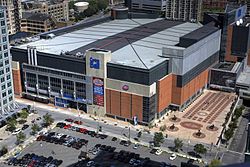
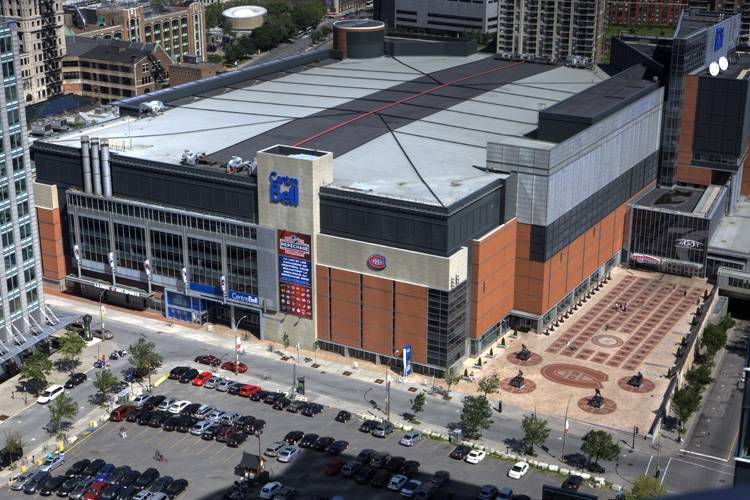
Bell Centre (French: Centre Bell), formerly known as Molson Centre (French: Centre Molson), is a multi-purpose arena located in Montreal, Quebec, Canada. Opened on March 16, 1996, it is the home arena of the Montreal Canadiens of the National Hockey League (NHL), replacing Montreal Forum and it is the largest indoor arena in Canada. It is owned by the Molson family via the team's ownership group Groupe CH, and managed via Groupe CH subsidiary Evenko.[7][8]
Key Information


With a seating capacity of 20,962 in its hockey configuration, Bell Centre is the second largest ice hockey arena in the world after the SKA Arena in St. Petersburg, Russia.[9] Alongside hockey, Bell Centre has hosted major concerts, and occasional mixed martial arts and professional wrestling events. Since it opened in 1996, it has consistently been listed as one of the world's busiest arenas, usually receiving the highest attendance of any arena in Canada.[10] In 2012, it was the fifth-busiest arena in the world based on ticket sales for non-sporting events.[11]
History
[edit]Construction began on the site on June 22, 1993, almost two weeks after the Canadiens defeated the Los Angeles Kings at the Forum for their 24th and most recent Stanley Cup. When the arena officially opened in 1996, its name initially reflected Molson, Inc., a brewing company which was owner of the Canadiens at the time. Molson elected not to keep the naming rights when they sold the team and the name was officially changed on September 1, 2002, after Bell Canada acquired the naming rights.
On October 14, 2015, it was announced that Bell Centre would undergo renovations, including the replacement of all the seats, renovated hallways and concessions, new restaurants, public Wi-Fi, and the planned conversion of Avenue des Canadiens-de-Montréal (the section of De la Gauchetière Street on which the arena is situated) into a pedestrian-only street. The renovations, which were not expected to interfere with normal operations, have a budget of $100 million.[12][13]
Location
[edit]Bell Centre is located in downtown Montreal in the borough of Ville-Marie, near the corner of Canadiens-de-Montréal Avenue (formerly De la Gauchetière west) and de la Montagne Street.[14] The Lucien L'Allier commuter rail terminal, to which it is connected, is next door on that corner. In addition, it is located across the street from the 1250 René-Lévesque skyscraper. It is easily accessible by public transportation, as it is linked to both Lucien-L'Allier and Bonaventure Metro stations. It is also connected to the underground city and Central Station.
Arena information
[edit]

The building covers an area of 1.568 hectares (3.87 acres) (15,680 square metres (168,800 sq ft)). It has a seating capacity of 20,962,[15] making it the second largest hockey arena in the world. It also holds six restaurants.
Capacities of the arena from highest to lowest are:[16][9]
- Basketball: 22,114
- Hockey: 20,962
- Concerts: 15,000-19,200
- Amphitheatre: 10,000–14,000
- Theatre: 5,000–9,000
A new scoreboard was installed prior of the 2008–09 season. This scoreboard consisted of four 47-square-metre (510 sq ft) video panels. It was the biggest in the NHL until 2012.[17] Another new board was installed in 2024 with rounded edges and smaller, angled internal screens for fans in lower seats.[18]
It is one of only two NHL arenas that uses an old-style siren to mark the end of periods instead of a horn; the other being the TD Garden in Boston. The sirens were inherited from the arenas' predecessor facilities, coming from the disused Montreal Forum and the Boston Garden respectively.
Seating
[edit]Unlike most North American arenas, which have generally been designed by Populous and its predecessors, the Bell Centre was designed by a local consortium, and has many unique design features. The grandstands are sloped steeply to improve sight lines. Washrooms on the 100 level are centralized on a specific lower level located at each end.
Bell Centre is arranged in a three-tier layout: The lower 100 section, commonly referred to as "the reds" since these seats are coloured red; the 200 section situated between the two levels of private and corporate boxes, known as "Club Desjardins" (which features premium amenities such as larger seats and free food and non-alcoholic drinks), and the upper 300 section. The ends of the 300 section are further divided into two more groups. At the end where the Canadiens shoot towards twice is the Ford Zone, featuring section cheerleaders and flashing lights. At the opposite end is the Family Zone, which features child-specific ticket prices and limited alcohol.
Seats behind the press gondola, in Sections 318, 319, and 320, feature their own scoreboards on the back of the gondola due to the normal scoreboard being blocked.
Interior
[edit]
After some early complaints of a generic feel, especially compared to the Forum, the Canadiens started to incrementally decorate the building with celebrations of the team's history, including a ring of players around the top level of seating. The Molson Ex Zone features a live band stage and its own red theme.
Entertainment
[edit]Bell Centre is the main venue in Montreal for large-scale entertainment events. Many artists have performed at the arena, like Beyoncé, Destiny's Child, Olivia Rodrigo, Céline Dion, Les Cowboys Fringants, Gloria Estefan, Stromae, Twenty One Pilots, Tina Turner, Depeche Mode, Prince, Drake, Shakira, Elton John, Billy Joel, Shania Twain, Cher, Bon Jovi, Van Halen, Rush, Coldplay, Rihanna, Guns N' Roses, Slipknot, U2, Nicki Minaj, Ariana Grande, Taylor Swift, Demi Lovato, Katy Perry, Paul McCartney, Lady Gaga, Janet Jackson, Roger Waters, Spice Girls, Justin Timberlake, Barbra Streisand, Madonna, Metallica, Iron Maiden, The Rolling Stones, Aerosmith, Imagine Dragons, Dua Lipa, Sabrina Carpenter and Kylie Minogue.
The singer who has performed the most times at the Bell Centre is Céline Dion with 50 performances between 1996 and 2020 from her Falling into You: Around the World tour in 1996 and 1997, Let's Talk About Love World Tour in 1998 and 1999, Taking Chances World Tour in 2008 and 2009, Summer Tour 2016 in 2016 and Courage World Tour in 2019 and 2020. On December 31, 1999, she performed the final show of the Let's Talk About Love World Tour, which was her last performance before a three-year hiatus from the music industry.
In August 1999, the third national tour of Les Misérables visited for a 12-day run. Robert Marien, who originated the role of Jean Valjean in Paris in 1980, as well as in the bilingual Canadian tour which started in Montreal in 1991, joined the cast exclusively for the Montreal stop.
Sports
[edit]Ice hockey
[edit]The final two games of the three-game 1996 World Cup of Hockey championship series were held at Bell Centre (the United States won both games, defeating Canada in the series 2–1). Bell Centre was also host to two pool games in the 2004 World Cup of Hockey. The Bell Centre was the host of the 2009 NHL All-Star Game and hosted the 2009 and 2022 NHL Entry Drafts, the latter of which saw the Canadiens take Juraj Slafkovský first overall.[19]
Montreal Canadiens home games have been almost consistently sold-out since October 2005.[20] Additionally, the Canadiens have one of the top attendance figures in the NHL. For the 2009–2010 season, the Habs had the highest attendance played at their home arena.[21]
On December 9, 2014, the Canadiens hosted the Vancouver Canucks, the first home game since the death of Jean Béliveau. The game was preceded by a memorial tribute to him. Bell Centre remained sold-out that night with 21,286 fans in attendance and one empty seat left for Béliveau, with the official attendance shortened by one to honour him.[22]
Bell Centre hosted its first Stanley Cup Final in 2021, with Game 3 and 4 against the defending champion Tampa Bay Lightning played inside the arena.[23] The Canadiens were allowed to have 2,500 people during the first and second round, then 3,500 for the semi-finals and the Stanley Cup Final due to the Government of Quebec's public health restrictions in response to the COVID-19 pandemic, although multiple fans stated that the limit was exceeded.[24] The Canadiens had hoped to further increase their capacity limit to 10,500 fans for the Stanley Cup Finals, however that request was denied by the Government of Quebec.[25] While the arena's capacity was limited during the playoffs, thousands more fans gathered outside the arena to watch the games on a TV screen outside of the La Cage sports bar situated adjacent to the Bell Centre.
From September 26 to October 8, 2021, 7,500 fans were allowed at the Bell Centre for the Canadiens’ pre-season games, and for the home opener on October 16, the Government of Quebec made new rules and stated that the Canadiens could return to its full capacity of 21,105 people.[26]
On April 20, 2024, Bell Centre hosted its first home game for the new PWHL team Montreal Victoire, a special match played against the Toronto Sceptres that was marketed as the "Duel at the Top", reflecting the two teams' position atop the league standings at the time.[27] The sell-out crowd of 21,105 set a new attendance record for a women's hockey game.[28] The PWHL returned to the Bell Centre on March 1, 2025 between the Montreal Victoire and the Boston Fleet.
The Bell Centre was one of two host venues for the NHL 4 Nations Face-Off in February 2025, alongside TD Garden in Boston.[29] The first four round robin games were played at the Bell Centre, featuring national teams representing the United States, Canada, Sweden and Finland.[30]
Basketball
[edit]
Since October 2010, Bell Centre has hosted selected NBA preseason games, primarily featuring the Toronto Raptors; the first was held on October 22, 2010, with the Raptors hosting the New York Knicks. It has since hosted preseason games as part of the NBA Canada Series, which have also included all-U.S. games.
Mixed martial arts
[edit]Bell Centre hosted UFC 83: Serra vs. St-Pierre 2 in April 2008, marking the first UFC mixed martial arts event to take place in Canada. The main event was a rematch between Welterweight champion Matt Serra and Montreal native Georges St-Pierre.[31] The tickets available to the public sold out in under one minute, and the event set the all time UFC attendance record, at that time (since surpassed by UFC 129: St-Pierre vs. Shields in Toronto).[32] Other UFC events have subsequently been held at Bell Centre, including UFC 97: Redemption, UFC 113: Machida vs. Shogun 2, UFC 124: St-Pierre vs. Koscheck 2, UFC 154: St-Pierre vs. Condit, UFC 158: St-Pierre vs. Diaz and UFC 186: Johnson vs. Horiguchi, the most recent three of which were headlined by St-Pierre.[33][34][35][36] The UFC returned to the arena a decade later for UFC 315: Muhammad vs. Della Maddalena on May 10, 2025.[37]
Professional wrestling
[edit]Bell Centre has occasionally hosted WWE professional wrestling events, including four pay-per-views (Survivor Series in 1997, No Way Out in 2003, Breaking Point in 2009 and Elimination Chamber in 2023), as well as 12 broadcasts of Raw, 9 broadcasts of SmackDown, and also hosted Saturday Night's Main Event XLIII on January 24, 2026. Elimination Chamber 2023 marked the first time that the Chamber structure was on Canadian soil and only the second time in history that the structure was outside of the United States, following the 2022 event that was held in Jeddah, Saudi Arabia,[38] and featured Laval native Sami Zayn competing in the event's main event match for the Undisputed WWE Universal Championship against Roman Reigns. In April 2019, Bell Centre hosted both Raw and SmackDown on consecutive nights for the 2019 Superstar Shake-up, the first time in WWE history that the event was held at an arena outside of the United States.[39] On August 19, 2022, Bell Centre hosted the 1,200th episode of SmackDown.[40]
During Survivor Series 1997, Bell Centre was the site of the infamous "Montreal Screwjob"—a match where Calgary-native Bret Hart controversially lost the WWF Championship to his rival Shawn Michaels. Hart had signed a contract to leave WWF for the rival World Championship Wrestling (WCW) the following month, and did not want to lose a championship match to Michaels in his own country. The original plan was for the match to end by disqualification after a brawl between the wrestlers' allies, which would have allowed Hart to lose or vacate the championship at a later date before leaving the promotion. However, WWF owner Vince McMahon intervened without Hart's knowledge, and had the referee declare a Michaels victory by submission after performing a Sharpshooter on Hart, even though he had not actually submitted.[41][42] Wrestling writer Mike Johnson considered the match to be "arguably the most talked-about match in the history of professional wrestling".[43] Eight years later, in the same venue, Michaels cut his infamous "Who's your daddy, Montreal?" heel promo in the lead-up to his impending match with Hulk Hogan at SummerSlam 2005, where he referenced the Screwjob during his promo, receiving plenty of heat from the Montreal fans.[44][better source needed]
Brock Lesnar made his televised WWE debut at Bell Centre on the March 18, 2002 Raw after WrestleMania X8 in Toronto, interfering in the Hardcore match that was taking place between Maven and Al Snow.[45][better source needed] A wall on the concourse of the arena depicting iconic events that took place inside the arena includes Lesnar's debut among others.[citation needed]
In December 2023, All Elite Wrestling (AEW) made its Montreal debut, with broadcasts of Collision and Dynamite.[46][47]
Figure skating
[edit]The Bell Centre was scheduled to host the 2020 World Figure Skating Championships in March of that year, but these were cancelled as a result of the onset of the COVID-19 pandemic.[48] It was eventually used to host the 2024 edition, in lieu of the earlier planned event. This was the second time the championship took place in Montreal, the first having been held in the old Forum in 1932.[49]
Retired jerseys
[edit]The following numbers have been retired by the Canadiens and hang from the rafters:
| No. | Player | Position | Tenure | Date of honour |
|---|---|---|---|---|
| 1 | Jacques Plante | G | 1952–63 | October 7, 1995 |
| 2 | Doug Harvey | D | 1947–61 | October 26, 1985 |
| 3 | Émile Bouchard | D | 1941–56 | December 4, 2009 |
| 4 | Jean Béliveau | C | 1950–71 | October 9, 1971 |
| 5 | Bernie Geoffrion | RW | 1950–64 | March 11, 2006 |
| Guy Lapointe | D | 1968–82 | November 8, 2014 | |
| 7 | Howie Morenz | C | 1923–37 | November 2, 1937 |
| 9 | Maurice Richard | RW | 1942–60 | October 6, 1960 |
| 10 | Guy Lafleur | RW | 1971–85 | February 16, 1985 |
| 12 | Dickie Moore | LW | 1951–63 | November 12, 2005 |
| Yvan Cournoyer | RW | 1963–79 | November 12, 2005 | |
| 16 | Henri Richard | C | 1955–75 | December 10, 1975 |
| Elmer Lach | C | 1940–54 | December 4, 2009 | |
| 18 | Serge Savard | D | 1966–81 | November 18, 2006 |
| 19 | Larry Robinson | D | 1972–89 | November 19, 2007 |
| 23 | Bob Gainey | LW | 1973–89 | February 23, 2008 |
| 29 | Ken Dryden | G | 1970–79 | January 29, 2007 |
| 33 | Patrick Roy | G | 1984–95 | November 22, 2008 |
While Elmer Lach and Henri Richard both wore the number 16, they were given separate ceremonies unlike Cournoyer and Moore. All have their own banner.
On October 18, 2005, the Canadiens also raised the following numbers on a single banner in honour of the former MLB team Montreal Expos, who left the city for Washington, D.C. after the 2004 season:
- 8 Gary Carter
- 10 Andre Dawson and Rusty Staub
- 30 Tim Raines
The only other banners hanging from the rafters at the arena are those of the Canadiens' Stanley Cup championship banners. Unlike other NHL arenas, the Canadiens do not display division or conference championship banners.
See also
[edit]Notes
[edit]References
[edit]- ^ 1688 to 1923: Geloso, Vincent, A Price Index for Canada, 1688 to 1850 (December 6, 2016). Afterwards, Canadian inflation numbers based on Statistics Canada tables 18-10-0005-01 (formerly CANSIM 326-0021) "Consumer Price Index, annual average, not seasonally adjusted". Statistics Canada. Retrieved April 17, 2021. and table 18-10-0004-13 "Consumer Price Index by product group, monthly, percentage change, not seasonally adjusted, Canada, provinces, Whitehorse, Yellowknife and Iqaluit". Statistics Canada. Retrieved 2024-05-08.
- ^ a b Chronology - HW: World Wide Habs Fans Community Archived May 31, 2013, at the Wayback Machine
- ^ "Bell Centre". IBI/DAA Group. Archived from the original on July 28, 2014. Retrieved February 1, 2013.
- ^ "Bell Centre". Dessau. Archived from the original on April 2, 2012. Retrieved February 1, 2013.
- ^ "Buildings". SNC-Lavalin. Archived from the original on March 22, 2012. Retrieved February 1, 2013.
- ^ "Bell Centre in Montreal, Quebec". magil.com. Retrieved August 4, 2022.
- ^ "Evenko, Live Nation Ditch Rivalry, Announce Partnership". FYIMusicNews. 2019-12-20. Retrieved 2020-01-27.
- ^ Bruemmer, René (2017-10-27). "Habs and Evenko owner Groupe CH didn't get special treatment: Coderre". Montreal Gazette. Retrieved 2020-01-27.
- ^ a b "Montréal Canadiens - Seattle Kraken - Oct 14, 2025". www.nhl.com. Retrieved 2025-10-15.
- ^ Bouchard, Dany (January 11, 2006). "The best Bell Centre". Canoë. Archived from the original on May 26, 2012. Retrieved February 1, 2013.
- ^ "2012 Year End Worldwide Ticket Sales Top 100 Arena Venues" (PDF). Pollstar. Archived from the original (PDF) on September 24, 2015. Retrieved February 1, 2013.
- ^ "Bell Centre to undergo $100 million renovation". CTV News Montreal. Bell Media. 14 October 2015. Retrieved 14 October 2015.
- ^ "Our History". Centre Bell. Archived from the original on 2 October 2019. Retrieved 6 January 2020.
- ^ "Directions and Parking". Bell Centre. Archived from the original on May 24, 2015. Retrieved February 1, 2013.
- ^ "NHL.com - Teams". www.nhl.com. Retrieved March 6, 2021.
- ^ Bell Centre (2009). "Bell Centre - Venue Specifications". Bell Centre. Archived from the original on June 23, 2011. Retrieved June 7, 2011.
- ^ "Tampa Forum adding record-size high-def video board | TBO.com and The Tampa Tribune". tbo.com. Archived from the original on May 8, 2015.
- ^ "Canadiens to debut new scoreboard at the Bell Centre". nhl.com.
- ^ Engels, Eric (July 28, 2022). "Slafkovsky confident he'll win support of Canadiens fans over time". Sportsnet.ca. Retrieved April 20, 2024.
- ^ "Season Ticket Waiting List". Montreal Canadiens. Retrieved February 1, 2013.
- ^ NHL attendance
- ^ "The Sport Market". www.thesportmarket.biz. Archived from the original on 1 December 2011. Retrieved 13 January 2022.
- ^ "Stanley Cup finals coming to the Bell Centre on July 2 and 5". Montreal. June 26, 2021. Retrieved 2021-06-28.
- ^ Serebrin, Jacob (June 15, 2021). "Quebec to increase arena capacity before 1st home game in Habs semifinal playoff series". CBC News. Archived from the original on June 16, 2021. Retrieved December 5, 2021.
- ^ "Quebec public health denies Canadiens' request to increase capacity at Bell Centre". CBC News. June 30, 2021. Archived from the original on 2021-06-30. Retrieved November 17, 2021.
- ^ Lofaro, Joe (June 15, 2021). "Bell Centre, other large events in Quebec now allowed to welcome up to 3,500 people". CTV News. Retrieved April 20, 2024.
- ^ Rowe, Daniel J. (April 20, 2024). "Nurse OT winner breaks Montreal hearts as Toronto wins PWHL 'Duel at the Top'". CTV News. Retrieved April 20, 2024.
- ^ Rainbird, Daniel (April 20, 2024). "PWHL-leading Toronto clinches playoff berth, wins in OT before record crowd in Montreal". CBC Sports. Retrieved April 20, 2024.
- ^ "Montreal, Boston to host 4 Nations Face-off in 2025". NHL.com. June 8, 2024. Retrieved June 9, 2024.
- ^ Gilmour, Matt (February 12, 2025). "Fans, former legends descend on Montreal's Bell Centre for 4 Nations Face-Off". CTV News. Retrieved February 18, 2025.
- ^ Stupp, Dann (January 4, 2008). "Matt Serra Is Willing to Fight Georges St-Pierre in Canada". MMAJunkie.com. Archived from the original on July 25, 2011. Retrieved January 31, 2008.
- ^ Stupp, Dan (February 8, 2008). "UFC 83 Creates Record Sellout". MMAjunkie.com. Archived from the original on 2008-10-12. Retrieved February 22, 2009.
- ^ Holland, Jesse (February 18, 2009). "UFC 97 to remain in Montreal on April 18". MMAmania.com. Retrieved February 18, 2009.
- ^ Morgan, John (December 15, 2012). "Georges St-Pierre vs. Nick Diaz official for UFC 158 in Montreal". MMAjunkie.com. Archived from the original on December 18, 2012. Retrieved December 18, 2012.
- ^ Andrews, Kenai (December 17, 2012). "MMA Crossfire – St-Pierre vs Nick Diaz highlights UFC 158 welterweight trilogy in Montreal". The Gazette. Archived from the original on January 28, 2013. Retrieved December 18, 2012.
- ^ Deibert, Dave (December 12, 2012). "St-Pierre vs. Diaz, MacDonald vs. Condit targeted for UFC 158 in Montreal". The Star Phoenix. Archived from the original on February 4, 2013. Retrieved December 18, 2012.
- ^ Wells, Matthew (May 11, 2025). "UFC 315 results: Jack Della Maddalena wins title, welcomes Islam Makhachev challenge". MMA Junkie. Retrieved May 11, 2025.
- ^ "WWE Elimination Chamber headed to Montreal on February 18, 2023 | WWE". WWE. Retrieved December 8, 2022.
- ^ "Smackdown: The Big Dog claims a new yard during the Superstar Shake-up". Canoe.com. Archived from the original on April 21, 2019. Retrieved October 15, 2019.
- ^ Bath, Dave (2022-08-19). "WWE SmackDown live results: Roman Reigns & Drew McIntyre face-to-face". WON/F4W. Retrieved 2024-02-22.
- ^ "Shawn Michaels on the Montreal Screwjob: The worst day I can recall in the entire 25 years I was in the wrestling business". ESPN.com. 2017-11-09. Retrieved 2019-02-20.
- ^ Mick Foley (2000). Have a Nice Day: A Tale of Blood and Sweatsocks. Regan Books. p. 626. ISBN 978-0-06-103101-4.
- ^ Johnson, Mike (November 9, 2015). "11/9 This Day in History: Bret Hart vs. Shawn Michaels in Montreal". PWInsider. Retrieved November 9, 2015.
- ^ mahmood, Malik umar Khalid (September 19, 2021). "Why Shawn Michaels' Heel Promo In Montreal Is The Best In WWE History". TheSportster. Retrieved August 19, 2022.
- ^ "On This Day In Wrestling History… March 18th". Hooked On Wrestling. 2021-03-18. Retrieved 2021-08-10.
- ^ "Updated Ticket Sale Numbers For Upcoming AEW Events, Including Full Gear". 411MANIA. Retrieved 2024-02-22.
- ^ Nason, Josh (2023-09-14). "AEW announces Montreal & Memphis debut dates". WON/F4W. Retrieved 2024-02-22.
- ^ Ewing, Lori (March 11, 2020). "World figure skating championships cancelled in Montreal". CBC News. Retrieved March 28, 2024.
- ^ Nichols, Paula (March 15, 2024). "What to watch for as Montreal hosts 2024 World Figure Skating Championships". Canadian Olympic Committee. Retrieved March 28, 2024.
External links
[edit]

| Events and tenants | ||
|---|---|---|
| Preceded by | Home of the Montreal Canadiens 1996–present |
Succeeded by current
|
| Preceded by | Host of the NHL All-Star Game 2009 |
Succeeded by |


| |
| Franchise | |
| History | |
| Personnel |
|
| Arenas | |
| Rivalries | |
| Affiliates | |
| Media |
|
| Culture and lore | |
| Authority control databases: Geographic |
|---|
Bell Centre
View on GrokipediaHistory
Planning and Construction
In the early 1990s, Molson Inc., the owner of the Montreal Canadiens, planned a new multi-purpose arena to replace the aging Montreal Forum, which had hosted the team since 1924 but lacked the facilities needed for competitive NHL operations and diverse revenue-generating events such as concerts.[5] The initiative was market-driven, prioritizing private investment to enhance the franchise's long-term financial sustainability amid evolving league standards for arena quality and event versatility.[3] Construction commenced on June 22, 1993, on a downtown site spanning approximately 1.6 hectares near the intersection of Rue Sainte-Catherine Ouest and Avenue Atwater.[6] The total cost reached C$270 million, financed almost entirely through private sources including Molson and Canadiens ownership interests, eschewing public subsidies in an era skeptical of taxpayer-funded sports facilities.[3] [7] Montreal-based architectural firms Lemay & Associés and LeMoyne Lapointe Magne led the design, emphasizing multi-functional capabilities to host hockey, basketball, and large-scale entertainment while incorporating engineering innovations like a steeply raked seating bowl for unobstructed sightlines across all levels.[8] The project progressed over nearly three years, culminating in structural completion by late 1995 ahead of operational readiness.[9]Opening and Initial Operations
The Bell Centre, initially named the Molson Centre, opened on March 16, 1996, hosting its inaugural National Hockey League game as the Montreal Canadiens defeated the New York Rangers 4-2.[10] [11] Vincent Damphousse scored the first goal in the arena just 2:38 into the contest, drawing a capacity crowd of approximately 21,273 and signaling strong initial demand in Montreal's hockey-dominated market.[12] This regular-season matchup marked the Canadiens' immediate shift from the Montreal Forum, which had hosted its final game five days prior, and underscored the new venue's role in sustaining the franchise's fanbase amid a transitional 1995–96 season.[3] The 1996–97 season represented the Molson Centre's first full campaign as the Canadiens' home, with all regular-season and playoff games (though none occurred that year) drawing robust attendance that established early sellout patterns and revenue stability.[13] Operational setup emphasized modern amenities like expanded media facilities accommodating up to 140 members and five ice-level television studios, facilitating efficient event management from the outset.[3] The arena's versatility was quickly tested through non-hockey programming, including Neil Young's concert on November 7, 1996, and Backstreet Boys shows in March 1997, which attracted diverse audiences and diversified income streams beyond hockey.[14] [15] These initial operations highlighted the venue's empirical success, with consistent high occupancy reflecting pent-up demand for upgraded facilities in a city where the Canadiens command deep cultural loyalty, positioning the Molson Centre as North America's busiest arena from its debut year onward.[3]Naming Rights Evolution
The Bell Centre, originally named the Molson Centre, opened on March 2, 1996, with its title reflecting the sponsorship and ownership stake of Molson Inc., the brewing conglomerate that controlled the Montreal Canadiens franchise and financed much of the arena's development costs exceeding $250 million CAD.[16] This initial naming aligned corporate branding with venue operations, a common practice to recoup capital outlays in professional sports facilities where ticket sales alone often fall short of debt servicing.[17] Molson relinquished the naming rights without compensation in early 2002 after divesting the Canadiens to U.S. investor George Gillett, enabling a more lucrative sponsorship amid NHL labor uncertainties and rising operational expenses.[18] On February 26, 2002, Bell Canada announced a 20-year agreement valued at $100 million USD—equivalent to roughly $5 million annually—to secure exclusive naming privileges, with the venue officially rebranded as the Bell Centre on September 1, 2002.[18] [19] The pact included ancillary benefits like luxury suite access but centered on branding visibility to drive telecom subscriber growth, while providing the Canadiens organization steady non-ticket revenue to stabilize finances in a league where arena maintenance and player salaries averaged tens of millions yearly.[20] The original term extended through 2022, but in December 2013, Bell Media—Bell Canada's subsidiary—extended naming rights to at least 2028 as part of a broader regional broadcasting deal with the Canadiens, ensuring continuity amid evolving media landscapes and preventing revenue gaps from re-negotiation delays.[21] This extension underscored naming rights as a hedge against volatile NHL economics, where such deals typically contribute 5-10% of annual operating budgets for franchises.[19] By 2025, no further extensions had been publicly detailed, though the arrangement mirrored industry norms, as seen in comparable NHL pacts like Scotiabank Arena's $50 million CAD, 15-year deal or KeyBank Center's multimillion renewals, affirming corporate sponsorships' role in enabling profitability without public subsidies.[19]Renovations and Modernization Efforts
In October 2015, the Montreal Canadiens ownership announced an investment of nearly $100 million over three years to upgrade the Bell Centre's interior and exterior, including renovations to luxury suites, enhancements to food and beverage services, installation of new video screens, expansion of corridors, and creation of a pedestrian-only zone along the adjacent street.[22] [23] [24] These improvements addressed aging infrastructure to sustain the venue's appeal amid competition from newer arenas, focusing on fan comfort and operational efficiency.[25] Further modernization continued with the installation of a new central scoreboard in 2024, debuting ahead of the 2024-25 NHL season, which expanded the video display surface to nearly 2,900 square feet and incorporated advanced technology for superior game presentation and spectator engagement.[26] The upgrade more than doubled the previous scoreboard's capabilities, supporting higher resolution visuals and integrated features to enhance the in-arena experience.[27] In May 2025, the Bell Centre introduced La Voûte CIBC, an ice-level premium club space converted from former offices and storage areas, offering 325 seats across three sections, two bars, gourmet food stations, and direct access to the stands for corporate and high-end events starting in the 2025-26 season.[28] [29] This addition, developed since 2023, targeted revenue growth through exclusive premium offerings while integrating visual updates such as refreshed Montreal Canadiens branding elements.[30] Ongoing maintenance and targeted upgrades, as outlined in ownership statements, aim to prolong the arena's service life for decades by adapting to technological advancements and fan expectations without requiring comprehensive reconstruction.[31]Location and Accessibility
Site Description
The Bell Centre is located at 1909 Avenue des Canadiens-de-Montréal in downtown Montreal, Quebec, within the Ville-Marie borough.[32] The arena occupies a site previously used for railway tracks leading to the adjacent Windsor Station, repurposing underutilized rail infrastructure into a key urban landmark that anchors the surrounding business district.[33] Its placement facilitates seamless integration into Montreal's downtown core, with direct underground connections to the Lucien-L'Allier Metro station on the Orange Line and proximity to the Peel station, promoting accessibility amid commercial and entertainment hubs.[32][34] The immediate vicinity includes office towers, hotels such as the Hyatt Centric Montreal, and a concentration of restaurants offering diverse dining options, enhancing the area's pedestrian-oriented vibrancy.[35][36]Transportation and Parking
The Bell Centre is directly accessible via the Société de transport de Montréal (STM) metro system, with Lucien-L'Allier station on the orange line providing underground connection to the venue's lower levels. Bonaventure station on the green line offers additional proximity, approximately a five-minute walk away. On event nights, STM augments metro frequency and capacity to handle surges in attendance, including integration with the Lucien-L'Allier commuter train station for regional arrivals.[32][37] Various STM bus routes, such as the 747 express from the airport, converge nearby, supporting efficient last-mile access for attendees from across the city.[38] On-site indoor parking is available at 1225 Saint-Antoine Street West, accommodating vehicles up to 6 feet 10 inches in height on level A and 6 feet 3 inches on level B, with electric vehicle charging stations provided. Facilities operate from 5:30 a.m. to 7 p.m. on non-event weekdays at a fixed $20 rate, escalating to $20–$45 starting at noon on event days, payable only by credit or debit card; restrictions prohibit pickups during hockey games and studded tires year-round. High demand during sold-out events, which draw up to 21,000 patrons, frequently leads to rapid sell-outs and elevated premiums in adjacent off-site lots, prompting recommendations for advance reservations or alternative transport to avoid delays.[32][39] Ride-sharing services like Uber maintain designated drop-off and pick-up zones near Saint-Antoine Street and Mountain Street to streamline access amid post-event crowds. Pedestrian pathways link directly from metro exits and surrounding sidewalks to the main entrance at 1909 Avenue des Canadiens-de-Montréal, facilitating crowd dispersal; however, peak-event congestion on adjacent roads and entry queues can extend average exit times by 20–45 minutes, as reported in user accounts balanced against transit efficiencies.[40][41]Arena Specifications
Capacity and Seating Configuration
The Bell Centre maintains a standard seating capacity of 21,105 for National Hockey League games in its hockey configuration.[42] This makes it North America's largest dedicated ice hockey venue by attendance capacity.[43] The arena employs a multi-tiered bowl design with three primary levels: the 100 level lower bowl (red seats), 200 level mezzanine (white seats), and upper 300 and 400 levels (blue seats), optimized for sightlines across events.[44] The lower bowl features a steep rake, positioning spectators close to the event floor while minimizing obstructions from dasher boards.[45] Equipped with 120 luxury suites distributed across two dedicated levels (3 and 5), the venue supports premium configurations accommodating 12 to 20 guests per suite, complete with private amenities.[44] These suites ring the arena above the lower and mezzanine tiers, providing enclosed viewing with catering and dedicated access. For basketball setups, the capacity expands to 22,114 by adjusting the floor layout and utilizing additional standing or floor areas.[46] Concert configurations adapt via modular staging and flooring, often reducing seated capacity to 15,000–19,200 for end-stage productions to accommodate production equipment and enhance acoustics, though full-arena setups can approach 21,000.[47] The venue's flexible gantry system enables rapid reconfiguration from intimate theater modes (5,000–9,000 seats) to maximum utilization.[48] In 2025, modifications for the 2025–26 season introduced "Le Parterre," a new premium lower-bowl section created by removing 300–400 seats to prioritize high-revenue experiences over general admission.[49]Interior Facilities and Technology
The Bell Centre offers multiple on-site restaurants and bars integrated into its interior layout, providing diverse dining options accessible from seating areas. Key venues include the 9-4-10 Steakhouse for upscale meals, Canti Osteria & Bar for Italian-inspired dishes, Mythik for casual fare, and Bazarette for quick bites, alongside additional concessions emphasizing local Quebec specialties such as poutine and smoked meat sandwiches.[50][51] These facilities support group hospitality spaces renovated for enhanced functionality, allowing customized event experiences with proximity to event floors.[51] Technological upgrades enhance spectator immersion, including a new central scoreboard installed for the 2024-25 season featuring a 360-degree rounded LED design with ultra-high-definition (UHD) video surfaces measuring 41 feet by 21 feet along the rink lengths and 32 feet by 21 feet at the ends, totaling nearly 2,900 square feet.[26] The arena employs Absen LED displays for ribbon boards and auxiliary screens, integrated with SMPTE ST 2110 IP-based infrastructure supporting 10 Sony 4K UHD cameras and advanced switching for dynamic content delivery.[52] Audio systems were upgraded in 2023 with EAW ADAPTive line components, including Anna loudspeakers, Otto subwoofers, and UXA amplifiers, providing higher definition and venue-wide clarity for events.[53] Accessibility features include designated wheelchair seating sections across levels and elevators servicing all floors, ensuring equitable access for patrons with mobility needs; the venue also maintains an accessibility guide outlining support services.[54] The ice surface adheres to NHL regulation dimensions of 85 feet by 200 feet, equipped with standard dasher boards designed for player safety through impact absorption and flexible panels.[3]Safety and Sustainability Features
The Bell Centre adheres to Quebec's Regulation respecting safety in public buildings, which establishes fire safety standards for assembly occupancies, including provisions for egress, fire suppression, and structural integrity.[55] In 2011, the arena upgraded rink-side protections with curved glass panels at player benches and energy-absorbing dasher boards to mitigate injury risks, following NHL-approved prototypes tested for compliance with league safety protocols.[56] Video surveillance via Genetec Security Center Omnicast manages extensive camera networks for real-time monitoring, aiding crowd control and incident response during events.[57] Designated seating on level 100 offers unobstructed paths to street-level doors, facilitating rapid evacuation in emergencies.[58] Sustainability efforts center on operational efficiencies rather than symbolic gestures, with the venue attaining LEED Gold certification in December 2022 for its integrated energy, water, and waste management systems.[59] It uniquely holds three independent certifications among North American professional sports facilities: LEED Silver for Existing Building Operations and Maintenance, BOMA BEST Level 3 for sustainable practices, and TRUE Zero Waste for diverting over 90% of waste from landfills.[7] Key retrofits include replacing more than 250 water fixtures with low-flow models, reducing usage without compromising functionality, alongside broader upgrades to lighting and building systems that minimize energy demands.[60] These features stem from private investments by arena operators, including maintenance fees dedicated to renovations that extend infrastructure life while meeting regulatory thresholds, avoiding dependency on taxpayer funds amid Quebec's stringent public building codes.[58]Events Hosted
Ice Hockey and Primary Sports Usage
The Bell Centre has been the primary home arena for the Montreal Canadiens of the National Hockey League since its inauguration on March 16, 1996, succeeding the Montreal Forum as the team's venue.[61] In this period, the arena has hosted the Canadiens' annual slate of 41 regular-season home games, totaling over 1,100 such contests through the 2023-24 season, alongside numerous playoff appearances. Attendance figures underscore hockey's operational primacy, with the Canadiens consistently ranking first in NHL total attendance; for instance, in the 2023-24 season, all 41 home games sold out at the venue's hockey capacity of 21,105, yielding an average of 21,105 fans per game.[62] This near-uninterrupted sellout streak, extending back over a decade, reflects sustained demand, with historical averages exceeding 21,000 even in non-playoff years.[63] The arena's ice hockey usage extends to women's professional leagues, notably hosting games for the Professional Women's Hockey League's Montreal Victoire since their inaugural 2024 season. The Victoire have played select high-profile matches at the Bell Centre, including a record-setting sellout crowd of 21,105 during the 2024 campaign, which helped establish the venue's role in elevating women's hockey visibility and attendance benchmarks.[64] These events leverage the facility's configuration for standard NHL rink dimensions, with minimal adaptations required beyond scheduling around the Canadiens' calendar. Playoff hockey amplifies the Bell Centre's economic significance within ice sports, where extended series generate measurable local multipliers. Each home playoff game typically injects approximately $3 million in direct economic activity, driven by heightened spending at surrounding restaurants, hotels, and retailers; for example, the Canadiens' 2021 postseason run tripled transaction volumes near the arena compared to regular periods.[65] Deeper runs compound this effect, as advancing rounds sustain fan influxes and associated revenues, historically boosting downtown Montreal's commerce during multi-week series.[66] The venue has also accommodated international competitions, such as the 2025 4 Nations Face-Off tournament featuring Canada, the United States, Finland, and Sweden, with key matches—including the Canada vs. United States game on February 15—played on its ice surface before capacity crowds of 21,105.[67] These events necessitate temporary branding and broadcast adjustments but affirm the arena's versatility for elite hockey while prioritizing its core NHL tenancy.Other Athletic Events
The Bell Centre accommodates a range of non-hockey athletic events through its convertible flooring systems, which allow for temporary installations over the ice rink to support combat sports, basketball exhibitions, and skating competitions. These events occur less frequently than hockey games but draw substantial crowds, often exceeding 15,000 attendees for major promotions, highlighting the venue's versatility despite its ice-centric architecture.[4] Mixed martial arts bouts, primarily under the Ultimate Fighting Championship (UFC), have been hosted regularly since 2010, with UFC 315 on May 10, 2025, attracting 19,786 spectators and contributing $38.2 million to the Montreal metropolitan economy through direct spending, visitor expenditures, and supported jobs.[68][69] This marked the eighth UFC event at the arena, underscoring its appeal for high-profile fight cards that fill the venue's capacity.[69] Basketball exhibitions feature prominently, including Harlem Globetrotters performances that combine athletic displays with entertainment, such as the April 17, 2026, show.[70] The arena also hosted an NBA preseason game on October 22, 2010, demonstrating adaptability for standard court setups.[4] Professional wrestling events by World Wrestling Entertainment (WWE) occur periodically, with recent instances like the August 8, 2025, SmackDown drawing estimated crowds of around 14,000.[71] These scripted athletic spectacles utilize the full arena layout for ringside seating and production. Figure skating competitions leverage the existing ice surface, as seen in the 2024 ISU World Figure Skating Championships held from March 18 to 24.[72] Adaptations for field sports like soccer remain limited due to the venue's fixed ice installation requirements and lack of documented major events in that category.Concerts and Entertainment Productions
The Bell Centre, originally opened as the Molson Centre in March 1996, has established itself as a premier venue for concerts and entertainment productions in Montreal, hosting performances by major international artists across genres.[44] Its flexible seating configuration supports end-stage setups typically accommodating 15,000 to 19,200 spectators, enabling large-scale shows with comprehensive stage production.[4][73] Canadian icon Céline Dion holds the record for the most performances by a solo artist at the venue, with 31 concerts since 1996 that collectively grossed over $30 million in ticket sales.[74] Other prominent acts include U2, which has played 11 times, and visits from artists such as Paul McCartney during his On the Run Tour and Taylor Swift on her Speak Now World Tour.[75] These events leverage the arena's modular design for optimal sightlines and production capabilities suited to high-profile tours. Technical enhancements support superior acoustic delivery, including a 2020 upgrade to an EAW audio system featuring ADAPTive Anna line array loudspeakers, Otto subwoofers, and MKD1096 point-source speakers, installed to provide even coverage across the venue.[76] Average sound levels during events reach approximately 96 decibels, reflecting the high-energy environment typical of arena concerts.[77] The facility's infrastructure accommodates extensive rigging and equipment loads essential for elaborate stage designs in modern productions.Miscellaneous Gatherings
The Bell Centre accommodates corporate meetings and private gatherings through its six dedicated meeting spaces, including configurations for amphitheatres, theatres, hemicycles, and banquet setups in areas such as the AMM room and Restaurant 9-4-10.[78] [79] Luxury suites on the third and fifth floors further support exclusive corporate or group events, offering private entrances, dedicated attendants, and customizable catering for up to 12-20 guests per suite depending on the configuration.[80] These facilities extend the venue's utility for business functions, distinct from its primary sports and entertainment roles. During the COVID-19 pandemic, the arena adapted for empty-arena operations, including a December 16, 2021, National Hockey League game between the Montreal Canadiens and Philadelphia Flyers played without spectators due to surging cases, as directed by Quebec health authorities.[81] [82] Broadcast adaptations transformed sections of the venue into soundstages with added visual elements and simulated crowd noise piped into television feeds by partners TSN and Sportsnet.[83] In parallel charitable efforts, the arena's kitchens produced meals for distribution to food-insecure individuals via organizations like Tablée des Chefs in May 2020, leveraging surplus capacity during event cancellations.[84] Holiday-themed events have included fan club Christmas parties featuring Santa Claus appearances, inflatable games, skating sessions, and pre-game viewing, alongside annual Halloween promotions integrated into the venue's schedule.[85] [86] Charitable galas, such as the Bal des Lumières mental health fundraiser hosted by Bell Canada, drew approximately 700 guests as the first external such event at the arena in over five years, emphasizing its role in targeted philanthropy without political overtones.[87]Economic and Cultural Impact
Contributions to Local Economy
The Bell Centre generates substantial private revenue through ticket sales, concessions, and event hosting, attracting approximately 2.9 million visitors annually via activities of the venue, the Montreal Canadiens, and promoter evenko, contributing $338 million to the Montreal economy in 2015 figures.[22] This impact includes multipliers from visitor spending on lodging, dining, and transportation, benefiting local businesses without direct public subsidies for core operations.[22] Specific high-profile events amplify these effects; for instance, UFC 315 on May 10, 2025, produced $38.2 million in total economic impact for the Montreal metropolitan area, including supported spending in hospitality and retail.[88] Similarly, Montreal Canadiens playoff runs drive surges in local tourism revenue, with each home playoff game estimated to yield about $3 million in economic activity, primarily through heightened hotel occupancy and restaurant patronage near the venue.[66] Data from 2025 playoffs showed spending spikes exceeding 200% in proximity to the arena during key matches.[65] Fiscal policies have influenced net contributions, as a 2019 property valuation reduction of $109 million lowered annual taxes for owners Groupe CH by nearly $4 million compared to 2013 levels, offering relief amid elevated effective tax rates for Canadian professional sports franchises relative to U.S. counterparts.[89] This adjustment, while reducing municipal revenue, aligns with pro-business incentives to sustain venue viability and event attraction. The arena supports ongoing job creation in hospitality, with events like UFC 315 alone sustaining 227 regional positions, complemented by partnerships such as the 2025 selection of Levy Restaurants for in-venue services.[90][91]Influence on Montreal's Sports Identity
The Bell Centre solidified the Montreal Canadiens' preeminent role in the city's sports culture after replacing the Montreal Forum, with sustained sellout attendance demonstrating profound fan allegiance independent of on-ice results. Opening on March 16, 1996, the arena quickly established itself as a hub for hockey passion, achieving a consecutive sellout streak of 490 games by March 2016, the longest in NHL history at the time. Although the streak paused briefly in October 2018 following a 14-year run without unsold tickets, the Canadiens continued to lead league-wide attendance, drawing 21,105 fans per game for all 41 home dates in the 2024–25 season and totaling 865,305 attendees, over 70,000 more than the next highest team. This loyalty metric reflects Montreal's entrenched hockey-centric identity, where the venue's centrality in downtown sustains turnout even during rebuilding phases. The arena prominently features the Canadiens' 24 Stanley Cup banners, commemorating victories from 1916 to 1993—all predating the Bell Centre—alongside retired jersey honors, which reinforce collective memory and regional self-conception tied to sporting triumph. These fixtures in the rafters evoke a narrative of enduring excellence, positioning the franchise as a cornerstone of Quebecois pride and distinguishing Montreal from markets with shallower historical roots in professional hockey. Adaptations within the Bell Centre, including expanded premium seating and fan loyalty initiatives, have countered broader declines in traditional viewership by prioritizing immersive in-person experiences. The 2025 rebranding of Club 1909 to Habs+ provides rewards, exclusive access, and engagement opportunities to cultivate repeat attendance amid cord-cutting. New premium areas like La Voûte CIBC, introduced in 2025, alongside targeted renovations such as updated center-ice designs, maintain the venue's vitality against comparably aged facilities elsewhere in the NHL, enabling private-sector upgrades that avert dependency on relocation incentives seen in other franchise moves.Broader Canadian Significance
The Bell Centre, with a hockey seating capacity of 21,105, serves as the largest arena in the National Hockey League (NHL), enabling the Montreal Canadiens to consistently lead league-wide attendance figures and contribute disproportionately to revenue-sharing pools that subsidize smaller-market teams.[42][92] In the 2024-25 season, the Canadiens achieved sellout crowds of 21,105 for all 41 home games, totaling over 865,000 attendees and topping the NHL's overall attendance record of 23 million across all teams, which represented 96.9% of available capacity.[93] This high gate revenue—bolstered by the NHL's heavy reliance on ticket sales for 44% of total income—feeds into the league's escrow and revenue-sharing system, where approximately 15% of gross revenues from high-performing franchises like Montreal are redistributed to ensure competitive parity across markets, including Canadian teams in Edmonton, Calgary, and Winnipeg.[94][95] As home to the Canadiens, the venue embodies Quebec's assertion of sports sovereignty within a predominantly English-speaking league, reinforcing francophone cultural retention through exclusive French-language broadcasts on networks like RDS, which often outperform English counterparts in Quebec viewership even during national playoffs.[96][97] The team's games draw average audiences exceeding 1.9 million in Canada for key playoff series, sustaining national interest and countering perceptions of hockey fandom's over-concentration in Toronto or Vancouver by maintaining sellout rates above 99% despite on-ice struggles, thus challenging narratives of Quebecois disengagement from federal sports institutions.[98][99]Controversies and Criticisms
Ticket Sales and Pricing Disputes
In August 2025, the Montreal Canadiens introduced "Le Parterre," a new standing-only section in the lower bowl of the Bell Centre, offering tickets at reduced prices of approximately $100 CAD but with obstructed views limited to one goal net due to the removal of seating in sections near ice level.[100] Fans criticized the change as prioritizing revenue over spectator comfort and full visibility, with some labeling it an anti-consumer tactic that effectively demotes lower-bowl access without corresponding improvements in amenities.[100] The team defended the section as an innovative way to expand affordable entry options in high-demand areas, aligning with broader efforts to diversify pricing tiers amid rising operational costs.[101] The Canadiens employ dynamic pricing for high-demand games, where ticket costs can exceed $300 CAD for prime lower-bowl seats, reflecting real-time market fluctuations based on opponent strength and attendance projections.[102] This model, rationalized by ownership as capturing fair value in a competitive entertainment market, has drawn fan backlash for excluding middle-income supporters, particularly during rivalry matchups against teams like the Toronto Maple Leafs.[103] Average ticket prices for standard Canadiens home games in the 2025-26 season remained around $150 CAD, mitigated somewhat by loyalty programs granting season ticket holders priority access and discounts on renewals.[104] Resale policies at the Bell Centre prohibit unauthorized scalping, with the venue and Canadiens actively revoking season tickets from holders who bypass official platforms like Ticketmaster for secondary sales.[105] Quebec provincial law reinforces this by capping resale prices at face value, aiming to curb inflated secondary markets, though enforcement challenges persist as bots and unofficial brokers continue to drive premiums up to 300% or more for playoffs.[106] Critics argue these restrictions fail to address root supply shortages, effectively favoring institutional control over free-market access, while proponents note they protect original buyers from exploitation.[106] Historical incidents, such as a 2018 case where fans received counterfeit or invalid resold tickets, underscore ongoing vulnerabilities despite regulations.[107]Fan Atmosphere and Venue Perception
The Bell Centre has long been regarded as one of the NHL's most intimidating venues due to its passionate and vocal fanbase, a reputation established since its opening in 1996 as the Molson Centre and solidified post-renovations.[108] Visiting players historically cited the arena's acoustics and capacity for over 21,000 spectators as amplifying crowd noise to disruptive levels, contributing to a home-ice advantage that influenced game outcomes.[109] This perception stemmed from consistent sellouts and fervent support during the Montreal Canadiens' competitive eras, where fans' intensity was described as brutal and unrelenting.[110] Recent player surveys indicate a shift in this dynamic, with the Bell Centre ranking lower in intimidation polls amid the Canadiens' rebuilding phase since 2021. In an October 2025 NHL.com informal poll, it placed second to Carolina's Lenovo Center as the toughest building, but earlier NHLPA data from 2024 showed it fifth with only 4.66% of votes for visiting-team difficulty, reflecting reduced perceived hostility toward opponents compared to peak periods.[111] [112] Attendance figures underscore this, as the Canadiens' 487-game sellout streak ended in October 2018 following poor performance, leading to visible empty seats in subsequent non-competitive seasons tied directly to on-ice results rather than inherent venue flaws.[113] [114] A February 2025 incident during the 4 Nations Face-Off at the Bell Centre highlighted lingering nationalist fervor, as crowds loudly booed the U.S. national anthem before Canada-USA games, drowning out "The Star-Spangled Banner" despite PA announcements urging respect.[115] [116] This behavior, repeated across multiple tournament matches, evoked debates on sportsmanship versus cultural patriotism, with some observers attributing it to Montreal's hockey-rooted identity rather than broad hostility.[117] [118] Washington Capitals forward Alex Ovechkin commented in April 2025 after a playoff game that the Bell Centre crowd felt "the same as in Washington," suggesting subdued energy amid the Canadiens' challenges, a view contested by Montreal players and fans who emphasized the venue's enduring historic pull despite evolving demographics and performance slumps.[119] [120] These critiques align with data showing crowd intensity correlating more with team success than fixed arena attributes, challenging narratives of perpetual intimidation.[121]Ownership and Tax Policies
The Bell Centre is owned by Groupe CH, a holding company controlled by the Molson family that also manages the Montreal Canadiens franchise and related entertainment operations.[122] Under this private ownership, the entity has pursued tax relief measures to address what it describes as disproportionately high fiscal burdens on Canadian sports venues compared to U.S. NHL counterparts.[123] In March 2016, Groupe CH registered a formal lobbying mandate in Quebec's lobbyist registry specifically seeking property tax reductions, citing the Canadiens as the NHL's most heavily taxed team overall—a claim supported by prior court challenges arguing the arena's tax bill exceeded the league average by over eight times.[123][89] These advocacy efforts culminated in a municipal reassessment that lowered the venue's property valuation from C$276.5 million in 2013 to C$167.1 million by 2020, driven by a court-approved depreciation model and updated 2018 revenue data.[89] The adjustment reduced annual property taxes by nearly C$4 million from previous levels around C$7 million, freeing capital for facility improvements without public funding.[89] Such savings have enabled ongoing private investments, including over C$100 million in upgrades from 2015 to 2018 and, more recently, a new central scoreboard installed for the 2024-25 season—featuring 2,900 square feet of video surface across multiple panels for enhanced fan engagement.[89][26] Complementary revenue strategies, such as the 2002 naming rights agreement with Bell Canada—valued at US$100 million over 20 years, encompassing C$40 million in direct payments plus integrated sponsorships—further stabilize finances and mitigate Quebec's elevated tax environment, which imposes higher combined federal-provincial rates and franchise obligations than most U.S. states.[18] This approach avoids dependency on taxpayer bailouts observed in other NHL markets, like those requiring public debt for arena renovations, by leveraging sponsorship multipliers that amplify economic returns through sustained event hosting.[124] Critics labeling such relief as undue corporate favoritism overlook the causal link to reinvestment-driven growth, where reduced burdens correlate with venue enhancements that boost local commerce without net fiscal drain.[89]Honors and Legacy
Retired Jerseys and Memorials
The Montreal Canadiens have retired 15 jersey numbers in honor of 18 players, displayed prominently in the rafters of the Bell Centre, recognizing their pivotal roles in securing 24 Stanley Cup titles through superior on-ice performance and longevity with the franchise.[125] These retirements adhere to stringent criteria, including induction into the Hockey Hall of Fame and direct contributions to multiple championships, ensuring selections prioritize verifiable excellence over fan sentiment or short-term acclaim.[126] Notable examples include #9 for Maurice Richard, retired on October 6, 1998, for his 544 goals and leadership in five Cups; #4 for Jean Béliveau, retired in 1985, honoring 10 championships and 507 goals; and shared honors like #1 for goalkeepers Jacques Plante (six Cups) and Patrick Roy (four Cups).[127]| Number | Player(s) Honored | Key Achievements |
|---|---|---|
| #1 | Jacques Plante, Patrick Roy | Plante: 6 Stanley Cups, 1952–1960; Roy: 4 Stanley Cups, 1986–2001 |
| #2 | Doug Harvey | 7 Stanley Cups, Norris Trophies 1955–1962 |
| #3 | Émile Bouchard | Captain, 2 Stanley Cups 1944–1946 |
| #4 | Jean Béliveau | 10 Stanley Cups, 507 goals |
| #5 | Bernie Geoffrion, Guy Lapointe | Geoffrion: 6 Stanley Cups; Lapointe: 3 Stanley Cups |
| #7 | Howie Morenz | Hart Trophy 1928, early franchise scoring leader |
| #9 | Maurice Richard | 8 Stanley Cups, 544 goals |
| #10 | Guy Lafleur | 5 Stanley Cups, 518 goals |
| #12 | Dickie Moore, Yvan Cournoyer | Moore: 6 Stanley Cups; Cournoyer: 10 Stanley Cups |
| #16 | Henri Richard, Elmer Lach | Richard: 11 Stanley Cups; Lach: 3 Stanley Cups |
| #18 | Serge Savard | 4 Stanley Cups as player, 2 as executive |
| #19 | Larry Robinson | 6 Stanley Cups total |
| #23 | Bob Gainey | 4 Stanley Cups, Selke Trophies |