


Community hub
Recent from talks
Contribute something
Nothing was collected or created yet.
Rowan & Martin's Laugh-In
View on Wikipedia | This article has multiple issues. Please help improve it or discuss these issues on the talk page. (Learn how and when to remove these messages)
|

| Rowan & Martin's Laugh-In | |
|---|---|
 | |
| Also known as | Laugh-In |
| Genre | Variety show |
| Created by | |
| Directed by |
|
| Starring | |
| Theme music composer | Ian Bernard |
| Opening theme | "Inquisitive Tango" |
| Country of origin | United States |
| No. of seasons | 6 |
| No. of episodes | 140 (+ one-time special and special episode) (list of episodes) |
| Production | |
| Running time | 45–48 minutes |
| Production companies |
|
| Original release | |
| Network | NBC |
| Release | January 22, 1968 – July 23, 1973 |
| Related | |
| |

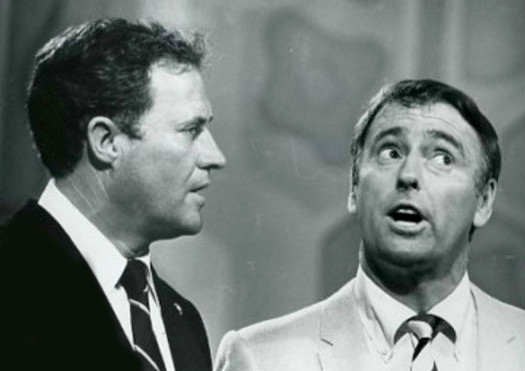
Rowan & Martin's Laugh-In (often simply referred to as Laugh-In) is an American sketch comedy television program that ran for six seasons from January 22, 1968, to July 23, 1973, on the NBC television network. The show, hosted by comedians Dan Rowan and Dick Martin, originally aired as a one-time special on September 9, 1967, and was such a success that it was brought back as a series, replacing The Man from U.N.C.L.E. on Mondays at 8 pm (ET). It quickly became the most popular television show in the United States.
The title of the show was a play on 1960s Hippie culture "love-ins" or counterculture "be-ins", terms which were derived from the "sit-ins" common in protests associated with civil rights and antiwar demonstrations of the time. In the pilot episode, Dan Rowan explained the show's approach: "Good evening, ladies and gentlemen, and welcome to television's first Laugh-In. Now for the past few years, we have all been hearing an awful lot about the various 'ins'. There have been be-ins, love-ins, and sleep-ins. This is a laugh-in and a laugh-in is a frame of mind. For the next hour, we would just like you to sit back and laugh and forget about the other ins."
Laugh-In had its roots in the humor of vaudeville and burlesque, but its most direct influences were Olsen and Johnson's comedies (such as the free-form Broadway revue Hellzapoppin'), the innovative television works of Ernie Kovacs (George Schlatter's wife Jolene Brand appeared in Kovacs' shows), and the topical TV satire That Was the Week That Was. The show was characterized by a rapid-fire series of gags and sketches, many of which were politically charged or contained sexual innuendo. The co-hosts continued the exasperated "straight man" (Rowan) and "dumb guy" (Martin) double act that they had established as nightclub comics.[1][page needed]
The show featured Gary Owens as the on-screen radio continuity announcer, and an ensemble cast. Ruth Buzzi appeared throughout the show's six-year run, while others appeared in at least three seasons including Judy Carne, Henry Gibson, Goldie Hawn, Arte Johnson, Jo Anne Worley, Alan Sues, Lily Tomlin, Dennis Allen, and Richard Dawson.
In 2002, Rowan & Martin's Laugh-In was ranked number 42 on TV Guide's 50 Greatest TV Shows of All Time.[2]
Episodes
[edit]
Laugh-In was designed to be very lightly structured and consisted mainly of short comedic sketches. Some of these would reappear multiple times throughout an episode with variations on a theme, while others involved reoccurring characters created by the cast. In others, cast members and guest stars would simply appear as themselves, delivering jokes or reacting to a previous sketch. In addition to the announced guest star or stars of the evening, some recurring guest stars would appear unannounced multiple times through a season (which was easy to accomplish given the show's non-linear taping sessions). A trademark of the series was its (even shorter) blackout sketches, often involving rapid-fire cuts between two or more scenes or camera angles, set to a six-note musical sting (or at times, an elongated 16-note version). These were used as transitions into and out of commercials, among other places.
Each show started with a batch of sketches leading into Gary Owens' introduction, in which the cast and announced guest star(s) would appear behind open doors of the show's iconic, psychedelically painted "Joke Wall". Owens would also insert offbeat lines in his monotone, deadpan style, in the introductions and occasionally throughout the episode, generally facing a microphone to his side with one hand cupped to his ear (Owens' character loosened up and became "hipper" in later seasons).
After more short sketches leading into and out of the first commercial break, Rowan and Martin would walk in front of the show's homebase set to introduce the show and have a dialogue, generally consisting of Martin frustrating Rowan by derailing his attempt to do a proper introduction via misunderstandings or digressions.
Eventually, Rowan would end the introduction and invite the audience to the "Cocktail Party". This live to tape segment consisted of all cast members and occasional surprise celebrities dancing before a 1960s "mod" party backdrop, delivering one- and two-line jokes interspersed with a few bars of dance music. (This was similar in format to the "Word Dance" segments of A Thurber Carnival, and would later be imitated on The Muppet Show.)
Another weekly segment was "Laugh-In Looks at the News", which began with the female cast members singing the segment's opening theme in a different costumed set piece each week, often with the help of the guest star. The news varied in presentation over the years, but in the earlier seasons started with Martin reading the "News of the Present", with Rowan providing "News of the Future" and sketches depicting the "News of the Past". Alan Sues, in his "Big Al" character, would provide a typically clueless sports report.
"Mod, Mod World" was a group of sketches introduced by Rowan and Martin that fit into an announced theme. This segment is notable for being interspersed with film clips of some of the female cast members (most frequently Carne and Hawn) performing go-go dancing in bikinis to the segment's burlesque-inspired theme, with the camera periodically zooming into jokes or images that had been painted onto their bodies. The segment also usually included an additional musical number based on the topic, performed by cast members at the beginning and end of the segment, as well as in short bridges between sketches.
At the end of every show, after a final dialogue, Rowan would turn to his co-host and say, "Say good night, Dick", to which Martin replied, "Good night, Dick!", leading into the final Joke Wall segment. The cast would pop out of their doors and either tell jokes to the camera, to each other, or to Rowan and Martin, who stood in front, or just yell out, "Good night, Dick!" This would lead into and continue under the closing credits. There would be one final batch of skits, including a closing appearance from Owens. Up until the finale of Season 4, the last gag would be Arte Johnson's character, Wolfgang, the German soldier. He would slowly rise up from among some plants, look into the camera and say with a thick German accent, "Veeeeery eeenterestingk!" This would bring the episode to a conclusion - almost. The very last thing the television audience would hear is one pair of hands clapping several seconds after all the credits had rolled. This was the conclusion to almost every show up to the Season 5 finale. For Season 6, the television audience would hear a woman laughing (Ruth Buzzi) very strangely long after the credits had rolled.
Other segments and recurring characters, listed below, would come and go throughout the years.
Production seasons
[edit]


1967 Special
[edit]The September 9, 1967, was meant to be a special, sponsored by Timex, with guest stars: Pamela Austin, Ken Berry, Judy Carne, Barbara Feldon, and featuring Ruth Buzzi, Henry Gibson, Larry Hovis, Arte Johnson, Monte Landis, Jo Anne Worley, and Paul Weston and His Orchestra[3]
Season 1, 1968
[edit]Season 1 ran from January to April 1968 with 14 episodes. Gary Owens joined the cast in the first episode along with series regulars Pamela Austin, Eileen Brennan, Judy Carne, Ruth Buzzi, Henry Gibson, Larry Hovis, Arte Johnson, and Jo Anne Worley. Goldie Hawn joined the cast in the third episode. She had been under contract to Good Morning World at the time of the pilot. Eileen Brennan, Barbara Feldon, and Jack Riley made frequent appearances in both season 1 and 2. Riley usually did skits as President Lyndon Johnson.
Ian Bernard (1930–2020) was the musical director for all 6 seasons. He composed the show's theme song along with numerous other pieces.
Billy Barnes composed special comic and topical songs for the show's cast and guest stars. He was regularly seen playing a golden grand piano to accompany solos by cast members such as Ruth Buzzi, Alan Sues, and Jo Anne Worley and guest stars such as Dinah Shore and Lena Horne.
Cast departures: all continued on into Season 2 but Hovis.
Season 2
[edit]Season 2 (1968–1969): New regulars included Chelsea Brown, Dave Madden and Alan Sues.
Arte Johnson now insisted on star billing, apart from the rest of the cast. The producer mollified him by having on-screen radio continuity announcer Gary Owens read Johnson's credit as a separate sentence: "Starring Dan Rowan and Dick Martin! And Arte Johnson! With Ruth Buzzi..." This maneuver gave Johnson the star billing he wanted, but it also implied that he was still part of the ensemble cast.
Cast departures: Chelsea Brown and Dave Madden left at the end of season 2. Judy Carne officially left the show after episode 11 but did return for a few appearances in season 3.
Season 3
[edit]Season 3 (1969–1970): New regulars included Johnny Brown, Byron Gilliam, Teresa Graves, Jeremy Lloyd, Pamela Rodgers, and Lily Tomlin. Gilliam was a dancer in seasons 1 to 2 and promoted to cast member this season. Both Brown and Tomlin joined late in this season.
Cast departures and changes: After the season finale, Gilliam returned to being a regular dancer in The Cocktail Party scene and in occasional skits. He remained until the end of the series. Graves, Hawn, Lloyd, and Worley left after the season 3 finale. Tomlin remained until the series ended in 1973.
Season 4
[edit]Season 4 (1970–1971): There were major changes to the set and new additions to the cast. The overall psychedelia look was replaced with a more avant-garde ambience. The Cocktail Party set now consisted of oversized cutouts of celebrity and historical figures. The show began to depart from both its Hippie-esque "vibe" and humor and its leanings toward the counterculture of the 1960s. There were now significantly fewer jokes and less commentary about race relations and anti-Vietnam War sentiment.
New cast members: Dennis Allen, writer-actress Ann Elder, and tap dancer Barbara Sharma.
Cast departures: Gibson left after episode 10 and Johnson left after the season 4 finale.
Notable visits for season 4: Goldie Hawn made a guest appearance in episode 3. After she left Laugh-In she made two movies, There's a Girl In My Soup and Cactus Flower, for which she won an Academy Award. Teresa Graves made two consecutive appearances toward the end of season 4.
Season 5
[edit]Season 5 (1971–1972): Another new set design was introduced that combined abstract art with avant-garde. The Cocktail Party set now consisted of a main wall covered in mirrored tiles. The jokes, commentary and overall humor became even more mainstream in Season 5, and there were more schtick and vaudeville-styled musical numbers. The few political jokes told were mostly aimed at the Nixon administration. Around mid-season, the show began to air brief anti-drug messages at the end of each episode. In keeping with Laugh-In's groundbreaking nature, these messages strongly resembled 21st century GIFs.
New cast members: Hogan's Heroes alumni Richard Dawson and Larry Hovis. Both had been part of season 1. Child actor Moosie Drier was also added, doing solo cameo jokes.
Cast departures after the season 5 finale: Brown, Elder, Hovis, Sharma, and Sues. Dawson remained until the series ended.
During season 5 the show also celebrated its 100th episode. Former cast regulars Carne, Gibson, Graves, Johnson, and Worley returned for the festivities. Frequent guest stars Tiny Tim and John Wayne were also on hand to celebrate. This was Wayne's first guest appearance since 1968.
Season 6
[edit]Season 6 (1972–1973): This was Laugh-In's final season. Rowan and Martin assumed the executive producer roles from George Schlatter and Ed Friendly. A new set was designed that mixed abstract art with muted psychedelia colors. There was once again a visible studio audience. Ian Bernard, the show's musical director, and five other musicians became participants in the Cocktail Party scenes as the house band known as "Ian Bernard and His Band at Large". Owens would often incorrectly introduce them as "Ian Bernard and His Band of Irvine Quickies", " ...His Band of Lard" or "...His Band of Lies". Also new for the first few episodes was a group of six women dancers called "The Downtown Beauties", referring to the show's running joke of "beautiful downtown Burbank". The members of this group were in the Cocktail Party scenes and the group was featured for many of the musical numbers. The known names of these dancers are Janice Pennington, Mary Rowan (Dan's daughter), and Adele Yoshioko.
Cast (returning veterans): Allen, Buzzi, Dawson, Owens, and Tomlin. (New members:) child actor Moosie Drier, promoted to cast member and teamed with child actor Tod Bass, character comedian Brian Bressler (up to episode 10), comedienne Patti Deutsch, German model Lisa Farringer (episodes 13–24), Sarah Kennedy, folksy singer-comedian Jud Strunk, ventriloquist act Willie Tyler and Lester, and Donna Jean Young. Former regular Jo Anne Worley returned for two guest appearances, including the series finale.
Although Owens was not in the 1967 pilot and Buzzi was not in two episodes of season 1, of the more than three dozen entertainers to join the cast over the years only Rowan, Martin, Owens, and Buzzi were present from beginning to end.
This last season was not George Schlatter's property, so it was not included in the edited and condensed rerun package of half-hour episodes that was syndicated (through Lorimar Productions) to local stations in 1983 and later to Nick at Nite in 1987. Season 6 ultimately was shown for the first time since its original 1972 -1973 run when the entire series of full, uncut episodes began airing on Decades in 2017.
Cast Tenures
[edit]*Indicates an extended guest performer and not a regular cast member
- All Seasons: Dan Rowan, Dick Martin, Gary Owens, and Ruth Buzzi
- Special (1967): Pamela Austin, Ken Berry, Judy Carne, Barbara Feldon, Henry Gibson, Larry Hovis, Arte Johnson, Monte Landis, Jo Anne Worley, and Paul Weston and His Orchestra[3]
- Season 1 (1968): Eileen Brennan, Judy Carne, Henry Gibson, Goldie Hawn (episode 3 on), Larry Hovis, Arte Johnson, Roddy Maude-Roxby, Jo Anne Worley
- Season 2 (1968–69): Chelsea Brown, Judy Carne, Arte Johnson, Henry Gibson, Goldie Hawn, Jo Anne Worley, Dave Madden, Alan Sues, "Sweet Brother" Dick Whittington* (through episode 14), Charlie Brill and Mitzi McCall - "The Fun Couple"* (through episode 11), Pigmeat Markham* (through episode 14), Jack Riley* (episodes 4, 7, 12, 13, 16), J. J. Barry (episodes 15–19)*[citation needed] Byron Gilliam* (dancer), Barbi Benton* (dancer)
- Season 3 (1969–70): Johnny Brown (episodes 22 and 24, originally introduced as "John Brown"), Judy Carne (through episode 12), Henry Gibson, Byron Gilliam (through episode 13, but continued as a dancer and in occasional cameos), Stu Gilliam* (episodes 14, 16, 19, 20, 26), Goldie Hawn, Teresa Graves, Jeremy Lloyd, Arte Johnson, Pamela Rodgers, Alan Sues, Lily Tomlin (from episode 15), Jo Anne Worley
- Season 4 (1970–71): Dennis Allen, Johnny Brown, Ann Elder, Henry Gibson (through episode 10), Arte Johnson, Nancie Phillips (through episode 17), Alan Sues, Barbara Sharma, Lily Tomlin, Byron Gilliam* (dancer). In possible support of "AIM" - The American Indian Movement that began in 1968 - the producers hired Betty Ann Carr, of Cherokee heritage, Sandra Ego, of Mescalero Apache heritage, and Linda Redfearn, of Cherokee and Anglo ancestry, as dancers in the weekly Cocktail Party scene.
- Season 5 (1971–72): Dennis Allen, Johnny Brown, Richard Dawson, Ann Elder, Larry Hovis, Barbara Sharma, Alan Sues, Lily Tomlin, Moosie Drier* (child), Mona Tera* (child, 6 episodes), Byron Gilliam* (dancer). Apparently, as an economic measure, producers Rowan and Martin gave performers the occasional week off, so not all cast members appear in every episode this season or the next. Apart from Dan and Dick, only Ruth Buzzi, Alan Sues, Lily Tomlin, and Gary Owens appeared in every episode.
- Season 6 (1972–73): Dennis Allen, Moosie Drier (teamed with child actor Tod Bass through episode 10), Brian Bressler, Richard Dawson, Patti Deutsch, Lisa Farringer (episodes 13–24), Sarah Kennedy, Jud Strunk, Lily Tomlin, Willie Tyler and Lester, Donna Jean Young. Like the previous season, not all cast members appear in every episode. Only Ruth Buzzi and Gary Owens were considered essential to the program and thus appeared in every episode.
- Dancers – All 6 Seasons (this list is incomplete):
- Terri Alexander, Jeanine Barrat, Barbi Benton, Sandahl Bergman, Betty Ann Carr, Pat Doty, Sandra Ego, Byron Gilliam, Jayne Kennedy, Millie Knight, Connie Kreski, Lisa Moore, Janice Pennington, Dolly Read (Dolly Martin), Linda Redfearn, Beverly Reed, Mary Rowan, Carol Richards, Adele Yoshioko.

Regular guest performers
[edit]- Jack Benny (seasons 2–4, 6)
- Johnny Carson (seasons 1–6)
- Carol Channing (seasons 3–5)
- Tony Curtis (seasons 2–3, 5)
- Sammy Davis Jr. (seasons 1–4, 6)
- Phyllis Diller (seasons 2–4, 6)
- Barbara Feldon (seasons 1–2)
- Zsa Zsa Gabor (seasons 2–3)
- Bob Hope (seasons 1–2, 4)
- Peter Lawford (seasons 1–4)
- Lawford became Dan Rowan's son-in-law in 1971
- Rich Little (seasons 2, 4, 6)
- Jill St. John (seasons 1, 3, 5–6)
- Tiny Tim (seasons 1–3, 5)
- John Wayne (seasons 1–2, 5–6)
- Flip Wilson (seasons 1–4)
- Henny Youngman (seasons 2, 5–6)
Series writers
[edit]The writers for Laugh-In were: George Schlatter, Paul W. Keyes (head writer),[4][5] Larry Hovis (pilot only), Digby Wolfe, Hugh Wedlock Jr. and Allan Manings, Chris Bearde (credited as Chris Beard), Phil Hahn and Jack Hanrahan, Coslough Johnson[6] (Arte Johnson's twin brother), Marc London and David Panich, Dave Cox, Jim Carlson, Jack Mendelsohn and Jim Mulligan, Lorne Michaels (before he became the producer of Saturday Night Live)[7] and Hart Pomerantz, Jack Douglas, Jeremy Lloyd, John Carsey, Dennis Gren, Gene Farmer, John Rappaport and Stephen Spears, Jim Abell and Chet Dowling, Barry Took, E. Jack Kaplan, Larry Siegel, Jack S. Margolis, Don Reo and Allan Katz, Richard Goren (also credited as Rowby Greeber and Rowby Goren), Winston Moss, Gene Perret and Bill Richmond, Jack Wohl, Bob Howard and Bob DeVinney. Script supervisors for Laugh-In included Digby Wolfe (comedy consultant, season 1), Phil Hahn and Jack Hanrahan (season 2), Allan Manings (season 3), Marc London and David Panich (seasons 3–6), and Jim Mulligan (season 6).
Musical direction and production numbers
[edit]The musical director for Laugh-In was Ian Bernard.[8] He wrote the opening theme music, "Inquisitive Tango" (used in Season 1 and again permanently from season 4), plus the infamous "What's the news across the nation" number. He wrote all the musical "play-ons" that introduced comedy sketches like Lily Tomlin's character, Edith Ann, the little girl who sat in a giant rocking chair, and Arte Johnson's old man character, Tyrone, who always got hit with a purse. He also appeared in many of the Cocktail Party scenes, primarily Season 6, where he directed his band as they stopped and started between jokes. Composer-lyricist Billy Barnes wrote all of the original musical production numbers in the show, and often appeared on-camera, accompanying Johnson, Buzzi, Worley, or Sues, on a golden grand piano. Barnes was the creator of the Billy Barnes Revue of 1959 and 1960. For the entire 141-episode series of Laugh-In, including the pilot, the show's musical coordinator was West Coast bebop jazz pianist and composer Russ Freeman.
Post-production
[edit]The show was recorded at NBC's Burbank facility using two-inch quadruplex videotape. As computer-controlled online editing had not been invented at the time, post-production video editing of the montage was achieved by the error-prone method of visualizing the recorded track with ferrofluid and cutting it with a razor blade or guillotine cutter and splicing with adhesive tape, in a manner similar to film editing. This had the incidental benefit of ensuring the preservation of the master tape, as a spliced tape could not be recycled for further use. Laugh-In editor Arthur Schneider won an Emmy Award in 1968 for his pioneering use of the "jump cut" – the unique editing style in which a sudden cut from one shot to another was made without a fade-out.[9][page needed]
When the series was restored for airing by the Trio Cable Network in 1996, the aforementioned edits became problematic for the editors, as the adhesive used on the source tape had deteriorated during 20+ years of storage, making many of the visual elements at the edit points unusable. This was corrected in digital re-editing by removing the problematic video at the edit point and then slowing down the video image just before the edit point; time-expanding the slowed-down section long enough to allot enough time to seamlessly reinsert the audio portion from the removed portion of video.
Recurring sketches and characters
[edit]Sketches
[edit]| go-go dancers with bodypaint | |
 Goldie Hawn Being Painted for Role Goldie Hawn Being Painted for Role | |
| Goldie Hawn as Painted Dancer | |
| Goldie Hawn as Painted Dancer | |
| Judy Carne, Hawn, Chelsea Brown |
Frequently recurring Laugh-In sketches included:
- "Cocktail Party"; a live to tape segment consisting of all cast members and occasional surprise celebrities dancing before a 1960s "mod" party backdrop, delivering one- and two-line jokes interspersed with a few bars of dance music. (This was similar in format to the "Word Dance" segments of A Thurber Carnival, and would later be imitated on The Muppet Show.)
- "Mod, Mod World"; a group of sketches introduced by Rowan and Martin that fit into an announced theme. This segment is notable for being interspersed with film clips of some of the female cast members (Judy Carne, Ruth Buzzi, Goldie Hawn, Chelsea Brown, and others[10]) performing go-go dancing in bikinis to the segment's burlesque-inspired theme, with the camera periodically zooming into puns, jokes and images that had been painted onto their bodies. The segment also usually included an additional musical number based on the topic, performed by cast members at the beginning and end of the segment, as well as in short bridges between sketches.
- "Sock it to me"; Judy Carne was often tricked into saying the phrase ("It may be rice wine to you, but it's sake to me!"), which invariably results in her (or other cast members) falling through a trap door, being doused with water, or playfully assaulted in various other manners. The phrase was also uttered by many of the cameo guest stars, most notably Richard Nixon, though they were almost never subjected to the same treatment as Carne. The phrase was "retired" after Carne left the series. In the last season where Alan Sues was a regular, he would be the one who got water thrown on him after a ticking alarm clock went off.
- "The Farkel Family", a couple with numerous children, all of whom wore round glasses, had bright red hair and large freckles - strikingly similar to their "good friend and trusted neighbor" Ferd Berfel (Dick Martin). The sketch employed diversion humor, the writing paying more attention to the lines said by each player, using alliterative tongue-twisters ("That's a fine-looking Farkel flinger you found there, Frank"). Dan Rowan played father Frank Farkel the Third, Jo Anne Worley, Barbara Sharma, and Patti Deutsch played his wife Fanny Farkel, Goldie Hawn played Sparkle Farkel, and Arte Johnson played Frank Farkel the Fourth. Ruth Buzzi played Flicker Farkel, who wore a frilly dress and would contort herself and roll on the floor and loudly say "HIIIIII!" in a very high-pitched voice. Two of the children were twins named Simon and Gar Farkel, played by cast members of different races (Teresa Graves and Pamela Rodgers in the third season; Johnny Brown and Dennis Allen in the fourth). By the final season the Farkel offspring had dwindled to only two children, played by Ruth Buzzi and the puppet Lester. All of the Farkel skits were written or co-written by David Panich.
- "Here Comes the Judge". The judge, originally portrayed by British comic Roddy Maude-Roxby, was a stuffy magistrate with a black robe and oversized judge's wig. Each sketch featured the judge trading barbs with a defendant brought before him. On delivery of the punchline, he would strike the defendant with an inflated bladder balloon tied to the sleeve of his robe. Guest stars Flip Wilson or Sammy Davis Jr. would introduce the sketch saying "Here come da judge!", which was a venerable catchphrase by nightclub comedian Pigmeat Markham. Surprised that his trademark had been appropriated, Markham asked producer George Schlatter to let him play the judge himself; Schlatter agreed and Markham presided for the first half of the second season. After Markham left, the sketch was briefly retired until Sammy Davis Jr. donned the judicial robe and wig during his guest appearances, making the role his own. The character was introduced as "The Right Honorable Samuel Davis, Junior" (or "Right Hon." for short). Davis introduced each sketch with a spoken verse like "If your lawyer's sleepin', better give him a nudge! Everybody look alive 'cause here come de judge!" Davis would then strut off stage chanting "Here come de judge! Here come de judge!"
- "Laugh-In Looks at the News", a parody of network newscasts. It first appeared in the pilot episode in a slightly different format, meant to show how a news broadcast would run if presented as a weekly variety show. The segment was introduced by the female cast members singing the segment's opening theme in a different costumed set piece each week, often with the help of the guest star, in a highly un-journalistic manner - with clever production numbers that had intricate choreography and amazing costume design. The sketch was originally called the Rowan and Martin Report (a take-off on the Huntley-Brinkley Report, Hovis had mimicked Brinkley in the Pilot/Special). The sketch itself featured Martin reading the "News of the Present", humorously reporting on current events, which then segued into Dan reporting on "News of the Future" (20 years later), and sketches depicting the "News of the Past". "News of the Future" segments, on at least two occasions, correctly predicted future events, one being that Ronald Reagan would be president in 1988, and another that the Berlin Wall would finally come down in 1989 (S2 E23). This segment was influenced by the BBC's That Was the Week That Was, and in turn inspired Saturday Night Live's "Weekend Update" segments (SNL creator Lorne Michaels was a Laugh-In writer early in his career). The News segments were followed by "Big Al" (Sues) and his sports report in seasons 2–5. After Sues left the show, Jud Strunk took over the sports segment ("reporting from the sports capital of Farmington, Maine") by featuring films of oddly-named events which were actual sports films played backwards. An example is the "Cannonball Catch", featuring a backwards film of a bowling tournament where the "cannonballs" (bowling balls) are caught one-handed by the catcher (the bowler) after rolling up the alley.
- "New Talent Time" also called "Discovery of the Week" in later seasons. It introduced oddball variety acts (sometimes characters played by regular cast members). Laugh-In writer Chris Beard (later known as Chris Bearde) took the "New Talent" concept and later developed it into The Gong Show.
- Tin Pan Alley musician Tiny Tim – The most notable of these performances was in episode 1 and shot him to fame. He returned in the Season 1 finale, made several guest appearances after, and was there for the series finale.
- Actor Paul Gilbert (adoptive father of actress Melissa Gilbert) appeared in three episodes as an inept French juggler, introduced as "Paul Jill-bare".
- The Holy Modal Rounders, 14 October 1968
- 6'2" actress Inga Neilsen made appearances as a bugle/kazoo player who could only play one note of "Tiger Rag" and had to deal with Martin's advances. Martin, who showed mild interest in most New Talent acts, enthusiastically cheered her on despite the obvious lack of talent.
- Ventriloquist Paul Winchell appeared three times as "Lucky Pierre", whose puppets would fall apart or die on him.
- Arte Johnson would appear as his Pyotr Rosmenko character looking for his big American break, singing gibberish in a Russian accent.
- Murray Langston, made an appearance. He would later achieve fame as the Gong Show's "Unknown Comic".
- "The Flying Fickle Finger of Fate Award" sardonically recognized actual dubious achievements by public individuals or institutions, the most frequent recipients being members or branches of the government. The trophy was a gilded left hand mounted on a trophy base with its extended index finger adorned with two small wings. The award was created by Paul Keyes and Jack Hanrahan, with the former credited with its name and the latter the trophy.[11]
- "The Wonderful World of Whoopee Award" was a counterpart to the "Flying Fickle Finger of Fate Award", described by Rowan as a citation "for the little man who manages to outfight or outfox the bureaucracy"; the statue was similar to the Finger of Fate, only it was a right hand (without wings on the index finger) pointing straight up, and with a hidden mechanism that, when activated, waved the finger in a circular motion.
- "The C.F.G. Automat"; a vending machine whose title was an inside joke for cast members who referred to producer Schlatter as "Crazy F***ing George". The vending machine would distribute oddball items that were a play on the name. Examples: The 'pot pie' produced a cloud of smoke when the door was opened, then the pie floated away. The 'ladyfingers' was a woman's hand reaching out and tickling Arte's face while another 'ladyfingers' door opened and picked his pocket.
- Many episodes were interspersed with a recurring, short wordless gag in which an actor repeatedly tried to accomplish some simple task like entering an elevator, opening a window or door, watering a plant, etc., which would fail each time in a different, surprising way (the object would move unexpectedly, another part of the wall or room would move, water would squirt the actor in the face from the object, etc.)
- Another recurring wordless gag involved one or more actors walking around the street in a jerky fashion (using stop-motion or low shutter speed filming) holding and turning a bare steering wheel, as if they were driving a car or actually were a car, with various sound effects to simulate honking, back-ups, collisions with each other, etc.
- From season 4 on, a variety of sketches or jokes used the word "Foon", usually as part of the name of imaginary products or persons (e.g., Foon detergent, Mr. Foonman). The names "Nern" and "Wacker" were used similarly from Seasons 1 through 3.
- "Questions From The Audience / Dick's Costumes"; In the sixth season, Dan Rowan would ask the audience if anybody had any questions about the show or otherwise. As he was doing so (in which nobody in the audience ever spoke up), Dick Martin would come out wearing a wacky costume which Rowan would ask about, leading to a humorous exchange on the costume's subject matter.
Characters
[edit].JPG)
- Dan Rowan, in addition to hosting, provided the "News Of The Future" and also appeared as General Bull Right, a far-right-wing representative of the military establishment and outlet for political humor.
- Dick Martin, in addition to hosting would also play the drunken Leonard Swizzle, husband of an equally drunk Doris Swizzle (Ruth Buzzi); and a character always buzzing for an elevator on which the doors never closed in a normal way
- Gary Owens as an on-screen radio continuity announcer, who regularly stands in an old-time radio studio (acoustic tiles, large microphone), with his hand cupped over his ear, making announcements, often with little relation to the rest of the show, such as (in an overly-dramatic voice), "Earlier that evening ..."
- Arte Johnson:
- Wolfgang, the WWII German soldier who was unaware the war was over – Wolfgang would often peer out from behind a potted palm and comment on the previous gag saying, with a thick German accent, "Verrry in-te-res-tink", sometimes with comments such as "... but shtupid!" He eventually closed each show by talking to Lucille Ball and her husband Gary Morton, as well as the cast of Gunsmoke — both airing opposite Laugh-In on CBS; as well as whatever was on ABC. Johnson later repeated the line while playing Nazi-themed supervillain Virman Vundabar on an episode of Justice League Unlimited. Johnson also reprised his Wolfgang character in a series of skits for the second season of Sesame Street (1970–1971), and in 1980 for a series of small introductory skits with a plant on 3-2-1 Contact, during the "Growth/Decay" week.
- Tyrone F. Horneigh (pronounced "hor-NIGH", presumably to satisfy the censors) was a "dirty old man" who was always after drab spinster Gladys Ormphby (Ruth Buzzi). As she sat on a park bench he would attempt to sit right next to her, eventually forcing her to the edge of the bench. Gladys always rebuked Tyrone's advances and would clobber him multiple times with her purse until he would make a final comment about his well-being and do a slow roll off the bench. Both Tyrone and Gladys later became animated characters (voiced by Johnson and Buzzi) in "The Nitwits" segments of the 1977 Saturday morning animated television show, Baggy Pants and the Nitwits.
- Pyotr Rosmenko, a Russian man, stands stiffly and nervously in an ill-fitting out-of-fashion 1940s pin-striped suit while commenting on differences between America and "the old country", such as "Here in America, is very good, everyone watch television. In old country, television watches you!" This type of joke has come to be known as the Russian reversal.
- Rabbi Shankar (a pun on Ravi Shankar) was an Indian guru who dresses in a Nehru jacket dispensing pseudomystical Eastern wisdom laden with bad puns. He held up two fingers in a peace sign whenever he spoke.
- An unnamed character in a yellow raincoat and hat, riding a tricycle and then falling over, was frequently used to link between sketches. The character was portrayed by many people besides Johnson, including his brother Coslough (a writer for the show), Alan Sues, and Johnny Brown.
- The Scandinavian Storyteller – spoke gibberish, including nonsensical 'Knock Knock' jokes in the Joke Wall. No one could ever understand him. Possibly inspiration for the Muppets' Swedish Chef character.
- The Psychiatrist - a black haired, black clad doctor who often attends the Cocktail Party during season four and talks about his experiments and patients with a thick Freudian accent.
- Ruth Buzzi:
- Gladys Ormphby – A drab, relatively young spinster, in the Close-up segments, including Cocktail Party segments, she is portrayed as desperate for males, in the Arte Johnson segments, she is the eternal target of Arte Johnson's Tyrone, whom she rebukes, then attacks; when Johnson left the series, Gladys retreated into recurring daydreams, often involving marriages to historical figures, including Christopher Columbus and Benjamin Franklin (both played by Alan Sues). She typically hit people repeatedly with her purse. The character was recreated, along with Tyrone, in Baggy Pants and the Nitwits. Buzzi also performed as Gladys on Sesame Street and The Dean Martin Show, most notably in the Celebrity Roasts.
- Doris Swizzle – A seedy barfly, she is paired with her husband, Leonard Swizzle, played by Dick Martin.
- Kim Hither – An exceedingly friendly hooker, commonly seen in sketches or at the Cocktail Party propositioning people while leaning against a lamppost.
- Busy Buzzi – A cold and heartless old-style Hedda Hopper-type Hollywood gossip columnist.
- Kathleen Pullman – A wicked parody of televangelist Kathryn Kuhlman. This always helpful but overdramatic woman is always eager to help people.
- Laverne Blossom - A former silent movie star (an Alla Nazimova as Marguerite Gautier in Camille homage) with dark make-up around the eyes. She often attends the Cocktail Party in the later seasons.
- Florence Lawrence - a meek wannabe secretary with giant teeth. Also attends the Cocktail Party during the back half of season four.
- Alice Capone - tells jokes during the Syndicate news segment in Season 6. Wears cotton stuffed in her mouth to resemble Marlon Brando in The Godfather.
- Henry Gibson:
- The Poet held an oversized flower and nervously read offbeat poems. (His stage name was a play on the name of playwright Henrik Ibsen.)
- The Parson – A character who makes ecclesiastical quips. In 1970, he officiated at a near-marriage for Tyrone and Gladys.
- Would frequently just pop up and utter the phrase "Marshall McLuhan, what are you doin'?".
- Also played a cub reporter for Busy Buzzi. While she was looking for a scoop, Gibson would come in with one (usually about Steve McQueen) which Buzzi would completely garble up to sound like something out of left field.
- Goldie Hawn is best known as the giggling "dumb blonde", stumbling over her lines, especially when she introduced Dan's "News of the Future". In the earliest episodes, she recited her dialogue sensibly and in her own voice, but as the series progressed, she adopted a Dumb Dora character with a higher-pitched giggle and a vacant expression, which endeared her to viewers. Frequently did a Donald Duck voice at inappropriate times, such as when she was expected to sing or doing ballet.

- Lily Tomlin:
- Ernestine/Miss Tomlin – An obnoxious telephone operator, she has no concern at all for her customers and constantly mispronounced their names. Her close friend is fellow telephone operator, Phenicia; and her boyfriend, Vito. She would boast of being a high school graduate. Tomlin later performed Ernestine on Saturday Night Live and Happy New Year, America. She also played the Ernestine character for a comedy album called This Is A Recording and also made guest appearances as the character on shows and TV specials, such as Sesame Street, The Electric Company, Free to Be... a Family, and Sesame Street Stays Up Late!, in the last of which Oscar calls the operator and harangues her into hooking him up with five of his Grouch relatives. At the suggestion of CFG, Ernestine began dialing with her middle finger in Season 4, sometimes blatantly flipping "the bird" to the camera as a result. Censors never caught on – "we know she's doing something wrong, we just can't put our finger on it!"
- Edith Ann – A 5+1⁄2-year-old child, she ends each of her short monologs with: "And that's the truth", followed by blowing a raspberry. Tomlin performs her skits in an oversized rocking chair that makes her appear small. Tomlin later performed Edith Ann on children's shows such as Sesame Street and The Electric Company.
- Mrs. Earbore (the "Tasteful Lady") – A prim society matron, Mrs. Earbore expressed quiet disapproval about a tasteless joke or remark, and then rose from her chair with her legs spread, getting doused with a bucket of water or the sound of her skirt ripping.
- Dotty – A crass and rude grocery checker who tended to annoy her customers at the store where she worked.
- Lula – A loud and boisterous woman with a Marie Antoinette hair-do who always loved a party.
- Suzie Sorority of the Silent Majority – clueless sorority college student who ended each bit with "Rah!"
- The Babbler – A character given to speaking exuberantly and at great length while digressing after every few words and never staying on one subject, producing an unbroken, incomprehensible monolog.[12][13]

- Judy Carne had two characters known for their robotic speech and movement:
- Mrs. Robot in "Robot Theater" – A female companion to Arte Johnson's "Mr. Robot".
- The Talking Judy Doll – She is usually played with by Arte Johnson, who never heeded her warning: "Touch my little body, and I hit you!"
- The Sock-It-To-Me Girl in which she would usually end up being splashed with water and/or falling through a trap door and/or getting conked on the head by a large club or mallet and/or knocked out by a boxing glove on a spring.
- Jo Anne Worley sometimes sings off-the-wall songs using her loud operatic voice or displaying an advanced state of pregnancy, but is better remembered for her mock outrage at "chicken jokes" and her melodic outcry of "Bo-ring!". At the cocktail parties, she would talk about her never-seen married boyfriend/lover "Boris" (who, according to her in a Season 3 episode, was finally found out by his wife).
- Alan Sues:
- Big Al – A clueless and fey sports anchor, he loves ringing his "Featurette" bell, which he calls his "tinkle".
- He would dress in drag as his former co-star, Jo Anne Worley, including skits where he appeared as a "fairy godmother". imitating Worley's boisterous laugh and offering help or advice to a Cinderella-type character in a conversation full of double entendres.
- Uncle Al, the Kiddies' Pal – A short-tempered host of a children's show, he usually goes on the air with a hangover: "Oh, kiddies, Uncle Al had a lot of medicine last night." Whenever he got really agitated, he would yell to "Get Miss Twinkle on the phone!"
- Grabowski – a benchwarmer football player obviously not cut out for the sport. Example lines included "He pushed me! He pushed me!... they all pushed me!" and "No, you can't wear your ballet slippers on the field, Grabowski!"
- Boomer – A self-absorbed "jock" bragging about his athletic exploits.
- Ambiguously gay saloon patron – while Dan and Dick ordered whiskey, he would saunter up to the bar and ask for a fruit punch or frozen daiquiri.
- In the last season where he was a regular, he would be the one who got water thrown on him after a ticking alarm clock went off (replacing Judy Carne as the one who always got drenched).
- Pamela Rodgers – "Your man in Washington"; she would give 'reports' from the Capitol that were usually double entendres to give the impression that the Congressmen were fooling around with her.
- Jeremy Lloyd – scrunched himself into an ultra-short character a la Toulouse-Lautrec.
- Dennis Allen:
- Lt. Peaches of the Fuzz – a stumble-bum police officer.
- Chaplain Bud Homily – a droll clergyman who often falls victim to his own sermons.
- Eric Clarified (a play on news commentator Eric Sevareid) – a correspondent for Laugh-In Looks at the News who further muddles up obfuscatory government statements he has been asked to clarify. Rowan would often throw to another correspondent (played by Sues) to analyze Eric Clarified's statements in turn.
- Barbara Sharma:
- The Burbank Meter Maid – a dancing meter maid who tickets anything from trees to baby carriages.
- An aspiring actress who often plays foil in cocktail-party segments to another "high-society" character (Tomlin).
- In season four, a Ruby Keeler-esque dancer (and arch-nemesis of Johnson's Wolfgang) who often praises Vice President Spiro Agnew.
- Johnny Brown lent his impersonations of Ed Sullivan, Alfred Hitchcock, Ralph Kramden and the Kingfish from Amos 'n' Andy.
- Ann Elder as Pauline Rhetoric (a play on NBC reporter Pauline Frederick), the chief interviewer for the Laugh-In News segments.
- Moosie Drier and Todd Bass – Drier did the "kids news for kids" segment of the Laugh-In news. Bass teamed with Drier in Season 6 to read letters from a treehouse
- Larry Hovis – the Senator, the Texan, David Brinkley, Father Time
- Richard Dawson – W.C. Fields, Groucho Marx, Hawkins the Butler, who always started his piece by asking "Permission to ...?" and proceeded to fall over.
- Roddy Maude-Roxby, Pigmeat Markham – Here Come Da Judge (Roxby for Season 1, Markham for Season 2)
- Dave Madden – would always throw confetti after "a naughty thought", usually a punch line that was a double-entendre. Once while kissing Carne, confetti erupted around him.
- Jud Strunk – sports news segment ("reporting from the sports capital of Farmington, Maine"), Vidal Bassoon (play on Vidal Sassoon) with the Bald News (who tears off a wig to reveal a bald cap each time).
- Patti Deutsch - Sister Mary Youngman (a nun who tells jokes a la Henny Youngman), Heavy Helen who presents the Hippy news.
Memorable moments
[edit] | This section needs additional citations for verification. (February 2020) |
The first season featured some of the first music videos seen on network TV, with cast members appearing in films set to the music of the Nitty Gritty Dirt Band, the Bee Gees, the Temptations, the Strawberry Alarm Clock, and the First Edition.
During the September 16, 1968, episode, Richard Nixon, running for president, appeared for a few seconds with a disbelieving vocal inflection, asking "Sock it to me?" Nixon was not doused or assaulted. An invitation was extended to Nixon's opponent, Vice President Hubert Humphrey, but he declined.[14] According to George Schlatter, the show's creator, "Humphrey later said that not doing it may have cost him the election", and "[Nixon] said the rest of his life that appearing on Laugh-In is what got him elected. And I believe that. And I've had to live with that."[4][15] In an episode of the ill-fated 1977 revival, Rich Little as Nixon says, "I invited the American people to sock-it-to-me.... you can stop now".[citation needed]
After winning the Academy Award for Best Supporting Actress in Cactus Flower, Goldie Hawn made a guest appearance in the third episode of the fourth season. She began the episode as an arrogant snob of an actress; however, a bucket of water thrown at her transformed her back to her giggling dumb blonde persona.
On multiple occasions, producer George Schlatter attempted to get William F. Buckley Jr. to appear on the show, only to be refused each time until he suddenly agreed to an appearance. In the episode that aired December 28, 1970, Buckley appeared in an unusual sit-down segment (portions of which were scattered throughout the episode) flanked by Rowan and Martin and fielding questions from the cast (which included Lily Tomlin doing her Babbler and Ernestine shticks) and giving humorous answers to each. Near the end, when Rowan asked Buckley why he finally agreed to appear on the show, Buckley explained that Schlatter had written him "an irresistable letter" in which he promised to fly Buckley out to Burbank "in an airplane with two right wings". At the end, Rowan thanked him for appearing: "You can't be that smart without having a sense of humor, and you have a delightful one."
The 100th episode featured John Wayne, Tiny Tim and the return of several former cast members. Wayne, with his ear cupped, read the line "and me, I'm Gary Owens" instead of Owens himself. Wayne also shook Tiny Tim's hand, pretending that his grip was too overpowering.
Catchphrases
[edit] | This section may contain an excessive amount of intricate detail that may only interest a particular audience. (June 2022) |
In addition to those already mentioned, the show created numerous catchphrases (for a full description of characters and recurring characters, see above sections.):
- "Look that up in your Funk and Wagnalls!"—said primarily by cast members. F & W was a lesser-known, cheaply made and sold in supermarkets,[16] as a door-buster, set of encyclopedia volumes whose phonetically tricky name was aimed at the NBC censors to poke fun of them by both Laugh-In and The Tonight Show Starring Johnny Carson. Originally coined by Pigmeat Markham.
- "Sock it to me!"—got the most exposure from this show. It had been used in two songs released in 1966 - two years before Laugh-In went on the air in 1968 as a series. The first was "Sock It To Me, Baby!" by Mitch Ryder & The Detroit Wheels and the second was "Respect" by Aretha Franklin. She repeatedly sang the phrase in her chart-topping hit. The phrase was retired after Season 3, when Carne left the series.
- "You bet your sweet bippy!"—said primarily by Dick Martin.
- "Beautiful downtown Burbank"—cast and guests. A tongue-in-cheek reference to the Los Angeles suburb in which the NBC studios were located and where the show was filmed. The same phrase was frequently used by Johnny Carson on The Tonight Show Starring Johnny Carson.
- "Here come de Judge!"—this Pigmeat Markham sing-song phrase was brought to the show by Sammy Davis Jr. in season 1. He wore an American judge's robe with a British judge's white wig and had a new rhyme with each appearance. Used primarily in Seasons 1–3.
- "Verrry in-te-res-ting."—done in a thick German accent by Wolfgang (Johnson) the soldier.
- "Blow in my/his/her ear and I/he/she will follow you anywhere."—cast and guests.
- "One ringy-dingy ... two ringy-dingys ..."—used solely by Ernestine (Lily Tomlin), the obnoxious telephone operator. She would mimic the rings while waiting for someone to pick up the receiver.
- "A gracious good afternoon. This is Miss Tomlin of the telephone company. Have I reached the party to whom I am speaking?"—Ernestine's greeting to people she would call. She always mispronounced the names of famous people, such as: Gore Vidal, who was "Mr. Veedle" or "Gory", William F. Buckley was "Mr. F'buckley", Richard Nixon was simply "Milhous".
- "I just wanna swing!"—Gladys Ormphby's catchphrase.
- "Ring my chimes!"—Flip Wilson.
- "Was that another chicken joke?" –- Jo Anne Worley's outraged cry. A spoof of people's complaints about Polish jokes.
- "Think about it"—used by cast members after a pun, especially one that stumped the censors.
- "Now, that's a no-no!"—cast and guests.
- "And that's the truth – PFFFFT!"—Edith Ann.
- "Go to your room!" -– cast members and guests. Used as a response to a particularly bad joke.
- "Want a Walnetto?"—a pickup line first used by Tryone on Gladys. (Anything he said to her resulted in a purse drubbing.)
- "Oh... that Henny Youngman!" -– preceded by cast members quoting a series of his punchlines in succession, but without the jokes leading up to them.
- "He pushed me!" –- usually said by Sues when another cast member would bump him.
- "Marshall McLuhan, what are you doin'" –- uttered by Gibson randomly between sketches.
- "How does that grab you?" and "BORRRRING!!!"—loudly sung by Jo Anne Worley.
- "I/he/she am/is/was was a much better person for that." –- cast and guests.
- "Well, I'll drink to that", "I did not know that!", "Whatever turns you on" –- Dick Martin.
- "Goodnight, Lucy." -– During the first three seasons, Laugh-In was scheduled opposite Lucille Ball's third television series, Here's Lucy. At the end of the show, one or more cast members would say, "Goodnight, Lucy."
- "Goodnight, Dick." –- the closing portion of each episode of Seasons 1 and 2 which began with the cast and celebrities taking turns saying "Goodnight, Dick!". Occasionally, one of the celebrities would say "Who's Dick?". This shtick was revived in the 6th season, usually after the end credits.
- "Gotcha!"—cast and guests.
- "Wr-r-r-ong!" –- uttered first by Otto Preminger in a cameo. Subsequent cameo actors would repeat the line, mimicking Preminger's delivery of it.
- "I think I've got it too." –- running gag where the person would say this and start scratching themselves as if they caught a skin disease.
- "That's not funny"—cast members and guests.
- "Wacker." –- a surname that was frequently used in sketches beginning in Season 2. It originated after Bobby Darin had done a skit with Martin and proceeded to call him 'Wacker' throughout the rest of the episode.
- "Foonman" - another surname frequently used in skits after Season 4.
- "I've Got a Secret" (paying homage to the game show) -- a running gag during the first two seasons. Celebrities made cameos claiming to be a celebrity of the opposite gender then state, "...and I've REALLY got a secret!".
- "Morgul the Friendly Drelb" –- a pink Abominable Snowman-like character that was introduced in the second episode. It bombed so badly that his name was used in various announcements by Owens for the rest of the series. The name was usually used after the introduction of the cast - "Yours truly, Gary Owens, and Morgul as the Friendly Drelb!"
Merchandise tie-ins and spin-offs
[edit].jpg)
A chain of Laugh-In restaurants opened in several states during 1968–69; primarily in Michigan, Ohio and Florida. Psychedelically themed like the show, they offered such menu items as Bippy Burgers, Is That A Chicken Joke Chicken, Fickle Finger Of Fate Fries, Beautiful Downtown Burbank Burgers, Fickle Finger Franks, Verrrry Interesting Sandwiches, I'll Drink To That beverages, Sock It To Me soups, Laugh-In Fortune Cookies and Here Come Da Fudge sundaes. Staff often rode around on red tricycles wearing yellow raincoats and hats. All locations were closed by the mid-1970s. Menus, French fry bags, sandwich wraps, napkins, salt and pepper shakers and other memorabilia are still sold on EBay.
A humor magazine tie-in, Laugh-In Magazine, was published for one year (12 issues: October 1968 through October 1969—no issue was published December 1968), and a 1968-1972 syndicated[17] Sundays and daily newspaper comic strip was drawn, without actors likeness, by Roy Doty[18] and eventually collected for a paperback reprint.[19][20][21]
The Laugh-In trading cards from Topps had a variety of items, such as a card with a caricature of Jo Anne Worley with a large open mouth. With a die-cut hole, the card became interactive; a finger could be inserted through the hole to simulate Worley's tongue. Little doors opened on Joke Wall cards to display punchlines.
On Letters to Laugh-In, a short-lived spin-off daytime show hosted by Gary Owens, cast members read jokes sent in by viewers, which were scored by applause meter. The eventual winning joke was read by actress Jill St. John: "What do you get when you cross an elephant with a jar of peanut butter? A 500 pound sandwich that sticks to the roof of your mouth!"
A cross-promotional episode of I Dream of Jeannie ("The Biggest Star in Hollywood", February 1969) features Judy Carne, Arte Johnson, Gary Owens, and producer George Schlatter playing themselves in a story about Jeannie being sought after to appear on Laugh-In.
In 1969, a Laugh-In View-Master packet was issued by General Aniline and Film (GAF); The packet featured 21 3D images from the show.[22]
The horror spoof film The Maltese Bippy (1969,) starring Dan Rowan and Dick Martin as low-budget moviemakers, was loosely related to the series. Pamela Rodgers was the only Laugh-In cast member to co-star in the film. The film received only a token release by Metro-Goldwyn-Mayer—it never even appeared in many key cities—and its disappointing performance resulted in no further Rowan & Martin films.
In 1969, the 1969 Pontiac GTO 2 Door Hardtop "The Judge" was an options package: rear spoiler, striped body paint and "The Judge" decals, and engines: 366 hp Ram Air III, or 370 hp Ram Air IV.[23][24][25]
In 1969, Sears, Roebuck and Company produced a 15-minute short, Freeze-In, which starred series regulars Judy Carne and Arte Johnson. Made to capitalize on the popularity of the series, the short was made for Sears salesmen to introduce the new Kenmore freezer campaign. A dancing, bikini-clad Carne provided the opening titles with tattoos on her body.[26]
Two LPs of material from the show were released: the first on Epic Records (FXS-15118, 1968); the second, which did not feature Rowan or Martin, was entitled Laugh-In '69 and released on Reprise Records (RS 6335, 1969).
"Murder on High C", a 1975 episode of the TV series Get Christie Love!, which starred former cast member Teresa Graves, featured a number of other Laugh-In cast members, including the villain (Arte Johnson), Johnny Brown, Judy Carne, Henry Gibson, Gary Owens and Joanne Worley.
DVD releases
[edit]On June 24, 2003, and then February 24, 2004, Rhino Entertainment Company (under its Rhino Retrovision classic TV entertainment brand), under license from the rightsholder at the time, SFM Entertainment, released two respective The Best Of releases of the show, each containing six episodes presented in its original, uncut broadcast version. In 2003, Rhino, through direct-response marketing firm Guthy-Renker, also released a series of DVDs subtitled The Sock-It-To-Me Collection, with each DVD containing two episodes.
On June 19, 2017, Time Life, another direct-response marketer, released Rowan & Martin's Laugh-In: The Complete Series on DVD in Region 1, in a deal with current rightsholder Proven Entertainment.[27] The 38-disc set contains all 140 episodes of the series, complete and uncut, restored and remastered as well as many bonus features and a special 32-page collector's book.
On September 5, 2017, Time Life began releasing individual complete season sets on DVD, beginning with the first season.[28] This was followed by the second season on January 9, 2018,[29] and the third season on March 6, 2018.[30] The fourth season was released on May 8, 2018.[31] Season 5 was released on July 10, 2018. Finally, Season 6 was released on September 4, 2018.[32]
| DVD name | Ep # | Release date |
|---|---|---|
| The Complete First Season | 14 | September 5, 2017 |
| The Complete Second Season | 26 | January 9, 2018 |
| The Complete Third Season | 26 | March 6, 2018 |
| The Complete Fourth Season | 26 | May 8, 2018 |
| The Complete Fifth Season | 24 | July 10, 2018 |
| The Complete Sixth Season | 24 | September 4, 2018 |
| The Complete Series | 140 | June 19, 2017 |
Ratings
[edit]TV season, ranking, average viewers per episode
Revival
[edit]In 1977, Schlatter and NBC briefly revived the property as a series of specials – titled simply Laugh-In – with a new cast. The standout was a then-unknown Robin Williams, whose starring role on ABC's Mork & Mindy one year later prompted NBC to rerun the specials as a summer series in 1979. Also featured were Wayland Flowers and Madame (as well as his other puppet, "Jiffy"), former child evangelist Marjoe Gortner, former Barney Miller actress June Gable, Good Times actor Ben Powers, Bill Rafferty of Real People and comedian Ed Bluestone.[39] Barry Goldwater appeared in three episodes.[40] Rowan and Martin, who owned part of the Laugh-In franchise, were not involved in this project. They sued Schlatter for using the format without their permission, and won a judgment of $4.6 million in 1980.
In 1987, George Schlatter attempted a revival of the program called George Schlatter's Comedy Club, the weekly half-hour program that appeared in syndication through King World Productions during the 1987-1988 television season. Featuring stand-up comedy routines alongside quick comedy sketches similar to Laugh-In, the series was hosted by Schlatter himself.[41]
In 2019, Netflix produced a special tribute to the original series entitled, Still Laugh-In: The Stars Celebrate.[42] Tomlin, Buzzi and Worley appeared in the special.
Retrospective criticism
[edit]Critics' views in retrospect, while noting that the show was groundbreaking and unique, have also indicated that it has not aged well.[43] Various aspects of the show are now recognized as being racist in current times and other portrayals stereotyped gay people and women.[44] While the show included Black actors and made occasional comments on racism, at the same time the show also featured White actors portraying Asian people in "yellowface" and offensive portrayals of Native Americans.[45] The show's humor was generally appreciated at the time and some skits and jokes were even quite progressive; however, other aspects are often not seen as humorous in the context of modern-day standards.[46]
Awards and honors
[edit]Emmy Awards
- Won:
- 1968: Outstanding Musical or Variety Program, George Schlatter (for the September 9, 1967, special)
- 1968: Outstanding Musical or Variety Series, George Schlatter
- 1968: Outstanding Writing Achievement in Music or Variety, Chris Bearde, Phil Hahn, Jack Hanrahan, Coslough Johnson, Paul Keyes, Marc London, Allan Manings, David Panich, Hugh Wedlock Jr., Digby Wolfe
- 1968: Outstanding Individual Achievement in Electronic Production – Arthur Schneider (tape editor)
- 1969: Outstanding Musical or Variety Series – Paul Keyes (producer), Carolyn Raskin (producer), Dick Martin (star), Dan Rowan (star)
- 1969: Special Classification Achievements – Individuals (Variety Performances), Arte Johnson
- 1971: Outstanding Directorial Achievement in Variety or Music, Mark Warren (episode #4.7 with Orson Welles)
- Nominated:
- 1968: Outstanding Directorial Achievement in Variety or Music, Bill Foster (pilot episode)
- 1968 Outstanding Directorial Achievement in Variety or Music, Gordon Wiles
- 1968: Outstanding Writing Achievement in Music or Variety, – Larry Hovis, Paul Keyes, Jim Mulligan, David Panich, George Schlatter, Digby Wolfe (pilot episode)
- 1969: Special Classification Achievements – Individuals (Variety Performances), Ruth Buzzi
- 1969: Special Classification Achievements – Individuals (Variety Performances), Goldie Hawn
- 1969: Outstanding Directorial Achievement in Comedy, Variety or Music – Gordon Wiles (For episode on February 3, 1969)
- 1969: Outstanding Writing Achievement in Comedy, Variety or Music – various writers (For episode on February 3, 1969)
- 1969: Outstanding Individual Achievement in Music – Billy Barnes (special material)
- 1969: Special Classification Achievements – Individuals (Variety Performances) – Ruth Buzzi
- 1969: Special Classification Achievements – Individuals (Variety Performances) – Goldie Hawn
- 1969: Outstanding Achievement in Art Direction and Scenic Design – Ken Johnson
- 1969: Outstanding Individual Achievement in Electronic Production – John Teele and Bruce Verran (video tape editors)
- 1969: Outstanding Individual Achievement in Electronic Production – Arthur Schneider (tape editor)
- 1970: Outstanding Variety or Musical Series – George Schlatter (executive producer), Carolyn Raskin (producer), Paul Keyes (producer), Dan Rowan (star), Dick Martin (star)
- 1970: Outstanding Writing Achievement in Comedy, Variety or Music – various writers (For episode on November 3, 1969, with Buddy Hackett)
- 1970: Outstanding Writing Achievement in Comedy, Variety or Music – various writers (For episode on December 20, 1969, with Nancy Sinatra)
- 1970: Special Classification of Outstanding Program and Individual Achievement – Individuals, Goldie Hawn
- 1970: Special Classification of Outstanding Program and Individual Achievement – Individuals, Arte Johnson
- 1970: Outstanding Achievement in Music, Lyrics and Special Material – Billy Barnes (composer) (For episode with Carol Channing)
- 1970: Outstanding Achievement in Costume Design – Michael Travis
- 1971: Outstanding Variety Series, Musical – George Schlatter (executive producer), Carolyn Raskin (producer), Paul Keyes (producer), Dan Rowan (star), Dick Martin (star)
- 1971: Special Classification of Outstanding Program and Individual Achievement – Individuals – Arte Johnson
- 1971: Special Classification of Outstanding Program and Individual Achievement – Individuals – Lily Tomlin
- 1971: Outstanding Achievement in Technical Direction and Electronic Camerawork – Marvin Ault (cameraman), Ray Figelski (cameraman), Louis Fusari (technical director), Jon Olson (cameraman), Tony Yarlett (cameraman)
- 1972: Outstanding Achievement by a Performer in Music or Variety, Ruth Buzzi
- 1972: Outstanding Achievement by a Performer in Music or Variety, Lily Tomlin
- 1972: Outstanding Achievement in Music, Lyrics and Special Material – Billy Barnes (For episode with Liza Minnelli)
- 1973: Outstanding Achievement by a Supporting Performer in Music or Variety – Lily Tomlin
- 1978: Outstanding Continuing or Single Performance by a Supporting Actress in Variety or Music, Bea Arthur (for episode on October 25, 1977)
- 1978: Outstanding Achievement in Video Tape Editing for a Series – Ed. J. Brennan (editor) (For show #February 6–8, 1978)
Golden Globe Award
- Won:
- 1973: Best Supporting Actress – Television, Ruth Buzzi
- 1969: Best TV Show
- Nominated:
- 1972: Best Supporting Actress – Television, Lily Tomlin
- 1971: Best Supporting Actor – Television, Henry Gibson
- 1970: Best TV Show – Musical/Comedy
- 1968: Best TV Show
International and American re-broadcasts
[edit] The first four seasons were broadcast on BBC2 from January 1969 to November 1971.[47] Some episodes from seasons 1, 2 and 3 were retransmitted during late 1983 and early 1984. Early broadcasts had to be shown with a black border, as technology was not available to render the 525-line NTSC video recording as a full-screen 625-line PAL picture. This issue was fixed for later broadcasts.
 The series was broadcast on RTÉ One.
 The series originally aired on the 0-10 Network in the 1960s and 1970s. It later appeared in re-runs on the Seven Network in the early 1980s.
 CTV aired the series at the same time as the NBC run.[citation needed]


1983 saw the first 70 one-hour shows syndicated to broadcast stations (the pilot, first three seasons and the first four episodes of season 4). Alternate recut half-hour shows (seasons 1–5, not including the pilot) were syndicated through Lorimar Television to local stations in 1983 and later on Nick at Nite in 1987 through August 1990.
The Vivendi Universal-owned popular arts/pop culture entertainment cable network Trio started airing the show in its original one-hour form in the early 2000s; the same abbreviated 70 episode package was run.
In September 2016, digital sub-network Decades started airing the show twice a day in its original one-hour format, complete with the NBC Peacock opening and 'snake' closing. The entire 6 season run was supplied by Proven Entertainment.
In 2018, the original series became available in full on Amazon Prime Video.
In 2020, the partially complete series became available on-demand on Tubi.
As of 2023[update], four episodes air per weeknight on the Z Living channel.
References
[edit]- ^ Hal Erickson, From Beautiful Downtown Burbank / A Critical History of Rowan and Martin's Laugh-In, 1968-1973 North Carolina: McFarland & Company, 2000 ISBN 0786407662.
- ^ "TV Guide Names Top 50 Shows". CBS News. April 26, 2002. Retrieved October 15, 2020.
- ^ a b Shout! Studios (December 24, 2021). "Laugh-In:Pilot | Full Episode". YouTube. Shout! Factory. Retrieved November 26, 2024.
- ^ a b Nesteroff, Kliph. "The Comedy Writer That Helped Elect Richard M. Nixon". WFMU's Beware of the Blog. Retrieved October 15, 2020.
- ^
- "Paul Keyes Audiovisual Collection: 1985 (5 items)". www.reaganlibrary.gov. Ronald Reagan Presidential Library. Retrieved November 26, 2024.
This collection consists of the video All-Star Party for "Dutch" Reagan taped on 12/4/1985 in Burbank, California and broadcast on 12/8/1985; Hosted by Frank Sinatra with Monty Hall, Vin Scully, Dean Martin, Burt Reynolds, Ben Vereen, Steve Lawrence, Eydie Gorme, Emmanuel Lewis and Charlton Heston. This collection is in the public domain. Youtube Channel video.
- paul w. keyes - Richard Nixon Foundation
- Munoz, Manuel (February 11, 2024). "PAUL KEYES ON MEETING FRANK SINATRA". Frank Sinatra Radio Station 24h. sinatraradio24h.com.
- Beck, June Parker (October 29, 1993). "Interview with Paul Keyes". moharamagazine.com. Maureen O'Hara Magazine. Archived from the original on November 26, 2013. Retrieved November 26, 2024.
- "Keyes, Paul W." Richard Nixon Presidential Library and Museum. Retrieved November 26, 2024.
- "Paul W. Keyes". Miller Center of Public Affairs. millercenter.org. May 1, 1973. Retrieved November 26, 2024.
- "Paul Keyes". Variety. January 7, 2004. Retrieved November 26, 2024.
He also did specials during the '70s and '80s that paid tribute to John Wayne, Frank Sinatra, Lucille Ball, Ronald Reagan and Clint Eastwood, among others. Keyes consulted for Richard Nixon...
- "Paul Keyes". Television Academy Interviews. televisionacademy.com. October 23, 2017. Retrieved November 26, 2024.
- "Paul W. Keyes Dies". Television Academy. emmys.com. Retrieved November 26, 2024.
- "Paul W. Keyes". Television Academy. emmys.com. Retrieved November 26, 2024.
- Oliver, Myrna (January 8, 2004). "Paul W. Keyes, 79; Comedy Writer and Producer for Classic TV Shows". Los Angeles Times. Retrieved November 26, 2024.
- "Paul Keyes Audiovisual Collection: 1985 (5 items)". www.reaganlibrary.gov. Ronald Reagan Presidential Library. Retrieved November 26, 2024.
- ^ Barnes, Mike (April 1, 2023). "Coslough Johnson, Writer on 'Laugh-In' and Sonny and Cher Variety Shows, Dies at 91". The Hollywood Reporter. Retrieved November 27, 2024.
- ^ Murphy, Mary Jo (September 10, 2015). "Remembering 'Rowan & Martin's Laugh-In'". The New York Times. Retrieved November 26, 2024.
- ^ Norbom, Mary Ann (February 4, 2016). "Ian Bernard, 'Wonder Boy' of song and dance, still performing at age 85". Santa Ynez Valley News. Retrieved November 26, 2024.
- ^ Art Schneider, Jump Cut: Memories of a Pioneer Television Editor, North Carolina: McFarland & Company, 1997 ISBN 0786403454.
- ^ Rowan & Martin's Laugh-In (March 6, 2024). "Eve Arden On Laugh-In". YouTube. Retrieved November 26, 2024.
- ^ Walders, Joe. "The Man Who Made Cleveland a National Joke," Cleveland Magazine, January 1976. Retrieved February 17, 2025.
- ^ Bell, Joseph N. (November 8, 1970). "How Lily Helps Keep 'em Laughin'". The New York Times. p. 127. ISSN 0362-4331.
- ^ Kent, Leticia (March 11, 1973). "They'll Leave You Laughing — and Thinking". The New York Times. p. 135.
- ^ Kolbert, Elizabeth (April 19, 2004). "Stooping To Conquer". The New Yorker. Archived from the original on October 5, 2008.
- ^ "Satire and Parody; Sock it to Me?" Make 'Em Laugh: The Funny Business of America, January 28, 2009.
- ^ Grimes, Lydia (September 19, 2018). "Looking Back: The A&P offered encyclopedias for 49 cents". Atmore Advance. Retrieved November 26, 2024.
- ^ Apeldoorn, Ger [in Dutch] (March 24, 2015). "A Lot Of Doty". all things ger: The Fabulous Fifties. Retrieved December 1, 2024.
- ^ "Roy Doty". lambiek.net. Retrieved October 15, 2020.
- ^ "Roy Doty. 1968. Laugh in" (PDF). library.osu.edu › finding-aids › cartoons › sfaca.
- ^ Doty, Roy (1969). Rowan & Martin's Laugh-In #2: Mod, Mod World. New York City: Signet Books.
Signet T3845
- ^ Morgul the Friendly Drelb (1969). Rowan & Martin's Laugh-In #1. New York City: Signet Books.
Signet T3844
- ^ Catalog of Copyright Entries. Third Series: 1969: July–December. 1972. p. 1969 – via Google books.
- ^ "1969 Pontiac GTO 2 Door Hardtop "The Judge"". Audrain Auto Museum. Retrieved December 1, 2024.
- ^ "GTO Judge - All Rise". Hot Rod Magazine. Retrieved December 1, 2024.
- ^ "The Pontiac GTO Judge - A Historical Look at a Great Muscle Car". Collectors Auto Supply. Retrieved December 1, 2024.
- ^ "Internet Archive: Details: Freeze-In". Archive.org. 1969. Retrieved October 15, 2020.
- ^ "TV Shows On DVD- Goodbye". www.tvshowsondvd.com. Archived from the original on September 2, 2017.
- ^ "TV Shows On DVD- Goodbye". www.tvshowsondvd.com. Archived from the original on September 2, 2017.
- ^ "TV Shows On DVD- Goodbye". www.tvshowsondvd.com. Archived from the original on January 1, 2018.
- ^ "TV Shows On DVD- Goodbye". www.tvshowsondvd.com. Archived from the original on January 1, 2018.
- ^ "TV Shows On DVD- Goodbye". www.tvshowsondvd.com. Archived from the original on February 7, 2018.
- ^ "Rowan & Martin'S Laugh-In – Complete Sixth Season". Amazon.com. September 4, 2018. Retrieved October 15, 2020.
- ^ 1967 ratings.
- ^ 1968 ratings.
- ^ 1969 ratings.
- ^ 1970 ratings.
- ^ 1971 ratings.
- ^ "The TV Ratings Guide: 1972-73 Ratings History".
- ^ Vanocur, Sander (May 25, 1977). "The Son Of 'Laugh-In'". The Washington Post. Washington, D.C., United States. Retrieved April 2, 2022.
- ^ Barry Goldwater at IMDb
- ^ Gelman, Morrie (September 9, 1987). "'Laugh-In' Creator Schlatter Tries Reworking Click Comedy Format For New Weekly Syndie Series". Variety. p. 44.
- ^ Wright, Meg (May 9, 2019). "Check Out the Star-studded Trailer for Netflix's Laugh-In Tribute". Vulture. Retrieved October 15, 2020.
- ^ "Change of Subject: The truth about 'Laugh-In' -- it isn't funny". blogs.chicagotribune.com. Retrieved March 16, 2023.
- ^ "Nixon gets socked in Laugh-In's most famous, and influential, five seconds". The A.V. Club. September 13, 2012. Retrieved March 16, 2023.
- ^ "'Still Laugh-In' Netflix Review: Stream It or Skip It?". May 14, 2019. Retrieved March 16, 2023.
- ^ "Rowan & Martin's Laugh-In". Television Academy Interviews. October 22, 2017. Retrieved March 16, 2023.
- ^ "BBC - Comedy Guide - Rowan And Martin's Laugh-In". December 30, 2004. Archived from the original on December 30, 2004.
External links
[edit]
- Rowan & Martin's Laugh-In's channel on YouTube
- Rowan & Martin's Laugh-In - Television Academy Interviews
- Rowan & Martin's Laugh-In Guide to broadcasts, books, and audio at laughterlog.com
- Rowan & Martin's Laugh-In at IMDb
- Rowan and Martins Laugh-In TV Show FBI files FOIA Library
| Authority control databases: Artists |
|---|


Rowan & Martin's Laugh-In
View on GrokipediaRowan & Martin's Laugh-In was an American sketch comedy and variety television series hosted by comedians Dan Rowan and Dick Martin that aired weekly on the NBC network for six seasons from January 22, 1968, to May 14, 1973.[1][2] The show originated as a one-hour special on September 9, 1967, before transitioning to a regular format featuring rapid-fire gags, short blackout sketches, and satirical commentary delivered by a rotating ensemble cast including Goldie Hawn, Ruth Buzzi, Arte Johnson, Henry Gibson, Judy Carne, and Lily Tomlin.[3][4] Its innovative style incorporated quick cuts, fourth-wall breaks, visual puns, and recurring characters like Johnson's gleeful Nazi spy and Tomlin's telephone operator Ernestine, blending countercultural elements with mainstream appeal amid the social upheavals of the late 1960s.[5][6] The series popularized enduring catchphrases such as "Sock it to me," "Verrry interesting," and "Here come da judge," while guest appearances by political figures like Richard Nixon contributed to its cultural penetration and influence on subsequent fast-paced comedy formats.[7] Achieving top Nielsen ratings in its first two seasons and launching careers for several performers, Laugh-In garnered 11 Emmy Awards and multiple Golden Globe nominations, cementing its status as a landmark program of its era despite criticisms of formulaic repetition in later years.[5][8]
Origins and Development
Pre-Premiere History
George Schlatter, a television producer experienced in variety programming from the early 1960s, including The Dinah Shore Chevy Show and The Judy Garland Show, conceived the core concept for Rowan & Martin's Laugh-In in 1967 as a fast-paced comedy format to capture the era's social upheaval.[9] Drawing inspiration from the innovative, rapid-cut style of The Ernie Kovacs Show and the satirical topicality of That Was the Week That Was, Schlatter envisioned a show blending sketch comedy, one-liners, and visual gags to reflect 1960s counterculture without overt preachiness.[10] The title "Laugh-In" emerged from reinterpreting contemporary "ins"—such as sit-ins and love-ins—as a comedic gathering to bridge generational divides through humor amid Vietnam War protests and cultural shifts.[11] Schlatter wrote the pilot script himself and partnered with Ed Friendly as co-producer to develop the project for NBC, positioning it as a cost-effective alternative to established hits like Gunsmoke for the network's Monday 8:00 p.m. Eastern Time slot, which had opened after The Man from U.N.C.L.E. concluded.[10][9] He recruited Dan Rowan and Dick Martin, a comedy duo known from nightclub and television appearances since the 1950s, as hosts; their selection aligned with potential sponsorship interests, such as from Timex.[10] To generate material, Schlatter assembled a team of 15 writers, prioritizing unconventional perspectives including a political science professor, to infuse scripts with timely, irreverent commentary on politics, celebrities, and societal norms.[10] Early pre-production emphasized technical innovation, such as quick editing without time codes—achieved through physical film splicing by editor Carolyn Raskin—to create the show's signature frenetic pace, distinguishing it from slower-paced variety predecessors.[10] Talent scouting began informally, with Schlatter approaching post-The Tonight Show guests like John Wayne, though many initial overtures faced rejections reflective of the era's resistance to experimental formats.[9] This groundwork, lacking a rigid blueprint and described by Schlatter as an "accident" born of improvisational necessity, set the stage for testing the format in a one-off special.[9]1967 Special and Pilot Success
![Judy Carne with hosts Dan Rowan and Dick Martin in the 1967 special]float-right Rowan & Martin's Laugh-In originated as a one-time NBC special hosted by comedians Dan Rowan and Dick Martin, which aired on September 9, 1967.[12] The 53-minute program featured rapid-fire sketch comedy, satirical bits, and a party-like atmosphere with a ensemble cast including Judy Carne, Ken Berry, Pamela Austin, and Barbara Feldon.[12] Segments such as "The Cocktail Party" showcased quick jokes and visual gags, previewing the chaotic, high-energy style that would define the series.[13] The special's innovative format, blending vaudeville traditions with contemporary social commentary, resonated strongly with audiences amid the cultural upheavals of the late 1960s.[14] Its success was evident in the immediate positive reception, prompting NBC to commission a full series despite initial plans for it as a standalone event.[1] Producers George Schlatter and Ed Friendly, who had developed the concept from earlier Rowan and Martin variety efforts, capitalized on the pilot's momentum to refine and expand the show's elements for weekly broadcast.[14] This pilot achievement marked a pivotal shift for network television, demonstrating the viability of fast-paced, irreverent sketch comedy in prime time and leading to the series premiere on January 22, 1968, where it quickly became a top-rated program.[15] The special's triumph underscored the hosts' chemistry and the production's ability to capture the era's zeitgeist, setting the stage for Laugh-In's cultural dominance in subsequent seasons.[13]Production Overview
Seasonal Breakdown and Episode Counts
Rowan & Martin's Laugh-In aired a pilot special on September 9, 1967, which introduced the format and much of the cast that would carry over to the series.[16] The regular series premiered on NBC on January 22, 1968, and ran for six seasons, concluding on March 12, 1973, with a total of 140 episodes excluding the pilot.[16] [17] Episode production varied by season, influenced by network scheduling and ratings performance, with early seasons featuring shorter initial runs before expanding to full-year commitments.[18] Season 1 consisted of 14 episodes from January 22 to April 29, 1968, establishing the show's rapid-fire sketch style amid midseason replacement programming.[16] Subsequent seasons shifted to fall premieres, aligning with standard network TV cycles, and maintained higher episode counts through season 4 before slight reductions in later years due to production adjustments and cast changes.[16]| Season | Premiere Date | Finale Date | Episodes |
|---|---|---|---|
| 1 | January 22, 1968 | April 29, 1968 | 14 |
| 2 | September 16, 1968 | March 31, 1969 | 26 |
| 3 | September 15, 1969 | March 16, 1970 | 26 |
| 4 | September 14, 1970 | March 15, 1971 | 26 |
| 5 | September 13, 1971 | March 20, 1972 | 24 |
| 6 | September 11, 1972 | March 12, 1973 | 24 |
Writing Team and Creative Process
The writing team for Rowan & Martin's Laugh-In was led by head writer Paul W. Keyes, who contributed to 100 episodes, alongside frequent collaborators such as Jim Mulligan (127 episodes) and David Panich (100 episodes).[19] Other key contributors included Digby Wolfe, who created the series and served as comedy consultant, as well as Chris Beard, Phil Hahn, and an early team of Canadian writers like Lorne Michaels, who helped shape the show's satirical edge before departing to develop Saturday Night Live.[20][11] Producer George Schlatter, drawing from his experience with Ernie Kovacs, also participated in writing the pilot and influenced the comedic tone, emphasizing absurd, zeitgeist-capturing one-liners and sketches.[21] The creative process emphasized a high-volume scripting approach to support the show's signature rapid-fire format, with episodes featuring dense, four-inch-thick scripts packed with pratfalls, zany recurring bits, and politically tinged gags designed to satirize 1960s social upheaval.[22] Writers crafted material for hosts Dan Rowan and Dick Martin to frame thematic sketches, such as "Mod, Mod World," while incorporating sexual innuendo and counterculture references to appeal to a youth audience disillusioned with slower-paced variety shows.[20] This scripted foundation was then amplified in post-production through innovative editing, where Schlatter's team exceeded industry norms by incorporating over 80 cuts per hour—adapting film technology to prioritize punchy, non-linear pacing over traditional continuity.[22] Schlatter's vision, informed by the era's "love-ins" repurposed as humor fests, drove a collaborative yet disciplined workflow: writers generated batches of short, interchangeable jokes and blackouts for flexibility in assembly, allowing the show to evolve weekly while maintaining its chaotic, high-energy essence that propelled it to top Nielsen ratings from 1968 to 1973.[11] This method prioritized empirical audience response—evident in the success of catchphrases like "Sock it to me"—over rigid narrative structures, fostering a causal link between the format's brevity and its cultural penetration.[23]Technical Innovations and Post-Production Techniques
Rowan & Martin's Laugh-In utilized a hybrid recording approach, capturing episodes simultaneously on color videotape and black-and-white kinescope film to enable efficient editing workflows unavailable with videotape alone at the time. This method allowed producers to leverage film's superior editability for initial assembly before conforming the master videotape.[22] Editor Arthur Schneider pioneered an offline editing process using the kinescope footage, constructing episodes with an average of 400 cuts—far exceeding norms for television comedy and creating a frenetic montage of jump cuts, quick blackouts, and abbreviated sketches that defined the show's style. The pilot alone required five recuts and 20-hour editing days due to the dense, chaotic script. Schneider's innovations included developing early time-code systems at NBC and advancing beyond live switching to deliberate post-production assembly, earning him a 1968 Emmy for Outstanding Achievement in Film Editing.[22][24] Post-production then involved physically splicing the original 2-inch quadruplex videotape to match the film edit, a labor-intensive process using tools like the Smith Block for precise hand-splicing under magnification. Producer George Schlatter emphasized adapting extant technology to the show's conceptual demands rather than conforming creatively to technical limits, stating, "To edit 'Laugh In', we had to adapt the technology to our concepts and not vice versa." This recognition elevated the editor's role, with Schlatter noting, "'Laugh In' may have been the first show on TV whose editor was recognized for the contribution he brought to the whole." The resulting 400-450 physical edits per episode marked a breakthrough in videotape post-production density, influencing faster cutting rhythms in subsequent television.[22][22]Format and Content
Core Structure and Sketch Style
Rowan & Martin's Laugh-In employed a vignette-based format characterized by a relentless barrage of short sketches, gags, and one-liners, each typically limited to 30 seconds or less, edited together with quick cuts to maintain a high-velocity pace.[25] This structure eschewed prolonged narratives in favor of blackout sketches—abrupt, punchline-driven segments that delivered a single humorous idea before cutting away—allowing for dozens of bits per 60-minute episode.[26] Hosts Dan Rowan and Dick Martin anchored the chaos, interspersing host-led banter, wry commentary, and transitions between vignettes, while announcer Gary Owens provided off-stage voiceovers to heighten the frenetic energy.[27] The sketch style drew from vaudeville traditions but innovated through rapid-fire delivery, topical satire on counterculture and politics, and visual absurdity, often incorporating wacky graphics, body paint gags, and ensemble interactions like the "cocktail party" or "joke wall" sequences where cast members traded one-liners in succession.[25] Unlike conventional sketch comedy relying on setup-payoff arcs, Laugh-In prioritized density and surprise via montage editing, mimicking a stream-of-consciousness flow that overwhelmed censors and audiences alike with innuendo-laden humor.[28] Musical numbers, dance routines, and guest spots were woven in as brief interludes, ensuring no segment lingered to disrupt the mosaic rhythm.[29] This format's consistency across 140 episodes from January 1968 to May 1973 enabled efficient production, with pre-recorded elements and live studio taping facilitating the quick-cut aesthetic that defined its visual and comedic signature.[25] The approach, while innovative for network television, reflected practical constraints of the era's broadcasting, prioritizing brevity to sustain viewer attention amid limited remote controls and channel options.[27]Recurring Sketches, Characters, and Bits
Recurring sketches and characters formed the backbone of Rowan & Martin's Laugh-In's rapid-fire format, blending topical satire, physical comedy, and character-driven humor into short, repeatable segments that aired across its 1968–1973 run. These elements often featured ensemble cast members in signature roles, emphasizing absurdity and wordplay over extended narratives.[1] The show's structure allowed for dozens of such bits per episode, with production logging over 140 sketches in peak seasons by reusing and varying core motifs.[30] A hallmark bit was the "Sock it to Me" sequence, where Judy Carne's character repeatedly solicited the phrase "sock it to me," typically resulting in slapstick retribution like a bucket of water or a pie in the face; this gag appeared in nearly every early episode, evolving to include celebrity guests by 1969.[31] Arte Johnson frequently embodied Wolfgang, a pedantic Nazi soldier observing American foibles and delivering the deadpan verdict "Verrry interesting," often appended with "but stupid!" in commentary on current events, a routine that debuted in the 1968 premiere season and persisted through Johnson's tenure ending in 1971.[6] Complementing this, Johnson's Tyrone F. Horneigh, a wheezing dirty old man on a bench or tricycle, propositioned Ruth Buzzi's frumpy spinster Gladys Ormphby, who repelled him with purse whacks, a park-bench vignette repeating weekly from 1968 onward and emblematic of the show's vaudeville-inspired physicality.[32] The Cocktail Party sequence delivered a barrage of one-liners and non-sequiturs among cast members mingling in formal attire, parodying social pretensions and incorporating "dirty movie" sight gags with quick cuts; this staple filled 2–3 minutes per show, amassing hundreds of iterations by 1970.[33] Dick Martin presented the "Fickle Finger of Fate" award, a satirical honor with a comically oversized plastic finger pointing at news absurdities, originating in season one and broadcast in over 100 episodes as a closing segment.[1] Goldie Hawn's nameless giggling go-go dancer, clad in mod attire and prone to uncontrollable laughter amid sketches, provided visual comic relief from 1968 to 1970, her physicality contrasting verbal bits.[34] Other fixtures included the Farkle Family, a dysfunctional clan in blackout sketches highlighting domestic chaos, and Johnson's manipulation of the "Talking Judy Doll," which warned against handling before retaliating; these supported the show's emphasis on brevity, with segments rarely exceeding 30 seconds to sustain momentum across 26–32 episodes per season.[30]Catchphrases and Signature Elements
Rowan & Martin's Laugh-In popularized several catchphrases through its rapid-fire sketch format, often delivered by regular cast members in recurring bits. The most iconic, "Sock it to me," was frequently uttered by Judy Carne as part of setups leading to comedic mishaps, such as being doused with water or lowered into a water tank; the phrase, meaning "give it to me straight" or "hit me with your best shot," predated the show in 1960s African American vernacular but gained widespread cultural penetration via Laugh-In's exposure.[35][36] In a notable 1968 appearance, presidential candidate Richard Nixon delivered the line on air, declining the subsequent dunking, which humanized his image and contributed to the show's influence on political media moments.[7][37] Other prominent catchphrases included Arte Johnson's "Verrry interesting... but stupid!" as his German soldier character Wolfgang, commenting wryly on preceding jokes from behind a potted palm.[38][39] "Look that up in your Funk & Wagnalls," also from Johnson, mocked pedantic corrections, referencing the dictionary publisher.[40] Ruth Buzzi's Gladys Ormphby character would retort "Is that a chicken joke?" to lame punchlines during her purse-smacking routines with Arte Johnson.[39] "Here come de judge," revived from Pigmeat Markham's 1920s routine, was shouted by Sammy Davis Jr. or others in judicial parody sketches.[38] Signature elements extended beyond verbal tags to visual and structural motifs that defined the show's frenetic pace. Recurring gags featured quick-cut editing, freeze-frame punchlines, and title cards flashing non sequiturs or puns, creating a barrage of one-liners from the "joke wall" where cast members delivered rapid-fire quips.[41] The "Flying Fickle Finger of Fate" award, a satirical honor given to absurd news or figures, highlighted the program's satirical edge on current events.[42] Closing segments often included bloopers and outtakes, with sign-offs referencing "beautiful downtown Burbank," NBC's studio location, underscoring the show's self-aware, behind-the-scenes humor.[43]Musical Direction and Performance Numbers
The musical direction for Rowan & Martin's Laugh-In was provided by Ian Bernard, who held the role from the series' debut in 1968 through its conclusion in 1973. Bernard composed the program's distinctive opening theme, "Inquisitive Tango," which featured a playful, tango-inflected melody underscoring the hosts' introduction, and the recurring "What's the news across the nation" segment, a satirical newsreel-style musical number delivered by announcer Gary Owens.[44][45] His arrangements supported the show's frenetic tempo, providing live orchestral cues for sketch transitions, sound effects integration, and comedic timing.[46] Composer and lyricist Billy Barnes crafted all original musical production numbers, which typically involved ensemble cast members in synchronized song-and-dance sequences blending vaudeville traditions with topical satire. These segments, staged by choreographer Nick Castle, often featured dancers such as Goldie Hawn and Judy Carne performing exaggerated, bikini-clad routines amid rapid punchlines and visual gags, parodying fads like mod fashion or protest movements.[47][19] Barnes' contributions extended to special material for over 140 episodes, ensuring music amplified the humor without overshadowing the sketch format.[48] Performance numbers occasionally spotlighted guest musicians, with Tiny Tim appearing as a semi-regular in seasons 1 through 3 and 5, delivering eccentric ukulele renditions of songs like "Tiptoe Through the Tulips" in standalone spots that juxtaposed his falsetto style against the cast's irreverence.[1] Early episodes incorporated contemporary acts such as The Temptations and the Bee Gees for brief live sets, aligning with the show's countercultural edge before shifting emphasis to in-house productions.[49] The orchestra, conducted by Bernard, remained off-camera, prioritizing versatility for the 60-minute episodes' 20-plus musical cues per installment.[44]Cast and Performers
Hosts Dan Rowan and Dick Martin
Dan Rowan (July 22, 1922 – September 22, 1987) and Dick Martin (January 30, 1922 – May 24, 2008) co-hosted Rowan & Martin's Laugh-In, the NBC sketch comedy series that premiered as a special on September 9, 1967, and ran for 140 episodes from January 22, 1968, to March 29, 1973.[1][50] The duo, longtime comedy partners since 1952 when introduced by Peter Marshall, had honed their nightclub act for nearly two decades prior, including a 1958 feature film Once Upon a Horse....[51][52][53] Rowan, a World War II U.S. Air Force pilot awarded the Distinguished Flying Cross for service flying P-40 aircraft, played the straight man, delivering deadpan reactions to Martin's antics.[54][55] Martin, a former radio scriptwriter and bartender known for his happy-go-lucky demeanor, served as the comic foil, injecting irreverent energy through ad-libbed interruptions and physical comedy.[50][6] Their tuxedo-clad banter framed the show's rapid-fire sketches, often opening episodes with introductory gags that transitioned into Gary Owens' announcer bits and the ensemble's door-lineups.[56][57] As hosts, Rowan and Martin provided continuity amid the chaotic format, linking disparate sketches with timed repartee that amplified the program's satirical edge without dominating the spotlight.[57] Their veteran nightclub timing ensured seamless pacing, contributing to Laugh-In's Emmy-winning variety success, including Rowan's 1969 award for Outstanding Variety or Musical Series host.[58] The pair's dynamic—Rowan's restraint contrasting Martin's exuberance—mirrored classic straight-man-and-foils like Abbott and Costello, grounding the show's experimental style in accessible humor.[56] Post-Laugh-In, their partnership dissolved in the late 1970s, with Martin transitioning to directing.[59]Regular Ensemble and Guest Performers
The regular ensemble of Rowan & Martin's Laugh-In comprised a dynamic group of comedians who delivered rapid-fire sketches, monologues, and character bits central to the show's format. Core performers included Goldie Hawn, who appeared from the 1967–1968 season through 1969–1970, often in go-go dancer roles emphasizing her comedic timing and physical humor; Judy Carne, a staple from 1967 to 1970 known for her "sock it to me" routine; Arte Johnson, featured 1967–1971 as the leering Wolfgang von Sauerkraut; Henry Gibson, present throughout much of the run with his deadpan poetry readings; Ruth Buzzi, enduring from 1967 to 1973 in characters like the purse-swinging Gladys Ormphby; Jo Anne Worley, active 1967–1970 and sporadically later, delivering exaggerated vocal impressions; Alan Sues, from 1967 to 1972 portraying effeminate personas such as Uncle Al; and Lily Tomlin, joining in 1970 and continuing to 1973 with iconic creations like the childlike Edith Ann and switchboard operator Ernestine. Gary Owens functioned as the booming-voiced announcer while contributing on-screen segments across all seasons.[19][4] Cast composition evolved with seasons, reflecting network decisions and performer departures; for instance, Hawn left after season 2 amid rising fame, Johnson exited post-season 3 citing creative frustrations, and Carne departed in season 4 following contract disputes, while later additions like Tomlin revitalized the ensemble with Emmy-winning versatility.[60][1] Guest performers augmented the ensemble by participating in integrated sketches, providing fresh dynamics without overshadowing the regulars; semi-regulars such as Tiny Tim (appearing in seasons 1–3 and 5 with ukulele performances) and John Wayne (featured in seasons 1–2 and 5–6, often in satirical Western bits) blurred distinctions, enhancing satirical breadth through celebrity cameos that numbered over 200 across the run.[1][61]Notable Guest Appearances by Politicians and Celebrities
Presidential candidate Richard Nixon made a brief but influential cameo on the September 16, 1968, episode of Rowan & Martin's Laugh-In, delivering the show's signature catchphrase "Sock it to me?" without receiving the expected comedic dousing. This appearance, taped amid the 1968 Republican National Convention's aftermath, aimed to humanize Nixon's public image and appeal to a youth audience amid national divisions over the Vietnam War and civil rights.[7] The segment aired on the season premiere, drawing an estimated 32 million viewers and marking a rare instance of a major political figure engaging with countercultural television satire.[11] That same episode featured a roster of celebrities including Bob Hope, John Wayne, Zsa Zsa Gabor, Hugh Hefner, Jack Lemmon, Sonny Tufts, and Barbara Feldon, showcasing the program's ability to attract A-list talent for rapid-fire cameos.[62] John Wayne appeared multiple times across the series, including in the 100th episode celebration, where he participated in sketches and embodied the show's blend of traditional stardom with irreverent humor.[16] Other notable celebrity guests included Sammy Davis Jr., who made recurring appearances performing musical numbers and comedic bits, and Tiny Tim, whose ukulele-driven falsetto performances became emblematic of the show's eccentric variety.[63] Conservative political commentator William F. Buckley Jr. guested in a 1970 episode, opting for conversational segments with hosts Dan Rowan and Dick Martin rather than physical comedy, highlighting the show's occasional forays into intellectual discourse amid its slapstick format.[64] These appearances by politicians and celebrities underscored Laugh-In's role as a cultural bridge, drawing high-profile figures into its fast-paced, boundary-pushing sketches during a period of social ferment from 1968 to 1973.[65]Reception During Run
Ratings Dominance and Audience Appeal
During its run from 1968 to 1973, Rowan & Martin's Laugh-In rapidly ascended to the top of Nielsen ratings, becoming the number one program in its second season and maintaining that position for three consecutive years.[66] This dominance reflected the show's ability to capture a significant share of available television households, with peak seasonal averages exceeding 30 rating points in the late 1960s, equivalent to roughly 18-20 million households tuning in weekly given the era's approximately 60 million TV households.[67] The program's viewership frequently reached 50 million individuals per episode at its height, outpacing competitors in overlapping time slots and contributing to NBC's scheduling leverage.[68] Factors such as its primetime Friday night slot and innovative brevity—sketches often limited to seconds—enabled high household penetration, as evidenced by total audience metrics surpassing those of direct rivals like CBS's variety offerings.[69] Audience appeal derived from the show's fast-paced, montage-style delivery, which aligned with evolving viewer preferences for concise entertainment amid lengthening attention spans influenced by print and early media fragmentation.[70] A substantial segment of its viewership comprised the 12-to-18 age group, accustomed to television's immediacy and drawn to the format's sensory intensity, including rapid cuts and visual gags that mirrored the era's cultural acceleration.[6] This demographic pull, combined with accessible humor that diluted countercultural edge for mainstream consumption, fostered cross-generational viewership, evidenced by sustained high shares (often 45-50%) among families and young adults alike.[71]Contemporary Critical Response
Upon its premiere as a weekly series on January 22, 1968, Rowan & Martin's Laugh-In garnered acclaim from critics for revitalizing television variety programming through its breakneck pace and integration of topical satire with visual gags. Jack Gould, television critic for The New York Times, observed in a September 1968 review of a special appearance that the show's characteristic speed demanded "an attentive ear to relish the better gags and forget the others," highlighting its selective strengths amid the barrage of material while noting Congress's satirical portrayal as a standout element.[72] This frenetic style was frequently praised as a departure from staid formats, with the program's ability to lampoon current events—like political figures and social mores—earning it recognition as a cultural barometer of the late 1960s. However, some reviewers expressed reservations about the format's sustainability and depth, critiquing the rapid succession of sketches as occasionally superficial or overwhelming, prioritizing quantity over sustained wit. Hal Erickson's analysis of period critiques in From Beautiful Downtown Burbank: A Critical History of Rowan & Martin's Laugh-In, 1968-1973 compiles contemporary assessments that underscore how the show's emphasis on quick cuts and one-liners, while innovative, risked diluting punchlines and fostering repetition as seasons progressed, particularly after the 1968-1969 peak.[73] Trade publications like Variety echoed this ambivalence in early coverage, lauding the ensemble's energy but cautioning that the non-stop delivery could border on exhaustion for viewers seeking more narrative coherence.[74] By 1970-1971, as ratings held strong but formulaic elements emerged, critics increasingly noted a shift from novelty to predictability, with the once-edgy content appearing diluted by network pressures and cast turnover. Erickson's compilation references 1970s-era reviews faulting the show for recycling motifs, such as recurring catchphrases and blackout sketches, which undermined its initial subversive appeal despite ongoing guest star draws.[75] Overall, contemporary response affirmed Laugh-In's role in modernizing sketch comedy but highlighted tensions between its chaotic vitality and the limitations of sustaining high-velocity humor without deeper craftsmanship.Cultural and Political Impact
Satire of Social Upheaval and Counterculture
Rowan & Martin's Laugh-In, airing from January 22, 1968, to March 12, 1973, captured the era's social upheavals through fast-paced sketches that parodied countercultural elements and protest movements. The program's title derived from "love-ins" and "be-ins," terms linked to hippie gatherings and civil rights sit-ins, signaling its engagement with youth-driven dissent against the Vietnam War and traditional norms.[7] [56] Sketches often exaggerated hippie stereotypes, depicting adherents as frivolous or hypocritical, such as through portrayals of "weed-smoking kids" embodying detached rebellion rather than principled activism.[71] Goldie Hawn's recurring ditzy, scantily clad character amplified perceptions of countercultural naivety, while Ruth Buzzi's purse-wielding old lady clashed with youthful radicals in generational spoofs.[31] Veiled references to marijuana and the sexual revolution appeared in bawdy innuendos and mock free-love scenarios, highlighting excesses without explicit advocacy.[76] The show balanced this by lightly satirizing war protests and establishment responses, incorporating winks to Vietnam alongside political guests like Richard Nixon, who in May 1968 uttered the catchphrase "Sock it to me" to humanize his image amid anti-war fervor.[7] [31] Such bipartisan jabs, including at figures like Ronald Reagan's unease with hippies, aimed for broad appeal, often prioritizing punchlines over partisan depth and reflecting a centrist deflection of radical energies.[71] This approach drew from countercultural visuals—psychedelic sets and mod fashion—but critiqued its absurdities, as noted in contemporary analyses of the program's superficial embrace of upheaval themes.[77]Influence on Television Comedy Formats
Rowan & Martin's Laugh-In revolutionized television comedy by introducing a fragmented, high-velocity sketch format that prioritized brevity and rapid transitions over extended narratives, featuring "blackout" gags—self-contained jokes resolving in seconds through punchy one-liners, visual absurdity, and quick cuts. This structure, which assembled disparate vignettes into a non-linear barrage, departed from the deliberate pacing of earlier variety shows like The Ed Sullivan Show, enabling a denser concentration of humor that sustained viewer attention amid the era's shorter attention spans influenced by countercultural media. The format's emphasis on editing for comedic rhythm, including freeze-frames and superimposed text for punchlines, prefigured montage techniques in later programming, allowing for efficient delivery of up to 300 gags per 60-minute episode.[5][6] Recurring elements, such as the "cocktail party" interludes where cast members traded rapid-fire quips and the ensemble's portrayal of stock archetypes (e.g., Ruth Buzzi's spinster and Arte Johnson's Nazi), provided thematic continuity amid chaos, blending familiarity with unpredictability to enhance memorability. Catchphrases like "Sock it to me!"—uttered over 50 times across seasons—and "Here come da judge" not only fueled audience interactivity, with figures like Richard Nixon mimicking them on air in 1968, but also established a blueprint for motif-driven humor that amplified cultural penetration without relying on plot development. This reliance on repeatable shtick and character-driven brevity directly shaped the evolution of sketch ensembles, as noted in archival assessments: "Laugh-In translated its comedy into discrete one-liners hurled helter-skelter," fostering a template for chaotic yet accessible wit.[5] The program's prime-time dominance, topping Nielsen ratings for two straight seasons starting in 1968 with viewership exceeding 30 million weekly, empirically validated the sketch format's commercial potency, paving the way for successors like Saturday Night Live (debuting 1975), which adopted similar stock characters, catchphrases, and ensemble dynamics while extending sketches for deeper satire. Laugh-In's innovations thus shifted comedy from monologue-heavy revues toward modular, producer-driven anthologies, influencing hybrid formats in shows such as In Living Color (1990–1994) through inherited rapid-pacing and topical edge, though later iterations often tempered its unscripted frenzy with scripted polish. Assessments affirm: "Not until Saturday Night Live would another television variety show ensemble leave such a firm imprint on the evolution of American comedy," underscoring Laugh-In's role in institutionalizing sketch comedy's structural DNA.[5]Broader Societal Reflections and Viewer Engagement
Rowan & Martin's Laugh-In mirrored the late 1960s' social ferment by delivering rapid-fire satire on Vietnam War protests, sexual liberation, and generational clashes, often through visual gags and one-liners that highlighted absurdities without endorsing radical ideologies.[6] This approach provided escapist humor amid national divisions, as the show's producers exploited television's immediacy to reflect cultural shifts like the counterculture's irreverence toward authority, appealing to viewers seeking levity over confrontation.[6] Unlike more pointed satires, its fragmented format encouraged passive consumption of topical jabs, fostering a shared cultural shorthand that bridged youth rebellion and mainstream sensibilities.[78] Viewer engagement manifested in the show's peak ratings, with Season 1 achieving a 65.0 household share and Seasons 2 and 3 topping Nielsen charts, drawing an estimated 30-40 million weekly viewers in a U.S. population of about 200 million.[79] [78] Catchphrases such as "Sock it to me," "You bet your sweet bippy," and "Here come de judge" permeated everyday language, evidencing deep audience absorption and mimicry, as these elements were replayed in schools, workplaces, and media.[40] The format's participatory feel—anticipating punchlines or recurring bits—cultivated active anticipation, turning passive watching into a communal ritual that amplified its reach beyond broadcasts.[80] Public figures leveraged the program for outreach, exemplified by Richard Nixon's October 11, 1968, cameo where he uttered "Sock it to me?"—a deliberate bid to appear approachable amid his stiff public persona.[7] [37] This five-second spot, aired two months before the election, correlated with a post-appearance poll bump, suggesting the show's platform influenced voter perceptions by humanizing candidates in a youth-oriented context.[11] Such engagements underscored Laugh-In's role as a societal mirror, where comedy intersected with politics to gauge and shape public mood without alienating its diverse audience.[37]Criticisms and Controversies
Challenges with Censors and Network Standards
Rowan & Martin's Laugh-In production faced ongoing scrutiny from NBC's standards and practices department, which maintained rigorous oversight on broadcast content to align with era-specific decency codes amid the show's reliance on double entendres, rapid-fire innuendos, and satirical jabs at social norms. A full-time censor was assigned to the program, monitoring sketches that lampooned sexual mores, politics, and cultural taboos, reflecting broader network efforts to balance commercial appeal with advertiser sensitivities in the post-NAB Code transition period of the late 1960s.[81] Unlike contemporaries such as The Smothers Brothers Comedy Hour, which endured cancellation over persistent clashes, Laugh-In largely evaded severe repercussions by cultivating a playful, apolitical veneer that masked edgier elements, allowing producers to negotiate boundaries without outright rebellion.[6] Producer George Schlatter described employing tactical overloads in scripts to distract censors, submitting material laden with deliberately provocative lines that drew objections, thereby permitting subtler or alternative content to proceed during filming and post-production editing. The show maintained a team of six censors whose focus on one element often permitted others to slip through, as Schlatter recounted: "They would be looking for something, and then something else would go by."[10][82] High Nielsen ratings, frequently exceeding a 50 share, provided leverage, with NBC prioritizing revenue from commercials over stringent enforcement, as networks "pretty much looked the other way" when profitability was at stake.[10] Co-host Dick Martin detailed negotiations with NBC censors in archival interviews, highlighting the friction over "naughty" humor that tested taste thresholds without intent to systematically violate rules, per Dan Rowan's clarification that approximately 90% of cuts stemmed from subjective taste rather than explicit indecency. Scripts routinely returned annotated with objections—often via paper clips or red marks—but the fast-paced format enabled on-set improvisation and selective airing that preserved the show's irreverent spirit.[83][33] This approach, while yielding esoteric disputes, underscored Laugh-In's adept circumvention of standards, contributing to its six-season run amid an era of tightening yet inconsistently applied broadcast regulations.[84]Accusations of Offensiveness in Era Context
Rowan & Martin's Laugh-In drew viewer complaints during its 1968–1973 run for its frequent sexual innuendos, political jabs at figures like Presidents Lyndon B. Johnson and Richard Nixon, and sketches touching on taboo topics including race relations and the Vietnam War, which unsettled conservative audiences accustomed to more restrained network fare.[85] These grievances manifested in letters to broadcasters and the Federal Communications Commission (FCC), prompting agency inquiries into NBC's content oversight, though the network managed a high volume without significant alterations to the format.[86][87] In the era's context, such accusations arose amid loosening post-1960s broadcast norms, where shows increasingly incorporated countercultural elements like psychedelic visuals and double entendres, yet still operated under FCC decency guidelines prohibiting outright obscenity.[88] Moral watchdogs and traditional viewers decried the rapid-fire gags as disruptive to family viewing, but the complaints paled against the program's broad appeal, evidenced by its status as television's top-rated series for five straight seasons from 1967–68 to 1971–72.[89] Unlike politically charged predecessors such as The Smothers Brothers Comedy Hour, which faced cancellation in 1969 over similar edginess, Laugh-In's lighthearted, fragmented style diffused sustained outrage, allowing it to thrive without formal sanctions.[86] The relative mildness of era-specific backlash underscores a transitional period in American media, where sexual suggestiveness and social satire—hallmarks of the show's cocktail party sketches and "Sock it to Me" segments—provoked grumbling from decency advocates but aligned with youth-driven cultural liberalization, prioritizing punchline velocity over deep provocation.[90] This dynamic highlights how Laugh-In navigated offensiveness accusations by embedding potentially risqué material within a manic, non-confrontational structure, evading the deeper ideological clashes that doomed edgier contemporaries.[71]Balanced Retrospective Assessments
Retrospective evaluations credit Rowan & Martin's Laugh-In with revolutionizing television comedy through its rapid-fire sketch format and dense humor, which accelerated pacing in the genre and influenced subsequent programs like Saturday Night Live, whose creator Lorne Michaels had ties to the show's writing team.[84][91] The series, airing from January 1968 to March 1973, introduced catchphrases such as "Sock it to me" and "Here come de judge" that permeated 1960s-1970s popular culture, while launching careers for performers including Goldie Hawn and Lily Tomlin through memorable characters like the ditzy blonde and telephone operator Ernestine.[84][91] Its irreverent satire of politics, social issues, and sexual innuendo pushed primetime boundaries without overt profanity, reflecting the era's countercultural energy amid Vietnam War protests and civil rights struggles.[92] Critics note that the show's humor has not aged uniformly well, with reliance on puns, canned laughter, and visual gags often appearing corny or repetitious to contemporary audiences accustomed to edgier, context-free comedy.[84] Elements like Arte Johnson's ethnic caricatures and the frequent bikini-clad "Laugh-In girls" would likely provoke modern backlash for perceived stereotypes, though they were standard vaudeville tropes adapted for television at the time.[92] Some assessments highlight occasional "awful" bits that parodied marginalized groups without deeper subversion, prioritizing broad accessibility over consistent wit.[71] The topical nature of many sketches, tied to 1960s-1970s events, diminishes rewatchability outside historical context, contributing to its perception as dated rather than timeless.[92] In balance, Laugh-In's enduring legacy lies more in its structural innovations—such as quick cuts and multipart sketches—that democratized sketch comedy for mass audiences, fostering a lighter political satire that contrasted with today's often partisan late-night formats.[92][91] While specific jokes may elicit groans rather than laughs now, the show's success stemmed from capturing primetime's shift toward faster, boundary-testing entertainment, evidenced by its top ratings and cultural permeation, even if retrospective views temper enthusiasm with recognition of era-specific limitations.[84][71]Legacy and Aftermath
Awards and Industry Recognition
Rowan & Martin's Laugh-In garnered substantial acclaim from television industry awards bodies, earning 11 Primetime Emmy Awards and 34 nominations over its run from 1968 to 1973.[8] Notable Emmy wins included Outstanding Directing for a Variety or Music Program in 1971 for director Mark Warren.[93] The show's innovative editing techniques were recognized early, with editor Arthur Schneider receiving an Emmy in 1968 for pioneering jump-cut methods that defined its rapid-fire style.[8]| Year | Category | Winner/Nominee |
|---|---|---|
| 1971 | Outstanding Directing for a Variety or Music Program | Mark Warren (Winner)[93] |
| 1968 | Outstanding Achievement in Film Editing | Arthur Schneider (Winner)[8] |