Hubbry Logo
CaimanCaimanMain
Open search
Caiman
Community hub
Caiman
logo
8 pages, 0 posts
0 subscribers
Be the first to start a discussion here.
Caiman
Caiman
from Wikipedia

Caimans
Temporal range: PaleocenePresent Possible Maastrichtian origin if Late Cretaceous taxa are included[1]
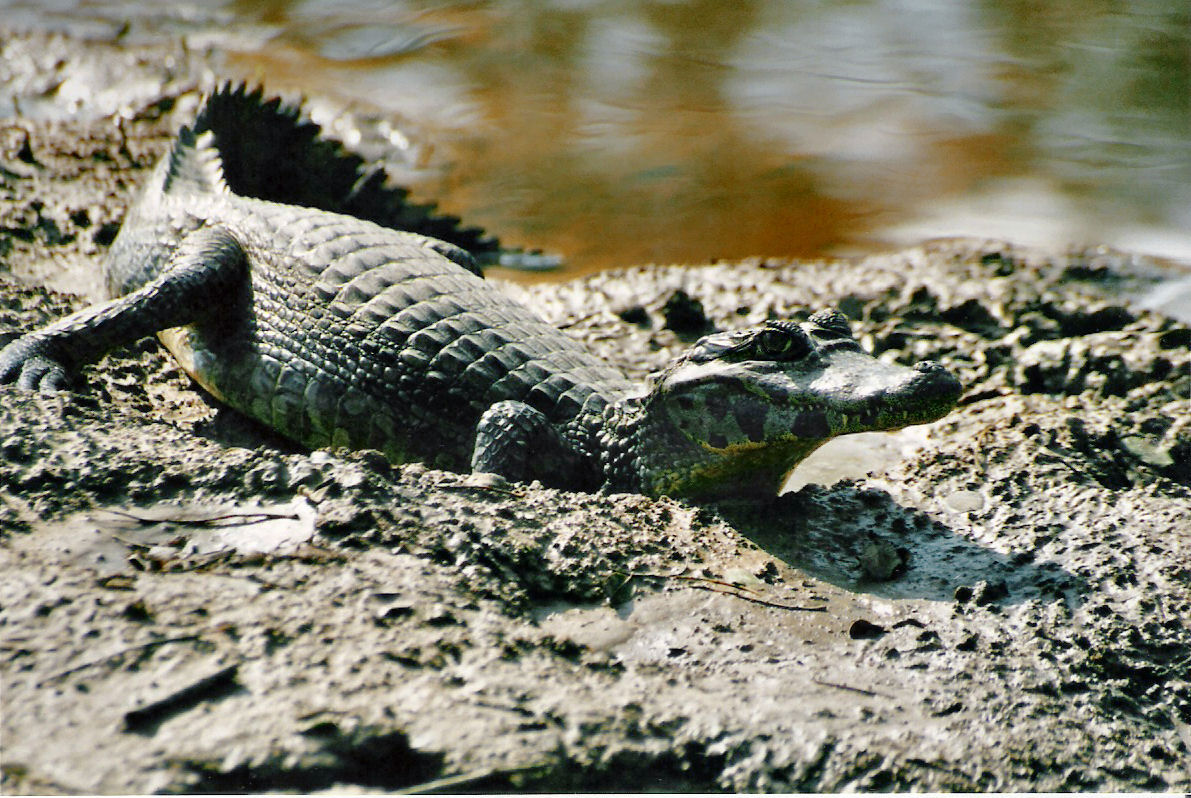
Yacare caiman, Caiman yacare
Scientific classification Edit this classification
Kingdom: Animalia
Phylum: Chordata
Class: Reptilia
Clade: Archosauria
Order: Crocodilia
Superfamily: Alligatoroidea
Family: Alligatoridae
Subfamily: Caimaninae
Brochu, 1999
Type genus
Caiman
Spix, 1825
Subgroups
Spectacled caiman (Caiman crocodilus)
Yacare caiman (Caiman yacare)
Black caiman (Melanosuchus niger)
Cuvier's dwarf caiman (Paleosuchus palpebrosus)
Smooth-fronted caiman (Paleosuchus trigonatus)

A caiman (/ˈkmən/ (also spelled cayman[3]) from Taíno kaiman[4][additional citation(s) needed]) is an alligatorid belonging to the subfamily Caimaninae, one of two primary lineages within the Alligatoridae family, the other being alligators. Caimans are native to Central and South America and inhabit marshes, swamps, lakes, and mangrove rivers. They have scaly skin and live a fairly nocturnal existence. They are relatively small-sized crocodilians with an average maximum weight of 6 to 40 kg (13 to 88 lb) depending on species, with the exception of the black caiman (Melanosuchus niger), which can grow more than 4 m (13 ft) long and weigh more than 450 kg (990 lb). The black caiman is the largest caiman species in the world and is found in the slow-moving rivers and lakes that surround the Amazon basin. The smallest species is the Cuvier's dwarf caiman (Paleosuchus palpebrosus), which grows to 1.2 to 1.5 m (3.9 to 4.9 ft) long. There are six different species of caiman found throughout the watery jungle habitats of Central and Southern America. The average length for most of the other caiman species is about 2 to 2.5 m (6.6 to 8.2 ft) long.

Caimans are distinguished from alligators, their closest relatives, by a few defining features: a lack of a bony septum between the nostrils, ventral armor composed of overlapping bony scutes formed from two parts united by a suture, and longer and sharper teeth than alligators. Caimans also tend to be more agile and crocodile-like in their movements.[5] The calcium rivets on caiman scales make their hides stiffer than those of alligators.

Several extinct forms are known, including Purussaurus, a giant Miocene genus that grew to 7.6–10 m (25–33 ft)[6] and the 5.89 m (19.3 ft) Mourasuchus, which had a wide duck-like snout.[6]

Behavior

[edit]

Caimans are predators and, like alligators and crocodiles, their diet largely consists of fish. Caimans also hunt insects, birds, small mammals and reptiles.

Because of their large size and ferocious nature, caimans have few natural predators within their environments. Humans are their main predators, because the animals have been hunted for their meat and skin. Jaguars, anacondas and crocodiles are the only other predators of caimans, although they usually prey on the smaller specimens or specific species of caiman such as the Spectacled Caiman and Yacare caiman. During summer or droughts, caimans may dig a burrow and go into a form of summer hibernation called aestivation.

Female caimans build a large nest in which to lay their eggs. The nests can be more than 1.5 m (4.9 ft) wide. Female caimans lay between 10 and 50 eggs, which hatch within about six weeks. Once they have hatched, the mother caiman takes her young to a shallow pool of water, where they can learn how to hunt and swim. The juveniles of spectacled caiman have been shown to stay together in pods for up to 18 months.[7]

Broad-snouted caiman (Caiman latirostris)

Phylogeny

[edit]

Caimaninae is cladistically defined as Caiman crocodylus (the spectacled caiman) and all species closer to it than to Alligator mississippiensis (the American alligator).[8][9] This is a stem-based definition for caimaninae, and means that it includes more basal extinct caimanine ancestors that are more closely related to living caimans than to alligators. The clade Jacarea includes the most derived caimans, being defined as the last common ancestor of Caiman latirostris (Broad-snouted caiman), Caiman crocodilus (Spectacled caiman), Caiman yacare (Yacare caiman), Melanosuchus niger (Black caiman), and all its descendants.[1]

Below is a cladogram showing the phylogeny of Caimaninae, modified from Hastings et al. (2013).[10]

Here is an alternative cladogram from Bona et al. 2018.[11]

The Late Cretaceous taxa Stangerochampsa, Brachychampsa and Albertochampsa have been previously referred to as stem-group caimans,[11][1] but Walter et al. (2022) recovered them as the basalmost alligatorines based on phylogenetic analysis and claimed that the earliest definitive stem-group caimans are known from the earliest Paleocene.[12] A different study by Adam Cossette and David Tarailo in 2024 recovered Brachychampsa and relatives in a clade at the base of Caimaninae. They named this clade Brachychampsini, defining it as "the largest clade of alligatorids more closely related to Brachychampsa montana than to Caiman crocodilus or Alligator mississippiensis".[2]

See also

[edit]

References

[edit]
Revisions and contributorsEdit on WikipediaRead on Wikipedia
from Grokipedia
Caimans comprise the genus Caiman within the family Alligatoridae, consisting of three extant species of semi-aquatic crocodilians: the (C. crocodilus), the (C. yacare), and the broad-snouted caiman (C. latirostris). These reptiles are characterized by their broad, short snouts, heavily armored skin embedded with osteoderms, and powerful tails adapted for swimming, with adults typically ranging from 1.5 to 3.5 meters in total length depending on the species. Native exclusively to the Neotropics, caimans inhabit a variety of freshwater environments including rivers, lakes, swamps, and flooded forests across from southward to northern , extending to northern . As opportunistic predators, caimans primarily feed on , amphibians, crustaceans, and small mammals, though larger individuals may consume birds and larger vertebrates; their diet varies by and availability. They exhibit complex social behaviors, including vocalizations for communication and where females guard nests and assist hatchlings to , contributing to their ecological significance in maintaining . Conservation status varies among , with the listed as Least Concern due to its wide distribution and adaptability, while the yacare and broad-snouted caimans face threats from loss and overhunting for skins, though populations have recovered in some areas through .

Taxonomy and Phylogeny

Classification

The Caiman belongs to the order , Alligatoridae, and subfamily Caimaninae. This places caimans within the broader group of alligatorids, distinguishing them from true crocodiles in the Crocodylidae based on cranial and dental features, such as the upper teeth fitting into pits in the lower rather than visible sockets. The genus comprises three extant species: the spectacled caiman (Caiman crocodilus Linnaeus, 1758), the yacare caiman (Caiman yacare Daudin, 1801), and the broad-snouted caiman (Caiman latirostris Daudin, 1801). Additionally, the Apaporis River caiman (Caiman crocodilus apaporiensis Medem, 1955) is recognized as a distinct subspecies within C. crocodilus, notable for its narrow, elongated snout and lighter coloration with dark blotches; it was described in 1955 but long considered possibly extinct until its rediscovery in 2019. The spectacled caiman includes several subspecies, such as the nominate C. c. crocodilus (found in northern South America) and C. c. fuscus (in Central America and Mexico), which are identified through variations in dorsal scale arrangements, including the number of transverse rows (typically 6–8 in C. crocodilus versus 4 in C. yacare) and overall patterning for taxonomic differentiation. Historically, species now assigned to Caiman were initially classified under the genus Alligator by Georges Cuvier in 1807, reflecting early uncertainties in crocodilian systematics based on limited specimens. The genus Caiman was formally established by Johann Baptist von Spix in 1825, with C. sclerops (now a synonym of C. crocodilus) as the type species, separating it from alligators based on osteological differences like snout shape and scale morphology. This separation has been upheld in modern taxonomy, though ongoing molecular studies continue to refine subspecies boundaries within the group.

Evolutionary History

Caimans belong to the subfamily Caimaninae within the family , which diverged from the true crocodiles (family Crocodylidae) approximately 80 million years ago during the , as supported by molecular clock analyses of sequences. This ancient split reflects the broader diversification of crocodylians following the breakup of , with ancestors likely originating in before dispersing southward. Within , Caimaninae diverged from Alligatorinae (including the genus Alligator) around 60–75 million years ago near the Cretaceous- boundary, marking a key event in the early radiation of alligatoroids. Phylogenetic analyses place Caimaninae as the clade to Alligatorinae, forming a basal within the , with molecular evidence from mtDNA confirming this topology and highlighting conserved genetic markers across the group. The earliest unambiguous fossils attributed to total-group Caimaninae date to about 63.5 million years ago in the of , indicating a rapid post-extinction establishment in the region. The fossil record of caimans is predominantly Neotropical, with significant evidence from the of , where diverse forms evolved during a period of continental isolation. For instance, the giant caiman Purussaurus brasiliensis, reaching lengths of up to 12 meters, is known from the Urumaco Formation in and related deposits, showcasing extreme size as an adaptation to ecosystems. Key sites like the Middle La Venta Formation in have yielded caimanine remains, including early representatives of crown-group taxa around 18 million years ago, illustrating a Miocene diversification burst. This isolation of following the final separation from around 100 million years ago, and subsequent closure of land connections until the , drove unique evolutionary trajectories in Caimaninae, including the development of specialized cranial features for durophagy and piscivory suited to tropical floodplains. Unlike their North American relatives, caimans exhibited high , with assemblages revealing and niche partitioning absent in other alligatoroids, underscoring the role of vicariance in shaping their phylogeny.

Physical Description

Morphology

Caimans are characterized by a broad, U-shaped that distinguishes them from the narrower, V-shaped snouts of true crocodiles, facilitating a diet primarily consisting of aquatic prey such as and crustaceans. This snout shape aligns closely with that of alligators, though in like the broad-snouted caiman (Caiman latirostris), it is notably shorter and wider relative to the American alligator's proportions, enhancing crushing capabilities for harder-shelled foods. The overall is robust and dorsoventrally flattened, with a dental formula typically featuring 68-72 conical, uniform teeth adapted for grasping rather than tearing, numbering approximately 14-16 pairs in the upper jaw and 18-20 pairs in the lower jaw. The body is armored with osteoderms—bony plates embedded in the scales—providing protection against predators and environmental hazards; these are prominent on both the dorsal surface and ventral belly scales, a trait more pronounced in caimans than in many other crocodilians like saltwater crocodiles, which lack belly osteoderms. Their limbs end in webbed feet, with the hind feet more extensively webbed to aid propulsion during , complemented by a powerful, laterally compressed for agile maneuvering in . Sensory adaptations include numerous integumentary sensory pits distributed across the jaws and scales, housing endings that detect subtle water vibrations and changes to locate prey even in murky conditions. The eyes feature vertical slit pupils that constrict in bright light and dilate widely in low light, supporting enhanced nocturnal vision through a reflective layer behind the . Adult caimans exhibit a typically olive-brown dorsal coloration for in aquatic and riparian habitats, with juveniles displaying yellow tones accented by darker crossbands that fade with age. is present but relatively minimal compared to other crocodilians, with males possessing broader heads than females, aiding in mate competition and territorial displays.

Size Variation

Caimans display considerable variation in body size and weight across species. The (Caiman crocodilus) is among the smaller species, with adults typically measuring 1.2–2.5 m in total length and weighing 7–40 kg, though exceptional males can reach 2.7 m. The (C. yacare) is larger, with adult males attaining 2–3 m in length and weighing 40–50 kg, while females reach up to 2.5 m. The broad-snouted caiman (C. latirostris) averages 2–2.5 m in length for adults, though rare old males can exceed 3 m. Sexual dimorphism is present in caimans, with males generally larger than females, though less pronounced than in some other crocodilians; for instance, in spectacled caimans, mature males exceed females by approximately 25% in size. Regional differences further contribute to size variation, as populations in the Amazon basin tend to produce larger individuals compared to those in the Orinoco basin, likely due to differences in resource availability and habitat structure. Caimans reach between 4 and 7 years of age, after which growth rates slow considerably, shifting from rapid juvenile increases to minimal annual gains in adults. In the wild, lifespans average 30–40 years, with a maximum of around 60 years, though captive individuals often live 20–50 years under optimal conditions. Compared to their ancestors, modern caimans are notably smaller; for example, the extinct Melanosuchus fisheri is estimated to have reached lengths of up to 6 m, exceeding the maximum sizes observed in contemporary species.

Habitat and Distribution

Geographic Range

Caimans, belonging to the genus Caiman within the family Alligatoridae, are primarily native to Central and South America. The spectacled caiman (C. crocodilus), the most widespread species, ranges from southern Mexico through Central America and into northern South America, extending as far south as northern Argentina, including Trinidad and Tobago. The yacare caiman (C. yacare), a distinct species, inhabits the Paraguay-Paraná River basins, spanning southern, central, and northern Brazil, as well as northeastern Argentina, southeastern and northern Bolivia, and Paraguay. The broad-snouted caiman (C. latirostris) is found in eastern South America, including southeastern Brazil, Paraguay, Uruguay, northeastern Argentina, and southeastern Bolivia, primarily in the drainages of the Paraná, Paraguay, Uruguay, and São Francisco River systems. Introduced populations of caimans have established outside their native range due to releases from the pet trade, particularly since the 1960s. , spectacled caimans are established in southern , where they have formed self-sustaining populations in wetlands. Similarly, populations have become established on in , introduced around 1959, and in . Fossil evidence indicates that caimanines, the subfamily including modern caimans, had a broader historical distribution during the period (66–23 million years ago), with records extending into . For instance, a new caimanine species from the Middle Eocene of southwest suggests that these crocodilians occupied temperate regions before climates restricted them to tropical latitudes in Central and . The earliest unambiguous caimanine fossils date to approximately 63.5 million years ago, supporting an origin and initial diversification that included northern extensions before the Eocene. In regions of range overlap, such as the wetlands of , the yacare and spectacled caimans occur sympatrically, sharing lowland riverine and habitats. These zones highlight the potential for interspecific interactions within diverse wetland ecosystems.

Ecological Preferences

Caimans, belonging to the genus Caiman, are semi-aquatic reptiles that primarily inhabit slow-moving freshwater systems such as rivers, marshes, swamps, and seasonally flooded wetlands, where they utilize the for and while accessing adjacent terrestrial areas for basking and nesting. Species like the (C. crocodilus) favor open wetlands, lagoons, ponds, and floodplains with abundant vegetation. The (C. yacare) is commonly found in marshy savannas, lakes, and larger river systems, while the broad-snouted caiman (C. latirostris) prefers densely vegetated environments including reservoirs and slow streams. These microhabitats provide cover from predators and prey availability, with caimans often congregating in remaining water bodies during seasonal low flows. Optimal environmental conditions for caimans include water temperatures of 26–30°C and body temperatures averaging 30°C (ranging 25.5–33°C), which support their ectothermic and activity levels in tropical and subtropical zones between approximately 10°S and 35°S . During dry seasons, caimans exhibit by burrowing into mud or banks to conserve moisture and avoid , a particularly noted in C. crocodilus populations in variable climates. Salinity tolerance is generally low across the , limiting most to freshwater, though C. crocodilus can inhabit brackish mangroves and estuaries temporarily. Vegetation associations are critical, with dense aquatic like moriche palms and flooded savannas providing ambush cover and nesting substrates. Caimans occur at altitudes from up to 1,000 m in the foothills, where cooler temperatures at higher elevations constrain distribution, with C. crocodilus recorded exceptionally to 800 m. They are vulnerable to droughts, which reduce available and lead to concentrations, growth cessation, and high juvenile mortality, exacerbating impacts in fragmented tropical wetlands already stressed by seasonal variability. Climate shifts, including prolonged dry periods, further threaten these preferences by altering water levels and dynamics essential for their survival.

Behavior and Ecology

Activity Patterns

Caimans exhibit primarily nocturnal activity patterns, with the majority of their movement and foraging occurring during nighttime hours to avoid daytime heat and potential predators. This secretive behavior is particularly evident in species like the (Caiman crocodilus), where individuals are most active under cover of darkness. They often become active at dusk and dawn, periods that facilitate by allowing brief transitions between aquatic and terrestrial environments without excessive exposure to midday temperatures. In cooler seasons, caimans shift toward more diurnal behaviors, including basking on land or in shallow water to raise their body temperature, which can exceed water temperatures by up to 15°C during these periods. This thermoregulatory strategy helps maintain optimal metabolic rates in regions like the , where seasonal temperature drops influence activity rhythms. Adult male caimans display strong territoriality, aggressively defending stretches of river or habitats, particularly during the breeding season when aggression intensifies with the onset of rains and higher temperatures. These territories exclude rival males and are maintained through displays that ensure access to mates and resources. Juveniles, in contrast, are more gregarious, often forming loose social groups that provide protection from predators and facilitate shared use. Caimans undertake limited migrations, primarily driven by seasonal flooding, shifting to deeper waters or dispersing from riparian zones during wet periods to exploit expanded habitats. In the dry season, they concentrate in remaining pools or move to deeper refugia as water levels recede. They possess notable diving capabilities, remaining submerged for extended periods at depths up to several meters, aiding in predator avoidance and rest. Communication among caimans involves a of vocalizations and physical displays, including deep used primarily for advertisements over long distances. Head-slaps on the water surface signal or territorial warnings, while pulses—low-frequency vibrations—enable detection in aquatic environments, often accompanying vocal signals for enhanced propagation.

Feeding Habits

Caimans are opportunistic carnivores whose diet varies ontogenetically, with juveniles primarily consuming aquatic invertebrates such as insects and crustaceans, alongside small fish, while adults shift to larger vertebrates including fish, mammals, birds, and reptiles. In the spectacled caiman (Caiman crocodilus), for example, fish constitute a significant portion of the adult diet by volume, reflecting their piscivorous tendencies in Amazonian floodplains. This dietary progression supports increasing energy demands as individuals grow, enabling them to exploit a broader range of prey sizes and types. Foraging strategies among caimans emphasize predation, where individuals remain submerged and motionless near water edges or in , striking suddenly at passing prey before employing a "death roll" to disorient and dismember larger victims. Opportunistic feeding also occurs, particularly in flooded forests where caimans scavenge or actively pursue accessible prey during seasonal inundations. Dietary composition exhibits seasonal shifts, with caimans favoring more aquatic prey like during wet seasons when floodplains expand prey availability, and potentially incorporating terrestrial items or reducing intake in dry periods when habitats contract. These patterns, combined with ontogenetic changes from to vertebrates, minimize and adapt to fluctuating resources. Ecologically, caimans regulate populations through predation, maintaining balance in aquatic food webs, while occasional in dense populations—particularly during resource scarcity—helps control juvenile numbers and population densities. As top predators, they exert structuring influences on swamp ecosystems, preventing by herbivores and supporting .

Reproduction and Life Cycle

Mating Behaviors

Caiman mating behaviors are closely tied to the and vary by species and region, typically occurring annually from April to August in regions like the for the , when increased rainfall facilitates movement and nesting. During this period, males actively court females through a series of aquatic displays, including bellowing vocalizations that produce subaudible infrasonic vibrations, bubble-blowing, circling, snout-touching, and back-rubbing while swimming together. These displays serve to attract receptive females and establish dominance among competing males, with larger individuals often gaining priority access to mates due to their superior size and territorial control. The of caimans is polygynous, with dominant males forming harems by mating with multiple females, while genetic studies indicate that females may also mate with several males, resulting in high rates of multiple paternity in clutches (up to 95% in some populations of the ). Male competition intensifies during courtship, leading to agonistic encounters involving bites, side-head strikes, and tail swings to defend territories and secure breeding rights; such conflicts are more frequent among larger adults establishing social hierarchies based on body size and resource control. Females select mates primarily based on these displays of vigor, size, and quality of defended territories, which signal the male's ability to provide suitable nesting sites near water but protected from flooding. Copulation takes place in shallow water and lasts several minutes, involving the male mounting the female from behind with cloacal contact for . Following successful mating, females seek out secluded areas within or near the male's to construct mound nests, excavating a chamber within a pile of , , and leaf litter that reaches approximately 0.5 meters in height and up to 1.5 meters in diameter; this structure provides insulation and humidity for .

Development and Growth

Caimans exhibit a reproductive strategy involving oviposition in nests constructed from or , with clutch sizes typically ranging from 20 to 40 eggs depending on female body size and species, such as the (Caiman crocodilus). These eggs are incubated for 80 to 90 days within the nest, where environmental temperatures of 30 to 32°C support embryonic development. Sex determination is temperature-dependent, following a female-male-female pattern; lower temperatures (around 29–31°C) produce females, intermediate temperatures (31.5–33.5°C) yield males, and higher temperatures around 34°C can result in females again. Hatching in caimans is often synchronized within a , triggered by vocalizations from the embryos that alert the attending female. Upon emergence, hatchlings measure approximately 25–30 cm in total length and immediately emit distress calls to signal their mother, who responds by excavating the nest. The female then transports the hatchlings to nearby water bodies by carrying them in her mouth, a behavior that minimizes predation risk during this vulnerable transition. Post-hatching is provided primarily by the female, who guards the nest throughout incubation and continues to protect the young for 1–2 months after , defending them from predators such as birds, mammals, and larger reptiles. This period of maternal vigilance allows the hatchlings to form loose groups and begin on small , though the intensity of care diminishes as the juveniles grow more independent. Growth in caimans occurs in distinct phases, with rapid development during early juvenile stages through continuous feeding and favorable environmental conditions. is attained at 6–8 years of age, coinciding with lengths of 1.2–1.4 m, after which growth slows considerably. Juvenile mortality is exceptionally high, with the majority of hatchlings succumbing to predation by , birds, and other caimans during early stages, underscoring the precarious nature of this life phase.

Conservation and Human Interaction

Threats and Status

Caimans face a range of threats across their native ranges in Central and , with varying levels of endangerment among . The (Caiman crocodilus) is classified as Least Concern on the , reflecting its widespread distribution and large overall population, though it is locally vulnerable in areas affected by intense human activity. The (Caiman yacare) shares this Least Concern status, supported by robust populations in regions like the and Bolivian Amazon. The broad-snouted caiman (Caiman latirostris) is also classified as Least Concern, with stable or recovering populations in parts of its range in eastern and central , despite historical declines from overhunting. Primary threats to caiman populations include habitat loss driven by for and infrastructure development, such as dams that fragment wetlands and alter river flows essential for caiman habitats. Overhunting persists for skins, meat, and traditional uses, particularly targeting larger individuals, though regulated harvests have aided recovery in some areas. from introduces mercury into aquatic ecosystems, leading to in caimans as top predators; studies in the Amazon show elevated mercury levels causing genotoxic effects and health risks. The supports sustainable harvests in , with annual quotas managed through monitoring to prevent . Emerging pressures from exacerbate vulnerabilities by altering wet season patterns, which disrupts nesting sites and hatchling survival through changes in flooding regimes and . In introduced ranges, such as the in Florida's , invasive populations compete with native alligators and crocodiles for resources, potentially impacting local .

Management Efforts

Management efforts for caimans emphasize regulated trade, habitat protection, community involvement, and scientific monitoring to ensure sustainable populations across their range. The Convention on International Trade in Endangered Species (CITES) lists the spectacled and yacare caimans in Appendix II since 1975, while the broad-snouted caiman is included in Appendix I except for populations in Argentina and Brazil (downlisted in 2022), permitting international trade in skins and other products under strict quotas and export permits to prevent overexploitation while allowing sustainable use. For instance, the yacare caiman (Caiman yacare) was included in Appendix II in 1975, supporting ranching and farming programs that harvest wild eggs for captive rearing. Ranching initiatives have been key to balancing conservation with economic benefits. In , captive-breeding programs for the (Caiman crocodilus) were established in the mid-1980s, restricting production to farmed individuals to reduce pressure on wild populations. Similarly, limits ranching to the in the region, where over 75 operations collect wild eggs for rearing, contributing to population stability under oversight. In , ranching programs for the broad-snouted caiman collect wild eggs and provide economic incentives for local communities to protect wetlands, aiding population recovery. Protected areas provide critical refuges for caimans, with significant portions of their habitat safeguarded in reserves. The Conservation Area, a spanning 187,818 hectares in , includes national parks and private reserves that harbor high densities of yacare and spectacled caimans, with ongoing efforts to restore populations affected by past exploitation. In , the Iberá Wetlands protect broad-snouted caiman populations through and measures. Community-based initiatives promote coexistence and sustainable use. implements sustainable harvesting quotas for the , exporting up to 50,000 skins annually under , with proceeds funding population monitoring to maintain ecological balance. In , Proyecto Yacaré engages local communities in broad-snouted caiman ranching and wetland restoration, fostering conservation awareness. Research supports these efforts through non-invasive techniques and genetic analysis. Camera traps are widely used for monitoring caiman populations in the . Anti-poaching patrols, funded by eco-tourism in the , deter illegal hunting and protect nesting sites. Genetic studies inform subspecies management, revealing high diversity in spectacled caimans on isolated islands like Gorgona, , to guide targeted protections against hybridization and .

References

Add your contribution
Related Hubs
User Avatar
No comments yet.