Hubbry Logo
Power door locksPower door locksMain
Open search
Power door locks
Community hub
Power door locks
logo
8 pages, 0 posts
0 subscribers
Be the first to start a discussion here.
Power door locks
Power door locks
from Wikipedia
Animation of how a power lock system works (simple relay operation)

Power door locks (also known as electric door locks or central locking) allow the driver or front passenger to simultaneously lock or unlock all the doors of an automobile or truck, by pressing a button or flipping a switch.

Power door locks were introduced on the luxury Scripps-Booth in 1914, but were not common on luxury cars until Packard reintroduced them in 1956. Nearly every car model today offers this feature as at least optional equipment.

Early systems locked and unlocked only the car doors. Many cars today also feature systems which can unlock such things as the luggage compartment or fuel filler cap door. It is also common on modern cars for the locks to activate automatically when the car is put into gear or reaches a certain speed.

Remote and handsfree

[edit]
Pressing a button on the key unlocks all of the car doors. Another button locks the car.

In 1980, Ford Motor Company introduced an external keypad-type keyless entry system, wherein the driver entered a numeric combination —either pre-programmed at the factory or one programmed by the owner— to unlock the car without the key. Early- to mid-1980s Nissan Maximas could also be installed with a keypad, which would also retract the windows and moonroof once the car was successfully unlocked by pushing a specific button on the keypad. During the 1990s the Subaru Legacy could also be opened by pulling the drivers external door handle a specific number of times to enter a passcode number that would unlock the driver's door only.

Today, many cars with power door locks also have a radio frequency remote keyless system, which allows a person to press a button on a remote control key fob, the first being available on the French made Renault Fuego in 1982.[1] Currently, many luxury makers also allow the windows to be opened or closed by pressing and holding a button on the remote control key fob, or by inserting the ignition key and holding it in the lock or unlock position in the external driver's door lock.

The remote locking system confirms successful locking and unlocking through either a light or a horn signal, and usually offers an option to switch easily between these two variants. Both provide almost the same functionality, though light signals are more discreet while horn signals might create a nuisance in residential neighborhoods and other busy parking areas (e.g. short-term parking lots). Some manufacturers offer the ability to adjust the horn signal volume.

Other cars have a proximity system that is triggered if a keylike transducer (Advanced Key or handsfree) is within a certain distance of the car.

See also

[edit]

References

[edit]
Revisions and contributorsEdit on WikipediaRead on Wikipedia
from Grokipedia
Power door locks, also known as central locking systems, are electrically operated mechanisms in automobiles that enable the simultaneous locking and unlocking of all vehicle doors from a single control point, such as an interior switch, key fob, or keyless entry sensor. These systems replace manual locking, enhancing convenience and security by allowing drivers to secure the entire vehicle without individually operating each door. At their core, power door locks function through electric actuators—small motors housed within each door—that receive signals from a central control module to engage or disengage the lock mechanism, ensuring reliable operation over tens of thousands of cycles. The technology originated in the early 20th century, with the first implementation appearing in 1914 on the luxury Scripps-Booth Model C, a high-end vehicle priced at $775 (equivalent to approximately $24,500 in 2025 dollars). Though innovative, power door locks remained a rare luxury feature until their reintroduction in 1956 on the , after which they gradually became more widespread in upscale models. Remote central locking emerged in 1982 with the , marking a shift toward wireless control via key fobs. In modern vehicles, power door locks have evolved into sophisticated components integrated with advanced security features, including keyless entry systems that use proximity sensors, , NFC, and technology for hands-free operation. Today, they are standard equipment on nearly all new cars and trucks, often linked to immobilizers, alarm systems, and automatic locking upon vehicle motion to prevent unauthorized access. This ubiquity reflects their role in improving occupant safety and theft deterrence, as regulated by standards like the U.S. Federal Motor Vehicle Safety Standard No. 206, which governs door lock performance and retention.

Fundamentals

Definition and Purpose

Power door locks are electromechanical systems designed to lock and unlock the doors of a using electrical actuators powered by the car's battery, rather than relying solely on manual keys or mechanical levers. These systems typically consist of electric motors connected to the lock mechanisms, allowing operation through switches located on the driver's door panel or center console. The primary purposes of power door locks include enhancing convenience by enabling simultaneous control of all from a single point, thereby eliminating the need to individually lock each . They also improve by facilitating quick locking to deter unauthorized entry and integrating with alarm systems to trigger alerts upon forced access attempts. Additionally, these locks support by allowing rear to be secured from the inside while permitting exit from outside in emergencies. Key benefits of power door locks encompass reduced physical effort for users, and their role as a standardized feature in passenger vehicles since the , when they transitioned from luxury options to widespread adoption. Commonly found in cars, trucks, and SUVs, power door locks are distinct from other vehicle accessories like power windows, which manage panel movement independently. These foundational systems have paved the way for advanced integrations, such as remote key fob controls.

Historical Development

Power door locks, also known as central locking systems, originated in the early as a luxury convenience feature for automobiles. The concept was first implemented in 1914 on the Scripps-Booth Model C, a high-end vehicle produced by the Detroit-based Scripps-Booth Corporation, marking the debut of electrically operated door locks in production cars. However, widespread practical adoption was delayed until after due to the limitations of early electrical systems and the focus on basic vehicle functionality during wartime production constraints. Initial designs relied on rudimentary solenoids or mechanisms, which were unreliable and power-intensive for the era's batteries and wiring. In the post-war period, power door locks reemerged as an optional feature in luxury models, with reintroducing them in 1956 on sedans equipped with power windows, signaling a resurgence in high-end American automobiles. By the , advancements in technology enabled more efficient electronic controls, facilitating broader integration into mainstream vehicles from manufacturers like Ford and , where they became available as factory options on mid-to-upper trim levels. This era saw power door locks transition from niche novelties to desirable conveniences, often paired with emerging features like power windows. In , adoption occurred earlier; introduced pneumatic central locking systems in the mid-1960s on models like the W112 series, reflecting a faster rollout in premium European markets compared to the U.S., where cost and simplicity delayed mass-market penetration. Key milestones in the included the integration of lock controls into central consoles and armrest switches for easier driver access, as seen in GM and Ford full-size sedans, enhancing usability in larger vehicles. The marked a shift to more reliable electronic solenoids, replacing earlier vacuum-based systems that were prone to failure; this change improved durability and reduced noise, aligning with the rise of computerized vehicle electronics. In the , regulatory standardization advanced , with the 1985 update to U.S. Federal Motor Vehicle Safety Standard (FMVSS) No. 206 requiring child safety features, such as rear-door manual overrides to prevent unintended openings from inside, which indirectly promoted robust power lock designs across all vehicles. Later amendments, such as those in 2007, further emphasized door lock retention. In modern evolution, power door locks have become ubiquitous, standard on nearly all new vehicles sold , particularly in the United States and most markets worldwide due to manufacturing economies and consumer expectations. The rise of electric vehicles (EVs) has further influenced designs, prioritizing battery-efficient actuators and low-power micro-motors to minimize energy draw, often integrating with advanced keyless systems for seamless operation. This progression from mechanical curiosities to essential, energy-optimized components underscores their role in enhancing and convenience.

Mechanical and Electrical Components

Core Mechanisms

Power door locks rely on a combination of electromechanical components to secure and release vehicle doors, primarily consisting of actuators, latches, lock rods, and linkage systems that translate input signals into mechanical action. The actuator serves as the core driver, typically an electric solenoid or DC motor housed within the door panel, which receives power to generate the necessary motion for locking or unlocking. Solenoids produce linear motion through electromagnetic coils that pull or push a plunger, directly engaging the lock mechanism, while motors generate rotary motion that is converted to linear movement via internal gears or linkages. In mechanical operation, these actuators interface with the —a pawl-and-striker assembly that holds the closed against the vehicle's frame—via lock rods and linkage systems. When activated, the moves the lock rod (a rigid metal or composite bar) vertically or horizontally to rotate the 's pawl, either engaging it to secure the or disengaging it for release. Linkage systems, often comprising rods, cables, or bell cranks, transmit this force from the to the and interior/exterior handles, ensuring synchronized operation. Early systems employed , which used manifold to draw a diaphragm and for , but these have largely been supplanted by electric types for reliability and integration with vehicle electronics. Electric dominate modern designs, offering precise control and quieter operation compared to variants. Design considerations emphasize durability, with components constructed from corrosion-resistant metals like or zinc alloys for rods and latches, paired with high-strength engineering plastics such as or for actuator housings to reduce weight and . These materials withstand environmental exposure, including temperature extremes and moisture, enabling over 100,000 cycles of operation in typical automotive lifespans. Variations exist for door types: hinged doors in sedans use compact inline or rotary mounted vertically to align with rod paths, while incorporate linkages to accommodate lateral movement. Fundamentally, the physics of these mechanisms involves overcoming frictional and spring forces in the , requiring s to deliver 30-50 N of linear or equivalent , typically 0.5-2 Nm in rotary configurations, to ensure secure engagement without excessive power draw. Failure modes, such as jamming, often arise from linkage misalignment, debris accumulation, or actuator wear, where insufficient leads to incomplete movement and potential binding of rods against door panels. For instance, in sedan applications, an inline linear setup positions the directly along the lock rod's path for straightforward push-pull action, minimizing pivot points, whereas a rotary motor variant uses a geared output to drive a crank arm, allowing more compact but introducing potential wear at conversion joints. These hardware elements integrate briefly with wiring for signal activation, as explored in control systems.

Control Systems

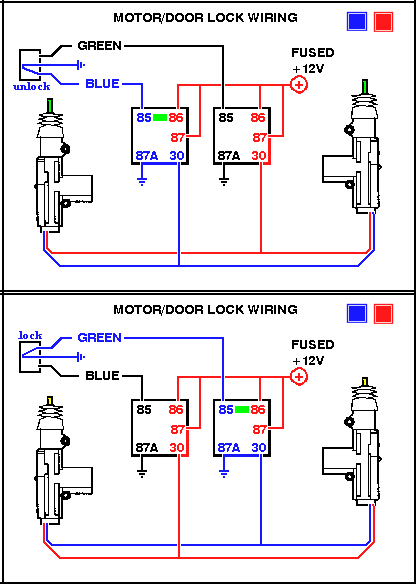
The control systems for power door locks rely on a standardized 12V DC electrical setup to ensure reliable operation within the vehicle's accessory circuit. This includes wiring harnesses that route power and signals from the battery to each , typically using 14-18 AWG conductors insulated for automotive environments to minimize resistance and prevent shorts. Switches, either dashboard-mounted for centralized control or door-mounted for local access, initiate lock/unlock commands by completing circuits that send low-voltage signals (around 5V) to the control logic. Relays amplify these signals, switching high-current paths to the actuators since switches alone cannot handle the load, often using 30-40A SPDT relays triggered by the low-power switch input. Central to these systems is the (BCM), an that processes inputs from switches and sensors to orchestrate door lock functions. The BCM acts as a gateway, interpreting commands and distributing them via networked protocols, while microcontrollers within it execute logic for sequential locking or diagnostics. In modern vehicles, integration with the Controller Area Network ( enables the BCM to communicate efficiently with other modules, such as the , allowing synchronized operations like locking upon ignition off. This setup reduces wiring needs compared to standalone circuits and supports fault isolation through error-checking protocols. Power for the system is drawn directly from the vehicle's 12V battery, with each lock typically consuming 5-10A during operation to drive the motor for 0.5-1 second pulses. To prevent battery drain, control systems enter low-power modes in key-off states, where the BCM and relays disengage, limiting quiescent current to under 50mA across the network. This is triggered after a timeout period, ensuring minimal energy use while maintaining readiness for remote signals. Signals to the actuators are primarily binary on/off pulses via control, but advanced systems employ (PWM) to regulate voltage and speed in compatible motors, optimizing response without overheating. Faults in these circuits generate OBD-II diagnostic trouble codes, such as B1300 for power door lock circuit failure or B1392 for lock issues, which can be read via the vehicle's diagnostic for . By 2025, advancements in electric vehicles (EVs) include distributed control modules and emerging wireless intra-vehicle networks, such as or protocols, which further reduce wiring harness complexity by enabling over-the-air commands between the BCM and nodes. This shift minimizes and installation costs in EVs, where space for traditional harnesses is limited, while maintaining latency below 10ms for secure locking.

Types of Systems

Centralized Locking

Centralized locking systems in vehicles enable the simultaneous securing or releasing of all through a single , typically a switch mounted on the driver's panel or the center console. This utilizes electrical actuators in each that receive uniform signals from the master switch via a shared wiring network, ensuring coordinated operation across the entire vehicle. The system relies on basic electrical controls, such as relays or electronic modules, to amplify and distribute the low-voltage input from the switch to the higher-power actuators. A key advantage of centralized locking is its efficiency in multi-door like sedans and SUVs, where manually locking each would be time-consuming and inconvenient; this feature became more common in luxury models starting in the mid-, evolving into standard equipment by the late as automotive electrification advanced. For instance, early implementations in luxury models evolved into standard equipment by the late , simplifying entry and exit for drivers and passengers while enhancing overall vehicle security. Variations in centralized systems include "all-lock" configurations, where activation locks or unlocks every door uniformly, and "driver-priority" modes, in which passenger doors respond only to commands from the driver's master switch to prevent unauthorized access from other positions. Implementation often incorporates multiplexed wiring, a technique that transmits multiple control signals over a single data bus to reduce cable complexity and , as demonstrated in early applications like Toyota's optical data-link system. However, in longer vehicles such as vans, poses challenges due to potential signal over extended wiring runs, requiring robust controllers to maintain reliable operation. By the , centralized locking had become a standard feature in nearly all global passenger vehicles, driven by manufacturing standards and consumer demand for convenience. Regulatory frameworks, such as the U.S. Federal Motor Vehicle Safety Standard No. 206, ensure the reliability of door locking systems to support occupant protection.

Individual and Selective Locking

Individual and selective locking systems in power door locks enable independent operation of specific doors, allowing users to lock or unlock particular doors without affecting others. These setups typically incorporate separate actuators and dedicated switches for each door, facilitating modes such as isolating rear doors for or . This design contrasts with uniform centralized systems by prioritizing flexibility, often through peripheral control units that can override or ignore global commands in certain scenarios, such as post-accident isolation. Such systems find primary applications in commercial vans and customizable luxury vehicles, where rear-door isolation enhances cargo or passenger privacy. In commercial settings, operators can lock cargo doors independently to prevent unauthorized access while keeping cab doors operational, a feature particularly useful for delivery fleets. Luxury models leverage selective modes to offer personalized configurations, such as unlocking only the driver's door initially for added . Technically, these systems rely on dedicated wiring paths from switches to individual s or addressable commands via the (BCM), which communicates with door control units over a network like to target specific doors. This approach increases complexity and cost compared to centralized systems, as it requires additional relays, sensors, and software logic for per-door addressing, but it enables precise control without full-vehicle synchronization. Brief reference to core hardware per door underscores the modular nature, where each unit operates semi-autonomously. Examples include the Ford Transit van, which supports per-door controls for cargo areas through optional deadbolt integrations or configurable power lock modules, allowing independent securing of side and rear doors. Aftermarket upgrades, such as universal keyless entry kits with modular actuators, enable personalization in older vehicles by adding selective wiring harnesses for individual door operation. Limitations of individual and selective locking include the risk of desynchronization, where faulty wiring or module failures cause one door to remain unlocked while others engage, potentially compromising . These systems are less common in standard passenger cars, where centralized uniformity prevails for simplicity.

Remote and Advanced Access

Key Fob Integration

Key fob integration with power door locks enables of entry through wireless (RF) signals transmitted from a handheld device to the car's receiver module, allowing users to lock or unlock doors without physical key insertion. This system typically operates using RF frequencies of 315 MHz in and 433 MHz in and other regions, where the fob sends encoded commands to a dedicated antenna and in the . The effective range for these lock/unlock commands generally extends from 5 to 20 meters under optimal conditions, though environmental factors like interference can reduce this distance. The core components of a key fob include physical buttons for selecting functions such as lock, unlock, or mode; an integrated chip that stores authentication data; and a small battery powering the transmitter. The vehicle's side features a receiver antenna connected to the , which processes incoming signals. To enhance security against replay attacks—where intercepted signals are rebroadcast—most modern fobs employ encryption, generating a unique pseudorandom code for each transmission that must match the vehicle's expected sequence. Remote key fobs first appeared in the early , with introducing the pioneering system on the 1982 Fuego model, marking the debut of mass-produced remote central locking via a handheld remote transmitter. This innovation evolved from basic fixed-code systems to more secure variants by the late , aligning with emerging automotive standards for wireless entry. By 2025, hybrid designs incorporating (BLE) alongside traditional RF have become prevalent, enabling extended features like pairing for remote start or location tracking while maintaining compatibility with legacy power door lock actuators. In operation, pressing the fob's lock transmits a signal that activates the power locks synchronously across all , often confirmed by audible chirps from the horn or visual flashes from the headlights and taillights to indicate success. Many fobs also integrate trunk release functionality, allowing a dedicated to unlatch the rear hatch independently of the . Typical battery life for these devices ranges from 1 to 2 years, depending on usage frequency and environmental conditions, after which replacement with a standard coin-cell battery restores functionality. These signals interface directly with the vehicle's centralized control systems to execute the locking mechanisms without manual intervention. Security features in key fobs include anti-scan measures such as frequency hopping, where the transmitter briefly shifts channels to evade interception devices. A notable has been signal amplification attacks, also known as attacks, demonstrated as early as 2010, in which thieves use portable to extend the fob's signal range and trick the vehicle into unlocking. Post-2010 mitigations, including advanced algorithms and (UWB) verification in hybrid systems, have significantly reduced these risks by requiring proximity confirmation beyond simple RF .

Proximity and Hands-Free Technologies

Proximity and hands-free technologies represent an evolution in power door lock systems, enabling automatic access without physical interaction by leveraging sensor-based detection of authorized devices or user movements. Passive Keyless Entry (PKE) systems primarily utilize (UWB) and (NFC) technologies to detect the proximity of a key fob or within approximately 1-2 meters of the vehicle. UWB provides precise location tracking and resistance to attacks through time-of-flight measurements, while NFC serves as a secure backup for close-range , such as tapping a phone to the . These systems emit low-frequency signals from vehicle antennas to wake the key device, which responds only if within the defined range, thereby unlocking doors upon approach. Hands-free operations further enhance convenience by incorporating motion and approach sensors that trigger unlocks without manual input. For instance, approach-sensing mechanisms detect a user's or proximity to automatically disengage locks as they near the , often integrated with PKE for seamless entry. A prominent example is the kick-to-open feature for trunks and liftgates, where an ultrasonic or capacitive sensor under the rear bumper registers a foot motion, opening the if an authorized key is detected nearby; this is standard in models from manufacturers like and . Smartphone integration via dedicated apps, such as Tesla's phone-as-key introduced in the late 2010s, allows (BLE) pairing to mimic fob functionality, enabling passive unlocking and even driver profile linking upon approach. BMW pioneered widespread adoption with its Comfort Access system, debuting in 2002 on the E65 7 Series, which combined proximity detection with handle-touch activation for keyless entry. Recent advancements incorporate geofencing and emerging AI elements to refine detection accuracy and automate behaviors based on location. Geofencing uses GPS data to define virtual boundaries, such as a radius, triggering auto-locking when the exits the zone or preventing premature unlocks in designated areas like driveways. By 2025, the global automotive keyless entry market has expanded rapidly, with over 65 million new vehicles equipped annually, driven by integrations in premium segments that enhance proximity detection through multi-sensor fusion. However, these systems face challenges including higher power consumption from continuous signal emissions, which is addressed via low-power sleep modes that activate only upon detected movement, and risks from always-on tracking signals that could expose user location data.

Safety and Security Features

Anti-Theft Measures

Power door locks enhance vehicle security through their primary latch mechanisms, with some systems incorporating reinforced features like deadbolts and secondary latches that can be activated electronically to provide additional resistance against forced entry. These optional features, such as pin dead locks or auxiliary bolts, engage automatically or manually to secure doors beyond standard latches, making it harder for thieves to pry or jimmy them open. In modern vehicles, power door locks integrate with immobilizer systems, where locking the doors arms the immobilizer to prevent engine startup without the authorized key, effectively deterring theft even if entry is gained. This integration is facilitated through the vehicle's body control module (BCM), which coordinates the locking sequence with the immobilizer's activation. Alarm systems linked to power door locks further bolster anti-theft capabilities by automatically locking all doors upon arming the security system, often triggered by the key fob or ignition off. If tampering occurs, such as forced entry detected via door ajar switches or shock sensors, the BCM processes the signal and activates the siren or horn as an audible deterrent. For instance, the BCM monitors intrusion events and initiates the alarm sequence, pulsing the vehicle's horn to alert owners and bystanders while potentially flashing lights. In connected vehicles of the , advanced anti-theft measures tie GPS tracking directly to door lock status, allowing real-time monitoring of whether doors are secured and enabling remote immobilization if unauthorized access is detected. Owners can use apps to view lock status, receive alerts for tampering, and remotely disable the via integrated GPS immobilizers, which cut power to critical systems. As of 2025, these systems increasingly incorporate biometric verification, such as facial recognition linked to locking and immobilizers, though they remain vulnerable to cyber threats like remote hacking. The effectiveness of these power door lock-based anti-theft systems is evident in significant theft reductions; for example, vehicles equipped with immobilizers integrated into locking systems have shown theft rates dropping by up to 51% compared to non-equipped models, according to NHTSA evaluations. However, vulnerabilities like relay attacks on keyless entry—where signals are amplified to trick the system into unlocking—persist, though countermeasures such as (UWB) technology mitigate this by using precise time-of-flight measurements to verify key proximity. Historically, the evolution of power door locks in anti-theft contexts accelerated in the due to widespread key cloning issues with early transponder systems, prompting a shift from basic mechanical locks to smart, integrated electronic setups that incorporated immobilizers and remote verification to combat signal interception and duplication. This transition addressed rising rates from cloned keys, leading to more robust, networked security architectures by the mid-.

Passenger Protection Mechanisms

Power door locks incorporate several mechanisms to safeguard passengers, particularly children and those with accessibility needs, by preventing unintended door openings and facilitating emergency egress. These features integrate electronic controls with mechanical overrides to enhance occupant retention during normal operation and rapid exit in crises, reducing the risk of ejections and injuries. Child safety locks serve as power-enabled overrides that prevent rear doors from being unlocked or opened from the inside, addressing the vulnerability of young passengers to accidental egress. Typically activated via a manual toggle on the door's edge or an on the driver's control panel, these systems disable the interior handle while allowing external unlocking and opening. In modern vehicles, electronic enforcement integrates with the central power locking module, enabling remote activation from the front seats without physical access to the rear doors. This design has been standard in passenger vehicles since the late , significantly curbing inadvertent openings by children. Automatic features further bolster protection through speed-sensitive locking, which engages all doors electronically once the vehicle exceeds a threshold speed, such as 10-15 mph (16-24 km/h), to minimize ejection risks during travel. For instance, many systems monitor vehicle speed via the and trigger the actuators simultaneously across doors. In crash scenarios, responsive unlocking activates upon deployment or impact detection, immediately disengaging locks to enable swift occupant escape; this is often part of integrated crash response systems that also illuminate interior lights and hazard signals. Such mechanisms have proven effective in reducing post-collision . Accessibility enhancements include one-touch interior unlocking, where pulling the or pressing a dedicated releases the lock electronically for all , allowing quick exit without multiple actions. While direct integration of seatbelt sensors with door controls remains limited, some advanced systems link buckle status to overall protocols, such as warning chimes if are unlocked with unfastened belts, promoting selective control in family vehicles. Regulations mandate these protections: In the U.S., Federal Motor Vehicle Safety Standard (FMVSS) No. 206, effective since 1968, requires rear door locks to necessitate a separate action from the handle, expanded in 1995 to include back doors and aimed at reducing ejections. In the EU, UN ECE Regulation No. 11 on door latches and retention components, in place since 1958 and updated through global technical regulations including since the 1970s, enforces similar child-proofing for rear doors, with mandates strengthened by 1995 for enhanced retention components. By 2025, innovations like haptic feedback in door systems provide tactile confirmation of locking status—such as vibrations through the handle or —for visually impaired users, improving independent operation. These protections contribute to measurable gains; FMVSS 206 upgrades are estimated to prevent 7 child deaths and 4 serious injuries annually by minimizing ejections.

Installation and Maintenance

Retrofitting Process

power door locks involves adding s and control modules to vehicles originally equipped with manual locks, typically using aftermarket kits designed for universal compatibility. The process begins with a thorough assessment to ensure feasibility. Compatibility checks include verifying sufficient space within the panels for installation, which may require measuring the internal cavity to accommodate the device's dimensions, often around 2-3 inches in height and width. Additionally, evaluate the availability of existing wiring harnesses or the need for new routing paths to the vehicle's electrical system; older classics may have simpler rod-style linkages that adapt easily to cable-operated actuators, while modern vehicles with complex electronics might require integration with the (BCM). For electric vehicles (EVs), special care is needed to avoid high-voltage components and ensure compatibility with the vehicle's software, often requiring manufacturer-specific diagnostic tools for . Essential tools include a for testing electrical circuits and voltage, a for creating mounting holes, screwdrivers, , wire cutters, and panel removal tools to avoid damaging trim. The step-by-step installation process requires careful disassembly and electrical integration. First, disconnect the vehicle's battery to prevent short circuits, then remove the panels using trim tools to access the manual lock mechanisms. small holes (typically 1/4-inch) in the 's inner structure to mount the s, securing them to the lock rods or cables with provided brackets; bend rods if necessary for alignment using . Route the wiring harness from each actuator through the to the central control module, often placed under the , and connect power wires to the battery or fuse box via a fused circuit for constant 12V supply. For electronic systems in post-2000 vehicles, program the BCM using a diagnostic tool to recognize the new locks, ensuring synchronized operation across s. Finally, test the system by reconnecting the battery and cycling the locks multiple times to confirm functionality before reassembling panels. Core components in these kits, such as solenoids and relays, facilitate this conversion without major alterations. Aftermarket kits provide a straightforward solution, with universal 4-door options priced between $100 and $300, including actuators, wiring, and sometimes keyless entry remotes; for example, AutoLoc's 12V central locking kit with 8-pound actuators costs approximately $150. These kits are compatible with both vehicles, where rod or cable linkages predominate, and modern cars, though may need minor adaptations for door geometries, while newer models benefit from plug-and-play harnesses that interface with existing CAN-bus systems. Legal and safety considerations are paramount to maintain vehicle compliance and occupant protection. Installations must adhere to Federal Motor Vehicle Safety Standard (FMVSS) No. 206, which governs door locks and retention components to ensure they withstand crash forces without failure; aftermarket additions should not compromise original mechanisms or hinges. Local vehicle modification laws vary by state but generally require that alterations do not void certifications, potentially necessitating or certification from a licensed . To avoid interference, particularly side-impact curtains in doors, refrain from drilling near locations or wiring harnesses—typically along the door's top edge—and always disconnect the battery for at least 10 minutes before working on panels to deactivate the supplemental restraint system (SRS). Improper modifications here could impair deployment, leading to regulatory non-compliance or increased injury risk. DIY installations typically take 4-8 hours for a 4-door , depending on experience and vehicle complexity, with each door requiring about 1-2 hours for mounting and wiring. , often performed by auto electricians or locksmiths, cost $500 or more in 2025, including labor at $100-150 per hour and any custom adaptations, ensuring certified compliance and preservation.

Common Issues and Repairs

Power door locks in vehicles commonly experience failures due to actuator burnout from repeated use, wiring from exposure to moisture and road salt, or switch faults from wear and debris accumulation. These issues often manifest as intermittent locking or unlocking, where doors respond sporadically to commands from the key fob or interior switches, or complete failure where no doors operate electrically. Diagnostics for these problems typically begin with visual inspections for damaged wiring, particularly in door harnesses prone to flexing during opening and closing, followed by fuse checks in the vehicle's fuse box to rule out blown protections. Advanced troubleshooting involves connecting an OBD-II scanner to retrieve error codes, such as B1394 indicating a power door memory lock relay circuit short or B1300 for a general power door lock circuit error, which pinpoint issues in the body control module. For electrical verification, a multimeter tests continuity and voltage at the actuator and switches, confirming power supply and ground integrity. Repair methods vary by fault but often include actuator replacement, which requires removing the door panel and takes 30 to per door, with parts costing $231 to $265 and total labor-inclusive repairs ranging from $368 to $466 depending on the model. Simple fixes like replacing a blown fuse or cleaning corroded connections can resolve issues without disassembly, while switch faults may need component swapping. In cases of software glitches, particularly in electric , a dealer-performed reset or update addresses control module errors. Preventive entails annual of lock linkages and cylinders with spray to prevent binding, alongside regular key fob battery replacements and battery checks to avoid voltage drops that strain the system. wiring, susceptible to , benefits from protective sleeving during repairs as detailed in broader electrical diagnostics. According to NHTSA data, door lock malfunctions represent a notable portion of vehicle complaints. In September 2025, NHTSA opened an investigation (PE25010) into approximately 174,000 vehicles (2021 models) for electronic door lock operability issues from the outside, citing over 140 reports related to electronic door systems in Tesla vehicles since 2018, including incidents where occupants, such as children, were trapped inside.

References

Add your contribution
Related Hubs
User Avatar
No comments yet.