


Community hub
Recent from talks
Contribute something
Nothing was collected or created yet.
Avrohom Yeshaya Karelitz
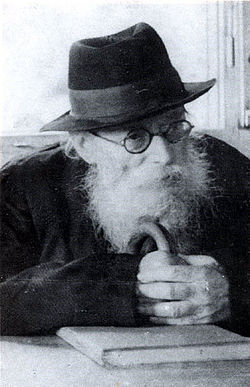
View on WikipediaAvraham Yeshayahu Karelitz (Hebrew: אברהם ישעיהו קרליץ; 7 November 1878 – 24 October 1953), also known as the Chazon Ish (Hebrew: החזון איש) after his magnum opus, was a Belarusian-born Orthodox rabbi who later became one of the leaders of Haredi Judaism in Israel, where he spent his final 20 years, from 1933 to 1953.
Key Information


Biography
[edit]Youth
[edit].jpg)

Born in the town of Kosava in the Grodno Governorate of the Russian Empire (today in Belarus). His father, Rabbi Shmaryahu Yosef Karelitz, served as the town's rabbi. His mother, Rashe Leah, was the daughter of the previous town rabbi, Rabbi Shaul Katzenelnbogen, who left his position for the rabbinate of Kobrin.
Except for a short period in which he studied in the "kibbutz" of R' Chaim Ozer Grodzinski in Vilna,[1] Avraham Yeshayahu Karelitz did not study in a cheder or yeshiva, and apparently was never officially ordained as a rabbi. His Torah education was received from his father and a private melamed named R' Moshe Tuvia. The Chazon Ish quotes Torah teachings from this teacher in several places in his writings. According to David Frankel,[2] the Chazon Ish related that his father hired a private melamed to keep him away from the company of children his age and idle chatter. For most of his life, he was self-taught. His mother later told Rebbetzin Malka Finkel, wife of Rabbi Eliezer Yehuda Finkel, that even in childhood he studied with great diligence. According to her, he told her several times that he did not enjoy studying, but he studied out of the recognition that "this is a good thing," hoping that the sweetness would come later.[3] His brother, Rabbi Meir Karelitz, said in his eulogy that at his bar mitzvah he committed to devote all his strength to Torah. According to a common story, his talents were not noticeable in childhood, though some deny this detail.[4] Binyamin Brown accepts both versions and speculates that although he was indeed talented, he was regarded in his environment as average due to his different study method, which did not meet the accepted criteria of yeshiva-style scholarship.[5]
Nevertheless, Brown, a scholar of the Chazon Ish’s life and thought, claims that there is a noticeable influence of Jewish Enlightenment literature in his writings and also in a few surviving poems he wrote. This influence is expressed in his florid and stylistic writing, and in his strict use of Hebrew free of foreign words, unlike other rabbis of his time.[6] In contrast, Shlomo Havlin claimed that the evidence for this assumption is anachronistic, since rabbinic literature had always been written in Hebrew, whereas Yiddish literature was then in its heyday.[7]
The Chazon Ish was known from a young age as a quiet person. To one of his associates, Yitzhak Gerstenkorn, founder of the city Bnei Brak, he explained that in his teens he decided not to utter anything that wasn't fully formed in his mind, but since he tends to write well-formed ideas, it is rare that he has anything to say aloud.[8]
In the year 5651 (1891), his grandfather Rabbi Shimshon Karelitz died. His son, Rabbi Shmaryahu Yosef Karelitz, was absent from the town that day, and the grandsons Meir and Avraham Yeshayahu, aged 16 and 12 respectively, prepared eulogies themselves, which the elder brother Meir read at the funeral.[9]
In his youth the Chazon Ish traveled to study in Brisk. Binyamin Brown also discusses the version that his journey was to Volozhin Yeshiva,[10] but this seems mistaken, in light of testimony by Rabbi Isser Yehuda Unterman that the Chazon Ish studied in Brisk,[11] but did not find his place there and returned home to Kosava. The reason for the trip was to study from Rabbi Yosef Dov HaLevi Soloveitchik of Brisk, who taught in Brisk after leaving Volozhin Yeshiva until his death in 5652 (1892).[12] Several speculations have been raised about his quick return home: from homesickness, to halachic issues (Chadash prohibition, which was treated leniently in Brisk based on the ruling of Rabbi Joel Sirkis, who once served as the local rabbi), and even poor spiritual environment in Brisk.[13][14]
In the year 5661 (1901), several responses under the name of the Chazon Ish were published in the journal "HaPeles", under the pen name "A.Ya.SH. from Kassava [=Kosava]". In one of them he defended the accepted calculation in the Hebrew calendar against a possible objection raised by another rabbi.[15] These were, as far as is known, his first printed words.
In the winter of 5665 (1905), the Chazon Ish stayed for an extended time in the city of Vilna and studied in the kibbutz of Rabbi Chaim Ozer Grodzinski there. He may have remained there due to travel disruptions caused by the 1905 Russian Revolution, which lasted the entire year.[16]
Period of Kvedarna
[edit]

In the winter of 5666 (end of 1905), at the age of 27, he became engaged to Batya (Basha), daughter of Mordechai Bay, a merchant from the town of Kvedarna (Yiddish: Kovidan) in western Lithuania, who was significantly older than him. Exact details about her year of birth, and thus about their age gap, are unknown. According to the author Chaim Grade,[17] her age was twice his; however, it may be that the fictional character “Machazeh Avraham”, undoubtedly based on the Chazon Ish, is not identical in all its details. The Karelitz family agreed to the match because she was considered an industrious and God-fearing woman, and also because their son Avraham Yeshayahu was known to be a heart patient and stringent in halacha, and was seeking a wife who would take on the burden of livelihood and allow him to study Torah.[18] After the "Tna'im” (conditions) were signed, it became clear that the father-in-law would not be able to meet his financial obligations and that the intended bride was older than thought; because of this, the family of the Chazon Ish sought to withdraw from the match, but he refused, arguing that one must not shame a daughter of Israel under any circumstance and once terms were agreed upon, one should not back out.[19]
The wedding took place three months after the engagement, on 11 Shevat 5666 (6 February 1906),[20] in Kovidan, and the couple made their home in that town. Batya opened a fabric shop there and supported the family, and the Chazon Ish devoted his time to Torah study. Rabbi Avraham Horowitz reports that Batya testified her husband sometimes helped her manage the household accounts,[21] but still, when the Chazon Ish needed something, he had to ask her for money.[22]
The Kovidan period is mentioned by the Chazon Ish's biographers as his "golden era", during which he studied Torah undisturbed. He studied in chavruta with the town’s rabbi, Rabbi Moshe Rozin, author of Nezer HaKodesh, and delivered Gemara lessons in the local synagogue. He would be in the beit midrash from early morning until night.[23] Rabbi Rozin held the Chazon Ish in high esteem and told Rabbi Chaim Ozer Grodzinski of him in Vilna. According to Brown, this was the point when the connection between the two men was formed.[24] Among his study companions in Kovidan were Rabbi Moshe Ilovitzky, Rabbi David Nachman Koloditzky,[25] and his future brother-in-law Rabbi Shmuel Eliyahu Kahan, with whom the Chazon Ish studied Tractate Niddah for a time, and through this connection arranged a match between him and his sister Badana. In Kovidan, the Chazon Ish founded a yeshiva with the local rabbi.[26]
In the year 5671 (1911), the first book in the series "Chazon Ish" was published, on topics of "Orach Chayim", "Kodashim", and the laws of Niddah. The book was published anonymously and only the name of the publisher, his brother Rabbi Moshe Karelitz, appeared on the title page, with no approbations. His books were not particularly popular, likely due to the difficult and concise writing style and the interpretive method that differed from the analytic method common in the Lithuanian Torah world. According to Brown, the difficulty in understanding his words stems from the fact that the author assumes the reader has already studied the sugya with its commentaries and is aware of the difficulties it raises, which the Chazon Ish seeks to solve.[27] The Chazon Ish's nephew, Rabbi Eliezer Alpha, once asked him, comparing it to Rabbi Chanokh Eigesh’s Marcheshet, published at the same time: "Your book is hard, and his is easy. And if we're already making an effort, we may as well study the works of the Rashba!" It is told that the Chazon Ish replied: "Once one toils over the Rashba, there’s no need to toil over the Chazon Ish."[28]
Due to the blood libel against Mendel Beilis and the Beilis trial (1911–1913), during which the defense submitted to the Russian court expert testimony disproving the blood libel in both private and general terms, Rabbi Karelitz, then age 34, wrote a treatise published in his letters collection under the title "To a Foreign Minister".[29] In this treatise, of which only the initial parts survived, there are twenty-six short chapters,[30] in which he surveys the Jewish outlook regarding the sanctity of human life and seeks to prove that ritual murder contradicts the fundamental principles of Judaism. Brown speculates that the missing parts of the treatise were never written, as it eventually became clear to him that his words would not receive the court's attention.[31]
Period of World War I
[edit]Stoybtz
[edit].jpg)
During the course of Eastern Front (World War I), the Imperial German Army occupied large swaths of historical Lithuania, and many residents from battle areas fled their homes and became refugees. The Chazon Ish and his wife, like many Jews of Kovidan, also fled to Russian-controlled territory and settled in the town of Stoybtz (Stołpce). Batya Karelitz opened a fabric shop in Stoybtz as well,[32] and the Chazon Ish continued his studies.
Although the Chazon Ish opposed holding a rabbinic post all his life, when the town’s rabbi, Rabbi Yoel Sorotzkin, was forced to leave by Russian orders, the Chazon Ish unofficially replaced him at his request, until he returned.[33] According to another version,[34] the residents begged Rabbi Karelitz to take the position after Rabbi Sorotzkin left, but he refused. According to one source, the Chazon Ish declined to bear communal responsibility, except in one case, when he joined efforts to restore the local mikveh that burned down in a fire.[35] That fire is described in a rare heading to one of the Chazon Ish’s commentaries on Tractate Kelim:
Stoybtzi, where nearly the whole town burned on Monday, 25 Sivan, and all its residents under pressure and distress with no home to live in and no place to lodge.[36]
Rabbi Shmaryahu Greineman recounted that when a plague broke out in town and the members of the chevra kadisha feared burial due to contagion, the Chazon Ish took it upon himself to bury the dead out of respect for the deceased. As a provocative act, he took one of the corpses on his shoulders and carried it to the cemetery, which caused the chevra kadisha members to return to their role. He later explained that his rationale was that if the dead were not buried, the entire town would be in mortal danger.[37]
In Stoybtz, the Chazon Ish hosted a group of young Jewish refugees in his home, among them Mordechai Shulman, who later founded Slabodka Yeshiva (Bnei Brak) and was one of his close associates.[38] Among the exiles to Stoybtz were also students of the Mir Yeshiva, along with their mashgiach Rabbi Yerucham HaLevi Leibowitz, and a connection was formed between them.[39] There are recorded cases of students from the Stoybtz area who came there to converse in Torah with the Chazon Ish.[40]
Minsk
[edit].jpg)
The Chazon Ish and his wife lived in Stoybtz during the first four years of the war, but at some point moved to the city of Minsk. After the October Revolution in 1917, the Belarusian Democratic Republic was declared. This state, which lacked broad international recognition, lasted briefly, and in 1919 the Communists took over and turned it into the Byelorussian Soviet Socialist Republic.
At first, the Chazon Ish moved alone to Minsk and lived in an apartment provided by Rabbi Zalman Sorotzkin, while Batya continued managing the fabric store in Stoybtz and traveled to Minsk for Sabbaths. His cousin Shaul Lieberman described those days in Minsk:
In those years he sat in his home in Minsk and studied all day and night. On Shabbat his wife came from Stoybtzi… I believe those were his best days, because he was still unknown… the public generally did not know of his existence, and he enjoyed that very much. He could seclude himself and study. Jews did not disturb him, and his mouth did not cease from learning. His wife would send him enough for sustenance, and he sufficed with little, from one Sabbath to the next.
— Shaul Lieberman, "In the Company of Rabbis"[41]
On 21 Iyar 5677 (1917), his father Rabbi Shmaryahu Yosef Karelitz died in Kosava, and was succeeded as town rabbi by his son-in-law, Rabbi Abba Swiatycki. The news of his father's death reached the Chazon Ish only four months later, on 29 Elul 5677,[42] via the Red Cross.[43] From then on, the Chazon Ish made a practice of studying the entire Tractate Chullin on his father's yahrtzeit, as his father had written the work Beit Talmud on that tractate.[44]
The Chazon Ish's seclusion for continuous Torah study during his time in Minsk was so complete that he did not go to prayers at the synagogue except on Shabbat and on Monday and Thursday, when there is Torah reading.[45] In those days, he wrote the commentaries later published on Tractate Eruvin and other topics in Orach Chayim and Yoreh De’ah. In Minsk, the Chazon Ish met leading Torah sages who were also staying there because of the war, including Rabbi Chaim Soloveitchik, Rabbi Nosson Tzvi Finkel, and Rabbi Yeruchom Levovitz.
Vilna period
[edit]

After the war, the Karelitz family returned to Stoybtz, which was in Soviet territory, and later crossed the border into Lithuania intending to return to Kovidan. Upon arrival, they found the town had not yet recovered from its destruction, and they turned to the Chazon Ish’s siblings (two brothers and a sister) who were living in Vilna to arrange their relocation there. An apartment with two rooms was rented for the couple in the Vilna suburb of Zaretshe, one of which was dedicated to Batya’s fabric shop.[46]
In 1920, the Karelitz family settled in the city of Vilna (then the capital of the short-lived state of Central Lithuania; in 1922 it was annexed by the Second Polish Republic), where he became close to the city’s rabbi, Rabbi Chaim Ozer Grodzinski. According to assessments, his exposure to Vilna’s Torah greats, even though he was not yet central in public affairs, contributed to the leadership ability he would later demonstrate as a Gadol Hador in the Land of Israel after the war.[47]
In the mornings, the Chazon Ish would walk to another suburb called Paplaujos (Paplauja), where his brother-in-law, Rabbi Shmuel Greineman, gave him a room in his apartment, simply furnished with a bed, chair, table, and basic sefarim. In this room, he studied alone, as was his custom, until evening, sometimes until collapse, for a period of three years.[48] It was said that during this time he delved into a specific Mishnah in Tractate Mikvaot for three months, about 15 hours a day.[49] During the 13 years he lived in Vilna, three more volumes of Chazon Ish were published. His brother-in-law Rabbi Greineman and his brother Rabbi Moshe managed their printing.
Binyamin Brown writes that although the Chazon Ish secluded himself for learning, he was “pleasant in manner, very kind, loved people, smiling, optimistic, and even possessed a subtle sense of humor,” and loved to offer advice and help people. He attributes his withdrawal from social interaction to natural shyness.[50]
In 5683 (1923), the second volume of his work on Orach Chayim was published, including his comprehensive treatment of the laws of muktzeh, Kuntres HaMuktzeh. That summer, the Chazon Ish collapsed and was forced to take a break from his intensive study. He wrote to his friend Rabbi Moshe Ilovitzky: “I suffered from nervous weakness and stopped learning.”[51] During that time, Rabbi Yoel Kloft recounted in his name: “Idleness was difficult for me; I felt like I was wandering the streets of Vilna like a madman because I couldn’t study.”[52] After this breakdown, he abandoned his habit of solitary all-day study and began learning with young students as chavruta. In late summer 5683 (1923), he recuperated in the resort town of Valkenik near Vilna, where Rabbi Chaim Ozer Grodzinski also stayed. There he began learning with a young man named Shlomo Cohen, grandson of Rabbi Shlomo HaCohen, one of Vilna’s rabbis. Cohen became his close student and later headed the semi-official biography project of the Chazon Ish.[53] Their joint study continued until the Chazon Ish immigrated to Eretz Yisrael in 5693 (1933), nearly 10 years after their acquaintance began.
Later during his time in Vilna, Chaim Grade, who would become a prominent Yiddish author, also lived in his home. He too studied with the Chazon Ish in chavruta for about seven years.[54] Some speculate that the Chazon Ish preferred to study with young students because he saw them as a substitute for children he never had, or because he preferred to shape their learning style rather than study with those already “corrupted” by standard yeshiva methods.[55]

In Vilna, the Chazon Ish made one final attempt to persuade his wife Batya to accept a get (Jewish divorce), so he could marry a younger woman who could bear children. Batya later recounted this to her friend, the mother of Chaim Kolitz. According to her, it happened on their way home across the Vilnia River (Vilnia); she answered: “Alright, but on my way home from the beit din, I will jump from the bridge straight into the water.” The Chazon Ish ceased all attempts and accepted the situation. However, according to Kolitz’s account, he then practiced the halakhic Niddah restrictions with her, such as not handing objects directly into her hand.[56]
In the 1930s, the Torah monthly Knesset Yisrael was published in Vilna, edited by his brother Rabbi Moshe. The Chazon Ish published insights there under pseudonyms. In one instance, he used the name of his student “Shlomo Cohen” to publish a critique of novellae written by Rabbi Joseph Dov Soloveitchik of Boston (then a student at Humboldt University of Berlin). According to the Chazon Ish’s brother-in-law, Rabbi Yaakov Yisrael Kanievsky (“the Steipler”), the Chazon Ish believed that the novellae were not the young Soloveitchik’s work, but that of his father, Rabbi Moshe Soloveichik, then Rosh yeshiva at Yeshiva University. Nonetheless, he chose to attack them ideologically, due to their association with Religious Zionist and Mizrachi circles.[57] According to Rabbi Soloveitchik’s son, Prof. Haym Soloveitchik, the novellae were indeed his father’s, not his grandfather’s, and the Chazon Ish sought to refute them even with weak arguments “to show that there is no Torah in him or his kind.”[58]
At this stage, the Chazon Ish was involved in several heated public issues, including:
A. The rabbinate controversy in Vilna,[59] a struggle that developed over the spiritual leadership of the city. The Mizrachi faction in Vilna sought to appoint Rabbi Yitzchak Rubinstein, who until then had been the official "government rabbi", as chief rabbi of the city. The Agudat Yisrael faction opposed, claiming that Rabbi Chaim Ozer Grodzinski was the natural spiritual leader of the community. The Chazon Ish led, behind the scenes, the effort to block Rubinstein’s appointment. The campaign failed, and the Chazon Ish’s brother, Rabbi Meir Karelitz, who was openly involved in the effort, was forced to resign from his seat on the “Rabbinical Council” of Vilna.[60]
B. A dispute between the Novardok Yeshiva network and the Vaad HaYeshivot regarding the share of funding to which the network was entitled. The leadership of the network argued that the Vaad should calculate each of the network’s branches as an independent institution when allocating the overall budget. The Vaad, for its part, decided due to financial constraints to treat the network as a single entity. Rabbi Grodzinski, who served as president of the Vaad, recused himself from the matter and imposed upon the Chazon Ish, in the presence of several prominent rabbis from Lithuania and beyond,[note 1] to issue a ruling. After deliberation, the Chazon Ish was compelled to decide. He heard both sides and ruled that the Novardok Yeshiva network would be entitled to 10% of the Vaad’s total budget. He was unaccustomed to such a position and quickly exited the hall after delivering the ruling. It is told that Rabbi Grodzinski summed up the meeting with the words:
Do you not know who the Chazon Ish is? The Chazon Ish is “truth” – and in the face of truth, one must yield![61]
In the year 5691 (1931), Rabbi Moshe Blau, at the recommendation of Rabbi Grodzinski, proposed that the Chazon Ish be appointed his deputy and eventual successor to Rabbi Yosef Chaim Sonnenfeld, the leader of the Edah HaChareidis in Jerusalem, who was by then struggling to fulfill his role. The Chazon Ish declined, saying he had no objection to the title, but was unwilling to judge monetary cases – a central part of the proposed position – thereby disqualifying the candidacy. In 5692 (1932), after Rabbi Sonnenfeld's death, Rabbi Grodzinski wrote to Jacob Rosenheim[62] that the Chazon Ish was not among the "fearful of issuing rulings" regarding matters of kashrut laws, but in monetary matters he hesitated to rule “out of great righteousness.”[63]
In his final years in Vilna, he studied in the mornings in chavruta with his acquaintance from Stoybtz, Rabbi Mordechai Shulman, then the young son-in-law of Rabbi Yitzchak Isaac Sher and later head of the Slabodka Yeshiva (Bnei Brak).[64]
In the spring of 5693 (1933), following a theft of merchandise from his wife’s fabric store,[65] the Chazon Ish decided to immigrate to the Land of Israel. He informed Rabbi Grodzinski, who hurried to arrange an immigration certificate for him and his wife. He turned to Moshe Blau, a leader of Agudat Yisrael in Eretz Yisrael, requesting that he handle the matter. Blau hinted that the Chazon Ish’s agreement to serve in the Edah HaChareidis Rabbinate in Jerusalem might ease the certificate process. The Chazon Ish again refused, and the process was handed to the secretary of Agudat Yisrael in Jerusalem, Moshe Porush. Before even receiving the Chazon Ish’s reply, Porush approached the British Mandate authorities, stating that there was a possibility that the Chazon Ish would be appointed head of the rabbinical court of the Edah, and that Agudat Yisrael guaranteed he would not be a public burden. The certificate was quickly arranged and sent to Rabbi Grodzinski.[66] At Rabbi Grodzinski’s special request on behalf of the Chazon Ish, the Jerusalem activists arranged a special exemption for him from the quarantine then in force at ports to prevent disease transmission.[67]

The Chazon Ish and his wife left Vilna on Sunday, 8 Tammuz 5693, 2 July 1933. On Saturday night, they were accompanied to the train station by a small group, including Rabbi Chaim Ozer Grodzinski and Rabbi Chanokh Eigesh.[68]
The Karelitz family traveled by train to Warsaw, and from there to the port city of Constanța on the shores of the Black Sea in Romania. From the port of Constanța, they sailed to the Land of Israel aboard the ship USS Martha Washington.
In Mandatory Palestine
[edit]I contemplate... and reflect on that wondrous man... the ideal type of the halachic man, who drew his authority from his intellectual capability and his personality, and not from the position he held. It seems he is one of the only figures about whom it is impossible not to speak in superlatives—and this is indeed what lexicon and encyclopedia writers, usually restrained in tone, do.
— Chaim Be’er, Report from Another World[69]


On 16 Tammuz 5693 (10 July 1933), the Chazon Ish and his wife immigrated to Mandatory Palestine. At the Port of Jaffa, they were greeted by members of Agudat Yisrael, at the request of Rabbi Grodzinski. In their early days in the Land of Israel, they stayed at the home of Rabbi David Potaš in Tel Aviv. After some time, they rented a room on Geula Street in the city. Rabbi Mattityahu Stigl, who had founded Beit Yosef Novardok Yeshiva in the new settlement of Bnei Brak, visited him in his apartment and invited him to move there. The Chazon Ish replied that he would come after the Three Weeks.[note 2] When the couple eventually arrived, they settled on the hill of Har Shalom. The air there pleased the Chazon Ish,[70] and he decided to settle in the area. Rabbi Shmuel Halevi Wosner related that he told him on the matter:
Jerusalem is full of righteous and great Torah scholars, but in the new settlement I found a wilderness; I wanted to plant seeds of Torah in it—therefore I came to Bnei Brak. If I do not succeed in planting? Then I will go to Gehinnom with its inhabitants like one of them.[71]
At first, he rented a two-room apartment from Rabbi Nachman Shmuel Yaakov Miyodser, rabbi of Bnei Brak and later head of the settlement council. After a short time, he moved to another apartment in Givat Rokach, where the rent was cheaper. Near his home was the Beit Yosef Yeshiva, and from time to time, the Chazon Ish would deliver lessons to its students. A few years later, he moved into a house built for him in eastern Bnei Brak.[72] In this house also lived his sister Miriam and her husband, Rabbi Yaakov Yisrael Kanievsky.
Bnei Brak later became, to a large extent due to the Chazon Ish, one of the strongholds of Haredi Judaism in Israel. At first, he was joined in Bnei Brak by a small circle of members of Poalei Agudat Yisrael, who followed his halachic guidance on agricultural matters, mainly after Rabbi Chaim Ozer Grodzinski referred them to him. Later, he became widely known and became a halachic authority among broader circles in the country.
An attempt by Batya Karelitz to reopen a textile shop failed, and she had to close it. A wealthy man who offered monthly financial support, at the request of Rabbi Yechezkel Abramsky, was declined by the Chazon Ish,[73] who resolved to support himself through the sale of his books, even though this income was neither profitable nor steady; the Chazon Ish had not yet achieved national fame, and buyers came only gradually.
In 5694 (1934), Rabbi Grodzinski put forward the Chazon Ish as one of the candidates for the Council of Torah Sages of Agudat Yisrael in the Land of Israel. After consulting with the Chazon Ish, Rabbi Grodzinski wrote:
Rabbi A.Y. Karelitz does not want to accept any official title or responsibility, but is willing to be consulted.[74]
That summer, the Chazon Ish spent an extended period in Safed for health reasons. During that time, he primarily studied in the Beit Midrash of Rabbi Yosef Karo in the Old City.
In 5696 (1936), he worked to establish the “Torah Education Center in the Land of Israel,”[75] and he founded a kollel in the Zikhron Meir neighborhood in Bnei Brak. This kollel, one of the first in the New Yishuv, became a model for many other institutions.[76] After his death, the institution was named "Kollel Chazon Ish".
In December 1936 (winter 5697), the Chazon Ish fell ill, apparently due to appendicitis, and required removal of the appendix (appendectomy).[77] Later that year, ahead of the upcoming Shmita year 5698 (1937–38), his brother-in-law Rabbi Shmuel Greineman printed for the first time in Jerusalem his book "Chazon Ish" on Tractate Shevi'it and the laws of shmita.
In the following years, several more volumes in the series were published, especially from Seder Taharot, which scholars had previously studied little due to the lack of both Babylonian Talmud and Jerusalem Talmud on it.
At the beginning of winter 5701, on 19 Cheshvan, his mother Rashe Leah died in Jerusalem. In her final years she had lived with her son Rabbi Meir Karelitz and was buried on the Mount of Olives. The Chazon Ish ascended to Jerusalem for the second time in his life; the first had been a year earlier, for the wedding of Shlomo Shimshon Karelitz, son of his older brother Rabbi Meir.
After the deaths of the great rabbis of Eastern European Judaism, some of whom perished in the Holocaust, many saw him as their successor. During this time, his status as Gadol Hador began to take shape.[78]
In the years prior to the founding of the State, the Chazon Ish was involved in several public issues, most with a religious background. He helped establish new yeshivot following the destruction of European Jewry and its yeshivot, encouraged both ideologically and financially farmers who kept Shmita, and wrote letters requesting financial aid for Haredi educational institutions that were in crisis (1947).
Shmita and Heter Mechira
[edit]When the Chazon Ish arrived in the Land of Israel, nearly all farmers (except a few in the Petah Tikva area) relied during the Sabbatical year on the Heter Mechira. He worked to change this situation. In 5698, when the treasurer of the Haredi settlement of Machane Yisrael (Jezreel Valley) came to consult with him on the matter, the Chazon Ish ruled that they should refrain from relying on the heter. In accordance with his ruling, Kibbutz Hafetz Haim and other settlements of Poalei Agudat Yisrael also acted.[79]
To enable farmers to keep shmita without heter mechira, the Chazon Ish permitted certain labors aimed at preserving the fruit ("le-okmei peira"), and allowed marketing the produce via Otzer Beit Din.
The international date line controversy
[edit]During World War II, when students of the Mir Yeshiva and others fled to East Asia, the "Shabbat controversy in Japan" arose, in which many halachic authorities debated the question of determining which day the Shabbat and festivals fall on in that region of the globe. On the eve of Yom Kippur 5702 (early October 1941), the issue intensified among the Jewish refugees in Japan. Until then, those who wished to be stringent avoided a decision by observing two consecutive days as Shabbat. However, a two-day fast was not a viable solution for most of the refugees, especially under wartime living conditions. The exiles sent telegrams to rabbis in the Land of Israel and elsewhere, asking how to proceed.
The Chazon Ish, who had already dealt with this issue in the past,[80] was also asked about the matter, and his response[81] was published in a well-known halachic ruling, which opposed the view of Jerusalem’s rabbis and rabbis affiliated with the Chief Rabbinate. According to his ruling, the Halachic date line passes west of Japan, and therefore Shabbat there falls on Sunday, contrary to the practice of the local Jewish community.
The Chazon Ish dictated his position on the date line to his student Rabbi Kalman Kahana on the night of Yom Kippur eve. On the morning of Yom Kippur eve, he sent Rabbi Kalman Kahana to Jerusalem to Rabbi Yitzchok Zev Soloveitchik to request that the two of them send a telegram to Japan instructing people to eat on Wednesday (according to their reckoning) and to fast on Thursday.
The Brisker Rav refused to send the telegram, arguing that it would arrive in Japan after Wednesday evening and some people would surely have already accepted the fast of Yom Kippur and would not want to interrupt it; seeing the telegram, they might fast again on Thursday and thus endanger themselves. He also added that the Av Beit Din of Brisk, Rabbi Simcha Zelig Riger, had already ruled, before their departure, that they should fast on Thursday.
Even before Rabbi Kalman Kahana returned from Jerusalem to Bnei Brak, the Chazon Ish sent a telegram to Japan instructing: "Eat on Wednesday and fast Yom Kippur on Thursday, and do not be concerned about anything."
Rabbi Yechezkel Levenstein, who was the spiritual authority among the Mir Yeshiva students at the time, ruled to follow the Chazon Ish’s opinion even against the majority of dissenters.
This position was printed in Kuntres Shemoneh Esreh Sha’ot (“Pamphlet of Eighteen Hours”), initially as a separate booklet,[82] and later included in his book on Orach Chayim.
The holocaust and his attitude toward it
[edit]During the Holocaust, the rabbi did not imagine the extent of the disaster and refused to believe the reports arriving about the extermination of millions of Jews. Eventually, when the scope of the destruction became known, the rabbi lamented: "From Heaven, the calamity that befell the Jews of Europe was concealed from us—even prayer efforts to annul the harsh decree were lacking."[83]
Various reports circulated regarding his statements on the cause of the Holocaust, including: that it could not be explained, that it was a punishment for the sins of the generation and its secular leaders, or that it was due to the weakness of the generation after the deaths of previous Gedolei Yisrael. He also claimed that despite everything, God's punishment was given with abundant mercy. Aharon Surasky reports that he likened the period to the work of tailoring, in which the tailor must "cut the fabric into shreds… in preparation for sewing a new garment"—destruction as a precursor to creation.[84] In light of all this, it seems he avoided providing a structured and systematic theological doctrine.[85]
Before the establishment of the state, a proposal was made to institute a perpetual public fast day and a collective shiv'ah. The rabbi responded with a lengthy letter opposing additions to what the Sages already instituted, especially in a generation he viewed as spiritually diminished. He did not see the Holocaust as an exceptionally unique catastrophe compared to the disasters that befell the Jewish people throughout history. Binyamin Brown assesses that this response also reflects hidden anxieties about accusations toward the Haredi world, which was surprised and unprepared for the devastation.[86]
Blaming the rabbis for the destruction of European Jewry was, in his view, heresy—even if said by someone otherwise observant.[87]
The establishment of the state of Israel and his attitude toward it
[edit]The rabbi instructed R’ Jacob Rosenheim, president of Agudat Yisrael Worldwide, to prevent the establishment of a Jewish state as much as possible.[88] Even after the state became a reality, he expressed reservation and hostility toward its ruling institutions and did not believe the state would last long.[89]
Upon the establishment of the State of Israel, he supported Agudat Yisrael's participation in the United Religious Front for the elections to the Knesset, in contrast to the position of the Edah HaChareidis. He explained that such participation did not imply recognition of the state and likened it to a man facing a robber and reaching an agreement with him to avoid being killed; this is not recognition of “authority” but an acknowledgment of reality.[90]
He opposed Zionism and Religious Zionism, and insisted that Tachanun be recited in his study hall on Yom HaAtzmaut. In one case where he was sandek on that day, he publicly announced it to prevent misunderstanding.[91] Two years later, he ruled that even when a brit was held in his study hall, Tachanun should be said—so no one would mistakenly think it was omitted due to Yom HaAtzmaut.[92]
After the 1948 Arab-Israeli War, he addressed the halachic implications of its outcomes. In his book on Tractate Sanhedrin, he discusses regarding the olives taken from Arab trees that they abandoned and [then] left, and regarding the question of Arab land ownership in the Land of Israel, he proposed that since all foreign ownership in the Land of Israel after the exile derives its legal validity from the laws of "kinyan kibush", which halachically regulate a conqueror’s ownership of captured land, then when a new conqueror (Israel) arrives, the previous ownership expires on its own. This has important halachic implications for the obligation of terumot and ma’aserot on agricultural produce from captured territories.[93]
National service law affair
[edit]In 1952, the issue of the conscription of religious women into national service arose. In the background of the controversy was an attempt to obligate women to serve military service, an obligation that even the vast majority of the Religious Zionist public opposed. Subsequently, due to this opposition, a clause was established in the law exempting women from military service for religious reasons, and in a second stage, an attempt was made to determine a national service alternative for women within the framework of the Security Service Law. The Chief Rabbinate and Haredi rabbis and others strongly opposed this, contrary to the position of the Religious Kibbutz Movement and the “Lamifneh” faction in HaPoel HaMizrachi, who supported the law. This issue was considered very essential in the eyes of the Chazon Ish. He wrote on the matter: “The stirring of my soul instructs and comes forth that it is a matter of ‘be killed and not transgress’, and perhaps also from the point of halacha it is so.”[94]
In this context, "Agudat Yisrael" left the coalition at the end of 1952.[95] Eventually, in 1953, the "National Service Law" was legislated, stipulating that any religious woman who received exemption from military service in Israel is obligated to national service. This law was passed with the agreement of the Chief Rabbinate and the support of the Mafdal representatives. Shlomo Zalman Shragai wrote that Minister Haim-Moshe Shapira and Deputy Minister Zerach Warhaftig received the Chazon Ish’s principled consent to their step.[96] However, due to the opposition, the law was not implemented in practice.
His death
[edit]

The Chazon Ish died of a heart attack on Friday night, the 15th of Cheshvan 5714, October 24, 1953, after midnight.[97] He died at 2:30 a.m., with his student Yechezkel Bartler at his side.[98]
The rumor of his death spread throughout Bnei Brak in the morning hours. By midday on Shabbat, the Chazon Ish’s room was closed due to the crowding. According to Rafael Halperin, thousands stood in the courtyard reciting Psalms. With the conclusion of Shabbat, the news of his death was broadcast on "Kol Yisrael".[99] The municipalities of Bnei Brak and Ramat Gan declared a suspension of work during the funeral hours. At the opening of the government meeting on Sunday morning, Prime Minister Ben-Gurion delivered remarks in the rabbi's memory.[100]
At the funeral procession, which was held on Sunday afternoon, tens of thousands of men, women, and children walked behind his bier. He was buried in the Shomrei Shabbat Cemetery in Bnei Brak.[101]
The Chazon Ish's grave serves as a pilgrimage site throughout the year, especially on the anniversary of his death. Nearby, his brother-in-law Rabbi Shmuel Greineman purchased a special burial compound for members of the Chazon Ish’s family.
After his death, his brother-in-law Rabbi Shmuel Greineman revealed the amounts of charity money the Chazon Ish distributed annually to the needy, from funds given to him by Jewish philanthropists from Israel and abroad. According to him, in the last year of his life, the Chazon Ish distributed over one hundred thousand Israeli lira. After his death, a charity fund was established in his name to continue this work.[102]
His thought and work
[edit]Halakha
[edit]His method of study, and his attitude toward the rulings of his predecessors
[edit]A central element in the teaching and halakhic rulings of the Chazon Ish was his attitude toward “dina degemara” — laws explicated in the Talmud — as those that may not be questioned, must not be deviated from even in the slightest, and must be fulfilled even if they were not mentioned by later halakhic authorities after the sealing of the Talmud: “A law that is clarified explicitly from the Gemara is, to me, the foundation of halakhic decision.”[103]
Even in some cases where the reality from which the Talmudic law was derived had changed over the generations, the Chazon Ish maintained that the law remained in force. His reason was that halakha for future generations was meant to be sealed according to the words of the sages of the “two thousand years of Torah,” which ended in the time of Chazal. Thus he wrote about the laws of terefot (non-kosher animals): “And behold, it was necessary that during the two thousand years of Torah, as it says in Avodah Zarah 9a and Bava Metzia 86a — Rabbi and R. Natan are the end of the Mishnah, Rav Ashi and Ravina are the end of the hora’ah — there should be a fixed determination of terefot. There is no new Torah after them. The terefot were determined by Divine Providence at that time, and even if medicine later develops cures for these conditions, they remain the terefot that the Torah forbade, both then and in future generations.”[104]
On the other hand, there were other Talmudic rulings, such as those relating to human terefot, that the Chazon Ish did not see as dependent on the conditions of Hazal’s time: “Indeed, regarding marrying off his wife, as long as there is a treatment in his time, we do not prevent him from doing so.”
Regarding later periods recognized in halakhic discourse, the Chazon Ish believed that although Torah scholars had accepted the authority of earlier generations, halakhic clarification must still derive from the original sources — i.e., the tradition of Hazal. Therefore, he maintained that someone who does not know how to derive halakhic conclusions from the Talmudic discussions may not issue rulings, even from works like the Shulchan Aruch, as he would be unable to match specific real-life cases to the abstract cases presented in halakhic literature.
As a result of this outlook, he shaped his study method to first derive halakhic conclusions from the Talmudic sugya (discussion), and only afterward to compare the conclusions to those in halakhic codes. Although in general he nullified his own opinion before that of the Rishonim (early authorities), he held that each person is required to exhaust his intellect in Torah study. Incorporating the greatness of the Rishonim into one’s own analytical process could hinder the understanding of the roots of halakha. Their words should be taken into account only when not understood, and in practical halakhic rulings — when it is clear that the Rishonim were addressing the same case.
He summed up this approach in a letter: “To take hold of the rope of Torah is a difficult matter, and manifold. I took upon myself to investigate the Gemara as much as possible, even if it contradicts the Rishonim — and to suffice with the knowledge that the words of our sages are fundamental, and we are ‘orphans of orphans.’ Nevertheless, not to refrain from clarifying and analyzing what we can in our smallness, and also to rule accordingly in cases where there is no explicit contrary ruling in halakha. Otherwise, I would lack the engagement of Torah.”[105]
Nevertheless, the Chazon Ish generally did not permit himself to rule against the Shulchan Aruch in cases where the opinion of the Rema was clear. Regarding the Vilna Gaon (Gra), he considered his status — especially in Lithuanian Jewry — to be like that of the Rishonim. This allowed accepting rulings from the Gra even when they contradicted the Shulchan Aruch.
In one of his letters, he placed the Gra in a row alongside Moses, Ezra the Scribe, Rabbi Yehuda HaNasi, Rav Ashi, and the Rambam: “We relate to the Gra in the same category as Moshe Rabbeinu, Ezra, Rabbeinu HaKadosh, Rav Ashi, the Rambam, and the Gra, through whom Torah was revealed as one sanctified for that purpose, who illuminated that which had not been illuminated before him and took his portion. He is counted as one of the Rishonim, and therefore disagrees with them in many places with great strength — even with the Rif and the Rambam. His stature in divine spirit, piety, wisdom, diligence, and mastery of the entire Torah cannot be fathomed. Therefore it is not surprising that he disagrees with the Shulchan Aruch — and the places where he does so are many.”[106]
Despite this, and according to his principle that one must “investigate the Gemara as much as possible, even if it contradicts the Rishonim,” he himself was eventually forced to interpret sugyot differently even from the revered Gra. Rabbi Shlomo Cohen recounted that in 1920, when the Chazon Ish was 41, he said that throughout his life he had tried to avoid disagreeing with the Gra, but had finally been compelled to interpret one grave sugya differently.[107]
A representative example of his approach — “to interpret and clarify what we can... and also to rule accordingly when there is no explicit contrary view” — that also highlights his social sensitivity, can be found in the case of an agunah that was brought before his nephew, Rabbi Shlomo Shimon Karelitz, head of the rabbinical court in Petah Tikva. The nephew struggled to find a solution to the dire situation and turned to his uncle. The Chazon Ish delved into the relevant sugyot and ruled leniently in that specific case. The judges accepted his opinion and signed a marriage permit for the woman. The nephew, still uneasy with the ruling, came to him the next morning and reiterated his strong objections. Under those circumstances, he argued, how could they allow it? The Chazon Ish reconsidered his arguments and then replied: “It is true that it is difficult to permit — but it is more difficult to forbid!”[108]
Precision in Halakha
[edit]“The Lithuanian genius, whose greatness at first glance is expressed in his intellectual achievements, [but in truth is revealed] as a great and multifaceted personality, full of imagination, emotion, and soul"[109]
One of the banners of the "Chazon Ish" worldview is the matter of meticulous adherence to the minutest detail in fulfilling halakha in all its details and refinements. The Chazon Ish viewed this exacting behavior as a guarantee of Yirat Shamayim (fear of Heaven) and dedicated to it the third section of his philosophical work "Emunah uVitachon", titled "Ethics and Halakha." His great independence as a halakhic authority led him to extreme precision even in the details of laws he deduced from halakhic discussion in the relevant Talmudic sugyot. These refinements became identified with him and his students. Most well-known are his stringencies, dating back to his time in Europe, especially in the following areas:
The laws of Eruvin:
Writing Torah scrolls, tefillin, and mezuzot – with special emphasis on the shape of the letters according to the ruling of the Beit Yosef. According to his approach, which contradicts the custom of the Ari, the right “leg” of the letter tzadi should be shaped like a regular yud (as in contemporary Hebrew fonts), not an inverted yud, as is customary among Sephardic and Hasidic Jews;[110]
Baking matzot – he insisted on baking them personally so he could supervise every step of the process in accordance with his stringencies;
The Four Species – into which he invested much money and effort to obtain them in their optimal halakhic form. It is told that once, in midsummer, he saw beautiful myrtle branches that met halakhic standards in a local non-Jew’s garden. He paid the man in advance to guard and care for them until Sukkot to add them to his lulav;[111]
Laws of mikvaot: the infusion of drawn water into rainwater (zeriah) to render it a valid mikveh – the Chazon Ish had his own unique position on this matter.[112]
Mitzvot between man and his fellow were also, in his view, included in halakhic precision, and he was very careful that one not come at the expense of the other. His close associate Rabbi Shlomo Cohen related that once the Chazon Ish instructed him not to say the usual verses before the shofar blowing but to blow without delay and finish prayers quickly. The reason for the haste became clear after prayers: the Chazon Ish had overheard a weak elderly man tell his son, who urged him to eat for health reasons: "No, I have never eaten before the shofar blowing." So that he would not be forced to prolong his fast, the Chazon Ish shortened the traditional ritual.[113]
The Chazon Ish instituted the reading of Megillat Esther in Bnei Brak also on Shushan Purim, out of doubt that the city might be considered "adjacent and visible" to the ancient city of Jaffa.[114]
Etrogim of the “Chazon Ish” strain:
A well-known case of the Chazon Ish’s halakhic stringency was his search for a native Israeli etrog variety that grew wild, to avoid the suspicion that etrogim might be grafted with another botanical species, which would render the etrog halakhically invalid for the Four Species. The etrog tree is prone to grafting due to its weakness. The etrogim he found were slightly lacking in aesthetic beauty and symmetry. In the Haredi public, his approach was widely accepted, and there is high demand for etrogim descended from trees whose fruits the Chazon Ish used. His method for identifying the ancient Israeli etrog was accepted by several researchers.[115]
Some etrogim come from a tree planted by Rabbi Michel Yehuda Lefkowitz in his yard, from seeds given to him by the Chazon Ish. These are called the "Lefkowitz strain," from which additional varieties have developed. There are also "Halperin etrogim of the Chazon Ish strain."
Land-dependent commandments
[edit]The Chazon Ish especially acted to instill broad awareness for the observance of land-dependent commandments, particularly the commandment of Shemitah. He demanded of the kibbutzim of Poalei Agudat Yisrael to observe the Sabbatical year without relying on the heter mechirah (permitted sale of the land to a non-Jew) by the Chief Rabbinate, which he rejected. As part of his activity for the observance of land-dependent commandments, he went out to the field several times to conduct experiments and trial examinations of halakhic concepts.
The Chazon Ish also acted in matters of terumot and ma'aserot (tithes and offerings). He was meticulous to tithe at home even foods that had already been tithed, out of concern that they had not been tithed properly. He also innovated the matter of the perutah chamurah, which was not practiced before him; he encouraged and spurred the study of Seder Zera'im among Torah scholars, and answered many inquiries on these topics.
The issue of halakhic measurements
[edit]The name of the Chazon Ish is also associated with a fundamental disagreement on the issue of "shiurim" (halakhic measures) mentioned in the Bible and the Talmud (cubit, span, fingerbreadth, olive-size, egg-size, etc.). Rabbi Avraham Chaim Naeh (the GaRa"Ch Naeh) published these measures in modern units (meters and grams), and according to his approach, a handbreadth is eight centimeters and a revi'it (liquid measure) is 86 cc. The Chazon Ish disagreed with this view, and claimed that the true measures are much greater — a handbreadth is about ten centimeters, and a revi'it is approximately 150 cc.
The main point of disagreement is whether to base the other measures on the volume of eggs or on the width of the thumb. Rabbis Naeh and Karelitz were not the first to differ on this point, they were preceded by great Acharonim, the Chatam Sofer and the Noda BiYehuda. Rabbi Naeh sought to preserve the custom of the Old Yishuv in Jerusalem, while the Chazon Ish held that the tradition he had received from his father’s home and the greats of Lithuania regarding measurements was accepted by Torah scholars with higher halakhic authority than that of popular custom. As part of this approach, the Chazon Ish relied on the measurement of the finger of his student Rabbi Kalman Kahana, whom he considered an average person for the purpose of measures and sizes.[116]
In practice, in the Lithuanian sector, the Chazon Ish’s method on this issue is the widespread norm. The spread of this practice began among graduates of Lithuanian yeshivas and from there extended to the broader sector. Even among the rest of the Haredi public, who follow their ancestral tradition with the smaller measure, some are stringent in Torah-level commandments according to the larger measurement due to concern for the opinions of the Chatam Sofer and the Chazon Ish, as recommended by the Mishnah Berurah.[117][118]
The philosophy of halakha
[edit]The Chazon Ish held that, beyond the essential obligation on every Jew to obey the Torah's directives as they are, their goal is to place a person in the position of a subject standing before his king and submitting to his authority. For this purpose, what is required on one hand is absolute submission and obedience to every detail; and on the other hand, the performance of mitzvot under all circumstances — even when it is clear to a person that he cannot precisely assess what is required of him for the full performance of the mitzvah. This is because the main thing is fulfilling the king’s command, and man’s limitations and assessments were taken into account with the command. Or in the words of the Chazon Ish: "The halakha was given to be calculated approximately, for the mitzvot were given only to purify the creatures, and to be precise in His commandments [i.e., God’s] to accept His sovereignty, and also to fulfill the wisdom of the Torah contained in all the laws of the commandment and its inner secret. And for all of these, nothing is lost if the fixing of boundary lines is approximate, so that even those of weak understanding can fulfill the practical commandments."[119]
His influence on the Haredi public
[edit]The Chazon Ish had a decisive contribution to shaping Judaism in the post-Holocaust generation. His contribution is directly reflected in the way the Haredi public conducts itself. He reinforced the sense of the importance of Torah study for the entirety of a person's life as an ideal, and is credited to some extent with the creation of a "society of learners" in Israel. As someone who was the “Gadol HaDor” (leading Torah sage of the generation) at the time of the post-war turning point, most of the yeshivas established during this period in the Land of Israel were founded with his blessing and advice—both regarding the very establishment of the yeshiva, and regarding the choice of location and staff; among them: Kfar Hasidim Yeshiva in Zikhron Ya'akov, the Sharon Yeshiva in Ramat HaSharon, and the Be'er Yaakov Yeshiva. For this reason, Haredi biographers attribute to him the title "Father of the Yeshivas in the Land of Israel."[120] Binyamin Brown, in a response article, claims this argument is flawed; according to him it is pure anachronism, as other rabbis of the time are also absent from the Haredi press.[121]
Through his students and associates, he also influenced yeshivas outside of this sector, such as Midreshet Noam in Pardes Hanna, which was founded with his blessing by his close disciple, Rabbi Yehoshua Yagel.
The Chazon Ish made an ideological contribution to establishing the status of yeshivas as a Torah territory and as the spiritual home port of Torah scholars, even when they go out to labor during the day. In his words, the yeshiva is a "fortress of might for raising students—Torah scholars destined to be great sages of the generation."[122] Practically as well, the Chazon Ish enlisted publicists and renowned Haredi educators to persuade on the one hand Jewish philanthropists to financially support institutions established in the 1940s and 1950s, and on the other hand, to convince young men to forgo possible career advancement and to choose a life of Torah study, despite the obvious financial consequences.
By virtue of his status, he became a prominent educational authority in Haredi society. Among his instructions, his opinion is well-known that students considered "wayward" should not be expelled, for fear that they might completely stray from the religious path.
Despite his great influence, the common analytical method in Lithuanian yeshivas is that of Rabbi Chaim of Brisk, which the Chazon Ish opposed. Also in halachic terms, some of his rulings were not accepted by the majority of the Lithuanian public. However, part of the Haredi-Lithuanian stream, called "Chazon Ish-niks," accepted his teachings in all areas. Within this group there are several subgroups centered around personalities among his students.[123] The main communal institutions in which members of this group concentrate are Kollel Chazon Ish and the Lederman Synagogue in the Chazon Ish neighborhood; the main yeshivas of this group are the Slabodka Yeshiva in Bnei Brak and Zichron Michael Yeshiva in Zikhron Ya'akov.
His attitude toward Rav Kook
[edit]The attitude of the Chazon Ish toward the Chief Rabbi of Israel at the time of his arrival in the Land of Israel, Rabbi Abraham Isaac Kook, occupied thinkers from the Religious Zionist public in the final decades of the 20th century and the early decades of the 21st, and subsequently also Haredi elements who criticize Rav Kook's path. Some see the official Haredi position, which expresses varying degrees of reservation toward Rav Kook’s path, as a rewriting of the true and respectful opinion of the Chazon Ish, as expressed in his letters to Rav Kook and other sources.[124]
Shortly after his immigration to Israel, the Chazon Ish addressed two short letters to Rav Kook containing halachic questions on laws applicable in the Land of Israel but not in the Diaspora. In these letters he addressed Rav Kook with the title “His Honor, the esteemed Maran, may he live and be well,” a title he only used for Rabbis Isser Zalman Meltzer, Chaim Ozer Grodzinski, Yitzchok Zev Soloveitchik, and Elchonon Wasserman. Rabbi Menachem Yehuda Halevi Ushpizai testified that when he informed the Chazon Ish of Rav Kook’s grave illness, tears came to his eyes, and he sent a message that he intended to visit him. However, Rav Kook told the messenger he did not want to interrupt the Chazon Ish’s Torah study and that he should pray for him at home.[125]
The first mayor of Bnei Brak, Yitzhak Gerstenkorn, relates in his memoirs that when Rav Kook arrived in Bnei Brak, he sent word that he wished to visit the Chazon Ish. The Chazon Ish replied that he would not allow Rav Kook to trouble himself and that he would come to him. For the meeting, the Chazon Ish wore his Shabbat clothes. At the cornerstone laying for Yeshivat Beit Yosef in Bnei Brak, the Chazon Ish stood throughout Rav Kook’s congratulatory speech—an honor he did not show to other Torah scholars who spoke there. When asked why he didn’t sit, he replied: “The Torah is standing!”[126]
The subject became a controversy between Religious Zionists and Haredim, and treatises have been written on both sides.[127] Binyamin Brown offers a developmental view of the Chazon Ish’s attitude toward Rav Kook: a warm relationship that deteriorated over time[128] as their acquaintance deepened and the Chazon Ish was exposed to elements of Rav Kook’s halachic approach that conflicted with his own views. This offers a plausible resolution for the contradictory sources presented in polemic literature on this topic.
The most famous halachic disagreement between the two was the controversy over the "heter mechira" during the sabbatical year, as a possible solution to the problem of agricultural produce loss and other damages caused by abandoning the land. The Chazon Ish rejected the solution for various reasons, yet ruled leniently in other shemitah-related questions to enable observance of shemitah without relying on the heter. In doing so, he wrote at length refuting Rav Kook's arguments in support of the heter and his rulings on shemitah laws in general.
His attitude toward the Mussar movement
[edit]The Chazon Ish expressed a critical view toward the ideas of the Musar movement, though he held affection for its figures. He expressed this in a letter to the head of Hebron Yeshiva, Rabbi Simcha Zissel Broide, while still a young man: “I spent much time with the Saba of Slabodka z”l, and with the Saba of Mir z”l, and with their great students, and also with the greats of the Novardok school, and there was always boundless love between us. They were entirely devoted to me, and I never refrained from voicing sharp critique, and they delighted in it. For it is the nature of scholars to delight more in a 'meitivay' (a challenging question in the Talmud) than in a 'tena nami hachi' (a supporting text); and I delighted in them, especially the yeshivas rooted in Torah and awe of Heaven, without separation...”[129]
Unlike early 19th-century opponents of the Mussar Movement, who accused its leaders of ideological affinity with the Jewish Enlightenment, the Chazon Ish, writing in the early 20th century, did not doubt their intentions. However, he believed the movement’s claim—that refined character traits alone can equip a person to overcome natural inclinations and align with halacha—was flawed. In his view, in moments of crisis or value conflict, one reverts to natural instincts: “When he is confronted by conflict with his fellow, he will surely decide in line with his natural tendencies. Even if these are refined, they often do not align with the divine halacha.”[130]
Moreover, refined character traits and self-awareness might cause one who places his trust in Mussar study to rely on the power of his intellect, even in cases of error. Therefore, the Chazon Ish believed that a proper ethical system cannot be based on anything other than halacha itself: absolute commitment to the minutiae of the law. This commitment operates on two levels: first, a person’s day is filled with small tests to fulfill or neglect the law—tests that are easy to overcome and strengthen religious awareness; second, in cases requiring special effort, precision in law trains one to overcome "bad" traits like laziness and desire.[131]
His attitude toward the Hasidic movement
[edit]The Chazon Ish did not explicitly address the Hasidic movement in writing. There are a number of passages in Emunah u’Bitachon that may have been aimed against Hasidism.[132] He opposed some customs practiced among Hasidim, such as writing the inverted tzadi in STaM and immersion in the mikveh on Shabbat, while praising others such as growing a beard, wearing a long coat, and marrying young. He encouraged Hasidim to travel to their Rebbe for Shabbat, but prevented young men from attending a Hasidic tish on Friday night, claiming that "on Friday night there is a lack of Torah in the world."[133] Biographies of his persona include testimonies that he ideologically opposed the Hasidic path, following his great admiration for the Vilna Gaon and his way.[134] Nevertheless, this view was not expressed in practice, because "today we have enough battles from outside."[135] He maintained friendly relations with Rebbes of his generation, and encouraged his close associates from Hasidic families to continue in their practice.[136][137]
On history and hagiography
[edit]The Chazon Ish believed that studying the conduct of great sages is a practical necessity, and only by truly knowing and recognizing their character can one learn from their actions. There is no value in a stereotyped perception of all sages as a uniform brand of a certain kind of perfection. He gave expression to this view in his famous letter, which also contains a halakhic reference to the possible problem of such study due to the prohibition of lashon hara: “If it is permitted to speak lashon hara about a craftsman in his craft, to someone inquiring for practical need, then all the more so it is permitted to inform those who hold fast to the Torah and need to know. For knowing the sages of the generation, their heart and measure, is itself Torah. Nonetheless, great caution is required, lest one misstate the matter by even a hair’s breadth and thereby bring out a bad name on a Torah scholar.[138]
Nevertheless, the Chazon Ish expressed significant skepticism regarding the events of the times as described in books of history and biographies. In his view, they mix truth and falsehood side by side, and historical written information should not be relied upon without a probabilistic examination of the events described. He attributed this to the innovating tendency of historians and their uncritical reliance on earlier ones: “Chronicles and world events teach much to the wise man in his path, and the foundations of wisdom are laid upon the history of the past. Yet because man loves to innovate and to speak before an audience, many lies have accumulated in historical books. For man is not naturally repulsed by falsehood; many love it and delight in it with the pleasure of friendship. And the wise man must sift through the storytellers’ tales, to accept the truth and discard the lies. Here lies broad ground for imagination, for imagination by nature hurries to judge before reason has weighed the matter on the scales of justice. And imagination passes judgment instantly—what is true and what is false.[139]
Chazon Ish
[edit]A series of books of commentary, innovations, and halachic rulings on the Babylonian Talmud and the Jerusalem Talmud, on Maimonides' Mishneh Torah, and on the Shulchan Aruch. This is Rabbi Karelitz’s main book series, and he is referred to as the “Chazon Ish” after it.
The name of the book hints at the author's name in an acronym: Abraham Yeshayahu. And it corresponds with the opening of the Book of Isaiah: “The vision of Isaiah son of Amoz.” Due to his modesty, he did not sign his name on his books, but rather they are signed by their publishers: his first book is signed behind the title page by his brother Rabbi Moshe Karelitz; and his other books—by Rabbi Shmuel Greineman. Rabbi Greineman’s family continues to print the books to this day.
Booklets from the series, such as “Kuntres Shmoneh Esreh Shaot,” “Kuntres HaShiurim,” and “Kuntres HaMuktzeh,” were published as independent editions and even as annotated and elucidated editions.
Emunah U'Bitachon
[edit]This is an ideological essay that summarizes the foundations of the Chazon Ish’s thought in the realm of Jewish philosophy. The portions found and printed deal mainly with topics of faith, trust, ethics and halacha, character development, imagination and intellect, divine inspiration and prophecy. The essay was printed at the end of the “Taharos” volume in the Chazon Ish series, and in many editions as an independent book, and has become a classic in Orthodox Jewish thought.
Letters and halachic correspondence
[edit]- "Kuntres Igrot Chazon Ish", a selection of his letters on various topics, in three volumes.
- "Kuntres Mikhtavim": Not printed in the "Kuntres Igrot", by the author of Chazon Ish, with letters from Rabbi Y. Kanievsky and Rabbi E.M. Shach..., Bnei Brak, 1981.
- Rabbi Meir Greineman (ed.), "Teshuvot U'Ketavim", from the Chazon Ish, Bnei Brak, 1991.
- Avraham Yissachar Kinig (ed.), "Genzim U'She'elot U'Teshuvot Chazon Ish", five volumes, 2011–2017.
Margins
[edit]The Chazon Ish used to write his notes in the margins of the books he used. From these margins, his comments on various books are occasionally published, in Torah journals and in new editions of the books he annotated. See for example:
- "Sefer Hagahot Chazon Ish": includes notes on the Talmud and a collection on the commentary of the Maharsha and the Maharam… Jerusalem: A. Bloom, 1997.
- Chazon Ish's margins on the book "Yeshuat David" by Rabbi David Poberesky: found in manuscript..., with a facsimile of the manuscript, Bnei Brak, 1990.
His notes on Rabbi Chaim Soloveitchik of Brisk’s book, "Chiddushei Rabbeinu Chaim HaLevi", on Maimonides’ Mishneh Torah, were printed in a separate book titled "Chazon Ish – Notes on Chiddushei Rabbeinu Chaim HaLevi," and in later editions of that book, as an appendix titled "Glosses of Chazon Ish." After the publication of these notes, a book titled "The Flaming Sword Turning Every Way – To Guard the Way of the Tree of Life"was published in New York, the stated purpose of the author being to reconcile the Chazon Ish's objections to Soloveitchik's method.
Foundational books of Yeshiva-style Talmudic study, such as "Shev Shema'tata" by Rabbi Aryeh Leib Heller, were printed in special editions with the Chazon Ish's notes.
Additionally, in many editions of popular halachic books, such as the "Mishnah Berurah" and "Kitzur Shulchan Aruch," various versions of "Likutei Chazon Ish" and "Piskei Chazon Ish" were published. These compilations, based on quotations from his writings, usually focus on places where his halachic opinion contradicts the ruling of the Mishnah Berurah.
Collections
[edit]- Rabbi Meir Greineman, "Pamphlet of Rulings and Matters from Maran the Chazon Ish", edited and compiled by a group of his students. Bnei Brak, 1974. Appendix to the book "Imrei Yosher".
- "Collected Practices: In the Ways of Torah Study and Prayer, Attributes and Good Conducts", compiled from the writings and letters of Maran the Chazon Ish. Bnei Brak, 1986.
- Rabbi Meir Greineman, "Collected Laws and Practices: Orach Chaim", along with letters not printed in "Kovetz Igrot", from Maran the Chazon Ish. Bnei Brak, 1988. The book is also referred to simply as: "Laws and Practices".
- Rabbi Meir Greineman, "Collected Laws and Practices – from Maran the Chazon Ish", Bnei Brak, 1996.
- "A’aleh B’Tamar", rulings and accounts from the Chazon Ish from Rabbi Aharon Leib Shteinman, with commentary by Rabbi Chaim Kanievsky.
- Rabbi Zundel Kroizer, "Paths of a Man: On Matters of Torah, Prayer, and Awe". A collection from the writings of... the Chazon Ish. Jerusalem, 1989. Appendix to the Passover Haggadah "Or HaChamah".
- "Paths of a Man: Pearls and Treasures", a collection of sayings... that illuminated... from the Chazon Ish. Bnei Brak, 1990.
- "Paths of the Man – Pearls and Treasures": Collection of sayings... that illuminated for us... from the Chazon Ish... with additions from his own handwriting, appearing in print for the first time. Jerusalem, 2011. Also cited by the alternate title "Paths of a Man".
- Rabbi Yaakov Shulavitz (editor), "Words of Torah", collected, arranged, and explained from the books of Maran the Chazon Ish... according to the order of the Torah portions. Bnei Brak, 1991.
- Rabbi Yaakov Shulavitz (editor), "Chapters of Faith, Philosophy and Conduct", ... topics collected and arranged based on the books of Maran the Chazon Ish. Bnei Brak, 1991.
- Asher Bergman, Passover Haggadah "The Chazon Ish: Practical Deeds", stories, conduct, and sayings arranged according to the order of the Haggadah, with additional practices and behaviors according to the rulings of Maran the Chazon Ish. Bnei Brak, 2004.
His disciples
[edit]Many Torah scholars considered themselves his students and managed their lifestyles and institutions under his guidance. In addition, a group of young students gathered closely around him and later formed what became known as the "Chazon Ish Circle."
- Rabbi Chaim Kanievsky (his nephew)
- Rabbi Dov Yaffe
- Rabbi Dov Landau
- Rabbi Michel Yehuda Lefkowitz
- Rabbi Kalman Kahana, Rabbi of Kibbutz Chafetz Chaim
- Rabbi Gedaliah Nadel
- Rabbi Nissim Karelitz (his nephew)
- Rabbi Meir Zvi Bergman
- Rabbi Avraham Chaim Brim
- Rabbi Avraham Yaakov Weiner
- Rabbi Eliezer Palczynski
- Rabbi Elazar Zadok Turchin
- Rabbi Aryeh Pomeranchik
- Rabbi Aryeh Abrams
- Rabbi Dov Tzvi Karlinsky
- Rabbi Chaim Shaul Greineman (his nephew)
- Rabbi Chaim Shaul Karelitz (his nephew)
- Rabbi Yehuda Boyar
- Rabbi Yehuda Shapira
- Rabbi Yechezkel Bartler
- Rabbi Yaakov Edelstein
- Rabbi Meir Greineman (his nephew)
- Rabbi Mordechai Shlomo Berman
- Rabbi Moshe Yehoshua Landau
- Rabbi Natan Fried, established the eruv in Bnei Brak
- Rabbi Natan Shulman, Rosh Yeshiva of Slabodka
- Rabbi Pinchas Schreiber
- Rabbi Shaul Barzam (married to his niece)
- Rabbi Shlomo Cohen
- Rabbi Shmaryahu Greineman (his nephew)
- Rabbi Shraga Feivel Steinberg, Rosh Yeshiva of Tiferet Zion
- Rabbi Sharia Deblitzki
- Rabbi Nachum Ragoznitsky, Rosh Yeshiva of Meorot HaTorah
Commemoration
[edit]The neighborhood of Beit Hazon, located in Kfar Haroeh, is named after the Chazon Ish. The neighborhood was established by immigrants from England, the United States, and South Africa.[140] In addition, the Hazon Ish neighborhood (Shkhunat Hazon Ish) in Bnei Brak is also named after him, where several of his prominent disciples reside. At the center of the neighborhood stands the Lederman Synagogue of the disciples of the Chazon Ish, originally named after him, "Hazon Ish Synagogue"; the synagogue's customs were established according to his rulings.[141] In Zichron Yaakov as well, one of the neighborhoods is called "Hazon Ish Neighborhood".


In 18 cities in Israel, streets are named after him. In Be'er Ya'akov, Beit Shemesh, Beitar Illit, Bnei Brak—where a central street is named after him on which he lived—Zichron Yaakov, Hadera in Giv'at Olga, Tiberias, and also in Jerusalem in the Ramat Shlomo neighborhood, Modi'in Illit, Netivot,Petah Tikva, Kiryat Sefer, Rehovot, Rishon LeZion, Ra'anana, Rosh HaAyin, Ramat Gan. In the past, a street was also named after him in Tel Aviv-Jaffa,[142] on historic Irshid Street in the Manshiya neighborhood.[143]


His name is commemorated in Kollel Chazon Ish, established under his guidance during his lifetime, and named after him following his death. The kollel includes hundreds of married students (avrechim), and was headed by his nephew, Rabbi Nissim Karelitz. Many of the Hazon Ish's disciples were formerly among its scholars. Adjacent to the kollel, Yaakov Halperin established in his memory an orphan girls' home, "Institution for Girls Zichron Meir in memory of our master the Hazon Ish of blessed memory".
His house, located at the center of Hazon Ish Street in Bnei Brak, was purchased about a year after his death by a group of his disciples, and a Talmud Torah (elementary religious school) was established there in his memory, called Talmud Torah Tashbar in the House of our Master the Hazon Ish. It primarily serves students from the Litvak public and families of his disciples who follow his path.
In 2025, a comprehensive preservation project was completed in his home in Bnei Brak, and the "Hazon Ish Heritage Center" was opened at the site (also called “Vision for Generations”). The center was established with joint funding from the Ministry of Tourism, the Ministry of Heritage, the Ministry of Culture and Sports, and the Municipality of Bnei Brak, as part of a national plan to develop tourism infrastructure.[144] The historical rooms—the study room, the synagogue, and his living quarters—were restored under the guidance of preservation experts and architects, adapted to modern exhibition standards. Alongside the original displays, the visitors’ center incorporates multimedia features: a short documentary film produced especially for the tour presents his halakhic and public path, and an interactive presentation in the form of a “station train” leads the visitor through stations of his life from Lithuania to the Land of Israel.[145]
Further reading
[edit]- Kalman Kahane, “HaIsh VeChazono (The Man and His Vision)“: Notes, Jerusalem: [n.p.], 1955; 2nd ed.: Tel Aviv: (Zohar Press), 1964.
- S. Y. Zevin, “The Hazon Ish,” in “Ishim uShitot (Figures and Approaches): A Series of Essays on Halachic Personalities and Their Methods in Torah“, new edition, Jerusalem: Kol Mevaser, 2006, pp. 290–341.
- Rabbi Yosef Kahaneman, “The Ark of God Is Captured,” Deglenu (Youth journal of Agudat Yisrael in Eretz Yisrael), issue 67, Cheshvan 5714 (1953).
- Deglenu, issue 68 – a special issue dedicated to eulogies following the death of the Hazon Ish, Kislev 5714 (1953).
- Yitzchak Gerstenkorn, “Hazon Ish: A Heritage for Bnei Brak“, Bnei Brak (Tel Aviv: D. Gutterman Press), 1953 – a short biography from the perspective of Bnei Brak’s founder. (Yiddish)
- David Tamar, “The Hidden Genius: On the Character of Rabbi Avraham Yeshayahu Karelitz, the Hazon Ish,” HaTzofe, 13 Nov. 1992, p. 6.
- Gila Mas, “LeOro (In His Light): Chapters of His Life, Vision, and Leadership of the Rabbi of Israel... the Hazon Ish“, Jerusalem: Tiferet, 2013.
- Lawrence Kaplan, “An Ethos of Submission, Unity with the Spirit of Torah, and Standing up to the Challenges of the Time: R. Avraham Yeshayahu Karelitz, the Hazon Ish,” in: Binyamin Brown and Nissim Leon (eds.), HaGdolim – Figures Who Shaped Haredi Judaism in Israel, Magnes Press, 2017.
- Studies on His Thought
- Eliezer Schlossberg, “Methods of Study in the Hazon Ish’s Igrot Collection,” HaMaayan, vol. 26, no. 3 (1986), pp. 10–25.
- David Tamar, “A Loaded Camel Meets a Loaded Camel: Ben-Gurion Meets the Hazon Ish – Each Man Stays True to His Faith,” in: At-Mol, vol. 22(2), p. 9, 1996.
- Neria Gutel, “On ‘Peshuto shel Mikra’ in the Teachings of the Hazon Ish,” HaMaayan, vol. 38, no. 1 (Tishrei 1997), pp. 19–33.** Yosef Ben-Arza, “On the Hazon Ish’s Approach to the Plain Meaning of Scripture,” HaMaayan, vol. 38, no. 3 (Nissan 1998), pp. 50–55.** Neria Gutel, “Between the Hazon Ish’s ‘Peshuto’ and His ‘Midrash,’” HaMaayan, vol. 38, no. 3 (Nissan 1998), pp. 56–58.** Neria Gutel, “The Plain Meaning of Scripture and the Censorship of the Hazon Ish’s Writings,” Bar-Ilan University, Weekly Parsha Sheet no. 1016, Parshat Bamidbar 5773 (2013). (Archived link)
- Yaakov Filber, “Eretz Yisrael and Am Yisrael in the Teachings of Rav Kook, Rav Soloveitchik, and the Hazon Ish,” in: LeZevulun, 1999, pp. 199–213.
- Yisrael Pat, “The Hazon Ish’s Method for Pronouncing God’s Name During Prayer,” HaTzofe, supplement, 12 March 1999, p. 12.
- Neria Gutel, “From the Leniencies of the Hazon Ish to the Stringencies of Rav Kook on Shemittah Laws,” Kovetz Tziyonut Datit, issue 5 (2002), pp. 327–336.
- Eliezer Ben Porat, “Faith in the Sages in the Light of the Hazon Ish,” Yeshurun, vol. 14 (2004), pp. 889–896.
- Chana Kehat, “Strengthening the Status of Torah in the Teachings of the Hazon Ish,” in: Yeshivot and Batei Midrash, 2007, pp. 315–355.
- Binyamin Brown, “Let Us Not Aspire to That Which Is Too Great for Us: The Hazon Ish’s Opposition to Holocaust Commemoration and Its Motivations,” in: Shoah MiMerchak Tavo, 2009, pp. 210–234.
- Uri Teger, Kuntres Derech Ish: Principles and Studies in the Teachings of the Hazon Ish. The commentary Derech Ish clarifies all the words of Maran Hazon Ish, compiled from his books and those of Rabbi Chaim Kanievsky. Jerusalem, 2009.
- Amitai Katz, “Electricity on Shabbat and Yom Tov – The Hazon Ish’s Halachic Rulings,” M.A. thesis, Tel Aviv University, 2012.
- Rabbi Yehoshua Anbal, “On the Methods of Halachic Ruling in the Mishnah Berurah and the Hazon Ish,” Yeshurun, vol. 31 (Elul 2014), pp. 891–920. Available online
- Sefer Zikaron – Hazon Ish, commemorating 70 years since his death. Discussions on his halachic thought and methodology and those of his students. Eds: Rabbi Yehoshua Anbal, Rabbi Avraham Yeshayahu Shapira, Modiin Illit, 2023.
Articles Following the Monograph "The Hazon Ish: The Decisor, the Believer, and the Leader of the Haredi Revolution":
- Kimi Kaplan, “The Hazon Ish: The Decisor, the Believer, and the Leader of the Haredi Revolution – A Critical Review,” Zion, vol. 78(1), pp. 132–145, 2013.
- Shlomo Tikochinsky, “The Vision and Its Limits,” Akdamot, vol. 27 (2012), pp. 253–263. Response: Binyamin Brown & Shlomo Tikochinsky, “To Bring Eternal Justice and to Seal a Vision,” in Akdamot, vol. 28 (2013).
- Yehoshua Levin, review of The Hazon Ish – The Decisor, the Believer, and the Leader of the Haredi Revolution, HaMaayan, vol. 52(1) (2011), pp. 92–100. Response: Binyamin Brown, “Those Who Hold Fast to the Torah Should Know Its True Greats,” HaMaayan, vol. 52(2), pp. 177–192.
- Shlomo Zalman Havlin, “The Hazon Ish,” Katarxis 18 (2013), pp. 12–73. Response: Binyamin Brown, “How Should We Study Halacha in Israel? A Response,” Katarxis 19, pp. 122–142. Follow-up response by Havlin.
- Yehoshua Anbal, “On Reading Comprehension in Talmudic Texts in ‘The Hazon Ish: Decisor, Believer, and Leader of the Haredi Revolution,’” Yeshurun, vol. 29 (2013), pp. 1010–1012. Response: Binyamin Brown, “This Is Not Truly the Way of Torah,” Yeshurun, vol. 30 (2014), pp. 968–982. Final reply by Anbal, pp. 983–1019.

Notes
[edit]- ^ Among the rabbis listed in reports of this special session were: Isser Zalman Meltzer, Baruch Ber Leibowitz, Elchanan Wasserman, Chanokh Eigesh, Aharon Kotler, Yosef Shlomo Kahaneman, Meir Karelitz, Aharon Levin, and Meir Shapiro.
- ^ Apparently so as not to engage in new dwellings during this period of mourning for the destruction of Jerusalem and the Temple.
References
[edit]- ^ Eitam Henkin, Chapters in the Biography of Maran the Chazon Ish zt"l – Facts on a Portrait, HaMaayan 223, 5778, pp. 90–101.
- ^ David Frankel, Zachor LeDavid – Memorial Book, Vol. 2, p. 143.
- ^ Quoted from her (translated from Yiddish) in: Scheinerman, Ohel Moshe - Bamidbar, p. 697.
- ^ Yaakov Yisrael Kanievsky, Toldot Yaakov p. 93.
- ^ Binyamin Brown, The Chazon Ish: The Halachist, the Believer, and the Leader of the Haredi Revolution, Jerusalem 2011, p. 20.
- ^ Brown, The Chazon Ish (2011), pp. 21–22 (see there for additional examples). There are no sources for his direct exposure to Haskalah literature, but indirect influence is possible.
- ^ Shlomo Zalman Havlin, "The Chazon Ish", Ktisis 18 (2013), pp. 12–73, at Daat website.
- ^ Gerstenkorn, Chazon Ish, p. 18, quoted in: Brown, The Chazon Ish p. 21, note 14.
- ^ Rabbi Zvi Rotberg, grandson of Rabbi Meir Karelitz, in his name; cited in: Avraham Yissachar Koenig, Genazim u’She’elot u-Teshuvot Chazon Ish, Vol. 2, Jerusalem 2012, p. 23, note 3.
- ^ Brown, The Chazon Ish, p. 23.
- ^ Eliezer Steinman (editor), Encyclopedia of the Diaspora: Poland Series, Vol. 2: Brisk-Delita, Tel Aviv: Encyclopedia of the Diaspora Company, 1955, p. 165.
- ^ Y. Segal [=Yehoshua Levin], Reb Velvel: Der Eidel Mann, Bnei Brak 2003, quoting R. Ze'ev Edelman in the name of the Chazon Ish's mother.
- ^ Brown, The Chazon Ish, pp. 23–24 and note 21.
- ^ Brown 23–24 quotes the Chazon Ish’s nephew, Rabbi Chaim Kanievsky, whose version combines two explanations. According to him, the Chazon Ish "said that the prohibition of Chadash saved him from bad company he didn’t get swept into." Brown interprets this as referring to the environment in Volozhin Yeshiva where Enlightenment influences were present; but the Chazon Ish’s quote regarding "Chadash" implies the story was in Brisk, where the Bach’s ruling was followed, unlike in Volozhin.
- ^ Brown (The Chazon Ish, p. 28) suggests that the objecting rabbi, who signed with the pseudonym "Rav Ashi", may have been the Chazon Ish himself (Ashi=Ish), who proposed the objection only to refute it.
- ^ Brown, The Chazon Ish, pp. 29–30, esp. note 43.
- ^ Chaim Grade, Milchemet HaYetzer, pp. 135–136.
- ^ Brown, Chazon Ish, p. 30, based on Grade.
- ^ Brown, Chazon Ish, p. 31, based on Grade, Milchemet HaYetzer p. 136. Brown explains this according to the Rema (Even HaEzer 2:1):
Brown notes a later letter from the Chazon Ish, in which he advises another, in a similar case, to act accordingly, hinting that heIf one was promised a large dowry and they went back on it, he should not withhold the bride for this, nor fight over her property, and one who does so will not succeed, and his match will not prosper… rather, whatever his father- and mother-in-law give, he should accept graciously, and then they will succeed.
(Karelitz, Kovetz Igrot, Vol. 1, Letter 167).was accustomed to the influence of the Rema’s words for myself and for others
- ^ Tzvi Iverov, Maaseh Ish, Vol. 1, p. 16.
- ^ Horowitz, Orchot Rabbeinu (from the life of Rabbi Yaakov Yisrael Kanievsky, the Chazon Ish’s brother-in-law), Vol. 1, p. 399.
- ^ Horowitz, Orchot Rabbeinu Vol. 1, p. 400; quoted in Brown, Chazon Ish, p. 32. Horowitz also reports in the name of Rabbi Chaim Kanievsky that the Rebbetzin, as well as the Chazon Ish’s mother, wore wigs (Horowitz, Orchot Rabbeinu, Vol. 3, note 63).
- ^ Brown (Chazon Ish, p. 33), accepting the descriptions of Karelitz's early biographers.
- ^ Brown, Chazon Ish, pp. 33–34, based on Pe’er HaDor, Vol. 1, p. 70.
- ^ Father of author Chaim A. Kolleitz (author of The Seer from Lithuania, a biography of the Chazon Ish) and Rabbi Yitzchak Kolitz, Chief Rabbi of Jerusalem.
- ^ Asher Z. Rand (editor), Toldot Anshei Shem, 6562, Moshe Rozin, pp. 123–124 (page=134), New York, 1950
- ^ Brown, Chazon Ish, p. 34.
- ^ Iverov, Maaseh Ish, Vol. 1, p. 18.
- ^ Karelitz, Kovetz Igrot, Vol. 2, Letter 173.
- ^ The editor of Kovetz Igrot noted at the end of the letter (Vol. 2, 173): "Regrettably, the continuation was lost". The published parts include key points from the Chazon Ish’s thought on various topics.
- ^ Brown, Chazon Ish, p. 36. Brown further argues that the content of the letter reveals the Chazon Ish's exposure to views from Jewish rationalist philosophy and their influence on his thinking.
- ^ Brown, Chazon Ish, p. 37, compares sources regarding the couple’s economic status during this time.
- ^ Cohen et al. (eds.), Pe'er HaDor, Vol. 1, p. 232; cited in Brown, Chazon Ish, p. 38. See also supporting testimony: Rabbi Yosef Eliyahu Henkin, "The Chazon Ish zt”l", eulogies, Lev Ivra, New York, 1957. Rabbi Henkin himself later served in Stoybtz (called “Stuyfpzi” in his words) as Rosh Yeshiva.
- ^ Getzel Reiser, "Rabbi Avraham Yeshayahu Karelitz, the 'Chazon Ish'", in: Nachum Chinich (ed.), Stoybtz Sverzhna Memorial Book: and Nearby Towns Rubazewitz Deravna Nalibak, Tel Aviv: Association of Stoybtz Immigrants in Israel, 1965, p. 55; Mordechai Mechtei, "At the Outbreak of World War I", ibid., p. 36; Zvi Stolovitzky, "Rabbi Yehoshua Dov Liberman", ibid., p. 52; all cited in Brown, Chazon Ish, p. 38.
- ^ Mechtei, ibid., cited in Brown, ibid.
- ^ Karelitz, Chazon Ish, Taharot, Tractate Kelim, siman 7. A rare title appears above the siman. See also his description of the war: “A year of war over the whole land, in which the kingdom of Ashkenaz [=Germany] and Austria waged against the kingdoms of Russia, England, France, and towns were destroyed and states ruined in the dwelling places of the Jewish people, and tens of thousands of Jews exiled with no support, and the youths of Judah [=the people of Israel] fell slain on battlefields on both sides, and Torah study halls dwindled, with no supporter and upholder, and there is great turmoil among all of Israel.” The book, written in Stoybtz, was published only 21 years later.
- ^ Testimony of Rabbi Shmaryahu Greineman, cited in: Zvi Iverov, Maaseh Ish, Vol. 1, p. 190.
- ^ Reuven Grossman, Ki Im... Milestones in the Life and Spiritual Teachings of Maran Hagaon Rabbi Mordechai Ze’ev Shulman, 2nd ed., Petah Tikva 1987, p. 21.
- ^ Cohen et al. (eds.), Pe’er HaDor, Vol. 1, p. 233 (this fact is also cited by other biographers).
- ^ Aharon Surasky (ed.), Ner LeYisrael: Memorial Book for Yisrael Dov and Leah Rapoport, Tel Aviv 1998, p. 12. It is told there that Yisrael Dov Rapoport and others traveled to Stoybtz for this purpose.
- ^ Shaul Lieberman, "In the Company of Rabbis", in: David Rosenthal (ed.), Studies in the Torah of the Land of Israel, Jerusalem 1991, pp. 608–609.
- ^ Karelitz, Chazon Ish, Orach Chayim, intro to Siman 106 (Eruvin 42).
- ^ Brown, Chazon Ish, p. 41.
- ^ Testimony of Rabbi Yaakov Yisrael Kanievsky, cited in: Iverov, Maaseh Ish, Vol. 1, p. 83, and from there in Brown, Chazon Ish, p. 42.
- ^ Cohen et al. (eds.), Pe’er HaDor, Vol. 1, pp. 243–244.
- ^ Brown, Chazon Ish, p. 43, based on Grade, Milchemet HaYetzer, p. 390, who claimed the business failed and left them in debt.
- ^ Brown, Chazon Ish, p. 42.
- ^ Brown, Chazon Ish, p. 92. His biographers note his practice not to rest until he completed his in-depth analysis of the subject before him, which sometimes caused him to collapse mid-study. This continued until his final years.
- ^ Surasky, HaChazon Ish BeDorotav, p. 53, citing the apartment owner, Rabbi Greineman. There, he describes the young children following him, mimicking him and repeating the Mishnah, which they heard hundreds or thousands of times sung from his mouth.
- ^ Brown, Chazon Ish, p. 46.
- ^ The full letter is cited in Surasky, HaChazon Ish BeDorotav, p. 54.
- ^ Translated from Yiddish, cited in Iverov, Maaseh Ish, Vol. 3, p. 64.
- ^ See Pe'er HaDor.
- ^ An audio recording of his recollections from that period is linked below in "External links".
- ^ Brown, Chazon Ish, pp. 50–51. The speculation about his preference to shape learning style is by his student Dr. Zvi Yehuda, cited in Brown there.
- ^ Chaim A. Kolitz, HaChozeh MiLita, Jerusalem 1991, p. 61, cited in Brown, Chazon Ish, pp. 49–50.
- ^ Horowitz (Orchot Rabbeinu, Vol. 5, p. 169) adds that he heard this also from Rabbi Chaim Kanievsky in the name of his father; cited in Brown, Chazon Ish, pp. 55–56.
- ^ Cited in Brown, Chazon Ish, p. 56, note 160. Rabbi Soloveitchik responded to the criticisms (his original novellae appear in Igrot HaGRYD, pp. 130–132; his responses on pp. 134–139).
- ^ For more on this controversy, see: Bacon, G. "Rubinstein Vs. Grodzinski: The Dispute Over the Vilnius Rabbinate and the Religious Realignment of Vilnius Jewry, 1928–1932," in: Izraelis Lempertas (ed.), The Gaon of Vilnius and the Annals of Jewish Culture, Vilnius: Vilnius University Publishing House, 1998, pp. 295–304 (English); "Ravam Dekaru," in: Aharon Surasky (ed.), Achiezer: Collection of Letters, Vol. 2, Bnei Brak 1970, Gate Ten: Life Chapters, pp. 684–694.
- ^ Brown, Chazon Ish, pp. 53–54, on the Chazon Ish’s involvement in this political battle. Brown suggests that this episode may have solidified the Chazon Ish’s hostile stance toward the Mizrachi movement.
- ^ Shalom Meir Wallach, Shmuel Bekorei Shmo (on Rabbi Shmuel Winterov), Bnei Brak 1991, pp. 47–50; cited in Brown, Chazon Ish, pp. 52–53 and note 145. In Chaim Grade’s literary version (Milchemet HaYetzer pp. 300–302), the Chazon Ish was summoned to the session and was already en route, but turned back.
- ^ Grodzinski, Letters of Rabbi Chaim Ozer, New York, 2001, Vol. 2, Letters 951 and 968.
- ^ Rabbi Elyakim Schlesinger, son-in-law of Blau, writes in HaDor VeHaTkufa, p. 47, that the Chazon Ish explained his objection to judging monetary cases as stemming from not yet having completed his study of the Choshen Mishpat section properly. These letters and Schlesinger’s statement are cited in Brown, Chazon Ish, p. 55.
- ^ Reuven Grossman, Ki Im... Milestones in the Life and Spiritual Path of Maran HaGaon Rabbi Mordechai Ze’ev Shulman, 2nd edition, Petah Tikva 1987, p. 41.
- ^ Binyamin Brown, "The Chazon Ish and the Direction of Haredi Judaism in the Land of Israel," in: Shnei Ivrei HaGesher: Religion and State in the Early Years of Israel, Yad Yitzhak Ben-Zvi, 2002, p. 372
- ^ Surasky, HaChazon Ish BeDorotav, Chapter 9, with attached relevant documents. Brown (Chazon Ish, pp. 56–57) brings an alternative version from Rabbi Shmuel Aharon Shazuri, first secretary of the Chief Rabbinate of Israel, regarding whether the Rabbinate was involved in the immigration certificate effort. Brown believes that Agudat Yisrael activists managed independently, but he doubts the Haredi claim that the Chazon Ish absolutely refused help from the Chief Rabbinate.
- ^ Brown, Chazon Ish, p. 59, based on Surasky, HaChazon Ish BeDorotav, pp. 84–85.
- ^ Brown (Chazon Ish, pp. 59–60) quotes early biographers saying Rabbi Grodzinski regretted his departure and wrote shortly afterward: “For us, this is a great loss.”
- ^ Davar, Chaim Be’er, Report from Another World: A Jewish Town in the Heart of Felled Orchards, 1983-03-28|147.
- ^ According to a letter from Rabbi Grodzinski quoting the Chazon Ish’s words; cited in Brown, Chazon Ish, p. 64.
- ^ Shlomo Cohen et al. (eds.), Pe’er HaDor, Vol. 2, p. 38.
- ^ Today, Chazon Ish Street (Bnei Brak). The site houses Talmud Torah Tashbar, named after the Chazon Ish.
- ^ Brown, Chazon Ish, pp. 65–66. See there (note 15) for two versions of the story.
- ^ Brown, Chazon Ish, p. 202, quoting Letters of Rabbi Chaim Ozer, Vol. 2, Letters 938, 979, 927.
- ^ Raphael Halperin, In the Presence of the Chazon Ish, p. 22.
- ^ Brown, Chazon Ish, p. 72.
- ^ Unser Express, Rabbi Avraham Yeshayahu Karelitz Dangerously Ill, 1936-12-24 (Yiddish).
- ^ Brown, Chazon Ish, esp. p. 87.
- ^ Glatt – Kashrut Guide for Passover and All Year Round, published by Badatz She'erit Yisrael, 16th ed., Bnei Brak, Nissan 2000, pp. 209–215.
- ^ See briefly below under His books, regarding his polemic with the views of Chaz"as on this topic.
- ^ Y. Koenig (ed.), Genzim u-She'elot u-Teshuvot Chazon Ish, vol. 2, Bnei Brak 2012, p. 819.
- ^ Chazon Ish – Kuntres Shemoneh Esreh Sha’ot, Jerusalem, 1943.
- ^ Aharon Surasky, HaChazon Ish BeDorotav, p. 274.
- ^ Aharon Surasky, HaChazon Ish BeDorotav, p. 299.
- ^ “Do Not Venture Into Matters Beyond Us”: The Chazon Ish’s Opposition to Holocaust Memorialization and Its Motives, Binyamin Brown, p. 211, note 2, in: Shoah MiMerchak Tavo: Leaders in the Yishuv and Their Attitudes Toward Nazism and the Holocaust, 1933–1948, ed. Dina Porat, 2009.
- ^ Binyamin Brown, HaChazon Ish: The Posek, the Believer, and the Leader of the Haredi Revolution, 2011, p. 799. The quote and analysis are cited from the blog Haredi Society During the Holocaust – New Facts
- ^ According to the testimony of Moshe Sheinfeld, Yalkut Da’at Torah, Ikveta d’Meshicha, p. 68. See also the article “Why Did God Do This? Haredi Responses to the Holocaust,” by Menachem Friedman, in: The Holocaust in Jewish History, p. 591.
- ^ Binyamin Brown, HaChazon Ish: The Posek, the Believer, and the Leader of the Haredi Revolution, pp. 244, 247.
- ^ Brown, ibid., pp. 246, 249.
- ^ Iverov, Maaseh Ish, vol. 3, p. 243 and onward.
- ^ Shlomo Lorincz, In the Presence of the Torah Giants, p. 86.
- ^ Kikar HaShabbat, Chananya Breitkoff, The Attitude of the Gedolei HaDor Toward the State of Israel – Through the Years • Special, 14 April 2021
- ^ See: Karelitz, Chazon Ish, new edition, Tractate Demai, Siman 15, in the section beginning "Regarding the olives that were taken".
- ^ Kovetz Igrot, vol. I, letter 112. However, in his famous meeting that year with the Prime Minister of Israel and Minister of Defense David Ben-Gurion, which took place in the midst of the public discussion about the law, the issue was not raised at all. Brown (The Chazon Ish, p. 90) adds that only after the meeting did the Chazon Ish urge Ben-Gurion via activists, and even wrote him a letter, to exert his influence to repeal the law; Ben-Gurion refused.
- ^ Sha'arim, "Why Agudah Left the Government”, 9 December 1952, p. 19.
- ^ HaTzofeh, Sh. Z. Shragai, “Certainly, you must do what the Chief Rabbinate tells you”: (On the statements of the “Chazon Ish” and our position in the Knesset), 30 August 1953, p. 28.
- ^ Haaretz, "Rabbi Karelitz ('the Chazon Ish') has passed away", October 25, 1953, p. 63.
- ^ Shlomo Cohen, Pe'er HaDor, vol. 5, p. 120.
- ^ Raphael Halperin, Bemachitzat HaChazon Ish, p. 147.
- ^ Al HaMishmar, October 26, 1953, front page.
- ^ See press reports from the period: "About twenty thousand accompany the 'Chazon Ish' to rest", Maariv, October 25, 1953, p. 1; continued article on p. 3. "The 'Chazon Ish' has passed", Al HaMishmar, October 25, 1953, p. 1. "Rabbi A.Y. Karelitz – the 'Chazon Ish'", Davar, October 25, 1953, p. 1. "Rabbi Avraham Yeshaya Karelitz, the author of Chazon Ish – is gone", HaTzofeh, October 25, 1953, p. 1; continuation on p. 4. "A.Y. Karelitz the Chazon Ish has died", Herut, October 25, 1953, p. 1. "Multitudes escort the Chazon Ish to eternal rest", HaTzofeh, October 26, 1953, p. 1. "Crowds paid their final respects to the late 'Chazon Ish'", Herut, October 26, 1953, p. 4. According to this report, nearly 30,000 people attended the funeral, and hundreds of the Chazon Ish's students tore kriyah behind his bier.
- ^ "Establishing 'Chazon Ish' Fund", Maariv, November 17, 1953.
- ^ Chazon Ish, Even HaEzer, Hilkhot Ishut, Siman 27:20.
- ^ Chazon Ish, Even HaEzer, Hilkhot Ishut, Siman 27:20, HebraBooks digital page 91.
- ^ Kovetz Igrot, vol. 1
- ^ Kovetz Igrot, vol. 1, Letter 32.
- ^ Shlomo Cohen, Pe’er HaDor, cited in Rafael Halperin, BeMekhitzat HaChazon Ish, p. 18.
- ^ Yavrov (on behalf of the nephew), Ma’aseh Ish, vol. 3, p. 172.
- ^ Letter from Rabbi Yosef Dov HaLevi Soloveitchik to Chaim Grade, September 21, 1969.
- ^ See: Aryeh Leib Friedman, "Tzidkat HaTzaddik: Laws gathered from Rishonim and Acharonim on textual variations in STaM script," Jerusalem, 1973; 2nd edition, 1988 – includes letters from the Chazon Ish.
- ^ Sorsky, "HaChazon Ish BeDorotav", pp. 65–66. For more on his meticulous observance, see there.
- ^ See article "Netan Sa'ah VeNatal Sa'ah – Method of the Chazon Ish: Borei Zeriah Only."
- ^ Sorsky, "HaChazon Ish BeDorotav", p. 66.
- ^ Maariv, "Second Purim line in Bnei Brak, which practices like a walled city," 21 March 1962.
- ^ Zohar Amar, Etrogim of the Land of Israel, 2010, p. 61. He writes there that there is no clear answer to the question of the originality of the Chazon Ish’s etrogim.
- ^ Source: Israel | Literature
- ^ "Biur Halakha", Siman 271, Se’if 13.
- ^ Binyamin Brown, The Chazon Ish, pp. 424–440.
- ^ Chazon Ish, Orach Chaim, Tractate Rosh Hashanah, Siman 138, letter 5.
- ^ Title also accepted by Binyamin Brown, scholar of his thought and persona, though not universally agreed upon: Shlomo Tikochinski believes that the fact that the Chazon Ish is not mentioned in the contemporary Haredi press testifies strongly that he was not the one "steering the ship" of Haredi Jewry. Tikochinski, "The Vision and Its Limits," Akdamot 27 (2012), pp. 253–263.
- ^ Binyamin Brown, "To Bring Eternal Justice and to Seal a Vision," Akdamot 28 (Adar 5773), pp. 187–194.
- ^ Kovetz Igrot Chazon Ish, vol. 3, letter 65.
- ^ Such as his nephews Rabbi Chaim Kanievsky and Rabbi Nissim Karelitz, and the group of students who accepted the leadership of his nephew Rabbi Chaim Greineman, including Rabbi Yehuda Boyar, Rabbi Dov Landau, and Rabbi Yechezkel Bartler.
- ^ See scanned handwritten letter: http://bh.hevre.co.il/forum/topic.asp?whichpage=8&topic_id=2023473
- ^ Rav Moshe Zvi Neria, “Between RAY”A and Chazon,” in his book "In the Field of the RAY”A", Bnei Brak: Tzela, 1991.
- ^ Rav Moshe Zvi Neria, "In the Field of the RAY”A", Kfar HaRoeh, 1991, pp. 233–248; see also Rav Avraham Horowitz, “Ways of Our Teacher.”
- ^ Besides the chapter “Between RAY”A and Chazon” in Rav Moshe Zvi Neria’s book "In the Field of the RAY”A", see also full books: (supportive side): M.Z. Neria, “RAY”A and Chazon: On Halachic Correspondence and Respect Between Maran Rabbi A.I. Kook and Maran Rabbi A.Y. Karelitz (Chazon Ish)”, Tel Aviv–Jaffa, 1982; (opposing side): Yoel Elchanan, “They Speak the Vision of Their Hearts: On the True Attitude of Maran the Chazon Ish Toward Rav Kook,” Petach Tikva 2013.
- ^ B. Brown, “The Chazon Ish,” pp. 220–227. There he also summarizes both sides’ testimonies about statements and actions of the Chazon Ish regarding Rav Kook.
- ^ Kovetz Igrot I:154
- ^ Emunah U'Bitachon 3:3
- ^ B. Brown, “The Chazon Ish,” Chapter 2 in Gate Two: “The Chazon Ish’s Polemic Against the Mussar Movement,” pp. 130–170. Brown also cites responses from rabbis who support the Mussar Movement but also revere the Chazon Ish, who say “it is a mistake of those who thought the Chazon Ish opposed the Mussar method,” and “on the contrary, he supported it wholeheartedly” (note 104).
- ^ Chapter 4, sections 18–19, and in the censored part printed in Ginzei and Responsa Chazon Ish, vol. 1, p. 107.
- ^ Yavrov, Maaseh Ish, vol. 3, p. 72.
- ^ See B. Brown, The Chazon Ish, p. 181. Some even claimed he wore festive clothing to mark the day of the excommunication of Hasidism (Nathan Kamenetsky, Making of a Gadol, p. 136), but this was denied by Rabbi Chaim Kanievsky (Dov Eliach, Besod Siach, p. 72).
- ^ Yavrov, Maaseh Ish, vol. 4, p. 229.
- ^ Rabbi Avraham Horowitz, Orchot Rabbeinu, vol. 5, p. 184.
- ^ Brown, The Chazon Ish, pp. 179–186.
- ^ Kovetz Igrot, vol. 2, letter 133.
- ^ Emunah u’Bitachon, ch. 1, sec. 8.
- ^ Kfar Haroeh, Emek Hefer Regional Council website (broken link, retrieved 7.6.2021).
- ^ For further information on the customs of this synagogue and the Hazon Ish’s rulings, see: Elchanan Cohen, Customs of the Hazon Ish Synagogue (Lederman), Bnei Brak, 2010.
- ^ Haaretz, “Hazon Ish Street inaugurated in Tel Aviv,” 30 June 1959, p. 47.
- ^ Or Alexandrovich, "Paper Boundaries: The Erased History of Neve Shalom Neighborhood", Theory and Criticism, 41, Summer 2013, p. 169, note 5.
- ^ Ministry of Tourism allocates approx. NIS 340 million to local authorities for the development of public tourism infrastructure, 11 January 2023.
- ^ Hazon Ish Heritage House Visitors Center
Avrohom Yeshaya Karelitz
View on GrokipediaAvrohom Yeshaya Karelitz (November 7, 1878 – October 24, 1953), known by his pen name the Chazon Ish, was a Lithuanian-born Orthodox Jewish rabbi and talmudic scholar recognized as one of the foremost halakhic authorities of the 20th century.[1][2] Born in Kosova in the Russian Empire (present-day Belarus), Karelitz engaged in intensive self-directed Torah study from a young age, mastering vast expanses of Talmud and halakha without prolonged formal yeshiva enrollment.[1] His seminal work, the Chazon Ish series, began publication anonymously in Vilna in 1911, covering tractates such as Orach Chaim, Kodashim, and laws of niddah, establishing his reputation for rigorous, innovative analysis that reconciled disparate rabbinic opinions.[1] Karelitz immigrated to Mandatory Palestine in 1933 amid rising European antisemitism, settling in the burgeoning religious community of [Bnei Brak](/page/Bnei Brak), where he became a spiritual and intellectual anchor for Lithuanian Jewry's remnants, fostering Torah scholarship and guiding halakhic decisions that shaped Haredi life in the nascent State of Israel.[3] Over decades, he authored dozens of volumes on Shulchan Aruch sections, tractates, and practical observance—encompassing agriculture, Shabbat, and medicine—exerting enduring influence on rabbinic adjudication and yeshiva curricula worldwide.[1] Despite eschewing public leadership roles, his reclusive yet authoritative presence drew seekers of guidance, solidifying his legacy as a pillar of uncompromised Torah fidelity amid modern upheavals.[1]
Early Life and Education
Youth and Family Background
Avrohom Yeshaya Karelitz was born on November 7, 1878, in Kosava, a shtetl in the Grodno Governorate of the Russian Empire, now part of Brest Region, Belarus.[4] His father, Rabbi Shmaryahu Yosef Karelitz, held the position of town rabbi and presided over the local bet din, maintaining a household centered on Torah scholarship and religious observance.[4][5] His mother, Rashe Leah (also recorded as Rashke Leah or Rasha Leah), was the daughter of Rabbi Shaul Katzenelbogen, who had previously served as rabbi of Kosava, linking the family to a lineage of rabbinic authority in the region.[4][5] Karelitz grew up as the second son in a prominent rabbinic family, with an older brother, Meir (born 1877, died 1955), and younger brothers Yitzchak and Moshe; Yitzchak later succeeded their father as rabbi of Kosava and was killed by German forces in 1942.[4][5] The family included several sisters, among them Henya Chaya, Badana, Tzivia, Batya, and the youngest, Pesha Miriam, who married Rabbi Yaakov Yisrael Kanievsky, known as the Steipler Gaon.[4] This environment of scholarly piety shaped his early years, immersed in a tradition of rigorous Jewish learning amid the constraints of life in a small Eastern European Jewish community under tsarist rule.[6][5] From childhood, Karelitz resided in Kosava, where the family's rabbinic status afforded modest stability, though economic pressures were typical for such locales; his upbringing emphasized self-reliance and devotion to religious study within the home.[5] The household's focus on Torah as a vocational and spiritual pursuit foreshadowed his lifelong commitment, though specific anecdotes of his pre-teen years remain sparse in documented accounts, reflecting the era's limited record-keeping for private family life.[7]Initial Studies and Prodigy Status
Avrohom Yeshaya Karelitz was born on the 11th of Cheshvan 5639 (1878) in Kosava, a town in the region then part of the Russian Empire (now Belarus), to Rabbi Shmaryahu Yosef Karelitz, the local rabbi, and his wife Rasha Leah.[8] From a young age, he demonstrated exceptional diligence in Torah study, immersing himself in the beis midrash of Kosava.[8] Unlike typical children, Karelitz did not attend a standard cheder or study with a melamed alongside peers, as his father sought to shield him from idle chatter and distractions that could hinder his spiritual development.[9] Instead, his initial education occurred privately under his father's guidance, fostering an environment of intense, focused learning from early childhood.[9] This personalized approach allowed him to progress rapidly in mastering foundational texts, including the Talmud, without the formal structure of a yeshiva.[5] By the time of his bar mitzvah in Cheshvan 5652 (1891), at age 13, Karelitz had already devoted years to Torah study lishmah (for its own sake) and was regarded as a qualified talmudic scholar, having internalized significant portions of the Oral Law.[8][5] His prodigious talent became evident early, earning him recognition as an illui—a child prodigy—in local Jewish circles, marked by profound analytical depth and an aversion to superficial engagement, as illustrated by his self-criticism for mastering only one tractate of Tosefta in forty minutes of study.[7][9] This early mastery laid the foundation for his lifelong self-directed scholarship, though initial progress owed much to paternal instruction.[9]Self-Taught Period and Early Methodologies
Following his bar mitzvah at age 13 in 1892, Karelitz had already achieved the status of a qualified Talmudic sage through education primarily from his father, Rabbi Shmaryah Yoseph Karelitz, as no local teachers were deemed sufficiently advanced for his prodigious abilities.[5] Lacking suitable formal instruction in Kosova, he transitioned into a phase of self-directed Torah study, eschewing extended enrollment in established yeshivas.[5] As a youth, Karelitz briefly studied under Rabbi Chaim Soloveitchik in Brisk but found the Brisker dialectical method incompatible with his inclinations, leading him to oppose its formulaic analytical structure after approximately two years.[10][4] Returning home, he pursued independent scholarship in solitude, characterizing his approach by silent, discrete immersion in texts without the verbal pilpul prevalent in communal settings.[5] This methodology emphasized prolonged, intensive analysis—devoting over four days to a single Talmudic page or four months to a Mishnah tractate, often for 15 hours daily—fostering deep concentration until interpretive satisfaction was attained.[5] Karelitz's early methodologies diverged from conventional pilpul by prioritizing varied, intuitive textual fidelity over rigid conceptual dichotomies, while integrating insights from secular disciplines such as anatomy, astronomy, and agriculture to illuminate halakhic principles, drawing inspiration from the Vilna Gaon's precedent.[5][11] His novellae, composed anonymously to prioritize substance over recognition, culminated in the 1911 publication of his inaugural work, Chazon Ish on Orach Chayim and portions of the Shulchan Aruch in Vilna, marking the emergence of his concise yet revolutionary halakhic style.[5][1] This period of autonomous erudition, sustained until disruptions from World War I prompted relocation to Vilna around 1914–1918, laid the foundation for his lifelong Torah endeavors.[5]European Periods Before Immigration
Pre-World War I in Kvedarna
Avrohom Yeshaya Karelitz married Batya, daughter of Reb Mordechai Bay from Kvėdarna, on 11 Shevat 5665 (January 1905).[12] Following the wedding, he settled in Kvėdarna, a modest Lithuanian shtetl of about 120 families, most of whom were observant Jews seeking a tranquil setting insulated from external distractions.[12] In Kvėdarna, Karelitz dedicated himself to rigorous Torah study in the local beit midrash, prioritizing scholarly isolation over communal leadership.[13] He consistently declined offers of rabbinic positions, opting instead for a simple existence supported by proceeds from his wife's local shop.[13] The townsfolk perceived him as an ordinary resident, oblivious to his profound talmudic insights and methodical approach to halakhic analysis, which he pursued without formal teaching roles.[12] This phase of secluded erudition persisted until the onset of World War I in 1914, forcing his departure from the region.[12]World War I Disruptions
The outbreak of World War I in August 1914 severely disrupted the life of Avrohom Yeshaya Karelitz in Kvedarna, a shtetl in Lithuania near the Prussian border, which quickly became a frontline zone amid Russian-German hostilities and evacuations of border populations.[8] As Russian authorities ordered mass relocations to prevent collaboration with advancing German forces, Karelitz and his wife fled eastward as refugees, joining thousands of Jews displaced from western Lithuania and Courland.[14] This upheaval interrupted his established routine of solitary Torah study, forcing reliance on communal networks for survival amid scarcity, military requisitions, and pogrom threats in war-torn areas.[8] Karelitz resettled temporarily in Stoibtz (Stowbtsy), Belarus, where the local rabbi had fled, leaving a leadership vacuum; he assumed rabbinic responsibilities, adjudicating disputes and guiding the community through occupation hardships, including food shortages and forced labor drafts, while maintaining his scholarly intensity by studying through nights.[14][8] Eyewitness accounts describe his immersion in Talmud and halakhic analysis even amid chaos, declining broader communal roles once the incumbent rabbi returned, prioritizing undistracted erudition over public office.[15] The period, spanning roughly the war's early years until around 1918, exposed him to refugee influxes straining local resources, yet he produced early manuscripts on ritual purity and Sabbath laws under these constraints.[14] By the war's later stages, escalating Bolshevik advances and further evacuations prompted relocation to Minsk, a major refuge for Lithuanian and Belarusian Jews, hosting tens of thousands alongside relocated yeshivas like Slabodka.[8] There, hosted in a modest room by Rabbi Zalman Sorotzkin, Karelitz achieved near-total seclusion for study, attending synagogue prayers only on High Holidays and avoiding social engagements to focus on composing works like his initial Chazon Ish commentaries, undeterred by the city's wartime overcrowding, disease outbreaks, and provisional governance shifts.[8] This phase underscored his resilience, transforming displacement into productive isolation amid the Eastern Front's collapse and the 1917 Russian Revolution's onset.[16]Experiences in Stoybtz
During the outbreak of World War I in 1914, Avrohom Yeshaya Karelitz, residing previously in the Lithuanian region, was displaced along with many others fleeing the advancing German and Russian armies, eventually reaching Stoibtz (now Stowbtsy, Belarus) where his family found temporary shelter.[8][15] In Stoibtz, Karelitz endured the severe hardships of wartime scarcity, including food shortages and instability from nearby battles, yet maintained his rigorous schedule of Torah study and halakhic analysis without interruption.[8] Local accounts from the Jewish community describe him as a revered talmudic authority during this exile, engaging in teaching and scholarly discourse amid the disruptions, though he held no formal rabbinic position.[17][18] This period, spanning approximately the first years of the war until around 1918, marked a continuation of his self-imposed isolation for study, with reports indicating he advanced his compositions on Shulhan Arukh and other texts despite the chaos.[19] He resided there with his wife until further displacements necessitated a move eastward to Minsk as the front lines shifted.[8]Time in Minsk
During World War I, following his displacement from Stoybtz, Avrohom Yeshaya Karelitz relocated to Minsk around 1915, settling in two small rooms on Zamkovaya Street adjacent to Rabbi Isser’s shtibel synagogue.[20] His wife maintained their store in Stoybtz, providing financial support and visiting for Shabbat observance.[20] In Minsk, Karelitz devoted himself to uninterrupted Torah study, focusing intensely on tractates such as Eruvin, while eschewing public teaching or institutional roles in favor of solitude; he dressed modestly like a local tailor and was initially unrecognized in scholarly circles.[20] This seclusion was profound enough that he remained unaware of Russian army conscription risks until Rabbi Zalman Sorotzkin, whom he befriended there, intervened by temporarily granting him rabbinic status to secure a deferment.[21] The city, a temporary hub for displaced Torah scholars amid wartime chaos, attracted visits from figures including Rabbi Chaim Soloveitchik of Brisk, Rabbi Velvel Soloveitchik, and Rabbi Yerucham Levovitz of Mir, though Karelitz prioritized personal scholarship over communal engagement.[19] He self-published early halakhic works under the pseudonym Chazon Ish using personal funds during this period.[20] Karelitz departed Minsk for Vilna approximately two years later, around 1917.[20]Interwar Vilna Period
Following the upheavals of World War I, Avrohom Yeshaya Karelitz settled in Vilna around 1920, establishing residence there until his departure for the Land of Israel in 1933.[10][4] In this period, he developed a close relationship with Rabbi Chaim Ozer Grodzinski, Vilna's leading rabbinic authority, with whom he consulted regularly on halakhic and communal issues.[10] Grodzinski encouraged Karelitz's scholarly pursuits, including the publication of his expanding body of halakhic writings under the pseudonym Chazon Ish.[10] Karelitz maintained a reclusive lifestyle, avoiding formal rabbinic positions or public leadership roles despite his profound erudition in Talmud and halakha.[1] He dedicated his days to intensive, self-directed Torah study, refining his unique analytical approach that emphasized precise textual analysis and independent reasoning over prevailing Lithuanian yeshiva methodologies.[1] This seclusion did not preclude private instruction; notable among his students was Chaim Grade, who studied Talmud under him for approximately seven years during the 1920s.[22] During the interwar years, Vilna served as a hub of Jewish intellectual and religious activity, yet Karelitz's influence remained understated, channeled through personal correspondences and occasional advisory responses rather than institutional involvement.[10] His growing corpus of works, building on the initial anonymous 1911 publication, continued to circulate among scholars, solidifying his reputation as a preeminent halakhic thinker even as he shunned acclaim.[1] By 1933, amid rising uncertainties in Europe, he immigrated to Palestine, marking the end of his European scholarly phase.[4][23]Life and Activities in the Land of Israel
Arrival, Settlement, and Community Building
Avraham Yeshaya Karelitz arrived at Jaffa port in the British Mandate of Palestine on 16 Tammuz 1933, deliberately timing his disembarkation just before the Three Weeks mourning period to avoid entering the Land during it.[24] His immigration was encouraged by Rabbi Chaim Ozer Grodzinski, with certificates facilitated by Chief Rabbi Abraham Isaac Kook.[4] [25] Initially, Karelitz and his wife resided in a single modest room near the Tel Aviv coast, maintaining a low profile amid unfamiliar surroundings.[5] Karelitz relocated to Bnei Brak shortly thereafter, settling in this emerging religious enclave founded as a Torah-oriented suburb of Tel Aviv.[26] Despite holding no official rabbinic post, his home at 37 Chazon Ish Street rapidly emerged as a focal point for halakhic consultation, drawing Torah scholars, survivors, and ordinary Jews seeking authoritative guidance on religious matters.[27] [4] This influx transformed Bnei Brak from a modest settlement into a burgeoning hub of Lithuanian-style Haredi scholarship, with Karelitz's personal rulings and methodical approach attracting dedicated followers who established kollels and study groups in his vicinity.[28] Through rigorous self-imposed isolation for study interspersed with selective audiences, Karelitz fortified the community's spiritual infrastructure, emphasizing uncompromised adherence to halakhah amid Zionist influences. His presence catalyzed the migration of like-minded Eastern European rabbis and students, solidifying Bnei Brak's identity as a "city of Torah" resistant to secular encroachments, even as he avoided direct institutional leadership.[29] [1] By the late 1930s, thousands had come to regard his residence as the de facto center for non-Zionist Orthodox decision-making in Palestine.[11]Key Halakhic Interventions
Karelitz, known as the Chazon Ish, profoundly influenced contemporary halakhic practice through stringent interpretations emphasizing fidelity to Talmudic sources over pragmatic leniencies. His interventions often prioritized undiluted observance amid modern agricultural and technological challenges in the Land of Israel, rejecting accommodations that he viewed as undermining core prohibitions.[30][31] A cornerstone of his halakhic legacy was his vehement critique of the heter mechirah, the mechanism instituted by Rabbi Abraham Isaac Kook in 1889 and expanded by the Chief Rabbinate to permit symbolic sales of Jewish-owned land to non-Jews during shmita (sabbatical year) cycles, thereby allowing continued cultivation under gentile ownership to sustain the nascent Jewish agricultural sector. Karelitz contended that such transactions failed halakhically, as the sale lacked genuine transfer of control—evidenced by immediate repurchase clauses and retained usufruct—rendering produce subject to shmita bans on sowing, reaping, and commerce. In his Chazon Ish on tractate Shvi'it (e.g., 20:7, 24:4), he marshaled precedents from the Rambam and Tosafot to argue against the validity of temporary alienations for evading Torah mandates, warning that reliance on heter mechirah eroded communal adherence to biblical agriculture laws and risked invalidating tithes and priestly gifts on resultant yields. He actively campaigned against its institutionalization, influencing poskim to favor otzar beit din (rabbinic trust distribution) systems and direct shmita compliance, particularly after 1939 when he settled in Bnei Brak and guided farmers toward non-sale alternatives like crop rotation deviations for leniency where permissible.[32][33][34] Equally impactful was Karelitz's ruling on the halakhic international date line, addressing discrepancies between civil conventions and Torah-derived time reckoning for distant locales. Diverging from the 180° meridian, he anchored the line at approximately 90° east longitude from Jerusalem—per the Ba'al HaMaor's principle of "end of the east" (ketz ha-mizrach)—while stipulating it must contour around landmasses to avoid bisecting nations, as halakha presumes unified civil days within territorial boundaries. This positioned Japan, New Zealand, and eastern Australia "westward" relative to Eretz Yisrael for Sabbath and holiday onset, requiring observance on what locals term Sunday in places like Kobe, where he advised yeshiva students in the 1950s to fast Yom Kippur accordingly despite civil calendars. His framework, detailed in responsa and adopted by segments of the Lithuanian yeshiva world, contrasted with views like Rabbi Tukachinsky's stricter 180° adherence, influencing travel guides and communal practices for Pacific regions.[35][36][37] Beyond these, Karelitz reshaped shiurim (halakhic minimal measures) by scaling Talmudic units—such as equating an ancient k'zayit (olive bulk) to a modern walnut volume for leniency in ritual quantities—based on empirical comparisons of historical versus contemporary produce sizes, a stance ratified in Israel’s rabbinic courts by 1950 and impacting kashrut and brachot observance. He also prohibited hydroponic and unnatural cultivation during shmita as tantamount to forbidden labor, deeming them non-exempt from sabbatical desistance, and innovated on electricity's molid (creative act) status for Shabbat, classifying completion of circuits as indirect construction rather than direct fire-kindling, though he permitted certain uses under stringencies. These positions, rooted in first-order textual analysis over precedent aggregation, solidified his authority among Haredi communities while sparking debates with modernist poskim.[38][10][6]Shmita Observance and Critique of Heter Mechira
The Chazon Ish vehemently opposed the heter mechirah, a rabbinic dispensation permitting the temporary sale of agricultural land in Israel to non-Jews during the shmita (sabbatical) year to circumvent biblical prohibitions on cultivation and commerce. He argued that such sales violate core halakhic principles, including the Torah's injunction against transferring land ownership to gentiles (lo techaneim, Leviticus 25:23), rendering the transaction invalid ab initio. In his seminal work Kovetz Teshuvos on Shvi'is (24:1-4), he rejected leniencies claiming the sale constitutes mere agency or symbolic transfer, asserting that the Torah does not accommodate partial or exceptional applications of its prohibitions (lo nitenah Torah l'shi'urim).[32] He further contended that even if formalized, the heter fails because non-Jewish buyers lack genuine intent to possess and work the land, invalidating the sale under agency laws (shlichut).[33] This critique emerged prominently in the interwar period and intensified after his 1933 arrival in Mandatory Palestine, where the Chief Rabbinate under Abraham Isaac Kook had endorsed heter mechirah for the 5699 (1939) shmita cycle to support Jewish settlers amid economic pressures. The Chazon Ish led opposition among haredi communities, deeming produce grown under the heter as biblically forbidden (kiddush hashevii) and prohibiting its consumption or benefit, even post-shmita.[30] His stance prioritized fidelity to shmita's agrarian release over pragmatic accommodations, viewing the heter as a dilution of divine imperatives tied to Israel's covenantal land ownership. While acknowledging farmers' hardships, he permitted select preservative measures—such as pruning or irrigating existing growth (le'okem peirah)—to sustain orchards without new planting, thereby enabling observance without total economic collapse.[39] In Bnei Brak, where the Chazon Ish settled and exerted influence, his rulings fostered rigorous shmita adherence, establishing a model of stringency that persists as minhag Chazon Ish. Communities there avoided heter-certified produce, relying instead on pre-shmita stockpiles (otzar beit din), imported goods, or limited haredi-grown items under strict oversight, treating even gentile-farmed outputs with partial shmita sanctity to uphold kedushat shevi'it.[30] This approach contrasted with broader Zionist agricultural policies but reinforced shmita as a theological bulwark against secular modernization, with the Chazon Ish personally aiding compliant farmers through halakhic innovations and communal support. His critiques, grounded in textual analysis of Talmudic sources like the Rambam (Hilchot Shemita ve-Yovel 4:10), underscored a methodology favoring unyielding precision over concessionary precedents.[34]International Date Line Ruling
In the mid-20th century, the International Date Line presented a halachic dilemma for determining the start and end of Shabbat and festivals, particularly for Jews in Pacific regions like Japan, Australia, and New Zealand, where civil time zones diverged sharply from traditional Jewish calendrical methods anchored to Jerusalem's longitude. Avrohom Yeshaya Karelitz, the Chazon Ish, issued a seminal ruling rejecting the civil dateline at the 180th meridian in favor of a Torah-based demarcation derived from the Talmudic concept of kitze hamizrach (the eastern extremity).[36][37] He followed the 12th-century authority Baal HaMaor, positing the halachic line at roughly 90 degrees east of Jerusalem—aligning with the 125th eastern meridian—but stipulated it must contour around landmasses to avoid splitting inhabited territories, thereby preserving the unity of settled areas in temporal observance.[35][40] This adjustment placed Japan, New Zealand, Fiji, and most of Australia on the "Asian" side, equivalent to the Western Hemisphere's dateline orientation, such that Shabbat commences there after the local civil Sunday begins, rather than on the locally termed Saturday.[41][42] Karelitz articulated this position in his 1943 pamphlet Hayomem BeKadur Ha'aretz (The Day in the Round Earth), a concise treatise responding to practical queries from travelers and settlers, including disputes with Rabbi Yosef Tzvi ben Yehuda Dushinsky and Rabbi Yissachar Elya Meir Tukachinsky, who favored approximations of the 180th meridian for simplicity in navigation.[43] His approach emphasized fidelity to classical sources over modern geographic conventions, arguing that civil lines, established for secular commerce in the 19th century, lacked Torah authority and could lead to erroneous holiday observance.[36] The ruling gained adherence among Haredi communities, influencing travel guides and rabbinic responsa for trans-Pacific journeys; for instance, it directed observance of Yom Kippur in Kobe, Japan, on the local Monday equivalent to avoid misalignment with Eurasian Jewish practice.[44][45] Critics, including some Sephardic authorities, noted its stringency might complicate adherence in isolated locales, yet Karelitz's methodology—prioritizing textual precision and land contiguity—reinforced his reputation for unyielding halachic rigor.[37][45]Stance on Historical Crises
Karelitz maintained a stance of restraint toward public expressions of grief over the Holocaust, rejecting proposals for collective mourning arrangements by rabbinic leaders and arguing that the event did not justify instituting a new memorial day, as the rabbinic establishment lacked such authority.[46] He advocated instead for individuals to observe personal mourning for their own losses within family settings, prioritizing informal remembrance over formalized ceremonies to preserve Jewish continuity.[46] This position, which prevailed in early Haredi circles despite opposition from figures like the Admorim of Vizhnitz and Sadigora, reflected his broader aversion to state-influenced or novel rituals, extending to outright refusal of all public Holocaust commemorations.[47] Following the war, upon learning of his family's destruction, Karelitz stressed that the sole remedy for the annihilation of European Jewry lay in reconstructing the pre-Holocaust world of Torah scholarship, viewing it as essential to the Jewish people's spiritual survival.[48] In response to the 1948 establishment of the State of Israel, Karelitz opposed the secular Zionist enterprise as a false solution to Jewish suffering, deeming the state's foundation on kefirah (heresy) a desecration of God's name that would invite external aggression and internal division (machlokes).[49] He criticized religious Zionists for political entanglement, which he saw as subordinating Torah values to secular governance, and one of the fiercest opponents of Agudath Israel's potential support for the state.[49] Yet, having immigrated to Mandatory Palestine in 1933, he did not call for exodus from the Land, instead urging settlement while insulating communities through intensified Torah study in yeshivot and batei medrash as "wildernesses" of refuge against assimilation.[49] This approach manifested in his 1952 meeting with Prime Minister David Ben-Gurion on October 20, where Karelitz invoked a Talmudic parable of burdened camels to assert that Torah scholars carried the spiritual weight of the nation, demanding the state yield to religious observance rather than compel integration or tolerate Sabbath violations.[48]Perspective on the Holocaust
Avrohom Yeshaya Karelitz, known as the Chazon Ish, opposed the establishment of public commemorations or collective mourning rituals for the Holocaust, rejecting proposals for a dedicated fast day or memorial arrangements. He argued that rabbinic authorities lacked the halakhic power to institute new communal observances for contemporary historical tragedies, emphasizing instead individual and familial expressions of grief aligned with traditional Jewish practices.[46][1] In his view, the appropriate response to the destruction of European Jewish life during the Holocaust was the systematic reconstruction of the Torah world that had been obliterated, prioritizing full-time Torah study and observance to redeem the Jewish people spiritually. He reportedly stated that the Holocaust had eradicated two generations of dedicated scholars, necessitating an equivalent period of intensified learning to restore prewar yeshiva culture and insulate the community from secular influences.[48] This approach framed survival and continuity through rigorous halakhic adherence rather than political or nationalist narratives. Karelitz cautioned against simplistic attributions of the Holocaust to divine retribution via biblical curses, noting that earlier eras featured overt miracles and strong collective faith, rendering rebellions deliberate and punishable under clear Torah frameworks. In contrast, the modern period's "divine concealment" and pervasive intellectual confusion diminished the intentionality of transgressions, making direct analogies to ancient punishments inapplicable and underscoring a need for nuanced understanding over causal moralizing.[50]Opposition to State Establishment
Avrohom Yeshaya Karelitz, known as the Chazon Ish, maintained a firm opposition to the Zionist project of establishing a secular Jewish state, regarding it as founded on heretical principles that threatened the integrity of Torah-observant Jewish life. He viewed the political activism of Zionism as a distortion of Jewish destiny, which traditional sources hold should culminate in divine redemption rather than human-engineered sovereignty. This stance led him to abstain entirely from participation in pre-state religious-political organizations, such as those aligned with the Mizrachi movement, which sought to integrate Orthodox elements into Zionist frameworks.[10][49] Karelitz criticized religious Zionists for entangling halakhic authority with partisan politics, arguing that such involvement subordinated eternal Torah values to transient state interests and risked compromising religious autonomy. His non-engagement extended to rejecting public endorsements of Zionist initiatives, prioritizing instead the independent flourishing of Torah communities insulated from secular governance. This approach reflected a broader commitment to apolitical Torah leadership, eschewing alliances that might legitimize a state lacking full halakhic legitimacy.[47] Upon the state's declaration on May 14, 1948, Karelitz acknowledged the immediate military exigency posed by invading Arab forces, which necessitated defensive measures for Jewish survival, but he did not endorse the establishment ideologically. He anticipated that the secular state's formation would engender "the sword from without and machlokes [internal strife] from within," interpreting these as inherent outcomes of a polity divorced from comprehensive Torah observance rather than as punitive curses. Throughout, his position underscored a vision of Jewish continuity through rigorous halakhic fidelity, independent of state structures.[49]Conflicts Over National Institutions
Karelitz, as a leader of the non-Zionist Agudat Yisrael faction, advocated minimal engagement with the nascent Israeli state's secular institutions, prioritizing independent Haredi communal structures for religious observance, education, and adjudication to preserve Torah authority uncompromised by governmental oversight.[51] This stance precipitated tensions with state bodies, particularly over mandates perceived as encroaching on religious autonomy, such as military conscription and national service requirements that included women.[51] [48] A primary flashpoint emerged in the early 1950s regarding the Defense Service Law, which mandated national service for women, including those from religious backgrounds, either in military roles or civilian equivalents like the Women's Auxiliary Territorial Service. Karelitz vehemently opposed this, authoring a letter to Chief Rabbi Isaac Herzog decrying the policy as incompatible with halakhic standards of modesty and communal segregation, and reportedly deeming enlistment tantamount to grave transgressions warranting extreme measures to avoid.[51] In response to escalating disputes, Prime Minister David Ben-Gurion visited Karelitz on October 20, 1952, in Bnei Brak—the sole recorded meeting between the two—to discuss intercommunal coexistence amid the conscription crisis.[48] [52] During the encounter, Ben-Gurion queried how religious and secular Jews could harmoniously share the state without internal rupture, prompting Karelitz to invoke a Talmudic analogy from Sanhedrin 32b of a camel bearing the foundational load (equating Haredi Torah scholarship with the "burden of the Torah" sustaining Jewish continuity), thereby justifying deference from the broader populace.[48] [52] While press releases from Ben-Gurion's office clarified that women's conscription was not directly addressed, the dialogue reinforced prior 1948 understandings exempting full-time yeshiva students—limited in number—from service under the torato umanuto doctrine, viewing their study as a spiritual defense of the nation.[51] [48] Karelitz's intransigence underscored his broader critique of state institutions as prioritizing national security over halakhic imperatives, influencing Haredi resistance to compulsory service frameworks that persisted beyond his lifetime.[51]National Service Law Dispute
In the aftermath of Israel's founding, the Defense Service Law of 1949 established compulsory military service for most Jewish citizens aged 18 and older, with initial exemptions limited to approximately 400 full-time yeshiva students under the Torato Umanuto provision, recognizing Torah study as their profession and a form of national contribution.[53] As the number of deferment requests from Haredi yeshiva students grew amid post-independence population influxes, tensions arose over expanding these exemptions, prompting debates on whether Torah scholarship equated to military duty in safeguarding the state.[54] Avrohom Yeshaya Karelitz, the Chazon Ish, as a preeminent halakhic authority opposed to Zionist institutions yet pragmatically protective of religious life, vehemently rejected conscripting yeshiva students, viewing their uninterrupted study as essential for spiritual defense against existential threats, superior to physical armament alone.[5] He contended that Torah observance inherently fortified the Jewish people, drawing on Talmudic precedents where scholars' learning exempted them from communal labors during times of peril.[53] On October 20, 1952, Prime Minister David Ben-Gurion personally visited the Chazon Ish's modest home in Bnei Brak to address the escalating draft disputes, facilitated by Agudat Israel intermediary Binyamin Mintz.[48] In the discussion, the Chazon Ish invoked a Talmudic parable of an empty wagon versus one laden with stones: the heavier load (symbolizing Torah-saturated scholars) demands more force to halt, illustrating how spiritual merit demands amplified divine and communal safeguarding, thus justifying exemptions as a reciprocal imperative.[55] Ben-Gurion, seeking accommodation to maintain Haredi non-opposition to the state, reportedly expressed partial alignment with this rationale, though he prioritized numerical limits on deferments; the encounter reinforced the Torato Umanuto framework without formal quotas, enabling its perpetuation and expansion in subsequent decades.[56] [54]Final Years and Death
In his final years, Avrohom Yeshaya Karelitz remained secluded in his Bnei Brak residence, dedicating himself to Torah study, halakhic writing, and selective consultations with rabbinic scholars and communal leaders, while avoiding public prominence despite his widespread influence in Haredi circles.[57] He continued authoring marginal notes and responsa, emphasizing precision in halakhic methodology amid post-World War II Jewish reconstruction efforts in Israel.[58] Karelitz died on October 24, 1953 (12 Cheshvan 5714), at age 74, in his home in Bnei Brak.[59] [60] His funeral, held the following day, attracted an estimated 20,000 mourners, reflecting his stature as a leading Talmudic authority.[60] He was buried in the Shomrei Shabbos Cemetery in Bnei Brak.[59] [61] ![Grave of Rabbi Avraham Yeshaya Karelitz]centerHalakhic Thought and Methodology
Attitude Toward Predecessors' Rulings
Avrohom Yeshaya Karelitz, known as the Chazon Ish, exhibited a highly deferential attitude toward the rulings of rabbinic predecessors, viewing established halakhic codes as authoritative stabilizers of Jewish law that should not be lightly overturned. He emphasized fidelity to the textual intent and historical acceptance of prior decisions, arguing that deviations required extraordinary justification rooted in primary sources like the Talmud and Rishonim. This approach stemmed from a commitment to preserving communal halakhic continuity, prioritizing the practical impact of rulings over speculative reinterpretations.[10] A hallmark of his methodology was an unyielding stance against reversing positions codified in the Shulchan Aruch based on newly discovered manuscripts of earlier authorities that had been unknown to Rabbi Yosef Karo. Karelitz maintained that once the Shulchan Aruch had rendered a decision—drawing on the sources available at the time—subsequent evidential finds could not retroactively undermine its validity, as this would erode the code's role as a binding consensus for posterity. For example, he applied this principle to resist revisions in areas like ritual measurements or agricultural laws, insisting that the Shulchan Aruch's authority derived from its synthesis of prior tradition rather than exhaustive access to all manuscripts. This position, while sometimes misinterpreted as a blanket rejection of new textual evidence, specifically targeted challenges to finalized codes, allowing for analysis of manuscripts to refine understandings without altering established psak.[10][4][62] Karelitz extended this reverence to the Rishonim, advocating an intuitive, text-driven exegesis that mirrored their analytical style over later systematized methods, such as the Brisker derech favored by some contemporaries. He frequently defended Rishonim against acharonim who introduced leniencies or novel distinctions, insisting on precise reconstruction of their reasoning from original contexts. In his commentaries, such as those on Yoreh De'ah, he would gloss and critique secondary interpretations but rarely dismissed foundational rulings outright, underscoring that true innovation lay in deepening fidelity to sources rather than overriding them. This conservative yet rigorous engagement ensured his own psakim built cumulatively on predecessors, reinforcing halakhic stringency where ambiguities arose.[10][4]Emphasis on Precision and Stringency
Karelitz placed profound emphasis on linguistic and interpretive precision in halakhic study and decision-making, viewing meticulous adherence to the exact formulations of Talmudic and medieval sources as essential to authentic Torah elucidation. He critiqued interpretive methods that relied on loose analogies or pilpul detached from textual peshat, insisting instead on rigorous analysis of wording, context, and logical consistency across authorities like the Rambam and Tosafot. This approach stemmed from his belief that halakha demands exactness to avoid distortion, as imprecise application could erode spiritual discipline; he articulated that "precision in applying halacha is the sole way to mend personality traits," linking strict observance to personal rectification.[63][64] In pesak, Karelitz frequently adopted stringent positions (machmir) not as an end in itself but to safeguard halakha's integrity against modern leniencies that might normalize erosion of traditional standards, particularly in an era of societal flux. While acknowledging his physical frailty limited personal indulgences, he applied stringency broadly in rulings to prioritize collective fidelity to the Shulchan Aruch over expedient interpretations, rejecting innovations that deviated from established precedents without compelling textual warrant. This methodology manifested in his opposition to unsubstantiated textual emendations or majority-based leniencies, favoring caution to preserve the halakhic system's causal robustness against interpretive drift.[65][66][67] His precision extended to practical observance, where he modeled exhaustive verification—such as recalibrating halakhic measurements (shiurim) based on empirical and source-based reevaluation—ensuring rulings aligned with original intent rather than approximations. Karelitz saw this stringency as a bulwark for reverence toward divine commandments, warning that leniency in doubt risked broader spiritual laxity, though he permitted flexibility where sources unequivocally supported it. This balanced yet resolute stance influenced subsequent Haredi poskim, reinforcing a tradition of textual fidelity over adaptive accommodation.[63][64]Rulings on Land-Dependent Commandments
The Chazon Ish issued stringent rulings on shemita (sabbatical year) observance, rejecting the heter mechira—the practice of temporarily selling land to non-Jews to permit agricultural work during the shemita year—as invalid, arguing it failed to fully exempt the land from biblical prohibitions.[68] [39] He viewed contemporary shemita as rabbinically ordained (derabbanan), following the Rambam's interpretation, yet enforced it with the gravity of Torah law to prevent erosion of sanctity.[69] [70] In practice, he supported alternatives like otzar beis din, a communal distribution system allowing limited handling of shemita produce without individual farmers violating harvest bans, including permissions for weighing and measuring under rabbinic oversight.[71] Upon his arrival in Mandatory Palestine in 1933, the Chazon Ish addressed lax observance of other land-dependent mitzvot, such as orlah (prohibition on fruit from trees under four years old), kilayim (forbidden plant mixtures), and hadash (unblessed new grain), particularly in produce sourced from Arab markets. He prohibited consumption of such fruits unless rigorously verified free of violations, citing risks of inadvertent transgression and the persistent kedushat ha'aretz (sanctity of the land) that binds these laws even post-exile.[72] [73] This stance prompted widespread adoption of stricter sourcing and inspection protocols among religious communities, influencing agricultural practices in settlements aligned with Agudat Yisrael.[6] In related areas, his rulings extended to post-shemita years, mandating separation of ma'aser sheni (second tithe) from lingering shemita produce, while permitting certain communal harvests for public distribution under limited conditions to balance observance with sustenance needs.[74] [75] He also invalidated etrogim (citrons for Sukkot) from grafted trees, upholding the requirement for pure species under land-dependent purity laws.[76] These positions, detailed in his Chazon Ish commentaries on Yoreh De'ah, reinforced empirical verification and first-principles fidelity to talmudic sources over pragmatic leniencies.Approach to Halakhic Measurements
The Chazon Ish, Rabbi Avrohom Yeshaya Karelitz, advocated for stringent and precise calculations of shiurim (halakhic measurements) in volumes such as the k'zayit (size of an olive) and revi'it (quarter-log), deriving them from Talmudic descriptions while assuming that ancient measures reflected smaller human proportions, thus requiring larger modern equivalents to fulfill commandments stringently.[77][78] His k'zayit measured approximately 50 cubic centimeters, and revi'it around 149.3 milliliters, doubling some prior estimates like those of Rav Chaim Na'eh to align with what he viewed as the original Talmudic intent based on empirical reconstruction.[79][80] This approach contrasted with leniencies that used smaller, contemporary approximations, emphasizing that shiurim serve as natural estimates fixed by historical usage rather than arbitrary modern conveniences.[77] In agricultural contexts, such as tithing (ma'aserot) and sabbatical year (shemitah) produce, Karelitz applied elevated standards to ensure compliance with land-dependent mitzvot, insisting on exact volumetric measures like the se'ah to avoid inadvertent violations amid Israel's post-1948 farming resurgence.[5] His rulings promoted higher thresholds—for instance, larger grain volumes for tithe separation—to enable meticulous observance, influencing practices in communities like Bnei Brak where approximations were deemed insufficient for Torah fidelity.[5] For Shabbat-related measurements, including eruv boundaries and carrying limits, he prioritized theoretical precision over practical easing, arguing that halakhic integrity demands adherence to reconstructed ancient scales even if burdensome, as mitzvot aim to elevate human discipline toward divine will.[81] This stringency extended to rejecting leniencies in spatial units like the tefach (handbreadth), calculated larger to reflect presumed smaller ancient hands, thereby expanding effective prohibitions.[82] His methodology, detailed in works like Chazon Ish on Orach Chaim, underscored that imprecise measures undermine halakhic purpose, fostering a culture of exactitude among followers despite debates with poskim favoring smaller sizes.[80][83]Underlying Philosophy of Halakha
Karelitz regarded Halakha as the core of Jewish theology and ethics, positing that moral values emerge not from independent philosophical abstractions but from adherence to its concrete legal imperatives. He articulated that "the practice of halakhah trains a person in the right values," framing observance as a mechanism for spiritual refinement and alignment with divine intent, wherein the minutiae of law cultivate discipline, humility, and ethical discernment. This approach rejected secular ethical theories or detached rationalism, insisting instead that Halakha's directives—rooted in the Torah's transmission from prophecy to rabbinic intellect—provide the sole pathway to human perfection, with Torah study as the paramount obligation for revealing latent truths within creation.[1][23] Central to his philosophy was the conception of Halakha as an eternal framework governing reality itself, where the Torah's principles underpin the natural order and human conduct, transcending mere jurisprudence to embody the Creator's will. Karelitz emphasized that divine providence orchestrates historical and textual developments, rendering established codifications—such as those in the Shulchan Aruch—irrevocable even upon discovery of variant manuscripts unknown to prior authorities, as God intentionally embedded the prevailing tradition to guide observance. This stance preserved Halakha's stability against modern textual criticism, prioritizing fidelity to received tradition over empirical revisions, and viewed deviations as undermining the Torah's role in sustaining cosmic harmony.[4][84][85] Karelitz's methodology integrated empirical human factors—social, psychological, and sensory—into interpretation, critiquing abstract conceptualism like the Brisker derech for its detachment from lived context and the texts' inherent spirit. He advocated definitions grounded in "natural senses" rather than scientific metrics or conventions, ensuring Halakha's applicability to real-world exigencies while maintaining stringency to avert error in divine service. Ultimately, this philosophy portrayed Halakhic life as a dynamic yet unyielding pursuit of precision, where study and practice harmonize intellect with the Torah's blueprint, fostering joy in conformity to unalterable truth amid worldly flux.[1][86]Major Writings and Correspondence
Chazon Ish Series
The Chazon Ish series constitutes Rabbi Avraham Yeshaya Karelitz's primary contribution to halakhic literature, comprising detailed novellae (chiddushim) and rulings on the Talmud, Mishnah, and Shulchan Aruch.[87] These works address intricate interpretive challenges across Talmudic tractates and codificatory texts, emphasizing textual fidelity and logical rigor in deriving practical law.[1] Karelitz authored dozens of volumes in the series, written in a concise Hebrew style that prioritizes precision over elaboration, often resolving longstanding disputes through novel reconciliations of sources.[1] The inaugural volume appeared in 1911 in Vilna, published anonymously under the Chazon Ish pseudonym and covering sections of Orach Chaim, the order of Kodashim, and the laws of niddah.[4] Subsequent publications expanded to all four chelkot (divisions) of the Shulchan Aruch—Orach Chaim, Yoreh De'ah, Even HaEzer, and Choshen Mishpat—as well as commentaries on Maimonides' Mishneh Torah and multiple Talmudic sedarim, including Zeraim, Moed, Nashim, and Nezikin.[1] [88] Many later volumes were edited and released posthumously by his students, drawing from manuscripts and marginal notes, with compilations such as a seven-volume set integrating treatments of select Talmudic tractates alongside Shulchan Aruch topics.[89] The series' influence stems from its comprehensive scope, with over 40 distinct works produced, serving as a cornerstone for contemporary Haredi halakhic study and psak (decision-making).[26] Editions continue to be reprinted and indexed for accessibility, including tools like Shvilei D'Chazon Ish, which catalogs references across the corpus.[90]Emunah U'Bitachon
Emunah U'Bitachon (Faith and Trust) is a mussar treatise composed by Rabbi Avrohom Yeshaya Karelitz, known as the Chazon Ish, addressing the foundational concepts of emunah (faith in God's existence, unity, and providence) and bitachon (trust in divine orchestration of events). Written during his later years in Bnei Brak, the work was published posthumously in its first edition in Jerusalem in 1954.[91] In it, Karelitz delineates prerequisites for genuine emunah, such as intellectual acceptance of God's omniscience and omnipotence without emotional prerequisites, and defines bitachon as the practical manifestation of emunah—actively relying on divine will amid uncertainty rather than presuming favorable outcomes.[92][93] Karelitz critiques prevailing mussar literature on these topics for oversimplifying bitachon as expectant optimism or assuming human worthiness guarantees success, instead broadening it to encompass acceptance of adversity as heavenly decree, even "bitter pills" decreed for ultimate good.[94][95] He emphasizes bitachon as a test of emunah's depth, rejecting notions that God inherently desires material prosperity for the faithful, and advocates a rigorous, intellect-driven approach over sentimental piety, stripping away accretions from prior writings to refocus on core halakhic and philosophical principles.[96] This framework extends to proper mussar methodology, urging self-perfection through unyielding trust irrespective of apparent results.[92] The treatise's influence lies in its austere realism, influencing Haredi thought by prioritizing causal acceptance of providence over anthropocentric expectations, and remains a key text for character refinement amid trials.[97] English translations, such as those by Judaica Press, have made its arguments accessible, underscoring bitachon's role in sustaining observance without reliance on miraculous intervention.[96]Responsa, Letters, and Marginal Notes
The Chazon Ish authored responsa primarily through private correspondence, eschewing formal publication during his lifetime to avoid self-promotion, though these writings established him as a leading halakhic authority consulted by rabbis worldwide. Posthumous compilations, such as the multi-volume Kovetz Igrot Chazon Ish, preserve over 150 letters addressing intricate halakhic queries on topics including ritual purity, agricultural laws, and Sabbath observance, alongside practical guidance for communal leaders.[98] [99] These epistles often blend rigorous analysis with ethical exhortations, as seen in his 1940s correspondence advising against leniencies in disputed monetary claims to uphold Torah integrity.[100] Specific letters reveal his influence on contemporary issues; for instance, in responses to Rabbi Zvi Yehuda Kook, he critiqued selective historical narratives while affirming Torah primacy over nationalism, shaping Haredi-Zionist dialogues.[101] Another, penned around 1948 to a former student enlisting in the IDF, expressed concern over potential spiritual risks amid wartime exigencies, prioritizing yeshiva study as a collective merit.[102] Such documents, totaling hundreds preserved by disciples like Rabbi Chaim Kanievsky, underscore his role in resolving post-Holocaust halakhic challenges without compromising stringency.[81] His marginal notes (haghot)—concise emendations and novellae—adorn personal copies of Talmudic tractates, Shulchan Aruch, and commentaries like Maharsha's, emphasizing textual precision and rejecting unsubstantiated interpretations. These were sporadically published in editions of his works or standalone volumes, such as glosses on Hilchot Shevi'it, correcting prior rulings based on unexamined sources.[103] Nine extant handwritten glosses on Marcheshet (1931) exemplify his method, refining logical inferences to align with first-order Talmudic principles.[104] Collected haghot on broader corpora, including Maharsha and Maharam, highlight discrepancies in rishonic-era gloss traditions, advocating empirical fidelity to manuscripts over customary glosses.[105] This corpus, disseminated via yeshiva photocopies before full editions in the 1990s, reinforced his methodology of source-critical rigor amid 20th-century printing variances.[106]Published Collections and Editions
Kovetz Igros Chazon Ish, a seminal two-volume compilation of Karelitz's letters, was first published in Jerusalem in 1955 by Machon HaChazon Ish. This collection assembles over 150 epistles spanning halakhic rulings, ethical counsel, and responses to communal concerns, many penned during his years in Bnei Brak from the 1930s onward; the letters reflect his terse yet profound style, often resolving complex issues through first-principles analysis of primary sources like the Talmud and Shulchan Aruch.[107][98] Later printings, including enlarged editions, have incorporated annotations and cross-references to his major works, enhancing their utility for scholars.[108] Additional collections draw from unpublished manuscripts preserved by disciples, such as Otsrot HaKodesh, which includes letters, kvittlach (prayer notes), and rare documents not in the original Kovetz Igros; these were systematically gathered and edited for publication starting in the late 20th century by institutions like Beit Maran HaChazon Ish.[109] One volume focuses on Orach Chaim laws and customs, integrating previously omitted correspondence on topics like muktzeh and eruvin, verified against Karelitz's autographs for authenticity. Posthumous editions also feature compilations of marginalia and responsa, such as selections from Ganeizim veShu"t Chazon Ish in five parts, which reproduce manuscript responsa on tractates including Bava Kamma and Yoreh De'ah, cross-checked with original texts to ensure fidelity despite editorial interventions. These efforts, often overseen by family and close students like Rabbi Moshe Karelitz, prioritize textual accuracy over expansion, though debates persist on relying solely on edited versions for halakhic decisions due to potential abridgments.[110]Interpersonal Attitudes and Influences
Relationship with Rav Kook and Religious Zionism
Avrohom Yeshaya Karelitz, known as the Chazon Ish, immigrated to Mandatory Palestine in 1933 and maintained a relationship with Rabbi Abraham Isaac HaKohen Kook, the Ashkenazi Chief Rabbi, characterized by personal respect for Kook's Torah scholarship alongside halakhic and ideological divergences. Upon arrival, Karelitz corresponded with Kook, addressing him deferentially as "HaRav HaRoshi HaGaon Rav Avraham Yitzchak HaKohen Kook, Hod K’vod Maran Shlita" (the Chief Rabbi, consummate Torah scholar, glory of our master, may he live long) and seeking guidance on a halakhic matter, as documented in Kook's collected letters (Iggerot Ha-Re'iyah, pp. 448–449).[111] At a public gathering of rabbis, Karelitz reportedly rose solely for Kook, declaring, "the Torah is standing before me," underscoring his esteem for Kook's erudition despite broader disagreements.[112] Their interactions highlighted tensions over practical halakhic applications in the Land of Israel, particularly regarding the sabbatical year (Shemitta). Kook endorsed the heter mechira, a mechanism permitting Jewish farmers to sell land to non-Jews during Shemitta to sustain agriculture, aligning with settlement efforts. Karelitz rejected this leniency, advocating stringent observance through alternatives like Otzar Beit Din (court-managed produce distribution) and early hydroponic methods to enable compliance without land sales; he personally inspected fields, such as in Moshav Yad Binyamin around Rosh Hashanah, to verify adherence and prevent economic collapse or land acquisition by Arabs.[30] Though divided on methodology—Karelitz prioritizing uncompromised halakhic stringency over Kook's pragmatic accommodations—both sought to bolster Jewish farming viability in Eretz Israel, reflecting a shared pragmatic concern amid ideological variance.[30] Karelitz's stance toward Religious Zionism, embodied by Kook's vision of nationalist revival as a precursor to redemption, was fundamentally oppositional, viewing it as subordinating Torah authority to secular political processes. He critiqued Religious Zionists for engaging in state-building and partisan politics, which he saw as risking the dilution of religious values through compromise with irreligious authorities.[47] Karelitz eschewed political involvement himself, insisting on practices like reciting Tachanun (a supplicatory prayer omitted by some Zionists post-1948 as a sign of redemption's dawn), signaling his rejection of the secular state's messianic pretensions.[7] This position stemmed from a commitment to divine timing over human initiative, prioritizing halakhic purity and communal insularity against the integrative ethos of Religious Zionism, which Karelitz deemed an unwarranted innovation lacking firm Torah precedent.[7]Views on the Mussar Movement
Karelitz critiqued the Mussar movement's methodology for prioritizing independent ethical introspection and emotional cultivation over rigorous Torah study, asserting that genuine moral refinement emerges from halakhic immersion rather than auxiliary self-analysis techniques. In Emunah u'Bitachon (chapter 3), he argued that such practices risk amplifying the yetzer hara (evil inclination) by fixating on personal volition and inner states, likening it to futile reinforcement of flawed human tendencies akin to an invalid obsessing over their condition.[113] [114] He insisted that mussar principles must derive strictly from halakha, rejecting any autonomous ethical framework that redefines or supersedes Torah norms; for example, he dismissed mussar-derived concepts like "stealing sleep" (prohibiting excess rest as theft from one's potential) for lacking direct halachic grounding.[113] This stance reflected his broader anthropology: humans as inherently flawed with no innate goodness to cultivate independently, necessitating complete self-subordination to divine law amid the devolution of spiritual capacity across generations, which precluded reliable voluntary piety beyond strict observance.[113] Notwithstanding these reservations, Karelitz recognized the movement's practical successes, such as kindling religious fervor among youth, and cooperated with its proponents—including extreme adherents—to reconstruct yeshivot devastated by the Holocaust.[115] [116] His own Emunah u'Bitachon functions as mussar literature on faith and trust, yet eschews the movement's psychological emphases in favor of Torah-centric exposition, underscoring his view that halakha alone suffices for ethical guidance without supplemental doctrines.[114]Position on Hasidism
Avrohom Yeshaya Karelitz, known as the Chazon Ish, emerged from the Lithuanian Jewish tradition, which historically emphasized analytical Torah study and rationalist piety in opposition to the ecstatic and leader-centric elements of Hasidism since its 18th-century origins. Despite this background, he did not explicitly critique Hasidism in his published writings, such as the Chazon Ish series or Emunah u'Bitachon, where ambiguous passages sometimes interpreted as critical could equally apply to other groups or internal Litvish excesses rather than the movement as a whole. His approach prioritized halachic rigor and unity among Torah-observant Jews, avoiding sectarian polemics that characterized earlier Mitnagdic-Hasidic conflicts.[117] The Chazon Ish demonstrated respect for individual Hasidic leaders and scholars, fostering personal relationships that bridged traditional divides. He maintained a close, affectionate correspondence over 17 years with Rabbi Yaakov Landa, a Chabad Hasid and rabbi in Bnei Brak, addressing him as "my dear" and "my precious" in letters that discussed halachic matters, supported communal projects like the city's eruv, and included personal gestures such as annual mishloach manot exchanges. Similarly, he reportedly instructed a disciple to connect with the Lubavitcher Rebbe after his own passing, describing the Rebbe as the emerging "Gadol HaDor" (greatest Torah authority of the generation), reflecting high esteem for Hasidic spiritual leadership. He also endorsed critiques by the Gerer Rebbe against overly rigid or insular behaviors in Lithuanian yeshivas, such as excessive focus on intellectual pilpul at the expense of practical piety, indicating openness to Hasidic perspectives on balancing intellect and emotion in religious life.[118][119][117] In practice, the Chazon Ish adhered to Litvish customs, favoring deliberate, text-focused prayer over Hasidic styles emphasizing melody and fervor, and he emphasized Torah study as the core of Jewish life without deference to charismatic Rebbes. Yet, in Bnei Brak from 1933 onward, he contributed to Haredi institutions serving diverse communities, including Hasidim, promoting cohesion against secular influences rather than division. This pragmatic stance aligned with his broader philosophy of causal realism in halacha, where empirical adherence to tradition superseded ideological factionalism, allowing collaboration while preserving methodological differences.[29]Skepticism Toward History and Hagiography
The Chazon Ish expressed profound reservations regarding modern historical scholarship, particularly its tendency to innovate interpretations that deviated from traditional Jewish sources. He attributed discrepancies between historical accounts and halakhic developments to the "innovating tendency of historians," arguing that such approaches often conflated verifiable facts with speculative reconstructions, thereby undermining the integrity of transmitted traditions. This critique extended to works applying critical methods to rabbinic literature, such as Isaac Hirsch Weiss's Dorot HaRishonim, which he deemed hazardous for exposing Orthodox youth to arguments that historicized sacred texts and eroded unquestioned fidelity to Torah she-be'al peh.[120] In his estimation, secular historical methods lacked the rigor of textual exegesis, frequently intermingling truth and falsehood without sufficient evidentiary anchors, thus rendering them unreliable for guiding Jewish practice or belief.[121] His approach to Jewish chronology exemplified this caution, as he defended the compressed timeline of Seder Olam Rabbah—spanning approximately 5,700 years from creation to the present—against extended secular estimates derived from astronomy or archaeology, insisting that traditional computations aligned with empirical halakhic implications, such as agricultural cycles and sabbatical years. The Chazon Ish refrained from definitive pronouncements on disputed historical events, such as specific incidents in rabbinic biographies, due to the inherent uncertainties in non-contemporary records, prioritizing causal reasoning from primary texts over conjectural narratives.[121] This stance reflected a broader epistemological preference for first-principles deduction in halakha, where unverifiable historical claims yielded to logical consistency with revealed law. Concerning hagiography, the Chazon Ish advocated discernment toward anecdotal legends and miracle tales attributed to sages (tzaddikim), warning that uncritical acceptance could foster distorted worldviews. Associates like Rabbi Binyamin Yehoshua Zilber, in Az Nidberu, explicitly cautioned against credulity in reported stories about the Chazon Ish himself, emphasizing verification to avoid propagation of unsubstantiated embellishments that might equate to heresy (mekatzetz b'netiyos) if they impugned the veracity of rabbinic statements.[122] While anecdotes portrayed him insisting on literal interpretations of aggadot—such as the immense stature of Og, King of Bashan (Berakhot 54b)—to reject theological doubt, these accounts themselves invite scrutiny, as they contrast with precedents among rishonim like Rambam and Rashba who permitted non-literal readings of non-halakhic narratives.[122] His implicit critique targeted hagiographic excess, which risked prioritizing inspirational myth over empirical truth, potentially weakening adherence to mitzvot grounded in observable reality rather than unverifiable lore. This meta-awareness underscored his commitment to causal realism, where exaggerated saintly biographies could inadvertently dilute the demand for personal accountability in Torah observance.Disciples, Influence, and Legacy
Key Disciples and Transmitters of Thought
Rabbi Chaim Kanievsky (1928–2022), the Chazon Ish's nephew through his sister Miriam, resided in close proximity to his uncle from childhood and studied with him for extended periods, absorbing his methodical approach to Talmudic analysis and halakhic decision-making. Kanievsky later emerged as a preeminent posek in the Haredi community, issuing thousands of rulings that frequently aligned with or expanded upon the Chazon Ish's stringent interpretations, particularly in areas like agricultural laws and ritual purity, thereby perpetuating his uncle's influence across generations of Lithuanian-style Torah scholarship.[123] Rabbi Moshe Shmuel Shapira (1917–2006) studied intensively in the Kollel Chazon Ish after arriving in Mandatory Palestine in 1941 and maintained a direct consultative relationship with Karelitz, who appointed him rosh yeshivah of Yeshivat Be'er Yaakov in 1950 alongside Rabbi Shlomo Wolbe to institutionalize rigorous Torah study modeled on the Chazon Ish's self-developed methodology. Shapira transmitted these principles through his leadership of the yeshiva, emphasizing depth in halakhic study over breadth, and remained at Karelitz's side until his passing in 1953, later authoring works and delivering shiurim that echoed the Chazon Ish's precision in pesak.[124][125] Other significant transmitters included Rabbi Yehudah Bauer (d. 2020), one of the last surviving direct talmidim, who served as rosh yeshivah at Yeshivat Beis Shmaya and disseminated the Chazon Ish's analytical style in his own Torah lectures and adjudications. Rabbi Dov Landau, a close associate who adopted and propagated Karelitz's views on Torah observance amid modern challenges, further extended this legacy as rosh yeshivah of Yeshivat Ohr Hachaim in Bnei Brak. These figures, often operating within the "Chazon Ish circle" (chug Chazon Ish), prioritized fidelity to his writings over institutional expansion, fostering a distinct Haredi-Lithuanian ethos centered on unyielding adherence to traditional halakha.[126][28]Impact on Haredi Institutions and Ideology
Avrohom Yeshaya Karelitz's relocation to Bnei Brak in 1933 marked a pivotal shift, establishing the city as a primary center for Lithuanian-style Haredi scholarship and institutions in Mandatory Palestine. His arrival drew a influx of Torah scholars fleeing European upheavals, fostering the growth of yeshivas such as those affiliated with the Lithuanian tradition, which emphasized analytical Talmudic study over Hasidic mysticism. By the 1940s, Bnei Brak had evolved into a self-sustaining Haredi enclave under his influence, with his residence serving as a hub for halakhic rulings and communal decisions that shaped local infrastructure, including synagogues and educational frameworks dedicated to full-time Torah immersion.[3] In the nascent State of Israel, Karelitz negotiated a 1948 agreement with Prime Minister David Ben-Gurion, securing exemptions from military service for yeshiva students in exchange for their spiritual support of the nation, a concession that institutionalized the kollel system of lifelong married Torah study. This arrangement, rooted in Karelitz's post-Holocaust vision of rebuilding the decimated rabbinic elite through two generations of uninterrupted learning, entrenched Haredi institutional autonomy and prioritized Torah scholarship over secular integration or national service. The policy, initially limited to 400 students, expanded dramatically, influencing the demographic and economic structure of Haredi communities by normalizing dependency on state subsidies for religious education.[127] Ideologically, Karelitz reinforced Haredi separatism through his advocacy of da'as Torah, positing that rabbinic sages possess divinely informed intuition extending to non-halakhic domains like politics and science, thereby justifying deference to Torah authorities over democratic or empirical processes. His writings critiqued modern historiography and scientific positivism, urging reliance on traditional sources and rabbinic oversight, which solidified Haredi resistance to Zionism and secular education. This framework, disseminated via his responsa and personal guidance, cultivated a worldview prioritizing spiritual purity and collective obedience, profoundly impacting Haredi ideology by framing institutional insularity as a bulwark against assimilation.[128][129]Broader Influence and Criticisms
The Chazon Ish's rulings significantly shaped contemporary observance of shmita, the biblical sabbatical year, by promoting stringent adherence over leniencies like the heter mechira. He rejected the sale of land to non-Jews as a mechanism to evade shmita prohibitions, deeming it halachically invalid due to its reliance on disputed precedents and potential for abuse.[31] [130] His position, articulated in Kovetz Igrot and his commentary on Chazon Ish: Kilayim, influenced Haredi farmers and institutions to adopt alternatives such as otzar beit din distribution systems, fostering a revival of direct shmita compliance in Israel since the 1950s despite economic challenges.[131] This approach extended broader impact on Israeli agriculture, as his views prompted even non-Haredi sectors to grapple with stricter produce sourcing during shmita years, affecting market standards and rabbinic certifications.[30] Beyond halachic spheres, the Chazon Ish's arrival in Mandatory Palestine in 1933 bolstered the Haredi community's resilience against secular Zionist influences, emphasizing Torah study and insularity as countermeasures to assimilation.[6] He advocated pragmatic engagement with the nascent state—such as instructing followers to vote in elections to protect religious freedoms—while maintaining ideological opposition to Zionism as a secular ideology lacking messianic fulfillment.[132] This duality informed Haredi ideology, promoting political participation without endorsement of the state's foundational narrative, and contributed to the growth of autonomous Haredi enclaves like Bnei Brak.[133] His emphasis on Torah-centric living influenced subsequent Haredi resistance to mandatory military service, framing it as a threat to spiritual integrity, though he reportedly met with David Ben-Gurion in 1950 to negotiate exemptions for yeshiva students.[29] Criticisms of the Chazon Ish largely arise from ideological and halachic opponents, particularly religious Zionists and modern Orthodox scholars who viewed his stringencies as impediments to practical Judaism in a sovereign state. His rejection of heter mechira was lambasted as an expression of anti-Zionist animus, prioritizing symbolic purity over agricultural viability and implicitly challenging rabbinic authorities who supported it, such as Chief Rabbi Abraham Isaac Kook.[134] Rabbi Joseph B. Soloveitchik contested his halachic methodology on issues like fruit maturation in kilayim laws, arguing that the Chazon Ish's uniform criteria overlooked nuanced growth stages supported by empirical observation and rival precedents.[66] Further critique targeted his dismissal of textual criticism and Genizah discoveries for emending halachic texts, which he saw as undermining Torah's divine inerrancy; detractors, including some academic talmudists, contended this insulated halacha from historical evidence, potentially perpetuating outdated interpretations.[135] His broader anti-Zionist posture, separating concern for Jewish settlement from endorsement of the state, drew accusations of fostering Haredi separatism that hindered national cohesion, as evidenced in ongoing debates over draft exemptions tracing to his era.[136] These views, while authoritative in Haredi circles, reflect tensions between his first-principles fidelity to tradition and demands for adaptive realism in modern contexts.Modern Commemorations and Scholarly Engagement
In Bnei Brak, Israel, where Avrohom Yeshaya Karelitz spent his final two decades, commemorations of his life include annual yahrzeit observances on 15 Cheshvan, featuring large tefillah gatherings at his gravesite in the Shomrei Shabbos Cemetery. These events draw hundreds for prayer and reflection, with daily minyanim also convening at the site year-round. The city features memorials such as a dedicated street, plaques, and a gate in his honor, alongside the Lederman Synagogue associated with his influence.[137] A multisensory visitor center established at Karelitz's former home on Chazon Ish Street 37 preserves rare Judaica, photographs, and writings from his collection, alongside exhibits tracing his biography from Kosova to Israel.[138] Opened to educate on his Torah contributions and role in Jewish continuity, the center hosts group tours and study sessions emphasizing his unifying impact on Jewish observance.[139] Scholarly engagement with Karelitz's works focuses on his halakhic methodology and haredi ideological framework. Lawrence Kaplan's analysis in The Uses of Tradition portrays him as a critic of pre-modern Orthodox norms, examining rulings on textual criticism and authority against 19th- and 20th-century Eastern European Jewish contexts.[140] Publications like The Hazon Ish: Halakhist, Believer and Leader of the Haredi Revolution detail his leadership in shaping ultra-Orthodox responses to modernity.[141] Academic papers, including those on his skepticism toward emendations in Talmudic texts, highlight tensions between traditional exegesis and critical scholarship, often citing his preference for received manuscripts over variant readings.[142] These studies, drawn from peer-reviewed journals and university presses, underscore Karelitz's enduring influence on contemporary halakhic discourse while critiquing potential overreach in his anti-historicist stance.[135]References
- https://commons.wikimedia.org/wiki/File:Grave_of_Rabbi_Avraham_Yeshaya_Karelitz_in_Bnei_Brak.JPG