Hubbry Logo
Mari peopleMari peopleMain
Open search
Mari people
Community hub
Mari people
logo
8 pages, 0 posts
0 subscribers
Be the first to start a discussion here.
Mari people
Mari people
from Wikipedia

The Mari (/ˈmɑːri/ MAR-ee),[a] also formerly known as the Cheremis or Cheremisses,[b][7][8] are a Finno-Ugric people in Eastern Europe, who have traditionally lived along the Volga and Kama rivers in Russia.[7] They live mostly in the Mari El republic, with significant minorities in Bashkortostan, Perm Krai, Tatarstan and Udmurtia.[7]

Key Information

Name

[edit]

The ethnic name mari derives from the Proto-Indo-Iranian root *márya-, meaning 'human', literally 'mortal', which indicates early contacts between Finno-Ugric and Indo-Iranian languages.[9]

Subgroups

[edit]
Distribution of Mari languages at the beginning of the 20th century[10][11]

There are two main ethnographic subgroups of Mari people: Meadow Mari, who live on the right bank of the Volga river, and Hill (or Mountain) Mari, who live on the left bank. The ethnogenesis of these two subgroups, and formation of distinct dialects, probably took place in the 14th century. Meadow Mari comprise the majority of Mari, and their language variety is more widespread than the Hill Mari language.[12] The 1995 Law on the Languages of the Republic and the Mari El constitution designate the Hill and Meadow varieties to be, along with Russian, the state languages of the republic.[13][14]

Since the 19th century a third subgroup has been identified, the Eastern Mari. The Eastern dialect has been considered a variant of the Meadow dialect.[15] Eastern Mari comprise the Mari populations living east of the Vyatka and in the Ural region, particularly in Bashkortostan as well as Sverdlovsk Oblast and Perm Krai.[16][7] This diaspora group formed after the Cheremis Wars in the 16th century, which caused migration to the east.[17]

Some scholars consider the speakers of Northwestern Mari dialects in Kirov and Nizhny Novgorod Oblasts a separate ethnographic group.[17] The number of Northwestern Mari was estimated to be over 7700 people in 2011. In recent decades, assimilation processes have proceeded quickly among this group, and in 2022 only 58.5% of the Mari in Nizhny Novgorod Oblast spoke the Mari language.[18] According to Saarinen (2022), there are only a few hundred Northwestern Mari speakers.[17]

History

[edit]

Early history

[edit]

Some scholars have proposed that two tribes mentioned by the Gothic writer Jordanes in his Getica among the peoples in the realm of Gothic king Ermanaric in the fourth century AD can be equated with the Mari people.[19] However, the identification of the Imniscaris (or Sremniscans) with "Cheremis", and Merens with "Mari" is controversial.[20]: 38–42  As a result, there is no consensus among scholars.[19] The first safely attested mention of the Mari people comes from Khazar sources from the 10th century, where they appear by the exonym tsarmis.[19] The old Russian name for the Mari (Cheremis) is derived from this.[21] At that time, the Mari settlement area was along the Volga. Mari folklore mentions a legendary hero named Chotkar and the semi-legendary king Chumblat, who ruled around the year 1100.[21] The Russians first encroached on Mari lands in the 12th century, when Novgorod seized the stronghold of Koksharov in 1174.[21] Around 1200, Vladimir-Suzdal gradually took control of the Volga valley down to the mouth of the river Vetulga, and pressure intensified after the founding of Nizhny Novgorod in 1221.[21] The eastern Mari remained subjects of Volga Bulgaria.[21]

Following the Mongol invasions in the 13th century, the Mari fell under the influence sphere of the Golden Horde.[21] Many Bulgars moved north, and so Bulgar influence on the Mari grew.[21] The new Bulgar capital, Kazan, was founded on ancient Mari lands.[21] In the 14th century, Russian pressure grew with increased raids, while the Mari responded with attacks on territories including Vyatka and even Ustyug.[22] As early as 1372, the Russians established an outpost at Kurmysh.[23] In 1443, the Mari became subjects of the Kazan Khanate. During this time, the Mari experienced some cultural convergence with the ruling Tatars and the Volga Bulgars, which is also seen in Turkic lexical and grammatical influence on the Mari language. The founding of the Russian fortress of Vasilgrad in 1523 exposed the Hill Mari to the Russians directly, while language differences weakened their cooperation with the Meadow Mari.[23]

In 1552, the territory of the Mari was incorporated into the Russian state with the Russian conquest of Kazan under Ivan the Terrible.[23] The Hill Mari assisted with the Russian conquest, while most of the Meadow Mari continued to back the Kazan Tatars.[23] Mari resistance continued in what is known in Russian historiography as the "Cheremis Wars", which lasted until 1584.[23] The heaviest periods of fighting occurred during 1553–1557, 1570–1572 and 1581–1584.[23] In 1572, the last Siberian khan, Kuchum, sent an army consisting of Bashkirs, Khanty, Mansi and Mari vassals to carry out reconnaissance into the lands held by the Stroganovs and to devastate the settlements there.[24] By the end of the 16th century, resistance was finally quelled, leaving a heavy toll on the Mari population. As a result of the ensuing influx of Russian settlers, and to escape forced Christianization (starting from c. 1700), the Mari started to settle further east in present-day Bashkortostan. In the following centuries under tsarist Russia, the Mari were able to retain their ethnic and cultural identity, reinforced by repeated waves of returning to their traditional pre-Christian religion.[25]

Soviet Union

[edit]

During the Soviet Era, the Mari Section was set up under the auspices of Narkomnats, the Peoples Commissariat for nationalities. Its task was to facilitate the close union of the Mari people with other people, to abolish anti-Russian mistrust and to raise the "class consciousness" of Mari workers. In practice this involved facilitating grain requisitions by the Soviet state, the recruitment of soldiers for the Red Army and the implementation of Bolshevik control of the society.[26][page needed]

Until the 1930s, the Mari people had no cultural ties to Russia and were able to maintain its own culture and identity, as cultural interaction with Russia was "limited to the payment of tributes and taxes". However, intensive Russification policies were introduced during the Soviet era – the Mari language was eliminated from schools and only Russian was taught instead, many Mari people were resettled and sent to work in remote parts of the Soviet Union, and Mari communities were forcibly enlarged under the Soviet policy of eliminating "unpromising villages", leading to Russian settlement and greatly disempowering the indigenous population.[27] The Mari Autonomous Soviet Socialist Republic was subjected to one of the harshest Russification measures in the USSR.[28] Furthermore, Bolshevik policies officially aimed at combating undue influence of nationalism in a multi-nation union, resulted in the murder of leading Mari figures, such as Sergei Čavajn and Olyk Ipai and other teachers, scientists, artists, as well as religious and community leaders.[29][30]

Russian Federation

[edit]
Mari pagan priests (kart)

Following the collapse of the Soviet Union, the newly created republic of Mari El saw a revival of Mari culture and language. However, following the appointment of Leonid Markelov as Head of the republic in 2001, the government of Mari El has pursued a policy of intense Russification in the region. According to Vasily Pekteyev of the Mari National Theater in Yoshkar-Ola, "[Markelov] hated the Mari people". He noted that the Mari language is no longer taught in villages or schools and that the republic of Mari El "has already ceased to be an ethnic republic in anything but name. We are just another oblast."[31] In 2005, the European Commission expressed its concern over reports of repression against ethnic Mari opposition figures, journalists, and government officials that promoted Mari culture and opposed Markelov's reappointment as head of the republic that year.[32]

Language

[edit]
Dialect map of the Mari language, c. 1976.
  Hill Mari
  Northwestern Mari
  Meadow Mari
  Eastern Mari

The Mari language belongs to the Uralic language family. It is pluricentric with two literary standards: Hill Mari and Meadow-Eastern Mari.[7] Both literary forms have official status in Mari El and are taught in schools. The Meadow-Eastern standard is more widely spoken than the Hill standard, although both are considered endangered.[33] Four main vernacular dialects have been distinguished: Hill Mari, Meadow Mari, Eastern Mari, and Northwestern Mari.[17]

The Mari language began developing independently around 3,000 years ago, and was in contact with Iranian languages by the first millennium CE.[17]

At the 2002 census, 451,033 people stated that they spoke the Mari language.

Religion

[edit]
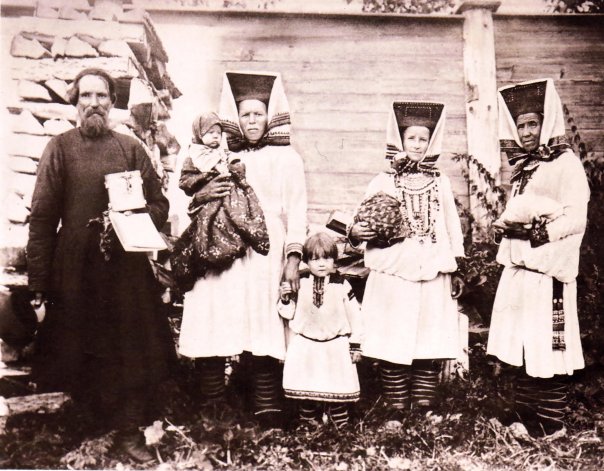
Mari orthodox monks and novices. 1894

Maris have traditionally practiced a shamanistic faith that closely connected the individual with nature. According to those beliefs, nature exerts an influence over people. Nature is seen as a sacred, powerful, and living being with which people are fully intertwined. Nature also serves as a source of absolute good who always helps humans as long as they refrain from harming or opposing it.[34] The indigenous religion of the Mari people is the most important element of their national identity and tradition; speaking of their faith, many Mari intellectuals concluded that "to kill our faith means to kill us".[35]

The Mari native religion also possesses a pantheon of gods who reside in the heavens, the most important of whom is known as the Great White God (Ош Кугу Юмо, Osh Kugu Yumo). Other lesser gods include the god of fire (Тул Юмо, Tul Yumo) and the god of wind (Мардеж Юмо, Mardezh Yumo). The Mari also believe in a number of half-men, half-gods (керемет, keremet) who live on earth. The most revered of these is Chumbulat (Чумбулат), or Chumbylat (Чумбылат), a renowned leader and warrior.[36] Attempts to convert the Maris to Christianity began in the 16th century after their territory was incorporated into the Russian state during the reign of Ivan IV ("the Terrible"). Pressure to convert to Christianity and adopt Russian culture by the tsarist authorities in the 17th and 18th century led to backlash by the Maris as they faced persecution to conform.[37] While the Mari people nominally converted to Russian Orthodoxy in the 16th century, in practice they kept to their old practices relatively unhindered, and the interaction with Christianity spurred growth of syncretic form of religions where Christian system of belief is combined with pagan traditions and rituals.[35] The Eastern Mari in particular were able to preserve the Mari religion due to them living in isolated communities.[38]

Many Mari today still practice paganism in syncretic forms, or purer forms adhering to organized neopagan Mari traditional religion organizations.[35] While most Mari today are members of the Russian Orthodox Church, pagans still comprise a significant minority of around 25%. Mari paganism is divided into three groups: Chimari are non-baptized Mari pagans who do not participate in Christian traditions; Marla Vera (also known as "dual faith") are baptized Mari who follow pagan traditions while also attending Christian services and celebrating Christian feasts;[35] and Kugu Sorta, adherents of a neopagan revivalist movement which rejects Christianity altogether in favour of purist paganism. About 60% of Mari pagans belong to the syncretic Marla Vera group, while the remaining 40% is composed of Chimari and Kugu Sorta pagans.[35]

Culture

[edit]

Mari culture has a many-stringed zither called the kusle and a bagpipe called the shyuvr.[38] Mari musical traditions include lyrics that mention the Volga and reflect the Mari adoration of nature, especially forests and rainbows.[38]

21st-century Mari poets include Albertina Ivanova.[39]

Genetics

[edit]
PCA and genetic distances of Uralic-speaking populations

The most common Y-chromosomal haplogroup among Mari people is N, which is frequently found within Uralic-speaking peoples and has its roots in East Eurasia. According to the data gathered by Kristiina Tambets and others in their 2018 study, 46.4 percent of Mari men have N-M178, and 8.2 percent belong to the subclade N-P43. R1a is a clearly less yet the second most common Y-DNA haplogroup for Maris, as it is carried by 22.7 percent of them.[40]

A 2002 study about mtDNA haplogroups in the Volga-Ural region found that 40 percent of the Maris belong to the haplogroup H. About one in four carry the haplogroup U (14 percent have the subclade U5 and about 10 percent have U4).[41]

Autosomally, Mari people stand out as an ethnic group in Europe by having a high level of Siberian-related admixture.[42] Tambets and others estimated that it is 35 percent of their ancestry. This Nganasan-like Siberian component is typical for Uralic-speaking groups.[40]

Notable people

[edit]
Ivan Palantai

See also

[edit]

Notes

[edit]

References

[edit]
[edit]
Revisions and contributorsEdit on WikipediaRead on Wikipedia
from Grokipedia
The Mari people are a Finno-Ugric ethnic group native to the Middle Volga region of Russia, primarily inhabiting the Republic of Mari El, where they constitute the titular population. Numbering around 271,000 in the republic as of the 2021 census—approximately 40% of its total inhabitants—they speak the Mari language, a Uralic tongue divided into three principal dialects: Meadow Mari, Hill Mari, and Eastern Mari. The Mari preserve a distinctive cultural heritage rooted in animistic traditions, featuring rituals conducted in sacred groves (keremet) dedicated to nature spirits and deities, often alongside nominal adherence to Orthodox Christianity, reflecting a syncretic worldview that emphasizes harmony with the natural environment. This enduring ethnic religion, centered on polytheistic beliefs with a supreme creator god (Kugu Yumo), distinguishes them among Volga Finnic peoples and underscores their resistance to full assimilation despite centuries of Russian influence.

Origins and Identity

Etymology and Historical Names

The ethnonym Mari serves as the autonym for the people, deriving from the Mari language term maрий (mariy), which denotes "man" or "person". This self-designation is believed to trace back to the Proto-Indo-Iranian root márya-, meaning "human" or "mortal", evidence of early linguistic contacts between Finno-Ugric groups and Indo-Iranian speakers in the Volga region during the Bronze Age. The term reflects a broader pattern among related Volga Finnic ethnonyms like Merya and Muroma, supporting a hypothesis of Indo-Iranian influence on local nomenclature rather than endogenous Finno-Ugric origins. Historically, Russian and Western sources referred to them primarily as Cheremis (Russian: черемис) or Tsheremiss, exonyms documented in chronicles from the medieval period onward and persisting into the early 20th century. The etymology of Cheremis remains debated, with proposals linking it to Turkic elements such as cherem ("warrior" or "black") combined with the suffix -mis (plural or agentive), or interpreting it as "white man" (čerem-iš), alluding to the sacred status of white in Mari cosmology amid Turkic-Tatar interactions. Earlier variants like Tsarmis appear in pre-Muscovite records, possibly from Bulgar or Tatar nomenclature. The shift to the autonym Mari gained official traction during the Soviet period, formalized with the creation of the Mari Autonomous Oblast in 1920 and elevation to the Autonomous Soviet Socialist in 1936, aligning with policies promoting indigenous self-identification over Russified exonyms. The republic's name, Mari El, incorporates the Turkic el ("people" or "land"), underscoring enduring regional linguistic borrowings.

Genetic Ancestry and Linguistic Classification

The is classified within the , specifically the Finno-Ugric branch, where it constitutes the Mariic subgroup comprising Meadow Mari, Hill Mari, and Eastern Mari varieties. These dialects exhibit mutual intelligibility to varying degrees and share phonological and morphological features typical of , such as and agglutinative structure. Although historically grouped with in a proposed Volga-Finnic , linguistic reconstructions indicate that Mari may form a distinct branch within Finno-Permic, with limited shared innovations supporting closer affinity to Mordvin. Genetic studies of the Mari reveal a paternal characterized by high frequencies of Y-chromosome N1c, reported at approximately 49.5% in sampled males, a lineage prevalent among Uralic-speaking populations and linked to post-Neolithic expansions from into . Additional haplogroups include R1a (around 41%) and I2 (8%), reflecting interactions with Indo-European and pre-Uralic groups in the . Bashkirian Mari subgroups share specific N-L1034 and R1a-Z280 haplotypes with Mansi and , suggesting ancient paternal across Uralic dispersals. Autosomal genome analyses position Mari populations as genetically intermediate between Northern Europeans and Siberian groups, with elevated East Eurasian ancestry components distinguishing them from neighboring Slavic and . of Uralic speakers shows Mari clustering closely with Volga Finnic relatives like and , while identity-by-descent segments indicate recent shared demographic histories among Finnic and Volga-Uralic groups. This profile aligns with archaeological evidence of Iron Age Siberian admixture in the Volga-Oka interfluve, ancestral to modern Mari.

Population and Geography

Subgroups and Dialects

The Mari people are ethnographically classified into three primary subgroups: the Meadow Mari (Olyk Mari), Hill Mari (Kuryk Mari), and Eastern Mari, with each corresponding to distinct dialects of the Mari language within the Finno-Ugric family. These divisions arise from historical geographic settlement patterns along the Volga, Vyatka, and Kama river basins, influencing cultural practices and linguistic variation. The subgroups reflect adaptations to meadow lowlands, hilly terrains, and eastern forest-steppe zones, respectively. The Meadow Mari, the predominant subgroup, inhabit the central and northern regions of the Republic and areas north of the Volga River, comprising the majority of the ethnic Mari population at approximately 548,000 in as of recent estimates. They speak the Meadow Mari , which forms the basis of the most widely used literary standard, characterized by its and agglutinative structure typical of . This spans a continuum that includes regional variations but maintains with Eastern Mari forms. The Hill Mari, a of about 24,000 individuals primarily located in the southern Republic south of the —especially around Kozmodemyansk—speak the Hill Mari , which diverges phonologically and lexically from the eastern varieties, featuring distinct shifts and a separate literary standard developed in the . This subgroup's reflects isolation in hilly terrains, with limited to Meadow Mari requiring translation for full comprehension. The Eastern Mari, numbering roughly 150,000 and residing east of the Vyatka River in Perm Krai, Sverdlovsk Oblast, and adjacent areas, utilize the Eastern Mari dialect, a variant within the Meadow-Eastern continuum that shares the Meadow literary standard but incorporates eastern lexical influences from neighboring Ugric and Turkic languages. This dialect lacks independent standardization, leading to assimilation trends under the dominant Meadow form. A smaller Northwestern Mari dialect group exists in northern border areas, blending features of Hill and varieties, but it remains non-standardized and spoken by a marginal population without distinct ethnographic recognition. Overall, Mari dialects cluster into western (Hill) and meadow-eastern branches, with efforts since the 1930s prioritizing Mari for broader communication while preserving Hill Mari literacy amid declining speaker numbers.

Geographic Distribution and Demographics

The Mari people are indigenous to the Middle Volga region of European Russia, primarily inhabiting the Mari El Republic, a federal subject spanning approximately 23,200 square kilometers between the Volga and Vyatka rivers. This area features a mix of forested hills, meadows, and river valleys, with the capital Yoshkar-Ola serving as the demographic and administrative center. Smaller but significant populations reside in adjacent regions, including Bashkortostan, Tatarstan, Udmurtia, and Perm Krai, often in rural districts along the Kama River basin. Urban migration has led to Mari communities in larger cities like Kazan, Nizhny Novgorod, and Moscow, though rural areas retain the highest concentrations. According to Russia's 2010 , the total ethnic Mari stood at 547,605, with the 2021 indicating a 22.6% decline to approximately 424,000 individuals, attributed partly to undercounting concerns and demographic trends like low birth rates and assimilation. In , ethnic Mari numbered around 290,900 in 2010, dropping to roughly 246,600 by recent estimates aligned with the 2021 data, comprising about 36-40% of the republic's 677,097 residents. Outside , hosts the largest diaspora at 84,989 as of the latest regional counts, followed by (around 40,000) and ..pdf) The Mari divide into two primary subgroups: the Meadow Mari (also known as Eastern or Low Mari), who predominate in the fertile lowlands of central and eastern Mari El extending into , and the Hill Mari (High or Western Mari), concentrated in the northern and western hilly terrains of Mari El and . These groups correspond to distinct and traditional settlement patterns, with Meadow Mari forming the majority (over 80% of the population) and maintaining higher urbanization rates. A smaller Northwestern Mari variant exists in border areas with Komi and Udmurt populations. Dialect distributions reflect historical migrations and terrain adaptations, as mapped in linguistic surveys. Demographic challenges include a fertility rate below replacement levels (around 1.5-1.7 in ), aging populations, and , with only about 50-60% of ethnic Mari reporting proficiency in s per 2010 data, a trend likely persisting into 2021. Russian intermarriage and economic outmigration to urban centers contribute to pressures, though 's titular status preserves some cultural enclaves.

Historical Development

Prehistoric and Ancient Roots

The prehistoric origins of the Mari people trace to ancient Finno-Ugric populations in the Middle Volga and Kama river basins, where linguistic reconstructions place the Proto-Finno-Ugric divergence from earlier Uralic stages around 2000–1000 BCE. This homeland is inferred from shared lexical innovations among Volgaic languages (including Mari and Mordvin), such as terms for beekeeping, coniferous forests, and riverine ecology, which align with the region's temperate forest environment and distinguish these groups from eastern Samoyedic branches lacking such features. The central Volga's role as a dispersal point for Finno-Ugric speakers is further evidenced by substrate influences in vocabulary, reflecting adaptation to local hydrology and fauna absent in Ural mountain or Siberian proto-forms. Archaeological evidence from the Mari Volga region supports continuity from settlements, with sites featuring flat-bottomed, stroke-ornamented dated to approximately 4000–3000 BCE, indicative of early hunter-gatherer-fisher communities transitioning to and use. These assemblages, found in the Sokolny cluster of the Middle Volga forest zone, include tools for and , consistent with subsistence patterns reconstructed for proto-Uralic speakers through and paleoenvironmental data. By the late (ca. 2000–1000 BCE), metal artifacts and burial practices in the region suggest increasing and networks, potentially linking to broader Uralic expansions influenced by interactions. In the (ca. 800–300 BCE), the Ananyino cultural complex in the Kama- area exhibits fortified hill settlements, , and distinctive ceramics, associated with proto-Finno-Permic and early Volgaic groups that prefigure Mari ethnogenesis through continuity in settlement patterns and artifact styles. Population estimates for these communities remain low, with site densities implying groups of several thousand across the interfluve, focused on mixed economies of swidden , , and . Ancient textual references to Volga Finnic tribes are absent until the early medieval period, underscoring reliance on interdisciplinary synthesis of and for reconstructing Mari roots, where direct ethnic attribution involves interpretive risks due to cultural overlaps with neighboring Indo-Iranian and Turkic influences.

Medieval Interactions and Resistance

The Mari, referred to as Cheremis in Russian sources, experienced initial interactions with Slavic principalities during the , primarily through trade in furs and raids into their Volga-Kama territories. Novgorod forces seized the Mari stronghold of Koksharov in 1174, marking an early encroachment on their lands amid competition for northern trade routes. These contacts intensified after the founding of in 1221, which served as a base for expansion, leading to tribute demands and sporadic conflicts with Mari communities. From the 10th to mid-13th century, the Mari were subjects of the kingdom, engaging in economic exchanges with Turkic populations that shaped their and political alignments. Following the Mongol invasion, they became vassals under the and later the from the mid-13th to mid-16th century, maintaining loyalty to Tatar overlords through tribute and military support, which buffered direct Slavic dominance. This period involved cultural borrowing, including Turkic influences on Mari settlement patterns and governance, while preserving core Finno-Ugric traditions. Resistance escalated after the Russian conquest of in 1552 under Ivan IV, prompting widespread Mari uprisings known as the Cheremis Wars, which persisted until 1584. These revolts, fueled by opposition to taxation, land seizures, and forced , saw meadow Mari rebels repeatedly challenge Russian garrisons, with peak violence in the 1550s and 1570s; Russian chronicles record punitive campaigns that razed villages and imposed forts to quell dissent. Despite initial alliances with remnants of Kazan forces, Mari fighters employed guerrilla tactics in forested terrains, delaying full subjugation and highlighting their strategic adaptation against superior Russian and numbers. By the early , systematic fortification and migrations to Bashkir lands fragmented resistance, though pagan practices endured among eastern subgroups.

Imperial Russian Period

The Mari territories, previously under the , were annexed by the in 1552 following Ivan IV's conquest of , marking the onset of direct imperial control over the region. This incorporation subjected the Mari—referred to as Cheremis in Russian administrative records—to systematic subjugation, including the imposition of the fur tribute and integration into the empire's fiscal and military obligations. Russian forces conducted punitive expeditions to enforce compliance, resulting in significant Mari casualties and displacement, as local leaders were compelled to submit or face eradication of their autonomy. Resistance manifested immediately in the First Cheremis War (1552–1556), a coordinated uprising involving Mari warriors alongside Tatar remnants, aimed at restoring the and repelling expansion; the rebellion was crushed through relentless campaigns that dispersed fighters into forested strongholds. Subsequent localized revolts persisted into the late , though Russian fortifications and Cossack garrisons gradually pacified the area, reducing Mari polities to tributary status under voevodes (military governors). By the 17th century, Mari participation in broader and ethnic uprisings, such as those during the , highlighted ongoing grievances over taxation and encroachments, yet these were quelled without altering their subordinate position. In the 18th century, Mari forces allied with rebels during (1773–1775), contributing fighters disillusioned by serfdom-like impositions and cultural pressures, but the uprising's defeat reinforced tsarist authority through reprisals and further Russification. Tsarist policies emphasized to consolidate loyalty, with Orthodox missions dispatched from the onward; IV's reign saw initial baptisms tied to tax exemptions, though conversions remained nominal among many Mari, who syncretized rituals while preserving animist practices in sacred groves. Efforts intensified in the under state directives, including the construction of churches and incentives for apostasy from paganism, but resistance persisted due to clerical corruption and cultural incompatibility, leading to superficial adherence rather than genuine doctrinal shift. Administrative reforms in the , such as the formation of guberniyas encompassing Mari lands, accelerated Russian settler colonization via state-encouraged migrations, eroding traditional communal lands and compelling Mari integration into Orthodox parish systems despite underlying pagan continuity. Economic exploitation through labor and military conscription further strained Mari society, yet their dispersed settlement patterns and forest-based economy enabled partial cultural retention until the empire's collapse.

Soviet Era Repressions and Policies

During the early Soviet period, the Mari Autonomous Oblast was formed in 1920 and elevated to the status of an Autonomous Soviet Socialist Republic (ASSR) in 1936, ostensibly granting territorial autonomy as part of nationalities policy. However, this was undermined by the implementation of collectivization in agriculture starting in , which disproportionately affected the rural Mari population, who comprised the ethnic majority and relied on traditional farming practices; resistance or inefficiency was often labeled as , leading to widespread arrests and executions. The of 1936–1938 intensified repressions in the Mari ASSR, where authorities fabricated cases of an anti-Soviet network tied to "Finno-Ugrian bourgeois nationalists," targeting intellectuals, party officials, writers, and ordinary workers accused of wrecking in industry, construction, and agriculture; the Union of Mari Writers was dissolved, and hundreds were repressed or disappeared. These campaigns physically destroyed most of the emerging Mari , decimating cultural and educational leadership that had briefly flourished under earlier efforts. Soviet policies systematically suppressed Mari traditional religion, a shamanist-animist system centered on sacred groves and nature spirits, through atheistic campaigns that closed shrines, persecuted priests (known as kudo), and promoted Orthodox Christianity or as alternatives; such practices persisted underground but faced harsh penalties for public observance. From the late 1950s to the early 1970s, ethnic privileges eroded amid broader centralization, with instruction banned in schools during the 1960s to enforce , restricting its use primarily to villages and accelerating linguistic assimilation; industrialization further marginalized it in urban and public spheres. These measures prioritized Russian as the , limiting Mari cultural expression and contributing to a decline in native speakers despite overall population stability.

Post-Soviet Autonomy and Challenges

Following the in December 1991, the Mari Autonomous Soviet Socialist Republic was elevated to the status of the within the Russian Federation on December 24, 1992, granting it nominal sovereignty including a and . This period initially saw signs of ethnic revival among the Mari, with increased cultural activities and assertions of amid the broader post-Soviet . However, federal centralization under President from 2000 onward eroded these gains, as exemplified by the 2004 abolition of direct popular elections for regional leaders, replacing them with Kremlin-appointed heads, which diminished Mari political influence. Under Leonid Markelov, who served as president from January 2001 to January 2012 after being appointed by Putin, reports emerged of systematic suppression of Mari cultural expression, including closures of independent Mari-language media outlets and physical assaults on opposition figures and journalists critical of policies. A 2005 European Parliament resolution highlighted political interference in Mari affairs, difficulties in accessing education in the , and harassment of activists, attributing these to efforts to marginalize the ethnic majority in its titular republic. Ethnic tensions manifested primarily as elite-level power struggles framed along ethnic lines, with Russian-speaking administrators dominating governance despite Mari comprising about 43% of the population per the 2010 census, exacerbating perceptions of titular disenfranchisement. Linguistically, the Mari language has faced accelerated decline since 1991, with the proportion of Mari identifying it as their mother tongue dropping from over 81% in 1989 to lower levels by the , driven by limited institutional support and a shift toward Russian in and media. Between the 2002 and 2010 censuses, the absolute number of Mari speakers decreased amid broader regional trends of erosion. Economically, the republic's heavy reliance on a collapsed military-industrial sector—which had comprised over 80% of GDP pre-1991—has perpetuated underdevelopment, with Mari El ranking among Russia's poorer regions and fostering out-migration that further dilutes ethnic cohesion. Ongoing challenges include persistent assimilation pressures, as evidenced by reduced Mari-language schooling and cultural programming, compounded by federal policies prioritizing Russian as the state since the 2005 law amendments. While non-territorial autonomy initiatives, such as cultural associations, have been proposed to bolster Mari identity outside failing territorial structures, their efficacy remains limited amid centralized control. Recent leadership under acting head Artyom Zdun since 2024 continues this pattern of Moscow-aligned governance, with little reversal of ethnic marginalization trends observed through the .

Language

Structure and Dialects

The comprises two principal dialects—Meadow Mari (Eastern Mari) and Hill Mari (Western Mari)—along with a transitional Northwestern Mari dialect exhibiting phonological and morphological traits intermediate between the two. Meadow Mari predominates among speakers and forms the foundation of the standard , while Hill Mari is confined to and maintains distinct standardized forms due to substantial lexical, phonological, and grammatical divergences from its eastern counterpart. These differences include variations in systems, inventories, and inflectional paradigms, such as marking and forms, rendering limited without exposure. Structurally, Mari is an agglutinative Uralic language characterized by extensive suffixation to encode grammatical categories, with a basic subject-object-verb (SOV) syntax influenced historically by contact with like Chuvash and Tatar. Nominal morphology features possessive suffixes integrated directly onto nouns, a system of cases (typically seven in Mari, including nominative, genitive, dative, accusative, ablative, inessive, and illative), and number marking for singular and plural. Verbal morphology includes three indicative moods (indicative, conditional, imperative), three simple tenses (present, , future), and four compound past tenses, half of which denote non-witnessed or inferential events, reflecting distinctions. Phonologically, Mari dialects display 32-34 consonants and 8-10 vowels, with features like palatalization of consonants before front vowels and partial retention of , though less rigidly than in other ; Hill Mari notably preserves additional phonemes absent or merged in Meadow Mari, contributing to dialectal divergence. Accentuation in Mari operates as a morphophonological system, with stress patterns interacting with suffixation and dialect-specific rules, as evidenced in field data from regions like Staryj Torjal. The Mari language employs distinct standardized forms corresponding to its primary dialects, with Meadow Mari (also known as Eastern Mari) functioning as the predominant literary standard, while Hill Mari maintains a separate normative variety for its speakers. Northwestern Mari has a more limited standardization, primarily for local use. These standards utilize a modified Cyrillic alphabet, incorporating additional letters such as ӱ (u with double acute), ӓ (a with diaeresis), and ҥ (ng) to accommodate phonemic distinctions absent in Russian. The foundational grammar for written Mari appeared in , but early texts employed inconsistent orthographies influenced by Russian and missionary traditions; systematic standardization accelerated in the early amid Soviet literacy campaigns, solidifying the Cyrillic base by the mid-1930s after a brief Latin-script experiment. Mari holds co-official status with Russian in the Republic, formalized in 1992, enabling its use in regional administration, signage, and courts alongside mandates for . It appears in school curricula, with subjects taught in Mari up to secondary levels in areas of ethnic concentration, and supports higher education programs at institutions like Mari State University. Media outlets include daily newspapers such as Mariyskaya Pravda (with Mari editions), regional television channels broadcasting in Mari, and online platforms producing literature, though content volume lags behind Russian equivalents. Speaker estimates place total proficient users at approximately 360,000 for Meadow Mari and 20,000 for Hill Mari as of recent assessments, though self-reported figures from the hover around 450,000 amid varying proficiency levels. Usage trends indicate intergenerational decline, driven by , intermarriage, and preferential Russian instruction; in schools, only about 7,400 pupils—or 9% of the total—identified Mari as their mother tongue in 2024, down from higher proportions in prior decades. This assimilation pattern reflects broader pressures, with urban Mari youth increasingly shifting to Russian for professional and social domains, despite cultural revitalization initiatives promoting Mari through festivals and . Native speaker growth tied to traditional cultural practices has been noted in rural strongholds, yet overall vitality remains vulnerable without expanded institutional support.

Religion and Spirituality

Traditional Paganism and Animism

The traditional religion of the Mari people, often termed or Chodyrla, is fundamentally , positing that spirits or souls inhabit natural phenomena, animals, , and even inanimate objects such as stones and bodies. This emphasizes a relational where s coexist with and respect these animate entities, influencing daily practices like hunting taboos and offerings to forest spirits. Ethnographic accounts describe Mari as involving of guardians (known as yurto kuguzaf), spirits, and ancestral shades, with rituals aimed at maintaining between the human and non-human worlds. At the core of Mari cosmology stands Osh Kugu Yumo (Great White God or God of Light), the supreme residing in the , who oversees the and receives primary invocations during major ceremonies. Subordinate deities include Tul Yumo ( of fire), responsible for and purification rites, and Mardezh Yumo ( of wind and thunder), invoked for weather-related petitions. These gods form a pantheon integrated with animistic elements, where lesser spirits act as intermediaries, reflecting a hierarchical yet interconnected rooted in Finno-Ugric traditions predating external influences. Rituals, led by kart priests or elders, occur predominantly in sacred groves (keremet), designated forest clearings protected as eternal sanctuaries where no axes may fall. These sites host annual cycles of prayers (ongon), often involving animal sacrifices—such as roosters or sheep—burnt offerings, and communal feasts to propitiate deities for fertility, health, and protection. Historical records from ethnographic studies note that up to the 19th century, such practices persisted covertly amid Christian pressures, preserving core animistic tenets like the sanctity of groves, estimated at over 300 active sites by the late . Ancestor worship complements these, with libations and narratives reinforcing kinship ties to the spirit realm.

Encounters with Christianity and Islam

The Mari people first encountered during the medieval era under the Kazan Khanate (1438–1552), when they served as tributaries to Muslim Turkic rulers, resulting in cultural and linguistic influences such as loanwords from and Khwarezmian languages, though widespread conversion did not occur and traditional animism predominated. Meadow Mari subgroups, living closer to Volga Tatar populations, showed somewhat greater exposure to Islamic practices compared to hill-dwelling Mari. Following Ivan IV's conquest of in 1552, Russian authorities initiated campaigns targeting , including the Mari, through Orthodox missionaries, church construction, and coercive policies that tied conversion to tax exemptions and land rights. This provoked armed resistance, notably the Mari Wars of the 1550s–1570s, where Mari forces allied with remnants of the to repel Russian expansion and reject . By the early , intensified tsarist edicts under Peter I and successors led to nominal mass baptisms, with most Mari formally joining the , yet syncretic practices persisted, blending Orthodox rites with worship and nature spirits. In response to 19th-century pressures for , including bans on traditional rituals, the Kugu Sorta movement arose around 1870 among hill Mari, reforming into a centralized centered on the supreme deity Kugu Yumo to foster ethnic unity and subtly counter Orthodox dominance without open revolt. This adaptation allowed many Mari to outwardly conform to while preserving core pagan elements, a pattern reinforced during Soviet antireligious campaigns that suppressed both faiths but inadvertently sustained underground traditionalism. Islamic presence among ethnic Mari remained limited historically, with post-Soviet revival in Mari El largely confined to Tatar communities (comprising about 6% of the republic's ), leading to occasional interethnic marriages and minor syncretic adoptions but no significant Mari conversion waves. Overall, both religions exerted pressure through state and neighborly channels, yet Mari resistance—manifest in uprisings, reformist movements, and covert adherence—ensured pagan animism's endurance as the ethnic core, often officially tolerated alongside in modern Mari El.

Modern Religious Practices and Syncretism

Contemporary Mari religious practices are characterized by widespread between ancestral animistic traditions and Russian Orthodoxy, often termed dvoeverie (dual faith), where nominal Christian affiliation coexists with rituals honoring nature spirits, deities, and ancestors. Sacred groves known as keremet serve as primary sites for worship, featuring offerings such as bread, salt, and animal sacrifices (e.g., calves or sheep) to entities like Kugu Yumo (the Great Life Giver) or the forest owner (unagindim), aimed at ensuring prosperity, health, and protection. These elements persist alongside Orthodox customs, such as incorporating pagan symbols like threads or twigs into Christian rites. Post-Soviet liberalization facilitated the revival and formal organization of Mari traditional religion, registered as an official faith in the Republic of Mari El, with groups conducting structured ushem (prayer services) and annual festivals emphasizing ethnic identity preservation. Rural vernacular practices, independent of formal institutions, maintain animistic core elements like family veneration and seasonal rites, though erodes some connections to traditional worldviews. gatherings, including summer prayers at sites like Chembulatov Mountain, have increased since the , blending pre-Christian invocations with occasional Orthodox prayers. In diaspora communities, such as those in , extends to , incorporating Muslim festivals or Lutheran influences among subgroups, reflecting historical interactions with neighboring and migrants. While self-identification as exclusively traditional believers remains limited (estimated at 25-40% in some surveys), syncretic adherence is far more prevalent, with ethnographic observations from 2017-2023 confirming active continuity in areas like Kirov region's districts. This dual framework sustains cultural resilience amid assimilation pressures, prioritizing empirical ethnic continuity over doctrinal purity.

Cultural Traditions

Folklore, Myths, and Oral Traditions

The oral traditions of the Mari people, primarily transmitted through , songs, and rituals, center on heroic legends, animistic beliefs, and narratives of ancestral resistance that encode ethnic identity and historical memory. These traditions emphasize a mythologized "" prior to subjugation by neighboring powers, with motifs of communal harmony disrupted by and the valor of local heroes restoring order. Such stories are performed during ethnocultural festivals and educational events in the Republic, ensuring continuity amid modernization. Heroic legends prominently feature patyr-vlak, revered figures embodying wisdom and martial prowess, such as the warriors Chotkar and Chumbulat, and princes like Akpars, Mamich-Berdei, and Poltysh. These tales depict conflicts with the Russian kingdom and Khanate, portraying heroes as defenders who rally communities against assimilation and territorial loss, often culminating in sacrificial victories or tragic exiles that sacralize specific locales. Collected through fieldwork in and from 2015 to 2021, these narratives underscore a collective perception of history as cyclical struggle, where oral recounting reinforces territorial claims and cultural resilience. Animistic myths revolve around spirits like Keremet, a dual-natured entity viewed among Meadow Mari as a cruel inducing frosts, droughts, and ailments, or among Hill and Eastern Mari as a familial guardian tied to sacred groves and hills. Legends describe Keremet originating from —such as deceased robbers or soldiers—who demand through sacrifices, evolving from human firstborns to animals or offerings like pancakes, as in tales from villages like Byrgynda and Kaleyevo where rituals averted calamity during wars or rebellions. These stories, embedded in oral rites, link natural phenomena to moral causation, warning against greed while prescribing communal propitiation to maintain ecological and social balance. Lyrical songs and incantations form another pillar, invoking deities and ancestral shades to explain seasonal cycles and fortunes, often performed in polyphonic styles during harvest or memorial gatherings. While lacking extensive epic cycles like those in neighboring Finnic traditions, Mari oral lore integrates mythic elements into shorter, episodic forms that prioritize ethical lessons over linear heroism, adapting to preserve core animistic tenets amid external pressures.

Arts, Music, and Crafts

The Mari musical tradition emphasizes acoustic instruments and vocal performances, with the kusle (), a , historically used by men in religious rites and festivals until the due to ritual prohibitions on women playing it. The shuvyr (), constructed with an animal bladder as an air reservoir, accompanies weddings and holds magical associations, capable of evoking remorse or compelling dance. Percussion includes the tumyr (), employed solo for ritual announcements at tribal gatherings and pagan holidays or in duets with bagpipes, while the shiyaltysh (pipe), a in oblique or straight variants, produces lyrical solo melodies. Folk songs form a core of Mari musical expression, earning the group the epithet "singing people" among Meadow and Hill Mari subgroups, with annual song festivals preserving choral and solo traditions in regions like the Hill Mari area. These performances often integrate traditional dances, as demonstrated in ensemble routines from Yoshkar-Ola featuring rhythmic steps synchronized to live instrumentation. Crafts among the Mari prominently feature , executed via counted-thread techniques on canvases without preliminary sketches, demanding precise and skill. Patterns incorporate geometric, vegetal, zoomorphic, and anthropomorphic motifs with historical magical and ethnic symbolism, using wool or threads dyed from sources; early 19th-century examples favor dark tones like black, blue, dark red, and brown, transitioning by mid-century to red-dominant schemes accented in green and yellow, with black or dark blue outlines. Contemporary preservation occurs through studios in Zvenigovo, Medvedevo village, Chodrayal in Morkinsky district, and Shorunzha, where training covers traditional methods alongside folk garments and , often adapting elements for modern costumes. Additional applied arts include , canvas for textiles, and processing of natural materials to recreate folk costumes, supported by regional initiatives to sustain decorative and fine arts traditions.

Economy, Cuisine, and Daily Life

The traditional of the Mari people relied on , including cultivation of , , and potatoes, alongside for and , for wild berries and mushrooms, river fishing, of game, and in forested areas along the and rivers basins. These activities sustained small, kin-based communities, with particularly prominent among Hill Mari subgroups due to abundant forest resources. Following the Soviet era's collectivization, which disrupted traditional practices, the post-1991 in Mari —predominantly agricultural and livestock-based—entered a severe crisis marked by declining rural productivity and farm consolidations. In contemporary Mari El Republic, where over 40% of residents are ethnic Mari, key industries encompass machine construction (e.g., electrical instruments and refrigeration equipment), , timber and , and , with industrial output concentrated in urban centers like . Despite these sectors, the region's gross regional product per capita lagged at approximately 74% of the Russian regional average in 2018, reflecting structural weaknesses in diversification and ongoing rural depopulation. persists as a backbone for many households, but low wages and limited contribute to Mari El ranking among Russia's lower-income regions as of 2024. Mari cuisine emphasizes hearty, flour-based staples adapted to local resources, including multi-layered pancakes known as koman-melna (prepared with alternating and unleavened layers), and both closed (shudyr or shulyash) and open pies filled with river fish, , eggs, peas, or . Forest and river influences feature prominently, with dishes incorporating foraged mushrooms, berries (e.g., lingonberries, cloudberries), nettles, and like or pike, often boiled or stewed simply to preserve flavors. Fermented dairy products and from complement meals, while large steamed dumplings such as podkogol—filled with potatoes, cheese, or —serve as communal fare during festivals. Daily life for many Mari, especially in rural villages comprising over half the Republic's settlements, revolves around seasonal farming cycles, household crafts like and , and family-oriented routines in wooden log homes clustered near sacred groves. Economic pressures in this agriculturally dominant but depressed region foster , with extended families sharing labor in fields or forests, though draws youth to for industrial jobs. Traditions persist in communal gatherings for rituals or harvests, blending with modern amenities like and roads, yet isolation and low incomes perpetuate a of resilience amid periodic gaps.

Genetics and Anthropology

Y-DNA and Autosomal Studies

Y-DNA studies of the Mari population indicate that N1c (N3a) predominates, comprising approximately 50% of male lineages, a frequency characteristic of Uralic-speaking groups and associated with male-mediated gene flow from Siberian sources during the spread of around 3,500–5,000 years ago. , linked to steppe expansions, follows at roughly 23%, reflecting admixture with Indo-European populations. Minor contributions include haplogroups I, R1b, and others, consistent with interactions with neighboring Slavic and Finno-Ugric groups. Autosomal DNA analyses reveal a complex admixture profile in the Mari, featuring substantial Siberian ancestry (30–40%), modeled as proximal to Nganasan-like East Eurasian sources, alongside components from Western European hunter-gatherers, Anatolian Neolithic farmers, and Yamnaya-related steppe pastoralists. This Siberian element, higher than in western Uralic speakers like , aligns with the linguistic phylogeny and distinguishes Mari from local non-Uralic neighbors such as and , despite elevated identity-by-descent sharing with other Uralic populations over geographic proximity. qpAdm modeling confirms these proportions, with the East Eurasian input dated to recent millennia via admixture graphs.

Admixture and Relations to Neighboring Groups

The Mari population displays a notable level of autosomal admixture characterized by a substantial Siberian-related ancestry component, which is higher than in many other European groups and aligns with patterns observed across Uralic-speaking peoples. This component, often modeled as akin to Nganasan or ancient Siberian sources, contributes to approximately 20-35% of Mari genetic makeup in various admixture analyses, reflecting ancient migrations associated with the spread of Uralic languages. Such admixture distinguishes the Mari from neighboring Indo-European and Turkic groups, where Siberian ancestry is typically lower, around 5-10%. In terms of genetic relations, Mari share closer affinities with other Uralic speakers, such as , , and Mansi, than with proximate Slavic or , as evidenced by shared identity-by-descent segments and principal component analyses. For instance, Mari exhibit greater and sharing with eastern Uralic populations across the Urals compared to local Turkic groups like and . Despite geographic proximity and historical interactions leading to some , particularly from , the Mari maintain a distinct profile due to retained Siberian and ancient European elements less diluted in neighboring populations. This structure underscores limited recent admixture with dominant Slavic and Turkic elements, preserving Uralic genetic continuity amid regional expansions.

Political Status and Controversies

Ethnic Rights and Autonomy Struggles

The Republic, formed as an in November 1920 and upgraded to an Autonomous Soviet Socialist Republic in December 1936, experienced erosion of ethnic privileges from the late 1950s through the 1970s, including a ban on teaching in the 1960s. Following the Soviet Union's dissolution, the republic declared sovereignty in October 1990, with the First World Congress of Finno-Ugric Peoples in November 1992 and the Second Congress in July 1995 demanding enhanced , property rights for indigenous groups, and prioritized use in public spheres. These efforts reflected broader aspirations for cultural and political autonomy amid Russia's federal structure, where titular ethnic republics like nominally retain state languages and representation but face central government oversight that limits substantive independence. A major ethnopolitical conflict unfolded in the after the December 2001 replacement of President Yuri Andreev—viewed as supportive of Mari interests—with Leonid Markelov, whose administration was accused of prioritizing Russian cultural dominance and suppressing Mari opposition. Markelov's tenure saw the dismissal of ethnic Mari officials in regions opposing his reelection bid, alongside physical attacks on Mari activists in , exacerbating interethnic tensions and prompting allegations of systemic repression against Mari identity. A May 2005 European Parliament resolution cited barriers to Mari-language , undue political interference in cultural bodies, underrepresentation of Mari in administration, and violence against activists as evidence of deteriorating rights. A February 2006 joint report by the International Helsinki Federation and attributed declining Mari language proficiency and cultural erosion to President Vladimir Putin's centralization reforms, which curtailed regional by shifting from elected to appointed leadership in ethnic republics. Language rights emerged as a focal point of struggle, with Mari—co-official in the republic—facing practical obstacles in schools and media due to insufficient teaching materials and enforcement. Soviet-era suppressions resumed in modified form post-2000, culminating in July 2017 amendments abolishing compulsory native-language study in ethnic republics and capping optional lessons at two hours weekly under a 2018 education bill, following Putin's 2017 speech in emphasizing Russian primacy. These policies accelerated assimilation, prompting 2010 protests by Mari activists against cultural erosion, which met with arrests and reported violence from authorities. Resistance persisted through online campaigns, petitions, and forums like the Democratic Congress of the Peoples of formed in June 2018, though activists faced threats, job losses, and expulsions. Autonomy demands have intersected with religious and cultural preservation, as Mari pagans voiced concerns in 2021 over regional restrictions on traditional rituals, perceived as extensions of efforts. Despite nominal federal protections, Mari representation remains limited, with central appointments since 2012 reinforcing Moscow's control and undermining ethnic , as evidenced by ongoing reports of disproportionate of minorities in conflicts like the Ukraine war, which amplifies rights vulnerabilities without yielding concessions.

Soviet and Contemporary Repressions

During the Stalinist Great Terror of the , authorities in the Mari Autonomous Oblast targeted the ethnic Mari intelligentsia under fabricated charges of 'bourgeois-nationalist counter-revolution' tied to alleged Finno-Ugrian and potential alignment with . Prominent victims included scholars V. M. Vasil'ev and V. A. Mukhin, as well as I. P. Petrov, whose arrests and executions decimated Mari elites and inflicted enduring damage on national culture, education, and Finno-Ugrian scholarship. Collectivization campaigns in the early compounded these purges by imposing forced agricultural on Mari communities, leading to widespread hardship and the physical elimination of much of the pre-revolutionary Mari . Russification intensified after , with instruction effectively banned from schools by the 1960s and ethnic privileges revoked between the late 1950s and early 1970s, prioritizing Russian as the sole medium of and administration. Soviet anti-religious policies rigorously suppressed Mari traditional animist-shamanist practices, including sacred forest rituals, driving them clandestine and eroding communal spiritual structures. These measures aimed to assimilate Mari identity into a homogenized Soviet framework, though underground persistence of language and customs occurred despite state oversight. In the post-Soviet period, under Republic of Mari El President Leonid Markelov (2001–2017), reports documented targeted persecution of Mari opposition activists, journalists, and cultural leaders, including physical assaults, murders, and dismissals of ethnic Maris from public roles. A May 2005 European Parliament resolution highlighted political meddling in Mari cultural bodies, inadequate ethnic representation in , barriers to Mari-language schooling, and official tolerance of violence against Mari organizations. Federal centralization policies under President further marginalized Mari language usage—despite its co-official status—through reduced institutional support, as detailed in 2006 reports by the International Helsinki Federation and . Contemporary restrictions include crackdowns on public remembrance of Soviet-era victims; in 2023, Mari activists faced detention in for assembling at a repression memorial with banners in Belarusian honoring Bolshevik casualties. Such actions reflect broader efforts to curb ethnic dissent amid Russia's authoritarian consolidation, exacerbating tensions over Mari and cultural preservation.

Recent Developments in Mari El

In September 2022, Yuri Zaitsev was elected as Head of the Republic for a full five-year term, securing over 80% of the vote in an election criticized by ethnic Mari activists for limited opposition and dominance. In September 2024 parliamentary elections, the pro-Kremlin party won a , though one ethnic Mari candidate was elected, marking a rare non-party-affiliated success amid broader calls for greater representation of Mari interests. The Republic has faced heightened scrutiny over its role in Russia's war in , with 1,748 residents mobilized by early 2023, including 255 confirmed deaths, predominantly from rural areas where Mari form a majority. Regional leader Zaitsev responded to public discontent in a January 2023 live broadcast by announcing increased one-time payments to volunteers, rising to 2 million rubles by January 2025, as part of broader federal efforts to sustain amid high casualties among ethnic minorities. Repression of dissent intensified, with anti-war voices targeted under federal laws. In January 2024, deputy Anton Sokolov lost his mandate for opposing the , the sole such critic in the regional assembly. Poet and activist Yuri Blagodarov was fined 400,000 rubles in 2024 for posts deemed to discredit the Russian army. By September 2025, activist Sergei Mamaev faced charges for "repeatedly demonstrating symbols," including traditional attire interpreted as oppositional. These actions reflect ongoing constraints on ethnic activism, with support declining due to policies prioritizing Russian in and administration. Cultural initiatives persisted amid tensions, including the 12th All-Russian Mari Congress in October-November 2024, which addressed identity preservation but avoided direct confrontation with authorities. In December 2024, received federal approval for a regional development program focusing on infrastructure, though ethnic advocates argue it neglects Mari-specific cultural funding.

Notable Figures

Andrei Yakovlevich Eshpai (1925–2015) was a Soviet and Russian composer, , and pedagogue of Mari ethnicity, recognized as a in 1981 for his contributions to symphonic, chamber, and film music. Born in Kozmodemyansk, Republic, he studied at the and composed over 100 works, including the ballets and The Tsar's Bride, drawing on Mari folk motifs alongside classical traditions. Sergei Grigorievich Chavain (1888–1937) founded modern Mari literature as a , , and novelist, producing the first literary poem in , Oto (The Grove), in 1905 while studying in . His novels, such as Elnet (1929), portrayed pre-revolutionary Mari peasant life and cultural transitions, though he faced Soviet repression and execution during the . Ivan Stepanovich Klyuchnikov-Palantai (1888–1935), a pioneering Mari composer and folklorist, established professional Mari music by collecting and notating traditional songs in the , collaborating with relatives like Eshpai to integrate ethnic instruments into composed works. His efforts laid the groundwork for Mari musical amid early Soviet cultural policies. Vyacheslav Arkadievich Bykov (born 1960), a retired player and coach of Mari descent born in Mari-Sholner village, , won two Olympic gold medals (1984, 1988) with the and later coached to world championships in 2008–2009.

References

Add your contribution
Related Hubs
User Avatar
No comments yet.