Hubbry Logo
ChengalpattuChengalpattuMain
Open search
Chengalpattu
Community hub
Chengalpattu
logo
8 pages, 0 posts
0 subscribers
Be the first to start a discussion here.
Chengalpattu
Chengalpattu
from Wikipedia

Chengalpattu, previously known as Chingleput or Chengalpet, is a town and the headquarters of Chengalpattu district of the state Tamil Nadu, India. The town is located near to the industrial and IT hub. It is the headquarters of the district and is 56 kilometres (35 mi) away from the state capital, Chennai on the National Highway 45.

Key Information

It is an important commercial center. It has a medical college and other colleges affiliated with the University of Madras.

Etymology

[edit]

The city is believed to have been named after a lily called 'chenkazhuneer poo' (செங்கழுநீர் பூ) which is found aplenty in the region. It is near the banks of Palar River about 56 km southwest of Chennai city (Madras) and thus Chengapattu is called the "Gateway of Chennai".

History

[edit]

Chengalpattu dates from the early Chola dynasty of the 2nd century BCE.[2] Chengalpattu was formerly a capital of the kings of Vijayanagara, after their defeat by the Deccan sultanates at Battle of Talikota in 1565. The fortress at Chengalpattu, built by the Vijayanagara kings in the 16th century, was of strategic importance, owing to its swampy surroundings and the lake that flanked its side.[3]

In 1639 a local governor or nayak, subject to these kings, granted a piece of coastal land to the British East India Company where Fort St George now stands, which became the nucleus of the city of Madras. Chengalpattu was taken by the French in 1751 and was retaken in 1752 by Robert Clive, after which it proved of great strategic advantage to the British, especially when Lally failed to capture the fortress in his advance on Madras.[3]

During the wars of the British with Hyder Ali of Mysore, it withstood his assault and afforded a refuge to the nearby residents. In 1780, after the defeat of Colonel W Baillie, the army of Sir Hector Munro took refuge there. By 1900 the town was noted for its manufacture of pottery and was a local market center, especially of the rice trade.[3] The surrounding district was home to cotton and silk weaving,[3] indigo dyeing, tanneries, and a cigar factory, and extensive salt manufacturing took place along the coast.

The city was part of the Chengalpattu (Lok Sabha constituency) that exist from 1952 to 2004 Lok Sabha elections. Since 2009 it is a part of the Kancheepuram (Lok Sabha constituency).

Chengalpattu Municipality was extended for Greater Municipality on 24 August 2021 by annexing the villages of Anjur, Kunnavakkam, Thimmavaram, Thenmelpakkam, Vallam, Alapakkam, Thiruporur cross-road, Malalinatham, Nenmeli, Melamaiyur, Singaperumalkoil, Pulipakkam, Veerapuram, Pattaravakkam, Pazhaveli, Chettipunniyam, and Tirumani.[citation needed]

Geography

[edit]

Chengalpattu is located at 12°42′N 79°59′E / 12.7°N 79.98°E / 12.7; 79.98.[4] It has an average elevation of 36 metres (118 ft). Lake Kolavai is the largest located in Chengalpattu.

Demographics

[edit]

According to 2011 census, Chengalpattu had a population of 62,579 with a sex-ratio of 1,020 females for every 1,000 males, much above the national average of 929.[1] A total of 5,884 were under the age of six, constituting 3,045 males and 2,839 females. Scheduled Castes and Scheduled Tribes accounted for 15.55% and 1.44% of the population respectively. The average literacy of the town was 83.25%, compared to the national average of 72.99%.[1] The town had a total of 15675 households. There were a total of 23,937 workers, comprising 264 cultivators, 215 main agricultural labourers, 475 in house hold industries, 19,376 other workers, 3,607 marginal workers, 127 marginal cultivators, 66 marginal agricultural labourers, 175 marginal workers in household industries and 3,239 other marginal workers.[5] As per the religious census of 2011, Chengalpattu had 85.33% Hindus, 6.09% Muslims, 6.48% Christians, 0.02% Sikhs, 0.13% Buddhists, 0.13% Jains, 1.79% following other religions and 0.02% following no religion or did not indicate any religious preference.[6]

Religious census
Religion Percent(%)
Hindu
85.33%
Muslim
6.09%
Christian
6.48%
Buddhist
0.13%
Jain
0.13%
Sikh
0.02%
Other
1.79%
No religion
0.02%

Religion

[edit]

There are numerous temples, mosques and churches in Chengalpattu.

Government and politics

[edit]

Chengalpattu (state assembly constituency) is part of Kancheepuram (Lok Sabha constituency).[7]

Civic Utility / Amenities / Services

[edit]

Chengalpattu Government Hospital is a landmark and the largest government hospital in this district. The hospital has its own medical college. The town has the principal court of the district, and Dr. Ambedhkar Law College.

Hospitals

[edit]

Economy

[edit]

Industry

[edit]

There are several modern industries around Chengalpattu, due to the town's proximity to Chennai and its frequent connectivity to other places through rail and road.

Several companies in and around the town like Al-Ohm Inc., Tech Mahindra, Wipro, BMW, Ford, Flextronics, Foxconn, Dell, Samsung, Infosys, Pepsi, TVS, Siemens, Nissan Renault, RLT Instrumentation, Apollo Tyres, Mahindra, Medopharm Pvt Ltd, R & D, Bay forge have production plants near Chengalpattu. Marg Swarnabhoomi SEZ at Kodur have several industries like DHL, Zwilling J. A. Henckels.

In September 2021, the Ministry of Industry announced development of a SIDCO industrial estate at Kodur Village, which would provide employment to over 2000 people.[8]

Culture/cityscape

[edit]

Tourist Attractions

[edit]

Today Chengalpattu has developed as a touristic spot for many foreign travellers on their way to Mamallapuram, Thirukazhukundram, Vedanthangal Bird Sanctuary and Kanchipuram, Karikili Bird Sanctuary.

The boat house established by Tamil Nadu Tourism Development Corporation (TTDC) in the Kolavai lake which is alongside the NH 45 highway has turned into a place where people can relax with their families on weekends. The monsoon rains flooded the gates of the lake in December 2005 due to which the TTDC boat club operation has been stopped. It also serves as a bridge connecting all nearby districts with the renowned tourist places like Mahabalipuram, Muttukadu, theme parks on East Coast Road (ECR), Thirukazhukundram, and Kanchipuram.

Kolavai Lake

[edit]

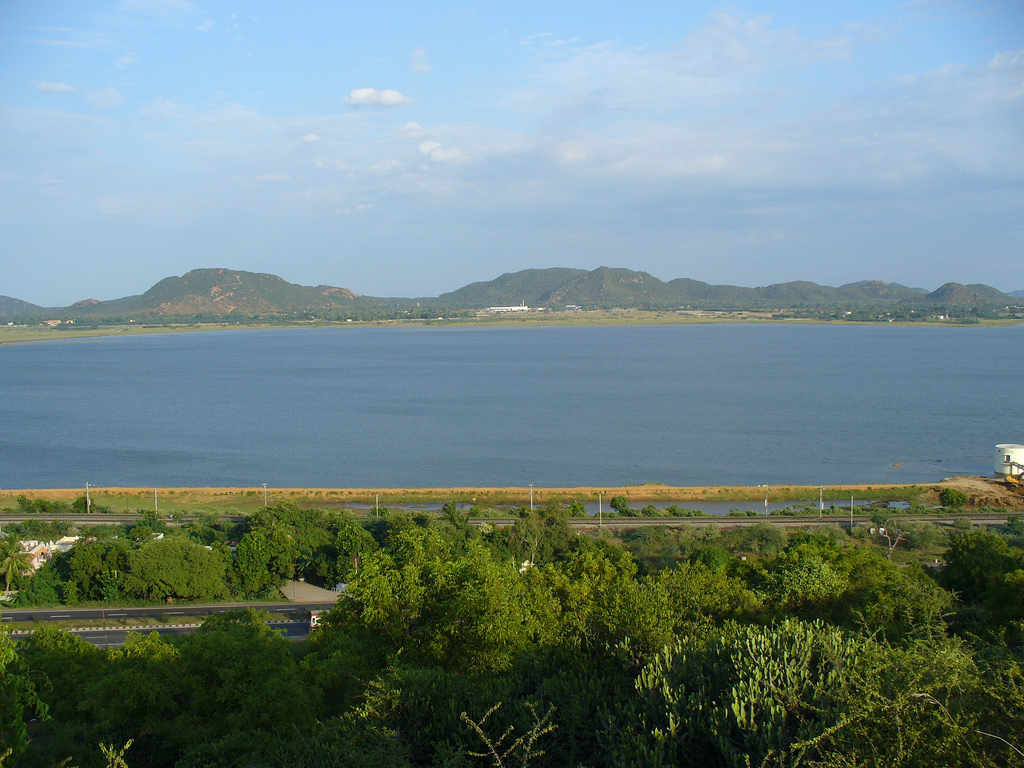
Kolavai Lake is the second largest lake in the Chengalpattu District after Madhuranthagam Lake. Kolavai Lake is well known for its perennial nature: There are records of going dry in summers. It even supplies water to industries in Chennai when the lakes in Chennai go dry. The lake is now being polluted due to the rapid urbanisation of Chengalpattu. The early morning sunrise and the moon hovering above the lake over its waters in the night are scenic to the eyes. The lake's beauty can be experienced by taking a train from the Chengalpattu station to Paranur.

Archaeological excavations

[edit]

Chengalpattu has received attention recently because of archaeological finds in the nearby village of Chettimedu Pathur. In February 2024, an ancient burial site of a child with a pot beside it likely dating back to the Neolithic period was unearthed at Chettimedu Pathur.[9][10]

Transport

[edit]

Chenglapattu is connected by road and rail.

By Air

[edit]

The Chennai Airport lies just 38 km north of the town and can be reached in about 1 hour by road.

By Rail

[edit]
View of the Chengalpattu Railway Junction, one of the main stations in the Chord Line

Chengalpattu Railway Station, technically known as CGL, is one of the major railway junctions of the Southern Railway and is a nationally important halt.

Chengalpattu railway junction lies in the Main Broad Gauge line and most of the south bound trains stop here. There is a railway connection to Arakkonam via Kanchipuram. There are many trains running from Chengalpattu to Chennai Beach Station. stopping at all stations up to Chennai city Tambaram. Express trains are available, running from Chengalpattu to Chennai city area's Tambaram, Guindy, Mambalam, Egmore, Park and finally Beach Station.

By Road

[edit]

There are many buses connecting Chengalpattu with other parts of the state and beyond.[citation needed] Kanchipuram - Chengalpattu road (State Highway - 58) is used to connect the city of Kanchipuram and Chengalpattu. Government MTC Buses and private buses which go to and from cities like Kanchipuram, Vellore, and Tirupati can be seen frequently along this route. Town of Mahabalipuram lies 29 km away from Chengalpattu and is connected through SH58.

Education

[edit]

Various educational institutions are in Chengalpattu like schools, engineering colleges, Dental, Medical colleges and Arts/Science colleges.

Arts and Science

[edit]

Law

[edit]

Medical

[edit]
  • Chengalpet Government Medical College
  • Karpaga Vinayaga Institute of Medical Science
  • National Institute for Empowerment Of Persons with Multiple Disabilities(Govt Of India - Ministry Of Social Justice and Empowerment)

Dental

[edit]
  • Asan Memorial Dental College and Hospital
  • Karpaga Vinayaga Institute of Dental Science

Nursing

[edit]
  • Karpaga Vinayaga Institute of Nursing
  • School of Nursing, Chengalpattu Government Hospital
  • Government College of Nursing

Engineering

[edit]
  • Asan Memorial College of Engineering & Technology

Schools

[edit]
  • Sri Ramakrishna Mission Vidyalaya Matriculation Higher Secondary School, Chengalpattu.[11]
  • Swamy Vivekananda Vidhyalaya Matric School, Chengalpattu
  • Sri Ramakrishna Boys.Hr.Sec.school.
  • Seventh Day Adventist Matric. Hr. Sec.School, Chengalpattu
  • Blessings Matric Hr. Sec. School.
  • Brindhavan Public School.
  • CSI Alison Cassie Girls Higher Secondary School.
  • CSI St. Hilda's & St. Hugh's Matric Hr.Sec. School.
  • Government Girls Hr. Sec. School.
  • Guardian International Nursery School.
  • Little Jacky Matric. Hr. Sec. School.
  • Maharishi Vidhya Mandir School.
  • Mahindra World School.
  • Prasan Vidhya Mandir School.
  • RLT Academy Matric. Hr. Sec. School.
  • Sri Ramakrishna Mission Boys Hr. Sec. School.[11]
  • Sri Ramakrishna Mission Girls Hr. Sec. School.[11]
  • St. Columba's Hr. Sec. School.
  • CSI St. Hilda's & St. Hugh's Matric.Hr.Sec.School.
  • St. Joseph's Higher Secondary School, Chengalpattu
  • St.Joseph's Matric. Hr. Sec. School.
  • Dr. MGR Nursery and Primary School, Perungalatore.
  • St.Mary's Girls Hr. Sec. School.
  • St.Mary's Primary School.
  • St.Paul's Academy(CBSE).
  • St.Paul's Matriculation School.
  • SCAD World School.
  • St. Ann's Matric Hr. Sec.School.
  • Vidhya Sagar Global School.
  • Annai Sathya School
  • Barathi School
  • Shree Vidya Mandir Matric. Hr.Sec.School

Beautician Academy

[edit]
  • Naturals Training Academy

Notable persons

[edit]

References

[edit]
[edit]
Revisions and contributorsEdit on WikipediaRead on Wikipedia
from Grokipedia

Chengalpattu is a historic town serving as the administrative headquarters of Chengalpattu district in the northeastern coastal region of Tamil Nadu, India. Located approximately 56 kilometers southwest of Chennai along the Palar River, it functions as a key gateway to southern Tamil Nadu. As of the 2011 census, the town had a population of 62,579, with a literacy rate of 91.88 percent and a sex ratio of 1,020 females per 1,000 males.
The town's history traces back to the Pallava and Chola periods, achieving prominence under the when it became a temporary capital after the 1565 and featured a strategic 16th-century fortress. This fortress changed hands during colonial rivalries, captured by French forces in 1751 and retaken by the British under in 1752, underscoring its military significance. Today, Chengalpattu remains notable as a major railway junction in the suburban network, facilitating connectivity to regional and long-distance routes, alongside its role in agriculture, industry, and proximity to sites like the .

Etymology

Name Origins and Historical References

The name Chengalpattu derives from Tamil roots, interpreted as "lily pond village" (chenkazhuneer pattu), evoking associations with local water bodies abundant in water lilies. An alternative folk etymology connects it to the chengal tree (Berrya celsa), a species native to the region's flora, with pattu denoting a settlement or division, suggesting "settlement of the chengal trees." In ancient Sanskrit literature, the locale appears as Kuvalayapura, translating to "water lily town," aligning with the aquatic floral theme and indicating early literary recognition tied to environmental features. British colonial records anglicized the name to Chingleput or Chengalpet, as seen in administrative surveys from the mid-18th century, including the Chengalpattu Survey of 1767–1774, which documented land revenue and local divisions under the . This spelling persisted in official gazetteers and district nomenclature until post-independence standardization reverted to the Tamil form Chengalpattu by the . No extant Pallava or Chola inscriptions directly reference the name, though the area's antiquity is evidenced by 7th-century Pallava Grantha slabs in nearby sites like Mangadu, reflecting broader regional epigraphic activity without specific toponymic ties.

History

Ancient and Medieval Foundations

Archaeological excavations at Venbedu in have uncovered Palaeolithic and microlithic assemblages, providing evidence of prehistoric human activity in the region, likely associated with economies adapted to local scrubland and riverine environments. These findings suggest continuous habitation predating historical records, though direct links to the modern town site remain unestablished due to limited site-specific surveys. The Chengalpattu area was incorporated into the Pallava kingdom's domain by the CE, serving as a peripheral zone to their capital at , with governance focused on agrarian administration and temple patronage rather than major urban centers. Epigraphic records from nearby sites indicate Pallava-era temple foundations in the 7th–8th centuries, reflecting structural advancements in , but no verified inscriptions confirm equivalent constructions within Chengalpattu town itself during this period. Chola conquests from the onward integrated the region into their expanding empire, with Vijayalaya Chola's campaigns around 848 CE establishing control over and designating local outposts for revenue collection and . Inscriptions from (r. 985–1014 CE) reference administrative units like Cholapuram in the district, underscoring Chengalpattu's role as a nexus linking coastal ports to inland Kanchi, evidenced by temple endowments such as the Kothanda Ramaswamy dated to 1041 CE. Later Chola rulers maintained this through irrigation enhancements and epigraphically recorded grants, fostering settled agriculture until the dynasty's decline in the 13th century. Under the (1336–1646 CE), Chengalpattu functioned as a fortified administrative outpost, with the town's strategic fort constructed in the amid swampy terrain and Kolavai Lake to defend against incursions and secure supply routes. This structure, built during the reigns of kings, capitalized on natural defenses for regional oversight, as corroborated by historical accounts of the empire's southern extensions, though specific battle for the site is absent. The fort's establishment marked a shift toward militarized , aligning with Vijayanagara's causal emphasis on decentralized nayak systems for territorial stability.

Colonial Period and British Influence

Chengalpattu, then known as Chingleput, was incorporated into British control after recaptured its fort from the French in 1752, establishing it as a key strategic outpost in the during conflicts with and . The fort's role underscored British efforts to consolidate territorial , transitioning local from poligar to centralized revenue administration. This integration prioritized fiscal extraction, replacing decentralized agrarian practices with systems designed for predictable imperial revenue, as evidenced by archival records of early collectorates assessing land productivity for taxation. Following the defeat of poligars in the of 1799–1801, British authorities imposed revenue reforms in Chingleput district, including elements of by 1802 under collector Greenway, which formalized landowner obligations and shifted economic incentives toward revenue maximization over subsistence farming. This zamindari-influenced system, adapted from models despite Madras's predominant framework, increased peasant indebtedness by fixing assessments on intermediaries, causal to localized agrarian distress as cultivators bore higher fixed burdens amid variable yields. impositions, such as emerging connections in the late , further oriented trade toward export commodities, linking Chingleput to Madras ports and amplifying revenue flows while disrupting traditional local markets. The 1857 rebellion echoed in Chingleput through revolutionary Sultan Bakhsh, who arrived from Madras in July to organize local resistance against British rule, coordinating with associates like Aruanagiry in attacks on colonial outposts before suppression. During the Great Famine of 1876–78, triggered by failures, the district faced severe crop losses; British responses included sparse relief works and camps enforcing labor for minimal rations, prioritizing fiscal restraint over comprehensive aid, which exacerbated mortality estimated in millions across the . These policies, rooted in ideology, causally intensified vulnerabilities in revenue-dependent agrarian economies, as underinvestment in persisted despite evident distress.

Post-Independence Evolution

Following India's independence in 1947, the Chengalpattu region remained integrated within the Madras Presidency's successor state, which was reorganized under the States Reorganisation Act of 1956 to form the linguistically aligned (predominantly Tamil-speaking), later renamed in 1969. Administratively, Chengalpattu continued as the headquarters for the combined Kancheepuram district until 1969, when the headquarters shifted to amid efforts to streamline district governance. This period saw state-led initiatives aligned with national five-year plans, focusing on and administrative consolidation to support rural-to-urban transitions. By 2019, on November 29, the government bifurcated Kancheepuram district to create the new , encompassing eight taluks and aimed at decentralizing administration to address growing suburban pressures from Chennai's expansion. Agricultural development in Chengalpattu benefited from national policies implemented in the 1960s and 1970s, which emphasized (HYV) seeds, chemical s, and expanded to enhance food grain production. As a paddy-dominant area adjacent to the basin, the region experienced productivity gains through these interventions, with Tamil Nadu's agricultural output rising due to state-specific adaptations led by figures like C. Subramaniam, who coordinated HYV adoption. projects and distribution under central schemes causally linked to reduced food shortages, though local impacts were moderated by soil and water constraints compared to northern wheat belts. These policies shifted farming from subsistence to surplus-oriented practices, supporting rural stability amid national industrialization drives. Urbanization accelerated from the , driven by migration spillover from 's industrial and service growth, with data indicating rising urban proportions in the erstwhile Chingleput —from 17.1% urban in 1951 to 38.93% by 1981, reflecting decadal increases tied to commuter patterns. Between 1971 and 2011, the Chengalpattu taluka's grew steadily, reaching 573,406 by 2011, with migration from rural interiors and Chennai suburbs fueling non-agricultural shifts under state policies promoting small-scale industries. Early industrial estates, established via Tamil Nadu's development corporations in the and , such as those under SIDCO in nearby areas, integrated the region into national manufacturing plans by providing plots for light industries, causally linking administrative to employment diversification. This evolution positioned Chengalpattu as a peri-urban node, with like rail junctions facilitating labor mobility.

Contemporary Developments and Urban Expansion

The (CMDA) launched a 20-year master plan for Chengalpattu New Town in May 2025, covering 2025-2045 and emphasizing integrated land use, housing expansion, , and infrastructure for , , and civic amenities. The plan projects population growth and demand assessments to guide compact, mixed-income urban form, responding to spillover from Chennai's metropolitan pressures. Industrial growth along the Grand Southern Trunk (GST) Road corridor has accelerated since 2021, with widening of an 18.5-km stretch to eight lanes and an elevated corridor from Container Freight Station to Chettipunnaiyam approved in 2025 to reduce congestion and support special economic zones (SEZs) and manufacturing hubs. These enhancements leverage direct connectivity, drawing investments in and industry. In September 2025, the government announced a 2,000-acre in Madurantakam taluk of , featuring commercial, residential, and institutional zones with sustainable infrastructure to attract high-value global investments. Rail connectivity improved with ' approval in October 2025 for a 30.02-km fourth line between and Chengalpattu, designed to separate suburban and express services and enable higher-speed operations. Urban sprawl is evident in Chengalpattu tehsil's projected population of 613,097 in 2025, reflecting a 6.92% rise tied to Chennai's expansion, though specific satellite data underscores broader peri-urban built-up increases in corridors.

Geography

Location and Topography

Chengalpattu is positioned at approximately 12°42′N 79°59′E in the of , , . It lies about 56 kilometers south-southwest of along the . The town's average elevation is 36 meters above , reflecting its location in a low-lying . The topography of Chengalpattu features predominantly flat terrain typical of the Palar River basin, with minimal elevation variations that facilitate drainage toward the Bay of Bengal but expose the area to potential inundation from river overflows. Soils in the region are chiefly red loamy types, derived from weathered granite and gneiss formations, which support agricultural activities while exhibiting moderate fertility and erosion susceptibility in undrained slopes. The Eastern Ghats, situated roughly 100-150 kilometers westward, contribute to the basin's sediment load via tributaries, shaping the alluvial deposits that define the local landforms. A notable natural feature is Kolavai Lake, a significant freshwater on the town's outskirts, serving as a that buffers seasonal fluctuations in the Palar basin and mitigates downstream flood propagation through its storage capacity. The lake's expansive shallow basin, integrated with surrounding marshlands, underscores the area's hydrological vulnerabilities, as evidenced by historical patterns linked to upstream .

Climate Patterns and Environmental Features

Chengalpattu exhibits a tropical savanna climate classified as Aw under the Köppen system, characterized by high temperatures year-round and a pronounced wet season during the northeast monsoon. Average annual temperatures range from 26°C to 35°C, with minimal seasonal variation due to the region's proximity to the equator and coastal influence. Mean maximum temperatures peak at around 35-38°C in May, while minimums hover near 26°C during cooler months, influencing agricultural cycles reliant on heat-tolerant crops like paddy and groundnut. Annual rainfall averages approximately 1,215 mm, predominantly concentrated from October to December, accounting for over 60% of the total from the northeast monsoon. Data from the indicate variability, with dry spells in summer exacerbating for irrigation-dependent farming, while excessive downpours, as in the 2015 northeast monsoon that delivered over 1,200 mm regionally in November alone, have triggered flooding and disrupted urban infrastructure in nearby areas including Chengalpattu. Such events underscore constraints on , where stormwater management must account for intense, short-duration rains amid expanding built environments. Environmental features include significant water bodies like Kolavai Lake, which supports local ecosystems and , and the , a 50-hectare irrigation tank recognized as an Important Bird and Area hosting migratory species such as open-billed storks and egrets during the breeding season. The sanctuary's barringtonia trees provide nesting sites, and bird deposits enhance soil fertility for surrounding paddy fields, linking to . in the district, including moderately dense areas totaling 62.69 km², contributes to regulation but faces pressures from , though as a whole recorded a net tree cover gain of 134 kha from 2000 to 2020.

Demographics

Population Dynamics and Growth Rates

The population of Chengalpattu municipality stood at 62,579 as per the , comprising 30,982 males and 31,597 females, with a of 1,020 females per 1,000 males. This marked a decadal increase of 15.6% from the 2001 figure of 54,127, aligning closely with Tamil Nadu's statewide growth rate of 15.61% during the same period but driven disproportionately by net in-migration rather than natural increase alone. The town's reached 10,276 persons per square kilometer over its 6.09 square kilometers area, underscoring intense urban concentration. Growth dynamics reflect substantial inflows tied to in proximate industrial zones, including and logistics hubs serving the metropolitan region, as evidenced by migration patterns showing urban-to-urban and rural-to-urban shifts for work-related reasons between 2001 and 2011. In the Chengalpattu taluk encompassing the town, total population rose to 573,406 in 2011, with migrants constituting a key component of expansion amid limited natural growth due to below-replacement rates observed in Tamil Nadu's National Family Health Surveys. rates in the broader district hovered around 51% by 2011, fueled by spillover from Chennai's economic pull, though the town's core experienced accelerated density pressures without corresponding policy-driven deconcentration until recent infrastructure initiatives. Projections based on post-2011 trends estimate the town's at approximately 89,000 by 2025, implying an annualized growth of about 1.5% amid delayed 2021 data, with stability around 1,000-1,020 per NFHS indicators for the region showing minimal adverse shifts from birth imbalances. District-level estimates for Chengalpattu reached around 3.4 million by , highlighting amplified growth in peripheral urban nodes linked to migration for industrial opportunities, though town-specific data underscores moderated expansion constrained by land availability.

Religious and Linguistic Composition

According to the 2011 Indian census, form the overwhelming majority in Chengalpattu , accounting for 85.33% of the . and constitute the main religious minorities, together comprising the remaining approximately 14.67%, with patterns in the surrounding taluka indicating at around 6% and at 4-6%. This composition correlates empirically with minimal inter-religious conflicts in the area, as Hindu-majority districts in have recorded low incidence of compared to more balanced distributions elsewhere in . Tamil is the dominant mother tongue, spoken natively by over 90% of residents, reflecting the Dravidian linguistic homogeneity of northern districts. Telugu-speaking minorities, estimated at 5-6%, trace to historical migrations and settlements from neighboring regions during colonial and post-independence periods. Other languages, including among Muslim communities, are marginal. Literacy rates show variation across groups, with the overall municipal rate at 91.88%—male 95.26%, female 87.94%—but detailed breakdowns by religion for Chengalpattu indicate higher rates among (aligned with district averages above 90%) compared to minorities, mirroring statewide trends where Christian literacy exceeds Muslim but trails Hindu in urban settings.

Government and Administration

Municipal and District Governance

Chengalpattu Municipality functions as a municipality, having been upgraded from status via Government Order No. 599 dated April 17, 1984, following its prior classification as under G.O. No. 169 dated April 1, 1972. The town has served as the administrative headquarters of since the district's formation on November 29, 2019, through the bifurcation of . The municipal council comprises elected representatives from 33 wards, with the 2022 urban local body elections resulting in a composition dominated by councilors from the (DMK). Municipal revenue is derived primarily from self-generated sources, including property taxes, profession taxes, and non-tax items such as fees and licenses, supplemented by devolution grants from the state government based on State Finance Commission recommendations. Additional funding includes Central grants allocated for urban infrastructure and . These resources support core administrative functions, with taxation yields enabling localized planning that correlates with improved urban management, as evidenced by budgeted allocations for revenue funds exceeding operational needs in recent fiscal statements. The District Collector, as the of the district administration, oversees revenue collection, , and inter-agency coordination, including guidance on municipal to align local initiatives with state directives. This oversight facilitates efficient , linking district-level policy enforcement to municipal service delivery outcomes such as timely tax assessments and grant utilization.

Civic Services and Public Utilities

Chengalpattu Municipality sources its primarily from the , utilizing intakes at Palavezhi Dam (3 km distant) and Mamandur (7 km distant), supplemented by local storage tanks such as Radio Malai Tanks I, II, and III with capacities of 9.00, 3.60, and 5.40 litres respectively. These schemes, some operational since over 60 years ago when the population was around 15,000, face strain from current demands exceeding original design capacities, leading to periodic shortages despite augmentation efforts. Solid waste management under the involves daily collection of approximately 19.5 tonnes per day (TPD), with 19.4 TPD processed, achieving near-complete treatment coverage relative to generated volume; infrastructure includes two material recovery facilities but no construction and demolition waste recycling units. initiatives emphasize open defecation-free status and garbage-free environments, supported by recent procurement of heavy vehicles flagged off on September 15, 2025, to enhance collection efficiency. Electricity distribution is handled by the Tamil Nadu Generation and Distribution Corporation (TANGEDCO), with supply interruptions limited to planned maintenance outages typically scheduled from 9:00 AM to 2:00 PM, ensuring high reliability outside these periods. Street lighting and related public utilities fall under municipal oversight, integrated into broader urban development plans by the (CMDA), which from 2025 onward aims to upgrade water, sewerage, and power networks in Chengalpattu New Town to match projected growth. These efforts address adequacy gaps, as legacy systems cover core needs but require expansion for sustained demand from urban expansion.

Healthcare Infrastructure

The Government serves as the district's primary public healthcare facility and teaching institution, with a bed capacity of 1,100 beds across departments including general medicine (six units), (six units), orthopedics, and obstetrics-gynecology. This functions as the headquarters for (now Chengalpattu), handling emergency services, casualty care, and referrals for over 2 million residents, with expansions increasing capacity from historical levels of 250 beds in the mid-20th century to current figures. Tamil Nadu's doctor-to-patient ratio of 1:253 applies regionally, enabling Chengalpattu's network of primary health centers, urban clinics, and private facilities to manage routine care, though exacerbates demand on public resources. Specialized units address through district-level programs, leveraging the area's legacy from the Chingleput BCG trial (1968–1985), which vaccinated over 250,000 individuals and informed global efficacy data showing 45-80% protection against pulmonary TB in revaccination cohorts. Private options, such as the 35-bed Jeevan Multispecialty Hospital, provide supplementary services including operation theaters, labs, and emergency care for non-subsidized patients. Vaccination efforts include sub-district mass camps for , achieving high coverage aligned with Tamil Nadu's statewide rates exceeding 90% for first doses among adults by mid-2023, supported by 24/7 centers at government . Empirical outcomes show maternal mortality ratios below targets, with 10 COVID-attributed cases in 2021-2022 amid overall declines, though infectious disease burdens persist due to exceeding 1,000 per square kilometer in urban pockets. Capacity expansions, including a planned 100-bed ESIC at Rs. 1,500 million, aim to address these pressures by 2026.

Economy

Primary Industries and Manufacturing

The manufacturing sector in Chengalpattu is anchored by multiple State Industries Promotion Corporation of Tamil Nadu (SIDCO) industrial estates, which primarily support micro, small, and medium enterprises (MSMEs) in , metal fabrication, and automotive components. The Alathur SIDCO estate, established on 67.69 acres near taluk and inaugurated in June 2022, accommodates general activities and is projected to generate for approximately 2,000 workers through its allotted plots and sheds. Similarly, the Thandarai estate, located about 20 km from Chengalpattu town, facilitates machinery and component , benefiting from its 65 km proximity to for logistics and supply chains. The Kodur estate further bolsters this ecosystem with infrastructure tailored for industrial expansion, including advanced utilities that attract firms in . These estates collectively drive secondary sector output by providing plug-and-play facilities, with recent developments like the 2021-announced Kodur expansion enhancing capacity for automotive ancillary units. Proximity to 's automotive corridor has positioned Chengalpattu as an emerging hub for vehicle and electronics assembly, with extensions in special economic zones (SEZs) amplifying investments. Mahindra World City, an integrated business city SEZ spanning over 1,200 acres in the Chengalpattu region, hosts key players in automotive and electronics, including machinery manufacturers like Nilpeter India, which established a dedicated factory site in 2018 for label printing and converting equipment production. Firms such as AAM India and Metal Tech operate within or near this SEZ, focusing on driveline systems and precision metal components for the automotive sector, leveraging the area's access to NH-32 and Chennai ports. Recent expansions, including Yazaki's 2025 entry into Horizon's Chengalpattu for wiring harness production, underscore the district's role in global supply chains, with state policies incentivizing such relocations through land allotments and infrastructure upgrades. Employment in draws from local and migrant labor pools, with SIDCO estates alone targeting thousands of direct jobs; for instance, the and Kadambadi estates combined aim to support over 3,000 positions in and related fields as of 2025 inaugurations. -level data indicate a substantial organized sector in industries like automotive parts and , though precise NSSO breakdowns for Chengalpattu highlight unorganized 's prevalence alongside formal units. Growth in these areas correlates with Chennai's spillover effects, including skilled labor availability and policy-driven incentives, rather than standalone initiatives.

Agricultural Sector and Local Trade

Agriculture in Chengalpattu district centers on paddy and groundnut as staple crops, with paddy occupying approximately 53,133 hectares and yielding around 4,554 kg per hectare in the Navarai season during 2020-21, while groundnut covered 7,358 hectares with production supporting local oilseed needs. Irrigation supports much of this output, with net irrigated area at 35,920 to 46,873 hectares—constituting about 46% of the net sown area of 63,552 hectares—primarily from tanks (730 in total), dug wells, and tube wells, though tanks play a key role in seasonal water supply for paddy fields. Overall paddy yields averaged 4,215 kg per hectare across seasons in 2023-24, reflecting reliance on monsoon and tank systems amid variable rainfall. Local trade revolves around three regulated markets in Chengalpattu, Madurantakam, and , handling commodities like paddy (storage gap of 27,377 metric tons) and groundnut (7,338 metric tons gap), supplemented by weekly shandies for direct farmer-consumer exchanges of produce, , and minor fisheries output from Kolavai reservoir. contributes via numerous local operations, providing eggs and meat to nearby urban centers, while inland fisheries from the reservoir yield licensed catches that integrate into district markets. Urban expansion has causally reduced agricultural land by 6.2% between 2011 and 2021, converting farmland to built-up areas and prompting a shift toward peri-urban farming practices post-2010, where smaller plots near suburbs focus on high-value and integrated poultry-fisheries systems to offset declining traditional acreage. This transition maintains agrarian contributions but pressures yields through fragmented holdings and competition for .

Recent Growth Drivers and Projections

The upgrading of the Grand Southern Trunk (GST) Road, including National Highways Authority of India (NHAI) plans for elevated corridors and flyovers between and Chengalpattu initiated in 2023-2024, has improved and reduced , enabling efficient movement of goods for and sectors in the district. These infrastructure enhancements, part of broader connectivity projects linking GST Road to the , support spillover from Tamil Nadu's boom, where the state achieved 14.7% sectoral growth in 2024-25 amid an overall real GSDP increase of 11.19%. Chengalpattu, integrated into the expanded since 2022, benefits from this as part of the KTCC (, Kancheepuram, , Chengalpattu) zone, which accounts for 36.6% of the state's GSDP and attracts industrial investments through special economic zones like Mahindra World City. Foreign direct investment inflows to , totaling Rs. 3,83,095 (US$ 45.07 billion) from April 2000 to December 2024 with the state ranking fifth nationally, have channeled into peripheral districts like Chengalpattu via automotive and clusters, amplifying job creation in export-oriented units. The district's proximity to Chennai's IT hubs further drives ancillary services and expansions along improved corridors, though growth remains market-led rather than subsidy-dependent. The (CMDA) New Town Development Plan for Chengalpattu, covering 2025-2045, projects structured expansion with population forecasts, housing demand assessments, and infrastructure for , , and to sustain economic multipliers from and . This framework targets local job generation to lessen commuting to , alongside initiatives like the TIDCO-proposed in Maduranthakam taluk, aimed at high-value sustainable investments without specified employment targets yet. Overall, these elements position Chengalpattu for compounded growth aligned with Tamil Nadu's projected 8%+ annual state GSDP trajectory into 2025 and beyond.

Infrastructure

Transportation Systems

Chengalpattu's transportation infrastructure centers on road, rail, and bus networks that link it to , approximately 55 km north, fostering economic integration through commuter flows and freight movement. The GST Road, designated as National Highway 45 (NH-45), serves as the primary arterial route connecting Chengalpattu to , handling substantial traffic volumes that exceed 75,000 passenger car units per day on key stretches, which supports daily commutes averaging 45-60 minutes during peak hours and enables the transport of agricultural and industrial goods to urban markets. Rail services operate via Chengalpattu Junction, a significant hub on the Chennai suburban network, where the 30 km Tambaram-Chengalpattu line currently features three tracks but faces capacity constraints from high suburban demand; in October 2025, the approved a fourth dedicated line at an estimated cost of ₹757.18 to alleviate congestion, extend suburban services, and accommodate growing passenger volumes estimated at thousands daily, thereby enhancing reliability for workers commuting to 's industrial corridors. Public bus operations by the (TNSTC) provide intra-district and inter-city connectivity, with frequent routes from Chengalpattu New Bus Terminal to Chennai's and hubs, offering fares starting at ₹17 and journey times of 1-2 hours depending on traffic, which collectively handle significant ridership that integrates rural hinterlands with urban employment centers. Access to (MAA), 40 km north via NH-45, takes about 40-50 minutes by car or longer by bus, positioning Chengalpattu as a viable base for while underscoring the need for improved last-mile options to sustain regional economic ties.

Urban Utilities and Connectivity Projects

The Chengalpattu New Town Development Plan, outlined in the Terms of Reference for 2025-2045, incorporates comprehensive utilities infrastructure, including water supply networks, sewerage systems, storm water drainage, and power distribution, to support projected urban expansion. This planning addresses the integration of existing high-tension lines and proposes enhancements to manholes, soak pits, and related facilities for sustainable service delivery. In water and upgrades, 's Municipal Administration and Water Supply Department allocated funds in the 2024-25 budget for improvements and underground schemes across urban areas, with restoration works estimated at Rs. 95.06 amid ongoing projects. Chengalpattu benefits from these state-level initiatives, aligned with broader programs like the Asian Development Bank's Tamil Nadu Urban Flagship Investment Program Tranche 2, targeting and in industrial corridor cities. Connectivity enhancements include the approval of a fourth rail line between and Chengalpattu in October 2025, spanning approximately 29 km at an estimated cost of Rs. 757.18 crore, aimed at reducing congestion and extending suburban services. The project, planned on the east side to minimize land acquisition issues, is expected to improve capacity for commuters in the region. Proposed metro extensions feature in the modified Detailed Project Report for the line, incorporating provisions for future connectivity to Chengalpattu based on demand assessments, as part of Phase II expansions. Telecommunications rollout has advanced with Airtel achieving 5G coverage across all 38 districts of , including Chengalpattu, by November 2023, enabling access for over 4.2 million customers.

Culture and Heritage

Historical Sites and Monuments

Chengalpattu Fort, constructed by kings in the , originally served as a military outpost of strategic value in the region's power dynamics. The structure exemplifies South Indian fortification techniques, with ramparts designed for defense against invasions, and it later factored into 18th-century Anglo-French conflicts, underscoring its enduring tactical role. Today, the fort stands largely in ruins, maintained as a historical remnant without central ASI protection but recognized for its architectural and military heritage. Within Chengalpattu town, the Sri Veerabathiraswamy Temple represents a key monument, featuring Dravidian-style gopurams and shrines that trace to medieval devotional traditions. The Kothanda Ramaswamy Temple, dedicated to with a prominent Anjaneya () sanctum, attracts pilgrims for its remedial significance in Hindu lore, embodying local Bhakti-era worship practices. These temples, built with granite and intricate carvings, preserve epigraphic and sculptural evidence of regional temple-building continuity from the and Nayak periods. The broader Chengalpattu district hosts protected monuments under the Department of Archaeology, including Karunguzhi Fort, Alambarai Fort, and cave temples such as Karivartharaja , , and Vedhandheeswarar, which date to Pallava and medieval eras with rock-cut architectures and inscriptions detailing patronage and rituals. Nearby, the Nityakalyana Temple at Tiruvidanthai exceeds 1,000 years in age, enshrining and linked to ancient Vaishnava endowments. Preservation efforts by state authorities focus on structural conservation amid urban pressures, though specific visitor data remains limited; the proximity to Mamallapuram's centrally protected Pallava monuments (7th-8th centuries CE) amplifies the area's archaeological profile through shared stylistic influences like monolithic rathas and bas-reliefs.

Traditional Festivals and Practices

Pongal, a four-day harvest festival marking the Tamil month of Thai (mid-January), is widely observed in Chengalpattu as a to the Sun , cattle, and agricultural abundance, with rituals including the boiling of freshly harvested rice in milk and until it overflows, symbolizing prosperity. In the district, celebrations feature community events such as processions and cultural performances; for instance, on January 12, 2025, Nellikuppam village hosted traditional welcomes and folk demonstrations drawing local participants. These practices reflect agrarian roots, with families decorating homes with (rice flour ) and honoring livestock on day through garlanding and feasts. Temple festivals dominate the annual calendar in this Hindu-majority region, occurring nearly daily across numerous shrines, often involving processions, ritual bathing of , and communal feasts that reinforce caste-specific roles in organization and service, as documented in regional ethnographies of Tamil temple customs. The Brahmotsavam, a multi-day Vaishnava rite featuring flag-hoisting, pulls, and processions, is held at temples like Marundeeswarar during the Magam month (February–March), attracting devotees for alms distribution and sacred recitations. Dasara (Navaratri-Vijayadashami), spanning nine nights in September–October, emphasizes goddess worship through fasting, storytelling from the , and culminates in burnings symbolizing good over evil; Chengalpattu's 2025 edition highlighted vibrant street processions and artisan displays. Folk practices integrated into these events include performances of Karagattam, a rhythmic pot-balancing dance invoking rain deities like , performed by trained artists in vibrant attire during temple fairs and harvest rites, preserving pre-modern agrarian invocations amid urban shifts post-2000 where professional troupes adapt for staged events rather than solely ritual contexts. Community scales vary, with major festivals drawing thousands from surrounding villages, though exact metrics remain anecdotal due to decentralized organization.

Local Cuisine and Social Customs

Chengalpattu's cuisine centers on rice-based staples like , dosa, and pongal, served with sambar and chutneys, reflecting the district's paddy-dominated agriculture. Freshwater seafood, including Kolavai-style from Kolavai Lake, supplements diets, providing protein tied to local water bodies and economies. Street vendors offer snacks such as vada and , supporting informal trade linked to agrarian and commuter populations. Social customs emphasize arranged endogamous marriages, with consanguineous unions—particularly cross-cousin types—prevalent at 30-47% in , preserving family ties and land holdings in rural-agrarian contexts. These practices, while culturally entrenched, correlate with elevated genetic risks, as noted in regional studies. Family structures traditionally favored joint households for and elder care, but has driven a shift toward nuclear families. Surveys in Chengalpattu villages report 42-78% nuclear setups, with joint and multi-generational forms declining due to migration for industrial jobs and smaller living spaces. This evolution mirrors broader socioeconomic pressures, reducing interdependence while increasing individual mobility.

Education

Higher Education Institutions

Chengalpattu hosts a range of higher education institutions, including and private colleges focused on , sciences, , , and , with total annual enrollment across major facilities surpassing 10,000 students. These institutions emphasize undergraduate and postgraduate programs, with quality reflected in accreditations such as NAAC grades and placement outcomes where data is available; for instance, programs often achieve placement rates above 80% in affiliated private colleges, while colleges report lower but steady in sectors like IT and . Prominent engineering institutions include SRM Valliammai Engineering College, an autonomous affiliate of SRM Group and , which recorded a 94% placement rate in 2024 with a package of INR 4 lakhs, drawing recruiters from IT and core industries; it holds NBA accreditation for select programs and NAAC A grade overall. R.M. Engineering College, AICTE-approved and located in Chengalpattu, offers B.E. and B.Tech. programs but lacks publicly detailed recent placement metrics. In and , Government Chengalpattu Medical provides 100 MBBS seats annually alongside postgraduate and courses, serving as a key public hub without specified NAAC in available records. Sathya Sai Medical College and Research Institute (SSSMCRI), a constituent, maintains NAAC A++ and supports MBBS and specialty , though specific enrollment figures beyond standard intakes are not detailed. Asan Memorial Dental and Hospital admits 100 BDS students per year, with reported average packages of INR 4.8 lakhs indicating moderate post-graduation employability in clinical settings. Arts and science colleges, such as , enroll 3,873 students across undergraduate programs and hold NAAC B accreditation, with placement rates around 50% for computer science streams and 29% in management, primarily through campus drives. , another SRM affiliate, serves 2,550 students, focusing on employability in emerging fields without specified recent placement data. Research outputs remain limited across these institutions, with measurable contributions primarily from medical colleges in clinical studies rather than high-volume publications.

Schools and Vocational Training

Chengalpattu district's primary and system comprises government-run and aided s, which primarily follow the state board and emphasize foundational and numeracy skills. As per 2011 census data for the Chengalpattu , overall stands at approximately 92%, reflecting the impact of widespread access, with male at 95.26% and female at 88.60%, indicating progress toward in outcomes though a persistent gap remains. State-level UDISE+ reports highlight that Tamil Nadu's primary-level dropout rates hover around 1.8-2.3%, with district-specific efforts in Chengalpattu contributing to containment below 5% at elementary stages through scholarships and retention programs under the Adi Dravidar and Tribal Welfare Department. Dropout challenges intensify at the secondary level, where records a 7% rate as of recent Union Ministry data, with Chengalpattu seeing 2,234 dropouts across classes I-X in 2021-22 amid urban migration and economic pressures, though interventions like up to higher secondary have mitigated broader declines. indices in school enrollment approach 1:1 at primary and upper primary levels district-wide, supported by targeted schemes for girls, but secondary retention shows slight female underrepresentation due to socioeconomic factors. Vocational training in the district centers on Industrial Training Institutes (ITIs), with the Government ITI Chengalpattu, established in 1963, offering craftsman training in trades like fitter, mechanic (motor vehicle), and driver-cum-mechanic to align with local and automotive sectors. Admissions target ages 14-40, with sessions starting in and fees subsidized for government quota seats at around ₹16,500 for engineering trades, fostering employability through the Craftsmen Training Scheme. Private ITIs, such as Mohanmull Chordia Jain (established 1985), supplement these with similar programs, contributing to enrollment trends that have stabilized post-pandemic via state apprenticeships in 111 trades. The Skill Development Corporation oversees broader initiatives, including sector-specific short courses, enhancing industry skills amid rising demand in nearby industrial corridors, though exact district enrollment figures remain integrated into state aggregates showing steady uptake.

Challenges and Criticisms

Environmental and Conservation Pressures

Kolavai Lake, a significant on the outskirts of Chengalpattu, suffers from due to untreated discharges from the town, with six major outfalls identified as primary contributors. Microplastic contamination has been quantified in the lake's surface waters and sediments, with pollution load indices indicating moderate to high risk levels that threaten the aquatic through ingestion by . Encroachment and have reduced the lake's storage capacity, amplifying flood vulnerabilities as evidenced during the 2015 Northeast Monsoon deluges, when peri-urban waterbody degradation intensified regional inundation. The Vedanthangal Bird Sanctuary, encompassing a 29.51-hectare tank and surrounding habitats in Chengalpattu district, faces ongoing conservation challenges from proposed industrial encroachments. In June 2020, the Tamil Nadu Forest Department sought to shrink the sanctuary's buffer zone from 5 km to 3 km radius around the core area, ostensibly to enable expansions like that of Sun Pharma's facility within the zone, prompting protests over potential habitat fragmentation and chemical pollution risks to nesting sites. The proposal, which risked denotifying approximately 40-60% of the protected landscape, was withdrawn in December 2021 amid legal scrutiny and ecological concerns, yet it underscored persistent development pressures on avian rookeries. Migratory bird populations at Vedanthangal have exhibited sharp declines, with the annual census recording a fall from 44,972 individuals in 2022 to 9,703 in 2023, linked to disruptions such as desilting in upstream reservoirs like that altered water availability for breeding. Typically hosting up to 40,000 waterbirds including spot-billed pelicans and open-billed storks, the sanctuary's nesting colonies have contracted due to these hydrological changes and broader degradation, signaling reduced ecological . Urban expansion in has driven shrinkage, mirroring regional trends where proximate metropolitan areas lost substantial marshlands to and , eroding natural flood buffers and refugia. These pressures, including conversion and discharges, have compromised the district's hydrological balance, with empirical losses in avian metrics and underscoring the trade-offs of rapid development against conservation imperatives.

Land Acquisition and Development Disputes

In 2021, emerged as a hotspot for land scams involving forged documents and impersonation, with police arresting eight members of a that fabricated papers for on the city's outskirts. These frauds exploited lax verification in transfers, distorting markets by enabling illegal sales and leading to multiple claims. Officials attributed the prevalence to involvement of corrupt local intermediaries, undermining legitimate title holders' rights and inflating litigation costs without quantified displacement data available. Development projects have triggered legal challenges over compulsory acquisition, as seen in the Madras High Court's March 2025 ruling quashing a June 2024 notification by the Chengalpattu Collector to seize 59 ares of private land for a in . The court invalidated the process due to procedural lapses, including inadequate public purpose justification and failure to adhere to the Right to Fair Compensation and Transparency in Land Acquisition Act, highlighting risks of abuse that favor infrastructure over property owners' market-determined values. In September 2025, villagers in Ozhalur opposed state-allotted free housing plots on poramboke land designated for 37 individuals, removing boundary markers and pressuring relocation amid claims of community incompatibility and prior local use. This standoff stalled construction despite allocation three months prior, reflecting tensions between government welfare directives and residents' assertions of land stewardship, with no reported compensation or mechanisms addressing potential value erosion for adjacent holdings. resistance prioritized established usage over mandated redistribution, exacerbating disputes without evidence of broader displacement metrics.

Social and Infrastructural Issues

Chengalpattu district has recorded instances of caste-based violence, aligning with statewide trends in where cases under the (Prevention of Atrocities) Act increased in 2023, as per data, reflecting persistent social frictions rooted in historical hierarchies and inadequate enforcement. Local police data indicate sporadic atrocities against , with surveys highlighting ongoing discrimination in schools, including attacks on students, exacerbating community divisions. Among youth, student vulnerabilities persist, with 2024 initiatives like the Enakkul Naan program targeting issues such as inadequate bus services leading to unsafe commuting, eve-teasing, and excessive use contributing to and strain in high schools. Cross-sectional studies in rural areas reveal elevated anxiety disorders among high schoolers, linked to academic pressures and limited support systems. Infrastructurally, rapid urbanization has intensified , with recurrent shortages attributed to depleting levels and inadequate supply , prompting reliance on alternative sources like quarries in 2024. Hydrological assessments confirm severity in parts of the district, impacting and availability during dry seasons from March to . Overcrowding strains services, with the municipal area's population density exceeding 1,300 persons per square kilometer, correlating with higher vulnerability to outbreaks like in 2021, where Chengalpattu's proximity to amplified transmission in densely populated zones. Police response is hampered by jurisdictional overlaps and resource constraints typical in Tamil Nadu's expanding districts, as evidenced by spatial pattern analyses showing uneven coverage. Tamil Nadu reviews for 2022 highlight gaps in staffing relative to rising incidents, including against children, underscoring causal links between under-resourcing and delayed interventions.

Notable Individuals

Historical Figures

Damarla Chennapa Nayaka (died c. 1630) was a Telugu chieftain and military commander (Dalavoy) under the , governing principalities including in the modern as part of the region. His administration involved maintaining local fortifications and palayams (feudal estates) during the empire's late phase, contributing to regional stability amid Deccan conflicts. Chennapa's loyalty to rulers facilitated the transition of authority to subordinate Nayaks after the empire's decline post-1565 . His son, Damarla Venkatadri Nayaka (active 1630s), succeeded in ruling and nearby territories, notably granting three villages—including Madraspatnam—to British factors Francis Day and Cogan on August 22, 1639, under permission from the Sultanate, enabling the East India Company's fortified settlement that evolved into . This administrative decision marked early European integration into local governance structures, reflecting pragmatic diplomacy amid shifting suzerainties from to Islamic powers. Venkatadri's role exemplified Polygar-like feudal oversight, collecting revenue and providing military support while navigating colonial encroachments. Local chieftains in Chengalpattu, such as those referenced in regional records as holding estates under Arcot Nawabs in the , engaged in sporadic resistance against revenue impositions but lacked centralized leadership seen in southern , with subdued revolts quelled by British forces post-1763 acquisition of the . Figures like Seshadri Pillai, identified as a Chengalpattu , administered fort-based defenses but are sparsely documented beyond feudal lists, highlighting administrative rather than prominent resistive legacies.

Modern Contributors

Waheeda Rehman, born in Chengalpattu in 1938, emerged as one of Indian cinema's most influential actresses, initially trained in dance before debuting in the Tamil film Alibabavum 40 Thirudargalum (1956) and achieving stardom in films through her collaborations with director , including (1957) and (1959). Her performance in Guide (1965) earned her the , and she received the in 2011 along with the in 2012 for lifetime achievement in cinema. Nassar, born Muhammad Hanif in Chengalpattu in 1958, has contributed extensively to Tamil and Telugu cinema as an actor, director, producer, and screenwriter, appearing in over 500 films since his debut in Avatharam (1986) and directing works such as Iruvar contributions and Kolaiyuthir Kaalam (2019). He won the National Film Award for Best Supporting Actor for Bommalattam (2008), highlighting his range in portraying complex characters across genres.

References

Add your contribution
Related Hubs
User Avatar
No comments yet.