Hubbry Logo
Chord (geometry)Chord (geometry)Main
Open search
Chord (geometry)
Community hub
Chord (geometry)
logo
8 pages, 0 posts
0 subscribers
Be the first to start a discussion here.
Chord (geometry)
Chord (geometry)
from Wikipedia
Common lines and line segments on a circle, including a chord in blue

A chord (from the Latin chorda, meaning "catgut or string") of a circle is a straight line segment whose endpoints both lie on a circular arc. If a chord were to be extended infinitely on both directions into a line, the object is a secant line. The perpendicular line passing through the chord's midpoint is called sagitta (Latin for "arrow").

More generally, a chord is a line segment joining two points on any curve, for instance, on an ellipse. A chord that passes through a circle's center point is the circle's diameter.

In circles

[edit]

Among properties of chords of a circle are the following:

  1. Chords are equidistant from the center if and only if their lengths are equal.
  2. Equal chords are subtended by equal angles from the center of the circle.
  3. A chord that passes through the center of a circle is called a diameter and is the longest chord of that specific circle.
  4. If the line extensions (secant lines) of chords AB and CD intersect at a point P, then their lengths satisfy AP·PB = CP·PD (power of a point theorem).

In conics

[edit]

The midpoints of a set of parallel chords of a conic are collinear (midpoint theorem for conics).[1]

In trigonometry

[edit]

Chords were used extensively in the early development of trigonometry. The first known trigonometric table, compiled by Hipparchus in the 2nd century BC, is no longer extant but tabulated the value of the chord function for every ⁠7+1/2 degrees. In the 2nd century AD, Ptolemy compiled a more extensive table of chords in his book on astronomy, giving the value of the chord for angles ranging from 1/2 to 180 degrees by increments of 1/2 degree. Ptolemy used a circle of diameter 120, and gave chord lengths accurate to two sexagesimal (base sixty) digits after the integer part.[2]

The chord function is defined geometrically as shown in the picture. The chord of an angle is the length of the chord between two points on a unit circle separated by that central angle. The angle θ is taken in the positive sense and must lie in the interval 0 < θπ (radian measure). The chord function can be related to the modern sine function, by taking one of the points to be (1,0), and the other point to be (cos θ, sin θ), and then using the Pythagorean theorem to calculate the chord length:[2]

[3]

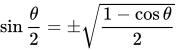
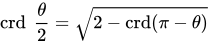
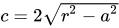
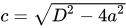
The last step uses the half-angle formula. Much as modern trigonometry is built on the sine function, ancient trigonometry was built on the chord function. Hipparchus is purported to have written a twelve-volume work on chords, all now lost, so presumably, a great deal was known about them. In the table below (where c is the chord length, and D the diameter of the circle) the chord function can be shown to satisfy many identities analogous to well-known modern ones:

Name Sine-based Chord-based
Pythagorean
Half-angle
Apothem (a)
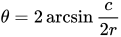
Angle (θ)

The inverse function exists as well:[4]
See also

[edit]

References

[edit]
[edit]
Revisions and contributorsEdit on WikipediaRead on Wikipedia
from Grokipedia
In , a chord is a straight whose endpoints both lie on the of a . This segment connects two points on the without passing through its unless it is a . A special case of a chord is the diameter, which is a chord that passes through the of the and is the longest possible chord in any given . Chords exhibit several fundamental properties that are central to circle geometry. The bisector of any chord passes through of the circle, ensuring that the line from to the of the chord is to it. Additionally, the from to a chord bisects the chord, and conversely, any radius to a chord bisects it if the chord is not a . Chords of equal are from , and congruent chords subtend equal central angles and intercept equal arcs. Key theorems involving chords include the , which states that if two chords intersect inside a at a point P, then the products of the lengths of the segments of each chord are equal: for chords AB and CD intersecting at P, PA × PB = PC × PD. These properties underpin many applications in , such as calculating distances, angles, and areas related to circular figures.

Definition and Basic Properties

Definition

In , a chord is defined as a straight whose endpoints both lie on a given , such as a , , or other . Although the concept applies generally, it is most commonly used in the context of . This concept establishes the foundational element for analyzing intersections between straight lines and curved paths in the plane. The term chord specifically refers to the finite segment between the two points of intersection, distinguishing it from a secant, which is the infinite straight line extending beyond those points. In the particular case of circles, a diameter represents a special type of chord that passes through the center of the circle. The word "chord" derives from the Greek chordē, meaning "string" or "cord," which alludes to its historical association with string-based constructions in ancient geometry, such as those used in measuring arcs or in musical instruments like the lyre. This etymology underscores the term's origins in practical, tactile methods of geometric exploration before formal mathematical abstraction. As a prerequisite for , the chord provides the basic building block for understanding more complex properties and relationships in subsequent analyses of specific .

General Properties

In , the length of a chord connecting two points on a is defined as the straight-line between those endpoints, providing a direct measure of the segment's extent independent of the curve's shape. This measurement assumes a and applies to any pair of points on a smooth , serving as a fundamental metric for analyzing linear approximations to curved paths. A key related concept, particularly for circular arcs, is the , which quantifies the deviation of the arc from the chord; it is the from the of the chord to the arc, measured along the bisector. This distance captures the "bulge" or depth of the arc relative to the straight chord and is particularly useful in applications involving curved surfaces or paths, such as or , where it helps assess local without requiring the full curve equation. Every chord subtends an arc on the curve, representing the portion of the curve between the endpoints. For sufficiently small arcs—corresponding to minor parameter intervals along the curve—the chord length serves as a close approximation to the arc length, with the difference becoming negligible as the interval shrinks; this principle underpins numerical methods for computing total curve lengths by summing infinitesimal chords. The power of a point theorem extends to a general form applicable to certain smooth algebraic curves: for a point PP exterior to the curve, if two secants from PP intersect the curve at points A,BA, B and C,DC, D respectively (forming chords ABAB and CDCD), then the products of the segment lengths satisfy APPB=PCPDAP \cdot PB = PC \cdot PD. This relation, originally established for circles, generalizes to specific classes of real algebraic curves, such as some conics and higher-degree polynomials, preserving the equality through algebraic invariants of the curve's equation, though it does not hold universally for arbitrary smooth curves.

Chords in Circles

Geometric Properties

In a circle, chords of equal length are from , and conversely, chords from have equal lengths. This symmetry arises from the radial nature of the circle, where the distance from to a chord determines its span. The from of a circle to a chord bisects that chord, dividing it into two equal segments. This property holds because the two right triangles formed by the share the same (the ) and have equal legs from to the endpoints, making the segments congruent by the hypotenuse-leg theorem. Equal chords subtend equal at the center of the circle, reflecting the circle's rotational symmetry. The longest chord is the , which passes through the center and subtends a central angle of 180 degrees, maximizing the distance between endpoints on the . The inscribed angle theorem states that the measure of an angle inscribed in a , with its vertex on the and sides passing through two other points on the circle, is half the measure of the subtended by the same arc. This relation highlights the circle's angular symmetry, where peripheral observations capture half the central perspective. When two chords intersect inside a circle, the product of the lengths of the segments of one chord equals the product of the lengths of the segments of the other chord; that is, if chords AB and CD intersect at point P, then APPB=CPPDAP \cdot PB = CP \cdot PD. This , a consequence of similar triangles formed by the intersecting lines, underscores the circle's power-of-a-point property for internal intersections.

Length Calculations

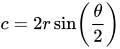
The length of a chord subtended by a θ\theta (in radians) in a of rr is given by the c=2rsin(θ2).c = 2r \sin\left(\frac{\theta}{2}\right). This arises from considering the formed by the two radii to the chord's endpoints and the chord itself, where the apex at the center is θ\theta; drawing the bisector from the center to the chord's creates a with hypotenuse rr, one acute θ/2\theta/2, and opposite side c/2c/2, yielding sin(θ/2)=(c/2)/r\sin(\theta/2) = (c/2)/r upon applying the . An alternative method computes the chord length using the dd from the circle's to the chord, via c=2r2d2.c = 2 \sqrt{r^2 - d^2}.
Add your contribution
Related Hubs
User Avatar
No comments yet.