Hubbry Logo
Color chargeColor chargeMain
Open search
Color charge
Community hub
Color charge
logo
8 pages, 0 posts
0 subscribers
Be the first to start a discussion here.
Color charge
Color charge
from Wikipedia

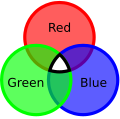
Color charge is a property of quarks and gluons that is related to the particles' strong interactions in the theory of quantum chromodynamics (QCD). Like electric charge, it determines how quarks and gluons interact through the strong force; however, rather than there being only positive and negative charges, there are three "charges", commonly called red, green, and blue. Additionally, there are three "anti-colors", commonly called anti-red, anti-green, and anti-blue. Unlike electric charge, color charge is never observed in nature: in all cases, red, green, and blue (or anti-red, anti-green, and anti-blue) or any color and its anti-color combine to form a "color-neutral" system. For example, the three quarks making up any baryon universally have three different color charges, and the two quarks making up any meson universally have opposite color charge.

The "color charge" of quarks and gluons is completely unrelated to the everyday meaning of color, which refers to the frequency of photons, the particles that mediate a different fundamental force, electromagnetism. The term color and the labels red, green, and blue became popular simply because of the loose but convenient analogy to the primary colors.

History

[edit]

Shortly after the existence of quarks was proposed by Murray Gell-Mann and George Zweig in 1964, color charge was implicitly introduced the same year by Oscar W. Greenberg.[1] In 1965, Moo-Young Han and Yoichiro Nambu explicitly introduced color as a gauge symmetry.[1]

Han and Nambu initially designated this degree of freedom by the group SU(3), but it was referred to in later papers as "the three-triplet model". One feature of the model (which was originally preferred by Han and Nambu) was that it permitted integrally charged quarks, as well as the fractionally charged quarks initially proposed by Zweig and Gell-Mann.

Somewhat later, in the early 1970s, Gell-Mann, in several conference talks, coined the name color to describe the internal degree of freedom of the three-triplet model, and advocated a new field theory, designated as quantum chromodynamics (QCD) to describe the interaction of quarks and gluons within hadrons. In Gell-Mann's QCD, each quark and gluon has fractional electric charge, and carries what came to be called color charge in the space of the color degree of freedom.

Red, green, and blue

[edit]

In quantum chromodynamics (QCD), a quark's color can take one of three values or charges: red, green, and blue. An antiquark can take one of three anticolors: called antired, antigreen, and antiblue (represented as cyan, magenta, and yellow, respectively). Gluons are mixtures of two colors, such as red and antigreen, which constitutes their color charge. QCD considers eight gluons of the possible nine color–anticolor combinations to be unique; see eight gluon colors for an explanation.

All three colors mixed together, all three anticolors mixed together, or a combination of a color and its anticolor is "colorless" or "white" and has a net color charge of zero. Due to a property of the strong interaction called color confinement, free particles must have a color charge of zero.

A baryon is composed of three quarks, which must be one each of red, green, and blue colors; likewise an antibaryon is composed of three antiquarks, one each of antired, antigreen and antiblue. A meson is made from one quark and one antiquark; the quark can be any color, and the antiquark has the matching anticolor.

The following illustrates the coupling constants for color-charged particles:

Field lines from color charges

[edit]

Analogous to an electric field and electric charges, the strong force acting between color charges can be depicted using field lines. However, the color field lines do not arc outwards from one charge to another as much, because they are pulled together tightly by gluons (within 1 fm).[2] This effect confines quarks within hadrons.

Fields due to color charges of quarks (G is the gluon field strength tensor) in "colorless" combinations.
Top: Color charge has "ternary neutral states" as well as binary neutrality (analogous to electric charge).
Bottom: Quark/antiquark combinations.[3][4]

Coupling constant and charge

[edit]

In a quantum field theory, a coupling constant and a charge are different but related notions. The coupling constant sets the magnitude of the force of interaction; for example, in quantum electrodynamics, the fine-structure constant is a coupling constant. The charge in a gauge theory has to do with the way a particle transforms under the gauge symmetry; i.e., its representation under the gauge group. For example, the electron has charge −1 and the positron has charge +1, implying that the gauge transformation has opposite effects on them in some sense. Specifically, if a local gauge transformation ϕ(x) is applied in electrodynamics, then one finds (using tensor index notation): where is the photon field, and ψ is the electron field with Q = −1 (a bar over ψ denotes its antiparticle – the positron). Since QCD is a non-abelian theory, the representations, and hence the color charges, are more complicated. They are dealt with in the next section.

Quark and gluon fields

[edit]
The pattern of strong charges for the three colors of quark, three antiquarks, and eight gluons (with two of zero charge overlapping).

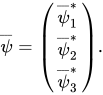
In QCD the gauge group is the non-abelian group SU(3). The running coupling is usually denoted by . Each flavour of quark belongs to the fundamental representation (3) and contains a triplet of fields together denoted by . The antiquark field belongs to the complex conjugate representation (3*) and also contains a triplet of fields. We can write

 and 

The gluon contains an octet of fields (see gluon field), and belongs to the adjoint representation (8), and can be written using the Gell-Mann matrices as

(there is an implied summation over a = 1, 2, ... 8). All other particles belong to the trivial representation (1) of color SU(3). The color charge of each of these fields is fully specified by the representations. Quarks have a color charge of red, green or blue and antiquarks have a color charge of antired, antigreen or antiblue. Gluons have a combination of two color charges (one of red, green, or blue and one of antired, antigreen, or antiblue) in a superposition of states that are given by the Gell-Mann matrices. All other particles have zero color charge.

The gluons corresponding to and are sometimes described as having "zero charge" (as in the figure). Formally, these states are written as

and

While "colorless" in the sense that they consist of matched color-anticolor pairs, which places them in the centre of a weight diagram alongside the truly colorless singlet state, they still participate in strong interactions - in particular, those in which quarks interact without changing color.

Mathematically speaking, the color charge of a particle is the value of a certain quadratic Casimir operator in the representation of the particle.

In the simple language introduced previously, the three indices "1", "2" and "3" in the quark triplet above are usually identified with the three colors. The colorful language misses the following point. A gauge transformation in color SU(3) can be written as , where is a 3 × 3 matrix that belongs to the group SU(3). Thus, after gauge transformation, the new colors are linear combinations of the old colors. In short, the simplified language introduced before is not gauge invariant.

Color-line representation of QCD vertex

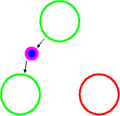
Color charge is conserved, but the book-keeping involved in this is more complicated than just adding up the charges, as is done in quantum electrodynamics. One simple way of doing this is to look at the interaction vertex in QCD and replace it by a color-line representation. The meaning is the following. Let represent the ith component of a quark field (loosely called the ith color). The color of a gluon is similarly given by , which corresponds to the particular Gell-Mann matrix it is associated with. This matrix has indices i and j. These are the color labels on the gluon. At the interaction vertex one has qi → gij + qj. The color-line representation tracks these indices. Color charge conservation means that the ends of these color lines must be either in the initial or final state, equivalently, that no lines break in the middle of a diagram.

Color-line representation of 3-gluon vertex

Since gluons carry color charge, two gluons can also interact. A typical interaction vertex (called the three gluon vertex) for gluons involves g + g → g. This is shown here, along with its color-line representation. The color-line diagrams can be restated in terms of conservation laws of color; however, as noted before, this is not a gauge invariant language. Note that in a typical non-abelian gauge theory the gauge boson carries the charge of the theory, and hence has interactions of this kind; for example, the W boson in the electroweak theory. In the electroweak theory, the W also carries electric charge, and hence interacts with a photon.

See also

[edit]

References

[edit]

Further reading

[edit]
Revisions and contributorsEdit on WikipediaRead on Wikipedia
from Grokipedia
Color charge is a fundamental quantum property of quarks and gluons that mediates the in (QCD), the theory describing the interactions among these particles, analogous to in but with three distinct types—red, green, and blue for quarks, and corresponding anticolors for antiquarks. Gluons, the force carriers, possess both a color and an anticolor, enabling them to bind quarks into color-neutral composite particles like protons and neutrons, where the net color charge is zero. The concept of color charge was introduced in 1964 by physicist Oscar W. Greenberg to resolve a in the proposed that year by and , where identical fermions (quarks) in baryons like the delta resonance appeared to violate the due to symmetric wave functions. Greenberg proposed that quarks carry an additional hidden degree of freedom—a three-valued "color" charge—allowing for antisymmetric combinations under parafermi statistics of order three, thus ensuring compliance with quantum statistics. This idea remained dormant until the 1970s, when QCD was formulated as a non-Abelian based on the SU(3)c symmetry group, with quarks transforming under the fundamental representation (color index 1 to 3) and gluons under the (eight types). In QCD, color charge is conserved, much like , but the strong force exhibits unique behaviors: it becomes stronger with increasing distance due to confinement, in contrast to at short distances, where free quarks or gluons cannot exist in isolation but are perpetually bound within . Experimental evidence for three colors includes the decay rate of the neutral into two photons and the hadron production rate in electron-positron collisions, both indicating a factor of three beyond naive predictions. Today, color charge underpins the Standard Model's sector, explaining the stability of atomic nuclei and phenomena from jet production in particle colliders to the quark-gluon plasma in heavy-ion collisions.

Basic Concepts

Definition and Analogy

Color charge is a fundamental quantum number possessed by quarks and gluons that determines their interactions via the strong nuclear force, as described in quantum chromodynamics (QCD). It serves as the source of the color field, analogous to how electric charge sources the electromagnetic field in quantum electrodynamics (QED). Unlike the single binary type of electric charge (positive or negative), color charge has three distinct varieties, conventionally denoted as red, green, and blue for quarks, with corresponding anticolors for antiquarks. This multiplicity arises from the underlying SU(3) gauge symmetry of QCD, a non-Abelian group whose Lie algebra is spanned by eight generators, reflecting the structure of the theory's force mediators. The analogy to provides an intuitive framework for understanding color charge. Just as oppositely charged particles attract and like-charged ones repel through photon exchange in QED, quarks of different colors attract via exchange, generating a that binds them together. Quarks behave like "colored" charges, with a single color each, while the gluons carry both color and anticolor, enabling the force to be long-range at short distances but effectively confining at larger scales. However, QCD's non-Abelian structure introduces a crucial difference: gluons self-interact because they possess color charge, leading to complex dynamics absent in the Abelian U(1) of QED, where are neutral. This self-coupling is a hallmark of the SU(3) group's properties, enhancing the strong force's intensity compared to . A key consequence of color charge is the requirement of color neutrality for observable particles. In QCD, hadrons such as protons and mesons must form color singlets, where the net color charge is zero—effectively "white" by combining all three colors or a color-anticolor pair. This neutrality ensures that isolated colored particles like free quarks cannot exist, as the strong force confines them within hadrons, unlike electrically charged particles that can propagate freely in QED. The SU(3) symmetry enforces this through the invariance of the theory's Lagrangian under local color transformations, guaranteeing color conservation.

The Three Color Charges

In (QCD), the three fundamental color charges carried by quarks are conventionally labeled , , and , serving as arbitrary mathematical labels rather than literal visual colors. These labels correspond to the three basis states in the fundamental triplet representation of the SU(3) color symmetry group, acting as orthogonal vectors in an abstract three-dimensional . The choice of these specific names draws from the additive primary colors to intuitively evoke how they combine, but they emphasize the non-Abelian structure of the strong force distinct from . The orthogonality of these color charges ensures that combinations of quarks and antiquarks can form color-neutral, or "white," states, analogous to emerging from balanced , , and components. For instance, a achieves color neutrality through a of one color paired with an antiquark bearing the corresponding anticolor, such as a and an anti-red antiquark, resulting in a color singlet overall. In baryons, color neutrality arises from the combination of three quarks, each carrying a different color— one , one , and one —yielding an antisymmetric colorless state that satisfies the SU(3) invariance requirements. Antiquarks carry anticolors (anti-, anti-, anti-), which follow similar combinatorial rules to form colorless combinations, such as a quark-antiquark pair in or three antiquarks in antibaryons. Color charge is strictly conserved in all strong interaction processes, mirroring the conservation of electric charge but extended to the three-dimensional SU(3) framework. Under SU(3) color rotations, individual quark colors can mix or transform— for example, a red quark might become a linear combination of red and green— yet the total color content of the system remains unchanged, preserving the overall neutrality of hadrons. This conservation arises from the global SU(3) symmetry of QCD, enforced by Noether's theorem, ensuring that interactions mediated by gluons do not alter the net color charge. Conceptual diagrams of color flow often illustrate these principles by depicting quarks as colored spheres exchanging color labels during interactions, showing how a red quark might pass greenness to a blue quark via gluon mediation, resulting in a green quark and a red-blue mixed partner while maintaining total . Such representations highlight the dynamic yet conserved nature of color without implying literal field lines, emphasizing the abstract transformations in .

Particles and Color Assignment

Quarks and Antiquarks

Quarks transform under the fundamental representation of the SU(3)c gauge group and carry one of three possible color charges: , , or blue. Antiquarks transform under the conjugate (antifundamental) representation and carry the corresponding anticolor charges: antired, antigreen, or antiblue. Each quark flavor exists in one of these three color states, and the color degree of freedom is essential for forming color-neutral hadrons.

Gluons

Gluons are the vector gauge bosons responsible for mediating the strong interaction between quarks in quantum chromodynamics (QCD), the theory describing the strong nuclear force. Unlike the photons of quantum electrodynamics, which are electrically neutral, gluons themselves carry color charge, enabling them to couple not only to quarks but also to each other. This property arises from the non-Abelian structure of the underlying SU(3)c gauge group, where the gauge bosons transform under the adjoint representation. The eight distinct types of gluons correspond to the eight generators of the SU(3) , as given by the . The number of gluons follows from : for a non-Abelian based on SU(N), the dimension of the is N2 − 1, yielding 32 − 1 = 8 massless gluons for N = 3 in QCD. Each gluon carries a composite color charge consisting of one color and one anticolor from the set {red, green, blue}, such as red-antigreen or blue-antired, excluding the color-neutral singlet combination. These color-anticolor pairs ensure that gluons transform appropriately under SU(3)c to maintain gauge invariance. The presence of color charge on gluons leads to self-interactions, including three-gluon and four-gluon vertices, which are absent in the Abelian U(1) theory of . These interactions complicate the perturbative expansion of the strong force, contributing to phenomena like at short distances. In mediating the strong force, gluons are exchanged between color-charged particles such as s; for instance, a can emit a -antiblue , thereby changing its own color to while the emitted carries away the color difference. This process conserves the total color charge, as the absorbing would then change from to upon absorption.

Interactions and Dynamics

Gluon-Mediated Forces

In (QCD), the strong force between color-charged particles is mediated by the exchange of virtual , analogous to exchange in (QED) but with distinct color dynamics. In a typical quark-quark process, as depicted in lowest-order Feynman diagrams, two incoming quarks of different colors (e.g., red and blue) exchange a virtual , resulting in outgoing quarks with exchanged color labels (blue and red, respectively). This exchange alters the individual color states at each quark- vertex while preserving the overall color neutrality of the system, ensuring that the interaction conserves color charge. The , carrying a combination of color and anticolor (e.g., red-antiblue), facilitates this color rotation without violating SU(3) color symmetry. At short distances on the order of 101510^{-15} m—comparable to the scale of quark confinement within hadrons—the strong force mediated by is approximately 100 times stronger than the electromagnetic force, enabling it to bind into stable hadrons such as protons and mesons despite electromagnetic repulsions between like-charged quarks. This intense attraction arises from the QCD coupling strength αs\alpha_s, which, while running with energy scale, yields effective force magnitudes far exceeding QED's α1/137\alpha \approx 1/137 in the relevant low-energy regime. The gluon exchange thus provides the dominant binding mechanism at these subnuclear scales. The probabilities of these gluon-mediated interactions are quantified by color factors derived from the SU(3) group structure, which enhance amplitudes compared to a naive color-blind estimate. For instance, in -gluon interactions, the color factor is given by the operator CF=(Nc21)/(2Nc)=4/3C_F = (N_c^2 - 1)/(2N_c) = 4/3 for Nc=3N_c = 3 colors, reflecting the strength of color exchange between a quark in the fundamental representation and a in the . Similarly, self-interactions involve CA=Nc=3C_A = N_c = 3. These factors, computed using SU(3) generators and , multiply the kinematic parts of amplitudes, systematically increasing interaction rates by factors like CFC_F in processes such as -antiquark to gluons. Unlike QED, where photons do not carry charge and interactions are limited to simple fermion-photon vertices, QCD's non-Abelian SU(3) gauge symmetry imparts color charge to gluons themselves, enabling triple-gluon and quartic-gluon vertices. These self-interaction terms, absent in Abelian QED, introduce additional Feynman diagrams such as gluon-gluon scattering via three-gluon exchanges, leading to more intricate perturbative expansions and nonlinear effects in the strong force dynamics. The resulting complexity underscores the non-Abelian nature of color charge mediation.

Color Confinement

Color confinement is a fundamental phenomenon in (QCD) where quarks and gluons, the carriers of color charge, are permanently confined within color-neutral composite particles known as hadrons, such as mesons and baryons. This binding arises because the strong force mediated by gluons increases with distance, preventing the isolation of individual color-charged particles; attempting to separate quarks to infinite separation would require infinite energy, as the potential between them rises linearly rather than falling off. Strong evidence for color confinement comes from both theoretical simulations and experimental observations. Lattice QCD calculations, which discretize spacetime to solve QCD non-perturbatively, demonstrate the formation of chromoelectric flux tubes—elongated structures of gluon fields—connecting a quark-antiquark pair, supporting the string-like model of confinement. Experimentally, high-energy particle collisions at accelerators like the Large Hadron Collider (LHC) produce jets of quarks and gluons that rapidly hadronize into color-neutral particles, with no free quarks detected despite extensive searches; bounds on free quark production exclude their existence at observable levels. The mechanism underlying color confinement involves effects in QCD at large distances, where the self-interacting nature of gluons leads to the formation of color flux tubes that behave like relativistic strings between color charges. These flux tubes generate a linear confining potential between a and antiquark, described by V(r)σr,V(r) \approx \sigma r, where rr is the separation distance and σ\sigma is the string tension, a measure of the energy per unit length of the tube, with typical values around σ1\sigma \approx 1 GeV/fm.90567-W) This confinement has profound implications for : it explains why only colorless hadrons, not individual quarks or gluons, are observed as free particles in nature, ensuring the stability of ordinary matter. Moreover, attempts to violate confinement by separating quark-antiquark pairs instead produce new quark-antiquark pairs from the , leading to cascades rather than isolated charges.

Theoretical Framework

Coupling Constant

In (QCD), the strength of the strong interaction is parameterized by the strong gsg_s, commonly expressed in terms of the αs=gs24π\alpha_s = \frac{g_s^2}{4\pi}. Besides the masses, αs\alpha_s is the only free parameter in the QCD Lagrangian. Due to effects, αs\alpha_s depends on the energy scale μ\mu at which it is measured, as described by the in the equation. This scale dependence results in : αs\alpha_s decreases at high energies (short distances), enabling perturbative QCD calculations, and increases at low energies, consistent with .

Quark and Gluon Fields

In (QCD), the dynamics of color-charged particles are described by a Lagrangian that incorporates s and s as the fundamental fields. The QCD Lagrangian is given by L=14GμνaGaμν+fqˉf(iγμDμmf)qf,\mathcal{L} = -\frac{1}{4} G^a_{\mu\nu} G^{a\mu\nu} + \sum_f \bar{q}_f (i \gamma^\mu D_\mu - m_f) q_f, where the sum runs over quark flavors ff, qfq_f represents the fields, mfm_f is the quark mass for each flavor, GμνaG^a_{\mu\nu} is the for the eight gluon color indices a=1,,8a = 1, \dots, 8, and the covariant derivative is Dμ=μigsλa2AμaD_\mu = \partial_\mu - i g_s \frac{\lambda^a}{2} A^a_\mu, with gsg_s the strong , λa\lambda^a the , and AμaA^a_\mu the fields. This form captures the non-Abelian gauge structure of the strong interaction, analogous to but with self-interacting gluons. Quarks are represented as Dirac spinor fields transforming under the fundamental representation of the SU(3)c_c color group, specifically the triplet (dimension 3), which means each quark field qfq_f carries an explicit color index i=1,2,3i = 1,2,3 corresponding to the three colors (red, green, blue). Antiquarks transform under the conjugate representation 3ˉ\bar{3}. Gluons, in contrast, are massless vector (spin-1) fields in the adjoint representation of SU(3)c_c (dimension 8), mediating the color interactions and themselves carrying color charge, which leads to gluon self-couplings absent in Abelian theories like QED. The theory is invariant under local SU(3)c_c gauge transformations, which require the introduction of colored quark and gluon fields to maintain the structure of the Lagrangian under color rotations at each spacetime point. Specifically, quark fields transform as qU(x)qq \to U(x) q where U(x)U(x) \in SU(3)c_c, and gluons as AμUAμU+igs(μU)UA_\mu \to U A_\mu U^\dagger + \frac{i}{g_s} (\partial_\mu U) U^\dagger, ensuring the covariant derivative and field strength tensor adjust accordingly to preserve invariance. This local symmetry prohibits mass terms for gluons, such as mg2AμaAaμm_g^2 A^a_\mu A^{a\mu}, as they would break the gauge invariance; thus, gluons remain massless, propagating at the speed of light. Quantization of these fields proceeds via the , where observables are computed as functional integrals over all possible field configurations weighted by eiSe^{i S}, with S=d4xLS = \int d^4x \mathcal{L} the action. For QCD, this involves integrating over Dirac fields and vector fields, incorporating Faddeev-Popov ghost fields to handle the necessary for well-defined propagators, thereby providing the field-theoretic foundation for perturbative expansions and non-perturbative studies.

Historical Development

Early Ideas

In the late 1950s and early 1960s, physicists sought to organize the growing zoo of strongly interacting particles observed in experiments, leading to the development of symmetry-based classification schemes. and independently proposed the "eightfold way" in 1961, a classification system based on the SU(3) flavor symmetry group that grouped hadrons into multiplets, such as octets and decuplets, to account for their observed masses and quantum numbers. This framework successfully predicted the existence of the Ω⁻ in the decuplet but was phenomenological, prompting deeper models like the to explain the underlying structure. To address these issues and explain hadron spectroscopy more fundamentally, Gell-Mann and introduced the in 1964, positing that hadrons are composite structures built from three types of fundamental constituents—up, down, and strange quarks—with fractional electric charges of +2/3 or -1/3. Baryons like the proton (uud) and the Δ⁺⁺ (uuu) were described as three-quark states, while mesons were quark-antiquark pairs; this model reproduced the SU(3) multiplets elegantly. However, it faced a statistical : the Δ⁺⁺, composed of three identical up quarks in a symmetric spin-3/2, s-wave spatial state, violated the for fermions, as all quarks would occupy the same without an additional degree of freedom to antisymmetrize the wave function. This issue was addressed by Oscar W. Greenberg in 1964, who introduced a three-valued "color" quantum number for quarks, enabling parafermi statistics of order three to antisymmetrize the wave function. In response to such concerns, including the fractional charges and Pauli issues, Moo-Young Han and proposed an alternative model in 1965, featuring three triplets of integrally charged quarks (with charges 0, +1, -1) to construct hadrons while maintaining approximate SU(3) × SU(3) symmetry. This "three-triplet" scheme introduced an SU(3) color-like symmetry to resolve statistics while using integer charges to avoid fractions, but was largely superseded by later developments emphasizing fractional charges. Concurrent observations in the 1960s hinted at underlying selection rules in strong decays that suggested hidden quantum numbers influencing interaction strengths. The Okubo-Zweig-Iizuka (OZI) rule, formulated around 1963–1966, stated that strong interaction processes involving disconnected quark-line diagrams—such as certain φ meson decays to lighter hadrons—are suppressed compared to connected diagrams, based on empirical patterns in vector meson decays and unitary symmetry arguments. This rule provided early evidence for quark substructure and motivated the search for an additional degree of freedom to explain suppression factors beyond flavor symmetry alone.

Formulation in QCD

The full formulation of color charge emerged within (QCD) in 1973, when Harald Fritzsch, , and Heinrich Leutwyler proposed quarks carrying one of three color charges (red, green, blue) and antiquarks carrying anticolors, with gluons as color-octet mediators in a non-Abelian SU(3) gauge theory. This framework resolved the proliferation of hadron states predicted by the naive and introduced the color octet gluon picture, enabling the strong force to bind color-neutral . Concurrently, and others in the early 1970s embedded color into the broader structure, unifying it with electroweak interactions under the . A pivotal theoretical advance came in 1973 with the discovery of by and , and independently by David Politzer, demonstrating that the decreases at short distances in non-Abelian gauge theories like SU(3) color, allowing perturbative QCD calculations at high energies. This property, for which they shared the , predicted gluons as massless color carriers and explained the scaling behavior in high-energy scattering. Experimental validation began in the with (DIS) experiments at the Stanford Linear Accelerator Center (SLAC), where electron-proton collisions revealed scaling cross-sections consistent with the parton model, incorporating a color factor of three to match the observed structure functions. The discovery of the J/ψ meson in 1974 by SLAC and teams provided further evidence, as its narrow width and aligned with charmonium states forming color singlets, supporting quark-antiquark binding via exchange. Up to 2025, precision measurements of the strong coupling constant α_s at the Large Hadron Collider (LHC) by ATLAS and CMS have refined QCD predictions, yielding world-average values with uncertainties below 1%, confirming asymptotic freedom across energy scales. Lattice QCD simulations have quantitatively verified color confinement by computing string tensions and potential profiles between static quarks, reproducing the linear confinement potential at low energies. Heavy-ion collisions at the LHC and Relativistic Heavy Ion Collider (RHIC) have recreated quark-gluon plasma states, with recent oxygen-oxygen runs in 2025 revealing small-system collectivity and deconfinement signatures consistent with perturbative QCD at high temperatures.

References

Add your contribution
Related Hubs
User Avatar
No comments yet.