Hubbry Logo
Computer-aided engineeringComputer-aided engineeringMain
Open search
Computer-aided engineering
Community hub
Computer-aided engineering
logo
8 pages, 0 posts
0 subscribers
Be the first to start a discussion here.
Computer-aided engineering
from Wikipedia
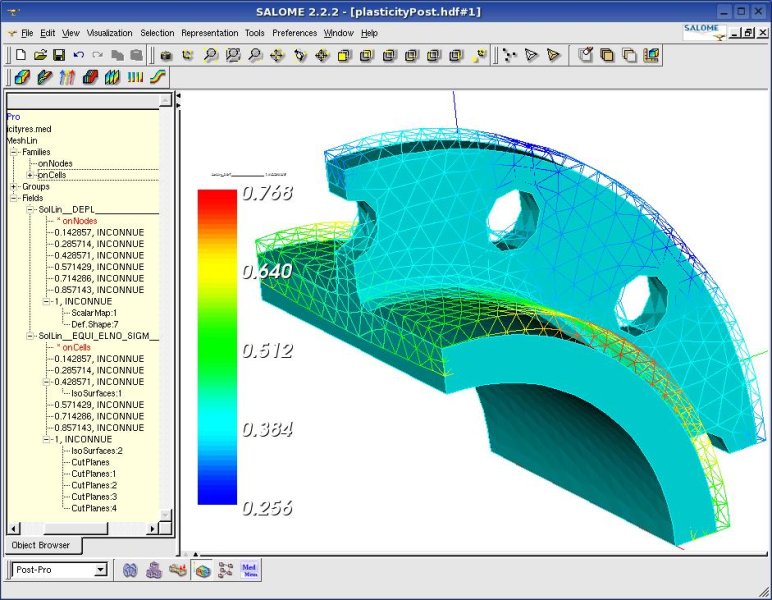
Nonlinear static analysis of a 3D structure subjected to plastic deformations


Computer-aided engineering (CAE) is the general usage of technology to aid in tasks related to engineering analysis.

Overview

[edit]

Computer-aided engineering (CAE) includes finite element method or analysis (FEA), computational fluid dynamics (CFD), multibody dynamics (MBD), durability and optimization. It is included with computer-aided design (CAD) and computer-aided manufacturing (CAM) in a collective term and abbreviation computer-aided technologies (CAx).

The term CAE has been used to describe the use of computer technology within engineering in a broader sense than just engineering analysis. It was in this context that the term was coined by Jason Lemon, founder of Structural Dynamics Research Corporation (SDRC) in the late 1970s. However, this definition is better known today by the terms CAx and product lifecycle management (PLM).[1]

CAE systems are individually considered a single node on a total information network, and each node may interact with other nodes on the network.

CAE fields and phases

[edit]

CAE areas covered include:

  • Stress analysis on components and assemblies using finite element analysis (FEA);
  • Thermal and fluid flow analysis computational fluid dynamics (CFD);
  • Multibody dynamics (MBD) and kinematics;
  • Analysis tools for process simulation for operations such as casting, molding, and die press forming;
  • Optimization of the product or process.

In general, there are three phases in any computer-aided engineering task:

  • Pre-processing – defining the model and environmental factors to be applied to it (typically a finite element model, but facet, voxel, and thin sheet methods are also used);
  • Analysis solver (usually performed on high powered computers);
  • Post-processing of results (using visualization tools).

This cycle is iterated either manually or with the use of commercial optimization software.

CAE in the automotive industry

[edit]

CAE tools are widely used in the automotive industry. Their use has enabled automakers to reduce product development costs and time while improving the safety, comfort, and durability of the vehicles they produce. The predictive capability of CAE tools has progressed to the point where much of the design verification is done using computer simulations (diagnosis) rather than physical prototype testing. CAE dependability is based upon all proper assumptions as inputs and must identify critical inputs (BJ). Even though there have been many advances in CAE, and it is widely used in the engineering field, physical testing is still a must. It is used for verification and model updating, to accurately define loads and boundary conditions, and for final prototype sign-off.

The future of CAE in the product development process

[edit]

Even though CAE has built a strong reputation as a verification, troubleshooting and analysis tool, there is still a perception that sufficiently accurate results come rather late in the design cycle to really drive the design. This can be expected to become a problem as modern products become ever more complex. They include smart systems, which leads to an increased need for multi-physics analysis including controls, and contain new lightweight materials, with which engineers are often less familiar. CAE software companies and manufacturers are constantly looking for tools and process improvements to change this situation.

On the software side, they are constantly looking to develop more powerful solvers, to better utilize computer resources, and to include engineering knowledge in pre and post-processing. Recent developments have seen the integration of artificial intelligence and machine learning into CAE tools, enabling real-time simulations and predictive modeling.[2] On the process side, they try to achieve a better alignment between 3D CAE, 1D system simulation, and physical testing. This should increase modeling realism and calculation speed.

CAE software companies and manufacturers try to better integrate CAE in the overall product lifecycle management. In this way they can connect product design with product use, which is needed for smart products. This enhanced engineering process is also referred to as predictive engineering analytics.[3][4]

See also

[edit]

References

[edit]

Further reading

[edit]
[edit]
Revisions and contributorsEdit on WikipediaRead on Wikipedia
from Grokipedia
Computer-aided engineering (CAE) is the application of computer software to simulate, analyze, and optimize engineering designs by evaluating their performance under various physical conditions, such as loads, stresses, and environmental factors. This process enables engineers to predict outcomes, identify potential failures, and refine designs virtually before physical prototyping. CAE emerged in the mid-1960s as computational power from large mainframe computers allowed for advanced numerical methods, building on earlier manual engineering analyses. By the 1980s, the (FEM) had become a cornerstone of CAE, dividing complex structures into smaller elements for precise calculations of stress, strain, and other properties. The field evolved alongside (CAD), extending beyond geometric modeling to include analytical and optimization phases across the . Core techniques in CAE encompass finite element analysis (FEA) for structural integrity, for fluid flow simulations, and multi-body dynamics for motion studies, often integrated with virtual prototyping tools like digital twins. Graphical preprocessors facilitate model creation, while postprocessors visualize results such as stress contours and vibration modes to aid interpretation. CAE finds widespread use in industries including , automotive, and , where it supports tasks like , fracture prediction, and durability assessment to enhance product robustness and . By minimizing the need for costly physical tests and accelerating iterations, CAE significantly reduces development time and costs while improving overall quality.

Fundamentals

Definition and Scope

Computer-aided engineering (CAE) is the application of computer software to simulate, analyze, and optimize the performance of engineering designs and systems, allowing engineers to predict and functionality without constructing physical prototypes. This involves creating virtual models to evaluate factors such as structural integrity, thermal performance, and under various conditions, thereby reducing development time and costs while enhancing reliability. The scope of CAE encompasses a range of computational disciplines, including finite element analysis (FEA) for assessing stresses and deformations in solid structures, for modeling fluid flow and , multibody dynamics (MBD) for simulating the motion and interactions of interconnected components, and optimization techniques to iteratively refine designs for and . These methods enable multidisciplinary analysis, from mechanical and to biomedical applications, by integrating physics-based simulations with numerical solvers to approximate real-world responses. CAE distinguishes itself from related fields by emphasizing post-design simulation and validation rather than creation or production. Unlike (CAD), which focuses on generating geometric models and visualizations, CAE uses those models as inputs for predictive testing and refinement. In contrast to (CAM), which translates designs into instructions for automated fabrication, CAE prioritizes analytical evaluation to inform iterative improvements before manufacturing begins. The term CAE originated in the alongside the development of early finite element methods and commercial , marking a shift from manual calculations to automated computational tools. Today, it has evolved to incorporate AI-driven simulations, where models accelerate predictions and enable exploration based on vast datasets from traditional analyses.

Historical Development

The origins of computer-aided engineering (CAE) trace back to the mid-20th century, when foundational computational methods for structural analysis emerged. In 1943, Richard Courant proposed an early conceptual framework for the finite element method (FEM) by applying the Rayleigh-Ritz variational principle to triangular subdomains, laying the groundwork for discretizing continuous systems into manageable elements. This idea, though not immediately pursued due to computational limitations, was independently rediscovered in the 1950s and 1960s by engineers addressing complex structural problems. Pioneers such as John Argyris and O.C. Zienkiewicz advanced FEM through practical implementations; Argyris applied matrix methods to aircraft structures in the 1950s, while Zienkiewicz's work in the 1960s formalized FEM for civil and mechanical engineering applications, establishing it as a core technique for simulation. During the 1960s, NASA adopted these early methods for aerospace applications, particularly in analyzing spacecraft and launch vehicle structures, with development efforts culminating in specialized codes to handle the demands of the Apollo program. The 1970s marked the commercialization of CAE, transitioning from research tools to accessible software. NASA released NASTRAN in 1969, a comprehensive finite element analysis program developed since 1964 to meet needs, which became a benchmark for industry-wide adoption. Concurrently, in 1970, John Swanson founded Swanson Analysis Systems, Inc., releasing the first version of software, which generalized FEM for broader engineering simulations beyond . These tools democratized computational , enabling engineers to perform static and dynamic simulations on mainframe computers, though access remained limited to large organizations due to high costs and hardware constraints. The and saw widespread expansion driven by hardware advancements and system integration. The rise of engineering workstations, such as those based on UNIX systems from and Apollo, in the early allowed CAE software to run on more affordable, dedicated machines, accelerating adoption in and . By the , integration with (CAD) systems became standard, enabling seamless workflows where geometric models directly fed into simulations, as exemplified by platforms like and Pro/ENGINEER that combined design and analysis. From the 2000s onward, CAE evolved toward distributed and . Cloud-based platforms emerged in the early , offering scalable resources for complex simulations without local hardware investments, as proposed in paradigms like cloud-based design and . Open-source tools gained prominence, with released in 2004 by OpenCFD as a free CFD package, fostering community-driven enhancements in and multiphysics simulations. Additionally, integration accelerated simulations by approximating results from high-fidelity models, reducing computational time in areas like optimization and since the late 2000s.

Core Technologies

Simulation and Analysis Methods

Simulation and analysis methods form the computational backbone of computer-aided engineering (CAE), enabling engineers to model and predict the physical behavior of systems under various conditions without physical prototypes. These methods approximate solutions to partial differential equations (PDEs) that govern phenomena such as stress, fluid flow, and , using numerical techniques like and iterative solvers. By dividing complex geometries into manageable subdomains, CAE simulations provide insights into structural integrity, aerodynamic performance, and dynamic responses, reducing design iterations and costs in engineering workflows. Finite element analysis (FEA) is a cornerstone method in CAE for , where continuous domains are discretized into a finite number of elements connected at nodes to approximate solutions to elasticity problems. This approach assembles local element behaviors into a global system, allowing analysis of deformation, stress, and in solids. The method was formalized by Ray W. Clough in 1960, who introduced the term "" for plane stress analysis using triangular elements. The governing equation for static in FEA is derived from the principle of , yielding the matrix form: [K]{u}={F}[K]\{u\} = \{F\} where [K][K] is the global stiffness matrix representing material and geometric properties, {u}\{u\} is the nodal displacement vector, and {F}\{F\} is the applied vector. This system is solved after applying boundary conditions, with [K][K] assembled from element stiffness matrices computed via integration over element domains. (CFD) addresses fluid flow and in CAE by numerically solving the Navier-Stokes equations, which describe , momentum, and energy in viscous flows. techniques, such as finite volume methods, divide the flow domain into control volumes to ensure conservation properties, making CFD essential for simulating , , and multiphase flows. The finite volume approach, popularized by Suhas V. Patankar in 1980, integrates the governing equations over each volume and balances fluxes at faces. The momentum equation in the Navier-Stokes system is: ρ(vt+vv)=p+τ+ρg\rho \left( \frac{\partial \mathbf{v}}{\partial t} + \mathbf{v} \cdot \nabla \mathbf{v} \right) = -\nabla p + \nabla \cdot \boldsymbol{\tau} + \rho \mathbf{g} where ρ\rho is fluid density, v\mathbf{v} is velocity, pp is pressure, τ\boldsymbol{\tau} is the viscous stress tensor, and g\mathbf{g} is gravity. Solutions often require turbulence models, like the k-ε model, to handle high-Reynolds-number flows computationally. Multibody dynamics (MBD) simulates the motion of interconnected rigid or flexible bodies in CAE, crucial for mechanisms, vehicles, and , by modeling kinematic constraints and dynamic forces. This method uses to describe system configurations and applies variational principles to derive , enabling prediction of trajectories, forces, and contact interactions. The foundations trace to 19th-century , with modern computational formulations advanced by Werner Schiehlen in the late for applications. For unconstrained systems, Lagrange's equations provide the framework: ddt(Lq˙i)Lqi=Qi\frac{d}{dt} \left( \frac{\partial L}{\partial \dot{q}_i} \right) - \frac{\partial L}{\partial q_i} = Q_i where L=TVL = T - V is the Lagrangian with TT and potential VV, qiq_i are , q˙i\dot{q}_i their time derivatives, and QiQ_i generalized forces. Constraints are incorporated via Lagrange multipliers or reduced coordinates for efficiency in simulations. Other specialized methods in CAE include , which models heat conduction, , and using the heat transfer equation to predict temperature distributions in materials and assemblies. The transient heat conduction equation is: ρcTt=(kT)+q˙\rho c \frac{\partial T}{\partial t} = \nabla \cdot (k \nabla T) + \dot{q} where ρ\rho is density, cc specific heat, TT temperature, kk thermal conductivity, and q˙\dot{q} internal heat generation; this is solved via finite element or finite difference methods, as detailed in standard heat transfer references. Electromagnetic simulations solve Maxwell's equations to analyze field interactions in devices like antennas and motors, often using finite-difference time-domain (FDTD) methods introduced by Kane S. Yee in 1966 for time-dependent wave propagation. Maxwell's equations in differential form are: D=ρe,B=0,×E=Bt,×H=Je+Dt\nabla \cdot \mathbf{D} = \rho_e, \quad \nabla \cdot \mathbf{B} = 0, \quad \nabla \times \mathbf{E} = -\frac{\partial \mathbf{B}}{\partial t}, \quad \nabla \times \mathbf{H} = \mathbf{J}_e + \frac{\partial \mathbf{D}}{\partial t} where E\mathbf{E} and H\mathbf{H} are electric and magnetic fields, D\mathbf{D} and B\mathbf{B} are displacements, ρe\rho_e , and Je\mathbf{J}_e . Validation of CAE simulations ensures reliability through processes like convergence studies, where solution accuracy is assessed by refining the until changes fall below a threshold, quantified by the Grid Convergence Index (GCI) proposed by Patrick J. Roache in 1994. The GCI estimates uncertainty as GCI=Fsϵrp1GCI = F_s \left| \frac{\epsilon}{r^p - 1} \right|
Add your contribution
Related Hubs
User Avatar
No comments yet.