


Community hub
Recent from talks
Contribute something
Nothing was collected or created yet.
Dan Cox
View on Wikipedia
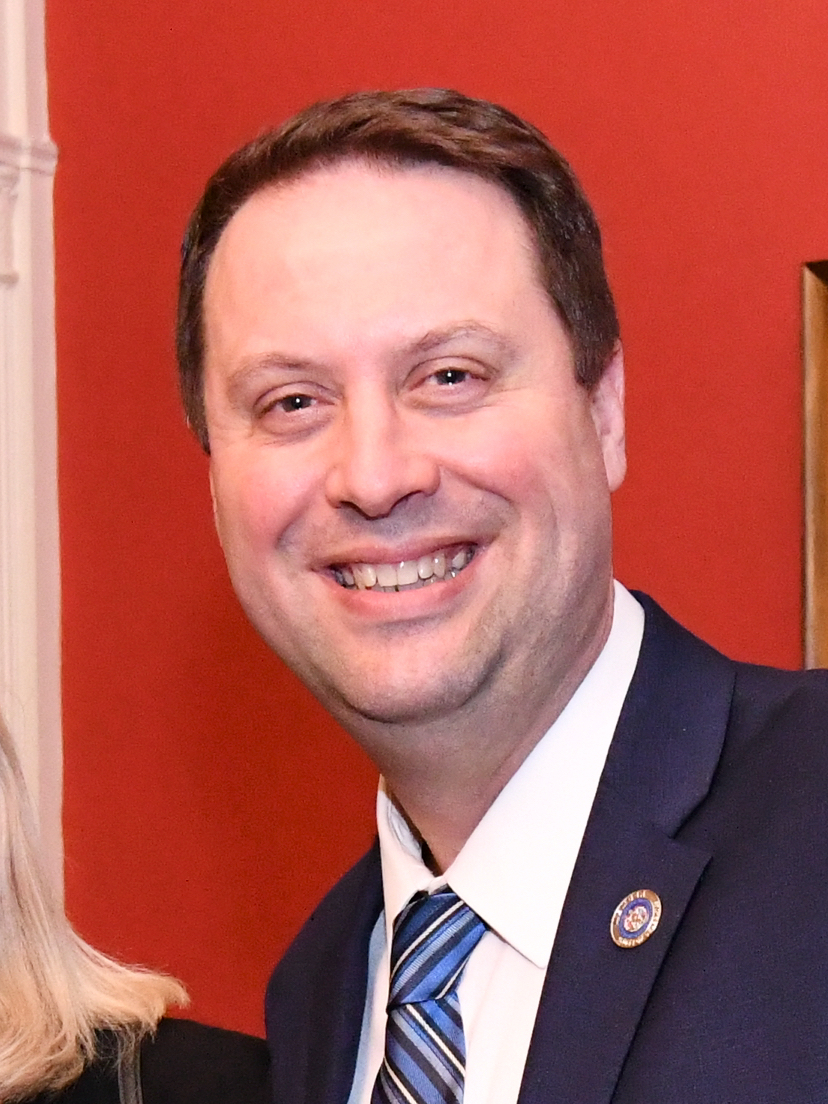
Daniel Lewis Cox (born August 9, 1974) is an American politician and lawyer. He was a Republican member of the Maryland House of Delegates, representing the fourth district from 2019 to 2023.[1] Cox was the unsuccessful Republican nominee in the 2022 Maryland gubernatorial election.[2] In 2024, Cox unsuccessfully ran for the U.S. House of Representatives in Maryland's 6th congressional district, losing to former state delegate Neil Parrott in the Republican primary election.[3][4]
Key Information

.jpg)

Cox is characterized as a far-right politician.[5][6][7] An election denier, he has continuously espoused the disproven theory that the 2020 U.S. presidential election was fraudulent.[2][8][9]
Early life and education
[edit]Cox was born in Washington, D.C., on August 9, 1974,[1] as one of ten children. His father named him after the biblical prophet, Daniel.[10] Cox initially lived in Takoma Park, Maryland, but his family moved north to Frederick County after his father took a job there as a minister. Cox grew up on a farm near Taneytown, Maryland.[11]
Cox attended the Wellspring Christian Family Schools, a faith-based home-school organization founded by his father, as a child.[10] He attended Mount St. Mary's University from 1992 to 1995 and later attended the University of Maryland Global Campus, where in 2002 he earned a bachelor's degree in government and politics.[10] He attended Regent University School of Law, earning a J.D. degree with distinction in 2006.[12]
Career
[edit]In 2006, he became a member of the Maryland State Bar Association[1] and was a sole practitioner outside of Emmitsburg, Maryland.[11] Cox was also a member of the Alliance Defending Freedom.[13][14]
Before getting involved with Maryland politics, Cox taught as a high school teacher from 1995 to 2005 at Walkersville Christian Family Schools.[12] He also served as a Captain in the Civil Air Patrol.[15]
Political involvement
[edit]Cox says he has been active in politics since 1980, when he campaigned with his parents for Ronald Reagan. He also worked on the 1996 presidential campaign of Alan Keyes and as an aide to former U.S. Representative Roscoe Bartlett.[16] He was the Republican nominee for Dorchester County Circuit Court Clerk in 2006, losing the race to Democratic nominee Michael L. Baker.[17][18] Cox ran on a platform that included establishing a division to help fathers gain visitation, ensuring mothers received child support, and refusing to issue licenses for same-sex marriages, which were not legal in Maryland at the time.[10] From 2007 to 2009, he was the President of the Town Commission of Secretary, Maryland.[1]
2016 House of Representatives election campaign
[edit].jpg)
On February 1, 2016, Cox filed to run in 2016 in Maryland's 8th congressional district.[19]
During the Republican primary, Cox was described as being the most conservative candidate in the Republican primary race.[16] He campaigned on imposing a 10 percent flat tax for incomes over $36,000 and eliminating payroll taxes, strengthening gun ownership rights, abolishing the Internal Revenue Service, and reducing funding and programs for the departments of Commerce, Education, Energy, and Housing and Urban Development.[11] He supported Ted Cruz in the 2016 Republican Party presidential primaries.[16] Cox pledged to join the Freedom Caucus, a group of tea party supporters, if elected.[20]
In September 2016, Cox claimed that "far-left sign Nazis" were stealing campaign signs he posted alongside state highways, and posted on Twitter that he had urinated on the signs as a deterrent to prevent theft.[21]
Cox won the Republican primary with 44.4 percent of the vote.[22] In the general election, he was defeated by Democratic nominee and state senator Jamie Raskin with 34.2 percent of the vote.[23][24]
Maryland House of Delegates
[edit]
In February 2018, Cox announced that he would run for the Maryland House of Delegates in District 4. He ran on a platform that included cutting regulations, increasing immigration enforcement, and supporting gun rights.[25] He campaigned on a platform that included lowering taxes, expanding Interstate 270, and supporting charter schools.[26] In November 2018, electioneering complaints were filed against Cox after he recorded a video of himself within 100 feet of an early voting center in Thurmont, which is prohibited by Maryland election law.[27][28]
Cox was sworn into the Maryland House of Delegates on January 9, 2019. He was a member of the Judiciary Committee, serving on its family law and public safety subcommittees from 2019 to 2020 and its family and juvenile law and civil law and procedure subcommittees from 2021 to 2023.[1] In his first term, Cox filed 84 bills,[10] only two of which passed (both of which were introduced in 2019), and attached amendments to others.[29]
From 2018 to 2021, Cox served as the secretary of the Frederick County Republican Central Committee.[1] During the 2020 United States presidential election, he served as a Frederick County co-chair for the state's Trump Victory Leadership County team.[30][31]
Involvement in the January 6 United States Capitol attack
[edit]In November 2020, Cox said that he was part of a Republican legal team observing the count of mail-in ballots in Philadelphia during the 2020 United States presidential election.[32] After Donald Trump lost the 2020 presidential election, Cox has repeatedly endorsed Trump's false claims of a stolen election and called for a "forensic audit" of the 2020 election results,[33][34] later calling for an audit of the 2020 elections in Maryland.[35]
Cox helped arrange for buses to take constituents to the "Save America March" in Washington, D.C., on January 6, 2021; the rally preceded the violent attack on the U.S. Capitol. During the rally, Cox sent a tweet attacking Vice President Mike Pence, writing "Pence is a traitor."[36][37][38] After receiving backlash, Cox tweeted and retweeted false claims blaming antifa for the attack on the Capitol, and expressed his support for Enrique Tarrio, the leader of the Proud Boys, an extremist group with nationalist, neofascist and self-proclaimed Western-chauvinist views.[39][40] Cox later said in June 2022 that his Twitter post was "his way of expressing his disappointment and not a personal attack on the vice president."[41] After his win in the Republican gubernatorial primary, Cox denied organizing buses for the rally.[42][43]
The Frederick County Democratic Central Committee began a letter-writing campaign calling for Cox to be expelled from the House of Delegates for his false claims.[44] Two days later Cox issued a statement denouncing "all mob violence including those who broke into the U.S. Capitol."[44] In the statement Cox said he had attended the rally, but was not involved in the storming of the Capitol.[44] Governor Larry Hogan and Steven Clark, the chairman of the Frederick County Republican Central Committee, denounced Cox's comments, and delegate Kathleen Dumais, the co-chair of the House Joint Committee on Legislative Ethics, said that the committee received some inquiries about Cox's tweets.[45][46]
In February 2022, representatives from Our Revolution and other progressive groups urged the Maryland State Board of Elections to consider blocking Cox from the ballot for his participation in the Capitol attack, citing Section 3 of the 14th Amendment to the United States Constitution.[47] In May 2022, a lawsuit was filed against Maryland Elections Administrator Linda Lamone, seeking to remove Cox from the 2022 Republican primary ballot for his presence during the Capitol attack.[48] Anne Arundel County circuit court judge Mark W. Crooks dismissed the case on May 20, 2022.[49]
2022 Maryland gubernatorial campaign
[edit]
In late June 2021, Cox filed paperwork to run for governor in 2022, and formally announced his candidacy on July 4, 2021.[50][51] He launched his campaign with a campaign rally in Cambridge on August 6, 2021.[52] He picked Gordana Schifanelli, an Eastern Shore lawyer, as his running mate.[53] On November 22, 2021, Cox received the endorsement of former president Donald Trump.[54][55]
Ahead of the primary election, Cox threatened lawsuits seeking to invalidate mail-in ballots.[56] Some political observers said before the primary that Cox would have publicly doubted the results if he had lost to Kelly Schulz.[57]
| External videos | |
|---|---|
 DGA Action Ad - Meet Dan DGA Action Ad - Meet Danvia YouTube[58] |
As polls showed Cox and Schulz running neck-and-neck in polls, the Democratic Governors Association spent $1 million for a television advertisement promoting Cox, hoping he would win the nomination and be easier for Democrats to defeat in November.[6][59][60] Cox denied receiving any support from the DGA, saying that he had "nothing to do with the ad purchase".[61] Some observers, including strategist Jim Dornan, say that two factors—Trump's endorsement and the DGA ad blitz—allowed Cox to advance to the general election. Other observers, including former Maryland lieutenant governor and Republican National Committee chair Michael Steele, say the ads had little impact on voters, highlighting that far-right politician and neo-Confederate activist Michael Peroutka had won the Attorney General primary on the same ballot by an almost identical margin to Cox, even though the DGA did not run any ads on his behalf.[62]
Cox won the Republican primary on July 19, 2022, defeating Schulz with 52.0 percent of the vote.[2] If elected, he would have been the first governor from Frederick County since Enoch Louis Lowe.[63] At his victory party, Cox took photos with[64] and accepted a gift from a young man who introduced himself as a member of the Maryland Proud Boys. The footage of this encounter, which was uploaded to Cox's Vimeo account, was deleted after The Washington Post contacted the Cox campaign, which responded with a statement denying an association with the young man.[65][66][67]
Following his primary win, Cox sought to distance himself from the January 6 insurrection and former president Donald Trump, removing references to his endorsement from his website and making adjustments to his biography and issues pages. He also deactivated his account on Gab, a website that has been described as a social media haven for white supremacists and neo-Nazis and was used by the perpetrator of the Pittsburgh synagogue shooting, on which he had more than 1,000 posts.[42][68] Republican leaders expressed concern that Cox's primary victory would hurt their candidates downballot,[69] with Senate minority leader Bryan Simonaire refusing to endorse or campaign with Cox[70] and House minority leader Jason C. Buckel saying that Cox would need to moderate his views for the party to make gains.[71] The Maryland Republican Party would end up losing two seats in the state Senate and three seats in the House of Delegates in the 2022 elections.[72]
Cox was defeated by Democratic nominee Wes Moore in the general election on November 8, 2022.[73] He initially declined to concede after the election was called for Moore by various national news outlets, believing that there was still a path to victory,[74] but called Moore the next day to concede the election.[75]
Following Cox's defeat, his running mate Gordana Schifanelli filed to run for Chair of the Maryland Republican Party, seeking to succeed retiring chairman Dirk Haire, but was blocked from running because she filed an hour after the candidacy deadline.[76][77] Schifanelli later said that Cox blamed her for their loss and that the running mates rarely spoke to each other during the campaign, with their relationship souring well before the general election. Cox disputed this claim, telling The Washington Post, "I never blamed Ms. Schifanelli for our election loss. Her comments are false and sadly self-serving."[78] Cox later endorsed Nicole Beus Harris, a political consultant and the wife of U.S. Representative Andy Harris, as the next chair of the Maryland Republican Party.[78]
Mail-in ballots lawsuit
[edit]In August 2022, Cox said he opposed a lawsuit filed by the Maryland State Board of Elections to allow officials to count mail-in ballots ahead of Election Day, calling it unconstitutional.[79][80] According to the National Conference of State Legislatures, Maryland is the only state that restricts the processing of absentee ballots until after Election Day.[81]
In September 2022 court papers and a hearing, Cox argued that the board lacked the authority to begin tabulating ballots before election day.[82][83][84][85] On September 23, 2022, a Montgomery County Circuit Court judge ruled in favor of the board, allowing it to begin counting mail-in ballots on October 1.[86] Cox appealed to the Appellate Court of Maryland,[87][88] which denied his request to halt the counting of mail-in ballots.[89] In October 7, 2022, Maryland's highest court unanimously[90] rejected a further appeal from Cox.[91][92] In an opinion written by Chief Justice Matthew J. Fader in March 2023, the court held that a section of the state's Election Law Article referenced in his lawsuit did not "violate the separation of powers guaranteed in the Maryland Constitution's Declaration of Rights".[93][94] In February 2023, the U.S. Supreme Court declined to hear Cox's challenge, letting the ruling stand without comment.[95]
Cox did not commit to accepting the results of the election with mail-in ballots being counted early.[57][96][97] During a debate on October 12, Cox was non-committal when asked if he would accept the results of the election: "I have always accepted the election results that are fair and that are following the Constitution. At this point, it would be similar to saying that before a surgery takes place to decide whether or not the surgery went well".[98][99][100] Ahead of the election, Cox called on his supporters to "monitor" the state's election drop boxes, alleging without evidence that the drop boxes were "regularly misused and stuffed with nefarious ballots".[101][102]
Post-legislative career
[edit]After being defeated in the 2022 Maryland gubernatorial election, Cox returned to private practice in Frederick County, Maryland. In February 2023, Pennsylvania state senator Doug Mastriano hired Cox as his chief of staff. Cox also started a podcast titled It's Your Freedom!, with the first episode premiering on Facebook on February 7.[103][104][105]
Also in February 2023, Wicomico County executive Julie Giordano nominated Cox to serve as special counsel for the county. Cox was scheduled to join the county council meeting to discuss any questions and concerns councilmembers had about his nomination, but was not present during the session. The Wicomico County Council voted 6–1 to reject Cox's nomination.[106][107]
In April 2023, Cox was hired by Robert Krop, a local firearms business owner who alongside Frederick County Sheriff Chuck Jenkins was charged by federal prosecutors with conspiracy and making false statements to acquire machine guns, to represent him in his federal trial.[108] In June 2023, Judge Stephanie A. Gallagher denied a motion to dismiss the charges against Krop,[109] in which Cox alleged that the indictment was "politically motivated" and questioned the Ukrainian citizenship of the lead ATF agent in the case.[110][111] Jenkins' attorneys also criticized Cox's motion, saying that he was employing "inconsistent, even hostile, defense strategies" and asking to be tried separately from Krop,[112] which was granted on August 31, 2023.[113] Gallagher dismissed the federal indictment against Krop in May 2024, stating that his right to a speedy trial was violated;[114] federal prosecutors filed new indictments against Krop later that month.[115] Krop was acquitted on all counts in October 2024.[116]
In May 2024, following the jury's guilty verdict in the Trump hush money trial, Cox called on the Maryland Republican Party to censure former governor Larry Hogan for calling on elected officials to not "pour fuel on the fire with more toxic partisanship" amid the ruling.[117] In November 2024, after Trump won the 2024 presidential election, Cox told The Daily Record that he was being considered for U.S. Attorney for the District of Maryland.[118] If appointed to the seat and confirmed by the U.S. Senate, Cox told The Baltimore Sun that his priorities would include prosecuting sex trafficking and criminal gangs, such as MS-13, and ensuring Maryland elections are transparent.[119]
2024 House of Representatives election campaign
[edit]In May 2023, Cox said he was considering a run for Congress in Maryland's 6th congressional district in 2024, seeking to succeed outgoing U.S. Representative David Trone.[120] On July 3, 2023, someone filed paperwork with the Federal Election Commission to enter Cox into the 2024 election, which prompted him to report the filing to the FEC for fraud.[121][122] According to a Daily Beast investigation, it was Cox's campaign treasurer, Tom Datwyler, who filed the FEC paperwork on his behalf after creating fundraising ads on WinRed for Cox's congressional campaign. Datwyler was told by Cox advisor Rory McShane to terminate the FEC filing the next day, saying that Cox had decided against running in 2024.[123]
Despite these emails, Cox announced that he would run for Congress on October 30, 2023.[3] Cox was seen as a frontrunner, alongside former state delegate Neil Parrott, in the Republican primary,[124] during which he sought to associate himself with former president Donald Trump,[125][126] calling the ongoing criminal cases against Trump a "witch hunt" and continuing to promote disproven conspiracy theories that the 2020 presidential election was marred by fraud,[124] and ran on a platform including immigration, crime, and opposing COVID-19 pandemic health restrictions.[127] Cox was defeated in the Republican primary election on May 14, 2024,[4] placing second behind Parrott with 30.1 percent of the vote.[128]
Political views and statements
[edit]Abortion
[edit]Cox identifies as pro-life.[25][129][130] In 2019, NARAL Pro-Choice Maryland, which supports abortion, gave Cox a 73% score. Maryland Right to Life, which opposes abortion, gave Cox a 92% score during his first term in the Maryland House of Delegates.[131]
During the 2019 legislative session, Cox was one of fourteen state delegates to vote against the state budget, citing the defeat of an amendment blocking state funding for abortions.[132]
In February 2021, Cox joined delegates Kathy Szeliga and Sid Saab at a protest against abortion at the Maryland State House.[133] During his first term in the legislature, Cox introduced fourteen bills that would restrict abortion access and offered budget amendments to remove state funding for the procedure.[29] He also cosponsored several bills that would prohibit abortions if a fetal heartbeat is detected,[134] including the Maryland Fetal Heartbeat Protection Act (HB 1195).[135]
In June 2022, Cox praised the Supreme Court's ruling in Dobbs v. Jackson Women's Health Organization, which overturned Roe v. Wade and Planned Parenthood v. Casey.[136] During his gubernatorial campaign, Cox said that he would end taxpayer funding through Medicaid for abortions[41] and opposed using taxpayer funding to provide contraception options for college students or to women traveling from other states to obtain abortion services in Maryland.[137] Cox declined to say whether he would support federal restrictions on abortions, including a bill introduced by Senator Lindsey Graham that would ban abortions after 15 weeks of pregnancy.[138] During a debate on October 12, 2022, Cox said that he supported exceptions for rape, incest, or for the life of the mother.[139]
Climate change and the environment
[edit]Cox rejects the scientific consensus on climate change[140] and opposes tax subsidies for clean energy programs.[141] He voted against the Climate Solutions Now Act of 2021 (SB 414),[142][143] a proposed climate bill that would have included a goal to reduce greenhouse gas emissions to a level that is 50 percent lower than it was in 2006 by 2030.[144] He voted against the bill when it was re-introduced in the 2022 legislative session.[145]
During the 2019 legislative session, Cox said he opposed a bill to ban the pesticide chlorpyrifos.[146]
In September 2022, Cox said he would support repealing the state's ban on fracking.[147]
In October 2022, Cox told Lancaster Farming that he supported efforts to clean up the Chesapeake Bay. Cox said he considered reducing effluent from bay area sewage systems and ending silt pouring from the Conowingo Dam to be a "top priority".[148]
COVID-19 pandemic
[edit]In April 2020, Cox posted a portion of the state constitution on his Facebook page after Maryland governor Larry Hogan issued an executive order implementing a stay-at-home directive.[149] He later challenged the legality of Hogan's statewide mask mandate.[150] Cox claimed in the court filing that he was threatened with arrest by Hogan's advisers if he attended and spoke at a rally protesting the stay-at-home orders; Hogan spokesperson rebutted with, "We fully respect Delegate Cox's right to protest and express his feelings, but that doesn't entitle him to make false and baseless claims."[151] U.S. District Court Judge Catherine Blake struck down his lawsuit on May 20, 2020, saying that the state and country are "now in the grip of a public health crisis more severe than any seen for a hundred years."[152] He withdrew his request for a temporary restraining order on July 20, 2020.[153] Blake again rejected another lawsuit against COVID-19 restrictions filed by Cox in November 2020.[154] In December 2020, Montgomery County Circuit Court Judge James Bonifant rejected a request made by local restaurants represented by Cox and attorney Ed Hartman to reverse an executive order issued by County Executive Marc Elrich that prohibited indoor dining at restaurants.[155]
In May 2020, Cox attended a rally in Annapolis which protested Hogan's stay-at-home orders alongside delegates Warren E. Miller and Brian Chisholm, former delegate Deb Rey, 7th congressional district special election candidate Liz Matory, 2nd congressional district candidate Tim Fazenbaker, #WalkAway founder Brandon Straka, and 2022 gubernatorial candidate and perennial candidate Robin Ficker.[156] Later in the month, Cox posted a tweet promoting a conspiracy theory linking the Bill and Melinda Gates Foundation to the coronavirus pandemic.[157]
In October 2020, Cox provided legal representation for a Harford County man who was arrested for not wearing a mask at a polling place, arguing that the pair were only ordered to wear masks once they were inside the facility and election staff learned that they were Republicans.[158] The family's request for a temporary restraining order to allow them to vote without wearing masks was rejected by Harford County Circuit Judge Angela M. Eaves.[159]
In January 2021, Cox cosponsored the Consent of the Governed Act, which would remove the governor's ability to unilaterally declare a state of emergency and would require the governor to form a special session to extend any state of emergency declaration for longer than fourteen days, which would require two-thirds approval from both chambers of the Maryland General Assembly.[160] In February 2021, Cox proposed a resolution that would immediately end Hogan's coronavirus emergency declaration.[161] In March 2021, he introduced a bill that would ban any requirement to show proof of "a medical examination, a vaccination, a medical test, or any other medical information" for employment or travel, and would allow parents to object to a child's vaccination as a requirement to be admitted to a public school.[162]
In June 2021, Cox called on Hogan to end the state's coronavirus emergency declaration.[163] In August 2021, Cox used his Facebook page to ask his constituents to e-mail the Maryland Board of Education to demand that they reject an emergency universal masking mandate regulation for the 2021–2022 academic year.[164]
Cox claims to have survived COVID-19 twice, saying that during one of his bouts with the virus, he took hydroxychloroquine and ivermectin he obtained in Florida.[41][165] Currently, ivermectin is used to treat parasites in livestock and river blindness in humans. It is of no benefit in preventing or treating COVID-19.[166]
In January 2022, Cox attended a rally against vaccine mandates in Annapolis, Maryland.[167] In September 2022, Cox said that he was "pro-vaccine" but does not believe in mandates.[129]
In February 2022, Cox introduced articles of impeachment against Governor Larry Hogan for his handling of the COVID-19 pandemic.[168][169] It was the first serious effort to impeach a Maryland governor in the state's history.[29] The Maryland House Rules and Executive Nominations Committee voted unanimously to reject the articles of impeachment.[170]
Crime and policing
[edit]During the 2019 legislative session, Cox introduced a bill to create a task force to study the history of criminal and civil classifications in Maryland.[171] He also supported a bill that would require people convicted of a violent crime to register information and a photo with the state, and opposed a bill prohibiting people convicted of animal abuse from adopting or buying another pet.[172]
In June 2022, Cox released a crime plan on Truth Social that called for allowing "modified stop and frisk" policies and enacting broken windows policing. In July, after a squeegee worker fatally shot a driver wielding a baseball bat, he posted on the conservative social media platform Gettr that he would "target an end of squeegee crimes and all crime no matter how small" and pledged to remove Marilyn Mosby as Baltimore State's Attorney.[173] Cox has expressed interest in establishing a "prosecutorial board" to work with elected leaders in Baltimore and other crime-challenged areas to keep violent criminals in prisons. He also said he was open to using a receivership to take control of Baltimore to help combat rising crime.[138][173] In an interview with DC News Now, Cox said he would provide law enforcement officers with qualified immunity protections along with increased pay.[174]
Following the August 8, 2022 FBI search of Mar-a-Lago, Cox said on social media that he would use the Maryland State Police and Maryland National Guard to "stand against" the federal government.[175][176] He also compared the FBI search to the actions of the Stasi, East Germany's secret police.[177] At a campaign rally later that month, Cox said he opposed attacks on law enforcement officers, saying, "It's the politicians that matter. It's not the law enforcement. It's the orders from the politicians. We have to make sure we're not threatening the law enforcement officers. It's the politicians who are giving the orders. It's the politicians who have to go."[178]
Education
[edit]As a state delegate, Cox was a vocal critic of the Blueprint for Maryland's Future, a sweeping education reform package passed by the Maryland General Assembly in 2021. During the 2022 legislative session, Cox introduced the Maryland Parent Rights Act (HB0618), a bill that would have allowed parents a larger role in their kids' education including notifying them when curriculum changes had been made. The bill failed to pass out of committee.[179][180] He also voted in favor of an amendment introduced by state Delegate Kathy Szeliga that would have blocked public schools from discussing gender and sexuality in the classroom.[145]
During his gubernatorial campaign, Cox unveiled a "Defending Parental Rights" education platform that would ban teaching children in kindergarten through third grade about gender identity, calling it "indoctrination."[181] When asked to elaborate his definition of indoctrination, he cited asexual and nonbinary author Maia Kobabe's memoirs Gender Queer, which he claimed depicts "things that I cannot show you on television, it's so disgusting."[182] Kobabe's book is not being taught in any kindergarten or elementary school classes.[183] He's also called for a ban on critical race theory, which is not taught in Maryland public schools, and supports the expansion of school choice by increasing funding for the state's BOOST program, which provides low-income families with scholarships to attend charter schools. In September 2022, Cox said he would appoint more parents to the Maryland State Board of Education.[181] In October 2022, Cox promised to create an office for parents' rights on his first day in office[179] and said that he supported mandating agriculture education in schools.[148]
Gun policy
[edit]In February 2018, following the Parkland high school shooting, Cox said he opposed laws that ban assault weapons and restrict gun ownership, instead endorsing legislation to arm teachers and school resource officers.[25]
In 2019, Cox said he opposed a bill to abolish the state's Handgun Permit Review Board.[184]
During the 2022 legislative session, Cox opposed a bill that would ban the possession and sale of privately made firearms, which he compared to the 2022 Russian invasion of Ukraine. He also voted against legislation that would increase security measures at firearms stores. In June 2022, Cox celebrated the Supreme Court's ruling in New York State Rifle & Pistol Association, Inc. v. Bruen.[145]
Healthcare
[edit]During his 2016 House of Representatives campaign, Cox said that he would move to scrap the Affordable Care Act if elected.[16]
During the 2019 legislative session, Cox voted against the End-of-Life Option Act, which would have provided palliative care to terminally ill adults.[185]
On Holocaust Remembrance Day in April 2021, Cox said he would vote against a bill to allow minors to consent to some health care services, comparing it to the infringement of "the rights of parents" by Nazis.[186] Cox's Nazi analogies were criticized by the local Jewish Community Relations Council.[186] Cox defended his remarks in a letter accusing his colleagues of twisting the words he used during an emotionally-charged floor debate to gain partisan advantage, and offered no apology for his comments.[187]
Immigration
[edit]During his 2016 House of Representatives campaign, Cox strongly rallied on regulating immigration. He said that he would support the full enforcement of existing laws and passage of Kate's Law, which would establish mandatory minimum five-year prison sentences for any immigrant convicted of reentering the country after being deported.[16]
Cox opposed HB892,[188] a bill that would require a warrant in order for the U.S. Immigration and Customs Enforcement to search through the state's driver's license database.[189][190] He also opposed the Maryland Highway Safety Act of 2013, which allowed undocumented immigrants to apply for driver's licenses.[25]
Cox strongly opposed the Dignity Not Detention Act, which would have required people arrested for federal civil crimes to be detained in federal facilities rather than in state or local facilities. During the House debate before the bill's final vote, Cox read off a list of offenses that local law enforcement agencies would not be able to use to pass undocumented people over to ICE after they completed sentences for their crimes. The bill passed the Maryland General Assembly with a veto-proof majority, but was vetoed by Governor Hogan on May 27, 2021.[191][192]
Marijuana
[edit]In 2021, Cox voted against a bill to decriminalize the possession of drug paraphernalia. In 2022, Cox voted against legislation that would create a ballot referendum to legalize recreational marijuana in Maryland, and another bill that would regulate marijuana possession should the referendum pass in November.[145] During a debate on October 12, 2022, Cox said that he supported the release of those charged with the possession of small amounts of marijuana.[193]
QAnon
[edit]In October 2020, Cox made a post on his Twitter account that contained hashtags related to the QAnon conspiracy theory.[194][195]
In April 2022, Cox attended "Patriots Arise for God and Country" conference in Gettysburg, Pennsylvania. The event was organized by QAnon conspiracy theorists Francine and Allen Fodsick and featured images of conspiracy theories related to the September 11 attacks, the assassination of John F. Kennedy, and vaccines.[196]
In June 2022, Cox ambushed a rally for gubernatorial candidate Kelly Schulz, where Governor Larry Hogan called him a "QAnon conspiracy theorist". In response, Cox yelled out, "Defamation, sir!" When asked to elaborate on how he had been defamed, Cox said that he was not a member of QAnon.[197] In October 2022, when asked by WJZ-TV if he believed in any of QAnon's beliefs, Cox replied, "Absolutely not. I'm disavowing all of that. This is just a lie."[198]
Social issues
[edit]In April 2001, Cox and his wife Valerie wrote a letter to The Dorchester Star about the state's Administration Act of 2001 (SB 205), which would ban discrimination against people based on their sexual identity. In the letter, they argued that the bill would violate the rights of "business owners ... who firmly believe homosexuality is sin and those who practice it are in danger of temporal disease and eternal death."[10][199]
During his 2016 House of Representatives campaign, Cox said that he did not support an increase in the minimum wage.[11] During the 2019 legislative session, he testified against a bill to raise Maryland's minimum wage to $15 an hour.[200]
In August 2017, Cox served as the attorney in a lawsuit challenging the Frederick County Public School's policy on transgender students.[201] The plaintiffs dropped the lawsuit on November 28, 2017, citing stress and potential humiliation that stemmed from the legal action.[202] In July 2022, Cox said that he would ban transgender students from competing on girls' sports team in schools.[203]
In September 2018, Cox disputed the sexual assault accusations made against Supreme Court nominee Brett Kavanaugh, claiming that his accusers "withheld evidence" from the confirmation hearing.[204]
In September 2019, Cox introduced a bill to add "dignity of the human body" to the state's hate crime statute to cover spitting on the victim.[205][206] The bill was named for John Weed, a Frederick County man who died after being assaulted and spit on.[207]
In March 2021, Cox voted against HB667, a bill that would abandon "Maryland, My Maryland" as Maryland's state song.[208][209]
In 2022, Cox was one of 21 legislators to vote against a bill that would raise the state's minimum marriage age from 15 to 17, saying in an interview that a pregnant 16-year-old should be allowed to marry the father.[29]
Taxes
[edit]During his 2016 House of Representatives campaign, Cox expressed support for trickle-down economics and called for "major cuts" to government spending.[141]
During his gubernatorial campaign, Cox said he would immediately suspend the state's gas tax.[210] He also said he would support providing businesses with increased tax credits, including a "dollar-for-dollar" tax credit to help employers cover the costs of paying for paid family and medical leave. Cox also supports eliminating the state income tax and would support cutting the state's corporate tax rate, personal income tax rate,[138][211] and property tax rates.[148][179]
Transportation
[edit].jpg)
During his 2016 House of Representatives campaign, Cox said he supported efforts to reduce congestion on Interstate 270.[141] During his gubernatorial campaign, he said he supported a proposal to expand I-270 and the Capital Beltway, but opposed plans to add high-occupancy toll lanes or use public–private partnerships to fund the new lanes.[212]
Personal life
[edit]Electoral history
[edit]| Party | Candidate | Votes | % | |
|---|---|---|---|---|
| Republican | Dan Cox | 1,467 | 100.0 | |
| Party | Candidate | Votes | % | |
|---|---|---|---|---|
| Democratic | Michael L. Baker | 6,742 | 65.0 | |
| Republican | Dan Cox | 3,629 | 35.0 | |
| Party | Candidate | Votes | % | |
|---|---|---|---|---|
| Republican | Dan Cox | 20,647 | 44.4 | |
| Republican | Jeffrey W. Jones | 9,343 | 20.1 | |
| Republican | Liz Matory | 7,295 | 15.7 | |
| Republican | Shelly Skolnick | 5,835 | 12.5 | |
| Republican | Aryeh Shudofsky | 3,421 | 7.4 | |
| Party | Candidate | Votes | % | |
|---|---|---|---|---|
| Democratic | Jamie Raskin | 220,657 | 60.6 | |
| Republican | Dan Cox | 124,651 | 34.2 | |
| Green | Nancy Wallace | 11,201 | 3.1 | |
| Libertarian | Jasen Wunder | 7,283 | 2.0 | |
| Write-in | 532 | 0.1 | ||
| Party | Candidate | Votes | % | |
|---|---|---|---|---|
| Republican | Dan Cox | 7,728 | 35.5 | |
| Republican | Jesse Pippy | 7,052 | 32.4 | |
| Republican | Barrie Ciliberti | 7,018 | 32.2 | |
| Party | Candidate | Votes | % | |
|---|---|---|---|---|
| Republican | Dan Cox | 33,303 | 20.6 | |
| Republican | Barrie Ciliberti | 31,817 | 19.7 | |
| Republican | Jesse Pippy | 31,071 | 19.2 | |
| Democratic | Lois Jarman | 22,807 | 14.1 | |
| Democratic | Ysela Bravo | 21,901 | 13.6 | |
| Democratic | Darrin Ryan Smith | 20,462 | 12.7 | |
| Write-in | 92 | 0.1 | ||
| Party | Candidate | Votes | % | |
|---|---|---|---|---|
| Republican |
|
153,423 | 52.0 | |
| Republican |
|
128,302 | 43.5 | |
| Republican |
|
8,268 | 2.8 | |
| Republican |
|
5,075 | 1.7 | |
| Party | Candidate | Votes | % | ±% | |
|---|---|---|---|---|---|
| Democratic | 1,293,944 | 64.53 | +21.02 | ||
| Republican |
|
644,000 | 32.12 | −24.23 | |
| Libertarian |
|
30,101 | 1.50 | +0.93 | |
| Working Class |
|
17,154 | 0.86 | N/A | |
| Green |
|
14,580 | 0.73 | +0.25 | |
| Write-in | 5,444 | 0.27% | +0.19 | ||
| Total votes | 2,005,259 | 100.0 | |||
| Democratic gain from Republican | |||||
| Party | Candidate | Votes | % | |
|---|---|---|---|---|
| Republican | Neil Parrott | 22,604 | 45.9 | |
| Republican | Dan Cox | 14,797 | 30.1 | |
| Republican | Mariela Roca | 6,071 | 12.3 | |
| Republican | Tom Royals | 2,060 | 4.2 | |
| Republican | Chris Hyser | 1,625 | 3.3 | |
| Republican | Brenda Thiam | 1,607 | 3.3 | |
| Republican | Todd Puglisi (withdrawn) | 446 | 0.9 | |
References
[edit]- ^ a b c d e f "Daniel L. Cox, Maryland State Delegate". Maryland Manual On-Line. Maryland State Archives. January 26, 2023. Retrieved February 5, 2023.
- ^ a b c Gomez, Henry (July 19, 2022). "Trump-backed election denier Dan Cox wins Maryland's GOP primary for governor". NBC News. Retrieved July 19, 2022.
- ^ a b Bixby, Ginny (October 30, 2023). "Dan Cox announces run for Maryland Sixth Congressional District". MoCo360. Retrieved October 30, 2023.
- ^ a b Shepherd, Katie; Asbury, Nicole; Portnoy, Jenna (May 14, 2024). "April McClain Delaney to face Neil Parrott in Md. 6th District in Nov". The Washington Post. Archived from the original on June 13, 2024. Retrieved May 15, 2024.
- ^ Janesch, Sam (June 21, 2022). "Pennsylvania's far-right, Trump-endorsed candidate was nominated for governor. Is Maryland's next?". The Baltimore Sun. Archived from the original on June 22, 2022. Retrieved July 20, 2022.
- ^ a b Tabb, Michael (July 15, 2022). "Democrats Spent $1 Million On An Ad For A Far-Right Candidate". FiveThirtyEight. Archived from the original on July 15, 2022.
- ^ Epstein, Reid J. (July 19, 2022). "Dan Cox, a far-right Trump loyalist, wins Maryland's Republican primary for governor". The New York Times. Retrieved July 20, 2022.
- ^ Cillizza, Chris (July 20, 2022). "Another election denier just won a big GOP primary". CNN. Retrieved October 18, 2022.
- ^ Janesch, Sam (September 6, 2022). "Maryland Senate GOP leader declines to endorse gubernatorial nominee Dan Cox during election push". The Baltimore Sun. Retrieved October 18, 2022.
Those nominees include Cox, a 2020 election denier who won his primary largely because of his support from former President Donald Trump.
- ^ a b c d e f Gaskill, Hannah (October 15, 2022). "Dan Cox upended the status quo in Maryland's Republican primary. Where will the election for governor take him?". The Baltimore Sun. Retrieved October 15, 2022.
- ^ a b c d Gaines, Danielle E. (October 6, 2016). "Cox leans on inspiration from past, looks to country's future in congressional bid". Frederick News-Post. Retrieved November 27, 2021.
- ^ a b Jamison, Peter (November 3, 2022). "The Christian home-schooling world that shaped Dan Cox". The Washington Post. Retrieved November 3, 2022.
- ^ Rose Madden, Mary (October 5, 2017). "Frederick County School Board faces a lawsuit for passing a policy that protects trans students". WYPR. Retrieved September 1, 2022.
- ^ "Alliance Defending Freedom". Southern Poverty Law Center. Retrieved September 1, 2022.
- ^ Dress, Brad (July 20, 2022). "Five things to know about Dan Cox, Maryland's GOP nominee for governor". The Hill. Retrieved September 6, 2022.
- ^ a b c d e Nirappil, Fenit; Turque, Bill (April 16, 2016). "GOP primary in Md.'s 8th District: 4 moderates and a conservative". The Washington Post. Retrieved November 23, 2021.
- ^ a b "Dorchester County, Maryland - General Election Returns 2006". Maryland Manual On-Line. Maryland State Archives. September 29, 2015. Retrieved February 7, 2020.
- ^ "Official 2006 Gubernatorial General Election results for Dorchester County". elections.maryland.gov. Maryland State Board of Elections. Retrieved February 7, 2020.
- ^ "2016 Presidential Primary Election State Candidates List". elections.maryland.gov. Maryland State Board of Elections. Retrieved November 27, 2021.
- ^ Peck, Louis (April 26, 2016). "Raskin Captures Democratic Nod to Succeed Van Hollen in 8th Congressional District". Bethesda Magazine. Retrieved September 1, 2022.
- ^ Gaines, Danielle E. (September 29, 2016). "Political Notes: Stinky security measure aimed at sign bandits". Frederick News-Post. Retrieved October 9, 2023.
- ^ Jones, Paige (April 26, 2016). "Raskin to battle Cox for 8th District seat in November". Frederick News-Post. Retrieved October 9, 2023.
- ^ "Dan Cox (Maryland)". Ballotpedia. Retrieved February 7, 2020.
- ^ "Official 2016 Presidential General Election results for Representative in Congress". elections.maryland.gov. Maryland State Board of Elections. December 9, 2016. Retrieved February 7, 2020.
- ^ a b c d Masters, Kate (February 24, 2018). "Dan Cox". Frederick News-Post. Retrieved October 9, 2023.
- ^ Marshall, Ryan (October 22, 2018). "District 4 Republicans bring focus on opioids, education". Frederick News-Post. Retrieved October 9, 2023.
- ^ Hogan, Samantha (November 2, 2018). "Electioneering complaints filed during early voting against Cox". Frederick News-Post. Retrieved October 9, 2023.
- ^ Hogan, Samantha (December 4, 2018). "State may consider complaints against Delegate-elect Dan Cox". Frederick News-Post. Retrieved October 9, 2023.
- ^ a b c d Cox, Erin; Wiggins, Ovetta (September 14, 2022). "Dan Cox was a backbench Md. lawmaker. Then the pandemic hit". The Washington Post. Retrieved September 14, 2022.
- ^ "Dan Cox". Frederick County GOP. Archived from the original on March 22, 2021. Retrieved October 12, 2021.
- ^ Uncapher, Mark (January 18, 2020). "Maryland Trump County Leaders Announced". RedMaryland.com. Archived from the original on November 23, 2021. Retrieved November 23, 2021.
- ^ Shwe, Elizabeth (November 10, 2020). "Leading Md. Republicans Largely Align With Trump on Election Outcome". Maryland Matters. Retrieved November 23, 2021.
- ^ Navarro, Aaron (July 20, 2022). "Trump-backed Dan Cox projected to win Maryland GOP primary for governor". CBS News.
- ^ Fleming, Leonard (September 23, 2022). "Maryland gubernatorial candidates address controversial pasts and views". WDCW. Archived from the original on September 23, 2022. Retrieved September 23, 2022.
- ^ DePuyt, Bruce (July 5, 2021). "Cox, Pro-Trump Delegate, Launches Gubernatorial Bid with Call for Election "Audit"". Maryland Matters. Retrieved September 19, 2022.
- ^ "Trump endorses Maryland gubernatorial candidate who called Pence 'a traitor' during Jan. 6 riot; rips Hogan". FOX 5 DC. November 22, 2021.
- ^ Gaskill, Hannah (January 7, 2021). "Del. Cox Arranged Buses to Violent Trump Rally, Calls Vice President a 'Traitor'". Maryland Matters. Retrieved January 11, 2021.
- ^ Rogers, Kaleigh (November 1, 2022). "Meet The Midterm Candidates Who Attended The Jan. 6 Rally". FiveThirtyEight. Retrieved November 6, 2022.
- ^ Gaskill, Hannah (January 15, 2021). "In Wake of Cox's 'Traitor' Tweet, Jones Says Situation Is Being 'Addressed'". Maryland Matters. Retrieved October 23, 2022.
- ^ "Fact check: Men who stormed Capitol identified by Reuters are not undercover Antifa as posts claim". Reuters. January 9, 2021. Retrieved April 14, 2021.
- ^ a b c Wood, Pamela (June 29, 2022). "Republican Dan Cox is leaning on Trump's support to lead him to Maryland's governorship". Baltimore Banner. Retrieved June 29, 2022.
- ^ a b Cox, Erin; Wiggins, Ovetta (August 24, 2022). "Md. GOP nominee Cox deletes account on Gab, site known for hate speech". The Washington Post. Archived from the original on August 24, 2022. Retrieved September 28, 2022.
- ^ Dacey, Kim (September 28, 2022). "Republican governor candidate Cox answers questions at Morgan State forum". WBAL-TV. Retrieved September 28, 2022.
- ^ a b c Gaskill, Hannah (January 8, 2021). "After 'Traitor' Tweet, Cox Denounces 'Mob Violence' at U.S. Capitol". Maryland Matters. Retrieved January 11, 2021.
- ^ Gaines, Danielle E. (January 12, 2021). "Hogan Denounces Delegate's 'Traitor' Tweet, Says He Wants to Help 'Fix' GOP". Maryland Matters. Retrieved November 23, 2021.
- ^ Marshall, Ryan (January 7, 2021). "Fellow Republicans disavow Del. Cox's tweet calling VP Pence a traitor". Frederick News-Post. Retrieved November 23, 2021.
- ^ DePuyt, Bruce (February 15, 2022). "Citing Jan. 6 Actions, Progressive Groups Urge Elections Board Inquiry of Dan Cox". Maryland Matters. Retrieved February 15, 2022.
- ^ Gaskill, Hannah; Kurtz, Josh; Shwe, Elizabeth (May 17, 2022). "Political Notes: Brown Poll Shows Big Lead, New Spots for Schulz and Baron, and More". Maryland Matters. Retrieved May 17, 2022.
- ^ "State Board of Elections – June 2, 2022 Meeting" (PDF). elections.maryland.gov. Maryland State Board of Elections. June 2, 2022. Retrieved July 25, 2022.
- ^ Sunnucks, Mike (June 29, 2021). "Trump backer Del. Dan Cox files for potential run for Maryland governor". The Star Democrat. Easton, Maryland. Retrieved June 30, 2021.
- ^ Wood, Pamela (July 4, 2021). "Republican Del. Dan Cox announces bid for Maryland governor in 2022, is first pro-Trump candidate in race". The Baltimore Sun. Retrieved November 23, 2021.
- ^ Gaskill, Hannah (August 6, 2021). "Cox Continues to Shut Out the Press as He Kicks Off His Gubernatorial Bid". Maryland Matters. Retrieved August 9, 2021.
- ^ Wood, Pamela (September 29, 2021). "Del. Dan Cox picks Queen Anne's County lawyer as running mate in his bid for governor". The Baltimore Sun. Retrieved November 20, 2021.
- ^ Stole, Bryn (November 22, 2021). "Trump endorses Del. Dan Cox for Maryland governor while criticizing Hogan". The Baltimore Sun. Retrieved November 23, 2021.
- ^ Choi, Joseph (November 22, 2021). "Trump endorses challenger to Hogan ally in Maryland governor's race". The Hill. Retrieved November 22, 2021.
- ^ Epstein, Reid (July 16, 2022). "Unpredictable Maryland Governor's Race Pits Old Guard vs. Upstarts". The New York Times. Retrieved July 16, 2022.
- ^ a b Gaskill, Hannah; Janesch, Sam (September 19, 2022). "Maryland GOP nominee Dan Cox knocks Democratic gubernatorial foe Wes Moore's book in wake of lower polling, party disunity". The Baltimore Sun. Retrieved September 19, 2022.
- ^ "DGA Action Ad - Meet Dan". July 15, 2022. Retrieved September 21, 2022 – via YouTube.
- ^ McCarty, Dario (July 15, 2022). "Democrats spend millions on Republican primaries". OpenSecrets.
- ^ Shapiro, Ari (June 20, 2022). "Why Democrats are paying for ads supporting Republican primary candidates". National Public Radio.
- ^ Gaskill, Hannah; Janesch, Sam (June 30, 2022). "Kelly Schulz campaign rails against national Democratic money being used to boost her GOP primary opponent". The Baltimore Sun. Retrieved July 17, 2022.
- ^ DePuyt, Bruce (July 20, 2022). "As non-Trump Republicans bemoan party's shift, Dems move quickly to define Dan Cox". Maryland Matters. Retrieved September 19, 2022.
- ^ Hogan, Jack (July 8, 2022). "Schulz or Cox could be first Frederick County governor since pre-Civil War". Frederick News-Post. Retrieved September 19, 2022.
- ^ Torres, Matthew (October 22, 2022). "Dan Cox captured taking picture with Maryland Proud Boys". WUSA (TV). Retrieved October 22, 2022.
- ^ Cox, Erin; Wiggins, Ovetta (October 21, 2022). "Video shows GOP gov. nominee Dan Cox accepting gift from Md. Proud Boys". The Washington Post. Retrieved October 21, 2022.
- ^ Wood, Pamela (October 21, 2022). "Video shows Maryland gubernatorial nominee Dan Cox accepting a gift from a member of the Proud Boys". Baltimore Banner. Retrieved October 21, 2022.
- ^ Vigdor, Neil (October 21, 2022). "The Proud Boys Presented Dan Cox With a Gift. Now, He Says He Didn't Keep It". The New York Times. Retrieved October 22, 2022.
- ^ Gans, Jared (August 24, 2022). "Maryland GOP governor hopeful Dan Cox deletes account from site known for hate speech, Gab". The Hill. Retrieved September 28, 2022.
- ^ Hogan, Jack (July 22, 2022). "Some Republicans worry about Cox's effect on down-ballot races in November". Frederick News-Post. Retrieved October 9, 2023.
- ^ Janesch, Sam (September 6, 2022). "Maryland Senate GOP leader declines to endorse gubernatorial nominee Dan Cox during election push". The Baltimore Sun. Retrieved October 9, 2023.
- ^ Dance, Scott; Jansech, Sam (July 24, 2022). "With far-right Dan Cox at top of ticket, choices for Maryland Republican leaders are fraught: vow support, push back or stay quiet?". The Baltimore Sun. Retrieved October 9, 2023.
- ^ Kurtz, Josh (November 9, 2022). "Democrats retain legislative majorities, but some seats have shuffled between parties". Maryland Matters. Retrieved April 28, 2024.
- ^ Janesch, Sam (November 8, 2022). "Democrat Wes Moore declares victory, will become Maryland's first Black governor". The Baltimore Sun. Retrieved November 9, 2022.
- ^ Baye, Rachel (November 9, 2022). "Maryland GOP nominee for governor Dan Cox not ready to concede". WYPR. Retrieved November 9, 2022.
- ^ "Wes Moore wins Gubernatorial race, becomes Maryland's first Black governor". WMAR-TV. November 9, 2022. Retrieved November 9, 2022.
- ^ DePuyt, Bruce (November 22, 2022). "Schifanelli bows out of GOP chair race after filing documents missed deadline by an hour". Maryland Matters. Retrieved November 29, 2022.
- ^ Barker, Jeff (November 23, 2022). "Former Maryland Lt. Gov. candidate Gordana Schifanelli's bid for GOP state chair is rebuffed in flare-up over filing deadline". The Baltimore Sun. Retrieved November 29, 2022.
- ^ a b Jamison, Peter (December 9, 2022). "Maryland GOP at war with itself after Dan Cox's failed governor's race". The Washington Post. Retrieved December 9, 2022.
- ^ Janesch, Sam (August 20, 2022). "Dan Cox says he will oppose step to count mail-in ballots earlier". The Baltimore Sun. Retrieved August 22, 2022.
- ^ Engel, Amanda (August 19, 2022). "Republican nominee for governor argues petition for earlier vote canvas is unconstitutional". WMAR-TV. Retrieved August 22, 2022.
- ^ Koslof, Evan (September 16, 2022). "Maryland Republican Governor candidate Dan Cox and Board of Elections locked in legal battle over mail-in ballots". WUSA9. Retrieved September 19, 2022.
- ^ Fleming, Leonard N. (September 15, 2022). "Cox files court response opposing early mail-in ballot counting, says Maryland failed to prove true emergency". WDCW. Archived from the original on September 15, 2022. Retrieved September 15, 2022.
- ^ Ryan, Kate (September 16, 2022). "Cox wants to block early counting of Maryland mail-in ballots". WTOP-FM. Retrieved September 16, 2022.
- ^ Elwood, Karina (September 20, 2022). "Dan Cox questions election integrity as Md. officials ask judge for help". The Washington Post. Retrieved September 20, 2022.
- ^ DePuyt, Bruce (September 20, 2022). "Montgomery judge weighing Board of Elections request to speed up mail-in ballot processing in November". Maryland Matters. Retrieved September 20, 2022.
- ^ "Judge rules Maryland boards of elections can count mail-in ballots before Election Day". WBAL-TV. September 23, 2022. Retrieved September 23, 2022.
- ^ Opilo, Emily (September 27, 2022). "Republican gubernatorial candidate Dan Cox to appeal order allowing October ballot counting". The Baltimore Sun. Retrieved September 27, 2022.
- ^ Elwood, Karina (September 27, 2022). "Dan Cox appeals Md. decision to allow early counting of mail-in ballots". The Washington Post. Retrieved September 27, 2022.
- ^ McCord, Joel (September 29, 2022). "Dan Cox's appeal to delay early mail-in ballot count denied by judge". WYPR. Retrieved October 4, 2022.
- ^ Lash, Steve (April 6, 2023). "Md. high court explains unanimous rejection of Cox's challenge to early vote counting". The Daily Record. Retrieved April 7, 2023.
- ^ Wood, Pamela (October 7, 2022). "Maryland's highest court allows early counting of mail ballots in general election". Baltimore Banner. Retrieved October 7, 2022.
- ^ Engel, Amanda (October 7, 2022). "Maryland Court of Appeals upholds lower court ruling on mail-in ballots after hearing arguments". WMAR. Retrieved October 7, 2022.
- ^ Segelbaum, Dylan; Sullivan, Emily; Wood, Pamela (April 1, 2023). "Banner political notes: It's poll season; FBI HQ in the budget; First family's first pitch; Bills are moving; The final word on Dan Cox's legal fight". Baltimore Banner. Retrieved April 1, 2023.
- ^ Elwood, Karina (October 7, 2022). "Md. appeals court disagrees with Cox, allows early mail-in vote counting". The Washington Post. Retrieved October 7, 2022.
- ^ Lash, Steve (February 21, 2023). "U.S. Supreme Court declines Cox's appeal of early counting in 2022 election". The Daily Record. Retrieved February 21, 2023.
- ^ Baye, Rachel (September 20, 2022). "Cox won't say if he will accept election outcome". WYPR. Retrieved September 20, 2022.
- ^ DePuyt, Bruce (September 19, 2022). "Down 22 points in a new poll, Dan Cox insists he has a path to victory". Maryland Matters. Retrieved September 19, 2022.
- ^ Gaskill, Hannah; Janesch, Sam (October 13, 2022). "Five takeaways from what's clearly the only debate between Maryland gubernatorial candidates Wes Moore and Dan Cox". The Baltimore Sun. Retrieved October 13, 2022.
- ^ "Moore, Cox face off over credibility in Maryland debate". WBAL-TV. October 12, 2022. Retrieved October 13, 2022.
- ^ Touchberry, Ramsey (October 12, 2022). "Maryland gubernatorial candidates trade barbs in lone debate to decide Larry Hogan successor". The Washington Times. Retrieved October 13, 2022.
- ^ DePuyt, Bruce; Kurtz, Josh (October 27, 2022). "Report from day 1 of early voting: 'Nobody's being really unpleasant because everyone's entitled to their opinion'". Maryland Matters. Retrieved October 31, 2022.
- ^ Duffy, Ken (October 29, 2022). "Republican gubernatorial candidate Dan Cox wants volunteers to 'monitor' ballot boxes". WBAL-TV. Retrieved October 31, 2022.
- ^ Wood, Pamela (February 9, 2023). "Former GOP gubernatorial candidate Dan Cox joins Doug Mastriano's staff in Pennsylvania". Baltimore Banner. Retrieved February 9, 2023.
- ^ Janesch, Sam (February 9, 2023). "Dan Cox joins Pennsylvania Sen. Doug Mastriano as chief of staff". The Baltimore Sun. Retrieved February 9, 2023.
- ^ Ford, William J.; Gaines, Danielle E.; Zorzi, William F. (February 10, 2023). "Political Notes: Prince George's House nominee would make history, Dan Cox's new gig, keeping up with Speaker Jones". Maryland Matters. Retrieved February 10, 2023.
- ^ Ford, William J.; Sears, Bryan (February 21, 2023). "Political Notes: Davis re-elected as state treasurer, Cox loses another vote, Schiraldi gets confirmed". Maryland Matters. Retrieved February 21, 2023.
- ^ Jaime, Kristian (February 21, 2023). "Dan Cox rejected as special counsel as Wicomico County Council session gets heated". The Daily Times. Salisbury, Maryland. Retrieved February 21, 2023.
- ^ Niel, Clara (April 13, 2023). "Frederick firearm business owner pleads not guilty to federal firearm charges". Frederick News-Post. Retrieved April 13, 2023.
- ^ Atelsek, Jillian (June 27, 2023). "Judge rebukes Krop, denies majority of pretrial motions in firearms case". Frederick News-Post. Retrieved June 28, 2023.
- ^ Fenton, Justin (May 31, 2023). "Dan Cox calls prosecution of Frederick Co. sheriff, gun dealer a 'political scheme'". Baltimore Banner. Retrieved June 21, 2023.
- ^ Augenstein, Neal (June 6, 2023). "Gun dealer indicted with Frederick Co. sheriff claims 'political vindictiveness'". WTOP-FM. Retrieved June 21, 2023.
- ^ Atelsek, Jillian (June 30, 2023). "Jenkins implores judge to be tried separately from Krop, calls Cox's legal strategy "dangerous"". The Frederick News-Post. Retrieved July 19, 2023.
- ^ Niel, Clara (August 31, 2023). "Judge orders separate trials for Jenkins, Krop". The Frederick News-Post. Retrieved September 8, 2023.
- ^ Niel, Clara (May 3, 2024). "Federal judge dismisses indictment against business owner in machine gun conspiracy case". The Frederick News-Post. Retrieved May 3, 2024.
- ^ Jacoby, Ceoli (May 31, 2024). "Federal prosecutors file new indictment against Krop on machine gun charges". Frederick News-Post. Retrieved June 3, 2024.
- ^ Jacoby, Ceoli (October 22, 2024). "Updated: Robert Krop, owner of The Machine Gun Nest, acquitted on all counts". The Frederick News-Post. Retrieved October 24, 2024.
- ^ Cox, Erin; Schwartzman, Paul (May 31, 2024). "Hogan provokes ire within Trumpworld: 'You just ended your campaign'". The Washington Post. Retrieved June 1, 2024.
- ^ O'Neill, Madeleine (November 14, 2024). "Veteran Baltimore lawyer vies for MD U.S. attorney job with Trump loyalist". The Daily Record. Retrieved November 14, 2024.
- ^ Conrad, Brooke (November 19, 2024). "Who will Trump pick as Maryland's top federal prosecutor? Former Catherine Pugh attorney and a Republican delegate are vying for the spot". The Baltimore Sun. Retrieved November 19, 2024.
- ^ Kurtz, Josh; Sears, Bryan P. (May 10, 2023). "Risks and opportunities for both parties as race to replace Trone ramps up". Maryland Matters. Retrieved July 18, 2023.
- ^ Sforza, Lauren; Shapero, Julia (July 3, 2023). "Dan Cox says he has not filed to run for House, has reported FEC filing for fraud". The Hill. Retrieved July 18, 2023.
- ^ Kurtz, Josh (July 3, 2023). "Someone files papers for Dan Cox to run for Congress — but he says it wasn't him". Maryland Matters. Retrieved July 18, 2023.
- ^ Sollenberger, Roger (July 17, 2023). "GOP Candidate Reported His Own False Filing to the Feds". The Daily Beast. Retrieved July 18, 2023.
- ^ a b Thompson, Steve (April 27, 2024). "Republicans in Maryland navigate Trump effect in run to flip House seat". The Washington Post. Retrieved April 28, 2024.
- ^ Kurtz, Josh; Gaines, Danielle E. (December 20, 2023). "Political notes: Lobby firm partner leaving firm he helped start, Cox touts Trump poll, Cardin addresses controversy". Maryland Matters. Retrieved February 13, 2024.
- ^ Jacoby, Ceoli (February 12, 2024). "With primary fields set in 6th District congressional race, candidates stake their positions". Frederick News-Post. Retrieved February 13, 2024.
- ^ "More candidates provide information ahead of Feb. 17 Republican Forum". WV News. February 15, 2024. Retrieved February 19, 2024.
- ^ a b "Unofficial 2024 Presidential Primary Election Results for Representative in Congress". elections.maryland.gov. Maryland State Board of Elections. May 31, 2024. Retrieved June 1, 2024.
- ^ a b Gaskill, Hannah (September 27, 2022). "Cox faces tough questions at his solo Morgan State gubernatorial forum". The Baltimore Sun. Retrieved September 27, 2022.
- ^ Sears, Bryan (October 12, 2022). "Moore, Cox clash on crime, abortion and fitness for office". The Daily Record. Retrieved October 13, 2022.
- ^ "Dan Cox's Ratings and Endorsements". VoteSmart.org. Retrieved September 27, 2022.
- ^ Hogan, Samantha (March 14, 2019). "House passes budget and considers $1.5 million for downtown hotel". Frederick News-Post. Retrieved October 9, 2023.
- ^ Sanchez, Olivia (February 4, 2021). "Anti-abortion advocates gather for socially distanced rally outside State House in Annapolis". The Capital. Retrieved November 23, 2021.
- ^ Marbella, Jean (September 9, 2022). "Post-Roe, continuing furor over abortion rights decision looms over November election in Maryland and beyond". The Baltimore Sun. Retrieved September 23, 2022.
- ^ Arias, Jeremy (May 21, 2019). "Activists in Frederick join nationwide reproductive rights protest". Frederick News-Post. Retrieved October 9, 2023.
- ^ Kurtz, Josh (June 24, 2022). "Maryland After Roe Is Extinguished: 'It's Going to Be a Different World'". Maryland Matters. Retrieved June 24, 2022.
- ^ Marquez, Alexandra (September 28, 2022). "Cox defends his conservative platform at HBCU forum". NBC News. Retrieved September 28, 2022.
- ^ a b c McLaughlin, Seth (September 14, 2022). "Republican Dan Cox laser-focused on the economy, crime and education in Maryland governor's race". The Washington Times. Retrieved September 14, 2022.
- ^ Frost, Mikenzie (October 12, 2022). "Maryland's gubernatorial candidates Wes Moore and Dan Cox clash in first and only debate". WBFF. Retrieved October 13, 2022.
- ^ Turque, Bill (October 15, 2016). "In Maryland's 8th District, congressional candidates tack hard to left and right". The Washington Post. Retrieved November 27, 2021.
- ^ a b c Lavin, Nancy (February 16, 2016). "U.S. House race: Cox pledges to revive Reaganomic policies". Frederick News-Post. Retrieved October 9, 2023.
- ^ "Legislation - SB0414". Maryland General Assembly.
- ^ "Voting Report - 1354.pdf" (PDF). Maryland General Assembly. Retrieved November 27, 2021.
- ^ Shwe, Elizabeth (April 13, 2021). "Climate Bill Dies as House and Senate Fail to Compromise". Maryland Matters. Retrieved November 27, 2021.
- ^ a b c d Gaskill, Hannah; Janesch, Sam (September 6, 2022). "Here's where Wes Moore and Dan Cox stand on health care, guns, the environment and more". The Baltimore Sun. Retrieved September 6, 2022.
- ^ Hogan, Samantha (March 29, 2019). "Md. Senate to consider statewide ban of the pesticide chlorpyrifos". Frederick News-Post. Retrieved October 9, 2023.
- ^ Larry, Greg (September 10, 2022). "'Freedom' at stake, says GOP nominee Cox". Cumberland Times-News. Retrieved September 10, 2022.
- ^ a b c Gruber, Philip (October 8, 2022). "Where Do Maryland Governor Candidates Stand on Ag Issues?". Lancaster Farming. Retrieved October 8, 2022.
- ^ Bohnel, Steve (April 2, 2020). "Del. Dan Cox asking for opinions on stay-at-home order". Frederick News-Post. Retrieved November 23, 2021.
- ^ DePuyt, Bruce (April 16, 2020). "GOP Lawmakers From Rural Areas Want Hogan to Ease Restrictions". Maryland Matters. Retrieved November 23, 2021.
- ^ Marimow, Ann E.; Cox, Erin (May 3, 2020). "Religious leaders, business owners and lawmakers file federal lawsuit over Hogan's stay-at-home orders". The Washington Post. Retrieved July 27, 2025.
- ^ Bohnel, Steve (May 20, 2020). "Federal judge rejects Cox lawsuit over Hogan's COVID-19 executive orders". Frederick News-Post. Retrieved November 23, 2021.
- ^ Bohnel, Steve (July 20, 2020). "Del. Cox withdraws restraining order, injunction request from appeals court". Frederick News-Post. Retrieved November 23, 2021.
- ^ Gaines, Danielle E. (November 18, 2020). "Federal Judge Dismisses Case Challenging Maryland's Pandemic-Related Restrictions". Maryland Matters. Retrieved November 23, 2021.
- ^ Gaskill, Hannah (December 23, 2020). "County Circuit Courts Uphold Officials' Decisions to Ban Indoor Dining". Maryland Matters. Retrieved November 23, 2021.
- ^ Gaskill, Hannah (May 15, 2020). "Protesters at Annapolis Reopen Rally Call for an End to 'Tyranny'". Maryland Matters. Retrieved November 23, 2021.
- ^ Domen, John (May 11, 2020). "Maryland Del. Cox appears to promote Bill Gates coronavirus conspiracy theory". WTOP-FM. Retrieved November 23, 2021.
- ^ Leckrone, Bennett (October 28, 2020). "Lawmaker Takes Legal Case of Man Arrested for Not Wearing a Mask at Polling Place". Maryland Matters. Retrieved November 23, 2021.
- ^ Opilo, Emily (October 30, 2020). "Judge rejects request from Harford County father and son to vote without face masks". The Baltimore Sun. Retrieved November 23, 2021.
- ^ "A Republican Maryland Delegate Wants To Limit Hogan's Emergency Powers". DCist. January 29, 2021. Archived from the original on March 8, 2021. Retrieved November 23, 2021.
- ^ DePuyt, Bruce (February 22, 2021). "Cox Resolution Would End Covid Emergency in Md". Maryland Matters. Retrieved November 23, 2021.
- ^ Olson, Laura (March 17, 2021). "'Vaccine Passports' That Show You're Inoculated Are On the Way". Maryland Matters. Retrieved November 23, 2021.
- ^ "Frederick County Delegate Calls On Governor To End Maryland's State Of Emergency". WFMD. June 10, 2021. Retrieved November 23, 2021.
- ^ Gaskill, Hannah (August 26, 2021). "State Board of Education Approves Universal Masking in Schools". Maryland Matters. Retrieved November 23, 2021.
- ^ Jones, Natalie (December 15, 2021). "Medical freedom conference criticizes vaccine mandates, lack of hospital staffing". The Star Democrat. Retrieved December 16, 2021.
- ^ Popp M, Reis S, Schießer S, Hausinger RI, Stegemann M, et al. (June 2022). "Ivermectin for preventing and treating COVID-19". Cochrane Database Syst Rev (Systematic review). 2022 (6) CD015017. doi:10.1002/14651858.CD015017.pub3. PMC 9215332. PMID 35726131.
- ^ Gaines, Danielle E. (January 12, 2022). "A Mixture of Hope and Solemnity as General Assembly Gets to Work". Maryland Matters. Retrieved January 13, 2022.
- ^ Cox, Erin (February 10, 2022). "Gov. Larry Hogan faces impeachment call from Trump-aligned Republican". The Washington Post. Retrieved February 10, 2022.
- ^ Kurtz, Josh (February 10, 2022). "In Longshot Move, Del. Cox Seeks to Impeach Gov. Hogan". Maryland Matters. Retrieved February 10, 2022.
- ^ Kurtz, Josh (March 3, 2022). "House Rules Panel Rejects Cox's Attempts to Impeach Hogan". Maryland Matters. Retrieved March 3, 2022.
- ^ Hogan, Samantha (February 19, 2019). "Hough, Cox team up to advance sentencing reform". Frederick News-Post. Retrieved October 9, 2023.
- ^ Hogan, Samantha (March 6, 2019). "Defeated but undaunted: Legislators leave losing legislation for next year". Frederick News-Post. Retrieved October 9, 2023.
- ^ a b Opilo, Emily (September 23, 2022). "Moore pledges cooperation; Cox to take Baltimore by court order. What path does city take under Maryland's next governor?". The Baltimore Sun. Retrieved September 23, 2022.
- ^ Fleming, Leonard (September 16, 2022). "Maryland gubernatorial hopefuls debate crime and solutions to keep and recruit officers". WDCW. Archived from the original on September 17, 2022. Retrieved September 16, 2022.
- ^ Gaskill, Hannah; Janesch, Sam (August 9, 2022). "Dan Cox says he would use Maryland law enforcement to 'stand against' federal government after raid on Trump's residence". The Baltimore Sun. Retrieved August 9, 2022.
- ^ Cox, Erin; Wiggins, Ovetta (August 9, 2022). "Md. governor hopeful Dan Cox says he would use state police against Biden". The Washington Post. Retrieved August 9, 2022.
- ^ Jiménez, Miguel (September 16, 2022). "Why the Democrats supported extreme Trumpists in the Republican primaries". El País. Retrieved September 16, 2022.
- ^ Kurtz, Josh (August 15, 2022). "At campaign HQ opening, Cox calls Moore a communist, modulates rhetoric on FBI search of Mar-a-Lago". Maryland Matters. Retrieved August 15, 2022.
- ^ a b c Munro, Dana (October 7, 2022). "GOP governor candidate Dan Cox promises to cut taxes, reduce crime, give parents a voice in education at Linthicum meeting". Capital Gazette. Retrieved October 7, 2022.
- ^ "Legislation - HB0618". mgaleg.maryland.gov. Maryland General Assembly. Retrieved October 7, 2022.
- ^ a b Reed, Lillian (September 16, 2022). "Maryland gubernatorial candidates Dan Cox, Wes Moore court parents, teachers, voters with education a key part of both their platforms". The Baltimore Sun. Retrieved September 16, 2022.
- ^ Lavers, Michael (October 13, 2022). "Cox criticizes 'transgender indoctrination' in Md. kindergartens". The Washington Blade. Retrieved October 15, 2022.
- ^ Russell, John (October 14, 2022). "GOP candidate accuses opponent of wanting "transgender indoctrination in kindergarten"". LGBTQ Nation. Retrieved October 15, 2022.
- ^ Hogan, Samantha (April 2, 2019). "Lawmakers question if handgun permit board decisions were improper". Frederick News-Post. Retrieved October 9, 2023.
- ^ Hogan, Samantha (March 7, 2019). "Md. House narrowly passes bill allowing medical aid in dying". Frederick News-Post. Retrieved October 9, 2023.
- ^ a b "GOP lawmaker marks Holocaust remembrance day by likening child mental health bill to Nazi laws". Jewish Telegraphic Agency. April 8, 2021. Retrieved April 16, 2021.
- ^ DePuyt, Bruce (April 27, 2021). "In Letter, Del. Cox Defends Remarks Invoking Holocaust on House Floor". Maryland Matters. Retrieved November 23, 2021.
- ^ "Legislation - HB0892". Maryland General Assembly. September 22, 2020.
- ^ "Md. Legislators Considering An Immigration Enforcement Restrictions Bill". WFMD. February 11, 2020. Retrieved November 23, 2021.
- ^ Iannelli, Nick (February 27, 2020). "Md. lawmakers may limit ICE's power, despite threat from Trump administration". WTOP-FM. Retrieved November 23, 2021.
- ^ Gaskill, Hannah (April 13, 2021). "Legislature Passes Immigrants' Rights Bill; Hogan Veto Expected". Maryland Matters. Retrieved November 23, 2021.
- ^ Velazquez, Rose (May 27, 2021). "Hogan vetoes bill that would have ended Worcester County contract to house ICE detainees". The Daily Times. Salisbury, Maryland. Retrieved November 23, 2021.
- ^ McQueen, Tashi (October 18, 2022). "Wes Moore and Dan Cox debate the topics: abortion, Jan 6, the racial wealth gap and education". Baltimore Afro-American. Retrieved October 19, 2022.
- ^ Lublin, David (October 24, 2020). "Republican Del. Dan Cox Now Using QAnon Hashtags". Seventh State. Retrieved November 23, 2021.
- ^ Bohnel, Steve (October 28, 2020). "Political notes: Del. Cox tweets QAnon hashtag, a theory that's been widely debunked". Frederick News-Post. Retrieved November 23, 2021.
- ^ Seidman, Andrew (April 27, 2022). "A top GOP candidate for governor campaigned at an event promoting QAnon and conspiracy theories about 9/11". The Philadelphia Inquirer. Retrieved April 28, 2022.
- ^ Gaskill, Hannah; Janesch, Sam (June 30, 2022). "Kelly Schulz campaign rails against national Democratic money being used to boost her GOP primary opponent". The Baltimore Sun. Retrieved October 15, 2022.
- ^ Gessler, Paul (October 14, 2022). "Republican Dan Cox - endorsed by Trump - has focus on Maryland governor's race". WJZ-TV. Retrieved October 15, 2022.
- ^ "Cambridge Reader opposes Bill SB 205". Dorchester Star. Cambridge, Maryland. April 20, 2001. p. 4. Retrieved October 15, 2022 – via Newspapers.com.
- ^ Hogan, Samantha (March 2, 2019). "Busy legislative week culminates in votes on minimum wage, right-to-die bills". Frederick News-Post. Retrieved October 9, 2023.
- ^ Etzler, Allen (August 14, 2017). "Lawsuit filed over Frederick County Public Schools' transgender policy". Frederick News-Post. Retrieved November 23, 2021.
- ^ St. George, Donna (November 28, 2017). "Legal challenge to transgender policy in Maryland school system withdrawn". The Washington Post. Retrieved November 23, 2021.
- ^ Cox, Erin; Wiggins, Ovetta (July 23, 2022). "Wes Moore vs. Dan Cox: A fight for Md. governor that will echo downballot". The Washington Post. Retrieved July 23, 2022.
- ^ Bohnel, Steve (September 27, 2018). "Political Notes: Delauter defends 287(g) program amid continued concerns from residents". Frederick News-Post. Retrieved October 9, 2023.
- ^ Collins, David (September 25, 2019). "Frederick County delegate is drafting legislation to expand hate crime definition". WBAL-TV. Retrieved February 7, 2020.
- ^ Broom, Scott (September 25, 2019). "Should spitting on a victim be a hate crime?". WUSA (TV). Retrieved February 7, 2020.
- ^ Bohnel, Steve (September 24, 2019). "Del. Cox proposes changes to state hate crime law after assault at fair". Frederick News-Post. Retrieved October 9, 2023.
- ^ "Legislation - HB0667". Maryland General Assembly. May 20, 2021.
- ^ Cohen, Steven (March 31, 2021). "Maryland decides to replace its state song". WDVM-TV. Archived from the original on April 1, 2021. Retrieved November 23, 2021.
- ^ Cox, Erin (May 26, 2022). "Surging gas taxes expected to be political weapon in Maryland politics". The Washington Post. Retrieved September 14, 2022.
- ^ Janesch, Sam (September 14, 2022). "Maryland gubernatorial nominees Dan Cox, Wes Moore talk child care, paid leave and budget surplus in virtual forum". The Baltimore Sun. Retrieved September 14, 2022.
- ^ Moore, Jack (November 3, 2022). "Moore vs. Cox: Maryland governor candidates on economy, education, transportation". WTOP-FM. Retrieved July 18, 2023.
- ^ Masters, Kate (February 28, 2019). "Beyond the Ballot — Dan Cox". Frederick News-Post. Retrieved July 20, 2022.
- ^ Janesch, Sam (July 20, 2022). "What you need to know about Maryland GOP gubernatorial nominee Dan Cox". The Baltimore Sun. Retrieved July 20, 2022.
- ^ "Dorchester County, Maryland - 2006 Primary Election Returns". msa.maryland.gov. Maryland State Archives. September 12, 2006.
- ^ "Official 2016 Presidential Primary Election results for Representative in Congress". elections.maryland.gov. Maryland State Board of Elections. May 31, 2016.
- ^ "Official 2016 Presidential General Election results for Representative in Congress". elections.maryland.gov. Maryland State Board of Elections. December 9, 2016.
- ^ "Official 2018 Gubernatorial Primary Election results for House of Delegates". elections.maryland.gov. Maryland State Board of Elections. July 31, 2018.
- ^ "Official 2018 Gubernatorial General Election results for House of Delegates". elections.maryland.gov. Maryland State Board of Elections. December 11, 2018.
- ^ "Official 2022 Gubernatorial Primary Election Results for Governor / Lt. Governor". elections.maryland.gov. Maryland State Board of Elections. July 19, 2022. Retrieved August 15, 2022.
- ^ "Official 2022 Gubernatorial General Election Results for Governor / Lt. Governor". elections.maryland.gov. Maryland State Board of Elections. December 7, 2022. Retrieved December 7, 2022.
External links
[edit]
- Gubernatorial campaign website
- Congressional campaign website
- Appearances on C-SPAN
- "Members – Delegate Daniel L. Cox". mgaleg.maryland.gov. Maryland General Assembly. February 6, 2020. Retrieved February 7, 2020.
- "Official 2018 Gubernatorial General Election results for House of Delegates – District 4". elections.maryland.gov. Maryland State Board of Elections. December 11, 2018. Retrieved February 7, 2020.
Dan Cox
View on GrokipediaEarly life and education
Family and upbringing
Daniel Lewis Cox was born on August 9, 1974. He grew up in Maryland within a family deeply embedded in the state's Christian homeschooling movement, which emphasized parental authority over education and resistance to government overreach in family matters.[13] Cox's father, Rev. Gary Cox, a Christian pastor, founded the Maryland Association of Christian Home Educators (MACHE) and has advocated for homeschooling freedoms since 1983, establishing organizations like Walkersville Christian Family Schools (later Wellspring Christian Family Schools) to support families seeking alternatives to public education.[14][15] The family's involvement in these efforts exposed Cox from an early age to principles of self-reliance, traditional Christian ethics, and skepticism toward institutional authority, particularly in contexts like educational regulation and governance failures observed in urban areas such as Baltimore, where public systems were perceived as declining. This environment fostered a worldview prioritizing personal responsibility and limited government intervention, contrasting with broader societal shifts toward expanded state roles in child-rearing and schooling.[13][15]Academic background
Cox earned a Bachelor of Science degree in government and politics from the University of Maryland University College in 2002.[1][2] He subsequently obtained a Juris Doctor degree from Regent University School of Law in 2006, graduating with distinction.[1][2][16] Regent University, a private Christian institution founded by evangelical broadcaster Pat Robertson, maintains a curriculum emphasizing originalist interpretations of the U.S. Constitution and limited government, which informed Cox's early legal studies and subsequent advocacy on federalism and individual rights.[1][2]Professional career
Legal practice
Cox established a private legal practice in Maryland after completing his education, founding The Cox Law Center, LLC, in Frederick County, where he served as principal attorney.[17] His practice emphasized constitutional law, civil litigation, family advocacy, and defense of individual liberties, spanning nearly two decades prior to his entry into elective office.[17][18] In family law, Cox handled matters including mediation, divorce proceedings, and child custody disputes, often prioritizing parental rights in adversarial contexts.[19] He also represented clients in estate litigation, fiduciary disputes, and small business conflicts, such as contractual disagreements and regulatory challenges.[19] Over fifteen years, his firm defended small businesses, churches, and parents against what it described as bureaucratic overreach, including excessive regulations and intrusions into personal freedoms like medical choice.[20] Cox's approach in constitutional litigation focused on challenging state actions perceived as infringing on First Amendment protections and other individual rights, building a reputation for advocating against governmental excesses in civil practice.[17][19] This work underscored a commitment to limiting state authority in favor of personal and property rights, as evidenced by his firm's emphasis on protecting clients from institutional overreach.[20]Business activities
Cox owned and operated small businesses in Maryland, where he made payroll and supported employees amid the state's challenging regulatory and tax environment.[21] In 2011, he founded Cox Capitol Strategies, a consulting firm offering advisory and advocacy services to help clients navigate governmental barriers and compliance issues.[22] These ventures exemplified his commitment to free-market operations, creating jobs and fostering local community connections without reliance on subsidies or cronyist favors, in contrast to larger, government-entwined enterprises.[21] Cox's experiences highlighted the burdens of overregulation and high taxation on small enterprises, such as Maryland's elevated corporate income tax rate of 8.25%—among the nation's highest—which he argued impeded growth and innovation for independent operators.Initial political involvement
2016 congressional campaign
In 2016, Dan Cox, a conservative attorney and political activist, announced his candidacy for the Republican nomination in Maryland's 8th congressional district, a heavily Democratic area encompassing much of Montgomery County and parts of Prince George's County.[23] Positioning himself as a staunch conservative challenger to more moderate Republican contenders, Cox criticized career politicians for corruption and bipartisan compromises on fiscal issues, emphasizing grassroots principles over establishment support.[24][23] Cox's platform focused on national security, economic growth, and limited government. He advocated securing U.S. borders through measures like Kate's Law to deport criminal illegal immigrants and end sanctuary cities, while strengthening defenses against threats from ISIS and Iran to protect against domestic "soft target" attacks.[23] On the economy, he called for tax cuts and deregulation to generate millions of jobs, alongside infrastructure improvements such as widening Interstate 270, 495, and 70 for commuter safety and national security.[23] In healthcare, Cox pledged to repeal the Affordable Care Act (Obamacare) and replace it with free-market reforms, including interstate insurance competition.[23] He also stressed enforcing laws to combat rising heroin overdoses, prison overcrowding, and crime.[23] In the Republican primary held on April 26, 2016, Cox secured the nomination with 20,647 votes, or 44.4 percent, defeating four opponents including Jeffrey W. Jones (25.9 percent) and Liz Matory (14.5 percent) in a plurality victory that highlighted his appeal to conservative voters amid a field of centrists.[25][26] Advancing to the general election against Democratic state Senator Jamie Raskin, Cox garnered 124,651 votes (34.2 percent) on November 8, 2016, in a district where Republicans faced significant structural disadvantages, but the campaign elevated his profile as an unyielding conservative voice rejecting fiscal bipartisanship.[27][24]Grassroots organizing
Prior to his entry into elective office, Dan Cox participated in conservative activist networks in Frederick County, Maryland, where he was recognized for advocacy aligned with Tea Party principles of limited government and fiscal restraint.[28] These efforts emphasized scrutiny of government spending expansions, often citing data on inefficiencies such as Maryland's budget growth outpacing population and inflation rates—state expenditures rose from $37.6 billion in fiscal year 2010 to $56.5 billion by 2018, despite slower economic indicators. Cox's involvement built coalitions skeptical of centralized initiatives, including opposition to Common Core standards, which he viewed as federal overreach infringing on local educational control and parental authority.[29] Influenced by his family's roots in the home-schooling movement, he supported parental rights advocacy that countered progressive educational policies with evidence-based critiques of standardized testing's inefficacy, such as stagnant national math proficiency rates hovering around 40% for eighth graders from 2011 to 2019 under Common Core implementation.[13] His pre-campaign activities also promoted Second Amendment protections, reflecting broader grassroots pushes against state-level restrictions amid rising concealed carry permit denials in Maryland, which exceeded 90% in some counties pre-2018.[30] These organizing endeavors fostered networks focused on term limits and constitutional fidelity, predating his formal pledges to join Tea Party-aligned groups like the House Freedom Caucus.[31]Maryland House of Delegates tenure (2019–2023)
2018 election and entry to legislature
In the Republican primary for Maryland House of Delegates District 5 on June 26, 2018, Dan Cox secured one of three nominations, receiving 7,728 votes and 35.5% of the total cast for the position.[32] District 5, spanning rural and suburban areas of Frederick and Carroll counties, featured a competitive primary where challengers including Cox and Jesse T. Pippy outperformed at least one incumbent Republican, advancing a slate emphasizing fiscal conservatism over establishment priorities.[32] Cox won the general election on November 6, 2018, as one of three Republicans elected to the district's seats, defeating Democratic challengers amid a statewide Republican effort to retain control in the multi-member district.[33] His platform highlighted fiscal restraint through reduced state spending, efforts to curb perceived corruption and insider influence in Annapolis, and advocacy for rural District 5 communities against policies perceived as favoring densely populated urban centers like Baltimore and the Washington, D.C., suburbs.[28] Cox was sworn into the Maryland House of Delegates on January 9, 2019, entering as a freshman member of the Republican minority caucus.[1][28]Legislative record and committee work
During his tenure in the Maryland House of Delegates from 2019 to 2023, Dan Cox served on the Judiciary Committee, where he contributed to deliberations on criminal justice, family law, and election-related matters.[34] He participated in hearings and votes on bills addressing issues such as law enforcement procedures and judicial reforms, often advocating for measures that prioritized public safety and limited government overreach.[35] Cox sponsored multiple bills aimed at enhancing election integrity, including HB 1165 in 2021, which sought to adjust the timing and implementation of manual postelection tabulation audits to improve verification processes.[36] Similarly, in 2022, he introduced HB 1348 to refine the selection and timing of postelection audits, emphasizing transparency in vote counting without expanding state administrative burdens.[37] These efforts aligned with his broader push for verifiable election mechanisms, though they did not advance amid Democratic majorities in the legislature. On education, Cox supported school choice initiatives through votes favoring voucher programs that would enable parental options beyond public schools, countering expansions of state-funded mandates.[30] In public safety, Cox opposed progressive-led efforts to reduce police funding, voting against bills that aligned with "defund the police" rhetoric, such as those weakening law enforcement oversight or reallocating budgets amid rising urban crime rates documented in FBI statistics showing homicide increases in cities like Baltimore (up 60% from 2019 to 2021). He advocated for sustained police funding to address causal links between reduced enforcement and crime spikes, as evidenced by national data from Democrat-controlled municipalities. Cox's voting record earned perfect scores from conservative advocacy groups, including a 100% pro-life rating from Maryland Right to Life for consistently opposing abortion expansion bills and supporting protections for unborn children.[38] He received an A rating from the National Rifle Association for defending Second Amendment rights against restrictive gun control measures, such as enhanced background checks or assault weapon bans that he argued infringed on lawful self-defense without reducing criminal violence.[39] Overall, his pattern reflected opposition to bills increasing state control, including those on healthcare mandates and regulatory expansions in committee work.[40]Participation in January 6, 2021, events and Maryland censure response
On January 6, 2021, Maryland Delegate Dan Cox organized and helped fund multiple tour buses to transport approximately 200 constituents from Frederick County to Washington, D.C., for a rally protesting perceived irregularities in the 2020 presidential election results.[41] The rally, addressed by President Donald Trump, focused on claims of electoral fraud supported by affidavits and lawsuits in states like Georgia, Pennsylvania, and Michigan, where witnesses alleged procedural violations such as improper ballot handling and observer restrictions.[41] Cox attended the rally at the Ellipse but did not proceed to the U.S. Capitol, enter the building, or participate in any violent activities. [42] During the events, as some protesters breached Capitol barriers, Cox tweeted criticism of Vice President Mike Pence for not blocking certification of electoral votes, stating "Pence is a traitor" in reference to Pence's adherence to constitutional procedures.[42] He later deleted the tweet, issued a statement condemning "mob violence" at the Capitol, and affirmed that his attendance supported peaceful First Amendment rights to petition the government and assemble against disputed election processes. [42] Cox maintained that the rally itself remained non-violent and distinct from subsequent unlawful acts by others, emphasizing no evidence linked him to criminal conduct. Criticism followed from Governor Larry Hogan and some Maryland legislators, who labeled Cox's comments inflammatory and suggested potential legislative censure for inciting unrest, though no formal censure resolution passed in the Maryland House of Delegates.[43] [44] In response, Cox defended his speech as protected political expression on election integrity, arguing that attempts to discipline him constituted retaliation against dissenters challenging official narratives.[42] He pursued no direct lawsuit against the House over these calls but framed broader legal challenges to state actions—such as election procedures and emergency powers—as safeguards against institutional suppression of similar viewpoints.[45]2022 gubernatorial campaign
Republican primary success
In the Republican primary for Maryland governor held on July 19, 2022, Dan Cox emerged victorious, defeating frontrunner Kelly Schulz, who had been endorsed by term-limited moderate Governor Larry Hogan.[5][46] Cox's campaign positioned him as an anti-establishment alternative, critiquing Schulz's ties to Hogan's administration and appealing to voters disillusioned with Republican accommodations to Democratic dominance in the state legislature.[47] Former President Donald Trump's endorsement of Cox, issued in fall 2021, proved pivotal in rallying the GOP base, framing the contest as a proxy battle between Trump-aligned conservatism and Hogan-style moderation.[48][49] Cox mobilized support by prioritizing election integrity reforms, arguing that vulnerabilities in voting processes had undermined public trust following the 2020 presidential contest, and linking policy failures like urban crime increases directly to unchecked Democratic governance over decades.[47] This platform resonated amid broader national GOP shifts toward skepticism of institutional election administration, contributing to Cox's upset in a multi-candidate field where he outperformed expectations against better-funded establishment opponents.[50] The primary outcome, certified on August 24, 2022, underscored voter preference for uncompromised conservative positions over continuity with Hogan's pragmatic approach, with Cox capturing a plurality sufficient for nomination in the low-turnout contest.[50][51]General election effort
In the general election on November 8, 2022, Cox faced Wes Moore, a Democrat with a background as an Army combat veteran, Rhodes Scholar, and executive at nonprofit organizations including the Robin Hood Foundation, but no prior elected office.[52] Cox's campaign strategy centered on portraying Moore as emblematic of entrenched progressive Democratic leadership, arguing that his inexperience in state governance would perpetuate policies contributing to Maryland's high property taxes—among the nation's steepest at an effective rate of 1.07%—and persistent fiscal pressures on residents.[53] The candidates participated in their sole debate on October 12, 2022, hosted by Maryland Public Television and broadcast statewide, where Cox pressed Moore on measurable declines under decades of Democratic dominance, including Maryland's public K-12 proficiency rates falling to 26% in reading and 14% in math by 2022 per National Assessment of Educational Progress data, amid ballooning per-pupil spending exceeding $17,000 annually.[54] Moore countered by labeling Cox's election skepticism as disqualifying, but Cox maintained focus on policy outcomes like unchecked urban crime rates in Baltimore, which reached 55 homicides per 100,000 residents in 2022.[53][52] Cox's voter outreach emphasized grassroots mobilization in conservative strongholds, yielding robust turnout in rural counties such as Garrett (73% for Cox) and Allegany (65%), but faltered in Democrat-heavy urban centers like Baltimore City (14% support) and Prince George's County (18%).[55] Overall, Cox received 644,000 votes or 32.12% statewide, a decisive defeat to Moore's 64%, which certified Democratic control amid Maryland's long-term leftward electoral shift and asymmetrical media coverage amplifying Cox's controversial associations over substantive critiques of incumbent policies.[56][55]Election integrity initiatives
Cox initiated legal action against the Maryland State Board of Elections in September 2022, seeking to enjoin the pre-Election Day canvassing and tabulation of mail-in ballots during the gubernatorial contest.[57] He contended that Maryland's Election Law Article § 11-302(e)(1), which permitted election officials to begin processing returned mail-in ballots up to two weeks prior to November 8, violated Article XVII of the Maryland Declaration of Rights, mandating that elections occur solely "on the day" designated by law.[58] Cox highlighted the scale of mail-in voting in the preceding July primary, where 345,230 such ballots were processed early, arguing that this practice risked compromising chain-of-custody protocols and enabling irregularities akin to those alleged in other states' delayed counts.[58][59] The Montgomery County Circuit Court rejected Cox's motion for a temporary restraining order on September 23, 2022, affirming that the pre-canvassing—limited to verification and scanning without result aggregation until polls closed—did not alter the constitutional election day or demonstrate imminent harm.[60] Cox appealed to the Maryland Court of Appeals, which unanimously upheld the lower ruling on October 7, 2022, clarifying that "canvassing" under state law encompassed preparatory steps distinct from final tabulation, and that the General Assembly's expansion of mail-in options via 2021 legislation complied with constitutional bounds.[61][8] His subsequent petition for certiorari to the U.S. Supreme Court was denied on February 22, 2023, leaving the process intact without vacating any ballots or results.[62][63] While the suits did not yield procedural reversals, they spotlighted empirical gaps in mail-in safeguards, such as the absence of uniform voter ID requirements for absentee ballots—Maryland mandates none for mail-ins despite in-person polling ID since 2022—and limited post-election audits beyond statistical sampling.[64] Cox's filings emphasized verifiable discrepancies in ballot handling timelines from the primary, including delayed returns exceeding statutory deadlines, to advocate for stricter audits and ID enforcement as baseline integrity measures, influencing subsequent Republican-led bills in the 2023 Maryland legislative session for enhanced verification.[65] Courts acknowledged procedural variances but prioritized legislative intent over facial constitutional challenges, without evidence of outcome-altering fraud in the race.[66][67]2024 congressional campaign
Candidacy announcement and primary challenge
On October 30, 2023, Dan Cox announced his candidacy for the Republican nomination to represent Maryland's 6th congressional district in the U.S. House of Representatives.[68] The seat became open after Democratic incumbent David Trone launched a bid for the U.S. Senate.[69] Cox, leveraging his prior endorsement from former President Donald Trump during the 2022 gubernatorial primary, presented himself as a fighter against establishment moderation within the party, vowing to advance an "America First" platform in contrast to perceived RINO influences.[70] Cox competed in a crowded Republican primary featuring nine candidates, including former state delegate Neil Parrott, businessman Chris Hyser, and others.[71] The May 14, 2024, primary drew 49,210 votes, with Parrott emerging victorious at 45.9% (22,604 votes) and Cox placing second at 30.1% (14,797 votes). Parrott's win reflected stronger appeal among voters seeking a less polarizing conservative profile, amid Cox's baggage from his 2022 gubernatorial defeat and involvement in January 6 events.[72] The contest underscored persistent fractures in the Maryland GOP between its Trump-aligned populist faction, which rallied behind Cox, and factions favoring candidates with broader electability in a district leaning Democratic.[73] Post-Hogan era dynamics amplified these tensions, as the party grappled with unifying behind nominees capable of challenging Democratic dominance without alienating swing voters.[70]Key campaign issues
Cox campaigned on reversing federal overreach by targeting the expansion of the Internal Revenue Service, which received $80 billion under the Inflation Reduction Act of 2022 to hire up to 87,000 new agents and modernize enforcement. He positioned this as a direct threat to middle-class taxpayers, pledging to defund the initiative to prevent increased audits on small businesses and families rather than solely the ultra-wealthy, differentiating his platform through a commitment to limiting bureaucratic intrusion beyond what rivals emphasized.[74] Energy independence formed another pillar, with Cox advocating deregulation to boost domestic oil and gas production, critiquing Biden-Harris administration policies like pausing new liquefied natural gas exports and restricting federal leases as causal drivers of higher energy prices. He highlighted how such measures contributed to U.S. gasoline prices averaging $3.50 per gallon in 2023, up from $2.17 in 2020, arguing for a return to pre-2021 permitting reforms to lower costs and enhance national security. On inflation, Cox applied a causal analysis tying persistent price increases to unchecked federal spending, pointing to the $1.9 trillion American Rescue Plan of 2021 and subsequent bills that fueled demand without supply-side offsets, resulting in a peak consumer price index rise of 9.1% year-over-year in June 2022 per Bureau of Labor Statistics data. This contrasted with the 1.2% rate in February 2021, underscoring fiscal policy over transient factors like supply disruptions, and he used median household income stagnation under current policies—rising only 2.3% adjusted for inflation from 2021 to 2023—to advocate spending cuts.[75] Cox also addressed Maryland-specific federal impositions, such as Environmental Protection Agency nutrient pollution regulations in the Chesapeake Bay watershed, which mandate expensive upgrades for farmers to reduce nitrogen and phosphorus runoff, often exceeding $4,000 per acre in compliance costs without proportional water quality improvements. These rules, he argued, exacerbate local agricultural burdens amid broader economic pressures, positioning his campaign as attuned to district farmers facing overregulation from Washington.Policy positions
Election security and fraud prevention
Cox has advocated for mandatory voter identification requirements, including proof of citizenship, to ensure only eligible individuals participate in elections and mitigate risks of impersonation or non-citizen voting.[76][77] He argues that such measures, absent in Maryland's current system, align with standard verification practices in other contexts and address vulnerabilities exposed in recent elections.[75] In opposition to the proliferation of no-excuse absentee and mail-in voting, Cox has challenged expansions like pre-election-day tabulation of mail ballots, contending they facilitate unverified submissions prone to chain-of-custody breaks and historical instances of fraud, such as ballot harvesting schemes documented in federal prosecutions.[78][77] During his 2022 gubernatorial campaign, he filed legal motions to block early mail-in counting in Maryland, citing potential for manipulation without safeguards like signature verification or witness requirements, which he links to reduced integrity compared to in-person voting.[79][80] Cox promotes the use of paper ballots with hand-count audits for transparency and verifiability, aligning with groups pushing post-election manual recounts to detect discrepancies undetectable in electronic systems.[81] He favors same-day voting to minimize extended periods of ballot handling, reducing opportunities for interference, and launched his 2022 bid calling for a full state audit modeled on forensic reviews that revealed anomalies in 2020 battleground states, including unexplained late-night vote influxes in Milwaukee and Detroit that shifted tallies dramatically.[76] These positions counter assertions of no significant irregularities by emphasizing empirical findings from independent post-election analyses, such as signature mismatches and duplicate registrations flagged in multiple jurisdictions.Second Amendment advocacy
Cox has consistently defended the Second Amendment as an individual right grounded in the U.S. Constitution's original intent, advocating for policies that prioritize self-defense capabilities over restrictive regulations.[82][75] In response to the U.S. Supreme Court's June 23, 2022, decision in New York State Rifle & Pistol Association v. Bruen, which invalidated subjective "proper cause" requirements for concealed carry permits, Cox praised the ruling for affirming the right to bear arms in public for self-defense and urged Maryland to implement shall-issue permitting standards without delay.[83] He further supported advancing to constitutional carry, where no permit is required for law-abiding adults to carry concealed handguns, arguing such measures empower citizens against crime without infringing on enumerated rights.[82] Cox opposed Maryland's 2022 ghost gun ban (HB 910), voting against the measure that prohibited the manufacture, sale, and possession of unserialized firearms, contending that serialization requirements do not prevent criminals from obtaining weapons illegally and instead burden compliant owners.[84] He similarly rejected enhanced security mandates for firearms dealers (HB 1021), viewing them as escalating government oversight without addressing root causes of criminal misuse.[85] In defending these positions, Cox emphasized historical precedents, such as armed civilian resistance in conflicts like Ukraine, and argued that empirical patterns show restrictions fail to disarm violent offenders who bypass legal channels.[84][82] As a state delegate, Cox sponsored legislation to broaden firearm access, aligning with District of Columbia v. Heller (2008)'s recognition of handgun possession for lawful purposes, while critiquing Maryland's post-2013 gun control expansions—including limits on magazine capacity and certain semi-automatic rifles—as disarming responsible users without causal impact on violence rates.[86] His advocacy favors data-driven deterrence, such as expanded carry rights correlating with defensive gun uses, over policies reliant on emotional responses to rare mass incidents.[82]Opposition to expansive government on abortion and social issues
Cox has articulated a staunch pro-life position, viewing abortion as a moral violation equivalent to the taking of innocent life and opposing any government expansion that facilitates it. In testimony before the Maryland House Health and Government Operations Committee on February 17, 2023, he criticized HB 705—which aimed to enshrine expansive abortion rights in the state constitution post-Dobbs v. Jackson Women's Health Organization (decided June 24, 2022)—as enabling "abortion on demand for any reason," arguing it would institutionalize the death of unborn children without justification.[87] His endorsement by Maryland Right to Life during the 2022 gubernatorial primary underscored this absolutist stance, with his campaign emphasizing protection of life from conception.[88] While Maryland has not enacted heartbeat legislation akin to that in other states, Cox's broader advocacy aligns with such restrictions by prioritizing fetal viability and rejecting relativist framings of abortion as a mere healthcare right.[89] On social issues, Cox champions parental authority against government overreach into family decisions, particularly regarding gender transitions for minors, where he critiques the lack of empirical long-term data and high potential for regret. Drawing from his background in Christian homeschooling and parental rights advocacy, he has opposed school policies that withhold information from parents about children's gender identity explorations, as evidenced by his participation in a 2023 rally protesting mandatory exposure to gender identity curricula without parental consent.[13] He supports legislative barriers to state-facilitated transitions, such as those barring minors from accessing puberty blockers or surgeries absent rigorous evidence of benefit outweighing risks—including studies showing detransition rates up to 30% in some cohorts and insufficient longitudinal outcomes.[90] This reflects his traditionalist framework, positioning social conservatism as a defense against cultural decay driven by moral relativism, with urgency underscored by U.S. fertility rates dropping to 1.62 births per woman in 2023—below replacement levels—necessitating policies bolstering family stability over expansive state interventions. Cox's positions integrate these issues under limited government principles, rejecting taxpayer funding for organizations like Planned Parenthood that perform abortions, though he has not sponsored state-specific defunding bills; instead, he aligns with federal efforts to redirect such funds away from elective procedures.[88] He argues that true compassion lies in supporting alternatives like adoption and crisis pregnancy centers, rather than subsidizing what he terms the commodification of life and family structures.[91]Fiscal responsibility and tax policies
Cox has advocated for substantial tax reductions to stimulate economic growth and alleviate burdens on Maryland residents. In his 2022 gubernatorial campaign, he proposed suspending the state gas tax and reducing property taxes as measures to curb inflation and return fiscal relief to taxpayers.[30] He has also supported broader tax cuts on all levels of government, opposing any increases and emphasizing their role in fostering prosperity.[77] Central to Cox's fiscal stance is the elimination or severe reduction of Maryland's progressive income tax, which he views as a disincentive to work and investment; reports indicate he advocated for totally eliminating it during his delegate tenure and campaign, potentially shifting reliance to less distortionary revenue sources like sales taxes.[92] [93] Critics, including Democratic organizations, contend this would slash state revenue by over $12 billion annually—nearly half of 2021's $25 billion total tax collections—necessitating deep spending cuts, though Cox frames such reforms as essential to counter government-induced economic stagnation.[94] On spending, Cox promotes reduced state budgets to enforce accountability and mitigate inflation, attributing rising costs partly to fiscal bloat amid Maryland's approximately $10 billion in outstanding general obligation bonds as of recent years.[30] [95] In his 2024 congressional bid, he reiterated commitments to lower taxes and trim government expenditures, arguing these steps would yield higher wages, more jobs, and sustainable finances without relying on progressive tax hikes that penalize productivity.[75]Education choice and reform
Dan Cox has advocated for expanding school choice options in Maryland, including increasing funding for the BOOST program, which provides vouchers for low-income students to attend nonpublic schools, and broadening access to charter schools.[96][97] As a state delegate, Cox supported legislation to promote vouchers and tax credits for education alternatives, positioning these reforms as responses to persistent proficiency gaps in public schools dominated by teachers' unions.[2] He has cited declining National Assessment of Educational Progress (NAEP) scores, such as Maryland's 2022 results showing only 26% of fourth-graders proficient in math and 30% in reading—below national averages—as evidence of systemic failures in union-influenced public education monopolies that prioritize inputs over outcomes.[98] Cox opposes the inclusion of critical race theory (CRT)-inspired curricula in public schools, contending that such content constitutes indoctrination that diverts from core skills like reading and math proficiency.[99] During his 2022 gubernatorial campaign, he highlighted parental frustrations with these materials, aligning with broader trends of increased homeschooling and private school enrollment in Maryland, which rose by over 10% from 2020 to 2022 amid concerns over ideological instruction.[13][97] Emphasizing local control and parental authority, Cox introduced the Maryland Parental Rights Act (HB618) and earlier bills like HB1242 to codify parents' rights to direct their children's education, medical care, and moral upbringing without undue state interference.[100][101] He argues that equity-focused policies often overlook behavioral and familial causal factors in achievement disparities, as evidenced by NAEP data showing persistent gaps uncorrelated with funding levels alone, and instead favor market-driven alternatives that empower families over centralized mandates.[98] Cox's homeschooling background and endorsement of the Moms for Liberty Parent Pledge underscore his commitment to decentralizing education authority to communities and individuals.[13][102]Immigration enforcement
Dan Cox has advocated for completing the U.S.-Mexico border wall to deter illegal entries and enhance national security, arguing that robust physical barriers are essential to sovereignty and preventing the influx of criminals and drugs.[103] He supports mandating E-Verify nationwide for all employers to verify work eligibility, aiming to curb unauthorized employment that competes with American workers and contributes to wage stagnation in low-skilled sectors.[103] Cox opposes sanctuary policies at local and state levels, criticizing them for shielding illegal immigrants with criminal records and undermining federal enforcement; as a town council member, he drafted legislation to close sanctuary loopholes in his locality.[104] In Maryland, he has highlighted Frederick's sanctuary practices and called on officials to comply with federal immigration laws rather than resist deportations.[105] He links such policies to elevated public safety risks, citing the 2022 murder of Kayla Hamilton by Walter Javier Martinez, an MS-13 gang member and previously deported illegal immigrant whose release under lax Biden-era policies exemplified failures in enforcement.[105] Cox's enforcement stance emphasizes restoring policies like Remain in Mexico and ending catch-and-release to reduce asylum fraud and illegal stays, framing unchecked immigration as a strain on state resources amid finite taxpayer funds already diverted to house unauthorized migrants at the expense of citizens' safety and fiscal priorities.[103][105] He counters humanitarian arguments for lax borders by stressing causal realities of resource scarcity, where mass inflows overwhelm assimilation capacities and exacerbate crime without historical precedents of successful large-scale integration under open policies.[105] Cox opposes amnesty measures, viewing them as rewards for fraud that perpetuate cycles of illegal entry and deter legal immigration pathways.[103]Resistance to COVID-19 mandates
Delegate Daniel L. Cox opposed Maryland Governor Larry Hogan's COVID-19 emergency measures, arguing they constituted executive overreach and infringed on individual liberties. In January 2021, Cox sponsored House Bill 17, titled the "Consent of the Governed Act," which sought to restrict the governor's emergency powers by limiting declarations to 14 days without General Assembly approval and prohibiting mandates for stay-at-home orders, masks, assembly limits, business capacity restrictions, or vaccinations without a two-thirds legislative vote.[106] The bill also reduced fines for violations from $5,000 and potential jail time to $50, allowed citizens to sue for damages from orders, and required the executive to prove necessity for restrictions.[107] Cox contended that Hogan's orders had created a "quasi-constitutional dictatorship," citing economic devastation such as a $1 billion loss to the restaurant industry and attributing 900,000 U.S. deaths to lockdown-related effects rather than the virus itself.[106] He referenced the sole large-scale randomized controlled trial on masks, the Danish DANMASK-19 study, which found no statistically significant reduction in COVID-19 infection rates among wearers, to argue against mask mandates.[108] In testimony, Cox highlighted the virus's lower severity for non-elderly populations, comparing its impact to seasonal flu for low-risk groups, and criticized school closures for their harms to children amid doubts on transmission efficacy.[108] In February 2021, Cox introduced House Joint Resolution 2 to terminate Maryland's COVID-19 state of emergency, declared on March 5, 2020, and renewed multiple times, labeling the measures "tyranny" and a "seizure of all our liberties."[109] He argued that no federal law mandated a state emergency for aid eligibility and emphasized reopening benefits for small businesses and schools, countering claims that restrictions had saved lives by pointing to their disproportionate burdens.[109] During his 2022 gubernatorial campaign, Cox reiterated opposition to vaccine mandates, pledging "no more jabs for jobs" and vowing not to fire healthcare workers for refusing vaccination, while criticizing potential Democratic-led future lockdowns and masking.[91] He introduced legislation to allow unemployment benefits for those terminated over vaccine refusal and, post-pandemic, represented plaintiffs in federal lawsuits alleging discrimination by Howard County and Johns Hopkins University due to COVID-19 mandates, framing them as coercive government overreach eroding public trust.[28][110] In July 2021, Cox opposed renewed mask mandates, citing herd immunity progress through vaccination and the virus's lower risk to youth.[111]Skepticism of climate alarmism
Cox has dismissed projections of severe climate change impacts as lacking scientific validity and functioning chiefly as a rationale for greater public spending.[112] During his 2016 bid for Maryland's 8th Congressional District, he characterized such forecasts as "an unscientific pretense for more government spending."[112][113] He has advocated an "all-of-the-above" approach to energy production, encompassing fossil fuels, nuclear, and renewables, rather than policies prioritizing rapid decarbonization.[114] This stance aligns with his rejection of alarmist interpretations of climate science, which he views as overstated to advance regulatory agendas.[113][115] Cox's positions have drawn opposition from environmental advocacy groups, who scored his legislative record poorly for resisting bills aimed at emissions reductions and renewable mandates.[116] He has consistently opposed measures perceived as burdensome to energy affordability, prioritizing market-driven solutions over subsidized transitions.[113]Support for law enforcement
Dan Cox has consistently opposed efforts to defund or reduce funding for police departments, arguing that such policies contribute to rising crime rates in Democrat-led jurisdictions. During his 2022 gubernatorial campaign, Cox accused Democratic nominee Wes Moore of supporting defunding through associations with organizations like the Open Society Institute, which he claimed advocated for reallocating police budgets.[117] He pledged to "back the blue" by restoring law and order, emphasizing that weakening law enforcement enables disorder, particularly citing repeat offenders who evade consequences due to lenient prosecution policies.[118] Cox linked these positions to empirical trends in violent crime, noting spikes in homicides following 2020's "defund the police" movements in cities like Baltimore, where progressive district attorneys and bail reforms have allowed high-risk individuals back on streets. Federal data indicate U.S. homicides rose nearly 30% from 2019 to 2020, with urban areas under Democratic leadership experiencing disproportionate increases; for instance, Baltimore's homicide rate reached 58 per 100,000 residents in 2021, far exceeding national averages.[2] Cox argued this causal chain—reduced policing capacity combined with prosecutorial leniency—directly fuels victimization, supported by analyses showing over 50% of homicide suspects in major cities have prior criminal records.[119] To bolster law enforcement, Cox advocated minimal reforms to qualified immunity, prioritizing protections for officers performing duties in good faith alongside incentives like doubled pay and record funding for hiring and retraining. He proposed community-oriented policing, including encouraging officers to live in the areas they patrol, to address shortages—such as Baltimore's deficit of hundreds of officers—and ensure due process for police facing complaints.[2][119] Cox highlighted his legislative record of opposing "defund the police" bills while aligning with Governor Larry Hogan to safeguard police funding amid statewide crime concerns.[117]Healthcare market solutions
Dan Cox advocates for free-market reforms to the Affordable Care Act (ACA), commonly known as Obamacare, emphasizing patient choice, competition, and cost reduction through deregulation rather than government expansion. He supports repealing the ACA to address its mandates, which he argues distort markets and drive up premiums by limiting plan flexibility and imposing coverage requirements unrelated to core insurance needs.[120][121] Cox promotes increased competition in the health insurance market, including support for health savings accounts (HSAs) to empower consumers with tax-advantaged savings for routine medical expenses, thereby encouraging price-sensitive decision-making. In 2020, he co-sponsored Maryland HB671, which aimed to clarify the application of trust law to HSAs, facilitating their establishment and use as tools for personal financial control over healthcare spending.[122] He opposes single-payer systems, warning that government-run models lead to care rationing and extended wait times, as evidenced by experiences in countries like Canada and the United Kingdom where median waits for specialist consultations exceed four months.[112] To combat price opacity that enables overcharging in low-competition environments, Cox backs healthcare price transparency requirements and ending surprise medical billing, measures he contends would foster informed consumer choices and downward pressure on costs without new mandates.[75] These positions align with his broader rejection of government-run healthcare in favor of market-driven affordability.[121]Criminal justice and drug decriminalization critiques
Cox has opposed expansions of marijuana legalization in Maryland, voting against House Bill 937 in 2021, which placed the recreational legalization referendum on the ballot, and against a 2014 medical cannabis expansion bill.[123] He has argued that such policies fail to eliminate black markets, as evidenced by persistent illegal sales in states like Colorado and California, where licensed markets captured only about 70-80% of consumption by 2023, sustaining cartel involvement and violence. Empirical data from legalized states show increased youth usage rates—up 20-30% in some surveys post-legalization—supporting critiques of marijuana as a gateway substance, with longitudinal studies linking early cannabis use to higher odds of subsequent harder drug dependence via shared risk factors and progression patterns. On fentanyl and synthetic opioids, Cox advocates for stringent sentencing enhancements for trafficking, contending that decriminalization or lenient possession thresholds incentivize suppliers by reducing perceived risks, as seen in Oregon's Measure 110, where post-decriminalization overdose deaths surged 20% in the first year to over 1,000 annually, correlating with expanded dealer networks unhindered by enforcement. Federal data indicate traffickers exploit decriminalization signals, with U.S. Customs seizures of fentanyl rising 50-fold from 2017 to 2023 amid policy shifts in user-end states, underscoring that demand-side leniency without border controls amplifies supply chains from Mexico. Cox favors robust enforcement over harm reduction approaches modeled on Portugal's 2001 decriminalization, noting its limited applicability to the U.S. due to Portugal's small population, geographic isolation, and pre-existing low prevalence rates, which contrast with America's 330 million people, porous borders, and entrenched opioid crisis claiming over 100,000 lives yearly. Portuguese outcomes relied on intensive treatment mandates and cultural factors absent in U.S. urban centers, where recidivism among decriminalized users exceeds 50% without compulsory intervention, per Bureau of Justice Statistics; Cox prioritizes deterrence through incarceration for dealers to disrupt causal pathways from policy signals to escalated trafficking and community decay.Controversies and criticisms
Alleged ties to fringe movements
In January 2021, Maryland Governor Larry Hogan labeled Delegate Dan Cox a "QAnon conspiracy theorist" and "whackjob," citing Cox's tweet on January 6 declaring Vice President Mike Pence a "traitor" amid the Capitol events and his role in organizing multiple buses to transport supporters to the preceding "Stop the Steal" rally in Washington, D.C.[43][41] Similar accusations appeared in mainstream outlets, linking Cox to fringe elements due to his promotion of 2020 election skepticism, including a letter co-signed by 185 state legislators calling for forensic audits in battleground states.[124][125] These claims hinge on Cox's October 23, 2020, tweet employing the #WWG1WGA hashtag—a slogan originating in QAnon circles but adopted by some broader Trump supporters—without evidence of Cox endorsing QAnon's core tenets, such as adrenochrome harvesting or deep-state cabals led by figures like Hillary Clinton.[124][125] Cox did not enter the Capitol on January 6, faced no legal charges related to the riot, and has not propagated conspiracy-specific content or associated with indicted QAnon actors.[41] When questioned about the hashtag, Cox emphasized support for Trump and General Michael Flynn over disavowing fringe labels, maintaining focus on verifiable policy disputes like election procedures rather than unsubstantiated theories.[124] Critics' assertions, often from anti-Trump Republicans and outlets with documented partisan leanings against election challengers, reflect a recurrent tactic post-2020 to conflate institutional distrust with extremism, absent direct proof of Cox's active fringe propagation or criminal entanglement.[43][126]Conflicts with Republican establishment
Cox's 2022 Republican primary victory for Maryland governor, announced on July 19, exemplified tensions between the party's conservative base and its moderate establishment wing. Endorsed by former President Donald Trump, Cox defeated a field including candidates perceived as aligned with outgoing Gov. Larry Hogan, such as former Commerce Secretary Kelly M. Schulz, capturing 41% of the vote in a contest that highlighted ideological divides over election integrity, government mandates, and fiscal priorities.[10][5] Hogan, a two-term moderate, refrained from endorsing any primary contender but publicly opposed Cox, later describing the primary outcome as a Trump-driven elevation of extremism that undermined the party's chances.[127] This contest underscored a broader base-versus-elite rift, with Cox positioning himself against "go-along-to-get-along" Republicans who prioritized pragmatic compromises over strict adherence to conservative principles.[128] Central to these conflicts were Cox's pointed criticisms of Hogan's governance, particularly on COVID-19 restrictions and executive overreach. In April 2020, Cox co-led a federal lawsuit challenging Hogan's stay-at-home orders and business closures as unconstitutional violations of individual liberties, arguing they exceeded statutory emergency powers; the suit was dismissed by a federal judge on May 20, 2020.[129] Cox further attempted to impeach Hogan in the House of Delegates in March 2022 over alleged abuses of power, including pandemic-related mandates, though the Rules Committee rejected the resolution.[130] In his November 9, 2022, concession speech after losing the general election to Democrat Wes Moore by 23 points, Cox lambasted Hogan for imposing "the lunacy of lockdowns" and pursuing "experimental vaccines," attributing the GOP's defeat partly to Hogan's refusal to support the nominee despite raising funds that enabled a volunteer-driven campaign reaching over 2 million voters.[131] Cox and allies, including Trump, labeled Hogan a "RINO" (Republican In Name Only) for such compromises, using voting records to highlight establishment deviations on taxes, spending, and borders as betrayals of core constituencies.[132] Cox framed these clashes as essential for realigning the Maryland GOP toward working-class priorities, arguing that moderate leadership had yielded electoral stagnation in a Democrat-dominated state—evidenced by the party's failure to retain the governorship post-Hogan despite his 2014 and 2018 wins.[46] He advocated scrutinizing and primarying Republicans with records of fiscal leniency or border laxity, positing that ideological purity would mobilize the base more effectively than elite accommodations, even as Hogan countered that such purity tests alienated swing voters and doomed general-election viability.[128][133] This internal push, Cox maintained, addressed empirical shortcomings under establishment control, where conservative gains on issues like taxes remained limited amid ongoing Democratic supermajorities in the legislature.[134]Media portrayals and defenses
Media outlets such as The Washington Post have depicted Dan Cox as unfit for office due to his social media activity on platforms like Gab, including deleted posts and a tweet issued amid the January 6, 2021, Capitol events, framing these as evidence of radicalism.[135] Coverage in The Guardian and other publications labeled him a "QAnon whack job" tied to election denialism, emphasizing his organization of a bus caravan to the "Stop the Steal" rally without noting his non-entry into the Capitol building or absence of related criminal charges.[126] [136] Such portrayals often amplify associations with groups like the Proud Boys, as in reports of Cox accepting a comb from a member post-primary victory, portraying it as endorsement of extremism despite the item's innocuous nature and Cox's subsequent disavowal of any formal ties.[137] [138] These narratives, drawn from secondary interpretations of events, have contributed to broader polarization by prioritizing associative guilt over primary evidence of Cox's actions, such as his documented presence only at the rally's exterior.[139] In rebuttals, Cox has countered "insurrectionist" labels as exaggerated in public statements and campaign communications, stressing his peaceful rally attendance, lack of violence, and focus on electoral accountability rather than disruption.[53] Supporters, including aligned Republican figures, have highlighted factual discrepancies in media accounts, arguing that uncharged status and video evidence undermine hyperbolic claims, while favoring direct sourcing like Cox's own rally footage over interpretive spins.[140] This approach underscores a preference for verifiable participation details—Cox organized transport for approximately 1,000 Marylanders to the permitted rally—over narrative-driven extremism tags that risk conflating advocacy with illegality.[136]Personal life
Family and residence
Dan Cox is married and the father of ten children.[21] As the eldest of ten siblings himself, Cox has emphasized a family-centered life amid his political career.[141] He resides in Frederick County, Maryland, where he has maintained roots while serving as a state delegate representing District 4.[142] Cox balances his public service commitments with responsibilities as a provider for his large household, including operating a small business to support his family.[21] No public records indicate marital dissolution or personal scandals involving his family.[1]Faith and values
Cox was raised in a Christian homeschooling environment through Wellspring Christian Family Schools and influenced by his father, Rev. Gary Cox, a pastor who founded the Maryland Association of Christian Home Educators in 1983.[14] He later attended Regent University School of Law, an institution rooted in evangelical Christian principles.[143] These experiences shaped his self-identification as a Christian holding Presbyterian evangelical values within the universal church tradition.[29] Cox's faith underscores a commitment to personal morality as the basis for ethical conduct, viewing Judeo-Christian principles as establishing the framework for limited government that prioritizes individual responsibility over expansive state roles.[29] Colleagues have described him as a devout Christian who seeks divine guidance in decision-making, reflecting biblical realism about human nature's inherent limitations and the need for moral self-restraint rather than coercive imposition.[28] His evangelical background informs stances emphasizing the sanctity of life from conception to natural death and traditional marriage as between one man and one woman, rooted in scriptural authority over relativistic alternatives.[29] In expressing concern over contemporary cultural shifts, Cox has remarked, "We live in a day and age when the Bible is scorned," framing Christian faith as a counter to secular relativism that he associates with eroding moral foundations.[144] This perspective aligns with empirical correlations between higher religiosity and indicators of social stability, such as lower crime rates and stronger community cohesion in religious communities, suggesting faith's role in fostering ethical governance through voluntary virtue rather than mandated uniformity.Electoral history
State legislative races
Cox first won election to the Maryland House of Delegates from District 4, comprising portions of conservative, rural Carroll and Frederick counties, in the November 6, 2018, general election.[30] The multi-member district elects three delegates, and Republican candidates collectively captured 59.3% of the 161,453 votes cast, reflecting the area's strong GOP lean amid statewide turnout exceeding 65% in a midterm cycle favoring Republicans locally despite Democratic dominance in urban areas.[30] Cox received 33,303 votes (20.6%), finishing third overall and securing one of the seats by a margin of 10,496 votes over the leading Democratic candidate, Lois Jarman.[30] This victory highlighted robust support from the district's conservative voters, who prioritized Republican unity in a race where the top three finishers—all Republicans—prevailed decisively.| Candidate | Party | Votes | Percentage |
|---|---|---|---|
| Dan Cox (Winner) | Republican | 33,303 | 20.6% |
| Barrie Ciliberti (Winner) | Republican | 31,817 | 19.7% |
| Jesse Pippy (Winner) | Republican | 31,071 | 19.2% |
| Lois Jarman | Democratic | 22,807 | 14.1% |
| Ysela Bravo | Democratic | 21,901 | 13.6% |
| Darrin Smith | Democratic | 20,462 | 12.7% |
Gubernatorial race
In the Republican primary for the 2022 Maryland gubernatorial election, held on July 19, 2022, Cox and his running mate Gordana Schifanelli received 153,423 votes, capturing 52 percent of the Republican ballot against a field including former Maryland Commerce Secretary Kelly Schulz and attorney Robin Ficker.[50] This victory reflected robust support from the party's conservative base, propelled by endorsements from former President Donald Trump and alignment with grassroots priorities such as election integrity and opposition to Democratic policies on taxation and education.[47] Cox advanced to the general election on November 8, 2022, where he and Schifanelli secured approximately 976,000 votes, or 32 percent of the statewide total, against Democratic nominee Wes Moore and running mate Aruna Miller.[145] Moore prevailed with 65 percent, continuing Maryland's pattern of Democratic dominance in gubernatorial contests since 1986, aside from Republican Larry Hogan's terms from 2015 to 2023.[55] Despite the lopsided outcome, Cox's vote haul marked a consolidation of Republican support amid criticisms of entrenched one-party Democratic rule, which controls the state legislature, governorship, and most congressional seats, fostering policies Cox campaigned against, including elevated property taxes and urban crime rates.[146] Vote breakdowns highlighted geographic polarization, with Cox exceeding 70 percent in rural, Republican-leaning counties such as Garrett (85 percent), Allegany (75 percent), and Worcester (72 percent), areas comprising lower population density but higher conservative turnout relative to urban centers.[147] In contrast, blue strongholds like Baltimore City (Moore 87 percent), Prince George's County (82 percent), and Montgomery County (75 percent) delivered minimal Republican shares, often under 20 percent, underscoring how concentrated Democratic majorities in populous urban and suburban jurisdictions dilute conservative electoral influence despite policy divergences on issues like public safety and fiscal restraint.[148] Statewide turnout reached about 59 percent of registered voters, with elevated participation in red counties signaling base mobilization as a rebuke to perceived Democratic overreach, though insufficient to overcome the 2:1 Democratic registration edge.Federal congressional race
In the 2024 Republican primary for Maryland's 6th congressional district, an open seat vacated by incumbent Democrat David Trone's Senate bid, Dan Cox competed against five other candidates on May 14.[149] The district, encompassing parts of Montgomery, Frederick, Carroll, and Washington counties, presented a competitive opportunity for Republicans given its recent close races, though rated likely Democratic by nonpartisan analysts.[70] Cox, leveraging his state legislative experience and prior gubernatorial campaign visibility, secured 14,797 votes or 30.07% of the total, finishing second behind former Delegate Neil Parrott's 22,604 votes (45.93%).[149] The full results from the certified tally, with all 213 precincts reporting 49,210 votes cast, are as follows:| Candidate | Votes | Percentage |
|---|---|---|
| Neil Parrott | 22,604 | 45.93% |
| Dan Cox | 14,797 | 30.07% |
| Mariela Roca | 6,071 | 12.34% |
| Tom Royals | 2,060 | 4.19% |
| Chris Hyser | 1,625 | 3.30% |
| Brenda J. Thiam | 1,607 | 3.27% |
| Todd A. Puglisi | 446 | 0.91% |