


Community hub
Recent from talks
Contribute something
Nothing was collected or created yet.
Deltona, Florida
View on Wikipedia
Deltona is a city in Volusia County, Florida, United States. It is located on the northern shore of Lake Monroe. As of the 2020 census, the city population was 93,692. It is a principal city of the Deltona–Daytona Beach–Ormond Beach metropolitan area, which was home to an estimated 685,344 people in 2021. It is the second largest city in the Greater Orlando combined statistical area.
Key Information


The city, previously known as Deltona Lakes, was originally established as a planned residential community,[6] and was master-planned and developed by the General Development Corporation and the Mackle Brothers. Since its opening in 1962, the community rapidly grew from a small subdivision to becoming one of largest cities in Central Florida by the end of the 20th century, largely in part by the Mackle Brothers' worldwide marketing efforts showcasing small low maintenance homes offered at affordable prices. The city is mostly residential, and primarily serves as a commuter town for the nearby cities of Orlando and Daytona Beach, as well as its surrounding communities.
History
[edit]The area of current Deltona and surrounding communities was originally inhabited by nomadic Timucuans, who found fish and fresh water to be plentiful in the area.[7] After Florida became a state in 1845, steamboats began to make regular trips up the St. Johns River to Lake Monroe.[7] George Sauls, a former secret agent for the Confederacy during the American Civil War, along with his wife Adeline and six children, were the first settlers in the area in 1859.[8] The area was located approximately three miles (4.8 km) north of the community of Osteen. Sauls' homestead caught fire in 1972, but it would eventually be designated as a historical site by the Volusia County Historical Commission, and the street, originally named Barranca, was renamed George Sauls Street in 1977. It was decommissioned as a historical site in 2000, and its site marker has since been relocated to the nearby Osteen Cemetery, with maintenance overseen by the Volusia County Preservation Board.[8][9]
What now constitutes the city was originally developed in 1962 as Deltona Lakes[10] by Elliott, Robert and Frank Mackle as a planned residential community through the purchase of 17,203 acres of land. The development would open to potential land buyers on November 18, 1962, and included out-parcels for drainage retention, apartments, churches, parks, commercial centers, an industrial area, a community center, and a golf course.[11] Deltona Lakes was heavily marketed throughout the United States, including Ohio, Illinois, Indiana and Michigan.[10] Sales representatives would also market in places such as Germany, Puerto Rico, Latin America and the Far East.[10]
By November 1965, just one year after its opening, Deltona Lakes grew to a population of nearly 1,600, nearly 1,000 homes were built or under construction, and had more than 120 miles of paved roads or roads being surfaced.[10] By September 1966, Deltona Lakes came to attract more families, growing to a population of 2,413, and a student enrollment of more than 200, resulting in soaring property sales of up to US$60 million.[10] In April 1967, more than 30 civic, social, charitable and fraternal clubs would form, including a civic association, a men's and women's golf association, a shuffle board club, and a bicycle club.[10] By 1970, Deltona Lakes had an estimated population of 4,868 and would continue to grow in population throughout the 1970s and 1980s, reaching a population of 51,828 by 1990.[12]
The residents of Deltona Lakes attempted to incorporate it as a city in 1987 and 1990, but were not successful until 1995.[13] A city charter was adopted on September 9, 1995, and a seven-member city commission was elected. Deltona Lakes was incorporated as a city on December 31, 1995, with its name shortened to Deltona.
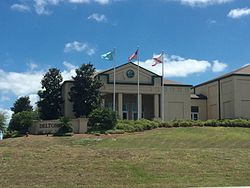
By 2000, the city grew to a population of 69,543 people, surpassing Daytona Beach as the most populous city in Volusia County. After the city's incorporation, regular city meetings would be held on the second floor of the now-defunct SouthTrust Bank building on Deltona Boulevard, until the first city hall began construction in 2001.[14] The US$7 million project would complete for opening on March 16, 2002.[15] On December 3, 2002,[16] ground broke for the development of the Deltona satellite campus of Daytona State College (then known as Daytona Beach Community College), adjacent to Deltona City Hall. The campus opened in August 2004.[17]
On August 6, 2004, four men broke into a home and beat six people and a dog to death with baseball bats, making it the deadliest mass murder in Volusia County history.
In recent years, new measures have been taken by city officials to begin attracting new businesses and industries into the city. Specially zoned areas in the city have been designated to allow for the development of upscale office facilities, light industrial space, health care facilities,[18] warehousing and distribution facilities, commercial recreational facilities, and lodging services.[19]
Geography and climate
[edit]
Deltona is located in southwestern Volusia County in Central Florida approximately 25 miles (40 km) inland from the Atlantic Ocean, halfway between Daytona Beach and Orlando. It is bordered by Lake Helen and Cassadaga on the north, DeLand on the northwest, Orange City on the west, DeBary on the southwest, Enterprise on the south, and Osteen on the southeast. It is included in the Deltona–Daytona Beach–Ormond Beach Metropolitan Statistical Area and the larger Orlando–Lakeland–Deltona Combined Statistical Area.
The majority of the land in the city is of karst topography, characterized by rolling hills and an abundant amount of lakes.[20] The St. Johns River passes through Lake Monroe, directly south of the city. The United States Geological Survey lists the city's elevation at 33 feet (10 m) above sea level at a point near Deltona's geographic center.[21] Elevations range from 20 feet (6.1 m) to 112 feet (34 m) above sea level. As of 2010[update], according to the United States Census Bureau, the city has a total area of 41.1 square miles (106.4 km2), 37.5 square miles (97.1 km2) of which is land and 3.5 square miles (9.1 km2) of which is water.
Deltona's climate is classified as a humid subtropical climate in the Cfa Köppen climate classification, meaning it typically has hot, humid summers and mild winters. The record high temperature is 103 °F (39 °C) recorded in July 1998, with a record low of 19 °F (−7 °C) recorded in January 1985.[22] Rainfall averages around 53 inches (1,300 mm) a year, with the wettest months being June through September. The hurricane season lasts from June 1 to November 30, with September as the most susceptible month to hurricanes. The most powerful hurricane to strike Deltona since its incorporation was Charley in 2004, during which the eye of the hurricane passed directly over the city; that same year, the city would also suffer from the effects of hurricanes Frances and Jeanne.
| Climate data for Deltona, Florida | |||||||||||||
|---|---|---|---|---|---|---|---|---|---|---|---|---|---|
| Month | Jan | Feb | Mar | Apr | May | Jun | Jul | Aug | Sep | Oct | Nov | Dec | Year |
| Record high °F (°C) | 89 (32) |
89 (32) |
92 (33) |
96 (36) |
100 (38) |
102 (39) |
103 (39) |
100 (38) |
98 (37) |
96 (36) |
92 (33) |
88 (31) |
103 (39) |
| Mean daily maximum °F (°C) | 70 (21) |
72 (22) |
77 (25) |
81 (27) |
87 (31) |
90 (32) |
92 (33) |
92 (33) |
89 (32) |
83 (28) |
78 (26) |
72 (22) |
82 (28) |
| Mean daily minimum °F (°C) | 47 (8) |
49 (9) |
54 (12) |
57 (14) |
63 (17) |
69 (21) |
71 (22) |
71 (22) |
70 (21) |
64 (18) |
57 (14) |
50 (10) |
60 (16) |
| Record low °F (°C) | 19 (−7) |
25 (−4) |
27 (−3) |
36 (2) |
45 (7) |
52 (11) |
60 (16) |
64 (18) |
52 (11) |
39 (4) |
30 (−1) |
19 (−7) |
19 (−7) |
| Average precipitation inches (mm) | 2.88 (73) |
2.96 (75) |
3.80 (97) |
2.55 (65) |
3.53 (90) |
6.41 (163) |
7.02 (178) |
7.23 (184) |
5.88 (149) |
3.56 (90) |
2.96 (75) |
2.53 (64) |
51.31 (1,303) |
| Source: The Weather Channel[22] | |||||||||||||
Demographics
[edit]| Census | Pop. | Note | %± |
|---|---|---|---|
| 1970 | 4,868 | — | |
| 1980 | 15,710 | 222.7% | |
| 1990 | 50,828 | 223.5% | |
| 2000 | 69,543 | 36.8% | |
| 2010 | 85,182 | 22.5% | |
| 2020 | 93,692 | 10.0% | |
| 2024 (est.) | 100,513 | [23] | 7.3% |
| U.S. Decennial Census | |||
2020 census
[edit]| Race / Ethnicity (NH = Non-Hispanic) | Pop 2000[24] | Pop 2010[25] | Pop 2020[26] | % 2000 | % 2010 | % 2020 |
|---|---|---|---|---|---|---|
| White (NH) | 50,540 | 48,502 | 42,893 | 72.67% | 56.94% | 45.78% |
| Black or African American (NH) | 4,478 | 8,058 | 9,837 | 6.44% | 9.46% | 10.50% |
| Native American or Alaska Native (NH) | 203 | 236 | 200 | 0.29% | 0.28% | 0.21% |
| Asian (NH) | 629 | 988 | 1,328 | 0.90% | 1.16% | 1.42% |
| Pacific Islander or Native Hawaiian (NH) | 28 | 29 | 61 | 0.04% | 0.03% | 0.07% |
| Some other race (NH) | 73 | 180 | 533 | 0.10% | 0.21% | 0.57% |
| Mixed race or Multiracial (NH) | 845 | 1,455 | 3,581 | 1.22% | 1.71% | 3.82% |
| Hispanic or Latino (any race) | 12,747 | 25,734 | 35,259 | 18.33% | 30.21% | 37.63% |
| Total | 69,543 | 85,182 | 93,692 | 100.00% | 100.00% | 100.00% |
As of the 2020 United States census, there were 93,692 people, 30,585 households, and 22,975 families residing in the city.[27]
As of the 2010 United States census, there were 85,182 people, 29,400 households, and 22,459 families residing in the city.[28]
The 2010 U.S. Census data indicated that 30.2% of the city's population were Hispanic or Latino.[29] The majority of Hispanic residents in Deltona were Puerto Rican, and made up 20.7% of the population. 1.8% of the population were Cuban, 1.6% of the population were Mexican, 1.5% of the population were Dominican, and 4.6% of the population were of other Hispanic or Latino origin, as of 2010[update].[29]
2000 census
[edit]In 2000, 32.8% had children under the age of 18 living with them, 55% were married couples living together, 15.3% had a female householder with no husband present, and 23.7% were non-families. Of all households, 38.3% were made up of individuals, and 26.6% had someone living alone who was 65 years of age or older.
As of 2000, the median income for a household in the city was $50,058. Males had a median income of $34,478 versus $27,230 for females. The per capita income for the city was $21,019. About 11.1% of the population were below the poverty line.
As of 2000, English spoken as a first language accounted for 81.39% of all residents, while 18.60% spoke other languages as their mother tongue. The most significant were Spanish speakers who made up 15.85% of the population, while Italian came up as the third most spoken language, which made up 0.71%, and French was at fourth, with 0.58% of the population.[30]
Government and infrastructure
[edit]
Deltona operates under a commission–manager form of government, consisting of seven elected officials, and an appointed city manager. Residents elect, through non-partisan elections, a mayor who represents the city at-large and six commission members who each represent a specific district of the community. Elected officials serve four-year terms, with a limit of two successive four-year terms. The mayor serves as the presiding officer at official meetings and as the ceremonial head of the city. A vice mayor is elected annually by the city commission from among the commission members. The current mayor is Santiago Avila Jr, who was elected into office in November 2022.
No invocation is normally recited at the start of City Commission meetings. However, in June, 2017, the national group Americans United for Separation of Church and State, acting on behalf of a Deltona resident, contacted the city's attorneys to advise them that the reading of passages from the Bible by City Commissioner Christopher Alcantara allegedly violates the Establishment Clause of the First Amendment of the United States Constitution.[31][32] The city responded that “engaging in the recitation of Biblical verse during a public meeting is not in and of itself enough for an Establishment Clause violation.”[33]
Citywide public bus transportation and paratransit service is provided by Votran, a public transit service governed by the County of Volusia. SunRail provides commuter rail service to the Orlando area in the neighboring city of DeBary via Votran feeder bus service to the DeBary station, and a 275-space park and ride.[34] The closest major passenger airport to Deltona is Orlando International Airport, located approximately 33 miles (53 km) south. Additional commercial airline service is provided at Orlando Sanford International Airport, approximately 9 miles (14 km) south, and Daytona Beach International Airport, approximately 22 miles (35 km) northeast. Deltona's only limited-access highway is Interstate 4, and traverses through the city's western boundary. Other major highways include Florida State Road 472, which terminates near the city limit in northwestern Deltona at Howland Boulevard, and Florida State Road 415, which traverses through the city's southeastern boundary.
The city's water supply and wastewater management is overseen by Deltona Water,[35] a division of the City of Deltona's Public Works Department, with some areas managed by the Volusia County Water Resources and Utilities division.[36] Its main water supply comes from the Floridan aquifer system, one of the most productive aquifers in the world.[37] Commercial solid waste (trash and garbage collection), and yard waste services are offered through Waste Pro. Natural gas is provided by Florida Public Utilities. Electric power service is provided by Florida Power & Light and Duke Energy. Wired telephone service is provided by AT&T and CenturyLink. Cable television is provided by Spectrum.
Economy
[edit]As of 2013[update], 60.0% of the population aged 16 years and over was in the labor force, with 52.7% employed and 7.2% unemployed. 32.4% of the population worked in sales and office occupations; 24.8% worked in management, business, science and arts occupations; 20.7% in service occupations; 11.5% in production, transportation, and material moving occupations; and 10.6% in natural resources, construction, and maintenance occupations.[5] The industries for which the city's inhabitants worked were 20.0% educational, health, and social services; 15.4% retail trade; 10.7% professional, scientific, management, administrative and waste management services; 9.5% arts, entertainment, recreation, accommodation and food services; 7.7% manufacturing; 7.6% finance, insurance, real estate, and rental and leasing; 7.2% construction; 6.3% public administration; 5.1% transportation, warehousing and utilities; 4.5% other services (except public administration); 3.5% information; 2.2% wholesale trade; and 0.4% agriculture, forestry, fishing and hunting, and mining.[5] 82.7% of workers worked in the private sector, 12.7% in government, and 4.6% self-employed in unincorporated businesses. 85.9% of the population commute to work by driving alone in own car, with 8.1% consisting of carpoolers, 3.3% worked from home, 0.5% walked to work, 0.4% used public transportation (excluding taxicab), and 1.7% used other means to travel to work. The average commute time for workers is 32 minutes.[5]
Fitch, Moody's, and Standard & Poor's rated Deltona bonds as "AA-" from 2013 to 2014.[38][39][40] Fitch attributed Deltona's small commercial sector to the city being a "largely residential and mostly built-out community", but did acknowledge the city's improving unemployment rate, dropping from a peak of 12% in 2010 to 6.4% in June 2014.[38] As of 2014[update], the largest employers in the city include Daytona State College, followed by Publix Super Markets, and Walmart.[38][41]
Education
[edit]
According to the 2010 American Community Survey, 14.2% of all adults over the age of 25 in Deltona have obtained a bachelor's degree, which was below the national average of 27.2% of adults over 25, and 84.7% of Deltona residents over the age of 25 have earned a high school diploma, as compared to the national average of 85.0%.[42] Deltona had approximately 11,877 students enrolled in its public schools in the 2012–2013 school year.[43] Three private schools are located in the city, offering both primary and secondary education. Higher education is offered by Bethune-Cookman University and Daytona State College through satellite campuses located in the city.
Public primary and secondary education is handled by Volusia County Schools (VCS). VCS operates 2 high schools (Deltona High School and Pine Ridge High School), 3 middle schools (Galaxy, Heritage and Deltona Middle Schools) and 7 elementary schools within city limits.[43] One elementary school is located in unincorporated Deltona, and four public schools in neighboring communities serve outer portions of the city. In 2010, the Florida Department of Education awarded all public elementary and middle schools in the city "A" or "B" grades based on their performance on the Florida Comprehensive Assessment Test.[44] In 2013, both public high schools in the city received a "B."[44]
Elementary schools[a]
- Deltona Lakes Elementary School
- Discovery Elementary School
- Forest Lake Elementary School[b]
- Friendship Elementary School
- Pride Elementary School
- Spirit Elementary School
- Sunrise Elementary School
- Timbercrest Elementary School
Middle schools[a]
- Deltona Middle School
- Galaxy Middle School
- Heritage Middle School
High schools[a]
Private schools
- Deltona Adventist School
- Deltona Christian School
- Good Shepherd Academy
- Trinity Christian Academy
Additional public schools serving Deltona[a]
- University High School (in Orange City)
- Enterprise Elementary School (in Enterprise)
- Osteen Elementary School (in Osteen)
- Volusia Pines Elementary School (in Lake Helen)
Media and culture
[edit]Deltona is a part of the Orlando–Daytona Beach–Melbourne media market, which is the 33rd largest radio market[45] and the eighteenth largest television market[46] in the United States. Its primary daily newspapers are the Orlando Sentinel, The Daytona Beach News-Journal, and the West Volusia Beacon. The city is also served by El Sentinel, the Spanish-language counterpart of the Orlando Sentinel and the city run Deltona TV which live streams city commission meetings and original programing online.
The city has one public library, the Deltona Regional Library, a branch of the Volusia County Public Library system which consists of the main library, an environmental learning center, and a 1,000-seat outdoor amphitheater built for community gatherings and educational instruction.[47] The 50,000 square foot (4,645 m2) facility received a Silver Certification from the U.S. Green Building Council.[6] The library is adjacent to the Lyonia Preserve, a 360-acre (146 ha) joint project between Volusia County's Land Acquisition & Management Division and the District School Board. The purpose of the project is to restore and maintain the area's endangered scrub habitat. The Lyonia Environmental Center, located at the library, serves to encourage discovery and exploration of Volusia County's ecosystems and foster community involvement in conservation efforts.
Notable people
[edit]- Chad Brown (born 1996), basketball player in the Israeli Basketball Premier League
- Montana DuRapau, former MLB pitcher for the Pittsburgh Pirates
- Paxton Lynch, former Denver Broncos quarterback
- John Masiarcyzk Sr., former first and third mayor of Deltona
- Dennis Mulder, business owner and the former second mayor of Deltona
- David Santiago, former city commissioner, vice mayor and current Florida State Representative representing the 27th district
References
[edit]- ^ "US Gazetteer files: 2010, 2000, and 1990". United States Census Bureau. February 12, 2011. Retrieved July 26, 2015.
- ^ "2020 U.S. Gazetteer Files". United States Census Bureau. Retrieved October 31, 2021.
- ^ "List of 2020 Census Urban Areas". census.gov. United States Census Bureau. Retrieved January 7, 2023.
- ^ a b "US Board on Geographic Names". United States Geological Survey. October 25, 2007. Retrieved January 31, 2008.
- ^ a b c d "U.S. Census website". United States Census Bureau. Retrieved January 31, 2008.
- ^ a b Deltona | Florida Business Relocation, Expansion | Volusia County. Team Volusia Economic Development Corporation. teamvolusia.com. Retrieved 2015-02-27.
- ^ a b "City of Deltona, Florida: City History". deltonafl.gov. Archived from the original on September 9, 2012. Retrieved January 31, 2012.
- ^ a b Volusia County History: City of Deltona Archived 2011-07-16 at the Wayback Machine. Volusia.org. Retrieved 2010-12-16.
- ^ Florida Historical Markers Programs - Marker: All Counties. Division of Historical Resources. Florida Department of State. Retrieved 2015-03-13.
- ^ a b c d e f Poertner, Bo (1997-07-23). "Newsletters Reveal Deltona's History Through The Eyes Of Its Developers". Orlando Sentinel. Retrieved 2015-04-10.
- ^ Mackle Company Home Page. The Mackle Company. Retrieved 2012-02-17.
- ^ City of Deltona. City of Deltona Evaluation and Appraisal Report. deltonafl.gov. June 2008. Retrieved 2012-02-18
- ^ Oropeza, Lorena (1987-01-28). Legislators Debate Deltona Incorporation Vote. Orlando Sentinel. Retrieved 2012-02-17
- ^ Poertner, Bo (2001-08-14). "City Hall Rises From The Sand In Deltona." Orlando Sentinel. Retrieved 2015-04-11.
- ^ "Celebrate, Tour Deltona's City Hall Today." Orlando Sentinel. 2002-03-16. Retrieved 2015-04-11.
- ^ "Dbcc Breaks Ground In Deltona." Orlando Sentinel. 2002-12-11. Retrieved 2015-04-11.
- ^ "Dbcc To Open 1st Building In Deltona Center In August." Orlando Sentinel. 2004-07-21. Retrieved 2015-04-11.
- ^ Everson, Al (2014-05-27). "Commercial development seen for Deltona’s north side Archived 2015-07-24 at the Wayback Machine." Retrieved 2015-04-11.
- ^ Everson, Al (2011-08-16). "Deltona has high hopes for industry Archived 2015-07-24 at the Wayback Machine." West Volusia Beacon. Retrieved 2015-04-11.
- ^ Deltona, FL - Forbes. Forbes. Forbes.com. Retrieved 2012-02-14.
- ^ Feature Detail Report for: City of Deltona. Geographic Names Information System. U.S. Geological Survey. 2008-03-10. Retrieved 2010-12-18.
- ^ a b Average Weather for Deltona, FL. Weather.com. Retrieved 2010-12-19
- ^ https://www.census.gov/quickfacts/fact/table/deltonacityflorida/PST045224
- ^ "P004 Hispanic or Latino, and Not Hispanic or Latino by Race – 2000: DEC Summary File 1 – Deltona city, Florida". United States Census Bureau.
- ^ "P2: Hispanic or Latino, and Not Hispanic or Latino by Race – 2010: DEC Redistricting Data (PL 94-171) – Deltona city, Florida". United States Census Bureau .
- ^ "P2: Hispanic or Latino, and Not Hispanic or Latino by Race – 2020: DEC Redistricting Data (PL 94-171) – Deltona city, Florida". United States Census Bureau .
- ^ "S1101 HOUSEHOLDS AND FAMILIES - 2020: Deltona city, Florida". United States Census Bureau.
- ^ "S1101 HOUSEHOLDS AND FAMILIES - 2010: Deltona city, Florida". United States Census Bureau.
- ^ a b Profile of General Population and Housing Characteristics: 2010 (Deltona city, Florida) . American FactFinder. United States Census Bureau. Retrieved 2012-02-09.
- ^ Modern Language Association Data Center Results of Deltona, Florida.
- ^ Kustura, Katie (July 9, 2017). "Deltona commissioner's Bible readings generate church-state complaint". The Daytona Beach News Journal. Retrieved July 31, 2017.
- ^ "D.C. group: Thou shalt not read the Bible at city meetings". The West Volusia Beacon. July 12, 2017. Archived from the original on July 31, 2017. Retrieved July 31, 2017.
- ^ "Deltona commissioner asked to stop reading Bible verses at meetings". WKMG ClickOrlando. July 10, 2017. Retrieved July 31, 2017.
- ^ Harper, Mark (2014-05-27). DeBary SunRail stop attracts 2nd most riders. The Daytona Beach News-Journal. Retrieved 2015-03-01.
- ^ SWAP: Assessment for DELTONA WATER. Florida Department of Environmental Protection. www.dep.state.fl.us. 2014-10-01. Retrieved 2015-03-01.
- ^ Everson, Al (2013-09-17). Deltona to finally get new sewage plant Archived 2015-04-02 at the Wayback Machine. West Volusia Beacon. beacononlinenews.com. Retrieved 2015-03-01.
- ^ Floridan Aquifer System. United States Geological Survey. usgs.gov. Retrieved 2015-03-01.
- ^ a b c Fitch Upgrades Deltona, FL's Transportation Capital Improvement Rev Bonds to 'AA-'; Outlook Stable. Business Wire. 2014-09-04. Retrieved 2015-03-05.
- ^ Deltona, FL Issuer Credit Rating Raised To 'AA' Based On Local GO Criteria Archived 2015-04-02 at the Wayback Machine. bondsonline.com. 2014-03-27. Retrieved 2015-03-05.
- ^ Moody's has corrected the rating of City of Deltona's (FL) Transportation Capital Improvement Bonds, Series 2006 to Aa3 from A1. Moody's Investors Service. 2013-01-14. Retrieved 2015-03-05.
- ^ City of Deltona, Florida - Comprehensive Annual Financial Report. p. 131. City of Deltona Finance Department. 2014-09-30. Retrieved 2015-03-18.
- ^ "Deltona city, Florida 2010 Demographic Profile Data". United States Census Bureau. Archived from the original on May 21, 2019. Retrieved February 25, 2012.
- ^ a b Deltona, Florida. National Center for Education Statistics. Institute of Education Sciences. Retrieved 2012-02-25.
- ^ a b 2013-2014 School Accountability Reports - School Grades Archived March 17, 2015, at the Wayback Machine. Florida Department of Education. Retrieved 2015-03-06.
- ^ "Market Survey Schedule & Population Rankings: Fall 2013" (PDF). Arbitron. Retrieved March 5, 2015.
- ^ "Local Television Market Universe Estimates" (PDF). Nielson Company. Retrieved March 5, 2015.
- ^ Deltona Regional Library, Lyonia Environmental Center and Deltona Amphitheater - Fact Sheet Archived 2015-02-13 at the Wayback Machine. lyoniapreserve.com. Retrieved 2015-03-18.
External links
[edit]

Municipalities and communities of Volusia County, Florida, United States | ||
|---|---|---|
| Cities | 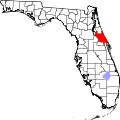 | |
| Towns | ||
| CDPs | ||
| Unincorporated communities | ||
| Ghost town | ||
| Footnotes | ‡This populated place also has portions in an adjacent county or counties | |
| Principal cities |  | ||||
|---|---|---|---|---|---|
| Counties |
| ||||
| Populated places | |||||
| Topics | |||||

| International | |
|---|---|
| National | |
| Geographic | |

Deltona, Florida
View on GrokipediaHistory
Pre-Development and Indigenous Era
The region encompassing modern Deltona was occupied by indigenous peoples for millennia prior to European contact, with archaeological evidence indicating human presence dating to approximately 12,000 years ago during the Paleo-Indian period, when nomadic hunter-gatherers exploited megafauna and post-glacial landscapes across Florida.[8] Successive Archaic and Woodland period cultures transitioned toward semi-sedentary lifestyles, utilizing inland areas like those near Deltona for seasonal hunting, gathering, and resource extraction, though denser shell middens and ceremonial sites are more prevalent along Volusia County's coastal and riverine zones.[9] By the late prehistoric and protohistoric eras, the Timucua people dominated north-central Florida, including Volusia County, maintaining chiefdoms with villages supported by maize, bean, and squash agriculture supplemented by fishing, hunting, and foraging in the St. Johns River watershed and adjacent wetlands.[1][10] Timucua society featured hierarchical structures under caciques, circular thatched dwellings, and a language family documented by Spanish missionaries, with regional subgroups adapting to Volusia's diverse ecosystems from pine flatwoods to swamps.[11] European contact, beginning with Spanish expeditions in the 16th century, introduced Old World diseases that decimated Timucua populations—estimated at tens of thousands regionally before 1492—leading to their effective extinction as distinct groups by the early 18th century through epidemics, enslavement, and displacement, with survivors absorbed into mission systems or fleeing southward.[10] No continuous Timucua cultural lineage persists today, though archaeological sites in nearby areas like Tomoka State Park preserve evidence of their Nocoroco village and associated artifacts.[12] Following the decline of indigenous populations, European-American settlement in the Deltona area remained minimal through the early 19th century, characterized by scattered homesteads amid predominantly undeveloped swampland and pine forests in southwestern Volusia County.[13] One of the earliest documented settlers was George Sauls, who arrived in the 1850s, petitioning for acreage near the St. Johns River and constructing a log home that evolved into a four-room structure by the post-Civil War era, serving as a hub for the nascent Saulsville community.[14][15] Saulsville functioned as a stagecoach stop along rudimentary trails connecting to Enterprise and Osteen, with families like the Sauls engaging in subsistence farming, turpentine extraction, and limited trade, though the absence of railroads nearby stunted growth and preserved the area's rural, low-density character.[15] By the early 20th century, the region supported only sparse pioneer outposts amid challenging terrain of muck soils and wetlands, with no significant infrastructure or population centers until mid-century land acquisitions presaged planned development.[13]Planned Community Origins and Early Expansion
Deltona originated as a master-planned residential community known as Deltona Lakes, developed by the Mackle brothers—Elliott, Robert, and Frank Mackle—through their newly formed Deltona Corporation. In 1962, following their departure from General Development Corporation, the brothers acquired approximately 17,200 acres of land in southwest Volusia County, filing plans for a self-contained community featuring 35,143 residential lots, along with designated sites for seven schools, 23 churches, 500 acres of commercial property, and 165 acres for industrial use.[1][16] The name "Deltona" derived from combining elements of nearby DeLand and Daytona Beach, reflecting its strategic location midway between Orlando and Daytona Beach. The master plan, designed by architect Jimmy Vensel, emphasized coordinated infrastructure development, including curvilinear streets, central water and sewer systems, government facilities, and recreational amenities like golf courses—innovations intended to support orderly expansion on a limited land base of around 15,000 to 17,000 acres.[16] The community officially opened for sales on November 18, 1962, initially comprising eight model homes, a single access road, and a sales office, which generated over $10 million in land and home sales by the end of 1963.[16] The first permanent residents arrived in April 1963, marking the start of population influx; by year's end, the area housed 78 families totaling 180 individuals, with school bus services established and construction underway on the Deltona Lakes Golf and Country Club.[1] Early expansion accelerated through the mid-1960s, driven by aggressive lot sales and infrastructure buildout: by 1965, more than 1,200 homes had been completed since opening, alongside extensive road networks and nearly 57 miles of water, sewer, and gas lines.[17] The Deltona Inn and golf facilities became operational that year, supporting the community's appeal as a modern, amenity-rich suburb. This foundational phase laid the groundwork for sustained growth into the 1970s, with U.S. Census data recording a population of 4,868 by 1970 and 15,710 by 1980, reflecting annual increases fueled by affordable housing and proximity to employment centers in Orlando and Daytona.[1] The planned layout prioritized residential density around natural lakes and green spaces, though it faced typical challenges of rapid suburbanization, such as dependency on automobiles and deferred commercial maturation.[16]Incorporation, Rapid Growth, and Economic Shifts
Deltona was incorporated as a city on December 31, 1995, after operating as an unincorporated planned community known as Deltona Lakes, which had been established in 1962 by the Mackle brothers through their Deltona Corporation.[1][4] This incorporation followed two prior failed attempts and marked the transition to self-governance with an elected mayor and city council, enabling local control over services previously managed by Volusia County.[1] The move was driven by residents' demands for improved infrastructure and autonomy amid sustained population influx.[1] Post-incorporation, Deltona experienced accelerated population growth, expanding from 15,710 residents in 1980 to 85,907 by the 2000 census, reflecting its appeal as an affordable suburban alternative near Orlando.[1][18] This trend persisted, with the population reaching 93,077 in the 2020 census and growing by 41.15% overall from 2000 to 2023 at an average annual rate of 1.79%, fueled by low-cost housing, proximity to Interstate 4, and regional job opportunities in tourism and services.[19][6] By 2024 estimates, Deltona surpassed 100,000 residents, crossing that threshold alongside other Southern cities amid broader U.S. migration patterns toward Florida.[3] In response to this rapid expansion, the city commission approved a nine-month moratorium on new development in July 2025 to assess infrastructure strains on water, roads, and schools.[20] Economically, Deltona shifted from a predominantly residential "bedroom community" reliant on commuting to Orlando and Daytona Beach toward greater local diversification, acquiring its water and wastewater utility from Florida Waterworks in November 2003 to support expansion and reduce external dependencies.[1] Median household income rose from $69,074 in 2022 to $72,967 in 2023, paralleling population gains and signaling improved economic vitality in retail, construction, and emerging manufacturing sectors.[21] Strategic plans emphasize transitioning to a "gallery of villages" model by 2040, fostering mixed-use development to retain jobs locally rather than exporting them, with recent business influxes including manufacturing projects promising 50 jobs and $40–80 million in investments.[22][23] This evolution counters earlier criticisms of over-reliance on residential sprawl, prioritizing sustainable commercial growth amid Volusia County's broader $21.9 billion GDP in 2023.[24]Geography
Location and Physical Features
Deltona is situated in northern Volusia County in east-central Florida, with geographic coordinates approximately 28°54′N 81°16′W.[25] The city lies about 25 miles (40 km) north of Orlando and forms part of the broader Orlando-Kissimmee-Sanford metropolitan statistical area, though it is primarily associated with the Deltona-Daytona Beach-Ormond Beach region. According to the U.S. Census Bureau, Deltona encompasses a land area of 37.3 square miles (96.6 km²), with additional water coverage contributing to a total area exceeding 40 square miles.[26] The physical landscape of Deltona exemplifies karst topography prevalent in Florida's interior, marked by undulating hills, solution depressions, and an abundance of lakes formed through limestone dissolution.[27] Elevations vary from a low of around 20 feet (6 m) to a high of 112 feet (34 m) above mean sea level, with an average near 33 feet (10 m).[28] The area contains over 100 lakes, including Lake Dupont and others integrated into the local hydrology, alongside proximity to Lake Monroe on the St. Johns River system to the east.[29] This terrain supports a network of natural depressions and minor ridges, influencing drainage patterns and contributing to the region's groundwater interactions via the surficial aquifer.[30]
Climate and Environmental Conditions
Deltona features a humid subtropical climate classified as Köppen Cfa, marked by hot, humid summers, mild winters, and no distinct dry season.[31][32] Annual temperatures typically range from average lows of 48°F in January to highs of 92°F in July and August, with overall yearly averages around 82.7°F for highs and 67.7°F for lows.[33][34] Precipitation totals approximately 52–54 inches annually, distributed throughout the year but peaking during the June-to-September wet season, when August sees an average of 5.5 inches of rain.[35][36] The region experiences negligible snowfall, averaging 0 inches per year.[36] Environmental conditions are influenced by Florida's coastal proximity and karst topography, featuring over 30 lakes within city limits that support local hydrology but exacerbate flood risks during heavy rains.[37] The area faces moderate to high flooding hazards from riverine overflow, stormwater runoff, and tropical systems, with about 10.5% of properties (4,138 structures) projected to flood at least once in the next 30 years due to 100-year floodplain zones and local drainage limitations.[38][39] Hurricanes and tropical storms pose the primary natural threats, as Deltona lies in a hurricane-prone corridor along Florida's Atlantic seaboard.[40] Notable impacts include widespread flooding from Hurricane Ian in September 2022, which damaged infrastructure and residences, and Hurricane Milton in October 2024, which caused prolonged road closures and property inundation in low-lying areas.[41] Local mitigation efforts, such as the Elkcam Boulevard improvement project completed in 2025, aim to alleviate recurrent post-storm flooding by enhancing drainage and elevation.[42] Overall flood risk scores high relative to national averages, driven by both coastal storm surges and inland precipitation events.[43][44]Demographics
Population Growth and Projections
Deltona's population has grown substantially since the mid-20th century, reflecting its evolution from a planned community to a major suburb in Volusia County. The 1970 U.S. Census recorded 4,868 residents, a figure that surged to 15,710 by 1980 amid post-World War II migration and affordable housing development.[1] This rapid expansion continued, with the population reaching 69,543 in the 2000 Census, driven by proximity to Orlando and Daytona Beach employment centers.[45] Decennial censuses confirm sustained growth: 85,182 in 2010 and 93,692 in 2020, representing a 9.9% increase over that decade despite national housing market fluctuations.[46] From 2000 to 2023, the city averaged an annual growth rate of 1.79%, resulting in a cumulative 41.15% rise, outpacing many Florida peers due to inbound domestic migration and lower living costs relative to coastal areas.[19] Recent annual estimates show a 1.39% increase from 94,373 in 2022 to 95,682 in 2023, though state university projections from the Bureau of Economic and Business Research (BEBR) estimated 97,337 for 2023, highlighting methodological variances in incorporating non-census data like building permits.[21][47]| Year | Population | Annual Growth Rate (from prior year, where available) |
|---|---|---|
| 1970 | 4,868 | - |
| 1980 | 15,710 | ~12.4% (decade average) |
| 2000 | 69,543 | ~6.4% (decade average from 1990, inferred) |
| 2010 | 85,182 | 2.06% |
| 2020 | 93,692 | 0.96% |
| 2023 | 95,682 | 1.39% (2022-2023) |