


Community hub
Recent from talks
Contribute something
Nothing was collected or created yet.
Diu district
View on Wikipedia
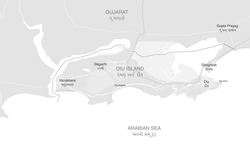
Diu district (/ˈdiːuː/) (formerly Distrito de Dio)[4] is one of the three districts of the union territory of Dadra and Nagar Haveli and Daman and Diu of India.[5] The district is made up of Diu Island and two small enclaves of Simbor and Gogola, at the border with the state of Gujarat. The district headquarters are at Diu Town. It is the ninth least populous district in the country (out of 640).[6]
Key Information


History
[edit]

The district was historically part of the Saurashtra region of Gujarat. Mirroring the system of administrative division in Portugal, Diu district (Distrito de Diu) was established as an administrative division of the Portuguese State of India (Estado da Índia) in the first half of the 19th century. It was headed by a district governor, subordinate to the governor-general of Portuguese India in Goa. The district included the single municipality of Diu, which was further subdivided into civil parishes.[7]
It remained an overseas territory of Portugal until it was annexed by Indian forces on 19 December 1961. From 1961 to 1987, it was a part of the union territory of Goa, Daman and Diu. In 1987, it became a part of the newly formed union territory of Daman and Diu. In January 2020, the district became part of the new union territory of Dadra and Nagar Haveli and Daman and Diu.[7]
Geography
[edit]Diu district occupies an area of 40 square kilometres (15 sq mi),[8]
It consists of Diu Island and a part on the mainland (the Ghogolá peninsula). 20 km East of Diu Island, is the small territory of Simbor.
Sub-districts
[edit]Diu Island
[edit]The town of Diu and most of the district's villages and settlements are on Diu Island. Many of these places have been renamed since the Invasion of 1961.
| Settlement type | Portuguese name | Indian name |
|---|---|---|
| Town | Diu | Diu |
| Village | Podamo | Fudam |
| Village | Bunxivará | Bucharwada |
| Settlement | Dangarvadi | Dangarwadi |
| Village | Brancavará | Vanakbara |
| Uninhabited | Fortim do Mar | Pani Kota |
| Uninhabited | Castilo de Diu | Diu Fortress |
Ghogholá
[edit]The area on the mainland borders Gir Somnath district of Gujarat. It contains the village of Ghogholá. The village lies on the mainland opposite the eastern end of the island .
Simbor
[edit]The tiny territory of Simbor, located about 25 km east of the town of Diu, is also part of the district. It has no permanent population.
Demographics
[edit]According to the 2011 census Diu district has a population of 52,074,[6] roughly equal to the nation of Saint Kitts and Nevis.[9] This gives it a ranking of 631st in India (out of a total of 640).[6] The district has a population density of 1,301 inhabitants per square kilometre (3,370/sq mi) .[6] Its population growth rate over the decade 2001-2011 was 17.73%.[6] Diu has a sex ratio of 1030 females for every 1000 males,[6] and a literacy rate of 83.36%.[6]
There is a small community of the variety of Indo-Portuguese creole spoken in the region known as Daman and Diu Portuguese Creole.[10][11][12]
Sister cities
[edit]Diu Island is twinned with the city of Loures, in Portugal.[13]
Landmarks
[edit]Diu is home to a few surviving buildings and monuments with Portuguese architecture. The best preserved are the churches and fortifications.
The nearest railway junction is Veraval, which is 90 km from Diu. Major cities like Mumbai, Ahmedabad, Pune, Jabalpur (Madhya Pradesh), Dwarka and Thiruvananthapuram are directly connected to Veraval Railway Station. Delwada is 8 km from Diu.
Churches and chapels
[edit]
1. Churches of St. Paul and St. Thomas (Diu)
2. Church of St. Francis of Assisi (Diu)
3. Church of Our Lady of Remedes (Fudam)
4. Church of Our Lady of Mercy (Vanakbara)
There has been a steady exodus of Christians from Diu[14] ever since the Invasion of 1961. This has led to many of their historic and historic and religious sites being victims of abandonment, disrepair, conversion to secular use or demolishment.
| Type[15][16] | Portuguese Name | English Translation | Location | Current Status |
|---|---|---|---|---|
| Cathedral | Catedral de São Paulo (Sé) | Church of St. Paul | Diu Town | Active (demoted to church) |
| Church | Igreja de São Tomás | Church of St. Thomas | Diu Town | Secularized (Museum) |
| Church | Igreja de São Francisco de Assis | Church of St. Francis of Assisi | Diu Town | Secularized (Hospital) |
| Church | Igreja de São João de Deus | Church of St. John of God | Diu Town | Inactive (Ruins) |
| Church | Igreja de Nossa Senhora da Esperança | Church of Our Lady of Hope | Diu town | Inactive (Ruins) |
| Church | Igreja da Misericórdia | Church of Mercy (informally 'Fort Church') | Diu Fort | Inactive (Ruins) |
| Church | Igreja de Nossa Senhora dos Remédios | Church of Our Lady of Remedies | Podamo | Active |
| Church | Igreja de Nossa Senhora da Misericórdia | Church of Our Lady of Mercy | Brancavará | Inactive (Intact) |
| Convent | Convento dos Dominicanos | Dominican Convent | Diu town | Demolished (1961) |
| Convent | Convento de Santa Ana | Convent of St. Anne | Diu Town | Active (School) |
| Chapel | Capela de São Tiago | Chapel of St. James | Diu Fort | Inactive (Ruins) |
| Chapel | Capela de São Martinho | Chapel of Saint Martin | Diu Fort | Demolished (2023) |
| Chapel | Capela de Nossa Senhora da Vitória | Chapel of Our Lady of Victory | Fortim do Mar | Inactive (Ruins) |
Fortresses
[edit]Due to constant invasions from neighboring kingdoms as well as distant powers, the Portuguese built several fortifications all over the district. Most survived to this day, although some have little to no physical traces of their existence.
| Portuguese Name | English Translation | Location | Current Status |
|---|---|---|---|
| Cidadela de Diu | Diu Fortress | Diu Town | |
| Fortim do Mar | Panikota | Diu Town | Ruin |
| Forte Santo Antonio | Fort St. Anthony of Simbor | Simbor | Ruin |
| Forte de Nagoá | - | Nagoá near Podamo | Ruins lost |
| Forte de Barra | - | Brancavará | Ruins lost |
Beaches
[edit]- Nagoá Beach, most visited beach in on Diu.
- Ghogolá Beach, largest beach off the island of Diu.
- Chakratirth Beach
- Barra Beach
- Nadia Caves
Gallery
[edit]-
 Diu Fort Fixed Cannons
 -
 St. Thomas Church, Diu
 -
 Diu fort
 -
 Nadia Caves of Diu
 -
 St. Paul's Church, Diu
 -
 Church in Nani Daman Fort
 -
 Se Cathedral
 -
 View of Water Fort Prison from Diu Fort with watchtower of Diu Fort
 -
 Portuguese Fort
 -
 Diu shores in Monsoon


.jpg)


See also
[edit]References
[edit]- ^ "Survey chapter: Diu Indo-Portuguese".
- ^ "Diu Indo-Portuguese at present".
- ^ "52nd Report of the Commissioner for Linguistic Minorities in India" (PDF). 29 March 2016. p. 87. Archived from the original (PDF) on 25 May 2017. Retrieved 15 January 2018.
- ^ Almeida, José C. (1965). "Alguns aspectos demograficos de Goa, Damao e Dio: Some demographic aspects of Goa, Daman & Diu".
- ^ "Dadra & Nagar Haveli and Daman & Diu UTs merge for 'better admin efficiency, service': MoS Home". Indus Dictum. 4 December 2019. Archived from the original on 11 November 2021. Retrieved 4 January 2021.
- ^ a b c d e f g "District Census 2011". Census2011.co.in. 2011. Retrieved 30 September 2011.
- ^ a b "Diu History". Diu Tourism Department. U.T. Administration of Dadra & Nagar Haveli And Daman & Diu. Retrieved 4 January 2021.
- ^ Srivastava, Dayawanti et al. (ed.) (2010). "States and Union Territories: Daman and Diu: Government". India 2010: A Reference Annual (54th ed.). New Delhi, India: Additional Director General, Publications Division, Ministry of Information and Broadcasting (India), Government of India. p. 1216. ISBN 978-81-230-1617-7.
{{cite book}}:|last1=has generic name (help) - ^ US Directorate of Intelligence. "Country Comparison: Population". Archived from the original on 13 June 2007. Retrieved 1 October 2011.
Saint Kitts and Nevis 50,314 July 2011 est.
- ^ "District at a Glance".
- ^ "Survey chapter: Diu Indo-Portuguese".
- ^ "Firangiwada Heritage Walk".
- ^ "Município – Cooperação externa – Diu". cm-loures.pt (in Portuguese). Loures, Portugal: Câmara Municipal de Loures. 2014. Archived from the original on 29 November 2014. Retrieved 17 November 2014.
- ^ "Census: Population: by Religion: Christian: Daman and Diu".
- ^ "Schools in the territory of Diu during the Portuguese India".
- ^ "Diu".
External links
[edit]Places adjacent to Diu district | ||||||||||||||||
|---|---|---|---|---|---|---|---|---|---|---|---|---|---|---|---|---|
| ||||||||||||||||


| Capital | |
|---|---|
| Districts | |
| Major towns | |
| History | |
| Languages | |
| Others | |

| International | |
|---|---|
| National | |
| Other | |

Diu district
View on GrokipediaDiu district is a coastal administrative district within the Indian union territory of Dadra and Nagar Haveli and Daman and Diu, primarily consisting of Diu Island and the adjacent Ghoghla peninsula exclave off the southern Gujarat coast in the Arabian Sea. Covering 40 square kilometres of mostly rocky terrain with a coastal length of 21 kilometres, it had a population of 52,074 according to the 2011 census, yielding a high density of over 1,300 persons per square kilometre and a literacy rate of 83.46 percent.[1][2][3] The district's economy relies on fishing, tourism drawn to its beaches and Portuguese-era heritage, and limited agriculture confined to about 20 percent of its land due to the predominance of rocky soil unsuitable for extensive cultivation.[4] Under Portuguese control from 1535 as part of Portuguese India, Diu served as a strategic trading outpost fortified against regional powers, with its rule enduring until December 1961 when Indian armed forces annexed it alongside Goa and Daman in Operation Vijay after Portugal refused negotiations for transfer.[5][6] Portugal formally acknowledged Indian sovereignty over the territory in 1975 following its own political changes. The district retains prominent remnants of this colonial period, including the imposing Diu Fort with its cannons overlooking the sea and churches such as St. Paul's, which exemplify Baroque architecture and contribute to its appeal as a heritage tourism destination alongside sites like Naida Caves and Gangeshwar Temple.[7][8]
History
Ancient and medieval periods
The documented history of Diu commences during the Maurya Empire (c. 322–185 BCE), when Emperor Chandragupta Maurya expanded control over Saurashtra, incorporating the island as part of broader imperial administration focused on trade and governance along the western coast.[9] Archaeological evidence from the region, including inscriptions and artifacts, supports Mauryan oversight of ports in Gujarat, though specific Diu relics remain sparse.[10] Post-Mauryan rule saw Diu transition through successive regional powers, including the Western Kshatrapas (c. 1st–5th centuries CE), who maintained Indo-Scythian influence over western India, followed by the Gupta Empire's indirect sway until around the 6th century CE.[11] Local dynasties such as the Maitrakas and Chudasamas then dominated early medieval Saurashtra, leveraging Diu's coastal position for maritime exchanges with Arab and Persian traders.[12] From the 10th century onward, Hindu Rajput clans asserted control: the Chalukyas of Gujarat rose in 941 CE, with subordinate Chavda chieftains governing locales like Somnath Patan and Diu until invasions by Mahmud of Ghazni around 1020–1025 CE disrupted stability.[11] The Vaghela dynasty, the last major Hindu rulers of Gujarat, held sway in the 13th century, fostering alliances with local tribal groups amid persistent threats from Delhi Sultanate forces.[13] In the early 15th century, Diu integrated into the Gujarat Sultanate under Muzaffar Shah I (r. 1407–1411), evolving into a pivotal port on medieval Indian Ocean trade networks linking Gujarat's textiles and spices to Arabian entrepôts and East African Swahili coast markets.[14] This era marked heightened commercial activity, with Gujarati fleets safeguarding routes against piracy, though textual accounts from Arab geographers like al-Mas'udi highlight Diu's role in exporting goods like indigo and cotton while importing horses and metals.[15] Interactions with indigenous fishing communities and semi-nomadic tribes persisted, blending Hindu maritime traditions with emerging Sultanate oversight until European incursions.[10]Portuguese colonial rule (1535–1961)
The Portuguese acquired Diu in 1535 through a treaty with Sultan Bahadur Shah of Gujarat, who ceded the island amid threats from Mughal Emperor Humayun's invasion, allowing Governor Nuno da Cunha to establish control without immediate full-scale conquest.[16] This strategic foothold enabled Portugal to enforce its cartaz system, requiring ships to purchase passes for safe passage in the Arabian Sea, thereby monopolizing trade routes to India and countering rivals like the Ottomans.[17] Following acquisition, the Portuguese constructed Diu Fort as a bastion against Ottoman-backed Gujarat forces and potential Mughal incursions, fortifying it with walls, bastions, and cannons to secure maritime dominance.[18] Under Portuguese administration as part of the Estado da Índia, governed from Goa, Diu served as a key northern outpost with a captain overseeing military and civil affairs, focusing on defense and revenue from salt evaporation pans, ship repairs, and transit duties on goods like horses and textiles.[19] Economic exploitation prioritized export-oriented activities, including salt production vital for preserving fish and provisioning ships, alongside limited shipbuilding to maintain the fleet amid constant threats.[20] However, repeated sieges—such as the Ottoman-Gujarati assaults in 1538 and 1546—inflicted heavy casualties and infrastructure damage, contributing to population decline through warfare, emigration, and harsh fiscal policies.[18] Religious policies imposed Christianity, with the Inquisition's extension from Goa leading to temple destructions, forced conversions, and persecution of non-Catholics, resulting in cultural suppression and further depopulation as locals fled intolerance.[21] Architectural remnants include St. Thomas Church, erected in 1598 within Diu Fort as the first parish church, and St. Paul's Church, constructed between 1601 and 1610 in Baroque style, reflecting missionary efforts to embed Catholicism amid local resistance.[22] These structures, alongside urban layouts emphasizing fortified settlements, endured sieges but symbolized the extractive nature of rule, which prioritized metropolitan interests over local development until 1961.[23] , marked by consistently warm temperatures and elevated humidity levels year-round. Average high temperatures reach 34°C during the hottest months of May and June, while lows dip to around 19°C in January, with annual averages hovering between 24°C and 32°C.[33] [34] Precipitation is concentrated in the monsoon period from June to September, delivering an average annual total of 550 mm, with July typically recording the peak at over 200 mm. The dry season spans November to May, featuring minimal rainfall and clear skies, though occasional pre-monsoon showers occur in April and May. High relative humidity, often exceeding 80% during monsoon months, contributes to muggy conditions that persist even in the drier periods.[34] [33] [35] Weather patterns expose the district to periodic tropical cyclones from the Arabian Sea, which, while less intense and frequent than Bay of Bengal systems, have historically caused flooding, storm surges, and wind damage; records document such events impacting the island's low-lying coastal areas in past decades. Limited elevation and proximity to the sea heighten vulnerability to these hazards, compounded by the district's narrow freshwater aquifers and dependence on rainwater harvesting or external supply.[36] Natural resources center on marine assets, with fisheries exploiting rich Arabian Sea stocks of finfish and shellfish, sustaining local employment and export. The Fudam Wildlife Sanctuary, spanning 2.18 km², protects biodiversity hotspots including mangroves, mudflats, saltmarshes, and sand dunes, harboring avian and reptilian species adapted to coastal ecosystems. Terrestrial resources are sparse, limited to scrub forests maintained for erosion control rather than commercial extraction, with no significant mineral deposits identified beyond minor shell limestone formations.[37] [38] [39]Administrative divisions and governance
Sub-divisions and local administration
Diu district constitutes a single administrative subdivision within the Union Territory of Dadra and Nagar Haveli and Daman and Diu, encompassing one taluka, Diu Taluka, which covers the entire 40 square kilometers of the district's land area.[40][41] The district collectorate, serving as the primary executive authority under the Collector and District Magistrate, is headquartered in Diu town on Fort Road, overseeing revenue administration, law and order, and developmental coordination across the taluka.[42] At the local level, urban administration falls under the jurisdiction of the Diu Municipal Council, a B-type body responsible for civic services in the main town, while rural areas are governed by multiple village panchayats, including Vanakbara, Ghogla (also known as Bucharwada in some contexts), Maharani, and Shaheed Bhagat Singh, which handle grassroots functions such as water management, sanitation, and minor infrastructure maintenance.[1][43] These panchayats operate under the Daman and Diu Village Panchayats Regulations, 1994 (as amended), facilitating decentralized service delivery in the district's five primary villages.[44] Administrative processes include periodic land acquisitions for infrastructure, exemplified by the Social Impact Assessment completed on March 21, 2025, for private land procurement tied to the Diu Airport Expansion Project, and a related public notice issued on February 3, 2025, for extension works.[45][46] Fiscal administration relies predominantly on central government grants allocated to the Union Territory, with local bodies generating supplementary revenue through limited sources like property taxes and user fees, reflecting the structural dependencies of Union Territory districts on Union budgetary support.[47]Political structure and recent electoral issues
Diu district, as part of the Union Territory (UT) of Dadra and Nagar Haveli and Daman and Diu, lacks an elected legislative assembly, with governance directed by an administrator appointed by the President of India, currently Praful Patel, who exercises executive powers over local administration.[48] Representation at the national level occurs via the Daman and Diu Lok Sabha constituency, which encompasses Diu and elects one member to India's lower house of Parliament; the seat is allocated one vote in the Lok Sabha proportional to the UT's population.[49] Local bodies, such as municipal councils and panchayats, handle grassroots administration under the administrator's oversight, but without autonomous legislative authority akin to states.[28] The 2020 merger of Daman and Diu with Dadra and Nagar Haveli consolidated administrative functions, enhancing central government control through unified budgeting and policy implementation, which diminished prior fragmented local decision-making in Diu compared to fuller state-like autonomies elsewhere in India.[50] This structure prioritizes efficiency in resource allocation but limits elected local input, as evidenced by direct central directives on development projects without intermediary assemblies.[51] In the 2024 Lok Sabha elections held on May 7, Independent candidate Umeshbhai Babubhai Patel won the Daman and Diu seat with 47.46% of votes, defeating the incumbent BJP's Lalubhai Patel, amid a voter turnout of approximately 65% in the constituency including Diu.[52] [53] Subsequent issues arose when Patel faced an FIR on September 12, 2025, under sections for promoting enmity and intentional insult, stemming from alleged derogatory remarks against officials from Uttar Pradesh and Bihar during a Facebook Live session criticizing administrative practices.[54] [55] Patel contested the FIR as political vendetta linked to his exposure of governance irregularities, including a petition to the Supreme Court in October 2025 for a court-monitored probe into alleged Rs. 33 crore financial discrepancies in the Moti Daman Secretariat project, though the court directed him to the Bombay High Court.[56] [57] These events highlight tensions between the MP's oversight role and UT administrative accountability, with no verified widespread electoral malpractices in Diu's local polls documented in court records as of October 2025.Demographics
Population trends and census data
According to the 2011 census, Diu district had a total population of 52,074, marking an increase from 44,110 recorded in the 2001 census and yielding a decadal growth rate of approximately 18%.[1][58] This rate was notably lower than the 53.5% growth observed across the former Daman and Diu union territory during the same period, suggesting relatively subdued expansion possibly linked to net out-migration patterns evident in lower-than-average population inflows.[59] The district's land area measures 40 square kilometers, resulting in a population density of about 1,302 persons per square kilometer in 2011, up from roughly 1,103 per square kilometer in 2001.[60][58] Urban residents numbered 23,991 (46.1% of the total), concentrated primarily in Diu town as the administrative and economic hub, while rural inhabitants totaled 28,083 (53.9%).[1] Literacy stood at 83.46% in 2011, surpassing India's national average of 74.04%, with rates of 91.21% among males and 76.06% among females; this elevated figure traces in part to historical educational initiatives under Portuguese administration, including missionary-led schooling that predated independence.[1][61]| Census Year | Total Population | Decadal Growth Rate (%) | Density (persons/km²) |
|---|---|---|---|
| 2001 | 44,110 | — | 1,103 |
| 2011 | 52,074 | 18.1 | 1,302 |