Hubbry Logo
DrupeDrupeMain
Open search
Drupe
Community hub
Drupe
logo
8 pages, 0 posts
0 subscribers
Be the first to start a discussion here.
Drupe
Drupe
from Wikipedia
Diagram of a typical drupe (peach), showing both fruit and seed
The development sequence of a typical drupe, a smooth-skinned (nectarine) type of peach (Prunus persica) over a 7+12-month period, from bud formation in early winter to fruit ripening in midsummer

In botany, a drupe (or stone fruit) is a type of fruit in which an outer fleshy part (exocarp, or skin, and mesocarp, or flesh) surrounds a single shell (the pip (UK), pit (US), stone, or pyrena) of hardened endocarp with a seed (kernel) inside. Drupes do not split open to release the seed, i.e., they are indehiscent.[1] These fruits usually develop from a single carpel, and mostly from flowers with superior ovaries[1] (polypyrenous drupes are exceptions).

The definitive characteristic of a drupe is that the hard, woody (lignified) stone is derived from the ovary wall of the flower. In an aggregate fruit, which is composed of small, individual drupes (such as a raspberry), each individual is termed a drupelet, and may together form an aggregate fruit.[2] Such fruits are often termed berries, although botanists use a different definition of berry. Other fleshy fruits may have a stony enclosure that comes from the seed coat surrounding the seed, but such fruits are not drupes.

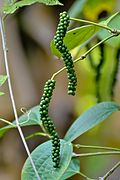
Flowering plants that produce drupes include coffee, jujube, mango, olive, most palms (including açaí, date, sabal and oil palms), pistachio, white sapote, cashew, and all members of the genus Prunus, including the almond, apricot, cherry, damson, peach, nectarine, and plum.

The term drupaceous is applied to a fruit having the structure and texture of a drupe, but which does not precisely fit the definition of a drupe.[3]

Description

[edit]

The boundary between a drupe and a berry is not always clear. Thus, some sources describe the fruit of species from the genus Persea, which includes the avocado, as a drupe;[4] others describe the avocado as a berry.[5] One definition of berry requires the endocarp to be less than 2 mm (332 in) thick, other fruits with a stony endocarp being drupes. In marginal cases, terms such as drupaceous or drupe-like are sometimes used.[6]

A freestone is a drupe with a stone that can easily be removed from the flesh.[7] A clingstone is a drupe with a stone which cannot easily be removed from the flesh.[8] A tryma is a nut-like drupe. Hickory nuts (Carya) and walnuts (Juglans) in the Juglandaceae family grow within an outer husk; these fruits are technically drupes or drupaceous nuts, not true botanical nuts.[5][9]

Many drupes, with their sweet, fleshy outer layer, attract the attention of animals as food, and the plant benefits from the resulting dispersal of its seeds.[10]

Examples

[edit]

Typical drupes include apricots, olives, loquat, peaches, plums, cherries, mangoes, pecans, and amlas (Indian gooseberries). Other examples include sloe (Prunus spinosa) and ivy (Hedera helix).[11]

The coconut is a drupe, its mesocarp a dry or fibrous husk, its endocarp a hard shell.[12]

Bramble fruits such as the blackberry and the raspberry are aggregates of drupelets. The fruit of blackberries and raspberries comes from a single flower whose pistil is made up of a number of free carpels.[13] However, mulberries, which closely resemble blackberries, are not aggregates but multiple fruits.[14]

Some drupes occur in clusters, as in palms. Examples include dates, Jubaea chilensis[15] in central Chile and Washingtonia filifera in the Sonoran Desert of North America.[16]

Many gymnosperms like cycads, ginkgos and some cypresses have drupe-like "fruits".[17]

[edit]

See also

[edit]
  • Pome (polypyrenous drupe)

References

[edit]
[edit]
Revisions and contributorsEdit on WikipediaRead on Wikipedia
from Grokipedia
A drupe is a type of simple, fleshy, indehiscent that develops from the mature of a single carpel in a flower, characterized by an outer edible layer surrounding a single hardened endocarp, or stone, that encloses one . The pericarp, or fruit wall, of a drupe consists of three distinct layers: the thin outermost exocarp (), the fleshy mesocarp (middle layer), and the hard, woody endocarp (pit) that protects the . This structure distinguishes drupes from other fruit types, such as berries, which lack a stony endocarp, and pomes, which have a central core rather than a single pit. Common examples of drupes include peaches (Prunus persica), cherries (Prunus avium), plums (Prunus domestica), apricots (Prunus armeniaca), and olives (Olea europaea), all of which feature a single seed within the pit and are widely cultivated for human consumption. Other notable drupes encompass mangos (Mangifera indica) and dates (Phoenix dactylifera), where the mesocarp provides the primary edible portion. In some cases, the seed enclosed by the endocarp is edible, as in almonds (Prunus dulcis), the seeds extracted from the drupe of the almond tree. Drupes exhibit variations in form and structure adapted to different ecological roles in , primarily through animal consumption of the fleshy exterior. For instance, the (Cocos nucifera) is a large drupe with a fibrous mesocarp, facilitating dispersal, while the seeds of many drupes, such as cherries, contain that can break down into , deterring . Aggregate drupes, like blackberries (), consist of a cluster of small drupelets derived from multiple ovaries on a single receptacle, and multiple drupes, such as the osage orange (), form from fused fruits of an . These adaptations highlight the diversity within drupes, which are significant in for their role in angiosperm and in as key crops contributing to global .

Definition and Characteristics

Botanical Definition

In angiosperms, fruits are classified based on their origin and , with simple fruits developing from a single pistil (comprising one or more fused carpels) within the of one flower, while compound fruits arise from multiple pistils or , either aggregate (from one flower) or multiple (from an ). The position of the relative to other floral parts further influences fruit morphology: a superior is free and positioned above the attachment point of sepals, petals, and stamens on the receptacle, whereas an inferior is embedded below this attachment. Drupes characteristically form from a superior . A drupe is defined botanically as an indehiscent fruit derived from a single carpel of a superior , consisting of an exocarp (often a thin ) and mesocarp (typically fleshy, but sometimes fibrous or dry) that enclose a single protected by a hard, lignified endocarp (often termed a stone or pit). This structure ensures the fruit does not split open at maturity to release seeds, distinguishing it from dehiscent fruit types. The term "drupe" originates from the Latin drupa, meaning an overripe or wrinkled olive, which itself derives from the Greek dryppa referring to an olive. Linnaeus first employed "drupa" in a botanical context in his Species Plantarum (1753), using it to describe certain stone-like fruits within his system of plant classification. This usage marked the evolution of the term in 18th-century botany, building on earlier classical references to olive morphology and integrating it into the emerging taxonomic framework for angiosperm fruits.

Anatomical Structure

A drupe is an indehiscent fruit that develops from a single carpel of a superior , featuring a pericarp differentiated into three distinct layers surrounding a single . The pericarp, the fruit wall derived from the , consists of the exocarp, mesocarp, and endocarp. The exocarp forms a thin, protective outer skin that serves as the fruit's initial barrier. The mesocarp, the middle layer, is typically fleshy and varies in thickness and texture, providing the edible portion in many drupes. The endocarp, the innermost layer, is sclerenchymatous and hardens into a woody or stony structure, often enclosing a single . Internally, the drupe contains a single protected by the endocarp, with the seed featuring a thin testa (seed coat) derived from the integuments, surrounding the embryo and, in some species, endosperm. In cases with endosperm, the testa adheres closely to this nutritive tissue that supports embryo development; otherwise, nutrients are stored in the cotyledons, while the embryo consists of the rudimentary plant structure. In some drupes, the endocarp exhibits variations such as for or splitting into multiple units called pyrenes, each containing a . These layers provide key structural adaptations for seed viability. The exocarp and mesocarp protect against and invasion through their waxy or fleshy composition, while the high content in the endocarp—often exceeding that of —resists mechanical and herbivory. The mesocarp's high further aids in maintaining internal , supporting dispersal mechanisms. Standard cross-section illustrations of a typical drupe, such as a , depict these layers clearly, with the exocarp as the outer skin, mesocarp as the surrounding flesh, and endocarp as the central pit.

Classification and Types

Simple Drupes

Simple drupes are monocarpellary fruits that develop from the of a single pistil in one flower, typically enclosing a single within a stony endocarp surrounded by a fleshy mesocarp and thin exocarp. These fruits are classified as simple because they arise from a single carpel, distinguishing them from more complex forms. The pericarp layers include the outer exocarp as a protective , the middle mesocarp as the fleshy portion, and the inner endocarp as the hardened pit. Common structural variants among simple drupes involve the adherence of the mesocarp to the endocarp and its texture. Freestone drupes feature a mesocarp that separates easily from the endocarp, facilitating and pitting for commercial uses like . In contrast, drupes have a mesocarp that adheres tightly to the endocarp, providing a firmer texture suitable for fresh consumption. Additionally, the mesocarp can be fiberless and smooth, as in many , or fibrous and tough, as seen in coconuts where the fibers serve non-edible purposes like cordage. Botanical examples illustrate these variations. Olives (Olea europaea) are simple drupes with a minimal mesocarp that is thin and primarily valued for oil extraction rather than direct eating. Cherries (Prunus spp.), another classic example, possess a small, juicy mesocarp that contributes to their appeal as fresh . Cultivation of simple drupes has involved for desirable traits like freestone characteristics since the , with early efforts focusing on cross-pollination and selection in Georgia to improve fruit quality and ease of handling for both fresh markets and processing. These practices enhanced commercial viability by prioritizing varieties with non-adherent pits and consistent mesocarp texture.

Aggregate and Multiple Drupes

Aggregate drupes develop from a single flower possessing multiple carpels, where each carpel matures into a small drupe known as a drupelet, collectively forming a clustered structure. In this arrangement, the drupelets adhere to a shared receptacle, the enlarged floral axis that supports the ovaries, creating a cohesive yet composite . For instance, the (Rubus idaeus) consists of approximately 100 drupelets, each enclosing a single within its own stony endocarp, while the fleshy exocarp and mesocarp portions contribute to the overall edible mass. This formation contrasts with simple drupes by multiplying the number of individual units from one flower, enhancing protection and dispersal potential through a larger, more attractive body. Multiple drupes, in contrast, arise from an comprising numerous flowers, each producing its own drupe that subsequently fuses externally to form a syncarpium, a unified mass derived from multiple ovaries across separate blooms. The mulberry (Morus spp.), for example, exemplifies this type, as its elongated aggregates numerous tiny drupes from clustered female flowers, resulting in a collective structure that resembles a but originates from distinct floral origins. Despite the multi-flower derivation, the resulting syncarpium maintains individuality in each component drupe, with no central shared receptacle as in aggregates. In both aggregate and multiple drupes, structural unity is achieved either through attachment to a common receptacle or via external fusion of the pericarps, yet each drupelet preserves its distinct anatomical features, including an individual hardened endocarp surrounding the seed and a fleshy outer layer for protection and appeal to dispersers. This modularity distinguishes compound drupes from other compound fruit types, such as follicles—which are dry and split open along one suture—or achenes, which are dry, indehiscent, and feature a thin pericarp loosely attached to the seed without a stony layer. The terminology emphasizes the drupe's fleshy nature and endocarp specialization, avoiding confusion with these drier, non-fleshy forms in botanical classification.

Specialized Forms

One specialized form sometimes classified as a drupe is the tryma, a nut-like variant characterized by a dry, often winged or fibrous exocarp and mesocarp that forms a dehiscent enclosing a hard endocarp containing the . This structure is typical in the family, such as walnuts ( spp.) and hickories (Carya spp.), where the outer splits along sutures to release the nut-like endocarp, facilitating dispersal by gravity or animals. Rarely, drupes exhibit follicle-like dehiscence, where the pericarp splits along one suture to release seeds, deviating from the typical indehiscent nature of drupes. Such variants occur in certain species, where the fruit combines drupe-like features with partial dehiscence for wind-assisted dispersal. Other modifications include drupes with multiple seeds within a single endocarp, as seen in some tropical species like (hog plums), where the woody stone may contain 1 to 5 seeds, enhancing reproductive output in resource-rich environments. Additionally, drupes derived from inferior ovaries, such as the coffee cherry ( spp.) in , feature a fleshy pericarp surrounding two seeds in a leathery endocarp. Evolutionarily, drupes show transitions from fleshy forms suited for dispersal to dry variants adapted for wind or gravity, with evidence of drupaceous fruits appearing in the early Eocene (approximately 50 million years ago) in deposits like the Wagon Bed Formation, indicating diversification amid cooling climates. This shift reflects adaptations in endocarp hardening and pericarp texture, as reconstructed from nuclear phylogenies showing multiple origins of fleshy drupes from dry-fruit ancestors in families like .

Examples

Common Drupes

Common drupes are found across diverse plant families, showcasing the fruit type's adaptability. In the Rosaceae family, the cherry (Prunus avium and P. cerasus) is a small, pendulous drupe, typically 1-2 cm in diameter with a thin exocarp and fleshy mesocarp surrounding a single stone. The peach (Prunus persica), also from Rosaceae, features a large drupe up to 7 cm across, distinguished by its fuzzy exocarp and thick, juicy mesocarp. Plums, encompassing various Prunus species in the same family, produce smooth-skinned drupes, often 2-5 cm in length, with a firm mesocarp and single pit. The apricot (Prunus armeniaca) similarly yields a drupe 3-5 cm in diameter, with a thin exocarp, fuzzy or smooth, and a hard endocarp enclosing the edible kernel, which is the seed. Almonds (Prunus dulcis) are seeds extracted from the drupe of the almond tree, where the mesocarp dries into a leathery hull around the hard endocarp. Beyond , other families illustrate further diversity in drupe morphology. The mango () of the family is a large, single-seeded drupe, reaching 10-25 cm in length, with a leathery exocarp and aromatic mesocarp enclosing a flat, woody endocarp. In the family, the (Olea europaea) forms an oil-rich mesocarp in its small drupe, about 1-3 cm long, where the fleshy portion is notably high in . The (Persea americana) from the family is a berry-like drupe, 5-20 cm long, with a thick, green exocarp, buttery mesocarp, and large single in a thin endocarp. Dates (Phoenix dactylifera), also in the family like the coconut, develop as elongated drupes 3-7 cm long, with a thin exocarp, fibrous mesocarp that becomes chewy when dried, and a hard endocarp surrounding one . The (Cocos nucifera) from the family exemplifies an extreme form, with its massive drupe featuring a fibrous serving as the outer layer, up to 30 cm long, protecting the hard endocarp and single . Drupes display considerable variations in color, size, and seed count, highlighting their diversity. Colors range from vibrant reds and yellows in cherries and peaches to greens and browns in olives and , influenced by pigmentation in the exocarp and mesocarp. Sizes vary dramatically, from the diminutive 1 cm cherry to the substantial 30 cm , adapting to different dispersal mechanisms. While most drupes contain a single within the endocarp, as seen in these examples, the apricot () in features a kernel inside the pit that functions as the viable . These representative drupes occur predominantly in temperate and tropical regions worldwide, spanning multiple plant families and contributing to floral diversity.

Economic Importance

Drupes play a significant role in global agriculture, with major crops such as peaches, cherries, plums, olives, mangos, avocados, dates, and almonds contributing substantially to food production and trade. In 2023, global peach production reached approximately 24.94 million metric tons, led by China with over 16 million tons, underscoring the fruit's importance in both fresh and processed markets. Olives represent another cornerstone, with worldwide production estimated at around 10 million tons annually as of 2023, over 95% originating from Mediterranean countries like Spain, Italy, and Greece, where about 90% of the harvest is destined for olive oil extraction. Mangos, the most produced drupe, reached over 61 million metric tons globally in 2023, primarily from India (about 25 million tons), supporting fresh markets, exports, and processing into juices and dried products. Avocados yielded around 8.5 million metric tons in 2023, with Mexico leading at over 2.5 million tons, driving demand in salads, guacamole, and oils. Dates production totaled approximately 9.5 million metric tons in 2023, topped by Egypt (1.87 million tons), valued for dried fruit snacks and religious/cultural uses. Almond production, focusing on the kernel, was about 3 million metric tons in 2023, led by the United States (over 1 million tons), essential for nuts, butters, and milk alternatives derived from the drupe seed. Nutritionally, drupes are valued for their rich content of vitamins, , and antioxidants, supporting human health through dietary consumption. For instance, cherries provide about 10-12% of the daily value of per cup, along with and polyphenols that exhibit properties. Mangos offer high and C, avocados provide healthy monounsaturated fats and , dates supply and iron, while almonds deliver and magnesium. The fleshy mesocarp offers that aids digestion, while antioxidants like anthocyanins in many stone fruits help combat . However, drupe kernels can pose risks; apricot seeds contain , a cyanogenic that breaks down into , potentially causing toxicity if consumed in excess, with safe limits typically under three small kernels per serving. Industrially, drupes are processed into a variety of products, including jams, juices, dried fruits, and oils, fueling a multibillion-dollar sector. Olives, in particular, yield used in cooking, , and pharmaceuticals, with historical evidence of production and dating back to 6000 BCE in the , where it underpinned ancient economies through export and cultural significance. Mangos and avocados are pulped for purees and oils, dates for sweeteners, and almonds for plant-based milks, enhancing global . Peaches and cherries are canned or juiced for year-round availability, enhancing and export revenues in producing regions. Production faces challenges from pests, diseases, and climate variability, impacting yields and necessitating sustainable practices. Insect pests like the oriental fruit moth and brown rot fungus affect stone fruits, requiring to minimize chemical use. Climate change exacerbates issues through erratic rainfall, heat stress, and reduced chilling hours, leading to lower outputs in key areas post-2020; for example, Mediterranean yields dropped due to droughts, prompting adoption of drought-resistant varieties and precision irrigation in sustainable farming initiatives. Similar challenges affect tropical drupes like mangos and avocados through hurricanes and pests.

Development and Reproduction

Fruit Development

Drupe fruit development initiates with , where is transferred to the stigma, followed by fertilization of the within the , typically occurring within days of successful . This event triggers the enlargement of the into the pericarp, the fruit wall comprising three layers derived from the carpel: the exocarp originating from the epidermal cells, the mesocarp from the middle hypodermal and layers, and the endocarp from the innermost cells adjacent to the . The process unfolds in phases, beginning with rapid and expansion post-fertilization, leading to initial fruit set. Hormonal signals orchestrate these changes, with auxins and playing key roles in promoting during early ovary enlargement and subsequent cell expansion in the mesocarp. As development progresses, the endocarp undergoes lignification, hardening into a protective stone around 4-6 weeks post-bloom, a process driven by deposition that completes within 2-3 weeks. is regulated by , which induces climacteric patterns in species like peaches—marked by a burst in ethylene production triggering softening and color change—contrasting with non-climacteric behavior in cherries, where predominates without an ethylene surge. In the peach (Prunus persica), a representative drupe, fruit development from bloom to harvest spans approximately 4-6 months, encompassing an initial 30-day rapid growth phase, a slower pit-hardening period, and a final 4-6 weeks of mesocarp expansion before maturity. Environmental factors, particularly temperature, influence stone hardening; elevated spring temperatures can accelerate early growth but lead to incomplete lignification or defects like split pits if excessive. Parthenocarpy, the development of seedless drupes without fertilization, occurs in some cultivated varieties of peaches and cherries, often induced by applications that mimic hormonal signals for fruit set, resulting in pitless or underdeveloped-stone fruits.

Seed Dispersal and Ecology

The primary mechanism of seed dispersal for drupes is zoochory, particularly endozoochory, in which frugivorous animals consume the fleshy mesocarp and excrete the durable endocarp enclosing the , thereby transporting it away from the parent to reduce and predation risk. This is highly effective for propagation, as the endocarp's lignified structure resists mechanical damage during digestion. For smaller drupes like cherries ( spp.), birds such as the (Turdus migratorius), (Bombycilla cedrorum), and (Cyanocitta cristata) ingest the fruit and deposit seeds via feces over distances of several kilometers, promoting colonization of new habitats. Larger drupes, such as peaches ( persica) and mangos (), are dispersed by mammals like bears (Ursus spp.) and , which often consume the pulp and either excrete or discard the intact endocarp, facilitating long-distance movement in forested ecosystems. Drupes have evolved ecological adaptations to enhance animal attraction and seed viability during dispersal. The mesocarp typically ripens to bright colors (e.g., red, black, or ) and produces volatile organic compounds (VOCs) that emit appealing odors, serving as visual and olfactory signals to frugivores indicating nutritional rewards and ripeness. Research on nocturnal mouse lemurs (Microcebus spp.) in forests shows that fruits with high blue-yellow chromatic contrast against foliage and elevated VOC emissions (e.g., >15,500 arbitrary units) are preferentially consumed and dispersed, increasing seed removal rates by up to 40%. The endocarp's hardened, lignified layer further protects the from digestive acids and abrasion, with high survival rates during gut passage (often near 100% for intact endocarps), though viability can vary with disperser and seed traits; this durability ensures a portion of seeds germinate post-deposition, often with scarification benefits from gastric treatment. Drupes play key roles in habitat dynamics, particularly in forest succession and supporting biodiversity across biomes. As pioneer species, aggregate drupes like those of raspberry (Rubus idaeus) rapidly colonize disturbed sites such as post-fire clearings or logged areas, peaking in abundance 2–4 years after disturbance and stabilizing soil while providing early food sources that attract wildlife, thereby facilitating the transition to mid-successional trees like birch (Betula spp.) and aspen (Populus spp.). In tropical biomes, drupes contribute to exceptional biodiversity by interacting with diverse frugivore assemblages (e.g., over 100 bird and mammal species per forest), promoting gene flow and maintaining high plant species richness through efficient zoochory in humid, low-latitude environments. Temperate biomes, by contrast, feature fewer dispersers but rely heavily on drupes for woodland regeneration, where they enhance ecosystem resilience by enabling recolonization of fragmented habitats and supporting moderate but vital biodiversity levels. Habitat loss and declining frugivore populations threaten these dispersal processes, particularly in temperate regions. Since the 1970s, North American populations—key dispersers for many drupes—have plummeted by nearly 3 billion individuals (a 29% decline), driven by , agricultural intensification, and impacts, which fragment forests and reduce seed deposition distances by up to 95% in some areas. This has cascading effects, including clustered seed shadows under parent , heightened predation, and diminished plant recruitment, potentially altering temperate forest composition and .

Distinctions from Other Fruits

Comparison with Berries

Drupes and berries represent two distinct categories of simple fleshy fruits, both developing from the of a single flower with superior or inferior positioning, yet they diverge markedly in pericarp composition and seed accommodation. The primary structural difference lies in the endocarp: in drupes, it is hard, lignified, and typically thick, forming a protective stony layer around a single or locule, while in , the endocarp remains thin, fleshy, and non-sclerenchymatous, enabling multiple to be embedded throughout the pericarp without such rigid enclosure. Both fruit types are indehiscent, retaining their seeds internally at maturity without splitting, which supports animal-mediated dispersal. Developmentally, drupes and arise from fertilized ovaries, but drupes feature specialized sclerification of the inner pericarp layers to produce the characteristic pit, contrasting with the uniform fleshy maturation in . Misclassifications often stem from culinary usage, where "berries" denotes small, juicy fruits like strawberries—an aggregate of achenes—and raspberries—an aggregate of drupes—while botanically, true berries encompass tomatoes, grapes, and bananas due to their single-ovary origin and fleshy pericarp. This botanical-gastronomic divide underscores how everyday prioritizes and appearance over anatomical criteria. From an evolutionary perspective, drupes have adapted for endozoochory through their hardened endocarp, which shields the from digestive breakdown during passage through guts, whereas berries promote broader fleshy allure and multi-seed production to enhance dispersal opportunities across diverse animal vectors.

Comparison with Nuts and Other Fruit Types

Drupes differ from true nuts primarily in their pericarp structure and texture. True nuts, such as acorns (Quercus spp.), are indehiscent, single-seeded fruits with a dry, hard pericarp throughout, derived from a multi-carpellate where only one seed develops, providing rigid protection without fleshy tissue. In contrast, drupes feature a differentiated pericarp: a thin exocarp, a fleshy mesocarp, and a hard, woody endocarp (the "stone") enclosing a single , as seen in peaches (Prunus persica). Many culinary "nuts," like almonds (Prunus dulcis), pistachios (Pistacia vera), and cashews (Anacardium occidentale), are actually drupes or "drupaceous nuts," where the edible kernel is the , and the surrounding is a fleshy precursor that dries or is removed during processing. Beyond nuts, drupes contrast with other dry fruit types in seed number, dehiscence, and pericarp characteristics. Achenes, such as those in sunflowers (Helianthus annuus), are small, indehiscent, single-seeded fruits from a single carpel, with a thin pericarp tightly fused to the seed at one point only, lacking the multilayered, stony endocarp of drupes. Capsules, exemplified by poppies (Papaver spp.), are dry, dehiscent fruits from multiple fused carpels, splitting open to release numerous seeds, unlike the indehiscent, typically single-seeded nature of drupes. Pepos, a specialized berry type in the Cucurbitaceae family like watermelons (Citrullus lanatus), arise from an inferior ovary with a leathery rind (exocarp and mesocarp fused) surrounding multi-seeded, fleshy pulp, differing from drupes in lacking a distinct hard endocarp and often containing multiple seeds. Functionally, drupes and nuts serve distinct ecological roles in seed dispersal. The fleshy mesocarp of drupes attracts animals for endozoochory, where ingestion and excretion aid seed spread, promoting dispersal over short to medium distances in forested or shrubby habitats. Nuts, being entirely dry and durable, often rely on scatter-hoarding by (e.g., squirrels caching acorns) or abiotic means like and , enabling longer-distance dispersal in open or ecosystems while resisting decay. Historical botanical reclassifications have clarified overlaps, particularly for nut-like drupes. In 20th-century taxonomy, walnuts (Juglans spp.) and hickory nuts (Carya spp.) were reclassified from true nuts to trymae—drupaceous fruits with a dehiscent outer husk enclosing a nut-like inner shell—reflecting their accessory tissue origins beyond the ovary. In the APG IV classification system (2016), drupes and nuts appear across diverse angiosperm orders, underscoring their convergent evolution as indehiscent, single-seeded forms adapted to various clades, such as Rosales for drupes in Rosaceae and Fagales for nuts in Fagaceae.

References

Add your contribution
Related Hubs
User Avatar
No comments yet.