


Community hub
Recent from talks
Contribute something
Nothing was collected or created yet.
East China
View on Wikipedia | You can help expand this article with text translated from the corresponding article in Chinese. (October 2021) Click [show] for important translation instructions.
|
 | This article needs additional citations for verification. (October 2012) |
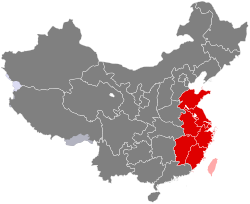
East China (Chinese: 华东; pinyin: huá dōng) is a geographical region in the People's Republic of China, mainly consisting of seven province-level administrative divisions, namely the provinces (from north to south) Shandong, Jiangsu, Anhui, Zhejiang, Jiangxi, Fujian, and the direct-administered municipality Shanghai.
Key Information

.jpg)


The region was defined in 1945 as the jurisdiction area of the Central Committee's East China Bureau (华东局), which was a merger politburo agency of the Shandong Bureau and the Central China Bureau previously established during the Second Sino-Japanese War. After the founding of the People's Republic of China, the region included all the aforementioned provinces except Jiangxi, which was previously considered part of South Central China before being reassigned in 1961. The East China Bureau was abolished in 1966 due to the Cultural Revolution, but in 1970 the fourth five-year plan redefined the region as the East China Coordinated Region (华东协作区), which supported the logistics of the Jinan and Nanjing Military Regions. This geographical definition was retained after the economic reform of the 1980s.
Since the Chinese Government claims sovereignty over Taiwan and the few outlying islands of Fujian (Kinmen and Matsu), which have been ruled by the exiled Government of the Republic of China (who fled to Taiwan after losing the Chinese Civil War in 1949) as its own territory, the nominal "Taiwan Province, People's Republic of China" is also classified in this region.
Administrative divisions
[edit]| GB[3] | ISO No. 3166-2:CN[4] | Province | Chinese Name | Capital | Population (2020 census) | Density | Area | Abbreviation | Abbreviation in Chinese |
|---|---|---|---|---|---|---|---|---|---|
| Hù | 31 | Shanghai Municipality | 上海市 Shànghǎi Shì |
Shanghai | 24,870,895 | 3,922.24 | 6,341 | SH | 沪 |
| Sū | 32 | Jiangsu Province | 江苏省 Jiāngsū Shěng |
Nanjing | 84,748,016 | 847.91 | 102,600 | JS | 苏 |
| Zhè | 33 | Zhejiang Province | 浙江省 Zhèjiāng Shěng |
Hangzhou | 64,567,588 | 615.67 | 102,000 | ZJ | 浙 |
| Wǎn | 34 | Anhui Province | 安徽省 Ānhuī Shěng |
Hefei | 61,027,171 | 436.29 | 139,700 | AH | 皖 |
| Mǐn | 35 | Fujian Province | 福建省 Fújiàn Shěng |
Fuzhou | 41,540,086 | 335.66 | 121,300 | FJ | 闽 |
| Gàn | 36 | Jiangxi Province | 江西省 Jiāngxī Shěng |
Nanchang | 45,188,635 | 270.69 | 167,000 | JX | 赣 |
| Lǔ | 37 | Shandong Province | 山东省 Shāndōng Shěng |
Jinan | 101,527,453 | 643.78 | 153,800 | SD | 鲁 |
| Tái | 71 | Taiwan Province[a] | 台湾省 Táiwān Shěng |
Taipei | 23,162,123 | 650.97 | 36,161 | TW | 台 |
Cities with urban area over one million in population
[edit]Provincial capitals in bold.
| # | City | Urban area[5] | District area[5] | City proper[5] | Prov. | Census date |
|---|---|---|---|---|---|---|
| 1 | Shanghai | 20,217,748 | 22,315,474 | 23,019,196 | SH | 2010-11-01 |
| 2 | Nanjing | 5,827,888 | 7,165,292 | 8,003,744 | JS | 2010-11-01 |
| 3 | Hangzhou | 5,162,093 | 6,241,971 | 8,700,373 | ZJ | 2010-11-01 |
| 4 | Jinan | 3,527,566 | 4,335,989 | 6,813,984 | SD | 2010-11-01 |
| 5 | Qingdao | 3,519,919 | 3,718,835 | 8,715,087 | SD | 2010-11-01 |
| 6 | Suzhou | 3,302,152 | 4,072,081 | 10,459,890 | JS | 2010-11-01 |
| 7 | Xiamen | 3,119,110 | 3,531,347 | 3,531,347 | FJ | 2010-11-01 |
| 8 | Hefei | 3,098,727 | 3,310,268 | 5,702,466 | AH | 2010-11-01 |
| 9 | Fuzhou | 2,824,414 | 2,921,762 | 7,115,369 | FJ | 2010-11-01 |
| 10 | Wuxi | 2,757,736 | 3,543,719 | 6,374,399 | JS | 2010-11-01 |
| 11 | Wenzhou | 2,686,825 | 3,039,439 | 9,122,102 | ZJ | 2010-11-01 |
| 12 | Ningbo | 2,583,073 | 3,491,597 | 7,605,689 | ZJ | 2010-11-01 |
| 13 | Zibo | 2,261,717 | 3,129,228 | 4,530,597 | SD | 2010-11-01 |
| 14 | Changzhou | 2,257,376 | 3,290,918 | 4,592,431 | JS | 2010-11-01 |
| 15 | Nanchang | 2,223,661 | 2,357,839 | 5,042,566 | JX | 2010-11-01 |
| 16 | Yantai | 1,797,861 | 2,227,733 | 6,968,202 | SD | 2010-11-01 |
| 17 | Xuzhou | 1,735,166 | 1,967,214 | 8,577,225 | JS | 2010-11-01 |
| 18 | Nantong | 1,612,385 | 2,274,113 | 7,283,622 | JS | 2010-11-01 |
| 19 | Huai'an | 1,523,655 | 2,635,406 | 4,801,662 | JS | 2010-11-01 |
| 20 | Linyi | 1,522,488 | 2,303,648 | 10,039,440 | SD | 2010-11-01 |
| 21 | Weifang | 1,261,582 | 2,044,028 | 9,086,241 | SD | 2010-11-01 |
| 22 | Huainan | 1,238,488 | 1,666,826 | 2,333,896 | AH | 2010-11-01 |
| 23 | Taizhou | 1,189,276 | 1,902,510 | 5,968,838 | ZJ | 2010-11-01 |
| 24 | Jinjiang | 1,172,827 | 1,986,447 | see Quanzhou | FJ | 2010-11-01 |
| 25 | Quanzhou | 1,154,731 | 1,435,185 | 8,128,533 | FJ | 2010-11-01 |
| 26 | Yancheng | 1,136,826 | 1,615,836 | 7,262,200 | JS | 2010-11-01 |
| 27 | Tai'an | 1,123,541 | 1,735,425 | 5,494,207 | SD | 2010-11-01 |
| 28 | Kunshan | 1,118,617 | 1,644,860 | see Suzhou | JS | 2010-11-01 |
| 29 | Wuhu | 1,108,087 | 1,307,042 | 2,263,123 | AH | 2010-11-01 |
| 30 | Putian | 1,107,199 | 1,953,801 | 2,778,508 | FJ | 2010-11-01 |
| 31 | Yangzhou | 1,077,531 | 1,392,563 | 4,460,066 | JS | 2010-11-01 |
| 32 | Cixi | 1,059,942 | 1,462,383 | see Ningbo | ZJ | 2010-11-01 |
| 33 | Jiangyin | 1,013,670 | 1,595,138 | see Wuxi | JS | 2010-11-01 |
See also
[edit]Notes
[edit]- ^ The People's Republic of China considers Taiwan to be its 23rd province, but Taiwan is currently administrated by the Republic of China. Since 1945, the ROC only controls the island of Taiwan and Penghu. For Kinmen and Matsu, see note on Fujian Province. See also Political status of Taiwan
References
[edit]- ^ "Main Data of the Seventh National Population Census". National Bureau of Statistics of China. Archived from the original on 11 May 2021.
- ^ GDP-2022 is a preliminary data "Home - Regional - Quarterly by Province" (Press release). China NBS. Archived from the original on 4 June 2023. Retrieved 16 March 2023.
- ^ "GB/T 2260 codes for the provinces of China". Archived from the original on 22 February 2017. Retrieved 23 September 2012.
- ^ ISO 3166-2:CN (ISO 3166-2 codes for the provinces of China)
- ^ a b c 国务院人口普查办公室、国家统计局人口和社会科技统计司编 (2012). 中国2010年人口普查分县资料. Beijing: 中国统计出版社 [China Statistics Press]. ISBN 978-7-5037-6659-6.
External links
[edit] East China travel guide from Wikivoyage

| Authority control databases: National |
|---|

East China
View on GrokipediaGeography
Physical Features and Topography
East China's topography encompasses flat coastal plains and river deltas in the north and east, transitioning to low hills and higher mountain ranges inland. The region includes the southern margins of the North China Plain in Shandong, where alluvial deposits from the Yellow River create low-lying terrain mostly below 50 meters above sea level, with coastal areas under 10 meters. Central Shandong features hilly terrain averaging 200 meters elevation, while the eastern peninsula includes rocky coastlines and cliffs along 3,000 kilometers of shoreline.[6][7][8] The Yangtze River Delta, extending across Shanghai, southern Jiangsu, and northern Zhejiang, forms a vast alluvial plain of low relief, shaped by sediment from the Yangtze River over thousands of years, supporting intensive agriculture and urban development. This deltaic area, part of the Middle-Lower Yangtze Plain, features elevations generally below 5 meters, with networks of rivers, lakes, and reclaimed polders. North of the delta, the Huai River plain in northern Jiangsu and Anhui provides additional flat, fertile lowlands.[9][10] Inland and southern provinces exhibit more varied and elevated landforms. Anhui's Huangshan Mountains reach 1,864 meters at Lianhua Peak, known for granite peaks, pine forests, and unique geomorphology. The Wuyi Mountains, spanning Fujian and Jiangxi, culminate at Huanggang Peak of 2,160.8 meters, featuring danxia landforms, canyons, and subtropical biodiversity. Shandong's Mount Tai, a prominent tectonic uplift, peaks at 1,532.7 meters on Jade Emperor Summit, with steep ascents and cultural significance. These ranges contrast with the predominantly lowland coastal zones, influencing regional hydrology and settlement patterns.[11][12][13]Climate and Environmental Conditions
East China features a monsoon-influenced climate, with hot, humid summers driven by the East Asian summer monsoon and cooler, drier winters affected by the Siberian High. The region spans humid subtropical conditions in southern provinces such as Zhejiang and Fujian, characterized by milder winters, to temperate monsoon climates in northern areas like Shandong, where winters are colder. Average annual temperatures approximate 17°C, peaking at 29°C in July and dropping to around 3-5°C in January across representative sites like Shanghai.[4] [14] [15] Precipitation is abundant and seasonal, averaging 800-1500 mm annually, with 60-80% occurring from June to September, fostering agricultural productivity but also elevating flood risks in deltas like the Yangtze. Summer typhoons from the Pacific Ocean intensify rainfall and associated hazards, while winter features low precipitation and occasional haze from stagnant air masses.[16] [17] Environmental degradation persists despite mitigation efforts, with air pollution in eastern metropolises showing PM2.5 concentrations that, while reduced by 20-30% between 2013 and 2020 through coal controls and industry regulations, still exceed WHO guidelines in many urban areas. Industrial emissions and vehicle exhaust contribute to ozone episodes, worsened by meteorological stagnation, causing an estimated 1 million annual premature deaths from ambient air pollution nationwide, disproportionately impacting densely populated eastern regions. Groundwater pollution from heavy metals and nitrates affects over 90% of shallow aquifers in industrialized zones, stemming from unchecked factory discharges and fertilizer overuse.[18] [19] [20] [21] Climate trends indicate accelerated warming, particularly in northern East China, with historical data showing temperature rises strongest in inland and northern sectors since the mid-20th century, amplifying drought-flood cycles and sea-level pressures on coastal infrastructure.[22]Natural Resources and Biodiversity
East China possesses limited mineral endowments compared to western regions, with notable concentrations of copper deposits across provinces including Anhui, Fujian, Jiangsu, Jiangxi, Shandong, and Zhejiang, accounting for over half of national copper resources.[23] Coal reserves exist in Anhui and Jiangxi, contributing to regional energy production, though extraction has declined amid environmental regulations and shifts toward cleaner sources.[24] Offshore hydrocarbon potential in the East China Sea includes an estimated 22 million barrels of petroleum and 482 billion cubic feet of natural gas in proved and probable reserves, primarily contested areas near Shandong and Zhejiang, though underexplored due to geopolitical tensions.[25] [26] Agricultural output dominates renewable resources, leveraging fertile eastern plains for rice, wheat, and vegetables, with Jiangsu and Zhejiang ranking among China's top producers of cash crops and aquaculture products.[27] Fisheries thrive in the East China Sea, supporting extensive marine capture and the world's leading aquaculture volumes, though overexploitation has depleted stocks like yellow croaker since the 1960s.[27] [28] Forestry covers limited areas, with subtropical broadleaf forests in Fujian and Zhejiang providing timber and non-timber products, but deforestation from urbanization has reduced canopy to under 20% in densely populated zones.[27] Biodiversity in East China, encompassing coastal and Yangtze Delta ecosystems, features high faunal diversity relative to other regions, with the coastal zone supporting elevated numbers of vertebrate and invertebrate species amid subtropical climates.[29] Key fauna includes the critically endangered Yangtze finless porpoise in riverine habitats of Jiangsu and Anhui, alongside migratory birds in wetlands and endemic amphibians in Jiangxi's mountains.[30] Flora comprises diverse subtropical species, such as camphor trees and orchids in Zhejiang's hills, though floral richness lags behind southwestern provinces.[29] Conservation efforts, including reserves in Fujian-Jiangxi's Wuyi Mountains, protect over 1,000 vascular plants and hundreds of vertebrates, but rapid industrialization has caused habitat fragmentation and species declines, with pollution in the Yangtze basin threatening 20% of regional endemics.[30] [29]History
Pre-Modern Development
The Neolithic era marked the onset of significant human activity in East China, particularly in the Yangtze River Delta and coastal Zhejiang. The Hemudu culture, flourishing from circa 5500 to 3300 BCE near present-day Ningbo, demonstrated early mastery of wet-rice farming on terraced fields, evidenced by preserved rice husks and tools, alongside pile-dwelling architecture adapted to marshy terrains and evidence of lacquerware production.[31] This culture's emphasis on millet, fish, and domesticated pigs supported sedentary communities, laying foundations for agricultural intensification in the region. Succeeding it, the Liangzhu culture (circa 3300–2300 BCE) in the lower Yangtze area exhibited proto-urban complexity, including large earthen platforms, intricate jade ritual objects symbolizing elite authority, and advanced water management systems like reservoirs, indicative of hierarchical societies with ritual economies.[32] The Liangzhu polity's collapse around 2300 BCE, linked to megafloods and monsoon shifts disrupting hydrology, led to a temporary depopulation before reoccupation.[33] By the Bronze Age, during the Spring and Autumn Period (771–476 BCE), the kingdoms of Wu (centered around the Lake Tai basin in modern Jiangsu) and Yue (in coastal Zhejiang) emerged as regional powers, leveraging iron tools for expanded agriculture and renowned for sword-making techniques using meteoric iron and bronze alloys.[34] These states, often in rivalry, developed naval warfare capabilities on rivers and coasts, with Wu briefly expanding northward before Yue's conquest under King Goujian circa 473 BCE; their integration into the Qin Empire after 221 BCE facilitated infrastructure like early canal extensions, enhancing rice yields and silk production through corvée labor and Han-era (206 BCE–220 CE) hydraulic projects.[35] The Tang (618–907 CE) and Song (960–1279 CE) dynasties catalyzed East China's transformation into an economic powerhouse, as southward migration and climate amelioration enabled double-cropping of Champa rice varieties, boosting per-acre outputs to sustain densities exceeding 100 persons per square kilometer in Jiangnan by the 11th century. Commercialization surged under the Song, with Jiangnan's markets in Hangzhou and Suzhou handling interregional trade in textiles, ceramics, and tea; state monopolies on salt and iron, coupled with paper money issuance, channeled surpluses to fund military and urban growth, while maritime exports via Ningbo port connected to Southeast Asia.[36] In the Ming (1368–1644) and Qing (1644–1912) eras, the Grand Canal's dredging solidified the region's role as China's fiscal core, generating over half of imperial revenue by the 18th century through cash-crop silk farming and artisan guilds, though Manchu conquests in 1645 triggered temporary disruptions like the Yangzhou massacre, and later Qing policies emphasized hydraulic maintenance amid growing population pressures reaching 300 million empire-wide by 1800.[37] Scholarly and mercantile elites flourished, exemplified by private academies and garden estates in Suzhou, reflecting accumulated wealth from proto-capitalist tenancy systems.[38]Republican and Early Communist Era
Following the Xinhai Revolution, the Republic of China was established on January 1, 1912, ending imperial rule and initiating a period of political fragmentation in East China, where warlords vied for control amid weak central authority.[39] Shanghai emerged as a key economic hub, leveraging its status as a treaty port to foster trade and light industry, while regions like Jiangsu and Zhejiang experienced uneven modernization efforts. The Kuomintang's Northern Expedition from 1926 to 1928 unified much of East China under Nanjing's control by 1928, marking the Nanjing Decade (1927–1937), during which the government stabilized currency, built infrastructure, and promoted economic growth in the Yangtze Delta, controlling prosperous areas that accounted for significant national output. However, corruption, rural neglect, and reliance on urban elites limited broader development, exacerbating tensions with communists and peasants. The Second Sino-Japanese War, erupting in 1937, devastated East China as Japanese forces targeted coastal industrial centers. The Battle of Shanghai (August 13 to November 26, 1937) saw intense urban fighting, with Japanese casualties exceeding 40,000 and Chinese forces suffering heavy losses estimated in the tens of thousands, delaying Japanese advances but failing to halt the occupation of key cities.[40] Nanjing fell in December 1937, followed by widespread atrocities and economic exploitation under occupation, contributing to approximately 15 million Chinese deaths nationwide, with East China's infrastructure and agriculture severely ravaged.[41] Puppet regimes, such as Wang Jingwei's in Nanjing from 1940, facilitated resource extraction, further undermining Nationalist authority and setting the stage for postwar civil war escalation. By 1949, amid hyperinflation and military defeats, the Chinese Communist Party (CCP) forces advanced rapidly in East China during the civil war's final phase. Shanghai was liberated on May 27, 1949, after brief outskirts battles, with the People's Liberation Army entering without major street fighting, preserving the city's economic assets unlike more destructive takeovers elsewhere.[42] The founding of the People's Republic of China on October 1, 1949, extended CCP control over East China, initiating campaigns to consolidate power through suppression of counter-revolutionaries and class-based purges. Early communist policies emphasized land reform to dismantle feudal structures, particularly in agrarian Jiangsu province, where from 1949 to 1952, land and resources were confiscated from landlords and redistributed to peasants under the Agrarian Reform Law of June 30, 1950, covering areas with over 66 million peasants by 1951.[43] This process involved peasant organizations—reaching 76% of townships in northern Jiangsu by August 1950—and class struggle tactics, including beatings and executions of landlords, though it aimed to boost production by eliminating exploitation; completion in southern Jiangsu by March 1951 facilitated rural stabilization but at the cost of social violence and economic disruptions from sabotage. The First Five-Year Plan (1953–1957) shifted focus to heavy industry, leveraging East China's pre-existing textile and manufacturing base in Shanghai and coastal provinces for Soviet-aided development. Subsequent initiatives like the Great Leap Forward (1958–1962) imposed communes and backyard furnaces across East China, prioritizing steel output over agriculture and exacerbating food shortages amid poor planning and resource diversion, contributing to national famine deaths estimated at 30 million.[44] Coastal provinces fared relatively better due to urban industry but still faced output declines and procurement excesses. The Cultural Revolution (1966–1976) intensified chaos in Shanghai, where the January Storm of 1967 saw worker rebels overthrow local party leaders, briefly establishing the Shanghai People's Commune as a radical model before military intervention restored order, reflecting Maoist purges that disrupted administration and education region-wide.[45]Reform and Contemporary Growth
Following the Third Plenum of the 11th Central Committee in December 1978, which initiated China's reform and opening-up policy, East China's coastal provinces—particularly Shanghai, Jiangsu, and Zhejiang—emerged as pioneers in market-oriented transitions, leveraging pre-existing industrial foundations from the Republican era to attract foreign direct investment and foster township and village enterprises (TVEs). These reforms dismantled collectivized agriculture, allowing rural laborers to shift toward light manufacturing and export processing, with Jiangsu's TVE output surging from negligible levels in 1978 to over 100 billion yuan by 1990, driven by pragmatic local experimentation rather than central planning mandates.[46][47] The designation of Shanghai's Pudong New Area as a development zone on April 18, 1990, marked a pivotal acceleration, transforming farmland into a financial and trade hub through preferential policies like tax incentives and land-use reforms, which drew over $100 billion in cumulative foreign investment by the early 2000s and catalyzed the Yangtze River Delta (YRD) region's integration. Deng Xiaoping's 1992 Southern Tour further propelled this by endorsing coastal prioritization, leading to Pudong's skyline emergence, including the Lujiazui financial district, and YRD-wide infrastructure like ports and highways that boosted intra-regional trade. By 2018, the YRD—encompassing Shanghai, southern Jiangsu, northern Zhejiang, and parts of Anhui—accounted for approximately 20% of national GDP, underscoring East China's role as an export engine with annual growth rates averaging over 10% in the 1990s and 2000s.[48][49] Contemporary growth has sustained high urbanization and innovation, though tempered by national slowdowns; for instance, East China provinces like Jiangsu and Zhejiang reported GDP expansions of 6-7% in 2023, outpacing inland regions, fueled by high-tech clusters in semiconductors and e-commerce, with Shanghai's Pudong hosting over 80% of the city's foreign-funded enterprises by 2024. State-led initiatives, such as the 2019 YRD regional integration plan, enhanced connectivity via high-speed rail networks spanning 2,000+ kilometers, facilitating labor mobility and supply-chain efficiencies that contributed to East China's foreign trade volume exceeding 5 trillion yuan annually in recent years. However, challenges including debt accumulation from infrastructure overinvestment and demographic aging have prompted shifts toward quality-focused growth, with 2024 provincial targets aligning with national 5% GDP aims amid global trade frictions.[50][51]Administrative Divisions
Provinces and Municipalities
East China comprises seven provincial-level administrative divisions: Shanghai Municipality and the provinces of Anhui, Fujian, Jiangsu, Jiangxi, Shandong, and Zhejiang. These units operate under China's unitary system of government, where provinces are headed by people's governments responsible to the central authorities, while Shanghai, as a municipality directly under the central government, enjoys administrative autonomy equivalent to a province. The divisions reflect a mix of coastal and inland territories, with varying levels of urbanization and integration into the Yangtze River Delta economic zone.[52] Shanghai Municipality, situated on the eastern coast at the Yangtze River estuary, functions as a global financial hub and serves as the regional anchor for East China. It encompasses an area of 6,340.5 square kilometers and recorded a resident population of 24,802,600 at the end of 2024, comprising 14,967,700 registered residents and 9,834,900 migrants.[53][54] Jiangsu Province, immediately north of Shanghai, borders the Yellow Sea and features Nanjing as its capital. Covering 102,600 square kilometers, it supports a population of approximately 85 million as of 2024, marking it as one of China's most densely populated provinces due to its fertile plains and industrial corridors.[55][56] Zhejiang Province lies south of Shanghai along the East China Sea coast, with Hangzhou as its capital city. The province spans about 101,800 square kilometers and has a population exceeding 65 million, driven by rapid urbanization in areas like the Hangzhou Bay region. Anhui Province, positioned west of Jiangsu and Zhejiang, includes Hefei as its capital and covers 140,140 square kilometers inland terrain. Its resident population reached 61.2 million in 2024, reflecting moderate growth amid migration to neighboring coastal areas.[57] Fujian Province, southeast of Jiangxi and facing Taiwan across the Taiwan Strait, has Fuzhou as its capital. Encompassing 121,400 square kilometers of mountainous and coastal land, it had a population of roughly 42.7 million in recent estimates, with growth of about 100,000 in 2024.[58][56] Jiangxi Province, inland and bordered by Anhui, Zhejiang, and Fujian, centers on Nanchang as capital. It occupies 166,900 square kilometers and maintains a population of around 45.2 million, characterized by stable demographics in its rural-heavy interior.[59] Shandong Province, on the northern Yellow Sea coast north of Jiangsu, designates Jinan as its capital. Spanning 157,100 square kilometers, it hosts over 100 million residents, making it one of China's most populous provinces with significant agricultural and manufacturing bases.Major Urban Centers
Shanghai serves as the preeminent urban center in East China, functioning as a direct-controlled municipality with a permanent population of approximately 24.8 million at the end of 2024, marking a slight decline from prior years due to net out-migration amid high living costs and policy restrictions on hukou registration.[60] As China's largest port city and a global financial hub, it generated a GDP of over 5.4 trillion yuan in 2024, driven by sectors including finance, manufacturing, and trade, with the Shanghai Stock Exchange ranking among the world's largest by market capitalization.[61] Its urban agglomeration extends influence across the Yangtze River Delta, integrating with nearby centers like Suzhou and Hangzhou to form one of the world's most economically integrated metropolitan regions. Nanjing, the capital of Jiangsu Province, ranks as a key secondary hub with an urban population exceeding 5.8 million, supporting a GDP of about 1.7 trillion yuan in recent years through advanced manufacturing, electronics, and education sectors, bolstered by its role as a historical administrative center.[56] Jiangsu itself hosts densely populated urban clusters, including Suzhou, whose high-tech parks contribute significantly to the province's overall GDP surpassing 13.7 trillion yuan in 2024, reflecting rapid industrialization and proximity to Shanghai.[61] Hangzhou, capital of Zhejiang Province, emerges as a technology and e-commerce powerhouse, with an urban population around 5.1 million and home to Alibaba Group, driving Zhejiang's GDP growth to over 9 trillion yuan in 2024 amid digital economy expansion.[62] The province's coastal cities like Ningbo, a major port handling over 1.2 billion tons of cargo annually, complement inland centers such as Wenzhou, known for private enterprise in light industry and trade. In Shandong Province, Qingdao stands out as a coastal economic engine with strengths in shipbuilding, beer production, and ocean economy initiatives, while Jinan, the provincial capital, focuses on heavy industry and logistics, together supporting Shandong's status as a high-GDP contributor exceeding 9 trillion yuan.[61] Anhui Province features emerging centers like Hefei, a hub for quantum computing and electric vehicles under state-backed innovation drives, though its urban density lags behind coastal peers. These centers collectively underscore East China's urbanization, where over 70% of the regional population resides in cities, fueled by migration and infrastructure like high-speed rail networks.[56]Economy
Industrial and Manufacturing Base
East China, encompassing provinces such as Jiangsu, Zhejiang, Shanghai municipality, and Anhui, forms a pivotal hub for China's manufacturing sector, particularly through the Yangtze River Delta economic zone, which integrates advanced production capabilities with extensive export infrastructure. This region leverages coastal ports, skilled labor pools, and foreign direct investment to drive high-volume output in electronics, automobiles, and machinery, contributing to China's position as accounting for approximately 30% of global manufacturing value added in 2024.[63] The area's industrial strength stems from clustered supply chains that minimize logistics costs and foster specialization, enabling rapid scaling in response to domestic and international demand. Jiangsu province exemplifies the region's manufacturing dominance, achieving a GDP of 13.7 trillion yuan (about $1.87 trillion) in 2024 with 5.8% year-on-year growth, led by sectors including machinery, electronics, chemicals, automotive, and telecommunications equipment.[64] It hosts the nation's highest concentration of foreign-invested manufacturing firms, particularly in Suzhou's industrial parks, where electronics assembly and semiconductor-related production thrive due to proximity to Shanghai's R&D centers.[65] Jiangsu's export-oriented model, supported by ports like Nanjing and Nantong, focuses on high-value intermediates such as batteries and precision components, integral to electric vehicle supply chains.[66] Zhejiang province complements this with strengths in textiles, clothing, footwear, and emerging high-tech fields like new energy vehicles and IT hardware, where cities such as Ningbo and Wenzhou produce chemicals, electrical machinery, telecom devices, and consumer electronics.[67] Ningbo's manufacturing ecosystem, bolstered by its deep-water port handling over 1.2 billion tons of cargo annually, emphasizes assembly for global brands, contributing to Zhejiang's role in China's 6.9% export growth in the first half of 2024.[68] The province's private enterprise-driven model has spurred innovation in renewable energy components, aligning with national pushes for green manufacturing. Shanghai municipality anchors advanced manufacturing in automobiles, shipbuilding, and biopharmaceuticals, with integrated production drawing on the region's talent and logistics. Its gross industrial output exceeded 3.96 trillion RMB in 2022, reflecting sustained emphasis on high-end sectors like semiconductor fabrication and electric vehicle assembly by firms such as SAIC Motor.[69] Cross-provincial synergies in the Yangtze Delta—such as Shanghai's chip design paired with Jiangsu's battery production and Zhejiang's body casting—exemplify causal efficiencies in supply chain localization, enhancing competitiveness amid global trade shifts.[70] Overall, East China's manufacturing base underpins about 25% of China's national industrial value added, fueled by policy incentives for tech upgrades and foreign investment, though reliant on imported raw materials and vulnerable to supply disruptions.[71] In 2024, the sector's value added grew 5.7% nationally, with regional clusters adapting to export surges in electronics and autos despite domestic consumption slowdowns.[72] This concentration has elevated the combined GDP of core East China provinces (Jiangsu, Zhejiang, Shanghai) to nearly $3.95 trillion in 2024, rivaling major economies while prioritizing scale over per-capita efficiency.[73]Trade, Investment, and Growth Metrics
The eastern region of China, comprising Shanghai Municipality and the provinces of Jiangsu, Zhejiang, Anhui, Fujian, Jiangxi, and Shandong, generated a gross domestic product (GDP) of 70,235.6 billion yuan (approximately US$9.8 trillion) in 2024, marking a 5.0% year-on-year increase at constant prices.[72] This figure accounted for roughly 52% of China's national GDP of 134.91 trillion yuan for the same year, underscoring the region's role as the economic powerhouse driving national output through manufacturing, services, and logistics.[72] [51] In 2023, the region's GDP stood at 65,208.4 billion yuan, with a slightly higher growth rate of 5.4%, reflecting resilience amid national challenges like property sector downturns and global demand fluctuations.[74] Foreign direct investment (FDI) inflows remain heavily concentrated in the eastern region, which captured 87.1% of China's actual utilized FDI in 2023, totaling around RMB 1.06 trillion nationwide before regional allocation.[75] Key eastern destinations included Jiangsu, Zhejiang, and Shanghai, attracting investments primarily in high-tech manufacturing, electronics, and integrated circuits, with new foreign-invested enterprises in the region comprising 87.6% of the national total.[75] National FDI declined 13.7% year-on-year to US$163 billion in 2023, influenced by geopolitical tensions and domestic regulatory shifts, yet the east's dominance persisted due to superior infrastructure, skilled labor, and proximity to global supply chains.[76] Independent analyses, such as those from Rhodium Group, suggest official national growth figures may overstate performance by 2-3 percentage points, implying potentially moderated regional gains when adjusted for local data discrepancies.[77] Trade volumes from the eastern region, facilitated by world-leading ports like Shanghai (handling 49.1 million TEUs in 2023) and Ningbo-Zhoushan, contribute disproportionately to China's export surplus, with the area underpinning over 60% of national manufacturing exports in sectors such as machinery, textiles, and consumer goods.[51] China's overall exports reached US$3.58 trillion in 2024, up from US$3.51 trillion in 2023, while imports totaled around US$2.72 trillion, yielding a trade surplus exceeding US$800 billion; eastern provinces, leveraging Yangtze River Delta integration, drove much of this through assembly and re-export activities.[78] Growth in regional trade metrics slowed in late 2024 amid U.S. tariff escalations, with national exports to the U.S. dropping 3% year-on-year, though diversification to ASEAN markets buffered impacts.[51]| Metric | 2023 Value | 2024 Value | Growth Rate (2024) |
|---|---|---|---|
| Eastern Region GDP (billion yuan) | 65,208.4 | 70,235.6 | +5.0% |
| Share of National FDI (%) | 87.1 | N/A (trends similar) | N/A |
| National Exports (US$ trillion) | 3.51 | 3.58 | +2.0% (approx.) |