

Electrical breakdown
View on Wikipedia
In electronics, electrical breakdown or dielectric breakdown is a process that occurs when an electrically insulating material (a dielectric), subjected to a high enough voltage, suddenly becomes a conductor and current flows through it. All insulating materials undergo breakdown when the electric field caused by an applied voltage exceeds the material's dielectric strength. The voltage at which a given insulating object becomes conductive is called its breakdown voltage and, in addition to its dielectric strength, depends on its size and shape, and the location on the object at which the voltage is applied. Under sufficient voltage, electrical breakdown can occur within solids, liquids, or gases (and theoretically even in a vacuum). However, the specific breakdown mechanisms are different for each kind of dielectric medium.
Electrical breakdown may be a momentary event (as in an electrostatic discharge), or may lead to a continuous electric arc if protective devices fail to interrupt the current in a power circuit. In this case electrical breakdown can cause catastrophic failure of electrical equipment, and fire hazards.
Explanation
[edit]Electric current is a flow of electrically charged particles in a material caused by an electric field, usually created by a voltage across the material. The mobile charged particles which make up an electric current are called charge carriers. In different substances different particles serve as charge carriers: in metals and some other solids some of the outer electrons of each atom (conduction electrons) are able to move about in the material; in electrolytes and plasma it is ions, electrically charged atoms or molecules, and electrons that are charge carriers. A material that has a high concentration of charge carriers available for conduction, such as a metal, will conduct a large current with a given electric field, and thus has a low electrical resistivity; this is called an electrical conductor.[1] A material that has few charge carriers, such as glass or ceramic, will conduct very little current with a given electric field and has a high resistivity; this is called an electrical insulator or dielectric. All matter is composed of charged particles, but the common property of insulators is that the negative charges, the orbital electrons, are tightly bound to the positive charges, the atomic nuclei, and cannot easily be freed to become mobile.
However, when a large enough electric field is applied to any insulating substance, at a certain field strength the number of charge carriers in the material suddenly increases by many orders of magnitude, so its resistance drops and it becomes a conductor.[1] This is called electrical breakdown. The physical mechanism causing breakdown differs in different substances. In a solid, it usually occurs when the electric field becomes strong enough to pull outer valence electrons away from their atoms, so they become mobile, and the heat created by their collisions with other atoms releases additional electrons. In a gas, the electric field accelerates the small number of free electrons naturally present (due to processes like photoionization and radioactive decay) to a high enough speed that when they collide with gas molecules they knock additional electrons out of them, called ionization, which go on to ionize more molecules creating more free electrons and ions in a chain reaction called a Townsend discharge. As these examples indicate, in most materials breakdown occurs by a rapid chain reaction in which mobile charged particles release additional charged particles.
Dielectric strength and breakdown voltage
[edit].jpg)
The electric field strength (in volts per meter) at which breakdown occurs is an intrinsic property of the insulating material called its dielectric strength. The electric field is usually caused by a voltage applied across the material. The applied voltage required to cause breakdown in a given insulating object is called the object's breakdown voltage. The electric field created in a given insulating object by an applied voltage varies depending on the size and shape of the object and the location on the object of the electrical contacts where the voltage is applied, so in addition to the material's dielectric strength, the breakdown voltage depends on these factors.
In a flat sheet of insulator between two flat metal electrodes, the electric field is proportional to the voltage divided by the thickness of the insulator, so in general the breakdown voltage is proportional to the dielectric strength and the length of insulation between two conductors


However the shape of the conductors can influence the breakdown voltage.
Breakdown process
[edit]Breakdown is a local process, and in an insulating medium subjected to a high voltage difference begins at whatever point in the insulator the electric field first exceeds the local dielectric strength of the material. Since the electric field at the surface of a conductor is highest at protruding parts, sharp points and edges, for a conductor immersed in a homogeneous insulator like air or oil, breakdown usually starts at these points. In a solid insulator, breakdown often starts at a local defect, such as a crack or bubble in a ceramic insulator. If the voltage is low enough, breakdown may remain limited to this small region; this is called partial discharge. In a gas adjacent to a sharp pointed conductor, local breakdown processes, corona discharge or brush discharge, can allow current to leak off the conductor into the gas as ions. However, usually in a homogeneous solid insulator after one region has broken down and become conductive there is no voltage drop across it, and the full voltage difference is applied to the remaining length of the insulator. Since the voltage drop is now across a shorter length, this creates a higher electric field in the remaining material, which causes more material to break down. So the breakdown region rapidly (within nanoseconds) spreads in the direction of the voltage gradient (electric field) from one end of the insulator to the other, until a continuous conductive path is created through the material between the two contacts applying the voltage difference, allowing a current to flow between them, starting an electric arc.
Electrical breakdown can also occur without an applied voltage, due to an electromagnetic wave. When a sufficiently intense electromagnetic wave passes through a material medium, the electric field of the wave can be strong enough to cause temporary electrical breakdown. For example a laser beam focused to a small spot in air can cause electrical breakdown and ionization of the air at the focal point.
Consequences
[edit]In practical electric circuits electrical breakdown is usually an unwanted occurrence, a failure of insulating material causing a short circuit, possibly resulting in a catastrophic failure of the equipment. In power circuits, the sudden drop in resistance causes a high current to flow through the material, beginning an electric arc, and if safety devices do not interrupt the current quickly the sudden extreme Joule heating may cause the insulating material or other parts of the circuit to melt or vaporize explosively, damaging the equipment and creating a fire hazard. However, external protective devices in the circuit such as circuit breakers and current limiting can prevent the high current; and the breakdown process itself is not necessarily destructive and may be reversible, as for example in a gas discharge lamp tube. If the current supplied by the external circuit is removed sufficiently quickly, no damage is done to the material, and reducing the applied voltage causes a transition back to the material's insulating state.
Lightning and sparks due to static electricity are natural examples of the electrical breakdown of air. Electrical breakdown is part of the normal operating mode of a number of electrical components, such as gas discharge lamps like fluorescent lights, and neon lights, zener diodes, avalanche diodes, IMPATT diodes, mercury-vapor rectifiers, thyratron, ignitron, and krytron tubes, and spark plugs.
Failure of electrical insulation
[edit]Electrical breakdown is often associated with the failure of solid or liquid insulating materials used inside high voltage transformers or capacitors in the electricity distribution grid, usually resulting in a short circuit or a blown fuse. Electrical breakdown can also occur across the insulators that suspend overhead power lines, within underground power cables, or lines arcing to nearby branches of trees.
Dielectric breakdown is also important in the design of integrated circuits and other solid state electronic devices. Insulating layers in such devices are designed to withstand normal operating voltages, but higher voltage such as from static electricity may destroy these layers, rendering a device useless. The dielectric strength of capacitors limits how much energy can be stored and the safe working voltage for the device.[2]
Mechanisms
[edit]Breakdown mechanisms differ in solids, liquids, and gases. Breakdown is influenced by electrode material, sharp curvature of conductor material (resulting in locally intensified electric fields), the size of the gap between the electrodes, and the density of the material in the gap.
Solids
[edit]In solid materials (such as in power cables) a long-time partial discharge caused by a defect such as a crack or bubble in the material typically precedes breakdown. The partial discharge is a local ionization and heating of the area, degrading the insulators and metals nearest to the defect. Ultimately the partial discharge chars through a channel of carbonized material that conducts current across the gap.
Liquids
[edit]Possible mechanisms for breakdown in liquids include bubbles, small impurities, and electrical super-heating. The process of breakdown in liquids is complicated by hydrodynamic effects, since additional pressure is exerted on the fluid by the non-linear electrical field strength in the gap between the electrodes.
In liquefied gases used as coolants for superconductivity – such as Helium at 4.2 K or Nitrogen at 77 K – bubbles can induce breakdown.
In oil-cooled and oil-insulated transformers the field strength for breakdown is about 20 kV/mm (as compared to 3 kV/mm for dry air). Despite the purified oils used, small particle contaminants are blamed.
Gases
[edit]Electrical breakdown occurs within a gas when the dielectric strength of the gas is exceeded. Regions of intense voltage gradients can cause nearby gas to partially ionize and begin conducting. This is done deliberately in low pressure discharges such as in fluorescent lights. The voltage that leads to electrical breakdown of a gas is approximated by Paschen's law.
Partial discharge in air causes the "fresh air" smell of ozone during thunderstorms or around high-voltage equipment. Although air is normally an excellent insulator, when stressed by a sufficiently high voltage (an electric field of about 3 million V/m or 3 kV/mm[3]), air can begin to break down, becoming partially conductive. Across relatively small gaps, breakdown voltage in air is a function of gap length times pressure. If the voltage is sufficiently high, complete electrical breakdown of the air will culminate in an electrical spark or an electric arc that bridges the entire gap.
The color of the spark depends upon the gases that make up the gaseous media. While the small sparks generated by static electricity may barely be audible, larger sparks are often accompanied by a loud snap or bang. Lightning is an example of an immense spark that can be many miles long and thunder produced by it can be heard from a very large distance.
Persistent arcs
[edit]If a fuse or circuit breaker fails to interrupt the current through a spark in a power circuit, current may continue, forming a very hot electric arc (about 30 000 degrees C). The color of an arc depends primarily upon the conducting gasses, some of which may have been solids before being vaporized and mixed into the hot plasma in the arc. The free ions in and around the arc recombine to create new chemical compounds, such as ozone, carbon monoxide, and nitrous oxide. Ozone is most easily noticed due to its distinct odour.[4]
Although sparks and arcs are usually undesirable, they can be useful in applications such as spark plugs for gasoline engines, electrical welding of metals, or for metal melting in an electric arc furnace. Prior to gas discharge the gas glows with distinct colors that depend on the energy levels of the atoms. Not all mechanisms are fully understood.

The vacuum itself is expected to undergo electrical breakdown at or near the Schwinger limit.
Voltage-current relation
[edit]Before gas breakdown, there is a non-linear relation between voltage and current as shown in the figure. In region 1, there are free ions that can be accelerated by the field and induce a current. These will be saturated after a certain voltage and give a constant current, region 2. Region 3 and 4 are caused by ion avalanche as explained by the Townsend discharge mechanism.
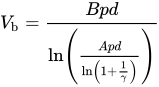
Friedrich Paschen established the relation between the breakdown condition to breakdown voltage. He derived a formula that defines the breakdown voltage () for uniform field gaps as a function of gap length () and gap pressure ().[5]


Paschen also derived a relation between the minimum value of pressure gap for which breakdown occurs with a minimum voltage.[5]
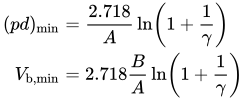
and are constants depending on the gas used.


Corona breakdown
[edit]Partial breakdown of the air occurs as a corona discharge on high voltage conductors at points with the highest electrical stress. Conductors that have sharp points, or balls with small radii, are prone to causing dielectric breakdown, because the field strength around points is higher than that around a flat surface. High-voltage apparatus is designed with rounded curves and grading rings to avoid concentrated fields that precipitate breakdown.
Appearance
[edit]Corona is sometimes seen as a bluish glow around high voltage wires and heard as a sizzling sound along high voltage power lines. Corona also generates radio frequency noise that can also be heard as ‘static’ or buzzing on radio receivers. Corona can also occur naturally as "St. Elmo's Fire" at high points such as church spires, treetops, or ship masts during thunderstorms.
Ozone generation
[edit]Corona discharge ozone generators have been used for more than 30 years in the water purification process. Ozone is a toxic gas, even more potent than chlorine. In a typical drinking water treatment plant, the ozone gas is dissolved into the filtered water to kill bacteria and destroy viruses. Ozone also removes the bad odours and taste from the water. The main advantage of ozone is that any residual overdose decomposes to gaseous oxygen well before the water reaches the consumer. This is in contrast with chlorine gas or chlorine salts, which stay in the water longer and can be tasted by the consumer.
Other uses
[edit]Although corona discharge is usually undesirable, until recently it was essential in the operation of photocopiers (xerography) and laser printers. Many modern copiers and laser printers now charge the photoconductor drum with an electrically conductive roller, reducing undesirable indoor ozone pollution.
Lightning rods use corona discharge to create conductive paths in the air that point towards the rod, deflecting potentially-damaging lightning away from buildings and other structures.[6]
Corona discharges are also used to modify the surface properties of many polymers. An example is the corona treatment of plastic materials which allows paint or ink to adhere properly.
Disruptive devices
[edit]
A disruptive device [citation needed] is designed to electrically overstress a dielectric beyond its dielectric strength so as to intentionally cause electrical breakdown of the device. The disruption causes a sudden transition of a portion of the dielectric, from an insulating state to a highly conductive state. This transition is characterized by the formation of an electric spark or plasma channel, possibly followed by an electric arc through part of the dielectric material.
If the dielectric happens to be a solid, permanent physical and chemical changes along the path of the discharge will significantly reduce the material's dielectric strength, and the device can only be used one time. However, if the dielectric material is a liquid or gas, the dielectric can fully recover its insulating properties once current through the plasma channel has been externally interrupted.
Commercial spark gaps use this property to abruptly switch high voltages in pulsed power systems, to provide surge protection for telecommunication and electrical power systems, and ignite fuel via spark plugs in internal combustion engines. Spark-gap transmitters were used in early radio telegraph systems.
See also
[edit]References
[edit]- ^ a b Ray, Subir (2013). An Introduction to High Voltage Engineering, 2nd Ed. PHI Learning Ltd. p. 1. ISBN 9788120347403.
- ^ Belkin, A.; Bezryadin, A.; Hendren, L.; Hubler, A. (2017). "Recovery of Alumina Nanocapacitors after High Voltage Breakdown". Scientific Reports. 7 (1): 932. Bibcode:2017NatSR...7..932B. doi:10.1038/s41598-017-01007-9. PMC 5430567. PMID 28428625.
- ^ Hong, Alice (2000). "Dielectric Strength of Air". The Physics Factbook.
- ^ "Lab Note #106 Environmental Impact of Arc Suppression". Arc Suppression Technologies. April 2011. Retrieved March 15, 2012.
- ^ a b Ray, Subir (2009). An Introduction to High Voltage Engineering. PHI Learning. pp. 19–21. ISBN 978-8120324176.
- ^ Young, Hugh D.; Roger A. Freedman; A. Lewis Ford (2004) [1949]. "Electric Potential". Sears and Zemansky's University Physics (11 ed.). San Francisco: Addison Wesley. pp. 886–7. ISBN 0-8053-9179-7.

| International | |
|---|---|
| National | |
| Other | |

Electrical breakdown
View on GrokipediaIntroduction
Definition and overview
Electrical breakdown, also known as dielectric breakdown, is the sudden transition of an insulating material from a non-conductive state to a highly conductive one when subjected to an electric field exceeding its dielectric strength. This failure results in a rapid increase in current flow, often forming a conductive path such as a spark, arc, or filament, which can cause permanent damage to the material. The phenomenon is characterized by the breakdown voltage, the minimum voltage required to initiate this transition, which depends on factors like material thickness, temperature, and electrode configuration.[11][2] The general process of electrical breakdown begins with the acceleration of free charge carriers (typically electrons) in the electric field, leading to impact ionization and an avalanche multiplication of carriers if the field is strong enough. This self-sustaining discharge can propagate through the dielectric, limited by mechanisms like carrier recombination or heat dissipation. Key influencing factors include the uniformity of the electric field, the presence of defects or impurities in the material, and external conditions such as pressure or humidity, which can lower the breakdown threshold. In quantitative terms, dielectric strength is often expressed in volts per unit length, with values ranging from about 3 kV/mm for air to over 100 kV/mm for advanced polymers under ideal conditions.[12][11][13] Electrical breakdown occurs across various media—gases, liquids, and solids—with distinct mechanisms and consequences in each. In gases, it frequently involves Townsend avalanches or streamers, allowing quick recovery of insulating properties; in liquids, bubble formation and streamer propagation dominate; while in solids, thermal runaway or electromechanical stresses often lead to irreversible degradation. This universality underscores its critical role in high-voltage engineering, where preventing breakdown ensures the reliability of power systems, capacitors, and insulation in devices like transformers and cables, mitigating risks of failures that could result in equipment damage or safety hazards. Seminal studies, such as those by Townsend on gas discharges, have laid the foundation for understanding these processes across media.[12][11]Historical context
The phenomenon of electrical breakdown has roots in 19th-century experiments with high-voltage electricity, where insulators began failing under strong electric fields, prompting initial investigations into dielectric limits. Early observations, such as those during the development of electrostatic generators like the Wimshurst machine in the 1880s, revealed sparking and material degradation, but systematic study awaited better instrumentation. By the late 1890s, researchers documented breakdown in air gaps, measuring spark lengths and voltages to quantify the process empirically.[14] In gases, foundational theories emerged in the early 20th century, driven by advances in vacuum tube technology and ionization studies. J.J. Thomson's 1897 discovery of the electron provided a key building block, but John Sealy Edward Townsend's experiments from 1899 to 1914 established the Townsend avalanche mechanism, where free electrons accelerate and ionize gas molecules, leading to multiplicative ionization. Earlier, in 1889, Friedrich Paschen formulated Paschen's law, empirically relating the breakdown voltage in gases to the product of pressure and electrode gap distance.[3] Townsend's ionization coefficients (α for primary ionization and γ for secondary emission) formalized the conditions for breakdown, with the criterion αd ≈ ln(1/γ) predicting spark formation across gaps of distance d. This work, detailed in his 1915 book Electricity in Gases, influenced high-voltage engineering and discharge physics.[15] The 1930s and 1940s saw refinements, particularly the streamer theory for rapid breakdown in gases at higher pressures. L.B. Loeb and J.M. Meek proposed in 1938 that avalanches could transition to positive streamers—branching plasma channels—when electron densities exceed 10^8 cm⁻³, accelerating propagation beyond Townsend's linear model. Independently, Hans Raether in 1939 derived a similar criterion, emphasizing space charge effects in uniform fields, which explained lightning-like discharges.[16] These developments were crucial for applications in gas-insulated switchgear and pulsed power systems. For solids and liquids, theoretical progress lagged behind gases due to material complexities but accelerated post-1930. In solids, Herbert Fröhlich's 1937 quantum mechanical theory modeled breakdown as electron acceleration in band structures, reaching runaway energies above a critical field (around 10^6 V/cm for many insulators), akin to Zener tunneling at high fields.[17] This built on Bloch's 1928 electron wave theory in crystals and influenced polymer dielectric design. In liquids, early 20th-century work by T.J. Lewis and others (1940s–1950s) identified bubble formation and electronic processes as key, with models like the 1960 anode-initiated avalanche by Sharbaugh and Watson integrating field-enhanced emission.[18] By mid-century, breakdown studies unified across media, supporting the growth of power transmission and electronics industries.Fundamental Concepts
Dielectric strength
Dielectric strength refers to the maximum electric field intensity that an insulating material can endure before electrical breakdown occurs, typically quantified in units such as kilovolts per millimeter (kV/mm) or volts per mil (V/mil). It represents the critical threshold at which the material transitions from insulating to conducting behavior under applied voltage stress, often due to mechanisms like avalanche ionization or thermal runaway. This property is fundamental to the design of capacitors, cables, and other high-voltage components, ensuring reliable insulation performance.[1] The standard measurement of dielectric strength follows procedures outlined in ASTM D149, where a sample of the insulating material is placed between two electrodes, and an increasing voltage—usually at commercial power frequencies (50-60 Hz)—is applied until dielectric breakdown is detected, marked by a sudden current surge or visible discharge. The dielectric strength is then calculated as the breakdown voltage divided by the sample thickness, with tests conducted under controlled conditions like short-time or stepwise voltage application to minimize heating effects. Common specimen thicknesses range from 0.8 to 3 mm, and results are averaged over multiple samples to account for variability.[19][20] Several factors influence dielectric strength, including material composition, environmental conditions, and test parameters. Moisture absorption significantly reduces strength in hygroscopic materials like paper or polymers by facilitating ion conduction and lowering the breakdown threshold. Temperature variations affect it nonlinearly: rising temperatures often decrease strength due to increased mobility of charge carriers, while cryogenic conditions can enhance it in some solids. Impurities, voids, or defects within the material act as initiation sites for breakdown, and electrode geometry—such as sharp protrusions—can concentrate fields and lower the effective strength. Additionally, the rate of voltage rise, frequency, and pressure play roles, with faster ramps or higher frequencies potentially yielding higher apparent strengths in gases and liquids.[21][22][23] In practice, dielectric strength values vary widely across materials, guiding their selection for specific applications. For instance, air at atmospheric pressure exhibits a modest strength suitable for low-voltage spacing, while engineered solids like mica provide exceptional performance in high-field environments. The following table summarizes representative values at room temperature for common dielectrics, highlighting the range of capabilities:| Material | Dielectric Strength (MV/m) | Typical Application |
|---|---|---|
| Air | 3 | Overhead lines, transformers |
| Paper | 16 | Wound capacitors |
| Glass | 9–13 | Insulators, bottles |
| Teflon | 60 | High-frequency cables |
| Mica | 100–300 | High-voltage capacitors |