Hubbry Logo
EnterocyteEnterocyteMain
Open search
Enterocyte
Community hub
Enterocyte
logo
8 pages, 0 posts
0 subscribers
Be the first to start a discussion here.
Enterocyte
Enterocyte
from Wikipedia
Enterocyte
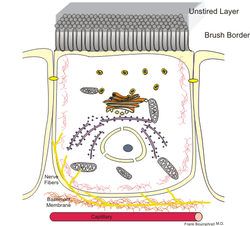
Schematic drawing of an enterocyte: the intestinal lumen is above the brush border.
Details
LocationSmall intestine
ShapeSimple columnar
FunctionEpithelial cells
Identifiers
Latinenterocytus
MeSHD020895
THH3.04.03.0.00006
FMA62122
Anatomical terms of microanatomy

Enterocytes, or intestinal absorptive cells, are simple columnar epithelial cells which line the inner surface of the small and large intestines. A glycocalyx surface coat contains digestive enzymes. Microvilli on the apical surface increase its surface area. This facilitates transport of numerous small molecules into the enterocyte from the intestinal lumen. These include broken down proteins, fats, and sugars, as well as water, electrolytes, vitamins, and bile salts. Enterocytes also have an endocrine role, secreting hormones such as leptin.

Function

[edit]

The major functions of enterocytes include:[1]

Clinical significance

[edit]
  • Dietary fructose intolerance occurs when there is a deficiency in the amount of fructose carrier.
  • Lactose intolerance is the most common problem of carbohydrate digestion and occurs when the human body doesn't produce a sufficient amount of lactase enzyme to break down the sugar lactose found in dairy. As a result of this deficiency, undigested lactose is not absorbed and is instead passed on to the colon. There bacteria metabolize the lactose and in doing so release gas and metabolic products that enhance colonic motility. This causes gas and other uncomfortable symptoms.
  • Cholera toxin may increase the secretion or decrease the intake of water and electrolytes, leading to possibly severe dehydration and electrolyte imbalance.[2]
  • Rotavirus selectively invades and kills mature enterocytes in the small intestine.[3]

Stem cell aging

[edit]

Intestinal stem cell aging has been studied in Drosophila as a model for understanding the biology of stem cell/niche aging.[4] Using knockdown mutants defective in various genes that function in the DNA damage response in enterocytes, it was shown that deficiency in the DNA damage response accelerates intestinal stem cell aging, thus providing a better understanding of the molecular mechanisms of this aging process.[4]

See also

[edit]

References

[edit]
[edit]
Revisions and contributorsEdit on WikipediaRead on Wikipedia
from Grokipedia
Enterocytes are polarized, columnar epithelial cells that form the majority of the absorptive lining in the , primarily responsible for the uptake and transport of dietary nutrients into the bloodstream or . These cells are characterized by their apical microvilli, which create a that dramatically increases surface area—up to 600-fold through villi and microvilli combined—for efficient absorption. Originating from stem cells at the base of intestinal crypts, enterocytes migrate upward along the villi, differentiating into mature absorptive cells over 3–5 days before being shed into the lumen, ensuring rapid renewal of the epithelial barrier. Their functions include active transport of carbohydrates via sodium-coupled glucose transporters (SGLT1), and peptides through specialized systems like PEPT1, and via micelle-mediated uptake followed by assembly in the . Additionally, enterocytes contribute to intestinal barrier integrity through tight junctions that regulate paracellular permeability and limit entry, while also participating in to food and microbial antigens.

Structure and Morphology

Cellular Morphology

Enterocytes are tall, columnar epithelial cells that constitute the majority of the absorptive lining in the . These cells exhibit a polarized structure, with an oval-shaped nucleus positioned basally, near the , and abundant concentrated apically to accommodate specialized organelles and projections. The reflects the high metabolic activity required for processing, with the basal region enriched in mitochondria for production and the apical domain dedicated to surface amplification for absorption. A prominent feature of enterocyte morphology is the striated border on the apical surface, visible under light microscopy as a series of fine striations resulting from densely packed microvilli. These microvilli, numbering approximately 2,000–3,000 per cell, are finger-like projections supported by cores, dramatically increasing the apical surface area by up to 600-fold to facilitate efficient nutrient uptake. Covering the microvilli is a layer, a fuzzy coat approximately 400–500 nm thick (occasionally up to 1 μm), composed primarily of glycoproteins and membrane-bound enzymes such as disaccharidases and peptidases, which contribute to the initial stages of and form a protective barrier against luminal contents. In terms of dimensions, mature enterocytes typically measure 20–30 μm in height, with a cylindrical shape that tapers slightly toward the apex. This height varies regionally along the , with the tallest enterocytes (around 30 μm) found in the , decreasing progressively to about 20 μm in the , reflecting adaptations to differing absorption demands in each segment.

Ultrastructure and Microvilli

Enterocytes exhibit a highly specialized adapted for their absorptive role in the . At the microscopic level, these cells display prominent organelles that support protein synthesis, processing, and degradation. The rough endoplasmic reticulum (RER) is abundant and involved in the synthesis of digestive enzymes and membrane proteins, such as the sucrase-isomaltase complex, with cisternae often positioned near the basolateral membrane. The Golgi apparatus, located centrally above the nucleus, plays a crucial role in packaging and glycosylating these enzymes before directing them to the apical surface. Lysosomes are distributed throughout the , particularly subapically, facilitating the degradation of internalized materials and maintaining cellular . The apical surface of enterocytes is dominated by the , consisting of densely packed that form finger-like projections. Each microvillus has a core composed of 20–40 parallel filaments, organized with barbed ends oriented toward the distal tip and pointed ends toward the base. These filaments are cross-linked by bundling proteins such as villin, espin, and fimbrin, which maintain the structural integrity and uniform polarity of the bundle. Myosin-1a, a class I myosin, forms lateral links between the actin core and the overlying plasma membrane, which is enriched with transport proteins embedded in a layer. Anchoring the microvilli to the underlying cytoplasm is the terminal web, a dense filamentous meshwork immediately beneath the apical membrane. This structure consists of intermediate filaments, including cytokeratins, interwoven with actin-myosin networks that connect the rootlets of adjacent microvillar actin bundles, providing mechanical stability and resistance to shear forces during peristalsis. A mature enterocyte bears approximately 2,000–3,000 microvilli, each about 1–2 μm in length and 0.1 μm in diameter, which collectively amplify the apical surface area by 20- to 30-fold relative to a smooth membrane, contributing to the overall 600-fold increase in intestinal absorptive capacity when combined with villi and plicae circulares. This amplification enhances the efficiency of nutrient uptake across the apical membrane.

Location and Distribution

In the Gastrointestinal Tract

Enterocytes are the primary epithelial cells lining the villi and crypts of the , encompassing the , , and , where they form a continuous absorptive layer on the mucosal surface. These cells are characterized by their apical microvilli, which amplify the surface area for nutrient uptake, and they are notably absent from the , whose glandular epithelium consists of mucous, parietal, and chief cells instead. In the , enterocytes are present in reduced numbers, with colonocytes serving as the dominant absorptive cells adapted for and reabsorption amid a higher microbial load. Regional variations in enterocyte distribution reflect functional adaptations along the . The jejunum hosts the densest population of enterocytes, supported by the tallest villi (typically 350–600 μm in height), which maximize the absorptive surface area for nutrient processing. In contrast, enterocyte proportions decline toward the , comprising approximately 95% of epithelial cells in the but dropping to about 80% in the , where increased goblet cells provide protective against the denser bacterial populations. Overall, enterocytes account for roughly 90% of the small intestinal epithelial cells, interspersed with goblet cells for and Paneth cells for defense. The distribution of enterocytes exhibits strong evolutionary conservation across mammals, consistently concentrating in the to support nutrient absorption from digested food. However, herbivores display variations, such as expanded regions with enhanced absorptive colonocytes, enabling microbial of fibrous material that is less efficiently handled in the . This adaptation underscores the flexibility of intestinal epithelial organization in response to dietary pressures while maintaining the core role of enterocytes in the proximal gut.

Epithelial Organization

Enterocytes form the predominant cell type in the lining the , where they are organized into finger-like projections known as villi that extend into the lumen and invaginations called crypts of Lieberkühn that extend into the underlying . This architectural arrangement maximizes the surface area for nutrient absorption while maintaining a single layer of polarized cells that separates the intestinal lumen from the internal environment. The lateral borders of adjacent enterocytes are sealed by tight junctions, which form a selective barrier preventing paracellular leakage of luminal contents and regulating and solute permeability. These junctions, composed primarily of proteins such as claudins, occludins, and zonula occludens, encircle the apical region of each cell, ensuring the integrity of the epithelial sheet. Enterocytes exhibit distinct apical-basal polarity, a hallmark of epithelial cells that dictates their functional specialization. The apical domain faces the intestinal lumen and is characterized by a dense array of microvilli forming the , which enhances through increased surface area and the presence of . In contrast, the basolateral domain interfaces with the and underlying tissues, facilitating the transport of absorbed nutrients into the bloodstream via capillaries or into lacteals for delivery. This polarity is maintained by intricate sorting mechanisms in the endocytic and exocytic pathways, ensuring that membrane proteins and s are correctly targeted to each domain. Within the epithelium, enterocytes are interspersed with other specialized cells, creating a heterogeneous monolayer that supports coordinated intestinal function. Goblet cells, which secrete mucus to lubricate and protect the epithelium, are distributed among enterocytes, forming a protective glycocalyx layer over the brush border. Enteroendocrine cells, scattered singly or in small clusters adjacent to enterocytes, release hormones such as cholecystokinin and glucagon-like peptide-1 in response to luminal stimuli, influencing motility and metabolism. M cells, specialized epithelial cells overlying lymphoid follicles, interact with enterocytes in follicle-associated epithelium by sampling antigens from the lumen and delivering them to underlying immune cells, thereby bridging absorption and immunity. The epithelial organization of enterocytes is dynamic, driven by continuous renewal to maintain barrier integrity against constant luminal challenges. New enterocytes originate from stem cells in the base and migrate upward along the villus axis, differentiating as they progress; this process completes in 3-5 days in humans, after which senescent cells are extruded at the villus tip without disrupting the . This migratory flux ensures rapid turnover, with the entire epithelial population replaced every few days, underscoring the tissue's remarkable regenerative capacity.

Development and Renewal

Stem Cell Origin

Enterocytes originate from the definitive , which forms during in the early embryonic stage of development. In humans, occurs around the third week post-fertilization, leading to the specification of the three germ layers, including the endoderm that gives rise to the gastrointestinal . By the fourth week, the posterior endoderm folds and elongates to form the primitive gut tube, marking the initial morphogenesis of the intestinal tract. The specification and patterning of the definitive are regulated by key transcription factors, including FoxA family members and GATA4/6. FoxA factors act as pioneer transcription factors that open and facilitate the activation of endodermal genes during this early phase. GATA4 and GATA6 are essential for endoderm formation, promoting cell migration and the expression of endodermal markers such as SOX17 and FOXA2 in response to signaling pathways like Nodal. These factors ensure the proper commitment of endodermal progenitors that will later differentiate into intestinal epithelial cells, including enterocytes. In the adult intestine, enterocytes are continuously generated from multipotent adult stem cells residing in the crypts of Lieberkühn. Lgr5+ crypt base columnar (CBC) cells, located at the base of the crypts interspersed with Paneth cells, serve as key progenitors for the entire small intestinal epithelium, actively cycling every 24 hours to maintain tissue homeostasis. However, recent studies indicate that Lgr5+ CBC cells originate from an upstream population in the upper crypt zone, marked by Fgfbp1, highlighting plasticity in the stem cell hierarchy. Lineage tracing experiments demonstrate that individual Lgr5+ cells can clonally expand to produce all epithelial lineages, including enterocytes, through symmetric proliferative divisions that stochastically yield stem cell daughters or committed transit-amplifying progenitors. Recent studies using intestinal models derived from these s have confirmed the critical role of Wnt and Notch signaling in sustaining Lgr5+ stemness and progenitor expansion. Wnt signaling, via ligands from the niche, maintains Lgr5 expression and crypt proliferation, while Notch promotes fate by suppressing differentiation. Single-cell sequencing analyses post-2020 have further uncovered heterogeneity within these populations, revealing distinct transcriptional states—such as Wnt-high active stem cells and more quiescent reserve-like subsets—along the intestinal tract, which contribute to robust epithelial renewal. Advances as of 2024 emphasize bidirectional regeneration and upper contributions to Lgr5+ renewal.

Differentiation and Maturation

Enterocytes originate from progenitor cells derived from intestinal stem cells located at the base of crypts. These progenitors give rise to transit-amplifying (TA) cells, which undergo rapid proliferation within the crypts, generating a continuous supply of new cells that push upward along the crypt-villus axis. This proliferative phase ensures the high turnover rate of the intestinal epithelium, with TA cells dividing multiple times before committing to differentiation. As TA cells migrate out of the crypts toward the villus base, they begin to differentiate, marked by the expression of key enzymes associated with enterocyte function. Alkaline phosphatase (ALP), a brush border enzyme involved in dephosphorylation, emerges as an early differentiation marker, becoming prominent as cells exit the proliferative compartment. Similarly, sucrase-isomaltase (SI), which hydrolyzes carbohydrates, is upregulated at the villus base, signaling the onset of absorptive capabilities. These markers reflect the progressive loss of proliferative potential and the acquisition of specialized features. Maturation of enterocytes occurs along the villus axis, with full functionality typically achieved by the mid-villus position. The entire migration from to villus tip spans approximately 4-5 days in mice, during which cells transition from immature progenitors to fully polarized enterocytes. This process is tightly regulated by (BMP) signaling: inhibition of BMP in the crypts maintains proliferation of TA cells, while activation along the villus—driven by a of BMP ligands from subepithelial mesenchymal cells—promotes differentiation and zonation of . For instance, BMP4 supports metabolic programs in the villus center, and drives terminal changes at the tip. Recent epigenetic studies have elucidated the role of modifications in fine-tuning this maturation. Post-2020 research highlights that , a repressive mark deposited by the Polycomb repressive complex 2 (PRC2), silences stem cell-associated genes during enterocyte ascent, thereby enabling the activation of enzyme genes like those encoding ALP and SI. Loss of leads to premature derepression and disrupted maturation, underscoring its importance in maintaining the balance between proliferation and differentiation.

Functions

Nutrient Absorption

Enterocytes play a central role in the absorption of dietary from the intestinal lumen into the bloodstream, primarily through specialized transporters located on their apical and basolateral membranes. This process occurs mainly in the , where the brush border microvilli enhance surface area for efficient uptake. are absorbed via transcellular pathways, involving across the enterocyte, or paracellular routes, which allow passive between cells. Carbohydrate absorption begins with the enzymatic hydrolysis of disaccharides, such as lactose, by lactase-phlorizin hydrolase (LPH), a brush-border enzyme that cleaves lactose into glucose and galactose. Glucose and galactose are then actively transported across the apical membrane via the sodium-glucose linked transporter 1 (SGLT1), a secondary active symporter that couples their uptake to the sodium electrochemical gradient established by the Na+/K+-ATPase on the basolateral side. Once inside the enterocyte, these monosaccharides exit through the basolateral membrane via the facilitative transporter GLUT2, facilitating their diffusion into the bloodstream. Protein digestion products, including di- and tripeptides, are absorbed primarily through the proton-coupled peptide transporter 1 (PepT1, SLC15A1) on the apical membrane, which uses the proton gradient generated by the Na+/H+ exchanger to drive uptake. Free amino acids, particularly neutral ones, are transported via sodium-dependent symporters such as B⁰AT1 (SLC6A19), which operates on the apical surface and requires collectrin or ACE2 as a trafficking partner for proper membrane localization. These transporters ensure efficient delivery of amino acids and peptides to the enterocyte cytosol before basolateral export. Lipid absorption relies on the formation of mixed micelles in the lumen, which solubilize monoglycerides and free fatty acids for across the apical , facilitated by scavenger receptor CD36. Inside the enterocyte, fatty acids are bound by intracellular fatty acid-binding proteins (FABPs), such as intestinal FABP (I-FABP) and liver FABP (L-FABP), which shuttle to the for re-esterification into . assembly occurs in the ER, mediated by microsomal triglyceride transfer protein (MTP), which transfers onto apolipoprotein B48 to form particles that are secreted via the basolateral into lacteals. Electrolytes and certain vitamins are absorbed through specific carriers; for instance, calcium ions (Ca²⁺) enter the apical membrane via the transient receptor potential vanilloid 6 channel (TRPV6), enabling vitamin D-regulated transcellular absorption. ions (Cl⁻) are modulated in enterocytes, with CFTR primarily facilitating secretion but influencing overall homeostasis during absorption processes. The paracellular pathway, regulated by tight junctions, supports passive absorption of ions like sodium (Na⁺) and , complementing transcellular mechanisms for smaller solutes but playing a minor role in active uptake.

Barrier and Secretory Roles

Enterocytes play a in maintaining the intestinal barrier through the formation of tight junctions, which seal the paracellular space between adjacent cells to prevent the translocation of pathogens and toxins from the luminal contents into the underlying tissues. These tight junctions are primarily composed of transmembrane proteins such as and various claudins, which regulate ion permeability and macromolecular flux while preserving epithelial integrity. For instance, contributes to the barrier by modulating the passage of larger molecules, whereas claudins like claudin-1 and claudin-3 form selective pores that restrict bacterial penetration without compromising access. This selective permeability is essential for shielding the host from microbial invasion while allowing controlled exchange. In addition to tight junctions, enterocytes interact with the overlying mucus layer to enhance the physical barrier against pathogens. The apical surface of enterocytes, covered by a glycocalyx, interfaces with mucins secreted primarily by goblet cells, forming a gel-like matrix that traps bacteria and impedes their adhesion to the epithelium. This interaction creates a diffusion barrier in the small intestine, where mucus remains penetrable to nutrients but slows microbial motility, promoting clearance through peristalsis and reducing direct contact with enterocyte membranes. Such synergy between enterocytes and mucus constituents fortifies the first line of defense in the gastrointestinal tract. Enterocytes also contribute to digestive processes through apical secretion of enzymes that facilitate luminal breakdown of nutrients. A key example is , a brush-border released by duodenal enterocytes that cleaves pancreatic to active , initiating a cascade of proteolytic activations essential for protein . This secretion occurs via at the microvillar membrane, ensuring localized activity without systemic effects. On the immune front, enterocytes express receptors such as Toll-like receptors (TLRs), particularly TLR4 on their apical surface, enabling detection of microbial motifs without eliciting overt . Upon binding, these receptors trigger intracellular signaling pathways that lead to controlled release of cytokines like interleukin-8 (IL-8), recruiting immune cells while maintaining barrier . This modulated response helps in microbial surveillance and tolerance to commensal bacteria, preventing excessive inflammatory cascades in the steady state. Finally, enterocytes regulate water and balance through vectorial transport driven by the basolateral Na⁺/K⁺- pump, which maintains low intracellular Na⁺ levels to power apical Na⁺ entry via coupled transporters. This gradient facilitates osmotic water absorption, with the pump extruding three Na⁺ ions in exchange for two K⁺, ensuring hydration and preventing luminal fluid accumulation. underpins this process, with the localized to the basolateral domain for directional flux.

Clinical Significance

Associated Diseases

Enterocytes play a central role in various syndromes characterized by their dysfunction or damage. In celiac disease, ingestion of triggers an autoimmune response that leads to villous and crypt in the small intestinal enterocytes, reducing absorption; this process is mediated by (tTG), which deamidates peptides to enhance their for T-cell activation, leading to the production of anti-tTG IgA antibodies that drive the autoimmune response. , an acquired disorder prevalent in tropical regions, involves chronic and infectious agents that cause partial villous flattening and enterocyte injury, resulting in of fats, vitamins, and carbohydrates. Infections directly target enterocytes, disrupting their absorptive and barrier functions. primarily infects mature villus-tip enterocytes in the , where its nonstructural protein NSP4 acts as an enterotoxin to increase intracellular calcium and activate secretion, leading to osmotic without overt tissue destruction. Similarly, produced by binds to gangliosides on enterocyte surfaces, entering the cells to ADP-ribosylate Gsα and elevate cAMP levels, which opens CFTR channels and causes massive secretory through anion efflux into the lumen. Genetic defects in enterocyte transporters and enzymes cause specific malabsorption disorders. Congenital sucrase-isomaltase deficiency arises from biallelic mutations in the SI gene, impairing the enzyme's trafficking to the brush border and leading to osmotic diarrhea upon sucrose or starch ingestion due to undigested carbohydrates fermenting in the gut. Glucose-galactose malabsorption results from mutations in the SLC5A1 gene encoding SGLT1, a sodium-dependent cotransporter on enterocytes that fails to absorb glucose and galactose, causing severe neonatal dehydration from osmotic diarrhea. Inflammatory conditions like prominently affect ileal enterocytes, where chronic inflammation induces barrier dysfunction through disruption and increased permeability, facilitating bacterial translocation from the lumen to the mucosa and perpetuating immune activation. Post-2020 research has further implicated gut in exacerbating enterocyte in , where reduced microbial diversity and overgrowth of pathobionts like adherent-invasive promote epithelial via pro-inflammatory cytokines and .

Diagnostic and Therapeutic Implications

Diagnostic assessment of enterocyte health primarily relies on invasive and non-invasive methods to evaluate structural integrity, enzymatic function, and inflammatory status. Duodenal biopsy remains a cornerstone for quantifying enterocyte damage, particularly through measurement of the villus height to crypt depth ratio, which is reduced in conditions like celiac disease due to villous atrophy. In pediatric patients with celiac disease, this ratio averages 0.78 compared to 1.89 in controls, with software-assisted analysis of biopsies providing high sensitivity and specificity when combined with intraepithelial lymphocyte counts per 100 enterocytes. Breath tests offer a non-invasive alternative for detecting disaccharidase deficiencies affecting enterocyte brush border enzymes, such as sucrase-isomaltase, by measuring hydrogen or methane exhalation after substrate ingestion; for instance, the sucrose hydrogen breath test yields positive results in about 26% of adults with chronic gastrointestinal symptoms attributable to these deficiencies. Fecal calprotectin serves as a biomarker for enterocyte-associated intestinal inflammation, with elevated levels (>50 μg/g) indicating neutrophil migration and mucosal injury in over 95% of inflammatory bowel disease cases, correlating with disease activity and predicting relapse with high specificity. Imaging techniques further aid in visualizing enterocyte damage without direct tissue sampling. Capsule endoscopy, particularly panenteric systems like PillCam Crohn’s, effectively detects mucosal erosions and ulcers indicative of enterocyte injury in inflammatory conditions, achieving a diagnostic yield of 83.3% for small bowel inflammation, surpassing traditional ileo-colonoscopy. Post-2020 advancements incorporate artificial intelligence to enhance analysis of mucosal patterns; for example, convolutional neural network-based tools in systems like OMOM® HD and PillCam™ achieve 98.6% sensitivity for lesion detection, reducing reading times by over 90% while grading inflammation severity with 92.4% accuracy, thereby improving early identification of subtle enterocyte alterations. Therapeutic interventions target enterocyte dysfunction to restore absorption and barrier integrity. In celiac disease, where gluten triggers immune-mediated enterocyte destruction, a strict gluten-free diet is the standard treatment, promoting mucosal healing and villous regeneration in 95% of children within two years and 66% of adults after five years by eliminating gliadin-induced inflammation. For disaccharidase deficiencies impairing enterocyte carbohydrate hydrolysis, enzyme replacement therapy with agents like sacrosidase (Sucraid) alleviates symptoms such as diarrhea and bloating, normalizing breath test results and enabling dietary liberalization. Probiotics support enterocyte barrier repair by enhancing tight junction proteins like zonula occludens-1 and occludin, increasing transepithelial resistance, and upregulating mucin expression (e.g., MUC2) in epithelial models, thereby reducing permeability in inflammatory states. Experimental stem cell transplants, involving intestinal stem cell-derived organoids, show promise for severe enterocyte disorders like microvillus inclusion disease, with preclinical rodent models demonstrating engraftment and functional epithelial restoration after gene-corrected cell delivery. Enterocyte-targeted drug delivery leverages the apical microvilli for improved oral bioavailability of therapeutics. Nanoparticles designed for enterocyte transcytosis, typically 50-200 nm in size, exploit endocytic pathways at the brush border to bypass harsh gastrointestinal conditions, facilitating uptake across the epithelium for biologics and enhancing absorption efficiency in preclinical intestinal models.

Aging and Regeneration

Stem Cell Aging

Aging significantly impacts the intestinal stem cells (ISCs) responsible for enterocyte production, primarily through the accumulation of DNA damage in Lgr5+ cells, which impairs their proliferative capacity. In Lgr5+ ISCs, age-related dysregulation of the DNA damage response (DDR) leads to unrepaired DNA lesions, reducing cell division and regenerative potential. This damage arises from oxidative stress and replication errors, compromising the stem cell pool at the crypt base. Concurrently, reduced canonical Wnt signaling in aged ISCs promotes biased differentiation toward secretory lineages rather than balanced enterocyte renewal, exacerbating functional decline. These mechanisms collectively diminish the stem cell reserve, limiting enterocyte turnover efficiency. Model organism studies have elucidated these processes. In Drosophila, deficiency in the DDR within enterocytes accelerates ISC aging by increasing oxidative stress sensitivity and disrupting homeostasis, as demonstrated by elevated γ-H2AX markers of DNA damage in aged intestinal stem cells. In mouse models, telomere shortening in Lgr5+ ISCs with advancing age occurs even in the presence of high telomerase activity. In humans, age-related decline in crypt stem cell reserve contributes to overall frailty by impairing intestinal regeneration and nutrient absorption capacity. Post-2020 research has shown that senolytics, such as dasatinib combined with quercetin, can rejuvenate ISC function in aged organoids by clearing senescent cells and restoring proliferative vigor.

Impact on Intestinal Homeostasis

Enterocytes play a crucial role in maintaining intestinal through their rapid turnover, which occurs every 3-5 days in the , ensuring continuous renewal of the epithelial barrier to prevent microbial translocation and support structural integrity. This dynamic process allows for the replacement of damaged cells, preserving the gut's selective permeability and immune defense mechanisms under normal conditions. However, with aging, the turnover rate slows due to diminished proliferative capacity in the epithelial compartment, leading to delayed barrier repair, increased (often termed "leaky gut"), and heightened susceptibility to infections from luminal pathogens. Aged enterocytes contribute to dysbiosis by altering the physicochemical properties of mucosal niches, such as reduced mucus production and altered metabolite secretion, which favor the overgrowth of pathogenic bacteria while diminishing beneficial microbial diversity. This shift disrupts the symbiotic balance, exacerbating inflammation and compromising host-microbe interactions essential for gut stability. Concurrently, aging impairs enterocyte-mediated nutrient absorption, particularly of proteins, vitamins, and minerals, resulting in systemic malnutrition that further weakens intestinal resilience and amplifies age-related frailty. In terms of regenerative capacity, +4 position reserve stem cells can activate following injury in aged intestines to support epithelial reconstitution, yet this process often yields suboptimal outcomes characterized by excessive deposition and , hindering full tissue restoration. Recent studies since 2020 have highlighted how /TAZ signaling pathways modulate this decline. Impaired enterocyte-driven in aging propagates systemic consequences, including contributions to through gut-muscle axis dysregulation and nutrient deficits that undermine muscle protein synthesis. Additionally, it fosters immune by promoting chronic low-grade via the gut-liver axis, where leaky barriers allow bacterial products to translocate and activate hepatic immune responses, accelerating organism-wide immunologic exhaustion.

References

Add your contribution
Related Hubs
User Avatar
No comments yet.