Hubbry Logo
AdipocyteAdipocyteMain
Open search
Adipocyte
Community hub
Adipocyte
logo
8 pages, 0 posts
0 subscribers
Be the first to start a discussion here.
Adipocyte
Adipocyte
from Wikipedia
Adipocyte
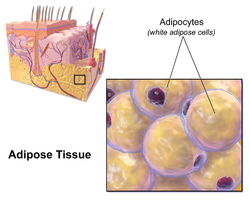
Illustration depicting white fat cells.
Morphology of three different classes of adipocytes
Details
Identifiers
Latinadipocytus
MeSHD017667
THH2.00.03.0.01005
FMA63880
Anatomical terms of microanatomy

Adipocytes, also known as lipocytes and fat cells, are the cells that primarily compose adipose tissue, specialized in storing energy as fat.[1] Adipocytes are derived from mesenchymal stem cells which give rise to adipocytes through adipogenesis. In cell culture, adipocyte progenitors can also form osteoblasts, myocytes and other cell types.

There are two types of adipose tissue, white adipose tissue (WAT) and brown adipose tissue (BAT), which are also known as white and brown fat, respectively, and comprise two types of fat cells.

Structure

[edit]

White fat cells

[edit]
A brown fat cell.
Yellow adipose tissue in paraffin.

White fat cells contain a single large lipid droplet surrounded by a layer of cytoplasm, and are known as unilocular. The nucleus is flattened and pushed to the periphery. A typical fat cell is 0.1 mm in diameter[2] with some being twice that size, and others half that size. However, these numerical estimates of fat cell size depend largely on the measurement method and the location of the adipose tissue.[2] The fat stored is in a semi-liquid state, and is composed primarily of triglycerides, and cholesteryl ester. White fat cells secrete many proteins acting as adipokines such as resistin, adiponectin, leptin and apelin. An average human adult has 30 billion fat cells with a weight of 30 lbs or 13.5 kg. If a child or adolescent gains sufficient excess weight, fat cells may increase in absolute number until age twenty-four.[3] If an adult (who never was obese as a child or adolescent) gains excess weight, fat cells generally increase in size, not number, though there is some inconclusive evidence suggesting that the number of fat cells might also increase if the existing fat cells become large enough (as in particularly severe levels of obesity).[3] The number of fat cells is difficult to decrease through dietary intervention, though some evidence suggests that the number of fat cells can decrease if weight loss is maintained for a sufficiently long period of time (>1 year; though it is extremely difficult for people with larger and more numerous fat cells to maintain weight loss for that long a time).[3]

A large meta-analysis has shown that white adipose tissue cell size is dependent on measurement methods, adipose tissue depots, age, and body mass index; for the same degree of obesity, increases in fat cell size were also associated with the dysregulations in glucose and lipid metabolism.[2]

Brown fat cells

[edit]

Brown fat cells are polyhedral in shape. Brown fat is derived from dermatomyocyte cells. Unlike white fat cells, these cells have considerable cytoplasm, with several lipid droplets scattered throughout, and are known as multilocular cells. The nucleus is round and, although eccentrically located, it is not in the periphery of the cell. The brown color comes from the large quantity of mitochondria. Brown fat, also known as "baby fat," is used to generate heat.

Marrow fat cells

[edit]

Marrow adipocytes are unilocular like white fat cells. The marrow adipose tissue depot is poorly understood in terms of its physiologic function and relevance to bone health. Marrow adipose tissue expands in states of low bone density but additionally expands in the setting of obesity.[4] Marrow adipose tissue response to exercise approximates that of white adipose tissue.[4][5][6][7] Exercise reduces both adipocyte size as well as marrow adipose tissue volume, as quantified by MRI or μCT imaging of bone stained with the lipid binder osmium.

Development

[edit]
Lipoblast features on histology, H&E stain.

Pre-adipocytes are undifferentiated fibroblasts that can be stimulated to form adipocytes. Studies have shed light into potential molecular mechanisms in the fate determination of pre-adipocytes although the exact lineage of adipocyte is still unclear.[8][9] The variation of body fat distribution resulting from normal growth is influenced by nutritional and hormonal status dependent on intrinsic differences in cells found in each adipose depot.[10]

Mesenchymal stem cells can differentiate into adipocytes, connective tissue, muscle or bone.[1]

The precursor of the adult cell is termed a lipoblast, and a tumor of this cell type is known as a lipoblastoma.[11]

Function

[edit]

Cell turnover

[edit]

Fat cells in some mice have been shown to drop in count due to fasting and other properties were observed when exposed to cold.[12]

If the adipocytes in the body reach their maximum capacity of fat, they may replicate to allow additional fat storage.

Adult rats of various strains became obese when they were fed a highly palatable diet for several months. Analysis of their adipose tissue morphology revealed increases in both adipocyte size and number in most depots. Reintroduction of an ordinary chow diet[13] to such animals precipitated a period of weight loss during which only mean adipocyte size returned to normal. Adipocyte number remained at the elevated level achieved during the period of weight gain.[14]

According to some reports and textbooks, the number of adipocytes can increase in childhood and adolescence, though the amount is usually constant in adults. Individuals who become obese as adults, rather than as adolescents, have no more adipocytes than they had before.[15]

People who have been fat since childhood generally have an inflated number of fat cells. People who become fat as adults may have no more fat cells than their lean peers, but their fat cells are larger. In general, people with an excess of fat cells find it harder to lose weight and keep it off than the obese who simply have enlarged fat cells.[3]

Body fat cells have regional responses to the overfeeding that was studied in adult subjects. In the upper body, an increase of adipocyte size correlated with upper-body fat gain; however, the number of fat cells was not significantly changed. In contrast to the upper body fat cell response, the number of lower-body adipocytes did significantly increase during the course of experiment. Notably, there was no change in the size of the lower-body adipocytes.[16]

Approximately 10% of fat cells are renewed annually at all adult ages and levels of body mass index without a significant increase in the overall number of adipocytes in adulthood.[15]

Adaptation

[edit]

Obesity is characterized by the expansion of fat mass, through adipocyte size increase (hypertrophy) and, to a lesser extent, cell proliferation (hyperplasia).[17][2] In the fatty tissue of obese individuals, there is increased production of metabolism modulators, such as glycerol, hormones, macrophage-stimulating chemokines, and pro-inflammatory cytokines, leading to the development of insulin resistance.[18] Production of these modulators and the resulting pathogenesis of insulin resistance are probably caused by adipocytes as well as immune system macrophages that infiltrate the tissue.[19]

Fat production in adipocytes is strongly stimulated by insulin. By controlling the activity of the pyruvate dehydrogenase and the acetyl-CoA carboxylase enzymes, insulin promotes unsaturated fatty acid synthesis. It also promotes glucose uptake and induces SREBF1, which activates the transcription of genes that stimulate lipogenesis.[20]

SREBF1 (sterol regulatory element-binding transcription factor 1) is a transcription factor synthesized as an inactive precursor protein inserted into the endoplasmic reticulum (ER) membrane by two membrane-spanning helices. Also anchored in the ER membrane is SCAP (SREBF-cleavage activating protein), which binds SREBF1. The SREBF1-SCAP complex is retained in the ER membrane by INSIG1 (insulin-induced gene 1 protein). When sterol levels are depleted, INSIG1 releases SCAP and the SREBF1-SCAP complex can be sorted into transport vesicles coated by the coatomer COPII that are exported to the Golgi apparatus. In the Golgi apparatus, SREBF1 is cleaved and released as a transcriptionally active mature protein. It is then free to translocate to the nucleus and activate the expression of its target genes.[21]

Proteolytic activation of SREBF-controlled lipid biosynthesis.

Clinical studies have repeatedly shown that even though insulin resistance is usually associated with obesity, the membrane phospholipids of the adipocytes of obese patients generally still show an increased degree of fatty acid unsaturation.[22] This seems to point to an adaptive mechanism that allows the adipocyte to maintain its functionality, despite the increased storage demands associated with obesity and insulin resistance.

A study conducted in 2013[22] found that, while INSIG1 and SREBF1 mRNA expression was decreased in the adipose tissue of obese mice and humans, the amount of active SREBF1 was increased in comparison with normal mice and non-obese patients. This downregulation of INSIG1 expression combined with the increase of mature SREBF1 was also correlated with the maintenance of SREBF1-target gene expression. Hence, it appears that, by downregulating INSIG1, there is a resetting of the INSIG1/SREBF1 loop, allowing for the maintenance of active SREBF1 levels. This seems to help compensate for the anti-lipogenic effects of insulin resistance and thus preserve adipocyte fat storage abilities and availability of appropriate levels of fatty acid unsaturation in face of the nutritional pressures of obesity.

Endocrine role

[edit]

Adipocytes can synthesize estrogens from androgens,[23] potentially being the reason why being underweight or overweight are risk factors for infertility.[24] Additionally, adipocytes are responsible for the production of the hormone leptin. Leptin is important in regulation of appetite and acts as a satiety factor.[25]

See also

[edit]

References

[edit]
[edit]
Revisions and contributorsEdit on WikipediaRead on Wikipedia
from Grokipedia
An adipocyte, commonly known as a cell, is a specialized cell that primarily functions as an energy reservoir by storing , mainly in the form of triglycerides, within a large central that occupies most of the cell volume, displacing the nucleus and to the periphery. These cells are the predominant component of , a dynamic organ that not only buffers energy fluctuations but also acts as an by secreting adipokines such as and to regulate , insulin sensitivity, and systemic . Adipocytes originate from mesenchymal stem cells in the stromal vascular fraction of and exhibit remarkable plasticity, expanding or contracting in response to nutritional cues to maintain and prevent ectopic deposition in organs like the liver and muscle. Mammals possess three main types of adipocytes, each with distinct morphological and functional properties: adipocytes, which dominate () and specialize in long-term through and release via ; adipocytes, found in () and characterized by multiple small droplets and iron-rich mitochondria expressing uncoupling protein 1 () for non-shivering to generate heat; and adipocytes, which arise within under stimuli like cold exposure or β-adrenergic signaling, acquiring thermogenic capabilities similar to adipocytes while retaining some adipocyte features. A fourth type, pink adipocytes, emerges transiently in subcutaneous during and in , facilitating secretion. These types differ in origin—white and from Myf5-negative progenitors, from Myf5-positive precursors—highlighting adipose tissue's developmental diversity and depot-specific roles, such as subcutaneous versus visceral in influencing metabolic health. Beyond and , adipocytes play pivotal roles in glucose homeostasis, modulation, and protection against metabolic disorders by secreting over 600 factors that communicate with distant organs, including the , liver, and . Dysfunctional adipocyte expansion, as seen in , leads to , , and impaired endocrine signaling, contributing to , , and through mechanisms like chronic low-grade and . Recent advances in have further refined our understanding of adipocyte heterogeneity, revealing transitional states and microenvironmental influences on their fate, including 2025 studies identifying depot-specific adipocyte subpopulations associated with metabolic outcomes in , underscoring their central position in metabolic adaptability and disease pathogenesis.

Overview and Classification

Definition and Role in the Body

Adipocytes, also known as fat cells, are specialized cells of that primarily function to store in the form of , particularly triglycerides, while also providing insulation and mechanical cushioning to the body. These cells originate from mesenchymal precursor cells within the stromal vascular fraction of , undergoing a differentiation process known as to become mature lipid-laden cells. In humans, the total number of adipocytes is established during childhood and adolescence, with adults typically possessing 20–60 billion such cells on average, though this can vary based on factors like and status. Adipocytes are distributed across various depots in the body, including subcutaneous adipose tissue beneath the skin, visceral adipose tissue surrounding internal organs such as the liver and intestines, and intra-organ depots like epicardial fat around the heart. These locations allow adipocytes to serve as a dynamic energy reservoir, storing excess caloric intake during periods of abundance and mobilizing fatty acids through lipolysis when energy demands increase, such as during fasting or exercise. Beyond energy homeostasis, adipocytes contribute to thermal insulation by reducing heat loss from the body and offer mechanical protection by cushioning vital organs against physical trauma. From an evolutionary perspective, adipocytes play a crucial role in maintaining energy balance, enabling survival during periods of food scarcity or famine by providing a readily accessible reserve of calories that can sustain vital functions. This adaptation underscores the importance of adipose tissue as a metabolic buffer in fluctuating nutritional environments. Historically, adipocytes were first recognized as distinct cellular entities in the 19th century by anatomists studying connective tissues, marking the beginning of systematic investigations into their structure and function. While adipocytes are broadly classified into types such as white, brown, and beige based on their metabolic properties, their core role remains centered on lipid management across all variants.

Types of Adipocytes

White adipocytes represent the predominant type of fat cells in adults, characterized by a unilocular morphology with a single large that occupies most of the cell volume, enabling efficient long-term primarily as triglycerides. These cells are distributed across subcutaneous depots beneath the skin and visceral depots surrounding internal organs, collectively accounting for the majority (~90%) of total body fat storage. In contrast, brown adipocytes are multilocular cells containing multiple small droplets and a dense concentration of mitochondria, adaptations that support their primary function of through uncoupled respiration. These cells are concentrated in specific depots, such as the interscapular region in infants for non-shivering heat production, and persist into adulthood in areas like the and along the spine. Beige adipocytes constitute an inducible subtype of multilocular cells that arise within adipose depots in response to environmental or hormonal stimuli, including exposure and β-adrenergic signaling, thereby exhibiting thermogenic capabilities that bridge and adipocyte functions. This subtype was characterized in emerging in the early , highlighting their role as an adaptive thermogenic reserve. Specialized variants include marrow adipocytes, which populate and regulate hematopoiesis as a distinct adipocyte subtype, and pink adipocytes, which transiently form in mammary glands during to support and are also derived from adipocyte lineages. Adipocyte distribution evolves postnatally, with expanding to accommodate increasing energy storage demands, regressing after infancy while retaining adult depots for metabolic flexibility, and beige adipocytes emerging as an inducible response to physiological stressors.

Cellular Structure and Morphology

General Features

Adipocytes are defined by their unique cellular architecture, featuring a prominent central that occupies up to 90% of the cell volume and primarily stores triglycerides. This droplet is enveloped by a that interfaces with the surrounding , maintaining structural integrity while allowing metabolic interactions. The dominance of the lipid droplet compresses the nucleus and other organelles to the cell periphery, creating a thin cytoplasmic rim that encases the storage core. Within this peripheral cytoplasm, essential organelles support cellular maintenance and lipid handling. The endoplasmic reticulum plays a key role in de novo lipid synthesis, facilitating the assembly of triglycerides from fatty acids and . The Golgi apparatus handles protein processing, , and packaging for or integration, while lysosomes contribute to the degradation of cellular waste and damaged components through hydrolytic enzymes. The of adipocytes is adapted for tissue integration and responsiveness, incorporating that anchor the cell to the via adhesion to and . Caveolae, flask-shaped invaginations rich in caveolin proteins, cluster signaling molecules and regulate mechanosensing and lipid transport at the membrane surface. Adipocyte size varies typically from 50 to 200 μm in , allowing flexibility in lipid storage capacity while the consistently dominates the intracellular volume. Electron provides high-resolution views of the 's and peripheral arrangement, revealing fine structural details not visible by light . In histological preparations, staining specifically targets neutral lipids, imparting a red coloration to the droplets for clear visualization in frozen tissue sections. While these general features are shared across adipocyte types, subtle variations exist in distribution and droplet characteristics.

Type-Specific Variations

adipocytes are characterized by a single large unilocular that occupies most of the cell volume, accompanied by few mitochondria and sparse , which optimizes the cell for efficient storage. This morphology results in a flattened nucleus pushed to the cell periphery and minimal intracellular space for other organelles. In contrast, brown adipocytes feature multiple small droplets distributed throughout the , creating a multilocular appearance, along with abundant mitochondria rich in uncoupling protein 1 () that supports uncoupled respiration. These cells also exhibit a dense network for enhanced nutrient and oxygen delivery, and their characteristic brown pigmentation arises from iron-containing in the mitochondria. The nucleus is typically centrally located amid the lipid droplets and organelles. Beige adipocytes display a transitional multilocular morphology with inducible expression in their mitochondria, featuring an intermediate density of these organelles compared to and types. They exhibit heterogeneity across depots, with some cells showing clustered small droplets and others retaining larger ones, and their nucleus often shifts from a peripheral to a more central position upon activation. Vascularization in beige adipocytes is generally less dense than in brown but more prominent than in . Pink adipocytes, which appear transiently in the during late and in and other mammals, undergo from white adipocytes, resulting in smaller cells with reduced and fragmented droplets, enhanced secretory machinery, and an intermediate morphology between adipocytes and milk-producing alveoli to facilitate lipid transfer for production. Upon , they revert to white adipocyte morphology.
FeatureWhite AdipocytesBrown AdipocytesBeige AdipocytesPink Adipocytes
Lipid Droplet NumberSingle (unilocular)Multiple (multilocular)Multiple (transitional multilocular)Reduced/fragmented (transient)
Mitochondrial DensityLowHigh (-rich)Intermediate (inducible )Low (similar to white)
VascularizationSparseDense capillary networkModerate, variable by depotEnhanced in context
PigmentationNone (pale)Brown (iron in )Pale to light brownNone (pale)
Recent 3D studies from the 2020s have demonstrated that adipocytes dynamically acquire brown-like organelles, such as increased mitochondria and multilocular droplets, while initially retaining a more white-like overall structure that adapts in response to stimuli. These structural variations underpin the specialized roles of each adipocyte type in .

Development and Differentiation

Embryonic and Postnatal Origins

Adipocytes arise during embryonic development from the , primarily through the differentiation of mesenchymal stem cells (MSCs). These MSCs, derived from mesodermal progenitors, give rise to various lineages, including adipocytes, under the influence of spatiotemporal cues in the developing . Lineage tracing studies have established that white adipocytes predominantly originate from the for visceral depots and from somitic mesoderm (dermatomes) for subcutaneous depots, highlighting a depot-specific embryonic patterning that contributes to the heterogeneous distribution of . In contrast, brown adipocytes primarily derive from the paraxial , specifically somite-derived myogenic precursors expressing markers such as Myf5 and Pax7, which commit to the adipogenic lineage during early embryogenesis. Certain brown adipose depots, particularly in the head and neck regions, receive contributions from cells in addition to mesodermal origins, as demonstrated in avian and murine models, though this dual influence varies across species. These embryonic origins underscore the distinct developmental trajectories for white and brown adipocytes, with white fat forming later and in more varied locations compared to the earlier appearance of brown fat depots essential for in neonates. Postnatally, adipose tissue expands through a combination of hyperplasia and hypertrophy, with hyperplasia—recruitment and differentiation of preadipocytes—predominating during childhood to increase the total number of adipocytes. This proliferative phase peaks around adolescence, stabilizing the adipocyte count at approximately 25–30 billion cells in humans, after which expansion in adulthood primarily occurs via hypertrophy (enlargement of existing cells) rather than new cell formation. Historical lineage mapping using Cre-lox recombination systems in the 2000s confirmed the persistence of these MSC-derived precursors into postnatal life, enabling depot-specific growth in response to nutritional and environmental demands. Species differences further illustrate these origins: exhibit well-defined brown adipose depots arising from , supporting robust , whereas in humans, and adipocytes are more dispersed within subcutaneous and visceral , reflecting an evolutionary with less segregated classical tissue in adulthood.

Molecular Regulation of Adipogenesis

, the process by which mesenchymal stem cells (MSCs) differentiate into adipocytes, proceeds in two main stages: commitment and terminal differentiation. During commitment, multipotent MSCs adopt a preadipocyte fate, becoming irreversibly restricted to the adipocyte lineage while losing potential for other cell types such as osteoblasts or myocytes. This stage involves the downregulation of multipotency markers and upregulation of lineage-specific genes. Terminal differentiation follows, where growth-arrested preadipocytes undergo mitotic clonal expansion—a brief proliferative phase—before expressing mature adipocyte characteristics, including accumulation and insulin responsiveness. Central to these stages are master regulatory transcription factors that orchestrate cascades. Peroxisome proliferator-activated receptor gamma (PPARγ) serves as the principal master regulator, driving terminal differentiation by forming heterodimers with (RXR) to activate genes involved in and insulin sensitivity. PPARγ expression is induced early in preadipocytes and peaks during maturation, with its activation threshold determining the efficiency of differentiation in a dose-dependent manner. The CCAAT/enhancer-binding protein (C/EBP) family complements PPARγ through a sequential cascade: C/EBPβ and C/EBPδ initiate early differentiation by promoting PPARγ and C/EBPα expression, while C/EBPα sustains PPARγ activity in mature adipocytes, ensuring maintenance of the differentiated state. Cross-regulation between PPARγ and C/EBPα forms a positive feedback loop essential for full adipogenic commitment. Several signaling pathways modulate these regulators to fine-tune adipogenesis. Insulin and insulin-like growth factor-1 (IGF-1) promote growth and differentiation by activating the PI3K/Akt pathway, enhancing glucose uptake and stimulating PPARγ and C/EBP expression during the post-confluent phase. In contrast, Wnt/β-catenin signaling inhibits commitment by stabilizing β-catenin, which represses PPARγ and C/EBPα transcription, thereby favoring alternative lineages like . Bone morphogenetic proteins (BMPs), particularly , BMP4, and BMP7, support preadipocyte commitment via Smad signaling, inducing C/EBPβ and PPARγ; BMPs also bias toward brown adipocyte fate at higher concentrations. Type-specific regulation distinguishes , , and adipogenesis. PRDM16 acts as a key determinant, promoting and fates over by interacting with PPARγ to activate thermogenic genes like while repressing white-specific markers such as . Loss of PRDM16 shifts preadipocytes toward muscle, underscoring its role in lineage switching. MicroRNAs provide fine-tuning; for instance, miR-133 targets the 3' of PRDM16 mRNA, suppressing its expression and thereby inhibiting / differentiation, with its levels decreasing during cold-induced to allow PRDM16 upregulation. In vitro models have been instrumental in elucidating these mechanisms. The 3T3-L1 preadipocyte cell line, established in the 1970s, mimics adipogenesis when induced with insulin, dexamethasone, and , enabling studies of the full differentiation cascade from proliferation to lipid accumulation. Recent advances using CRISPR/Cas9 editing in 3T3-L1 cells have revealed epigenetic contributions, such as histone acetylation at PPARγ promoters, which facilitates accessibility and enhances transcriptional activation during early differentiation. These edits confirm that disrupting acetyltransferases like p300 reduces adipogenic efficiency by maintaining repressive states. Obesity alters adipogenesis rates, often impairing the process to favor adipocyte over , which contributes to metabolic dysfunction. In obese states, chronic and elevated free fatty acids elevate Wnt/β-catenin signaling, raising the PPARγ activation threshold and reducing differentiation efficiency in a context-dependent manner—higher doses are needed to overcome repression, leading to fewer but larger adipocytes. This conceptual dose-response shift highlights how environmental factors modulate the molecular cascade, promoting unhealthy adipose expansion.

Physiological Functions

Energy Storage and Mobilization

Adipocytes serve as the primary site for in mammals, storing excess as triglycerides in lipid droplets during periods of nutrient abundance and mobilizing these reserves as free fatty acids and during energy demand. This bidirectional process, known as for storage and for mobilization, is tightly regulated to maintain systemic metabolic balance. White adipocytes, in particular, excel in this role due to their large unilocular lipid droplets, which allow for efficient expansion and contraction in response to nutritional cues. Lipid storage in adipocytes begins with the uptake of glucose, facilitated by the insulin-responsive GLUT4, which translocates to the plasma membrane upon insulin stimulation to enhance glucose influx. Inside the cell, glucose is converted to , serving as the substrate for de novo lipogenesis, where (ACC) catalyzes the carboxylation of to malonyl-CoA, and (FAS) assembles fatty acids from malonyl-CoA units. These fatty acids are then esterified with glycerol-3-phosphate to form triglycerides, which accumulate in the central . This process is upregulated in to buffer postprandial nutrient surges, preventing ectopic lipid deposition in other organs. Mobilization of stored energy occurs through , a sequential enzymatic of triggered by catabolic hormones such as and catecholamines, which bind to G-protein-coupled receptors on the adipocyte surface. These signals activate (PKA), which phosphorylates and activates hormone-sensitive (HSL), alongside adipose triglyceride (ATGL) as the rate-limiting initiator and monoacylglycerol (MGL) for the final step. The overall reaction can be represented as: Triglyceride (TAG)ATGLDiacylglycerol (DG) + FFAHSLMonoacylglycerol (MG) + FFAMGL[Glycerol](/page/Glycerol) + FFA\text{Triglyceride (TAG)} \xrightarrow{\text{ATGL}} \text{Diacylglycerol (DG) + FFA} \xrightarrow{\text{HSL}} \text{Monoacylglycerol (MG) + FFA} \xrightarrow{\text{MGL}} \text{[Glycerol](/page/Glycerol) + FFA}
Add your contribution
Related Hubs
User Avatar
No comments yet.