Respect all members: no insults, harassment, or hate speech.
Be tolerant of different viewpoints, cultures, and beliefs. If you do not agree with others, just create separate note, article or collection.
Clearly distinguish between personal opinion and fact.
Verify facts before posting, especially when writing about history, science, or statistics.
Promotional content must be published on the “Related Services and Products” page—no more than one paragraph per service. You can also create subpages under the “Related Services and Products” page and publish longer promotional text there.
Do not post materials that infringe on copyright without permission.
Always credit sources when sharing information, quotes, or media.
Be respectful of the work of others when making changes.
Discuss major edits instead of removing others' contributions without reason.
If you notice rule-breaking, notify community about it in talks.
Do not share personal data of others without their consent.
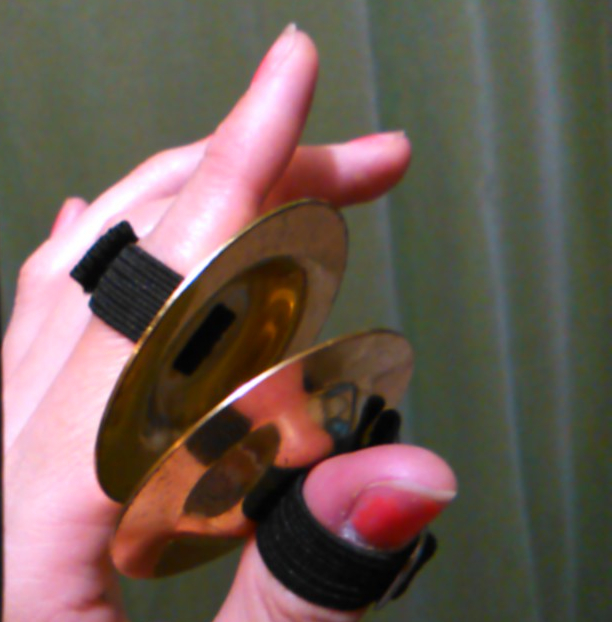
Zills, zillia, zils, or sagat, also known as finger cymbals or fanglesnaps, are small metallic cymbals used in belly dancing and similar performances.[1] They are similar to Tibetan tingsha bells. In Western music, several pairs can be set in a frame to make a tambourine.
Other names include nuqaisāt (after the naqus) and ṣunnūj ṣaghīra in Arabic, sanj angshati in Persian, zil in Turkish.[2]
Zills, or finger cymbals, are part of a family of musical instruments known as clappers. Clappers are musical instruments made of wood, bone, metal, and other substances that are played by being struck against each other. Clappers come in pairs and are often held in the hands, fastened together, or strapped to the performer's fingers. The clapper family also includes spoons, bones and castanets.[3]
4th century A.D. relief of Greek dancer with cymbals. Roman artwork from Mildenhall Treasure. Modern dancers use varieties of zills, finger cymbals or castanets.
One of the earliest forms of clappers are wooden krotala already present in Greece around 500 BC. Ancient Greek potteries depict men and women celebrating at Dionysian festivals, some of them playing krotala.[4] From known representations, ancient Greeks used metallic cymbals, but they held only one cymbal in each hand and clapped them together to strike them. The finger cymbal practice appears in representations from the Roman Empire period. Examples of mosaics and stone reliefs showing Roman finger cymbal players come from Bulgaria, Italy and Belgium, and are dated between the second and fourth century CE.[5] It is not known whether the finger cymbal practice was continuous or was forgotten and then reinvented much later in the Middle East. At least, it is clear that the tradition of dancers with different types of clappers continued through the Middle Ages. First representations of "modern" finger cymbal players in Egypt and Ottoman Empire date from the 18th century at the latest.
Zills are one of the main percussive elements of Middle Eastern belly dancing. The use of zill in belly dancing is particularly present in the Ghawazi, a line of hereditary dancers.[6] Zills are also important in some rituals of Egyptian culture.[7]
Finger cymbals are used in the Sufi religious music. They are also used in the zaar, a healing ritual utilizing rhythmic songs and dances meant to soothe Jinn, a form of magically empowered spirit beings. Dancers use the zill to find a rhythm that soothes the spirits, which then becomes the rhythm performed by the ensemble.
While the tradition of finger cymbals spans centuries, their use in the Middle East showcases distinct regional styles. In Egypt, sagat are a key element of raqs sharqi (oriental dance), where skilled dancers employ them to emphasize intricate movements, creating a rhythmic interplay with live percussion. Roman dance, performed by Romani communities in Ottoman Empire, features sagat in a more dynamic, improvisational style, often accompanying upbeat folk melodies. Beyond traditional settings, sagat have found a place in modern fusion genres, blending Arabic rhythms with jazz, electronica, and other global influences, highlighting their adaptability and continued cultural significance. [8]
A set of zills consists of four cymbals, two for each hand. Zills come in a range of sizes, the most common having a diameter of about 5 cm (2 in). Different sizes and shapes of zills will produce sounds that differ in volume, tone and resonance. For instance, a dancer performing with an orchestra will use a larger zill with more volume, whereas many belly dancers may use a zill with a more delicate sound, depending on the venue and whether their music is live or recorded, amplified or acoustic. American Tribal dancers typically use a much larger zill with a more mellow tone.
Zill manufacturers commonly use brass rather than the bronze used for larger cymbals, and may design their own brass alloys specifically to achieve particular sound qualities. They may plate some zills in order to give a specific color to them. Zills vary in appearance and may be shiny, dull, plain or engraved.
Before the invention of elastic, zills were tied onto the fingers with leather strips. Modern cymbalists use elastic to secure the zills, one to the thumb and one to the middle finger of each hand. Many zills have two slots to allow the threading of the elastic through the zill, allowing greater control of the instrument. Others have a single hole, allowing greater wobble and creative use with speed.
Zills played as idiophones (two on each hand) can be played in many ways to produce a wide and subtle range of sound, from quiet clicking, bell-like ringing, muted cupped sounds, loud clacks, and even a small range of pitch change. Zills belong to the family of instruments used in Ottoman military bands, and also occasionally appear as part of Western orchestral or other musical performances. In these cases, musicians usually just call them finger cymbals and use them to obtain a ringing sound with "Middle Eastern" associations. Percussionists who are not exclusively cymbalists sometimes play finger cymbals by striking one cymbal with a drumstick, or by holding one cymbal in each hand by gripping the strap between the thumb and the index finger, and striking the rims together. They tend to use zills for occasional flourishes in the music rather than for complex rhythms and sounds. For more intricate rhythms, an orchestral player might attach a cymbal to both his thumb and first finger. Then, placing that hand between his other hand and knee, the player will alternate between striking the knee and the opposite hand. Each of the motions produce one articulation of the cymbals.[9]
There are many rhythms in belly dancing music that can be spelled out in finger cymbal playing.[10] The style of playing varies from one style and era of dance to the next.
Dancing girl playing Zills from Qajar Era.Triples, not to be confused with triplets: left/right/left/pause – “giddyup, giddyup, giddyup”)
Quads: L/R/L/R (no pause)
Beledi: dum/dum/tek-a-tek/dum-tek-a-tek
Chiftatelli: dum/dum/tek-a-tek/dum/dum/dum – “John went to the sea; caught. three. fish.”
Ayoub: dum/a-tek-tek – “buy more shoes, and…buy more shoes, and . . .”
Bolero: dum/tek-a-tek-tek/dum/dum/dum/dum – “I want to be a belly dancer”
In the count of the beat, the gallop is played as "and a ONE, and a TWO..." It can also be played as right/left/right/rest. Many teachers recommend thinking of it as dominant hand / non-dominant hand / dominant hand / rest.
Zills are also used in Sufi music, and may be played arrhythmically in a lyrical flow of sound for meditations and sound healing.
^Dimitrios., Yatromanolakis (2009). An archaeology of representations : ancient Greek vase-painting and contemporary methodologies. Institut du Livre, A. Kardamitsa. ISBN978-960-354-250-6. OCLC670122007.
Peinkofer, Karl; Tannigel, Fritz (1988) [1976]. Handbook of percussion instruments : their characteristics and playing techniques, with illustrations and musical examples from the literature. Mainz / London: Schott. OCLC604102910.
Woods, Jenna (2007). The Dancing Cymbalist: How to play music with finger cymbals and dance at the same time. Boulder: Oyna Music in Motion Arts.
Foreman, Kelly Marie (1994). Zills, the idiophone of the Middle Eastern belly dancer : their history, pedagogy, techniques of playing, and role in the context of bodily expression (MA thesis). Kent State University. OCLC32361787.
A zill, also known as a finger cymbal, is a small, round metallic percussion instrument worn on the thumb and middle finger of each hand and struck together to produce rhythmic sounds, primarily in association with Middle Eastern belly dancing.[1][2] These instruments, typically measuring about 5 cm (2 inches) in diameter, enable dancers to accentuate movements, maintain tempo, and add percussive layers to live or recorded music.[3] Zills are essential in traditional performances, where they serve not only as accompaniment but also as a means to express emotion and narrative through varied striking patterns.[4]The term "zill" originates from the Turkish word zil, meaning "bell" or "cymbal," which itself is of imitative origin, mimicking the sharp, ringing sound produced by the instruments.[1] In English, the word first appeared in 1964, reflecting the growing popularity of belly dance in Western contexts during the mid-20th century.[1] Finger cymbals like zills have ancient roots, with evidence of their use dating back to antiquity in the Middle East and Mediterranean regions, where similar small cymbals (sometimes called crotales) appeared in rituals, dances, and musical ensembles.[5]Modern zills are commonly crafted from brass for its resonant tone and durability,[6] though variations in materials such as nickel or aluminum exist to suit different acoustic preferences and price points.[7] In belly dance traditions, they are integral to styles originating from Turkey, Egypt, and other Middle Eastern cultures, where dancers employ techniques like rolls, clicks, and finger isolations to synchronize with complex rhythms.[3] The instrument's introduction to the West occurred in the late 19th century through performances by Egyptian and Turkish dancers at international expositions, contributing to the global spread of Oriental dance forms.[8]
Terminology and Classification
Names and Variants
The primary English term for these instruments is "zill," derived from the Turkish word "zil," which means "small cymbal" or simply "cymbal."[9][10]In Arabic-speaking regions, they are commonly known as "sagat," particularly in Egyptian contexts, with additional terms including "nuqaisāt" (derived from the naqus, a related percussion instrument) and "ṣunnūj ṣaghīra" (meaning "small cymbals").[11][12]The Persian name is "sanj angshati," referring to finger-held cymbals.[11]Other variants in English include "zillia" and "zils," while "fanglesnaps" serves as a humorous Western colloquialism.[11]In Turkish folk music contexts, the term "zil" is used more broadly to denote these small cymbals, distinguishing them from larger orchestral varieties.[10]
Musical Classification
Zills, also referred to as sagat or zil in various cultural contexts, are formally classified within the Hornbostel–Sachs system of musical instrument categorization as concussion idiophones under the code 111.142. This designation places them in the broader category of struck idiophones (class 1), specifically as vessel clappers with an everted rim, where two or more complementary sonorous metal parts are struck against each other to produce sound. The system, originally developed by Erich von Hornbostel and Curt Sachs in 1914 and revised by the Musical Instrument Museums Online (MIMO) project, distinguishes zills as paired, dish-shaped instruments designed for direct percussion via collision, emphasizing their role as portable, body-worn percussion tools.[13]Acoustically, zills generate sound through the metal-on-metal concussion of their paired discs, resulting in a bright, ringing tone characterized by a complex spectrum of overtones. The impact excites multiple vibrational modes in the thin metal shells, producing a sharp attack followed by a sustained decay, with the timbre influenced by the instrument's curvature and material composition. Smaller zills yield higher-pitched sounds that carry over shorter distances, while larger variants produce deeper tones with greater volume and resonance.[14][15]In comparison to related instruments, zills are distinct from larger orchestral cymbals, which share the same 111.142 classification but are handheld and significantly bigger, enabling broader sweeps and lower fundamental frequencies for ensemble use. They also differ from castanets, categorized as 111.141 vessel clappers, which are typically wooden and clapped together without metal resonance or finger attachment, resulting in a drier, less sustained sound. This portability and direct finger mounting make zills uniquely suited for rhythmic accompaniment in dance and solo performance traditions.[13]
Historical Development
Ancient and Classical Origins
The earliest known precursors to zills appear in ancient Mesopotamian art, where clappers are depicted as percussion instruments played by figures in ceremonial scenes on artifacts from the Royal Cemetery of Ur, dating to approximately 2600–2500 BCE. These clappers, often shown in the hands of performers accompanying lyres and dances, contributed rhythmic accompaniment to festive and ritual banqueting contexts associated with elite and religious gatherings.[16]In ancient Egypt, similar clappers emerged as important ritual tools, typically crafted from materials like hippopotamus ivory or hardwood in shapes resembling hands or boomerangs, used from the Middle Kingdom onward (ca. 2030–1650 BCE) to provide cadence in temple ceremonies, festivals, and dances dedicated to deities such as Hathor, the goddess of music and joy. These instruments paralleled and likely influenced the development of sistra, sacred rattles with metal rods or disks that produced clattering sounds when shaken during worship of Hathor and other goddesses, symbolizing protection and rhythmic invocation in processions and chants from the Old Kingdom (ca. 2686–2181 BCE). While early Egyptian clappers were predominantly non-metallic, later variants incorporated metal elements, bridging idiophonic percussion traditions in Near Eastern temple practices.[17][18][19]By the Classical period in ancient Greece, around 500 BCE, krotala—wooden or bone clappers akin to castanets—served as key percussion instruments in Dionysian rituals, where maenads and satyrs used them to create ecstatic rhythms accompanying frame drums and auloi during festivals honoring the god Dionysos. Archaeological evidence from Attic vase paintings and statues illustrates krotala being struck together or worn on fingers by dancers in orgiastic cults, emphasizing their role in inducing trance-like states and marking the percussive foundation of theatrical and religious performances.[20][21]In the Roman Empire, from the 2nd to 4th centuries CE, depictions of true metal finger cymbals—small pairs attached to thumbs and middle fingers—appear in mosaics and reliefs across the empire, including examples from Augusta Traiana (modern Stara Zagora, Bulgaria), Rome (Italy), and Arlon (Belgium), portraying female dancers in theatrical or entertainment scenes. These artifacts confirm the widespread adoption of finger-worn metal clappers for rhythmic accompaniment in performances, transitioning from earlier wooden forms to more resonant bronze variants suited for larger venues. These ancient and classical precedents provided essential rhythmic and cultural influences that evolved into the metal finger cymbals central to later Middle Eastern traditions.[22]
Middle Eastern and Ottoman Evolution
In Egypt under Ottoman rule, Ghawazi troupes, often of Romani descent, incorporated sagat as essential props, clashing them to produce sharp, clacking sounds that complemented their energetic, improvisational dances. By the 18th century, these instruments featured prominently in Egyptian public entertainments, as documented in early 19th-century accounts reflecting ongoing practices.Edward William Lane's 1836 observations in Manners and Customs of the Modern Egyptians provide key 19th-century records of sagat use among Ghawazi performers in Egypt, describing them as "brass castanets" worn on the fingers and thumbs to mark beats during dances for audiences in Cairo and Upper Egypt.[23]Lane noted the dancers' skillful manipulation of these instruments, which added percussive layers to their movements, distinguishing Ghawazi styles from other regional forms.[24]In 19th-century documentation, zills extended into ritual contexts, such as Egyptian zaar exorcism ceremonies, where male participants clapped sagat alongside drumming and chanting to invoke and appease possessing spirits, facilitating healing through rhythmic trance.[25] These uses underscored the instruments' role in blending entertainment, spirituality, and cultural expression across Middle Eastern societies.
Physical Characteristics
Materials and Construction
Zills are primarily made from brass, a copper-zinc alloy that provides durability and a mellow, resonant tone suitable for rhythmic accompaniment in performance.[26][8] This material is favored in traditional designs for its balance of weight and sound projection, allowing sustained vibrations when struck. Alternative materials include bronze, which produces a lower, heavier tone; German silver (a nickel-silver alloy), offering a brighter, higher pitch but prone to faster wear; and aluminum, used in lighter variants for beginners due to its reduced weight and affordability.[26][27][28]The construction of zills typically involves forging or casting small disc-shaped cymbals, with diameters around 5 cm to ensure portability and precise control.[26] In traditional Turkish styles, the discs feature thin rims and high domes, achieved through hand-hammering or stamping processes that temper the metal for extended ring duration of 4-8 seconds.[8] Egyptian variants, known as sagat, are often cast with thicker walls and wider rims for a shorter, clacking sound lasting 1-2 seconds.[8] These methods are rooted in Middle Eastern workshops, where artisans shape the metal to include one or two slots or holes for secure attachment via elastic bands.[26][8]Modern basic manufacturing retains these techniques but may incorporate machine stamping for consistency, while preserving the hand-hammered aesthetic in high-quality pieces from Turkish producers.[26] Size variations in construction can subtly influence tone, with larger discs yielding deeper resonance.[26]
Sizes, Shapes, and Attachments
Zills typically measure 5 to 6 cm in diameter, with each pair (two zills for one hand) weighing approximately 20 to 80 grams, providing a balance of portability and audible projection suitable for most performers.[29] Smaller variants, around 4 cm in diameter, are often recommended for beginners due to their lighter weight and reduced strain on the fingers during extended practice.[30] Larger sizes, up to 7 cm, produce greater volume and resonance, appealing to dancers in larger venues or those emphasizing percussive emphasis in performances.[30]The standard shape of zills is circular with a slight dome, which contributes to their characteristic ring; however, regional variations influence the curvature and edge design. Turkish-style zills feature high domes and thin rims, resulting in a lighter construction that sustains longer reverberations.[8] In contrast, Egyptian sagat exhibit smaller domes and wider rims, creating a heavier form with a more pronounced clacking sound upon impact.[8]Attachments for zills are designed for secure placement on the thumb and middle finger of each hand, facilitating precise control during movement. Traditional methods involve threading elastic bands or fabric loops through two holes in the cymbal—one for the thumb and one for the middle finger—to anchor them without direct finger contact, allowing the metal to vibrate freely.[8] Egyptian sagat may use a single hole, requiring a modified grip where the thumbcymbal remains stationary while the finger one strikes it.[8] Contemporary options include adjustable straps, often elastic or fabric-based, which accommodate varying finger sizes and enhance comfort for prolonged wear.[28]
Playing Techniques
Basic Methods and Strokes
Zills are typically worn with one cymbal attached to the thumb and another to the middle finger of each hand using adjustable elastic bands that fit snugly across the base of the finger without restricting movement.[31][32] To achieve proper hand positioning, performers maintain relaxed wrists to allow fluid motion and curl the remaining fingers gently inward, keeping the hands open in a natural dance posture that facilitates both sound production and integrated movement.[33][31]The fundamental strokes for producing sounds with zills involve controlled contacts between the cymbals, starting with simple techniques to build precision and volume. The thumb-to-thumb stroke, often used for rolling patterns, entails striking the thumb cymbals of both hands together repeatedly in a rapid sequence, such as right-left-right (RLR), to create a continuous, pulsating rhythm suitable for sustaining beats.[33][31] The finger-to-thumb stroke produces a crisp click by snapping the middle finger cymbal against the thumb cymbal on the same hand, typically alternating between hands (RLRL) for even, single-note accents that emphasize off-beats or transitions.[33][31] For louder effects, the hand-to-hand clash brings the full hands together, colliding both sets of cymbals to generate a sharp, resonant double note, which can be executed as singles or in pairs for dynamic punctuation.[33][31]These strokes yield distinct sound profiles essential for rhythmic accompaniment: the finger-to-thumb click delivers a sharp "ting" with quick decay, ideal for precise articulation, while the thumb-to-thumb roll or hand-to-hand clash produces a sustained ring that reverberates longer, adding texture and volume to the performance.[31][33] Beginners should practice these basics in 4/4 time signatures, starting slowly with a metronome at around 70 beats per minute to internalize timing, gradually incorporating simple rhythms like the beledi pattern before advancing to dance integration.[33][32]
Advanced Rhythms and Patterns
Advanced zill playing extends beyond foundational thumb-to-finger clacks by incorporating intricate rhythms that synchronize with complex Middle Eastern time signatures, enhancing the percussive layer in belly dance performances. These patterns demand precise coordination between hands, allowing dancers to accentuate musical phrases and improvise dynamically. For instance, triplets—often rendered as a crisp "ting-ting-ting"—form a gallop-like sequence typically executed with right-left-right hand alternation, suitable for 2/4 or 4/4 rhythms such as the maqsoum. This pattern builds rhythmic momentum, with each strike emphasizing even subdivision for fluidity.[34]Quads are played as four notes per beat, typically through rapid alternation between hands (e.g., R L R L), adding intensity to 4/4 rhythms like the masmoudi kabir, enabling dancers to layer accents over undulating movements. In Turkish music, the 9/8 aksak rhythm—characterized by its limping, asymmetric feel—employs specialized patterns, such as strong strikes on counts 1, 3, 5, and 7, with optional fills on the "and" of beats 1 through 6 for elaboration. Advanced variations include syncopated placements on counts 2, 4, 6, 8, and 9, requiring heightened precision to maintain clarity amid the rhythm's irregularity.[35][36]Key techniques amplify these patterns' expressiveness. Finger rolls achieve a continuous cascade via multiple rapid strikes of the finger zill against the stationary thumb, ideal for bridging sections or sustaining energy in improvisational solos. Shakes generate a vibrating tremolo through quick wrist oscillations, simulating a trill without individual strikes, often used to punctuate transitions. Mutes involve dampening the resonance by immediately pressing the palm or webbing against the zills post-strike, producing a dull thud or clank to control decay and create staccato effects. These methods, when combined, allow for multi-tonal phrasing that mirrors the music's nuances.[35][34]Zill patterns are commonly notated in simplified tablature to facilitate practice and teaching. Patterns are often indicated by hand alternation, such as R for right hand and L for left hand. For example:
Triplet gallop: R L R – right-left-right hand strikes.
Quad: R L R L – rapid hand alternations for four notes.
9/8 basic: Strikes on 1 (R), 3 (L), 5 (R), 7 (L), silence on 8-9.
This notation emphasizes hand independence, enabling dancers to drill patterns separately before integrating with choreography.[34]
Cultural and Musical Roles
In Belly Dancing and Raqs Sharqi
In raqs sharqi, also known as oriental dance, zills—referred to as sagat in Arabic—serve as a percussive instrument that accentuates key movements such as hip isolations and shimmies, adding rhythmic depth to the dancer's performance.[37] These finger cymbals are typically worn on the thumbs and middle fingers of both hands, producing sharp, resonant sounds that complement the live music and highlight the dancer's precision.[38] Their integration became a standard feature in professional solos during the early 20th century, evolving from earlier Ottoman performance traditions into a hallmark of Egyptian stage dance.[39]Within Egyptian styles, Ghawazi dancers employ zills to create layered rhythms over accompanying instruments like the tabla, enhancing the improvisational flow of their energetic group performances.[37] This technique allows the dancer to synchronize percussive accents with footwork and hip articulations, maintaining a dynamic interplay with the ensemble's percussion. The practice traces back to traditional Ghawazi troupes, where zills provided both musical and visual emphasis in rural and festival settings.[40]Badiaa Masabni played a pivotal role in popularizing zills during her 1920s Cairo revues at the Opera Casino, where she incorporated them into choreographed solos and trained generations of dancers in their use.[41] Masabni, who learned to play sagat instinctively, featured them prominently in her nightclub shows, blending them with Western influences to elevate raqs sharqi as a theatrical art form.[39] Her academy further disseminated the technique, making zills essential for professional dancers like Tahiya Carioca and Samia Gamal.[42]In choreography, zills enable syncopated patterns that underscore veil manipulations and intricate floor patterns, allowing dancers to build tension and release through precise timing.[38] These rhythms often mirror the underlying baladi or saidi beats, providing a counterpoint that amplifies the emotional narrative of the performance.[37]
In Folk and Ritual Traditions
In Turkish Romani and Balkan folk traditions, zills play a key role in energetic performances, where they enhance improvisation with crisp tones that distinguish these informal expressions from more staged forms.[43] These dances, originating in regions spanning modern-day Turkey, Greece, and the Balkans, feature couples facing each other in fluid steps, with the zills accentuating footwork and hand movements to foster communal harmony during social gatherings.[44] In Turkish Romani communities, the instrument's vibrant rhythms support intricate handwork in their dance styles.[45]In Egyptian rituals, sagat are integral to zar ceremonies, where male participants clap them alongside drumming to generate trance-inducing clatters that facilitate spirit possession and healing.[25] These all-night sessions, rooted in Sudanese-Ethiopian influences and practiced in Cairo's working-class neighborhoods, employ the sagat's metallic resonance to invoke jinn, amplifying the hypnotic atmosphere as the possessed individual manifests symptoms like convulsions.[25] Similarly, in Sufi sema practices, particularly the Egyptian tanoura variant of whirling, performers may wield large sagat while rotating to evoke ecstatic states, symbolizing spiritual ascent and union with the divine.[46] The instrument's role here underscores a broader ritual use in Sufi orders, where rhythmic percussion supports meditative whirling beyond formalized Turkish Mevlevi ceremonies.[46]North African variants, such as the ouais dance in Berber communities, incorporate finger cymbals to punctuate collective celebrations with vibrant percussion.[47] In High Atlas traditions like ahwash, communal performances blend synchronized rhythms with bendirs and flutes to mark seasonal festivals and social rites among Amazigh people.[48] This usage parallels but remains distinct from evolutions in belly dancing, emphasizing informal communal bonding over individual expression.[43]
Modern Usage and Variations
Contemporary Performance and Fusion
In the late 20th century, the Western revival of belly dance fostered innovations like American Tribal Style (ATS), an improvisational group format created in the 1980s by Carolena Nericcio-Bohlman of FatChanceBellyDance (FCBD). Zills serve as a core rhythmic tool in ATS, enabling dancers to synchronize accents with formations, hipwork, and traditional-inspired patterns during live performances. This style emphasizes collective improvisation over solo display, with zills providing a percussive layer that enhances musicality and group cohesion.[49]Contemporary fusion genres have expanded zills' role beyond traditional Middle Eastern contexts, integrating them into hybrid forms like tribal fusion to bridge classical rhythms with modern music and movement vocabularies. Performers adapt zil patterns—such as triplets, rolls, and flams—to complement electronic, rock, or world music backings, creating dynamic textures that amplify emotional and narrative depth in solos or ensembles. For instance, Rachel Brice, a pioneer in tribal fusion, teaches foundational zil combinations paired with undulations, armlines, and floorwork in her Datura style, allowing dancers to layer percussive precision over eclectic soundscapes for innovative stage presentations.[50][51]Zills appear in global festivals that highlight evolving belly dance practices, such as Cairo's Ahlan Wa Sahlan International Festival, where dedicated workshops explore advanced finger cymbal techniques alongside showcases of fusion routines. These events, drawing international artists, demonstrate zills' versatility in blending heritage elements with experimental choreography, as seen in sessions led by instructors like Leyla Lanty focusing on rhythmic drills for contemporary application.[52]
Manufacturing and Availability
Modern zills are primarily manufactured using machine-stamping techniques, where sheet metal, often brass, is pressed into domed shapes to create the resonant discs.[26] This production method is common in Turkey, where brands like Istanbul Agop produce handmade finger cymbals from cast brass alloys, emphasizing traditional craftsmanship.[53] In India, manufacturers handcraft similar zills from solid brass, incorporating etched designs for aesthetic appeal while maintaining affordability.[54] Sets from these producers typically range in price from $10 for basic stamped models to $50 for higher-quality, engraved pairs.[26][55]Customization options enhance the versatility of zills, with some brands offering tuned pairs calibrated to specific pitches for better integration with musical ensembles.[56] Advanced performers may select custom engravings or adjusted weights, though eco-friendly variants using sustainable brass alloys are less common but available from select wholesalers.[57]Zills are readily accessible through online platforms like Amazon and Etsy, where a wide array of sizes, finishes, and brands cater to both beginners and professionals.[58][59] In physical locations, they are sold in workshops and bazaars across the Middle East, including imports from Cairo's traditional markets.[60]