Hubbry Logo
Goblet drumGoblet drumMain
Open search
Goblet drum
Community hub
Goblet drum
logo
8 pages, 0 posts
0 subscribers
Be the first to start a discussion here.
Goblet drum
Goblet drum
from Wikipedia
Goblet drum
Percussion instrument
Other namesChalice drum, tarabuka (tarambuka), tarabaki, darbuka, derbake, debuka, doumbek, dumbec, dumbeg, dumbelek, dumbul, toumperleki (tumberleki), tumbak, zerbaghali
Classification Hand percussion, membranophone
Hornbostel–Sachs classification211.26
DevelopedEgypt

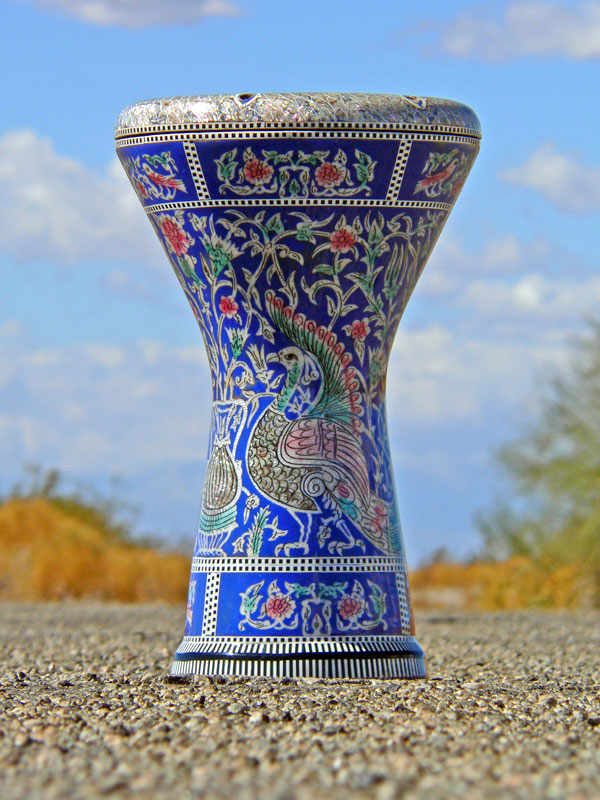
The goblet drum (also chalice drum, tarabuka, tarabaki, darbuka, darabuka, derbake, debuka, doumbek, dumbec, dumbeg, dumbelek, toumperleki, tumbak, or zerbaghali;[1] Arabic: دربوكة / Romanized: darbuka) is a single-head membranophone with a goblet-shaped body.[2] It is most commonly used in the traditional music of Egypt, where it is considered the national symbol of Egyptian Shaabi Music.[3] The instrument is also featured in traditional music from West Asia, North Africa, South Asia, and Eastern Europe.[4] The West African djembe is also a goblet membranophone.[5] This article focuses on the Middle Eastern and North African goblet drum.

History

[edit]

The origin of the term Darbuka lies in the rural Egyptian Arabic slang word that changed "darb" meaning "to strike" into "darabuka".[6]

Goblet drums have been around for thousands of years and were used in Mesopotamian and Ancient Egyptian cultures. They were also seen in Babylonia and Sumer from as early as 1100 BCE. On Sulawesi, large goblet drums are used as temple instruments and placed on the floor when played, which may reflect ancient use of the drum.[7]

Technique

[edit]
Darabukka from Egypt, 1825~35. From Lane 1836, p. 363
Sound of Darbuka

The Eastern and North-African goblet drums are played under the arm or resting on the player's leg, with a much lighter touch and quite different strokes (sometimes including rolls or quick rhythms articulated with the fingertips) to hand drums such as the djembe, found in West Africa.

There are two main types of goblet drums. The Egyptian style, Darbuka, is also known as Tabla and is very popular; it has rounded edges around the head, whereas the Turkish style exposes the edge of the head. The exposed edge allows closer access to the head so finger-snapping techniques can be done, but the hard edge discourages the rapid rolls possible with the Egyptian style.

The goblet drum may be played while held under one arm (usually the non-dominant arm) or by placing it sideways upon the lap (with the head towards the player's knees) while seated. Some drums are also made with strap mounts so the drum may be slung over the shoulder, to facilitate playing while standing or dancing. It produces a resonant, low-sustain sound while played lightly with the fingertips and palm. Some players move their fists in and out of the bell to alter the tone. Some players also place their hands on the surface of the drum to produce a muted sound. There are a variety of rhythms (see dumbek rhythms) that form the basis of the folkloric and modern music and dance styles of the Middle East.

There are three main sounds produced by the goblet drum. The first is called a "doom". It is the deeper bass sound produced by striking the head near the center with the length of the fingers and palm and taking off the hand for an open sound. The second is called the "tak" and is the higher-pitched sound produced by hitting near the edge of the head with the fingertips. A "tak" struck with the secondary hand is also known as a "ka". The third is the closed sound "pa" (also called "sak"), for which the hand is briefly rested on the head so as not to permit an open sound. Additionally, there are more complex techniques including snaps, slaps, pops and rolls that are used to ornament the basic rhythm. Hand clapping and hitting the sides of the drum can be used in addition to drumhead sounds.

Another technique commonly used in Greece, Bulgaria, North Macedonia, Albania and Turkey is to tap with the fingers of one hand and with a thin drum stick in the other. In Turkey the stick is called the çubuk, which means wand, or stick, and where the Romanis there occasionally use this technique.[citation needed]

Use in Western classical music

[edit]

The first known Western classical composition to feature a goblet drum is the opera Les Troyens (1856–1858) by the French composer Hector Berlioz, which calls for a tarbuka in the Dance of the Nubian Slaves in Act IV.

The first compositions for goblet drum and orchestra were composed by the Egyptian-American musician Halim El-Dabh in the 1950s; his Fantasia-Tahmeel for goblet drum and strings was premiered in New York City in 1958, with a string orchestra conducted by Leopold Stokowski.

Notable goblet drum musicians

[edit]
[edit]

See also

[edit]

References

[edit]
Revisions and contributorsEdit on WikipediaRead on Wikipedia
from Grokipedia
The goblet drum is a single-headed instrument characterized by its distinctive goblet-shaped body, which narrows at the base and flares outward toward the top where a taut is affixed. The body is traditionally constructed from materials such as clay, wood, or metal, with the drumhead typically made from animal skin like or , though synthetic alternatives such as are common in modern versions. It produces a versatile range of sounds through hand strikes, including deep bass tones from the center of the head and sharp, ringing highs from the rim, enabling complex rhythmic patterns essential to various musical traditions. Originating in the , the goblet drum traces its roots to Mesopotamian civilizations as early as 4000 BC, with archaeological evidence of precursors in clay forms from Assyrian sites around 1700 BC. By approximately 1750 BC, more defined goblet-shaped variants appeared in , likely introduced from the , where they were used in religious and ceremonial contexts alongside other percussion instruments. The instrument spread widely following cultural exchanges, such as the Great's invasion of Egypt in 332 BCE, reaching the Mediterranean, , and beyond, and evolving into regional forms documented in Persian, Turkish, and North African music by the medieval period. Known by diverse names—including darbuka or dümbelek in , doumbek in and the , tonbak in Persia, and tabl in —the goblet drum holds central roles in folk, classical, and genres across these regions. In Turkish traditions, for instance, it transitioned from rural ceramic models associated with village life to urban metal versions symbolizing professional musicianship and modernity by the early . Playing techniques vary, from traditional snapping methods using a static hand position to innovative split-finger approaches developed in the for faster, more expressive rhythms. Culturally, it accompanies dances, weddings, spiritual rituals, and ensemble performances, embodying social identities tied to , class, and regional heritage while influencing global percussion practices today.

Design and construction

Shape and materials

The goblet drum is characterized by its distinctive goblet-shaped body, featuring a wide opening at the top where the is mounted, a narrow cylindrical that flares out to a wider, bell-like base, which contributes to its resonant qualities. The base provides stability and amplifies lower frequencies. Typical dimensions include a of 16 to 18 inches (40 to 45 cm), a drumhead diameter of approximately 8 to 9 inches (20 to 23 cm), and a base diameter of 9 to 12 inches (23 to 30 cm), though variations exist based on regional styles and modern adaptations. Traditional goblet drums are often constructed from natural materials such as clay or for the body, which is either hand-thrown on a or molded in sections and fired for durability. Modern versions frequently use wood, such as or , carved or turned on a , or metals like aluminum, , or , which are cast, welded, or spun for a seamless shell. Synthetic options, including or PVC, offer enhanced weather resistance and lighter weight for contemporary use. The drumhead consists of a single stretched taut over the top opening, traditionally made from natural animal skins such as goat or sheep (most common for a warm, deep sound), fish (for a sharper, higher tone, especially in Egyptian and Turkish models), or calf skin (rarely), which provide a warm, responsive tone. These skins are secured using lacing, thongs, or tacks around a wooden or metal hoop, while modern heads often employ synthetic materials like mylar, plastic, or special coatings imitating natural skin, attached via tunable bolts or screws for adjustable tension and longevity. Regional variations in materials reflect local traditions and desired tonal profiles; for instance, Egyptian models commonly feature heavy clay bodies to produce a deep bass , whereas Turkish versions favor lightweight aluminum or for a brighter, more projecting tone. These material choices influence the drum's overall pitch and sustain, with denser clays yielding lower fundamentals compared to resonant metals.

Tuning and sound production

The goblet drum generates sound through the vibration of its taut drumhead membrane, a membranophone principle where striking the head initiates oscillations that produce audible tones. The low bass sound, known as doum, results from impacting the center of the head with the palm or fingers, exciting primarily low-frequency modes, while the high-pitched slap, or tek, arises from rim strikes that emphasize higher-frequency vibrations. The instrument's goblet-shaped body acts as a resonance chamber, with the wide base amplifying and sustaining low frequencies and the narrow neck facilitating the projection of higher harmonics, creating a distinctive timbral contrast. Tuning the goblet drum involves adjusting the drumhead tension to control pitch and , with traditional models often employing lacing systems that allow manual tightening of vertical and horizontal to pull the head secure. Modern variants incorporate hardware such as bolts or screws around the rim, enabling precise adjustments via a tuning key to increase or decrease tension evenly across the head. For fine-tuning on skin-headed instruments, a paste mixture—sometimes incorporating —is applied selectively to the head's surface to dampen specific overtones and refine the tonal balance, though this practice is more common in related loaded-membrane traditions. The acoustic properties of the goblet drum are shaped by its form, which directs low frequencies toward the resonant base for a focused bass response while the constricted promotes brighter, higher harmonics from peripheral strikes, yielding a typical pitch range spanning approximately one depending on the drum's size and construction. In studied examples of goblet drums, the fundamental at the center registers around 293 Hz (D above middle C), with rim tones reaching 392–440 Hz (G or A above middle C), illustrating the instrument's versatile sonic palette. Factors such as thickness—thinner s favoring higher pitches and brighter tones—tension levels, which directly influence vibration frequency, and environmental , which can cause natural skin heads to expand or contract and alter sustain, all contribute to the final sound profile.

History and cultural origins

Ancient and regional development

The goblet drum's earliest evidence appears in ancient Mesopotamian artifacts, where goblet-shaped percussion instruments, akin to precursors of the modern or zarb, are depicted in Sumerian and Babylonian temple scenes dating to the second millennium BCE. These instruments, referred to in historical texts as "lilis" or "lilissu," were portable goblet-like drums used in religious rituals and ceremonial processions to invoke deities and accompany hymns. In , goblet drums emerged around 1750 BCE, introduced alongside wheel-thrown pottery forms with animal-skin heads and open bottoms, primarily for ritualistic and funerary ceremonies to honor gods and ensure spiritual transitions. These early Egyptian variants, often crafted from clay, evolved into specialized forms that influenced later traditions. By the 8th century CE, naqqara variants—small, paired goblet or kettledrums—became integral to in and the , played with sticks in ensembles for signaling during processions and enhancing modal performances. influence from the 16th to 19th centuries further refined the Turkish darbuka for court and military use, which standardized its goblet shape and amplified its role in regional percussion traditions. The instrument held profound cultural significance across pre-modern societies, featuring prominently in Sufi rituals for inducing trance states through rhythmic meditation, in royal court music to underscore imperial grandeur, and in folk traditions for communal celebrations and storytelling. Its evolution from rudimentary clay pots—initially struck for basic rhythms in Mesopotamian and Egyptian contexts—to tuned, specialized versions reflected adaptations to local acoustics and symbolic needs, with materials shifting to wood and metal for durability in ensemble settings. The goblet drum spread via trade routes like the during the medieval period (8th–15th centuries CE), adapting to diverse materials such as terracotta in and goatskin heads in Persia, which facilitated its integration into exchanges and local musical practices. By the pre-20th century, it had become embedded in systems, providing intricate rhythmic cycles to support melodic improvisation in urban ensembles, and in Persian classical radif traditions, where the anchored modal suites in courtly gatherings.

Modern adaptations and global spread

In the 20th century, the goblet drum underwent significant innovations driven by industrialization, shifting from traditional clay and wood constructions to more durable metal bodies made of aluminum, , or , which enhanced longevity and sound projection. Synthetic materials, such as shells and tunable or mylar drumheads, were introduced to improve resistance and ease of adjustment via tuning screws, allowing for consistent performance in varied environments. These changes facilitated and broader accessibility, particularly from the mid-1900s onward. The influence of recording technology post-1950s further contributed to standardization, as composers like integrated the goblet drum into orchestral works, such as his Fantasia-Tahmeel, promoting uniform tuning and construction for reproducible sounds in studio and live settings. This era marked the instrument's entry into Western classical compositions, bridging traditional forms with modern recording practices. The goblet drum's global spread accelerated in the late 20th century through ethnomusicologists and performers like , who relocated to Britain in 1975 and adapted the Egyptian for ensembles before collaborating on projects with artists such as and , introducing its rhythms to Western percussion contexts. By the 1970s and 1980s, it gained prominence in festivals. Key milestones include the recognition of in , which incorporate the zarb—a Persian goblet drum—as a central element in and rhythmic accompaniment, highlighting its cultural significance on an international stage. Commercialization advanced with brands like producing tunable models, such as the Festival Doumbek, featuring synthetic heads and Acousticon shells for professional bass, slap, and open tones suitable for global markets. Adaptations in the late 20th century included fusions with rock and , exemplified by Ramzy's contributions to Led Zeppelin's : Unledded (1994), where the drum's intricate patterns complemented electric instrumentation, and its use in recordings by ensembles incorporating Middle Eastern elements for rhythmic complexity. In the , electronic versions emerged with capabilities, enabling integration into digital production setups for sampled goblet sounds in contemporary compositions. As of the , the goblet drum maintains strong production in regions like and , with 's overall market valued at approximately $14 million in 2024, reflecting sustained demand and export growth amid rising interest in .

Playing techniques

Basic strokes and grips

The goblet drum, also known as the darbuka or doumbek, is typically played with the right hand as the dominant one for producing primary tones, while the left hand provides secondary sounds and support. In the Egyptian style, the right hand features fingers curved slightly over the drum's rim to facilitate quick rim strikes. The drum is often held resting on the left for seated play, with the body tilted slightly away from the player to allow unobstructed hand access, or tucked under the left arm for standing performance. Fundamental strokes begin with the doum, a deep bass tone generated by striking the center of with the full palm or the base of the fingers using the dominant hand, allowing the hand to bounce off naturally for sustained resonance. The tek follows as a sharp, high-pitched slap produced by snapping the —typically the index and middle—against the rim or near the edge with the dominant hand, employing a quick motion for crisp articulation. The ka is a lighter, muted rim tap executed with the of the non-dominant hand, mirroring the tek but with less force to create a secondary high tone that aids in rhythmic layering. These strokes can vary in volume from soft () for subtle to forte for emphatic accents, depending on the force applied. Proper execution emphasizes arm and shoulder relaxation to ensure fluid motion, with a subtle snap enhancing the clarity and projection of each stroke without straining the muscles. Ergonomic hand positioning adjusts based on drum size—smaller instruments allow closer finger curvature, while larger ones require extended reach to avoid tension that could lead to repetitive strain injuries over time. Optimal response from these strokes relies on the drumhead's tuning, which should be firm yet responsive to allow clear differentiation between bass and high tones. For beginners, progressions start with isolated practice of each stroke at slow tempos around 60 beats per minute, gradually incorporating alternating doum-tek patterns to build coordination, aiming for 80-120 beats per minute as control improves. Daily sessions of 15-20 minutes focusing on these basics, using a for steady timing, help develop even tone production before advancing to combined sequences.

Rhythmic patterns and ornamentation

Rhythmic patterns on the goblet drum, also known as the darbuka or doumbek, typically revolve around repeating cycles that provide a foundational groove for ensembles. One of the most common is the 4/4 rhythm, prevalent in Egyptian music, structured as doum-doum-tek-doum-tek repeated across measures to create a steady, dance-oriented pulse. In Turkish styles, 9/8 usul cycles such as karsilama or Roman aksak introduce asymmetric phrasing, often notated as a sequence of short-long beats (e.g., 2-2-2-3) to evoke lively, improvisational energy. Ornamentation enhances these patterns with expressive flourishes, allowing performers to add nuance and variation. Rolls, produced by rapid alternating finger trills on , create sustained effects for transitions or emphasis. Muffling involves dampening the sound by resting the fingers or palm on the head immediately after a , yielding a muted "pa" or "sak" to control resonance and build tension. Snaps and slaps, executed with quick finger flicks or palm edges, provide sharp accents that decorate the core rhythm without disrupting its flow. Advanced elements introduce rhythmic complexity for skilled players. is achieved by accenting off-beats or using subtle —soft, barely audible strikes—to create a layered, propulsive feel within patterns like . Polyrhythms, such as layering 3-over-4 beats, emerge in contexts where the goblet drum interlocks with other percussion, producing interwoven textures that heighten musical . Innovative techniques, such as the split-finger approach developed in the , enable faster and more expressive rhythms through independent finger movements while maintaining a static hand position. Notation for goblet drum rhythms employs a tablature-like system rather than standard Western staff, using symbols for clarity: "D" or "doum" for the deep bass tone, "T" for the high-pitched tek, and "K" or "ka" for the crisp slap. For example, the maqsum appears as D T K T, facilitating quick reading and adaptation across styles. Practice methods emphasize gradual mastery through repetitive ostinatos—short, looping —to develop precision and endurance. Drummers begin at 80-100 BPM with basic cycles like heavy sa’idi (D D _ D D _ T _), focusing on even stroke quality, then incrementally increase to 150-200 BPM to build speed while maintaining control. drills, alternating between plain and ornamented versions of rhythms, reinforce timing and facilitate seamless integration of techniques like rolls or .

Regional and stylistic variations

Middle Eastern and North African styles

In traditions, the darbuka functions as a core , underpinning improvisations and compositions within maqam modes by delivering rhythmic pulses that allow soloists on instruments like the or nay to navigate microtonal phrases. It holds a prominent role in wedding ensembles across the region, where it often leads dance rhythms in 2/4 or 4/4 meters, syncing with vocals and other percussion to drive celebratory processions and communal dances. North African variants of the goblet drum, such as the derbouka, blend with frame drums like the in various rituals and music, including layered patterns in spiritual healing ceremonies. In rituals originating from sub-Saharan influences in , frame drums like the bendir combine with the guembri and krakebs to induce states. In Algerian chaabi music, a popular urban style emerging in the early , the derbouka employs rapid fills and syncopated accents to propel energetic ensemble performances, emphasizing populist themes in everyday life. Stylistic traits of these traditions frequently incorporate call-and-response structures between the darbuka and vocals, fostering interactive dynamics in group settings, while its phrasing incorporates microtonal nuances to align precisely with maqam scales, enhancing the modal expressiveness of accompanying melodies. In key historical contexts, the darbuka anchored rhythms in Egyptian takht orchestras during the 19th and 20th centuries, small chamber groups featuring strings and winds that performed suites in urban centers like . Similarly, it provides the foundational pulse in Moroccan Andalusian music cycles, multi-movement suites derived from medieval Iberian-Arab repertoires, sustaining intricate nubah forms across regional conservatories. From the 1980s onward, the modern regional scene has seen the darbuka integrate into fusion styles like and contemporary chaabi, where it adapts traditional beats to electric amplification and Western influences, as evident in Algerian 's evolution from folk roots to global pop hybrids.

South Asian and other global influences

In South Asian musical traditions, the represents a pair of hand drums, with its left-hand component known as the bayan. This larger, metal-bodied drum features a rounded, shape that allows it to produce deep bass tones when paired with the smaller, cylindrical wooden right-hand drum called the dayan in ensembles. The bayan is tuned to lower pitches to provide rhythmic foundation, enabling complex bols such as "ghe," an open bass stroke that emphasizes resonant low-end sounds essential for accompanying vocal and melodic . This pairing has been central to North Indian classical performances since at least the , where the bayan's bass contrasts with the dayan's higher, more melodic tones to create intricate rhythmic dialogues. A key feature enhancing the tabla's tonal versatility, especially on the bayan, is the syahi—a black paste made from , , and glue applied to the drumhead center—which alters vibration patterns to produce varied pitches and , from sharp slaps to sliding bass glissandos. This application allows for nuanced modulation, distinguishing South Asian drum adaptations by prioritizing expressive pitch variation over the sustained booms common in other regions. In contrast to broader goblet drum uses, South Asian contexts often emphasize higher-pitched elements within the ensemble, with the dayan's tuned resonances aligning directly to the raga's scale for melodic support. Beyond , the goblet drum's influence extends to Balkan folk music through the Turkish dumbek, which was integrated via Ottoman cultural exchanges into traditions in , , and surrounding areas, providing driving rhythms for dances and oral epics. In Latin American contexts, African goblet-shaped drums like the contributed to later Afro-Cuban percussion evolutions, influencing fusions in and rhythms despite the conga's more barrel-like form derived from Bantu traditions. Global adaptations in the further highlight the goblet drum's migratory role, as seen in Indo-Arabic fusions within communities in and , where techniques merged with darbuka patterns to create hybrid styles blending Hindustani bols with rhythms. The West African , itself a classic goblet drum carved from a single piece, has become a staple in world beat scenes, hybridizing with diverse elements like Australian drones in fusion ensembles to evoke cross-cultural trance grooves. These developments underscore the instrument's adaptability, driven by 20th-century migrations and , fostering innovative rhythmic dialogues in contemporary global music.

Musical applications

Traditional ensemble roles

In traditional Middle Eastern ensembles such as the Egyptian takht, the goblet drum, known as the darbuka or , serves as the primary provider of rhythmic foundation by delivering steady pulses and accents through iqa'at patterns, which range from 2 to 24 beats and underpin the melodic of instruments like the qanun, , and nay. This role ensures the ensemble maintains metric coherence, typically within small groups of 3 to 5 members where the drum synchronizes with strings and winds to create a balanced texture. In Persian classical music ensembles, the (a goblet drum variant) acts as the rhythmic anchor, setting the pace and guiding other instruments such as the , , and through basic cycles that accompany measured compositions and respond to melodic phrases with complementary fills. These interactions often involve cueing transitions, such as signaling shifts in rhythms, while balancing volume to support the overall dynamics in groups of 4 to 8 performers. The goblet drum holds significant cultural roles in spiritual and communal settings, including accompaniment during Sufi ceremonies in , where the provides a percussive metric base in public hadras, enhancing the emotional intensity of choral inshad alongside frame drums like . Similarly, in traditions, the darbuka contributes to processions and folk gatherings by maintaining lively rhythms that interact with zurnas and other percussion, fostering communal participation in ensembles of 5 to 10 members. Historically, goblet drums featured prominently in 18th-century Persian ensembles, where the supported narrative and ceremonial music in courtly groups, providing accents and fills to cue performers during epic recitations and dances. In North African contexts, such as Moroccan and Algerian wedding bands, the derbeke or similar goblet drums deliver pulsating rhythms for celebratory processions, syncing with bendirs and vocals in dynamic groups of 6 to 10 to drive communal festivities.

Contemporary and fusion uses

The goblet drum, known variably as the darbuka or doumbek, has been integrated into Western since the late , with notable early use by French in his opera (1863), where it provided exotic rhythmic texture. By the , it became a fixture in orchestral percussion sections, particularly in works evoking Middle Eastern or Oriental themes, as seen in performances conducted by , who incorporated the instrument to enhance atmospheric depth in symphonic arrangements. This adoption reflected broader trends in Western composition toward incorporating non-European percussion for coloristic effects, solidifying the goblet drum's role beyond traditional contexts. In fusion genres, the goblet drum has bridged traditional rhythms with modern styles, appearing in rock through influences on drummers exploring world percussion, such as in progressive ensembles drawing from Middle Eastern motifs. In , it contributes to improvisational layers, as evidenced by its use in fusion ensembles blending scales with swing rhythms, exemplified by percussionists like those in Artem Uzunov's Jazz-n-Darbuka recordings. Electronic music has embraced it via sampling, with darbuka loops integrated into EDM tracks for ethnic-infused beats, as seen in sample packs from producers like Gio , who layer its resonant tones over synthesizers and bass drops. Contemporary applications extend to film scores, where the goblet drum underscores Middle Eastern cues in Hollywood productions. World music collaborations have further expanded its reach, with the instrument featured in cross-cultural projects that fuse it with Latin or African elements, building on ensembles like those involving global percussionists in the onward. Innovations in performance include amplified setups using contact microphones or built-in pickups, allowing the drum's subtle dynamics to project in large venues, and looping pedals for layered solo acts, as demonstrated by artists like Onur Seçki in live darbuka jams. Since the , it has entered formal education in conservatories, such as the Lebanese National Higher Conservatory of Music, where it is taught as part of percussion curricula to train musicians in non-Western techniques. Global trends in the and beyond have seen the goblet drum applied in therapeutic contexts, such as for and anxiety reduction, where its rhythmic patterns promote focus and emotional regulation. This evolution underscores the instrument's adaptability, transforming it from a regional staple into a versatile tool for contemporary expression across genres and wellness practices.

Notable performers

Pioneers in traditional contexts

(1953–2019), an Egyptian percussionist, significantly popularized the darbouka in scenes after relocating to in the 1970s, where he integrated its rhythms into broader performances and collaborations. He contributed to over 100 albums as a performer, arranger, and , blending traditional Egyptian percussion patterns with diverse musical styles while preserving their cultural essence. Ramzy's pedagogical efforts further advanced traditional darbouka playing through structured workshops and the establishment of the Drumzy School of Music & , which trained dancers and musicians in authentic Egyptian rhythms and techniques. In Turkish musical heritage, Hasan Tahsin Parsadan (1900–1954), a and performer of Armenian-Turkish origin, standardized the dumbek's integration into Ottoman ensembles during the late 19th and early 20th centuries, transitioning it from folk contexts to classical and urban professional settings. These figures preserved goblet drum lineages in the mid-20th century by producing seminal recordings that captured intricate rhythms and by supporting the evolution of notation systems, which facilitated accurate transmission and study of traditional patterns.

Innovators in modern music

Glen Velez, born in 1949 in , is an American percussionist renowned for revitalizing frame drumming in contemporary contexts while incorporating elements of the goblet drum, known as the dumbek, into his new age and performances. As a founding member of the Consort in the 1970s, Velez explored cross-cultural percussion, blending Middle Eastern dumbek techniques with Western improvisation, which helped introduce these sounds to broader audiences through live concerts and recordings. He co-founded the percussion ensemble Repercussion Unit in 1972, where goblet drum patterns featured alongside frame drums in innovative ensemble works that bridged traditional and experimental styles. Mickey Hart, born in 1943, gained fame as a drummer for the , where he integrated the dumbek into arrangements during the band's live improvisations and from the late onward. His exploration of global rhythms extended beyond through the formation of Planet Drum in the 1990s, a supergroup that prominently featured the goblet drum in fusion recordings like the 1991 album Planet Drum, which won a Grammy for Best Album and showcased dumbek alongside African and Indian percussion. Hart further documented these influences in his 1991 book Planet Drum: A Celebration of Percussion and Rhythm, emphasizing the goblet drum's role in rhythmic healing and cross-genre experimentation. In the , digital platforms amplified the goblet drum's global appeal through online educators, exemplified by Raquy Danziger, whose tutorials and performance videos, such as "Monkey Mind" (2014), have amassed over 6 million views, teaching advanced dumbek techniques to millions of aspiring players worldwide.

References

Add your contribution
Related Hubs
User Avatar
No comments yet.