


Community hub
Recent from talks
Contribute something
Nothing was collected or created yet.
Fishing weir
View on Wikipedia

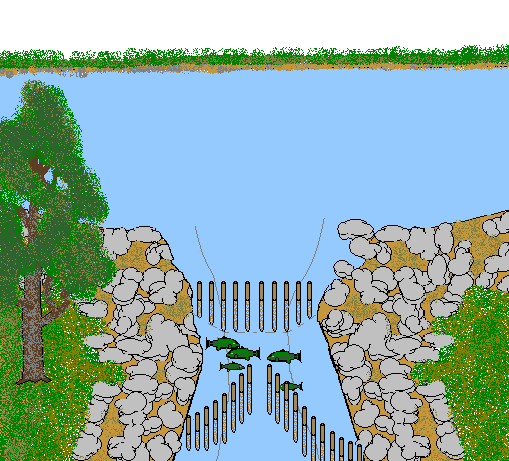
A fishing weir, fish weir, fishgarth[1] or kiddle[2] is an obstruction placed in tidal waters, or wholly or partially across a river, to direct the passage of, or trap, fish. A weir may be used to trap marine fish in the intertidal zone as the tide recedes, fish such as salmon as they attempt to swim upstream to breed in a river, or eels as they migrate downstream. Alternatively, fish weirs can be used to channel fish to a particular location, such as to a fish ladder. Weirs were traditionally built from wood or stones. The use of fishing weirs as fish traps probably dates back prior to the emergence of modern humans, and have since been used by many societies around the world.
In the Philippines, specific indigenous fishing weirs (a version of the ancient Austronesian stone fish weirs) are also known in English as fish corrals and barrier nets.[3][4]
Etymology
[edit]The English word 'weir' comes from the Anglo-Saxon wer, one meaning of which is a device to trap fish.[5]
By region
[edit]Africa
[edit]A line of stones dating to the Acheulean in Kenya may have been a stone tidal weir in a prehistoric lake, which if true would make this technology older than modern humans.[6]
Americas
[edit]North America
[edit]

In September 2014 researchers from University of Victoria investigated what may turn out to be a 14,000-year-old fish weir in 120 ft (37 m) of water off the coast of Haida Gwaii, British Columbia.[7]
In Virginia, the Native Americans built V-shaped stone weirs in the Potomac River and James River. These were described in 1705 in The History and Present State of Virginia, In Four Parts by Robert Beverley Jr:
At the falls of the Rivers, where the Water is shallow, and the Current strong, the Indians use another kind of Weir thus made. They make a Dam of loose stone where of there is plenty on hand, quite across the River, leaving One, Two or more Spaces or Tunnels, for the water to pass thro': at the Mouth of which they set a Pot of Reeds, Wove in form of a Cone, whose Base is about Three Foot, and in Perpendicular Ten, into which the Swiftness of the Current carries the Fish, and wedges them in fast, that they cannot possibly return.[8]
This practice was taken up by the early settlers but the Maryland General Assembly ordered the weirs to be destroyed on the Potomac in 1768. Between 1768 and 1828 considerable efforts were made to destroy fish weirs that were an obstruction to navigation and from the mid-1800s, those that were assumed to be detrimental to sports fishing.[8]
In the Back Bay area of Boston, Massachusetts, wooden stake remains of the Boylston Street Fishweir have been documented during excavations for subway tunnels and building foundations. The Boylston Street Fishweir was actually a series of fish weirs built and maintained near the tidal shoreline between 3,700 and 5,200 years ago.
Natives in Nova Scotia use weirs that stretch across the entire river to retain shad during their seasonal runs up the Shubenacadie, Nine Mile, and Stewiacke rivers, and use nets to scoop the trapped fish. Various weir patterns were used on tidal waters to retain a variety of different species, which are still used today. V-shaped weirs with circular formations to hold the fish during high tides are used on the Bay of Fundy to fish herring, which follow the flow of water. Similar V-shaped weirs are also used in British Columbia to corral salmon to the end of the "V" during the changing of the tides.
The Cree of the Hudson Bay Lowlands used weirs consisting of a fence of poles and a trap across fast flowing rivers. The fish were channelled by the poles up a ramp and into a box-like structure made of poles lashed together. The top of the ramp remained below the surface of the water but slightly above the top of the box so that the flow of the water and the overhang of the ramp stopped the fish from escaping from the box. The fish were then scooped out of the box with a dip net.[9]
South America
[edit]A large series of fish weirs, canals and artificial islands was built by an unknown pre-Columbian culture in the Baures region of Bolivia, part of the Llanos de Moxos.[10] These earthworks cover over 500 square kilometres (190 sq mi), and appear to have supported a large and dense population around 3000 BCE.[11]
Stone fish weirs were in use 6,000 years ago in Chiloé Island off the coast of Chile.[12]
Asia and Oceania
[edit]

.jpg)
Tidal stone fish weirs are one of the ancestral fishing technologies of the seafaring Austronesian peoples. They are found on tidal estuaries and shallow coastal waters throughout regions settled by Austronesians during the Austronesian expansion (c. 3000 to 1500 BCE).[13] They are very similar in shape and construction throughout. They come in several variants, the most basic of which is the semicircular shape (with various examples being described as horseshoe-shaped, arrow-shaped, boomerang-shaped, or heart-shaped), with the opening facing seaward (the direction of the ebb tide). They also sometimes include linear or triangular fish corridors, creating a tennis racket-like or keyhole-like shape that guides the fish into the weir opening. Some variants also include a fish labyrinth at the tips that serves as the fish trap. The weirs can also be nested into each other or extended with multiple short chambers for subdividing the communal fish catch.[14] In some regions they have also been adopted into fish pens or fish ponds or use more perishable materials like bamboo, brushwood, and netting.[13][14][15][16]
Austronesian stone fish weirs are found in the highest concentrations in Penghu Island in Taiwan, the Philippines, and all throughout Micronesia.[13][15][16][14] They are also prevalent in eastern Indonesia, Melanesia, and Polynesia. Around 500 stone weirs survive in Taiwan, and millions of stone weirs used to exist through all of the islands of Micronesia. They are known as atob in the Visayas Islands of the Philippines, maai in Chuuk, aech in Yap, loko ‘umeiki in Hawaii, and pā in New Zealand, among other names.[14] The oldest known example of a stone fish weir in Taiwan was constructed by the indigenous Taokas people in Miaoli County.[16] Most stone fish weirs are believed to also be ancient, but few studies have been conducted into their antiquity as they are difficult to determine due to being continually rebuilt in the same location.[14]
The technology of tidal stone fish weirs has also spread to neighboring regions when Taiwan came under the jurisdiction of China and Imperial Japan in recent centuries.[16] They are known as ishihibi or sukki in Kyushu, kaki in the Ryukyu Islands; dŏksal, sŏkpangryŏm, sŏkchŏn, or wŏn in South Korea (pariticularly Jeju Island); and chioh-ho in Taiwan.[14]
The Han Chinese also had separate ancient fish weir techniques, known as hu, which use bamboo gates or "curtains" in river estuaries. These date back to at least the 7th century in China.[16]
Europe
[edit]In medieval Europe, large fishing weir structures were constructed from wood posts and wattle fences. V-shaped structures in rivers could be as long as 60 m (200 ft) and worked by directing fish towards fish traps or nets. Such weirs were frequently the cause of disputes between various classes of river users and tenants of neighbouring land. Basket weir fish traps are shown in medieval illustrations and surviving examples have been found. Basket weirs are about 2 m (6.6 ft) long and comprise two wicker cones, one inside the other—easy for fish to get into but difficult to escape.[17]
Great Britain
[edit]In Great Britain the traditional form was one or more rock weirs constructed in tidal races or on a sandy beach, with a small gap that could be blocked by wattle fences when the tide turned to flow out again.
Wales
[edit]

Surviving examples, but no longer in use, can be seen in the Menai Strait, with the best preserved examples to be found at Ynys Gored Goch (Red Weir Island) dating back to around 1842.[18] Also surviving are 'goredi' (originally twelve in number) on the beach at Aberarth, Ceredigion. Another ancient example was at Rhos Fynach in North Wales, which survived in use until World War I.[19] The medieval fish weir at Traeth Lligwy, Moelfre, Anglesey was scheduled as an Ancient Monument in 2002.[20]
England
[edit]Fish weirs were an obstacle to shipping and a threat to fish stocks, for which reasons over the course of history several attempts were made to control their proliferation. The Magna Carta of 1215 includes a clause embodying the barons' demands for the removal of the king's weirs and others:
All fish-weirs shall be removed from the Thames, the Medway, and throughout the whole of England, except on the sea coast.[21]
A statute was passed during the reign of King Edward III (1327–1377) and was reaffirmed by King Edward IV in 1472[22] A further regulation was enacted under King Henry VIII, apparently at the instigation of Thomas Cromwell, when in 1535 commissioners were appointed in each county to oversee the "putting-down" of weirs. The words of the commission were as follows:[23]
All weirs noisome to the passage of ships or boats to the hurt of passages or ways and causeys (i.e. causeways) shall be pulled down and those that be occasion of drowning of any lands or pastures by stopping of waters and also those that are the destruction of the increase of fish, by the discretion of the commissioners, so that if any of the before-mentioned depend or may grow by reason of the same weir then there is no redemption but to pull them down, although the same weirs have stood since 500 years before the Conquest.
The king did not exempt himself from the regulation and by the destruction of royal weirs lost 500 marks in annual income.[24] The Lisle Papers provide a detailed contemporary narrative of the struggle of the owners of the weir at Umberleigh in Devon to be exempted from this 1535 regulation.[25] The Salmon Fishery Act 1861 (24 & 25 Vict. c. 109) (relevant provisions re-enacted since) bans their use except wherever their almost continuous use can be traced to before the Magna Carta (1215).
Ireland
[edit]In Ireland, discoveries of fish traps associated with weirs have been dated to 8,000 years ago.[5] Stone tidal weirs were used around the world and by 1707, 160 such structures, some of which reached 360 metres in length, were in use along the coast of the Shimabara Peninsula of Japan.[26]
Gallery
[edit]-
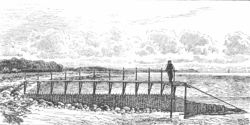 19th-century fishing weir used to trap eels on the Danish coast
 -
 The Martinsville Fish Dam Virginia, a historic Native American Indian fishing weir built with rocks
 -
 Remains of an ancient stone fishing weir in the tidal Menai Strait in Wales
 -
 Fishing weir, Penghu County
 -
 Fishing weir on the rapidly flowing Mogami River in Japan
 -
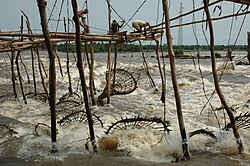 Fishing weirs using baskets at a river waterfall, Democratic Republic of the Congo
 -
 Ancient V-shaped fishing weir at Countisbury Cove, Somerset
 -


See also
[edit]References
[edit]- ^ "Fishgarth". Merriam Webster online. Merriam Webster Inc. Retrieved 3 July 2014.
- ^ "The British Salmon Fisheries". Fishing Excerpts, Volume 3 (published June 1861). January 6, 2009. p. 752 – via Google Books.
{{cite book}}:|journal=ignored (help) - ^ Monteclaro, Harold; Anraku, Kazuhiko; Ishikawa, Satoshi (2017). Field Guidebook on Philippine Fishing Gears: Fishing Gears in Estuaries (PDF). Kyoto: Research Institute for Humanity and Nature. ISBN 978-4-906888-31-3.
- ^ Fisheries Administrative Order No. 154 (PDF). Ministry of Agriculture and Food, Republic of the Philippines. 1986.
- ^ a b Jecock, Marcus. "River Fisheries and Coastal Fish Weirs" (PDF). Introductions to Heritage Assets. English heritage. Retrieved 3 July 2014.
- ^ Clark, J. Desmond (1960). "Human Ecology During Pleistocene and Later Times in Africa South of the Sahara". Current Anthropology. 1 (4): 317. doi:10.1086/200115. JSTOR 2739766. S2CID 145339570.
- ^ "Canada's Oldest Archaeological find unearthed on Haida Gwaii". Global T.V. Retrieved 24 September 2014./
- ^ a b Hranicky, William (1 April 2009). Material Culture from Prehistoric Virginia. Vol. 1. Authorhouse. ISBN 978-1438968490.
- ^ Lytwyn, Victor P. (1 Jan 2002). "TheLlowland Cree and the Land". Muskekowuck Athinuwick: Original People of the Great Swampy Land. University of Manitoba Press. pp. 93, 94. ISBN 9780887553462.
- ^ Erickson, Clark (2000): "An artificial landscape-scale fishery in the Bolivian Amazon". Nature, 408(6809):190–193
- ^ Erickson, Clark (2000b): "AN ARTIFICIAL LANDSCAPE-SCALE FISHERY IN THE BOLIVIAN AMAZON" Archived 2008-01-17 at the Wayback Machine University of Pennsylvania website retrieved 12 Oct. 2007
- ^ Ramirez-Aliaga, Jose Miguel (2011). "The Mapuche Connection". In Terry L. Jones; et al. (eds.). Polynesians in America: Pre-Columbian Contacts with the New World. AltaMira Press. p. 107.
- ^ a b c Jeffery, Bill (16 April 2024). "Tidal Stone-Walled Fish Weirs across Asia-Pacific: An Austronesian Cultural Identity and Its Relevance in Marine Ecology Conservation". Sustainability in Ancient Island Societies: 174–197. doi:10.5744/florida/9780813069975.003.0007.
- ^ a b c d e f Iwabuchi, Akifumi (1 September 2022). "On the Frontline of Climate Change: The Underwater Cultural Heritage of Stone Tidal Weirs". Blue Papers. 1 (1): 89–95. doi:10.58981/bluepapers.2022.1.09.
- ^ a b Jeffery, Bill (June 2013). "Reviving Community Spirit: Furthering the Sustainable, Historical and Economic Role of Fish Weirs and Traps". Journal of Maritime Archaeology. 8 (1): 29–57. Bibcode:2013JMarA...8...29J. doi:10.1007/s11457-013-9106-4.
- ^ a b c d e Chen, Chao-Yuan; Lee, Ming-Ju (31 December 2023). "Evolution of stone fish weirs in Jibei area, Penghu Archipelago (eighteenth to twenty-first century)". Journal of Maps. 19 (1). Bibcode:2023JMaps..1977904C. doi:10.1080/17445647.2023.2277904.
- ^ Shooting and Fishing the Trent Archived 2007-01-25 at the Wayback Machine, ancient fish traps.
- ^ Anon. "Ynys Gorad Goch". Menai Heritage. Menai Bridge Community Heritage Trust. Retrieved 30 September 2018.
- ^ Reid, Ian (2001): "Rhos-on-Sea Heritage Trail". BBC Wales North West website retrieved 7 August 2007.
- ^ Anon. "Traeth Lligwy Fish Weir". Ancient monument. Retrieved 24 February 2018.
- ^ The Text of Magna Carta, see paragraph 33.
- ^ Byrne, Muriel St. Clare, (ed.) The Lisle Letters, 6 vols, University of Chicago Press, Chicago & London, 1981, vol.2, p.622, quoting Luders, A., Statutes of the Realm, vol.2, 1810–28, pp.439–42
- ^ Byrne, Muriel St. Clare, (ed.) The Lisle Letters, 6 vols, University of Chicago Press, Chicago & London, 1981, vol.2, p.628
- ^ Byrne, Muriel St. Clare, (ed.) The Lisle Letters, 6 vols, University of Chicago Press, Chicago & London, 1981, vol.2, pp.623-627
- ^ Byrne, 1981, 6 vols., the matter is referred to in all 6 vols
- ^ Nishimura, Asahitaro (1975). "Cultural and social change in the mode of ownership of stone tidal weirs". In Richard W. Casteel; Jean-Claude Passeron; Walter de Gruyter (eds.). Maritime Adaptations of the Pacific. Walter de Gruyter. pp. 77–88. ISBN 9783110879902.
External links
[edit]- Prehistoric Fishweirs in Eastern North America – master's thesis on fish weirs
Fishing equipment and methods | ||||||||||||||||||||||||||||
|---|---|---|---|---|---|---|---|---|---|---|---|---|---|---|---|---|---|---|---|---|---|---|---|---|---|---|---|---|
| ||||||||||||||||||||||||||||
| ||||||||||||||||||||||||||||


Fishing weir
View on GrokipediaDefinition and Etymology
Core Concept and Functionality
A fishing weir functions as a passive trapping device comprising human-constructed barriers, such as low walls or fences, strategically positioned in waterways to exploit natural water currents and fish migratory patterns for capture. These barriers, often arranged in V- or heart-shaped configurations, channel fish moving with the flow—whether upstream in rivers or into intertidal zones during tidal cycles—toward a central funnel or enclosed basin where they become concentrated and harvestable as water levels recede.[8][9] The design leverages empirical principles of fluid dynamics, wherein the velocity of water directs schooling fish instinctively following currents, while gaps in the structure permit smaller or juvenile individuals to escape, selectively retaining larger specimens.[8] Operationally, the weir's efficacy stems from its reliance on gravitational drainage and tidal ebb rather than mechanical propulsion; as outgoing tides or stream flows lower the water beyond the barrier height, trapped fish are isolated in shallow pools or baskets, minimizing escape without the need for active herding. This physics-based mechanism capitalizes on diadromous fish behaviors, such as tidal-phase migration, where species like salmon or eels navigate predictable flow patterns, rendering the weir a low-maintenance intercept rather than a pursuit-based tool.[9][10] In contrast to active fishing techniques—such as casting nets, lines, or spears, which require direct human exertion to locate, chase, and extract fish—weirs embody energy-efficient scalability, enabling sustained yields through initial construction alone and facilitating communal harvesting with reduced per capita labor input. This passivity aligns with causal efficiencies observed in pre-industrial fisheries, where return on effort often exceeded that of labor-intensive methods by directing natural ecological flows toward human benefit.[2][5]Linguistic Origins
The English term "weir" originates from Old English wer, denoting a dam, fence, or enclosure, with a primary historical application to structures impeding streams for fish capture rather than broad water retention.[11] This root traces to Proto-Germanic *warjaną, implying "to dam up" or defend against flow, evolving into Middle English were while preserving its specificity to fishing enclosures that channeled aquatic harvest without full impoundment.[12] Early attestations, such as in Anglo-Saxon contexts, emphasize practical barriers of stakes or brush for trapping migratory species, distinguishing the term from later hydraulic adaptations focused on milling or diversion.[13] Cross-linguistically, equivalent concepts appear in terms prioritizing functional trapping, as in Welsh gorad for stone or stake-based fish weirs in tidal or riverine settings, highlighting convergent nomenclature rooted in enclosure efficacy across Indo-European and indigenous traditions.[13] Such designations, including Austronesian variants like Philippine panginhas for corral-like traps, converge on harvest-oriented designs over nomenclature uniformity, avoiding conflation with modern barriers engineered for flow control or power generation.[8]Historical Development
Prehistoric and Ancient Uses
Archaeological investigations reveal fishing weirs as early manifestations of sophisticated resource management among prehistoric hunter-gatherers, with wooden stake alignments and basket traps dated to 8000–7000 years ago at estuarine sites such as Haynes Inlet in Oregon, where radiocarbon assays on organic remains confirm their antiquity.[14] These structures exploited tidal and riverine hydrology to channel fish into harvestable concentrations, demonstrating empirical adaptations predating agricultural sedentism.[2] In Eastern North America, wooden stake weirs like those at Mnjikaning in Ontario, with stakes exceeding 5000 calendar years in age, underscore the technology's role in intercepting migratory fish species across river systems.[15] Cobble-based V-shaped weirs, formed by arranging river stones to form downstream-pointing barriers spanning channel widths, appear in archaeological contexts from the Archaic period, as seen in the Paterson weir in New Jersey, facilitating passive capture without constant attendance.[16][17] Such installations influenced settlement dynamics by anchoring communities near seasonal anadromous runs, particularly salmon in northwestern regions, where wood stake weirs enabled sustained yields that supported semi-sedentary lifestyles and population nucleation around fixed fishing locales.[17][18] Faunal evidence from proximate sites indicates heavy fish dependence, with weirs providing a reliable protein source that mitigated risks of foraging variability, though direct overexploitation signals remain absent in analyzed assemblages.[17][19]Medieval and Early Modern Applications
In medieval Europe, fishing weirs formed a key component of feudal economies, where tenants were often obligated to construct and maintain these structures as services to lords, thereby securing rights to elite fisheries and reinforcing hierarchical bonds. A prominent example is the Horngarth, a wooden V-shaped weir at Whitby, England, documented from around 600 CE and rebuilt annually through ceremonies that symbolized communal duty and atonement, such as the Penny Hedge ritual originating in the 12th century following a local abbot's penance. These weirs, typically erected from stakes and hurdles to funnel fish into traps during tidal flows, supported lordly privileges by yielding concentrated catches of species like salmon and herring, which were vital for provisioning households and monasteries during fasting periods mandated by the Church.[20][20] Such installations boosted food security by providing surplus beyond subsistence needs; historical manorial records from England indicate weirs could harvest hundreds of fish per tide in optimal conditions, enabling salting or smoking for trade across regions, though yields fluctuated with seasonal migrations and weather. Regulations like Magna Carta's Clause 33 in 1215 mandated removal of obstructive river weirs (except coastal ones) to preserve navigation and fair access, reflecting tensions between economic utility and broader waterway use.[21][22] During the early modern era (c. 1500–1800), fishing weirs expanded with European colonization, as settlers adapted the technology to New World rivers for exploiting migratory runs, integrating it into colonial provisioning systems despite suppressing indigenous variants. In North America, colonists employed stake weirs and traps to capture shad and salmon, yielding hauls that supported settlements and export trades, with 17th-century accounts from Virginia and New England documenting seasonal efficiencies rivaling European counterparts. This proliferation enhanced trade surpluses—Dutch fisheries alone processed up to 79,000 tons annually by 1602, partly via weir-assisted coastal operations—while underscoring weirs' role in transitioning from feudal duties to mercantile economies.[23][24]Design and Construction
Materials and Basic Structures
Fishing weirs are constructed primarily from natural materials suited to local environments, emphasizing durability against water flow, erosion, and seasonal changes. Stone, particularly river cobbles or boulders, forms the backbone of permanent structures in intertidal and tidal zones, where interlocking rocks resist wave action and sediment movement over centuries.[5] Wooden stakes, logs, reeds, or bamboo serve for riverine or temporary weirs, driven into substrates or woven into barriers that can be dismantled and rebuilt as needed, though they degrade faster in prolonged submersion.[2][25] Pre-industrial designs eschewed metals due to their rarity, corrosion susceptibility in saline or freshwater, and lack of necessity for passive trapping mechanisms.[26] Basic structures adopt V-shaped or funnel configurations to exploit fish migration patterns, with asymmetrical wings converging at an apex to channel prey toward traps or baskets. These wings, often 1-8 meters long at the funnel opening and up to 60 meters extended, incorporate gaps or low walls to allow water passage while blocking fish escape.[27][28] Heights typically range from 20 to 100 cm, calibrated to substrate depth and flow velocity for hydraulic efficiency without full damming.[29] Permeable elements like brush fences or spaced stones minimize turbulence and sediment buildup, as evidenced by archaeological remnants preserving these forms.[30] This engineering prioritizes low-cost, site-specific adaptations over uniform templates, ensuring functionality across diverse hydrological conditions.Operational Mechanics and Variations
Fishing weirs function by channeling water currents or tidal flows to direct fish into confined spaces designed for minimal escape. In tidal environments, low walls—often arranged in V- or heart-shaped configurations—guide fish toward a central enclosure during incoming tides; as the tide recedes, fish become trapped in impoundments or "pounds" where they can be harvested.[8] This passive mechanism exploits fish behavior, such as schooling against currents, while gaps in the structure allow smaller juveniles to exit, selectively retaining larger individuals.[8] In riverine settings, linear barriers partially span the streambed, funneling upstream migrants like salmon into terminal traps or baskets via one-way funnels that prevent retrograde movement.[5] The upstream portions of panels anchor to the substrate, with downstream ends elevated by resistance boards that plane against flow, maintaining structural integrity without fully damming the waterway.[31] Weirs differ typologically by permanence and hydrology: fixed stone variants, common in intertidal zones, endure wave action through interlocking boulders forming semi-permanent walls, whereas stake or "hedge" weirs employ removable wooden poles or reeds for seasonal river deployment, allowing reconfiguration or clearance during low flows.[32] Basket-integrated designs append funnel-shaped traps to the weir apex for active collection, contrasting plain barriers that rely on stranding.[33] Unlike solid dams, which generate hydraulic heads impeding all passage, fishing weirs maintain porosity—spaces between elements permit continuous flow while directing fish via behavioral cues and minor head differentials, reducing energetic costs to operators but demanding precise alignment with local bathymetry.[34] Operational efficiency hinges on site-specific factors like flow velocity and migration timing, with capture rates varying widely; permanent river weirs for salmon exhibit higher consistency across years compared to temporary setups, though overall proportions captured seldom exceed site-dependent maxima without auxiliary netting.[35] Historical applications, such as in Pacific Northwest streams, leveraged weirs to harvest substantial runs—evidenced by communal yields supporting pre-industrial societies—but required intensive labor for construction and tending, often yielding lower per-unit effort than modern active gears despite passive advantages in selectivity.[10] Overbuilt contemporary analogs, prioritizing monitoring over harvest, amplify material demands without proportional gains in entrapment, underscoring the causal primacy of hydrodynamic simplicity in ancestral designs.[31]Regional Examples
Africa and Middle East
In the Nile Valley of Sudan, Mesolithic communities constructed fishing weirs using stone and other materials to capture fish during seasonal floodplain inundations, as evidenced by archaeological sites at the confluence of the Nile and Atbara rivers dating to approximately 10,000–6,000 years before present.[36] These weirs facilitated diverse procurement strategies, including barriers that directed migrating fish into baskets or holding areas when water levels receded, adapting to the river's predictable flood cycles.[37] The use of locally available cobbles for structural elements minimized labor and maintenance in sparsely populated regions, enabling reliable subsistence yields without evidence of resource depletion in faunal assemblages from associated sites like Abu Darbein.[38] Such riverine weirs in arid-adjacent African contexts, including tributaries like the Atbara, leveraged hydraulic gradients during floods to concentrate fish schools, with low-profile stone alignments guiding species such as Nile perch and tilapia into harvestable positions.[39] This design's resilience stemmed from its integration with natural ebb flows, reducing the need for constant vigilance and allowing juvenile fish to pass through gaps, thereby preserving breeding stocks over millennia as indicated by sustained fish bone densities in stratigraphic layers.[36] In contrast to wood-based variants, stone components endured erosion in sediment-laden waters, supporting long-term use by mobile hunter-gatherers who revisited sites annually. Further south in Central Africa, river weirs at waterfalls, such as those documented in the Democratic Republic of the Congo, employed stone bases augmented with basketry to exploit rapid flows, capturing migratory fish during high-water periods. These adaptations highlight empirical resilience in variable hydrological regimes, where durable stone anchors withstood currents while permeable elements permitted selective harvesting, aligning with subsistence patterns that avoided overexploitation through tidal or seasonal timing.[19] In the Middle East, evidence for stone weirs remains sparse, with potential tidal variants inferred from broader Levantine coastal archaeology, though direct attributions lag behind African riverine records; hydraulic stone features along arid wadis primarily served irrigation rather than pisciculture.[40] Regional aridity constrained permanent structures, favoring ephemeral barriers tied to infrequent floods, yet the absence of extensive faunal proxies limits verification of widespread weir deployment compared to Nile-centric applications.[41]Americas
In North America, indigenous groups employed fishing weirs constructed from stone and wooden stakes to capture migratory fish in rivers and streams, with evidence dating back millennia. Cherokee communities in the Appalachian Mountains built V-shaped rock walls extending into waterways, funneling fish into traps or baskets at the apex for efficient harvest during seasonal runs.[25] Similar prehistoric structures appear in the Mississippi Valley, including stake alignments in creeks and a rock weir at the Aztalan site in Wisconsin, erected by Mississippian peoples between the 10th and 13th centuries using glacial boulders to impede and concentrate fish in the Crawfish River.[42][43] Salmon-centric designs prevailed among Pacific Northwest and Alaskan indigenous peoples, featuring stake weirs that selectively harvested returning runs while allowing escapement for spawning, sustaining populations over thousands of years.[44] In Alaska's Bristol Bay region, modern rotary screw traps at weirs on the Upper Nushagak and Koktuli Rivers monitor Chinook salmon escapement, with annual counts informing management; for instance, the Nushagak system supports runs exceeding 100,000 fish, demonstrating continuity from traditional practices to data-driven conservation.[45] These methods achieved ecological balance through targeted capture of ripe individuals, averting overexploitation evident in less selective industrial fisheries and refuting claims of inherent inefficiency in pre-contact technologies.[46] In South America, interior floodplain systems incorporated weirs for trapping fish during seasonal inundations, as documented in Bolivia's Baures region where hundreds of stone and earth structures channeled aquatic species into enclosures amid raised fields.[47] Riverine variants in Amazonian tributaries utilized reeds and stakes to intercept migratory fish like characins, enabling sustained yields without habitat degradation, as inferred from archaeological stability over centuries.[48] Such designs underscore adaptive resource management, prioritizing harvest of surplus while preserving breeding stocks for long-term viability.Asia and Oceania
In Taiwan's Penghu Archipelago, over 600 stone tidal fish weirs, known locally as shi hu, have been constructed along the shorelines, with many dating back more than 100 years and some exceeding 300 years in age.[49][50] These massive, geometrically precise structures, often resembling land art with V- or heart-shaped designs, extend from the intertidal zone seaward, funneling fish into central traps as tides ebb, enabling communal harvesting with minimal equipment.[51] Built primarily from locally abundant stones, they capitalized on the archipelago's tidal range and wave patterns to concentrate migratory species, supporting indigenous and coastal communities by providing reliable protein sources and reducing reliance on open-sea fishing.[52] In the Federated States of Micronesia's Yap islands, over 800 stone-walled tidal weirs, varying from 65 to 650 feet in length, form arrow-shaped barriers across reef flats, directing fish toward apex points for capture via hand nets during low tides.[8] Constructed from stacked stones and reef limestones, these traps, integral to traditional Yapese fishing since pre-colonial times, emphasized communal use and sustainability, with designs empirically refined to exploit tidal flows and minimize bycatch of non-target species.[53][54] Their role extended beyond subsistence, fostering social cohesion through shared maintenance and harvests that sustained island populations without depleting stocks, as evidenced by persistent reef health in weir-adjacent areas.[55] Across broader Pacific island ecosystems in Oceania, such as Vanuatu and Fiji, traditional weirs incorporating stone walls around mangroves or seagrass beds, alongside bamboo or reed variants in lagoons, were tuned to lunar-influenced tidal cycles for optimal yields, capturing fish en masse during predictable ebbs.[55] These structures supported pre-colonial economies by enabling high catch rates with low effort, preserving biodiversity through size and species selectivity that limited incidental captures, thus maintaining viable fish populations for generations.[55][56]Europe
In medieval Europe, fishing weirs were constructed primarily from wooden stakes and wattle fences in temperate rivers and estuaries, directing migratory fish such as salmon into traps. These structures, often V-shaped and extending up to several hundred meters, exploited tidal flows and river currents to concentrate fish for harvest. Stone variants predominated in intertidal zones, where low tides exposed trapped fish for collection by hand or net.[57][30] In Great Britain and Ireland, wicker-based traps known as kiddles or garths were common in rivers, with the Horngarth at Whitby, North Yorkshire, exemplifying medieval design tied to feudal customs. Originating around 1159 as part of a penance ritual involving annual hedge construction from woven branches, the Horngarth persisted as a seasonal salmon weir, reflecting communal labor and lordly rights over fisheries. Stone weirs in tidal estuaries, such as those in Welsh bays like Lligwy and the Menai Strait, date to at least the early medieval period, with walls of stacked stones forming barriers that funneled fish on ebb tides.[20][13] Continental examples included stake weirs along major rivers, though detailed yields from manorial records are sparse; monastic and seigneurial accounts from the Rhine and Danube basins document consistent salmon and eel harvests supporting feudal economies. Wooden stakes driven into riverbeds created semi-permanent barriers, harvested via baskets or spears, with structures rebuilt seasonally to withstand floods.[22] Feudal regulations governed weir placement to prevent overexploitation and navigation obstruction, as seen in 13th-century English charters limiting kidde construction and Magna Carta clauses (1215) mandating free passage for boats by removing fixed weirs. Royal ordinances across Europe banned destructive variants, enforcing gaps for fish migration and vessel transit, which transitioned weirs toward sustainable, regulated use by the late Middle Ages. Conflicts arose, such as 1365 Scottish burghers demolishing abbey weirs blocking Stirling trade routes, underscoring tensions between harvest yields and riverine commerce.[57][58][59]Environmental Impacts
Ecological Effects on Fish Populations and Habitats
Fishing weirs can impede upstream migration of anadromous species such as salmon, leading to delays, energy expenditure, and reduced reproductive success, particularly in rivers with fixed structures that lack adequate passage mechanisms. A 2020 study on a low-head weir in an Australian stream documented altered hydraulic conditions upstream, including reduced water velocity and temperature shifts, which contributed to habitat degradation and behavioral changes in fish assemblages, such as decreased movement rates for species like Murray cod.[60] In North American contexts, low-head barriers including weirs have been linked to habitat fragmentation, isolating populations and limiting access to spawning grounds, as evidenced by short-term monitoring post-removal in Mid-Atlantic streams where fish diversity and abundance increased after barrier mitigation in 2021.[61] Fixed weirs may also reduce overall fish diversity by favoring lentic-adapted species over rheophilic ones, with a generalized linear model analysis in South Korean streams showing a significant negative correlation between weir presence and Shannon diversity indices for total fish communities.[62] Hydrologically, weirs can promote sediment deposition in low-gradient areas, altering benthic habitats and potentially exacerbating effects during low-flow periods associated with climate variability, though empirical data specific to tidal or seasonal weirs indicate less severe siltation compared to full impoundments due to maintained overall flow regimes.[63] Conversely, traditional weir designs often incorporate selective features, such as V-shaped funnels or escape gaps sized to release juveniles while trapping adults, thereby mitigating overharvest of immature stocks and allowing natural recruitment; archaeological records from Pacific Northwest sites demonstrate sustained salmon populations over millennia without evidence of depletion attributable to weir use.[46] In intertidal settings, such as Oregon estuaries, wood stake weirs spanning over 3,000 years of use supported consistent harvests by exploiting tidal cycles without collapsing local fish stocks, as inferred from stratigraphic and oral historical evidence.[64] Empirically, the localized harvest intensity of weirs contrasts with broader depletions from industrial trawling or gillnetting, with indigenous management systems integrating weirs into ecosystems that preserved biodiversity, as seen in pre-colonial North American fisheries where weir complexes facilitated predator control on juveniles indirectly through size-selective capture.[65] Quantitative models from community-based salmon monitoring using ancient weir analogs confirm minimal long-term population impacts when operations align with migration peaks, underscoring lower ecological footprints relative to non-selective modern gears.[46]Sustainability of Traditional vs. Modern Designs
Traditional fishing weirs have sustained fish populations over millennia without evidence of systemic collapse, as demonstrated by archaeological records of continuous use in regions like the Pacific Northwest, where salmon exploitation remained stable for approximately 7,500 years.[66] Indigenous systems, such as those employing riverine weirs for selective salmon harvest, relied on designs that exploited natural migratory behaviors, minimizing bycatch and allowing escapement for reproduction, thereby maintaining ecological balance through low-intensity, behaviorally attuned interventions rather than exhaustive extraction.[46] This longevity underscores a causal link between sustainability and operational scale: weirs built at appropriate sizes relative to local hydrology and fish runs, combined with routine maintenance to prevent over-impingement, fostered regenerative cycles without inherent environmental degradation.[67] ![Salmon weir at Quamichan Village on the Cowichan River, Vancouver Island][float-right] In contrast, modern hybrid weirs—often incorporating permeable materials for scientific enumeration or monitoring—prioritize data collection over harvest selectivity, potentially elevating risks such as fish stranding during fluctuating flows if permeability fails under high velocities or sediment loads. While effective for short-term assessments, these adaptations can amplify vulnerabilities when scaled beyond traditional precedents, particularly amid climate-induced variability in water levels, where inadequate maintenance exacerbates entrapment compared to the adaptive, low-tech resilience of ancestral structures.[68] Empirical continuity in archaeological sites, spanning cultures from tidal traps in Oceania to estuarine barriers in Europe, refutes claims of inherent harm in weir-based fishing, attributing persistence to site-specific calibration rather than blanket prohibitions driven by regulatory assumptions of uniform ecological threat.[5] ![Modern anchovy weir in the Oosterschelde near Bergen op Zoom in the Netherlands (aerial view)][center] Overregulation of traditional designs, often supplanting proven indigenous protocols with standardized modern frameworks, has correlated with fishery declines, as observed in Pacific salmon systems where displacement of communal weir management eroded long-honed sustainability.[65] True viability hinges on causal factors like localized enforcement of escapement thresholds and material renewability, not ascribed "green" attributes independent of human oversight; unchecked expansion of any weir type risks perturbation, yet historical precedents affirm that traditional moderation—untethered from excessive bureaucratic constraints—avoids such pitfalls.[69] This distinction highlights how empirical track records, rather than ideologically motivated reforms, best inform enduring practices.Modern Applications and Innovations
Scientific Monitoring and Conservation
Fishing weirs serve as precise tools for enumerating fish passage in rivers, enabling direct counts of species, sizes, and timings essential for escapement estimates in fisheries management.[70][71] In salmon-bearing streams, temporary picket weirs—barriers with vertical slats allowing water flow while trapping fish—facilitate manual or video-assisted counts, providing empirical data on run strength superior to indirect methods like aerial surveys.[71] For instance, in Alaska's Nushagak River system, weirs operated in 2024 enumerated 2,206 Chinook, 7,259 chum, and 1,369 sockeye salmon at the Upper Nushagak site, alongside genetic and length data to assess stock health.[72] These installations often incorporate video traps or chutes for non-lethal sampling, minimizing handling stress while capturing real-time footage for species identification and migration patterns.[71] The U.S. Fish and Wildlife Service deploys such weirs in regions like the Yukon-Kuskokwim Delta, where 2024 monitoring plans included weir-based counts for subsistence and conservation assessments, informing federal quotas to align harvest with spawning needs.[73] Globally, weir-derived escapement data underpin sustainable yield models, as seen in Pacific salmon systems where counts at weirs like those on the Unalakleet River track annual returns against benchmarks.[74][75] Recent innovations enhance weir efficacy through integrated tracking technologies, such as active fish tracking systems in guide weirs that quantify passage efficiency via telemetry or video analytics.[76] In 2023–2024 developments, AI-driven "Salmon Vision" systems combined with weir structures enable automated species detection and enumeration, reducing human error in remote settings and supporting biodiversity monitoring.[77] These advancements facilitate data on fish behavior around barriers, optimizing designs to minimize entrainment risks.[78] In Bristol Bay, Alaska, weir monitoring of sockeye escapement—such as tower-assisted counts on the Nuyakuk River—has directly informed in-season quota adjustments, sustaining runs averaging 40–50 million fish annually while preventing overharvest through evidence-based closures.[79][80] This empirical approach contrasts with less precise indices, yielding verifiable metrics that correlate harvest levels with spawning success, as evidenced by 2025 returns exceeding forecasts by 14% due to prior conservative management.[81] Such data-driven strategies underscore weirs' role in averting depletion, prioritizing population viability over expansive commercial takes.[5]Restoration and Contemporary Uses
In 2025, the Sumas First Nation in British Columbia pursued the construction of a traditional fish weir on its Fraser Valley territory to restore ancestral salmon harvesting practices, despite ongoing prohibitions under Canada's Fisheries Act that classify such structures as illegal obstructions.[82] This initiative highlights efforts to integrate indigenous knowledge with modern environmental assessments, aiming to enable selective, low-impact fishing that supports community food security amid declining wild stocks.[83] Contemporary applications of fishing weirs persist in small-scale artisanal operations across developing regions, such as tidal traps in coastal Vanuatu and basket weirs in parts of Africa, where they facilitate efficient capture of migratory species during predictable tidal cycles without relying on fuel-intensive gear.[8] These designs, often adapted from pre-colonial techniques, provide economic viability for local fishers by yielding consistent harvests—typically 10-20 kg per tide in optimal sites—while reducing overexploitation risks through temporary deployment aligned with natural fish runs.[46] Hybrid structures combining flood control with fish passage, such as the 2025 Sacramento Weir expansion in California, demonstrate weir adaptations that indirectly bolster fisheries by improving upstream access for endangered salmon and steelhead, potentially increasing spawning returns by facilitating migration during high flows.[84] Such projects underscore practical benefits like habitat connectivity and resilience against climate-driven floods, though regulatory approvals often prioritize conservation over active harvesting.[85]Controversies and Regulations
Indigenous Practices and Rights Conflicts
Indigenous communities in North America have employed salmon fishing weirs for millennia, incorporating selective harvest techniques that allowed escapement of spawning fish, as evidenced by thriving populations at European contact and ethnographic records of deliberate conservation measures.[67] These practices, including V-shaped weirs and gaps for upstream migration, supported balanced harvests without depleting stocks, with historical data indicating sustainable yields across generations in regions like the Pacific Northwest.[86] Such systems prioritized multigenerational stewardship, contrasting with later industrial approaches by minimizing bycatch and enabling precise control over fishing pressure.[65] Colonial interventions disrupted these practices, exemplified by the Canadian federal government's forcible removal of Indigenous weirs between 1904 and 1905, despite evidence of their sustainability and community resistance, which interfered with established ecological balances in favor of emerging commercial interests.[67] In the United States, treaty rights to off-reservation fishing, including weir use, faced enforcement challenges leading to arrests during the "fish wars" of the 1960s and 1970s, until the 1974 Boldt Decision affirmed tribes' entitlement to 50% of the harvestable catch in usual and accustomed places, mandating co-management with states.[87] This ruling recognized the empirical viability of Indigenous methods, countering state assertions of exclusive regulatory authority.[88] Ongoing conflicts highlight tensions between Indigenous stewardship evidence and governmental conservation claims, as seen in Canadian cases where Fisheries Act enforcement has restricted traditional practices amid declining stocks, even as studies affirm the resilience of pre-colonial weir systems.[89] A 2025 British Columbia court decision adversely impacted Musqueam Nation fishing rights following a protracted trial, underscoring persistent legal barriers despite data showing Indigenous approaches foster selective, sustainable harvests superior to uniform restrictions.[90] Indigenous-led analyses reveal that balanced escapement protocols in weirs prevented overharvest, challenging state narratives that portray such methods as threats requiring prohibition, with empirical records from contact-era abundances supporting the inefficiency of disruptive policies.[44][65]Regulatory Frameworks and Debates
In the European Union, the Water Framework Directive mandates member states to mitigate barriers to fish migration, including weirs, to achieve good ecological status in waterbodies, often requiring modifications or removals to facilitate upstream passage for species like salmon.[91] This framework prioritizes anadromous fish recovery amid observed declines, with enforcement varying by country; for instance, Belgium's removal of Weir No.1 on the River Mark in recent years restored migration routes previously obstructed by such structures.[92] In the United States, federal guidelines under the National Marine Fisheries Service stipulate that fish weirs in salmonid habitats must incorporate safe passage mechanisms, such as chutes or traps, to prevent injury or blockage during downstream migration, with operations restricted to avoid entrainment risks.[93][94] These requirements, enforced via permits from agencies like the U.S. Army Corps of Engineers, aim to comply with Endangered Species Act protections but can limit weir deployment in rivers with listed species. Canadian regulations, administered by Fisheries and Oceans Canada, impose restrictions on fixed gear like weirs in certain salmon-bearing waters to safeguard migration corridors, clashing with indigenous-led restoration efforts; for example, Sumas First Nation's 2024-2025 initiatives to rebuild traditional rock weirs in British Columbia highlight tensions, as federal policies emphasize habitat protection while proponents argue for exemptions based on historical low-impact designs that minimize environmental disruption and reduce monitoring costs compared to modern alternatives.[82] Recent Atlantic herring fishery specifications for 2025-2027 indirectly constrain weir operations in areas like New Brunswick, where landings thresholds (e.g., below 2,600 metric tons by October 1) trigger quota adjustments to prevent overfishing, potentially rendering seasonal weir fisheries uneconomical amid reduced allowable catches.[95][96] Debates center on balancing migration facilitation against evidence of traditional weirs' sustainability, with regulators advocating stricter controls due to climate-driven shifts in fish passability—such as reduced upstream success at rock weirs under warmer, variable flows—while critics contend that blanket prohibitions overlook data from unregulated indigenous sites showing no overfishing and stable populations via selective, low-by-catch harvests.[97] Proponents of deregulation cite economic analyses indicating that bans elevate compliance costs for small-scale operators, shifting reliance to fuel-intensive mobile gear and inflating seafood prices, whereas empirical studies of Pacific Northwest and Hawaiian traditional weirs demonstrate long-term viability without stock depletion, supporting policy reforms for site-specific allowances.[98][44] Opposing views, drawn from fisheries management bodies, emphasize verifiable migration bottlenecks at weirs exacerbating climate vulnerabilities, yet concede that adaptive designs incorporating passage features could reconcile conservation with traditional efficacy, as evidenced by ongoing U.S. and Canadian pilot restorations yielding habitat benefits without yield losses.[99][65]References
- https://en.wiktionary.org/wiki/weir