Hubbry Logo
PenghuPenghuMain
Open search
Penghu
Community hub
Penghu
logo
8 pages, 0 posts
0 subscribers
Be the first to start a discussion here.
Contribute something
Penghu
Penghu
from Wikipedia

Key Information

Penghu Islands
Traditional Chinese澎湖群島
PostalPescadores Islands
Transcriptions
Standard Mandarin
Hanyu PinyinPénghú Qúndǎo
Bopomofoㄆㄥˊ   ㄏㄨˊ
ㄑㄩㄣˊ   ㄉㄠˇ
Gwoyeu RomatzyhPernghwu Chyundao
Wade–GilesPʻêng2-hu2 Chʻün2-tao3
Tongyong PinyinPénghú Cyúndǎo
Yale RomanizationPénghú Chyúndǎu
MPS2Pénghú Chiúndǎu
IPA[pʰə̌ŋ.xǔ tɕʰy̌n.tàʊ]
Southern Min
Hokkien POJPhîⁿ-ô͘-kûn-tó or
Phêⁿ-ô͘-kûn-tó
Tâi-lôPhînn-ôo-kûn-tó or
Phênn-ôo-kûn-tó
Penghu Island
Traditional Chinese澎湖島
Transcriptions
Standard Mandarin
Hanyu PinyinPénghú Dǎo
Bopomofoㄆㄥˊ   ㄏㄨˊ   ㄉㄠˇ
Gwoyeu RomatzyhPernghwu Dao
Wade–GilesPʻêng2-hu2 Tao3
Tongyong PinyinPénghú Dǎo
Yale RomanizationPénghú Dǎu
MPS2Pénghú Dǎu
IPA[pʰə̌ŋ.xǔ tàʊ]
Southern Min
Hokkien POJPhîⁿ-ô͘-tó or
Phêⁿ-ô͘-tó
Tâi-lôPhînn-ôo-tó or
Phênn-ôo-tó
Penghu County
Traditional Chinese澎湖
Transcriptions
Standard Mandarin
Hanyu PinyinPénghú Xiàn
Bopomofoㄆㄥˊ   ㄏㄨˊ   ㄒㄧㄢˋ
Gwoyeu RomatzyhPernghwu Shiann
Wade–GilesPʻêng2-hu2 Hsien4
Tongyong PinyinPénghú Siàn
Yale RomanizationPénghú Syàn
MPS2Pénghú Shiàn
IPA[pʰə̌ŋ.xǔ ɕjɛ̂n]
Hakka
Pha̍k-fa-sṳPhàng-fù-yen
Southern Min
Hokkien POJPhîⁿ-ô͘-koān or
Phêⁿ-ô͘-koān
Tâi-lôPhînn-ôo-kuān or
Phênn-ôo-kuān
Historical affiliations

Song dynasty (1170–1279)
Yuan dynasty (1281–1368)
Ming dynasty (1368–1622, 1624–1644)
Dutch Empire (1622–1624)
Kingdom of Tungning (1661–1683)
Qing dynasty (1683–1895)
Empire of Japan (1895–1945)
Republic of China (1945–present)

Northern islands of Penghu (the Pescadores)

The Penghu (/ˈpʌŋˈh/ PUNG-HOO,[1] Hokkien POJ: Phîⁿ-ô͘  or Phêⁿ-ô͘ ) or Pescadores Islands are an archipelago of 90 islands and islets in the Taiwan Strait, about 50 kilometres (25 nautical miles) west of the main island of Taiwan across the Penghu Channel, covering an area of 141 km2 (54 sq mi). The archipelago collectively forms Penghu County. The largest city is Magong, on the largest island, which is also named Magong.

The Penghu islands first appear in the historical record in the Tang dynasty and were inhabited by Chinese people under the Southern Song dynasty, during which they were attached to Jinjiang County of Fujian.[2] The archipelago was formally incorporated as an administrative unit of China in 1281 under Tong'an County of Jiangzhe Province in the Yuan dynasty.[3] It continued to be controlled by Imperial China with brief European occupations by the Dutch Empire (1622–1624) and Second French colonial empire (1885), until it was ceded to the Empire of Japan in 1895. Japan’s surrender in 1945 ended its colonial rule over the Islands, which has since then been governed by the Republic of China (ROC). Under the terms of the Sino-American Mutual Defense Treaty and the subsequent Taiwan Relations Act between the ROC and the United States, Penghu is defined and geographically acknowledged as part of Taiwan.[4][5]

Penghu Islands rely solely on sea and air transportation, with air transport having a significant role in outside access. The islands are served by three local domestic airports: Penghu Airport, Qimei Airport, and Wang-an Airport. The Penghu National Scenic Area comprises most of the islands and islets of the archipelago. It is also renowned for its unique natural feature of columnar basalt landscape. Tourism is one of the main sources of income to the county.

Name

[edit]

The "Penghu" islands were mentioned in a series of poems from the Tang dynasty (618–907). In the Song dynasty (960–1279), it was mentioned that in the Tang period, "Pinghu" barbarians from beyond Quanzhou had laid siege to Fuzhou, now the capital of Fujian Province.[2] In 1171, poet Lou Yue [zh] described a place across the sea from Quanzhou, identified as Penghu, that had thousands of sandbars called "Pinghu" (flat lake) because of the "encircling shape of its inner coastline".[6] Song sources describe migrants from Fujian cultivating land on Pinghu.[7] In 1225, the Song historian Zhao Rukuo called the islands attached to Jinjiang County "Penghu".[8] In 1227, Wang Xiangzhi described Penghu as a group of 36 islands in an "outlying region" which took three days to reach by sailing from Jinjiang.[9] In the Southern Min language, both Pinghu and Penghu are pronounced similarly, and scholars in Taiwan believe them to be the same place.[8] In Southern Min it is pronounced Phêⁿ-ô·.[10]

According to the official Penghu County Chronicle, Penghu's original name had been "Pinghu" (平湖), but as "Ping" (平) sounded similar to "Peng" (彭) in Hokkien, "Pinghu" (平湖) was also written as "Penghu" (彭湖), and ultimately the consensus, is to write "Penghu" (澎湖).[11][12] The islands have also been called Pehoe from the Minnan name Phêⁿ-ô·.[10]

The name "Pescadores" comes from the Portuguese name Ilhas dos Pescadores ("Fishermen Islands"). The European Portuguese pronunciation is [pɨʃkɐˈðoɾɨʃ][13] but, in English, it is typically closer to /ˌpɛskəˈdɔːrɪz, -z/.[10]

History

[edit]

Prehistory

[edit]

Penghu 1, a fossil jaw (mandible) dating to the Middle or Late Pleistocene that belonged to a member of an extinct hominin species, possibly a Denisovan, was discovered in the Penghu Channel c. 2008.[14]

Finds of fine red cord-marked pottery at Guoye, Huxi, indicate that Penghu was visited by Austronesians from southwestern Taiwan around 5,000 years ago, though not settled permanently.[15]

Song dynasty

[edit]

Han Chinese from southern Fujian began to establish fishing communities on the islands in the 9th and 10th centuries,[15] and representatives were intermittently stationed there by the Southern Song and Yuan governments from c. 1170.[16] Chinese fishermen had settled on the Penghu Islands by 1171, when a group of "Bisheye" bandits with dark skin speaking a foreign language landed on Penghu and plundered the fields planted by Chinese migrants. The Song government sent soldiers after them and from that time on, Song patrols regularly visited Penghu in the spring and summer. A local official, Wang Dayou [zh] had houses built on Penghu and stationed troops there to prevent depredations by the Bisheye.[17][18][16] Coins dating to the Xining (1068–1077) and Zhenghe (1111–1117) reign periods as well as many Song pottery and porcelain shards have been unearthed in Penghu.[9]

In 1225, the Book of Barbarian Nations anecdotally indicated that Penghu was attached to Jinjiang, Quanzhou Prefecture.[3] A group of Quanzhou immigrants lived on Penghu.[19]

Yuan dynasty

[edit]

In November 1281, the Yuan dynasty under Emperor Shizu officially established the Penghu Patrol and Inspection Agency under the jurisdiction of Tong'an County, incorporating Penghu into China's borders 403 years earlier than Taiwan.[3]

Wang Dayuan gave a detailed first-hand account of the islands in his Daoyi Zhilüe (1349).[20]

There are thirty-six islands, large and small, so close together that the slopes of one are visible from another. Among them are seven harbors which are named. With a favoring wind they can be reached from Ch'üan-chou in two days and nights. There is grass but no trees ; the land is barren and not suited for growing rice. The Ch'üan-chou people make their houses by thatching grass. The weather is always warm. The customs [of the residents] are rustic. Many of the people are long-lived [or, the people are mostly old]. Men and women both wear long cloth gowns girded with local cotton cloth. They boil sea [water] to get salt, and ferment millet to make liquor. They gather fish, shrimp, snails, and clams to supplement their [staple of grain]. They burn ox dung to cook fish fat for use as oil. The land produces sesame and green beans. The goats multiply into flocks of several tens of thousands. A family [which owns some goats] brands their hair and cuts their horns as marks of identification, but does not gather them in during the day or night, so that they all forage for themselves. Their workmen and merchants enjoy the profits of a flourishing trade.
The territory is attached to Chin-chiang county [hsien] of Ch'üan-chou [prefecture]. During the reign-period Chih-yüan 至元[1280-1294] a sub-county magistrate was assigned there to be in charge of the annual tax fixed on salt; during the Chung-t'ung 中統 reign-period [1260-1279] this amounted to ten ingots [ting 錠] and twenty-five ounces. No other tax or corvée is levied.[21]

Ming dynasty

[edit]

In the 15th century, the Ming ordered the evacuation of the islands as part of their maritime ban. When these restrictions were removed in the late 16th century, legal fishing communities, most of which hailed from Tong'an County,[22] were re-established on the islands. These fishermen worshiped at the Mazu Temple that gave Magong its name and themselves gave rise to the Portuguese name Pescadores.[16] The Ming established a permanent military presence starting in 1597.[23]

At this time, the Dutch East India Company was trying to force China to open a port in Fujian to Dutch trade and expel the Portuguese from Macau.[24][25][26] When the Dutch were defeated by the Portuguese at the Battle of Macau in 1622, they seized Penghu, built a fort there, and threatened raids on Chinese ports and shipping unless the Chinese allowed trading with them on Penghu and that China not trade with Manila.[27] In response, the Chinese governor of Fujian demanded that the Dutch withdraw from Penghu to Taiwan, where the Chinese would permit them to engage in trade.[28][29] The Dutch continued to raid the Fujian coast between October 1622 and January 1624 to force their demands, but were unsuccessful.[30] In 1624, the new governor of Fujian sent a fleet of 40–50 warships with 5,000 troops to Penghu and expelled the Dutch, who moved to Fort Zeelandia on Taiwan.[31][32]

Qing dynasty

[edit]
Map of Penghu, 1752

For a period in the mid-17th century, Taiwan and the archipelago were ruled by the Kingdom of Tungning under the Zheng family, which was overthrown by the Qing dynasty in 1683 after the Battle of Penghu. Military personnel were stationed on Penghu afterwards. Penghu became a sub-prefecture of Taiwan Prefecture, Fujian Province, in the Qing period.[33]

The Penghu archipelago was captured by the French in March 1885, in the closing weeks of the Sino-French War, and evacuated four months later. The Pescadores Campaign was the last campaign of Admiral Amédée Courbet, whose naval victories in the war had made him a national hero in France. Courbet was among several French soldiers and sailors who died of cholera during the French occupation of Penghu. He died aboard his flagship Bayard in Makung harbour on 11 June 1885.[34][non-primary source needed]

Empire of Japan

[edit]
Hōko Prefecture Government building

Towards the end of the First Sino-Japanese War, having defeated the Qing in northern China, Japan sought to ensure that it obtained Penghu and Taiwan in the final settlement. In March 1895, the Japanese defeated the Chinese garrison on the islands and occupied Makung. The Japanese occupation of Penghu, with its fine harbor, gave the Imperial Japanese Navy an advanced base from which their short-range coal-burning ships could control the Taiwan Straits and thus prevent more Chinese troops from being sent to Taiwan. This action persuaded the Chinese negotiators at Shimonoseki that Japan was determined to annex Taiwan, and, after Penghu, Taiwan and the Liaodong Peninsula had been ceded to Japan in the Sino-Japanese Treaty of Shimonoseki in April, helped to ensure the success of the Japanese invasion of Taiwan in May.[35][non-primary source needed]

Penghu County was then called the Hōko Prefecture by the Japanese government of Taiwan. In World War II, Makō (Makung) was a major base for the Imperial Japanese Navy and the embarkation point for the invasion of the Philippines.[citation needed]

In 1944, Penghu was extensively bombed in the Penghu air raids.

Republic of China

[edit]
The Pescadores (1950)

In the Cairo Declaration of 1943, the United States, the United Kingdom and China stated it to be their purpose that "all the territories that Japan has stolen from the Chinese, such as Formosa and The Pescadores, shall be restored to the Republic of China". On 26 July 1945, the three governments issued the Potsdam Declaration, declaring that "the terms of the Cairo Declaration shall be carried out". However, the United States and the United Kingdom have regarded the aforementioned documents as merely wartime statements of intention with no binding force in law.[36]

Following the surrender of Japan on 2 September 1945, Supreme Commander of the Allied Powers Douglas MacArthur issued General Order No. 1, which directed Japanese forces to surrender to the Allied Powers and facilitate the occupation of Japanese territories by the Allied Powers. The Office of the Supreme Commander for the Allied Powers ordered Japanese forces in China and Taiwan to surrender to Chiang Kai-shek, who the Allied Powers delegated to accept the surrender. On 25 October 1945, Governor-General Rikichi Andō handed over the administration of Taiwan and the Penghu islands to the head of the Taiwan Investigation Commission, Chen Yi.[37][38]

The Republic of China and Japan signed the Treaty of Taipei on 28 April 1952, and the treaty came into force on 5 August, which is considered by some as giving a legal support to the Republic of China's claim to Taiwan as "de jure" territory. The treaty stipulates that all treaties, conventions, and agreements between China and Japan prior to 9 December 1941 were null and void, which according to Hungdah Chiu, abolishes the Treaty of Shimonoseki ceding Taiwan to Japan. In the 1956 Japan v. Lai Chin Jung case, it was stated that Taiwan and the Penghu islands came to belong to the ROC on the date the Treaty of Taipei came into force.[38]

However, in 1954, the United States denied that the sovereignty over Taiwan and the Penghu islands had been settled by the Treaty of Taipei.[39] In the following year, the United States also stated its position that Taiwan and Penghu were handed over to the Allied Powers, and that the Republic of China was merely asked to administer these territories for the Allied Powers pending a final decision as to their ownership. [40] In the 1960 Sheng v. Rogers case, it was stated that, in the view of the U.S. State Department, no agreement has purported to transfer the sovereignty of Taiwan to the ROC, though it accepted the exercise of Chinese authority over Taiwan and recognized the Government of the Republic of China as the legal government of China at the time.[41]

Boat people fleeing Vietnam in the 1970s and 1980s who were rescued by Taiwan's ships in the South China Sea were sent to Penghu.[42]

On 25 May 2002, China Airlines Flight 611, a Boeing 747-200 aircraft flying from Taipei to Hong Kong, disintegrated and exploded over the Islands. The wreckage slammed into the Taiwan Strait, a couple of miles off the coast. All 225 passengers and crew on board were killed.[43]

Climate

[edit]

Penghu County has a dry-winter humid subtropical climate (Köppen climate classification: Cwa), bordering on a regular humid subtropical climate (Köppen climate classification: Cfa).

Climate data for Penghu (1991–2020 normals, extremes 1897–present)
Month Jan Feb Mar Apr May Jun Jul Aug Sep Oct Nov Dec Year
Record high °C (°F) 28.6
(83.5)
29.5
(85.1)
30.8
(87.4)
33.0
(91.4)
34.2
(93.6)
35.9
(96.6)
36.7
(98.1)
35.2
(95.4)
35.1
(95.2)
35.3
(95.5)
31.1
(88.0)
30.0
(86.0)
36.7
(98.1)
Mean daily maximum °C (°F) 19.4
(66.9)
20.0
(68.0)
22.9
(73.2)
26.3
(79.3)
29.1
(84.4)
30.9
(87.6)
32.2
(90.0)
31.8
(89.2)
31.0
(87.8)
28.2
(82.8)
25.1
(77.2)
21.3
(70.3)
26.5
(79.7)
Daily mean °C (°F) 17.1
(62.8)
17.4
(63.3)
19.9
(67.8)
23.2
(73.8)
25.9
(78.6)
27.9
(82.2)
28.9
(84.0)
28.6
(83.5)
28.0
(82.4)
25.5
(77.9)
22.7
(72.9)
19.1
(66.4)
23.7
(74.6)
Mean daily minimum °C (°F) 15.5
(59.9)
15.6
(60.1)
17.8
(64.0)
21.1
(70.0)
24.0
(75.2)
25.9
(78.6)
26.7
(80.1)
26.6
(79.9)
26.1
(79.0)
24.0
(75.2)
21.3
(70.3)
17.7
(63.9)
21.9
(71.4)
Record low °C (°F) 7.7
(45.9)
7.2
(45.0)
7.4
(45.3)
10.5
(50.9)
16.6
(61.9)
19.3
(66.7)
21.8
(71.2)
21.1
(70.0)
19.2
(66.6)
15.0
(59.0)
9.6
(49.3)
9.0
(48.2)
7.2
(45.0)
Average precipitation mm (inches) 20.9
(0.82)
38.1
(1.50)
50.7
(2.00)
77.9
(3.07)
117.8
(4.64)
148.0
(5.83)
163.2
(6.43)
229.4
(9.03)
100.3
(3.95)
30.1
(1.19)
26.0
(1.02)
28.1
(1.11)
1,030.5
(40.59)
Average precipitation days (≥ 0.1 mm) 5.2 6.2 7.6 8.7 9.3 10.2 8.1 9.4 5.6 2.4 3.6 4.8 81.1
Average relative humidity (%) 78.7 80.7 80.0 80.9 82.8 85.2 83.6 84.4 79.6 75.2 76.8 76.8 80.4
Mean monthly sunshine hours 102.9 98.7 131.1 153.1 183.6 211.2 265.3 231.4 214.9 186.4 129.2 111.4 2,019.2
Source: Central Weather Bureau[44][45][46][47][48]

Geology

[edit]
Columnar basalt at South Penghu Marine National Park

Penghu is the remnant of a Miocene-age shield volcano. The stratigraphy of the island is dominated by two to four layers of basalt interbedded with sandstone and mudstone deposited in shallow marine conditions.[49]

Demographics

[edit]

Ethnicities

[edit]

The majority of the populace (72%+) in Penghu are descendants of settlers from Tong'an in Fujian.[22]

Population

[edit]
Historical population
YearPop.±%
1985 102,282—    
1990 95,932−6.2%
1995 90,937−5.2%
2000 89,496−1.6%
2005 91,785+2.6%
2010 96,918+5.6%
2015 102,304+5.6%
Source: "Populations by city and country in Taiwan". Ministry of the Interior. May 2018. Archived from the original on 16 December 2017. Retrieved 1 May 2016.

Language

[edit]

In Penghu, the native language is Taiwanese Hokkien, with Tong'an dialect being the most prevalent speech.[50]

Government

[edit]
Lai Feng-wei, former Magistrate of Penghu County
Penghu County Hall

Penghu County is administered by Penghu County Government headed by Magistrate Lai Feng-wei of the Kuomintang and headquartered at the Penghu County Hall.

Administrative divisions

[edit]
Administrative subdivisions of Penghu County

Penghu County is divided into one city and five rural townships. It is further divided into 97 villages.[51] Like Lienchiang County, Penghu County has no urban townships. The county seat is at Magong City, where it houses the Penghu County Hall and Penghu County Council.

Type Name Chinese Taiwanese Hakka English translation
City Magong City 馬公 Má-keng Mâ-kûng Originally Mazu Temple (媽宮)
Rural
townships
Baisha 白沙 Pe̍h-soa Pha̍k-sâ White Sand
Cimei (Qimei) 七美 Chhit-bí Tshit-mî Seven Beauties (大嶼)
Huxi 湖西 Ô͘-sai Fù-sî Lake West
Wangan (Wang-an, Wang'an) 望安 Bāng-oaⁿ Mong-ôn Hope Safe (網垵)
Xiyu 西嶼 Sai-sū Sî-yí Western Isle

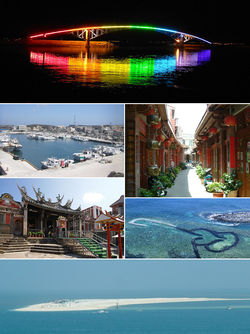
The main island (comprising Magong City and Huxi Township), Baisha Island and Xiyu are the three most populous islands and are connected via bridges. The Penghu Great Bridge connecting Baisha and Xiyu is the longest bridge in Taiwan. Two shorter bridges connect Huxi and Baisha via the small island of Zhongtun.

Politics

[edit]

The county elects a single representative to the Legislative Yuan. In the 2016 Republic of China legislative election, this seat was won by the Democratic Progressive Party with 55.4% of the vote.[52]

Political dispute

[edit]

Despite the controversy over the political status of Taiwan, both the Republic of China and the People's Republic of China agree that Penghu is a county in (their own respective) "Taiwan Province" (Taiwan Province, Republic of China and Taiwan Province, People's Republic of China). Yet, geographically, the island of Taiwan does not include Penghu, although it is closer to Taiwan than mainland China. Thus, Penghu is listed separately from "Taiwan" in some contexts, e.g. the Separate Customs Territory of Taiwan, Penghu, Kinmen, and Matsu (the official WTO name for the Republic of China) and in the Treaty of Shimonoseki, the Cairo Declaration, and the Treaty of San Francisco.[53][54][55]

Economy

[edit]

Due to its restricted geography, fishing has been the main industry for Penghu.[56] The Agriculture and Fisheries Bureau of the Penghu County Government governs matters related to agriculture and fisheries in Penghu.

In 2016, the bureau placed a ban on the harvesting of sea urchins due to their declining population. The ban was partially lifted in 2017, with catches limited to only specimens larger than 8 cm (3.1 in) in diameter.[57]

Education

[edit]
National Penghu University of Science and Technology

Education-related matters in Penghu County are administered under the Education Department of the Penghu County Government. The county houses the National Penghu University of Science and Technology.[citation needed]

Energy

[edit]

Penghu is powered by the Chienshan Power Plant, a 140 MW diesel-fired power plant commissioned in 2001, and the Hujing Power Plant on Table Island. On 24 December 2010, the Taiwan-Penghu Undersea Cable Project of Taipower was approved by the Executive Yuan to connect the electrical grid in Taiwan Island to Penghu.[58]

Under a wind power development project approved in 2002 by the Executive Yuan, the ROC government plans to set up a total of 200 wind turbines in Penghu within 10 years. However, only 14 turbines have been set up as of 2015. On 1 October 2015, Taipower announced the construction of another 11 new wind turbines across the island, of which six will be constructed in Huxi Township and five in Baisha Township.[59]

The current total desalination capacity of the county to provide clean water to its residents is 15,500 m3 per day. To reduce its groundwater use, in November 2015 the county secured a contract of building an additional desalination plant with 4,000 m3 capacity per day, construction of which is expected to be completed by May 2018.[60]

Tourism

[edit]

The Penghu National Scenic Area was established in the early 1990s, comprising most of the islands and islets of the archipelago. Tourism has since become one of the main sources of income of the county.

Historical sites include Central Street, Erdai Art Hall, Tianhou Temple, Four-eyed Well, Penghu Reclamation Hall, Qimei Lighthouse, Xiyu Eastern Fort, Jinguitou Fortress and Xiyu Western Fort. Museums in the county are Chuwan Crab Museum, Ocean Resources Museum, Chang Yu-sheng Memorial Museum and Penghu Living Museum. Other attractions in the county include the Double-Heart of Stacked Stones, Fenggui Cave, Little Taiwan, Whale Cave, Xiaomen Geology Gallery and South Penghu Marine National Park.[61]

Since 1 January 2015, tourists from Mainland China can directly apply for the Exit & Entry Permit upon arrival in Penghu. This privilege also applies to Kinmen and the Matsu Islands as a means to boost tourism in the outlying islands of Taiwan.[62]

The county welcomed 1.8 million tourists in 2018 with an average annual growth of around 10%.[63]

Drug trafficking

[edit]

As a lightly populated outlying island, Penghu lends itself to being used as a trans-shipment hub for drug smuggling into Taiwan from China and the Philippines. Beginning in 2016, the area became the focus of a major drug trafficking crackdown by the Taiwanese police.[64][65][66]

In 2016, Chou Meng-hsiang (周盟翔), chief prosecutor of the Penghu District Prosecutors Office, "led an investigation team in Taiwan, including officers from the Coast Guard Administration, in a bid to bring (a) drug trafficking ring to justice." A joint investigation with Philippine and Chinese authorities spanning one and a half years resulted in the seizure of "22.6 kilograms of amphetamine, 11.4 kilograms of ephedrine, and about 40 kilograms of calcium chloride" with an estimated value of NT$123 million. Eight suspects were arrested in Cagayan, a small island in northern Philippines, but no Taiwanese nationals were charged in relation to the importation scheme.[67]

In 2017, media reported "the biggest-ever haul of drugs in the county's history" when 506 kg of ephedrine was seized from a Chinese fishing boat off Penghu "as part of an ongoing crackdown on the area drug trade".[64] Ephedrine smuggling has increased in recent years as it has a similar structure to amphetamines and can be easily converted into methamphetamine. According to a Focus Taiwan report, "(It) can then be sold for ten times the price, in this case that would be more than NT$1 billion (US$33.33 million)."[65]

Despite the size of the drug seizure, only the five crew members of the Chinese fishing boat were detained in the operation, with authorities "unable to find the Taiwanese ship which should have turned up to take delivery of the drugs". It was unclear from media reports how the Taiwanese side of the smuggling operation knew to abort the rendezvous. The suppliers of the shipment also evaded capture. It was believed that the drugs were destined to be transported from Penghu for distribution on Taiwan.[68]

Transport

[edit]
Qimei Airport

Air

[edit]

Penghu is served by Penghu Airport in Magong City and Qimei Airport in Cimei Township. Both airports opened in 1977. Daily Air operates flights between Penghu to Kaohsiung.

Water

[edit]

The county has Magong Harbor and Longmen Jianshan Pier. Magong Harbor hosts ferry connections with Kaohsiung, Tainan, Chiayi and Kinmen.

See also

[edit]

References

[edit]

Further reading

[edit]
[edit]
Revisions and contributorsEdit on WikipediaRead on Wikipedia
from Grokipedia
Penghu County (Chinese: 澎湖縣; : Pénghú Xiàn) is an comprising 90 islands situated in the central , approximately 50 kilometers west of 's main island, and is administered as the sole insular of the Republic of (). The county spans a land area of 127.96 square kilometers, with 19 islands inhabited by a of roughly 108,000 residents concentrated primarily on Penghu () Island, featuring low-lying terrain rising to a maximum elevation of 70 meters and a coastline exceeding 400 kilometers indented by cliffs, sea caves, and wave-cut platforms. Its subtropical climate, marked by mild temperatures averaging 23°C annually and strong northeast winds, supports a distinctive including reefs, diverse fisheries, and migratory , while the islands' volcanic origins yield unique columnar formations that draw geological interest. Historically, Penghu served as a strategic outpost in the Taiwan Strait, with evidence of human settlement dating to the Southern Song dynasty, followed by periods of Dutch, Qing, Japanese, and post-1945 Republic of China control, during which it hosted military installations due to its position amid regional tensions. Today, the county's economy relies heavily on fishing, aquaculture, and tourism, bolstered by attractions such as national scenic areas, marine parks, and events like fireworks festivals, though it faces challenges from water scarcity, typhoon vulnerability, and dependence on mainland Taiwan for resources. Penghu's isolation fosters a distinct cultural identity blending Han Chinese traditions with maritime influences, evidenced in sites like ancient forts and temples, while recent developments emphasize renewable energy, including offshore wind farms leveraging consistent winds.

Names

Etymology

The name Penghu (Chinese: 澎湖; : Pēnghú; : Phêⁿ-ô͘) derives from the onomatopoeic description of the islands' maritime environment, where waves surge and crash turbulently (pēngpài, 澎湃) outside the harbors while the inner waters remain calm and lake-like (, 湖). This etymology is attested in records from the (1127–1279), when the archipelago was first formally documented in Chinese historical texts as a fishing outpost. Earlier designations included Pínghú (平湖; "flat lake"), emphasizing the sheltered bays' placid conditions amid the surrounding of over 60 islands, but the name shifted to Pēnghú by the (1368–1644), likely due to phonetic convergence in pronunciation and to better evoke the dynamic coastal features. The appellation Pescadores ("fishermen"), bestowed in the early , reflects European marinels' observations of the islands' dense fishing populations and abundant marine resources in the . This exonym persisted in Western and , underscoring the archipelago's role as a fisheries hub predating formalized administration under imperial .

Alternative Designations

The Penghu Islands are internationally recognized under the alternative English designation Pescadores Islands, derived from the 16th-century Portuguese Ilhas dos Pescadores ("islands of the fishermen"), reflecting the extensive fishing activities observed by early European mariners in the surrounding waters. This name persists in historical and geographical contexts despite the official adoption of Penghu in modern usage. Early Chinese historical references, dating to the CE, likely identified the as Liu-chiu, a term possibly encompassing nearby island groups, with more specific mentions as P'eng-hu or P'ing-hu emerging in 10th-century records to denote the basin-like internal seas amid the volcanic islets. In the () dialect spoken by Fujianese fishermen who settled the islands over a millennium ago, Penghu is rendered as Phêⁿ-ô͘ or historically transliterated in Western accounts as Pehoh or Pehoe, emphasizing phonetic adaptations from the original Mandarin Pénghú. These variants underscore the islands' long association with maritime communities from southeastern . Under Japanese colonial rule from 1895 to 1945, following the , the islands were administratively termed Hōko (澎湖) and organized initially as Hōko-chō (澎湖廳), a , before integration into Takao as Hōko-gun (澎湖郡) after 1920.

Geography

Location and Topography

Penghu County encompasses an archipelago of 90 islands and islets situated in the , positioned approximately 50 kilometers west of Taiwan's main island and roughly 150 kilometers east of coast. This strategic location renders it the westernmost county of the Republic of , serving as an offshore extension of Taiwan's territory. The inhabited islands number 19, supporting a dispersed across the group. The total land area of the measures 127.96 square kilometers, with the populated portions covering 124.94 square kilometers. The largest island, (also known as Penghu or Pescadores Main Island), spans 64.2 square kilometers and hosts the of . Other principal islands include Baisha (16.6 km²), Xiyu (14.7 km²), and Chimei (6.9 km²), which collectively dominate the habitable landmass. Topographically, Penghu features predominantly low-lying, flat terrain formed through volcanic extrusion and subsequent marine erosion, resulting in minimal relief across the islands. Elevations rarely exceed 70 meters, with the highest point at approximately 70 meters on Damao Islet; other notable peaks reach 64 meters on adjacent formations. The landscape exhibits a gentle southward-to-northward incline, interspersed with basalt plateaus, columnar formations, and coastal cliffs, while lacking significant rivers or highlands due to the archipelago's insular and geologically young character.

Geology and Natural Features

The Penghu archipelago consists of 64 islands and numerous smaller islets, with nearly all—except Huayu Island—composed primarily of layered basalt originating from Miocene to Pleistocene submarine volcanic eruptions. These eruptions produced successive lava flows that interbedded with unconsolidated sands and gravels, forming the islands' foundational stratigraphy of two to four basaltic layers typically 30 to 60 meters thick. The basalt's alkaline composition distinguishes it from the more acidic volcanic rocks prevalent on Taiwan's main island, reflecting distinct mantle plume influences during crustal extension in the Eurasian passive margin. Cooling of these subaerial and lava flows resulted in characteristic , where contraction fractures formed hexagonal or pentagonal prisms, often exposed in steep sea cliffs and platforms. Prominent examples include the columns at , reaching heights of 30 , and erosional features like the Double Heart of Stacked Stones on Qimei , sculpted by wave action into arch-like stacks. The islands generally exhibit flat-topped from wave during Pleistocene sea-level fluctuations, with elevations rarely exceeding 100 . Coastal geomorphology features barrier reefs, sea stacks, and basalt slabs fractured into polygonal patterns, enhanced by ongoing erosion from the Strait's strong currents and typhoons. Huayu Island deviates with its andesitic and rhyolitic compositions, forming rugged cliffs and contributing to the archipelago's limited but varied lithological diversity. These formations underpin protected areas like the Penghu Columnar Nature Reserve, highlighting the region's volcanic heritage amid subtropical marine influences.

Climate and Environmental Conditions

Penghu County has a characterized by dry winters (Köppen classification Cwa), influenced by the East Asian monsoon. The annual average temperature is 23.4°C, with the coolest month of recording a mean of 16.7°C and the warmest month of reaching 28.6°C. Winters are mild and dry, while summers are hot and humid, with temperatures occasionally exceeding 30°C during peak heat from to . Precipitation totals approximately 1,000 mm annually, distributed unevenly with the majority falling during the summer season from May to ; typically sees the highest monthly rainfall at around 190 mm. The islands experience consistent winds, particularly strong northeasterly trades in winter, and are highly vulnerable to tropical cyclones, with destructive typhoons impacting the area roughly every 15–20 years, often altering local weather patterns through high winds and storm surges. The environmental conditions feature basalt-formed islands surrounded by nutrient-rich subtropical waters supporting diverse marine ecosystems, including coral reefs, seagrass beds, and habitats for species such as green sea turtles (Chelonia mydas). Conservation efforts emphasize protected areas like the South Penghu Marine National Park, established to safeguard amid threats from , which peaked in local production around 1980 before declining due to . Ongoing initiatives include restoration to counter bleaching from warming sea surface temperatures exceeding 26.5°C during typhoon seasons and sustainable to mitigate habitat degradation from coastal development and tourism pressures. Global environmental changes exacerbate on the rocky shorelines and risks, prompting community adaptations for resilience against monsoon-driven winds and rising sea levels.

History

Prehistoric and Early Human Activity

The earliest documented evidence of hominin activity in the consists of the , a fossilized lower jaw dredged from seafloor sediments in the Penghu Channel during the early 2000s. places this specimen between 10,000 and 70,000 years ago or, alternatively, 130,000 and 190,000 years ago, with morphological and genetic analyses confirming it as belonging to a male —an extinct archaic human group previously identified mainly from Pleistocene deposits in . This find represents the easternmost evidence of Denisovan dispersal, indicating their capacity for maritime adaptation and expansion into subtropical island environments during the . No other archaic hominin fossils have been recovered from Penghu, and the transition to anatomically modern human (Homo sapiens) occupation appears in the Neolithic period. Archaeological surveys reveal human presence dating to 4,000–5,000 years ago, marked by shell middens and tombs at sites such as Suokang, which contain marine shells, stone tools, and burial structures suggestive of coastal foraging economies reliant on shellfish gathering and rudimentary fishing. These assemblages align with broader Taiwanese Neolithic patterns, potentially linked to early Austronesian-speaking groups migrating via southeastern coastal routes, though direct cultural affiliations remain under study due to limited stratified deposits. Submerged landforms off the Penghu coast, detected through sonar and photographic surveys, hint at possible inundated prehistoric sites from lower sea levels, but confirmatory excavations are lacking, and interpretations favor natural formations over definitive settlements. Overall, early activity reflects episodic rather than dense occupation, constrained by the islands' geology and isolation, with no evidence of permanent villages until later periods.

Imperial Chinese Era

The Penghu archipelago served as a strategic outpost during the (1368–1644), where garrisons were intermittently maintained to deter pirate incursions by raiders who frequently used the islands as bases to harass coastal . These threats prompted defensive measures, including the expulsion of Dutch intruders; in 1624, Ming naval forces under Shen Yourong compelled the , which had established a foothold on Penghu since 1604, to abandon the islands and shift operations to . Following the Ming collapse, the islands fell under the control of the Zheng family's , a Ming loyalist regime based in . The asserted dominance through Admiral Shi Lang's campaign, culminating in the on July 31 to August 4, 1683 (Gregorian), where Qing forces decisively defeated the Zheng fleet, leading to the surrender of and the incorporation of Penghu into Qing territory. In the 23rd year of the Kangxi Emperor's reign (1684), the Qing formalized administration by establishing a dedicated Inspection Agency (xunjian si) in Penghu to oversee local governance, taxation, and defense, subordinating it initially to Taiwan Prefecture within Province. Under Qing rule, Penghu functioned primarily as a and outpost with limited settlement, focused on salt production and maritime patrol. Administrative reforms in 1727 reorganized it under Zhuluo County (later renamed Taiwan County), emphasizing fortification against external threats. By the late Qing, in response to growing foreign pressures, Penghu was integrated into the newly established in 1885, though it retained sub-provincial status. During the (1884–1885), French naval forces under Admiral Amédée Courbet bombarded and occupied key sites in Penghu starting March 1885, using the islands as a bargaining chip until their withdrawal in April 1885 following the armistice. This episode prompted enhanced Qing coastal defenses, including upgraded artillery forts, but Penghu remained under imperial control until the 1895 ceded it to alongside .

Japanese Colonial Period

Japanese forces occupied the Penghu Islands on March 23, 1895, as a prelude to the main invasion of Taiwan during the First Sino-Japanese War, securing the archipelago to establish a staging point for further operations. The subsequent Treaty of Shimonoseki, signed on April 17, 1895, formalized the cession of Taiwan and the Penghu Islands from the Qing Dynasty to Japan, marking the beginning of 50 years of colonial rule. Initial resistance from local militias was suppressed, and by June 17, 1895, the Taiwan Government-General was established, incorporating Penghu into the administrative structure of the new colony. Under Japanese administration, Penghu served primarily as a strategic naval outpost, with enhancements to harbors and fortifications to support maritime defense and regional expansion. The centered on , bolstered by traditional methods such as stone tidal weirs, shore netting, and gill nets, which capitalized on the islands' rich coastal waters; remained limited due to poor , focusing on drought-resistant crops like sweet potatoes and millet. Infrastructure developments included port improvements in and the introduction of modern techniques, though the islands' isolation constrained large-scale industrialization compared to proper. Education and public health initiatives were implemented to assimilate the population, with Japanese-language schooling and sanitation campaigns reducing disease prevalence, though these efforts prioritized loyalty to imperial rule over local autonomy. During , Penghu functioned as a forward base for Japanese naval operations, heightening its military significance until Japan's surrender on , 1945, after which the islands were retroceded to the in October 1945 under Allied agreements.

Republic of China Administration

Following Japan's on August 15, 1945, the Penghu Islands were formally handed over to the Republic of China (ROC) on October 25, 1945, marking the end of 50 years of Japanese colonial rule and the restoration of Chinese administration. The handover ceremony occurred in , with ROC representatives accepting control over and Penghu under the Cairo Declaration and Potsdam Proclamation frameworks, which designated the territories for return to the ROC. Administrative takeover in Penghu concluded by December 1, 1945, with the restoration of Chinese names for citizens and the resumption of local governance structures. The Penghu County Government was established on January 21, 1946, under the oversight of the Taiwan Provincial Administration headed by Chen Yi, integrating the islands into ROC provincial governance. Initial post-handover efforts focused on demobilizing Japanese forces, repatriating personnel, and rebuilding damaged during the , including ports and fortifications repurposed for ROC use. After the ROC government's retreat to in December 1949 amid the , Penghu remained firmly under ROC control, serving as a forward in (now City) to secure the against threats. Local autonomy commenced in 1950 with the implementation of county-level elections, enabling the selection of magistrates and council members, though under the broader framework of national declared on , 1949, which emphasized anti-communist security measures. Penghu was officially designated as the 16th and smallest of in 1960, formalizing its administrative boundaries encompassing 64 islands with a land area of approximately 127 square kilometers. During the era (1949–1987), governance prioritized military preparedness, with restricted civilian access to certain islets and centered on and limited , reflecting the islands' geopolitical frontline status. The lifting of in 1987 ushered in democratic reforms, including fully competitive multi-party elections for the position, held regularly since. Administrative reforms in the and enhanced local , with the county government overseeing 1 city () and 5 rural townships as of 2025, while central ROC ministries handle defense, foreign affairs, and cross-strait relations. Penghu's administration has since emphasized , renewable energy projects like offshore wind farms initiated in the , and environmental conservation, balancing its historical military role with civilian development.

Demographics

Population Dynamics

The population of Penghu County peaked at approximately 105,848 in 1990 before entering a period of decline driven primarily by net out-migration and low rates. By 2000, the figure had dropped to 83,214, reflecting substantial youth exodus to mainland for and opportunities amid limited local economic prospects in and seasonal . This trend partially reversed in the 2000s, with the population rising modestly to 86,967 by 2010, possibly due to temporary returns or policy incentives, though structural challenges persisted. Subsequent years saw renewed contraction, with the 2020 census recording 81,738 residents, underscoring ongoing depopulation in outlying islands exacerbated by an aging demographic and outbound migration of working-age individuals. Key drivers include the archipelago's geographic isolation, which limits job diversity beyond primary sectors, prompting young people to relocate to urban centers like , where historical Penghu migrants contributed to post-war economic growth but rarely returned permanently. Declining birth rates, aligned with Taiwan's national below 1.0, compound natural decrease, while elevated crude mortality—reaching 12.39 per 1,000 in 2024—reflects an elderly-heavy population structure vulnerable to health declines without sufficient inflows.
YearPopulation
1990105,848
200083,214
201086,967
202081,738
These figures illustrate a net loss averaging over 1% annually since the peak, with migration accounting for the majority of change rather than vital events alone, as low births fail to offset deaths in a super-aged society. Efforts to reverse this, such as investments, have yielded limited success against entrenched economic disincentives for residency.

Ethnic Composition

The population of Penghu County is overwhelmingly , accounting for over 99% of residents, with comprising a small minority of approximately 700 individuals as of 2022 out of a total of roughly 107,000. This Han dominance stems from sustained migrations from Fujian Province starting in the 13th century during the , which established fishing and settlement communities that grew over subsequent imperial Chinese eras. Within the Han population, the predominant subgroup is Hoklo (also referred to as or ), descendants primarily from Tong'an and surrounding areas in , who form the ethnic core through historical continuity and linguistic prevalence. Census language data supports this, showing as a major spoken language alongside Mandarin, with minimal Hakka or indigenous language use, reflecting limited admixture from other Han subgroups like post-1949 mainlanders () or Hakka settlers. A smaller cohort includes new immigrants, numbering about 1,700, often from through marriage migration, though their descendants typically assimilate into the Han Hoklo framework. Indigenous residents in Penghu belong to Taiwan's officially recognized Austronesian groups, such as the Pingpu or plains tribes historically present before widespread Han settlement, but their numbers remain marginal due to assimilation and low rates relative to the Han majority. track indigenous status separately, underscoring their distinct legal recognition under Republic of policies, yet demographic pressures from out-migration and aging continue to diminish this proportion.

Languages and Cultural Practices

The predominant languages spoken in Penghu County are , the official language of the Republic of (Taiwan), and (Southern Minnan), with residents primarily using a distinct Penghu dialect of the latter as their mother tongue. This dialect shares phonological similarities with the Amoy (Xiamen) variety of but features differences in certain finals and tones, reflecting historical migrations from Fujian Province in . Mandarin dominates formal education, government, and media, while Hokkien prevails in daily conversation, family settings, and local markets, with nearly all ethnic Han residents—comprising over 99% of the population—proficient in it. Cultural practices in Penghu are deeply rooted in maritime traditions, emphasizing folk religion, fishing heritage, and artisanal crafts adapted to the island environment. Worship of , the Daoist sea goddess revered as protector of fishermen and seafarers, forms the core of religious life, centered at the Tianhou Temple in Magong City, Taiwan's oldest Mazu temple dating to the early 17th century and designated a National Historic Site for its unique architectural elements like swallowtail ridges and stone carvings. Annual rituals, including incense offerings and processions, underscore Mazu's role in safeguarding against typhoons and ensuring bountiful catches, a practice tied to Penghu's history of settlement by Fujianese migrants during the . Traditional fishing methods, such as tidal stone weirs on Jibei Island—constructed from to trap during —exemplify adaptive environmental practices dating back centuries and still used by locals for subsistence and small-scale harvest. Complementary crafts include bamboo weaving for baskets and mats, and mottle stone carvings for decorative items, and wooden "plague boat" models symbolizing rituals to ward off epidemics, often handmade by family artisans preserving pre-modern techniques. Festivals like the "Ciguei" (turtle-praying) lantern events blend animistic beliefs with communal prayers for prosperity, featuring handmade lanterns and feasts that highlight the islands' reliance on . These elements persist amid modernization, with over 100 temples per capita fostering community cohesion through shared rituals uninfluenced by significant indigenous or non-Han customs, given the archipelago's near-exclusive Han demographic since the 13th century.

Government and Administration

Local Governance Structure

Penghu County's local governance is structured under the executive authority of the , elected by popular vote every four years to oversee general administration, policy implementation, and coordination with . The current , Chen Kuang-fu of the , took office on December 25, 2022, after securing victory in the November 26, 2022, local elections with approximately 52% of the vote. The is supported by a and a secretary-general, who assist in executive duties and internal coordination. The executive branch, headquartered at Penghu County Hall in Magong City, includes core departments such as , , , Social Affairs, and , each managed by a department head reporting to the magistrate. Specialized level-one agencies handle operational functions, including the Police Bureau for public safety, Fire Bureau for emergency response, Health Bureau for medical services, Bureau for sustainability efforts, and and Fisheries Bureau for primary industries. Level-two agencies support specific tasks, such as the Land Office for property management and Household Registration Offices for demographic records. Legislative oversight is provided by the Penghu County Council, an elected body responsible for approving budgets, enacting local ordinances, and scrutinizing executive actions in line with Taiwan's Local Government Act. Councilors are directly elected concurrently with elections, ensuring alignment with voter mandates. The council operates independently from the executive, with sessions held in to deliberate on issues like infrastructure, economic development, and environmental policy tailored to Penghu's island context. Administrative execution extends to subordinate township offices in the county's six townships and one , which implement county policies at the level while maintaining local in routine affairs. This structure reflects Taiwan's decentralized local framework, where county magistrates represent public interests and manage resources under national oversight.

Administrative Divisions

Penghu County is administratively divided into one municipal city and five rural townships, reflecting its island geography with concentrations on the main island and outlying islets. The municipal city, Magong City (馬公市; Mágōng Shì), functions as the , housing the Penghu County Government and serving as the economic and transportation hub with the primary and terminals. The rural townships include Huxi Township (湖西鄉; Húxī Xiāng) and Baisha Township (白沙鄉; Báishā Xiāng), both located on the main Penghu Island alongside Magong City. Xiyu Township (西嶼鄉; Xīyǔ Xiāng) occupies Xiyu Island to the west of the main island, known for its columns and communities. Wang'an Township (望安鄉; Wàng'ān Xiāng) administers Wang'an Island and nearby smaller islets, while Cimei Township (七美鄉; Qīmeì Xiāng) governs Cimei Island, the southernmost inhabited island in the archipelago. Local governance in these divisions is managed through township and city offices, which handle , , and community services under the oversight of the government in . Each township and the city is further subdivided into villages (里; lǐ), the basic unit for household registration and local administration, though exact numbers vary with demographic shifts. This supports decentralized suited to the dispersed populations, with and air links connecting the outlying townships to the main .

Political Status

Sovereignty Claims and Disputes

The Penghu Islands have been under the effective administration of the Republic of China (ROC) since 1945, following Japan's surrender in , and are organized as Penghu County within ROC-controlled . The ROC maintains that sovereignty over Penghu derives from historical Chinese governance under the Ming and Qing dynasties, combined with Allied wartime declarations such as the and 1945 Potsdam Proclamation, which stipulated the return of and associated islands including Penghu to the Republic of China after Japanese colonial rule from 1895 to 1945. Effective control has been exercised continuously by the ROC government, with no interruption despite the . The (PRC), established in 1949 on the mainland, claims sovereignty over Penghu as inseparable from , asserting that the islands are inherent Chinese territory under the principle and that the PRC succeeded the ROC as the sole legitimate . This position relies on the PRC's interpretation of state succession, viewing the and agreements as binding transfers of sovereignty to "China" without regard to the subsequent ROC retreat to , and dismissing the 1951 —which required to renounce claims to and Penghu without naming a recipient—as incomplete but not altering underlying Chinese rights. PRC official narratives emphasize Penghu's reversion to Chinese sovereignty in 1945, framing any separate status as a product of foreign interference. The sovereignty dispute over Penghu is not distinct from the broader question and lacks claimants beyond the ROC and PRC; no third-party states assert territorial rights, unlike contested features in the . The 1952 between and the ROC affirmed Japanese renunciation but did not explicitly resolve succession, leading some analyses to describe Penghu's status as effectively administered by the ROC amid unresolved legal ambiguities from the framework. International recognition remains limited by widespread adherence to the "" policy, under which most nations avoid formal acknowledgment of ROC sovereignty while pragmatically engaging Taiwan's de facto control over Penghu; for instance, the has historically supported the status quo without endorsing PRC claims. No armed conflicts or diplomatic incidents have targeted Penghu specifically since 1949, though its position in the underscores its role in cross-strait tensions.

Strategic and Geopolitical Significance

The Penghu Islands' central location in the , roughly 40 km west of Taiwan's main island and 150 km east of China's coast, positions them as a pivotal node for controlling maritime access between the East and Seas. This placement enables dominance over key shipping lanes carrying over half of global container traffic and facilitates potential blockades or amphibious operations in regional conflicts. The archipelago's 64 islands provide natural harbors and terrain suitable for air and naval basing, amplifying their utility in denying adversaries control. Under Republic of China administration, Penghu hosts critical military assets, including air force bases on and naval facilities, which support Taiwan's layered defense posture against incursions. These installations enable rapid response to aerial threats and surveillance of strait traffic, with annual Han Kuang exercises emphasizing Penghu's reinforcement to counter invasion scenarios more effectively than peripheral islands like . Taiwan's Ministry of National Defense has fortified bridges and infrastructure to withstand assaults, recognizing Penghu's role in extending defensive depth without serving as an expendable forward outpost. Geopolitically, Penghu factors into U.S. strategic commitments, as articulated in diplomatic records deeming its security alongside Taiwan's essential to countering communist expansion and preserving Western interests in the Western Pacific. In ongoing tensions, the islands experience frequent gray-zone pressures, such as Chinese fishing militia incursions that disrupt local operations and test resolve, heightening escalation risks without full-scale war. Beijing's claims over Penghu as inseparable from frame potential seizure as a limited contingency to coerce unification, though analyses assess such moves as high-risk due to Taiwan's anti-access/area-denial capabilities and international repercussions.

International Perspectives

The sovereignty of Penghu remains undetermined under , as Japan renounced its claims to the islands—along with —in the 1951 San Francisco Peace Treaty without designating a successor state, leaving the status ambiguous post-World War II. This indeterminacy applies specifically to Penghu as part of the Taiwan-Penghu grouping, distinct from other ROC-administered islands like and Matsu, which have separate historical trajectories under the treaty framework. The (PRC) asserts sovereignty over Penghu based on the and 1945 Potsdam Proclamation, which stated that and Penghu "shall be restored to ," but these were non-binding political statements rather than formal treaties, and the San Francisco Treaty—ratified by Allied powers including the —did not endorse their transfer to any Chinese entity. The maintains that title to Penghu did not revert to after and views the islands' status as unresolved, consistent with its broader "" policy that acknowledges the PRC's position without endorsing it. Under the 1979 , the US commits to providing defensive arms to —including Penghu as part of its effective territory—and opposes unilateral changes to the status quo, treating the islands within the scope of de facto ROC administration for security purposes. This approach reflects a pragmatic recognition of ROC control since , without formal diplomatic acknowledgment, as evidenced by US military engagements like the 1955 Formosa Resolution authorizing defense of and associated islands such as Penghu. Japan, having administered Penghu from 1895 to 1945 under the , aligns with the undetermined status post-renunciation and supports the maintenance of peace in the , implicitly backing Taiwan's governance over the islands amid regional tensions. member states and other democracies generally follow a similar pattern, engaging Penghu through unofficial channels focused on , , and environmental cooperation—such as initiatives—while adhering to policies that avoid explicit sovereignty endorsements. Globally, Penghu's international visibility is limited, with no independent recognition or membership in organizations like the UN, where Taiwan's broader exclusion reflects PRC influence since 1971, though bilateral ties emphasize practical interactions over legal disputes.

Economy

Traditional Sectors: Fishing and Agriculture

constitutes the primary traditional economic sector in Penghu, capitalizing on the archipelago's position amid nutrient-rich waters of the . The industry encompasses coastal and offshore operations, with stone fish weirs—a traditional trap system—contributing 77% of total output according to 2023 county records. Production peaked in 1980 amid intensive exploitation but has since declined due to and regulatory measures, positioning Penghu among Taiwan's top three fish-producing regions nonetheless. Key harbors like Wai-an facilitate large-scale operations, supporting processed exports including canned, frozen, and dehydrated products. Labor in the sector increasingly depends on migrant workers from and , comprising the bulk of the workforce as local youth emigrate and the population ages; in 2020, imported labor addressed chronic shortages in this labor-intensive field. Traditional practices persist alongside modern vessels, though challenges include gear loss, accumulation, and competition from distant-water fleets. Agriculture remains subsidiary and constrained by Penghu's scant —totaling about 735 hectares as of 2015—and infertile basaltic soils derived from volcanic origins. Principal crops include sweet potatoes, , corn, watermelons, and melons, cultivated on small plots or within stone-walled enclosures to combat wind erosion and salt spray; these support local consumption over commercial scale. In fishing villages, women predominantly manage farming tasks, integrating it with household needs amid the male-dominated . Varietal improvements, such as the high-yield "Penghu 1" loofah and pumpkin strains developed locally, aim to boost resilience, though output lags behind fishing's economic weight.

Tourism Development

Tourism emerged as a pivotal economic sector in Penghu following the establishment of the Penghu National Scenic Area in 1996, leveraging the archipelago's columns, beaches, and marine to attract visitors. Over the subsequent decades, the industry expanded through targeted investments and promotional campaigns, with annual visitor numbers surpassing 1 million by the late . In 2018, Penghu recorded 1,326,216 tourists, of whom 63.56% participated in activities such as island-hopping and . Government initiatives have emphasized to mitigate environmental pressures from growth. The Penghu County Government and National Scenic Area Administration have implemented guidelines for marine resource protection, including service systems that integrate public transportation enhancements and . Infrastructure upgrades, such as the 2022 sustainable redesign of Ferry Terminal featuring recycled materials and improved facilities, aimed to boost capacity while aligning with ecological goals. Visitor arrivals peaked at 1.14 million in 2020 before declining sharply to 618,000 in 2021 amid restrictions, prompting a shift toward resilient, high-value models. To counter , authorities launched year-round promotion campaigns starting in 2022, highlighting winter events and diversified experiences beyond summer beach . Recent efforts include post-typhoon reconstructions enhancing watersports facilities to draw eco-tourists, alongside empirical models for sustainable operations that balance economic gains with local ecological . These developments have positioned as a driver of regional resilience, though challenges like risks and over-reliance on domestic visitors persist.

Renewable Energy Initiatives

Penghu County has pursued renewable energy development primarily through the Low Carbon Island Project, initiated in 2011 by Taiwan's Ministry of Economic Affairs to establish the as a demonstration site for carbon reduction and energy self-sufficiency by leveraging abundant wind resources from the northeast monsoon and solar irradiation. The project integrates onshore and with solar photovoltaic installations, aiming to replace diesel-dependent generation, which historically dominated the island's energy mix due to its isolation. By 2018, existing capacity included 10.2 MW of and 8 MW of solar, with Phase 2 (2018–2021) adding 11 sets of 3 MW onshore turbines and initiating demonstrations. Offshore wind constitutes the core of expansion efforts, capitalizing on Penghu's position in the . The 150 MW Penghu Offshore Wind Farm in Huxi Township, fully owned and operated by , became operational as a key demonstration project under national offshore wind targets, contributing to zonal development goals of up to 3,000 MW nationwide by 2025. Additional plans include a 33 MW onshore wind expansion and feasibility studies for further offshore capacity, potentially scaling to 4 GW in the long term, though some proposed onshore sites like those in Huxi and Baisha townships have faced delays or shelving due to local opposition over noise and landscape impacts. Solar initiatives complement wind, focusing on distributed applications such as rooftop panels for residential heating, street lighting, and agricultural drying to minimize transmission losses on the dispersed islands. The project incorporates smart bay elements, including marine energy governance and fishery integration, with partners like Chung-Hsin Electric and Machinery Group supporting hybrid systems. As of May 2024, Penghu County Government continues advancing these efforts to align with global low-carbon standards, including quarterly progress reviews under the ongoing Low Carbon Island framework, though achievement of full self-sufficiency remains challenged by intermittency and grid interconnection needs via undersea cables to Taiwan proper.

Society and Infrastructure

Education System

The education system in Penghu County operates under Taiwan's national framework, which mandates 12 years of : six years of primary schooling, three years of junior high school, and three years of senior high school or vocational training. This structure aims to provide foundational literacy, numeracy, and vocational skills, with curricula emphasizing , , , and English, alongside local adaptations for Penghu's island context, such as marine-related subjects. Penghu County maintains 12 elementary schools and four junior high schools, serving a student population affected by demographic decline. Enrollment challenges are acute due to low birth rates and youth outmigration; for instance, in 2023, a on Hujing operated with only two sixth-grade students, prompting closure considerations. Conversely, larger institutions like Penghu Elementary saw an influx of 614 new students in 2018, reflecting some urban concentration in City. The county government supports specialized facilities, including an elementary resource and a educational resource , to address diverse learning needs. Higher education is anchored by National Penghu University of Science and Technology (NPUST), established in 1995 as the sole university in the . NPUST enrolls approximately 2,646 students across three colleges—Humanities and Management, Tourism and Leisure, and Marine Science—focusing on fields like , , and to leverage Penghu's maritime economy. Programs include bachelor's and master's degrees, with an emphasis on practical training in ocean engineering and sustainable fisheries. Secondary schools, such as Magong Junior High, integrate initiatives, including English immersion and cross-cultural exchanges, to enhance global competitiveness amid local isolation. Overall, while aligned with national standards, Penghu's system grapples with sustaining quality amid shrinking cohorts, prompting resource consolidation and vocational prioritization.

Healthcare and Social Services

Penghu County operates within Taiwan's universal system, providing comprehensive coverage to residents, though its remote island location necessitates adaptations such as specialist rotations from mainland hospitals. The primary facility is Penghu Hospital, under the Ministry of Health and Welfare, located at No. 10, Zhongzheng Road in Magong City, offering general and specialized outpatient and inpatient services. Additional support comes from the NDMC Tri-Service General Hospital Penghu Branch at No. 90, Qianliao, Magong City, which handles military and civilian care. The archipelago's three district hospitals serve outer islands, but limited local capacity often requires air medical evacuations to proper, a process strained during events like the . To address shortages, partnerships like E-Da Hospital's delegation of specialists for outpatient services and stationing of nursing staff on islands have expanded access since at least 2024. Penghu ranks low in healthcare professional density among Taiwanese counties, with approximately 74 professionals per unit population compared to higher mainland averages, contributing to reliance on telemedicine and referrals. Social services emphasize support for an aging , where seniors comprise nearly 15% of residents, through programs including in-home care, meal delivery, and welfare. Local governments, such as City Office, manage assistance for low-income families, disabled individuals, youth, and children, including handicap assessments and lifestyle subsidies. Township-level offices, like Baisha, provide targeted handicapped welfare, while a dedicated Penghu Disabled Welfare and Services coordinates broader rehabilitation and support. Family services are accessible via a (1999 locally or +886-6-927-4400 externally), offering free initial consultations for welfare inquiries.

Security and Challenges

Military Installations and Defense Role

The Penghu Islands serve as a critical forward position in the Republic of China (ROC) Armed Forces' defense strategy within the , functioning as a barrier to potential amphibious assaults from the (PRC) and enabling interdiction of PLA air and naval forces to delay invasions of proper. Their location approximately 50 kilometers west of 's mainland positions them as the first line of defense in the western Pacific's , complicating PRC logistics by extending required operational ranges for aircraft and ships. The archipelago's 64 islands provide dispersed basing options for , anti-aircraft, and counter-landing operations, with exercises demonstrating capabilities such as M60A3 tank maneuvers against simulated amphibious threats. The ROC Army's Penghu Defense Command (PDC), established through reorganization in 2006, oversees combat operations across the islands, integrating ground, air, and naval assets for area denial and rapid response. Headquartered in the region, the PDC conducts regular drills, including anti-air assaults and nighttime defense simulations near Magong City, to maintain readiness against PRC incursions. Key installations include the Magong Air Force Base, which supports ROC Air Force scrambles to intercept PRC military aircraft entering Taiwan's air defense identification zone and hosts live-fire training for integrated air-ground defenses. Naval facilities in Penghu bolster maritime surveillance and harbor defense, contributing to the islands' role in monitoring PRC naval movements through the strait. While some historical sites like the Longmen Military Outpost have been decommissioned and repurposed, active infrastructure emphasizes asymmetric warfare tactics suited to the islands' terrain, such as underground bunkers and mobile artillery.

Crime and Drug Trafficking

Penghu maintains low incidences of and petty , aligning with 's overall reputation for , where such offenses are rare in tourist and residential areas. trafficking, however, poses a persistent challenge due to the archipelago's strategic maritime location, which has positioned it as a transshipment hub for narcotics targeting 's mainland. In November 2024, the Penghu District Prosecutors' Office indicted eight suspects following the seizure of marijuana valued at NT$1.1 billion (approximately US$34 million), which was intended to be relayed through the islands from . The operation involved coordinated via sea routes, underscoring vulnerabilities in remote island logistics. Methamphetamine-related activities have also drawn enforcement actions. On September 4, 2025, Penghu authorities arrested a suspect near a gas station, confiscating substantial amounts of alongside other controlled substances in a trafficking probe. Earlier, in December 2017, the largest recorded drug interception off Penghu yielded over 1 metric ton of —a key precursor for —with an estimated street value of NT$100 million (US$3.3 million), highlighting the islands' role in supply chains. These incidents reflect broader regional patterns of maritime smuggling, prompting intensified patrols and prosecutorial scrutiny, though among drug offenders in remains high at around 46%. Local efforts emphasize over demand reduction, amid Taiwan's escalating narcotics consumption trends.

Transportation

Air Connectivity

Penghu Airport (IATA: MZG), located in Huxi Township near City, functions as the principal domestic airport for the Penghu archipelago, facilitating connectivity exclusively to mainland destinations. All flights are operated by Taiwanese carriers, with no international services available, reflecting the islands' reliance on domestic routes for tourism, commerce, and resident travel. Uni Air and Mandarin Airlines dominate operations, providing non-stop flights to seven primary destinations, including Taipei (both Songshan and Taoyuan airports), Kaohsiung, Taichung, and Tainan. offers the highest frequency, with direct services to at least six cities, while supplements routes from three key hubs. Schedules feature multiple daily departures, exceeding 30 regular services to Magong, enabling flexible access despite peak-season demand surges. Passenger traffic underscores robust demand, particularly on high-volume corridors; for instance, the –Penghu route recorded 232,662 passengers and –Penghu 224,784 in the first quarter of 2025, ranking among Taiwan's busiest domestic links with load factors around 77%. A secondary facility, Cimei Airport on Qimei Island, supports limited shuttle flights using smaller aircraft for inter-island connectivity, primarily operated by to supplement Magong's hub role.

Maritime Transport and Ferries

Maritime transport serves as the primary means of connecting to mainland and facilitating inter-island travel among its 64 islands. The main hub is Magong Harbor in , which handles both passenger ferries and occasional cruise vessels. High-speed ferries from in provide the most frequent service, with journeys taking approximately 1 to 1.5 hours and multiple daily departures, operated by companies such as and Triumph Marine Transport. Fares for these routes typically range from NT$800 to NT$1,300 one-way, depending on seating class and season. Slower conventional ferries operate from ports like Harbor, with travel times of 4 to 5 hours and services running several times weekly, including routes managed by Taiwan Navigation Co. (TNC). These vessels accommodate larger passenger volumes and offer amenities such as dining and entertainment, with one-way fares around NT$800 to NT$1,300. Limited services also depart from and other central ports, though remains the dominant gateway due to its proximity and speed. Ferry schedules are subject to weather conditions in the , with suspensions common during typhoon season from to . Inter-island ferries, essential for accessing outlying townships, are divided into northern, southern, and eastern routes. South Sea Ferry operates key southern lines from to Wang'an, Qimei, and smaller islets like Jiangjunao and Dongyuping, with fares starting at NT$50 for short hops and up to NT$480 for longer trips; daily schedules include fixed commuter services. Northern routes to Baisha and Chimeu are handled by operators under oversight, while eastern services cover less populated areas. These ferries, often smaller vessels, run multiple times daily but prioritize residents, with tourist capacity limited during peak summer months. Recent infrastructure upgrades, including the expanded Penghu Cruise opened in , aim to enhance capacity for both ferries and international cruise traffic.

References

Add your contribution
Related Hubs
Contribute something
User Avatar
No comments yet.