Hubbry Logo
Fon languageFon languageMain
Open search
Fon language
Community hub
Fon language
logo
8 pages, 0 posts
0 subscribers
Be the first to start a discussion here.
Fon language
Fon language
from Wikipedia
Fon
fɔ̀ngbè
Native toBenin, Nigeria, Togo
EthnicityFon people
Native speakers
2.3 million (2019–2021)[1]
Dialects
  • Agbome
  • Arohun
  • Gun
  • Gbekon
  • Kpase
Latin
Gbékoun
Official status
Official language in
 Benin
Language codes
ISO 639-2fon
ISO 639-3fon – inclusive code
Individual codes:
guw – Gun
mxl – Maxi Gbe
wem – Weme Gbe
Glottologfonn1241  Fon language
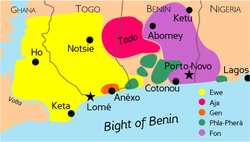
Gbe languages. Fon is purple.
This article contains IPA phonetic symbols. Without proper rendering support, you may see question marks, boxes, or other symbols instead of Unicode characters. For an introductory guide on IPA symbols, see Help:IPA.
PersonFon
PeopleFon-nu
Languagefɔ̀ngbè
CountryDanhɔmɛ

Fon (fɔ̀ngbè, pronounced [fɔ̃̀ɡ͡bē][2]), also known as Dahomean, is the language of the Fon people. It belongs to the Gbe group within the larger Atlantic–Congo family. It is primarily spoken in Benin, as well as in Nigeria and Togo by approximately 2.3 million speakers.[1] Like the other Gbe languages, Fon is an isolating language with a SVO basic word order.

[edit]

In Benin, French is the official language, and Fon and other indigenous languages, including Yom and Yoruba, are classified as national languages.[3]

Dialects

[edit]

The standardized Fon language is part of the Fon cluster of languages inside the Eastern Gbe languages. Hounkpati B Christophe Capo groups Agbome, Kpase, Gun, Maxi and Weme (Ouémé) in the Fon dialect cluster, although other clusterings are suggested. Standard Fon is the primary target of language planning efforts in Benin, although separate efforts exist for Gun, Gen, and other languages of the country.[4]

Phonology

[edit]
"Welcome" (Kwabɔ) in Fon at a pharmacy at Cotonou Airport in Cotonou, Benin

Vowels

[edit]

Fon has seven oral vowel phonemes and five nasal vowel phonemes.

Vowel phonemes of Fon[5]
Oral Nasal
front back front back
Close i u ĩ ũ
Close-Mid e o
Open-mid ɛ ɔ ɛ̃ ɔ̃
Open a ã

Consonants

[edit]
Consonant phonemes of Fon[5]
Labial Coronal Palatal Velar Labial
-velar
"Nasal" m ~ b n ~ ɖ
Occlusive (p) t d k ɡ kp ɡb
Fricative f v s z x ɣ ɣʷ
Approximant l ~ ɾ ɲ ~ j w

/p/ occurs in only linguistic mimesis and loanwords but is often replaced by /f/ in the latter, as in cɔ́fù 'shop'. Several of the voiced occlusives occur before only oral vowels, and the homorganic nasal stops occur before only nasal vowels, which indicates that [b] [m] and [ɖ] [n] are allophones. [ɲ] is in free variation with [j̃] and so Fong can be argued to have no phonemic nasal consonants, a pattern rather common in West Africa.[a] /w/ is nasalized (to [ŋʷ]) before nasal vowels, and may assimilate to [ɥ] before /i/. /l/ is sometimes also nasalized.[clarification needed]

The only consonant clusters in Fon have /l/ or /j/ as the second consonant. After (post)alveolars, /l/ is optionally realized as [ɾ]: klɔ́ 'to wash', wlí 'to catch', jlò [d͡ʒlò] ~ [d͡ʒɾò] 'to want'.

Tone

[edit]

Fon has two phonemic tones: high and low. High is realized as rising (low–high) after a voiced consonant. Basic disyllabic words have all four possibilities: high–high, high–low, low–high, and low–low.

In longer phonological words, such as verb and noun phrases, a high tone tends to persist until the final syllable, which, if it has a phonemic low tone, becomes falling (high–low). Low tones disappear between high tones, but their effect remains as a downstep. Rising tones (low–high) simplify to high after high (without triggering downstep) and to low before high.

Hwevísatɔ́,

/ɣʷèví-sà-tɔ́

[ɣʷèvísáꜜtɔ́‖

fish-sell-agent

é

é

é

s/he

ko

PERF

xɔ̀

ꜜxɔ̂

buy

asón

àsɔ̃́

àsɔ̃́

crab

we.

wè/

wê‖]

two

Hwevísatɔ́, é ko hɔ asón we.

/ɣʷèví-sà-tɔ́ é kò xɔ̀ àsɔ̃́ wè/

[ɣʷèvísáꜜtɔ́‖ é kó ꜜxɔ̂ àsɔ̃́ wê‖]

fish-sell-agent s/he PERF buy crab two

"The fishmonger, she bought two crabs."

In Ouidah, a rising or falling tone is realized as a mid tone. For example, 'we, you', phonemically high-tone /bĩ́/ but phonetically rising because of the voiced consonant, is generally mid-tone [mĩ̄] in Ouidah.

Orthographies

[edit]

Roman alphabet

[edit]

The Fon alphabet is based on the Latin alphabet, with the addition of the letters Ɖ/ɖ, Ɛ/ɛ, and Ɔ/ɔ, and the digraphs gb, hw, kp, ny, and xw.[6]

Fon alphabet
Majuscule A B C D Ɖ E Ɛ F G GB H HW I J K KP L M N NY O Ɔ P R S T U V W X XW Y Z
Minuscule a b c d ɖ e ɛ f g gb h hw i j k kp l m n ny o ɔ p r s t u v w x xw y z
Sound (IPA) a b t͡ɕ d ɖ e ɛ f ɡ ɡb ɣ ɣʷ i d͡ʑ k kp l m n ɲ o ɔ p r s t u v w x j z

Tone marking

[edit]

Tones are marked as follows:

Tones are fully marked in reference books, but not always marked in other writing. The tone marking is phonemic, and the actual pronunciation may be different according to the syllable's environment.[7]

Gbékoun script

[edit]
Table of Gbékoun script

Speakers in Benin also use a distinct script called Gbékoun that was invented by Togbédji Adigbè.[8][9] It has 24 consonants and 9 vowels, as it is intended to transcribe all the languages of Benin.

Sample text

[edit]

From the Universal Declaration of Human Rights

Acɛ, susu kpo sisi ɖokpo ɔ kpo wɛ gbɛtɔ bi ɖo ɖò gbɛwiwa tɔn hwenu; ye ɖo linkpɔn bɔ ayi yetɔn mɛ kpe lo bɔ ye ɖo na do alɔ yeɖee ɖi nɔvinɔvi ɖɔhun.
Translation
All human beings are born free and equal in dignity and rights. They are endowed with reason and conscience and should act towards one another in a spirit of brotherhood.

Use

[edit]

Radio programs in Fon are broadcast on ORTB channels.

Television programs in Fon are shown on the La Beninoise satellite TV channel.[10]

French used to be the only language of education in Benin, but in the second decade of the twenty-first century, the government is experimenting with teaching some subjects in Benin schools in the country's local languages, among them Fon.[11][12][13]

Machine translation efforts

[edit]

There is an effort to create a machine translator for Fon (to and from French), by Bonaventure Dossou (from Benin) and Chris Emezue (from Nigeria).[14] Their project is called FFR.[15] It uses phrases from Jehovah's Witnesses sermons as well as other biblical phrases as the research corpus to train a Natural Language Processing (NLP) neural net model.[16]

Notes

[edit]

References

[edit]

Bibliography

[edit]
[edit]
Revisions and contributorsEdit on WikipediaRead on Wikipedia
from Grokipedia
Fon (Fɔ̀ngbè), also known as Fongbe, is an Eastern Gbe language within the Niger–Congo family, spoken primarily by the Fon ethnic group as their native tongue. It originated in the region of the former Kingdom of Dahomey and functions as a lingua franca in southern Benin, where it is used alongside French, the official language. With an estimated 2.5 million first-language speakers constituting about 20% of Benin's population, Fon predominates in the south and center of the country, extending into neighboring and . The language features a tonal system with high and low tones, , and serial verb constructions characteristic of . While literacy efforts exist through community programs, formal education primarily employs French, though Fon is recognized as a .

Linguistic Classification

Genetic Affiliation within Niger-Congo

The Fon language belongs to the Gbe cluster of languages, which is classified within the Volta-Niger branch of the Niger-Congo language family. This placement reflects a consensus among linguists based on comparative evidence, including shared morphological features such as multi-level marking via prefixes and suffixes, serial verb constructions, and basic lexical cognates with other Volta-Niger languages like Yoruba and Igbo. The Volta-Niger branch, comprising approximately 50 languages spoken by over 30 million people as of 2012, was formerly grouped under the broader Kwa category but reclassified in the late to better account for internal genetic relationships supported by phonological and syntactic parallels. The broader Niger-Congo , encompassing roughly 1,650 languages and over million speakers as estimated in , derives its genetic unity primarily from Greenberg's mass lexical comparison, supplemented by reconstructed proto-forms for noun classes and verb extensions in subgroups like Volta-Congo. However, the depth of affiliation beyond well-demonstrated branches such as Benue-Congo remains contentious, as regular sound correspondences are sparse outside Bantu and closely related groups, leading some scholars to question the phylum's coherence and advocate for narrower families based on rigorous historical reconstruction. For like Fon, the evidence for Volta-Niger membership is stronger, rooted in shared innovations such as the reduction of nominal affixes and tonal systems distinguishing anterior/posterior aspects, distinguishing them from adjacent Gur or Kru branches.

Position in the Gbe Language Cluster

The Fon language holds a prominent position within the Gbe language cluster, serving as the eponymous core of the Fon subgroup, which is one of five major clusters identified in linguistic classifications of Gbe: Ewe, Fon, Aja, Gen (Mina), and Phla–Pherá. This cluster structure emerges from phonological, morphophonological, and lexical analyses, with Fon varieties exhibiting high internal mutual intelligibility while showing moderate to low intelligibility with other Gbe clusters. Fon is typically grouped under Eastern Gbe, alongside Aja and Gen clusters, distinguishing it from Western Gbe groups like Ewe and Phla–Pherá based on shared innovations in tone, vowel systems, and serial verb constructions. Within the Fon cluster, core varieties include Agbome, Alada, Ayizo, Fon proper, Gbekon, Maxi, and Weme, primarily spoken in the Ouémé and Zou departments of southern , where Fon functions as a prestige variety influencing neighboring dialects. Quantitative lexical studies, such as of wordlists, confirm the cohesion of these Fon varieties, with Fon proper at the , reflecting geographic and historical centrality tied to the Fon people's expansion from the Mono River region. Divergences from Aja cluster varieties, such as and Tɔli, appear in patterns and labial-velar consonants, underscoring Fon's distinct yet continuum-linked role in Eastern Gbe. Classificatory proposals, including those by Capo (1988, 1991), emphasize Gbe's dialect continuum nature, with Fon bridging Aja to the west and Gen to the east through transitional forms like (Gungbe), which shares up to 80% with standard Fon. Ethnographic and geolinguistic surveys highlight Fon's role in unifying Eastern Gbe speech communities, though lexical distance metrics reveal gradients rather than sharp boundaries, supporting its position as a pivotal node in the cluster's internal diversity. This positioning aligns with Gbe's broader Volta–Niger affiliation, where shared archaisms like nine-vowel systems reinforce cluster integrity against external Kwa influences.

Debates on Language versus Dialect Status

The Gbe speech varieties, including Fon, form a spanning southeastern , where decreases with geographic distance due to gradual phonetic, lexical, and grammatical shifts, prompting debates on whether Fon constitutes a distinct or a of a larger Gbe entity. Sociolinguistic surveys indicate high comprehension of Fon among proximate varieties like Ayizo (over 80% intelligibility in recorded text tests) and Kotafon, but only partial or minimal understanding in farther ones such as Saxwe (around 40-60%) or Ewe, underscoring that intelligibility alone does not resolve the continuum's chaining pattern. Linguists like those from SIL International classify Gbe components, including Fon, as a "continuum" of varieties rather than strictly dialects or languages, avoiding binary distinctions influenced by political boundaries—Fon standardized in as a with literacy materials since the 1970s, while Ewe holds similar status in and . In 1980, the Fourteenth West African Languages Congress at adopted "Gbe" (meaning "language" in the varieties) as a neutral cover term for approximately 20-25 closely related forms, recognizing shared innovations within the Kwa branch of Niger-Congo but rejecting a single transdialectal standard due to ethnolinguistic fragmentation. Proponents of Fon as a separate emphasize its institutional development, including code "fon," over 2 million L1 speakers as of 2023 estimates, and endogenous standardization efforts predating colonial influences, which differentiate it from less codified Gbe forms. Conversely, quantitative lexical studies reveal 85-95% similarity between Fon and core Gbe varieties like , supporting arguments for status within a macrolanguage framework, though such metrics undervalue functional barriers like divergent tone systems and in distant pairs. No consensus exists, as classifications often reflect practical needs for Bible translation or education rather than purely linguistic criteria, with listing Fon as a primary in its Gbe subgroup while noting the broader continuum's fluidity.

Historical Development

Origins among the Fon People

The Fon language emerged as the vernacular of the Fon ethnic group, whose oral traditions trace ancestral origins to , a settlement on the Mono River in present-day associated with early Aja-speaking populations. This region served as a dispersal point for related groups, with Fon forebears migrating eastward into the territory of modern southern , where they differentiated culturally and linguistically from neighbors such as the Aja to the west and Mahi to the north. The migration, linked in legends to intergroup movements and settlements, positioned the Fon in fertile coastal plains conducive to agricultural expansion and social organization, fostering the language's entrenchment as a medium for , , and ritual communication. Linguistic evidence situates Fon within the Gbe cluster of the Niger-Congo family, suggesting its proto-form arose from shared Volta-Niger substrates during these migrations, with Fon-specific innovations—including nasal vowels and tonal distinctions—crystallizing as the group consolidated in the plateau area by the late medieval period. Ethnogenetic processes, including alliances and conflicts with adjacent peoples like the and Ayizo, further shaped Fon's lexical and phonological profile, embedding terms for local ecology, Vodun deities, and political reflective of Fon societal . While precise dating remains inferential from oral genealogies rather than written records, archaeological correlations with ironworking sites in the Mono region support an origins timeline predating the 17th-century founding of the Dahomey Kingdom, under which Fon solidified as a prestige variety. The language's resilience amid these dynamics underscores its role in preserving Fon identity, transmitted orally through griots and initiatory societies long before European transcription efforts.

Documentation and Early Records

The Fon language, lacking an indigenous , relied on oral transmission among speakers until European contact introduced the in the . Initial European records emerged in the amid interactions with the Kingdom of Dahomey, particularly at coastal ports like , where Portuguese, Dutch, and French traders documented basic vocabularies and phrases primarily for and the slave . These fragmentary accounts, often embedded in travel narratives, represent the earliest written attestations of Fon lexical items, though they lacked systematic analysis. Systematic linguistic documentation commenced in the 19th century through explorers and early missionaries. British explorer Richard Francis Burton's 1864 publication A Mission to Gelele, King of Dahomey included observations on Fon phonology, vocabulary, and usage derived from his embassy to the Dahomean court, providing one of the first detailed English-language references to the language. Subsequent missionary efforts produced vocabularies and rudimentary grammars, laying groundwork for later standardization, though full reference grammars, such as those analyzing serial verb constructions and tonal systems, appeared primarily in the 20th century.

Influence of the Kingdom of Dahomey

The Kingdom of Dahomey, established by Fon leaders around 1620 in the region of , positioned the Fon language as the dominant medium of governance and cultural expression in southern . As the tongue of the royal court and military elite, Fon—also termed Danmegbe or "language of Dahomey"—served administrative functions, including command structures and diplomatic exchanges during the kingdom's expansion against neighboring groups like the Yoruba-speaking . This central role fostered a prestige variety of Fon, particularly the Abomey dialect, which influenced linguistic norms across conquered territories and integrated lexical elements related to warfare, trade, and Vodun cosmology. Fon's oral traditions thrived under Dahomean patronage, with court poets (gbonu-gan) composing praise chants (recades) and historical epics that chronicled royal lineages from founder Houegbadja onward. These genres, performed at annual customs like the Xwetanu festival, preserved and propagated Fon phonological patterns, tonal melodies, and idiomatic expressions tied to state ideology. The kingdom's involvement in the Atlantic slave trade from the late introduced limited and English loanwords into Fon , particularly for trade goods and weaponry, though the core structure remained intact due to the oral-exclusive nature of Fon documentation until European missionary efforts in the . By the reign of King Ghezo (1818–1858), Fon's prestige extended regionally, absorbing substrate influences from Aja and Gen subgroups while asserting dominance over other Gbe varieties through Dahomey's conquests, which expanded the kingdom's territory to the Atlantic coast by 1730. This period marked no formal standardization but reinforced Fon's vitality as a vehicle for political unity, with ritual liturgies and proverbs embedding causal narratives of power and divine favor central to Fon worldview. The kingdom's fall to French forces in 1894 preserved Fon's oral heritage, which later informed post-colonial linguistic efforts, underscoring Dahomey's enduring role in elevating it from a local to a symbol of historical authority.

Geographic Distribution

Primary Speaking Regions

The Fon language is predominantly spoken in the southern regions of , where it functions as a primary vernacular among the Fon ethnic group, concentrated in areas surrounding historic centers like and extending to coastal urban hubs such as and . This region encompasses departments including Atlantique, Littoral, Ouémé, and Zou, reflecting the historical territory of the Kingdom of Dahomey. Fon serves as a in southern , spoken as a by approximately 20% of the national population, with higher prevalence in these southern zones due to urban density and ethnic distribution. In neighboring , Fon speakers are primarily located in the southern Plateaux and Maritime regions, adjacent to the border, with an estimated 35,500 speakers reported as of 1991. The maintains vitality in these border communities, often alongside Ewe and other Gbe varieties. Fon is also spoken by minority communities in southwestern , particularly in and states, where it overlaps with Yoruba-speaking areas and reflects historical migrations and trade links. Speaker numbers in Nigeria are smaller and integrated into multilingual settings, contributing to the overall Gbe continuum across the Benin-Nigeria- tripoint.

Speaker Demographics and Vitality

Fon is spoken primarily in southern and adjacent by an estimated 3 million native speakers, concentrated among the Fon ethnic group, which forms Benin's largest ethnic community. In , linguistic data indicate that Fon serves as the for approximately 24% of the , equating to over 3 million individuals given the country's total of around 13.5 million as of 2023. Additional speakers, including second-language users, extend its reach, particularly as a in urban areas like , where it facilitates communication across ethnic lines in southern . Smaller communities exist in eastern , , and diaspora populations in and , though these number in the tens of thousands. The language demonstrates robust vitality, classified as stable with no significant intergenerational transmission issues or shift toward dominant languages like French. Sociolinguistic surveys by SIL International reveal high comprehension and positive attitudes toward Fon among related Gbe-speaking groups, with speakers viewing it favorably for both oral and written domains. Institutional support bolsters its status, including its role in curricula, national radio and television broadcasts, and local in , where it is recognized as a alongside others. No evidence from recent assessments points to , contrasting with smaller Gbe varieties; instead, and media exposure sustain its use among younger generations.

Dialectal Variation

Major Dialects and Subgroups

The Fon cluster within the Eastern consists of several mutually intelligible varieties classified by linguist H. B. C. Capo as dialects of Fon, including Agbome, Kpase, Gun, Maxi, and Weme (Ouémé). Agbome, centered around in central , forms the foundation of standardized Fon, which is used in programs, , and official contexts since its promotion in the mid-20th century under Benin's post-independence language policies. Kpase, spoken near , exhibits phonological variations such as distinct realizations but retains high (over 90%) with Agbome, supporting its status. Gun (Gungbe), prevalent in southeastern Benin along the Nigeria border, is integrated into the Fon cluster by Capo and others due to shared grammatical structures like serial verb constructions and tonal patterns, though some classifications treat it as a coordinate language owing to geographic separation and minor syntactic divergences. Maxi and Weme, found in the Ouémé department and along the riverine areas, feature localized innovations in lexicon influenced by trade with neighboring groups, yet demonstrate intelligibility levels of 80-85% with core Fon varieties based on SIL sociolinguistic surveys conducted in the 1980s-1990s. Additional subgroups like Alada and Ayizo are variably included in expanded Fon classifications, reflecting the dialect continuum's fluidity across and . These dialects arose from historical migrations of Fon-speaking groups from the kingdom northward to in the , with subgroups differentiating through contact with Aja and Gen varieties. Standardization efforts, primarily around Agbome since the , have prioritized unity over subgroup diversity, but challenges persist due to uneven intelligibility in peripheral areas like Weme, where French loanwords further diverge speech.

Mutual Intelligibility and Standardization Challenges

Fon dialects belong to the Eastern Gbe cluster, encompassing varieties such as Agbome, Arohun, Gun, Kpase, Maxi, and Weme, which exhibit a chaining pattern of mutual intelligibility typical of dialect continua. Comprehension tests reveal high intelligibility between Fon and proximate dialects like Ayizo and Kotafon, while more distant ones, such as Saxwe, show only partial understanding. Across the broader Gbe continuum of 49 varieties, average lexical similarity stands at 64% and grammatical similarity at 52%, with intelligibility testing recommended when lexical overlap surpasses 70%. Standardization of Fon, known as Fongbe, relies primarily on the Agbome dialect from , leveraging its prestige from the historical Kingdom of Dahomey for use in Benin's education, media, and since the . However, the lack of a transdialectal variety fully intelligible across all Gbe speech forms poses significant challenges, exacerbated by the continuum's gradual variations and distinct ethnolinguistic identities that resist unification. Efforts to develop and encounter hurdles in securing consensus among diverse communities, further complicated by French's official status and limited resources for peripheral dialects.

Phonological System

Vowel Inventory and Harmony

The Fon language possesses a vowel inventory of seven oral vowels, transcribed as /i/, /e/, /ɛ/, /a/, /ɔ/, /o/, and /u/, which exhibit four degrees of (high, upper-mid, lower-mid, and low). These vowels are distinguished primarily by and backness, with /e/ and /o/ representing advanced root (+ATR) variants of the mid series, contrasting with the retracted root (-ATR) /ɛ/ and /ɔ/. The system lacks phonemic lax high vowels, resulting in an asymmetric structure typical of many . Nasal vowels number five, generally /ĩ/, /ɛ̃/, /ã/, /ɔ̃/, and /ũ/, with three degrees of and no nasal counterparts for /e/ and /o/, as nasalization of those tends to lower them to /ɛ̃/ and /ɔ̃/ in phonetic realization.
Oral VowelsFrontCentralBack
Highiu
Upper Mideo
Lower Midɛɔ
Lowa
Nasal VowelsFrontCentralBack
Highĩũ
Lower Midɛ̃ãɔ̃
Fon demonstrates , a in which the nasal feature spreads rightward across vowels within a phonological word, often treating nasality as an autosegmental property that docks onto multiple segments unless blocked by oral consonants or morphological boundaries; this is evident in alternations during vowel coalescence or , where surviving nasality confirms its floating or spreading nature. Unlike languages with robust cross-height ATR harmony (e.g., certain Akan varieties), Fon lacks a strict system requiring all vowels to agree in tongue position, though assimilatory patterns divide oral s into a tense set (/i, e, o, u/) and a lax set (/ɛ, a, ɔ/), influencing realizations in compounds or derivations without enforcing full harmony. This partial sensitivity to ATR contributes to vowel quality alternations in specific contexts, such as -controlled affixation where mid-vowel choice aligns with the stem's [±ATR] specification.

Consonant System

The consonant system of Fon (also known as Fongbe) features 22 phonemic , spanning plosives, fricatives, nasals, a lateral, a rhotic, and glides, with no phonemic aspiration, implosion, or ejection. These are articulated at bilabial, labiodental, alveolar, postalveolar, palatal, velar, labiovelar, and glottal places, following typical Kwa patterns without labialized or prenasalized series as distinct phonemes. Voiceless plosives /p t k kp/ are unaspirated, while voiced counterparts /b d g gb/ exhibit tendencies intervocalically, often realized as or flaps in casual speech. The inventory is presented below in a standard phonological chart:
Manner \ PlaceBilabialLabiodentalAlveolarPostalveolarPalatalVelarLabiovelarGlottal
p, bt, dk, gkp, gb
f, vs, zʃ, ʒh
Nasalmnɲŋ
Laterall
Flapɾ
Glidewj
This chart reflects phonemic distinctions confirmed through minimal pairs and distributional evidence; for instance, /kp/ and /gb/ contrast with velar stops in words like kpɔ́ ('head') versus kɔ́ ('receive'). Orthographic representations use digraphs for labiovelars (kp, gb) and palatoalveolars (ch, j for ʃ, ʒ in some systems), but phonemically they are unitary. Six additional phonetic consonants appear allophonically, such as palatalized variants of alveolar stops before front vowels. Consonants primarily occur syllable-initially in Fon's (C)V(N) structure, with rare word-final nasals; labiovelars like /kp gb/ are incompatible with rounded vowels, triggering harmony adjustments. No phonemic consonant clusters exist, aligning with the language's preference for open syllables.

Tonal Features and Suprasegmentals

Fongbe possesses two phonemic tones—high (H) and low (L)—which serve to distinguish lexical items and grammatical functions. For instance, H tone on a syllable can mark , while L tone indicates in certain verbal forms. High tones are phonetically realized as level or rising pitches, particularly rising after voiced consonants due to tonal perturbations, whereas low tones manifest as falling or level-low pitches. These underlying tones interact through phonological processes to produce a richer set of surface realizations, including contour tones (rising L-H and falling H-L) via spreading and assimilation across syllables. A key suprasegmental feature is downstep, where an intervening low tone—often deleted in Hi-Hi sequences—triggers a stepwise lowering of subsequent high tones, creating the perceptual effect of mid tones (!H). This downstep is non-automatic, conditioned by floating low tones from deletion or historical processes, and it establishes register ceilings for following highs, limiting contrast to two levels per tone group. Downdrift complements this by progressively compressing the pitch range of successive highs after lows within an intonation , yielding a terraced-level contour typical of West African tone languages. No phonemic stress or distinctions operate independently; prosodic prominence arises primarily from tonal prominence and phrase boundaries. In the standard Roman-based , high tones are indicated by an (e.g., sɔ́ 'to arrive'), low tones by a (e.g., sɔ̀ 'to buy'), with marked via combined diacritics or context. Tonal alternations exhibit limited effects, such as H tone spreading to adjacent L syllables in compounds, but these are constrained by syllable structure and morphological boundaries. Empirical studies confirm that tone in Fongbe relies heavily on f0 , with downstep cued by abrupt pitch drops rather than gradual .

Grammatical Structure

Morphological Characteristics

Fongbe morphology is predominantly isolating, with words exhibiting little to no inflectional variation to encode grammatical categories such as , person, or number. Verbs appear in their bare, uninflected form regardless of syntactic context, relying instead on preverbal , postverbal particles, and serial constructions to express temporal and modal distinctions. Nouns lack inflection for case, , or plurality, which is typically unmarked and determined contextually or via associative markers like numerals and ; distributive interpretations may employ partial of the noun stem. Derivational morphology remains sparse, with limited affixation; new lexical items form chiefly through , juxtaposing roots (e.g., noun-noun or verb-noun sequences) to denote compound concepts without obligatory phonological fusion or adjustments seen in some affixed forms. , often partial or total, functions derivationally on verbs to convey iterative, distributive, or intensive senses, though it frequently interfaces with syntactic verb copying in or focus constructions. Pronouns distinguish person, number, and basic case (subject/object) through invariant suppletive forms but show no agreement with antecedents or heads. Adjectives and stative verbs lack morphological agreement or derivation beyond , behaving as predicates without inflectional adjustments for degree or comparison, which are handled analytically via adverbs or for intensification. This paucity of inflection underscores Fongbe's analytic typology, where morpheme-per-word ratios approach unity, prioritizing syntactic and pragmatic means over bound morphology.

Syntactic Patterns and Word Order

Fon, as a , primarily follows a subject-verb-object (SVO) in non-nominalized declarative clauses, reflecting its analytic structure where syntactic relations are encoded through position rather than morphological marking. This SVO pattern aligns with the head-initial ordering in verbal projections, where verbs precede their complements, as seen in simple transitive sentences like Kɔkú sɔ́ àlɔ̀ (' bought a '). In nominalized clauses, however, Fon shifts to subject-object-verb (SOV) order, a pattern attributed to the reanalysis of verbal sequences as nominal constituents, where the object moves pre-verbally within the nominal domain. This variation highlights Fon's mixed head-directionality: head-initial in clausal and verbal phrases (e.g., verb-object, adposition-noun) but head-final in certain nominal phrases, such as genitives (noun-possessor) and relative clauses (noun-relative clause). Syntactic flexibility arises from pragmatic factors, including topic-fronting and focus constructions, which permit deviations from SVO for emphasis, such as object preposing in focus contexts without dedicated morphological cues. Adverbs and aspectual markers typically follow the verb, maintaining post-verbal positioning for temporal and manner elements, while particles precede the . Questions retain SVO order, with interrogative words or fronted based on scope, underscoring the language's reliance on prosody and for illocutionary force.

Serial Verb Constructions

Serial verb constructions (SVCs) in Fon consist of two or more independent verbs that combine within a single to form a complex predicate, without conjunctions or other overt linking elements. These verbs share the same subject, tense, aspect, polarity, and often arguments, functioning monoclausally to encode nuanced event structures such as causation, instrumentality, or manner-path combinations in motion events. SVCs are a core syntactic feature of Fon, reflecting broader patterns in , where facilitates the expression of composite actions that would require subordinate clauses or prepositions in Indo-European tongues. In motion event expressions, Fon SVCs typically exhibit a serializing pattern akin to satellite-framed languages, with the initial lexicalizing manner and basic motion components, while subsequent verbs specify path, direction, or ground reference. For instance, the first may denote a manner of movement (e.g., rolling or flying), followed by a path verb like ('go') or ('enter'), enabling detailed encoding of without adpositional satellites. This structure contrasts with verb-framed systems by distributing semantic components across multiple finite verbs, enhancing expressivity in dynamic scenes. A prevalent subtype is the 'take' serial construction, where a verb like sɔ́ ('take' or 'carry') precedes another action or directional verb, often implying causation or possession transfer. An example is Kòkú sɔ́ asɔ́ yì fɔ̀n ('Koku take go market'), glossed as Koku brought the crab to the market, where sɔ́ integrates the object into the event, unifying argument structures across the verb sequence. Such constructions originate lexically, with individual verbs' conceptual structures unifying to project bi-headed verbal phrases in . SVCs in Fon also serve aspectual and modal functions, such as completive or iterative readings via verbs like ('finish'), though these may vary dialectally within Gbe. Argument sharing is symmetric, with objects from later verbs potentially accessible to earlier ones, supporting analyses of SVCs as tight-knit predicates rather than loose juxtapositions. Empirical studies confirm their productivity, with scoping over the entire series, as in prefixed má- applying uniformly.

Writing Systems

Roman-Based Orthography

The Roman-based orthography for Fon, a Gbe language primarily spoken in , employs a modified Latin alphabet tailored to its phonetic structure, including seven oral vowels (a, ɛ, e, i, o, ɔ, u) and five nasal vowels, alongside 21 and four semivowels. This system prioritizes phonemic representation, with nasal vowels typically denoted by a over the vowel (e.g., ã, ɛ̃, ĩ, õ, ũ) or, in some variants, by adjoining 'n' to the vowel. Digraphs such as gb (for [ɡ͡b]), kp ([k͡p]), ny ([ɲ]), hw ([ɣʷ] or similar), and xw account for labialized and co-articulated sounds common in the language's inventory. Consonants include standard Latin letters plus adaptations like ɖ or Ɖ for the voiced implosive [ɖ], reflecting Fon's use of implosives in positions. The orthography aligns closely with , minimizing digraph ambiguities except for the specified clusters, and was developed through missionary and colonial influences in the early before national standardization efforts in post-independence. In , where Fon holds status, this script supports programs, , and media, though tone marking remains inconsistent in practical use. Fon features two primary tones—high and low—optionally indicated by diacritics: an (á) for high tone and a (à) for low tone on vowels, primarily in linguistic documentation, dictionaries, or pedagogical materials rather than everyday writing. draws from broader Gbe language harmonization initiatives, such as those by the Conférence Intergouvernementale des États du Bénin, du et du pour la Standardisation des Langues Gbe (CISOLA), aiming for pandialectal consistency across dialects like Agbome and Ayizo while preserving phonemic distinctions. This approach favors morphophonemic principles over strict , facilitating readability without excessive diacritics in non-tonal contexts.

Tone Representation Methods

The Roman-based of Fon employs diacritical marks to indicate tones on vowels, reflecting the language's tonal nature where pitch distinctions convey lexical meaning. High tones are typically marked with an (e.g., ), while low tones use a (e.g., ); mid tones, arising from tonal assimilation or downstep, may appear unmarked or with a macron () in detailed linguistic transcriptions. Contour tones, such as rising or falling patterns resulting from tonal or phrase-level processes, are represented by combining or modifying these diacritics: rising tones often receive an , falling tones a , and complex like falling-rising may use a (e.g., ǔ) or double accents in specialized notations. In phonetic or pedagogical contexts, tones can also be superscripted with numbers (e.g., ā¹ for high, ā² for low) following International Phonetic Alphabet conventions, though this is less common in native orthographic practice. Despite these methods, tone marking is frequently omitted in standard Beninese orthography for practical reasons, as native speakers infer tones from , morphology, and prosody; only ambiguous syllables—where tone disambiguates homophones or grammatical functions—are explicitly marked to avoid overburdening readers. This selective approach, standardized in educational materials since the orthographic reforms by Benin's language commissions, balances with the language's isolating structure, where tones operate independently of stress. Full tonal specification prevails in linguistic analyses, dictionaries, and learning resources to ensure precision for non-native users.

Gbékoun Script and Innovations

The Gbékoun script is an alphabetic invented in by Togbédji Adigbè, a native speaker of the Weme dialect of Fon from Dangbo in , who died in 2006. Designed as an indigenous for the , it targets Fon and has been adapted for related varieties including Adja, Ayizo, and others such as Yoruba, Dendi, Boo, and . The script comprises 33 letters—24 for consonants and 9 for vowels—written left to right, with provisions for tonic diacritics to mark tones, decimal digits, and punctuation marks. Gbékoun's innovations emphasize phonetic representation suited to Beninese linguistic diversity, aiming to enable transcription of local pronunciations without reliance on Latin adaptations. Adigbè promoted it for cultural and development through mother-tongue , producing works on these themes. Following his death, successor Houesse Ayigbedekin Vidéhouenou continued advocacy. Adoption remains limited to a community of approximately 300 users, supported by weekly in-person classes in and online sessions via and ; three known publications exist, all instructional manuals. Recent advancements include draft digital fonts and keyboards developed by Jamra Patel in collaboration with the Fon community, with final versions anticipated by late 2023 and a proposal in preparation to facilitate broader computational use. These efforts represent key steps toward digitizing the script, though practical implementation in education or media is minimal as of 2023.

Cultural and Religious Role

Integration with Vodun Practices

The Fon language functions as the primary medium for Vodun rituals among the of , where priests (hounnon) and devotees employ it for invocations, prayers, and esoteric communications with spirits known as vodun. Specific lexical items, such as vodun itself denoting "spirit" or "deity," encode core theological concepts, distinguishing sacred entities like Legba (the intermediary spirit) and Hevioso (thunder god) through terms rooted in Fon and semantics. This linguistic embedding ensures that ritual efficacy relies on precise pronunciation and intonation, as deviations could disrupt , reflecting the language's tonal system in conveying supernatural intent. Ceremonial chants and songs, integral to invoking vodun presence, are composed and performed exclusively in Fon, often tailored to individual spirits with dedicated repertoires that accompany rhythmic drumming and possession dances. For instance, during annual Vodun festivals or initiations in sacred groves (hunwé), participants recite litanies and call-and-response sequences in Fon to facilitate states and offerings, preserving oral corpora of hymns that transmit cosmological narratives across generations. These performances, documented in ethnographic recordings from regions like Savalou, underscore Fon's role in maintaining ritual authenticity amid syncretic influences from and . Proverbs and recitations in Fon further integrate linguistic structure with , articulating principles of balance between human agency and spiritual forces, such as warnings against sorcery (àzǐ) through idiomatic expressions that invoke ancestral wisdom. Initiates undergo linguistic training to master these forms, ensuring the continuity of practices that blend everyday Gbe with archaic, specialized registers reserved for temple contexts. This deep highlights Fon's causal function in Vodun's , where acts not merely as a tool but as a conduit for metaphysical causation, unmediated by translation in core rites.

Oral Traditions and Proverbs

The Fon people maintain a vibrant oral tradition through the Fon language, transmitting cultural knowledge, historical narratives, and spiritual insights across generations without reliance on written records. These traditions encompass myths recounting origins from regions like Tado near the Togo-Benin border, legends of ancestral heroes and Vodun deities, folktales featuring animal protagonists that illustrate moral dilemmas, and ritual chants integral to Vodun ceremonies. In the Afa (or Fa) divination system, derived from Yoruba Ifá and practiced by Fon diviners, each of the 256 binary patterns generates a primary parable accompanied by explanatory proverbs and short songs in Fon, offering interpretive guidance on personal, social, and cosmic matters such as agriculture, kinship conflicts, or spiritual balance. This oral framework preserves causal understandings of human behavior and environmental interdependence, with narratives often performed during communal gatherings or initiations to reinforce ethical norms and communal resilience. Proverbs, known as concise encapsulations of , form a of Fon discourse, employed in counseling, , and everyday to evoke first-s insights into , reciprocity, and human frailty. They frequently draw on observable natural phenomena or Vodun symbolism, privileging empirical analogies over abstract moralizing; for example, "Nu e úo m’ xo m’ ., e w’ n. nyi vodun m’ ton" translates to "The thing which is in the belly of someone, that is his vodun," signifying that one's deepest priorities function as personal deities, demanding authentic devotion rather than superficial allegiance. Another, "The green snake said, 'Watching a person is better than biting,'" cautions against impulsive , advocating strategic observation to discern true intentions and avoid , a rooted in amid historical threats like intertribal raids or colonial incursions. Fon proverbs also reflect unflinching realism about power dynamics and social hierarchies, as seen in sayings addressing slavery's legacy, such as those critiquing exploitation without romanticizing victimhood; one collection of 95 Benin proverbs, including Fon examples like "XOGƆ ZANFƆN NƆ GƆ GBADÀ A" ("Being satisfied in the morning does not mean that one will be satisfied until evening"), warns against complacency after transient gains, drawing from agrarian uncertainties to underscore the need for sustained vigilance. In Vodun contexts, proverbs embedded in Afa interpretations extend this by linking individual fates to broader causal chains, such as environmental utility in "NYA ÐÉ GBO KPENTIN DO BLO AZAKPO NÁ" ("A man used a papaya trunk to make the ceiling of his room: environment is useful in all things"), promoting adaptive resourcefulness over . These expressions, orally iterated in markets, courts, and rituals, sustain linguistic vitality amid pressures from French and literacy shifts, with ethnographic studies noting their role in negotiating postcolonial identities without deference to external ideological overlays.

Influence on Diaspora Cultures

The Fon language profoundly shaped diaspora cultures through the transatlantic slave trade, particularly in , where Fon speakers from Dahomey (modern ) formed a significant portion of the enslaved population transported to between the 16th and 19th centuries. This migration embedded Fon linguistic elements into , a syncretic blending West African spiritual traditions with Catholicism, preserving Fon terminology amid the emergence of . Core concepts such as "vodun" (spirits or deities), directly transliterated as "vodou," underpin the religion's lexicon and ritual framework. Specific Vodou (deities) retain Fon-derived names and attributes, facilitating ongoing cultural transmission. For instance, , the gatekeeper invoked at the start of ceremonies, corresponds to the Fon Lɛgba, a divine messenger and crossroads figure in Dahomean cosmology. Ritual songs and invocations in often incorporate Fon lexical items and phonetic patterns, even when performed in Creole, reinforcing ethnic memory and communal identity among descendants. Scholarly analysis of Vodou terminology confirms Fon as a for fundamental elements like spirit classifications and priestly roles (e.g., "hounsi" from Fon "hunsi," initiates). Beyond , Fon influences appear in , where Dahomean captives contributed to a similar religious synthesis, though diluted by diverse African substrates. Terms and invocation styles echo Fon origins, influencing Creole spiritual practices and in the American South. These linguistic survivals underscore Fon's role in maintaining causal links to ancestral worldviews, countering assimilation pressures through oral and ritual preservation.

Sociolinguistic Status

In , French is the sole , as established by Title I, Article 1 of the . , along with Yoruba and other indigenous languages, holds the status of a , enabling its promotion in domains such as , local media, and cultural activities, though it is not used in national governance or legislation. This recognition stems from policies aimed at linguistic diversity, including Article 118 of the , which guarantees communities the freedom to use their spoken and written languages while respecting national unity. In , Fon receives no specific legal or official recognition; French serves as the , with Ewe and Kabiyé designated as national languages for similar promotional purposes. Fon speakers, concentrated in southern border regions adjacent to , primarily engage in formal contexts through French or Ewe, reflecting its minority sociolinguistic position without dedicated policy support. Beyond Benin and Togo, Fon lacks formal legal recognition in other countries where it is spoken, such as Nigeria, where it functions informally among diaspora communities without governmental endorsement. International bodies like UNESCO classify Fon as a stable language of wider communication but do not confer legal status.

Usage in Education, Media, and Daily Life

In Benin, where Fon serves as a lingua franca among southern ethnic groups, the language predominates in informal daily interactions, including markets, social gatherings, healthcare settings, and traditional religious practices among the Fon people, who constitute the largest ethnic group in the country. Approximately 60% of Benin's population speaks Fon as a first or second language, facilitating commerce and community communication in urban centers like Cotonou and Porto-Novo. In Togo, Fon usage is more localized to southern regions but similarly supports everyday oral exchanges in rural and peri-urban areas. Education in Benin has historically prioritized French as the from primary levels onward, with Fon confined to home and informal contexts, contributing to lower rates in indigenous languages estimated at around 34.7% nationally. initiatives since the have introduced experimental mother-tongue-based programs incorporating Fon in early primary grades in select southern schools, aiming to improve foundational learning before transitioning to French; however, implementation remains limited, with French and increasingly English dominating curricula and accelerating shifts away from local languages. These efforts, supported by policy conferences since 2006, reflect stakeholder consensus on balancing French proficiency with cultural preservation, though resource constraints hinder widespread adoption. In media, Fon features prominently in , which reaches rural audiences via state and community stations airing news, music, and cultural programs, as well as in local print and emerging digital content tailored to southern . Popular media outlets, including market-oriented publications and formats, leverage Fon's tonal for idiomatic expression, though French dominates national television and formal . Community-driven projects, such as the Fon edition launched in 2023, promote written , but overall media vitality relies on oral traditions amid limited formal orthographic resources.

Language Shift and Preservation Efforts

In , where Fon serves as a in the south alongside French as the , language shift manifests primarily through the dominance of French in formal , administration, and urban professional contexts, leading to reduced intergenerational transmission among younger speakers in cities like . This shift is evidenced by Fongbe gradually losing ground as a primary mother tongue in southern , with and French proficiency prioritized for socioeconomic mobility, though rural areas maintain stronger daily usage. Despite this, Fon retains high vitality with approximately 2.3 million speakers across , , and , and no widespread indicators in surveys of related Gbe communities. Preservation efforts in emphasize standardization and integration of national languages like Fon into public life, with Standard Fongbe designated as a key focus of since the 1990s to develop orthographies, dictionaries, and materials. The government recognizes over 50 indigenous languages, including Fon, as national languages under policy frameworks promoting their use in through experimental bilingual programs that introduce mother-tongue instruction in early grades to counter French-centric curricula. Media initiatives, such as radio and television broadcasts in Fon, further support usage, while cultural organizations document oral traditions and proverbs to sustain linguistic heritage. Recent technological advancements bolster preservation, including a 2025 initiative by Benin's AI lab to develop voice-to-voice models for Fon, enabling digital processing and accessibility to reduce barriers in documentation and everyday applications. Community-driven projects, such as literacy campaigns and the establishment of Fon-language editions in 2023, aim to expand written resources and online presence, countering the historical neglect of instruction in schools. These efforts face challenges from Benin's linguistic diversity and resource limitations but demonstrate causal links between policy interventions and maintained speaker numbers, prioritizing empirical promotion over assimilation.

Contemporary Applications

Technological Advancements in Processing

Efforts in computational processing of the Fon language, a tonal and morphologically rich low-resource language spoken by approximately 2 million people, have accelerated since the mid-2010s to address data scarcity and enable applications like and speech technologies. Initial advancements targeted , with a unit selection text-to-speech system developed in 2014 using the Multisyn to model Fon's tonal through diphone-based concatenation from a 1-hour corpus of recorded utterances. This approach prioritized natural prosody but was constrained by limited phonetic coverage. Machine translation progressed with the FFR v1.1 dataset and neural model released in June 2020, compiling 25,000 parallel Fon-French sentence pairs for training transformer-based systems, achieving scores around 20-25 on held-out test sets despite tonal challenges. Complementary work in 2021 introduced English2Gbe, a multilingual neural model translating English to Fon (alongside Ewe), leveraging from high-resource languages to improve fluency on low-data pairs. Tokenization innovations, such as crowdsourced Word-Expressions-Based (WEB) methods tested on Fon, enhanced subword segmentation for morphologically complex inputs, outperforming standard BPE by 5-10% in downstream tasks like . Speech recognition saw the OkwuGbé end-to-end system in 2021, using wav2vec 2.0 architectures fine-tuned on 10-20 hours of Fon audio, yielding word error rates of 30-40% on validation sets and demonstrating feasibility for real-time applications in low-resource settings. Meta's Massively Multilingual Speech project extended this with TTS models for Fon by 2023, supporting synthesis in over 1,000 languages via unified multilingual on diverse corpora. Multitask learning frameworks emerged in 2023 with FonMTL, jointly training models on Fon datasets for tasks including and , boosting individual task performance by 15-20% through shared representations despite datasets under 10,000 examples. In July 2025, unveiled a voice-to-voice AI model localized for Fon, trained on regional speech data to facilitate non-literate access to services like queries and commands, marking a shift toward practical deployment in rural contexts. These developments, often community-driven via initiatives like Masakhane, underscore ongoing needs for larger corpora to rival high-resource languages.

Machine Translation Initiatives

The FFR (Fon-French ) project, initiated in 2020, represents a foundational effort to develop robust models for Fon, a low-resource tonal language, primarily translating from Fon to French. The project released version 1.1 in June 2020, leveraging parallel corpora to address data scarcity, with evaluations showing improved scores over baseline statistical methods despite limited training data of approximately 20,000 sentence pairs. Supporting datasets, such as the ongoing FFR corpus, compile and clean Fon-French sentence pairs specifically for training MT systems, emphasizing through and manual verification to mitigate errors in low-resource scenarios. In 2021, the English2Gbe model extended multilingual capabilities to Fon and related like Ewe, enabling translations from English to Fon via shared multilingual embeddings. Trained on datasets including JW300 and FFR, it achieved state-of-the-art results on benchmarks, outperforming monolingual English-Fon baselines by up to 5 points through from high-resource languages. This initiative highlights the efficacy of multilingual approaches for under-resourced African languages, where direct parallel data is scarce, though challenges persist in handling Fon's tonal morphology and idiomatic expressions. Broader efforts include the MMTAfrica system, presented in November 2021, which supports many-to-many translation across six African languages, incorporating Fon alongside Igbo, Yoruba, and others, using techniques like back-translation to augment limited corpora. Complementary projects, such as the French-to-Fongbe GitHub challenge, foster community-driven model development for French-to-Fon , often integrating tokenization innovations like Word-Expressions-Based methods tailored to Fon's phrase-level . These initiatives underscore ongoing reliance on hybrid data strategies and pre-training, yet translation quality remains constrained by Fon's underrepresentation in large-scale models, with average scores below 20 for most pairs.

Revitalization Projects

Several initiatives aim to bolster the Fon language through digital innovation and community-driven tools, countering the dominance of French in education and media. In 2025, software developer Mahuton Possoupe, a Fellow based in , developed a mobile keyboard and online specifically for Fon, enabling easier digital input and content creation that was previously hindered by lack of standardized typing support. This project addresses a core barrier to online usage, with Possoupe emphasizing accessibility for communities and Beninese users to produce and media in Fon. Technological advancements form a key pillar of recent revitalization, particularly via . In June 2025, hosted the Regional Laboratory of Innovation and Digital Technologies, launching a pioneering voice-to-voice AI model in Fon to enhance digital inclusion for non-French speakers, including rural and elderly populations. The initiative, which processes spoken Fon for and interaction, represents the lab's first effort and plans expansion to other African languages, aiming to bridge linguistic barriers in communication and services. Complementing this, incorporated Fon into its AI language support in 2024, facilitating preservation through and tools that promote broader usability. Broader preservation efforts include compilation and campaigns, which support revitalization by standardizing and enabling educational resources. These projects, often led by cultural organizations, focus on Fon as a in southern , integrating it into apps and online platforms to sustain intergenerational transmission amid urbanization and .

Illustrative Examples

Sample Texts and Translations

One illustrative example from Fon linguistic analysis is the phrase used to express gratitude: Enan tchè numi, which conveys thanks without a literal equivalent to "" in English. A simple declarative sentence in Fon is un ɔ ganji, translating to "I am fine" or "I am okay," highlighting basic subject-predicate structure typical in . For a more complex construction, consider a ɔ ji ɔ i ɔ e ɔ wutu cé à n ɔ nvi cé, rendered in English as "My brother, do you trust in me?" This example demonstrates form and relational vocabulary, with tokenization challenges arising from multi-word expressions. Fon proverbs often embed cultural concepts, such as Vodun towe lo; Ayi towe m’ w’ de, translated as "Your vodun is in your heart." The meaning underscores that individuals worship or prioritize what they hold dearest internally, reflecting vodun as ancestral or spiritual entities central to Fon cosmology. Another proverb, Nu e úo m’ xo m’ ., e w’ n. nyi vodun m’ ton, means "The thing which is in the belly of someone, that is his vodun," emphasizing personal inclinations as objects of devotion.

Common Phrases and Idioms

The Fon language employs a variety of common phrases for greetings and social interactions, reflecting communal values in daily life among speakers in and . "Zanzan," used for good morning from 6 a.m. to 11 a.m., elicits the response "Un fin ganji," meaning "I woke up well." "Kud’o hwemE" conveys good afternoon from 11 a.m. to 3 p.m., often repeated as acknowledgment. Evening greetings take the form of "Kud’o gbada" after 6 p.m. "Nɔn a de gbɛn?" asks "How are you?," with "Un do ganji" as the standard reply indicating wellness. is expressed as "Kudo akwe." Basic courtesy phrases extend to farewells and invitations, such as "Hwe yixɛ" for goodbye, literally "the sun sets," signaling the end of the day. Invitations to eat are phrased "Wa etu nu," met with "Un gɛ xo" if declining due to fullness. Congratulations use "Ab towe cɛɛ" or "Kudo ta nyinyi," while condolences involve "Do nu wa mɛ gbe." Fon idioms and proverbs, rooted in , encode cultural insights through metaphorical language drawn from nature, animals, and social roles. These expressions prioritize practical wisdom over literal interpretation. For example, "Nu e úo m’ xo m’ ., e w’ n. nyi vodun m’ ton" translates literally as "The thing which is in the belly of someone, that is his vodun," idiomatically meaning "The thing dearest to someone is what he worships," emphasizing personal priorities as objects of devotion. Another proverb, "Afinsa úu hwehwe ny•hu gb•sa úu gbe úokpo," renders as "To eat a leg regularly is better than eating a leg only once," conveying the idiom "A in the hand is worth two in the bush," favoring reliable gains over uncertain larger rewards. "Vodun towe lo; Ayi towe m’ w’ de" means "Your vodun is in your heart," idiomatically advising that true stems from internal conviction rather than external . The proverb "Ny•nu úo viji w‘, b jot• wa xwegbe," or "When a gives birth the thief arrives," paired with the retort "A úo nuúe wa w‘ hun wa," idiomatically translates to "," underscoring boundaries in communal settings. Such proverbs illustrate causal realism in Fon thought, linking observable behaviors—like vultures scavenging altars in "Ta e úo su k•nu b`‘ xo v• e w‘ úo gangan k•nu a"—to moral distinctions: similar appearances belie differing actions, warning against superficial judgments.

References

Add your contribution
Related Hubs
User Avatar
No comments yet.