


Wikipedia
Ford Zephyr
View on Wikipedia
| Ford Zephyr | |
|---|---|
 Ford Zephyr 6 Mark III Saloon | |
| Overview | |
| Manufacturer | Ford of Britain |
| Production | 1950–1972 |
| Assembly | |
| Body and chassis | |
| Class | Executive car (E) |
| Body style | |
| Chronology | |
| Predecessor | Ford Pilot |
| Successor | |
The Ford Zephyr is an executive car manufactured by Ford of Britain from 1950 until 1972. The Zephyr and its luxury variants, the Ford Zodiac and Ford Executive, were the largest passenger cars in the British Ford range from 1950 until their replacement by the Consul and Granada models in 1972.
Initially, the four-cylinder version was named Ford Consul, but from 1962, both four- and six-cylinder versions were named Zephyr.
History
[edit]The Mark I Ford Consul and Zephyr models were first displayed at the Earls Court Motor Show in 1950. They were the first mass-produced British cars to use the MacPherson strut independent front suspension, which is widely used today. Production began with the Consul on 1 January 1951. The Mark I model ran until 1956. From April 1956, the Mark II Consul, Zephyr, and Zodiac went on sale and were known as the Three Graces. The Mark II range was popular, and finished its run in 1962, when from April that year the Mark III Zephyr 4, Zephyr 6, and Zodiac went on sale. The Consul name was dropped, with the car's place in the Ford UK line-up being filled by the first four-cylinder Ford Zephyr. While the Mark II Zephyr and Zodiacs had shared the same body (the Consul had shorter front guards and bulkhead), the new Zodiac and Zephyrs launched in 1962 shared few body panels. With the Mark III, Ford finally sorted out problems that had beset previous models (Mark I axles and Mark II gearboxes were particular weaknesses) and the Mark III proved to be popular and the most durable of the range. The model sold at a rate equal to or better than the Mark II, both in the UK and overseas, but was in production for a shorter time. During the last months of production, an upmarket Executive version was added to the Mark III range. The Mk III range was discontinued in January 1966, and the completely new Zephyr/Zodiac Mark IV range was released in April 1966. This car's design anticipated the later Consul/Granada range with V-type engines and independent rear suspension, but the development of the model was rushed, which was reflected in its durability. It was one of the first medium-priced cars to feature rear disc brakes.
The Zephyr was the last car to be independently designed by Ford of Britain; closer integration with Ford-Werke of Cologne had already started with both the Transit and Escort, and the replacement Consul/Granada would be a genuine pan-European effort.
Although the Ford Zephyr never saw American production, a very limited number were imported into the U.S., and the name itself has appeared on other American Ford-related cars. The first use of the Zephyr name was in 1936 with the Lincoln Zephyr, a smaller companion to the full-sized Lincoln sedan sold at the time, followed in the late 1970s with the Mercury Zephyr, an upscale version of the Ford Fairmont. The Lincoln Zephyr name was resurrected for a new model in 2006, but was changed to Lincoln MKZ the following year.
Mark I
[edit]Zephyr Six (or Zephyr Mark I)
[edit]| Ford Zephyr Six | |
|---|---|
 | |
| Overview | |
| Production | 1951–1956 |
| Body and chassis | |
| Body style |
|
| Related | Ford Consul I |
| Powertrain | |
| Engine | 2,262 cc (138 cu in) Zephyr ohv I6 |
| Dimensions | |
| Wheelbase | 104 in (2,642 mm)[1] |
| Length | 172 in (4,369 mm)[2] |
| Width | 64 in (1,626 mm)[2] |
| Height | 60 in (1,524 mm)[2] |
| Curb weight | 2,464 lb (1,118 kg) |
- Model number EOTTA
The first of the Zephyr range was a lengthened version of the four-cylinder 1,508 cc (92 cu in) Consul, with a 2,262 cc (138 cu in) six-cylinder engine producing 68 bhp (51 kW). Like the Consul, the Zephyr came with a three-speed gearbox, controlled by a column-mounted lever (three-on-the-tree).[3] The front suspension design employed what later came to be known as MacPherson struts[4] while a more conventional configuration for the rear suspension used a live axle with half-elliptical springs. The car could reach just over 80 mph (130 km/h) and 23 mpg.
The Ford Zephyr Six was available with four-door saloon, estate, and two-door convertible bodies. The convertible version was made by Carbodies and had a power-operated hood; the estate car was by Abbotts of Farnham and was sold as the Farnham.
In addition to the main British Ford factory in Dagenham, the Consul and Zephyr were assembled at Ford New Zealand's Seaview factory in Lower Hutt from knock-down kits. The large Fords competed with the also locally built Vauxhall Wyvern and Velox, and later the Australian Holden. When newly crowned Queen Elizabeth II visited New Zealand as part of a Commonwealth tour in the early 1950s, she was pictured watching Zephyrs being built at the local Ford plant. The Consul and Zephyr were also assembled at the Cork plant in Ireland from 1951 to 1956.
In 1953, a Ford Zephyr Six driven by Maurice Gatsonides won the Monte Carlo rally, pushing a Jaguar Mark VII into second place in the process. Two years later, a Ford Zephyr Six driven by Vic Preston (Snr) and D. P. Marwaha won the East African Safari Rally.[5]
A saloon tested by The Motor in 1951 had a top speed of 79.8 mph (128.4 km/h) and could accelerate from 0–60 mph (97 km/h) in 20.2 seconds. A fuel consumption of 23.7 miles per imperial gallon (11.9 L/100 km; 19.7 mpg‑US) was recorded. The test car cost £842 including taxes, but was fitted with optional leather trim, heater, and radio.[2]
-
 Ford Zephyr Mark I
 -

-

-
 Ford Zephyr Convertible (Mark I)


.JPG)
Zephyr Zodiac (or Zodiac Mark I)
[edit]| Ford Zephyr Zodiac | |
|---|---|
 | |
| Overview | |
| Production | 1954–1956 |
| Body and chassis | |
| Body style | |
| Powertrain | |
| Engine | 2,262 cc (138 cu in) Zephyr ohv I6 |
| Dimensions | |
| Curb weight | 2,680 lb (1,215 kg) |
Model number EOTTA
The Zephyr Zodiac (or Zodiac Mark I) was an upmarket version of the Zephyr launched at the London Motor Show in autumn 1953. It had two-tone paintwork, leather trim, a heater, windscreen washers, whitewall tyres, and spot lights. The engine had a higher compression ratio – 7.5:1 instead of 6.8:1 – increasing the maximum power to 71 bhp (53 kW).[6]
A car tested by The Motor in 1955 had a top speed of 80 mph (130 km/h) and could accelerate from 0-60 mph (97 km/h) in 20.2 seconds. A fuel consumption of 22.2 miles per imperial gallon (12.7 L/100 km; 18.5 mpg‑US) was recorded. The test car cost £851 including taxes.[6]
No official records exist of Zephyr Zodiac convertibles being produced, but a few estate cars were built.
-
 Ford Zodiac Mark I
 -
 Rear side view
 -
 Zodiac ornament


Mark II
[edit]Zephyr Mark II
[edit]| Ford Zephyr Mark II | |
|---|---|
 Ford Zephyr Mark II Saloon | |
| Overview | |
| Production | 1956–1962 |
| Body and chassis | |
| Body style |
|
| Related | Ford Consul II |
| Powertrain | |
| Engine | 2,553 cc (156 cu in) Zephyr ohv I6 |
| Dimensions | |
| Wheelbase | 107 in (2,718 mm) [1] |
| Length | 178.5 in (4,534 mm) |
| Width | 67 in (1,702 mm) [7] |
| Curb weight | 2,576 lb (1,168 kg) |
Model number 206E
In 1956, the Consul, Zephyr, and Zodiac were all restyled. The six-cylinder cars' engines were enlarged to 2,553 cc (156 cu in), with power output correspondingly raised to 86 bhp (64 kW).[7] The wheelbase was increased by 3 inches (76 mm) to 107 inches (2,700 mm) and the width increased to 69 inches (1,800 mm). The weight distribution and turning circle were also improved. Top speed increased to 88 mph (142 km/h), and the fuel consumption was also improved at 28 mpg‑imp (10 L/100 km; 23 mpg‑US).
The Zodiac and Zephyr were also offered in two body styles, the "Highline" and "Lowline", depending on the year of manufacture – the difference being 1.75 in (44 mm) being cut from the height of the roof panel. The "Highline" variant featured a hemispherical instrument cluster, whereas the "Lowline" had a more rectangular panel.
The performance of the Zephyr and the Zodiac series II models likely was restricted by the rudimentary exhaust system, both the manifold assembly and the exhaust itself. The well-known Raymond Mays complete engine conversion boosted the performance figures to a top speed of 101 mph and 0–60 to 10.0s, with a standing quarter mile of 17.6s, as recorded by The Autocar in the issue dated 8 November 1957.
As well as a three-speed manual gearbox, an overdrive was optional, and from 1956 (1959 in Australia), a Borg Warner DG automatic transmission was available. At first, drum brakes were fitted all round (with a larger lining area of 147 sq in or 950 cm2), but front discs became optional in 1960 and standard from mid-1961 (in Australia, only four-wheel drum brakes were available; some dealers fitted servo-assistance from 1961).
A two-door convertible version was offered with power-operated hood. Because of the structural weaknesses inherent in the construction of convertibles, few survive.
A convertible with overdrive tested by The Motor in 1961 had a top speed of 88.3 mph (142.1 km/h) and could accelerate from 0-60 mph (97 km/h) in 17.0 seconds. A fuel consumption of 24.5 miles per imperial gallon (11.5 L/100 km; 20.4 mpg‑US) was recorded. The test car cost £1193 including taxes.[8]
Australian production
[edit]In Australia, the Mark II Consul, Zephyr, and Zodiac were built at Ford Australia's factory in Geelong. Sedan, coupe utility (more commonly abbreviated to "Ute"), and both four-cylinder Consul and six-cylinder Zephyr station wagon versions were produced. No Zodiac version station wagons were offered. The Australian-developed Mark II Station Wagon differed from its British Estate Car counterpart in having a wind-up rear window,[9] and a straight C pillar, rather than a curved one. A handful of Station Wagons were registered in 1958, but sales did not really commence until about halfway through 1959. Also, the Australian-designed and -developed ute version differed significantly in its cab design and rear panels to that of its British counterpart. Mark II manufacture continued until 1962, when production switched to the assembly of Mark IIIs from imported complete knock-down (CKD) kits.[9] It had originally been planned by Ford Australia to facelift the Mark II as its main competitor to the rival Holden, but due to the exorbitant price being asked for by Ford UK for its now redundant production jigs for the Mark II, Ford Australia chose to instead locally manufacture the newly released North American Ford Falcon, which was significantly cheaper to manufacturer than the Zephyr, with the Mark III being relegated to special order only.
New Zealand assembly
[edit]New Zealand assembly of the Mark II, also from CKD kits, now included the Zodiac. The big Fords from Britain were now offered alongside the Australian-sourced Ford Falcon and also competed with the Vauxhall Victor and Velox, Holden, and Australia's Chrysler Valiant. Supplies were restricted due to strict import licensing rules in place at the time, and demand always exceeded availability; not uncommonly, buyers waited two to three years for their new big Ford.
-
 Ford Zephyr Mark II "Lowline" Saloon
 -

-

-
 Ford Zephyr Mark II Convertible (by Carbodies)
 -
 Ford Zephyr Mark II Estate
 -
 Australian Ford Zephyr Mark II Station Wagon
 -
 Australian Ford Zephyr Mark II Coupe Utility


.JPG)
.jpg)
Zodiac Mark II
[edit]| Ford Zodiac Mark II | |
|---|---|
 | |
| Overview | |
| Production | 1956–1962 |
| Body and chassis | |
| Body style |
|
| Powertrain | |
| Engine | 2,553 cc (156 cu in) Zephyr ohv I6 |
- Model number 206E
The Mark II Zodiac was slightly altered to distinguish it from the lesser variants, having more elaborate tail-end styling and at the front, a different grille. The auxiliary lamps and wing mirrors were deleted from the Zodiac range, but it retained two-tone paint, whitewall tyres, chrome wheel-trim embellishers, and gold-plated badges.
A car tested by the British magazine The Motor in 1956 had a top speed of 87.9 mph (141.5 km/h) and could accelerate from 0-60 mph (97 km/h) in 17.1 seconds. A fuel consumption of 21.5 miles per imperial gallon (13.1 L/100 km; 17.9 mpg‑US) was recorded. The test car cost £968 including taxes.[7]
-
 Zodiac Mark II
 -

-

-
 Convertible Zodiac


Abbott (Farnham) Estates
[edit]-
 Zodiac Mark II 206E Abbott estate
 -

-

-


Mark III
[edit]Zephyr 4 Mark III
[edit]| Ford Zephyr 4 Mark III | |
|---|---|
 | |
| Overview | |
| Production | 1962–1966 |
| Designer | Roy Brown |
| Body and chassis | |
| Body style | |
| Related | Ford Zephyr 6 Mark III |
| Powertrain | |
| Engine | 1,703 cc (104 cu in) Zephyr straight-4 |
| Dimensions | |
| Wheelbase | 107 in (2,718 mm) |
| Length | 180.75 in (4,591 mm) (saloon and estate) |
| Width | 69.25 in (1,759 mm) |
| Height |
|
| Curb weight |
|
Model 211E
In April 1962, Ford replaced the Consul/Zephyr/Zodiac range with a dramatically restyled model, although it shared some of its mechanical components, as well as the basic chassis design, with the Mark II models. Rather than continue the Consul name, Ford UK decided to call its replacement Zephyr 4, the 4 indicating that it still used the four-cylinder 1,703 cc (104 cu in) engine from Consul 375. A four-speed manual gearbox, now with synchromesh on all ratios, was standard, with overdrive or automatic transmission available as options. Front disc brakes were standard. During the production run, the nose styling was changed and the grille lowered. The Zephyr lettering moved from the front edge of the bonnet to below the bonnet opening and the ‘4’ badge below the grille was eliminated.
-
 Zephyr 4
 -

-


Zephyr 6 Mark III
[edit]| Ford Zephyr 6 Mark III | |
|---|---|
 | |
| Overview | |
| Production | 1962–1966 |
| Body and chassis | |
| Body style | |
| Powertrain | |
| Engine | 2,553 cc (156 cu in) Zephyr ohv I6 |
Model numbers 213E, 214E (right- and left-hand drive)
The Zephyr Mark III shared some of its mechanical components, as well as the basic chassis design, with the Mark II, but had a stronger overall body construction. The exterior was designed by Canadian Roy Brown, who had also designed the Edsel and the Cortina, though the rear of the body was inspired by a design proposal by Frua. Unlike the Zephyr 4, the Zephyr 6 had a full-width grille including the headlight surrounds; overall body length and width were the same for both Zephyr III versions. With the same 2,553 cc (156 cu in) displacement as before, the Mark III model had higher compression ratio, resulting in some 20 hp (15 kW) higher output, as well as a broader torque range.
-
 Ford Zephyr 6
 -

-


Only saloons and estate cars were made, the estate being a conversion by Abbotts of Farnham.
Abbott (Farnham) Estates
[edit]-
 Zephyr 6 Abbott estate
 -

-

-
 Rear view of Zodiac, for comparison


Zodiac Mark III
[edit]| Ford Zodiac Mark III | |
|---|---|
 Ford Zodiac Mark III saloon (213E) | |
| Overview | |
| Production | 1962–1966 |
| Body and chassis | |
| Body style | |
| Powertrain | |
| Engine | 2,553 cc (156 cu in) Zephyr ohv I6 |
| Dimensions | |
| Wheelbase | 107 in (2,718 mm)[10] |
| Length | 182.75 in (4,642 mm)[10] |
| Width | 69 in (1,753 mm)[10] |
| Height | 56.75 in (1,441 mm) |
| Curb weight | 2,828 lb (1,283 kg) |
Model numbers 213E, 214E
The Zodiac was an upmarket version of the Zephyr 6, but differed considerably from that model by the limousine-type rear doors, sharper roofline (with narrower C-pillar) and tail, unique grille (four headlights instead of two), exclusive bumper bars, plusher seating, and up-market upholstery, dashboard, and interior fittings. A choice of individual or bench front seats was available trimmed in leather or cloth. The front doors and bonnet panels were shared with the Zephyr 6. The Executive version had extra luxury fittings again. The 2553 cc, single-carburettor, six-cylinder engine was improved internally to increase the power output to 109 bhp and a new four-speed all synchromesh transmission with column change was fitted. The brakes, servo assisted, use discs at the front and drum at the rear.
A Mk III saloon tested by The Motor in 1962 had a top speed of 100.7 mph (162.1 km/h) and could accelerate from 0-60 mph (97 km/h) in 13.4 seconds. A touring fuel consumption of 22.6 miles per imperial gallon (12.5 L/100 km; 18.8 mpg‑US) was recorded. The test car cost £1070 including taxes on the UK market.[10]
Ford New Zealand initially built the Zephyr 4 and 6, as well as the Zodiac, locally from CKD kits, offering only the bench front seat option finished in vinyl. Automatic transmission, introduced late in the life of the Mk II, was again available, but were a rare factory option, as most buyers chose manual. As well as the Zephyr 6, Ford NZ built a six-cylinder Zephyr Special (which replaced the 4) with a lower equipment level and deletion of the central vertical grille bar, boot lid trim strip, and other exterior brightwork, which was sold to fleet operators such as the government. The big Fords were unusual in having four-speed manual gearboxes when rivals, including Ford's own Falcon, had only three-speed ones. Building the top luxury Zodiac model locally also gave Ford a supply advantage over key rivals such as GM's Vauxhall, whose upmarket Cresta was not assembled locally after 1960, and once available only as a fully imported model, was much harder to obtain than the locally assembled Velox.
-
 Ford Zodiac Mark III (213E)
 -

-

-
 Ford Zodiac Mark III Estate (213E)


Mark IV
[edit]Zephyr Mark IV
[edit]| Ford Zephyr Mark IV | |
|---|---|
 | |
| Overview | |
| Production | 1966–1972 |
| Body and chassis | |
| Body style | |
| Powertrain | |
| Engine | |
| Transmission | |
| Dimensions | |
| Wheelbase | 115 in (2,921 mm)[11] |
| Length | 185 in (4,699 mm) |
| Width | 71.25 in (1,810 mm) |
| Height | 58.5 in (1,486 mm) |
| Curb weight |
|
Models 3008 / 3010E
In 1961, Ford began a complete redesign on the Zephyr, under the title of "Project Panda". As the car used the new V-series engines, the then traditional long bonnet concept created a problem until design engineer Harley Copp required that the car was both larger and had more internal space, and came up with the idea of placing the spare wheel ahead of the radiator on an angle.[12] The result was a vehicle of similar dimensions to the North American Ford Fairlane.
The Mk IV range was launched, not at an October motor show, but in early 1966 with new V-format engines, the 4 having a 1,996 cc (122 cu in) V4 and the 2,495 cc (152 cu in) V6 unit. The independent suspension was aided by servo-assisted disc brakes on all wheels.
Criticism of the handling of early examples in the UK led to the fitting as standard of radial-ply tyres on the larger-engined version in place of the more conventional (in the UK at that time) cross-ply tyres with which all versions were fitted at the 1966 launch, and the retrofitting of radial-ply tyres to early examples addressed the tendency of the rear wheels to slide uncontrollably in wet weather, justifying in the process Ford's investment in a new and relatively sophisticated rear suspension arrangement for the Mark IVs.[13] Even after that, a contemporary nevertheless opined that the ride involved a certain amount of 'float', and reported that the nose-heavy handling called for a 'strong driver', a problem which the more expensive Zodiac and Executive versions mitigated through the fitting as a standard feature of power assisted steering.[14] Cost constraints precluded adding power assisted steering for the Zephyr, but during its production run the steering ratio was lowered which reduced the strength needed to change direction by increasing the number of turns between locks from 5.5 to an even higher 6.4.[15] Another production modification for the 4-cylinder Zephyr involved redesigning the valve gear in order to eliminate the need on the early Mk IVs for frequent tappet adjustments.[15]
The size of the bonnet was emphasized by square-cut styling of the wings. A practical use was found for some of the extra space in front of the driver; the spare wheel was stored, ahead of the engine, under the bonnet, freeing up space at the other end of the car for more luggage.[16]
Although large, the car, at least in its Zephyr form, was not particularly luxurious. Individual front seats were available at extra cost, but the standard front bench seat was described by one commentator who ran the car on a long-term test as being intended for people no taller than 5 feet 8 inches (1.73 m) who have the right leg 3 inches (7.6 cm) shorter than the left.[13]
An estate version of the Zephyr Mark IV was announced just in time for the London Motor Show in October 1966, though deliveries commenced only in January 1967.[17] As with the earlier Zephyrs, volumes did not justify tooling up for estate production at the Dagenham plant, and the cars were instead built by E. D. Abbott Ltd of Farnham, based on part finished saloons received from Ford.[17] The Mark IV Zephyr estates (like their more expensive Zodiac siblings) came with black vinyl-covered roof, a fashionable distinguishing feature of upmarket vehicles at the time: retention unchanged of the saloon's rear light clusters attracted criticism, however, because of the way it narrowed the rear hatch opening at floor level when compared to the arrangements on the cheaper Ford Cortina estates.[18]
Export models
[edit]In November 1966, the manufacturers announced a plan to introduce an "export special" version of the Zephyr Mk IV combining the 3.0-L engine of the Zodiac with other specifications largely following those of the existing Zephyr.[19] This 3.0-L Zephyr was not offered by Ford on the domestic (UK) market.[19]
This 3.0-litre model was quickly adopted by Ford New Zealand, which had originally launched the Mk IV Zephyr assembled locally from CKD kits with the 2.5-litre V6 (no Zephyr 4 this time) and received complaints it was underpowered for a country where towing boats and caravans was common. Ford New Zealand also introduced optional floor gear shift and bucket seats as an alternative to the standard column shift and bench front seat, and a large number of Zephyrs were built in this form, with other modifications, for New Zealand's traffic police.
The Zodiac was also again assembled in New Zealand with both bench and bucket front seats and Zodiacs from about 1967 also had the walnut dashboard from the U.K. market Executive. An automatic transmission was optional with both the Zephyr and Zodiac. The local Mark IV line did not include the Zephyr Deluxe version available in the UK, was not as popular as the Mark III, and was outsold by the now much wider, locally built Australian Falcon range. Production ended in 1972, and the Consul and Granada replacements introduced in the UK were never officially imported into New Zealand.
South African Zephyrs and Zodiacs all received the 3.0-litre "Export" engine beginning with the 1968 model year. This also included replacing the earlier Zephyr Super with the new Zephyr de luxe, which received the dummy grille as on European cars.[20]
-
 Ford Zephyr 4 Mark IV
 -

-


-
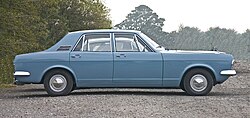 Ford Zephyr 4 Mark IV: the short tailed long nosed profile recalled Ford's iconic Mustang
 -
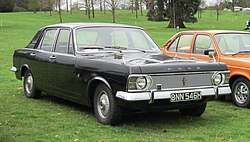 Ford Zephyr 6 Mark IV: the deluxe version gained a dummy grille between the headlights


Zodiac and Executive Mark IV
[edit]
| |
|---|---|
 Ford Zodiac Mark IV Saloon | |
| Overview | |
| Production | 1966–1972 |
| Body and chassis | |
| Body style |
|
| Powertrain | |
| Engine | 2,994 cc (182.7 cu in) Essex V6 |
Models 3012E / 3022E
The Zodiac Mark IV and "Executive" had four headlights and an uprated 2,994 cc (183 cu in) V6 engine. Claimed output was 140 bhp 'net' at 4,750 rpm, with 181.5 lb⋅ft (246.1 N⋅m) of torque at 3,000 rpm.[21] The Zodiac featured an alternator instead of a dynamo on the Zephyr, an adjustable steering column, a spare wheel in the engine compartment, a heater and Aeroflow ventilation, electric window washers, two-speed wipers, a cigar lighter, rev counter (tachometer), clock, ammeter, and reversing lights as standard.
The Zephyr/Zodiac Mark IVs with their complex independent rear suspension design represented a considerable step up when compared to the Mark III big Fords that they replaced. Ford also determined to widen the price gap between the Zephyr and Zodiac versions. In January 1967, less than a year after the car's introduction, Ford announced that production of the Mark IVs was being cut back in response to poor sales. The announcement was accompanied by several pieces of more upbeat news about Cortina sales, and it was stressed that workers taken off Zephyr/Zodiac production would all be redeployed on the Cortina production lines.[22]
An estate version of the Zodiac Mk IV was announced at the same time as the Zephyr equivalent, and built alongside it at Farnham.[17] No "Executive" estate was built.[17]
The "Executive" was an upmarket version, and had the highest specification offered by Ford to UK customers in the 1960s. Automatic transmission (the Zodiac's four-speed manual box with overdrive being also available as a 'no cost' option[21]) along with power steering and a sunroof were standard equipment. Other standard features included fully reclining front seats, walnut fascia, full instrumentation, carpeting throughout, reversing lights, fog lamps, front inertial-reel safety belts, and a radio. The Executive was distinguishable from other models by exterior trim and name badges on the front and rear.
An automatic transmission-equipped Ford Executive was tested by Britain's Autocar in 1967. It had a top speed of 100 mph (160 km/h) and could accelerate from 0-60 mph (97 km/h) in 13.1 seconds.[21] An overall fuel consumption of 17.2 miles per imperial gallon (16.4 L/100 km; 14.3 mpg‑US) was recorded.[21] By these performance criteria, the Ford betrayed its weight, but nevertheless usefully bettered the similarly sized 3.3-L-engined Vauxhall Viscount. The Ford's recommended retail price of £1,567 exceeded the £1,483 sticker price on the Viscount.[21]
-
 Ford Zodiac Mark IV estate conversion
 -
 Ford Executive 1967
 -
 Ford Executive 1966


References
[edit]- ^ a b Culshaw, David; Horrobin, Peter (1974). Complete Catalogue of British Cars. London: Macmillan. ISBN 0-333-16689-2.
- ^ a b c d "The Ford Zephyr Six Saloon". The Motor. 3 October 1951.
- ^ "Ford Zephyr Six Saloon (road test)". Autocar. 20 October 1950.
- ^ "Ford Zephyr Six Saloon (road test)". Autocar. 20 October 1950.
The independent front suspension is unorthodox in the modern world ... As on the Consul, it consists of a vertically placed sliding unit containing the coil spring and hydraulic damper. This is housed at the top end by a spherical seating and at the lower end by a wishbone formed by one horizontal arm and the end of the anti-roll bar.
- ^ Hutton, Ray (11 May 1972). "The Myth Breakers". Autocar. 136 (3969)): 15–17.
- ^ a b "The Ford Zephyr Zodiac". The Motor. 8 June 1955.
- ^ a b c "The Ford Zodiac Mk.II". The Motor. 2 May 1956.
- ^ "The Ford Zephyr Convertible". The Motor. 10 May 1961.
- ^ a b Darwin, Norm (1986). The History of Ford Australia. Eddie Ford Publications. p. 135. ISBN 9780959228717.
- ^ a b c d "The Ford Zodiac Mk III". The Motor. 18 April 1962.
- ^ Cardew, Basil (1966). Daily Express Review of the 1966 Motor Show. London: Beaverbrook Newspapers.
- ^ "President's Report". geocities.com. 27 October 2009. Archived from the original on 27 October 2009. Retrieved 20 November 2011.
- ^ a b Wilding, Tony (17 February 1968). "24,000 mile staff car report: Ford Zephyr 6 Mk IV". Motor: 75–77.
- ^ "Autocode-Ford: Zephyr-Zodiac". Autocar. 134 (3925)): 57–64. 17 June 1971.
- ^ a b Smith, Maurice A., ed. (10 October 1968). "Used Car Test: 1966 Ford Zephyr V4". Autocar. 129 (3791)): 100–102.
- ^ Cardew, Basil, ed. (October 1969). "Motor Show Review 1969 on 1970 Cars". Daily Express. p. 23 (Ford Zephyr).
- ^ a b c d "Ford Zephyr 6 estate car". Autocar. 136 (3956)): 16–17. 27 January 1972.
- ^ Smith, Maurice A., ed. (21 October 1966). "New big Ford estate cars". Autocar. 125 (3688): 890.
- ^ a b Smith, Maurice A., ed. (18 November 1966). "News and views: Additional Ford for export". Autocar. 125 (3692)): 1102.
- ^ Wright, Cedric, ed. (August 1968). "Ford Zephyr AT de luxe". CAR. Vol. 12, no. 7. Cape Town, South Africa: Central News Agency Ltd. p. 48.
- ^ a b c d e "Autocar Road Test Ford Executive 2,994 c.c.". Autocar. 126 (3716)): 49–53. 4 May 1967.
Ford's Top [UK] Car, with V6 engine and automatic transmissions. Comfortable five-seater, with all independent suspension. Power steering, but handling vague. Optional radial-ply tyres give good grip. Brakes light for normal use but very heavy for emergencies. Poor town fuel consumption. Good finish and tasteful interior trim.
- ^ Smith, Maurice A., ed. (12 January 1967). "News and views: Cortina exports". Autocar. 126 (3700)): 46.
Further reading
[edit]- Allen, Michael (1990). Consul, Zephyr, Zodiac, Executive/Fords Mark 1 to 4. Motorbooks International. ISBN 9780947981426.
External links
[edit]
- The Mark I Consul, Zephyr and Zodiac Owners Club
- The Ford Zephyr and Zodiac Owners Club of South Australia Archived 1 June 2023 at the Wayback Machine
- The classic BBC TV Show "Z Cars"
| Subsidiaries and brands |
|  | |||||||||||
|---|---|---|---|---|---|---|---|---|---|---|---|---|---|
| Facilities |
| ||||||||||||
| Passenger cars | |||||||||||||
| Commercial vehicles |
| ||||||||||||

| Current models |
| | |||||||||||||||||||||||
|---|---|---|---|---|---|---|---|---|---|---|---|---|---|---|---|---|---|---|---|---|---|---|---|---|---|
| Former models (by date of introduction) |
| ||||||||||||||||||||||||
| Military | |||||||||||||||||||||||||
| Related topics | |||||||||||||||||||||||||

Grokipedia
Ford Zephyr
View on GrokipediaBackground and Development
Origins and Design Influences
The Ford Zephyr originated as part of Ford of Britain's post-war effort to modernize its lineup and compete in the executive car segment, replacing outdated pre-war models like the Pilot. Developed at the Dagenham plant, the Zephyr was conceived as the upscale six-cylinder counterpart to the four-cylinder Consul, sharing a common platform but extended for greater refinement and space. Unveiled alongside the Consul at the Earls Court Motor Show in October 1950, the Zephyr represented a bold step forward for British automotive engineering, emphasizing advanced construction techniques and performance suitable for the emerging middle-class market.[6][7] Design influences for the Mark I Zephyr drew heavily from contemporary American Ford aesthetics, particularly the 1949 Detroit-built Ford Custom Tudor sedan, which inspired its sleek, integrated body lines devoid of running boards and separate fenders—features still prevalent in many British competitors. This transatlantic styling cue aimed to inject modernity and appeal, with a low-slung profile, curved fenders, and a prominent grille that echoed the fluid, optimistic forms of U.S. postwar design. Internally, the layout prioritized comfort with bench seating for six and ample luggage space, reflecting Ford's goal to blend American flair with practical British engineering. No single designer is prominently credited, but the project was led by Ford of Britain's engineering team under the broader direction of the company's European operations.[6] Key innovations underscored the Zephyr's origins in forward-thinking development. It was the first mass-produced British car to feature unitary (monocoque) body construction, eliminating a separate chassis for improved rigidity and lighter weight, a technique borrowed from emerging global trends but adapted for cost-effective volume production. The front suspension introduced the MacPherson strut system—designed by Ford engineer Earle S. MacPherson—which combined coil springs, shock absorbers, and control arms into a compact, independent setup, enhancing ride quality and handling while simplifying manufacturing. At the rear, a live axle with leaf springs provided conventional stability. Power came from a newly developed overhead-valve inline-six engine displacing 2,262 cc, delivering 68 bhp, a significant advance over Ford's prior side-valve units and marking the company's shift to more efficient, high-revving powerplants influenced by American overhead-valve trends. These elements positioned the Zephyr as a pioneering executive saloon, influencing subsequent British designs.[8][7]Initial Production and Market Positioning
The Ford Zephyr Mark I, alongside its sibling the Consul, was unveiled to the public at the Earls Court Motor Show in October 1950, representing Ford of Britain's bold step into modern post-war motoring design. Production officially began on 1 January 1951 at the company's Dagenham assembly plant in Essex, England, with the Zephyr serving as the premium six-cylinder offering in a lineup that also included the more affordable four-cylinder Consul. This model introduced several engineering innovations to the British market, notably becoming the first mass-produced car to employ MacPherson strut independent front suspension, which improved ride comfort and roadholding compared to contemporary rigid-axle setups.[9][10] Market positioning for the Zephyr emphasized accessible executive-class motoring, appealing to upwardly mobile businessmen, young professionals, and families desiring refined performance without the cost of true luxury marques. Priced at £842 on launch—substantially higher than the £627 Consul but still competitive—it slotted into the upper-middle segment, directly challenging the Standard Vanguard Phase I (£750) and Austin A70 Hereford (£725), which offered similar four- or six-cylinder power but lacked the Zephyr's advanced suspension and aerodynamic styling influenced by American trends. The 2,262 cc overhead-valve inline-six engine, producing 68 bhp, enabled a top speed of around 80 mph and 0-60 mph in 22 seconds, prioritizing smooth cruising over outright sportiness to suit long-distance business travel and family outings.[9][11] Initial sales were strong, reflecting the model's appeal in a recovering British economy focused on export-driven growth, with total production of the Zephyr Six reaching 148,629 units by the end of its run in 1956, excluding the separate Zodiac trim which added 22,634 examples. This volume helped Ford capture a significant share of the executive saloon market, underscoring the Zephyr's role in elevating the brand's reputation for innovative, value-oriented engineering amid competition from established players like Vauxhall and Rootes.[10][12]First Generation (Mark I, 1950–1956)
Zephyr Six
The Ford Zephyr Six, introduced as part of Ford of Britain's post-war lineup, debuted at the 1950 Earls Court Motor Show alongside the four-cylinder Consul, marking a significant advancement in British automotive engineering.[1][10] Production commenced on January 1, 1951, at Ford's Dagenham plant, replacing the outdated V8-Pilot model and establishing the Zephyr as the six-cylinder executive car in Ford's portfolio.[1][10] The Zephyr Six emphasized modern construction techniques, including unit-body (monocoque) design for improved rigidity and reduced weight, along with hydraulic drum brakes and 12-volt electrical systems, which were innovative for mid-1950s British saloons.[13][1] At the heart of the Zephyr Six was a newly developed 2,262 cc inline-six-cylinder overhead-valve engine, constructed from cast iron with a single Zenith carburettor, producing 68 bhp at 4,200 rpm and 112 lb ft of torque at 2,000 rpm.[13][1][10] This oversquare powerplant, with a bore of 79.37 mm and stroke of 76.20 mm, delivered smooth performance suitable for family use, paired with a three-speed manual column-shift gearbox; an optional Laycock-de Normanville overdrive was added in 1955 for enhanced highway cruising.[1][10] The chassis featured pioneering MacPherson strut independent front suspension—a first for mass-produced cars—combined with a live rear axle on semi-elliptic leaf springs, contributing to composed handling despite the era's live-axle limitations.[13][10] Body styles for the Zephyr Six included a standard four-door saloon with bench seats accommodating five passengers (or six in a pinch), measuring 4,366 mm in length, 1,626 mm in width, and 1,511 mm in height, with a 2,642 mm wheelbase that provided a 7-inch longer front overhang than the Consul to house the six-cylinder engine.[13][1] Additional variants encompassed a two-door convertible (introduced in production form in 1953 after a 1951 prototype) and a five-door estate, though the saloon dominated sales; optional features like leather upholstery, a heater-demister, and a push-button radio enhanced comfort.[13][10] Priced at approximately £842 including taxes in 1951, it targeted middle-class buyers seeking reliability and refinement.[10] Performance figures reflected the engine's modest output for the 1,107-1,223 kg curb weight, with a top speed of 80-84 mph, 0-60 mph acceleration in 20.2-20.4 seconds, and fuel economy around 23 mpg under typical conditions, as tested by contemporary publications.[13][1][10] The model's durability was proven in motorsport, notably winning the 1953 Monte Carlo Rally in the hands of driver Maurice Gatsonides and the 1955 East African Safari Rally, underscoring its robust engineering.[1][10] Over its six-year run until February 1956, approximately 148,629 Zephyr Six and Zodiac Mark I units were produced, contributing to the overall Mark I range total of 231,481 vehicles including the Consul.[1][10] The Zephyr Six's blend of innovation and practicality helped Ford capture a significant share of the British executive car market, paving the way for the facelifted Mark II in 1956.[1]Zodiac Variant
The Zodiac variant of the first-generation Ford Zephyr, often referred to as the Zephyr Zodiac or Zodiac Mark I, was introduced as an upmarket trim level at the London Motor Show in autumn 1953.[1][14] It built upon the existing Zephyr Six saloon, which had entered production in January 1951, by adding luxury appointments and subtle performance enhancements to appeal to executive buyers seeking distinction without radical redesign.[14] Approximately 22,634 units were produced until February 1956, when it was superseded by the restyled Mark II series, contributing to the overall Mark I lineup's total of approximately 231,000 units across Consul, Zephyr, and Zodiac models.[1][14][15] Distinguishing the Zodiac from the standard Zephyr were its cosmetic and comfort upgrades, including two-tone paint schemes (such as black over cream or grey over white), chrome trim accents on the grille and side spears, whitewall tires, and fog lamps integrated into the front bumper.[1] The interior featured two-tone leather upholstery, armrests on all doors, a rear armrest, and enhanced soundproofing with wool matting under the carpet for a quieter cabin.[1] Additional conveniences included a screen washer, reversing light, and optional radio, positioning it as Ford's premium offering in the medium-sized saloon segment.[1] These features elevated the Zodiac's price to around £1,100 at launch, roughly 10-15% more than the base Zephyr Six.[14] Mechanically, the Zodiac shared the Zephyr's innovative unitary steel monocoque body and MacPherson strut independent front suspension—the first such system on a mass-produced British car—paired with a live rear axle and hydraulic drum brakes.[1] Its 2,262 cc overhead-valve inline-six engine featured a higher compression ratio of 7.5:1 compared to the Zephyr's 6.8:1, yielding 71 bhp at 4,200 rpm and 108 lb ft of torque at 2,000 rpm.[1][14] Power was delivered through a three-speed manual gearbox, with column-mounted gearchange; overdrive became an optional extra in 1955 for smoother highway cruising.[14] This setup enabled a top speed of 84 mph and 0-60 mph acceleration in about 20.4 seconds, marginally outperforming the standard Zephyr's 80 mph top speed and 21.9-second sprint, despite the Zodiac's added 60 lb curb weight.[14] Fuel economy hovered around 23 mpg under typical conditions.[14]| Specification | Zodiac Mark I Details |
|---|---|
| Engine | 2,262 cc OHV inline-six, 71 bhp @ 4,200 rpm |
| Torque | 108 lb ft @ 2,000 rpm |
| Transmission | 3-speed manual (overdrive optional from 1955) |
| Suspension (Front/Rear) | MacPherson struts / Live axle with leaf springs |
| Brakes | Hydraulic drums all around |
| Dimensions (L x W x Wheelbase) | 172 x 64 x 104 inches (4366 x 1626 x 2642 mm) |
| Curb Weight | 2,660 lb |
| Top Speed | 84 mph |
| 0-60 mph | 20.4 seconds |