
Hubbry Logo
Fuel saving deviceFuel saving deviceMain
Open search
Fuel saving device
Community hub
Fuel saving device
logo
7 pages, 0 posts
0 subscribers
Be the first to start a discussion here.
Fuel saving device
Fuel saving device
from Wikipedia

Fuel-saving devices are sold on the aftermarket with claims they may improve the fuel economy, the exhaust emissions, or optimize ignition, air flow, or fuel flow of automobiles in some way. An early example of such a device sold with difficult-to-justify claims is the 200 mpg‑US (1.2 L/100 km) carburetor designed by Canadian inventor Charles Nelson Pogue.

The US EPA is required by Section 511 of the Motor Vehicle Information and Cost Savings Act to test many of these devices and to provide public reports on their efficacy; the agency finds most devices do not improve fuel economy to any measurable degree, unlike forced induction, water injection (engine), intercooling and other fuel economy devices which have been long proven.[1] Tests by Popular Mechanics magazine also found unproven types of devices yield no measurable improvements in fuel consumption or power, and in some cases actually decrease both power and fuel economy.[2]

Other organizations generally considered reputable, such as the American Automobile Association and Consumer Reports have performed studies with the same result.[3][4]

One reason that ineffective fuel-saving gadgets are popular is the difficulty of accurately measuring small changes in the fuel economy of a vehicle. This is because of the high level of variance in the fuel consumption of a vehicle under normal driving conditions. Due to selective perception and confirmation bias, the buyer of a device can perceive an improvement where none actually exists. Also, observer-expectancy effect can result in a user subconsciously altering driving habits. These biases can be either positive or negative to the device tested, depending on the biases of the individual. For these reasons, regulatory bodies have developed standardized drive cycles for consistent, accurate testing of vehicle fuel consumption.[5] Where fuel economy does improve after the fitment of a device, it is usually due to the tune-up procedure that is conducted as part of the installation.[6] In older systems with distributor ignitions, device manufacturers would specify timing advance beyond that recommended by the manufacturer, which by itself could boost fuel economy while potentially increasing emissions of some combustion products, at the risk of possible engine damage.[5]

Types of devices

[edit]

Accessory drive modifications

[edit]

Modifying the accessory drive system can increase fuel economy and performance to some extent.[7] Underdrive pulleys modify the amount of engine power that can be drawn by accessory devices. Such alterations to the drive systems for alternators or air conditioning compressors (rather than the power steering pump, for example) can be detrimental to vehicle usability (e.g., by not keeping the battery fully charged), but will not impair safety.[8]

Fuel & oil additives

[edit]

Compounds sold for addition to the vehicle's fuel may include tin, magnesium and platinum. The claimed purpose of these is generally to improve the energy density of the fuel.[citation needed] Additives for addition to the engine oil, sometimes marketed as "engine treatments", contain teflon, zinc, or chlorine compounds.[9][10][11][12][13][14]

Magnets

[edit]

Magnets attached to a vehicle's fuel line have been claimed to improve fuel economy by aligning fuel molecules, but because motor fuels are non-polar, no such alignment or other magnetic effect on the fuel is possible. When tested, typical magnet devices have shown no effect on vehicle performance or economy.[2]

Vapor devices

[edit]

Some devices claim to improve efficiency by changing the way that liquid fuel is converted to vapor. These include fuel heaters and devices to increase or decrease turbulence in the intake manifold. These do not work on standard vehicles because the principle is already applied to the design of the engine.[15] This method is however integral to making vegetable oil conversions, and similar heavy oil engines, run at all.[16]

Air bleed devices

[edit]

Devices have been marketed which bleed a small amount of air into the fuel line before the carburetor. These may improve fuel economy because the engine runs slightly lean as a consequence. However, running leaner than the manufacturer intended can cause overheating, piston damage, loss of maximum power and poor emissions (e.g., higher NOx due to higher combustion temperatures, or, if misfiring occurs, greater hydrocarbon emissions).

Electronic devices

[edit]

Some electronic devices are marketed as fuel savers. The Fuel Doctor FD-47, for example, plugs into the vehicle's cigarette lighter and displays several LEDs. It is claimed to increase vehicle fuel economy by up to 25% through "power conditioning of the vehicle's electrical systems",[17] but Consumer Reports detected no difference in economy or power in tests on ten separate vehicles, finding that the device did nothing but light up.[18] Car and Driver magazine found that the device contains nothing but "a simple circuit board for the LED lights",[19] and disassembly and circuit analysis reached the same conclusion.[20] The maker disputed claims that the device has no effect,[21] and proposed changes to the Consumer Reports testing procedure, which when implemented made no difference to the results.[22]

Another device described as 'electronic' is the 'Electronic Engine Ionizer Fuel Saver'. Testing of this device resulted in a loss of power and an engine compartment fire.[2]

There are also 'emissions-control defeat devices' that operate by allowing a vehicle's engine to operate outside government-imposed tailpipe emissions parameters. These government standards may force factory engines to operate outside their most efficient range of operation. Either engine control units are reprogrammed to operate more efficiently,[23] or sensors that influence the ECU's operation are modified or 'simulated' to cause it to operate in a more efficient manner. Oxygen sensor simulators allow fuel-economy reducing catalytic converters to be removed.[24] Such devices are often sold for "off-road use only".[24]

Thermodynamic efficiency

[edit]

The reason why most devices are not capable of producing the claimed improvements is based in thermodynamics. This formula expresses the theoretical efficiency of a petrol engine:[25]
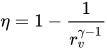
where η is efficiency, rv is the compression ratio, and γ is the ratio of the specific heats of the cylinder gases.

Assuming an ideal engine with no friction, perfect insulation, perfect combustion, a compression ratio of 10:1, and a 'γ' of 1.27 (for gasoline-air combustion), the theoretical efficiency of the engine would be 46%.

For example, if an automobile typically gets 20 miles per US gallon (12 L/100 km) with a 20% efficient engine that has a 10:1 compression ratio, a carburetor claiming 100 mpg‑US (2.4 L/100 km) would have to increase the efficiency by a factor of 5, to 100%. This is clearly beyond what is theoretically or practically possible. A similar claim of 300 mpg‑US (0.78 L/100 km) for any vehicle would require an engine (in this particular case) that is 300% efficient, which violates the first law of thermodynamics.

Extremely efficient vehicle designs capable of achieving 100+ mpg‑US (2.4 L/100 km) (such as the VW 1L) do not have substantially greater engine efficiency, but instead focus on better aerodynamics, reduced vehicle weight, and using energy that would otherwise be dissipated as heat during braking.

Urban legend

[edit]

There is a debunked[26] urban legend about an inventor who creates a 100 mpg‑US (2.4 L/100 km) or even 200 mpg‑US (1.2 L/100 km) carburetor, but after demonstrating it for the major vehicle manufacturers, the inventor mysteriously disappears. In some versions of the story, he is claimed to have been killed by the government. This fiction is thought to have started after Canadian Charles Nelson Pogue filed patents in the 1930s for such a device.[27][28][29]

MythBusters

[edit]

The popular U.S. television show MythBusters investigated several fuel-saving devices using gasoline- and diesel-powered fuel-injected cars under controlled circumstances.[30] Fuel line magnets, which supposedly align the fuel molecules so they burn better, were tested and found to make no difference in fuel consumption. The debunked[31] notion that adding acetone to gasoline improves efficiency by making the gasoline burn more completely without damaging the plastic parts of the fuel system was tested, and although there was no apparent damage to the fuel system, the vehicle's fuel economy was actually worsened.

The show tested the hypothesis that a car with a carburetor type gasoline engine can run on hydrogen gas alone, which was confirmed as viable, although the high cost of hydrogen gas as well as storage difficulties currently prohibit widespread adoption. They also tested a device that supposedly produces sufficient hydrogen to power a car by electrolysis (running an electric current through water to split its molecules into hydrogen and oxygen). Although some hydrogen was produced, the amount was minuscule compared to the quantity necessary to run a car for even a few seconds.

The show also tested a carburetor that, according to its manufacturer, could improve fuel efficiency to 300 miles per US gallon (0.78 L/100 km). However, the device actually made the car less fuel efficient. They also determined that a diesel-powered car can run on used cooking oil though they did not check whether it damaged the engine.

The show noted that out of 104 fuel efficiency devices tested by the EPA, only seven showed any improvement in efficiency, and even then, the improvement was never more than six percent. The show also noted that if any of the devices they tested actually worked to the extent they were supposed to, the episode would have been one of the most legendary hours of television.

See also

[edit]

References

[edit]
[edit]
Revisions and contributorsEdit on WikipediaRead on Wikipedia
from Grokipedia
A fuel saving device refers to an aftermarket product marketed to enhance the of vehicles, typically through purported mechanisms such as fuel magnetization, vapor injection, adjustments, or alterations. These gadgets, including magnetic conditioners, heaters, and control enhancers, often claim reductions in fuel consumption by 10% to 50% without requiring changes to driving habits or vehicle maintenance. However, independent testing by the U.S. Environmental Protection Agency (EPA) has evaluated over 100 such devices and consistently found no significant improvements in fuel economy for the vast majority, with results showing negligible or zero gains in controlled and on-road assessments. The ineffectiveness stems from the fundamental of engine operation, where true efficiency gains demand alterations to compression ratios, , or —factors unaffected by superficial attachments like magnets or bleed valves, as demonstrated in EPA evaluations of specific types such as the PETRO-MIZER magnetic device and Energy Gas Saver mixture enhancer, both yielding no measurable benefits. Some devices, including certain air bleed or liquid injection systems, produced minor savings in isolated tests but at the cost of elevated emissions, rendering them non-compliant with regulatory standards. Regulatory bodies like the (FTC) have responded aggressively to deceptive marketing, securing settlements against promoters of bogus products such as magnetic fuel savers and fuel additives for unsubstantiated claims, with bans on future sales and redress payments to defrauded consumers. Prominent controversies involve widespread consumer exploitation during periods of high fuel prices, where pseudoscientific explanations—such as "ionizing" fuel molecules—preyed on desires for cost savings without empirical validation, leading to FTC injunctions and highlighting the absence of peer-reviewed evidence supporting broad efficacy. While legitimate vehicle technologies like automatic stop-start systems or low-rolling-resistance tires achieve verifiable savings through integration, standalone fuel saving devices rarely surpass effects or minor aerodynamic tweaks like spoilers, which offer at best 1-2% gains under ideal conditions. This pattern underscores a reliance on verifiable over marketed novelties for meaningful fuel economy advancements.

Overview

Definition and Claims

Fuel saving devices encompass a range of aftermarket attachments and modifications promoted for installation on vehicles to purportedly enhance fuel economy in internal engines, primarily targeting automobiles, trucks, and motorcycles. These products are advertised as simple add-ons to fuel systems, manifolds, or ignition setups, requiring minimal alteration to the original design while claiming to optimize efficiency, reduce emissions, or improve power output. Proponents assert typical fuel savings of 12 to 25 percent, with some materials exaggerating benefits up to 35 percent or more, attributing gains to processes like fuel ionization, magnetic restructuring of hydrocarbons, or enhanced vaporization for better atomization in the engine. Such promises frequently rely on anecdotal user reports and uncontrolled demonstrations rather than standardized testing protocols. Marketing for these devices has historically intensified during episodes of sharp fuel price increases, including the 1973-1974 oil embargo that quadrupled crude prices and spurred widespread consumer interest in efficiency aids, as well as the 2008 commodity spike exceeding $140 per barrel amid recessionary pressures. Federal agencies such as the FTC have issued repeated advisories against unsubstantiated claims during these periods, noting patterns of deceptive advertising.

Historical Development

The development of fuel saving devices emerged in the early alongside the rapid adoption of automobiles in the United States and , where vehicle registrations grew from under 1 million in 1900 to over 23 million by 1930. Inventors focused on mechanical tweaks to carburetors to address nascent concerns over consumption, despite gasoline prices averaging around 20 cents per in the . Canadian Charles Nelson Pogue filed multiple patents with the Canadian between April 3, 1928, and June 23, 1936, for a "super-carburetor" that purportedly vaporized completely for efficiencies up to 200 miles per , reflecting entrepreneurial responses to expanding personal mobility rather than acute scarcity. The , initiated by the Organization of Arab Petroleum Exporting Countries' embargo on October 17, 1973, quadrupled global oil prices from about $3 to $12 per barrel within months, catalyzing a surge in aftermarket saving inventions amid U.S. shortages and . This economic shock spurred devices like vapor carburetors, exemplified by American inventor Thomas Ogle's 1977 demonstration of a system installed on a 1970 claiming over 100 miles per gallon through before engine intake. The subsequent 1979 energy crisis, exacerbated by the and reducing Iranian oil output by 4.8 million barrels per day, further proliferated such offerings, including magnetic conditioners that applied fields to lines to supposedly enhance combustion. From the 1980s onward, the transition to electronic fuel injection and engine control units (ECUs), which by 1980 managed timing and mixture for emissions compliance under the U.S. Clean Air Act, shifted device innovations toward electronic interventions like ECU reprogramming or add-on modules to adjust parameters for purported savings. Economic volatility rekindled interest during the , when U.S. prices peaked at $4.11 per gallon in July, prompting gadgets such as the Kiwi monitor for driver habit feedback. Post-2020, inflation-driven fuel price spikes—U.S. averages exceeding $5 per gallon in mid-2022 amid supply disruptions and the shift toward electric vehicles—fueled marketing of hybrid electronic and app-based savers targeting legacy internal combustion engines.

Types of Devices

Mechanical Modifications

Underdrive pulleys consist of smaller-diameter replacements for stock , , and water pump pulleys, which slow the rotational speed of belt-driven accessories and thereby decrease the mechanical power diverted from the to operate them. Aftermarket suppliers claim these reduce accessory by 10-15%, freeing power for propulsion and yielding fuel economy gains of 2-3 MPG in tested installations. Lightweight flywheels employ materials such as aluminum or to cut the of the stock cast-iron unit, lowering rotational and the energy required to accelerate or decelerate the during throttle changes or gear shifts. This modification targets internal and momentum losses in the , with proponents asserting diminished engine workload for quicker revving, though quantified benefits remain secondary to claims. Intake and exhaust tweaks replace restrictive factory components with high-flow air filters, ram-air scoops, or mandrel-bent piping and catalytic converters to enhance and expel gases with less backpressure, aiming to curb pumping losses across the engine cycle. Combined upgrades reportedly deliver 5% improvements in fuel economy by easing airflow resistance. Such alterations often prove incompatible with contemporary vehicles featuring , , or integrated emissions diagnostics, as they can disrupt calibrated accessory outputs or trigger fault codes. Installation typically voids warranties, per manufacturer policies, unless the modification demonstrably avoids causation of failures under the Magnuson-Moss Warranty Act.

Chemical Additives

Chemical additives consist of specialized compounds blended into , , or lubricating oils to target aspects of or engine maintenance, such as deposit accumulation or ignition characteristics. Common categories include detergents, which are formulated to adhere to and solubilize carbonaceous residues on fuel system components like injectors and intake valves; cetane improvers for diesel, primarily alkyl nitrates like 2-ethylhexyl nitrate that facilitate faster chain-branching reactions during autoignition; and oxygenates such as or methyl tert-butyl (MTBE), which increase the fuel's oxygen content to volumes of 5-15% by blending. Detergents typically feature amine-based polymers, including polyisobutylene amine (PIBA) or polyetheramine (), with a non-polar chain for in and a polar head group for binding to metal surfaces. Cetane boosters operate at treat rates of 0.05-0.3% by volume to elevate the by 3-10 points, depending on base quality. Oxygenates serve dual roles in , contributing to antiknock properties via higher ratings while embedding oxygen atoms to theoretically support stoichiometric combustion. Oil-specific additives, such as viscosity index improvers or anti-wear agents like zinc dialkyldithiophosphate (ZDDP), are incorporated into crankcase lubricants to reduce friction in bearings and cylinders. Consumer-oriented fuel and oil additives entered the market in the 1950s, exemplified by STP's debut in 1954 as an oil treatment derived from "Scientifically Treated Petroleum," initially focused on thermal stability under high engine loads before expanding to fuel line cleaners. These early products were dosed manually into fuel tanks or oil reservoirs, with instructions specifying ratios like one ounce per five gallons of fuel or per quart of oil. Modern variants include nano-engineered additives, comprising metal oxide nanoparticles (e.g., cerium oxide or iron oxide) or carbon-based nanostructures at concentrations of 25-100 ppm, promoted for their elevated surface areas that purportedly catalyze fuel pyrolysis and dispersion at the molecular scale. Application methods emphasize precise metering to avoid over- or under-dosing, typically via pre-packaged bottles added directly to tanks before refueling—e.g., treating 15-20 gallons with a 16-ounce —or during routine oil changes for crankcase formulations, where additives comprise 0.1-30% of the total volume. Additives may be introduced at refineries, during distribution, or post-sale by end-users, with automated dispensers in fleets ensuring consistent ratios based on throughput.

Magnetic and Field-Based Devices

Magnetic and field-based devices typically involve arrays of permanent magnets or electromagnetic coils clamped externally around fuel lines, carburetors, or fuel injectors in internal engines. Proponents assert that exposure to these static or pulsed fields aligns molecules in the fuel, purportedly reducing , enhancing atomization, or promoting to facilitate more efficient and yield fuel savings of 5-20%. Such devices require no engine disassembly, featuring simple installation via straps or brackets, and manufacturers often claim ancillary benefits like lower emissions without altering mechanical components. These products proliferated in the and early amid rising prices, with emphasizing passive operation and compatibility across and diesel vehicles. Examples include neodymium rings sold in sets of four to six, positioned upstream of the delivery system to influence liquid flow. Electromagnetic variants, such as those generating alternating fields via battery power, extend the claim to breaking fuel clusters for better oxygen mixing, though static magnet models dominate due to lower cost and maintenance. Independent evaluations by regulatory bodies have consistently found no measurable improvements in fuel economy or emissions. The U.S. in 2006 prohibited unsubstantiated claims for a magnetic fuel saver after testing revealed it neither increased mileage nor reduced pollutants, deeming the molecular alignment mechanism implausible for non-magnetic hydrocarbons. Similarly, U.S. Environmental Protection Agency assessments of electromagnetic fuel treatments, including the POLARION-X device in the , concluded no effects on performance, attributing any anecdotal gains to or measurement errors rather than causal field interactions. While some papers report modest gains—such as 9-14% reduction tied to field intensity in small-scale tests—these originate from non-Western academic sources with limited replication and methodological flaws, like uncontrolled variables or short-duration runs, contrasting with rigorous, standardized protocols in trials. From physical principles, fuels like exhibit diamagnetic properties with negligible response to low-strength fields (typically 0.1-1 Tesla in consumer devices), insufficient to alter molecular bonds or persist through turbulent flow to the . No peer-reviewed consensus supports efficacy, positioning these devices as ineffective for substantive savings.

Vapor and Air Bleed Devices

Vaporizers, also known as bubblers or vapor s, operate by drawing air or heated air through a of , generating a vapor-saturated that is piped to the engine's for mixing with additional air. This method purportedly facilitates finer dispersion and enables operation with leaner overall air- ratios by pre-vaporizing hydrocarbons outside the standard or . Such systems often incorporate simple tubing, filters, and sometimes heaters to promote , with the vapor feed bypassing conventional metering. Air bleed devices function by metering supplemental air into the 's venturi, circuits, or PCV pathway, typically via restrictors or valves installed in the tract upstream of the throttle body. This addition aims to dilute the charge in specific operating regimes, such as or part-throttle, to refine before final air integration. Common installations replace mixture screws or splice into lines, altering formation within the carburetor wells. These devices proliferated as DIY modifications during the 1970s oil crises, with enthusiasts adapting stock carburetors—such as those on V8 engines—by adding vapor chambers or bleed fittings to counter rising fuel costs. Inventors like Tom Ogle exemplified early prototypes, showcasing vapor injection systems on production vehicles in demonstrations around 1977-1978. Later variants have incorporated auxiliary vapor generators compatible with electronic setups, feeding vapor lines parallel to liquid injectors. Operational risks include induction of overly lean conditions, which can precipitate from uneven propagation and elevate temperatures, potentially warping pistons or eroding valves. Air bleeds further risk manifold vacuum loss, impairing brake boosters, transmission modulators, or emission components reliant on consistent . Government evaluations have noted potential for such mechanical disruptions without long-term durability assessments.

Electronic and Software Devices

Electronic fuel saving devices encompass hardware modifications to the (ECU), such as piggyback chips or standalone programmers, and software-based remapping that alters fuel delivery, ignition advance, and throttle response to target leaner air-fuel ratios (AFR) under light loads. These interventions seek to exploit untapped in factory calibrations optimized for emissions, power, and drivability rather than maximal . Professional ECU remapping, often performed via OBD-II interfaces with custom software, can achieve modest fuel savings of 5-15% in controlled tests on diesel vehicles by retarding injection timing and optimizing boost pressure, though results diminish in real-world mixed driving. Plug-and-play OBD-II dongles, which connect to the vehicle's diagnostic port and purportedly monitor or adjust ECU signals in real time, surged in availability post-2010 with the advent of affordable adapters and companion applications like those interfacing with chips. Manufacturers claim dynamic adaptations yielding 15-35% reductions in consumption by fine-tuning parameters like AFR and spark timing based on instantaneous data from sensors including mass airflow and oxygen levels. However, empirical dissections and signal analyses reveal many such devices, including models marketed under names like ECO OBD2 or , lack substantive ECU communication protocols and instead operate as simple timers with blinking LEDs to simulate activity, delivering no measurable efficiency gains. Risks associated with these devices include the generation of diagnostic trouble codes (DTCs) from attempted unauthorized ECU access, potential of engine power in mode, and accelerated wear on components like turbochargers if remaps push beyond thermal limits without hardware upgrades. Software tunes prioritizing economy may increase (EGR) rates, risking carbon buildup and higher emissions that violate regulatory standards such as Euro 6 or EPA Tier 3, while voiding manufacturer warranties due to altered factory parameters. In extreme cases, improper AFR leaning can induce or overheating, shortening engine life, as documented in post-remap analyses.

Fundamental Principles

Thermodynamic Limits of Engine Efficiency

The efficiency of any , including internal combustion (IC) engines, is fundamentally constrained by the second law of thermodynamics, which dictates that not all heat input can be converted to work due to inevitable increase. The theoretical maximum efficiency is given by the , η_Carnot = 1 - T_c / T_h, where T_c and T_h are the absolute temperatures of the cold and hot reservoirs, respectively. For typical IC engine conditions with combustion temperatures around 2000–2500 K and exhaust or coolant temperatures of 300–600 K, this yields a Carnot efficiency of approximately 70–85%, though such limits are unattainable in practice because real engines operate on irreversible cycles rather than the idealized reversible . IC engines approximate the for spark-ignition gasoline engines or the for compression-ignition engines, both of which exhibit lower efficiencies than Carnot due to finite-rate processes, across finite temperature differences, and non-quasi-static compression/expansion. The ideal is η_Otto = 1 - (1 / r_v)^{γ-1}, where r_v is the volume and γ ≈ 1.4 is the specific heat ratio for air-fuel mixtures; for practical compression ratios of 8–12 to avoid autoignition (knock), this ideal efficiency reaches 50–60%. In the , higher compression ratios of 14–25 allow ideal efficiencies up to 65%, but the cutoff ratio (expansion during heat addition) reduces this advantage. Real-world IC engine efficiencies fall to 20–30% for gasoline Otto-cycle engines and 30–40% for Diesel engines, primarily due to irreducible losses such as incomplete fuel combustion (limited by reaction kinetics and mixing), heat rejection to cylinder walls and exhaust (up to 30–40% of energy input), mechanical friction (5–10%), and pumping losses from intake/exhaust throttling. These factors establish baseline minima independent of add-on devices, as of thermodynamics (energy conservation) prohibits extracting additional work without corresponding energy input, while the second law ensures some fraction of fuel energy dissipates as unusable heat.

Physical Mechanisms Targeted by Devices

Fuel saving devices often claim to intervene in the combustion process by enhancing fuel atomization and vaporization, which influences the air-fuel mixture homogeneity and subsequent burn completeness in internal combustion engines. Improved atomization reduces droplet size, promoting faster evaporation and mixing with intake air, potentially lowering brake specific fuel consumption (BSFC) by enabling leaner mixtures or higher indicated thermal efficiency without exceeding knock limits. This mechanism aligns with established principles where finer atomization correlates with reduced cycle-to-cycle variability and unburned fuel losses, though gains are constrained by injector design and in-cylinder turbulence in production engines. Ignition timing optimization represents another targeted area, with devices purporting to advance or retard spark events to match varying loads, thereby minimizing heat losses during the expansion stroke and improving the proximity to ideal efficiency. Precise timing adjustments can reduce BSFC by 1-3% in spark-ignition engines under part-load conditions, as suboptimal timing leads to incomplete or excessive exhaust temperatures. However, such interventions require dynamic sensing of engine parameters like manifold and , and static modifications risk or power loss across operating ranges. Efforts to boost (VE) focus on manifold modifications, such as air bleeds or vortex-inducing inserts, aiming to increase the inducted relative to displaced volume—typically targeting VE values above 80-90% in naturally aspirated engines. Enhanced VE supports greater torque at low speeds without , indirectly lowering BSFC by allowing operation closer to peak points on the engine map. Port flow improvements or throttle body enhancements seek to mitigate restrictions, but causal impacts demand measurable rises in trapped charge mass, often limited by overlap and backpressure dynamics. Parasitic and accessory load reductions, including decoupling or friction modifiers, target mechanical inefficiencies that divert power from propulsion. For instance, variable-load accessories can cut idling use by minimizing constant-drag components, with potential BSFC benefits in urban cycles where accessories consume 5-10% of output. Throttle loss mitigation through electronic bypasses or cylinder deactivation analogs aims to preserve pumping in throttled spark-ignition engines, avoiding negative work during intake strokes. Beyond the , some devices address vehicle-level dynamics like aerodynamic drag via add-on fairings or underbody panels, which reduce coefficient of drag (Cd) by 5-10% in highway scenarios, or through tire inflation monitors. These mechanisms interact with engine operation by lowering required power for steady speeds, but claims frequently conflate systemic reductions with isolated engine tweaks, overlooking that true savings hinge on integrated changes in power demand and BSFC. Effective interventions must demonstrably alter VE or BSFC contours, as superficial modifications rarely propagate causal efficiency gains through the .

Empirical Evaluation

Independent Scientific Testing

In controlled laboratory and track evaluations, independent tests by researchers and testing organizations have consistently shown that most fuel-saving devices—such as magnetic treatments, fuel ionizers, and vapor carburetion aids—produce no statistically significant improvements in fuel economy beyond measurement variability. A 2011 study by magazine's technical team installed devices including the Dynamic Ionizer (an electrical conditioning unit), Fuel Doctor FD-47 (a spark-enhancer), Hot Inazma ECO (a fuel-line restrictor), and Fuel Boss Magnetic Fuel Saver on a 3 sedan and , measuring consumption via gravimetric tank draining during steady-state oval-track runs at 35 mph and 70 mph. None of the devices yielded measurable mileage gains, with fuel use differences of less than 1% across repeated trials attributable to wind, temperature fluctuations, and instrument precision limits rather than causal device effects. Dyno-based assessments reveal similar discrepancies between claimed mechanisms and outcomes, often highlighting reduced output rather than efficiency gains. For example, ' 2005 dynamometer tests of air-vortex devices like the Intake Twister and Fuel Preheater on a Chevrolet S-10 pickup showed peak horsepower drops exceeding 10% and fuel consumption increases of up to 20% under load, contradicting manufacturer assertions of enhanced via or preheating. Such lab results underscore thermodynamic constraints, where alterations to intake flow or fuel polarity fail to overcome inherent cycle inefficiencies without verifiable changes in air-fuel ratios or . Peer-reviewed engineering papers, including those from the Society of Automotive Engineers (SAE), report marginal or null effects for magnetic and additive-based devices in multi-cylinder engine rigs. A 2014 SAE investigation into magnetic fuel line treatments on a single-cylinder diesel engine found combustion enhancements limited to under 1% fuel reduction, within the bounds of sensor error and not replicable under varied loads, attributing any minor shifts to transient magnetization rather than sustained molecular realignment. Analogous studies on chemical additives in gasoline engines, such as a 2022 Frontiers in Mechanical Engineering analysis, indicate that generic octane boosters or detergents yield efficiency uplifts below 0.5% in controlled cycles, often indistinguishable from baseline after accounting for blend variability and exhaust backpressure. Achieving reliable conclusions demands statistical controls like double-blind protocols across vehicle fleets to mitigate driver behavior biases and environmental confounders, yet most device-specific trials lack such rigor, amplifying placebo-driven anecdotal reports. Independent organizations emphasize that real-world road tests must incorporate fleet-scale sampling—e.g., 10+ vehicles over thousands of miles—to detect effects smaller than 2-3%, as single-vehicle dyno or track data frequently overstate variability from pressure or quality alone.

Government and Regulatory Assessments

The (EPA) maintains a voluntary evaluation program for aftermarket retrofit devices and fuel additives claiming to enhance fuel economy or reduce emissions, initiated under Section 511 of the Motor Vehicle Information and Cost Savings Act of 1972 and active through the 1990s and 2000s. Testing employs standardized protocols, including the cycle simulating urban driving conditions, with multiple cold- and hot-start runs to compute composite fuel economy in miles per gallon (MPG). Statistical analysis determines significance, where observed deviations under 0.5 MPG—often within the inherent variability of ±1-3% from test conditions, vehicle preconditioning, and measurement precision—are deemed non-verifiable and attributable to noise rather than device efficacy. EPA assessments of over 100 products from the 1970s to 2010s consistently found no substantive fuel savings for categories like devices, air-bleed modifiers, and chemical additives, with measured changes averaging zero or negligible. The 1983 test of the Environmental Fuel Saver device yielded identical fuel economy results across baseline and modified configurations on runs. Similarly, evaluations of the Vitalizer III retrofit in 1999 and the Fuelon Power additive in the early 2000s reported no statistically significant improvements, aligning with thermodynamic constraints where unproven mechanisms fail to alter meaningfully. Post-2020, the program persists amid evolving standards like (CAFE), with scrutiny on electronic OBD-II interface devices that purport efficiency gains via ECU tweaks, yet EPA data indicate such interventions rarely exceed test variability without risking emissions non-compliance. Parallel efforts by the (NHTSA) emphasize fleet-level technologies over individual aftermarket claims, reinforcing that only verified modifications, such as aerodynamic aids for heavy-duty vehicles, achieve measurable savings under controlled protocols.

Notable Cases and Controversies

High-Profile Debunkings

The series tested fuel-saving devices in its May 17, 2006, episode titled "Exploding Pants," focusing on internet-promoted gadgets such as magnetic attachments and additives intended to enhance . The hosts conducted controlled experiments on both carbureted and fuel-injected vehicles, measuring fuel consumption via flow meters during repeated highway and city driving cycles with and without the devices installed. Results indicated no discernible improvement in miles per gallon, with magnetic devices yielding identical to unmodified controls, debunking claims of hydrocarbon alignment or benefits. Consumer Reports has exposed similar inefficacy in multiple evaluations of physical add-ons. Tests published in January 2012 on the Fuel Genie (an air bleed valve), Platinum Gas Saver (a catalytic insert), and (a fuel-line vortex generator) involved and on-road assessments across various engine types, revealing zero gains in fuel economy compared to baselines. In a November 2016 trial, the Fuel Doctor FD-47—marketed for up to 25% savings via fuel ionization—was installed on ten vehicles ranging from sedans to SUVs; post-installation fuel tracking over extended drives showed no statistical deviation from pre-test averages. Electronic OBD-II savers have faced recent high-profile critiques for data manipulation rather than genuine optimization. A June 2022 Jalopnik investigation of devices like the eco OBD2, which plug into the diagnostic port and purport to remap engine controls via apps, found they merely log existing ECU data without modifying parameters such as or timing, often inflating reported efficiency through selective averaging. Independent electronics dissections corroborated this, noting passive components incapable of real-time ECU reprogramming. Anecdotal endorsements of these devices frequently stem from , where users interpret routine variations in driving habits or fuel quality as device-induced savings, lacking the isolation of variables seen in controlled studies. The Federal Trade Commission's analysis of consumer claims highlights how imprecise personal mileage tracking amplifies perceived effects, contrasting with empirical tests showing null outcomes. Devices such as Fuel Save Pro and , marketed aggressively between 2023 and 2025, claim gains of 15% to 35% through plug-and-play OBD-II interfaces that purportedly use AI-driven algorithms to dynamically tune (ECU) parameters in real-time. These units connect to the vehicle's diagnostic port, asserting adaptation to driving conditions by adjusting fuel-air mixtures and without installation. Manufacturer testimonials and user anecdotes, often featured in promotional videos and affiliate reviews, report sustained savings under varied loads, positioning the devices as accessible innovations amid rising fuel costs. However, these assertions lack substantiation from peer-reviewed studies or independent laboratory validations, with no published data demonstrating verifiable ECU modifications via consumer-grade OBD-II plugs. Engineering analyses highlight fundamental physical constraints: modern ECUs employ locked and proprietary protocols that resist unauthorized overrides, rendering simple plug-in devices incapable of altering core parameters without triggering error codes or reverting to safe modes. Doubts persist on causal mechanisms, as any observed improvements may stem from transient effects like cleaning during initial use or behavioral —drivers unconsciously adopting smoother —rather than persistent thermodynamic gains. Proponents counter with aggregated fleet data from unverified trials, yet critics, including automotive engineers, emphasize the absence of controlled comparisons isolating device effects from variables like seasonal fuel quality or odometer resets. This unresolved tension underscores ongoing promotional cycles, where hype via endorsements clashes with principles of , which demand comprehensive remapping tools beyond off-the-shelf hardware. No regulatory endorsements affirm long-term efficacy, leaving efficacy debates anchored in anecdotal versus mechanistic scrutiny.

Regulatory and Market Impacts

In November 2004, the U.S. (FTC) filed a complaint and sought a temporary against Fuel Doctor, Inc., and related entities marketing a magnetic "fuel saver" device claimed to increase gas mileage by 10-20%, reduce emissions, and extend engine life without substantiation from reliable testing. Federal courts granted the order, prohibiting further sales and deceptive advertising until resolution, as the device failed to deliver promised benefits in controlled evaluations by FTC experts and independent labs. By May 2005, the FTC secured settlements from operators who had promoted the Fuel Doctor via illegal spam emails, requiring cessation of unsubstantiated claims that the magnetic treatment altered fuel combustion for savings, alongside consumer redress provisions. In August 2006, the FTC obtained a permanent against another magnetic fuel-saving device marketer, Performance1Marketing, Inc., after evidence showed no mileage improvements or emission reductions, with the agency pursuing refunds for affected buyers. Concurrently, a federal court imposed a $4.2 million on a Nevada-based firm for similar of a device promising 25% fuel efficiency gains, effectively banning its U.S. distribution. Lanham Act litigation under Section 43(a) has occasionally involved competitors challenging false claims in adjacent products, such as additives, where courts scrutinized internal testing failures revealing no verifiable savings; for instance, a 2020s in Star-Bryte LLC v. Gold Eagle Co. dismissed claims but highlighted evidentiary burdens on efficacy data in such disputes. These suits underscore how rival challenges can expose methodological flaws in device promoters' proprietary tests, though direct precedents for aftermarket hardware remain sparse compared to FTC interventions.

Consumer Guidance and Market Realities

Consumers should scrutinize fuel-saving devices for verifiable evidence from independent testing, as the U.S. Environmental Protection Agency has evaluated approximately 100 such products and found none to deliver significant mileage improvements beyond standard driving practices. Claims of 20-50% fuel economy gains, common in marketing for magnetic fuel-line devices or OBD-II plugs, typically lack substantiation from controlled studies and serve as primary red flags indicating potential scams. Testimonials or manufacturer-provided data, without third-party validation, further undermine credibility, as these often cherry-pick results under non-representative conditions. Market dynamics perpetuate these products despite repeated debunkings, driven by low production costs and high retail markups; for instance, basic magnetic clamps or plastic OBD dongles manufactured for under $10 can retail for $50-150, yielding substantial profits with minimal R&D investment. Surging fuel prices, as seen in 2022 when U.S. averages exceeded $4 per , amplify demand and enable aggressive , allowing persistence even after actions against false claims. Money-back guarantees frequently include restrictive terms, such as short windows or proof burdens that deter refunds, prioritizing seller retention of revenue over consumer satisfaction. In free-market environments, personal —such as logging pre- and post-installation fuel consumption over thousands of miles under varied conditions—offers a more direct safeguard than awaiting regulatory intervention, which lags behind evolving tactics in digital . Overreliance on approvals can foster complacency, whereas rooted in basic physics—recognizing that aftermarket add-ons rarely overcome inherent inefficiencies without altering core processes—empowers buyers to avoid ineffective purchases.

Recent Advances and Alternatives

Post-2020 Developments

In the early 2020s, advancements in integrated with OBD-II interfaces enabled real-time monitoring and predictive modeling of fuel consumption, primarily through data analytics rather than direct engine control. Peer-reviewed studies highlighted applications using neural networks to estimate instantaneous fuel use and emissions from OBD-II parameters like air-fuel ratio (AFR), throttle position, and engine load, aiming to provide drivers with optimization feedback. These systems, often app-based or dashboard-integrated, focused on predictive rather than interventional adjustments, as standard OBD-II ports lack authority to override factory engine control units (ECUs) without specialized reprogramming. Devices such as the SynGas OBD-II plug-in, marketed in 2025, claimed to employ for dynamic AFR optimization, with promotional reviews citing user-reported fuel savings of 10-15% after a 150-mile period. However, independent analyses and consumer feedback exposed these assertions as unsubstantiated, often attributing perceived gains to effects or rather than measurable efficiency improvements, consistent with broader scrutiny of similar post-2020 OBD gadgets. Low trust scores from user aggregators, averaging below 3/5, underscored credibility issues with vendor-sponsored testimonials over empirical validation. Telematics platforms gained traction for commercial fleets post-2020, combining OBD-II data with GPS for route optimization and driver coaching, yielding documented fuel reductions of up to 20% through behavioral adjustments like reduced idling and speeding. These integrated systems emphasized data-driven insights over hardware alterations, with 2025 implementations incorporating AI for to minimize inefficiencies. Yet, amid accelerating adoption, which reduced (ICE) market share, such innovations faced empirical gaps: independent testing rarely confirmed manufacturer claims beyond basic monitoring, and gains remained bounded by thermodynamic constraints. Software cannot circumvent core engine limits, such as the 's η=11rvγ1\eta = 1 - \frac{1}{r_v^{\gamma - 1}}, where rvr_v is and γ\gamma is the specific heat ratio, dictating maximum convertible energy from fuel regardless of algorithmic tweaks.

Proven Efficiency Strategies

Automatic start-stop systems, integrated in many modern vehicles, reduce fuel consumption by shutting off the engine during periods, yielding savings of 7 to 26 percent depending on the proportion of time in the drive cycle, as measured in testing across varied conditions. These gains stem from eliminating unnecessary engine operation at stops, with empirical validation from and on-road evaluations showing consistent causality in urban and congested scenarios where idling exceeds 10 percent of total time. Routine maintenance practices provide verifiable, low-cost efficiency improvements without relying on unproven modifications. Maintaining recommended tire pressure prevents rolling resistance increases, improving fuel economy by up to 3 percent, according to U.S. Department of Energy analyses of underinflation effects. Similarly, replacing dirty engine air filters enhances airflow and efficiency, potentially boosting mileage by 1 to 10 percent in vehicles with clogged filters, particularly older models, as determined by Department of Energy tests on air-fuel mixture optimization. These interventions are scalable, requiring no specialized equipment, and deliver causal benefits confirmed through standardized fuel economy protocols. Aerodynamic enhancements, such as factory-optimized body shaping or verified aftermarket additions like side skirts, reduce drag coefficients and yield 5 to 12 percent savings in heavy-duty vehicles at highway speeds, per U.S. Department of Energy and industry simulations. In passenger cars, such mods offer smaller but measurable gains of 1 to 3 percent when applied systematically, outperforming isolated gimmicks by addressing fundamental drag physics. Hybrid electric powertrains exemplify systemic, empirically superior strategies, achieving 30 to 50 percent better than comparable conventional engines through and electric assist, as rated by EPA combined cycle tests. In contrast, fuel additives show negligible or inconsistent effects in well-maintained engines, lacking the causal mechanisms of integrated . These proven approaches prioritize first-order physics—friction reduction, idle elimination, and —over speculative one-off interventions, with benefits reproducible across fleets via standardized metrics.

References

Add your contribution
Related Hubs
User Avatar
No comments yet.