Hubbry Logo
Fouta DjallonFouta DjallonMain
Open search
Fouta Djallon
Community hub
Fouta Djallon
logo
8 pages, 0 posts
0 subscribers
Be the first to start a discussion here.
Fouta Djallon
Fouta Djallon
from Wikipedia
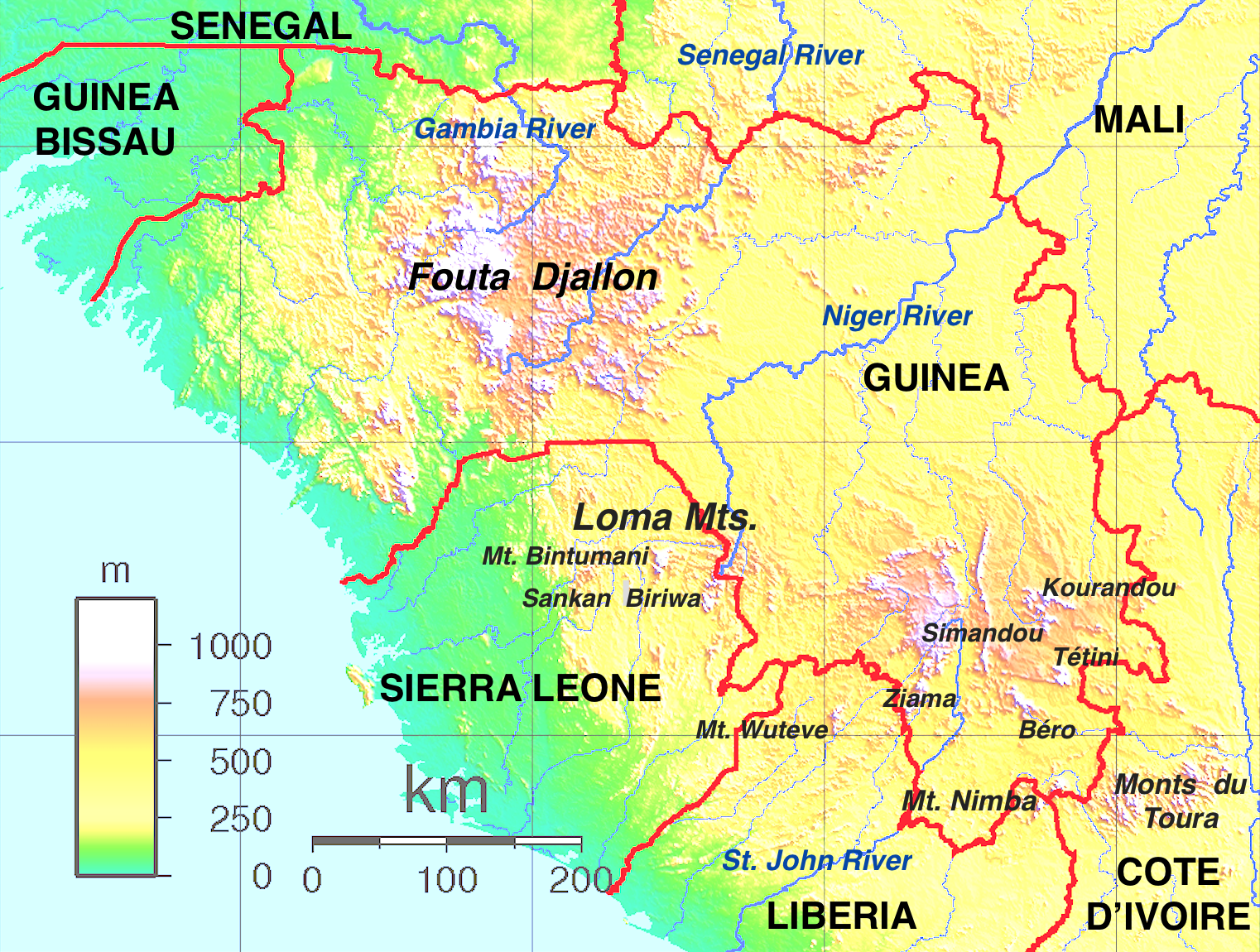
Map of the Guinea Highlands.

Fouta Djallon (Fula: Fuuta Jaloo, ࢻُوتَ جَلࣾو‎, 𞤊𞤵𞥅𞤼𞤢 𞤔𞤢𞤤𞤮𞥅; Arabic: فوتا جالون) is a highland region in the center of Guinea, roughly corresponding with Middle Guinea, in West Africa.

Etymology

[edit]

The Fulani people call the region Fuuta-Jaloo ( ࢻُوتَ جَلࣾو‎) in the Pular language. 'Futa' is a Fula word for any region inhabited by the Fulɓe. 'Djallon' means 'mountain' in old Jallonke.[1][2][3]

French is the official language of Guinea, and Fouta-Djallon or sometimes Fouta-Djalon is the French spelling. Common English spellings include Futa Jallon and Futa Jalon.

The French, during the colonial period, wrote:

  • “The name of this region has often been spelled ‘Fouta‑Djallon’, with a ‘j’ after the capital ‘D’, which contradicts the local pronunciation: the natives themselves all say ‘Fouta‑Diallo’, and Europeans (whether officers or traders) likewise say ‘Fouta‑Diallon’."[4]

History

[edit]

The Jallonke people were the earliest inhabitants of the Futa Djallon.[2][3] The region was a province of both the Sosso Empire and Mali Empire under the name 'Dialonkadugu', meaning 'home of the mountain people'.[1]

Since the 17th century, the Fouta Djallon region has been a stronghold of Islam. Early revolutionaries led by Karamokho Alfa and Ibrahim Sori set up a federation divided into nine provinces. Several succession crises weakened the central power located in Timbo until 1896, when the last Almamy, Bubakar Biro, was defeated by the French army in the Battle of Porédaka.[5]

The Fulɓe of Fouta Djallon spearheaded the expansion of Islam in the region.[6] Fulɓe Muslim scholars developed indigenous literature using the Arabic alphabet.[7] Known as Ajamiyya, this literary achievement is represented by such great poet-theologians as Tierno Muhammadu Samba Mombeya [fr], Tierno Saadu Dalen, Tierno Aliou Boubha Ndyan, Tierno Jaawo Pellel etc.[8] In its heyday, it was said that Fuuta-Jaloo was a magnet of learning, attracting students from Kankan to the Gambia, and featuring Jakhanke clerics at Tuba as well as Fulɓe teachers. It acted as the nerve centre for trading caravans heading in every direction. The more enterprising commercial lineages, of whatever ethnic origin, established colonies in the Futanke hills and along the principal routes. It served their interests to send their sons to Futanke schools, to support the graduates who came out to teach, and in general to extend the vast pattern of influence that radiated from Futa Jalon.[8]

Amadou Hampâté Bâ has called Fuuta-Jaloo "the Tibet of West Africa" in homage to the spiritual and mystic (Sufi) tradition of its clerics.

Geography

[edit]

Fouta-Djallon consists mainly of rolling grasslands, at an average elevation of about 914 m (3,000 ft), and is the second highest land in West Africa behind Mount Cameroon.[9] The highest point, Mount Loura, rises to 1,515 m (4,970 ft). The plateau consists of thick sandstone formations that overlie granitic basement rock. Erosion by rain and rivers has carved deep jungle canyons and valleys into the sandstone.

Map of the Fouta Djallon with the major rivers.

It receives a great deal of rainfall, and is the headwaters of four major rivers and other medium ones:

It is, thus, sometimes called the watertower (chateau d'eau in French literature) of West Africa. Some authors also refer to Fouta Jallon as the "Switzerland of West Africa." This is a common expression whose origin may be unknown.[10]

Population

[edit]
Children in the village of Doucky

The population consists predominantly of Fulɓe [sing. Pullo], also known as Fula or Fulani. In Fouta Djallon, their language is called Pular or Pulaar. The broader language area bears the name Fula/Fulfulde, and it is spoken in numerous countries in West and Central Africa. The Fulani (French: Peul) population represents between 32.1% and 40% of the population in Guinea.[11]

Economy

[edit]

The largest town in the region is Labé. Mainly rural the economy covers animal husbandry (cattle, sheep, goats), agriculture, gathering, trading, and marginal tourism.

The Fulbe practice a form of natural farming that can be recognized today as biointensive agriculture. The region's main cash crops are bananas and other fruits. The main field crop is fonio, although rice is grown in richer soils. Most soils degrade quickly and are highly acidic with aluminum toxicity, which limits the range of crops that can be grown without significant soil management.

Biointensive agriculture

[edit]
Sunture Mindmap

Sometime in the late 18th century, the Fulɓe in Fouta Djallon developed a type of biointensive agriculture, probably out of necessity, since the conquered indigenous women were taken into the households of their Islamic overlords whose livestock became their responsibility. Combining animal husbandry and sedentary agriculture into an efficient system of agropastoralism required a new way of organizing daily life. Livestock, which included horses and cattle, ate more and produced more waste than what the indigenous farmers were accustomed. Since the livestock had to be protected from wildlife at night, they were brought into the family compound, referred to by the French as a tapade, and locally as cuntuuje (sing. suntuure) in the Pular language.[6]

Today, livestock graze in open areas during the day but are sheltered in corrals during the night, except for goats, which are permitted to manage on their own within limits. A similar pattern must have developed by the latter part of the 18th into the 19th century. Nonetheless, the disposal of livestock waste, which became woman's work, required a systematic way of disposing of it. And, over time, the women worked out a method for doing so. In organic gardening, their solution is called sheet composting or mulching. Over time, the women mixed a variety of other organic matter with the manure (kitchen scraps, harvest residues, and vegetative materials from a living fence or hedgerow) and piled it each day on their garden beds and trees to decompose and become nutritious humus. In the 20th century, livestock among the Fulɓe shifted from large animals to smaller types. Horses, perhaps due to the tsetse fly, decreased, while goats, sheep, pigs, and poultry increased, and n'dama cattle remain an integral asset.

Permaculture Zones

The tapade gardens of Fouta Djallon have been highly researched by international scholars from various disciplines. This research has revealed that the cuntuuje system has a higher soil nutrient level than any other soil in the region. Almost all labor, except for the initial preparation, is performed and managed by women and children, in the past and now, within each family group. The gardens are important for both food and cash crops for their families. PLEC, a project of the United Nations University, measured yields on 6.5 ha from tapade fields at Misiide Heyre, Fouta Djallon and found that maize yielded up to 7 t/ha, cassava 21 t/ha, sweet potatoes 19 t/ha, and groundnuts (peanuts) about 8 t/ha.[12]

Each suntuure is about 1-hectare (2.5 acres) on average, so referring to them as gardens is not accurate, neither for their size nor complexity. The cuntuuje represents a systems approach to food production, and is distinguished by their agrodiversity, as well as the way the people intensively use and maximize a limited amount of land. Today, the cuntuuje gardens continue to produce a significant quantity and variety of agricultural products.[13]

The living fences that surround each suntuure are not just a barrier to keep out people, wild animals, and domestic livestock. In the permaculture vocabulary, the fence is a vegetative berm, and is instrumental in the process of nutrient cycling and nutrient retention within the suntuure. In other words, the cuntuuje represent a sustainable biointensive polyculture farm system and landscape architecture, housing one or more microclimate ecosystems and are examples of what we know today to be a permaculture design. The graphic in this section is a mind map of the internal zones and sectors found typically in a suntuure environment.

The interior of the suntuure, Zones 1-3 (internal gate, entryway, privacy screen, and residence) are reserved primarily for family members. It is in Zones 4 and 5 (the hoggo[check spelling] and suntuure living fence) where most activities of daily life occur. Here, visitors are greeted at a secondary shelter or pavilion, work on gardens (hoggos) is organized, children spend the day in play and work if of age, and afternoon prayers, naps, conversations, and meals occur until dark. Zone 6 is the outside world.

In 2003, the cuntuuje of Fuuta-Jalon were recognized by the United Nations Food and Agriculture Organization (UNFAO) as one of the Globally Important Agricultural Heritage Systems.[14]

Notes

[edit]

References

[edit]

Sources

[edit]

Further reading

[edit]
Revisions and contributorsEdit on WikipediaRead on Wikipedia
from Grokipedia
Fouta Djallon is a highland plateau located in central Guinea, West Africa, encompassing roughly the Middle Guinea region and characterized by its dissected laterite-covered terrain of rolling grasslands, savannas, and steep escarpments. With average elevations around 900 meters and peaks reaching up to 1,515 meters at Mount Loura, it functions as the "water tower of West Africa," serving as the primary source for major rivers including the Senegal, Gambia, and tributaries of the Niger such as the Tinkisso. Primarily inhabited by Fulani (Peul) pastoralists who herd tsetse-resistant N'Dama cattle and cultivate crops on terraced slopes, the area supports diverse ecosystems ranging from montane grasslands to gallery forests along waterways. The region's historical prominence stems from the , a theocratic established between 1727 and 1751 through a Fulani-led under cleric Karamokho Alfa, who mobilized against local non-Muslim rulers to impose Fulani clerical dominance and expand territorial control via slave-raiding armies and alliances. At its zenith in the , the Imamate governed from Timbo, influencing trade in gold, salt, and captives across coastal and inland until its progressive subjugation by French colonial forces culminated in the capture of key centers like in 1896, marking the end of independent Fulani rule. This polity exemplified early modern West African through religious mobilization and pastoralist militarism, shaping ethnic demographics and Islamic scholarship in the highlands. In contemporary , Fouta Djallon remains a cultural stronghold for Fulani communities, with its underpinning , , and downstream for millions, though pressures from , , and variability threaten its watershed integrity. Key settlements like function as trade and administrative hubs, preserving architectural traditions such as mud-brick mosques and compounds adapted to the plateau's microclimates. The area's strategic geography continues to influence regional stability, as evidenced by its role in Guinea's post-independence and occasional ethnic tensions rooted in historical legacies.

Etymology

Name and Linguistic Origins

The name Fouta Djallon, alternatively spelled Fuuta Jaloo in Fulfulde (the language of the Fulani people), originates from the fusion of two elements: fuuta, denoting a highland or plateau in Fulfulde, and jaloo (or jalon), derived from Jalonke (also known as Yalunka or Dialonke), the name of the indigenous non-Fulani inhabitants who predated the region's Fulani-dominated . This etymology underscores the area's elevated , averaging 800–1,000 meters above , and its historical layering of ethnic groups, with the Jalonke having settled the highlands prior to Fulani migrations and conquests beginning in the late 17th century. The French colonial rendering Fouta Djallon adapted the local pronunciation for administrative use, while the endogenous Fuuta Jaloo literally translates to "the highlands of the Jalonke," reflecting both linguistic and pre-jihad demographic realities before the 1725 Fulani uprising established Islamic clerical rule under the . Linguistic variations persist, with Jaloo sometimes linked to specific Fulani clans like the Jallo, though primary attribution ties it to the earlier Jalonke substrate, as evidenced in oral traditions and early European accounts of the region's stratification.

History

Pre-Jihad Era

The Fouta Djallon highlands, located in central , were primarily inhabited by the Dialonke (also known as Jallonke or Yalunka), a Mandé-speaking people who engaged in agriculture and established small-scale chiefdoms across the region's fertile plateaus and valleys prior to significant Fulani influence. These indigenous groups maintained animist traditions and localized political structures, with no evidence of a unified state encompassing the entire area. Starting from the 13th to 16th centuries, semi-nomadic Fulani (Fulɓe or Peul) pastoralists migrated into the region, drawn by its expansive grasslands ideal for cattle herding, leading to increased settlement and through payments to local landowners. This influx diversified the ethnic composition, introducing Fulani clans that coexisted with the Dialonke and other groups such as the Susu, often intermarrying while preserving distinct pastoral livelihoods. By the early , Fulani communities had amassed considerable wealth from livestock, yet persisted, with Muslim clerical Fulani (Torodbe) advocating Islamic reforms amid tensions with animist Dialonke rulers and non-Muslim Fulani herders. The absence of centralized left the region vulnerable to internal disputes and external pressures, characterized by a of autonomous villages and petty kingdoms enforced through kinship ties and rather than formal administration. These dynamics, including perceived oppression of Muslim elements by pagan authorities, precipitated the conditions for the of 1725.

The Fulani Jihad of 1725

The Fulani Jihad of 1725 marked the beginning of a religious and military campaign by Muslim Fulani (Fula) clerics against the non-Muslim Dialonke rulers in the Fouta Djallon highlands, driven by desires to enforce Islamic governance under Shari'a law and capitalize on emerging Atlantic trade opportunities in slaves, hides, and rice. This movement was fueled by earlier Fulani migrations from regions like Masina around 1700, where brotherhood adherents sought to escape suppression and propagate militant among sedentary populations. Alfa Ba, a prominent cleric, initially rallied a coalition of Muslim Fulani lineages—including Barry, , Sow, and Bah—in 1725, but died before active hostilities; his son, Karamoko Alfa (also known as Ibrahim Musa), assumed leadership and launched the jihad proper that year. Karamoko Alfa, tutored in Islamic scholarship by Qadiriyya figures such as Kadry Sanounou from Kankan, coordinated with allies like Alfa Kikala (Barry), Sheik Aldiouma Maoudo (Diallo), and Sheik Mamadou Ibn Alkali (Bah) to proselytize and arm converts. The campaign progressed gradually from Timbo as a base, achieving early successes against local nonbelievers through a combination of preaching, alliances, and warfare, though it faced resistance and proceeded slowly due to the Fulani's pastoralist background limiting large-scale mobilization. By the late 1720s, jihadists had secured key highland areas, displacing Dialonke authorities and establishing Muslim dominance, though full territorial consolidation required decades of intermittent conflict. The culminated in the founding of the as a theocratic state by around 1727, with Karamoko Alfa as its first spiritual leader (Alfaya), emphasizing clerical rule over military . This shift introduced Shari'a-based administration, including Quranic schools and slave-based to support exports to European traders on the coast, laying the groundwork for Fouta Djallon's expansion into neighboring regions like . Karamoko Alfa's death in 1751 transitioned leadership to more militaristic figures, but the 1725 's religious impetus remained foundational to the imamate's identity until French in the 1890s.

The Imamate of Futa Jallon (1725–1896)

The Imamate of Futa Jallon emerged from a Fulani-led jihad in the early 18th century, overthrowing the ruling Jallonke dynasty and animist Fulani clans that dominated the highlands. Karamoko Alfa, a Fulani cleric trained in Islamic scholarship, initiated the religious reform movement around 1720, emphasizing strict adherence to Sharia and criticizing local practices as syncretic deviations from orthodoxy. Allied with the warrior Ibrahima Sori, Alfa's forces achieved decisive victory at the Battle of Talansan in 1725, establishing Muslim control over the region and founding the Imamate with Timbo as its capital. Karamoko Alfa served as the first almamy (imam-ruler) until his death in 1751, prioritizing clerical authority and education through Quranic schools (daaras), which produced a class of literate marabouts central to governance. Governance combined theocratic principles with decentralized administration, divided into seven to nine diwés (provinces) such as Timbo, , and Fugumba, each led by a lamb-fouta (provincial ) selected from Fulani lineages. The almamy held executive power, advised by a council of elders (serigne-foutanko) and marabouts, enforcing via courts that penalized infractions like alcohol consumption or non-Islamic rituals. Political stability eroded due to factionalism between the Alfaya (clerical descendants of Karamoko Alfa, favoring religious purity) and Soriya ( kin of Ibrahima Sori, emphasizing military expansion), resulting in alternating almamy tenures and intermittent civil wars from the onward, such as the 1783-1784 conflict that weakened central authority. Society stratified along ethnic and status lines, with Muslim Fulani elites dominating as herders, landowners, and administrators, while incorporating Mandinka, Susu, and other groups as subjects or tributaries. (cattle rearing) and (millet, , ) formed the economic base, supplemented by raiding non-Muslim neighbors for , who comprised up to 30-50% of the in some estimates and labored in fields or as soldiers. The Imamate's integration into Atlantic trade networks from the mid-18th century amplified slave exports southward via rivers to coastal ports, generating that funded armies exceeding 10,000 men but fostering dependency on bondage; domestic expanded as produced surplus for export, contrasting with Islamic prohibitions on enslaving fellow Muslims, which were often evaded through non-Muslim sourcing. At its peak in the late , the projected power through conquests, subjugating adjacent polities like and controlling trade routes, but internal strife and ecological pressures (, soil depletion) eroded cohesion by the . French incursions began with exploratory missions in the , escalating to treaties in and that undermined almamy sovereignty; resistance peaked under Bokar Biro Barry (r. 1896), who mobilized 5,000-7,000 fighters but was defeated at battles like Porédaka in November 1896, leading to the Imamate's dissolution and incorporation into .

French Conquest and Colonial Period

French efforts to penetrate the Fouta Djallon began in the coastal regions adjacent to the highlands, with treaties securing trade rights and cessions in areas like Boké and the Rio Nunez as early as 1837 and 1859. In 1881, Lieutenant-Governor Dr. Bayol signed a treaty with Almamy Ibrahima Sori Mawdo, establishing nominal French influence, though this was renewed in 1888 and later annulled amid regional conflicts involving neighboring powers like Ahmadu and Samory Touré. European adventurer Olivier de Sanderval further advanced French interests from 1879 by obtaining concessions in the Kahel district, where he established a semi-autonomous rule until 1896, providing logistical support for subsequent military operations. The conquest proper exploited deep internal divisions within the Imamate, particularly succession rivalries between candidates like Bokar Biro (supported by the French) and Modi Abdoulaye, which fragmented resistance among the Fulani elite and provincial leaders such as Alfa Yaya of Labé. In November 1896, a French military column, comprising limited forces including around 80 tirailleurs at key engagements like the battle of Poredaka, occupied Timbo, the Imamate's capital, defeating Almamy Bokar Biro who had initially sought French aid but later opposed them; Biro was killed in January 1897. A definitive protectorate treaty followed on February 6, 1897, formalizing annexation and subordinating the remaining Almamy authority to French oversight. Under colonial rule, Fouta Djallon was integrated into (part of from 1895), with direct administration imposed through a resident system that eroded traditional power structures. Resident Noirot, appointed in 1897, issued general orders restricting the Almamy's role and transforming local chiefs into executive agents for taxation, labor, and infrastructure projects like roads; by 1898, these measures centralized control and diminished chiefly . The Fulani largely collaborated, retaining influence as intermediaries, though sporadic resistance emerged, such as the 1909-1912 uprising led by Tierno Aliou against French restrictions on Islamic practices and perceived anti-jihad policies. Administrative divisions into cantons and circles facilitated resource extraction, including agricultural produce and labor, while the region's highlands were mapped and exploited for their strategic and economic value within the broader colony. This period saw the Imamate's theocratic framework supplanted by secular colonial governance, persisting until Guinea's independence referendum in 1958.

Post-Independence Developments

Following Guinea's independence from on October 2, 1958, the Fouta Djallon region—predominantly Fulani (Peul)—experienced intensified political contestation and marginalization under President Ahmed Sékou Touré's Parti Démocratique de Guinée (PDG) regime, which established a one-party . As the last highland area to resist PDG dominance during , Fouta Djallon saw continued opposition from Fulani elites tied to pre-colonial legacies, leading to suppression through arrests, purges, and dismantling of traditional chieftaincy institutions by the early . Touré, from the Malinké ethnic group, centralized power in , fostering ethnic favoritism that disadvantaged Fulani communities, who comprised about 40% of the national population but held limited influence in the PDG hierarchy. Economic policies exacerbated regional grievances, as Touré's Marxist-inspired collectivization efforts disrupted Fouta Djallon's , prompting livestock seizures and state farms that reduced Fulani herders' . By the 1970s, national crises like shortages and a were publicly attributed to Fulani "saboteurs," intensifying repression and driving mass emigration to and other neighbors, with thousands of Fulani families abandoning highland villages. Social structures eroded further, as Islamic education and clerical networks—rooted in the 18th-century —faced campaigns, though underground resistance persisted. Touré's death in 1984 triggered a military coup by , shifting dynamics toward ethnic balancing; Fulani from Fouta Djallon gained roles in commerce and administration under Conté's 24-year rule, aiding partial economic recovery in cattle rearing and highland . Post-2008 democratic transitions amplified the region's political voice, with Fulani leaders like Cellou Dalein —originating from the highlands—emerging as opposition figures, contesting elections in 2010 and 2015 amid ethnic tensions and violence targeting Fulani voters. The 2021 coup under maintained military oversight, but Fouta Djallon's demographic weight continues to influence national debates on and from its vital watersheds.

Geography

Topography and Physical Features

The Fouta Djallon consists of a blocky, elevated plateau with elevations ranging from 600 to 1,500 meters above sea level, dissected by deep gorges through which rivers descend to surrounding lowlands. The highest peak, Mont Loura, attains 1,538 meters near the town of Mali. This topography forms a significant hydrological divide, separating coastal basins from inland Sudano-Sahelian systems. Geologically, the region features a granitic basement in the southeast and thicker sedimentary sequences in the northwest, including sandstones, dolerites, and argillites reaching 1,500 to 4,000 meters in thickness. Impervious types such as , dolerite, and predominate, limiting storage and promoting . The plateau developed through uplift in the , with additional elevation in the , resulting in a stable, weathered landscape. Terrain elements include lateritic plateaus termed "bowe" capped with ferruginous and aluminous crusts, alongside cornices and deeply incised valleys exceeding 700 meters in depth. These features create rugged escarpments and waterfalls, with low sediment loads in rivers due to the ancient, eroded surfaces. The highlands serve as the primary source for transboundary rivers, including the (via Tinkisso tributary), (via Bafing), , Konkouré, and Corubal, sustaining basins across multiple West African countries.

Hydrology and Environmental Role

The Fouta Djallon highlands function as a critical watershed, originating the headwaters of major transboundary rivers in , including the Bafing (a primary of the ), the , and the Tinkisso (a ). Additional rivers such as the Téné ( basin), Rio Corubal, and Great Scarcies also emerge from this elevated plateau, which spans elevations up to 1,200 meters. This hydrological centrality positions the region as the " of ," supplying a substantial portion of surface water resources to downstream Sahelian nations for , , and domestic use. The environmental role extends to regulating seasonal flows through its aquifers and cover, mitigating floods and droughts in recipient basins like the and . However, hydrological analyses of discharge data from gauging stations (e.g., on the Bafing, , and Tinkisso from the to ) reveal statistically significant decreasing trends in annual and low-flow volumes, attributed to including and . These changes have reduced the region's buffering capacity, with observed drops in river levels impacting ecosystems and for over 100 million people dependent on these rivers. Biodiversity in the highlands supports endemic and maintains stability, but from unsustainable exacerbates in downstream reservoirs, as documented in transboundary basin studies. Restoration efforts, including and sustainable promoted by organizations like the FAO since the early , aim to preserve this role amid variability.

Climate and Biodiversity

The Fouta Djallon experiences a wet equatorial highland , marked by a rainy season from May to and a from November to April. Annual averages 1,500 to 1,800 mm, concentrated during the wet period and contributing to the region's role as a major watershed. Temperatures remain moderate year-round, with daytime highs of 20–25°C and occasional dry-season nighttime lows reaching 6°C in higher elevations. Ecologically, the highlands support diverse ecosystems including montane and gallery forests, grasslands, and savannas, forming part of the Guinean montane forests ecoregion within West Africa's hotspots. These habitats sustain high levels of amid varying altitudes up to 1,600 m. encompasses a range of endemic and , such as the Compositae Vernonia djalonensis on plateaus like Diaguissa, alongside dozens of Guinea-specific taxa unobserved for 60–110 years, signaling vulnerability in diversity. Fauna exhibits notable richness, particularly in herpetofauna with endemic reptiles and amphibians; recent discoveries include the slippery frog Conraua sapsupi restricted to highland streams. Avian diversity is elevated, featuring species like the endemic white-eyed prinia (Prinia leontoptilus) in gallery forests at elevations around 700 m.

Demographics

Ethnic Composition and Population Dynamics

The Fouta Djallon region is predominantly inhabited by Fulani (also known as Peul or Fulɓe) peoples, who constitute the majority ethnic group following their establishment of a theocratic through the of 1725. These Muslim Fulani, primarily herders adapted to the plateau's tsetse-resistant Ndama breeds, form between 30% and 40% of Guinea's national of approximately 13.9 million as of 2023 estimates, with the vast majority concentrated in this highland area. Subgroups include the clerical Torodbe Fulani who led the historical conquests and the more nomadic , though intermarriage and sedentarization have blurred distinctions over centuries. Prior to Fulani dominance, the region was occupied by Mandé-speaking groups such as the Yalunka (Dialonké), who remain a minority presence as descendants of the original inhabitants displaced or assimilated during the 18th-century expansions. Smaller populations of Susu and Malinke (Mandinka) exist in peripheral zones, often resulting from trade or forced relocations, but they comprise less than 10% collectively in core highland districts. Genetic studies indicate Fulani admixture with local West African populations, reflecting historical migrations from the Valley eastward into Fouta Djallon around the 17th-18th centuries, which bolstered their demographic hegemony through conquest and pastoral expansion. Population dynamics have been shaped by pastoral nomadism, jihad-era influxes, and 20th-century factors including colonial disruptions and post-independence . High rates from Fouta Djallon occurred in the 1970s and early 1980s, driven by economic pressures and political instability under Sékou Touré's regime, reducing rural densities before stabilizing in later decades. Today, the region's exceeds 3 million, with growth rates mirroring 's national average of about 2.8% annually, fueled by high fertility among Fulani communities but offset by ongoing rural-to-urban migration toward and . Urbanization in trade centers like has diversified local dynamics, incorporating non-Fulani laborers, though ethnic Fulani retain cultural and political primacy.

Languages and Cultural Identity

The dominant language in Fouta Djallon is (also termed Pula Futa or Fuuta Jalon Fulfulde), a Western dialect of the continuum spoken primarily by the Fulani (Peul or Fula) ethnic group, who constitute the region's majority population of approximately 40% of 's total inhabitants concentrated there. This language serves as the vernacular for daily communication, , and traditional governance discourses, with an estimated 4.3 million speakers across , many in the Fouta Djallon highlands where it reinforces communal bonds through storytelling and praise-singing traditions. French, as 's since independence in 1958, coexists for administration and education but holds secondary status in rural Fulani settings. Cultural identity in Fouta Djallon is inextricably linked to Fulani heritage, characterized by pastoral nomadism, patrilineal clans (e.g., the ndiandi descent groups), and a historical emphasis on Islamic orthodoxy stemming from the 1725 that established the . This identity manifests in practices like cattle ownership as a measure of wealth and status—Fulani proverbs equate herds with social prestige—and seasonal migrations that sustain ethnic cohesion amid environmental pressures. The encodes these values, with lexicon rich in terms for livestock management and kinship obligations, while Arabic-influenced loanwords reflect centuries of Quranic scholarship that elevated Fulani clerics (serenos) as cultural arbiters. Minority groups, including Malinke and Susu speakers, integrate through intermarriage and trade but often adopt as a , underscoring the region's Fulani-centric forged during the era (1725–1896), when linguistic uniformity aided administrative control over diverse tributaries. Post-colonial urbanization has introduced bilingualism, yet core identity persists via festivals like the gerewol beauty contests and resistance to assimilation, as evidenced by Fulani-led political movements advocating ethnic recognition in Guinea's since 1990.

Religion and Social Structures

The Imamate of Futa Jallon established as the region's dominant religion following a launched in 1725 against non-Muslim rulers, transforming the area into a theocratic state governed by Koranic principles under Fulani leadership. Adherents practiced , strictly observing the five pillars: the profession of faith ("There is no God but and Mohammed is His "), ritual prayer five times daily, almsgiving, fasting during , and pilgrimage to when feasible. Major observances included (Sumayee), the sacrificial feast (Donkin), the (Jombente), and the 's birthday, typically marked by restrained celebrations with minimal singing or dancing. Sufi brotherhoods shaped religious life, beginning with the in the 18th century, followed by the Shadhiliyya under Ali as-Sufi in the early 19th, and the Tijaniyya, which gained prominence after El Hadj Omar established a center in Dinguiraye by 1848, influencing local Fulani clerics. Koranic education was widespread through village schools, structured in four progressive levels from basic memorization (Jangugol) to advanced interpretation (Fennyu), fostering a class of religious scholars known as karamokos and marabouts who held titles like Tierno or Alfa. Social organization was rigidly hierarchical, intertwining religious authority with ethnic and economic divisions, dominated by Muslim Fulani elites who relegated non-Muslims and converts to subordinate roles. At the apex stood the free Muslim aristocracy (Rimbe), encompassing the Almami (elected biennially from descendants of founders Karamoko Alfa or Almami Sori Mawdo, viewed as divinely empowered), provincial governors (Lamdo Diiwal overseeing nine diiwe or districts), councillors (Horeebe, including karamokos), and village sages (Mawbe). Mosques anchored village units (missiide), reinforcing Islamic , while mid-level artisan castes (N’en’en’ube)—endogamous groups such as griots (Awlube), tailors (Garanke), box-makers (Lawbe), potters (Daaloyaabe), and blacksmiths (Waylube)—provided essential services without political power. The base consisted of slaves (Haabe), split into non-tradable local serfs (Ndiimaabe, often from conquered groups like the Jallonke) who tilled fields, and purchasable captives (Soodaabe) subject to internal trade and labor extraction. This caste-like system, rooted in Fulani traditions and sanctified by interpretations, maintained Fulani clerical-military dominance, with the Almami's authority extending over semiautonomous provinces unified by religious law.

Economy

Traditional Pastoralism and Agriculture

The traditional economy of the Fouta Djallon highlands relied heavily on Fulani-led pastoralism, centered on herding trypanotolerant Ndama cattle adapted to the region's humid conditions, alongside sheep and goats. These livestock provided milk as a dietary staple, manure for soil fertilization, and traction for plowing, while serving as a primary store of wealth and status symbol among Fulɓe households. Herds were typically smaller than those of nomadic Fulani groups elsewhere, reflecting the plateau's settled agro-pastoral adaptation, with a high proportion of cows to sustain dairy production; for instance, surveys in the mid-20th century recorded average holdings of around 72 cattle per sampled community, though many households owned none. Transhumance, involving seasonal herd movements to higher pastures, persisted into the colonial period but declined thereafter due to administrative controls. Complementing pastoralism, agriculture emphasized subsistence through shifting cultivation and women's-managed gardens on the fertile volcanic soils of the highlands. Key crops included fonio (Digitaria exilis), an indigenous millet cultivated since at least the 14th century via manual sowing from May to August, harvesting from July to November, and labor-intensive processing by threshing, winnowing, and pounding; it remained a resilient staple for porridge, bread, and ceremonial foods, rotated with rice or peanuts on fallowed plots of 5–10 years. Other staples encompassed maize planted in clustered holes with a traditional hoe (daba), taro varieties propagated vegetatively, manioc maturing in 20–24 months, and supplementary peanuts or rice grown on manured fields using slash-and-burn techniques. Gardens, often spanning several hectares per village, supplied daily needs like sauces and fruits, with surpluses traded at local markets, though commercialization was limited by the focus on self-sufficiency. Pastoral and agricultural systems integrated synergistically, as livestock dung enriched garden plots and fields, while crop residues fed animals; however, practices like uncontrolled grazing and bush fires for clearing land contributed to early soil degradation on slopes. This agro-pastoral balance supported high population densities up to 120 inhabitants per km², exceeding national averages, underscoring the highlands' productivity prior to modern intensification.

Modern Economic Activities

The economy of Fouta Djallon centers on , which employs the majority of the population and supports both subsistence needs and limited exports such as , bananas, mangoes, and pineapples from the region's fertile volcanic soils. Rice, , , and potatoes are staple crops grown intensively in the highlands, contributing to Guinea's overall agricultural output, where the sector accounts for about 20% of national GDP and sustains over 50% of rural households. Livestock husbandry, dominated by Fulani herders raising tsetse-resistant cattle alongside sheep and goats, ranks as the second-largest rural economic activity after cropping, with animal products traded locally and regionally. Efforts to modernize include projects emphasizing sustainable practices, such as soil restoration and improved , as seen in World Bank-funded initiatives launched in 2018 targeting in Guinea's highland zones. Artisanal mining for and small-scale extraction occurs in parts of the Fouta Djallon plateau, where deposits have been mapped, though large-scale operations remain limited compared to Guinea's coastal bauxite boom, due to infrastructural challenges and environmental concerns in the rugged terrain. is an emerging activity, drawing visitors for hiking, waterfalls, and cultural experiences in towns like and Dalaba, with potential for growth amid Guinea's push for sustainable revenue diversification, though it contributes minimally to local GDP as of 2023.

Resource Management and Sustainability

The Fouta Djallon Highlands, encompassing roughly 47,000 km² across , function as West Africa's primary , originating major transboundary rivers such as the , Gambia, , Rio Corubal, and Great Scarcies, which sustain agriculture, hydropower, and ecosystems in , , , and . in the region traditionally relies on and by Fulani communities, but sustainability is threatened by practices like seasonal leading to , which accelerates and vegetation loss. Key environmental pressures include from farmland expansion, firewood collection, production, and brick-making; bush fires; and roving cultivation, all exacerbating degradation and reducing water retention capacity. by livestock herds contributes to and declining , with studies linking these to increased rates in highland watersheds. Climate change amplifies these issues through erratic rainfall and higher temperatures, depleting and river flows while intensifying across the 20 associated river basins. Efforts to enhance sustainability include the Fouta Djallon Highlands Integrated Natural Resources Management Project (FDH-INRM), a multi-tranche initiative launched under the Global Environment Facility to promote conservation of the international watershed and biodiversity through community-based planning and reduced land degradation. This ten-year program, active as of 2022, focuses on ecosystem restoration and sustainable land use to improve local livelihoods. Complementary actions involve Integrated Water Resources Management (IWRM) frameworks, such as the development of a comprehensive water atlas synthesizing highland hydrology and usage patterns to guide transboundary policies. Recent initiatives emphasize shifting from slash-and-burn practices, with Global Environment Facility-supported projects since 2017 training communities in erosion-control techniques like contour farming and to mitigate soil loss. In September 2024, FAO-led regional workshops launched the Appeal, advocating restoration, , and local capacity-building to counter degradation under human and climatic pressures. has committed to leading , including platforms for basin organizations to address and enforce reward schemes for services. Despite progress, persistent challenges like unregulated artisanal activities and weak enforcement underscore the need for scaled-up, data-driven interventions to maintain the highlands' role in regional .

Legacy and Controversies

Achievements in Governance and Islamic Reform

The jihad led by Karamoko Alfa, beginning around 1725, culminated in the establishment of the as West Africa's first Fulani-founded Muslim theocracy by approximately 1750, marking a key achievement through the unification of disparate ethnic groups under centralized clerical authority. Alfa, a religious scholar, mobilized marginalized Fulani and other against the ruling Jalonke and Dialonke elites, whose syncretic practices and decentralized rule had fragmented the highlands. This reformist movement not only ousted non-Muslim rulers but also instituted an elective system for the almamy (supreme ), advised by a council of ulema (scholars) and clan representatives, which balanced religious legitimacy with political . The resulting structure divided the territory into seven provinces, each administered by appointed amirs responsible for tax collection, , and levies, fostering administrative efficiency and territorial control over roughly 100,000 square kilometers. Islamic reforms under the emphasized purification of doctrine and practice, with Karamoko Alfa prioritizing the enforcement of Sharia-derived laws that prohibited alcohol, polygamous excesses beyond Quranic limits, and animist rituals prevalent among conquered populations. Successors like Ibrahim Sori, who assumed leadership after Alfa's death in 1751, consolidated these reforms by integrating military conquest with scholarly oversight, establishing madrasas and Quranic schools that trained a cadre of to disseminate orthodox Maliki and literacy. This clerical network not only legitimized the but also extended Islamic to Fulani pastoralists and tributary groups, reducing reliance on pre-Islamic and promoting for devout scholars within the hierarchy of missidés (parish-villages centered on mosques) and diwals (districts). By the early , these institutions had produced a sustained of religious , evidenced by the imamate's correspondence with external Muslim centers and its resistance to unorthodox Sufi influences until later Tijaniyya inroads. Governance successes included the imamate's ability to maintain internal stability for over 150 years amid succession disputes, achieved through dual almamy roles—one clerical, one —and revenue systems blending (Islamic tithes) with tribute from non-Fulani serfs, which funded like mosques and defensive fortifications. This model enabled expansionist raids that secured routes for , hides, and grains to coastal ports, enhancing economic self-sufficiency and the state's role as a regional power broker. Reforms also curbed arbitrary rule by codifying inheritance and judicial processes under , as seen in the of co-rulers from rival Alfa and Sori lineages post-1780s, which mitigated civil strife and exemplified adaptive theocratic rooted in consultative principles from Islamic tradition.

Criticisms: Conquests, Slavery, and Internal Conflicts

The establishment of the through the Fulani-led initiated around 1725 under Karamokho Alfa involved extensive military campaigns against the indigenous Jalonke rulers and non-Muslim Fulani groups, resulting in the subjugation of local chiefdoms and the imposition of Islamic governance by approximately 1750. These conquests, framed by participants as a religious revolt against perceived pagan and social inequities, nonetheless entailed armed conflict between Fulani pastoralists and their Jalonke agriculturalist hosts, as well as opposition to indigenous African religions, leading to displacement and loss of for conquered populations. Critics, including later historians, have highlighted how such expansions prioritized Fulani ethnic and religious hegemony, often through coercive means that disrupted pre-existing social equilibria. Slavery formed a of the imamate's economy, with conquests generating surplus captives who were either integrated as domestic laborers in and or exported to European traders along the coast, thereby fueling the Atlantic slave trade. Between 1750 and 1900, estimates indicate that one- to two-thirds of the in Fulani states like Futa Jallon consisted of slaves, underscoring the scale of coerced labor that underpinned pastoral and agricultural production. While Islamic doctrine theoretically prohibited enslaving fellow Muslims, raids frequently targeted non-Muslims—and occasionally Muslims—resulting in widespread exploitation; for instance, captives from Futa Jallon's wars were sold externally, amplifying the region's role in transatlantic shipments despite the jihad's reformist rhetoric. This system drew scrutiny for perpetuating hierarchical inequalities, as slave status determined social and economic roles, with little evidence of mitigating the institution's entrenchment. Internal conflicts plagued the , particularly after the death of Ibrahima Sori in 1791, when succession disputes escalated between the rival Alfaya and Soriya factions—descended from key leaders—which were meant to alternate rule but instead fueled chronic civil strife and provincial fragmentation. These clan rivalries manifested in repeated power struggles, such as the 1844 civil war resolved temporarily by external mediator Al-Hajj Umar, and later oustings like that of Soriya leader Mamadu Paathe by his brother Bokar Biro in 1886, eroding centralized authority and inviting external interventions. By the late , such divisions had weakened military cohesion, contributing to the state's vulnerability to French in 1896, as factional loyalties prioritized kin-based claims over unified . Historians note that these endogenous conflicts, rooted in post- factionalism, undermined the 's longevity despite its initial achievements in Islamic reform.

References

Add your contribution
Related Hubs
User Avatar
No comments yet.