


Community hub
Recent from talks
Contribute something
Nothing was collected or created yet.
Carl Gustaf Emil Mannerheim
View on Wikipedia
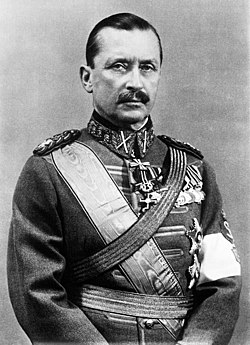
Baron Carl Gustaf Emil Mannerheim (Finland Swedish: [kɑːrl ˈɡʉstɑv ˈeːmil ˈmɑnːærhejm] ⓘ, 4 June 1867 – 27 January 1951) was a Finnish military commander and statesman.[2][3] He served as the military leader of the Whites in the Finnish Civil War (1918), as regent of Finland (1918–1919), as commander-in-chief of the Finnish Defence Forces during World War II (1939–1945), and as the president of Finland (1944–1946). He became Finland's only field marshal in 1933 and was appointed honorary Marshal of Finland in 1942.[4]
Key Information


Born into a Swedish-speaking aristocratic family in the Grand Duchy of Finland, Mannerheim made a career in the Imperial Russian Army, serving in the Russo-Japanese War and the Eastern Front of World War I and rising by 1917 to the rank of lieutenant general. He had a prominent place in the 1896 coronation ceremonies for Emperor Nicholas II and later had several private meetings with him. After the Bolshevik coup of November 1917 in Russia, Finland declared its independence on 6 December, but soon became embroiled in the 1918 Finnish Civil War between the Whites, who were the troops of the Senate of Finland, supported by troops of the German Empire, and the pro-Bolshevik Reds.
A Finnish delegation appointed Mannerheim as the military chief of the Whites in January 1918; and he led them to victory, holding a triumphal victory parade in Helsinki in May. After spending some time abroad, he was invited back to Finland to serve as the country's second regent, or head of state, from December 1918 to July 1919. He secured the recognition of Finnish independence by multiple Entente powers[a] and, despite being a monarchist, formally ratified the republican Constitution of Finland. He then ran against K. J. Ståhlberg in the first Finnish presidential elections in 1919 but lost and quit politics. Mannerheim helped found the Mannerheim League for Child Welfare in 1920 and headed the Finnish Red Cross from 1922 to his death.[5] He was restored to a central role in national defence policy when President Svinhufvud appointed him as the Chairman of the Finnish Defence Council in 1931, tasked with making preparations for a potential war with the Soviet Union. It was also agreed that he would temporarily take over as commander-in-chief of the country's armed forces should there be a war.[3][6]
Accordingly, after the Soviet Union invaded Finland in November 1939 in what became the Winter War, Mannerheim replaced President Kyösti Kallio as commander-in-chief, and occupied the post for the next five years. He became a unifying symbol of the war effort and part of the core leadership of the country.[3] He personally participated in the planning of Operation Barbarossa[7] and led the Finnish Defence Forces in an invasion of the Soviet Union alongside Nazi Germany known as the Continuation War (1941–1944). As a representative of Finland, Mannerheim refused to deport Finnish Jews to Nazi Germany during the Holocaust. In 1944, when the prospect of Nazi Germany's defeat in World War II became clear, the Parliament of Finland unanimously appointed Mannerheim as the President, and he oversaw peace negotiations with the Soviet Union and the United Kingdom, leading to the Lapland War. Already in declining health, he resigned the presidency in 1946 and spent much of his remaining life in a sanatorium in Switzerland, where he wrote his memoirs, and where he died in 1951.[8]
Participants in a Finnish survey taken 53 years after his death voted Mannerheim the greatest Finn of all time.[9] During his own lifetime he became, alongside Jean Sibelius, the best-known Finnish personage at home and abroad.[3] According to historian Tuomas Tepora[fi], a cult of personality began to be built around Mannerheim after the civil war.[10]
Given the broad recognition in Finland and elsewhere of his unparalleled role in establishing and later preserving Finland's independence from the Soviet Union, Mannerheim has long been referred to as the father of modern Finland,[11][12][13][14][15] and the New York Times called the Finnish capital Helsinki's Mannerheim Museum, memorializing the leader's life and times, "the closest thing there is to a [Finnish] national shrine".[13]
Early life and military career
[edit]Name
[edit]Carl was a common name in Mannerheim's family, and he was known by his middle name Gustaf. Because he disliked his third name, Emil, he wrote his signature as C. G. Mannerheim, or simply Mannerheim.[16] He often signed letters as Field Marshal G. Mannerheim, Field Marshal Mannerheim or G. Mannerheim.
During his career in the Russian military, he was known as Gustav Karlovich Mannergeim (Russian: Густав Карлович Маннергейм) or Karl Gustovich (Карл Густафович) in official documents, and while serving as Regent of Finland, he used the finnicised form of his name, Kustaa Mannerheim,[17] but later abandoned it. His first names are most commonly shortened as C. G. E., as reflected on his tombstone.
In a military fashion, he often signed military documents by just his military rank and surname.[18]
Ancestry
[edit]The Mannerheims, originally from Germany as Marhein, became Swedish noblemen in 1693. In the latter part of the 18th century, they moved to Finland, which was then an integral part of Sweden.[19][20] For a long time, it was thought that the Mannerheim family came from the Netherlands.[21] King Charles XI of Sweden ennobled Augustin Marhein in 1693 at which time the family name Marhein was changed to Mannerheim.[21]
After Sweden lost Finland to the Russian Empire in 1809, Mannerheim's great-grandfather, Count Carl Erik Mannerheim (1759–1837), son of the Commandant Johan Augustin Mannerheim,[22][23] became the first head of the executive of the newly-autonomous Grand Duchy of Finland, an office that preceded that of the contemporary Prime Minister. His grandfather, Carl Gustaf Mannerheim (1797–1854), was an entomologist and jurist.
Mannerheim's father, Carl Robert, Count Mannerheim (1835–1914), was both a playwright and industrialist, with modest success in both endeavours.[24]: 8 He was an exception to the family's tradition as he never became a soldier or an official.[25]: 14 Carl Robert Mannerheim was known for his radical political views, and when he inherited the title of Graf from his father, the officials disapproved of him, thinking of him as political satirist.[25]: 14 As a man with a sharp wit, Carl Robert Mannerheim clearly expressed his view of the Russian authorities. He spent a lot of time abroad, but after turning 50 years old, he moved to Helsinki, founded a shop selling office machinery of the "Systema" brand, and proved to be a busy and systematic businessman.[24]: 8
In 1862 Carl Robert Mannerheim married Hedvig Charlotta Hélène von Julin (1842–1881), the daughter of a wealthy industrialist, John von Julin (1787–1853). The Julin family had also moved to Finland from Sweden. The Mannerheim couple had seven children, four sons and three daughters: Sophie Mannerheim, Carl Mannerheim, Carl Gustaf Emil Mannerheim (1867-1951), Johan Mannerheim, Eva Sparre, Anna Mannerheim (1872-1886) and August Mannerheim (1873-1910). Carl Robert Mannerheim had a further daughter by his second wife Sofia Nordenstam (1849-1915), Marguerite (Kissie) Gripenberg (1884-1958).[26]
Childhood
[edit]
Gustaf Mannerheim was born in the Louhisaari Manor of the Askainen parish (currently Masku) on 4 June 1867.[27][21] After Mannerheim's heavily indebted father left the family in 1880 for his mistress, a daughter of Baron and General Johan Mauritz Nordenstam,[28] the young Mannerheim's mother and her seven children went to live with her aunt Louise; but Mannerheim's mother died the following year.[29][30] Mannerheim's maternal uncle, Albert von Julin (1846–1906), then became his legal guardian and financier of his later schooling.[31] The third child of the family, Mannerheim inherited the title of Baron.
Mannerheim is said to have enjoyed playing military games and "leading the troops".[32]: 92 He was first taught by a female Swiss home teacher, and at the age of seven he started going to school in Helsinki, where he lived with his father. From 1874 to 1879 he and his brother Carl attended the Böök private lyceum, where he was expelled for a year in autumn 1879 for throwing stones at the windows.[33]: 30
Education
[edit]
From 1881 to 1882 Mannerheim went to a school in Hamina preparing students for the Hamina Cadet School, a state school educating aristocrats for the Imperial Russian Army. The Hamina Cadet School was the only school to give military education in Finland at the time.[25]: 18 However, Mannerheim felt hatred towards the city of Hamina,[25]: 17 which was also evident from his behaviour.
Mannerheim was accepted to the Hamina Cadet School in 1882 at the age of 14.[34][35][24]: 12 This can be seen as the start of his military career.[21]
However, Mannerheim was left behind in class for one year because he managed to score only seven points of twelve in an examination in June 1883. This extra year was of help, as in the next year Mannerheim was moved to the first general class with the second-best grades. He did best in French and Swedish as well as history, but did worse in Russian and Finnish.[25]: 19 Among other students of his age and younger cadets Mannerheim was in a clear leadership position.[24]: 12 The handsome young Baron towered over his classmates, standing 6 ft 4 in (1.93 m).
Mannerheim's financial situation was poor, and he often had to borrow money from his caretaker Albert von Julin. He also did not like his time at the Hamina Cadet School: he could not tolerate the atmosphere at the school or its tight regulations, and he was punished often.[25]: 20
Mannerheim had hoped that after the Hamina Cadet School, he would get to the Page Corps military academy in Saint Petersburg, which was one of the most prestigious military academies in the country. The academy only allowed students with a hereditary noble title. Another requirement was that the student's father, grandfather or great-grandfather had a military rank of at least lieutenant general or an equivalent civilian rank. Civilian ranks were contrasted to military officer ranks according to a system devised by Peter the Great.[36] Mannerheim got his father Carl Robert Mannerheim to leave an application to the Page Corps, but the academy's director major general Neovius did not recommend Mannerheim to the academy claiming his skills in French and Russian were not good enough.[25]: 22 Because of Neovius's letter, Mannerheim's application to the academy was rejected, and he fell into a deep depression.
His future is indeed bleak. He does not seem to have any ambition, nor any understanding to improve himself and to attend the Cadet School so he could support himself.
(Mannerheim's grandmother Eva about the young Cadet School student)[37]
Mannerheim's depression also manifested as rebellion towards the Hamina Cadet School, and he was expelled on 22 July 1886.[38][35] According to his memoirs, Mannerheim had left without permission and spent the night at the home of a registrar he knew, the 35-year-old deputy judge Hugo Elfgren. In the next morning, he was discovered there by a warrant officer at the Cadet School. According to education committee at the cadet board Mannerheim had "left later in the night with a person of ill repute to the countryside to this person's residence". The person this referred to was the chief of the telegraph station Agathon Lindholm, who was known to be possibly homosexual. The letter also mentioned Mannerheim's "immoral aberrations and degrading lecherousness".[39] The school could have put the strictest form of its expulsion policy into use, which would have prevented Mannerheim from studying at any Finnish school or university ever again, but the board held a vote and decided to use a more lenient policy on the condition that Mannerheim's family would leave a voluntary application for him to leave the school.[25]: 24
Mannerheim next attended the Helsinki Private Lyceum, where he passed the university entrance examinations in June 1887.[40] From 1887 to 1889, Mannerheim attended the Nicholas Cavalry College in Saint Petersburg.[41] Mannerheim was recommended to the Nicholas Cavalry College by the general Johan Fredrik Gustav Aminoff, who was friends with the college's director Pavel Adamovich von Plehwe.[42] The entry requirements to the college were practically having a noble title and having graduated from cadet school or matriculated.[35] On the best applicants were selected to the college and the entry requirements were strict.[43]
Mannerheim graduated from the Nicholas Cavalry College on 10 August 1889. His graduation examination had gone well, and especially his grades in Russian had improved. In the spring of the same year, before being promoted to cornet, Mannerheim had been promoted to a porte d'épée Junker. This rank corresponded to the rank of a soldier promoted from the rank and file to a junior officer, who could serve as the warrant officer of a troop.
In January 1891, Mannerheim joined the Chevalier Guard Regiment in Saint Petersburg.[44]
Service in the Imperial Russian Army
[edit]Mannerheim planned a career at the prestigious Russian Imperial Guard, at the Chevalier Guard regiment of Her Majesty Empress Maria Feodorovna, but at first he was rejected. On 22 August 1889 he was hired as a cornet into the 15th dragoon regiment of Alexander's His Imperial Majesty Grand Duke Nikolai Nikolayevich the elder situated in Kalisz in Poland, which was not a guard regiment. Mannerheim was not happy with this situation,[25]: 32 but dreamed of entry to the Chevalier Guard.[45]
Finally an application by Mannerheim's godmother got the empress to accept him into the guard, but first he had to join the dragoons. Mannerheim served in Kalisz at the border of Poland and Germany from 1889 to 1890, until he was transferred to the Chevalier Guard in Saint Petersburg in 1891.[46]: 84 In Saint Petersburg he married Anastasia Arapova, the wealthy heiress of a Russian major general on 2 May 1892.[47] The marriage solved Mannerheim's financial problems which he had suffered from for his whole life. Mannerheim was the leader of the first group of the first troop of the regiment of the Chevalier Guard and in 1895 he started taking care of the regiment train. After a transfer to the highest court stables management the regiment's commander von Grünwald invited Mannerheim there to take care of the horses. Mannerheim was appointed to special duties at the court stables on 14 September 1897.
Mannerheim was not accepted to the academy for the general staff, and he remained as an expert of horses. In 1901 he was promoted to a captain in the cavalry.[24]: 13 He bought horses for the army and had a horse breeding farm in the countryside.[48] As a buyer of elite horses for the emperor he travelled all around Europe photographing horses.[49] In his duties in the court stables he visited Germany, Austria-Hungary, Belgium and the United Kingdom.[50]: 137
Mannerheim's marriage to Anastasia Arapova practically ended in 1902 when the couple entered an unofficial separation in residence.[51][52] From 1903 Mannerheim served as chief of the model troop and the director of horseriding teaching in the mounted regiments of the guard. He also made his name in competitive riding.[48] By his own request, in 1904 Mannerheim was transferred to the officer riding school in Saint Petersburg where he was commanded to already in the previous year. His service as the chief of the model troop of the riding school was very significant for a future commander of the cavalry.[24]: 14
Mannerheim served in the Imperial Chevalier Guard until 1904. In 1896, he took part in the coronation of Emperor Nicholas II, standing for four hours in his full-dress Imperial Chevalier Guard uniform at the bottom of the steps leading up to the imperial throne.[53] Mannerheim always considered the coronation a high-point of his life, recalling with pride his role in what he called an "indescribably magnificent" coronation.[53] An expert rider and trained horseman, Mannerheim bought horses for the Russian army as one of his official duties. In 1903, he was put in charge of the model squadron in the Imperial Chevalier Guard and became a member of the equestrian training board of the cavalry regiments.[54]

Mannerheim volunteered for active service with the Imperial Russian Army in the Russo-Japanese War in 1904. He was transferred to the 52nd Nezhin Dragoon Regiment in Manchuria, with the rank of Lieutenant-Colonel. During a reconnaissance patrol on the plains of Manchuria, he first saw action in a skirmish and had his horse shot out from under him.[53] He was promoted to Colonel for bravery in the Battle of Mukden in 1905[55] and briefly commanded an irregular unit of Hong Huzi, a local militia, on an exploratory mission into Inner Mongolia.[56] During the war, Mannerheim also managed to lead a group of local bandits with whom he sought the rear of the enemy to defeat them.[57]
Journey to Asia
[edit]After returning from the Russo-Japanese war Mannerheim spent a little time in Finland and Sweden. As a representative of his family he took part in the 1905 Diet of the Estates in Helsinki from February to June 1905. This was the last Diet of the Estates in Finland.[24]: 16
Mannerheim, who had a long career in the Imperial Russian army, also rose to become a courtier of Emperor of all the Russias Nicholas II.[57] When Mannerheim returned to Saint Petersburg, he was asked to undertake a journey through Turkestan to Beijing as a secret intelligence officer. The cover story of this journey was a scientific exploration together with professor Paul Pelliot.[58] This became a journey that produced valuable geographical and ethnological research results.[21][59]: 16
The Russian General Staff wanted accurate, on-the-ground intelligence about the reforms and activities by the Qing dynasty, as well as the military feasibility of invading Western China: a possible move in their struggle with Britain for control of inner Asia.[60][61] Disguised as an ethnographic collector, he joined the French archeologist Paul Pelliot's expedition at Samarkand in Russian Turkestan (now Uzbekistan). They started from the terminus of the Trans-Caspian Railway in Andijan in July 1906, but Mannerheim quarreled with Pelliot,[60] so he made the greater part of the expedition on his own.[62]


.jpg)
Mannerheim undertook his journey through Asia to China on horseback. The total length of the journey was 14 thousand kilometres and it took two years from 1906 to 1908.[64]: 117 Mannerheim took his cover role seriously and collected a lot of ethnographic material from hitherto almost unexplored areas. Before his journey he had contacted the Finno-Ugrian Society where he had received a lot of instructions for scientific research. Kai Donner described him as an enlightened explorer.[24]: 18 Mannerheim also became familiar with Marco Polo's notes as well as exploration stories written by Nikolay Przhevalsky, Sven Hedin and Marc Aurel Stein.[65]: 22–24 He collected almost 1200 objects to the collection of the National Museum of Finland[66] and took about 1500 photographs. The photograph he took of Kurmanjan Datka in Kyrgyzstan is used in the 50 Kyrgyz som banknote. Kurmanjan Datka was the ruler of Kyrgyzstan at the time when the country was annexed to Russia. In part 27 of the journal of the Finno-Ugrian Society Mannerheim published a linguistically significant paper A visit to the Sarö and Shera Yögurs.[24]: 18 The most famous militarily significant result was the mapping of a road about 2000 kilometres in length.[24]: 14
With a small caravan, including a Cossack guide, Chinese interpreter, and Uyghur cook, Mannerheim first trekked to Khotan in search of British and Japanese spies. After returning to Kashgar, he headed north into the Tian Shan range, surveying passes and gauging the stances of the tribes towards the Han Chinese. Mannerheim arrived in the provincial capital of Urumqi, and then headed east into Gansu province. At the sacred Buddhist mountain of Mount Wutai in Shanxi province, Mannerheim met the 13th Dalai Lama of Tibet, who was living in exile on Mount Wutai after the British had occupied Tibet. Mannerheim was only the third European to be granted an audience with the 13th Dalai Lama. Mannerheim and the Dalai Lama discussed Russia and the expenses of Mannerheim's journey to Asia. The Dalai Lama gave Mannerheim a white decorated cloth to give as a gift to emperor Nicholas II. In return, Mannerheim gave the Dalai Lama his pistol and showed him how to use it.[67][68][69]
He followed the Great Wall of China, and investigated a mysterious tribe known as Yugurs.[70] From Lanzhou, the provincial capital, Mannerheim headed south into Tibetan territory and visited the lamasery of Labrang, where he was stoned by xenophobic monks.[71] Mannerheim arrived in Beijing in July 1908, returning to Saint Petersburg via Japan and the Trans-Siberian Express. His report gave a detailed account of Chinese modernization, covering education, military reforms, colonization of ethnic borderlands, mining and industry, railway construction, the influence of Japan, and opium smoking.[71] He also discussed the possibility of a Russian invasion of Xinjiang, and Xinjiang's possible role as a bargaining chip in a putative future war with China.[72] His trip through Asia left him with a lifelong love of Asian art, which he thereafter collected.[67]
From Beijing, Mannerheim travelled to Japan and from there to Vladivostok, from where he returned to Saint Petersburg along the Trans-Siberian Railway. After returning to Russia in 1909, Mannerheim presented results of the expedition to Emperor Nicholas II. Mannerheim had originally planned to spend twenty minutes with the emperor, but the meeting lasted about an hour longer than that.[65]: 22–24 There are many artifacts still on display in the museum.[57] After that, Mannerheim was appointed to command the 13th Vladimir Uhlan Regiment in the Congress Kingdom of Poland. The following year, he was promoted to major general and was posted as the commander of the Life Guard Uhlan Regiment of His Imperial Majesty in Warsaw.
Mannerheim recorded his journey to Asia in two books: A visit to the Sarö and Shera Yögurs and A journey through Asia. The latter book was originally published in Russian but has since been translated to numerous other languages and has attracted a great deal of professional attention.[21]
Next Mannerheim became part of the Imperial entourage and was appointed to command a cavalry brigade.[73]
World War I and the end of the Russian Empire
[edit]At the beginning of World War I, Mannerheim served as commander of the Separate Guards Cavalry Brigade (the 23rd Army Corps), and fought on the Austro-Hungarian and Romanian fronts. In December 1914, after distinguishing himself in combat against the Austro-Hungarian forces, Mannerheim was awarded the Order of St. George, 4th class. In March 1915, Mannerheim was appointed to command the 12th Cavalry Division.[74]
Mannerheim received leave to visit Finland and Saint Petersburg in early 1917 and witnessed the outbreak of the February Revolution. After returning to the front, he was promoted to lieutenant general in April 1917 (the promotion was backdated to February 1915), and took command of the 6th Cavalry Corps in the summer of 1917. However, Mannerheim fell out of favour with the new government, who regarded him as not supporting the revolution, and was relieved of his duties. He retired and returned to Finland.[73] Mannerheim kept a large portrait of Emperor Nicholas II in the living room of his house in Helsinki right up to his death, and when asked after the overthrow of the House of Romanov why he kept the portrait up, he always answered: "He was my emperor".[67]
Marriage and daughters
[edit]
In 1892 at the age of 25[47] Mannerheim married Anastasia Arapova (1872–1936), the wealthy heiress of a Russian major general of Russian-Serbian heritage.[75][76] Anastasia was five years younger than Mannerheim. They were married in an Orthodox way at the Church of the Saints Zachary and Elizabeth and later again in a Lutheran way at the house of the privy councillor Ivan Zvegintsev.[46]: 84 [77]
The marriage opened Mannerheim's way to the social life in Saint Petersburg and solved his financial problems which he had suffered from for his whole life.[78] The marriage resulted in two daughters: Anastasie "Stasie" (1893-1978) and Sophie "Sophy" (1895-1963).[48][79] Another child, a son, was stillborn in summer 1894.[80] The death of his son was a complete shock for Mannerheim.[78]
In practice, Mannerheim's marriage ended in 1902 in an unofficial separation of residence.[81] The marriage had been risky to begin with, as Mannerheim is said to have married the wealthy Anastasia under pressure from his family, and that he was really more interested in her little sister.[46]: 84 After spending a year and a half as a military nurse in the service of the Red Cross in the Asian Far East Anastasia Mannerheim left her husband and moved to Paris, France with her daughters[46]: 84 [78] and in 1903 via China to the United States together with her children. Ten years later, both daughters came to Finland to live at their relatives, because their father was in Warsaw in Poland and could not take his daughters to live with him.[47] Even though they were already practically separated, Mannerheim and Anastasia were not divorced as Anastasia feared a divorce would make her unwelcome to the social circles in Saint Petersburg.[78]
Mannerheim only officially divorced his wife in 1919.[78] The couple reconciled via letters in the 1920s.[77] They met each other in 1936 in Paris where they reconciled face to face. Anastasia died soon afterwards.[47][77] In his memoirs, Mannerheim devotes only one single sentence to his marriage and wife. After their parents' divorce, Anastasie and Sophie lived unmarried in the United Kingdom and in France.
Both of Mannerheim's daughters ended up choosing female partners in life. Sophie fell in love with Alexandra "Alix" Demidoff-Depret-Bixio who had emigrated to France from Russia, while Anastasie chose the English Olive Rooney as her partner. Mannerheim had nothing against his daughters' choices, as his travels all around the world had made him open-minded.[78]
Anastasia Arapova died on New Year's Eve 1936. This came as a shock to her daughters.[78]
Political career
[edit]The White General and the Regent of Finland
[edit]
In December 1917, Finland declared independence from Russia, now ruled by the Bolsheviks who had overthrown the Provisional Government in the October Revolution. The Bolsheviks accepted the secession for a variety of reasons, mostly because they could not control Finland; also, they hoped they could inspire a communist revolution there modeled after the Russian one. The Finnish parliament appointed P. E. Svinhufvud to lead the newly independent grand duchy's interregnum government. In January 1918, a military committee was charged with bolstering the Finnish army, then not much more than some locally organised White Guards. Mannerheim was appointed to the committee, but soon resigned to protest its indecision. On 13 January, he was given command of the army.[82] He had only 24,000 newly enlisted, mostly untrained men. The Finnish Red Guard, led by communist leader Kullervo Manner and backed by Soviet Russia, had 30,000 men; and there were 70,000 Red Russian troops in Finland. Mannerheim's army was financed by a fifteen million mark line of credit provided by the bankers. His raw recruits had few arms. Nonetheless, he marched them to Vaasa, which was garrisoned by 42,500 Red Russians.[83] He surrounded the Russian garrison with a mass of men; the defenders could not see that only the front rank was armed, so they surrendered, providing badly needed arms. Further weapons were purchased from Germany. Eighty-four Swedish officers and 200 Swedish NCOs served in the Finnish Civil War (or "War of Liberty", as it was known among the "Whites"). Other officers were Finns who had been trained by the Germans as a Jäger Battalion. In March 1918 they were aided by German troops landing in Finland and occupying Helsinki.

After the Whites' victory in the bitterly fought civil war, during which both sides employed ruthless terror tactics, Mannerheim resigned as commander-in-chief. He left Finland in June 1918 to visit relatives in Sweden.[84] In Stockholm, Mannerheim conferred with Allied diplomats, emphasizing his opposition to the Finnish government's policy; Finnish leaders were confident the Germans would win the war, and had chosen Kaiser Wilhelm II's brother-in-law, Frederick Charles of Hesse, to be the King of Finland. In the meantime Svinhufvud served as the first Regent of the nascent kingdom. Mannerheim's rapport with the Allies was recognized in October 1918 when the Finnish government sent him to Britain and France to attempt to gain Britain's and the United States's recognition of Finland's independence. In December, he was summoned back to Finland; Frederick Charles had renounced the throne, and in his stead, Mannerheim had been elected Regent. As Regent, Mannerheim often signed official documents using Kustaa, the Finnish form of his Christian name, to emphasize his Finnishness to those who were suspicious of his background in the Russian armed forces and his difficulties with the Finnish language.[85]

Mannerheim secured recognition of Finnish independence from Britain and the United States. In July 1919, after he had confirmed a new, republican constitution, Mannerheim stood as a candidate in the first presidential election, with parliament as the electors. He was supported by the National Coalition Party and the Swedish People's Party. He finished second to Kaarlo Juho Ståhlberg, and withdrew from public life.[73]
Language skills
[edit]Mannerheim's mother tongue was Swedish. He spoke fluent German, French, and Russian, the last of which he learned serving in the Imperial Russian Army. He also spoke some English, Polish, Portuguese, Latin, and Chinese.[85] He did not start learning Finnish properly until after Finland's independence in 1918, but never became fluent.[46]
Interwar period
[edit]

In the interwar years, Mannerheim held no public office, mainly because he was viewed by many politicians of the centre and left as a controversial figure for his ruthless battle with the Bolsheviks, his supposed desire for Finnish intervention on the side of the Whites during the Russian Civil War, and the Finnish socialists' antipathy toward him. They saw him as the bourgeois "White General". Mannerheim doubted that modern party-based politics would produce principled and high-quality leaders in Finland or elsewhere. In his gloomy opinion, the fatherland's interests were too often sacrificed by the democratic politicians for partisan benefit.[87][88]
After leaving his post as regent of Finland, Mannerheim spent his time on farming and was active in many communal duties. He kept busy heading the Finnish Red Cross (Chairman 1919–1951), was a member of the board of the International Red Cross, and founded the Mannerheim League for Child Welfare (Mannerheimin Lastensuojeluliitto). The foundation of the Mannerheim League for Child Welfare was possible with a sum of money collected through a petition in 1919. The sum amounted to 7.6 million markka (about 3 million euro in 2017).[89] Mannerheim stayed as the honorary chairman of the Mannerheim League for Child Welfare up to his death. He was also the director of the central cabinet of the Finnish Red Cross from 1922 up to his death. He was the founder of the Red Cross Hospital and served as the director of its construction board.[59]: 57
Mannerheim respected the scouts movement and was awarded the first honorary membership of the Finnish Scouts Association in 1919. He was the honorary director of the association from 1941.[59]: 54 He also founded the Mannerheim Buckle award on 15 February 1920.[90] The inspiration for this award came from meeting the scouts on many of his official trips while he was serving as the regent of Finland. The award was designed by the Finnish artist Akseli Gallén-Kallela.
Mannerheim was also the chairman of the supervisory board of a commercial bank, the Liittopankki-Unionsbanken, and after its merger with the Bank of Helsinki, the chairman of the supervisory board of that bank until 1934, and was a member of the board of Nokia Corporation.[91] He offered to serve the French Foreign Legion in the Rif War (1925–1926), but was turned down.[92]
In the early 1920s Mannerheim had no interest to become involved in politics.[93]: 128 A stark conflict between Mannerheim and president Ståhlberg kept Mannerheim away from government and defence duties.[93]: 129 This caused some criticism. For example Rabbe Axel Wrede thought that the weakness of the democratic government was that Mannerheim's unquestionable abilities and hard-workingness were not being utilised for the good of Finland.[93]: 129 A lack of demanding duties was troubling Mannerheim, and for a while he considered applying to the service of some other European power - such as France - as he was not given any duties in Finland.[93]: 129
In June 1921 president Ståhlberg dismissed the commander-in-chief of the Finnish White Guard Didrik von Essen because of the so-called White Guard Affair.[94]: 188 The White Guard suggested Mannerheim as the new commander-in-chief. However, president Ståhlberg declined to confirm Mannerheim as the new commander-in-chief as he feared this would give Mannerheim too much power.[93]: 130 Demonstrations and citizens' meetings were held in support of Mannerheim in Loviisa and Porvoo.[95]: 64–65 President Ståhlberg ended up appointing the young Jäger lieutenant colonel Lauri Malmberg as the new commander-in-chief.
Mannerheim declined to appear as a candidate in the 1925 Finnish presidential election.[93]: 129 As the "White General" Mannerheim enjoyed a great deal of prestige, which allowed him to be involved in matters related to the defence and the White Guard.[93]: 129
In the 1920s and 1930s, Mannerheim returned to Asia, where he travelled and hunted extensively.[96] On his first trip in 1927, to avoid going through the Soviet Union, he travelled through the British Empire, going by ship from London to Bombay. From there he travelled to Lucknow, Delhi, and Calcutta in the British India. From there he travelled overland to Burma, where he spent a month at Rangoon and Mandalay. He then went on to Sikkim and returned to Finland by car and aeroplane.[91]

In his second voyage, in 1936, he went by ship from Aden (a British territory in Southern Arabia) to Bombay. During his travels and hunting expeditions, he visited Madras, Delhi and Nepal, where he was invited by the Rana Prime Minister Juddha Shumsher Jung Bahadur Rana to join a tiger hunt.[97] In the same year, Mannerheim made a private visit to the United Kingdom, where he was accompanied for the first time by security guards, who Prime Minister Winston Churchill himself had given Mannerheim to use during the trip. However, Mannerheim is known to have been bothered by the presence of security guards, because mainly as a fatalist, he firmly believed in fate, if it had to happen in the form of an untimely death, and in addition, he also strongly trusted his own authority.[98]
In 1936, Mannerheim represented the Finnish government at the funeral of King George V of the United Kingdom.[99] On his way to the United Kingdom Mannerheim met the new king Edward VIII and talked with him about the commercial relations between Finland and the United Kingdom as well as the rising threat posed by Germany. King George VI awarded Mannerheim the Grand Cross of the Order of the British Empire in 1938.[100][101]
In 1929, Mannerheim rejected a plea by right-wing radicals to become a military dictator. While he did express some support for the right-wing Lapua Movement, he distanced himself from the group after they became violent.[102] After President Pehr Evind Svinhufvud was elected in 1931, he appointed Mannerheim as chairman of Finland's Defence Council and gave him a written promise that in the event of war he would become the Commander-in-Chief of the Finnish Army. (Svinhufvud's successor Kyösti Kallio renewed this promise in 1937).
In 1933, Mannerheim received the title of Field Marshal (sotamarsalkka, fältmarskalk). The title came with a substantial stamp duty of four thousand markka, equivalent of one month's pay of an army major, and by mistake, the bill was sent to Mannerheim himself. As Mannerheim was taking the money from his wallet he commented wryly: "It's a good thing they didn't make a bigger chief out of me."[103][104] "Field marshal" was not an official military rank but instead a title presented to general of the cavalry Mannerheim. Even after being appointed field marshal he continued to appear as a general of the cavalry in the list of military officers in the Republic of Finland. Mannerheim was appointed Marshal of Finland on his 75th birthday on 4 June 1942. This marked his progress in titles. Many other countries, such as the German Reich, had a practice where the next senior rank from Kriegsmarschall was Reichsmarschall. In the German Reich Reichsmarschall was an official military rank.
By this time, Mannerheim had come to be seen by the public, including some former socialists, less as a "White General" and more as a nonpartisan figure, enhanced by his public statements urging reconciliation between the opposing sides in the Civil War and the need to focus on national unity and defence: "we need not ask where a man stood fifteen years ago".[105] Mannerheim supported Finland's military industry and sought in vain to obtain a military defence union with Sweden. However, rearming the Finnish army did not occur as swiftly or as well as he hoped, and he was not enthusiastic about a war. He had many disagreements with various Cabinets, and signed many letters of resignation.[106][107]
1920 assassination attempt
[edit]After their defeat in the Civil War, some Red Guards attempted to assassinate Mannerheim. One of the would-be assassins, Eino Rahja,[108] was in charge of the Saint Petersburg International School of Red Officers.
Rahja began planning an assassination by assembling a group of eight Finnish Red Guards in Saint Petersburg for this purpose. The group included Aleksander Weckman, August Enroth, Aleksanteri Suokas, Karl (Kaarle) Salo, Väinö Luoto, Hjalmar Forsman, Emil Kuutti and Antti Pokkinen. The group was led by Weckman and he, Suokas and Salo were chosen as the actual assassins. They travelled to Helsinki under falsified passports in March 1920.
The attempt happened in April 1920 during a White Guard's parade on Hämeenkatu in Tampere, in which General Mannerheim was to participate.[98]
The group gathered on 3 April at the Park Café in Hämeenkatu; and at this stage, group member Karl Salo was designated as a shooter and given a Colt pistol. However, the assassination attempt failed due to Salo's hesitation.[98] Salo's security detail in the crowd, consisting of Aleksander Weckman and Aleksanteri Suokas, who had been equipped with Walther and Colt pistols, lost sight of Salo and never had time to shoot Mannerheim either.[109]
On 6 April, Weckman, the operation leader, threatened to kill Salo if he had not assassinated either Mannerheim or Bruno Jalander, the Minister of War and Uusimaa County Governor, within a week.[110] This attempt was also unsuccessful, as Mannerheim and Jalander did not come to the Helsinki Conservation Party celebration after the authorities received a tip. Salo returned his pistol and escaped afterwards. Weckman and Suokas tried to escape to the Soviet Union with their two assistants but were arrested on the Helsinki-Vyborg train the night of 21 April. Salo was arrested in Espoo on 23 April.[109]
The Helsinkian smith Teodor Sädevirta who had been assisting Weckman testified at the trial against the would-be assassins. As a revenge for this, the members who were still free organised a hand grenade attack against him on 26 August. The attack killed Sädevirta's bride. Of the remaining members of the group, Pokkinen, Forsman and Luoto escaped to Russia, but Enroth, who had organised the revenge attack, was arrested. Kuutti had already been arrested in Helsinki on 11 July. Both were sentenced to life in prison. Weckman and Enroth were deported to the Soviet Union in a secret prisoner exchange in June 1926. A group of policemen were rewarded with money for stopping the assassination attempt.[109]
Because of his testimony, Teodor Sädevirta was released and later worked as a smith in Kalvola. He died in 1958. It has been speculated that he could have been a police informant who had infiltrated the group.[109]
Jari Tervo's historical novel Troikka (2008) is about a fictive version of the background of Mannerheim's assassination attempt.[111]
Commander-in-Chief
[edit]
As chairman of the Finnish Defence Council, Mannerheim opposed war with the Soviet Union from the beginning. When the Soviets requested that Finland cede territory, he recommended that the Finnish government give into these demands, arguing that the Finnish Army was not strong enough to repel a Soviet attack.[112] When negotiations with the Soviet Union failed in 1939, and aware of the imminent war and deploring the lack of equipment and preparation of the army, Mannerheim resigned from the military council on 17 October 1939, declaring that he would agree to return to business only as Commander-in-Chief of the Finnish Army. He officially became the supreme commander of the armies, at the age of 72, after the Soviet attack on 30 November 1939. In a letter to his daughter Sophie, he stated, "I had not wanted to undertake the responsibility of commander-in-chief, as my age and my health entitled me, but I had to yield to appeals from the President of the Republic and the government, and now for the fourth time I am at war."[85]
Mannerheim addressed the first of his often controversial orders of the day to the Defence Forces on the day the war began:
The President of the Republic has appointed me on 30 November 1939 as Commander-in-Chief of the armed forces of the country. Brave soldiers of Finland! I enter on this task at a time when our hereditary enemy is once again attacking our country. Confidence in one's commander is the first condition for success. You know me and I know you and know that everyone in the ranks is ready to do his duty even to death. This war is nothing other than the continuation and final act of our War of Independence. We are fighting for our homes, our faith, and our country.[85]
The defensive field fortifications they manned became known as the Mannerheim Line.
Field Marshal Mannerheim quickly organised his headquarters in Mikkeli. His chief of staff was Lieutenant General Aksel Airo, while his close friend, General Rudolf Walden, was sent as a representative of the headquarters to the cabinet from 3 December 1939 until 27 March 1940, after which he became defence minister.[106][107]
Mannerheim spent most of the Winter War and Continuation War in his Mikkeli headquarters but made many visits to the front. Between the wars, he remained commander-in-chief.[107] Although Mannerheim's main task was to lead the war, he also knew how to strengthen and maintain the will of the soldiers to fight. He was famed for this quote:
Forts, cannons and foreign aid will not help unless every man himself knows that he is the guard of his country.[113]
Mannerheim kept relations with Adolf Hitler's government as formal as possible. Mannerheim did not really appreciate Hitler,[114] even though he initially expressed an interest in his rise to power; his attitude towards Hitler turned negative at the point when Mannerheim's visit to Germany made him realize what kind of "ideal state" Hitler was building; he compared Hitler's rise in Germany to the 1917 rise of the Bolshevists in Russia.[115] Before the Continuation War, the Germans offered Mannerheim command over 80,000 German troops in Finland. Mannerheim declined so as to not tie himself and Finland to Nazi war aims;[116] Mannerheim was ready for cooperation and fraternity with Hitler's Germany, but for practical rather than ideological reasons because of the Soviet threat.[115] In July 1941 the Finnish Army of Karelia was strengthened by the German 163rd Infantry Division. They retook the Finnish territories annexed by the Soviet Union after the Winter War,[117] and went further, occupying East Karelia. Finnish troops took part in the Siege of Leningrad, which lasted 872 days.
Soviet leader Joseph Stalin pressured Churchill to declare war against Finland, a decision that was particularly difficult for Churchill due to his acquaintance with Mannerheim. Churchill delayed the declaration and sent a personal note to Mannerheim, in which he recalled their past encounters and warned Mannerheim about the impending declaration. Mannerheim thanked Churchill for his thoughtfulness and responded that his mission was to ensure Finland's security.[118]
On 20 June 1942, Mannerheim was inspecting Finnish front line troops in Poventsa when he and his staff were engaged by a Soviet anti-tank gun with direct fire. One shell exploded near Mannerheim who, on varying accounts, took cover either in a trench or behind tree trunks until Finnish counter-battery fire neutralized the attacker. Captain Ahti Petramaa, section commander during the inspection, lost fingers from flying shrapnel and was escorted to an aid station where he was promoted to major by Mannerheim.[119][120][121]
Visit by Adolf Hitler
[edit]

Mannerheim's 75th birthday, 4 June 1942, was a national celebration. The government granted him the unique title of Marshal of Finland (Suomen Marsalkka in Finnish, Marskalk av Finland in Swedish). So far he is the only person to receive the title. 4 June was designated as the flag day of the Finnish Defence Forces and the street Heikinkatu in Helsinki was renamed as Mannerheimintie.[59]: 92 Mannerheim's birthday was celebrated on with many events both in the army and at the home front. The festivities emphasised the importance of the commander-in-chief as a nationally collective great man in difficult times. The Marshal himself would have wanted to celebrate his birthday as discreetly and modestly as possible.[122] Of the congratulations he received, Mannerheim most liked the greeting from the trade union association describing the reuniting of the people.[123]
A surprise birthday visit by Hitler occurred on the day as he wished to visit the "brave Finns (die tapferen Finnen)" and their leader Mannerheim.[106][107] The news that Hitler would be arriving to visit Finland only arrived on the day previous to the visit, and ensuring the security of the high-ranking visitor required quick special arrangements.[122] When president Risto Ryti telephoned Mannerheim and told him Hitler would be arriving, Mannerheim's first reply was "Vad i helvete gör han här?" (Swedish for: "What the bloody hell is he doing here?").[114]
Mannerheim did not want to meet him at his headquarters or in Helsinki, as then it would seem like an official state visit. The meeting took place in a salon railway coach at the railway yard of the Kaukopää factory near Imatra, in south-eastern Finland, and was arranged in secrecy.[106] From Immola Airfield, Hitler, accompanied by President Ryti, was driven to where Baron Mannerheim was waiting at a railway siding. Hitler gave Mannerheim a portrait of him painted by Karl Truppe as a gift.[124] As well as Hitler and President Ryti, the entourage included Prime Minister of Finland Jukka Rangell, Ambassador of Germany to Finland Wipert von Blücher and Hitler's chief of staff field marshal Wilhelm Keitel. A speech from Hitler was followed by a birthday meal and negotiations between him and Mannerheim. Overall, Hitler spent about five hours in Finland;[122] he reportedly asked the Finns to step up military operations against the Soviets, but apparently made no specific demands.[106]
During the visit, an engineer of the Finnish broadcasting company Yleisradio, Thor Damen, succeeded in recording the first eleven minutes of Hitler's and Mannerheim's private conversation. This had to be done secretly, as Hitler never allowed off-guard recordings. Damen was assigned to record the official birthday speeches and Mannerheim's response and therefore placed microphones in some of the railway cars. However, Mannerheim and his guests chose to go to a car that did not have a microphone in it. Damen acted quickly, pushing a microphone through one of the car windows onto a net shelf just above where Hitler and Mannerheim were sitting. After eleven minutes of Hitler's and Mannerheim's private conversation, Hitler's SS bodyguards spotted the cords coming out of the window and realized that the Finnish engineer was recording the conversation. They gestured to him to stop recording immediately, and he complied. The SS bodyguards demanded that the tape be destroyed, but Yleisradio was allowed to keep the reel after promising to keep it in a sealed container. It was given to Kustaa Vilkuna, head of the state censors' office, and in 1957 returned to Yleisradio. It was released to the public a few years later. It is the only known recording of Hitler speaking outside of a formal occasion.[125][126]
.jpg)
There is an unsubstantiated story that while conversing with Hitler, Mannerheim lit a cigar. Mannerheim expected that Hitler would ask Finland for more help against the Soviet Union, which Mannerheim was unwilling to give. When Mannerheim lit up, all in attendance gasped, for Hitler's aversion to smoking was well known. Nevertheless, Hitler continued the conversation calmly, with no comment. By this test, Mannerheim could judge if Hitler was speaking from a position of strength or weakness. He refused Hitler, knowing that Hitler was in a weak position, and could not dictate to him.[106][107]
Shortly thereafter, Mannerheim returned the visit, travelling to Hitler's headquarters in East Prussia.[127]
End of war and presidency
[edit]

In June 1944, Baron Gustaf Mannerheim, to ensure German support while a major Soviet offensive was threatening Finland, thought that it was necessary to agree to the pact the German Foreign Minister Joachim von Ribbentrop demanded. But even then Mannerheim distanced himself from the pact, and it fell to President Risto Ryti to sign it, so it came to be known as the Ryti-Ribbentrop Agreement. This allowed Mannerheim to revoke the agreement upon the resignation of President Ryti at the start of August 1944. Mannerheim succeeded Ryti as president.[106][128]
When Germany was deemed sufficiently weakened, and the USSR's summer offensive was fought to a standstill (see Battle of Tali-Ihantala) thanks to the June agreement with the Germans, Finland's leaders saw a chance to reach a peace with the Soviet Union.[129] At first, attempts were made to persuade Mannerheim to become prime minister, but he rejected them because of his age and lack of experience running a civil government. The next suggestion was to elect him head of state. Risto Ryti would resign as president, and parliament would appoint Mannerheim as regent. The use of the title regent would have reflected the exceptional circumstances of Mannerheim's election. Mannerheim and Ryti both agreed, and Ryti submitted a notice of resignation on 1 August. The Parliament of Finland passed a special act conferring the presidency on Mannerheim on 4 August 1944. He took the oath of office the same day.[106][128]

A month after Mannerheim took office, the Continuation War was concluded on harsh terms, but ultimately far less harsh than those imposed on the other states bordering the Soviet Union. Finland retained its sovereignty, its parliamentary democracy, and its market economy. Territorial losses were considerable; a portion of Karelia and all Petsamo were lost. Numerous Karelian refugees needed to be relocated. The war reparations were very heavy. Finland also had to fight the Lapland War against withdrawing German troops in the north, and at the same time demobilize its own army, making it harder to expel the Germans;[130] Mannerheim appointed Lieutenant General Hjalmar Siilasvuo as the high commander of the army to take this action.[131][132] It is widely agreed that only Mannerheim could have guided Finland through these difficult times, when the Finnish people had to come to terms with the severe conditions of the armistice, their implementation by a Soviet-dominated Allied Control Commission, and the task of post-war reconstruction.[128]
Before deciding to accept the Soviet demands, Mannerheim wrote a missive directly to Hitler:[133]
Our German brothers-in-arms will forever remain in our hearts. The Germans in Finland were certainly not the representatives of foreign despotism but helpers and brothers-in-arms. But even in such cases foreigners are in difficult positions requiring such tact. I can assure you that during the past years nothing whatsoever happened that could have induced us to consider the German troops intruders or oppressors. I believe that the attitude of the German Army in northern Finland towards the local population and authorities will enter our history as a unique example of a correct and cordial relationship ... I deem it my duty to lead my people out of the war. I cannot and I will not turn the arms which you have so liberally supplied us against Germans. I harbour the hope that you, even if you disapprove of my attitude, will wish and endeavour like myself and all other Finns to terminate our former relations without increasing the gravity of the situation.
Mannerheim's term as president was difficult for him. Although he was elected for a full six-year term, he was 77 years old in 1944 and had accepted the office reluctantly after being urged to do so. The situation was exacerbated by frequent periods of ill-health, the demands of the Allied Control Commission, and the war responsibility trials. He was afraid throughout most of his presidency that the commission would request his prosecution for crimes against peace. This never happened. One of the reasons for this was Stalin's respect for and admiration of the Marshal. Stalin told a Finnish delegation in Moscow in 1947 that the Finns owed much to their old Marshal. Due to Mannerheim, Finland was not occupied.[134] Despite Mannerheim's criticisms of some of the demands of the Control Commission, he worked hard to carry out Finland's armistice obligations. He also emphasised the necessity of further work on reconstruction in Finland after the war.[106][128]
Mannerheim was troubled by recurring health problems during 1945, and was absent on medical leave from his duties as president from November until February 1946. He spent six weeks in Portugal to restore his health.[135] After the announcement of the verdicts in the war crimes trials in February, Mannerheim decided to resign. He believed that he had accomplished the duties he had been elected to carry out: The war was ended, the armistice obligations carried out, and war responsibility trials finished.
Mannerheim resigned as president on 4 March 1946, giving as his reason his declining health and his view that the tasks he had been selected to carry out had been accomplished.[136] He was succeeded as president by the conservative Prime Minister J. K. Paasikivi.[128]
Final days and death
[edit]
Even during his presidency Marshal Baron Mannerheim had been a sick man.[32]: 103 After he had become sure he would not be found guilty of war crimes at the war-responsibility trials in Finland, the sickly Mannerheim resigned from his duties as President of Finland at the age of 78 in March 1946. He spent most of his retirement years abroad. In 1946, Mannerheim bought Kirkniemi Manor in Lohja, intending to spend his retirement there. He was the fourth marshal to have lived in the manor.[137] In June 1946, he underwent an operation for a perforated peptic ulcer, and in October of that year he was diagnosed with a duodenal ulcer.[138] The ulcer developed suddenly in June 1946 when he was visiting Jakobstad. The difficult operation was performed by the doctor Runar C. Öhman.[139] In early 1947, it was recommended that he should travel to the Valmont Sanatorium in Montreux, Switzerland, to recuperate and write his memoirs. Valmont was to be Mannerheim's main residence for the remainder of his life, although he regularly returned to Finland, and also visited Sweden, France and Italy.[140]
Because Mannerheim was old and sickly, he personally wrote only certain passages of his memoirs. He dictated some other parts. The remaining parts were written from his recollections by Mannerheim's various assistants, such as Colonel Aladár Paasonen; General Erik Heinrichs; Generals Grandell, Olenius and Martola; and Colonel Viljanen, a war historian. As long as Mannerheim was able to read, he proofread the typewritten drafts of his memoirs. He was almost totally silent about his private life, and focused instead on Finland's history, especially between 1917 and 1944. When Mannerheim suffered a fatal bowel obstruction in January 1951,[141] his memoirs were not yet in their finished form. They were published after his death.[88]
In 1948 Mannerheim underwent another major surgery, this time in Stockholm. For a few years, the surgery yielded good results.[93]: 300 In January 1951 Mannerheim had a serious peptic ulcer case and on 23 January he was taken to the Cantonal Hospital in Lausanne (French: L'Hôpital cantonal à Lausanne; modern Lausanne University Hospital[142]), Switzerland.


Mannerheim died on 27 January 1951 (28 January Finnish time), in the Cantonal Hospital. At the Marshal's bedside in his last moments were his Swedish personal physician Nanna Svartz, his adjutant Colonel Olof Lindeman, and the Envoy of Finland to Bern, Reinhold Svento.[143] When the news of Mannerheim's death reached Finland, President J. K. Paasikivi told the Finnish people on the radio about his death, saying that "one of the greatest men and most brilliant figures in Finnish history had left us".[88]
Mannerheim's coffin arrived at Helsinki-Malmi Airport on 2 February, after which the public had the opportunity to visit Helsinki Cathedral to pay their respects for two days. He was buried on 4 February 1951 in the Hietaniemi Cemetery in Helsinki in a state funeral with full military honours. Prime Minister Urho Kekkonen and Foreign Minister Åke Gartz attended the funeral as representatives of the government, and the State's greetings to the late Marshal were presented by the Speaker of Parliament K. A. Fagerholm.[46][144] The funeral procession was 3.7 kilometres (2.3 mi) long and was followed by 100,000–150,000 people.[145] As well as a show of respect to a national great man, the funeral ceremony had a dash of a patriotic protest.[146]
The General Gustaf Mannerheim national fund had been founded as a citizens' gift for Mannerheim on 25 July 1919. In the will and testament Mannerheim had signed on 16 August 1945 he wrote that his fortune should be donated to this fund (currently known as the Mannerheim Foundation) and that the money should be primarily used to give grants for Finnish officers for studying at foreign military academies. The fund is also responsible for maintaining the Mannerheim Museum founded in 1951.[147]
Mannerheim's horse, Käthy, was shot on a military order on 25 February 1953. There is a monument to the horse in Ypäjä.[148][149]
Legacy
[edit]
Today, Mannerheim retains respect as Finland's greatest statesman. This may be partly due to his refusal to enter partisan politics (although his sympathies were more right-wing than left-wing), his claim always to serve the fatherland without selfish motives, his personal courage in visiting the front lines, his ability to work diligently into his late seventies, and his foreign political farsightedness in preparing for the Soviet invasion of Finland years before it occurred.[106] Although Finland fought alongside Nazi Germany during the Continuation War and thus in co-operation with the Axis Powers, a number of leaders of the Allies still respected Mannerheim. These included, among others, the then British Prime Minister Winston Churchill; at a 2017 conference in London, war historian Terry Charman said it was difficult for Churchill to declare war on Finland at Stalin's demand due to his previous uncomplicated co-operation with Mannerheim, which led Churchill and Mannerheim to exchange polite and apologetic correspondence about the prevailing circumstance, with deep respect for each other.[150]

Mannerheim's birthday, 4 June, is celebrated as Flag Day by the Finnish Defence Forces. This decision was made by the Finnish government on the occasion of his 75th birthday in 1942, when he was also granted the title of Marshal of Finland. Flag Day is celebrated with a national parade, and rewards and promotions for members of the defence forces. The life and times of Mannerheim are memorialised in the Mannerheim Museum.[91] The most prominent boulevard in the Finnish capital was renamed Mannerheimintie (Mannerheim Road) already in the Marshal's honour during his lifetime; along the road, at the Kamppi district, stands Hotel Marski, which is named after him. Mannerheim's former hunting lodge and resting place known as the "Marshal's Cabin" (Marskin Maja), which now serves as both a museum and a restaurant, is located at the shores of Lake Punelia in Loppi, Finland.[151]
Various landmarks across Finland honour Mannerheim, including most famously the Equestrian statue located on Helsinki's Mannerheimintie in front of the later-built Kiasma museum of modern art. Mannerheim Parks in both Turku and Seinäjoki include statues of him. Tampere's Mannerheim statue depicting the victorious Civil War general of the Whites was eventually placed in the forest some kilometres outside the city (in part due to lingering controversy over Mannerheim's Civil War role). Other statues, for examples, were erected in Mikkeli and Lahti.[152] On 5 December 2004, Mannerheim was voted the greatest Finnish person of all time in the Suuret suomalaiset (Great Finns) contest.[9]
From 1937 to 1967, at least five different Finnish postage stamps or stamp series were issued in honour of Mannerheim; and in 1960 the United States honoured Mannerheim as the "Liberator of Finland" with regular first-class domestic and international stamps (at the time four cents and eight cents respectively) as part of its Champions of Liberty series that included other notable figures such as Mahatma Gandhi and Simon Bolivar.[153][154][155]
-
 1941 Finnish postal stamp portraying the then-Field Marshal Mannerheim (he was appointed Marshal of Finland in 1942).
 -
 Marshal Mannerheim on two United States commemorative stamps, 1960 issue, part of the Champion of Liberty issues.


Mannerheim appears as a main character in Ilmari Turja's 1966 play and its the 1970 film adaptation The Headquarters, directed by Matti Kassila. In both the play and the film, Mannerheim was played by Joel Rinne.[156] Mannerheim was also played by Asko Sarkola in the 2001 television film Valtapeliä elokuussa 1940, directed by Veli-Matti Saikkonen.[157]
Military ranks
[edit]Ranks
[edit]In the Russian Army
[edit]- 1 July 1888: Non-commissioned officer
- 10 August 1889: Cornet
- 27 July 1891: Cornet of the Guard
- 30 August 1893: Lieutenant of the Guard
- 22 July 1899: Captain of the Guard, Junior grade
- 6 December 1902: Captain of the Guard
- 7 October 1904: Lieutenant Colonel
- 29 November 1905: Colonel
- 13 February 1911: Major General
- 25 April 1917: Lieutenant General
In the Finnish Army
[edit]- 7 March 1918: General of Cavalry
The titles Field Marshal (19 March 1933) and Marshal of Finland (4 June 1942) were not official military ranks although they are often thought of as such. Mannerheim's official military rank in the Finnish Army was General.[158]
Supreme Command
[edit]- 1918: Commander-in-Chief of the White Guard: from January to May 1918
- 1918: Commander-in-Chief of the Finnish Defence Forces: from December 1918 to July 1919
- 1931: Chairman of the Defence Council: from 1931 to 1939
- 1939: Commander-in-Chief of the Finnish Defence Forces: from 1939 to 1946
Awards
[edit]| Coat of Arms of Gustaf Mannerheim | |
|---|---|
 | |
| Armiger | Gustaf Mannerheim |
| Motto | "Candida pro causa ense candido"[159]("With an honourable sword for an honourable cause") |
In the course of his lifetime, Mannerheim received 82 military and civilian decorations.[160]
National
 Republic of Finland:
- Grand Cross with Swords and Diamonds of the Order of the Cross of Liberty (1940; Grand Cross with Swords: 1918)[161][162]
- Knight of the Mannerheim Cross, 1st and 2nd class, of the Order of the Cross of Liberty (1941)[163][164]
- Grand Cross with Collar, Swords and Diamonds of the Order of the White Rose (1944; Grand Cross with Collar: 1919)[165][166]
- Grand Cross with Swords of the Order of the Lion of Finland (1944)[167]
 Russian Empire:
- Order of St. Anna, 1st class (1914; 2nd class: 1904; 3rd class: 1900)[168]
- Order of St. Stanislaus, 1st class (1914; 2nd class: 1904)[169]
- Order of St. Vladimir, 2nd class (1916; 3rd class: 1914; 4th class: 1909)[170]
- Gold Sword for Bravery (1906)[171]
- Order of St. George, Knight 4th class (1914)[172]
 Kingdom of Sweden:
- Commander Grand Cross of the Order of the Sword (1918)[173]
- Knight of the Order of the Seraphim (1919)[174]
- Knight Grand Cross 1st Class of the Order of the Sword (1942)[173]

Foreign
 Austro-Hungarian Empire: Knight of the Order of Franz Joseph (1895)[175][168]
 Independent State of Croatia: Grand Cross of the Order of the Crown of King Zvonimir with Swords (1942)[176]
 Kingdom of Denmark: Knight of the Order of the Elephant (1919)[177]
 Republic of Estonia:
- Military Order of the Cross of the Eagle, 1st Class with Swords (1930)[178]
- Grand Cross of Order of the Estonian Red Cross (1933)[179]
 French Republic: Grand Cross of the Legion of Honour (1939; Officer: 1910; Knight: 1902)[180]
- Germany:
 German Empire: Iron Cross 1st and 2nd Class (1918)[181]
 Nazi Germany:
- Knight's Cross of the Iron Cross with Oak Leaves (1944; Knight's Cross: 1942; Clasp to the Iron Cross: 1942)[182]
- Grand Cross of the Order of the German Eagle in Gold with Star (1942)[183]
- Grand Cross of the German Red Cross Decoration with Oak Leaves (1937)[184]
 Kingdom of Greece: Officer of the Order of the Saviour (1902)[185]
 Kingdom of Hungary: Grand Cross of the Order of Merit of the Kingdom of Hungary with the Holy Crown of St. Stephen (1942)[186]
 Kingdom of Italy:
- Officer of the Order of Saints Maurice and Lazarus (1902)[187]
- Grand Officer of the Military Order of Savoy (1942)[188]
 Empire of Japan: Grand Cordon of the Order of the Rising Sun with Paulownia Flowers (1942)[189]
 Republic of Latvia: Honour Cross of the Latvian Red Cross (1938)[190]
 Republic of Lithuania: Order of the Cross of Vytis, 2nd class, 2nd degree (1933)[191]
 Kingdom of Romania: Order of Michael the Brave, 1st class (1941)[192][193][194]
 United Kingdom: Knight Grand Cross of the Order of the British Empire (GBE) (1938)[195]


Works
[edit]- C.G. Mannerheim, Across Asia From West to East in 1906–1908. (1969) Anthropological Publications. Oosterhout N.B. – The Netherlands
- Across Asia : Vol. 1 – digital images
Mannerheim as a person
[edit]
Personality
[edit]As commander-in-chief of the army, Mannerheim was very self-conscious and power-hungry supreme authority who did not tolerate his decisions being questioned, even by his trusted generals; Mannerheim's dissatisfaction with his subordinates could very quickly lead to the loss of his positions. Mannerheim did not follow the line staff leadership, which is the traditional way of leading in the General Staff, but led through individuals; when it came to commanders, he did not necessarily care about seniority or qualifications, but chose those who were most suitable for him, and if they were not suitable, he very quickly dismissed them.[196] Well-known examples included General Paavo Talvela, who was a close associate and trusted officer of Mannerheim even before the Winter War; he constantly tested the nerves of the headquarters and tried to choose his own subordinates according to his own wishes, ending up in the Continuation War from the position of army corps commander to Mannerheim's "special envoy" to the German army headquarters in Berlin.[196][197]
Religion
[edit]Mannerheim had been baptised into the Lutheran faith. Before his marriage to Anastasia Arapova, her parents tried to pressure him to convert to Orthodoxy, but in vain. Both of Mannerheim's daughters were Orthodox (one of them later converted to the Catholic faith).[198][77]
During the Winter War and the Continuation War Mannerheim regularly attended Lutheran services at the Mikkeli Cathedral as well as Orthodox services at the Holy Trinity Church in Helsinki.[198] During his final years in Switzerland Mannerheim attended Orthodox services at the Church of the Great Martyr Varvara in Vevey.[77]
Mannerheim can be seen as religiously tolerant and broad-sighted. He also had seventeen godchildren from several different faiths.[77]
Culinarism
[edit]
Mannerheim was a great friend of good food, and he often wrote down recipes he liked. The food did not have to be fine or special cuisine, only good. He especially enjoyed stuffed pork, crayfish, crêpes, ruffe soup, fårikål and vorschmack.[199][200] Mannerheim's name is connected to the famous liqueur "Marskin ryyppy", and at his home in Kaivopuisto he also had a large collection of the French wine Château Tertre Dauguay de Vassal, vintage 1929.[201]
Style
[edit]Mannerheim was very careful about his style, which had been influenced by both his Victorian family and the imperial army of Russia which had a strict sense of etiquette among the officers. Mannerheim's appearance and clothes were highly groomed: he made sure his moustache was correctly shaped and his boots were thoroughly shined. According to John E. Screen, Mannerheim understood the importance of maintaining a public image: during the Continuation War Mannerheim forbade publishing photographs of him where he appeared tired. Mannerheim also took care of his health and washed his teeth with a water shower every day.[202]
Cars
[edit]Mannerheim was famous for his cars, especially the ones donated to him by Germany during the Continuation War.[203] Mannerheim was invited to be the honorary chairman at the Finnish Automobile Club at its first annual meeting in 1920.[204] During Mannerheim's term as the regent of Finland from 1918 to 1919 his personal official car was a 1915 Rolls-Royce Silver Ghost, which has been preserved as a museum car to this day.[205]

The most famous of Mannerheim's cars was an armoured Mercedes-Benz 770 donated to him by the German Führer Adolf Hitler in December 1941 as recognition of Finland's military prowess at the eastern front. The car was given to Mannerheim by Hitler's personal chauffeur Erich Kempka in Mikkeli. After the end of the wars, the car was sold to Sweden where it later ended up in the United States.[206]
During his term as President of Finland Mannerheim used two official cars, Cadillacs from 1930 and 1938. Kalle Westerlund, the official chauffeur of the President of Finland from 1927 to 1963 recollects that Mannerheim's style was different from his predecessors. Mannerheim insisted that the chauffeur kept both hands on the steering wheel while driving. He also steadfastly insisted that the driver must not speak to the person sitting next to him while driving. Mannerheim also insisted on absolute punctuality down to the exact minute. According to Westerlund Mannerheim enjoyed fast driving, and if the journey had been relatively smooth, Mannerheim gave his thanks to the chauffeur.[203]
Despite research from numerous archive sources it was uncertain for a long time whether Mannerheim himself had a driver's license. A license having belonged to Mannerheim was accidentally found at the National Archives of Finland among his other personal papers in December 2014. The Helsinki police department had given the license to Mannerheim in 1929 for a period of five years and it also allowed him to drive a passenger car and a motorcycle in private traffic. One of Mannerheim's private letters from 1928 shows that he already had a driver's license at that time.[207] According to the June 1925 issue of the Moottori magazine published by the Finnish Automobile Club Mannerheim had made a long car journey to Europe in May 1925.[208]
Mannerheim in popular culture
[edit]
The first fictive film about Mannerheim was The Headquarters (1970) by Matti Kassila, based on Ilmari Turja's play by the same name. In the film Mannerheim was played by Joel Rinne who had already performed in the same role at the National Theatre of Finland.
In the 2000s Renny Harlin was planning a biographical film about Mannerheim for a long time. The project was cancelled. Mannerheim would have been played by Mikko Nousiainen.
In 2012 Yleisradio made a film about Mannerheim titled The Marshal of Finland. The film was shot in Kenya and encountered mixed reception in Finland,[209][210] but in Kenya it was awarded the Kalasha prize by the Kenya Film Commission.[211]
There are also many television series and films about Mannerheim's life. In the television series Mummoni ja Mannerheim (1971) based on Paavo Rintala's novel trilogy the marshal was played by Helge Herala. In the drama series Sodan ja rauhan miehet (1978) about the years after World War II Mannerheim was played by Rolf Labbart, in the television series Valtapeliä elokuussa 1940 he was played by Asko Sarkola and in the historical drama series Presidentit (2005) by Antti Litja. In the films Beyond the Front Line (2004) and Tali-Ihantala 1944 (2007) by Åke Lindman Mannerheim was played by Asko Sarkola. The five-part documentary Mannerheim - Jörn Donnerin kertomana was shown on YLE TV1 in January 2011. In the documentary Donner sought to show a contrastual whole image of Mannerheim.
The puppet animation film The Butterfly from Ural directed by Katariina Lillqvist raised a controversy in 2008 because it portrayed Mannerheim as homosexual or bisexual.
The character of Mannerheim appears at the end of the Kyrgyz drama film Kurmanjan Datka (2014) where he takes a photograph of the main character Kurmanjan Datka (1811-1907) in 1906. The photograph appears in the 50 Kyrgyz som banknote.[212]
Mannerheim's relationship with Catharina "Kitty" Linder has also interested writes and the media. The monthly supplement of Helsingin Sanomat published an article about Kitty Linder and Mannerheim in 2013.[213] In 2017 the character "Kitty" has appeared as Mannerheim's bride in Juha Vakkuri's novel Mannerheim ja saksalainen suudelma.[214]
See also
[edit]
Notes
[edit]- ^ Including the United Kingdom, the United States, the Empire of Japan and the Kingdom of Italy; see Independence of Finland#List of recognition.
References
[edit]- ^ Keski-Rauska, Riku. Georg C. Ehrnrooth – Kekkosen kauden toisinajattelija (in Finnish). University of Helsinki. 2005.
- ^ C. G. E. Mannerheim at the Encyclopædia Britannica
- ^ a b c d Klinge, Matti. "Mannerheim, Gustaf (1867–1951)". National Biography of Finland. Retrieved 21 April 2017.
- ^ HS: Muodikas Marski (in Finnish).
- ^ "MANNERHEIM - Civilian".
- ^ "Mannerheim - Defence Council".
- ^ Zeiler, Thomas W.; DuBois, Daniel M., eds. (2012). "Scandinavian Campaigns". A Companion to World War II. Wiley Blackwell Companions to World History. Vol. 11. Wiley-Blackwell. ISBN 978-1-4051-9681-9.
- ^ "MANNERHEIM - Retirement". mannerheim.fi.
- ^ a b (in Finnish) Suuret suomalaiset at YLE.fi
- ^ Pesonen, Mikko (13 March 2023). ""Adolf Ehrnrooth välitti Mannerheimin tahtoa haudan takaa" – Mannerheim on ainutlaatuinen kulttihahmo, jonka myyttiä lähipiiri rakensi määrätietoisesti". Yle (in Finnish). Retrieved 15 March 2023.
- ^ Edwards, Robert, ed. (2007). White Death: Russia's War with Finland 1939–1940. Phoenix Press. p. 21. ISBN 978-0-7538-2247-0.
- ^ Warner, Oliver (1967). Marshal Mannerheim and the Finns. Weidenfeld & Nicolson. p. 154.
- ^ a b Binder, David (16 October 1983). "Finland's Heritage on parade". The New York Times. Retrieved 17 August 2013.
- ^ "Field Marshal Mannerheim, THE FATHER OF FINLAND". Western Mail. 15 November 1945. Retrieved 17 August 2013.
- ^ "Finland Country Profile – Timeline". BBC News. 25 September 2012. Retrieved 17 August 2013.
- ^ Meri (1990), p. 104.
- ^ "Name". Mannerheim.fi.
- ^ Mannerheim - Elämänkaari - Nimi, Finnish Mannerheim website. Accessed on 28 January 2008.
- ^ "Mannerheimin suku onkin lähtöisin Saksasta". Kaleva (in Finnish). 1 March 2007. Archived from the original on 30 September 2007. Retrieved 17 August 2007.
- ^ "Mannerheimin suku onkin lähtöisin Saksasta" (in Finnish). MTV3. March 2007.
- ^ a b c d e f Cal Gustaf Emil Mannerheim, obituary. Helsingin Sanomat 28 January 1951. Accessed on 30 August 2025.
- ^ Johan Augustin Mannerheim Archived 29 June 2020 at the Wayback Machine. tjelvar.se (in Swedish)
- ^ Muotokuva; Johan Augustin Mannerheim; (1706–1778). finna.fi (in Finnish)
- ^ a b c d e f g h i j Hannula, J.O.: Mannerheim - vapaussodan ylipäällikkö, Sanatar 1937.
- ^ a b c d e f g h i Screen, J.E.O.: Mannerheim. otava, 2001. ISBN 951-31-3841-0.
- ^ Sukutausta, Finnish Mannerheim website.
- ^ Everyman's Encyclopedia volume 8. J. M. Dent & Sons Ltd. 1978. ISBN 0-460-04020-0.
- ^ Meri (1990), pp. 107–108.
- ^ Meri (1990), p. 108.
- ^ Varjus, Seppo (23 August 2024). "Näin tuhoutui menestyjän perhe". Ilta-Sanomat (in Finnish). Retrieved 9 July 2025.
- ^ IS: Pikavippi olisi kelvannut Mannerheimillekin (in Finnish)
- ^ a b Rajala, Pertti: Suomalaisia presidenttejä. The Finnish Association on Intellectual and Developmental Disabilities, 2004. ISBN 951-580-375-6.
- ^ Vihavainen, Timo (ed.): Mannerheim: keisarillisen Venäjän armeijan upseeri, itsenäisen Suomen marskalkka, Helsinki: Pietari-säätiö, 2005. ISBN 951-97072-2-0.
- ^ Jägerskiöld (1965), pp. 68–70.
- ^ a b c Kasvuvuodet, Finnish Mannerheim website.
- ^ Ignatyev, A Subaltern in Old Russia, p. 49; Inkinen: "Vaihe Mannerheimin nuoruusvuosilta".
- ^ Koulukiusaaja, tuhlari ja huligaani - Mannerheimin nuoruus oli levoton, Yle 2016.
- ^ Jägerskiöld (1965), pp. 93–94.
- ^ Seura: Näin huhut Mannerheimin homoudesta alkoivat, Iltalehti 17 April 2014. Accessed on 3 May 2014.
- ^ Meri (1990), p. 123.
- ^ Meri (1990), p. 129.
- ^ Vlasov, Leonid: Mannerheim Pietarissa 1887-1904, p. 17. Translated to Finnish by Kari Klemelä. Helsinki: Gummerus, 1994. ISBN 951-20-4429-3.
- ^ Николаевское кавалерийское училище — Офицеры русской императорской армии, ria1914.info. Accessed on 6 April 2025.
- ^ Screen (1970), p. 33.
- ^ Kransman, Alex: Mannerheimin venäläiset rykmentit, Mannerheim Museum of Finland 31 August 2021. Accessed on 18 November 2022.
- ^ a b c d e f Koivunen, Elina (15 June 2010). "Carl Gustaf Mannerheim – Suomen historian myyttisin mies". Kotiliesi (in Finnish). No. 12. pp. 82–85. ISSN 0023-4281.
- ^ a b c d Mannerheimin perhe, Finnish Mannerheim website.
- ^ a b c Klinge, Matti: Mannerheim, Gustaf (1867-1951), Suomen kansallisbiografia volume 6. Helsinki: Finnish Literature Society 2005. ISBN 951-746-447-9.
- ^ Jukka Kukkonen in the book C. G. Mannerheimin valokuvia Aasian-matkalta 1906-1908, Otava 1990. ISBN 951-1-11357-7.
- ^ Skvarov, Aleksei: Kenraaliluutnantti Mannerheim, syntynyt tsaarin palvelukseen. Teos, 2010. ISBN 978-951-851-293-9.
- ^ Vanhala, Ville: Mannerheim oli innokas golfari - Näin marsalkalla viuhui myös draiveri: "Hän oli ehdottomasti niitä ihmisiä, jotka tarvitsivat adrenaliiniryöppyjä", Seura 23 September 2021. Accessed on 30 August 2022.
- ^ Suku ja perhe, Finnish Mannerheim website. Accessed on 30 August 2022.
- ^ a b c Trotter (2013), p. 24.
- ^ Clements (2009), p. 40.
- ^ Screen (1970), pp. 43–49.
- ^ Clements (2009), pp. 80–81.
- ^ a b c "Mannerheim halusi diktaattoriksi ja lähes sai haluamansa". Iltalehti (in Finnish). 27 January 2021. Archived from the original on 15 November 2023. Retrieved 27 January 2021.
- ^ Tieteellinen tutkimusretki Aasiassa, Finnish Mannerheim website. Finnish Club in Helsinki. Accessed on 11 October 2015.
- ^ a b c d Friman, Paavo: Mannerheimin matkassa, Ajatus Kirjat 1999, renewed publication 2004. ISBN 951-20-6675-0.
- ^ a b "Horse That Leaps Through Clouds – Retracing Mannerheim's Journey Across Asia". horsethatleaps.com.[dead link]
- ^ Caldwell, Christopher (11 August 2017). "Start to Finnish". Washington Examiner. Retrieved 4 February 2020.
It was an 8,000-mile spying expedition. Russia was drawing up plans to invade China from the west—but failed to.
- ^ Clements (2009), pp. 100–103.
- ^ Tamm, Eric Enno (2010). The Horse That Leaps Through Clouds: A Tale of Espionage, the Silk Road and the Rise of Modern China[dead link]. Vancouver: Douglas & McIntyre. ISBN 978-1-55365-269-4.
- ^ Uusi Pikkujättiläinen (3rd edition), WSOY 1986. ISBN 951-0-12416-8.
- ^ a b Bäckman, Juha; Koivumäki, Jarno; Marschan, Nikolai: Mannerheim adjutantttina: O. R. Bäckman muistelee. Helsinki: Finnish Literature Society 2011. ISBN 978-952-222-296-1.
- ^ Harry Halén in the book C. G. Mannerheimin valokuvia Aasian-matkalta 1906-1908.
- ^ a b c Trotter (2013), p. 29.
- ^ "Mannerheim tapasi Dalai-laman". Kaleva (in Finnish). Retrieved 7 September 2021.
- ^ Similä, Ville: Silkkitietä saapuu Mannerheim, Helsingin Sanomat 27 December 2020. Accessed on 23 February 2024.
- ^ "Horse That Leaps Through Clouds – Retracing Mannerheim's Journey Across Asia". horsethatleaps.com.
- ^ a b "Horse That Leaps Through Clouds – Retracing Mannerheim's Journey Across Asia". horsethatleaps.com.
- ^ Clements (2009), p. 155.
- ^ a b c Putensen, Dörte (2017). "Der größte Finne aller Zeiten?". Damals (in German). No. 5. pp. 72–76.
- ^ Haarmann, Harald (2016). Modern Finland. McFarland. p. 122. ISBN 978-1-4766-2565-2.
- ^ "Краткие сведения об офицерах-Александрийцах: Великая война, Гражданская война, эмиграция. Часть 2-я (фамилии К – Р). – Статьи – Каталог статей – 5-й Гусарский Александрийский полк". blackhussars.ucoz.ru (in Russian).
- ^ Meri (1990), pp. 145–147.
- ^ a b c d e f Simola, Seppo: Mannerheim ja ortodoksilaisuus 19 December 2018. Accessed on 1 January 2022.
- ^ a b c d e f g Forsström, Riikka: Marskin molemmat tyttäret valitsivat rinnalleen naispuoliset elämänkumppanit, Apu 6 June 2017. Accessed on 30 August 2025.
- ^ Pallaste, Tuija (4 November 2017). "Mannerheimin tyttärien vaietut elämät: hauras Stasie eli nunnana ja levoton Sophy pakeni Pariisiin – lopulta kumpikin eli suhteessa naisen kanssa". Helsingin Sanomat (in Finnish). Retrieved 12 May 2020.
- ^ Ylisimiö, Marjaterttu: Mannerheimin suhteet: Naisten Marski, Seura 17 December 2012.
- ^ Meri (1990), pp. 148–149.
- ^ Screen (2000), p. 9.
- ^ Mannerheim (1953), p. 138.
- ^ Mannerheim (1953), p. 184.
- ^ a b c d Jägerskiöld (1986).
- ^ Mannerheim ei ollut koko valkoisen Suomen sankari – Turun Sanomat (in Finnish)
- ^ Virkkunen, Sakari (1992). Mannerheimin kääntöpuoli (in Finnish). Helsingissä: Otava.
- ^ a b c Jägerskiöld (1983).
- ^ Lilja, Esa: Presidentinvaalit hävinnyt Mannerheim pakeni kahvilayrittäjäksi Hankoon, Helsingin Sanomat 23 June 2017. Accessed on 24 June 2017.
- ^ Mannerheim-solki, Scout-wiki.
- ^ a b c "Mannerheim-Museo.fi". Archived from the original on 13 January 2011.
- ^ "MANNERHEIM - Civilian - Foreign Legion".
- ^ a b c d e f g h Jägerskiöld, Stig: Mannerheim 1867-1951. Otava, 1983. ISBN 951-1-07369-9.
- ^ Voipio, Anni: Suomen Marsalkka, 2nd inspected edition. Porvoo: WSOY, 1943.
- ^ Niku, Risto: Ministeri Ritavuoren murha, Edita 2004. ISBN 951-37-4146-X.
- ^ Screen (2000), pp. 90–97.
- ^ Manninen, Tuomas (10 December 2020). "Tutkija: Mannerheim oli kolonialisti, kun ampui tiikereitä norsun päältä – tällaisia olivat Intian-matkat, joihin marsalkka osallistui "valkoisen metsästäjän roolissaan"". Ilta-Sanomat (in Finnish). Retrieved 4 June 2021.
- ^ a b c Pietiläinen, Jari (7 October 2022). "Omatkin halusivat tappaa Mannerheimin – Uutta tietoa: tällaisia murhayrityksiä aikalaiset juonivat marsalkan päänmenoksi". Nurmijärven Uutiset (in Finnish). Retrieved 8 October 2022.
- ^ "Mannerheim-museo - Kronologia". www.mannerheim-museo.fi. Retrieved 4 December 2024.
- ^ Sihvonen, Lauri: Verkottumisen ihme, Seura 17 December 2012. Accessed on 8 April 2024.
- ^ Mannerheim, Freiherr, Carl Gustav Emil, TracesOfWar.com. Accessed on 8 April 2024.
- ^ Screen (2000), p. 104.
- ^ Meeting notes of the Tornström-Hiidenheimo family 26 July 2014. Accessed on 1 September 2025.
- ^ Director, major Tapani Tikkala's speech at the Mannerheim statue in Seinäjoki 4 June 2021. Accessed on 1 September 2025.
- ^ Screen (2000), p. 112.
- ^ a b c d e f g h i j Virkkunen, Sakari (1994) "Presidents of Finland II" (Suomen presidentit II), published in Finland
- ^ a b c d e Turtola (1994).
- ^ Mannerheimin murhayrityksen jälkinäytös käytiin Vallilassa (in Finnish)
- ^ a b c d Mikko Porvali : Murhayritys joka jäi tekemättä Archived 30 October 2023 at the Wayback Machine (in Finnish)
- ^ Murhahankkeet kenraali Mannerheimia ja sotaministeri Jalanderia vastaan, Aamulehti July 24, 1920, no. 167, p. 5. (in Finnish)
- ^ Tervo tarttuu Mannerheimin vaiettuun murhayritykseen, MTV 29 August 2008. Accessed on 2 January 2019.
- ^ Webster '95, Steven (1 April 1995). "Bright Hopes and Bloody Realities: The Diplomatic Preclude to the Winter War". Honors Projects, History.
{{cite journal}}: CS1 maint: numeric names: authors list (link) - ^ Uusi Pikkujättiläinen (in Finnish). Werner Söderström Osakeyhtiö. 1986. p. 1022. ISBN 951-0-12416-8.
- ^ a b Mannerheim kuuli Hitlerin saapuvan syntymäpäiväjuhliin: – "Vad i helvete gör han här?" (in Finnish)
- ^ a b Uutuuskirja: Mannerheim innostui aluksi Hitleristä (in Finnish)
- ^ Jakobson (1999).
- ^ Mannerheim (1953), p. 456.
- ^ Jantunen, Jyrki (5 November 2017). "Churchill kehui Mannerheimia: "Todellinen mies – vahva kuin kallionjärkäle"". Suomenkuvalehti.fi. Retrieved 4 December 2024.
- ^ "JATKOSODAN KESÄNÄ 1942 MANNERHEIMIN HENGENLÄHTÖ OLI VAIN METRIEN PÄÄSSÄ" (in Finnish). 17 June 2019. Retrieved 5 August 2024.
- ^ "Mannerheim vierailee Poventsassa" (in Finnish). Retrieved 17 August 2024.
- ^ "Marskiniemi Poventsa" (in Finnish). Retrieved 5 August 2024.
- ^ a b c Siilasvuo, Ensio (ed.): Jatkosota-kronikka, pp. 98-99. Jyväskylä: Gummerus, 1997. ISBN 951-20-3661-4.
- ^ Varjus, Seppo: Hitler kertoi Mannerheimille tiedot, jotka olivat järkyttäneet Suomea ja Saksaa - "Hirveä peto", Ilta-Sanomat 4 June 2022.
- ^ Huhtanen, Jarmo: Hitlerin antama lahja piilotettiin. Helsingin Sanomat 11 May 2019, pp. A20-A21.
- ^ Helsingin Sanomat International Web-Edition Archived 19 August 2014 at the Wayback Machine – "Conversation secretly recorded in Finland helped a German actor prepare for Hitler role" Helsingin Sanomat / First published in print 15 September 2004 in Finnish.
- ^ Recording available Yle's web-archive
- ^ Mannerheim (1953), pp. 454–455.
- ^ a b c d e Zetterberg, Seppo et al., eds. (2003) "A Small Giant of Finnish History" (Suomen historian pikkujättiläinen)
- ^ Screen (2000), p. 205.
- ^ Kinnunen, Tiina; Kivimäki, Ville, eds. (2011). Finland in World War II: History, Memory, Interpretations. Brill. p. 87. ISBN 978-9004208940.
- ^ Ilkka Enkenberg: Lapin sodan alku (in Finnish)
- ^ YLE Elävä arkisto: Lapin sodan tuhot (in Finnish)
- ^ Nenye, Vesa; Munter, Peter; Wirtanen, Toni; Birks, Chris (2016). Finland at War: the Continuation and Lapland Wars 1941–45. Osprey Publishing. ISBN 978-1472815262.
- ^ Meri (1990), p. 397.
- ^ Hinkkanen, Tomi (4 June 2021). "Raihnainen Mannerheim teki salaperäisen matkan Portugaliin, rantaloman aikana kaikkosi riski sotasyyllisyystuomiosta". Suomen Kuvalehti (in Finnish). Retrieved 4 June 2021.
- ^ "Mannerheim Quits Office In Finland; Resigns In Finland". The New York Times. 5 March 1946. Retrieved 4 March 2024.
- ^ Salonen, Torsti: Kirkniemi, Lohjan kartanot.
- ^ Suomen presidentit: Mannerheim oli väärän ajan päämies, Apu 6 December 1917. Accessed on 22 April 2019.
- ^ Meri, Veijo: Suomen marsalkka C. G. Mannerheim, p. 408. Porvoo; Helsinki; Juva: WSOY, 1940. ISBN 951-01660-1-4.
- ^ Screen (2000), p. 245.
- ^ Screen (2000), pp. 252.
- ^ "Historique". Lausanne University Hospital (in French). Retrieved 24 February 2018.
- ^ Päivi Tapola: "Mannerheim 150 vuotta", p. B5. Aamulehti, 4 June 2017. (in Finnish)
- ^ Brantberg, Robert (2000). Sotasankarit (in Finnish). Jyväskylä: Revontuli. p. 220. ISBN 952-5170-11-X.
- ^ Friman, Paavo (1995). Sodan marsalkka – rauhan presidentti (in Finnish). Helsinki: Otava. p. 108. ISBN 951-1-13756-5.
- ^ Tarkka, Jukka; Tiitta, Allan: Itsenäinen Suomi: seitsemän vuosikymmentä kansakunnan elämästä, p. 197. Helsinki: Otava, 1987. ISBN 951-1-09314-2.
- ^ Mannerheim Foundation, Mannerheim Museum. Accessed on 4 December 2011.
- ^ Ranta, Elina: Mannerheimin hevosen mysteeri herättää yhä kysymyksiä, Ilta-Sanomat 18 March 2018.
- ^ Tarinoita Mannerheimista, YLE 19 November 2014. Accessed on 26 January 2025.
- ^ Cunningham, Marjo (5 November 2017). "Churchill kehui Mannerheimia: "Todellinen mies – vahva kuin kallionjärkäle"". Suomen Kuvalehti (in Finnish). Retrieved 19 December 2020.
- ^ "Häme Lake Uplands - visitloppi.com". www.visitloppi.com.
- ^ Matti Klinge. "Mannerheim, Gustaf (1867–1951) President of Finland, Marshal of Finland". Translated by Roderick Fletcher. Biografiakeskus. Retrieved 12 September 2013.
- ^ "MANNERHEIM – Special Topics – Stamps". www.mannerheim.fi.
- ^ "8-cent Mannerheim". 12 December 2008. Retrieved 26 April 2023.
- ^ "50th Anniversary USA Champions of Liberty Mahatma Gandhi Stamp". 9 March 2011. Retrieved 18 August 2013.
- ^ Päämaja – Finna.fi (in Finnish)
- ^ "Valtapeliä elokuussa 1940 (TV Movie 2001) ⭐ 7.6 | Drama, History" – via m.imdb.com.
- ^ Mannerheimin sotilasarvot - Suomen Marsalkka Mannerheimin perinnesäätiö. Accessed on 1 October 2022.
- ^ "Gustaf Mannerheim The Marshal of Finland". mannerheim-museo.fi. Archived from the original on 19 January 2020. Retrieved 2 October 2017.
- ^ Mannerheim Internetprojekti, kunniamerkit valokuvineen (Finnish)
- ^ "Vapaudenristin Suurristi miekkojen ja jalokivien kera" [Grand Cross of the Cross of Liberty with swords and jewels]. Archived from the original on 18 April 2001.
- ^ "Vapaudenristin Suurristi miekkojen kera" [Grand Cross of the Cross of Liberty with Swords] (in Finnish). Archived from the original on 17 April 2001.
- ^ "Vapaudenristin 2. luokan Mannerheim-risti (No:18)" [Mannerheim Cross of the Cross of Liberty, 2nd Class (No:18)] (in Finnish). Archived from the original on 18 April 2001.
- ^ "Vapaudenristin 1. luokan Mannerheim-risti (No:1)" [Mannerheim Cross of the Cross of Liberty, 1st Class (No:1)] (in Finnish). Archived from the original on 31 July 2001.
- ^ "Suomen Valkoisen Ruusun Suurristi Ketjuineen Jalokivien ja miekkojen kera" [Grand Cross of the White Rose of Finland with Chains, Jewels and Swords] (in Finnish). Archived from the original on 31 July 2001.
- ^ "Suomen Valkoisen Ruusun Suurristi Ketjuineen" [Grand Cross of the White Rose of Finland with Chain] (in Finnish). Archived from the original on 18 April 2001.
- ^ "Suomen Leijonan Suurristi Miekkojen Kera" [Grand Cross of the Finnish Lion, Order of Swords] (in Finnish). Archived from the original on 18 April 2001.
- ^ a b "Mannerheim's decorations".
- ^ "Pyhän Stanislawin Ritarikunta, II luokka miekkojen kera" [Order of St. Stanislaus, 2nd Class with Swords] (in Finnish). Archived from the original on 19 April 2001.
- ^ "Pyhän Wladimirin Ritarikunta 2. luokka miekkojen kera" [Order of St. Vladimir 2nd Class with Swords] (in Finnish). Archived from the original on 19 April 2001.
- ^ "Mannerheim-museo - Koti". mannerheim-museo.fi. Retrieved 28 June 2025.
- ^ "Pyhän Yrjön Ritarikunta IV luokka" [Order of St. George, 4th class] (in Finnish). Archived from the original on 19 April 2001.
- ^ a b "Mannerheim – riddare med stora korset av Svärdsorden". 17 March 2021.
- ^ "Kuninkaallinen Serafimer Ritarikunta, Ritari ja Komentaja" [Royal Seraphim Order, Knight and Commander] (in Finnish). Archived from the original on 19 April 2001.
- ^ "Franz Josefin Ritarikunnan Upseeriristi" [Officer's Cross of the Order of Franz Josef] (in Finnish). Archived from the original on 19 April 2001.
- ^ "Kuningas Zvonomirin Kruunuritarikunnan Suurristi miekkojen kera" [Grand Cross of the Order of the Crown of King Zvonimir with Swords] (in Finnish).
- ^ "Elefanttiritarikunnan Ritari" [Knight of the Order of the Elephant] (in Finnish). Archived from the original on 19 April 2001.
- ^ "Eestin Suojeluskuntain Kotkaristin I luokka miekkojen kera" [Estonian Guards Eagle Order 1st Class with swords] (in Finnish). Archived from the original on 19 April 2001.
- ^ "Eestin Punaisen Ristin Suurristi" [Grand Cross of the Estonian Red Cross] (in Finnish). Archived from the original on 19 April 2001.
- ^ "Kunnialegioonan Suurristi" [Grand Cross of the Legion of Honor]. www.mannerheim.fi (in Finnish).
- ^ "Preussin Rautaristin I Luokka 1914" [Prussian Iron Cross 1st Class 1914] (in Finnish). Archived from the original on 19 April 2001.
- ^ "Rautaristin Ritariristi Tammenlehvien kera 1939" [Knight's Cross of the Iron Cross with Oak Leaves 1939] (in Finnish). Archived from the original on 19 April 2001.
- ^ "Saksan Kotkan Ansioritarikunnan Kultainen Suurristi" [Grand Cross of the Order of Merit of the German Eagle in Gold] (in Finnish). Archived from the original on 19 April 2001.
- ^ "Saksan Punaisen Ristin Kunniamerkin Suurristi Tammenlehvien kera" [Grand Cross of the Order of Honor of the German Red Cross with Oak Leaves] (in Finnish). Archived from the original on 19 April 2001.
- ^ "Vapahtajan Ritarikunnan Ritarinristi" [Knight's Cross of the Order of the Redeemer] (in Finnish). Archived from the original on 19 April 2001.
- ^ "Unkarin Ansioritarikunnan Suurristi Pyhän Tapanin Kruunulla miekkojen kera sota-ajan nauhassa" [Grand Cross of the Hungarian Order of Merit with the Crown of St. Stephen with Swords on a wartime ribbon] (in Finnish). Archived from the original on 19 April 2001.
- ^ "Pyhän Mauritiuksen ja Lasaruksen Ritarikunnan Upseeriristi" [Officer's Cross of the Order of Saints Maurice and Lazarus] (in Finnish). Archived from the original on 19 April 2001.
- ^ "Archived copy". Archived from the original on 19 April 2001.
{{cite web}}: CS1 maint: archived copy as title (link) - ^ No. 77, Nousevan Auringon Ritarikunnan I luokka Paulovniakukkasin, Japani, mannerheim.fi.
- ^ "Archived copy". Archived from the original on 19 April 2001.
{{cite web}}: CS1 maint: archived copy as title (link) - ^ "Archived copy". Archived from the original on 17 April 2001.
{{cite web}}: CS1 maint: archived copy as title (link) - ^ "Archived copy". Archived from the original on 19 April 2001.
{{cite web}}: CS1 maint: archived copy as title (link) - ^ "Archived copy". Archived from the original on 19 April 2001.
{{cite web}}: CS1 maint: archived copy as title (link) - ^ "Archived copy". Archived from the original on 19 April 2001.
{{cite web}}: CS1 maint: archived copy as title (link) - ^ "Ison-Britannian British Empire Ritarikunnan Suurristi" [Grand Cross of the Order of the British Empire of Great Britain]. www.mannerheim.fi (in Finnish).
- ^ a b Laaksonen, Lasse (2025). Temperamenttia! Sotilasylijohdon tunnehistoria (in Finnish). Docendo. ISBN 9789523829084.
- ^ Tanner, Matti (18 September 2025). "Uutuuskirja: Nämä sanat saivat Mannerheimin tulistumaan täysin – "Tuskin kukaan oli puhunut sotamarsalkalle niin karkeasti"" [A new book: These words made Mannerheim completely furious – "Hardly anyone had spoken so rudely to the Field Marshal"]. Iltalehti (in Finnish). Retrieved 21 September 2025.
- ^ a b Könönen, Janne: Vaimon suku painosti Mannerheimia kääntymään ortodoksiksi, Seurakuntalainen 28 January 2011. Accessed on 6 December 2015.
- ^ Baraka, Josefiina: Kun Marski tuli syömään ravintolaan, keittiössä kohahti, Ilta-Sanomat 9 October 2017.
- ^ Haavikko, Paavo: Päämaja - Suomen hovi. Art House 1999, ISBN 951-884-265-5.
- ^ Marskin suosikkiviini jäljitettiin ranskalaiselle pikkutilalle, YLE. Accessed on 1 November 2010.
- ^ Kantola, Anu: Matala valta, pp. 13-15. Vastapaino 2014, ISBN 978-951-768-424-8.
- ^ a b Levä, Kimmo (ed.): Pyörillä kuormat kulkevat (Mobilia-vuosikirja 1996), p. 78. Kangasala: Vehoniemen Automuseosäätiö, 1996.
- ^ Laaksonen, Esko: Herraklubista koko kansan autoliitoksi: Autoliiton 75 vuotta, p. 12. Helsinki: Autoliitto ry, 1994. ISBN 951-9-97106-0-4
{{isbn}}: Checkisbnvalue: length (help). - ^ Mäkipirtti, Markku: Brittiautot (Ajoneuvot Suomessa 3), p. 14. Tampere: Apali Oy, 2010. ISBN 978-952-5026-98-6.
- ^ Suutarinen, Leila (ed.): Vehoniemeläinen 9/1991, pp. 7-8. Kangasala: Vehoniemen automuseo, 1991.
- ^ Honkamaa, Antti: Arvoitus ratkesi sattumalta - Marskilla olikin ajokortti!, Ilta-Sanomat 5 December 2014.
- ^ Suutarinen, Leila (ed.): Vehoniemeläinen 4/1986, p. 38. Kangasala: Vehoniemen automuseo, 1986.
- ^ Topelius, Taneli: IS arvio: Suomen marsalkka on kuin lastensatu, Ilta-Sanomat 6 October 2012. Accessed on 26 March 2015.
- ^ Marski-leffalle sataa haukkuja, Iltalehti 27 September 2012. Accessed on 26 March 2015.
- ^ Kohutun Suomen marsalkka -elokuvan Mannerheim sai "Kenian Oscarin", Helsingin Sanomat 26 July 2014. Accessed on 26 March 2015.
- ^ Laurén, Anna-Lena: Mannerheim hjälte i kirgisisk storfilm. Hufvudstadsbladet 19 October 2014, pp. 30-31.
- ^ Pallaste, Tuija: Rakkaudella, Gustaf, Helsingin Sanomat. Accessed on 1 November 2017.
- ^ Ruuska, Helena: Kirja-arvostelu: Juha Vakkurin romaani kaivelee Mannerheimin sotilasuran kipeitä kohtia, Helsingin Sanomat 27 October 2017.
Bibliography
[edit]- Clements, Jonathan (2009). Mannerheim: President, Soldier, Spy. London: Haus Publishing. ISBN 978-1907822575.
- Ganzenmüller, Jörg. Das belagerte Leningrad 1941–1944 [Leningrad Besieged: 1941-1944] (in German). Paderborn: Verlag Ferdinand Schöningh. 2005. ISBN 3-506-72889-X.
- Jägerskiöld, Stig (1965). Nuori Mannerheim [Young Mannerheim] (in Finnish).
- Jägerskiöld, Stig (1983). Mannerheim 1867–1951. Helsinki: Otava Publications.
- Jägerskiöld, Stig (1986). Mannerheim: Marshal of Finland. Minneapolis: University of Minnesota Press. ISBN 0-8166-1527-6.
- Koskikallio, Petteri. Asko Lehmuskallio, and Harry Halén. C. G. Mannerheim in Central Asia 1906–1908. Helsinki: National Board of Antiquities, 1999. ISBN 951-616-048-4.
- Jakobson, Max (1999). Väkivallan vuodet, 20. vuosisadan tilinpäätös [20th Century Accounts: Years of Violence] (in Finnish). Otava. ISBN 9789511133698.
- Warner, Oliver (1967). Marshal Mannerheim and the Finns. London: Weidenfeld & Nicolson.
- Warner, Oliver (July 1964). "Mannerheim, Marshal of Finland, 1867–1951". History Today. Vol. 14, no. 7. pp. 461–468.
- Mannerheim, Carl Gustaf Emil (1953). The Memoirs of Marshal Mannerheim. London: Cassell. OCLC 12424452., primary source
- Meri, Veijo (1990). Suomen marsalkka C. G. Mannerheim (in Finnish).
- Pajunen, Jussi; Karjalainen, Mikko (2019). "Finnish Volunteer Battalion of the Waffen SS in 1941–1943 and Related Finnish studies" (PDF). Finno-German Yearbook of Political Economy. 2. Archived (PDF) from the original on 19 October 2021. Retrieved 12 October 2021.
- Screen, J. E. O.. Screen, J. E. O. (1970). Mannerheim: The Years of Preparation. Vancouver: University of British Columbia Press. ISBN 0-900966-22-X.
- Screen, J. E. O.. Screen, J. E. O. (2000). Mannerheim: The Finnish Years. London: Hurst. ISBN 1-85065-573-1.
- Trotter, William (2013). A Frozen Hell: The Russo-Finnish Winter War of 1939–1940. Chapel Hill: Algonquin Books. ISBN 9781565126923.
- Martti Turtola. Turtola, Martti (1994). Risto Ryti: Elämä isänmaan puolesta [Risto Ryti: A Life for the Fatherland] (in Finnish). Helsinki: Otava.
- Tyni, Mikko (2022). Marsalkan muskettisoturit – Mannerheimin henkivartiointi ja turvallisuus 1918–1946 (in Finnish). Jyväskylä: Docendo. ISBN 9789523823891.
- Westerlund, Lars. The Finnish SS Volunteers and Atrocities 1941–1943 (PDF). The National Archives of Finland and Finnish Literature Society. 2019. ISBN 978-951-858-111-9. Archived (PDF) from the original on 23 August 2021. Retrieved 13 October 2021.
External links
[edit]
- "Carl Gustaf Emil Mannerheim". Biografiskt lexikon för Finland (in Swedish). Helsingfors: Svenska litteratursällskapet i Finland. urn:NBN:fi:sls-4132-1416928956738.
- Mannerheim's Journey Across Asia including interactive Google maps, slide shows, videos and more
- C. G. E. Mannerheim in the history of Finland
- Mannerheim Museum
- Audio recordings of Hitler and Mannerheim's public and private talk (w/English text on YouTube), 4 June 1942
- "Mannerheim's 1944 inauguration address".[permanent dead link]
- On Mannerheim's role in defending Jews
- Mannerheim League for Child Welfare English website
- Newspaper clippings about Carl Gustaf Emil Mannerheim in the 20th Century Press Archives of the ZBW
- C. G. E. Mannerheim in The Presidents of Finland
|  | |
| International | |
|---|---|
| National | |
| Academics | |
| Artists | |
| People | |
| Other | |


Carl Gustaf Emil Mannerheim
View on GrokipediaEarly Life
Ancestry and Childhood
The Mannerheim family originated from the Netherlands, with ancestors migrating through Germany to Sweden in the 1640s, where they were elevated to nobility by King Charles XI in 1693.[6] The family established itself in Finland during the 1790s, becoming part of the Swedish-speaking noble class within the Grand Duchy of Finland under Russian rule.[7] [8] Carl Gustaf Emil Mannerheim was born on June 4, 1867, at Louhisaari Manor in Askainen, near Turku.[9] [8] He was the eldest son and third child of Count Carl Robert Mannerheim, a businessman from a prominent industrial family, and Hedvig Charlotta Hélène von Julin, daughter of a wealthy ironworks owner.[8] As the third-born, Mannerheim inherited the baronial title, reflecting the family's comital status granted in 1835.[7] Mannerheim's early childhood unfolded in relative affluence at the family manor, but economic hardship struck during the 1870s depression, culminating in his father's bankruptcy and the sale of Louhisaari in 1880.[8] His parents separated amid these troubles, and his mother died in 1881 when he was 14.[8] Subsequently, Mannerheim lived with his grandmother and uncle, Count Löwenhjelm, while his five younger siblings were distributed among relatives, marking the end of his immediate family cohesion.[8] Raised in the culturally distinct Swedish-speaking elite of Finland, Mannerheim's formative years instilled a sense of noble duty amid personal adversity.[9] [8]Education and Formative Experiences
Mannerheim attended a preparatory school in Hamina from 1881 to 1882 to qualify for admission to the Finnish Cadet School.[10] In June 1882, at the age of 15, he entered the Hamina Cadet School, a military institution training young aristocrats for service in the Imperial Russian Army's Finnish contingent.[11] The school's strict regimen emphasized discipline, physical training, and basic military skills, but Mannerheim struggled with its constraints, reflecting his independent and restless nature shaped by family financial difficulties and early loss of his mother.[9] His tenure at Hamina ended in expulsion on July 22, 1886, due to repeated disciplinary infractions, including taking unauthorized leave.[12] Following dismissal, Mannerheim enrolled in the Helsinki Private Lyceum, where he completed his matriculation examination on May 14, 1887, qualifying him for higher military education.[12] This period of private study allowed him to rectify his academic record and demonstrate determination, passing the entrance requirements for elite Russian institutions despite his earlier setbacks. In September 1887, Mannerheim gained admission to the Nicholas Cavalry School in Saint Petersburg, a prestigious two-year program established in 1865 for training cavalry officers.[13] He excelled in the curriculum, which focused on equitation, tactics, and leadership, graduating on August 22, 1889, as a kornet (second lieutenant) with high honors.[12] His proficiency in horsemanship and adaptability during this formative phase laid the groundwork for his subsequent reconnaissance missions and command roles, transforming youthful rebellion into professional resolve.[11] These experiences in Russian military academies exposed him to imperial standards and diverse officer corps, fostering skills in multilingual communication and strategic thinking essential for his later career.[14]Imperial Russian Military Service
Entry into the Russian Army
After his expulsion from the Hamina Cadet School in Finland in 1886 due to repeated infractions including tardiness and insubordination, Carl Gustaf Emil Mannerheim pursued a military career in the Imperial Russian Army, the only viable option for aspiring Finnish officers given the Grand Duchy's status within the Russian Empire.[15][16] In late July 1887, Mannerheim received permission to sit for the entrance examination to the Nicholas Cavalry School (Nikolaevskoe kavalerijskoe uchilishche) in Saint Petersburg, an elite institution training noble youths for cavalry commissions.[17] He passed the exam with distinction and was admitted that year, benefiting from his family's noble Swedish-Finnish heritage which met the school's aristocratic entry criteria.[18][19] Mannerheim completed the two-year program, emphasizing equitation, fencing, and tactical instruction, graduating on 15 July 1889 as a cornet (the Russian equivalent of second lieutenant in cavalry) and ranking third in his class of 32.[11][18] This commission marked his formal entry into active service, initially with the 52nd Nezhin Dragoon Regiment before a transfer to the prestigious Chevalier Guard Regiment in 1891.[20][21]Key Campaigns and Reconnaissance Missions
Mannerheim volunteered for active duty in the Russo-Japanese War (1904–1905), departing for Manchuria and arriving on 10 November 1904.[22] He served as a staff officer assisting the commander of the Nizhny Novgorod Dragoon Regiment (Nezhinski Dragoon Regiment), participating in combat operations against Japanese forces.[22] Key engagements included the Battle of Sandepu in January 1905, the relief of Inkou in February, and the Battle of Mukden in March, where Russian forces suffered heavy losses but Mannerheim contributed to cavalry maneuvers and reconnaissance.[22] For his performance under fire, he received the 2nd class Orders of Saint Stanislaus and Saint Anna, as well as the 4th class Order of Saint Vladimir, and was promoted to colonel by Emperor Nicholas II on 29 November 1905.[22] His service concluded on 4 June 1906, following the Treaty of Portsmouth that ended the war in Russian defeat.[22] Following the war, Mannerheim was tasked by the Imperial Russian General Staff with a major reconnaissance mission across Central Asia and China, conducted under the guise of a scientific expedition to collect ethnographic, linguistic, and natural history data.[23] Officially supported by the St. Petersburg Academy of Sciences, the covert military objectives involved mapping overland routes suitable for Russian troop advances, assessing terrain obstacles, evaluating Chinese and Mongol fortifications, and gauging the potential for recruiting local ethnic groups into Russian service amid Anglo-Russian rivalry in the region.[24] Departing from Andijan in Russian Turkestan on 29 July 1906, he traveled approximately 14,500 kilometers, mostly by horseback, through the Pamir Mountains, Kashgar in Chinese Turkestan, the Taklamakan Desert fringes, the Gobi Desert, and Inner Mongolia to Beijing, enduring harsh conditions including extreme cold and bandit threats.[25] From Beijing, Mannerheim proceeded to Japan for further observations before returning via Vladivostok and the Trans-Siberian Railway, arriving in St. Petersburg on 20 July 1908.[25] The expedition yielded detailed reports on strategic geography and political instability in the Qing Empire, which Mannerheim presented directly to Emperor Nicholas II, influencing Russian assessments of potential conflicts with Britain or Japan over Asian spheres of influence.[19] His two-volume account, Across Asia from West to East in 1906–1908, published in Finnish in 1940, documents both the scientific collections—now held in Finnish museums—and the military intelligence gathered, underscoring the dual civilian-military nature of such pre-war explorations by European powers.[23] This mission enhanced Mannerheim's reputation within the Russian cavalry elite and provided him with unparalleled firsthand knowledge of Asian frontiers, though the intelligence proved of limited immediate use due to Russia's internal upheavals.[19]Personal Life
Marriage, Family, and Private Challenges
Carl Gustaf Emil Mannerheim married Anastasia Nikolajevna Arapova on 2 May 1892 in St. Petersburg.[26] She was the daughter of Russian Major-General Nikolai Arapov and belonged to the Russian gentry, with French as the language spoken at home and adherence to the Orthodox faith.[26] The union produced two daughters: Anastasie, born in 1893, and Sophie, born on 24 July 1895.[26] The marriage proved unhappy, deteriorating around 1896, after which Anastasia traveled to the Russian Far East.[26] An unofficial separation occurred in 1902, followed by her relocation abroad with the daughters in 1903; the girls were subsequently raised in Catholic boarding schools in France.[26] The couple divorced formally in 1919.[26] Mannerheim's extensive military obligations, including postings that kept him away from family—such as in Poland in 1913, when the daughters were sent to live with relatives in Finland as he could not care for them—limited his direct involvement in their upbringing.[26] Anastasie endured frail health throughout her life and entered a Carmelite convent in England, from which she departed in the 1930s.[26] Sophie resided in Switzerland and England before moving to Finland in 1918 and later settling in France.[26] These familial disruptions, amid Mannerheim's demanding career, underscored private challenges including emotional distance and the challenges of reconciling military service with paternal responsibilities.[6]Linguistic Abilities and Elite Swedish-Speaking Background
Mannerheim was born into a prominent Swedish-speaking noble family in the Grand Duchy of Finland, where Swedish served as the lingua franca of the elite classes, a legacy of Finland's six centuries under Swedish rule until its cession to Russia in 1809.[27] His ancestors, originally of German origin and ennobled in Sweden in the 18th century, had established themselves in Finland, maintaining Swedish as their primary household language alongside the family's affluent status in banking and industry.[28] This linguistic environment positioned Mannerheim within Finland's försvenskade upper crust, where proficiency in Swedish signified social and cultural prestige, often at the expense of fluency in the Finnish spoken by the majority peasantry.[29] His native Swedish enabled seamless integration into aristocratic circles across the Nordic region and Russian imperial society, but his multilingualism expanded significantly through military education and service in the Imperial Russian Army.[30] Mannerheim achieved fluency in French, German, and Russian—languages essential for his cavalry training at the Nicholas Cavalry School in St. Petersburg (1887–1889) and subsequent postings—while acquiring working knowledge of English, Polish, and Latin.[27] Exposure to Portuguese and rudimentary Chinese occurred during reconnaissance missions in Asia (1906–1908), though these remained limited.[27] Despite early childhood exposure to Finnish, Mannerheim largely forgot the language during his decades in Russian service and only re-engaged with it post-1917 Finnish independence, driven by political necessity rather than cultural affinity.[17] He never attained full proficiency, relying on interpreters for complex public addresses and preferring Swedish in private and elite settings, which underscored his rootedness in Finland's Swedish-speaking minority even as he symbolized national unity.[27] This linguistic profile facilitated his cosmopolitan career but highlighted tensions in Finland's emerging bilingual identity, where Swedish elites faced pressures from Finnish-language nationalism.[30]Rise During Finnish Independence
Command in the Finnish Civil War
In mid-January 1918, as the Finnish Civil War erupted between the socialist Red Guards—who seized power in Helsinki on 27-28 January with Bolshevik encouragement—and the anti-communist White Guards loyal to the Senate-in-exile in Vaasa, Carl Gustaf Emil Mannerheim, a lieutenant general in the Imperial Russian Army, was appointed commander-in-chief of the White government troops.[31] His selection leveraged his extensive military experience, including command of Finnish Jaeger volunteers on the German front during World War I, to unify disparate White militias into a disciplined force of approximately 70,000 men by war's end.[19] Mannerheim established headquarters in Vaasa, swiftly disarmed Russian garrisons in White-held Ostrobothnia to secure weapons and prevent Bolshevik alliances, and on 30 January issued a proclamation declaring the Whites fought not against Russia but for Finnish sovereignty against revolutionary upheaval.[31] Mannerheim's strategy emphasized rapid offensive advances from rural strongholds in the north and west toward Red-controlled industrial south, prioritizing the neutralization of urban centers while minimizing exposure to Red numerical superiority bolstered by Russian-supplied arms.[31] The Whites, augmented by 1,200 battle-hardened Jaegers, exploited Red disorganization and internal divisions—exacerbated by Bolshevik Russia's preoccupation with its own civil war—for coordinated strikes. Key early successes included the capture of Seinäjoki on 28 January and Tampere's outskirts by mid-March, culminating in the pivotal Battle of Tampere from 15 March to 6 April, where White forces, using artillery and infantry assaults, overran Red defenses in house-to-house fighting, inflicting at least 2,000 casualties and shattering Red morale.[31] German intervention in early April—comprising the 10,000-strong Baltic Division and Detachment Brandenstein—proved decisive, landing at Hanko and enabling the rapid conquest of Helsinki on 13 April and Vyborg on 29 April, which severed Red escape routes to Soviet Russia.[31] The war concluded with White victory declared on 16 May 1918, marked by Mannerheim's triumphal parade in Helsinki, though both sides' terror tactics contributed to total casualties exceeding 38,000, including 6,600 Red and 3,900 White battle deaths, plus executions and prison camp fatalities disproportionately affecting Reds.[31][31] Mannerheim's resolute command, favoring merit over ideology and integrating professional tactics, was instrumental in White success, attributed to superior organization, combat experience, and external aid amid Red logistical failures and ideological overreach.[31] Post-victory, he resigned as commander-in-chief on 25 May amid tensions over German influence and monarchical proposals, prioritizing Finnish autonomy.[19]Regency and Monarchical Efforts
Following the collapse of the German monarchy proposal, in which the Finnish Parliament had elected Prince Friedrich Karl of Hesse as King Väinö I on 9 October 1918 amid alliance with Imperial Germany during the Civil War, the prince renounced the throne on 14 December 1918 after the German Empire's defeat and Wilhelm II's abdication.[32] The Parliament then appointed Mannerheim, the victorious White commander, as Regent on 12 December 1918 to provide interim leadership and stability in the power vacuum.[33][19] As Regent, Mannerheim assumed broad executive authority equivalent to head of state, including command over foreign policy, domestic administration, and military affairs; he simultaneously resumed duties as Commander-in-Chief of the Finnish Army on 30 December 1918, consolidating power to suppress residual Red Guard threats and Bolshevik influences from Soviet Russia.[12][33] A conservative monarchist by conviction, Mannerheim initially favored a constitutional monarchy as a bulwark against revolutionary chaos, viewing it as aligned with Finland's historical ties to European aristocracies and capable of ensuring disciplined governance; some monarchist factions even proposed him as king, citing his military prestige and Swedish-Finnish elite background, though he prioritized unifying the fractured nation over personal ambition.[34] Facing shifting domestic opinion toward republicanism—driven by social democratic pressures, fears of foreign monarchical entanglements post-World War I, and the need for broad legitimacy—Mannerheim pragmatically facilitated the constitutional assembly's work, ratifying the republican Form of Government Act on 17 July 1919 (effective 19 July), which established a parliamentary republic with a president as head of state.[12][19] This ratification ended seven months of regency rule, after which Mannerheim resigned on 25 July 1919 following his defeat in the presidential election to Kaarlo Juho Ståhlberg, a centrist who championed republican stability.[34][33] His tenure thus bridged the monarchical interlude to enduring republicanism, reflecting causal pressures from geopolitical upheaval and internal divisions rather than ideological rigidity.Interwar Activities
Political Engagements and Anti-Communist Stance
Following his resignation as Regent in July 1919, Mannerheim withdrew from active political roles during the 1920s, amid opposition from centrist and leftist politicians who regarded him as emblematic of conservative monarchism and military authoritarianism incompatible with Finland's republican democracy.[15] This period of relative seclusion reflected broader political dynamics, where his leadership in suppressing the 1918 communist uprising continued to polarize views, with right-wing elements viewing him as a bulwark against Bolshevik influence while others saw him as a threat to parliamentary stability.[35] In the early 1930s, Mannerheim reengaged politically by endorsing the core anti-communist objectives of the Lapua Movement, a nationalist organization formed in 1929 to counter perceived communist subversion through paramilitary actions and suppression of leftist activities.[36] He publicly supported its efforts to protect Finland from Soviet-inspired agitation but explicitly rejected leadership positions and distanced himself from its escalating violence, particularly during the Mäntsälä Rebellion of November 1932, where Lapua forces challenged government authority in an abortive coup attempt.[36] Mannerheim's stance aligned with his longstanding conviction that communism posed an existential threat to Finnish sovereignty, rooted in his command of White forces against Red Guards in 1918, and he regarded socialist ideologies as inherently undermining democratic defense capabilities.[37] The pivotal aspect of his interwar political involvement came in February 1931, when President Pehr Evind Svinhufvud appointed him Chairman of the Defence Council, a body tasked with coordinating national security policy amid rising Soviet pressures.[36] In this capacity, Mannerheim advocated for substantial military reforms, including the expansion of domestic arms production, fortification of border defenses (laying groundwork for the later Mannerheim Line), and public campaigns to foster national resolve for defense spending, which averaged 3-4% of GDP by the mid-1930s despite parliamentary resistance.[36] His efforts emphasized preparedness against communist expansionism from the USSR, promoting Scandinavian alliances—particularly with Sweden—for joint defense initiatives like Åland Islands security and shared munitions manufacturing, while critiquing governmental complacency toward Moscow's demands.[36] Mannerheim's pragmatic anti-communism was evident in his October 1939 recommendation for limited territorial concessions to the Soviets to secure time for mobilization, a strategy underscoring his prioritization of Finnish survival over ideological confrontation.[36] Throughout, he maintained that proletarian ideologies eroded national cohesion, positioning military vigilance as the primary safeguard against both domestic subversion and external Bolshevik aggression.[15]Assassination Attempt and Security Concerns
In April 1920, shortly after his resignation as regent, Mannerheim faced an organized assassination plot orchestrated by remnants of the defeated Red Guards from the Finnish Civil War. The attempt occurred on 3 April during a White Guard parade in Tampere, where Mannerheim was present as a prominent figure. Aleksander Weckman led the operation under orders from Eino Rahja, a former Red leader and communist activist who sought revenge for the Whites' victory.[38] [39] The plot involved armed assailants aiming to shoot Mannerheim amid the public event, but it failed due to detection by authorities or internal mishandling, resulting in no injuries. Rahja, who had fled to Soviet Russia after the war but maintained ties to underground networks, was implicated and faced consequences, underscoring the persistent grudges among exiled socialists.[38] The incident reflected broader personal security vulnerabilities stemming from Mannerheim's decisive role in suppressing the 1918 Red uprising, which had claimed thousands of lives and entrenched him as a hated symbol among communists. Domestic radical elements, bolstered by Soviet ideological support, viewed him as an existential threat to proletarian resurgence, prompting heightened vigilance around his movements. Although Mannerheim retreated to private life on his estate, focusing on equestrian and conservation pursuits, the attempt necessitated informal protective measures, including discreet surveillance by loyalists from the Jäger movement and White Guard affiliates.[40] Interwar Finland's polarized politics amplified these risks, with communist agitation and Soviet border proximity fostering espionage and subversion attempts that indirectly endangered anti-Bolshevik leaders like Mannerheim. His outspoken criticism of leftist influences and advocacy for military preparedness—evident in his later chairmanship of the Defense Council from 1931—drew further ire from Moscow-aligned groups, though no subsequent plots materialized publicly. These concerns reinforced Mannerheim's preference for low-profile activities, yet they did not deter his strategic counsel on national defense against the overarching Soviet menace, which dominated Finland's security calculus throughout the 1920s and 1930s.[40][18]Leadership in World War II
Winter War: Defensive Strategies Against Soviet Invasion
Following the Soviet invasion on 30 November 1939, Carl Gustaf Emil Mannerheim, as commander-in-chief of Finnish forces, implemented a strategy of elastic defense aimed at trading space for time while maximizing Soviet casualties through attrition.[41] This approach leveraged Finland's difficult terrain—dense forests, numerous lakes, and harsh winter conditions—against an adversary whose forces, numbering over 450,000 initially and poorly equipped for sub-zero temperatures, suffered from extended supply lines and low morale.[42] Finnish troops, totaling around 250,000 mobilized personnel, emphasized mobility with ski-equipped infantry for rapid encirclements rather than static positions alone.[43] Central to the southern defenses was the Mannerheim Line, a series of fortified positions, bunkers, trenches, and anti-tank obstacles stretching approximately 100 kilometers across the Karelian Isthmus from the Gulf of Finland to Lake Ladoga.[44] Constructed in phases from the 1920s to 1939 but incomplete at war's outset, the line featured concrete bunkers with machine guns and limited artillery, supported by minefields and natural barriers; Mannerheim prioritized its reinforcement in December 1939 to absorb initial Soviet assaults.[45] In the north and east, where terrain precluded extensive fortifications, Mannerheim directed decentralized operations using small, independent units for guerrilla-style ambushes and motti tactics—Finnish for "kettle," involving feigned retreats to lure enemies into encirclements followed by annihilation from multiple directions.[46] Notable successes included the Battle of Suomussalmi from December 1939 to January 1940, where Finnish forces under Colonel Hjalmar Siilasvuo enveloped and decimated the Soviet 163rd and 44th Divisions, culminating in the destruction of the latter at the Raate Road pocket on 7 January, resulting in approximately 9,000 Soviet dead or captured against Finnish losses of 400.[46] Similar encirclements at Tolvajärvi in December 1939 repelled Soviet advances, with Finnish troops employing white camouflage, skis for outmaneuvering, and close-quarters combat to exploit Soviet overextension.[43] These actions inflicted disproportionate losses—Soviet estimates exceeding 126,000 dead versus Finland's 25,000—demonstrating the efficacy of Mannerheim's emphasis on depth, deception, and exploitation of environmental factors over direct confrontation.[44] Air operations complemented ground defenses, with the Finnish Air Force, though outnumbered, focusing on reconnaissance and interdiction of Soviet supply lines using Brewster Buffaloes and Fiat G.50s to maintain local superiority.[42] Mannerheim's refusal of premature counteroffensives preserved limited resources, allowing Finland to prolong resistance until diplomatic exhaustion forced the Moscow Peace Treaty on 13 March 1940, ceding territory but preserving independence.[41] This defensive paradigm, rooted in realistic assessment of numerical disparities (Soviets fielded up to three times Finnish manpower in key sectors), underscored causal advantages in preparation, adaptability, and intimate terrain knowledge over sheer force.[43]Continuation War: Co-Belligerency with Germany
The Continuation War commenced on June 25, 1941, following a Soviet air raid on Finnish territory and coinciding with Germany's Operation Barbarossa, as Mannerheim, serving as Commander-in-Chief of the Finnish Defence Forces, directed counteroffensives to reclaim territories lost in the 1940 Moscow Peace Treaty.[47] [48] Finnish forces, numbering around 475,000 mobilized troops, advanced swiftly across the Karelian Isthmus and into East Karelia, recapturing key areas including Viipuri (Vyborg) by early September 1941 through operations coordinated loosely with German efforts against the Soviet Union.[48] This phase marked Finland's status as a co-belligerent with Germany, sharing a mutual adversary in the USSR without entering a formal military alliance, joint command, or ideological commitment to Axis goals.[48] Mannerheim emphasized operational independence, halting major Finnish offensives on December 31, 1941, after regaining pre-Winter War borders and additional East Karelian territories, thereby transitioning to a defensive posture of static trench warfare that persisted for over two years.[47] This restraint prevented deeper entanglement in German strategic aims, such as encircling Leningrad, despite pressure from Berlin; Mannerheim explicitly refused Adolf Hitler's June 1942 request for Finnish troops to join the siege, arguing that national objectives had been sufficiently met and further advances risked unnecessary casualties and overextension.[48] [49] Practical cooperation included German provision of armaments—such as aircraft, artillery, and anti-tank weapons like Panzerfausts supplied from April 1944 onward—in exchange for market-rate payments and a transit agreement allowing German logistics through northern Finland to support operations in Norway.[50] [51] Approximately 200,000 German troops operated from bases in Finnish Lapland, attempting to sever the Murmansk railway via Operation Silver Fox, but these efforts faltered short of objectives, with Finnish units maintaining separate commands and focusing on their eastern fronts.[48] Mannerheim's prior refusal of a German offer to command their forces in Finland underscored his commitment to sovereign control over Finnish military actions.[52] Hitler's uninvited visit to Mannerheim at Immola airfield on June 4, 1942—Mannerheim's 75th birthday—highlighted the pragmatic yet delimited nature of the partnership, as the Finnish leader hosted the German chancellor reluctantly amid frontline conditions, discussing war progress without yielding to demands for escalated joint offensives.[49] Throughout, Finland avoided declarations of war on Western powers, preserving neutrality toward the Allies and enabling later peace negotiations with the USSR via Sweden, which culminated in the Moscow Armistice of September 19, 1944.[47] This co-belligerency enabled Finland to inflict significant attrition on Soviet forces—estimated at over 300,000 casualties—while safeguarding democratic institutions and territorial integrity against communist expansion.[48]Interactions with Nazi Germany and Strategic Limits
Finland pursued a policy of co-belligerency with Nazi Germany during the Continuation War (1941–1944), cooperating militarily against the Soviet Union to reclaim territories lost in the Winter War while avoiding a formal alliance.[53] This stance was formalized by signing the Anti-Comintern Pact on November 25, 1941, but Finland refrained from joining the Tripartite Pact and maintained operational autonomy, with Mannerheim insisting on separate Finnish command structures independent of German oversight.[53] Mannerheim's directives emphasized limited objectives: advancing only to the 1939 borders, as achieved by December 1941, after which he ordered a halt to further offensives, initiating a phase of static warfare to conserve resources and avoid deeper entanglement in German strategic aims.[47][53] The sole direct interaction between Mannerheim and Adolf Hitler occurred on June 4, 1942, when Hitler flew to Immola airfield in Finland to congratulate Mannerheim on his 75th birthday.[49] During the meeting, Hitler urged greater Finnish commitment, including renewed offensives to tighten the siege of Leningrad and sever Soviet supply lines like the Murmansk railway, but Mannerheim rebuffed these requests, citing insufficient manpower and munitions, as well as Finland's narrow strategic goals confined to border restoration.[53][54] Mannerheim had previously rejected similar German pressure; on August 31, 1941, he ordered Finnish forces to cease southward advances short of Leningrad, halting approximately 20 kilometers from the city and prohibiting artillery or air support against it, despite Field Marshal Wilhelm Keitel's appeals via liaison General Waldemar Erfurth.[54][55] These limits extended to moral and ideological boundaries, distinguishing Finland from full Axis participation. Mannerheim refused Nazi demands to enact racial laws or deport Finnish Jews, allowing over 300 Jewish soldiers to serve in the Finnish army with full equality, including rabbis as chaplains who prayed for Allied victories alongside Finnish troops.[56] Under pressure, Finland deported only 8 to 12 foreign Jewish refugees to German custody between 1941 and 1944, with Mannerheim personally intervening in some cases to protect citizens, reflecting a deliberate policy against Holocaust complicity amid co-belligerency.[56][53] Finland also preserved neutrality toward the Western Allies, continuing trade and avoiding offensive actions beyond Soviet targets, which preserved diplomatic flexibility leading to the 1944 armistice with the USSR.[53] Mannerheim's strategic restraint stemmed from pragmatic calculations: overextension risked Finnish exhaustion against superior Soviet forces, while full alignment with Nazi ideology threatened domestic cohesion and postwar viability.[53] By December 1941, after reclaiming Karelia, he declared, "I shall attack no more, I have already lost too many men," prioritizing defense over conquest and rejecting German visions of broader anti-Bolshevik campaigns.[53] This approach enabled Finland to extricate itself via the Moscow Armistice on September 19, 1944, expelling German forces and initiating the Lapland War, without suffering occupation or total defeat.[47]Post-War Role
Presidency and National Stabilization
Carl Gustaf Emil Mannerheim was elected President of Finland by the Parliament on August 4, 1944, succeeding Risto Ryti following the latter's resignation to facilitate separate peace negotiations with the Soviet Union.[57] His selection stemmed from his unparalleled military prestige and perceived acceptability to Soviet authorities, positioning him as the figure best equipped to avert national collapse amid wartime defeat and internal divisions.[3] Mannerheim, initially reluctant, assumed office to safeguard Finnish sovereignty and prevent potential communist seizure of power, leveraging his command over the armed forces to maintain order.[58] Under Mannerheim's presidency, Finland signed an armistice with the Soviet Union and Allied powers on September 19, 1944, committing to demobilization, territorial concessions, and expulsion of German troops.[59] He directed the Lapland War from October 1944 to April 1945, coordinating Finnish forces to evict approximately 200,000 German troops from northern Finland in compliance with armistice terms, while minimizing destruction despite German scorched-earth tactics that razed cities like Rovaniemi. This operation, executed under his oversight as commander-in-chief, preserved military cohesion and territorial integrity against both external and potential domestic threats.[17] Mannerheim prioritized political stabilization by forming coalition governments that incorporated the Finnish People's Democratic League—dominated by communists—but curtailed their influence through balanced cabinets and reliance on non-communist majorities.[60] His prestige deterred leftist extremism, averting a Soviet-backed coup despite the legalization of the Communist Party and inclusion of its members in key posts, such as Interior Minister Yrjö Leino.[61] By suppressing radical movements and ensuring loyalty of the defense forces, he fostered national unity, enabling Finland to implement onerous reparations—totaling $300 million in goods over eight years—without economic disintegration or loss of independence.[58] During war-responsibility trials initiated in 1945, Mannerheim secured exemptions for himself and shielded senior military leaders from severe prosecution, focusing accountability on political figures tied to the Ryti-Ribbentrop agreement while mitigating broader purges that could have destabilized the officer corps.[16] His administration navigated the transition to peacetime by upholding democratic institutions, resisting Soviet demands for bases or occupation, and laying groundwork for the 1947 Paris Peace Treaty, which confirmed Finland's borders with adjustments but preserved its republican government.[14] These measures collectively stabilized Finland politically and economically, positioning it as a resilient buffer state amid Soviet expansion in Eastern Europe.[18]Resignation Due to Health
Mannerheim's health had been in decline throughout his presidency, exacerbated by the stresses of wartime leadership and post-war negotiations with the Soviet Union. Recurring issues, including stomach ulcers, forced him to take medical leave from his presidential duties starting in November 1945, during which he sought treatment abroad.[62] He remained absent until February 1946, with Prime Minister Juho Kusti Paasikivi acting as interim head of state.[62] Upon his return to Finland in late 1945, Mannerheim's condition showed limited improvement, and medical assessments indicated the potential need for surgical intervention for his ulcers.[62] Despite resuming some duties, his frailty persisted, limiting his capacity to manage the demands of office amid Finland's fragile post-war stabilization and compliance with the 1944 armistice terms. On March 4, 1946, he formally resigned after serving approximately two years of his six-year term, citing his deteriorating health as the primary factor, alongside his assessment that the immediate crises of national defense and peace settlement had been addressed.[63] The resignation was accepted by the Finnish parliament, which had previously enacted special legislation in 1944 to enable Mannerheim's interim presidency following the ousting of President Risto Ryti.[64] Paasikivi, who had effectively led during Mannerheim's absences, was elected as his successor in a special electoral college process later that year. Mannerheim relocated to Switzerland for continued medical care, where he spent his remaining years in relative seclusion, focusing on recovery and memoir-writing until his death in 1951.[63]Death and Formal Honors
Final Illness and Passing
Mannerheim's health deteriorated significantly during his presidency, compounded by the physical toll of wartime command and post-war diplomatic pressures. In early 1946, reports indicated he was confined to bed with severe stomach ulcers, potentially necessitating surgical intervention.[62] This condition, identified as peptic and duodenal ulcers, led to a perforated ulcer requiring operation in June 1946, followed by a diagnosis of duodenal ulcer in October.[65] He formally resigned the presidency on March 11, 1946, attributing the decision to recurrent illness that impaired his capacity to govern. Following resignation, Mannerheim sought recuperation abroad, initially in Sweden before relocating to Switzerland in 1947 for ongoing treatment in a sanatorium. There, amid persistent abdominal and intestinal complications from his chronic peptic ulcer disease, he dictated his memoirs, Memoirs of Marshal Mannerheim, published posthumously.[65] In January 1951, his stomach condition aggravated critically, leading to hospitalization. Mannerheim died on January 27, 1951, at the age of 83, in Lausanne's Cantonal Hospital from complications of this long-standing illness.[66] The time difference resulted in Finland observing his passing on January 28.[1]Ranks, Awards, and Official Recognitions
Mannerheim advanced through the ranks of the Imperial Russian Army, beginning as a cornet upon commissioning in 1889 following graduation from the Nicholas Cavalry School. His service in the Russo-Japanese War led to promotion to colonel in 1905 for gallantry at the Battle of Mukden.[67] During World War I, he attained the rank of lieutenant general in 1917.[68] In the Finnish Defence Forces, Mannerheim served as Commander-in-Chief of the White Guards during the Finnish Civil War in 1918, receiving promotion to General of Cavalry (Ratsuväenkenraali) on 7 March 1918.[68] On 19 May 1933, he was promoted to Field Marshal (Sotamarsalkka), Finland's highest peacetime military rank.[69] On 4 June 1942, coinciding with his 75th birthday, Parliament elevated him to Marshal of Finland (Suomen Marsalkka), an honorary title reserved exclusively for him in recognition of his wartime leadership.[70]| Award | Date | Issuing Authority | Notes |
|---|---|---|---|
| Order of St. George, 4th Class | 1905 | Russian Empire | For actions at Mukden during Russo-Japanese War.[67] |
| Mannerheim Cross of Liberty, 1st Class | 7 September 1941 | Finland | Sole recipient; highest Finnish military honor, named in his honor but awarded for Winter War command.[71] |
| Grand Cross with Collar, Jewels, and Swords of the Order of the White Rose | 4 June 1944 | Finland | Unique highest class, conferred upon his election as President.[72] |