Hubbry Logo
Russian FuturismRussian FuturismMain
Open search
Russian Futurism
Community hub
Russian Futurism
logo
8 pages, 0 posts
0 subscribers
Be the first to start a discussion here.
Russian Futurism
Russian Futurism
from Wikipedia

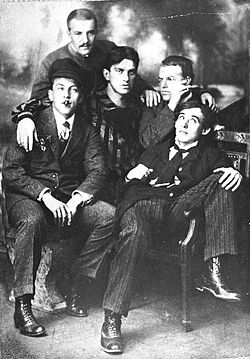
Group photograph of some Russian Futurists, published in their manifesto A Slap in the Face of Public Taste. Left to right: Aleksei Kruchyonykh, Vladimir Burliuk, Vladimir Mayakovsky, David Burliuk, and Benedikt Livshits.

Russian Futurism is the broad term for a movement of Russian poets and artists who adopted the principles of Filippo Marinetti's "Manifesto of Futurism", which espoused the rejection of the past, and a celebration of speed, machinery, violence, youth, industry, destruction of academies, museums, and urbanism;[1] it also advocated for modernization and cultural rejuvenation.[citation needed]

Russian Futurism began roughly in the early 1910s; in 1912, a year after Ego-Futurism began, the literary group "Hylea"—also spelt "Guilée"[2] and "Gylea"—issued the manifesto A Slap in the Face of Public Taste. The 1912 movement was originally called Cubo-Futurism, but this term is now used to refer to the style of art produced. Russian Futurism ended shortly after the Russian Revolution of 1917, after which former Russian Futurists either left the country, or participated in the new art movements.[citation needed]

Notable Russian Futurists included Natalia Goncharova, Mikhail Larionov, David Burliuk, Kazimir Malevich, Vladimir Mayakovsky, and Velimir Khlebnikov.

Style

[edit]

The Manifesto celebrated the "beauty of speed" and the machine as the new aesthetic.[1] Marinetti explained the "beauty of speed" as "a roaring automobile is more beautiful than the Winged Victory" further asserting the movement towards the future. Artforms were greatly affected by the Russian Futurism movement within Russia, with its influences being seen in cinema, literature, typography, politics, and propaganda. The Russian Futuristic movement saw its demise in the early 1920s.

Name

[edit]

Initially the term "futurism" was problematic, because it reminded them too much of their rivals in Italy; however, in 1911, the Ego-futurist group began. This was the first group of Russian futurism to call themselves "futurist"; shortly afterwards, many other futurists followed in using the term too.

Origins

[edit]
The Knifegrinder (1912–13), by Kazimir Malevich, is an example how Cubism and Futurism crossed over to create Cubo-Futurism, a combined art form.
Игра в Аду (A Game in Hell; Moscow 1914 edition) is an example of the collaborations of Futurist writers and visual artists. It fused Khlebnikov and Kruchenykh's poems with Malevich and Rozanova's bold imagery.

The most important group of Russian Futurism may be said to have been born in December 1912, when the Moscow-based literary group Hylaea (Russian: Гилея [Gileya]) (initiated in 1910 by David Burlyuk and his brothers at their estate near Kherson, and quickly joined by Vasily Kamensky and Velimir Khlebnikov, with Aleksey Kruchenykh and Vladimir Mayakovsky in 1911)[3] issued a manifesto entitled A Slap in the Face of Public Taste (Russian: Пощёчина общественному вкусу).[4] The Russian Futurist Manifesto shared similar ideas to Marinetti's Manifesto, such as the rejection of old literature for the new and unexpected.[1]

In addition to the forenamed authors, the group included artists Mikhail Larionov, Natalia Goncharova, Kazimir Malevich, and Olga Rozanova.[5]

Although Hylaea is generally considered to be the most influential group of Russian Futurism, other groups were formed in St. Petersburg (Igor Severyanin's Ego-Futurists), Moscow (Tsentrifuga, with Boris Pasternak among its members), Kiev, Kharkiv, and Odessa. While many artforms and artists converged to create "Russian Futurism", David Burlyuk (born 1882, Ukraine) is credited with publicizing the avant-garde movement and increasing its renown within Europe and the United States.[6] Burlyuk was a Russian poet, critic, and publisher who centralized the Russian movement. While his contribution to the arts were lesser than his peers, he was the first to discover many of the talented poets and artists associated with the movement. Burlyuk was the first to publish Velimir Khlebnikov and to celebrate the Futurist poetry of Vladimir Mayakovsky.[7] Russian futurism also adopted ideas from "French Cubism" which coined the name "Cubo-Futurists" given by an art critic in 1913.[6] Cubo-futurism adopted ideas from "Italian Futurism" and "French Cubism" to create its own blended style of visual art. It emphasized the breakdown of forms, the use of various viewpoints, the intersection of spatial planes, and the contrast of colour and texture. The focus was to show the intrinsic value of a painting, without it being dependent on a narrative.[6]

Modernity

[edit]

Like their Italian counterparts, the Russian Futurists were fascinated with the dynamism, speed, and restlessness of modern machines and urban life. They purposely sought to arouse controversy and to gain publicity by repudiating the static art of the past. The likes of Pushkin and Dostoevsky, according to A Slap in the Face of Public Taste, should be "heaved overboard from the steamship of modernity".[8] They acknowledged no authorities whatsoever; even Filippo Tommaso Marinetti, when he arrived in Russia on a proselytizing visit in 1914, was obstructed by most Russian Futurists, who did not profess to owe him anything.[1]

Cinema

[edit]

Russian Futurist cinema refers to the futurist movement in Soviet cinema. Russian Futurist cinema was deeply influenced by the films of Italian futurism (1916–1919) most of which are lost today. Some of the film directors identified as part of this movement are Lev Kuleshov, Dziga Vertov, Sergei Eisenstein, Vsevolod Pudovkin and Aleksandr Dovzhenko. Sergei Eisenstein's film Strike was seen as "the mordern Futurist art form par excellence" by Olga Bulgakowa. Bulgakowa theorized how the camera could change one's perceptions of reality and how it could make it seem like time was speeding up or slowing down during the film.[9]

Literature and typography

[edit]

In contrast to Marinetti's circle, Russian Futurism was primarily a literary rather than a plastic philosophy. Although many poets (Mayakovsky, Burlyuk) dabbled with painting, their interests were primarily literary. However, such well-established artists as Mikhail Larionov, Natalia Goncharova, and Kazimir Malevich found inspiration in the refreshing imagery of Futurist poems and experimented with versification themselves. The poets and painters collaborated on such innovative productions as the Futurist opera Victory Over the Sun, with music by Mikhail Matyushin, texts by Kruchenykh and sets contributed by Malevich.[6]

Cyclist (1913) by Natalia Goncharova. This painting is an example of how Russian Futurism affected her later works.

Members of Hylaea elaborated the doctrine of Cubo-Futurism and assumed the name of budetlyane (from the Russian word budet 'will be'). They found significance in the shape of letters, in the arrangement of text around the page, in the details of typography. They considered that there is no substantial difference between words and material things, hence the poet should arrange words in his poems like the artist arranges colors and lines on his canvas. Grammar, syntax, and logic were often discarded; many neologisms and profane words were introduced; onomatopoeia was declared a universal texture of verse. Khlebnikov, in particular, developed "an incoherent and anarchic blend of words stripped of their meaning and used for their sound alone",[10] known as zaum.

Politics

[edit]

With all this emphasis on formal experimentation, some Futurists were not indifferent to politics. In particular, Mayakovsky's poems, with their lyrical sensibility, appealed to a broad range of readers. He vehemently opposed the meaningless slaughter of World War I and hailed the Russian Revolution as the end of that traditional mode of life which he and other Futurists ridiculed so zealously. Although never a member of the Russian Communist Party (RKP(b)), he was active in early 1919 in the attempt to set up Komfut as an organisation promoting Futurism affiliated to the Viborg District Branch of the Party.[11]

The Bolshevik Agit-trains

[edit]

War correspondent Arthur Ransome and five other foreigners were taken to see two of the Bolshevik propaganda trains in 1919 by their organiser, Burov. The organiser first showed them the "Lenin",[12] which had been painted a year and a half ago

when, as fading hoardings in the streets of Moscow still testify, revolutionary art was dominated by the Futurist movement. Every carriage is decorated with most striking but not very comprehensible pictures in the brightest colours, and the proletariat was called upon to enjoy what the pre-revolutionary artistic public had for the most part failed to understand. Its pictures are 'art for arts sake', and can not have done more than astonish, and perhaps terrify, the peasants and the workmen of the country towns who had the luck to see them.

The "Red Cossack"[12] was quite different. As Burov put it with deep satisfaction, "At first we were in the artists' hands, and now the artists are in our hands". Initially the artists were so revolutionary that at one point Burov had delivered the Department of Proletarian Culture some Futurists "bound hand and foot", but now "the artists had been brought under proper control".[13]

The other three trains were the "Sverdlov", the "October Revolution", and the "Red East".

Demise

[edit]
Black Square (1915), by Kazimir Malevich, was featured at the 0,10 Exhibition, the last exhibition of Russian Futurist paintings. The exhibition was held from 19 December 1915 to 17 January 1916.

After the Bolsheviks gained power, Mayakovsky's group—patronized by Anatoly Lunacharsky, Bolshevik Commissar for Education—aspired to dominate Soviet culture. Their influence was paramount during the first years after the revolution, until their program—or rather lack thereof—was subjected to scathing criticism by authorities. In December 1920 the Central Committee of the Communist Party officially condemned Futurism among the artistic movements that were "hostile to Marxism".[14] By the time OBERIU attempted to revive some of the Futurist tenets during the late 1920s, the Futurist movement in Russia had already ended. The most militant Futurist poets either died (Khlebnikov, Mayakovsky) or preferred to adjust their very individual style to more conventional requirements and trends (Aseyev, Pasternak).[15] The decline of futurism can also be seen in Russia when Kruchenykh attempted to publish Fifteen Years of Russian Futurism 1912-1927 in 1928 and the Communist Party made it clear they did not want any futurist influence in Soviet literature. This marked an abrupt fall from grace for Kruchenykh's writing and futurism as a literary movement.[15]

See also

[edit]

References and sources

[edit]
[edit]
Revisions and contributorsEdit on WikipediaRead on Wikipedia
from Grokipedia
Russian Futurism was an avant-garde artistic and literary movement that flourished in Russia from approximately 1910 to 1920, distinguished by its vehement rejection of traditional aesthetics, embrace of formal experimentation, and aspiration to forge a revolutionary language and visual idiom attuned to the machine age and urban velocity. Emerging independently yet inspired by Italian Futurism, it diverged through emphases on phonetic innovation, "transrational" language (zaum), and the deconstruction of syntax in poetry, alongside cubo-futurist syntheses in painting that fragmented forms to capture simultaneity and motion. The movement's core group, Hylaea (or Gileya), included poets Vladimir Mayakovsky, Velimir Khlebnikov, and Aleksei Kruchenykh, and artists David Burliuk and Kazimir Malevich, who collectively issued the incendiary 1912 manifesto A Slap in the Face of Public Taste, demanding the repudiation of canonical figures like Alexander Pushkin and the incineration of libraries to liberate art from historical encumbrance. This provocative propelled , self-published with handmade , and public scandals that positioned Russian Futurists as cultural insurgents, initially aligning some with the 1917 Bolshevik Revolution's before ideological fractures and Stalinist repression curtailed the movement's vitality by the mid-1920s. Achievements encompassed pioneering abstract tendencies—Malevich's early cubo-futurist works presaging —and linguistic experiments that influenced subsequent , though the group's internal diversity spawned offshoots like Ego-Futurism and imaginism, diluting a unified doctrine. Controversies arose from their anarchic tactics, including assaults on bourgeois sensibilities and transient leftist sympathies that masked deeper apolitical avant-gardism, rendering Futurism a flashpoint for debates on art's societal role amid Russia's turbulent transition to Soviet order.

Origins and Early Development

Founding Events and Key Figures

Russian Futurism emerged from the Hylaea (Gileya) group, formed around 1910 by painter and his brothers Nikolai and Vladimir Burliuk at the family's estate in Semyrotivshchyna, near in . Burliuk, recognized as a central organizer and often termed the founding father, drew inspiration from Italian Futurism encountered during his travels and studies, adapting its emphasis on dynamism and rejection of tradition to Russian contexts through early lectures, exhibitions, and poetic experiments. The defining founding event occurred on December 18, 1912, with the publication of the manifesto A Slap in the Face of Public Taste (Poshchëchina obshchestvennomu vkusu), signed by , Aleksey Kruchenykh, , and . This document provocatively rejected established Russian literary symbols like Pushkin and Tolstoy, calling for the creation of a new artistic language to capture modern velocity and urban experience, thereby crystallizing the movement's insurgent ethos. Key figures included (1882–1967), a multifaceted who financed and promoted the group's activities, including publishing avant-garde almanacs; (1893–1930), a dynamic poet whose early works embodied Futurist bombast and urban themes; (1885–1922), a visionary poet pioneering transrational language (); and Aleksey Kruchenykh (1886–1968), known for radical linguistic innovations and efforts. Other early participants, such as Benedikt Livshits and the Burliuk brothers, contributed through poetry, painting, and group performances that toured Russian cities from 1913 onward.

Primary Manifestos and Declarations

The foundational manifesto of Russian Futurism, A Slap in the Face of Public Taste (Poš č ina obš estvennomu vkusu), was published in December 1912 by the Hylaea group, signed by , , Aleksei Kruchenykh, and . This document explicitly rejected canonical , demanding the expulsion of figures such as , , , and from the "Steamship of Modernity" to clear space for art reflecting contemporary urban and technological realities. It called for poets to expand vocabulary through neologisms and derivative words, to experiment with the "self-sufficient word" detached from conventional meaning, and to liberate language from pre-existing constraints, positioning the Futurists as the true representatives of their era. Accompanying this were declarations in A Trap for Judges 2 (Sadok sudej 2), published in early 1913 and signed by Burliuk, Elena Guro, Nikolai Burliuk, Mayakovsky, Konstantin Nizen, Khlebnikov, Benedikt Livshits, and Kruchenykh. These emphasized freeing from grammatical norms, prioritizing graphic and phonic elements over , abolishing and , and deriving meaning from word parts like prefixes and suffixes to create novel rhythms and rhymes. Building on these, The Word as Such (1913), co-authored by Kruchenykh and Khlebnikov, treated the poetic word as an autonomous phonetic entity with its own ontology, introducing zaum (transrational language) to prioritize expressiveness through sonic variation over rational content or tendentiousness. Kruchenykh's standalone Declaration of the Word as Such (Deklaratsiia slova kak takovogo), issued as a leaflet in summer 1913, further advocated zaum for direct emotional conveyance, the invention of new words to refresh perception, and the supremacy of words over thought, rejecting translation and rational limits to forge unprecedented artistic realities. These texts collectively established the core linguistic innovations of Russian Futurism, distinguishing it from Italian precedents by emphasizing verbal autonomy and sonic primacy.

Influences and Distinct Russian Adaptations

Russian Futurism emerged under the direct influence of Italian Futurism, particularly Filippo Tommaso Marinetti's Manifesto of Futurism, published on February 20, 1909, which advocated destroying museums, libraries, and academies to celebrate speed, technology, and violence as expressions of modern life. This text was translated into Russian by 1910 and circulated among avant-garde circles in St. Petersburg and Moscow, inspiring figures like David Burlyuk and Vladimir Mayakovsky during their European travels. The 1912 manifesto A Slap in the Face of Public Taste, signed by Burlyuk, Mayakovsky, Velimir Khlebnikov, and Aleksei Kruchenykh on December 18, 1912, explicitly echoed Marinetti's rejection of cultural heritage by declaring war on Pushkin, Dostoevsky, and Symbolism, proposing to "throw overboard from the Steamship of Modernity" Russia's literary icons. Distinctly, Russian adaptations fused Italian dynamism with French Cubism's geometric fragmentation, birthing around 1912–1914, as seen in works by Aristarkh Lentulov and , who rendered motion through angular, multi-perspective forms rather than the Italians' emphasis on blurred speed lines and muscular machinery. This synthesis addressed Russia's nascent industrialization and urban expansion, incorporating motifs from folk lubki prints and Orthodox icons to ground abstraction in national , diverging from Italian Futurism's unyielding cult of the machine and militarism. By 1913, subgroups like the Hyleans emphasized phonetic experimentation over Italian , prioritizing sound's from meaning. A hallmark Russian innovation was (transrational language), developed by Khlebnikov and Kruchenykh in , which sought to create neologisms and phonetic constructs free from referential logic, as outlined in Kruchenykh's New Paths of the Word (February 1913), contrasting Italian Futurism's typographic liberation that retained semantic cores. This linguistic radicalism reflected Russia's multilingual empire and revolutionary ethos, enabling poetry to evoke primal energies and prefigure abstract , while Italian efforts remained more tethered to patriotic and war glorification. Such adaptations positioned Russian Futurism as a bridge to later movements like and Constructivism by 1915.

Aesthetic and Philosophical Foundations

Core Principles of Rejection and Innovation

Russian Futurism's core principles centered on a vehement rejection of established cultural traditions and an aggressive pursuit of innovative forms reflective of modern technological and social dynamism. The foundational manifesto A Slap in the Face of Public Taste, published on December 18, , encapsulated this ethos by demanding the expulsion of canonical Russian literary figures—including , , , and —from the "Ship of Modernity." Signed by , Aleksei Kruchenykh, , and , the document condemned Symbolism's "sweetness and sluttishness" and the Academy's hieroglyphic incomprehensibility, asserting that only through such rupture could art align with the era's "horns of automobile and aeroplane engines" over outdated psalms. This rejection was not mere provocation but a philosophical imperative to dismantle bourgeois aesthetic norms, which the Futurists viewed as impediments to capturing the and of contemporary life. They positioned themselves as the era's authentic voice—"We alone was the face of our Time"—prioritizing , struggle, and urban-industrial motifs over historical reverence. , in turn, demanded the creation of unprecedented artistic languages and structures, free from representational constraints, to embody the "self-sufficient word" and fragmented perceptions of . Subsequent manifestos reinforced these tenets, advocating for art's role in societal transformation through bold experimentation, distinguishing Russian Futurism from Italian counterparts by integrating primitivist and folk elements alongside machine glorification. This dual commitment to destruction and renewal underscored a causal realism: old forms perpetuated stagnation, while radical innovation promised cultural vitality attuned to empirical shifts in and .

Language Experiments and Zaum

Russian Futurists pursued radical linguistic innovations to dismantle established literary norms, rejecting syntactic coherence and semantic predictability in favor of phonetic autonomy and neologistic invention. These experiments aimed to forge a verbal art attuned to the velocity of industrial modernity and primal sonic energies, distinct from Italian Futurism's onomatopoeic mimicry of machinery. Central to this endeavor was zaum' (заумь), a "transrational" or "beyondsense" language that privileged sound's inherent expressivity over referential meaning, positing words as self-sufficient entities capable of evoking universal sensations. The foundational manifesto "A Slap in the Face of Public Taste," published December 1912 and signed by , Aleksei Kruchenykh, , and Victor Khlebnikov, demanded poets "hate the language existing before their time" and expand vocabulary through "arbitrary and derivative words." This set the stage for zaum', formalized in Kruchenykh and Velimir Khlebnikov's 1913 declaration "The Word as Such," which proclaimed the poem's primacy as "the primary human matter" and asserted that "a word is the same flesh." They exemplified zaum' with Khlebnikov's lines "Dyr bul shchyl / Urpy bul shchyl," claiming these five syllables held more intrinsic Russianness than Pushkin's entire corpus, thereby elevating phonetic invention over . Khlebnikov, often termed the "president of the Zaum Republic," pursued zaum' through systematic etymological reconstruction, deriving neologisms from ancient Slavic roots to approximate a prehistoric "universal language" of laws and stars, as in his 1910-1913 "Laws of Time and Reckoning in the Word." Kruchenykh, by contrast, advocated explosive "shift" (sdvig), distorting existing words via phonetic mutation to liberate latent energies, outstripping even Khlebnikov in radicalism; his 1913 pamphlet New Ways of the Word defended zaum' as enabling "fuller expression" unbound by dictionary constraints. These principles manifested in works like Kruchenykh's Explosion (1913), where fragmented vocables mimicked explosive force, and Khlebnikov's Zangezi (1922), blending zaum' with mythic narrative. Zaum' experiments extended beyond poetry to influence and , with irregular layouts and declamations emphasizing verbal percussion over comprehension. Though critiqued for opacity, proponents viewed it as a causal return to language's originary power, prefiguring sonic universality amid revolutionary upheaval; Kruchenykh's persistence through the underscored its endurance against post-revolutionary demands for .

Embrace of Modernity, Technology, and Urbanism

Russian Futurists positioned their movement as a radical affirmation of the contemporary era, rejecting historical artistic traditions in favor of forms that embodied the velocity and mechanization of early 20th-century life. In the manifesto A Slap in the Face of Public Taste, published on December 18, 1912, by David Burliuk, Vladimir Mayakovsky, Viktor Khlebnikov, and Aleksei Kruchenykh, the authors proclaimed the imperative to cast aside figures like Alexander Pushkin and Leo Tolstoy "overboard from the Ship of Modernity," thereby aligning art with the transformative forces of industrialization and urbanization. This nautical metaphor underscored their view of modernity as an inexorable voyage propelled by technological innovation, distancing themselves from what they deemed obsolete cultural baggage. The group's literary output vividly captured urban dynamism and mechanical power, with poets deploying neologisms and rhythmic structures to evoke the clamor of factories and streets. , a central figure, infused poems such as those in his 1916 collection Simple as Mooing with imagery of roaring engines and pulsating cityscapes, portraying machinery not as mere tools but as extensions of human vitality and societal upheaval. His verse often anthropomorphized urban elements—trams screeching like defiant voices, skyscrapers piercing the sky—to celebrate the raw energy of Moscow's expanding infrastructure amid Russia's rapid industrialization from 1900 to 1914, when urban populations swelled by over 50 percent. In , synthesized Cubist fragmentation with Futurist motion to depict technological and urban motifs, emphasizing speed and simultaneity. Natalia Goncharova's Cyclist (1913) renders a bicyclist in angular, overlapping planes against a blurred backdrop, symbolizing the intrusion of modern velocity into everyday Russian life and reflecting the era's burgeoning adoption of personal transport amid expanding road networks. Similarly, Kazimir Malevich's The Knife Grinder (Principle of Glittering) (1912–1913) abstracts the grinding machine into shimmering geometric facets, capturing the "glittering" essence of industrial processes and aligning with the Futurists' quest to aestheticize mechanical labor as a pinnacle of progress. These works, exhibited in events like the 1912 Donkey's Tail show, propagated a vision of art as a mirror to the metallic sheen and kinetic frenzy of the .

Artistic Expressions

Literary and Poetic Innovations

Russian Futurists advanced literary innovation through aggressive rejection of classical , as articulated in the 1912 A Slap in the Face of Public Taste, authored by , Aleksei Kruchenykh, , and . This document demanded the "throw[ing] overboard of Pushkin, Dostoevsky, Tolstoy, etc., more decisively than ever," proposing instead a oriented toward the "self-sufficient word" independent of meaning or syntax. The , published as part of the Hylaea group's almanac, emphasized linguistic autonomy, where words gained value through phonetic qualities rather than referential content. Central to these innovations was zaum, or transrational language, developed primarily by Khlebnikov and Kruchenykh around 1913. rejected grammatical conventions and semantic logic, prioritizing and invented words to evoke primal, intuitive responses; Kruchenykh described it as "beyond rationality," exemplified in works like his 1913 poem Dyr bul shchyl, comprising neologisms such as "shchyl" to simulate explosive auditory effects. Khlebnikov viewed as a means to uncover universal linguistic roots, deriving terms from phonetic resemblances across languages, as in his experimental cycles like Zangezi (1922). This approach contrasted with Italian Futurism's onomatopoeic "words-in-freedom" by delving deeper into phonetic invention, influencing and later linguistics. Mayakovsky contributed a declamatory, performative style suited to public , innovating with rhythmic "step-ladders"—staircase-like typographic layouts that mimicked speech cadences and emphasized oral delivery over . In poems like (1915), he employed hyperbole, neologisms, and syntactic disruptions to convey urban dynamism and personal turmoil, breaking from rhyme and meter to create a "poetry of agitation" aligned with urbanism. These techniques extended to collaborative experiments, such as books with irregular and integrated visual elements, blurring lines between text and image to heighten sensory impact.

Visual Arts, Typography, and Design

Russian Futurism in the primarily manifested through , a hybrid style emerging around 1912 that fused Cubist fragmentation with dynamism to represent motion, machinery, and urban energy via angular forms and simultaneous perspectives. Prominent artists included , whose 1912–1913 painting The Knife Grinder (Principle of Glittering) employed jagged, metallic shards to evoke industrial grinding and visual dissonance. contributed early counter-reliefs around 1913–1914, using assembled materials to simulate three-dimensional movement and reject traditional canvas painting. and Mikhail Larionov pioneered in 1912–1913, depicting intersecting rays of light to capture velocity, as seen in Goncharova's Cyclist (1913), which fragments the figure amid radiating lines symbolizing speed. These experiments often incorporated Russian folk motifs and , adapting Italian Futurism's to contexts like peasant imagery and Orthodox icons, diverging from pure toward narrative disruption. By 1915, Malevich's shift to with Black Square marked a radical break from representational , prioritizing pure geometric forms as "zero of form," though rooted in Futurist rejection of the past. Other figures like and advanced non-objective compositions, blending and linear to embody technological progress. In and , Russian Futurists treated the printed page as a dynamic , employing asymmetrical arrangements, bold fonts, diagonal axes, and typographic "explosions" to mimic verbal and visual speed from 1910 onward. Publications like the 1912 manifesto A Slap in the Face of Public Taste featured irregular spacing and integrated illustrations, while books by and , such as Mayakovsky's 1915 , used handwritten elements, oversized letters, and spatial distortions to disrupt linear reading and evoke sonic chaos. These innovations extended to book covers and posters, prioritizing haptic and visual impact over legibility, influencing later Constructivist with principles of utility and .

Cinema, Theater, and Performance

Russian Futurists revolutionized theater and performance by rejecting naturalistic drama and psychological depth in favor of synthetic spectacles that fused declamation, music, visual abstraction, and zaum to assault bourgeois sensibilities and herald technological dynamism. These events often occurred in unconventional venues like cabarets and amusement parks, emphasizing immediacy, noise, and anti-traditional disruption over plot or character development. The opera Victory over the Sun, premiered in December 1913 at in , exemplified this approach, with Aleksei Kruchenykh's in invented , Mikhail Matiushin's dissonant score using quarter-tones, and Kazimir Malevich's geometric costumes and sets that introduced Suprematist motifs, including a black square emblematic of eclipsing the past. Performed over several nights to mixed reactions of outrage and acclaim, the production subordinated narrative to sonic and visual assault, capturing the Futurists' aim to "overcome the sun" as a symbol of obsolete naturalism. Vladimir Mayakovsky's A Tragedy, staged earlier that year in Petrograd, similarly employed bombastic recitation and urban motifs to parody societal norms, reinforcing the movement's performative . Engagement with cinema remained peripheral, as Futurists prioritized live disruption over recorded media, though Mayakovsky explored film scenarios in 1913, aligning dynamic editing and visual speed with manifesto ideals of velocity and mechanization. No major Futurist films emerged pre-Revolution, but these tentative forays anticipated montage techniques in later Soviet works influenced by the movement's velocity worship. Performances like cabaret recitals of illustrated poems, such as Kruchenykh's Igra v adu (1914 edition), integrated typography and visuals into oral delivery, blurring lines between literature and stage action.

Political Engagement and Ideology

Pre-Revolutionary Political Stances

Russian Futurists displayed heterogeneous political inclinations before the 1917 revolutions, united more by cultural rebellion against Tsarist orthodoxy than by a singular . Emerging amid the social ferment post-1905 Revolution, groups like the Hylaeans—centered on figures such as , , and —espoused radical left-wing ideas that intertwined aesthetic innovation with critiques of imperial stagnation and bourgeois complacency. Their 1912 manifesto A Slap in the Face of Public Taste demanded the jettisoning of Pushkin, Dostoevsky, and Tolstoy from the "Steamship of Modernity," targeting icons of state-endorsed Russian literary tradition as relics obstructing progress. Individual stances varied, but anti-autocratic sentiments prevailed, often manifesting as anarchic provocation rather than organized partisanship. Mayakovsky, the most overtly political, joined the Bolshevik faction of the around 1908, was arrested in 1909 for revolutionary agitation, and infused his pre-war poetry with anti-bourgeois fervor, as seen in collaborations with Burliuk to reject establishment art. Burliuk, while primarily an aesthetic driver, supported this subversive ethos, framing as a bulwark against . Yet, the movement eschewed formal platforms; Ego-Futurists like Igor Severyanin leaned toward , and no unified anti-Tsarist program coalesced, prioritizing metaphysical "self-sufficiency" over electoral or insurgent tactics. World War I (1914–1917) exposed fissures: initial endorsements of mechanized warfare as a destroyer of obsolete structures echoed Italian Futurism's glorification of violence and technology, with Mayakovsky and others viewing conflict as a catalyst for renewal. This shifted for some amid military failures and domestic turmoil, fostering disillusionment with the regime. Authorities responded with sporadic censorship of Futurist publications and performances, perceiving their iconoclasm as seditious, though outright suppression remained limited pre-revolution. later dismissed them as apolitical "café artists," highlighting their emphasis on bohemian disruption over disciplined ideology.

Support for the Bolshevik Revolution

Russian Futurists, including prominent figures such as , Vasily Kamensky, and , reacted to the Bolshevik seizure of power in the of 1917 (November 7 by the ) with immediate enthusiasm, interpreting it as a political upheaval that aligned with their longstanding advocacy for cultural destruction and renewal. They perceived the revolution not merely as a class struggle but as a catalyst for a broader "revolution of the spirit," enabling the integration of art into societal transformation and the rejection of bourgeois traditions. This support stemmed from their pre-revolutionary manifestos, which had already condemned tsarist-era culture, positioning as inherently compatible with radical change. Mayakovsky, the movement's leading poet, exemplified this alignment by publicly endorsing Bolshevik authority shortly after the events in Petrograd. On November 17, 1917, at a meeting of the Union of Art Workers (Soyuz Deyateley Iskusstva), he urged artists to collaborate with the new regime, contrasting with many contemporaries who resisted state oversight of creative production. Mayakovsky later described his personal immersion in the revolution as entering "his own home," reflecting a seamless ideological continuity from Futurist iconoclasm to proletarian mobilization. Other Futurists, including Kamensky and Burliuk, resumed collective activities in Moscow, opening the Kafe Poetov (Café of Poets) in autumn 1917 as a venue for provocative readings and discussions that propagated revolutionary themes through zaum experimentation and anti-traditional rhetoric. By early 1918, this support manifested in publications that explicitly tied aesthetics to Bolshevik goals. The group issued Gazeta Futuristov on March 15, 1918, featuring the "Manifesto of the Flying Federation of Futurists" and poems exhorting cultural overhaul in service of the new order. Mayakovsky contributed articles critiquing pre-revolutionary art and advocating its replacement with forms accessible to workers, laying groundwork for later initiatives like public performances before proletarian audiences. These efforts positioned Futurists within emerging state structures, such as Narkompros's arts section (), despite initial frictions with proletarian cultural organizations like , which viewed Futurism as elitist.

Agitprop Efforts and Agit-Trains

Russian Futurists aligned with Bolshevik objectives post-1917 by producing materials to mobilize the populace during the Civil War (1918–1921). , a leading figure, created over 200 "Okna ROSTA" posters for the Russian Telegraph Agency starting in 1919, employing stenciled Futurist graphics and rhymed chastushki verses to convey anti-White Army, pro-Red mobilization, and anti-religious themes accessible to illiterate workers and peasants. These window displays substituted for newspapers amid wartime shortages, blending poetic innovation with direct calls to action. Agit-trains (agitpoezda), operational from late , exemplified contributions to mobile , traversing rail lines to reach remote fronts and villages with cars fitted for printing, lecturing, and performances. artists adorned exteriors with dynamic paintings and posters evoking machinery, speed, and revolutionary fervor, while Mayakovsky rode such to recite verse and generate content en route between , Petrograd, and battle zones. Approximately 40 agit-trains operated by mid-1920 under Narkompros oversight, distributing over 1 million leaflets and posters per journey to instill proletarian ideology. This effort integrated Futurism's rejection of with Bolshevik goals, using as itinerant cultural hubs to combat illiteracy and sentiment through visual and performative . However, the avant-garde's abstract tendencies sometimes clashed with demands for mass accessibility, leading to simpler designs for rural audiences. By 1921, as Civil War hostilities waned, networks dismantled, shifting Futurist energies toward institutional roles.

Criticisms, Controversies, and Internal Conflicts

Accusations of Cultural Nihilism and Violence Promotion

The 1912 manifesto A Slap in the Face of Public Taste, authored by , , , and Aleksei Kruchenykh, explicitly called for rejecting established Russian literary figures such as , , and , urging their expulsion "overboard from the Ship of Modernity." This provocative stance drew accusations of cultural from contemporaries, who viewed it as a deliberate assault on Russia's literary heritage and traditional values. Critics argued that the Futurists' dismissal of canonical works undermined the foundations of national culture without offering substantive alternatives, portraying the movement as vandalistic and destructive. Literary critic Valery Bryusov, in his 1910 review of the Futurist almanac Sadok sudei, described the contents as "beyond the limits of " and filled with "boyish pranks in ," highlighting a perceived lack of and an embrace of senseless provocation. Similarly, Sergei Bobrov in 1913 accused the Hylaea group (key Futurist poets) of producing work that transcended art into decadent bourgeois territory, implying a nihilistic erosion of aesthetic standards. Poet Igor Severyanin launched vehement attacks post-1914, condemning the Futurists' mockery of "sacred values" as a threat to cultural continuity. Victor Khovin reluctantly acknowledged the movement's "vandalistic" tendencies in 1913, distinguishing destructive imitators from potential innovators but underscoring the risk of heritage obliteration. Accusations of promoting stemmed from the Futurists' aggressive and in works like Kruchenykh's 1913 book Half Alive, which included graphic depictions such as a draining blood from fallen warriors, evoking themes of and destruction. The itself employed combative language, framing cultural renewal as a "slap" against public norms, which critics interpreted as endorsing societal upheaval and . While Russian Futurism diverged from Italian counterparts' explicit glorification of —focusing more on linguistic and formal experimentation—its adoption of violent metaphors in public actions and poetry fueled perceptions of inciting disorder, particularly amid pre-revolutionary tensions. These charges persisted despite the movement's emphasis on constructive innovation, as detractors prioritized the apparent endorsement of rupture over renewal.

Divisions Among Futurists and Ideological Shifts

Russian Futurism fragmented into distinct subgroups early in its development, reflecting aesthetic and temperamental differences rather than a monolithic movement. The Hylaea group, centered in and often termed Cubo-Futurists, emphasized radicalism through linguistic experiments like zaum (transrational language) and typographical innovation, with key figures including , , Aleksei Kruchenykh, and David Burlyuk; their 1912 A Slap in the Face of Public Taste exemplified this aggressive rejection of tradition in favor of machine-age dynamism and social disruption. In contrast, the Ego-Futurists, led by Igor Severyanin in St. Petersburg from 1911, prioritized individualistic self-expression and lyrical over extreme formal disruption, producing more refined almanacs that explored personal ego and sensory rather than Hylaea's rough, assaults on syntax. These divisions manifested in rival publications and public scandals, such as the Hylaeans' mockery of Ego-Futurists as insufficiently , underscoring tensions between 's politicized collectivism and Petersburg's decadent . Ideologically, Russian Futurists initially lacked a cohesive program, blending anti-bourgeois with aesthetic provocation but avoiding explicit partisanship; Hylaeans exhibited left-wing radicalism shaped by the Empire's crises, yet the movement's core was formal experimentation over doctrine. The 1917 Bolshevik Revolution prompted shifts, as many—particularly Mayakovsky—aligned with the new regime, fusing premises of destruction and renewal with Marxist tenets to promote collectivism and proletarian utility in art. This evolution created internal strains: purists like Khlebnikov resisted politicization, favoring mystical , while pragmatists embraced , leading to accusations of opportunism; by 1921, Mayakovsky's cooperation with Soviet institutions marked a pivot from ego-centric futurism to state-serving , though this alienated some who prioritized artistic . Such rifts foreshadowed broader conflicts, as experimental freedom clashed with demands for ideological conformity.

Critiques from Traditionalists and Later Regimes

Traditionalist critics in pre-revolutionary condemned as a destructive on the nation's literary and cultural patrimony, exemplified by the 1912 A Slap in the Face of Public Taste, which explicitly urged discarding canonical figures like , , and as outdated relics impeding modern progress. This provocation elicited widespread backlash from conservative literary circles and the broader , who argued that Futurism's advocacy for "" (transrational language) and rejection of syntactic norms reduced poetry to incoherent babble, stripping it of its historical role in preserving moral and national values. Figures aligned with Symbolism and Acmeism, representing continuity with classical traditions, dismissed the movement's innovations as aesthetic rather than genuine evolution, fearing it eroded the spiritual depth inherent in Russia's Orthodox-influenced heritage of narrative realism and ethical inquiry. Under the Bolshevik regime, initial tolerance for Futurism's revolutionary waned as the movement's emphasis on linguistic experimentation and abstract form clashed with demands for art serving proletarian education and ideological clarity. By the late , Soviet cultural authorities labeled Futurist techniques "formalist," accusing them of prioritizing self-referential aesthetics over content that depicted class struggle and socialist construction, a formalized in the 1932 creating monolithic creative unions under control. , a prominent , faced targeted denunciations for works like the 1929 play The Bathhouse, which satirized bureaucratic inertia and was deemed a "leftist deviation" undermining Soviet unity, exacerbating pressures that contributed to his suicide in April 1930. Stalinist policy culminated in the 1934 codification of as the sole acceptable style, explicitly rejecting Futurism's dynamism and fragmentation as elitist distortions incompatible with the regime's vision of art as a tool for and . Critics in state organs portrayed the movement as a remnant of bourgeois , arguing its urban fetishism and machine worship alienated rural workers and failed to foster the "typical" socialist hero, leading to the purging of Futurist publications, exhibitions, and groups like LEF by the mid-1930s. This shift reflected a broader causal prioritization of centralized narrative control over disruption, ensuring cultural output aligned with state power consolidation rather than autonomous experimentation.

Decline, Suppression, and Legacy

Immediate Post-Revolutionary Trajectory

Following the of 1917, Russian Futurists positioned themselves as natural allies of the Bolshevik regime, interpreting the upheaval as a practical enactment of their prewar manifestos calling for the destruction of autocratic and bourgeois cultural traditions in favor of dynamic, machine-age aesthetics. Leading figures like , who had witnessed the insurrections in Petrograd, rapidly produced poetry and visual works endorsing the new order, framing it as a rupture with the past that aligned with Futurist . This enthusiasm stemmed from a shared rejection of realism and tradition, though Futurists sought not mere endorsement but dominance in reshaping to serve revolutionary ends. In 1918, the establishment of the People's Commissariat for Enlightenment (Narkompros) under Anatoly Lunacharsky provided institutional avenues for Futurist integration, with the Fine Arts Section (IZO) incorporating avant-garde artists to oversee museums, exhibitions, and educational reforms. Vladimir Tatlin, a key Constructivist influenced by Futurism, joined IZO in Petrograd by January 1918, advocating for art's subordination to utility and propaganda over autonomous expression. Futurists also launched the newspaper Iskusstvo kommuny (Art of the Commune) from December 1918 to April 1919, using it to promote "art into production" principles amid the Civil War, though debates over accessibility for proletarian audiences emerged early. Lunacharsky, despite personal reservations about extreme abstraction, tolerated and appointed such figures to foster cultural experimentation supportive of Bolshevik goals. Practical applications intensified during 1919–1921, as Futurists contributed to mass agitation efforts. Mayakovsky designed over 200 stencil-based ROSTA Windows—temporary propaganda posters displayed in public spaces—for the Russian Telegraph Agency, blending verse, bold , and satirical to disseminate Bolshevik messages on fronts like famine relief and anti-White Army mobilization. Tatlin's unrealized Monument to the Third International, a spiraling iron-and-glass tower model exhibited on November 8, 1920, in Petrograd, epitomized Futurist ambitions for monumental, functional symbolizing global , though its engineering impracticality highlighted tensions between visionary ideals and material constraints. This phase represented Futurism's zenith of official sanction, with artists leveraging state resources to prototype a "communist environment" before bureaucratic and ideological frictions prompted reorganization of Narkompros in 1921.

Stalinist Suppression and Cultural Purges

As consolidated power in the late , the Soviet regime increasingly viewed avant-garde movements like Russian Futurism as incompatible with emerging cultural policies emphasizing accessibility and ideological utility for the . The Left Front of the Arts (LEF), a key Futurist-aligned group promoting constructivist and experimental forms, ceased operations in 1928 amid mounting official disapproval of its abstract tendencies, which were deemed elitist and detached from socialist goals. This marked an early phase of suppression, predating but accelerating under Stalin's full dominance, as state control shifted toward prescriptive realism over innovative disruption. The imposition of Socialist Realism as the official doctrine in 1934, formalized at the First Congress of Soviet Writers, explicitly rejected Futurist experimentation as "formalism"—a term denoting bourgeois decadence and lack of content-driven propaganda. Artists associated with faced censorship, with works removed from public view and exhibitions curtailed; for instance, , whose evolved from roots, was arrested on September 20, 1930, by the OGPU (precursor to the ) on suspicions tied to his Western contacts and abstract style, enduring two to three months of interrogation and imprisonment before release. Malevich's manuscripts were confiscated and partially destroyed, compelling him to revert to figurative painting to evade further persecution. Vladimir Mayakovsky, Futurism's most prominent poet, encountered direct Stalinist backlash in 1930 when his satirical play Banya (The Bathhouse) was denounced for mocking bureaucratic excesses, triggering a campaign by critics like Vladimir Yermilov that portrayed his work as ideologically deviant. Despite Stalin's posthumous endorsement of Mayakovsky as "the best and most talented poet of the " following his suicide on April 14, 1930, the regime's intolerance for his earlier iconoclastic verse contributed to an environment of creative suffocation. During the Great Purge of 1936–1938, surviving Futurists and fellow avant-gardists suffered arrests, executions, or forced conformity, with experimental theaters like the Blue Blouses—echoing Futurist —dissolved by 1928 and their methods later vilified. This cultural purge dismantled Futurism's institutional presence, relocating works to storage or destruction and enforcing a monolithic aesthetic that prioritized heroic depictions of labor over radical form, effectively erasing the movement's revolutionary aesthetic legacy until post-Stalin reevaluations.

Long-Term Influences and Reassessments

Despite suppression under Stalinist cultural policies, Russian Futurism exerted lasting influence on subsequent movements within the , particularly and Constructivism, which emerged around 1915 and incorporated Futurist emphases on geometric abstraction, technological dynamism, and rejection of representational art. Kazimir Malevich's (1915), initially presented at the 0.10 exhibition alongside Futurist works, exemplified this transition, prioritizing pure form over narrative and influencing later abstract and minimalist tendencies in global art. ![Kazimir Malevich, 1915, Black Suprematic Square, oil on linen canvas, 79.5 x 79.5 cm, Tretyakov Gallery, Moscow.jpg][center] Futurist innovations in interdisciplinary forms persisted in Soviet graphic design, typography, and children's literature, with Vladimir Mayakovsky's poetic experiments informing Constructivist layouts by artists like El Lissitzky and Alexander Rodchenko into the 1920s. In theater and cinema, productions such as Victory Over the Sun (1913) anticipated experimental techniques in sound poetry, Fluxus performances, and conceptual art of the mid-20th century, emphasizing non-linear narrative and multimedia integration. These elements extended beyond the USSR, contributing to international Modernism's focus on urban speed and machine aesthetics, though often mediated through émigré artists and Western adaptations. Reassessments of Russian Futurism have highlighted its distinct national character—rooted in Slavic folk motifs and linguistic innovation (e.g., or transrational )—separating it from Italian Futurism's militaristic bent and positioning it as a foundational force in the Russian avant-garde's literary-visual synthesis. Scholarly analyses, particularly since the mid-20th century, have reevaluated its legacy beyond Soviet-era denunciations as "formalist decadence" incompatible with (formalized in ), recognizing instead its role in asserting cultural dynamism amid industrialization. This perspective underscores Futurism's ongoing relevance in contemporary experiments with , form, and , unencumbered by ideological .

References

Add your contribution
Related Hubs
User Avatar
No comments yet.