


Community hub
Recent from talks
Contribute something
Nothing was collected or created yet.
Primitivism
View on Wikipedia
In the arts of the Western world, Primitivism is a mode of aesthetic idealization that means to recreate the experience of the primitive time, place, and person, either by emulation or by re-creation. In Western philosophy, Primitivism proposes that the people of a primitive society possess a morality and an ethics that are superior to the urban value system of civilized people.[1]
In European art, the aesthetics of primitivism included techniques, motifs, and styles copied from the arts of Asian, African, and Australasian peoples perceived as primitive in relation to the urban civilization of Western Europe. In that light, the painter Paul Gauguin's inclusion of Tahitian imagery to his oil paintings was a characteristic borrowing of technique, motif, and style that was important for the development of Modern art (1860s–1970s) in the late 19th century.[2] As a genre of Western art, Primitivism reproduced and perpetuated racist stereotypes, such as the "noble savage", with which colonialists justified white colonial rule over the non-white other in Asia, Africa, and Australasia.[3]
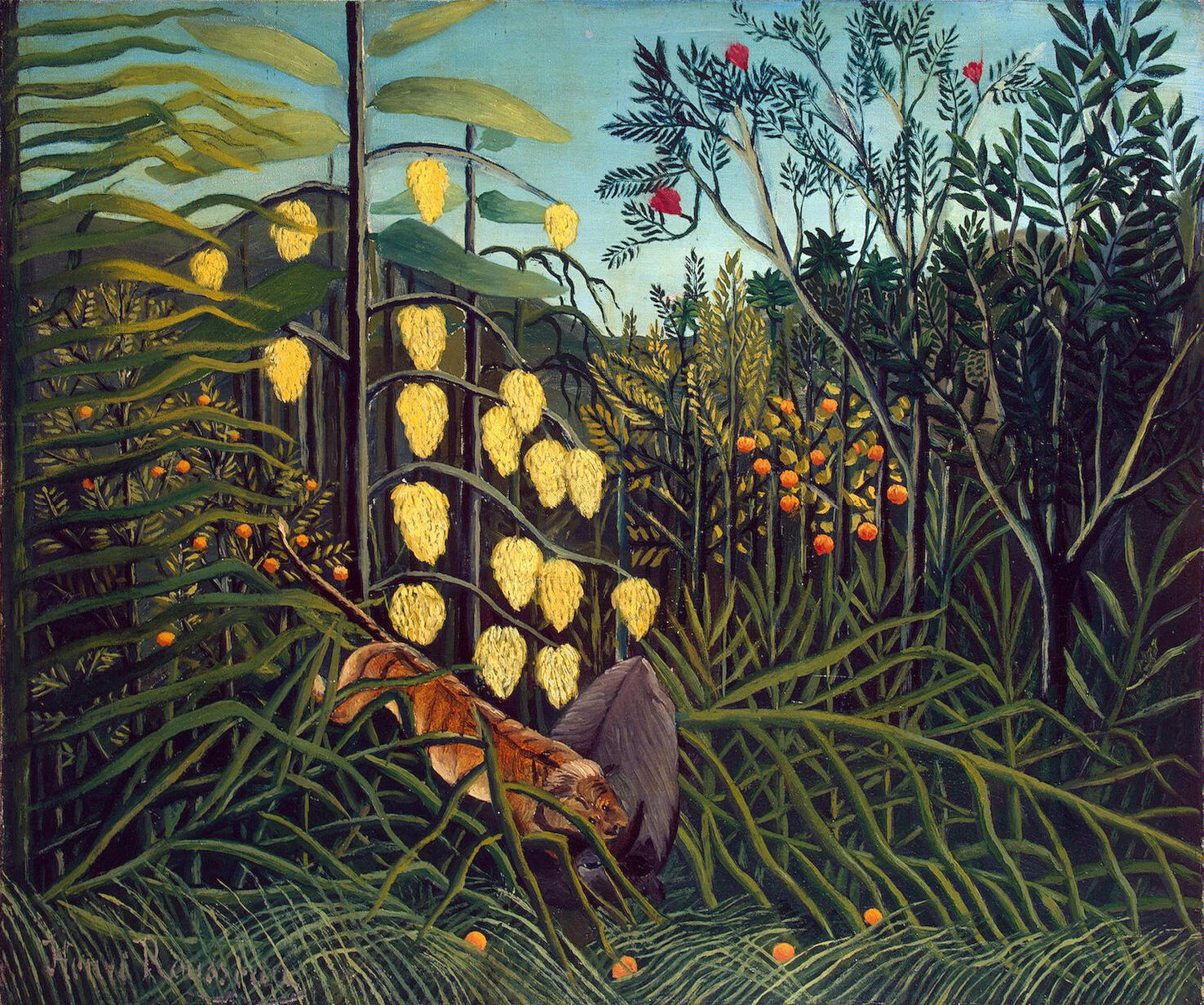
Moreover, the term primitivism also identifies the techniques, motifs, and styles of painting that predominated representational painting before the emergence of the Avant-garde; and also identifies the styles of naïve art and of folk art produced by amateur artists, such as Henri Rousseau, who painted for personal pleasure.[4]
Philosophy
[edit]Primitivism is a utopian style of art that means to represent the physical world of Nature and humanity's original state of nature with two styles: (i) chronological primitivism and (ii) cultural primitivism.[5] In Europe, chronological primitivism proposes the moral superiority of a primitive way of life represented by the myth of a golden age of pre-societal harmony with Nature, as depicted in the Pastoral genres of European representational art and poetry.[6]
Notable examples of European cultural primitivism are the music of Igor Stravinsky, the Tahitian paintings of Paul Gauguin, and the African period artworks of Pablo Picasso. Stravinsky's The Rite of Spring (1913) is primitivist program music about the subject of Paganism, specifically the rite of human sacrifice in pre-christian Russia. Foregoing the aesthetic and technical restraints of Western musical composition, in The Rite of Spring the composer employs harsh consonance and dissonance and loud, repetitive rhythms as a mode of Dionysian spontaneity in musical modernism. The critic Malcolm Cook said that "with its folk-music motifs and the infamous 1913 Paris riot securing its avant-garde credentials, Stravinsky's The Rite of Spring engaged in Primitivism in both form and practice" while remaining within the technical praxes of Western classical music.[7] The primitivism movement is not just limited to Europe. Australia’s John Antill is known for his major primitive work Corroboree. According to Campbell, Corroboree holds significance for broader discussions of musical primitivism, as much of the musicological discourse in classical music often assumes certain musical gestures inherently signify primitivism or blends primitivism into the broader concept of musical exoticism. In contrast, Corroboree highlights representational primitivism by linking the ballet's prominent musical elements to historical ideas from the 18th to 20th centuries about the earliest phases of human musical evolution.[8]
- 17th century
During the Age of Enlightenment, intellectuals rhetorically used the idealization of indigenous peoples as political criticism of European culture;[9] however, as part of the Quarrel of the Ancients and the Moderns, the Italian intellectual Giambattista Vico said that the lives of primitive non-Europeans were more attuned to Nature's aesthetic inspirations for poetry than the arts of civilized, modern man. From that perspective, Vico compared the artistic merits of the epic poetry of Homer and of the Bible against the modern literature written in vernacular language.[10]
- 18th century
In the Prolegomena to Homer (1795), the scholar Friedrich August Wolf identified the language of Homer's poetry and the language of The Bible as examples of folk art communicated and transmitted by oral tradition.[11] Later, the ideas of Vico and Wolf were developed at the beginning of the 19th century by Johann Gottfried Herder;[12] nevertheless, although influential in literature, the ideas of Vico and Wolf slightly influenced the visual arts.[13]
- 19th century
The emergence of historicism — judging and evaluating different eras according to their historical context and criteria — resulted in new schools of visual art dedicated to historical fidelity of setting and costume, such as the art of Neoclassicism and the Romantic art of the Nazarene movement in Germany who were inspired by the primitive school of Italian devotional paintings, i.e. before Raphael and the discovery of oil painting.
Whereas academic painting (after Raphael) used dark glazes, idealized forms, and suppression of detail, the artists of the Nazarene movement used clear outlines, bright colors, and much detail. The artistic styles of the Nazarene movement were similar to the artistic styles of the Pre-Raphaelites, who were inspired by the critical writings of John Ruskin, who admired the painters before Raphael (e.g. Sandro Botticelli) and recommended that artists paint outdoors.
In the mid-19th century, the photographic camera and non-Euclidean geometry changed the visual arts; photography impelled the development of artistic Realism and non-Euclidean geometry voided the mathematic absolutes of Euclidean geometry, and so challenged the conventional perspective of Renaissance art by suggesting the existence of multiple worlds in which things are different from the human world.[14]
Modernist Primitivism
[edit]
The three-hundred-year Age of Discovery (15th c.–17th c.) exposed western European explorers to the peoples and cultures of Asia and the Americas, of Africa and Australasia, but the explorers' perspective of cultural difference led to colonialism.[15] During the Age of Enlightenment, the explorers' encounters with the non-European Other provoked philosophers to question the Mediaeval assumptions about the fixed nature Man, of society, and of Nature, doubted the social-class organization of society and the mental, moral, and intellectual strictures of Christianity, by comparing the civilization of Europe against the way of life of the uncivilized natural man living in harmony with Nature.[16]
In the 18th century, Western artists and intellectuals participated in "the conscious search in history for a more deeply expressive, permanent human nature and cultural structure in contrast to the nascent modern realities", by studying the cultures of the primitive peoples encountered by explorers.[17] The spoils of European colonialism included the works of art of the colonized natives, which featured primitive styles of expression and execution, especially the absence of linear perspective, a simple outline, the presence of hieroglyphs, distortions of the figure, and the meaning communicated with repeated patterns of ornamentation.[18] The African and Australasian cultures provided artists an answer to their "white, Western, and preponderantly male quest" for the ideal of the primitive, "whose very condition of desirability resides in some form of distance and difference."[19]
Paul Gauguin
[edit]The painter Paul Gauguin departed urban Europe to reside in the French colony of Tahiti, where he adopted a primitive style of life much unlike the way of life in urban France. Gauguin's search for the primitive was a search for sexual freedom from the Christian constrictions of private life, evident in the paintings Spirit of the Dead Watching (1892), Parau na te Varua ino (1892), and Anna the Javanerin (1893), Te Tamari No Atua (1896) and Cruel Tales (1902).
.JPG)
Gauguin's European perspective of Tahiti as a sexual utopia free of the religious sexual prohibitions is in line with the perspective of pastoral art, which idealizes rural life as better than city life. The similarities between Pastoralism and Primitivism are evident in the paintings Tahitian Pastoral (1892) and Where Do We Come From? What Are We? Where Are We Going? (1897–1898).[20]
The artist Gauguin said that his paintings celebrated Tahitian society, and that he was defending Tahiti against French colonialism; nonetheless, from the postcolonial perspective of the 20th century, feminist art critics said that Gauguin's taking adolescent mistresses voids his claim of being an anti-colonialist.[21] As a European man, his sexual freedom derived from the male gaze of the colonist, because Gauguin's artistic primitivism is part of the "dense interweave of racial and sexual fantasies and power, both colonial and patriarchal", which French colonialists invented about Tahiti and the Tahitians;[22] European fantasies invented in "effort to essentialize notions of primitiveness", by Othering non-European peoples into colonial subordinates.
Fauves and Pablo Picasso
[edit]
In 1905–1906 period, a group of artists studied the arts from Sub-Saharan Africa and from Oceania, because of the popularity of the Gauguin paintings of Tahiti and the Tahitians. Two posthumous, retrospective exhibitions of Gauguin's works of art in Paris, one at the Salon d'Automne in 1903, and the other in 1906, influenced fauve movement artists such as Maurice de Vlaminck, André Derain and Henri Matisse, but also Pablo Picasso. In particular, Picasso studied Iberian sculpture, African sculpture, and African traditional masks, and historical works such as the Mannerist paintings of El Greco, from which aesthetic study Picasso painted Les Demoiselles d'Avignon (1907), and invented Cubism.[23]
Anti-colonial primitivism
[edit]Primitivism in art is usually regarded as a cultural phenomenon of Western art, yet the structure of primitivist idealism is in the art works of non-Western and anti-colonial artists. The nostalgia for an idealized past when humans lived in harmony with Nature is related to critiques of the negative cultural impact of Western modernity upon colonized peoples. The primitivist works of anti-colonial artists are critiques of the Western stereotypes about colonized peoples, while also yearning for the pre-colonial way of life. The processes of decolonization fuse with the reverse teleology of Primitivism to produce native works of art distinct from the primitivist artworks by Western artists, which reinforce colonial stereotypes as true.[24]
As a type of artistic primitivism, the artworks of the Négritude movement tend to nostalgia for a lost golden age. Begun in the 1930s, by francophone artists and intellectuals on both sides of the Atlantic Ocean, the Négritude movement was readily adopted throughout continental Africa and by the African diaspora. In rejection of Western rationalism and European colonialism, the Négritude artists idealized pre-colonial Africa with works of art that represent pre-colonial Africa as composed of societies who were more culturally united before the Europeans arrived to Africa.
Notable among the artists of the Négritude movement is the Cuban artist Wifredo Lam who was associated with Picasso and the surrealists in Paris, in the 1930s.[25] On returning to Cuba in 1941, Lam was emboldened to create dynamic tableaux that integrated human beings, animals, and Nature. In The Jungle (1943), Lam's polymorphism creates a fantastical jungle scene featuring African motifs among the stalks of sugar cane to represent the connection between the neo-African idealism of Négritude and the history of plantation slavery for the production of table sugar.
Neo-primitivism
[edit]Neo-primitivism was a Russian art movement that took its name from the 31-page pamphlet Neo-primitivizm, by Aleksandr Shevchenko (1913). It is considered a type of avant-garde movement and is proposed as a new style of modern painting which fuses elements of Cézanne, Cubism, and Futurism with traditional Russian 'folk art' conventions and motifs, notably the Russian icon and the lubok.
Neo-primitivism replaced the symbolist art of the Blue Rose movement. The nascent movement was embraced due to its predecessor's tendency to look back so that it passed its creative zenith.[26] A conceptualization of neo-primitivism describes it as anti-primitivist Primitivism since it questions the primitivist's Eurocentric universalism.[27] This view presents neo-primitivism as a contemporary version that repudiates previous primitivist discourses.[27] Some characteristics of neo-primitivist art include the use of bold colors, original designs, and expressiveness.[28] These are demonstrated in the works of Paul Gauguin, which feature vivid hues and flat forms instead of a three-dimensional perspective.[29] Igor Stravinsky was another neo-primitivist known for his children's pieces, which were based on Russian folklore.[30] Several neo-primitivist artists were also previous members of the Blue Rose group.[31]
Neo-primitive artists
[edit]Russian artists associated with Neo-primitivism include:
- Mikhail Larionov
- Natalia Goncharova
- Aleksandr Shevchenko
- Marc Chagall
- Kasimir Malevich
- Ilya Mashkov
- Pavel Filonov
- David Burlyuk
- Igor Stravinsky
Gallery of Russian Neo-primitive artists
[edit]-
 Natalia Goncharova, Street in Moscow, 1909
 -
 Natalia Goncharova, “Blue Cow”
 -
 Mikhail Larionov, “Two Chevaliers”, 1910
 -
 Aleksandr Shevchenko, “Portrait of Man in Chair”, 1914
 -
 Aleksandr Shevchenko, “Red House with River”, 1911


Museum exhibitions on primitivism in modern art
[edit]In November 1910, Roger Fry organized the exhibition titled Manet and the Post-Impressionists held at the Grafton Galleries in London. This exhibition showcased works by Paul Cézanne, Paul Gauguin, Henri Matisse, Édouard Manet, Pablo Picasso, and Vincent Van Gogh, among others. This exhibition was meant to showcase how French art had developed over the past three decades; however, art critics in London were shocked by what they saw. Some called Fry "mad" and "crazy" for publicly displaying such artwork in the exhibition.[32] Fry's exhibition called attention to primitivism in modern art even if he did not intend for it to happen; leading American scholar Marianna Torgovnick to term the exhibition as the "debut" of primitivism on the London art scene.[33]
In 1984, The Museum of Modern Art in New York had a new exhibition focusing on primitivism in modern art. Instead of pointing out the obvious issues, the exhibition celebrated the use of non-Western objects as inspiration for modern artists. The director of the exhibition, William Rubin, took Roger Fry's exhibition one step further by displaying the modern works of art juxtaposed to the non-Western objects themselves. Rubin stated, "That he was not so much interested in the pieces of 'tribal' art in themselves but instead wanted to focus on the ways in which modern artists 'discovered' this art."[34] He was trying to show there was an 'affinity' between the two types of art. Scholar Jean-Hubert Martin argued this attitude effectively meant that the 'tribal' art objects were "given the status of not much more than footnotes or addenda to the Modernist avant-garde."[35] Rubin's exhibition was divided into four different parts: Concepts, History, Affinities, and Contemporary Explorations. Each section is meant to serve a different purpose in showing the connections between modern art and non-Western 'art.'
In 2017, the Musée du Quai Branly – Jacques Chirac in collaboration with the Musée National Picasso – Paris, put on the exhibition Picasso Primitif. Yves Le Fur, the director, stated he wanted this exhibition to invite a dialogue between "the works of Picasso – not only the major works but also the experiments with aesthetic concepts – with those, no less rich, by non-Western artists."[36] Picasso Primitif meant to offer a comparative view of the artist's works with those of non-Western artists. The resulting confrontation was supposed to reveal the similar issues those artists have had to address such as nudity, sexuality, impulses and loss through parallel plastic solutions.
In 2018, the Montreal Museum of Fine Arts had an exhibition titled From Africa to the Americas: Face-to-Face Picasso, Past and Present. The MMFA adapted and expanded on Picasso Primitif by bringing in 300 works and documents from the Musée du Quai Branly – Jacques Chirac and the Musée National Picasso – Paris. Nathalie Bondil saw the issues with the ways in which Yves Le Fur presented Picasso's work juxtaposed to non-Western art and objects and found a way to respond to it. The headline of this exhibition was, "A major exhibition offering a new perspective and inspiring a rereading of art history."[37] The exhibition looked at the transformation in our view of the arts of Africa, Oceania, and the Americas from the end of the 19th century to the present day. Bondil wanted to explore the question about how ethnographic objects come to be viewed as art. She also asked, "How can a Picasso and an anonymous mask be exhibited in the same plane?"[38]
See also
[edit]Notes
[edit]- ^ Hirsch, Edward (2014). A Poet's Glossary. New York: HMH. p. 485. ISBN 978-0-15-101195-7.
- ^ Atkins, Robert. Artspoke (1993) ISBN 978-1-55859-388-6
- ^ See: Marianna Torgovnick. Gone primitive: Savage Intellects, Modern Lives (Chicago: University of Chicago Press, 1991); Ben Etherington, Literary Primitivism (Stanford: Stanford University Press, 2018).
- ^ Camayd-Freixas, Erik; Gonzalez, Jose Eduardo (2000). Primitivism and Identity in Latin America: Essays on Art, Literature, and Culture. Tucson: University of Arizona Press. p. 16. ISBN 978-0-8165-2045-9.
- ^ Lovejoy, A. O. and Boas, George Boas. Primitivism and Related Ideas in Antiquity (Baltimore: Johns Hopkins Press, 1935).
- ^ Hamilton, Albert Charles (1997). The Spenser Encyclopedia. Toronto: University of Toronto Press. p. 557. ISBN 0-8020-2676-1.
- ^ Cook, Malcolm (2017-08-24). "A Primitivism of the Senses". In Rogers, Holly; Barham, Jeremy (eds.). The Music and Sound of Experimental Film. Oxford University Press. doi:10.1093/acprof:oso/9780190469894.003.0003.
- ^ Campbell, Rachel (2022-06-01). "Primitivism and Settler Primitivism in Music: The Case of John Antill's Corroboree". The Musical Quarterly. 105 (1–2): 192. doi:10.1093/musqtl/gdab022. ISSN 0027-4631.
- ^ Pagden, Anthony. "The Savage Critic: Some European Images of the Primitive", The Yearbook of English Studies, 13 (1983), 32–45.
- ^ Bitterli, Urs; Robertson, Ritchie (1989). Cultures in Conflict: Encounters Between European and Non-European Cultures, 1492-1800. Stanford, CA: Stanford University Press. p. 12. ISBN 978-0-8047-2176-9.
- ^ Anttonen, Pertti; Forselles, Cecilia af; Salmi-Niklander, Kirsti (2018). Oral Tradition and Book Culture. Helsinki: Finnish Literature Society. p. 70. ISBN 978-951-858-007-5.
- ^ Berlin, Isaiah. Vico and Herder (New York: Viking, 1976) p. 000.
- ^ Rubin, William, "Modernist Primitivism, 1984," p. 320, in Primitivism: Twentieth Century Art, A Documentary History, Jack Flam and Miriam Deutch, editors.
- ^ Dalrymple Henderson, Linda, The Fourth Dimension and Non-Euclidean Geometry in Modern Art (Princeton University Press, 19810) p. 000.
- ^ Diamond, S. In Search of the Primitive: A Critique of Civilization, (New Brunswick: Transaction Publishers, 1974), pp. 215–217.
- ^ Diamond, Stanley (2017). In Search of the Primitive: A Critique of Civilization. Oxon: Taylor & Francis. p. 159. ISBN 978-1-138-08779-8.
- ^ Diamond 1974, p. 215.
- ^ Goldwater, Robert, Primitivism in Modern Art, Revised Edition (New York: Vintage, 1967) p. 0000.
- ^ See Solomon-Godeau 1986, p. 314.
- ^ About the painting Where Do We Come From? What Are We? Where Are We Going? (1897–1898), the art historian George T.M. Shackelford said: "Although, [Gauguin] downplayed the painting's relationship to the murals of Puvis, on the grounds of procedure and intention, in formal terms he cannot have hoped that his figured landscape — for all its apparent rejection of classical formulas and execution — could escape comparison with the timeless groves that Puvis had popularized in murals for the museums in Lyon and Rouen, as well as the great hemicycle of the Sorbonne."
- ^ Solomon-Godeau 1986, p.324.
- ^ Solomon-Godeau 1986, p.315.
- ^ Cooper, 24
- ^ Etherington, Ben. Literary Primitivism (Stanford: Stanford University Press, 2018) p. 000.
- ^ Stokes Sims, Lowery. Wifredo Lam and the International Avant-garde, 1923–1982, University of Texas Press, 2002 p. 000.
- ^ Bowlt, John E. (1976). Russian Art, 1875-1975: A Collection of Essays. New York, NY: MSS Information Corporation. p. 94. ISBN 0-8422-5262-2.
- ^ a b Li, Victor (2006). The Neo-primitivist Turn: Critical Reflections on Alterity, Culture, and Modernity. Toronto: University of Toronto Press. pp. ix, 18, 19. ISBN 0-8020-9111-3.
- ^ Bachus, Nancy; Glover, Daniel (2006). The Modern Piano: The Influence of Society, Style, and Musical Trends on the Great Piano Composers. Los Angeles, CA: Alfred Music Publishing. p. 26. ISBN 0-7390-4298-X.
- ^ Bachus, Nancy; Glover, Daniel (2003). Beyond the Romantic Spirit 1880-1922. Los Angeles, CA: Alfred Music Publishing. p. 24. ISBN 978-0-7390-3217-6.
- ^ Foxcroft, Nigel H. (2019). The Kaleidoscopic Vision of Malcolm Lowry: Souls and Shamans. Lanham, MD: Rowman & Littlefield. p. 22. ISBN 978-1-4985-1657-0.
- ^ Brooker, Peter; Thacker, Andrew (2013). The Oxford Critical and Cultural History of Modernist Magazines, Volume III. Oxon: Oxford University Press. p. 1289. ISBN 978-0-19-968130-3.
- ^ Frances Spalding, "Roger Fry and His Critics in a Post-Modernist Age," The Burlington Magazine 128, no. 1000 (1986): 490.
- ^ Marianna Torgovnick, Gone Primitive: Savage Intellects, Modern Lives, Nachdr. (Chicago: Univ. of Chicago Press, 1990), 104.
- ^ William Rubin et al., eds., "Primitivism" in 20th Century Art: Affinity of the Tribal and the Modern (New York : Boston: Museum of Modern Art ; Distributed by New York Graphic Society Books, 1984).
- ^ Jean-Hubert Martin, The Whole Earth Show, interview by Benjamin H. D. Buchloh, July 1989.
- ^ Yves Le Fur, "Picasso Primitif," Exhibition Leaflet, Musée du quai Branly - Jacques Chirac, 2017, 2.
- ^ "From Africa to the Americas: Face-to-Face Picasso, Past and Present," The Montreal Museum of Fine Arts, accessed December 3, 2018.
- ^ Ian McGillis, "MMFA Show Shines a Light on How Picasso Tapped into Africa to Redefine Art in the 20th Century," Montreal Gazette, May 4, 2018.
References
[edit]- Antliff, Mark and Patricia Leighten, "Primitive" in Critical Terms for Art History, R. Nelson and R. Shiff (Eds.). Chicago: University of Chicago Press, 1996 (rev. ed. 2003).
- Blunt, Anthony & Pool, Phoebe. Picasso, the Formative Years: A Study of His Sources. Graphic Society, 1962.
- Connelly, S. Frances. The Sleep of Reason: Primitivism in Modern European Art and Aesthetics, 1725–1907. University Park: Pennsylvania State University Press, 1999.
- del Valle, Alejandro. (2015). "Primitivism in the Art of Ana Mendieta". Tesis doctoral. Universitat Pompeu Fabra. Retrieved 8 July 2017.
- Cooper, Douglas The Cubist Epoch, Phaidon in association with the Los Angeles County Museum of Art & the Metropolitan Museum of Art, London, 1970, ISBN 0-87587-041-4
- Diamond, Stanley. In Search of the Primitive: A Critique of Civilization. New Brunswick: Transaction Publishers, 1974.
- Etherington, Ben. Literary Primitivism. Stanford: Stanford University Press, 2018.
- Flam, Jack and Miriam Deutch, eds. Primitivism and Twentieth-Century Art Documentary History. University of California Press, 2003.
- Goldwater, Robert. Primitivism in Modern Art. Belnap Press. 2002.
- Lovejoy, A. O. and George Boas. Primitivism and Related Ideas in Antiquity. Baltimore: Johns Hopkins Press, 1935 (With supplementary essays by W. F. Albright and P. E. Dumont, Baltimore and London, Johns Hopkins U. Press. 1997).
- Redfield, Robert. "Art and Icon" in Anthropology and Art, C. Otten (Ed.). New York: Natural History Press, 1971.
- Rhodes, Colin. Primitivism and Modern Art. London: Thames and Hudson, 1994.
- Shevchenko, Aleksandr. 1913. Neo-primitivizm: ego teoriia, ego vozmozhnosti, ego dostizheniia. Moscow: [s.n.].
- Solomon-Godeau, Abigail. "Going Native: Paul Gauguin and the Invention of Primitivist Modernism" in The Expanded Discourse: Feminism and Art History, N. Broude and M. Garrard (Eds.). New York: Harper Collins, 1986.
External links
[edit]- John Zerzan, Telos 124, Why Primitivism?. New York: Telos Press Ltd., Summer 2002. (Telos Press).
- Articles on Primitivism
- "Primitivism meaning and methods""Primitivism, or anarcho-primitivism, is an anarchist critique of the origins and progress of civilization. Primitivists argue that the shift from hunter-gatherer to agricultural subsistence gave rise to social stratification, coercion, and alienation. "
- Research Group in Primitive Art and Primitivism (CIAP-UPF)
- Ben Etherington, "The New Primitives", Los Angeles Review of Books, May 24, 2018.
Further reading on Neo-primitivism
[edit]- Cowell, Henry. 1933. "Towards Neo-Primitivism". Modern Music 10, no. 3 (March–April): 149–53. Reprinted in Essential Cowell: Selected writings on Music by Henry Cowell, 1921–1964, edited by Richard Carter (Dick) Higgins and Bruce McPherson, with a preface by Kyle Gann, 299–303. Kingston, NY: Documentext, 2002. ISBN 978-0-929701-63-9.
- Doherty, Allison. 1983. "Neo-Primitivism". MFA diss. Syracuse: Syracuse University.
- Floirat, Anetta. 2015a. "Chagall and Stravinsky: Parallels Between a Painter and a Musician Convergence of Interests", Academia.edu (April).
- Floirat, Anetta. 2015b. "Chagall and Stravinsky, Different Arts and Similar Solutions to Twentieth-Century Challenges". Academia.edu (April).
- Floirat, Anetta. 2016. "The Scythian Element of the Russian Primitivism, in Music and Visual arts. Based on the Work of Three Painters (Goncharova, Malevich and Roerich) and Two Composers (Stravinsky and Prokofiev)". Academia.edu.
- Garafola, Lynn. 1989. "The Making of Ballet Modernism". Dance Research Journal 20, no. 2 (Winter: Russian Issue): 23–32.
- Hicken, Adrian. 1995. "The Quest for Authenticity: Folkloric Iconography and Jewish Revivalism in Early Orphic Art of Marc Chagall (c. 1909–1914)". In Fourth International Symposium Folklore–Music–Work of Art, edited by Sonja Marinković and Mirjana Veselinović-Hofman, 47–66. Belgrade: Fakultet Muzičke Umetnosti.
- Nemirovskaâ, Izol'da Abramovna [Немировская, Изольда Абрамовна]. 2011. "Музыка для детей И.Стравинского в контексте художественной культуры рубежа XIX-ХХ веков" [Stravinsky's Music for Children and Art Culture at the Turn of the Twentieth Century]. In Вопросы музыкознания: Теория, история, методика. IV [Problems in Musicology: Theory, History, Methodology. IV], edited by Ûrij Nikolaevic Byckov [Юрий Николаевич Бычков] and Izol'da Abramovna Nemirovskaâ [Изольда Абрамовна Немировская], 37–51. Moscow: Gosudarstvennyj Institut Muzyki im. A.G. Snitke. ISBN 978-5-98079-720-1.
- Sharp, Jane Ashton. 1992. "Primitivism, 'Neoprimitivism', and the Art of Natal'ia Gonchrova, 1907–1914". Ph.D. diss. New Haven: Yale University.

Primitivism
View on GrokipediaDefinition and Core Concepts
Etymology and Variations
The term "primitivism" emerged in English during the mid-19th century, specifically between 1860 and 1865, as a compound of "primitive"—derived from the Latin primitivus, meaning "first" or "earliest of its kind," rooted in primus ("first")—and the suffix "-ism," indicating a belief, practice, or doctrine.[2][3] This linguistic formation reflected growing intellectual interest in contrasting modern industrial society with imagined earlier or simpler human conditions, though the underlying ideas trace back to ancient myths of a primordial "Golden Age" described by Hesiod around 700 BCE, where humanity lived in harmony without toil or conflict.[1] Primitivism manifests in distinct variations, primarily chronological and cultural (also termed synchronic). Chronological primitivism views historical precursors—such as prehistoric hunter-gatherers or ancient pastoral societies—as embodying a lost moral or natural purity superior to subsequent civilizations, often invoking regression to that state as ideal; examples include Renaissance humanists' admiration for classical antiquity or Romantic-era nostalgia for pre-industrial eras.[4] Cultural primitivism, by contrast, idealizes contemporaneous non-industrial societies, such as tribal groups in Africa, Oceania, or the Americas, as repositories of authenticity, simplicity, and vitality absent in Western modernity; this form gained traction during European colonial expansions from the 15th century onward, influencing both philosophical critiques of progress and artistic appropriations.[5] Each variation can adopt "soft" forms, expressing mere admiration without advocating societal reversal, or "hard" forms, urging active dismantling of complex institutions to reclaim primitive conditions, as seen in 20th-century anarcho-primitivist calls to abandon agriculture and technology.[4][6]Philosophical vs. Artistic Primitivism
Philosophical primitivism constitutes a worldview asserting that pre-civilizational human conditions—characterized by hunter-gatherer lifestyles and minimal technological intervention—embodied superior moral, social, and existential qualities compared to those engendered by advanced societies. This perspective traces its modern articulation to Enlightenment critiques of progress, notably Jean-Jacques Rousseau's Discourse on the Sciences and Arts (1750), wherein he contended that the advancement of knowledge and culture fosters inequality, vanity, and ethical erosion rather than genuine improvement, positing an inverse correlation between societal complexity and individual virtue.[7] Rousseau's subsequent Discourse on the Origin and Basis of Inequality Among Men (1755) further elaborated this by idealizing early humanity's self-sufficiency and freedom from artificial dependencies, though he qualified that an intermediate stage of rudimentary social organization represented an optimal equilibrium before full civilizational corruption set in.[8] Proponents viewed primitive existence as causally linked to innate human authenticity, unmarred by institutions like private property or state authority, influencing later thinkers such as Henry David Thoreau, whose Walden (1854) advocated simplified living in harmony with nature as a corrective to industrial alienation.[9] Artistic primitivism, by contrast, pertains to the selective incorporation of formal and stylistic attributes from non-Western tribal, Oceanic, or prehistoric artifacts into Western modernist practices, primarily as a means to disrupt established representational norms and inject vitality into artistic expression. Emerging prominently in the late 19th and early 20th centuries amid European encounters with colonized cultures' artifacts—facilitated by ethnographic museums and colonial expositions—this approach prioritized aesthetic innovation over ideological endorsement of primitive lifestyles. For instance, Paul Gauguin's Tahitian works, commencing with his 1891 relocation to the Marquesas, drew on perceived exotic simplicity and symbolic flatness to evoke spiritual immediacy, rejecting academic perspective in favor of bold contours and vibrant, non-naturalistic color.[1] Similarly, Pablo Picasso's Les Demoiselles d'Avignon (1907) integrated angular, mask-like facial distortions inspired by Iberian and African sculptures encountered at Paris's Trocadéro Ethnographic Museum around 1906, employing these elements to fragment form and challenge illusionistic depth, thereby pioneering Cubism's geometric abstraction.[10] This formal borrowing often coexisted with Eurocentric exoticism, treating "primitive" art as a resource for renewal rather than a model for societal restructuring.[11] The divergence between the two manifests in their objectives and implications: philosophical primitivism advances a normative critique of civilization's causal trajectory, advocating regression or emulation of pre-modern structures to reclaim purported lost virtues, whereas artistic primitivism functions as a pragmatic tool for formal experimentation, leveraging "primitive" motifs to advance avant-garde rupture without presupposing the moral superiority of their origins. While philosophical variants, such as later anarcho-primitivist extensions, derive from deductive romanticization of scarcity and egalitarianism—frequently disregarding ethnographic evidence of primitive intergroup conflict—artistic manifestations emphasize perceptual shock and stylistic hybridity, as evidenced by the 1984 Museum of Modern Art exhibition "Primitivism in 20th Century Art," which juxtaposed Western canvases with tribal objects to highlight affinities in abstraction rather than ethical hierarchies.[12] This aesthetic focus mitigated deeper engagement with the socio-economic disparities enabling such appropriations, underscoring primitivism's dual role as both ideological lament and creative catalyst.[13]Philosophical Foundations
Historical Origins in Enlightenment Thought
Jean-Jacques Rousseau's Discourse on the Arts and Sciences (1750) marked an early Enlightenment critique of civilization's progress, asserting that advancements in knowledge, arts, and luxury fostered moral corruption and inequality rather than virtue. Rousseau argued that ancient societies like Sparta and early Rome exemplified simplicity and robustness, which declined as refinement increased, setting a precedent for viewing pre-modern states as ethically preferable. This theme deepened in Rousseau's Discourse on the Origin and Basis of Inequality Among Men (1755), where he conjectured a "state of nature" preceding society, in which isolated humans satisfied basic needs through physical strength, guided by self-preservation and innate pity, unencumbered by property, language, or comparative vices.[14] He contrasted this with societal evolution, where agriculture, metallurgy, and division of labor introduced dependency, envy, and despotism, implying that primitive self-sufficiency offered greater freedom and happiness than civilized constraints.[14] However, scholarly analysis, notably Arthur O. Lovejoy's 1923 examination, contends that Rousseau eschewed outright primitivism by depicting the pure state of nature as brutish and pre-moral—lacking reason, foresight, and true humanity—and favoring an intermediate "savage" phase with basic social bonds before full corruption. Rousseau's framework, nonetheless, laid groundwork for primitivist ideologies by prioritizing natural independence over institutional progress, influencing critiques of Enlightenment optimism about societal improvement.[15] Scottish Enlightenment figures like Adam Ferguson later engaged Rousseau's ideas, adapting them into stadial theories of human advancement while rejecting a return to origins.[16]Development of Anarcho-Primitivism
Anarcho-primitivism developed as a radical critique within post-1970s anarchist circles, particularly in the United States, where thinkers began extending anti-authoritarian analysis beyond state and capital to the very foundations of civilization, including agriculture, technology, and symbolic culture. This shift emerged through debates in publications like Fifth Estate, an anarchist newspaper that evolved from countercultural roots in the 1960s into a platform for revolutionary ideas by the mid-1970s. Early discussions in Fifth Estate questioned the progressive narrative of human history, positing that the Neolithic Revolution—marked by domestication around 10,000 BCE—initiated hierarchy, alienation, and ecological degradation rather than advancement.[17] By 1977, contributions from figures like John Zerzan formalized a primitivist perspective, arguing that pre-agricultural hunter-gatherer societies exemplified autonomy absent the coercive structures of settled life.[18] John Zerzan, born in 1943, became the movement's preeminent theorist, publishing essays in Fifth Estate from the late 1970s that dissected the origins of division of labor, timekeeping, and language as mechanisms of control. His 1978 exchange with Fifth Estate staff highlighted tensions, as Zerzan pushed for a total rejection of industrial progress, contrasting with more reformist anarchist views. These ideas culminated in Elements of Refusal (1988), Zerzan's first collection, which compiled critiques of modern artifacts like mathematics and unions as extensions of primal domination.[19] The book emphasized empirical anthropology showing low population densities and egalitarian norms in Paleolithic bands, challenging romanticized views of progress.[20] The 1990s saw anarcho-primitivism gain traction amid rising environmentalism and anti-globalization movements, with Zerzan's Future Primitive and Other Essays (1994) articulating a vision of dismantling civilization to restore wild, immediate relations. Published by Autonomedia, the text drew on archaeological evidence of forager societies' relative freedom from chronic scarcity, while decrying domestication's role in fostering surplus, property, and war.[21] This period also featured collaborations, such as John Moore's A Primitivist Primer (1997), which framed the ideology as reclaiming "original anarchism" from primitive communism predating the state.[22] By the early 2000s, the ideas proliferated via zines, conferences, and outlets like Green Anarchy magazine (founded 2000), influencing direct actions against logging and biotech, though internal critiques from fellow anarchists accused it of ahistorical nostalgia.[23] Despite limited mainstream adoption, anarcho-primitivism persisted as a marginal but insistent voice, peaking in influence during the ultra-leftist ferment of the 1980s to early 2000s before fragmenting amid broader eco-radical discourses.[23]Key Proponents and Texts
John Zerzan, an American writer born in 1943, is a central figure in anarcho-primitivism, advocating the abolition of technology, agriculture, and symbolic mediation as sources of alienation and domination.[24] His seminal collection Future Primitive and Other Essays (Autonomedia, 1994) posits that the Neolithic Revolution marked the inception of hierarchical society through domestication and surplus production, urging a return to pre-agricultural lifeways. Zerzan's Elements of Refusal (Trace, 1999) extends this critique to language, mathematics, and time abstraction as mechanisms of control, drawing on ethnographic accounts of hunter-gatherer autonomy.[19] Derrick Jensen, born in 1960, contributes to primitivist thought through ecophilosophical works emphasizing civilization's destructiveness to ecosystems and human freedom, though he resists strict categorization as an anarcho-primitivist.[25] In A Language Older Than Words (Chelsea Green, 2000), Jensen uses personal narrative and historical analysis to argue that coercive structures originate in early domestication, paralleling Zerzan's views on violence embedded in civilized progress.[26] His two-volume Endgame (Seven Stories Press, 2006) frames industrial society as a terminal culture reliant on conquest, advocating resistance informed by indigenous resistance models.[27] Fredy Perlman (1934–1985), a historian and anarchist, influenced primitivist historiography by portraying Leviathan—the biblical metaphor for the state—as an emergent force suppressing nomadic freedoms in Against His-story, Against Leviathan! (Black & Red, 1989).[28] Perlman traces civilization's arc from Mesopotamian enclosures to modern capitalism as a continuous imposition on egalitarian, land-based communities, echoing primitivist rejection of progress narratives.[29] John Moore's A Primitivist Primer (Green Anarchy, early 2000s) synthesizes anarcho-primitivism as a critique of domestication's totality, proposing rewilding as praxis against civilized pathologies.[22] These texts collectively challenge leftist teleology, prioritizing empirical regressions to forager egalitarianism over utopian blueprints.Empirical Realities of Primitive Societies
Violence and Warfare in Hunter-Gatherer Groups
Empirical evidence from archaeology and ethnography indicates that violence, including homicide and intergroup warfare, was a pervasive feature of hunter-gatherer societies, often resulting in higher proportional lethality than in modern state societies. Forensic analysis of prehistoric skeletons frequently reveals trauma consistent with interpersonal and group violence, with rates of violent injury or death estimated at 10-20% of the population in many cases. For instance, a synthesis of global archaeological data shows that up to 15% of Paleolithic and Mesolithic remains exhibit signs of lethal trauma from weapons or blunt force.[30][31] These findings challenge assumptions of inherent peacefulness, as mass graves and defensive structures—such as ditches and palisades—attest to organized conflict over resources and territory, with casualty rates in some engagements exceeding 25% of participants.[32] Ethnographic records from uncontacted or minimally contacted hunter-gatherer bands further substantiate elevated violence levels. Lifetime risks of dying from homicide or warfare in non-state societies average 15%, ranging from under 5% in some egalitarian groups to over 50% in others characterized by resource competition. Among the Yanomami of the Amazon, approximately 30% of adult male deaths stem from feuds and raids, often escalating into cycles of revenge killing. The Hiwi foragers of Venezuela exhibit rates approaching 60% for males, linked to infanticide, spousal abuse, and interband raids. These patterns align with broader data showing that intergroup aggression, rather than mere individual disputes, drove much of the mortality, with warfare selecting for cooperative defense and aggression in ancestral populations.| Group/Society | Estimated % of Deaths from Violence | Primary Forms | Source |
|---|---|---|---|
| Yanomami | ~30% (adults, esp. males) | Raids, revenge feuds | |
| Hiwi | 40-60% (males) | Raids, infanticide | |
| Aché | ~9% | Intergroup conflict | |
| General non-state foragers | Median ~15% | Homicide, warfare |