Hubbry Logo
PrecisionismPrecisionismMain
Open search
Precisionism
Community hub
Precisionism
logo
8 pages, 0 posts
0 subscribers
Be the first to start a discussion here.
Precisionism
Precisionism
from Wikipedia
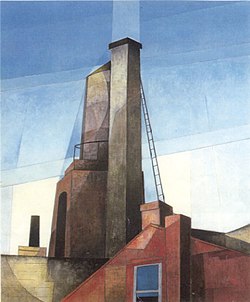
Charles Demuth, Aucassin and Nicolette, oil on canvas, 1921

Precisionism was a modernist art movement that emerged in the United States after World War I. Influenced by Cubism, Purism, and Futurism, Precisionist artists reduced subjects to their essential geometric shapes, eliminated detail, and often used planes of light to create a sense of crisp focus and suggest the sleekness and sheen of machine forms. At the height of its popularity during the 1920s and early 1930s, Precisionism celebrated the new American landscape of skyscrapers, bridges, and factories in a form that has also been called "Cubist-Realism."[1] The term "Precisionism" was first coined in the mid-1920s, possibly by Museum of Modern Art director Alfred H. Barr[2] although according to Amy Dempsey the term "Precisionism" was coined by Charles Sheeler.[3] Painters working in this style were also known as the "Immaculates", which was the more commonly used term at the time.[4] The stiffness of both art-historical labels suggests the difficulties contemporary critics had in attempting to characterize these artists.

An American movement

[edit]
Charles Demuth, I Saw the Figure 5 in Gold, 1928, Metropolitan Museum of Art

While influenced by European modernist artistic movements like Cubism, Purism, and Futurism, Precisionism focused on the themes of industrialization and modernization in the American landscape, using precise, sharply defined geometrical forms. Precisionist artists embraced their American identity and some were reluctant to acknowledge European artistic influences.[5]

There is a degree of reverence for the industrial age in the movement, but social commentary was not fundamental to the style. Like Pop Art, Precisionism has on occasion been interpreted as a criticism of the de-natured society it portrays, though its artists did not often feel comfortable with this reading of their work. Elsie Driggs' Pittsburgh (1926) illustrates this gap in perception.[6] A painting of black and gray steel-mill smokestacks, thick piping, and crisscrossing wires, with only clouds of smoke to relieve the severity of the image, viewers have been tempted to see this dark painting as a statement of environmental concern. To the contrary, Driggs always claimed that she intended an ironic beauty in the image and referred to it as "my El Greco." Upon seeing the painting, Charles Daniel dubbed her "one of the new classicists."[7] More often than not, Precisionism implicitly celebrated man-made dynamism and new technologies. Possible exceptions to this statement are some of the darker, more claustrophobic city paintings of Louis Lozowick and the comic anti-capitalist satires of Preston Dickinson.

Varying degrees of abstraction are found in Precisionist works. The Figure 5 in Gold (1928) by Charles Demuth, an homage to William Carlos Williams' imagist poem about a fire truck is abstract and stylized, while the paintings of Charles Sheeler sometimes verge on a form of photorealism. (In addition to his meticulously detailed paintings like River Rouge Plant and American Landscape, Sheeler, like his friend Paul Strand, also created sharply focused photographs of factories and public buildings.[8]) Some Precisionist works tended toward a "highly controlled approach to technique and form" as well as an application of "hard-edged style to long-familiar American scenes".[9]

Precisionist artists often focused on urban imagery: office towers, apartment houses, bridges, tunnels, subway platforms, streets, the skyline and grid of the modern city. Other artists, however, such as Georgia O'Keeffe, Charles Demuth, Niles Spencer, Ralston Crawford, Sanford Ross, and Charles Sheeler, applied the same approach to more pastoral settings and painted starkly geometric renderings of barns, cottages, country roads, and farm houses. Stuart Davis and Gerald Murphy painted still life compositions in a Precisionist style.

Precisionists

[edit]
Paul Strand, Wall Street, 1915

American artists whose work has been labeled as reflective of Precisionism include: Anna Held Audette,[10] George Ault, Ralston Crawford, Francis Criss, Stuart Davis, Charles Demuth, Georgia O'Keeffe, Preston Dickinson, Elsie Driggs, Louis Lozowick, Gerald Murphy, Charles Sheeler, Niles Spencer, Morton Schamberg, Joseph Stella,[11] Charles Rosen, Dale Nichols, Millard Sheets,[12]Edward Hopper, Virginia Berresford, Henry Billings, Peter Blume, Stefan Hirsch, Edmund Lewandowski, John Storrs, Miklos Suba, Sandor Bernath, Herman Trunk, Arnold Wiltz, Clarence Holbrook Carter, Edgar Corbridge and the photographers Paul Strand and Lewis Hine. The movement had no major presence outside the United States, although it did influence Australian art where Jeffrey Smart adopted its principles.[citation needed] Although no manifesto was ever created, some of the artists were friends and frequently exhibited at the same galleries. Georgia O'Keeffe's husband, photographer and art dealer Alfred Stieglitz, was a highly regarded mentor for the group and was especially supportive of Paul Strand.[citation needed]

Precisionism had an indirect influence on the later styles known as magic realism, pop art, and photorealism, but it was largely considered a dated "period style" by the 1950s, though its influence on advertising imagery and stage and set design continued throughout the twentieth century. Its two most famous practitioners are Charles Demuth and Charles Sheeler.[citation needed]

[edit]

References

[edit]

Bibliography

[edit]

Further reading

[edit]
[edit]
Revisions and contributorsEdit on WikipediaRead on Wikipedia
from Grokipedia
Precisionism is an early 20th-century American art movement characterized by depictions of industrial and urban landscapes rendered in sharp, geometric forms with clean lines, minimal detail, and a smooth, machined aesthetic that blends realism and . Emerging in the United States around 1915 and flourishing through the 1920s and 1930s, it celebrated the nation's rapid industrialization and technological progress while conveying a sense of cool detachment from modern machinery and . As America's first indigenous modernist style, Precisionism lacked a formal manifesto but reflected post-World War I optimism and , focusing on subjects like factories, skyscrapers, bridges, and grain elevators to symbolize and progress. The movement's visual language drew from European influences such as , , and , which introduced geometric fragmentation and dynamism, as well as American straight photography by artists like and , emphasizing crisp clarity and objective precision. Precisionist works typically feature simplified compositions with bold outlines, flattened perspectives, and a reduction of forms to essential shapes, often excluding human figures to highlight the impersonal scale of the . This approach created a stylized realism that evoked both admiration for innovation and subtle unease about mechanization's dehumanizing effects, as seen in paintings that transform everyday industrial scenes into harmonious, almost utopian visions. Prominent Precisionists included Charles Sheeler, known for his precise renderings of factories and barns like Classic Landscape (1931); Charles Demuth, who abstracted industrial motifs in works such as My Egypt (1927); and Georgia O'Keeffe, whose early urban paintings like New York, Night (1929) incorporated Precisionist elements before shifting to natural forms. Other key figures were Joseph Stella, with his dynamic views of the Brooklyn Bridge; Preston Dickinson; Elsie Driggs; and Ralston Crawford, who extended the style into the 1940s with even more abstracted urban scenes. These artists, often based in New York, exhibited through galleries like Alfred Stieglitz's 291 and institutions such as the Museum of Modern Art, where curator Alfred H. Barr coined the term "Precisionism" in the 1920s. By the late 1930s, Precisionism waned amid the and , as societal anxieties about technology intensified, but its legacy endured in influencing Abstract Expressionism's formal rigor, Pop Art's celebration of consumer culture, and even commercial design. The movement's emphasis on American iconography and precise abstraction helped bridge European modernism with a distinctly national voice, underscoring the ' transition into a modern industrial power.

History

Origins and Influences

Precisionism emerged in the aftermath of , amid a period of rapid economic expansion and cultural transformation that positioned America as an industrial powerhouse. The played a pivotal role in this context, introducing American audiences to European modernism—including avant-garde styles from and —for the first time on a large scale, challenging traditional artistic norms and inspiring a generation of artists to engage with abstraction and modernity. The movement drew significant inspiration from European art movements, adapting their formal innovations to American subjects. , pioneered by and , contributed geometric fragmentation and multi-perspective views that Precisionists reinterpreted for depictions of urban structures. , advocated by and Amédée Ozenfant, influenced the emphasis on clean, precise lines and harmonious proportions, emphasizing machine-like clarity. , led by artists like , infused dynamism and a celebration of technological speed, particularly in rendering the motion of industrial machinery. Alfred Stieglitz's Gallery 291 in New York served as a crucial nexus for these ideas from 1905 to 1917, exhibiting works by European modernists such as Cézanne, Picasso, and Matisse, while fostering a community of American artists through mentorship and discourse. This gallery bridged transatlantic influences, encouraging early adopters to explore in response to America's burgeoning industrialization during the and , marked by the proliferation of , assembly lines, and factories symbolizing progress and urban expansion. Early precursors to Precisionism appeared in the works of artists like Morton Schamberg, whose machine-inspired paintings from 1916 to 1918—such as depictions of parts and wire-stitching machines—blended Cubist abstraction with precise renderings of industrial forms, laying foundational groundwork for the movement's aesthetic.

Development and Peak

Precisionism gained momentum in the 1920s as an informal network of artists centered in New York, including figures like Charles Sheeler, , and , who coalesced around a shared emphasis on geometric precision and modern subjects without issuing a formal or organizing as an official group. The term "Precisionism" was first used in 1927 by Alfred H. Barr, founding director of the , in a published review of the artists' works. This loose affiliation extended to galleries such as the Whitney Studio Club and Charles Daniel Gallery, where works were exhibited together, fostering visibility amid the burgeoning American modernist scene. Key exhibitions marked the movement's consolidation, including the 1922 Society of Independent Artists annual show in New York, which prominently featured Precisionist paintings depicting industrial and urban forms. Further momentum came from the 1927 Machine-Age Exposition in New York, organized by the Société Anonyme to celebrate technological progress, and the 1925 Exposition Internationale des Arts Décoratifs et Industriels Modernes in , where American Precisionist influences intersected with international design trends. These events highlighted the style's alignment with the era's fascination with machinery and efficiency, drawing attention from critics and patrons like and . The movement's evolution reflected the shifting economic and social landscape of the Roaring Twenties, with its booming industrialization inspiring optimistic, celebratory portrayals of factories and skyscrapers, contrasted by the introspective, streamlined compositions that emerged during the Great Depression's hardships in the 1930s. Artist interconnections underscored this period's dynamism, as seen in the 1920 collaboration between Sheeler and Paul Strand on the avant-garde film Manhatta, which blended photography and cinematic abstraction to capture New York's urban geometry, influencing subsequent Precisionist explorations of form across media. Precisionism reached its peak output between approximately 1925 and 1935, during which artists produced serial works delving into industrial motifs, such as Sheeler's 1927 commission yielding 32 photographs of Ford's River Rouge plant, methodically documenting its vast mechanical structures to emphasize rhythmic patterns and monumental scale. This intensive phase solidified the movement's focus on America's machine-age identity, with repeated studies of , bridges, and assembly lines exemplifying a contemplative engagement with technological transformation.

Decline and Evolution

The onset of the in the late 1920s profoundly impacted Precisionism, as economic hardship redirected artistic attention toward , which emphasized the struggles of everyday amid widespread and . This shift was exacerbated by , which introduced new influences from European émigrés fleeing , including and Constructivist principles that further marginalized Precisionism's machine-age optimism in favor of more socially engaged or abstract expressions. By the 1940s and 1950s, Precisionism was increasingly viewed as dated within the evolving American art scene, overshadowed by the rise of , which prioritized emotional spontaneity over geometric precision. Artists associated with the movement, such as , transitioned toward pure abstraction during this period, moving away from the urban industrial themes that had defined Precisionist works in the preceding decades. Precisionism evolved into hybrid forms during its waning years, blending with magic realism—as seen in the works of Peter Blume, who incorporated Precisionist clarity into surreal, dreamlike compositions—and regionalism, where artists like George Ault applied sharp geometric techniques to rural American subjects. In the post-war era, Precisionist aesthetics permeated commercialization without formal artistic acknowledgment, influencing and through streamlined forms and clean geometries that echoed the movement's celebration of . The last major groupings of Precisionist artists dissolved around 1940, though isolated works in the style persisted into the 1950s among practitioners who retained its core .

Characteristics

Visual Style

Precisionism emphasizes sharp edges, geometric simplification, and crystalline forms, reducing subjects to essential planes and volumes that underscore underlying structures. Artists achieved this through clear outlines and minimal detail, creating compositions that prioritize form over complexity. The style employs hard-edged techniques with smooth surfaces, minimal shading, and to convey precision and clarity. These elements produce a polished, almost machine-like quality, where transitions between shapes are abrupt and unmodulated. Light and shadow are rendered as flat, luminous planes rather than gradual modeled gradients, fostering a sense of stasis and timelessness. This approach enhances the geometric purity, making forms appear suspended in an eternal, unchanging . Levels of vary within the movement, from near-photorealistic depictions to semi-abstract patterns, frequently incorporating and repetition for rhythmic emphasis. Such variations allow for a spectrum of interpretive depth while maintaining formal rigor. Technical execution often utilizes with fine brushwork, influenced by photography's crisp focus to attain heightened detail and . This method ensures surfaces remain untextured and impeccably finished, aligning with the movement's pursuit of objective exactitude.

Themes and Subjects

Precisionist works predominantly featured subjects drawn from the American landscape, emphasizing urban industrialization through depictions of factories, bridges, , steel mills, and mines, which symbolized the nation's rapid technological advancement. Rural scenes, including barns, silos, and , also appeared frequently, highlighting regional traditions alongside modern mechanization and tying into broader themes of national progress. These subjects often appeared in depopulated compositions, where machines and structures took precedence over human figures, conveying a sense of at industrial scale while evoking subtle alienation in the . The movement celebrated modernity as a utopian force, portraying technology's efficiency, speed, and cleanliness as triumphs of American ingenuity, particularly in the post-World War I economic boom. Yet, a dual undercurrent emerged, especially in Depression-era pieces from , blending optimism about technological expansion with quiet critiques of , worker displacement, and environmental . American icons such as grain elevators and railroads served as emblems of national expansion and identity, integrating industrial motifs with symbols of and economic vitality. Figurative elements, when present, were rare and heavily abstracted, prioritizing structural forms over narrative details to maintain focus on the geometric essence of progress rather than individual stories.

Key Artists

Charles Sheeler and Charles Demuth

Charles Sheeler (1883–1965) was a pivotal figure in Precisionism, renowned for his dual expertise in photography and painting, which he developed after training at the School of Industrial Art in Philadelphia (1900–1903) and the Pennsylvania Academy of the Fine Arts (1903–1906). As a self-taught photographer, Sheeler documented local architecture and rural subjects with sharp clarity, later incorporating Cubist influences to abstract forms while maintaining photorealistic precision. His paintings often blended these elements, as seen in Upper Deck (1929), an oil on canvas derived from a photograph of the S.S. Majestic's deck, where Sheeler integrated structural abstraction into a realistic depiction, stating that "a picture could have incorporated in it the structural design implied in abstraction and be presented in a wholly realistic manner." Similarly, American Landscape (1930), also in oil on canvas, portrayed industrial silos and factories against a rural backdrop, exemplifying his fusion of geometric abstraction and precise rendering to celebrate American machinery. In 1920, Sheeler collaborated with photographer Paul Strand on the short film Manhatta (1921), a visual portrait of Manhattan's skyline that emphasized abstract urban geometries through dramatic viewpoints, marking an early multimedia exploration of Precisionist themes. Charles Demuth (1883–1935) contributed significantly to Precisionism through his mastery of watercolor and later oils, focusing on industrial subjects from his native Lancaster, Pennsylvania. Renowned for his precise, translucent watercolors of flowers and urban scenes, Demuth shifted to oils in the 1920s for larger-scale industrial depictions, incorporating Cubist fragmentation to distill architecture into geometric planes. His industrial series culminated in works like My Egypt (1927), an oil on composition board portraying a monumental grain elevator with intersecting lines and subtle floral motifs evoking ancient pyramids, thereby humanizing machinery through symbolic integration. Cubism's influence is evident in Buildings, Lancaster (1930), an oil and graphite on composition board that abstracts local facades into sharp, angular forms with spatial ambiguity in the lower corners, emphasizing clean lines over naturalistic detail. Sheeler and Demuth exerted mutual influence during the , sharing a commitment to geometric simplicity and American subjects that helped define Precisionism's core of crisp outlines, minimal shading, and abstracted industrial forms. They exhibited together at the Daniel Gallery in , a hub for the movement, alongside artists like Niles Spencer, which amplified their collective impact on portraying modernity's rational order. Sheeler extended his Precisionist approach into commercial work with his 1927 commission from an to photograph Ford Motor Company's River Rouge plant, a sprawling 2,000-acre complex near that symbolized industrial scale. The resulting images of conveyors and furnaces, later inspiring paintings like River Rouge Plant (1932), applied photorealistic detail to geometric compositions, framing the factory as a "cathedral" of progress while eliding human labor. Demuth's productivity was curtailed by lifelong health issues, including a childhood hip injury causing a permanent limp and a 1921 diagnosis that necessitated experimental treatments like insulin and restrictive diets. These struggles led to frequent hospitalizations and reduced output in his later years, culminating in his death on October 23, 1935, at age 51 from complications. Despite this, his focused oeuvre of Precisionist oils and watercolors, preserved through efforts by contemporaries like , cemented his legacy as a pioneer in blending personal symbolism with industrial .

Georgia O'Keeffe and Other Painters

(1887–1986) contributed to Precisionism during her early phase in 1920s New York, where she depicted urban skyscrapers with sharp, geometric forms and luminous contrasts that echoed the movement's emphasis on modernity and structure. Her painting New York, Night (1928–1929), featuring the illuminated Radiator Building against a dark sky, exemplifies this style through its reduced forms and nocturnal glow, capturing the city's machine-like energy. This period was shaped by her mentorship under , her husband and a key promoter of modernist art, who exhibited her work at his Gallery 291 and encouraged explorations of American industrial subjects influenced by . By the 1930s, shifted away from strict Precisionism toward organic abstraction, increasingly drawing inspiration from the Southwest after her first visits to in 1929. Her focus turned to natural forms like bleached bones and vast desert landscapes, as seen in works such as Cow's Skull: Red, White, and Blue (1931), marking a divergence from urban geometries to more fluid, personal expressions of the American terrain. Among other painters, Elsie Driggs (1898–1992) stood out for her industrial scenes, particularly (1927), which portrays glowing steel mills with angular silhouettes and vibrant lights, highlighting the movement's fascination with . As one of the few women in Precisionism, Driggs's contributions underscored the underrepresentation of female artists in the group, where male figures dominated exhibitions and critical attention. Louis Lozowick (1892–1973) advanced the style through his 1920s lithographs, such as New York (1926), rendering urban machinery and skyscrapers in stark, monochromatic lines that emphasized mechanical precision and rhythm. Ralston Crawford (1906–1978) brought a second-generation intensity to Precisionism in the 1930s with his stark depictions of ports and infrastructure, like Coal Elevators (1938), which abstracts industrial forms into bold, planar compositions evoking the scale of American commerce. Niles Spencer (1893–1952) introduced regional variations, focusing on Midwestern industrial and rural structures in paintings such as Porch of the Barn (c. ), where geometric barns and sheds convey a quieter, more intimate take on everyday American architecture. These artists, including underrepresented women like Driggs and , participated in loose centered around shared galleries and influences, though regional focuses—from urban Northeast to Midwestern heartland—added diversity to the movement's scope. Precisionist painters gained indirect visibility through broader exhibitions celebrating American themes, such as the 1931 American Folk Art show at the Museum of Modern Art, which revived interest in vernacular motifs and paralleled the movement's celebration of national identity and craftsmanship.

Photographers and Peripheral Contributors

Paul Strand (1890–1976), a pioneer of straight photography, significantly influenced Precisionist painters through his precise, unmanipulated depictions of urban and industrial subjects that emphasized geometric forms and stark clarity. His 1915 photograph Wall Street, a platinum palladium print capturing the abstracted movement of crowds and architecture in lower Manhattan, exemplified this approach by reducing the bustling scene to rhythmic, machine-like patterns of suits and shadows. Strand's collaboration with Charles Sheeler on the 1920 experimental film Manhatta further bridged photography and Precisionism, documenting New York City's skyscrapers and harbors in a detached, rhythmic style that inspired painters to hybridize rural and industrial motifs. Charles Sheeler, primarily known as a painter, also played a pivotal role as a whose work directly informed Precisionist by translating industrial subjects into sharply focused, geometric compositions that blurred the lines between media. In 1927, commissioned by an advertising agency, Sheeler produced a series of photographs of the Ford Motor Company's River Rouge plant near , including Criss-Crossed Conveyors, which highlighted the plant's vast machinery and conveyor belts in a clean, abstract manner devoid of human figures to emphasize mechanical harmony. These images, with their luminous precision and elimination of extraneous detail, served as source material for Sheeler's own paintings like River Rouge Plant (1932) and influenced the movement's visual language across disciplines. Photographers like contributed indirectly to Precisionism by documenting America's industrial landscape, providing visual references that painters adapted into stylized forms. Hine's early 20th-century images of factory workers and machinery, such as Power House Mechanic (1920), captured the scale and grit of industrial labor, offering compositional ideas of and that Precisionists refined into idealized, geometric celebrations of modernity. Among peripheral contributors, Joseph Stella infused Precisionism with Futurist dynamism in works like The Brooklyn Bridge: Variation on an Old Theme (1939), an oil painting that rendered the bridge's cables and towers as interlocking geometric planes with vibrant, angular energy borrowed from Italian Futurism. Edward Hopper exhibited realist overlaps with Precisionism through his precise renderings of urban architecture and isolation, as in House by the Railroad (1925), but maintained a more narrative, moody detachment without fully embracing the movement's abstract geometry or industrial optimism. Gerald Murphy, a marginal figure, brought a decorative flair to industrial scenes in paintings like Watch (1925), where he depicted mechanical objects with immaculate, flattened forms and jewel-like colors, innovating within Precisionism's framework during his brief but impactful career in the 1920s. Internationally, echoes appeared in later interpretations, such as those by Anna Held Audette (1938–2013), an American precisionist who, in the post-1950s era, painted monumental industrial ruins like scrapped machinery and factories with sharp edges and scaled forms, extending the movement's focus on obsolescence and structure.

Legacy and Influence

Impact on Later Art Movements

Precisionism's emphasis on geometric clarity, industrial subjects, and machine aesthetics left a lasting imprint on subsequent movements, extending its visual language into diverse practices that celebrated modernity and form. The movement's celebration of mechanical precision and commercial imagery resonated in of the 1960s, where artists like adopted clean graphics and a reverence for machine-produced objects, echoing Precisionism's fusion of abstract form with everyday icons. For instance, Charles Demuth's typographic compositions, such as I Saw the Figure 5 in Gold (1928), prefigured Pop's integration of advertising motifs and serial repetition, influencing Warhol's soup can series through their shared graphic boldness and critique of consumer culture. This stylistic continuity highlighted Precisionism's role as a bridge to Pop's ironic embrace of . Precisionism's hyper-detailed rendering of urban and industrial scenes found echoes in the of the 1970s, particularly in Richard Estes's meticulous depictions of cityscapes that prioritized optical accuracy and reflective surfaces. Estes's technique has been described as precisionist for its uncanny clarity in capturing modern environments, extending the earlier movement's focus on structural precision to photographic realism without overt . This connection underscored how Precisionism paved the way for 's emphasis on perceptual fidelity in representing technological landscapes. In Magic Realism of the 1940s and 1950s, Precisionism contributed its crystalline clarity to works that blended everyday realism with surreal undertones, as seen in Ivan Albright's hyper-detailed portraits that mortified the flesh through meticulous, almost mechanical rendering. Albright's style merged Precisionist sharpness with gothic elements, creating a sense of eerie precision that amplified the in ordinary subjects. This synthesis helped define Magic Realism's tension between the tangible and the fantastical, drawing on Precisionism's disciplined visual order. Beyond , Precisionism shaped advertising and , particularly in the , where corporate imagery embraced its geometric simplicity and streamlined forms to convey efficiency and modernity. Artists like Louis Lozowick, a key Precisionist, directly engaged with commercial graphics, influencing the era's posters and branding that reduced industrial motifs to bold, unadorned shapes for visual impact. This legacy persisted in mid-century design's clean lines, mirroring Precisionism's aesthetic of order in promotional materials.

Exhibitions and Modern Recognition

One of the pivotal historical exhibitions dedicated to Precisionism was "Precisionism in America, 1915–1941: Reordering Reality," organized by the Montclair Art Museum in 1994, which featured over 60 works by leading artists and emphasized the movement's role in reinterpreting industrial modernity through . This retrospective, accompanied by a catalog edited by Gail Stavitsky, highlighted the stylistic precision and thematic focus on American industry, drawing from private and public collections to underscore the movement's underappreciated contributions to . In 2007, The published a scholarly on Precisionism, further solidifying its curatorial recognition by analyzing key works and their geometric underpinnings, which helped integrate the style into broader narratives of 20th-century American art. Major modern collections preserve significant Precisionist holdings, with the (MoMA) owning iconic pieces such as Charles Sheeler's American Landscape (1930), exemplifying the movement's crisp industrial depictions. The Whitney Museum of American Art maintains a robust ensemble, including works by and , reflecting Precisionism's centrality to in its permanent collection of over 21,000 artworks. The also holds notable examples, such as Ralston Crawford's Buffalo Grain Elevators (1937), supporting ongoing research into the movement's urban and mechanical themes. Recent acquisitions in the have enriched these holdings; for instance, Crystal Bridges Museum of American Art purchased Elsie Driggs's Blast Furnaces (1927) in 2017, bringing renewed attention to female Precisionists. In the , revivals have connected Precisionism to contemporary issues like industrial legacy and environmental critique, as seen in the 2018 exhibition "Cult of the Machine: Precisionism and American Art" at the Fine Arts Museums of San Francisco's and the , which displayed over 100 works and explored the movement's fascination with amid modern discussions. Scholarly recognition has deepened through publications like Ashley Lazevnick's Fantasies of Precision: American Modern Art, 1908–1947 (2023), which reexamines the movement's cultural implications, and digital archives such as the Smithsonian's Archives of American Art, which provide accessible oral histories and documents enhancing public engagement. Post-2010 analyses have addressed historical gaps by emphasizing , including O'Keeffe's Precisionist-leaning landscapes and Driggs's industrial scenes, within feminist art history frameworks that highlight gender dynamics in early modernism.

References

Add your contribution
Related Hubs
User Avatar
No comments yet.