Hubbry Logo
GlipizideGlipizideMain
Open search
Glipizide
Community hub
Glipizide
logo
8 pages, 0 posts
0 subscribers
Be the first to start a discussion here.
Glipizide
Glipizide
from Wikipedia

Glipizide
Clinical data
Trade namesGlucotrol, Glucotrol XL, others
AHFS/Drugs.comMonograph
MedlinePlusa684060
License data
Pregnancy
category
  • AU: C
Routes of
administration
By mouth
Drug classSulfonylurea
ATC code
Legal status
Legal status
Pharmacokinetic data
Bioavailability100% (regular formulation)
90% (extended release)
Protein binding98 to 99%
MetabolismLiver hydroxylation
Elimination half-life2 to 5 hours
ExcretionKidney and fecal
Identifiers
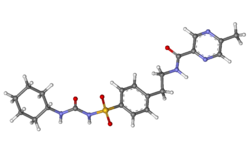
  • N-(4-[N-(cyclohexylcarbamoyl)sulfamoyl]phenethyl)-5-methylpyrazine-2-carboxamide
CAS Number
PubChem CID
IUPHAR/BPS
DrugBank
ChemSpider
UNII
KEGG
ChEBI
ChEMBL
CompTox Dashboard (EPA)
ECHA InfoCard100.044.919 Edit this at Wikidata
Chemical and physical data
FormulaC21H27N5O4S
Molar mass445.54 g·mol−1
3D model (JSmol)
Melting point208 to 209 °C (406 to 408 °F)
  • O=C(c1ncc(nc1)C)NCCc2ccc(cc2)S(=O)(=O)NC(=O)NC3CCCCC3
  • InChI=1S/C21H27N5O4S/c1-15-13-24-19(14-23-15)20(27)22-12-11-16-7-9-18(10-8-16)31(29,30)26-21(28)25-17-5-3-2-4-6-17/h7-10,13-14,17H,2-6,11-12H2,1H3,(H,22,27)(H2,25,26,28) checkY
  • Key:ZJJXGWJIGJFDTL-UHFFFAOYSA-N checkY
 ☒NcheckY (what is this?)  (verify)

Glipizide, sold under the brand name Glucotrol among others, is an anti-diabetic medication of the sulfonylurea class used to treat type 2 diabetes.[1][2] It is used together with a diabetic diet and exercise.[1][2] It is not indicated for use by itself in type 1 diabetes.[1][2] It is taken by mouth.[1][2] Effects generally begin within half an hour and can last for up to a day.[1]

Common side effects include nausea, diarrhea, low blood sugar, and headache.[1] Other side effects include sleepiness, skin rash, and shakiness.[3] The dose may need to be adjusted in those with liver or kidney disease.[1] Use during pregnancy or breastfeeding is not recommended.[3] It works by stimulating the pancreas to release insulin and increases tissue sensitivity to insulin.[1]

Glipizide was approved for medical use in the United States in 1984.[1] It is available as a generic medication.[1] In 2023, it was the 42nd most commonly prescribed medication in the United States, with more than 15 million prescriptions.[4][5]

Mechanism of action

[edit]

Glipizide sensitizes the beta cells of pancreatic islets of Langerhans insulin response, meaning that more insulin is released in response to glucose than would be without glipizide ingestion.[2] Glipizide acts by partially blocking potassium channels among beta cells of pancreatic islets of Langerhans. By blocking potassium channels, the cell depolarizes, which results in the opening of voltage-gated calcium channels. The resulting calcium influx encourages insulin release from beta cells.[6]

History

[edit]

It was patented in 1969, and approved for medical use in 1971.[7] Glipizide was approved for medical use in the United States in 1984.[1]

Synthesis

[edit]

Synthesis of glipizide:[8][9] Alternative:[10] Cmp#3:[11] Related article:[12]

5-Methylpyrazine-2-carboxylic acid [5521-55-1] (1) is converted to its acid chloride. A Schotten-Baumann reaction is then performed with 4-(2-aminoethyl)benzene sulfonamide [35303-76-5] (2) to give the corresponding amide PC9883549 [33288-71-0] (3). This forms glipizide on reaction with cyclohexylisocyanide and base in acetone.

References

[edit]
Revisions and contributorsEdit on WikipediaRead on Wikipedia
from Grokipedia
Glipizide is a second-generation oral antidiabetic FDA-approved for the treatment of mellitus in adults as an adjunct to diet and exercise. It belongs to the class of drugs that stimulate insulin release from pancreatic beta cells to lower blood glucose levels. Chemically known as 1-cyclohexyl-3-[[p-[2-(5-methylpyrazinecarboxamido)ethyl]phenyl]sulfonyl], it has the molecular formula C21H27N5O4S and a molecular weight of 445.5 g/mol. Glipizide works by binding to receptors on the surface of pancreatic beta cells, blocking ATP-sensitive potassium channels, which leads to membrane depolarization, calcium influx, and subsequent insulin secretion. This mechanism is dependent on functioning beta cells and helps reduce hepatic glucose production while improving peripheral insulin sensitivity. It is available in immediate-release tablets (typically 5 mg or 10 mg, taken 30 minutes before the first meal) and extended-release tablets (2.5 mg to 20 mg, taken once daily with breakfast), with dosing starting at 5 mg daily for immediate-release forms (maximum 40 mg per day) or extended-release forms (maximum 20 mg per day), titrated based on glycemic response. Common brand names include Glucotrol and Glucotrol XL. The medication is contraindicated in patients with , , or hypersensitivity to . Use with caution in patients with severe renal or hepatic impairment. Common adverse effects include , , gastrointestinal upset such as and , and dermatologic reactions like . Monitoring involves regular assessment of plasma glucose, HbA1c levels every , renal and hepatic function, and body weight to ensure efficacy and safety. Glipizide may interact with drugs like beta-blockers, NSAIDs, or alcohol, potentially affecting blood glucose control, and caution is advised in elderly patients or those with due to risks of prolonged .

Medical Uses

Indications

Glipizide is indicated as an adjunct to diet and exercise to improve glycemic control in adults with mellitus. It is not approved for the management of or , conditions for which insulin therapy remains the . Although glipizide belongs to the class, which stimulates insulin release from pancreatic beta cells, its use is limited to established where endogenous insulin production is present but insufficient. Potential off-label applications, such as in or , lack robust clinical evidence and are not recommended as standard therapy; for , data on glipizide are particularly sparse, with other s like glyburide showing mixed outcomes but also not endorsed as first-line. Clinical guidelines from the (ADA) position glipizide and other second-generation as effective second-line oral therapies for , typically following metformin initiation, particularly in patients requiring affordable options with demonstrated reductions in hemoglobin A1c levels. Similarly, (WHO) recommendations endorse as part of pharmacologic management for in resource-limited settings, aligning with glipizide's role in enhancing glycemic control when lifestyle interventions alone are inadequate.

Dosage Forms and Administration

Glipizide is available in immediate-release (IR) tablets in strengths of 2.5 mg, 5 mg, and 10 mg, as well as extended-release (ER) tablets in strengths of 2.5 mg, 5 mg, and 10 mg, all for . For the immediate-release formulation, the recommended initial dose in adults is 5 mg orally once daily, taken approximately 30 minutes before the first meal of the day to optimize postprandial glycemic control. In geriatric patients or those with hepatic impairment, initiation at 2.5 mg once daily is advised to reduce the risk of . Dosage should occur in increments of 2.5 mg to 5 mg every several days, guided by , with doses exceeding 15 mg per day divided into two administrations before the morning and evening meals. The maximum recommended total daily dose is 40 mg. For the extended-release formulation, the initial dose is 5 mg orally once daily, administered with or the first main meal of the day. As with the IR form, a starting dose of 2.5 mg is recommended for geriatric patients or those at higher risk for . involves increases of up to 5 mg at intervals of at least one week, based on glycemic response assessed through plasma glucose levels. The maximum dose is 20 mg once daily, and tablets must be swallowed whole without chewing, dividing, or crushing to maintain the controlled-release mechanism. Blood glucose levels, including fasting plasma glucose and hemoglobin A1c, should be monitored periodically to guide dose adjustments and ensure adequate glycemic control in management. Glipizide is intended for long-term use as part of a comprehensive treatment regimen, with ongoing to assess the need for continued .

Pharmacology

Mechanism of Action

Glipizide is a second-generation that lowers blood glucose primarily by stimulating insulin secretion from pancreatic s. It binds to the sulfonylurea receptor 1 (SUR1) subunit of ATP-sensitive potassium (KATP) channels on the surface of pancreatic s. This binding inhibits the activity of the KATP channel, preventing potassium efflux and causing membrane . The subsequently activates voltage-gated calcium channels, leading to an influx of calcium ions into the . This rise in intracellular calcium triggers the of insulin-containing granules, thereby releasing insulin into the bloodstream. The insulinotropic action of glipizide is largely independent of ambient glucose levels, as the channel closure occurs regardless of glucose concentration, but it primarily augments insulin secretion when glucose levels are elevated, with reduced efficacy in hypoglycemic states due to the modulation of KATP channel activity by glucose metabolism. In addition to its primary effects on beta cells, glipizide exhibits extrapancreatic actions, including a reduction in hepatic glucose output and an enhancement of peripheral insulin sensitivity, which contribute to its overall antidiabetic .

Pharmacokinetics

Glipizide is rapidly and completely absorbed from the following , exhibiting an absolute of approximately 100%. For the immediate-release formulation, peak plasma concentrations are typically reached within 1 to 3 hours after dosing, while the extended-release formulation achieves peak levels in 6 to 12 hours due to its design for controlled release. The extended-release tablets employ an osmotic pump mechanism, featuring an osmotically active core encased in a with a laser-drilled orifice, which facilitates steady-state over 24 hours. Food intake delays the time to peak concentration for the immediate-release form by about 40 minutes but does not significantly alter the overall extent of absorption; administration 30 minutes before meals is recommended to optimize . Upon absorption, glipizide distributes primarily within the , with an apparent of about 10 to 11 liters. The is extensively bound to plasma proteins, particularly , at levels of 98% to 99%, which influences its availability in tissues. Glipizide undergoes extensive hepatic , predominantly mediated by the enzyme , resulting in inactive metabolites such as hydroxylated derivatives and polar conjugates; no pharmacologically active metabolites are produced. The elimination ranges from 2 to 5 hours, with less than 10% of the parent excreted unchanged in or . Metabolites are primarily eliminated via the kidneys (approximately 80%) and to a lesser extent through (about 10%), and clearance may be reduced in patients with hepatic impairment due to slowed and .

Adverse Effects

Common Adverse Effects

Glipizide, a used to manage , is associated with several common adverse effects that are typically mild and self-limiting. These effects primarily involve the , metabolic changes, blood glucose regulation, skin, and , occurring in a minority of patients during treatment. Gastrointestinal disturbances are among the most frequently reported side effects, including , , , and , affecting approximately 2-5% of users overall. In clinical trials of the extended-release formulation, occurred in 5.4% of patients, in 3.2%, and other symptoms such as , , and dyspepsia in less than 3%. These effects are often transient and may resolve with continued use or dose adjustment. Weight gain is a common metabolic effect linked to glipizide's of insulin , which promotes anabolic processes. Patients typically an average increase of 1-3 kg during the first year of . For instance, in a 52-week comparative study, glipizide treatment resulted in a mean of 1.2 kg, contrasting with observed in comparator groups. Regular monitoring of body weight is recommended to manage this effect. Mild episodes of , characterized by symptoms such as sweating, , and hunger, represent another frequent concern, with incidences reported in clinical trials around 3%, particularly with the extended-release form at 3.4% (defined as blood glucose <60 mg/dL or symptomatic), though rates can increase with combination therapies or improper dosing. data for the extended-release form report in 3.4% of patients, with discontinuation due to this effect in 2.6%. These episodes are usually manageable with oral carbohydrates and do not typically require medical intervention. Dermatological reactions, such as or pruritus, are less common, occurring in fewer than 1% of patients. In controlled studies, or urticaria was reported in <1.5% of glipizide users. These skin manifestations are generally mild and resolve upon discontinuation if necessary. Nervous system effects, including and , are transient and affect about 2% of patients each. was noted in 6.8% and in 3.6% in extended-release trial data, while immediate-release formulations report , , and drowsiness each in approximately 1 in 50 patients (2%). These symptoms seldom lead to treatment cessation and often diminish over time.

Serious Adverse Effects

Glipizide, like other , can cause severe , characterized by symptoms such as , seizures, and , particularly in cases of overdose or when renal function is impaired, as these factors prolong the drug's and enhance its hypoglycemic effects. Risk is heightened in patients with renal failure due to reduced clearance, and treatment involves immediate administration of oral or intravenous glucose, with monitoring for at least 24 to 48 hours to prevent recurrence. In clinical trials, symptomatic occurred in approximately 3.4% of patients, though severe episodes leading to discontinuation were less common at 2.6%. Rare allergic reactions to glipizide include and Stevens-Johnson , with the latter documented in isolated case reports following dosage increases, occurring at an incidence below 0.1%. is contraindicated, and management requires immediate discontinuation of the drug and supportive care, such as corticosteroids or antihistamines for . Hematologic adverse effects, including and , are idiosyncratic and have been reported postmarketing, particularly in patients with (G6PD) deficiency, though cases also occur without this predisposition. These events are rare, with no quantified incidence in large trials, and necessitate prompt hematologic evaluation and drug withdrawal. Hepatic effects from glipizide include cholestatic , reported rarely in as cholestatic or hepatocellular , warranting monitoring of (LFTs) in at-risk patients. Mild elevations in LFTs such as ALT and alkaline phosphatase were observed in trials but were not definitively linked to the drug. Cardiovascular risks associated with glipizide include a potential increased incidence of in susceptible patients, drawn from older data like the University Group Diabetes Program study showing elevated mortality, and more recent analyses indicating a 13% higher risk of major events compared to dipeptidyl peptidase-4 inhibitors. Patients with preexisting should be monitored closely, as may exacerbate through fluid retention or ischemic mechanisms.

Contraindications and Interactions

Contraindications

Glipizide is contraindicated in patients with mellitus and , with or without coma, as these conditions require treatment with insulin. It is also contraindicated in individuals with known to glipizide, other , or any components of the formulation. Additionally, glipizide should not be used in patients with a history of to derivatives due to potential . Glipizide is contraindicated in patients with G6PD deficiency due to the risk of . In patients with renal impairment, glipizide use requires caution owing to an elevated risk of prolonged from reduced drug clearance; initiate at reduced doses with close monitoring, though no specific threshold contraindicates use. Alternatives are generally preferred in severe cases (e.g., eGFR below 30 mL/min/1.73 m² per some guidelines). For hepatic impairment, such as , use glipizide with caution because of the potential for decreased leading to excessive drug accumulation and ; conservative dosing and monitoring are advised. Risk summary for pregnancy: There are no adequate data regarding the developmental risks associated with glipizide use in pregnant women. In animal reproduction studies, no adverse developmental effects were observed. Sulfonylureas cross the and may cause ; thus, glipizide should only be used if the potential benefit justifies the potential risk to the . Insulin is the preferred agent for glycemic control in , and glipizide should be discontinued at least two weeks prior to expected delivery to minimize . In breastfeeding, glipizide levels in human milk are low or undetectable based on limited data, but an alternative agent with more established safety is preferred, or the infant should be monitored for signs of such as jitteriness or if glipizide is continued.

Drug Interactions

Glipizide, a antidiabetic agent, is associated with numerous interactions that can potentiate , reduce its hypoglycemic efficacy, or alter its , necessitating careful monitoring and potential dose adjustments. A total of 497 known interactions have been identified, including major, moderate, and minor categories, with miconazole posing a particular risk of severe and often considered contraindicated in concurrent use. Certain medications potentiate glipizide's glucose-lowering effects, increasing the risk of . Beta-blockers can mask the symptoms of (such as ) while potentially prolonging recovery from it, requiring enhanced . Other antidiabetic agents, including insulin and metformin, amplify the hypoglycemic response when combined with glipizide, often necessitating dose reductions. Nonsteroidal anti-inflammatory drugs (NSAIDs) and alcohol also heighten this risk; alcohol consumption can unpredictably lower blood glucose levels, and patients are advised to avoid excessive intake. Drugs that antagonize glipizide's efficacy may induce and impair glycemic control. Rifampin accelerates glipizide , reducing its plasma concentrations and therapeutic effect. diuretics similarly counteract by promoting glucose intolerance, often requiring increased glipizide doses during co-administration. Pharmacokinetic interactions significantly influence glipizide's exposure. Inhibitors of , such as , elevate glipizide levels by inhibiting its ; for instance, increases glipizide's area under the curve (AUC) by approximately 57%, heightening risk. Glipizide's high protein binding (98-99%) leads to displacement interactions with , where glipizide may increase free concentrations, potentiating anticoagulation effects alongside . Fibrates, including , potentiate glipizide-induced and require dose adjustments with frequent to prevent adverse events. Overall, when initiating or modifying therapy with interacting agents, healthcare providers should adjust glipizide doses and monitor patients closely for glycemic changes.

Chemistry

Glipizide is an oral antidiabetic agent characterized by the molecular formula C21H27N5O4S and a molecular weight of 445.54 g/mol. Its systematic IUPAC name is N-[2-[4-[(cyclohexylcarbamoyl)sulfamoyl]phenyl]ethyl]-5-methylpyrazine-2-carboxamide. The core structure of glipizide consists of a moiety, -SO2-NH-CO-NH-, which serves as the typical of second-generation . This central unit is substituted at one nitrogen with a cyclohexyl group and at the sulfonyl-attached phenyl ring via a phenethyl linker to a 5-methylpyrazine-2-carboxamide , conferring specificity in its molecular interactions. The ring introduces heteroatoms that contribute to the compound's aromatic amide characteristics, while the overall scaffold includes elements of pyrazines, sulfonamides, and carboxamides. Glipizide lacks chiral centers, rendering the molecule achiral with no optical isomers.

Physical and Chemical Properties

Glipizide is a to off-white, odorless crystalline powder. Its melting point ranges from 208 to 209 °C. Glipizide exhibits low aqueous solubility, being practically insoluble in (approximately 0.0184 g/L at 25 °C) and in alcohols, which classifies it as a (BCS) Class II . It is sparingly soluble in acetone and , soluble in (1.9 mg/mL), and freely soluble in and 0.1 N . The compound has a pKa of 5.9, indicating weak acidity that influences its and profile in physiological environments. Glipizide demonstrates high stability as a solid at under normal conditions, though it should be protected from light and moisture to prevent degradation. Due to its poor water solubility, glipizide is primarily formulated as immediate-release or extended-release oral tablets to enhance bioavailability through dissolution enhancement techniques.

History

Development

Glipizide was developed by Carlo Erba S.p.A. as a second-generation sulfonylurea designed to provide greater potency and a lower incidence of side effects relative to first-generation sulfonylureas, such as tolbutamide, which required higher doses and carried a greater risk of prolonged hypoglycemia. The compound was synthesized with modifications to the arylsulfonylurea structure, incorporating a pyrazine ring to enhance specificity for pancreatic beta-cells and promote more efficient insulin secretion. The compound was first patented in 1969, with the US patent filed in 1970 by chemists at Carlo Erba S.p.A., marking a key step in its as part of efforts to create hypoglycemic agents that could achieve therapeutic effects at low doses, mimicking the action of endogenous hormones more closely than prior agents. Preclinical synthesis emphasized structural optimizations to minimize off-target effects while maximizing glucose-lowering . In preclinical studies, glipizide demonstrated rapid and a short duration in animal models, including starved rabbits, where intravenous doses as low as 7.5 mg/kg reduced blood glucose levels by 26–29% within 3–6 hours, confirming its potential to address the limitations of longer-acting first-generation . These findings supported its advancement, with initial synthesis occurring in the late and early preclinical evaluations in highlighting its favorable pharmacokinetic profile.

Regulatory Approvals

Glipizide was first approved for medical use internationally in the early 1970s, with approval in in 1971 under the brand name Minidiab, prior to its availability in other regions. In the United States, the (FDA) approved the immediate-release formulation under the brand name Glucotrol on May 8, 1984, as an adjunct to diet for glycemic control in adults with mellitus. The extended-release formulation, Glucotrol XL, received FDA approval in 1994, offering once-daily dosing to improve patient adherence while maintaining efficacy in blood glucose management. In 2002, the FDA approved a fixed-dose combination product, Metaglip, pairing glipizide with metformin to enhance glycemic control through complementary mechanisms, with approval granted on 21. Generic versions of glipizide became available in the United States following the expiration of the original in , increasing accessibility and reducing costs for patients. Glipizide is now marketed in numerous countries worldwide, including , the , , , and , reflecting its broad global adoption for treatment. There have been no major regulatory withdrawals of glipizide products due to concerns. In , the FDA confirmed that discontinuation of certain Glucotrol tablet strengths was not for reasons of or effectiveness. Post-2020 clinical reviews, including real-world analyses, have reaffirmed its established profile, with no new serious cardiovascular or other adverse effects identified after decades of use.

References

Add your contribution
Related Hubs
User Avatar
No comments yet.