



Community hub
Recent from talks
Contribute something
Nothing was collected or created yet.
Grating
View on Wikipedia

A grating is any regularly spaced collection of essentially identical, parallel, elongated elements. Gratings usually consist of a single set of elongated elements, but can consist of two sets, in which case the second set is usually perpendicular to the first (as illustrated).[1] When the two sets are perpendicular, this is also known as a grid (as in grid paper) or a mesh.
As filters
[edit]A grating covering a drain (as illustrated) can be a collection of iron bars (the identical, elongated elements) held together (to ensure the bars are parallel and regularly spaced) by a lighter iron frame. Gratings over drains and air vents are used as filters, to block movement of large solids (e.g. people) and to allow movement of liquids. A register is a type of grating used in heating, ventilation, and air conditioning, which transmits air, while stopping solid objects.
-

-
 Sewer grating (manhole cover) that can be driven on despite letting water pass through
 -
 Tree grating that can be walked on despite letting water pass through


.jpg)
As decking
[edit]Grating can also come in panels that are often used for decks on bridges, footbridges and catwalks. Grating can be made of materials such as steel, aluminum, fiberglass. Fiberglass grating is also known as FRP grating. They are used to optimize bending stiffness while minimizing weight.
-
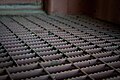 Close up view of anti-slip grating
 -
 Bridge showing deck grating driving surface
 -
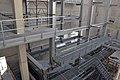 Walkway gratings at a power plant


Optical grating
[edit]

As optical elements, optical gratings are images having the characteristic pattern of alternating, parallel lines. The lines alternate between high and low reflectance (black-white gratings) or high and low transmittance (transparent-opaque gratings). The grating profile is the function of the reflectance or transmittance perpendicular to the lines. This function is generally a square wave, in that every transition between lines is abrupt.
A grating can be defined by six parameters:
- Spatial frequency is the number of cycles occupying a particular distance (e.g. 10 line pairs per millimeter). The period of the grating is the inverse of the spatial frequency, measured in distance (e.g. 0.1 mm).
- Duty Cycle is the relative thickness of high and low lines. The duty cycle is the ratio of the width of the low line (black or opaque) to one whole grating period.
- Profile is the shape of the repeating pattern, which is typically a square wave but can also be any periodic pattern (sine wave, triangle wave, sawtooth wave, etc.).
- Contrast is a measure of the difference in luminance between the high lines of the grating and the low lines. It is usually expressed as Michelson contrast:[2] the difference between maximum and minimum luminance divided by their sum.
- Orientation is the angle the grating makes with some reference orientation (such as the y-axis in a picture or of another grating). It is usually measured in degree or in radians.
- Phase is the position of the grating profile relative to some reference position. It is usually measured in degrees (from 0 to 360 for one complete cycle) or in radians (2π for one complete cycle). For example, two identical transparent gratings of 50% duty cycle and the same orientation will appear fully opaque only if the relative phase is π (180 degrees).
Gratings with sine wave profiles are used extensively in optics to determine the transfer functions of lenses. A lens will form an image of a sine wave grating that is still sinusoidal, but with some reduction in its contrast depending on the spatial frequency and possibly some change in phase. The branch of mathematics dealing with this part of optics is Fourier analysis while the associated branch of study is Fourier optics. Gratings are also used extensively in research into visual perception. Campbell and Robson promoted using sine-wave gratings by arguing that the human visual performs a Fourier analysis on retinal images.[3]
Diffraction gratings
[edit]Grating can also refer to a diffraction grating: a reflecting or transparent optical component on which there are many fine, parallel, equally spaced grooves. They disperse light, so are one of the main functional components in many kinds of spectrometers, which decompose a light source into its constituent wavelength components.
See also
[edit]References
[edit]- Palmer, Christopher, Diffraction Grating Handbook, 8th edition, MKS Newport (2020). [2]
- ^ "[1] Archived 2014-07-02 at the Wayback Machine" by sanorient, The frp Demonstrations Project.
- ^ Michelson, A. A. (1891). On the application of interference methods to spectroscopic measurements. I. The London, Edinburgh, and Dublin Philosophical Magazine and Journal of Science, Fifth Series, 31, 338-346 and Plate VII.
- ^ Campbell, F. W., & Robson, J. G. (1968). Application of Fourier analysis to the visibility of gratings. Journal of Physiology, 197, 551-566.

Grating
View on GrokipediaOverview
Definition and Basic Principles
A grating is a periodic structure composed of parallel or intersecting elements, such as bars, lines, or slits, that create regular openings to permit the passage of fluids, light, or other media while blocking larger particles or objects. This design leverages the repetitive arrangement of its components to achieve selective filtration or dispersion based on the size or wavelength of the incident material or wave. In engineering and physics contexts, gratings serve as foundational elements in applications ranging from mechanical supports to optical instruments, where their periodicity ensures consistent performance. The core principles of gratings revolve around their periodicity, characterized by the spatial frequency or groove density (lines per unit length) and the grating spacing , which is the distance between adjacent elements.[3] Additionally, the duty cycle—defined as the ratio of open space to the total period (or conversely, the proportion of blocked versus open area)—determines the degree of openness, typically ranging from 50% to 80% in structural designs to optimize flow while maintaining strength.[4] These parameters enable gratings to act as size-selective filters in mechanical uses, where openings block debris larger than , or as wavelength-selective dispersers in optical contexts, where the structure interacts with waves to produce interference patterns.[3] Gratings can be classified by dimensionality: one-dimensional gratings feature parallel elements, such as evenly spaced bars in a drain cover, which provide unidirectional filtering; two-dimensional gratings, like meshes or grids in window screens, offer bidirectional openness for enhanced ventilation or light passage. The grating spacing plays a pivotal role in selectivity; for instance, in optical applications, it governs the diffraction angle according to the relation , where is the diffraction order and is the wavelength, allowing separation of spectral components without detailed derivation here.[5] This foundational equation underscores how tunes the grating's response to specific scales, ensuring precise control over transmission or reflection.[3]History and Development
The concept of gratings traces its origins to ancient architectural applications, where they served practical purposes such as drainage and ventilation. In the Roman Empire around the 1st century BCE, stone grates were employed to cover sewage systems and channel rainwater runoff into underground sewers, as evidenced by archaeological findings in sites like Vienna's early infrastructure.[6] These early structures demonstrated the utility of parallel bars or slots for fluid management, laying foundational principles for later structural designs. By the 17th century, basic optical slits emerged in scientific experiments that explored light's behavior; Isaac Newton used narrow slits in his Opticks (1704) to investigate refraction and color dispersion, while Christiaan Huygens' wave theory (1678) incorporated slit-like apertures to explain wave propagation, marking the inception of gratings in optics.[7] The 19th century brought significant advancements in grating technology, driven by precision engineering and scientific inquiry. David Rittenhouse invented the first ruled diffraction grating in 1785 by stretching parallel hairs between screws, enabling early spectral analysis.[8] Joseph von Fraunhofer independently developed ruled gratings in 1814, using them to map solar absorption lines and advancing spectroscopy.[8] In the 1880s, Henry A. Rowland introduced mechanical ruling engines at Johns Hopkins University, producing high-precision concave gratings that revolutionized astronomical spectroscopy by achieving resolutions over 400,000.[9] Pioneers Robert Bunsen and Gustav Kirchhoff further promoted optical gratings through their 1859 invention of spectral analysis techniques, which, though initially prism-based, spurred demand for grating instruments in chemical element identification.[10] Concurrently, during the Industrial Revolution, gratings gained industrial adoption for safety platforms and catwalks in factories, facilitating worker movement and ventilation in emerging mechanized environments.[11] In the 20th century, gratings evolved with material and fabrication innovations tailored to industrial and scientific needs. Welded bar gratings for flooring emerged in the 1920s, offering durable alternatives to riveted designs for heavy-duty applications like bridges and subways, as seen in early mass-produced systems for New York City's infrastructure.[12] The off-axis holography technique, pioneered by Emmett Leith and Juris Upatnieks at the University of Michigan in 1964, enabled the fabrication of the first holographic diffraction gratings in 1967.[13] Post-World War II, fiberglass-reinforced plastic (FRP) gratings rose in the 1950s for corrosion-resistant uses in chemical and marine settings, building on wartime composites to replace metals in harsh environments.[14] Modern developments have standardized and expanded grating applications across disciplines. The ANSI/NAAMM MBG 531 standard for metal bar gratings, first issued in the mid-20th century and updated in 2024, provides load tables and fabrication guidelines to ensure safety and uniformity in structural uses.[15] Since the 1990s, gratings have integrated into photonics and nanotechnology, with subwavelength structures enabling photonic crystals and diffractive optics for applications like fiber Bragg gratings in telecommunications.[8]Structural Gratings
Bar and Welded Gratings
Bar and welded gratings consist of parallel bearing bars, typically 1 to 2 inches deep, that are welded or mechanically locked to perpendicular cross rods to form a rigid, load-bearing panel. These bearing bars run in the direction of the span and provide primary structural support, while the cross rods, often twisted or round, maintain spacing and enhance lateral stability. The design allows for high open areas, typically 50 to 80 percent, facilitating drainage, ventilation, and reduced material use compared to solid flooring. Spacing notations follow ANSI/NAAMM MBG 531 standards, such as 19-W-4, where "19" denotes 19/16-inch (1-3/16-inch clear) bearing bar spacing, "W" indicates welded construction, and "4" specifies 4-inch cross rod spacing; these notations ensure consistent load distribution and compatibility in industrial applications.[16][17][4] Materials for bar and welded gratings are selected based on environmental demands and load requirements, with carbon steel being the most common due to its strength and cost-effectiveness; hot-dip galvanizing is frequently applied to carbon steel for corrosion resistance in outdoor or humid settings. Stainless steel variants, such as Type 304 or 316, offer superior resistance to chemicals and marine environments, while aluminum provides lightweight corrosion resistance without needing coatings, ideal for architectural or portable structures. Load ratings are governed by ANSI/NAAMM MBG 531 and MBG 532 standards, categorizing gratings as light-duty (e.g., up to 1,000 lbs per wheel for pedestrian walkways) or heavy-duty (e.g., up to 8,000 lbs per wheel for vehicular traffic in truck terminals or airfields); these ratings account for uniform and concentrated loads, ensuring safety factors of at least 2 for deflection limits of L/360.[18][16] In applications such as trailer decks, plain mild steel bar grating—uncoated carbon steel—presents specific drawbacks. It rusts quickly when exposed to chemicals or moisture, compromising structural integrity unless protected by galvanizing or other coatings. Additionally, the open structure allows small debris to fall through, potentially requiring mitigation such as covering with a tarp.[19][20] However, mild steel bar grating offers several advantages over solid aluminum plates for trailer deck applications, particularly when properly protected. It provides superior strength and durability for heavy loads, making it resilient in demanding industrial environments. The open structure facilitates excellent drainage, allowing spills to flow through and preventing the pooling of flammable liquids, which provides a significant safety benefit by reducing fire hazards. Serrated surfaces enhance traction, improving slip resistance in wet or oily conditions. Furthermore, compared to solid steel decking, bar grating is often lighter due to its open design, achieving weight savings of up to 80 percent while maintaining equivalent load capacity. For optimal durability, reinforcements under mounts are recommended, and corrosion protection such as hot-dip galvanizing is essential to mitigate rusting in exposed settings.[19][21] Manufacturing processes emphasize durability and precision, with pressure-welding used for steel gratings to fuse bearing bars and cross rods under high heat and force, creating strong fillet welds without filler material. For aluminum or lighter applications, swage-locking involves inserting cross rods into pre-notched bearing bars and mechanically deforming them for a secure, vibration-resistant assembly. Serrated surfaces, formed by notching the top edges of bearing bars, are commonly added to enhance slip resistance in wet or oily conditions, meeting OSHA requirements for walking surfaces. Common bar sizes include 3-inch by 1/4-inch rectangular profiles for heavy-duty uses, though 1-1/4-inch by 3/16-inch is prevalent for standard industrial panels. These gratings offer weight savings of up to 80 percent compared to solid steel plates of equivalent load capacity, owing to their open structure, which reduces dead load in construction while maintaining structural integrity. Since the 1920s, bar gratings have been widely applied in platforms, stair treads, and trench covers for industrial flooring and catwalks.[22][23][24][4] Engineering standards for bar and welded gratings incorporate beam theory to calculate deflections and stresses, treating the panel as a series of parallel beams under uniform loading. The uniform load deflection formula, derived from Euler-Bernoulli beam theory for a simply supported span, is: Here, is the maximum deflection at midspan, is the uniform load per unit length (e.g., in lbs/in), is the span length, is the modulus of elasticity (e.g., 29 × 10^6 psi for steel), and is the moment of inertia of the effective section (typically per bearing bar, adjusted for panel width). This formula ensures deflections remain within allowable limits, such as span/360, to prevent excessive vibration or sagging.[25][26] Derivation: The formula arises from solving the governing differential equation for beam bending, , where is the deflection curve. Integrating four times yields: Applying boundary conditions for a simply supported beam—, , , —determines the constants: , , , and . Substituting into the deflection equation and simplifying gives the maximum deflection . This derivation assumes small deflections and neglects shear effects, valid for typical grating spans under ANSI/NAAMM MBG 534 guidelines.[25][26] Example Calculation: Consider a light-duty steel welded grating panel (19-W-4 spacing, 1-1/4 × 3/16-inch bearing bars, galvanized carbon steel) spanning 4 feet (48 inches) with a uniform load of 100 psf across a 3-foot panel width. The line load for the panel is 25 lb/in (100 psf × 3 ft width / 12 in/ft). For per-bar calculations, the tributary width is 1.1875 inches, load intensity is 100/144 ≈ 0.694 lb/in², so w ≈ 0.694 × 1.1875 ≈ 0.824 lb/in per bar. For one bearing bar, in⁴ (where inch thickness, inch depth). With approximately 10.1 bars per foot (12 / 1.1875), the total per foot width is approximately in⁴/ft, but calculations use per-bar adjusted for tributary width. Using psi, inches, well below L/360 (0.133 inches), confirming suitability. For heavy-duty scenarios, such as a 20,000 lb wheel load, concentrated load formulas from MBG 534 would supplement this, often requiring deeper bars like 2 × 3/8 inch.[25][26][18]Expanded, Perforated, and Safety Gratings
Expanded metal gratings are produced by slitting and stretching sheet metal to form interconnected diamond-shaped or hexagonal patterns, creating a lightweight mesh without waste material.[27][28] This manufacturing process uses specialized machinery to expand the slits, resulting in open areas typically ranging from 60% to 80% for regular types, which feature raised strands for added rigidity.[27] Flattened variants are created by cold-rolling the standard expanded metal, yielding a smoother surface suitable for applications requiring a level finish. Common materials include carbon steel for durability and aluminum for its lightweight and corrosion-resistant properties, particularly in outdoor environments. These gratings are widely used in fencing for security perimeters and as machine guards to protect against debris while allowing visibility and airflow.[27][29] Perforated gratings consist of sheet metal with precisely punched holes, offering customizable patterns for specific functional needs. Holes are typically round, square, or slotted, formed through mechanical or hydraulic punching processes that create openings with open areas up to 70%, depending on hole size and spacing.[30][31] Materials such as stainless steel and galvanized steel enhance longevity in demanding settings. These gratings excel in ventilation applications, such as HVAC registers and diffusers, where high open areas facilitate airflow— for instance, hexagonal patterns achieve the highest permeability among perforated types.[32] They also serve in screening roles for filtration and partitioning, balancing structural integrity with passage for air, light, or liquids.[30] Safety gratings prioritize anti-slip performance through specialized surface treatments, making them essential for high-risk walking surfaces. Traction tread designs incorporate raised patterns or hundreds of small perforated buttons across the surface, providing multi-directional grip that complies with OSHA standards for slip resistance on walking-working surfaces.[33][34] These often feature an industry-standard coefficient of friction exceeding 0.5, especially under wet or oily conditions. Marine-grade aluminum variants, with their inherent corrosion resistance in saltwater environments, are commonly applied to ship decks and offshore platforms.[35] Fiberglass-reinforced plastic (FRP) safety gratings offer superior chemical resistance for industrial settings exposed to corrosives, alongside a Class 1 fire rating with a flame spread of 25 or less per ASTM E84. Mesh overlays on some models further enhance traction without compromising lightweight construction. Examples include McNichols expanded metal catwalk gratings, which combine open-area ventilation with safe footing for elevated walkways.[36][37]| Material | Corrosion Resistance in Saltwater (Relative Rating) | Typical Applications |
|---|---|---|
| Aluminum (Marine-Grade) | High (forms protective oxide layer) | Ship decks, coastal structures[38][35] |
| Stainless Steel | Moderate to High (depending on grade, e.g., 316) | Offshore platforms, marine ventilation[30] |
| FRP | Excellent (non-metallic, inert to salts) | Chemical plants, wet environments[37] |
| Carbon Steel (Galvanized) | Low to Moderate (zinc coating sacrifices over time) | Sheltered marine areas[38] |