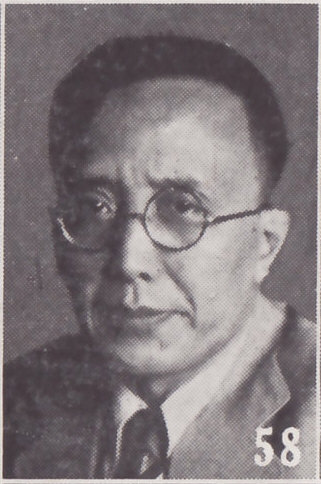

Guo Moruo
View on Wikipedia | This article's lead section may be too short to adequately summarize the key points. (September 2025) |
Guo Moruo (November 16, 1892 – June 12, 1978),[1] courtesy name Dingtang, was a Chinese author, poet, historian, archaeologist, and government official.
Key Information


Biography
[edit]Family history
[edit]Guo Moruo, originally named Guo Kaizhen, was born on November 10 or 16, in the small town of Shawan, located on the Dadu River some 40 km (25 mi) southwest from what was then called the city of Jiading (Lu) (Chia-ting (Lu), 嘉定(路)), and now is the central urban area of the prefecture level city of Leshan in Sichuan Province.
At the time of Guo's birth, Shawan was a town of some 180 families.[2]
Guo's father's ancestors were Hakkas from Ninghua County in Tingzhou Prefecture, near the western border of Fujian. They moved to Sichuan in the second half of the 17th century, after Sichuan had lost much of its population to the rebels/bandits of Zhang Xianzhong (c. 1605–1647). According to family legend, the only possessions that Guo's ancestors brought to Sichuan were things they could carry on their backs. Guo's great-grandfather, Guo Xianlin, was the first in the family to achieve a degree of prosperity. Guo Xianlin's sons established the Guo clan as the leaders of the local river shipping business, and thus important people in that entire region of Sichuan. It was only then that the Guo clan members became able to send their children to school.[2]
Guo's father, one of whose names may possibly have been Guo Mingxing (1854–1939), had to drop out of school at the age of 13 and then spent six months as an apprentice at a salt well. Thereafter he entered his father's business, a shrewd and smart man who achieved some local renown as a Chinese medical doctor, traded successfully in oils, opium, liquor, and grain and operated a money changing business. His business success allowed him to increase the family's real estate and salt well holdings.[2]
Guo's mother, in contrast, came from a scholar-official background. She was a daughter of Du Zhouzhang, a holder of the coveted jinshi degree. Whilst serving as an acting magistrate in Huangping prefecture (黄平州), now part of Qiandongnan Miao and Dong Autonomous Prefecture, in eastern Guizhou, Du died in 1858 while fighting Miao rebels, when his daughter (the future mother of Guo Moruo) was less than a year old. She married into the Guo family in 1872, when she was fourteen.[2]
Childhood
[edit]Guo was the eighth child of his mother. Three of his siblings had died before he was born, but more children were born later, so by the time he went to school, he had seven siblings.[2]
Guo also had the childhood name Guo Wenbao ("Cultivated Leopard"), given due to a dream his mother had on the night he was conceived.[2]
A few years before Guo was born, his parents retained a private tutor, Shen Huanzhang, to provide education for their children, in the hope of them later passing civil service examinations. A precocious child, Guo started studying at this "family school" in the spring of 1897, at the early age of four and a half. Initially, his studies were based on Chinese classics, but with the government education reforms of 1901, mathematics and other modern subjects started to be introduced.[2]
When in the fall of 1903 a number of public schools were established in Sichuan's capital, Chengdu, the Guo children started going there to study. Guo's oldest brother, Guo Kaiwen (1877–1936), entered one of them, Dongwen Xuetang, a secondary school preparing students for study in Japan; the next oldest brother, Guo Kaizou, joined Wubei Xuetang, a military school. Guo Kaiwen soon became instrumental in exposing his brother and sisters still in Shawan to modern books and magazines that allowed them to learn about the wide world outside.[2]
Guo Kaiwen continued to be a role model for his younger brothers when in February 1905 he left for Japan, to study law and administration at Tokyo Imperial University on a provincial government scholarship.[2]
After passing competitive examinations, in early 1906 Guo Moruo started attending the new upper-level primary school (高等小學; gāoděng xiǎoxué) in Jiading. It was a boarding school located in a former Buddhist temple and the boy lived on premises. He went on to a middle school in 1907, acquiring by this time the reputation of an academically gifted student but a troublemaker. His peers respected him and often elected him a delegate to represent their interests in front of the school administration. Often spearheading student-faculty conflicts, he was expelled and reinstated a few times, and finally expelled permanently in October 1909.[2]
Guo was glad to be expelled, as he now had a reason to go to the provincial capital Chengdu to continue his education there.[2]
In October 1911, Guo was surprised by his mother announcing that a marriage was arranged for him. He went along with his family's wishes, marrying his appointed bride, Zhang Jinghua, sight-unseen in Shawan in March 1912. Immediately, he regretted this marriage, and five days after the marriage, he left his ancestral home and returned to Chengdu, leaving his wife behind. He never formally divorced her, but apparently never lived with her either.[2]
Study abroad
[edit]Following his elder brothers, Guo left China in December 1913, reaching Japan in early January 1914. After a year of preparatory study in Tokyo, he entered Sixth Higher School in Okayama.[2] When visiting a friend of his hospitalized in Saint Luke's Hospital in Tokyo, in the summer of 1916, Guo fell in love with Sato Tomiko, a Japanese woman from a Christian family, who worked at the hospital as a student nurse. Sato would become his common-law wife. They were to stay together for 20 years, until the outbreak of the war, and to have five children together.[3]
After graduation from the Okayama school, Guo entered in 1918 the Medical School of Kyushu Imperial University in Fukuoka.[2] He was more interested in literature than medicine, however. His studies at this time focused on foreign language and literature, namely the works of: Spinoza, Goethe, Walt Whitman, and the Nobel Laureate Rabindranath Tagore. Along with numerous translations, he published his first anthology of poems, entitled The Goddesses (女神; nǚshén) (1921). He co-founded the Creation Society (創造社) in Shanghai, which promoted modern and vernacular literature.
The war years
[edit]![[icon]](https://en.wikipedia.org/wiki/File:Wiki_letter_w_cropped.svg) | This section needs expansion. You can help by adding to it. (November 2008) |
Guo joined the Chinese Communist Party in 1927. He was involved in the Communist Nanchang Uprising and fled to Japan after its failure. He stayed there for 10 years studying Chinese ancient history. During that time he published his work on inscriptions on oracle bones and bronze vessels, Corpus of Inscriptions on Bronzes from the Two Zhou Dynasties (两周金文辭大系考釋).[4] During this period he published ten monographs on archeology of the Shang and Zhou periods and ancient Chinese script, thus establishing himself as a preeminent scholar in the field.
In the summer of 1937, shortly after the Marco Polo Bridge incident, Guo returned to China to join the anti-Japanese resistance. His attempt to arrange for Sato Tomiko and their children to join him in China were frustrated by the Japanese authorities,[3] and in 1939 he remarried to Yu Liqun, a Shanghai actress.[3][5] After the war, Sato went to reunite with him but was disappointed to know that he had already formed a new family.
In early February 1942, Guo created a five-act historical drama 虎符, Hǔfú ("Tiger Talisman") in a single nine-day period.
In 1942, Guo's essay The Answer to Nora was published in New China Daily.[6]: 74 Guo's essay responded to Lu Xun's question "what happens after Nora" -- the principal character in Henrik Ibsen's play A Doll's House -- "leaves home".[6]: 74 Writing that Nora should emulate the revolutionary martyr Qiu Jin, Guo stated, "Where should Nora go after she leaves the doll's house? She should study and acquire the skills to live independently; fight to achieve women's emancipation in the context of national liberation; take on women's responsibilities in national salvation; and not fear sacrificing her life to accomplish these tasks -- these are the right answers."[6]: 74–75
As a communist leader
[edit]
Along with holding important government offices in the People's Republic of China, Guo was a prolific writer, not just of poetry but also fiction, plays, autobiographies, translations, and historical and philosophical treatises. He was the first President of the Chinese Academy of Sciences and remained so from its founding in 1949 until his death in 1978. He was also the first president of University of Science & Technology of China (USTC), a new type of university established by the Chinese Academy of Sciences (CAS) after the founding of the People's Republic of China and aimed at fostering high-level personnel in the fields of science and technology.
For the first 15 years of the PRC, Guo, with his extensive knowledge of Chinese history and culture, was the ultimate arbiter of philosophical matters relating to art, education, and literature, although all of his most vital and important work had been written before 1949.
Guo was one of the leaders of China's delegation to the December 1957 Afro-Asian Peoples' Solidarity Conference, along with Liu Liangmo, Liu Ningyi, and Ji Chaoding.[7]: 175
Beginning in the middle of 1958, the new folk song movement sought to compile folk songs and poetry.[8]: 101 Among the major compendiums of these folk works was Red Flag Ballads, compiled by Guo and Zhou Yang, which presented the works of amateur poets anonymously as part of an effort to develop the figure of the mass writer in communist art and literature.[8]: 101
With the onset of the Cultural Revolution in 1966, Guo became an early target of persecution. To save face, he wrote a public self-criticism and declared that all his previous works were in error and should be burned. He then turned to writing poetry praising Mao's wife Jiang Qing and the Cultural Revolution and also denounced former friends and colleagues as counterrevolutionaries. However, this was not enough to protect his family. Two of his sons, Guo Minying and Guo Shiying, "committed suicide" in 1967 and 1968 following "criticism" or persecution by Red Guards.[9][10]
Because of his loyalty to Mao, he survived the Cultural Revolution and received commendation by the chairman at the 9th National Congress of the Chinese Communist Party in April 1969. By the early 1970s, he had regained most of his influence. He enjoyed all the privileges of the highest-ranking party elites, including residence in a manor house once owned by a Qing official, a staff of assigned servants, a state limousine, and other perks. Guo also maintained a large collection of antique furniture and curios in his home.[citation needed]
In 1978, following Mao's death and the fall of the Gang of Four, the 85 year old Guo, as he lay dying in a Beijing hospital, penned a poem denouncing the Gang.[citation needed]
- 什么令人振奋的消息! (What wonderful news!)
- 删除四人帮。 (Rooting out the Gang of Four.)
- 文学流氓。 (The literary rogue.)
- 政治流氓。 (The political rogue.)
- 险恶的顾问。 (The sinister adviser.)
- 白骨精。 (The White-Boned Demon.)
- 所有由铁扫帚一扫而空。 (All swept away by the iron broom.)
The White-Boned Demon was a character in the Ming-era novel Journey to the West, an evil shapeshifting being, and was a popular derogatory nickname for Jiang Qing.[citation needed]
In March of the same year, (1978), Guo defied illness to attend the First National Science Conference, the first of its kind to be held since the end of the Cultural Revolution. He was visibly frail and it would be the last time he was seen in public before his death three months later.[citation needed]
Guo was awarded the Stalin Peace Prize.[11]
Legacy
[edit]Guo was held in high regard in Chinese contemporary literature, history and archaeology. He once called himself the Chinese answer to Goethe and this appraisal was widely accepted. Zhou Yang said: "You are Goethe, but you are the Goethe of the New Socialist Era of China."("你是歌德,但你是社会主义时代新中国的歌德。")[12]
He was criticised as the first of "Four Contemporary Shameless Writers".[13][14][15] For example, he spoke highly of Mao Zedong's calligraphy, to the extent that he justified what the CCP leader had written mistakenly.[16] His historical works have been described by historians as "near-pseudohistorical" due to his political manipulation of ancient Chinese classics.[17] And during the Cultural Revolution, he published a book called Li Bai and Du Fu in which he praised Li Bai while belittling Du Fu, which was thought to flatter Mao Zedong.[18] His attitude to the Gang of Four changed sharply before and after its downfall.[19][20]
In his private life, he was also known to have affairs with many women, whom he abandoned shortly afterwards. One of them, Li Chen (立忱), allegedly committed suicide after his betrayal, although this is disputed.[21]
Family
[edit]
Guo had five children (four sons and a daughter) with Sato Tomiko and six with Yu Liqun (four sons and two daughters). An article published in the 2000s said that eight out of the eleven were alive, and that three have died.[22]
With Sato Tomiko (listed chronologically in the order of birth):
- son Guo Hefu (郭和夫) (December 12 (or 31, according to other sources) 1917, Okayama - September 13, 1994). A chemist, he moved from Japan to Taiwan in 1946 and to mainland China in 1949. He was the founder of the Institute of Chemical Physics of the Chinese Academy of Sciences.[23]
- son Guo Bo (郭博) (born 1920), a renowned architect and photographer. He came to China in 1955, invited by his father, and worked in Shanghai, where he participated in the design of many of its famous modern buildings.[23] Guo Bu is also known as a photographer of Shanghai's heritage architecture;[23] an album of his photographic work has been published as a book.[24]
- son Guo Fusheng (郭福生).
- daughter Guo Shuyu (郭淑禹), a Japanese-language teacher, now deceased.
- son Guo Zhihong (郭志宏).
With Yu Liqun (listed chronologically in the order of birth):
- son Guo Hanying (郭汉英) (born 1941, Chongqing). An internationally published theoretical physicist.[23]
- daughter Guo Shuying (郭庶英).[25] She published a book about her father.[26]
- son Guo Shiying (郭世英) (1942 - April 22, 1968). In 1962, while a philosophy student at Beijing University, he created an "underground" "X Poetry Society". In the summer of 1963 the society was exposed and deemed subversive. Guo Shiying was sentenced to re-education through labor. While working at a farm in Henan province, he developed interest in agriculture. Returning to Beijing in 1965, he enrolled at Beijing Agricultural University. In 1968, kidnapped by Red Guards and "tried" by their "court" for his poetry-society activity years before he jumped out of the window of the third-floor room where he was held and died at the age of 26. His father in his later writing expressed regret for encouraging his son to return to Beijing from the farm, thinking that it indirectly led to his death.[9][27]
- son Guo Minying (郭民英), (November 1943, Chongqing - April 12, 1967). His death is described as an unexpected suicide.[27]
- daughter Guo Pingying (郭平英)
- son Guo Jianying (郭建英) (born 1953).
Commemoration
[edit]- Guo's residence in Beijing, near Shicha Lake (Shichahai), where he lived after the war with his second (or third, if the arranged marriage is to be counted) wife, Yu Liqun, is preserved as a museum.[28]
- Guo and Sato Tomiko's house in Ichikawa, Chiba, Japan, where they lived from 1927 to 1937, is a museum as well.[29] Due to the Guo Moruo connection, Ichikawa chose to establish sister city relations with Leshan in 1981.[30]
- W.E.B. Du Bois dedicated his poem I Sing to China to Guo.[31]
Honours
[edit] Iran – Commemorative Medal of the 2500th Anniversary of the founding of the Persian Empire (1971)[32]

Bibliography
[edit]This is a select bibliography. A fuller bibliography may be found in: A Selective Guide to Chinese Literature, 1900-1949, edited by Milena Doleželová-Velingerová et al.[33]
Poetry, stories, novellas, plays
[edit]- 1921: Goddess: Songs and Poems (女神 : 劇曲詩歌集).[34] English translation: Selected Poems from the Goddesses, A. C. Barnes and John Lester, tr., Beijing: Foreign Languages Press, 1958.[35]
- 1926, 1932: Olives (橄榄), Shanghai: Chuangzao she chubanshe bu, 1929 (book series: Chuangzao she congshu).[36]
- 1928, 1932: Fallen Leaves (落叶 : 沫若小说戏曲集), Shanghai : Xin zhong guo shu ju, 1932.[37]
- 1936: Chu Yuan: Five Acts (屈原 : 五幕劇);.[38] English translation: Chu Yuan: A Play in Five Acts, Yang Xianyi and Gladys Yang, tr., Beijing: Foreign Languages Press, 1953; 2nd edition, 1978; Honolulu: University Press of the Pacific, 2001.[39]
- 1946: "Under the Moonlight", in: The China Magazine (formerly China at War), June 1946; reprinted in: Chi-Chen Wang, ed., Stories of China at War, Columbia University Press, 1947; reprinted: Westport, Conn. : Greenwood Press, 1975.[40][41]
- 1947: Laughter Underground (地下的笑声), Shanghai and Beijing: Hai yan shu dian[42] - selected stories.
- 1959: Red Flag Ballad (红旗歌谣), Beijing Shi: Hongqi zhazhi she (= Red Flag Magazine), 1959; English translation: Songs of the Red Flag, Yang Zhou, tr., Peking, Foreign Languages Press, 1961.[43]
Autobiography
[edit]Guo wrote nine autobiographical works:[44]
- 1947: My Youth (我的童年), Shanghai.[45]
- French translation: Autobiographie : mes années d'enfance, tr. Pierre Ryckmans, Paris, Gallimard, 1970.[46]
- German translation: Kindheit : Autobiographie, tr. Ingo Schäfer, Frankfurt am Main: Insel, 1981.[47]
- Before and After the Revolution (Fanzheng qianhou).
- 1930, 1931: The Black Cat and the Tower (黑貓與塔), Shanghai, 1930.[48] - often referred to just as Black Cat (黑貓).
- The First Outing of Kuimen (Chuchu Kuimen).
- My Student Years (Wode xuesheng shidai).
- 1932: Ten Years of Creation (创造十年), Shanghai : Xian dai shu ju, 1932.[49]
- 1938: Sequel to Ten Years of Creation (创造 十 年 续编), Shanghai : Bei xin shuju. (book series: Chuangzuo xin kan).
- On the Road of the Northern Expedition (Beifa Tuci).
- 洪波曲 / Hongbo qu.
Historical, educational, and philosophical treatises
[edit]- 1935, rev. ed., 1957: 兩周金文辭大系圖彔攷釋 / Liang Zhou jin wen ci da xi tu lu kao shi (Corpus of Inscriptions on Bronzes from the Two Zhou [Chou] Dynasties), Beijing: Ke xue chu ban she, 1957 (考古学专刊. 甲种 = Archaeological monograph series).[50]
- 1950: "Report on Culture and Education", in: The First Year of Victory, Peking, Foreign Languages Press.[51]
- 1951: Culture and Education in New China, Peking : Foreign Languages Press, 1951 (joint authors: Chien Chun-jui, Liu Tsun-chi, Mei Tso, Hu Yu-chih, Coching Chu and Tsai Chu-sheng).[52]
- 1982: 甲骨文合集 Jiaguwen Heji (Oracle Collection), Shanghai: Zhonghua shuju, 1978–1983, 13 volumes (edited with Hu Houxuan)[53] - collection of 41,956 oracle bone inscriptions from Yinxu.
Other nonfiction
[edit]- Appeal and Resolutions of the First Session of the World Peace Council : Berlin ; February 21–26, 1951 ; Kuo Mo-jo's Speech at the World Peace Council, Peking: Foreign Languages Press, 1951.[54]
- Kuo Mo-jo, "The Struggle for the Creation of New China's Literature" in: Zhou Enlai, The People's New Literature : Four Reports at the First All-China Conference of Writers and Artists, Peking: Cultural Press, 1951.[55]
Translations
[edit]- 1922: J. W. von Goethe, Die Leiden des Jungen Werther (The Sorrows of Young Werther)
- 1924: Kawakami Hajime, Social Organization and Social Revolution
- 1924:Omar Khayyam,Rubaiyat
- 1925: Ivan Turgenev, Xin shi dai (Virgin Soil)
- 1926: Schiller, Wallenstein
- 1928: Friedrich Nietzsche, Also sprach Zarathustra (Thus Spake Zarathustra)
- 1928: J. W. von Goethe, Faust, I. Teil
- 1929: Upton Sinclair, Tu chang (The Jungle)
- 1931: Karl Marx, Kritik der Politischen Ökonomie (Capital: A Critique of Political Economy)
- 1935: Leo Tolstoy, Voina i mir (War and Peace)
Contributions
[edit]- 1974: Cho Wen-chün: A Play in Three Acts (abridged), in: Straw Sandals: Chinese Short Stories, 1918-1933, Harold R. Isaacs, ed., Cambridge, Mass.: MIT Press.[56]
References
[edit]- ^ "Raise a glass to painter Fu Baoshi, MA". www.chinadaily.com.cn. Retrieved 2018-10-26.
- ^ a b c d e f g h i j k l m n David Tod Roy, "Kuo Mo-jo: The Early Years". Harvard University Press, Cambridge, Massachusetts. 1971. No ISBN.
- ^ a b c Yan Lu. "Re-understanding Japan: Chinese Perspectives, 1895-1945". University of Hawaii Press, 2004. ISBN 0-8248-2730-9 Partial text on Google Books
- ^ Guo, Moro (2002). 两周金文辭大系考釋 [Corpus of Inscriptions on Bronzes from the Two Zhou Dynasties] (in Traditional Chinese). China Science Publishing & Media. ISBN 978-7-03-010656-8.
- ^ The Westernization of Chinese Theatre (CCTV)
- ^ a b c Wang, Xian (2025). Gendered Memories: An Imaginary Museum for Ding Ling and Chinese Female Revolutionary Martyrs. China Understandings Today series. Ann Arbor: University of Michigan Press. ISBN 978-0-472-05719-1.
- ^ Gao, Yunxiang (2021). Arise, Africa! Roar, China! Black and Chinese Citizens of the World in the Twentieth Century. Chapel Hill, NC: University of North Carolina Press. ISBN 9781469664606.
- ^ a b Kindler, Benjamin (2025). Writing to the Rhythm of Labor: Cultural Politics of the Chinese Revolution, 1942-1976. New York City, NY: Columbia University Press. ISBN 978-0-231-21932-7.
- ^ a b - Portraits of China's historical figures Archived 2009-03-25 at the Wayback Machine (This article contains portraits of a number of people who participated in the Cultural Revolution - as actors or as victims - painted by Xu Weixin, and biographical comments).
- ^ 《郭沫若的晚年岁月》:郭民英与郭世英 [Guo Moruo's late years: Guo Minying and Guo Shiying]. Xinhua News. 2004-07-22. Archived from the original on 2009-02-25. Retrieved 2008-11-10.. This article is based on the book Feng, Xigang (冯锡刚) (2004). 郭沫若的晚年岁月 [Guo Moruo's Late Years] (in Simplified Chinese). Central Literature Publishing House. ISBN 7-5073-1622-X.
- ^ Tae-Kyung, Kim; 김태경 (2018). "Representations of War and Peace in Post-Korean War North Korean Literature". Oriens Extremus. 57: 45–70. ISSN 0030-5197. JSTOR 27197047.
- ^ Wu, Dongping (吴东平) (2006-03-01). 现代名人的后代 [The heirs of the famous people of our times] (in Chinese). Hubei People's Press. Archived from the original on 2006-04-25.
- ^ Hu, Zhiwei (胡志偉) (1987). 黑暗與光明:海峽兩岸的對比. Taiwan: 台灣商務印書館 [Taiwan Commercial Press].
- ^ Bo, Huang (黃波) (2008). 真實與幻影:近世文人縱橫談. Taiwan: 秀威資訊科技股份有限公司. ISBN 9789862211168.
- ^ Mou, Zongsan (牟宗三) (1980). 政道與治道. 臺灣: 台灣學生書局. p. 6.
- ^ Guo, Moruo. 红旗跃过汀江 (in Chinese).
主席并无心成为诗家或词家,但他的诗词却成了诗词的顶峰。主席更无心成为书家,但他的墨迹却成了书法的顶峰。例如这首《清平乐》的墨迹而论,'黄粱'写作'黄梁',无心中把粱字简化了。龙岩多写一个龙字。'分田分地真忙'下没有句点。这就是随意挥洒的证据。然而这幅字写得多麼生动,多麼潇洒,多麼磊落。每一个字和整个篇幅都充满了豪放不羁的革命气韵。在这里给我们从事文学艺术工作的人,乃至从事任何工作的人,一个深刻的启示∶那就是人的因素第一,政治工作第一,心理工作第一,抓活的思想第一,'四个第一'的原则,极其灵活地、极其具体地呈现下了我们的眼前。
- ^ Wong, Wynn (2024). "A New Discourse on Fengjian: the Redefinition of Fengjian and the Demonization of Federalism". Chinese Historical Review. 31 (1). Taylor & Francis: 81–102. doi:10.1080/1547402X.2024.2327206.
- ^ 郭沫若晚年的败笔:为自保即席向江青献诗. 新闻午报. 2006-10-16. Retrieved 2009-02-01.
- ^ 郭沫若 (1976-05-12). 水调歌头 ·庆祝无产阶级文化大革命十周年 (in Chinese).
四海《通知》遍/文革卷风云/阶级斗争纲举/打倒 刘少奇刘和 林/十载春风化雨/喜见山花烂漫/莺梭织锦勤/茁茁新苗壮/天下凯歌声/走资派/奋螳臂/邓小平/妄图倒退/奈"翻案"不得人心/"三项为纲"批透/复辟罪行怒讨/动地走雷霆/主席挥巨手/团结大进军
- ^ Guo, Moruo (1976-10-21). 水调歌头·粉碎四人帮 (in Chinese).
大快人心事/揪出四人帮/政治流氓 文痞/张春桥 狗头军师张/还有 精生白骨/自比 则天武后/铁帚扫而光/篡党夺权者/一枕梦黄梁/野心大/阴谋毒/诡计狂/真是罪该万死/迫害 毛泽东 红太阳/接班人 是俊杰/遗志继承果断/功绩何辉煌/拥护 华主席/拥护党中央
- ^ Xie, Bingying (谢冰莹) (1984-06-15). -{于}-立忱之死. 《传记文学》第六十五卷第六期 (in Traditional Chinese). 联合报.
- ^ 郭沫若之女细说父亲往事 [Guo Moruo's daughter recalls details about events in her father's life] (in Simplified Chinese). 2003-08-17. Archived from the original on 2020-08-07. Retrieved 2008-11-13.
- ^ a b c d 长子郭和夫 [Guo Hefu – the eldest son]. Archived from the original on 2007-09-17. Retrieved 2008-11-16., and following chapters, from the book Wu, Dongping (吴东平) (2006). 现代名人的后代 [The heirs of the famous people of our times]. Hubei People's Press. ISBN 7-216-04476-2.
- ^ Guo Bu, "Zheng zai xiao shi de Shanghai long tang (The Fast Vanishing Shanghai Lanes)". Shanghai Pictorial Publishing House (1996). ISBN 7-80530-213-8. (In Chinese and English)
- ^ USTC Newsletter 2001 No.2 Archived 2008-12-01 at the Wayback Machine (2005-08-14)
- ^ Guo, Shiying (郭庶英) (2000). 我的父親郭沫若 [My father Guo Moruo]. Liaoning People's Press. ISBN 7-205-05644-6.. The book's cover and table of contents are available on amazon.cn.
- ^ a b 《郭沫若的晚年岁月》:郭民英与郭世英 [Guo Moruo's late years: Guo Minying and Guo Shiying]. 2004-07-22. Archived from the original on 2009-02-25. Retrieved 2008-11-10. This article is based on the book Feng, Xigang (冯锡刚) (2004). 郭沫若的晚年岁月 [Guo Moruo's Late Years] (in Chinese). Central Literature Publishing House. ISBN 7-5073-1622-X.
- ^ Former Residence of Guo Moruo
- ^ 郭沫若紀念館 [Guo Moruo's Memorial House] (in Japanese). City of Ichikawa.
- ^ City of Ichikawa: Leshan City Archived 2009-08-28 at the Wayback Machine
- ^ Gao, Yunxiang (2021). Arise, Africa! Roar, China! Black and Chinese Citizens of the World in the Twentieth Century. Chapel Hill, NC: University of North Carolina Press. p. 57. ISBN 9781469664606.
- ^ Badraie Archived 2016-03-05 at the Wayback Machine
- ^ Doleželová-Velingerová, Milena; et al., eds. (1988–1990). A Selective Guide to Chinese Literature, 1900–1949. Vol. 1–4. Leiden: E. J. Brill.
- ^ Nü shen : ju qu shi ge ji (Book, 1921), worldcat. Retrieved 15 June 2022.
- ^ Selected poems from The Goddesses (Book, 1984), worldcat. Retrieved 15 June 2022.
- ^ Ganla (Book, 1929), worldcat. Retrieved 15 June 2022.
- ^ Xiao pin wen yan jiu (Book, 1932), worldcat. Retrieved 15 June 2022.
- ^ Chʻü Yüan (book, 1936), worldcat. Retrieved 15 June 2022.
- ^ Chu Yuan : a play in five acts (Book, 2001), worldcat. Retrieved 15 June 2022.
- ^ Kuo Mo-jo, "Under the Moonlight", The China Magazine (formerly China at War), June 1946; reprinted in: Chi-Chen Wang, ed., Stories of China at War, Columbia University Press, 1947; reprinted: Westport, Conn.: Greenwood Press, 1975. Retrieved 15 June 2022.
- ^ Chi-Chen Wang, ed., Stories of China at War, Westport, Conn.: Greenwood Press, 1975. Retrieved 15 June 2022.
- ^ Di xia de xiao sheng (Book, 1947), worldcat. Retrieved 15 June 2022.
- ^ Songs of the Red Flag (Book, 1961), worldcat. Retrieved 15 June 2022.
- ^ Michelle Loi, "L'œuvre autobiographique d'un écrivain chinois moderne : Guo Moruo (Kouo Mo-jo)", Revue de littérature comparée, 2008/1 (n° 325), pp. 53-65. Retrieved 24 May 2022.
- ^ Wo de tong nian (Book, 1947), worldcat.org. Retrieved 15 June 2022.
- ^ Autobiographie mes années d'enfance (Book, 1970), worldcat.org. Retrieved 15 June 2022.
- ^ Kindheit : Autobiographie (Book, 1981), worldcat.org. Retrieved 15 June 2022.
- ^ Hei mao yu ta (Book, 1931), worldcat.org. Retrieved 15 June 2022.
- ^ Chuangzao shi nian (book, 1932), worldcat.org. Retrieved 15 June 2022.
- ^ "Guo Moruo" entry, Merriam Webster's Encyclopedia of Literature, 1995 edition.
- ^ The First Year of Victory (Book, 1950), worldcat.org. Retrieved 15 June 2022.
- ^ Culture and Education in New China (book, 1951), worldcat.org. Retrieved 15 June 2022.
- ^ [Jiaguwen heji Jiaguwen Heji (Book, 1978)], worldcat.org. Retrieved 15 June 2022.
- ^ Appeal and Resolutions of the First Session of the World Peace Council : Berlin ; February 21-26, 1951 ; Kuo Mo-jo's Speech at the World Peace Council (Book, 1951), worldcat.org. Retrieved 15 June 2022.
- ^ The People's New Literature : Four Reports at the First All-China Conference of Writers and Artists (Book, 1951), worldcat.org. Retrieved 15 June 2022.
- ^ Cho Wen-chün: A Play in Three Acts (Book, 1974), worldcat.org. Retrieved 15 June 2022.
Further reading
[edit]- Chen Xiaoming, From The May Fourth Movement to Communist Revolution: Guo Moruo and the Chinese Path to Communism, Albany, New York: State University of New York Press, 2007.
- Arif Dirlik, "Kuo Mo-jo and Slavery in Chinese History", in: Arif Dirlik, Revolution and History : The Origins of Marxist Historiography in China, 1919-1937, Berkeley, CA : University of California Press, 1978, pp. 137–179. Also online here (UC Press E-Books Collection, 1982–2004).
- Robert Elegant, "Confucius to Shelley to Marx: Kuo Mo-jo", in: Robert Elegant, China's Red Masters, New York: Twayne Publishers, 1951; reprinted: Westport, Connecticut: Greenwood Press, 1971
- Gudrun Fabian, "Guo Moruo: Shaonian shidai", 4 November 2020, in: Kindlers Literatur Lexikon, Living Edition (i.e. online edition), Heinz Ludwig Arnold, ed.
- Marian Galik, The Genesis of Modern Chinese Literary Criticism (1917–1930), Routledge, 1980 - includes chapter: "Kuo Mo-jo and his Development from Aesthetico-impressionist to Proletarian Criticism"
- James Laughlin, New Directions in Prose and Poetry 19: An Anthology, New York: New Directions, 1966.
- Jean Monsterleet, Sommets de la littérature chinoise contemporaine, Paris: Editions Domat, 1953. "Includes a general overview of the literary renaissance from 1917-1950, as well as sections on Novel (with chapters on Ba Jin, Mao Dun, Lao She and Shen Congwen), Stories and Essays (with chapters on Lu Xun, Zhou Zuoren, Bing Xin, and Su Xuelin), Theater (Cao Yu, Guo Moruo), and Poetry (Xu Zhimo, Wen Yiduo, Bian Zhilin, Feng Zhi, and Ai Qing). Source: General Literary Studies 1 Archived 2023-09-26 at the Wayback Machine
- Jaroslav Prusek, ed., Studies in Modern Chinese Literature, Ostasiatische Forschungen, Schriften der Sektion fur Sinologie bei der Deutschen Akademie der Wissenschaften zu Berlin, Heft 2. Berlin (East), Akademie Verlag, 1964
- David Tod Roy, Kuo Mo-jo: The Early Years, Cambridge: Mass., Harvard University Press, 1971 (Harvard East Asian series, 55)
- Shi Shumei, The Lure of the Modern : Writing Modernism in Semicolonial China, 1917-1937, Berkeley and Los Angeles, California: University of California Press, 2001, especially chapter "Psychoanalysis and Cosmopolitanism: The Work of Guo Moruo"
- Yang Guozheng, "Malraux et Guo Moruo: deux intellectuels engagés", in: Présence d'André Malraux No. 5/6, Malraux et la Chine: Actes du colloque international de Pékin 18, 19 et 20 avril 2005 (printemps 2006), pp. 163–172.
Journals
[edit]- 郭沫若学刊 = Journal of Guo Moruo Studies, Century Journals Project - Literature/History/Philosophy (Series F): 1987 - 1993, at ebscohost.com
External links
[edit] Media related to Guo Moruo at Wikimedia Commons
- Guo Moruo at Encyclopaedia Britannica
- Guo Moruo newssc.org
- Guo Moruo's rare masterpiece... demonstrates extraordinary talents at inf.news
- (Photo) Kuo Mo-Jo speaking at great figures of world culture meeting, December 12, 1956 at digitalcommonwealth.org
- Kuo Mo-jo And Peiping's Power Struggle

