


Community hub
Recent from talks
Contribute something
Nothing was collected or created yet.
Thermonuclear weapon
View on Wikipedia
- The "primary": a fission weapon that triggers the secondary
- The "secondary": fission and fusion fuel imploded by radiation
- Radiation case: Channels x-ray radiation from primary to secondary.
- Channel filler: Plastic foam that improves radiation implosion
- Booster gas cannister: Periodic replacement as tritium gas decays.
- High-explosive lenses
- Plutonium-239 hollow pit
- Deuterium and tritium boosting gas
- Lithium deuteride thermonuclear fuel
- Highly enriched uranium sparkplug
- Highly enriched uranium tamper
- Natural uranium case

A thermonuclear weapon, fusion weapon or hydrogen bomb (H-bomb) is a second-generation nuclear weapon, utilizing nuclear fusion. The most destructive weapons ever created, their yields typically exceed first-generation nuclear weapons by twenty times, with far lower mass and volume requirements. Characteristics of fusion reactions can make possible the use of non-fissile depleted uranium as the weapon's main fuel, thus allowing more efficient use of scarce fissile material. Its multi-stage design is distinct from the usage of fusion in simpler boosted fission weapons. The first full-scale[a] thermonuclear test (Ivy Mike) was carried out by the United States in 1952, and the concept has since been employed by at least the five NPT-recognized nuclear-weapon states: the United States, Russia, the United Kingdom, China, and France.[1]
The design of all thermonuclear weapons is believed to be the Teller–Ulam configuration. This relies on radiation implosion, in which X-rays from detonation of the primary stage, a fission bomb, are channelled to compress a separate fusion secondary stage containing thermonuclear fuel, primarily lithium-6 deuteride. During detonation, neutrons convert lithium-6 to helium-4 plus tritium. The heavy isotopes of hydrogen, deuterium and tritium, then undergo a reaction that releases energy and neutrons. For this reason, thermonuclear weapons are often colloquially called hydrogen bombs or H-bombs.[b]
Additionally, most weapons use a natural or depleted uranium tamper and case. This undergoes fast fission from fast fusion neutrons and is the main contribution to the total yield and radioactive fission product fallout.[2][3]
Thermonuclear weapons were thought possible since 1941 and received basic research during the Manhattan Project.[4] The first Soviet nuclear test triggered an all-out pursuit of a thermonuclear weapon in the US, despite initial opposition by many former Manhattan Project scientists. The Teller-Ulam configuration, named for its chief contributors, Edward Teller and Stanisław Ulam, was outlined in 1951,[5] with contribution from John von Neumann. Operation Greenhouse investigated thermonuclear reactions before the full-scale Mike test.
Multi-stage devices were later developed and tested, largely independently,[c] by the Soviet Union (1955), the United Kingdom (1957), China (1966), and France (1968).[6] There is not enough public information to determine whether India,[7][8][9][10][11] Israel,[12][13] or North Korea[14][13] possess multi-stage weapons. Pakistan is not considered to have developed them.[10][15] After the 1991 collapse of the Soviet Union, Ukraine, Belarus, and Kazakhstan became the first and only countries to relinquish their thermonuclear weapons, although these had never left the operational control of Russian forces. Following the 1996 Comprehensive Nuclear-Test-Ban Treaty, most countries with thermonuclear weapons maintain their stockpiles and expertise using computer simulations, hydrodynamic testing, warhead surveillance, and inertial confinement fusion experiments.
Thermonuclear weapons are the only artificial source of explosions above one megaton TNT. The Tsar Bomba was the most powerful bomb ever detonated at 50 megatons TNT.[16] As they are the most efficient design for yields above 50 kilotons of TNT (210 TJ), and with decreased relevance of tactical nuclear weapons, virtually all nuclear weapons deployed by the five recognized nuclear-weapons states today are thermonuclear.[17] Their development dominated the Cold War's nuclear arms race. Their destructiveness and ability to miniaturize high yields, such as in MIRV warheads, defines nuclear deterrence and mutual assured destruction. Extensions of thermonuclear weapon design include clean bombs with marginal fallout and neutron bombs with enhanced penetrating radiation. Nonetheless, most thermonuclear weapons designed, including all current US and UK nuclear warheads, derive most of their energy from fast fission, causing high fallout.[18]
| Nuclear weapons |
|---|
 |
| Background |
| Nuclear-armed states |
|
Terminology
[edit]Phrases of the combination "thermonuclear"/"fusion"/"hydrogen" and "weapon"/"bomb"/"device" are applied primarily to multi-stage devices, which allow large fusion yields. These operate on the radiation implosion principle, and are synonymous with the Teller-Ulam design, independently developed by at least five countries.
"Thermonuclear" refers to thermonuclear fusion, where nuclei are fused via their high collision speeds at high temperatures. Unlike fission weapons, whose detonations are mediated via neutron transport, thermonuclear yield is also more directly dependent on the temperatures and pressures achieved during compression of the secondary.
These are in contrast to boosted fission devices, which employ thermonuclear fusion, but detonate a single stage design theoretically limited to around one megaton.[19]
Despite their name, the simplest and most common thermonuclear weapons derive most of their yield (>80% for US weapons) from fast fission of a natural or depleted uranium tamper. Clean thermonuclear weapons (<10% fission) have also been tested and possibly deployed.[20]
-LLNL.jpg)
Basic principle
[edit]Primary and secondary stages
[edit]The basic principle of the Teller–Ulam configuration is the idea that different parts of a thermonuclear weapon can be chained together in stages, with the detonation of each stage providing the energy to ignite the next stage. At a minimum, this implies a primary section that consists of an implosion-type fission bomb (a "trigger"), and a secondary section that consists of fusion fuel. The energy released by the primary compresses the secondary through the process of radiation implosion, at which point it is heated and undergoes nuclear fusion. This process could be continued, with energy from the secondary igniting a third fusion stage; the Soviet Union's AN602 "Tsar Bomba" is thought to have been a three-stage fission-fusion-fusion device. Theoretically by continuing this process thermonuclear weapons with arbitrarily high yield could be constructed. Fission weapons are limited in yield because only so much fission fuel can be amassed in one place before the danger of its accidentally becoming supercritical becomes too great.

Surrounding the other components is a hohlraum or radiation case, a container that traps the first stage or primary's energy inside temporarily. The outside of this radiation case, which is also normally the outside casing of the bomb, is the only direct visual evidence publicly available of any thermonuclear bomb component's configuration. Numerous photographs of various thermonuclear bomb exteriors have been declassified.[21]
The primary is a standard implosion method fission bomb, though likely with a core boosted by small amounts of fusion fuel (usually 1:1 deuterium:tritium gas) for extra efficiency; the fusion fuel releases excess neutrons when heated and compressed, inducing additional fission. When fired, the 239
Pu or 235
U core would be compressed to a smaller sphere by special layers of conventional high explosives arranged around it in an explosive lens pattern, initiating the nuclear chain reaction that powers the conventional "atomic bomb".
The secondary is usually shown as a column of fusion fuel and other components wrapped in many layers. Around the column is first a "pusher-tamper", a heavy layer of uranium-238 (238
U) or lead that helps compress the fusion fuel (and, in the case of uranium, may eventually undergo fission itself). Inside this is the fusion fuel, usually a form of lithium deuteride, which is used because it is easier to weaponize than liquefied tritium/deuterium gas. This dry fuel, when bombarded by neutrons, produces tritium, a heavy isotope of hydrogen that can undergo nuclear fusion, along with the deuterium present in the mixture. Inside the layer of fuel is the "spark plug", a hollow column of fissile material (239
Pu or 235
U) often boosted by deuterium gas. The spark plug, when compressed, can undergo nuclear fission (because of the shape, it is not a critical mass without compression). The tertiary, if one is present, would be set below the secondary and probably be made of the same materials.[22][23]
Interstage
[edit]Separating the secondary from the primary is the interstage. The fissioning primary produces four types of energy: 1) expanding hot gases from high explosive charges that implode the primary; 2) superheated plasma that was originally the bomb's fissile material and its tamper; 3) the electromagnetic radiation; and 4) the neutrons from the primary's nuclear detonation. The interstage is responsible for accurately modulating the transfer of energy from the primary to the secondary. It must direct the hot gases, plasma, electromagnetic radiation and neutrons toward the right place at the right time. Less than optimal interstage designs have resulted in the secondary failing to work entirely on multiple shots, known as a "fissile fizzle". The Castle Koon shot of Operation Castle is a good example; a small flaw allowed the neutron flux from the primary to prematurely begin heating the secondary, weakening the compression enough to prevent any fusion.


There is very little detailed information in the open literature about the mechanism of the interstage. One of the best sources is a simplified diagram of a British thermonuclear weapon similar to the American W80 warhead. It was released by Greenpeace in a report titled "Dual Use Nuclear Technology".[24] The major components and their arrangement are in the diagram, though details are almost absent; what scattered details it does include likely have intentional omissions or inaccuracies. They are labeled "End-cap and Neutron Focus Lens" and "Reflector Wrap"; the former channels neutrons to the 235
U/239
Pu spark plug while the latter refers to an X-ray reflector; typically a cylinder made of an X-ray opaque material such as uranium with the primary and secondary at either end. It does not reflect like a mirror; instead, it gets heated to a high temperature by the X-ray flux from the primary, then it emits more evenly spread X-rays that travel to the secondary, causing what is known as radiation implosion. In Ivy Mike, gold was used as a coating over the uranium to enhance the blackbody effect.[25]
Next comes the "Reflector/Neutron Gun Carriage". The reflector seals the gap between the Neutron Focus Lens (in the center) and the outer casing near the primary. It separates the primary from the secondary and performs the same function as the previous reflector. There are about six neutron guns (seen here from Sandia National Laboratories[26]) each protruding through the outer edge of the reflector with one end in each section; all are clamped to the carriage and arranged more or less evenly around the casing's circumference. The neutron guns are tilted so the neutron emitting end of each gun end is pointed towards the central axis of the bomb. Neutrons from each neutron gun pass through and are focused by the neutron focus lens towards the center of primary in order to boost the initial fissioning of the plutonium. A "polystyrene Polarizer/Plasma Source" is also shown (see below).
The first U.S. government document to mention the interstage was only recently released to the public promoting the 2004 initiation of the Reliable Replacement Warhead (RRW) Program. A graphic includes blurbs describing the potential advantage of a RRW on a part-by-part level, with the interstage blurb saying a new design would replace "toxic, brittle material" and "expensive 'special' material... [that require] unique facilities".[27] The "toxic, brittle material" is widely assumed to be beryllium, which fits that description and would also moderate the neutron flux from the primary. Some material to absorb and re-radiate the X-rays in a particular manner may also be used.[28]
Candidates for the "special material" are polystyrene and a substance called "Fogbank", an unclassified codename. Fogbank's composition is classified, though aerogel has been suggested as a possibility. It was first used in thermonuclear weapons with the W76 thermonuclear warhead and produced at a plant in the Y-12 Complex at Oak Ridge, Tennessee, for use in the W76. Production of Fogbank lapsed after the W76 production run ended. The W76 Life Extension Program required more Fogbank to be made. This was complicated by the fact that the original Fogbank's properties were not fully documented, so a massive effort was mounted to re-invent the process. An impurity crucial to the properties of the old Fogbank was omitted during the new process. Only close analysis of new and old batches revealed the nature of that impurity. The manufacturing process used acetonitrile as a solvent, which led to at least three evacuations of the Fogbank plant in 2006. Widely used in the petroleum and pharmaceutical industries, acetonitrile is flammable and toxic. Y-12 is the sole producer of Fogbank.[29]
Summary
[edit]A simplified summary of the above explanation is:
- A (relatively) small fission bomb known as the "primary" explodes.
- Energy released in the primary is transferred to the "secondary" (or fusion) stage. This energy compresses the fusion fuel and sparkplug; the compressed sparkplug becomes supercritical and undergoes a fission chain reaction, further heating the compressed fusion fuel to a high enough temperature to induce fusion.
- Energy released by the fusion events continues heating the fuel, keeping the reaction going.
- The fusion fuel of the secondary stage may be surrounded by a layer of additional fuel that undergoes fission when hit by the neutrons from the reactions within. These fission events account for about half of the total energy released in typical designs.
Compression of the secondary
[edit]How exactly the energy is "transported" from the primary to the secondary has been the subject of some disagreement in the open press but is thought to be transmitted through the X-rays and gamma rays that are emitted from the fissioning primary. This energy is then used to compress the secondary. The crucial detail of how the X-rays create the pressure is the main remaining disputed point in the unclassified press. There are three proposed theories:
- Radiation pressure exerted by the X-rays. This was the first idea put forth by Howard Morland in an article in The Progressive.
- Plasma pressure exerted by the X-ray-ionized channel filler (a polystyrene or plastic foam or "Fogbank"). This was a second idea put forward by Chuck Hansen and later by Howard Morland.
- Ablation pressure exerted by the tamper/pusher. This is the concept best supported by physical analysis.
Radiation pressure
[edit]The radiation pressure exerted by the large quantity of X-ray photons inside the closed casing might be enough to compress the secondary. Electromagnetic radiation such as X-rays or light carries momentum and exerts a force on any surface it strikes. The pressure of radiation at the intensities seen in everyday life, such as sunlight striking a surface, is usually imperceptible, but at the extreme intensities found in a thermonuclear bomb the pressure is enormous.
For two thermonuclear bombs for which the general size and primary characteristics are well understood, the Ivy Mike test bomb and the modern W-80 cruise missile warhead variant of the W-61 design, the radiation pressure was calculated to be 73×106 bar (7.3 TPa) for the Ivy Mike design and 1,400×106 bar (140 TPa) for the W-80.[30]
Foam plasma pressure
[edit]Foam plasma pressure is the concept that Chuck Hansen introduced and published independently during the course of the Progressive case, based on research that located declassified documents listing special foams as liner components within the radiation case of thermonuclear weapons.[31][32][33]
The sequence of firing the weapon (with the foam) would be as follows:
- The high explosives surrounding the core of the primary fire, compressing the fissile material into a supercritical state and beginning the fission chain reaction.[34]
- The fissioning primary emits thermal X-rays, which "reflect" along the inside of the casing, irradiating the polystyrene foam.[34]
- The irradiated foam becomes a hot plasma, pushing against the tamper of the secondary, compressing it tightly, and beginning the fission chain reaction in the spark plug.[34]
- Pushed from both sides (from the primary and the spark plug), the lithium deuteride fuel is highly compressed and heated to thermonuclear temperatures. Also, by being bombarded with neutrons, each lithium-6 (6Li) atom splits into one tritium atom and one alpha particle. Then begins a fusion reaction between the tritium and the deuterium, releasing even more neutrons, and a huge amount of energy.
- The fuel undergoing the fusion reaction emits a large flux of high energy neutrons (14 MeV [2.2 pJ]), which irradiates the 238
U tamper (or the 238
U bomb casing), causing it to undergo a fast fission reaction, providing about half of the total energy.
 |
This would complete the fission-fusion-fission sequence. Fusion, unlike fission, is relatively clean; it releases energy but no harmful radioactive products or large amounts of nuclear fallout. The fission reactions though, especially the last fission reactions, release a tremendous amount of fission products and fallout. If the last fission stage is omitted, by replacing the uranium tamper with one made of lead, for example, the overall explosive force is reduced by approximately half but the amount of fallout is relatively low. The neutron bomb is a hydrogen bomb with an intentionally thin tamper, allowing as many of the fast fusion neutrons as possible to escape.

- Warhead before firing; primary (fission bomb) at top, secondary (fusion fuel) at bottom, all suspended in polystyrene foam.
- High-explosive fires in primary, compressing plutonium core into supercriticality and beginning a fission reaction.
- Fission primary emits X-rays that are scattered along the inside of the casing, irradiating the polystyrene foam.
- Polystyrene foam becomes plasma, compressing secondary, and plutonium sparkplug begins to fission.
- Compressed and heated, lithium-6 deuteride fuel produces tritium (3
H) and begins the fusion reaction. The neutron flux produced causes the 238
U tamper to fission. A fireball starts to form.
Current technical criticisms of the idea of "foam plasma pressure" focus on unclassified analysis from similar high energy physics fields that indicate that the pressure produced by such a plasma would only be a small multiplier of the basic photon pressure within the radiation case, and also that the known foam materials intrinsically have a very low absorption efficiency of the gamma ray and X-ray radiation from the primary. Most of the energy produced would be absorbed by either the walls of the radiation case or the tamper around the secondary. Analyzing the effects of that absorbed energy led to the third mechanism: ablation.
Tamper-pusher ablation
[edit]The outer casing of the secondary assembly is called the "tamper-pusher". The purpose of a tamper in an implosion bomb is to delay the expansion of the reacting fuel supply (which is very hot dense plasma) until the fuel is fully consumed and the explosion runs to completion. The same tamper material serves also as a pusher in that it is the medium by which the outside pressure (force acting on the surface area of the secondary) is transferred to the mass of fusion fuel.
The proposed tamper-pusher ablation mechanism posits that the outer layers of the thermonuclear secondary's tamper-pusher are heated so extremely by the primary's X-ray flux that they expand violently and ablate away (fly off). Because total momentum is conserved, this mass of high velocity ejecta impels the rest of the tamper-pusher to recoil inwards with tremendous force, crushing the fusion fuel and the spark plug. The tamper-pusher is built robustly enough to insulate the fusion fuel from the extreme heat outside; otherwise, the compression would be spoiled.

- Warhead before firing. The nested spheres at the top are the fission primary; the cylinders below are the fusion secondary device.
- Fission primary's explosives have detonated and collapsed the primary's fissile pit.
- The primary's fission reaction has run to completion, and the primary is now at several million degrees and radiating gamma and hard X-rays, heating up the inside of the hohlraum and the shield and secondary's tamper.
- The primary's reaction is over and it has expanded. The surface of the pusher for the secondary is now so hot that it is also ablating or expanding away, pushing the rest of the secondary (tamper, fusion fuel, and fissile spark plug) inwards. The spark plug starts to fission. Not depicted: the radiation case is also ablating and expanding outwards (omitted for clarity of diagram).
- The secondary's fuel has started the fusion reaction and shortly will burn up. A fireball starts to form.
Rough calculations for the basic ablation effect are relatively simple: the energy from the primary is distributed evenly onto all of the surfaces within the outer radiation case, with the components coming to a thermal equilibrium, and the effects of that thermal energy are then analyzed. The energy is mostly deposited within about one X-ray optical thickness of the tamper/pusher outer surface, and the temperature of that layer can then be calculated. The velocity at which the surface then expands outwards is calculated and, from a basic Newtonian momentum balance, the velocity at which the rest of the tamper implodes inwards.
Applying the more detailed form of those calculations to the Ivy Mike device yields vaporized pusher gas expansion velocity of 290 kilometres per second (29 cm/μs) and an implosion velocity of perhaps 400 km/s (40 cm/μs) if +3⁄4 of the total tamper/pusher mass is ablated off, the most energy efficient proportion. For the W-80 the gas expansion velocity is roughly 410 km/s (41 cm/μs) and the implosion velocity 570 km/s (57 cm/μs). The pressure due to the ablating material is calculated to be 5.3 billion bars (530 trillion pascals) in the Ivy Mike device and 64 billion bars (6.4 quadrillion pascals) in the W-80 device.[30]
Comparing implosion mechanisms
[edit]Comparing the three mechanisms proposed, it can be seen that:
| Mechanism | Pressure (TPa) | |
|---|---|---|
| Ivy Mike | W80 | |
| Radiation pressure | 7.3 | 140 |
| Plasma pressure | 35 | 750 |
| Ablation pressure | 530 | 6400 |
The calculated ablation pressure is one order of magnitude greater than the higher proposed plasma pressures and nearly two orders of magnitude greater than calculated radiation pressure. No mechanism to avoid the absorption of energy into the radiation case wall and the secondary tamper has been suggested, making ablation apparently unavoidable. The other mechanisms appear to be unneeded.
United States Department of Defense official declassification reports indicate that foamed plastic materials are or may be used in radiation case liners, and despite the low direct plasma pressure they may be of use in delaying the ablation until energy has distributed evenly and a sufficient fraction has reached the secondary's tamper/pusher.[35]
Richard Rhodes' book Dark Sun stated that a 1-inch-thick (25 mm) layer of plastic foam was fixed to the lead liner of the inside of the Ivy Mike steel casing using copper nails. Rhodes quotes several designers of that bomb explaining that the plastic foam layer inside the outer case is to delay ablation and thus recoil of the outer case: if the foam were not there, metal would ablate from the inside of the outer case with a large impulse, causing the casing to recoil outwards rapidly. The purpose of the casing is to contain the explosion for as long as possible, allowing as much X-ray ablation of the metallic surface of the secondary stage as possible, so it compresses the secondary efficiently, maximizing the fusion yield. Plastic foam has a low density, so causes a smaller impulse when it ablates than metal does.[35]
Design variations
[edit] | The examples and perspective in this section deal primarily with the United States and do not represent a worldwide view of the subject. (July 2025) |
Possible variations to the weapon design have been proposed:
- Either the tamper or the casing have been proposed to be made of 235
U (highly enriched uranium) in the final fission jacket. The far more expensive 235
U is also fissionable with fast neutrons like the 238
U in depleted or natural uranium, but its fission-efficiency is higher. This is because 235
U nuclei also undergo fission by slow neutrons (238
U nuclei require a minimum energy of about 1 megaelectronvolt (0.16 pJ)) and because these slower neutrons are produced by other fissioning 235
U nuclei in the jacket (in other words, 235
U supports the nuclear chain reaction whereas 238
U does not). Furthermore, a 235
U jacket fosters neutron multiplication, whereas 238
U nuclei consume fusion neutrons in the fast-fission process. Using a final fissionable/fissile jacket of 235
U would thus increase the yield of a Teller–Ulam bomb above a depleted uranium or natural uranium jacket. This has been proposed specifically for the W87 warheads retrofitted to currently deployed LGM-30 Minuteman III ICBMs. - In some descriptions, additional internal structures exist to protect the secondary from receiving excessive neutrons from the primary.
- The inside of the casing may or may not be specially machined to "reflect" the X-rays. X-ray "reflection" is not like light reflecting off a mirror, but rather the reflector material is heated by the X-rays, causing the material to emit X-rays, which then travel to the secondary.
Most bombs do not apparently have tertiary "stages"—that is, third compression stage(s), which are additional fusion stages compressed by a previous fusion stage. The fissioning of the last blanket of uranium, which provides about half the yield in large bombs, does not count as a "stage" in this terminology.[citation needed]
The U.S. tested three-stage bombs in several explosions during Operation Redwing but is thought to have fielded only one such tertiary model, i.e., a bomb in which a fission stage, followed by a fusion stage, finally compresses yet another fusion stage. This U.S. design was the heavy but highly efficient (i.e., nuclear weapon yield per unit bomb weight) 25 Mt (100 PJ) B41 nuclear bomb.[36] The Soviet Union is thought to have used multiple stages (including more than one tertiary fusion stage) in their 50 Mt (210 PJ) (100 Mt (420 PJ) in intended use) Tsar Bomba. The fissionable jacket could be replaced with lead, as was done with the Tsar Bomba. If any hydrogen bombs have been made from configurations other than those based on the Teller–Ulam design, the fact of it is not publicly known. A possible exception to this is the Soviet early Sloika design.[citation needed]
In essence, the Teller–Ulam configuration relies on at least two instances of implosion occurring: first, the conventional (chemical) explosives in the primary would compress the fissile core, resulting in a fission explosion many times more powerful than that which chemical explosives could achieve alone (first stage). Second, the radiation from the fissioning of the primary would be used to compress and ignite the secondary fusion stage, resulting in a fusion explosion many times more powerful than the fission explosion alone. This chain of compression could conceivably be continued with an arbitrary number of tertiary fusion stages, each igniting more fusion fuel in the next stage[37]: 192–193 [38][better source needed] although this is debated. Finally, efficient bombs (but not so-called neutron bombs) end with the fissioning of the final natural uranium tamper, something that could not normally be achieved without the neutron flux provided by the fusion reactions in secondary or tertiary stages. Such designs are suggested to be capable of being scaled up to an arbitrary large yield (with apparently as many fusion stages as desired),[37]: 192–193 [38][better source needed] potentially to the level of a "doomsday device." However, usually such weapons were not more than a dozen megatons, which was generally considered enough to destroy even the most hardened practical targets (for example, a control facility such as the Cheyenne Mountain Complex). Even such large bombs have been replaced by smaller yield nuclear bunker buster bombs.[citation needed]
For destruction of cities and non-hardened targets, breaking the mass of a single missile payload down into smaller MIRV bombs in order to spread the energy of the explosions into a "pancake" area is far more efficient in terms of area-destruction per unit of bomb energy. This also applies to single bombs deliverable by cruise missile or other system, such as a bomber, resulting in most operational warheads in the U.S. program having yields of less than 500 kt (2,100 TJ).[citation needed]
Ivy Mike
[edit]In his 1995 book Dark Sun: The Making of the Hydrogen Bomb, author Richard Rhodes describes in detail the internal components of the "Ivy Mike" Sausage device, based on information obtained from extensive interviews with the scientists and engineers who assembled it. According to Rhodes, the actual mechanism for the compression of the secondary was a combination of the radiation pressure, foam plasma pressure, and tamper-pusher ablation theories; the radiation from the primary heated the polyethylene foam lining of the casing to a plasma, which then re-radiated radiation into the secondary's pusher, causing its surface to ablate and driving it inwards, compressing the secondary, igniting the sparkplug, and causing the fusion reaction. The general applicability of this principle is unclear.[25]
Ripple
[edit]The Ripple secondary is the cleanest (largest fusion fraction) and highest yield-to-weight ratio device tested. It was tested during the 1962 Operation Dominic series. Unlike previous clean bombs, which were clean simply by replacing the uranium-238 tamper with lead, Ripple was inherently clean. The fission sparkplug was replaced by a large deuterium-tritium gas core, surrounded by a thinner lithium deuteride shell. It is assumed that thin concentric shells of a high-Z material like lead, driven by the small Kinglet primary allowed propagated sustained shockwaves to the core, sustaining the thermonuclear burn and giving the device its name. The design was influenced by the nascent field of inertial confinement fusion. Ripple was also extremely efficient; plans were made for a 15 kt/kg. Shot Androscoggin featured a proof-of-concept Ripple design, resulting in a 63-kiloton fizzle (significantly lower than the predicted 15 megatons). It was repeated in shot Housatonic, which featured a 9.96 megaton explosion that was reportedly >99.9% fusion.
While it was extremely lightweight, the large amount of DT gas used made it a low density and thus high volume warhead. Among US ICBMs, only the Titan II was wide enough to deliver it, but the military had already shifted away from it towards the smaller Minuteman missiles.[18]
W88
[edit]In 1999 a reporter for the San Jose Mercury News reported that the U.S. W88 nuclear warhead, a small MIRVed warhead used on the Trident II SLBM, had a prolate primary (code-named Komodo) and a spherical secondary (code-named Cursa) inside a specially shaped radiation case (known as the "peanut" for its shape). The value of an egg-shaped primary lies apparently in the fact that a MIRV warhead is limited by the diameter of the primary: if an egg-shaped primary can be made to work properly, then the MIRV warhead can be made considerably smaller yet still deliver a high-yield explosion. A W88 warhead manages to yield up to 475 kilotonnes of TNT (1,990 TJ) with a physics package 68.9 inches (1,750 mm) long, with a maximum diameter of 21.8 inches (550 mm), and by different estimates weighing in a range from 175 to 360 kilograms (386 to 794 lb).[39] The smaller warhead allows more of them to fit onto a single missile and improves basic flight properties such as speed and range.[40]
History
[edit]First tests
[edit]| Country | First tests by nuclear weapon design | |||||||
|---|---|---|---|---|---|---|---|---|
| Fission | Year | Boosted fission | Year | Multi-stage | Year | Multi-stage above one megaton | Year | |
 United States United States
|
Trinity | 1945 | Greenhouse George | 1951 | Greenhouse George | 1951 | Ivy Mike | 1952 |
 Soviet Union Soviet Union
|
RDS-1 | 1949 | RDS-6s | 1953 | RDS-37 | 1955 | RDS-37 | 1955 |
 United Kingdom United Kingdom
|
Operation Hurricane | 1952 | Mosaic G1 | 1956 | Grapple 1 | 1957 | Grapple X | 1957 |
 China China
|
596 | 1964 | 596L | 1966 | 629 | 1966 | 639 | 1967 |
 France France
|
Gerboise Bleue | 1960 | Rigel | 1966 | Canopus | 1968 | Canopus | 1968 |
 India India
|
Smiling Buddha | 1974 | Shakti I (unconfirmed) | 1998 | Shakti I (unconfirmed) | 1998 | n/a | |
 Pakistan Pakistan
|
Chagai I | 1998 | Chagai I | 1998 | n/a | n/a | ||
 North Korea North Korea
|
#1 | 2006 | #4 (unconfirmed) | 2016 | #6 (unconfirmed) | 2017 | n/a | |
 Israel Israel
|
See Nuclear weapons and Israel § Nuclear testing | n/a | ||||||
 South Africa South Africa
|
See South Africa and weapons of mass destruction § Nuclear weapons | n/a | ||||||
United States
[edit]
The idea of a thermonuclear fusion bomb ignited by a smaller fission bomb was first proposed by Enrico Fermi to his colleague Edward Teller when they were talking at Columbia University in September 1941,[25]: 207 at the start of what would become the Manhattan Project.[5] Teller spent much of the Manhattan Project attempting to figure out how to make the design work, preferring it over work on the atomic bomb, and over the last year of the project he was assigned exclusively to the task.[25]: 117, 248 However once World War II ended, there was little impetus to devote many resources to the Super, as it was then known.[41]: 202 [42]
The first atomic bomb test by the Soviet Union in August 1949 came earlier than expected by Americans, and over the next several months there was an intense debate within the U.S. government, military, and scientific communities regarding whether to proceed with development of the far more powerful Super.[43]: 1–2 The debate covered matters that were alternatively strategic, pragmatic, and moral.[43]: 16 In their Report of the General Advisory Committee, Robert Oppenheimer, Fermi, and colleagues, warning of the civilian casualties inherent to its use, characterized it as a "weapon of genocide", and concluded that "[t]he extreme danger to mankind inherent in the proposal [to develop thermonuclear weapons] wholly outweighs any military advantage".[44] Despite the objections raised, on 31 January 1950, President Harry S. Truman made the decision to go forward with the development of the new weapon.[41]: 212–214

Teller and other U.S. physicists struggled to find a workable design.[43]: 91–92 Stanislaw Ulam, a co-worker of Teller, made the first key conceptual leaps towards a workable fusion design. Ulam's two innovations that rendered the fusion bomb practical were that compression of the thermonuclear fuel before extreme heating was a practical path towards the conditions needed for fusion, and the idea of staging or placing a separate thermonuclear component outside a fission primary component, and somehow using the primary to compress the secondary. Teller then realized that the gamma and X-ray radiation produced in the primary could transfer enough energy into the secondary to create a successful implosion and fusion burn, if the whole assembly was wrapped in a hohlraum or radiation case.[5]
The "George" shot of Operation Greenhouse of 9 May 1951 tested the basic concept for the first time on a very small scale. As the first successful (uncontrolled) release of nuclear fusion energy, which made up a small fraction of the 225 kt (940 TJ) total yield,[45] it raised expectations to a near certainty that the concept would work. On 1 November 1952, the Teller–Ulam configuration was tested at full scale in the Mike shot of Operation Ivy, at an island in the Enewetak Atoll, with a yield of 10.4 Mt (44 PJ) (over 450 times more powerful than the bomb dropped on Nagasaki during World War II). The device, dubbed the Sausage, was created by Richard Garwin, assigned this task by Edward Teller.[46][47][48] This was not widely known until 2001, as his involvement was kept secret.[49] It used an extra-large fission bomb as a "trigger" and liquid deuterium—kept in its liquid state by 20 short tons (18 t) of cryogenic equipment—as its fusion fuel,[citation needed] and weighed around 80 short tons (73 t) altogether.
The liquid deuterium fuel of Ivy Mike was impractical for a deployable weapon, and the next advance was to use a solid lithium deuteride fusion fuel instead. In 1954 this was tested in the "Castle Bravo" shot (the device was code-named Shrimp), which had a yield of 15 Mt (63 PJ) (2.5 times expected) and is the largest U.S. bomb ever tested. Efforts shifted towards developing miniaturized Teller–Ulam weapons that could fit into intercontinental ballistic missiles and submarine-launched ballistic missiles. By 1960, with the W47 warhead[50] deployed on Polaris ballistic missile submarines, megaton-class warheads were as small as 18 inches (0.46 m) in diameter and 720 pounds (330 kg) in weight. Further innovation in miniaturizing warheads was accomplished by the mid-1970s, when versions of the Teller–Ulam design were created that could fit ten or more warheads on the end of a small MIRVed missile.[21]
Soviet Union
[edit] |

The first Soviet fusion design, developed by Andrei Sakharov and Vitaly Ginzburg in 1949 (before the Soviets had a working fission bomb), was dubbed the Sloika, after a Russian layer cake, and was not of the Teller–Ulam configuration. It used alternating layers of fissile material and lithium deuteride fusion fuel spiked with tritium (this was later dubbed Sakharov's "First Idea"). Though nuclear fusion might have been technically achievable, it did not have the scaling property of a "staged" weapon. Thus, such a design could not produce thermonuclear weapons whose explosive yields could be made arbitrarily large (unlike U.S. designs at that time). The fusion layer wrapped around the fission core could only moderately multiply the fission energy (modern Teller–Ulam designs can multiply it 30-fold). Additionally, the whole fusion stage had to be imploded by conventional explosives, along with the fission core, substantially increasing the amount of chemical explosives needed.
The first Sloika design test, RDS-6s, was detonated in 1953 with a yield equivalent to 400 kt (1,700 TJ) (15%-20% from fusion). Attempts to use a Sloika design to achieve megaton-range results proved unfeasible. After the United States tested the "Ivy Mike" thermonuclear device in November 1952, proving that a multimegaton bomb could be created, the Soviets searched for an alternative design. The "Second Idea", as Sakharov referred to it in his memoirs, was a previous proposal by Ginzburg in November 1948 to use lithium deuteride in the bomb, which would, in the course of being bombarded by neutrons, produce tritium and free deuterium.[51]: 299 In late 1953 physicist Viktor Davidenko achieved the first breakthrough of staging the reactions. The next breakthrough of radiation implosion was discovered and developed by Sakharov and Yakov Zel'dovich in early 1954. Sakharov's "Third Idea", as the Teller–Ulam design was known in the USSR, was tested in the shot "RDS-37" in November 1955 with a yield of 1.6 Mt (6.7 PJ). The Soviets demonstrated the power of the staging concept in October 1961, when they detonated the massive and unwieldy Tsar Bomba. It was the largest nuclear weapon developed and tested by any country.
United Kingdom
[edit]
In 1954 work began at Aldermaston to develop the British fusion bomb, with Sir William Penney in charge of the project. British knowledge on how to make a thermonuclear fusion bomb was rudimentary, and at the time the United States was not exchanging any nuclear knowledge because of the Atomic Energy Act of 1946. The United Kingdom had worked closely with the Americans on the Manhattan Project. British access to nuclear weapons information was cut off by the United States at one point due to concerns about Soviet espionage. Full cooperation was not reestablished until an agreement governing the handling of secret information and other issues was signed.[52][unreliable source?] However, the British were allowed to observe the U.S. Castle tests and used sampling aircraft in the mushroom clouds, providing them with clear, direct evidence of the compression produced in the secondary stages by radiation implosion.[52] Because of these difficulties, in 1955 Prime Minister Anthony Eden agreed to a secret plan, whereby if the Aldermaston scientists failed or were greatly delayed in developing the fusion bomb, it would be replaced by an extremely large fission bomb.[52]
In 1957 the Operation Grapple tests were carried out. The first test, Green Granite, was a prototype fusion bomb that failed to produce equivalent yields compared to the U.S. and Soviets, achieving only approximately 300 kt (1,300 TJ). The second test Orange Herald was the modified fission bomb and produced 720 kt (3,000 TJ)—making it the largest fission explosion ever. At the time almost everyone (including the pilots of the plane that dropped it) thought that this was a fusion bomb. This bomb was put into service in 1958. A second prototype fusion bomb, Purple Granite, was used in the third test, but only produced approximately 150 kt (630 TJ).[52]
A second set of tests was scheduled, with testing recommencing in September 1957. The first test was based on a "… new simpler design. A two-stage thermonuclear bomb that had a much more powerful trigger". This test Grapple X Round C was exploded on 8 November and yielded approximately 1.8 Mt (7.5 PJ). On 28 April 1958 a bomb was dropped that yielded 3 Mt (13 PJ)—Britain's most powerful test. Two final air burst tests on 2 and 11 September 1958, dropped smaller bombs that yielded around 1 Mt (4.2 PJ) each.[52]
American observers had been invited to these kinds of tests. After Britain's successful detonation of a megaton-range device (and thus demonstrating a practical understanding of the Teller–Ulam design "secret"), the United States agreed to exchange some of its nuclear designs with the United Kingdom, leading to the 1958 US–UK Mutual Defence Agreement. Instead of continuing with its own design, the British were given access to the design of the smaller American Mk 28 warhead and were able to manufacture copies.[52]
China
[edit]
China detonated a full-scale multi-stage thermonuclear bomb, codenamed "639", on 17 June 1967, with a yield of 3.31 Mt, becoming the world's fourth thermonuclear power. At only 32 months after detonating its first fission weapon, this remains the fastest success of a national hydrogen bomb program following a nation's first nuclear test. China had previously tested a layer cake design ("596L") boosted fission weapon in May 1966, yielding 220 kt, and a small-scale multi-stage thermonuclear bomb ("629") in December 1966. Testing took place in the Lop Nor Test Site in northwest China.[53][54]
The Soviet Union assisted the Chinese nuclear program from 1957, but this was abruptly ended by the Sino-Soviet split in 1959. For thermonuclear weapons, China had received a lithium deuteride production plant, and limited knowledge of the Soviet layer cake design. Unlike the US and USSR, at the time of their hydrogen bomb program, China operated no production facilities for plutonium or tritium. Plutonium production reactor in Jiuquan became operational only in 1967, and plutonium separation began in September 1968.[55] During 1963, Chinese scientists led by Peng Huanwu extensively investigated this design, but knew it was too inefficient to be the hydrogen bomb possessed by other countries. Nonetheless, plans were made to test a small layer cake designs in 1966 and "658", a three-staged layer cake design capable of reaching one megaton (similar to the British backup design Orange Herald Large), in October 1967.[56] In September and October 1965, a theoretical research crash project ran in Shanghai led by Yu Min, using digital computers and manual calculation. Yu held a lecture series on the layer cake bomb, and in doing so realized its flaw was its slow production of tritium from lithium deuteride i.e. the Jetter cycle. This resulted in a Teller-Ulam analogue design for compression of a thermonuclear secondary by a fission primary. In December 1965, this design was selected as the focus of thermonuclear development. Yu later stated this rapid development prevented the hydrogen bomb research program from crumbling during the ten-year Cultural Revolution beginning in May 1966 (such as occurred to China's first crewed space program).[56]
The 1966 small layer cake test was still carried out in May 1966 as "596L" (for Project 596 first atomic bomb but with the addition of [L]ithium deuteride). The true two-stage thermonuclear design first tested at a small scale as the "629" device, in December 1966, yielding 120 kt. Following this success it was decided to cannibalize the materials from the backup "658" layer cake project. In the fervor of the Cultural Revolution, the Ninth Academy eagerly competed against Peng Huanwu's prediction that France would test its first hydrogen bomb in 1967, and moved the speculative 639 test date from October to July.[56] The two-stage design was then tested at full scale as the "639" device aka Test No. 6 in June 1967, yielding 3.31 Mt.[56]
In China the two-stage design has become known as the Yu Min configuration (于敏构型, Yú Mǐn gòu xíng). The Chinese government claims that although it is a multi-stage thermonuclear weapon design, it is distinct from the Teller-Ulam design assumed to be used by the other four thermonuclear nations, allowing further miniaturization, and that together these two comprise the only feasible thermonuclear weapon designs.[57] The differences are unclear, as the Chinese design also channels energy from a nuclear fission primary to compress a thermonuclear secondary. Like the initial Soviet and British hydrogen bombs, the secondary is spherical, unlike the first cylindrical secondaries used in the US.[56]
A story in The New York Times by William Broad[58] reported that in 1995, a supposed Chinese double agent delivered information indicating that China knew secret details of the U.S. W88 warhead, supposedly through espionage.[59] (This line of investigation eventually resulted in the abortive trial of Wen Ho Lee.)
France
[edit]
Following their first nuclear test in 1960, France prioritized fission weapon development and deliverability by Mirage IV bombers. In 1966, de Gaulle felt pressure that China would become the fourth thermonuclear country, and set a deadline of 1968 for the first hydrogen bomb test. A participating scientist, Pierre Billaud, wrote of French thermonuclear knowledge in 1965:
Compared to our American colleagues in 1948, French scientists had many advantages: we knew that hydrogen bombs existed and worked and that they used Li6D, and we understood the reactions at work. We also had powerful computers, of U.S. origin, which were not available in the late 1940s. And we knew, more or less, the dimensions and weights of the nuclear weapons deployed at NATO bases in Europe and their yields. This information was obtained from tips we had managed to get, as well as from articles in the open literature from such publications as Aviation Week or the Bulletin of the Atomic Scientists.
Early tests "closely fitted Li6D [lithium deuteride] to the fissile core", implying a layer cake design. France began testing thermonuclear principles in the 1966–70 French nuclear tests, beginning with the 125 kt Rigel boosted fission shot in September 1966. In April 1967, physicist Michel Carayol outlined the radiation implosion idea central to the Teller-Ulam design, but the weapons scientists were not immediately convinced it was the solution. In June, France lost the hydrogen bomb race to China's three-megaton Project 639 test. By mid-1967, like their Chinese counterparts, French scientists had identified an extremely high, almost twenty-fold density increase of the lithium deuteride fuel, to be crucial to megaton success, but planned a test of Carayol's correct Teller-Ulam analogue as only one of three designs for summer of 1968.
France's hydrogen bomb development path was crucially influenced by the British scientist William Richard Joseph Cook, who led the successful British hydrogen bomb programme a decade prior. Unlike France, the UK, as well as the US and USSR, had aerial reconnaissance capabilities to collect nuclear fallout from testing and make deductions, including France's lack of progress in thermonuclear weapons. In September 1967, Cook provided limited thermonuclear development information to the military attache at the French Embassy in London, specifically that their current designs would not succeed and that the solution was more simple. This allowed the French scientists to identify and proceed with only Carayol's proposal for the ultimately successful 1968 thermonuclear tests. It is believed this was done on the instruction of Prime Minister Harold Wilson, aimed as an overture to de Gaulle, who was currently blocking the accession of the United Kingdom to the European Communities due to its closer relationship to the United States. However, de Gaulle again vetoed UK accession in November 1967, and was very shocked when made aware of the British contribution.[60]
The first DT-boosted warhead, the MR 41, was tested in the Castor and Pollux shots of July and August 1968, successfully yielding 450 kt in the former.[61]
The "Canopus" test in the Fangataufa atoll in French Polynesia on 24 August 1968 was the country's first multistage thermonuclear weapon test. The bomb was detonated from a balloon at a height of 520 metres (1,710 ft). The result of this test was significant atmospheric contamination.[62] France is currently believed to have nuclear weapons equal in sophistication to the other major nuclear powers.[52]
France and China did not sign or ratify the Partial Nuclear Test Ban Treaty of 1963, which banned nuclear test explosions in the atmosphere, underwater, or in outer space. Between 1966 and 1996 France carried out more than 190 nuclear tests.[62] France's final nuclear test took place on 27 January 1996, and then the country dismantled its Polynesian test sites. France signed the Comprehensive Nuclear-Test-Ban Treaty that same year, and then ratified the Treaty within two years.

In 2015 France confirmed that its nuclear arsenal contains about 300 warheads, carried by submarine-launched ballistic missiles and fighter-bombers. France has four Triomphant-class ballistic missile submarines. One ballistic missile submarine is deployed in the deep ocean, but a total of three must be in operational use at all times. The three older submarines are armed with 16 M45 missiles. The newest submarine, "Le Terrible", was commissioned in 2010, and it has M51 missiles capable of carrying TN 75 thermonuclear warheads. The air fleet is four squadrons at four different bases. In total, there are 23 Mirage 2000N aircraft and 20 Rafales capable of carrying nuclear warheads.[63] The M51.1 missiles are intended to be replaced with the new M51.2 warhead beginning in 2016, which has a 3,000 kilometres (1,900 mi) greater range than the M51.1.[63]
France has about 60 air-launched missiles tipped with TN 80/TN 81 warheads with a yield of about 300 kt (1,300 TJ) each. France's nuclear program has been carefully designed to ensure that these weapons remain usable decades into the future.[52][unreliable source?] Currently, France is no longer deliberately producing critical mass materials such as plutonium and enriched uranium, but it still relies on nuclear energy for electricity, with 239
Pu as a byproduct.[64]
India
[edit]
On 11 May 1998, India announced that it had detonated a thermonuclear bomb in its Operation Shakti tests ("Shakti-I", specifically, in Hindi the word 'Shakti' means power).[65][66] Samar Mubarakmand, a Pakistani nuclear physicist, asserted that if Shakti-I had been a thermonuclear test, the device had failed to fire.[67] However, Harold M. Agnew, former director of the Los Alamos National Laboratory, said that India's assertion of having detonated a staged thermonuclear bomb was believable.[68] India says that their thermonuclear device was tested at a controlled yield of 45 kt (190 TJ) because of the close proximity of the Khetolai village at about 5 kilometres (3.1 mi), to ensure that the houses in that village do not suffer significant damage.[69] Another cited reason was that radioactivity released from yields significantly more than 45 kt might not have been contained fully.[69] After the Pokhran-II tests, Rajagopala Chidambaram, former chairman of the Atomic Energy Commission of India, said that India has the capability to build thermonuclear bombs of any yield at will.[68] India officially maintains that it can build thermonuclear weapons of various yields up to around 200 kt (840 TJ) on the basis of the Shakti-1 thermonuclear test.[69][70]
The yield of India's hydrogen bomb test remains highly debatable among the Indian science community and the international scholars.[71] The question of politicisation and disputes between Indian scientists further complicated the matter.[72] In an interview in August 2009, the director for the 1998 test site preparations, K. Santhanam claimed that the yield of the thermonuclear explosion was lower than expected and that India should therefore not rush into signing the Comprehensive Nuclear-Test-Ban Treaty. Other Indian scientists involved in the test have disputed Santhanam's claim,[73] arguing that his claims are unscientific.[66] British seismologist Roger Clarke argued that the magnitudes suggested a combined yield of up to 60 kilotonnes of TNT (250 TJ), consistent with the Indian announced total yield of 56 kilotonnes of TNT (230 TJ).[74] U.S. seismologist Jack Evernden has argued that for correct estimation of yields, one should 'account properly for geological and seismological differences between test sites'.[69]
Israel
[edit]Israel is alleged to possess thermonuclear weapons of the Teller–Ulam design,[75] but it is not known to have tested any nuclear devices, although it is widely speculated that the Vela incident of 1979 may have been a joint Israeli–South African nuclear test.[76][77]: 271 [78]: 297–300
It is well established that Edward Teller advised and guided the Israeli establishment on general nuclear matters for some 20 years.[79]: 289–293 Between 1964 and 1967, Teller made six visits to Israel where he lectured at the Tel Aviv University on general topics in theoretical physics.[80] It took him a year to convince the CIA about Israel's capability and finally in 1976, Carl Duckett of the CIA testified to the U.S. Congress, after receiving credible information from an "American scientist" (Teller), on Israel's nuclear capability.[78]: 297–300 During the 1990s, Teller eventually confirmed speculations in the media that it was during his visits in the 1960s that he concluded that Israel was in possession of nuclear weapons.[78]: 297–300 After he conveyed the matter to the higher level of the U.S. government, Teller reportedly said: "They [Israel] have it, and they were clever enough to trust their research and not to test, they know that to test would get them into trouble."[78]: 297–300
North Korea
[edit]North Korea claimed to have tested its miniaturised thermonuclear bomb on 6 January 2016. North Korea's first three nuclear tests (2006, 2009 and 2013) were relatively low yield and do not appear to have been of a thermonuclear weapon design. In 2013, the South Korean Defense Ministry speculated that North Korea may be trying to develop a "hydrogen bomb" and such a device may be North Korea's next weapons test.[81][82] In January 2016, North Korea claimed to have successfully tested a hydrogen bomb,[83] although only a magnitude 5.1 seismic event was detected at the time of the test,[84] a similar magnitude to the 2013 test of a 6–9 kt (25–38 TJ) atomic bomb. These seismic recordings cast doubt upon North Korea's claim that a hydrogen bomb was tested and suggest it was a non-fusion nuclear test.[85]
On 3 September 2017, the country's state media reported that a hydrogen bomb test was conducted that resulted in "perfect success". According to the U.S. Geological Survey (USGS), the blast released energy equivalent to an earthquake with a seismic magnitude of 6.3, 10 times more powerful than previous nuclear tests conducted by North Korea.[86] U.S. Intelligence released an early assessment that the yield estimate was 140 kt (590 TJ),[87] with an uncertainty range of 70 to 280 kt (290 to 1,170 TJ).[88] On 12 September, NORSAR revised its estimate of the explosion magnitude upward to 6.1, matching that of the CTBTO but less powerful than the USGS estimate of 6.3. Its yield estimate was revised to 250 kt (1,000 TJ), while noting the estimate had some uncertainty and an undisclosed margin of error.[89][90] On 13 September, an analysis of before and after synthetic-aperture radar satellite imagery of the test site was published suggesting the test occurred under 900 metres (3,000 ft) of rock, and the yield "could have been in excess of 300 kilotons".[91]
Public knowledge
[edit] | This section needs additional citations for verification. (December 2015) |
| The examples and perspective in this section deal primarily with the United States and do not represent a worldwide view of the subject. (July 2025) |
Classification
[edit]Detailed knowledge of fission and fusion weapons is classified to some degree in virtually every industrialized country.[citation needed] In the United States, such knowledge can by default be classified as "Restricted Data", even if it is created by persons who are not government employees or associated with weapons programs, in a legal doctrine known as "born secret" (though the constitutional standing of the doctrine has been at times called into question; see United States v. Progressive, Inc.). Born secret is rarely invoked for cases of private speculation. The official policy of the United States Department of Energy has been not to acknowledge the leaking of design information, as such acknowledgment would potentially validate the information as accurate. In a small number of prior cases, the U.S. government has attempted to censor weapons information in the public press, with limited success.[92] According to the New York Times, physicist Kenneth W. Ford defied government orders to remove classified information from his book Building the H Bomb: A Personal History. Ford claims he used only pre-existing information and even submitted a manuscript to the government, which wanted to remove entire sections of the book for concern that foreign states could use the information.[93]
The Teller–Ulam design was for many years considered one of the top nuclear secrets, and even today it is not discussed in any detail by official publications with origins "behind the fence" of classification. United States Department of Energy (DOE) policy has been, and continues to be, that they do not acknowledge when "leaks" occur, because doing so would acknowledge the accuracy of the supposed leaked information. Aside from images of the warhead casing, most information in the public domain about this design is relegated to a few terse statements by the DOE and the work of a few individual investigators.
Unclassified knowledge
[edit]Though large quantities of vague data have been officially released—and larger quantities of vague data have been unofficially leaked by former bomb designers—most public descriptions of nuclear weapon design details rely to some degree on speculation, reverse engineering from known information, or comparison with similar fields of physics (inertial confinement fusion is the primary example). Such processes have resulted in a body of unclassified knowledge about nuclear bombs that is generally consistent with official unclassified information releases and related physics and is thought to be internally consistent, though there are some points of interpretation that are still considered open. The state of public knowledge about the Teller–Ulam design has been mostly shaped from a few specific incidents outlined in a section below.
U.S. Department of Energy statements
[edit]
In 1972 the United States government declassified a document stating "[I]n thermonuclear (TN) weapons, a fission 'primary' is used to trigger a TN reaction in thermonuclear fuel referred to as a 'secondary'", and in 1979 added, "[I]n thermonuclear weapons, radiation from a fission explosive can be contained and used to transfer energy to compress and ignite a physically separate component containing thermonuclear fuel." To this latter sentence the US government specified that "Any elaboration of this statement will be classified." [emphasis in original] The only information that may pertain to the spark plug or tamper was declassified in 1991: "Fact that fissile or fissionable materials are present in some secondaries, material unidentified, location unspecified, use unspecified, and weapons undesignated." In 1998 the DOE declassified the statement that "The fact that materials may be present in channels and the term 'channel filler', with no elaboration", which may refer to the polystyrene foam (or an analogous substance).[94]
Whether these statements vindicate some or all of the models presented above is up for interpretation, and official U.S. government releases about the technical details of nuclear weapons have been purposely equivocating in the past (e.g., Smyth Report). Other information, such as the types of fuel used in some of the early weapons, has been declassified, though precise technical information has not been.
United States v. The Progressive
[edit]Most of the current ideas on the workings of the Teller–Ulam design came into public awareness after the DOE attempted to censor a magazine article by U.S. anti-weapons activist Howard Morland in 1979 on the "secret of the hydrogen bomb". In 1978, Morland had decided that discovering and exposing this "last remaining secret" would focus attention onto the arms race and allow citizens to feel empowered to question official statements on the importance of nuclear weapons and nuclear secrecy.[citation needed] Most of Morland's ideas about how the weapon worked were compiled from accessible sources: the drawings that most inspired his approach came from the Encyclopedia Americana.[citation needed] Morland also interviewed (often informally) many former Los Alamos scientists (including Teller and Ulam, though neither gave him any useful information), and he used a variety of interpersonal strategies to encourage informative responses from them (i.e., asking questions such as "Do they still use spark plugs?" even if he was not aware what the latter term specifically referred to).[95]
Morland eventually concluded that the "secret" was that the primary and secondary were kept separate and that radiation pressure from the primary compressed the secondary before igniting it. When an early draft of the article, to be published in The Progressive magazine, was sent to the DOE after falling into the hands of a professor who was opposed to Morland's goal, the DOE requested that the article not be published and pressed for a temporary injunction. The DOE argued that Morland's information was (1) likely derived from classified sources, (2) if not derived from classified sources, itself counted as "secret" information under the "born secret" clause of the 1954 Atomic Energy Act, and (3) was dangerous and would encourage nuclear proliferation. Morland and his lawyers disagreed on all points, but the injunction was granted, as the judge in the case felt that it was safer to grant the injunction and allow Morland, et al., to appeal.
Through a variety of more complicated circumstances, the DOE case began to wane as it became clear that some of the data they were attempting to claim as "secret" had been published in a students' encyclopedia a few years earlier. After another H-bomb speculator, Chuck Hansen, had his own ideas about the "secret" (quite different from Morland's) published in a Wisconsin newspaper, the DOE claimed that The Progressive case was moot, dropped its suit, and allowed the magazine to publish its article, which it did in November 1979. Morland had by then, however, changed his opinion of how the bomb worked, suggesting that a foam medium (the polystyrene) rather than radiation pressure was used to compress the secondary, and that in the secondary there was a spark plug of fissile material as well. He published these changes, based in part on the proceedings of the appeals trial, as a short erratum in The Progressive a month later.[96] In 1981, Morland published a book about his experience, describing in detail the train of thought that led him to his conclusions about the "secret".[95][97]
Morland's work is interpreted as being at least partially correct because the DOE had sought to censor it, one of the few times they violated their usual approach of not acknowledging "secret" material that had been released; however, to what degree it lacks information, or has incorrect information, is not known with any confidence. The difficulty that other countries had in developing the Teller–Ulam design (even when they apparently understood the design, such as with the United Kingdom) makes it somewhat unlikely that this simple information alone is what provides the ability to manufacture thermonuclear weapons. Nevertheless, the ideas put forward by Morland in 1979 have been the basis for all the current speculation on the Teller–Ulam design.
Notable accidents
[edit]On 5 February 1958, during a training mission flown by a B-47, a Mark 15 nuclear bomb, also known as the Tybee Bomb, was lost off the coast of Tybee Island near Savannah, Georgia. The US Air Force maintains that the bomb was unarmed and did not contain the live fissile core necessary to initiate a nuclear explosion.[98] The bomb was thought by the Department of Energy to lie buried under several feet of silt at the bottom of Wassaw Sound.[99]
On 17 January 1966, a fatal collision occurred between a B-52G and a KC-135 Stratotanker over Palomares, Spain. The conventional explosives in two of the Mk28-type hydrogen bombs detonated upon impact with the ground, dispersing plutonium over nearby farms. A third bomb landed intact near Palomares while the fourth fell 12 miles (19 km) off the coast into the Mediterranean sea and was recovered a few months later.[100]
On 21 January 1968, a B-52G, with four B28FI thermonuclear bombs aboard as part of Operation Chrome Dome, crashed on the ice of the North Star Bay while attempting an emergency landing at Thule Air Base in Greenland.[101] The resulting fire caused extensive radioactive contamination.[102] Personnel involved in the cleanup failed to recover all the debris from three of the bombs, and one bomb was not recovered.[103]
See also
[edit]Notes
[edit]- ^ The first test of any thermonuclear design was the 1951 Greenhouse George explosion
- ^ The misleading term hydrogen bomb was already in wide public use before fission product fallout from the Castle Bravo test in 1954 revealed the extent to which most designs primarily rely on fast fission.
- ^ Rudimentary theory and designs were transferred between US and UK scientists during the Manhattan Project, from the US to USSR via atomic spies, and from the USSR to China until 1960. The UK provided very limited information to France in 1967. See history
References
[edit]- ^ Conan, Neal (8 November 2005). "Sixty Years of Trying to Control the Bomb (Transcripts)". Talk of the Nation (Podcast). NPR. Retrieved 10 February 2021.
But, yes, the hydrogen bomb—that is, a two-stage thermonuclear device, as we refer to it—is indeed the principal part of the US arsenal, as it is of the Russian arsenal..
- ^ Gsponer, Andre (2005). Fourth Generation Nuclear Weapons: Military effectiveness and collateral effects. Independent Scientific Research Institute. arXiv:physics/0510071. ISRI-05-03.
- ^ Gsponer, Andre (2005). The B61-based "Robust Nuclear Earth Penetrator:" Clever retrofit or headway towards fourth-generation nuclear weapons?. Independent Scientific Research Institute. arXiv:physics/0510052. ISRI-03-08.
- ^ Chadwick, M. B.; Reed, B. Cameron (2 September 2024). "Introduction to Special Issue on the Early History of Nuclear Fusion". Fusion Science and Technology. 80 (sup1). Bibcode:2024FuST...80D...3C. doi:10.1080/15361055.2024.2346868. ISSN 1536-1055.
- ^ a b c Teller, Edward; Ulam, Stanislaw (9 March 1951). On Heterocatalytic Detonations I. Hydrodynamic Lenses and Radiation Mirrors (pdf) (Technical report). A. Los Alamos Scientific Laboratory. Archived (PDF) from the original on 28 November 2020. Retrieved 10 February 2021 – via Nuclear Non-Proliferation Institute.
- ^ Taylor, Adam (6 January 2016). "Map: The countries believed to have tested hydrogen bombs". The Washington Post. Retrieved 6 May 2025.
- ^ Kristensen, Hans M.; Korda, Matt (4 July 2022). "Indian nuclear weapons, 2022". Bulletin of the Atomic Scientists. 78 (4): 224–236. Bibcode:2022BuAtS..78d.224K. doi:10.1080/00963402.2022.2087385. ISSN 0096-3402. Retrieved 5 May 2025.
- ^ Ganguly, Šumit (5 October 2011). "India's Pathway to Pokhran II: The Prospects and Sources of New Delhi's Nuclear Weapons Program". International Security. 23 (4). The MIT Press: 148–177. doi:10.1162/isec.23.4.148. ISSN 1531-4804. Retrieved 6 May 2025.
- ^ Lakshmi, Rama (5 October 2009). "Key Indian Figures Call for New Nuclear Tests Despite Deal With U.S." The Washington Post. Retrieved 6 May 2025.
- ^ a b "6/5/98 India-Pakistan Tests FAQ". www.NCI.org. 9 June 1998. Retrieved 6 May 2025.
- ^ Burns, John F. (18 May 1998). "NUCLEAR ANXIETY: THE OVERVIEW; INDIA DETONATED A HYDROGEN BOMB, EXPERTS CONFIRM". The New York Times. ISSN 0362-4331. Retrieved 15 April 2025.
- ^ Kristensen, Hans M.; Korda, Matt (2 January 2022). "Israeli nuclear weapons, 2021". Bulletin of the Atomic Scientists. 78 (1): 38–50. Bibcode:2022BuAtS..78a..38K. doi:10.1080/00963402.2021.2014239. ISSN 0096-3402.
- ^ a b Taylor, Adam (6 January 2016). "Map: The countries believed to have tested hydrogen bombs". The Washington Post. Retrieved 6 May 2025.
- ^ Kristensen, Hans M.; Korda, Matt; Johns, Eliana; Knight, Mackenzie (3 July 2024). "North Korean nuclear weapons, 2024". Bulletin of the Atomic Scientists. 80 (4): 251–271. Bibcode:2024BuAtS..80d.251K. doi:10.1080/00963402.2024.2365013. ISSN 0096-3402.
- ^ Kristensen, Hans M.; Korda, Matt (3 September 2021). "Pakistani nuclear weapons, 2021". Bulletin of the Atomic Scientists. 77 (5): 265–278. Bibcode:2021BuAtS..77e.265K. doi:10.1080/00963402.2021.1964258. ISSN 0096-3402.
- ^ Magazine, Smithsonian; Machemer, Theresa. "Russia Declassifies Video From 1961 of Largest Hydrogen Bomb Ever Detonated". Smithsonian Magazine.
- ^ Sublette, Carey (3 July 2007). "Nuclear Weapons FAQ Section 4.4.1.4 The Teller–Ulam Design". Nuclear Weapons FAQ. Retrieved 17 July 2011. "So far as is known all high yield nuclear weapons today (>50 kt or so) use this design."
- ^ a b Grams, Jon (6 June 2021). "Ripple: An Investigation of the World's Most Advanced High-Yield Thermonuclear Weapon Design". Journal of Cold War Studies. 23 (2). The MIT Press: 133–161. doi:10.1162/jcws_a_01011. ISSN 1531-3298. Retrieved 7 April 2025.
- ^ Wellerstein, Alex; Geist, Edward (1 April 2017). "The secret of the Soviet hydrogen bomb". Physics Today. 70 (4): 40–47. Bibcode:2017PhT....70d..40W. doi:10.1063/PT.3.3524. ISSN 0031-9228.
- ^ Grams, Jon (6 June 2021). "Ripple: An Investigation of the World's Most Advanced High-Yield Thermonuclear Weapon Design". Journal of Cold War Studies. 23 (2). The MIT Press: 133–161. doi:10.1162/jcws_a_01011. ISSN 1531-3298. Retrieved 7 April 2025.
- ^ a b "Complete List of All U.S. Nuclear Weapons". 1 October 1997. Retrieved 13 March 2006.
- ^ Hansen, Chuck (1988). U.S. Nuclear Weapons: The Secret History. Crown. ISBN 978-0517567401. LCCN 87021995. OCLC 865554459. OL 2392513M. Retrieved 10 November 2021 – via Internet Archive.
- ^ Hansen, Chuck (2007). Swords of Armageddon: U.S. Nuclear Weapons Development Since 1945 (PDF) (CD-ROM & download available) (2nd ed.). Sunnyvale, California: Chukelea Publications. ISBN 978-0979191503.
- ^ "Figure 5 – Thermonuclear Warhead Components". Archived from the original on 12 July 2010. Retrieved 27 August 2010. A cleaned up version: "British H-bomb posted on the Internet by Greenpeace". Federation of American Scientists. Retrieved 27 August 2010.
- ^ a b c d Rhodes, Richard (1 August 1995), Dark Sun: The Making of the Hydrogen Bomb, OCLC 456652278, OL 2617721W, Wikidata Q105755363 – via Internet Archive
- ^ Sublette, Carey (9 January 2007). "The W76 Warhead: Intermediate Yield Strategic SLBM MIRV Warhead". Nuclear Weapon Archive. Archived from the original on 26 January 2021. Retrieved 8 February 2021.
- ^ "Improved Security, Safety & Manufacturability of the Reliable Replacement Warhead" Archived 2008-12-17 at the Wayback Machine, NNSA March 2007.
- ^ A 1976 drawing that depicts an interstage that absorbs and re-radiates X-rays. From Howard Morland, "The Article", Cardozo Law Review, March 2005, p 1374.
- ^ Speculation on Fogbank, Arms Control Wonk
- ^ a b "Nuclear Weapons Frequently Asked Questions 4.4.3.3 The Ablation Process". 2.04. 20 February 1999. Retrieved 13 March 2006.
- ^ "BORN SECRET: The H-Bomb, the Progressive Case and National Security – Gerald E. Marsh". www.gemarsh.com. Archived from the original on 18 April 2025. Retrieved 19 October 2025.
- ^ DeVolpi, A.; Marsh, G. E.; Postol, T. A.; Stanford, G. S. "BORN SECRET: The H-Bomb, the Progressive Case and National Security" (PDF). www.gemarsh.com. Archived from the original (PDF) on 16 March 2025. Retrieved 19 October 2025.
- ^ Magazine, The Progressive (1 November 1979). "The H-Bomb Secret". Progressive.org. Archived from the original on 24 September 2025. Retrieved 19 October 2025.
- ^ a b c Schumann, Anna (18 November 2022). "Fact Sheet: Thermonuclear Weapons". Center for Arms Control and Non-Proliferation. Archived from the original on 30 September 2025. Retrieved 19 October 2025.
- ^ a b "Nuclear Weapons Frequently Asked Questions 4.4.4 Implosion Systems". 2.04. 20 February 1999. Retrieved 13 March 2006.
- ^ "The B-41 (Mk-41) Bomb – High yield strategic thermonuclear bomb". 21 October 1997. Retrieved 13 March 2006.
- ^ a b Winterberg, Friedwardt (2010). The Release of Thermonuclear Energy by Inertial Confinement: Ways Towards Ignition. World Scientific Publishing Company. ISBN 978-9814295901. OCLC 496957934. OL 26140529M – via Internet Archive.
- ^ a b Croddy, Eric A.; Wirtz, James J.; Larsen ear, Jeffrey A., eds. (2004). Weapons of Mass Destruction: An Encyclopedia of Worldwide Policy, Technology, and History. ABC-Clio. ISBN 978-1851094905. OCLC 941444356. OL 8969957M. Retrieved 8 February 2021 – via Google Books.
- ^ Harvey, John R.; Michalowski, Stefan (21 December 2007). "Nuclear weapons safety: The case of trident". Science & Global Security. 4 (1): 288. Bibcode:1994S&GS....4..261H. doi:10.1080/08929889408426405.
- ^ Stober, Dan; Hoffman, Ian (2001). A Convenient Spy: Wen Ho Lee and the Politics of Nuclear Espionage. Simon & Schuster. ISBN 978-0743223782. LCCN 2001054945. OL 7927314M – via Internet Archive.
- ^ a b Bundy, McGeorge (1988). Danger and Survival: Choices About the Bomb in the First Fifty Years. Random House. ISBN 978-0394522784. LCCN 89040089. OCLC 610771749. OL 24963545M.
- ^ Rhodes R (1995). Dark Sun: The Making of the Hydrogen Bomb. Simon & Schuster. ISBN 978-0-684-80400-2.
- ^ a b c Young, Ken; Schilling, Warner R. (2020). Super Bomb: Organizational Conflict and the Development of the Hydrogen Bomb. Cornell University Press. ISBN 978-1501745164. OCLC 1164620354. OL 28729278M.
- ^ "Historical Documents - Office of the Historian". history.state.gov. Retrieved 8 October 2025.
- ^ "The 'George' shot, Comprehensive Test Ban Treaty Organisation website". Archived from the original on 24 April 2013. Retrieved 12 July 2013.
- ^ Finkbeiner, Ann (2025). "Richard Garwin obituary: Designer of the hydrogen bomb who advocated for arms control". Nature. 641 (8065): 1097. doi:10.1038/d41586-025-01573-3.
- ^ "Richard Garwin and Building the First Hydrogen Bomb - IEEE Spectrum".
- ^ "Richard Garwin - Nuclear Museum".
- ^ Broad, William J. (19 May 2025). "A Scientist Fighting Nuclear Armageddon Hid a 50-Year Secret". The New York Times.
- ^ "Photograph of a W47 warhead" (JPG). Retrieved 13 March 2006.
- ^ Holloway, David (1994). Stalin and the Bomb: The Soviet Union and Atomic Energy, 1939–1956. Yale University Press. ISBN 978-0300060560. OCLC 470165274. OL 1084400M.
- ^ a b c d e f g h Younger, Stephen M. (2009). The Bomb: A New History. HarperCollins. ISBN 978-0061537196. OCLC 310470696. OL 24318509M – via Internet Archive].
- ^ "17 June 1967 – China's first thermonuclear test: CTBTO Preparatory Commission". www.ctbto.org. Retrieved 3 October 2016.
- ^ Gaulkin, Thomas (11 April 2024). "The short march to China's hydrogen bomb". Bulletin of the Atomic Scientists. Retrieved 18 June 2025.
- ^ Zhang, Hui (2011). "China's HEU and Plutonium Production and Stocks". Science & Global Security. 19 (1): 68–89. Bibcode:2011S&GS...19...68Z. doi:10.1080/08929882.2011.566469. ISSN 0892-9882.
- ^ a b c d e Zhang, Hui (11 April 2024). "The short march to China's hydrogen bomb". Bulletin of the Atomic Scientists. Archived from the original on 11 April 2024. Retrieved 15 April 2024.
- ^ "全球氢弹仅两种 "于敏构型"是其一 _大公网". www.takungpao.com. Archived from the original on 25 January 2019. Retrieved 14 October 2023.
- ^ "Spies versus sweat, the debate over China's nuclear advance". The New York Times. 7 September 1999. Retrieved 18 April 2011.
- ^ Christopher Cox, chairman (1999). Report of the United States House of Representatives Select Committee on U.S. National Security and Military/Commercial Concerns with the People's Republic of China. Archived from the original on 4 August 2005., esp. Ch. 2, "PRC Theft of U.S. Thermonuclear Warhead Design Information".
- ^ Billaud, Pierre; Journé, Venance (2008). "THE REAL STORY BEHIND THE MAKING OF THE FRENCH HYDROGEN BOMB: Chaotic, Unsupported, But Successful". The Nonproliferation Review. 15 (2): 353–372. doi:10.1080/10736700802117361. ISSN 1073-6700.
- ^ "Development of the French Arsenal". France's Nuclear Weapons. 1 May 2001. Retrieved 18 June 2025.
- ^ a b "24 August 1968 – French 'Canopus' test: CTBTO Preparatory Commission". www.ctbto.org. Retrieved 15 April 2017.
- ^ a b "France | Countries | NTI". The Nuclear Threat Initiative. Retrieved 15 April 2017.
- ^ "Overview of the verification regime: CTBTO Preparatory Commission". www.ctbto.org. Retrieved 15 April 2017.
- ^ Burns, John F. (12 May 1998). "India Sets 3 Nuclear Blasts, Defying a Worldwide Ban; Tests Bring a Sharp Outcry". The New York Times. ISSN 0362-4331. Retrieved 24 December 2019.
- ^ a b "Pokhran – II tests were fully successful; given India capability to build nuclear deterrence: Dr. Kakodkar and Dr. Chidambaram". pib.nic.in. Retrieved 26 July 2019.
- ^ Sublette, Carey (10 September 2001). "Pakistan's Nuclear Weapons Program - 1998: The Year of Testing". The Nuclear Weapon Archive. Archived from the original on 10 August 2011. Retrieved 10 August 2011.
A. Q. Khan...said..."none of these explosions were thermonuclear, we are doing research and can do a fusion test if asked..." ""These boosted devices are like a half way stage towards a thermonuclear bomb. They use elements of the thermonuclear process, and are effectively stronger Atom bombs," Munir Ahmad Khan
- ^ a b Burns, John F. (18 May 1998). "Nuclear Anxiety: The Overview; India Detonated a Hydrogen Bomb, Experts Confirm". The New York Times. ISSN 0362-4331. Retrieved 26 July 2019.
- ^ a b c d "Press Statement by Dr. Anil Kakodkar and Dr. R. Chidambaram on Pokhran-II tests". Press Information Bureau. 24 September 2009. Archived from the original on 24 October 2017.
- ^ "Nukes of 200kt yield possible: Architect of Pokhran-II". The Times of India. 25 September 2009.
- ^ PTI, Press Trust of India (25 September 2009). "AEC ex-chief backs Santhanam on Pokhran-II". The Hindu, 2009. Retrieved 18 January 2013.
- ^ Sublette, Carey; et al. "What are the real yield of India's Test?". What Are the Real Yields of India's Test?. Retrieved 18 January 2013.
- ^ "Former NSA disagrees with scientist, says Pokhran II successful". The Times of India. 27 August 2009. Archived from the original on 30 August 2009. Retrieved 20 November 2015.
- ^ "We have an adequate scientific database for designing ... a credible nuclear deterrent". Frontline. 2 January 1999. Archived from the original on 28 October 2019. Retrieved 14 June 2019.
- ^ Samdani, Zafar (25 March 2000). "India, Pakistan can build hydrogen bomb: Scientist". Dawn News Interviews. Archived from the original on 15 October 2009. Retrieved 23 December 2012.
- ^ "Doctrine", Israel, FAS.
- ^ Hersh, Seymour M. (1991). The Samson Option: Israel's Nuclear Arsenal & American Foreign Policy. New York: Random House. ISBN 978-0394570068. LCCN 91052678. OCLC 1159416022. OL 1567229M – via Internet Archive.
- ^ a b c d Cohen, Avner (1998). "Chapter 16: The Battle over the NPT". Israel and the Bomb. Columbia University Press (published 1999). ISBN 978-0585041506. LCCN 98003402. OCLC 42330721. OL 344440M – via Internet Archive.
- ^ Karpin, Michael I. (2006). The Bomb in the Basement: How Israel Went Nuclear and What That Means for the World. Simon & Schuster. ISBN 978-0743265942. LCCN 2005051689. OCLC 892937053. OL 3427490M – via Internet Archive.
- ^ Gábor Palló (2000). "The Hungarian Phenomenon in Israeli Science". Hungarian Academy of Science. Retrieved 11 December 2012.
- ^ Kim Kyu-won (7 February 2013). "North Korea could be developing a hydrogen bomb". The Hankyoreh. Retrieved 8 February 2013.
- ^ Kang Seung-woo; Chung Min-uck (4 February 2013). "North Korea may detonate H-bomb". Korea Times. Retrieved 8 February 2013.
- ^ "North Korea nuclear: State claims first hydrogen bomb test". BBC News. 6 January 2016.
- ^ M5.1 – 21 km ENE of Sungjibaegam, North Korea (Report). USGS. 6 January 2016. Retrieved 6 January 2016.
- ^ "North Korea nuclear H-bomb claims met by scepticism". BBC News. 6 January 2016.
- ^ "North Korea says conducts 'perfect' hydrogen bomb test". Reuters. 3 September 2017. Retrieved 10 September 2023.
- ^ Panda, Ankit (6 September 2017). "US Intelligence: North Korea's Sixth Test Was a 140 Kiloton 'Advanced Nuclear' Device". The Diplomat. Retrieved 6 September 2017.
- ^ Michelle Ye Hee Lee (13 September 2017). "North Korea nuclear test may have been twice as strong as first thought". Washington Post. Retrieved 28 September 2017.
- ^ "The nuclear explosion in North Korea on 3 September 2017: A revised magnitude assessment – NORSAR". Archived from the original on 13 September 2017. Retrieved 18 November 2017.
- ^ "North Korea's Punggye-ri Nuclear Test Site: Satellite Imagery Shows Post-Test Effects and New Activity in Alternate Tunnel Portal Areas | 38 North: Informed Analysis of North Korea". 12 September 2017.
- ^ Lewis, Jeffrey (13 September 2017). "SAR Image of Punggye-ri". Arms Control Wonk.
- ^ Broad, William J. (23 March 2015). "Hydrogen Bomb Physicist's Book Runs Afoul of Energy Department". The New York Times. Retrieved 20 November 2015.
- ^ Greene, Jes (25 March 2015). "A physicist might be in trouble for what he revealed in his new book about the H bomb". Business Insider. Retrieved 20 November 2015.
- ^ Restricted Data Declassification Decisions, 1946 to the present. Vol. 7. United States Department of Energy. January 2001.
- ^ a b Morland, Howard (1981). The secret that exploded. Random House. ISBN 978-0394512976. LCCN 80006032. OCLC 7196781. OL 4094494M.
- ^ "The H-Bomb Secret: How we got it and why we're telling it". The Progressive. 43 (11). November 1979.
- ^ De Volpi, Alexander; Marsh, Gerald E.; Postol, Ted; Stanford, George (1981). Born Secret: The H-Bomb, the Progressive Case and National Security. Pergamon Press. ISBN 978-0080259956. OCLC 558172005. OL 7311029M – via Internet Archive.
- ^ "Air Force Search & Recovery Assessment of the 1958 Savannah, GA B-47 Accident". AF Nuclear Weapons and Counterproliferation Agency. U.S. Air Force. 2001.
- ^ "For 50 Years, Nuclear Bomb Lost in Watery Grave". NPR. 3 February 2008.
- ^ "US to clean up Spanish radioactive site 49 years after plane crash". The Guardian. 19 October 2015.
- ^ "The Cold War's Missing Atom Bombs". Der Spiegel. 14 November 2008.
- ^ "US B-52 nuclear bomber crash in Greenland 51 years ago has ill Danes seeking compensation". Fox News. 3 June 2019.
- ^ Swaine, Jon (11 November 2008). "US left nuclear weapon under ice in Greenland". The Daily Telegraph. ISSN 0307-1235. OCLC 49632006. Archived from the original on 1 June 2009. Retrieved 10 February 2021.
Following the crash, and a painstaking clear-up mission to recover thousands of pieces of material from 500 million gallons of ice, the Pentagon stated that all four weapons onboard had been "destroyed". However, documents obtained by the BBC under the US Freedom of Information act have disclosed that while this is technically true—none of the bombs remained complete—one of the weapons was not recovered.
Further reading
[edit]Basic principles
[edit]- Sublette, Carey (19 March 2019). "Section 4.0 Engineering and Design of Nuclear Weapons". Nuclear Weapon Archive. Archived from the original on 6 February 2021. Retrieved 9 February 2021.
- Barroso, Dalton E. G. (2009). A Fisica dos Explosivos Nucleares [The Physics of Nuclear Explosives] (in Portuguese) (2nd ed.). Livraria da Física. ISBN 978-8578610166. OCLC 733273749. OL 30689359M. Retrieved 9 February 2020 – via Google Books.
History
[edit]- Bundy, McGeorge (1988). Danger and Survival: Choices About the Bomb in the First Fifty Years. Random House. ISBN 978-0394522784. LCCN 89040089. OCLC 610771749. OL 24963545M.
- DeGroot, Gerard J. (2005). The Bomb: A Life. Harvard University Press. ISBN 978-0674017245. OCLC 57750742. OL 7671320M – via Internet Archive.
- Galison, Peter; Bernstein, Barton J. (1 January 1989). "In Any Light: Scientists and the Decision to Build the Superbomb, 1952–1954". Historical Studies in the Physical and Biological Sciences. 19 (2): 267–347. doi:10.2307/27757627. eISSN 1939-182X. ISSN 1939-1811. JSTOR 27757627.
- Goncharov, German A. (31 October 1996). "American and Soviet H-bomb development programmes: historical background". Physics-Uspekhi. 39 (10): 1033–1044. Bibcode:1996PhyU...39.1033G. doi:10.1070/PU1996v039n10ABEH000174. eISSN 1468-4780. ISSN 1063-7869. LCCN 93646146. OCLC 36334507. S2CID 250861572.
- Holloway, David (1994). Stalin and the Bomb: The Soviet Union and Atomic Energy, 1939–1956. Yale University Press. ISBN 978-0300060560. OCLC 470165274. OL 1084400M.
- Rhodes, Richard (1995). Dark Sun: The Making of the Hydrogen Bomb. New York: Simon & Schuster. ISBN 978-0684804002. OCLC 717414304. OL 7720934M – via Internet Archive.
- Schweber, Silvan S. (2007). In the Shadow of the Bomb: Oppenheimer, Bethe, and the Moral Responsibility of the Scientist. Princeton Series in Physics. Princeton University Press. ISBN 978-0691127859. OCLC 868971191. OL 7757230M – via Internet Archive.
- Stix, Gary (20 October 1999). "Infamy and Honor at the Atomic Café: Father of the hydrogen bomb, "Star Wars" missile defense and Lawrence Livermore National Laboratory, Edward Teller has no regrets about his contentious career". Scientific American. Vol. 281, no. 4. pp. 42–43. ISSN 0036-8733.
- Young, Ken; Schilling, Warner R. (2020). Super Bomb: Organizational Conflict and the Development of the Hydrogen Bomb. Cornell University Press. ISBN 978-1501745164. OCLC 1164620354. OL 28729278M.
- Younger, Stephen M. (2009). The Bomb: A New History. HarperCollins. ISBN 978-0061537196. OCLC 310470696. OL 24318509M – via Internet Archive.
Analyzing fallout
[edit]- De Geer, Lars-Erik (1991). "The radioactive signature of the hydrogen bomb". Science & Global Security. 2 (4): 351–363. Bibcode:1991S&GS....2..351D. doi:10.1080/08929889108426372. ISSN 0892-9882. OCLC 15307789.
- Khariton, Yuli; Smirnov, Yuri; Rothstein, Linda; Leskov, Sergei (1993). "The Khariton Version". Bulletin of the Atomic Scientists. 49 (4): 20–31. Bibcode:1993BuAtS..49d..20K. doi:10.1080/00963402.1993.11456341. eISSN 1938-3282. ISSN 0096-3402. LCCN 48034039. OCLC 470268256.
External links
[edit]
Principles
[edit]- "Basic Principles of Staged Radiation Implosion (Teller–Ulam)" from Carey Sublette's NuclearWeaponArchive.org.
- "Matter, Energy, and Radiation Hydrodynamics" from Carey Sublette's Nuclear Weapons FAQ.
- "Engineering and Design of Nuclear Weapons" from Carey Sublette's Nuclear Weapons FAQ.
- "Elements of Thermonuclear Weapon Design" from Carey Sublette's Nuclear Weapons FAQ.
- Annotated bibliography for nuclear weapons design from the Alsos Digital Library for Nuclear Issues
History
[edit]- PBS: Race for the Superbomb: Interviews and Transcripts Archived 11 March 2017 at the Wayback Machine (with U.S. and USSR bomb designers as well as historians).
- Howard Morland on how he discovered the "H-bomb secret" (includes many slides).
- The Progressive November 1979 issue – "The H-Bomb Secret: How we got it, why we're telling" (entire issue online).
- Annotated bibliography on the hydrogen bomb from the Alsos Digital Library
- University of Southampton, Mountbatten Centre for International Studies, Nuclear History Working Paper No5.
- Peter Kuran's "Trinity and Beyond" Archived 9 December 2018 at the Wayback Machine – documentary film on the history of nuclear weapon testing.
- YouTube Playlist of declassified nuclear explosion tests obtained by converting film scans to digital at Lawrence Livermore Laboratory
Fusion power, processes and devices | |||||||||||||||||||||||||||||||||||||||||||||||||||||
|---|---|---|---|---|---|---|---|---|---|---|---|---|---|---|---|---|---|---|---|---|---|---|---|---|---|---|---|---|---|---|---|---|---|---|---|---|---|---|---|---|---|---|---|---|---|---|---|---|---|---|---|---|---|
| Core topics |
| ||||||||||||||||||||||||||||||||||||||||||||||||||||
| Processes, methods |
| ||||||||||||||||||||||||||||||||||||||||||||||||||||
| Devices, experiments |
| ||||||||||||||||||||||||||||||||||||||||||||||||||||


| International | |
|---|---|
| National | |
| Other | |

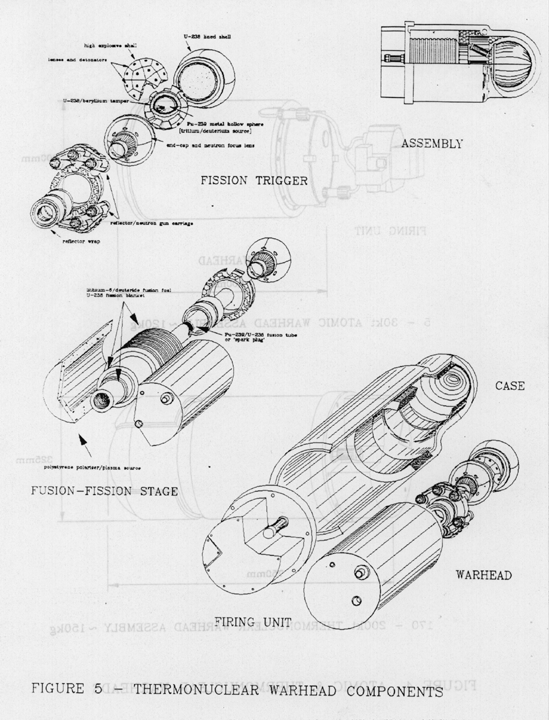

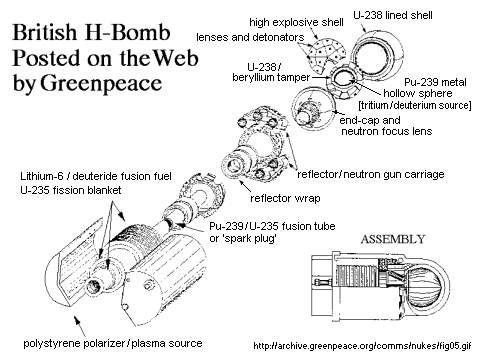
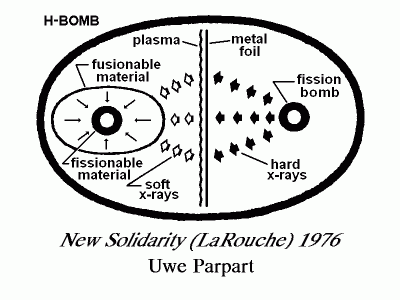

Thermonuclear weapon
View on GrokipediaTerminology and Definitions
Nomenclature and Distinctions from Fission Weapons
A thermonuclear weapon, also designated as a hydrogen bomb or H-bomb, derives its nomenclature from the fusion of hydrogen isotopes—principally deuterium and tritium—in a secondary stage that amplifies the initial fission detonation.[7] This contrasts with the colloquial "atomic bomb," which exclusively denotes fission-based devices, though both fall under the broader category of nuclear weapons. The term "thermonuclear" underscores the requisite extreme temperatures, exceeding tens of millions of degrees Kelvin, generated by a fission primary to ignite fusion reactions, distinguishing it from hypothetical pure-fusion concepts that remain unachieved in deployable form.[8][9] Pure fission weapons, such as the uranium-based Little Boy (yield approximately 15 kilotons TNT equivalent) and plutonium-based Fat Man (21 kilotons), release energy solely through the chain reaction splitting of fissile isotopes like uranium-235 or plutonium-239, constrained by the device's critical mass and neutron economy.[10] In contrast, thermonuclear weapons integrate a fission trigger to compress and heat a fusion fuel assembly, enabling yields orders of magnitude higher—typically from hundreds of kilotons to megatons—via the binding energy of helium nuclei formed from light elements, which exceeds that of fission fragments per nucleon.[11] This staged architecture circumvents fission's scalability limits, as fusion stages can be cascaded or scaled with additional fissile material in the tamper, contributing up to 50% or more of total yield in designs like the Soviet RDS-37 (1.6 megatons, 1955).[8] Key technical distinctions include energy mediation: fission detonations propagate via neutron-induced chain reactions in dense fissile cores, whereas thermonuclear yields depend critically on x-ray ablation and hydrodynamic compression of the secondary, channeling radiative energy from the primary to achieve fusion ignition without direct mechanical contact.[9] Fission weapons exhibit sharper yield ceilings due to predetonation risks and implosion inefficiencies, rarely exceeding 500 kilotons even in optimized gun-type or implosion designs, while thermonuclear configurations permit arbitrary escalation, exemplified by the U.S. Ivy Mike test (10.4 megatons, 1952) versus the maximum practical fission yield of around 500 kilotons.[10] Furthermore, thermonuclear devices often incorporate fission of the depleted uranium tamper for additional yield, blurring pure distinctions but emphasizing fusion's dominant role in high-end outputs.[11]Yield Classifications and Multi-Stage Designs
Thermonuclear weapons are categorized by explosive yield, measured in equivalents of kilotons (kt) or megatons (Mt) of TNT, with designs typically achieving 100 kt to over 50 Mt, far exceeding pure fission weapons limited to around 500 kt maximum due to critical mass constraints.[12] Low-yield thermonuclear configurations, often around 100-800 kt, enable compact warheads for missile delivery, as in the U.S. W47 (600-800 kt, deployed 1960s), while high-yield variants exceed 1 Mt for strategic deterrence.[12] Tactical applications favor lower yields under 50 kt, but true multi-stage thermonuclear weapons rarely fall below 100 kt, distinguishing them from boosted fission devices used for battlefield roles; strategic classifications dominate, targeting population centers or infrastructure with yields causing severe damage radii beyond 2 miles for 1 Mt devices.[13][13] Multi-stage designs amplify yield through sequential energy transfer: a primary fission stage generates X-rays that compress and ignite a secondary fusion stage containing lithium deuteride, releasing fusion energy and neutrons that induce further fission in a uranium tamper.[12] This two-stage Teller-Ulam configuration, implemented in the first test Ivy Mike on November 1, 1952 (10.4 Mt yield), uses radiation implosion for efficient compression, achieving yields impractical with single-stage fission alone.[12] Castle Bravo, tested March 1, 1954, exemplified enhanced two-stage performance at 15 Mt, though unintended yield escalation from lithium-7 reactions highlighted design sensitivities.[12] Three-stage variants incorporate a tertiary fusion or fission stage, imploded by secondary output, to scale yields into tens of megatons while maintaining relative compactness; the primary sequentially drives the secondary, whose energy then compresses the tertiary, often with a uranium-238 pusher for additional fission contribution.[12] The U.S. B53 bomb (9 Mt maximum yield, deployed 1962-1990) employed this for high-end strategic roles, while the Soviet Tsar Bomba, tested October 30, 1961, at 50 Mt (97% fusion-derived), used a three-stage setup originally designed for 100 Mt but modified to limit fallout by substituting lead for uranium in the tertiary tamper.[12][12] Such designs prioritize yield-to-weight efficiency, with theoretical maxima around 6 Mt per tonne, though practical limits reflect engineering trade-offs in staging and materials.[12]Fundamental Physics and Principles
Fission Primary and Fusion Secondary Interaction
In the Teller-Ulam configuration, the fission primary detonates, generating intense soft X-rays that constitute over 80% of its energy output and propagate through a radiation channel to interact with the fusion secondary.[14] These X-rays, emitted at temperatures corresponding to roughly 10 keV, fill the channel—a low-density gap between the weapon's radiation case and the secondary—and establish thermal equilibrium, ensuring uniform irradiation of the secondary's surface.[15] The radiation case, typically constructed from high atomic number (high-Z) materials like uranium (Z=92), functions as a hohlraum to reflect and soften the X-rays to 1-2 keV, promoting symmetric energy deposition.[15] The interaction proceeds via radiation implosion: X-rays ablate the outer layer of the secondary's pusher-tamper assembly, which is often a high-Z material such as uranium, vaporizing it and creating a plasma that expands outward.[14] This ablation generates inward-directed implosion pressure through momentum conservation, akin to a rocket effect, with pressures reaching values like 5.3 × 10^9 bars in early designs.[15] The resulting symmetric compression reduces the secondary's dimensions significantly— for instance, to 1/30th the original diameter in cylindrical approximations—achieving fuel densities of 1000 times or more the normal value, such as 33.3 g/cm³ in the Ivy Mike device.[14][3] Compression heats the fusion fuel, typically lithium deuteride, to temperatures exceeding 100 million Kelvin, igniting deuterium-tritium fusion reactions whose rates scale with the square of density.[14] A central fissionable "sparkplug," such as a 2-3 cm diameter rod of plutonium-239 or uranium-235 compressed to supercriticality, often contributes initial fission energy to assist uniform ignition before the primary's hydrodynamic effects arrive.[14] This staged radiation implosion, proposed by Teller and Ulam in early 1951, enables efficient energy transfer from the primary's fission (yields typically in the kiloton range) to the secondary's fusion, as demonstrated in the Ivy Mike test on November 1, 1952, which yielded over 10 megatons.[3] The process relies on the opacity of high-Z materials to confine radiation and prevent premature heating of the fuel, ensuring compression precedes significant hydrodynamic disruption from the primary.[15]Radiation Implosion and Compression Dynamics
In the Teller-Ulam design, radiation implosion utilizes soft X-rays emitted by the fission primary, which constitute over 80% of its energy output primarily at energies around 10 keV, to drive the compression of the fusion secondary stage.[15] These X-rays propagate through a radiation channel within the weapon's casing, a low-density foam or gas-filled space that facilitates rapid thermalization and uniform distribution via multiple absorptions and re-emissions, approximating blackbody equilibrium in a hohlraum cavity.[15] The resulting photon gas exerts pressure on the secondary's outer tamper-pusher, composed of high atomic number (high-Z) materials like uranium to enhance opacity and ablation efficiency.[15] Ablation dynamics commence as the intense X-ray flux vaporizes the tamper's surface, generating a high-velocity plasma outflow—typically 290-410 km/s in tested designs—with the outward expansion imparting inward momentum to the remaining shell through conservation of momentum, producing ablation pressures on the order of 5×10^9 to 6×10^10 bars.[15] This "rocket effect" induces spherical or cylindrical implosion, compressing the fusion fuel (such as lithium deuteride) and any central fissile spark plug to densities exceeding 100 times solid density, with factors up to 197-fold in the 1952 Ivy Mike test achieving 33 g/cm³ and higher in modern variants reaching 720 g/cm³.[15][14] Compression occurs over nanoseconds, with initial shock velocities of 150-550 km/s propagating inward to achieve the requisite stagnation for ignition, where fuel temperatures rise to 30-35 keV, enabling deuterium-tritium fusion reactions at rates governed by the Lawson criterion.[15] The process demands precise timing to mitigate hydrodynamic instabilities like Rayleigh-Taylor, which could disrupt uniformity; the opaque tamper shields the fuel from premature heating during the initial radiation flood, ensuring adiabatic compression dominates over direct thermal conduction.[15] Ablation efficiency, around 15-20%, couples ~75% of the tamper mass into the implosion drive, with the spark plug—often plutonium or uranium—fissioning under compressed supercriticality to provide initial heat and neutrons, bootstrapping the fusion burn that sustains for 20-40 ns at densities of 100 g/cm³ or more.[15][14] This staged radiation implosion, conceptualized by Edward Teller and Stanislaw Ulam in January 1951, supplanted earlier mechanical compression attempts by leveraging electromagnetic radiation pressure over material shock waves for scalability and yield enhancement.[15]Energy Release Mechanisms from First Principles
The energy released in thermonuclear weapons derives fundamentally from the conversion of nuclear binding energy differences into kinetic energy and radiation, as dictated by , where mass defects arise from the strong nuclear force's saturation. Light nuclei, such as hydrogen isotopes, exhibit low binding energy per nucleon—approximately 1.11 MeV for deuterium and 2.83 MeV for tritium—compared to helium-4's 7.07 MeV per nucleon. Fusing deuterium and tritium thus yields a net increase in binding energy, liberating 17.59 MeV per reaction: , with energy partitioning favoring the neutron (80%) for efficient escape and subsequent interactions./Nuclear_Chemistry/Nuclear_Energetics_and_Stability/Energetics_of_Nuclear_Reactions)[16][17] This fusion process requires overcoming Coulomb repulsion via quantum tunneling at temperatures of 10–100 keV (roughly 100–1,000 million Kelvin) and densities compressed to 100–1,000 times liquid values, conditions provided by the primary fission stage's X-ray flux ablating and imploding the secondary fuel. Reaction rates scale with the square of fuel density due to binary collision probabilities, , where is density and the reactivity, enabling rapid energy deposition before bremsstrahlung losses dominate at lower densities. In lithium deuteride fuels, neutron capture on lithium-6 breeds tritium in situ (), amplifying D-T reactions and neutron flux.[15][13][15] Fusion neutrons, unmoderated at 14 MeV, exceed the ~1 MeV threshold for fast fission in the depleted uranium-238 (U-238) tamper, triggering a secondary fission cascade: each U-238 fission releases ~200 MeV, far exceeding the ~17 MeV per fusion event, with cross-sections enabling efficient multiplication. This fission-fusion-fission synergy often dominates total yield; for example, in the 1952 Ivy Mike device (10.4 Mt total), direct fusion contributed ~23% while tamper fast fission accounted for ~77%, with potential for up to 89% fission under optimized neutron economy. Designs can vary "cleanliness," minimizing tamper fission for reduced fallout, but most operational weapons leverage U-238 for maximized yield scalability.[15][15][13]Core Design Components
Teller-Ulam Configuration
The Teller-Ulam configuration refers to the staged radiation implosion design that enables efficient thermonuclear detonation in multi-stage weapons, where a fission primary generates X-rays that compress and ignite a separate fusion secondary stage.[14] This approach, developed at Los Alamos National Laboratory, overcame prior challenges in achieving high-yield fusion by decoupling the primary explosion's mechanical shock from the secondary compression, relying instead on electromagnetic radiation for uniform, rapid implosion.[15] In early 1951, physicist Stanislaw Ulam proposed compressing fusion fuel through the hydrodynamic implosion of a surrounding fissile material triggered by a nearby primary fission device, addressing inefficiencies in classical super designs that attempted direct fusion ignition.[18] Edward Teller refined this by recognizing that the primary's X-ray flux, traveling at near-light speed, could fill a radiation case enclosing both stages, ablating the secondary's outer tamper and driving inward compression via rocket-like ablation pressure before significant mechanical debris arrived.[14] Their joint memorandum, dated March 9, 1951, titled "On Heterocatalytic Detonations I: Hydrodynamic Lenses and Radiation Mirrors," outlined this principle, marking the breakthrough for practical thermonuclear weapons.[15] The configuration typically features a cylindrical or spherical primary at one end of a radiation channel, surrounded by a high-Z case (hohlraum) that channels soft X-rays to heat and ablate the secondary's pusher-tamper assembly, which encapsulates fusion fuel such as lithium deuteride and a central fission sparkplug for ignition enhancement.[14] Compression ratios exceeding 1000-fold are achieved, enabling fusion ignition at densities where Lawson criterion conditions are met for net energy gain from deuterium-tritium reactions, followed by fission of the depleted uranium tamper contributing up to 50% or more of total yield in optimized designs.[19] This staged separation allows independent optimization of primary efficiency and secondary gain, scaling yields from kilotons to megatons without proportional increases in primary size.[14] Declassification of core elements occurred progressively from the 1950s onward, with fuller public disclosure in the 1970s via court testimonies and technical analyses confirming the radiation-dominated implosion as the causal mechanism distinguishing modern thermonuclear devices from single-stage fission or early fusion experiments.[18] Soviet replication, achieved independently by Andrei Sakharov and team by late 1953, validated the design's universality, leading to their 1955 RDS-6s test yielding 400 kilotons.[20] Empirical tests, such as the U.S. Ivy Mike shot on November 1, 1952, demonstrated 10.4 megatons from this configuration, empirically verifying the physics of radiation transfer and ablation-driven compression.[15]Interstage and Tamper-Pusher Systems
In the Teller-Ulam configuration of thermonuclear weapons, the interstage occupies the region between the fission primary and fusion secondary stages, functioning as an energy transfer modulator that channels x-ray radiation while shielding the secondary from premature heating by the primary's hot gases, neutrons, and debris.[21] This component ensures precise timing for the radiation implosion process, often incorporating low-density foams or structured channels that fill with plasma upon primary detonation to uniformize x-ray flux and prevent asymmetric compression.[15] Declassified analyses indicate variations in interstage design, such as the use of specialized materials to absorb or reflect specific radiation wavelengths, optimizing compression efficiency; for instance, the U.S. employed a classified aerogel-like substance known as Fogbank in certain warheads to achieve this modulation.[22] The tamper-pusher system constitutes the structural envelope of the secondary stage, where the pusher—typically a dense layer of material like beryllium or uranium—undergoes ablation from incoming x-rays, generating reactive pressure that implodes the surrounding fusion fuel toward criticality.[15] Ablation occurs as surface atoms vaporize and expand outward, transferring momentum inward per conservation of momentum principles, achieving compression ratios necessary for fusion ignition on microsecond timescales.[14] Integral to this, the tamper, often composed of depleted uranium-238, provides inertial confinement by resisting disassembly forces during the fusion burn, thereby extending the reaction duration and enhancing yield; its high atomic mass reflects neutrons back into the fuel, boosting efficiency, while in "dirty" designs, it undergoes fast fission from fusion neutrons, contributing up to 50% or more of total energy release.[12][15] The combined tamper-pusher must withstand extreme pressures exceeding 10^15 pascals without fracturing, a requirement met through precise material selection and layering to balance ablation rate with structural integrity.[15]Boosting and Fission-Fusion-Fission Stages
Boosting enhances the efficiency of the fission primary in thermonuclear weapons by incorporating a small quantity of fusion fuel, typically a deuterium-tritium (D-T) gas mixture, into the hollow pit of the plutonium or uranium fissile core. Upon initiation of the fission chain reaction via implosion, the rising temperature and compression ignite fusion reactions in the D-T gas, releasing high-energy neutrons at approximately 14 MeV. These neutrons promptly induce additional fissions in the surrounding fissile material, accelerating the reaction rate and increasing the primary's yield by a factor of 2 to 5 compared to unboosted designs, while also elevating the production of X-rays and neutrons essential for compressing the secondary stage.[23][24] This boosting mechanism reduces the required mass of fissile material for achieving criticality under compression and minimizes neutron pre-detonation risks by relying on fusion-generated neutrons rather than solely spontaneous fission sources. Declassified U.S. tests, such as those during Operation Plumbbob in 1957, demonstrated boosted primaries yielding 12-19 kilotons, with fusion contributing about 7 kilotons in one instance, underscoring the technique's role in compact, high-output triggers for multi-stage devices.[25] Soviet designs similarly adopted boosting by the mid-1950s to parallel U.S. advancements in primary efficiency.[12] In the fission-fusion-fission (FIF) process, the thermonuclear secondary's fusion reactions generate abundant 14 MeV neutrons that interact with the surrounding depleted uranium (U-238) tamper, inducing fast fission in this otherwise non-fissile isotope, which requires neutrons above ~1 MeV to overcome its fission barrier. This tertiary fission stage substantially amplifies the overall weapon yield, often accounting for 50% or more of the total energy release in high-yield designs, as the tamper's dense mass captures neutrons inefficiently used in fusion fuel while converting their kinetic energy into fission products.[12][26] The tamper, typically a U-238 shell, serves dual purposes: reflecting neutrons inward to sustain reactions and providing inertial confinement via its inertia, but in FIF configurations, its fission contribution is deliberately maximized for yield optimization rather than minimized for "clean" low-fallback designs. For instance, enriching the tamper with U-235 further boosts slow-neutron fission alongside fast fission, though standard depleted uranium suffices for predominant fast-fission dominance. Yield contributions from this stage vary by design; in some U.S. weapons like the B-41 bomb, fusion boosting in the primary and tamper fission in the secondary enabled multi-megaton outputs from staged architectures.[12][27] This staged fission amplification exemplifies causal chaining in thermonuclear energy release, where primary fission enables fusion, which in turn drives tamper fission for multiplicative effects grounded in neutron economy and isotopic response thresholds.[28]Implosion and Compression Techniques
Radiation Pressure Dominance
In the Teller-Ulam configuration of thermonuclear weapons, radiation pressure from the soft X-ray flux generated by the fission primary serves as the initiating and dominant energy transfer mechanism for compressing the fusion secondary, enabling yields orders of magnitude greater than fission alone. The primary detonation converts roughly 80% of its energy into X-rays with temperatures exceeding 10 keV, which propagate at the speed of light through the enclosing radiation case and interstage region, achieving near-instantaneous coupling without the delays inherent in hydrodynamic shock waves that travel at velocities around 10 km/s.[14] This radiation rapidly thermalizes, creating a photon gas whose pressure ablates the outer tamper-pusher layer of the secondary, generating inward recoil forces that implode the fusion fuel.[15] Direct radiation pressure, given by where is the Stefan-Boltzmann constant, the radiation temperature, and the speed of light, reaches extreme values on the order of 10^{12} Pa or higher in the hohlraum-like enclosure, far surpassing material vapor pressures at equivalent temperatures.[15] However, unmitigated photon momentum transfer would over-compress the secondary too swiftly for sustained fusion reactions, as initial Livermore calculations in the early 1950s demonstrated; instead, the absorption of X-rays vaporizes and ejects surface material, amplifying the effective compression via ablation recoil, which produces hydrodynamic pressures up to hundreds of megabars (10-100 TPa).[15] This ablation-driven process ensures controlled convergence, achieving fuel densities over 1000 times that of liquid deuterium-tritium, critical for ignition.[14] The dominance of radiation pressure over alternative mechanisms, such as direct plasma contact or mechanical pistons explored in pre-1951 designs, stems from its superior speed and uniformity, minimizing asymmetries that could disrupt spherical implosion. In the Ivy Mike test on November 1, 1952, this principle yielded 10.4 megatons, validating the staged radiation implosion with lithium deuteride fuel compressed to fusion conditions.[15] Subsequent refinements, including foam-filled interstages to enhance radiation confinement, further optimized pressure uniformity, as evidenced by yields in the Castle Bravo test (March 1, 1954) reaching 15 megatons despite design errors.[15] In modern designs like the W88 warhead, integrated ablation, foam plasma, and residual radiation pressures sustain compression efficiencies approaching 30-50% of theoretical fusion limits.[15]Ablation and Foam Plasma Effects
In the Teller-Ulam configuration of thermonuclear weapons, ablation constitutes the primary mechanism for compressing the secondary stage's fusion fuel. X-rays generated by the fission primary irradiate the outer surface of the secondary's tamper—a dense material such as uranium or lead—causing rapid heating, vaporization, and expulsion of surface atoms as plasma. This outward-directed ablation produces a reactive force that accelerates the remaining tamper inward, akin to the thrust from a rocket nozzle reversed, achieving compression ratios exceeding 1000-fold necessary for fusion ignition.[14] The process relies on the momentum transfer from the ablated material, with pressures reaching tens of gigabars, far surpassing mechanical shock waves from direct blast.[15] The efficiency of ablation-driven implosion stems from the near-light-speed propagation of X-ray energy, enabling near-simultaneous irradiation of the secondary's surface before significant hydrodynamic expansion disrupts symmetry. Empirical validation occurred during U.S. tests like Ivy Mike on November 1, 1952, where measured yields of 10.4 megatons confirmed the ablation model's predictions for radiation-dominated compression over neutron or hydrodynamic alternatives.[15] Ablation pressures scale with X-ray flux intensity, typically 10^15 to 10^16 watts per square centimeter, ensuring inertial confinement times on the order of nanoseconds.[14] Foam plasma effects augment ablation in the interstage region between primary and secondary. A low-density foam, often polystyrene, fills this space to channel X-rays and prevent premature mixing of materials. Upon irradiation, the foam ablates into a hot, optically thick plasma at temperatures exceeding 10^7 Kelvin, which expands and exerts uniform hydrodynamic pressure against the secondary's pusher-tamper, enhancing compression symmetry and mitigating Rayleigh-Taylor instabilities.[7] This plasma also re-radiates softer X-rays, prolonging the ablation phase and contributing up to 20-30% of the total implosion drive in optimized designs.[29] The foam's role was refined in subsequent tests, such as Operation Castle Bravo on March 1, 1954, where lithium deuteride secondary compression yielded 15 megatons, partly attributable to plasma-mediated energy transfer from foam ablation. Unlike direct radiation pressure, which dominates only in idealized hohlraums, foam plasma provides causal robustness against channel closure, as the expanding plasma maintains flux until peak compression. Designs without foam, as in early concepts, suffered asymmetric implosions, underscoring the foam's empirical necessity for high-yield reliability.[15]Comparative Analysis of Mechanism Efficiencies
Radiation implosion, as employed in the Teller-Ulam configuration, achieves significantly higher compression efficiencies than mechanical implosion methods used in fission primaries or pre-Teller-Ulam fusion concepts. In radiation implosion, X-rays from the fission primary—comprising up to 95% of its energy output—fill a radiation channel, uniformly heating the secondary's tamper-pusher assembly and inducing ablation pressures on the order of 5.3 × 10^9 bars in early designs like Ivy Mike, escalating to 6.4 × 10^10 bars in optimized modern warheads such as the W-80.[15] This ablation drives inward shock waves at velocities exceeding 570 km/s, compressing fusion fuel to densities of 33.3 g/cm³ (197-fold increase) in Ivy Mike and up to 720 g/cm³ (878-fold) in advanced systems, enabling fusion ignition temperatures around 30 million K and burn fractions approaching 80% within confinement times of approximately 20 ns.[15] By contrast, mechanical implosion in fission weapons typically yields only 2-3x density increases in the fissile core, as convergent shock waves from chemical explosives or direct contact compress plutonium or uranium pits, limiting scalability for fusion stages due to hydrodynamic instabilities and asymmetric forces.[30] The superior efficiency of radiation implosion stems from its hohlraum-like energy transfer, which avoids mechanical linkages that introduce Rayleigh-Taylor instabilities prevalent in direct-contact compression schemes. Pre-Teller-Ulam designs, such as classical superposition or "alarm clock" layered fission-fusion assemblies, relied on fission heat conduction or mechanical drivers for fusion fuel compression, resulting in negligible thermonuclear yields—often less than 1% of theoretical fusion energy—due to insufficient areal density (ρR) for sustained burn-up.[14] In Teller-Ulam staging, the separated primary and secondary allow optimized energy coupling, with the fusion tamper retaining thermal radiation to enhance burn propagation, yielding specific fusion energies of 82.2 kt/kg for pure deuterium and 64.0 kt/kg for lithium-6 deuteride under ideal compression.[15] Mechanical alternatives, lacking this radiative uniformity, fail to achieve the required ρR product (typically >1 g/cm² for efficient D-T burn), confining their utility to boosted fission where fusion contributes only marginally to total yield, as seen in early Soviet devices like RDS-4 with yields under 1% thermonuclear.[14] Foam plasma effects in the radiation channel further boost efficiency by preserving photon transparency during ablation, preventing premature plasma formation that could scatter X-rays and reduce coupling to the secondary by up to 50% in opaque channels.[15] Empirical validation from Operation Ivy's Mike shot on November 1, 1952, demonstrated a 10.4 Mt yield with ~77% from fission (including tamper) and the balance from fusion, far exceeding mechanical-driven prototypes' outputs by orders of magnitude in yield-to-mass ratio.[15] In comparative terms, radiation implosion's advantages enable multi-megaton yields from compact designs, whereas mechanical compression's limitations—evident in unviable large-scale fusion attempts—necessitated the 1951 Teller-Ulam breakthrough for practical thermonuclear weapons.[14]| Mechanism | Typical Compression Ratio | Peak Ablation Pressure (bars) | Fusion Burn Fraction | Example Yield Efficiency |
|---|---|---|---|---|
| Radiation Implosion | 197–878x | 10^9–10^10 | ~80% | 10.4 Mt (Ivy Mike, mostly fusion)[15] |
| Mechanical Implosion | 2–3x | N/A (explosive-driven) | <1% for fusion | Boosted fission <1% thermo (RDS-4)[14] |
Historical Development
Pre-Thermonuclear Concepts and Early Fission Foundations
Nuclear fission was discovered in December 1938 by German chemists Otto Hahn and Fritz Strassmann, who observed that uranium atoms split when bombarded with neutrons, releasing additional neutrons and energy.[31] This process enabled the possibility of a self-sustaining chain reaction, as theorized by Hungarian physicist Leo Szilard, who recognized its potential for both power generation and explosive weapons.[31] In August 1939, Szilard and Albert Einstein alerted President Franklin D. Roosevelt to the military implications via a letter, prompting initial U.S. research efforts that evolved into the Manhattan Project by 1942.[32] The first controlled chain reaction was achieved on December 2, 1942, under the University of Chicago's Stagg Field with the Chicago Pile-1 reactor, led by Enrico Fermi, confirming the feasibility of sustained fission for weaponization.[33] The Manhattan Project, formalized after Roosevelt's approval in late 1941 and directed by General Leslie Groves, pursued two primary fission bomb designs: the gun-type assembly using uranium-235 and the implosion method for plutonium-239.[34] The gun-type design accelerated one subcritical mass of highly enriched uranium into another to achieve supercriticality rapidly, minimizing predetonation risks due to uranium's lower spontaneous fission rate.[35] In contrast, implosion compressed a plutonium sphere symmetrically using high-explosive lenses to initiate criticality, necessitated by plutonium's higher impurity content, particularly Pu-240, which increased spontaneous neutron emissions.[36] The implosion design was validated during the Trinity test on July 16, 1945, at Alamogordo, New Mexico, yielding approximately 20 kilotons of TNT equivalent and confirming the plutonium bomb's viability despite complexities in explosive symmetry and neutron initiators.[37] This was followed by combat deployments: the uranium gun-type "Little Boy" on Hiroshima on August 6, 1945, with a yield of about 15 kilotons from 64 kilograms of uranium (less than 1 kilogram fissioned), and the plutonium implosion "Fat Man" on Nagasaki on August 9, 1945, yielding around 21 kilotons.[35][36] These fission weapons established the foundational physics of rapid energy release via exponential neutron multiplication, with efficiencies limited by material availability and design constraints—gun-type at roughly 1.4% fission and implosion higher but requiring precise engineering.[38] Pre-thermonuclear concepts emerged concurrently, as Fermi suggested to Edward Teller during the Manhattan Project that a fission explosion could provide the extreme temperatures and neutrons to ignite fusion in deuterium or tritium, potentially amplifying yields beyond pure fission limits.[39] Teller, while prioritizing fission work at Los Alamos, explored "super" bombs post-1945, initially proposing direct heating of fusion fuel by fission products in a layered "classical super" configuration, though calculations later revealed insufficient compression and temperature for sustained fusion burn.[40] These ideas built on stellar fusion models but faced challenges in achieving the Lawson criterion for net energy gain, relying on fission's ~10 million Kelvin temperatures to overcome deuterium-deuterium repulsion barriers, yet early designs like multi-stage "alarm clocks" proved inefficient without advanced staging.[40] The fission foundations thus provided not only proven explosive precedents but also the neutron flux and radiation environment essential for subsequent thermonuclear ignition mechanisms.United States Pioneering Tests (1950s)
Operation Greenhouse, conducted at Enewetak Atoll from April 7 to June 24, 1951, featured four nuclear tests that explored thermonuclear principles through boosted fission and early fusion experiments, including the George shot on May 9 which achieved partial fusion yielding 225 kilotons via deuterium-tritium gas.[41] These tests validated radiation implosion concepts foundational to the Teller-Ulam design but did not produce a full thermonuclear detonation.[40] The breakthrough came with Operation Ivy at Enewetak Atoll, where the Mike shot on November 1, 1952, detonated the first full-scale thermonuclear device on Elugelab Island, achieving a yield of 10.4 megatons—over 700 times the Hiroshima bomb—and completely vaporizing the 3.3-square-kilometer island into a 1.9-kilometer-wide crater.[42] [43] Mike employed a cryogenic liquid deuterium fusion fuel in a Teller-Ulam configuration, confirming the staged radiation implosion mechanism but resulting in a massive, non-deployable "sausage" device weighing 82 tons and measuring 7.3 meters long.[44] Subsequent Operation Castle at Bikini Atoll in 1954 tested scalable, dry-fuel thermonuclear weapons for practical delivery. The Bravo shot on March 1, 1954, yielded an unexpected 15 megatons—2.5 times predictions—due to unanticipated fusion from lithium-7, contaminating over 11,000 square kilometers and exposing Marshallese islanders and Japanese fishermen to fallout.[45] [46] Other Castle tests, like Romeo on March 26 (11 megatons) and Union on April 25 (6.9 megatons), refined multi-stage designs, enabling megaton-class warheads compatible with bombers and missiles by the late 1950s.[47] These experiments established U.S. thermonuclear superiority, though declassified data later revealed yield predictions often underestimated fusion efficiencies from unpredicted reactions.[48]Soviet Union Parallel Advancements
The Soviet thermonuclear weapons program was launched in the aftermath of the RDS-1 atomic test on August 29, 1949, under the direction of Igor Kurchatov and with significant contributions from Andrei Sakharov, who became a central figure in fusion research.[49] Sakharov, collaborating with Igor Tamm, proposed the "layer cake" (sloyka) configuration around 1948, which arranged alternating layers of lithium deuteride fusion fuel and uranium-238 fission material within a boosted fission primary to achieve partial thermonuclear yield through compression and radiation effects.[50] This approach paralleled early unclassified Western concepts like Edward Teller's "alarm clock" but was developed independently within the Soviet closed-city laboratory at Arzamas-16.[51] The program's first milestone came with the RDS-6s device, tested on August 12, 1953, at the Semipalatinsk Test Site in Kazakhstan from a 37-meter tower, producing a yield of 400 kilotons—roughly ten times that of the RDS-1.[49] Known to NATO as Joe-4, RDS-6s utilized a "dry" fuel of lithium-6 deuteride, enabling a deliverable weapon design compatible with existing bomber casings, though it remained a single-stage "boosted" system rather than a full multi-stage device.[52] This test demonstrated practical thermonuclear enhancement via layered fission-fusion interactions, validating Sakharov's schema despite the device's classification limitations compared to the U.S. Ivy Mike test of 1952.[53] Advancing to true staged designs, the RDS-37 test on November 22, 1955, at Semipalatinsk represented the Soviet Union's first two-stage thermonuclear detonation, air-dropped from a Tu-16 bomber with a yield of 1.6 megatons (scaled down from an intended 3-5 Mt for safety).[54] RDS-37 employed radiation implosion to compress a secondary fusion stage, incorporating principles of x-ray ablation and foam plasma channeling that echoed the Teller-Ulam configuration without direct replication, as Soviet physicists refined Sakharov's ideas through iterative modeling and subcritical experiments.[55] While espionage, including data from Klaus Fuchs on U.S. fission primaries, accelerated the overall nuclear effort, declassified analyses indicate the thermonuclear innovations stemmed primarily from indigenous theoretical work, enabling rapid parity with U.S. capabilities by the mid-1950s.[51][56]Proliferation to Other Nations
The United Kingdom achieved thermonuclear capability through Operation Grapple, a series of tests conducted from 1957 to 1958 at Malden and Christmas Islands in the Pacific, marking the first proliferation beyond the United States and Soviet Union. The initial test on 31 May 1957 yielded about 300 kilotons but underperformed expectations for a full two-stage device; subsequent refinements culminated in successful detonations, including a 1.8-megaton explosion on 8 November 1957 and a 3-megaton blast on 28 April 1958 during Grapple Y.[57] These tests validated Britain's independent mastery of Teller-Ulam staging, supported by collaboration with the United States under the 1958 Mutual Defence Agreement, enabling deployment of warheads like the Yellow Sun bomb by 1960.[58] France developed thermonuclear weapons independently, detonating its first device, codenamed Canopus, on 24 August 1968 at Fangataufa Atoll in French Polynesia with a yield of 2.6 megatons. Suspended from a balloon, the test confirmed multi-stage fusion design after earlier fission-only trials since 1960, driven by President de Gaulle's force de frappe doctrine for strategic autonomy amid NATO tensions.[59] France conducted 210 atmospheric and underground tests through 1996,[60] refining warheads for submarines and aircraft, with yields up to 2.6 megatons, before halting explosive testing under the Comprehensive Test Ban Treaty. China rapidly advanced to thermonuclear status, testing its first device on 17 June 1967 at Lop Nur, just 32 months after its initial fission test in 1964, with a 3.3-megaton airburst from an H-6 bomber. This three-stage design, developed amid the Cultural Revolution and severed Soviet aid, demonstrated boosted fission-primary and fusion-secondary mechanics, yielding data for missile-warhead integration by the 1970s.[61] China's arsenal expanded to an estimated 500 warheads by 2024, emphasizing silo-based and mobile ICBMs with thermonuclear payloads.[6] India claimed a thermonuclear detonation during Operation Shakti on 11 May 1998 at Pokhran, reporting a 45-kiloton yield from a two-stage device, but seismic data and post-test analysis indicated a partial fizzle with fusion contribution below expectations, estimated at 15-20 kilotons total. Indian officials, including former DRDO coordinator K. Santhanam, later asserted underperformance due to design flaws, prompting calls for re-testing, though government sources maintain success sufficient for deterrence.[62] [63] Pakistan lacks confirmed thermonuclear capability, relying on fission-boosted designs tested in 1998. North Korea announced a "successful" hydrogen bomb test on 3 September 2017 at Punggye-ri, claiming a 250-kiloton yield miniaturized for ICBMs, but seismic measurements of 100-150 kilotons and radionuclide analysis suggest a boosted fission device rather than full thermonuclear staging, consistent with prior doubts over its 2016 claim.[64] [65] Israel maintains nuclear ambiguity but possesses an estimated 90 warheads, with fissile material for up to 200; assessments indicate potential thermonuclear designs by the 2000s, possibly aided by advanced simulations absent explosive tests.[6] No other nations have verifiably proliferated thermonuclear weapons, constrained by the Nuclear Non-Proliferation Treaty and technical barriers to multi-stage implosion.[66]Post-Cold War Refinements and Modernizations
Following the end of the Cold War in 1991 and the subsequent moratorium on nuclear explosive testing, the United States initiated the Stockpile Stewardship Program in 1995 to maintain and refine thermonuclear warheads without full-yield underground tests. This program relies on advanced supercomputing simulations, hydrodynamic experiments, subcritical nuclear tests at the Nevada National Security Site, and high-energy-density physics research at facilities like the National Ignition Facility to certify the performance of primary fission triggers and secondary fusion stages in existing designs. Annual assessments by the national laboratories confirm the safety, security, and reliability of the stockpile, addressing age-related degradation in components such as plutonium pits and lithium deuteride fuel.[67][68] Life extension programs have refurbished key thermonuclear warheads, incorporating insensitive high explosives, fire-resistant pits, and enhanced arming, safing, and fuzing mechanisms to improve safety margins while preserving yields. The W76 warhead, deployed on Trident II submarine-launched ballistic missiles, underwent a major refurbishment completed in 2019, replacing aged components and verifying thermonuclear efficiency through surrogate testing and modeling. In 2019, the low-yield W76-2 variant, with an estimated yield of 5-7 kilotons from its modified fusion stage, entered service to provide tailored deterrent options against limited nuclear threats. The B61-12 gravity bomb, certified in 2022 after a decade-long effort, integrates a multi-yield thermonuclear assembly adjustable from 0.3 to 50 kilotons, emphasizing precision delivery over raw power.[69][67] Russia has modernized its thermonuclear arsenal amid post-1991 economic constraints and treaty obligations, focusing on refurbishing warheads for new delivery systems like the RS-24 Yars ICBM and Borei-class submarines without acknowledged full-yield tests since 1990. State sources report upgrades to multiple independently targetable reentry vehicles with variable-yield fusion primaries, aiming to counter perceived U.S. advantages, though independent verification is limited by classification. Estimates suggest over 1,500 deployed strategic warheads as of 2024, sustained through disassembly-reassembly cycles and materials science advancements to mitigate corrosion in tritium reservoirs and fusion tampers.[70] The United Kingdom maintains approximately 225 thermonuclear warheads derived from U.S. designs for its Trident system, with a 2016 defense review committing to life extensions through 2030s via shared stewardship data and hydrodynamic testing, avoiding independent explosive trials post-1991. France, after its final Pacific tests in 1996 yielding up to 120 kilotons, adopted a simulation-based approach akin to the U.S. SSP, refining TNO-series warheads for M51 missiles with improved two-stage efficiency and airburst fuzing for hardened targets. China, having conducted 45 tests until 1996 including multi-megaton thermonuclear devices, has expanded its arsenal to over 500 warheads by 2024, reportedly enhancing miniaturization and MIRV capabilities through computational modeling and subcritical experiments, enabling deployment on DF-41 ICBMs.[6]Strategic Doctrine and Deterrence Role
Mutual Assured Destruction Framework
The Mutual Assured Destruction (MAD) framework posits that strategic stability arises from each nuclear superpower possessing a secure second-strike capability sufficient to devastate the opponent's society, economy, and military infrastructure even after absorbing a first strike, thereby rendering any nuclear initiation irrational due to the certainty of reciprocal annihilation. This doctrine relies fundamentally on thermonuclear weapons' capacity for yields in the megaton range—far exceeding fission devices' kiloton limits—enabling the destruction of urban centers, industrial bases, and population concentrations across vast territories in a single exchange. For instance, a single 1-megaton thermonuclear detonation can incinerate an area of approximately 100 square kilometers and generate fallout affecting thousands more, scaling to national extinction levels when deployed in salvos via intercontinental ballistic missiles (ICBMs) or submarine-launched ballistic missiles (SLBMs).[71][72] The framework crystallized in the early 1960s amid U.S.-Soviet parity in thermonuclear delivery systems, following the U.S. deployment of Minuteman ICBMs in 1962 (each capable of carrying multiple-megaton warheads) and the Soviet Union's analogous SS-7 and SS-8 systems by 1961, which ensured mutual vulnerability despite preemptive attempts. U.S. Secretary of Defense Robert McNamara articulated MAD as official policy in 1967, emphasizing countervalue targeting of civilian and economic assets over counterforce strikes on military targets, as thermonuclear arsenals grew to over 30,000 warheads combined by the mid-1970s, with survivable elements like the U.S. Polaris SLBM fleet (operational from 1960) guaranteeing retaliation. This shift from earlier Eisenhower-era "massive retaliation" doctrines reflected empirical recognition that thermonuclear escalation would collapse distinctions between military and civilian targets, with simulations indicating that a full U.S.-Soviet exchange could kill hundreds of millions and induce nuclear winter effects.[73][74] Empirical validation of MAD's deterrent efficacy is inferred from the absence of direct superpower nuclear conflict despite proxy wars and crises, such as the 1962 Cuban Missile Crisis, where Soviet deployment of medium-range ballistic missiles prompted U.S. naval quarantine but halted short of invasion due to reciprocal threats of thermonuclear escalation. Declassified assessments confirm that by 1960, both sides maintained assured destruction postures, with the U.S. achieving a "fail-deadly" triad (bombers, ICBMs, SLBMs) by 1967, rendering first-strike advantages illusory under game-theoretic rationality where the payoff matrix favors restraint. Critics, including strategist Donald Brennan who coined the term "mutual assured destruction" in 1962, argued it incentivized arms racing, yet no verified instance exists of rational actors overriding MAD's logic, underscoring causal realism in deterrence: thermonuclear weapons' indiscriminate, irreversible destructiveness enforces equilibrium absent superior defenses.[71][72]Escalation Control and Flexible Response Theories
Flexible response doctrine, formalized by NATO in its MC 14/3 strategy document on December 12, 1967, represented a shift from the earlier emphasis on massive nuclear retaliation to a graduated spectrum of military options, including conventional forces, tactical nuclear weapons, and ultimately strategic thermonuclear strikes.[75][76] This approach aimed to deter Soviet aggression in Europe by providing credible responses proportional to threats, thereby preserving escalation control and avoiding immediate recourse to all-out thermonuclear exchange, which could result in mutual assured destruction.[77] Proponents argued that integrating non-nuclear capabilities with limited nuclear options created a "seamless web" of deterrence, allowing alliance leaders to signal resolve at lower conflict thresholds while reserving high-yield thermonuclear arsenals—such as the U.S. Minuteman ICBMs with W56 warheads yielding up to 1.2 megatons—for deliberate escalation if conventional and tactical measures failed.[78] Escalation control theory, intertwined with flexible response, posits that nuclear-armed states can manipulate adversary risk perceptions through deliberate steps on an escalation ladder, inhibiting vertical (intensity) or horizontal (geographic) expansion toward strategic thermonuclear war.[79] In practice, this involved U.S. and NATO signaling via tactical nuclear deployments, such as the 7,200 B61 gravity bombs in Europe by the 1980s, to coerce de-escalation without crossing into homeland strikes with multi-megaton thermonuclear devices.[77] Theorists like those influencing Secretary of Defense Robert McNamara's policies emphasized intra-war deterrence, where controlled nuclear use—hypothetically limited to battlefield yields under 10 kilotons—could terminate conflicts short of full-scale thermonuclear volleys, though empirical simulations and critiques highlighted risks of miscalculation leading to uncontrolled escalation.[80] Soviet doctrine, by contrast, viewed such ladders skeptically, prioritizing preemptive counters to NATO's perceived first-use ambiguities in flexible response.[81] Critics within strategic analyses contended that flexible response undermined deterrence by blurring nuclear thresholds, potentially inviting limited probes that adversaries like the USSR could exploit, as evidenced by Warsaw Pact exercises simulating rapid escalation dominance over NATO's tactical assets.[81] Nonetheless, the theory persisted into post-Cold War adaptations, informing U.S. nuclear posture reviews that integrate thermonuclear capabilities with precision conventional strikes for tailored deterrence, aiming to manage multi-domain escalation against peer competitors like Russia and China.[82] Declassified assessments from the 1970s onward reveal that while flexible response enhanced perceived control, its efficacy relied on verifiable second-strike thermonuclear survivability, such as submarine-launched Trident missiles with W88 warheads yielding 475 kilotons, to backstop any controlled exchanges.[83]Empirical Evidence of Deterrence Success
The absence of direct great-power wars since the mid-20th century provides key empirical support for the efficacy of thermonuclear deterrence, as nuclear-armed states possessing hydrogen bomb capabilities have refrained from territorial conquests or escalatory conflicts that could invoke mutual assured destruction. Following the U.S. development of deployable thermonuclear weapons in the early 1950s and the Soviet Union's parallel advancements, the superpowers engaged in proxy conflicts and ideological competition but avoided homeland invasions or nuclear exchanges, a pattern contrasting with the two world wars preceding the nuclear age. This "Long Peace" among major powers correlates with the strategic stability induced by thermonuclear arsenals, which raised the prospective costs of aggression to existential levels through guaranteed retaliation capabilities enabled by high-yield weapons and delivery systems like submarine-launched ballistic missiles.[84][85] The Cuban Missile Crisis of October 1962 exemplifies crisis de-escalation under thermonuclear shadows, where the U.S. and USSR, both equipped with hydrogen bombs deliverable via bombers and emerging missiles, confronted mutual vulnerability yet resolved the standoff without combat. U.S. discovery of Soviet medium- and intermediate-range ballistic missiles in Cuba on October 14 prompted a naval quarantine on October 22, bringing the world to the brink of nuclear war; however, backchannel negotiations led to Soviet withdrawal of the missiles by October 28 in exchange for a U.S. non-invasion pledge regarding Cuba and the discreet removal of U.S. Jupiter missiles from Turkey. Analyses attribute this outcome to deterrence dynamics, where the fear of thermonuclear escalation—capable of yields in the megaton range—compelled rational restraint despite domestic pressures for military action on both sides.[86][87] Further evidence emerges from Soviet non-aggression against NATO Europe, where Warsaw Pact conventional forces outnumbered NATO by ratios of up to 3:1 in tanks and artillery by the 1970s, yet Moscow refrained from exploiting perceived vulnerabilities in fulfillment of expansionist goals outlined in doctrines like Brezhnev's. Thermonuclear weapons underpinned NATO's flexible response strategy, ensuring any conventional advance risked escalation to strategic nuclear strikes, thereby denying Soviet confidence in a successful limited war. This restraint persisted through tensions like the 1979 Soviet invasion of Afghanistan—confined to a non-NATO state—and the 1983 Able Archer exercise, which simulated NATO nuclear release but prompted no Soviet preemption despite heightened alerts.[84] Regionally, the limited scope of conflicts between emerging thermonuclear powers reinforces deterrence patterns; for instance, post-1967 when China achieved thermonuclear status, no direct U.S.-China war materialized over flashpoints like the Taiwan Strait crises of 1954-1958 and 1995-1996, despite U.S. naval interventions and Chinese missile tests. Similarly, among the five recognized nuclear-weapon states under the NPT—all now reliant on thermonuclear designs—no pairwise full-scale wars have occurred, with border skirmishes or proxy engagements terminating short of escalation. While skeptics in academic literature highlight the absence of controlled tests for deterrence causality, the consistent historical record of restraint amid high-stakes rivalries substantiates thermonuclear weapons' role in preserving stability over conventional alternatives alone.[88][89]Controversies and Ethical Debates
Legality Under International Law
The possession and development of thermonuclear weapons by the five states recognized as nuclear-weapon states under the Treaty on the Non-Proliferation of Nuclear Weapons (NPT)—the United States, Russia (as successor to the Soviet Union), the United Kingdom, France, and China—are not prohibited by binding international law applicable to them. The NPT, which entered into force on March 5, 1970, and has been extended indefinitely since 1995, defines these states as those that manufactured and detonated a nuclear explosive device before January 1, 1967, and permits their continued possession while requiring non-nuclear-weapon states parties to forgo acquisition of such weapons. Article VI of the NPT obligates all parties, including nuclear-weapon states, to pursue negotiations in good faith toward complete nuclear disarmament, though compliance has been limited, with global stockpiles remaining at approximately 12,100 warheads as of 2023, over 90% held by the United States and Russia. The 2017 Treaty on the Prohibition of Nuclear Weapons (TPNW), adopted by the United Nations on July 7, 2017, and entering into force on January 22, 2021, after ratification by 50 states, explicitly bans the development, testing, production, possession, stockpiling, transfer, and use of nuclear weapons, including thermonuclear designs, for its parties.[90] However, no nuclear-armed state has signed or ratified the TPNW, rendering it non-binding on them and ineffective in constraining actual possession or deployment, as evidenced by the treaty's state parties consisting primarily of non-nuclear states without influence over possessors' arsenals.[90] Regional nuclear-weapon-free zone treaties, such as the 1967 Treaty of Tlatelolco for Latin America, further prohibit possession in their zones but do not affect the recognized nuclear states' rights under the NPT.[91] The threat or use of thermonuclear weapons implicates international humanitarian law (IHL) and the jus ad bellum framework of the UN Charter. In its July 8, 1996, advisory opinion requested by the UN General Assembly, the International Court of Justice (ICJ) unanimously held that no provision of customary or conventional international law specifically authorizes the threat or use of nuclear weapons.[92] By 11 votes to 3, the ICJ determined that such threat or use would generally contravene IHL rules, including prohibitions on indiscriminate attacks, unnecessary suffering, and environmental damage under the Geneva Conventions and customary principles, due to nuclear weapons' inherent blast, radiation, and fallout effects spanning vast areas.[92] The Court noted, however, that it could not definitively conclude on legality in an "extreme circumstance of self-defense, in which the very survival of a State would be at stake," leaving open a narrow exception tied to Article 51 of the UN Charter.[92] Testing of thermonuclear weapons faces partial restrictions under the 1963 Partial Test Ban Treaty (PTBT), ratified by over 130 states and prohibiting explosions in the atmosphere, outer space, underwater, or on the high seas, which entered into force on October 10, 1963, following U.S., Soviet, and UK adherence after atmospheric tests like the 1961 Tsar Bomba.[93] The 1996 Comprehensive Nuclear-Test-Ban Treaty (CTBT), signed by 187 states but not yet in force due to non-ratification by key states including the United States and China, aims to ban all nuclear explosions, including underground tests conducted by India (1998) and others post-1996; thermonuclear tests fall under this scope without distinction from fission devices. Non-signatories like India, Pakistan, Israel, and North Korea operate outside these frameworks, with North Korea's claimed thermonuclear tests in 2016 and 2017 cited as violations of UN Security Council resolutions but not universal treaty law. Overall, while use contravenes core IHL norms in most scenarios, possession by NPT-recognized states remains lawful absent a verified disarmament agreement.Moral Critiques vs. Realist Justifications
Moral critiques of thermonuclear weapons center on their incompatibility with established ethical frameworks such as just war theory, particularly the principles of discrimination and proportionality. The principle of discrimination requires distinguishing between combatants and civilians, yet thermonuclear devices, with yields ranging from hundreds of kilotons to megatons—exemplified by the 10.4-megaton Ivy Mike test on November 1, 1952—produce blast radii, thermal effects, and fallout that indiscriminately devastate urban areas, rendering civilian immunity infeasible.[94] Similarly, proportionality demands that force not exceed what is necessary to achieve military objectives, but the overkill capacity of weapons like the Soviet Tsar Bomba, tested at 50 megatons on October 30, 1961, far surpasses requirements for countering aggression, potentially causing millions of deaths in a single detonation.[94] Ethicists, including those drawing from religious traditions, argue that even deterrent possession implies a willingness to violate these norms, equating it to moral preparation for genocide-scale destruction.[95] Critics further contend that thermonuclear weapons undermine human dignity by normalizing existential threats, with organizations like the Bulletin of the Atomic Scientists emphasizing their uselessness beyond perpetuating fear, as no feasible use aligns with ethical constraints on warfare.[96] This perspective often prevails in academic and advocacy circles, where systemic biases toward pacifism may amplify deontological prohibitions over consequentialist outcomes, sidelining evidence of alternative aggressions in non-nuclear eras.[97] In contrast, realist justifications prioritize causal mechanisms in an anarchic international system, where states must secure survival through credible threats rather than moral appeals. Thermonuclear arsenals enable mutual assured destruction (MAD), deterring large-scale invasions by imposing unacceptable costs, as demonstrated by the absence of direct great-power wars since 1945 despite ideological rivalries and proxy conflicts.[98] Proponents like Kenneth Waltz argued that nuclear weapons stabilize relations by equalizing power asymmetries, preventing escalations that conventional forces might provoke, with empirical patterns—such as Soviet restraint during the 1962 Cuban Missile Crisis—supporting deterrence's efficacy over moral suasion.[99] While acknowledging ethical tensions, realists contend that unilateral disarmament invites exploitation by revisionist actors, as historical precedents like pre-nuclear conquests illustrate; thus, possession reflects pragmatic necessity, not endorsement of use, grounded in observable power dynamics rather than aspirational ethics.[100] This view counters moral absolutism by highlighting how deterrence has empirically forestalled worse atrocities, though debates persist on whether mixed evidence of crisis bargaining fully validates long-term reliability.[101]Disarmament Advocacy and Counterarguments
Advocates for the complete disarmament of thermonuclear weapons emphasize the catastrophic humanitarian and environmental consequences of their potential use, estimating that a single detonation over a major city could kill millions immediately through blast, heat, and radiation effects, while broader exchanges could trigger global famine via nuclear winter disrupting agriculture for years.[102] [103] Organizations such as the International Campaign to Abolish Nuclear Weapons (ICAN) argue that these weapons violate international humanitarian law by their indiscriminate nature and divert resources from pressing global needs, advocating for a Treaty on the Prohibition of Nuclear Weapons (TPNW) adopted in 2017, though ratified primarily by non-nuclear states.[104] Moral critiques frame thermonuclear arsenals as inherently immoral due to their capacity for existential threats, with figures like UN delegates asserting that their mere existence tempts escalation in crises.[105] [97] Counterarguments rooted in deterrence theory maintain that thermonuclear weapons have empirically stabilized great-power relations by preventing direct interstate conflicts between nuclear-armed states since the Soviet Union's first atomic test in 1949, attributing this to mutual assured destruction (MAD) where the certainty of retaliatory devastation deters aggression.[98] Realist perspectives highlight verification challenges in total disarmament, noting that clandestine retention or rapid reconstitution by adversaries—evident in historical proliferation cases like North Korea's program despite sanctions—could enable surprise attacks without recourse to retaliation.[106] [107] Unilateral or rushed disarmament risks incentivizing further proliferation, as non-nuclear states might pursue covert programs absent the balancing threat of established arsenals, potentially destabilizing regions like East Asia or the Middle East.[108] Empirical analyses show mixed but non-zero evidence for deterrence efficacy in crises, such as the Cuban Missile Crisis of 1962, where superpower restraint avoided escalation partly due to known thermonuclear capabilities.[101] Critics of disarmament advocacy, including strategic analysts, contend that moral absolutism overlooks causal realities of power politics, where weaker states historically aggress without facing overwhelming retaliatory threats, as seen in pre-nuclear eras with conquests like those of Imperial Japan or Nazi Germany.[109] While acknowledging accident risks—such as the 1961 Goldsboro incident involving a U.S. Mark 15 bomb—proponents argue safeguards and command protocols have minimized inadvertent use over decades, outweighing unverifiable disarmament scenarios that could invite conventional invasions or terrorist acquisition of fissile material.[108] These positions underscore a divide: disarmament as an ethical imperative versus retention as a pragmatic necessity for causal stability, with no nuclear-armed state endorsing total abolition due to persistent geopolitical rivalries.[110]Testing, Verification, and Public Disclosure
Major Test Series and Yields
The United States conducted the first full-scale thermonuclear test, codenamed Ivy Mike, on November 1, 1952, at Enewetak Atoll, achieving a yield of approximately 10 megatons through a Teller-Ulam configuration that demonstrated practical multi-stage fusion.[42][44] This test vaporized Elugelab Island, validating the staged implosion primary-fusion secondary design essential for scalable thermonuclear weapons. Subsequent U.S. efforts in Operation Castle produced the highest American yield with Bravo on March 1, 1954, at Bikini Atoll, yielding 15 megatons—over twice the predicted 6 megatons due to unanticipated lithium-7 fusion contributions—resulting in widespread fallout and contamination.[45][48] The Soviet Union accelerated its program post-U.S. tests, achieving its first thermonuclear detonation with RDS-37 on November 22, 1955, at Semipalatinsk, yielding 1.6 megatons and confirming a layered fission-fusion design. The pinnacle was the AN602 device, known as Tsar Bomba, air-dropped over Novaya Zemlya on October 30, 1961, with a yield of 50 megatons—the largest ever recorded—designed as a propaganda showpiece with a tamped-down third stage to limit fallout, equivalent to 3,300 Hiroshima bombs.[111][112] The United Kingdom's Operation Grapple series at Malden and Christmas Islands from 1957 to 1958 culminated in successful thermonuclear validation; Grapple Y on April 28, 1958, yielded 3 megatons, establishing Britain as the third thermonuclear power through an independent, compressed-fission primary design.[113] France's inaugural thermonuclear test, Canopus, occurred on August 24, 1968, at Fangataufa Atoll, with a 2.6-megaton yield from a balloon-suspended device incorporating heavy water for fusion enhancement due to limited tritium production capacity.[114] China rapidly advanced, detonating its first thermonuclear device, Test No. 6, on June 17, 1967, at Lop Nur, yielding 3.3 megatons a mere 32 months after its initial fission test, showcasing efficient program scaling.[115]| Country | Series/Test | Date | Yield (Mt) |
|---|---|---|---|
| United States | Operation Ivy Mike | November 1, 1952 | 10 |
| United States | Operation Castle Bravo | March 1, 1954 | 15 |
| Soviet Union | RDS-37 | November 22, 1955 | 1.6 |
| Soviet Union | Tsar Bomba (AN602) | October 30, 1961 | 50 |
| United Kingdom | Operation Grapple Y | April 28, 1958 | 3 |
| France | Canopus | August 24, 1968 | 2.6 |
| China | Test No. 6 | June 17, 1967 | 3.3 |
Declassification and Unclassified Technical Insights
The Teller-Ulam configuration, conceived in March 1951 by physicists Edward Teller and Stanislaw Ulam at Los Alamos National Laboratory, forms the basis of modern thermonuclear weapons through staged radiation implosion.[15] This design separates a fission primary stage from a fusion secondary stage, with X-rays from the primary's detonation channeled within a radiation case to compress and ignite the secondary's fusion fuel.[15] While core implementation details remain classified, the fundamental principles have been inferred from declassified test data, public analyses of fallout, and limited government disclosures, enabling unclassified models of the mechanism.[40] Radiation implosion relies on the primary fission explosion generating a flux of soft X-rays, comprising up to 95% of its energy output at energies around 10 keV, which are trapped and directed by a high atomic number (high-Z) radiation case, such as materials with Z greater than 71 like uranium or tungsten.[15] These X-rays heat the outer pusher or tamper surrounding the secondary's fusion fuel—typically lithium deuteride—causing ablation where surface material vaporizes and expands outward, exerting inward rocket-like pressure that compresses the fuel to densities exceeding 200 g/cm³.[15] The ablation process, documented in unclassified descriptions from tests like Ivy Mike on November 1, 1952 (yielding 10 megatons), generates pressures on the order of 5.3 × 10^9 bars, sufficient for fusion ignition without direct mechanical contact between stages.[15][40] A central "sparkplug" of subcritical fissile material, such as uranium-235 or plutonium-239, resides at the secondary's axis; compression renders it supercritical, initiating a fission chain reaction that provides additional heat to sustain fusion burn.[15] Fusion fuels include lithium-6 deuteride for efficient tritium breeding via neutron capture on lithium-6 (Li-6 + n → T + He-4), yielding 64 kt/kg energy, though lithium-7 deuteride contributed unexpectedly to higher yields in events like Castle Bravo on March 1, 1954 (15 megatons).[15] Tampers may incorporate fissionable uranium-238 for boosted yields—accounting for about 77% fission fraction in early designs—or non-fissionable lead for reduced fallout in "clean" variants.[15] Declassifications, such as the 1974 release of the 1949 General Advisory Committee report and U.S. Department of Defense disclosures on radiation case liners using foamed plastics, have incrementally revealed optimizations like enhanced opacity to prevent premature fuel heating.[40] These insights, derived from over 200 U.S. tests and independent analyses, confirm the design's scalability to yields exceeding 50 kilotons, with all high-yield thermonuclear weapons employing variants of this configuration.[15] Empirical validation came from Operation Ivy's Mike shot, the first full-scale test demonstrating the principle's viability.[40]Challenges in Proliferation Verification
Verifying the proliferation of thermonuclear weapons presents significant technical and political hurdles, as these devices require not only fissile materials but also sophisticated engineering for fusion staging, which evades standard material-accounting safeguards. The International Atomic Energy Agency (IAEA) primarily monitors declared nuclear facilities for diversion of plutonium or highly enriched uranium, but its system struggles to detect parallel covert programs focused on weapon design, implosion physics, or cryogenic tritium handling essential for thermonuclear primaries and secondaries.[116][117] Undeclared sites, often buried or disguised as civilian research, limit inspectors' access, as demonstrated by historical revelations of hidden centrifuges in Iraq (1991) and undeclared enrichment in Iran (2002), where IAEA detection lagged behind intelligence breakthroughs.[118] Distinguishing thermonuclear capability from advanced fission or boosted-fission devices compounds these issues, since seismic monitoring from test sites yields magnitude estimates but not mechanistic details like fusion yield fractions. Boosted fission weapons, injecting deuterium-tritium gas into a plutonium pit for neutron multiplication, can achieve yields overlapping with low-end thermonuclear tests (10-50 kilotons) without a true staged secondary, yet radionuclide signatures from contained underground explosions rarely vent fusion-specific isotopes like helium-3 for unambiguous confirmation.[119][120] North Korea's September 2016 test, estimated at 10-20 kilotons, and September 2017 event at 100-250 kilotons were claimed as thermonuclear, but external analyses question full two-stage ignition due to inconsistent seismic ratios and lack of on-site sampling, relying instead on imperfect hydroacoustic and infrasound data from the Comprehensive Nuclear-Test-Ban Treaty Organization's International Monitoring System.[119] Non-cooperative states exacerbate verification gaps; North Korea's 2009 expulsion of IAEA inspectors and withdrawal from the Nuclear Non-Proliferation Treaty in 2003 severed routine oversight, forcing reliance on national technical means like satellite imagery, which excels at tracking missile tests but falters for compact warhead assembly halls or computer-simulated designs bypassing full-yield testing.[121][122] Even under arms control, warhead inspections risk design disclosure, deterring intrusive protocols, while fissile material production for thermonuclear lithium deuteride can occur in small-scale reactors evading Comprehensive Safeguards Agreements without Additional Protocols.[123] These limitations underscore that empirical verification demands integrated intelligence, on-site access, and challenge inspections, yet political resistance from proliferators ensures persistent uncertainty in assessing true thermonuclear arsenals.[124]Safety, Accidents, and Reliability
Design Safeguards Against Accidental Detonation
Thermonuclear weapons employ layered design principles to preclude accidental nuclear yield, prioritizing incompatibility between normal storage or transport environments and the precise sequence of events required for detonation. These safeguards evolved from early fission designs but were refined for thermonuclear systems, which rely on a fission primary to trigger fusion in a secondary stage; thus, preventing primary supercriticality inherently blocks secondary initiation. Key criteria, such as those codified in U.S. Department of Energy standards, mandate that weapons withstand severe accidents—including fires up to 1,200°C for 30 minutes, impacts at 1,500 ft/s, and electrical surges—without producing a yield exceeding 4 pounds TNT equivalent.[125][126] Central to these designs is the one-point safety principle, ensuring that high-explosive detonation at any single point yields no nuclear explosion greater than a negligible threshold, with a probability below 1 in 1,000,000 per weapon lifetime. This is engineered through symmetric implosion requirements in the plutonium pit and tamper, where asymmetric compression from partial detonation fails to achieve criticality, dispersing fissile material instead. Complementing this, insensitive high explosives (IHE), such as triaminotrinitrobenzene (TATB) adopted in U.S. primaries since the 1970s, resist unintended initiation from shock, friction, or heat, unlike conventional explosives like Composition B used in early bombs. TATB's stability allows survival of bullet impacts or fires without propagating to a full lens detonation.[127][128][129] Additional barriers include strong link/weak link (SL/WL) devices and permissive action links (PALs). SL/WL systems use robust "strong links" that remain closed (blocking firing signals) until deliberate arming sequences, paired with "weak links" that open or fail safe under abnormal stresses like acceleration anomalies or electromagnetic pulses, interrupting circuits before strong links could be compromised. PALs, integrated since the 1960s, function as coded electronic interlocks requiring unique authorization signals—typically from national command authorities—to enable arming, preventing local or unauthorized use even if physical access is gained. Environmental sensing devices further enforce this by monitoring parameters like altitude, velocity, and arming codes, disabling sequences outside launch profiles. These features, verified through component testing rather than full-yield events, have rendered U.S. thermonuclear warheads "one-point safe" and "accident-resilient" since the W56 and later designs in the 1960s.[130][129][131]Historical Incidents and Lessons Learned
On May 22, 1957, a U.S. Air Force B-36 bomber at Kirtland Air Force Base in New Mexico accidentally jettisoned a Mark 17 thermonuclear bomb, weighing approximately 42,000 pounds with a potential yield of up to 15 megatons, during a landing approach due to a cockpit malfunction that simulated a bomb bay fire.[132] The bomb's conventional high-explosive trigger detonated on impact, excavating a 25-foot-wide, 12-foot-deep crater and dispersing plutonium particles over a localized area, though no nuclear yield occurred as the fission primary did not achieve criticality.[133] This incident exposed vulnerabilities in early thermonuclear weapon handling and arming mechanisms, prompting immediate scrutiny of aircraft-bomb interfaces. The January 24, 1961, Goldsboro, North Carolina, accident involved a B-52G Stratofortress that disintegrated mid-air from a fuel leak during a routine training flight, releasing two Mark 39 thermonuclear bombs each rated at 3.8 megatons.[134] One bomb parachuted safely and was recovered intact, while the second burrowed 20 feet into swampy soil; declassified documents reveal three of its four arming switches had activated, with only a single low-voltage switch preventing full sequencing to nuclear detonation, underscoring the perilously thin margins in sequential safety interlocks of early designs.[135] Partial recovery efforts left uranium components unretrieved due to contamination risks, highlighting challenges in post-accident remediation.[136] In the January 17, 1966, Palomares incident off Spain's coast, a B-52G collided with a KC-135 tanker during aerial refueling, causing the bomber to crash and release four B28 thermonuclear weapons with yields around 1.1 to 1.45 megatons each. Three bombs impacted land near Palomares village: two experienced conventional high-explosive detonations that spread plutonium-239 over 558 acres, necessitating evacuation and cleanup by over 1,600 personnel, while the fourth sank into the Mediterranean and required a 80-day search involving 3,000 sailors before recovery.[137] Elevated plutonium levels persist in the soil, with ongoing monitoring by U.S. and Spanish authorities.[138] The January 21, 1968, crash at Thule Air Base in Greenland saw a B-52G suffer an in-flight fire and impact sea ice while on airborne alert, rupturing four B28 thermonuclear bombs and igniting their conventional explosives, which dispersed approximately 2 kilograms of plutonium across 2.5 square kilometers in subzero conditions.[139] Operation Crested Ice mobilized 700 personnel for cleanup amid harsh Arctic weather, recovering most material but confirming long-term contamination of ice and sediment; studies later linked elevated plutonium in local wildlife and sediments to the event.[140] These Broken Arrow incidents—defined by the U.S. Department of Defense as accidental events involving nuclear weapons that do not create nuclear war risk but result in damage, loss, or radiological release—demonstrated systemic risks from aerial deployment, including structural failures, human error in refueling, and inadequate environmental safeguards in thermonuclear pits.[132] Key lessons included the necessity for "one-point safe" designs, where single-point detonation of the high-explosive lens yields less than 4 pounds of TNT equivalent to prevent unintended boosts to yield, leading to retrofits with insensitive high explosives less prone to accidental ignition.[130] Post-Palomares and Thule, the U.S. terminated continuous airborne alerts like Operation Chrome Dome in 1968, shifting emphasis to hardened silos and submarines for deterrence, which reduced exposure to crash risks by over 90% in subsequent decades.[141] Further advancements incorporated permissive action links (PALs) by the late 1960s, requiring presidential codes to arm weapons, addressing unauthorized use potentials revealed in near-misses; environmental sensing devices (ESDs) to inhibit arming absent specific sequences of acceleration, altitude, and rotation; and fire-resistant plutonium pits to mitigate high-temperature dispersion.[142] Declassified reviews post-1961 emphasized rigorous testing of safety circuits under simulated accident conditions, contributing to zero U.S. Broken Arrow incidents since 1980, though critics note reliance on self-reported data from military sources potentially understates minor events.[143] These reforms prioritized causal factors like mechanical reliability over procedural fixes alone, enhancing overall stockpile stewardship without full-yield tests.[126]Stockpile Stewardship Without Full-Scale Testing
The United States Stockpile Stewardship Program (SSP), established following the 1992 moratorium on nuclear explosive testing, maintains the safety, security, and reliability of the nuclear arsenal, including thermonuclear weapons, through science-based methods rather than full-scale detonations.[67] This approach relies on advanced computational simulations, laboratory experiments, and non-nuclear tests to certify warhead performance, addressing the challenges of an aging stockpile derived from designs dating to the 1970s and 1980s.[68] Annual assessments by the Department of Energy's National Nuclear Security Administration (NNSA) culminate in presidential certification that the weapons remain effective without underground tests.[144] Key methods include hydrodynamic testing to study material compression under extreme pressures, subcritical experiments using conventional explosives on fissile materials to probe primary stage behavior without achieving criticality, and high-energy-density physics experiments at facilities like the National Ignition Facility (NIF).[145] These are complemented by supercomputer modeling of fusion processes in thermonuclear secondaries, leveraging data from past tests and surrogate materials to predict yield and reliability.[146] Facilities at Los Alamos, Lawrence Livermore, and Sandia National Laboratories, along with the Nevada National Security Site, support these efforts, including proton radiography (pRad) for imaging implosions in real time.[147] Challenges persist due to uncertainties in long-term material degradation, such as plutonium pit aging and secondary stage instabilities, which simulations may not fully replicate without full-yield validation.[147] The FY 2025 Stockpile Stewardship and Management Plan outlines investments in infrastructure modernization and plutonium production capacity to sustain certification over the next 25 years, amid concerns over potential delays and escalating costs.[148] Life extension programs for warheads like the W88 have successfully refurbished components without new designs requiring tests, though some analyses question the program's ability to detect subtle performance drifts over decades.[149][67]Current Status and Global Stockpiles
Modernization Programs by Key Holders
The United States maintains an active program to extend the life and enhance the safety of its thermonuclear warheads while integrating them with modern delivery systems. The W88 warhead (455 kt yield) life-extension program incorporates updated arming, fuzing, and insensitive high explosives, achieving first production unit in July 2021 and full production by the fourth quarter of fiscal year 2025 for deployment on Trident II D5 submarine-launched ballistic missiles (SLBMs).[150] The W76-1 (90 kt) has undergone life extension with enhanced safety features and Mk4A reentry vehicle upgrades for improved accuracy on the same SLBMs, while the low-yield W76-2 variant (8 kt) supports flexible targeting options.[150] The B61-12 guided gravity bomb (variable yield up to 50 kt) entered operational service on B-2 bombers in 2023 and fighter aircraft in 2024, replacing older B61 variants, with the higher-yield B61-13 (~360 kt) in development for the B-21 Raider bomber.[150] For land-based systems, the W87-1 warhead is under development for the Sentinel intercontinental ballistic missile (ICBM), with deployment targeted for the early 2030s at an estimated cost of $14.8 billion.[150] These efforts integrate with the Columbia-class SSBN and B-21 platforms, ensuring stockpile reliability without full-scale testing via advanced simulation and stewardship programs.[150] Russia continues modernization of its strategic nuclear triad, though progress has slowed amid production challenges. The RS-28 Sarmat ICBM development faces delays, limiting replacement of older silo-based systems, while Borei-class submarines with Bulava SLBMs are incrementally deploying to replace Soviet-era platforms in the Northern and Pacific fleets.[151] Strategic bomber upgrades lag, with the PAK DA stealth bomber still in protracted development.[151] Warhead storage facilities at naval bases are being modernized to support SLBM integration, maintaining approximately 1,718 deployed strategic warheads as of 2025.[151] China's rapid nuclear expansion includes thermonuclear warhead enhancements and diversified delivery systems, with its arsenal estimated at around 600 warheads in 2025, projected to surpass 1,000 by 2030.[152] Construction of over 320 new ICBM silos for solid-fuel missiles like the DF-41 (potentially MIRV-capable with up to three warheads) and additional liquid-fuel DF-5 silos underscores a shift toward greater survivability and penetration.[152] The JL-3 SLBM equips Type 094 submarines, while the H-6N bomber fleet (~20 aircraft) has been realigned for nuclear missions with air-launched ballistic missiles, complemented by emerging H-20 stealth bombers.[152] Hypersonic systems like the DF-27 further bolster capabilities.[152] The United Kingdom's nuclear deterrent modernization centers on the Dreadnought-class submarines, set to replace Vanguard-class SSBNs with service entry in the early 2030s, featuring PWR3 reactors and 12 missile tubes each.[153] The Holbrook warhead (comparable to the U.S. W76) receives refurbishments including Mk4A aeroshells for Trident II D5 SLBMs, while the new A21/Mk7 (Astraea) warhead enters concept phase for late-2030s deployment, aligned with U.S. W93 developments.[153] Stockpile capacity increased to 260 warheads in 2021 to address evolving threats.[153] France is strengthening its forces through warhead and platform upgrades under a long-term program. The M51.3 SLBM (range exceeding 6,000 km, equipped with TNO-2 warheads) deploys on Triomphant-class SSBNs by 2025, with M51.4 variants planned subsequently; the ASN4G hypersonic air-launched missile develops for 2035 integration on Rafale aircraft.[154] The SNLE-3G submarine program commences, with first delivery around 2035, while bases like Luxeuil reactivate for nuclear-capable Rafale F5 squadrons by the mid-2030s.[154] Approximately 290 warheads sustain the arsenal, with retired TN75 models undergoing dismantlement.[154]Estimated Inventories and Delivery Systems (as of 2025)
As of January 2025, the global military stockpile of nuclear warheads stood at approximately 9,614, with the vast majority—over 90%—being thermonuclear designs held by the United States, Russia, the United Kingdom, France, and China.[155] [156] These estimates derive from declassified data, satellite imagery, and expert analysis, though exact figures remain classified and subject to uncertainty due to opaque state reporting.[156] India, Pakistan, North Korea, and Israel possess smaller nuclear arsenals, but only India and North Korea have conducted thermonuclear tests, with deployment of operational thermonuclear warheads unconfirmed or limited in these cases.[156]| Country | Estimated Military Stockpile (Thermonuclear) | Deployed Warheads |
|---|---|---|
| United States | 3,700 | 1,770 |
| Russia | 4,309 | 1,718 |
| China | 600 | ~24 |
| France | 290 | 280 |
| United Kingdom | 225 | 120 |