

Community hub
Recent from talks
Contribute something
Nothing was collected or created yet.
Hashima Island
View on Wikipedia
Key Information


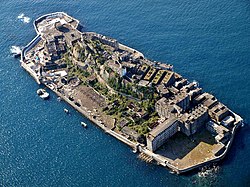
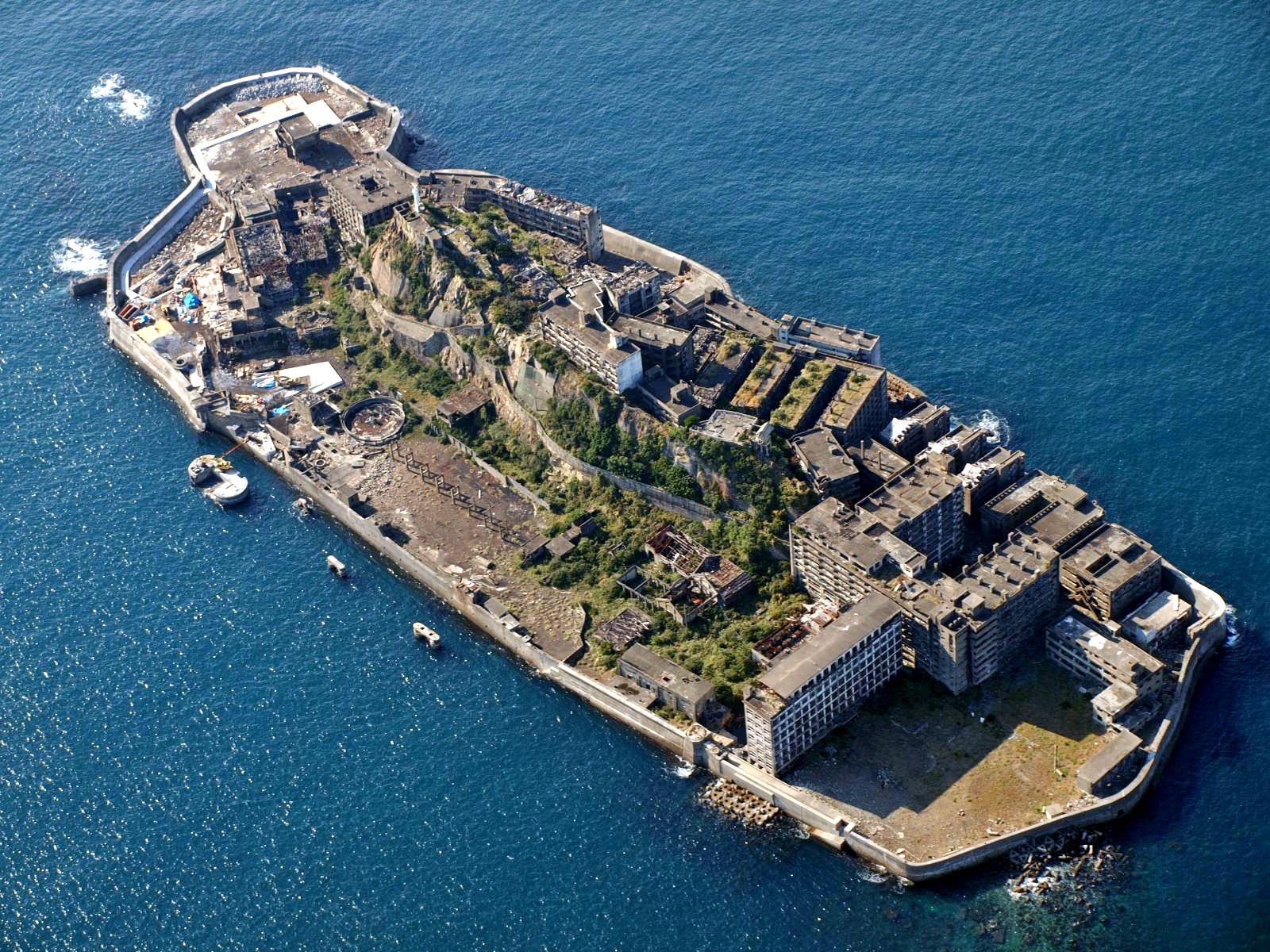
Hashima Island (端島; or simply Hashima, as -shima is a Japanese suffix for 'island'), commonly called Gunkanjima (軍艦島; meaning 'Battleship Island'), is an abandoned island off Nagasaki, lying about 15 kilometres (8 nautical miles) from the centre of the city. It is one of 505 uninhabited islands in Nagasaki Prefecture. The island's most notable features are its abandoned concrete buildings, undisturbed except by nature, and the surrounding seawall. While the island is a symbol of the rapid industrialisation of Japan, it is also a reminder of Japanese war crimes as a site of forced labour prior to and during World War II.[1][2]
The 6.3-hectare (16-acre) island was known for its undersea coal mines, established in 1887, which operated during the industrialisation of Japan. The island reached a peak population of 5,259 in 1959. In 1974, with the coal reserves nearing depletion, the mine was closed and all of the residents departed soon after, leaving the island effectively abandoned for the following three decades.
Interest in the island re-emerged in the 2000s on account of its undisturbed historic ruins, and it gradually became a tourist attraction. Certain collapsed exterior walls have since been restored, and travel to Hashima was reopened to tourists on 22 April 2009. Increasing interest in the island resulted in an initiative for its protection as a site of industrial heritage.
After much controversy, the island's coal mine was formally approved as a UNESCO World Heritage Site in July 2015, as part of the Sites of Japan's Meiji Industrial Revolution series. Japan and South Korea negotiated a deal to facilitate this, in which Korea would not object to allowing Hashima Island to be included, while Japan would cover the history of forced labour on the island. All other UNESCO committee members agreed that Japan did not fulfill its obligations, and efforts to mediate this are ongoing.[3][4][5]
Etymology
[edit]Battleship Island is an English translation of the Japanese nickname for Hashima Island, Gunkanjima (gunkan meaning warship, Jima being the rendaku form of Shima, meaning island). The island's nickname came from its resemblance from a distance to the Japanese battleship Tosa.[6]
History
[edit]


Coal was first discovered on the island around 1810,[7] and the island was continuously inhabited from 1887 to 1974 as a seabed coal mining facility. Mitsubishi Goshi Kaisha bought the island in 1890 and began extracting coal from undersea mines, while seawalls and land reclamation (which tripled the size of the island[citation needed]) were constructed. Four main mine-shafts (reaching up to a kilometre deep) were built, with one actually connecting it to a neighbouring island. Between 1891 and 1974, around 15.7 million tons of coal were excavated in mines with temperatures of 30 °C and 95% humidity.
In 1916, the company built Japan's first large reinforced concrete building (a 7-floor miner's apartment block),[8] to accommodate their burgeoning ranks of workers. Concrete was specifically used to protect against typhoon destruction. Over the next 55 years, more buildings were constructed, including apartment blocks, a school, kindergarten, hospital, town hall, and a community centre. For entertainment, a clubhouse, cinema, communal bath, swimming pool, rooftop gardens, shops, and a pachinko parlour were built for the miners and their families.
Beginning in 1930s and until the end of World War II, conscripted Korean civilians and Chinese prisoners of war were forced to work under very harsh conditions and brutal treatment at the Mitsubishi facility as forced labourers under Japanese wartime mobilisation policies.[1][9][10][11] During this period, many of these conscripted labourers died on the island due to various dangers, including underground accidents, exhaustion, and malnutrition; 137 died by one estimate;[12] about 1,300 by another.[13]
In 1959, the 6.3-hectare (16-acre) island's population reached its peak of 5,259, with a population density of 835 people per hectare (83,634 people/km2, 216,264 people per square mile) for the whole island, or 1,391 per hectare (139,100 people/km2) for the residential district.[14]
As petroleum replaced coal in Japan in the 1960s, coal mines began shutting down across the country, and Hashima's mines were no exception. Mitsubishi officially closed the mine in January 1974, and the island was cleared of inhabitants on 20 April.[15]
Today, its most notable features are the abandoned and still mostly-intact concrete apartment buildings, the surrounding seawall, and its distinctive profile shape. The island has been administered as part of Nagasaki city since the merger with the former town of Takashima in 2005. Travel to Hashima was re-opened on 22 April 2009, after 35 years of closure.[16]
Current status
[edit]
The island was owned by Mitsubishi until 2002, when it was voluntarily transferred to Takashima Town. Currently, Nagasaki City, which absorbed Takashima Town in 2005, exercises jurisdiction over the island. On 23 August 2005, landing was permitted by the city hall to journalists only. At the time, Nagasaki City planned the restoration of a pier for tourist landings in April 2008. In addition a visitor walkway 220 meters (722 feet) in length was planned, and entry to unsafe building areas was to be prohibited. Due to the delay in development construction, however, at the end of 2007, the city announced that public access was delayed until spring 2009. Additionally the city encountered safety concerns, arising from the risk of collapse of the buildings on the island due to significant ageing.
It was estimated that landing of tourists would only be feasible for fewer than 160 days per year because of the area's harsh weather. For reasons of cost-effectiveness, the city considered cancelling plans to extend the visitor walkway further—for an approximate 300 metres (984 feet) toward the eastern part of the island and approximately 190 metres (623 feet) toward the western part of the island—after 2009.[citation needed] A small portion of the island was finally reopened for tourism in 2009, but more than 95% of the island is strictly delineated as off-limits during tours.[17] A full reopening of the island would require substantial investment in safety, and detract from the historical state of the aged buildings on the property.
The island is increasingly gaining international attention not only generally for its modern regional heritage, but also for the undisturbed housing complex remnants representative of the period from the Taishō period to the Shōwa period. It has become a frequent subject of discussion among enthusiasts for ruins. Since the abandoned island has not been maintained, several buildings have collapsed, mainly due to typhoon damage, and other buildings are in danger of collapse. However, some of the collapsed exterior walls have been restored with concrete.[18]
Access
[edit]
When people resided on the island, the Nomo Shosen line served the island from Nagasaki Port via Iōjima Island and Takashima Island. Twelve round-trip services were available per day in 1970. It took 50 minutes to travel from the island to Nagasaki. After all residents left the island, this direct route was discontinued.
Since April 2009, a small southern section of the island has been open for public visits,[16][19] although there are restrictions by Nagasaki city's ordinance.[20][21] The residential sections occupying most of the island remain publicly off-limits.
World Heritage Site approval controversy
[edit]In 2009, Japan requested to include Hashima Island, along with 22 other industrial sites, in the UNESCO World Heritage Site list. The inclusion of Hashima in particular was condemned by the South Korean, North Korean, and Chinese governments.[22][23] South Korea argued that the official recognition of those sites would "violate the dignity of the survivors of forced labour" and that "World Heritage sites should [...] be acceptable by all peoples across the globe".[23]
South Korea and Japan eventually agreed on a compromise: that Japan would present information about the use of forced labour in relevant sites and both nations would cooperate towards the approval of each other's World Heritage Site candidates.[24][25]
On 5 July 2015,[4] at the 39th UNESCO World Heritage Committee (WHC) meeting, South Korea formally withdrew its opposition to Hashima Island being on the list. Japan's UNESCO representative Kuni Sato committed to acknowledging the issue as part of the history of the island, and stated that "there were a large number of Koreans and others who were brought against their will and forced to work under harsh conditions in the 1940s at some of the sites [including Hashima Island]".[25][4][26][27][28] Japan also claimed to be "prepared to incorporate appropriate measures into the interpretive strategy to remember the victims such as the establishment of information centre".[25][26][29]
The site was subsequently approved for inclusion on the UNESCO World Heritage list on 5 July as part of the item Sites of Japan's Meiji Industrial Revolution: Iron and Steel, Shipbuilding and Coal Mining.[30]
Historical revisionism and international condemnation
[edit]Immediately after the UNESCO WHC meeting, Japanese Foreign Minister Fumio Kishida rejected the idea that Koreans were "forced labourers", and claimed that they were instead "requisitioned against their will" to work.[31][32][33] This remark was condemned by a South Korean government official as being nonsensical and evasive.[33]
The Japanese politician Kōko Katō, a close ally of Prime Minister Shinzo Abe, was to manage the preparation of the sites.[34] The Japanese government gave Katō's private company, the National Congress of Industrial Heritage (産業遺産国民会議), a budget of at least 1.35 billion yen. Even before the opening of the first museum covering Hashima, Katō used part of her budget to publish a series of articles and videos that denied that Koreans were ever forced to labour on the island.[35][36] This includes videos that single out and attempt to discredit individual Korean survivors.[37][38]
.jpg)
On 15 June 2020, the Industrial Heritage Information Centre (産業遺産情報センター; IHIC) opened in Tokyo. Shortly afterwards, the South Korean Ministry of Foreign Affairs officially strongly protested the interpretations of Hashima Island presented at the IHIC, which it characterised as revisionist.[39][34] A number of domestic observers echoed these sentiments and called for Japan to correct the exhibit.[40][41]
These complaints prompted UNESCO to send a committee to investigate. In June 2021, the committee published a report that found that Japan had failed to meet its end of the original agreement. The report stated that:[42][34]
The oral testimonies displayed [in the centre], which were all related to Hashima Island, convey the message that there were no instances of [Koreans and others] being forced to work there. The mission has therefore concluded that the interpretive measures to allow an understanding of those brought against their will and forced to work are currently insufficient.
The IHIC's displays were based mostly on Katō's primary sources, all of whom were based in Japan. Only one Korean had his testimony presented in the exhibit; he was a young child on the island and did not recall the labour conditions or experiencing discrimination. Some of the testimonies (all from Japanese residents) explicitly deny that Koreans were discriminated against. Most testimonies are reportedly from people who were children on the island or left the island at a young age, and had little actual contact with Korean labourers there.[41][34][43]
Soon afterwards, the other 21 nations of the World Heritage Committee unanimously called for Japan to revise the exhibit.[34][44] These calls were echoed by The Asahi Shimbun and a number of other observers.[45][34][44][36] UNESCO asked Katō and the IHIC to submit a report with their future plans to revise the exhibit by 1 December 2022.[34][44]
Katō published a response on 4 August, in which she rejected the possibility of acknowledging forced labour and claimed that "the people from the Korean Peninsula on Hashima Island [...] supported the system of increased production as a harmonious workforce like a family".[46] Meanwhile, she had been conducting interviews with and inviting far right historical revisionists to visit her museum, such as Toshio Motoya, who denies that the Nanjing Massacre occurred. She also appeared in an interview with Japan-based American influencer Kent Gilbert, who denies that Japan had sex slaves during World War II. In many of her interviews, she spent significant time discrediting Korean survivors.[35]
Japan did not meet the deadline, and instead submitted a 577-page document defending the IHIC and saying its exhibits showed the complete history of the island.[43] It also filed a request to have Sado Island, another island where forced labour took place, to be recognised as a UNESCO site.[47]
In 2023, a number of new exhibits were installed at the IHIC to quell the concerns of UNESCO and South Korea. The museum reportedly maintains that no systemic discrimination occurred towards Koreans, and its new exhibits align with this message. In one exhibit, a video is played of Kuni Sato's affirmation that forced labour occurred. A reporter for The Hankyoreh claimed that there are no Japanese subtitles for the English-language statement. Another exhibit acknowledges the occurrence of a mine cave-in, during which workers of varying ethnicities, including Korean, died. There are reportedly no testimonies from Koreans about forced labour or discrimination; one testimony from a Korean expresses denial of any discrimination occurring.[4]
In September 2023, UNESCO reported that Japan had taken some measures to improve the situation, but asked for continual improvements and for a follow-up report due 1 December 2024. South Korea requested continuing dialogue on improvements.[4][5] A reporter for The Hankyoreh argued that UNESCO's report leaned positive because South Korean representatives under the administration of President Yoon Suk Yeol, who is considered to be friendlier to Japan, did not adequately challenge the changes.[4]
In February 2025, the WHC released a report that found that the IHIC had still not adequately addressed forced labour in its exhibits. According to South Korean officials, Korean victims testimonies were included in the museum, but they were left in the Korean language and put on a bookshelf, rather than being in a museum display.[48]
NHK documentary controversies
[edit]Around 2020, Katō learned of a 1955 documentary about the island called Island Without Green (緑なき島). It was produced by Japanese broadcaster NHK, and portrayed extremely poor conditions for workers. Katō questioned the documentary, and requested that NHK issue a statement that the documentary was misleading as it used footage filmed at other mines and in much later time periods.[49] Opposition groups questioned the validity of the requested NHK clarifications, categorising them as revisionist.[36][50][51]
In popular culture
[edit] |
In 2002, Swedish filmmaker Thomas Nordanstad visited the island with Dotokou, a Japanese man who grew up on Hashima. Nordanstad documented the trip in a film called Hashima, Japan, 2002.[52]
During the 2009 Mexican photography festival FotoSeptiembre, Mexican photographers Guillaume Corpart Muller and Jan Smith, along with Venezuelan photographer Ragnar Chacin, showcased images from the island in the exhibition "Pop. Density 5,000/km2". The exhibition traced urban density and the rise and fall of cities around the world.[53]
In 2009, the island was featured in History Channel's Life After People, first-season episode "The Bodies Left Behind" as an example of the decay of concrete buildings after only 35 years of abandonment.[54] The island was again featured in 2011 in episode six of a 3D production for 3net, Forgotten Planet, discussing the island's current state, history and unauthorised photo shoots by urban explorers.[55] The Japanese Cultural Institute in Mexico used the images of Corpart Muller and Smith in the photography exhibition "Fantasmas de Gunkanjima", organised by Daniela Rubio, as part of the celebrations surrounding 200 years of diplomacy between Mexico and Japan.[56]
In July 2009, Japanese rock duo B'z shot the music video for their single "My Lonely Town" on the island. This was the first time a large-scale music video had been shot there. Special permission was given from Nagasaki to utilise the entire island for filming, including aerial shots of the island and the band being able to go in areas most visitors wouldn't normally be able to go in.[57][58]
The island has appeared in a number of feature films. External shots of the island were used in the 2012 James Bond film Skyfall.[52] The 2015 live-action Japanese films based on the manga Attack on Titan used the island for filming multiple scenes,[59] and 2013 Thai horror film Hashima Project was filmed there.[60]
The island is depicted in the comic series Atomic Robo, where it features prominently as a central location in the storylines of Volume 6: The Ghost of Station X, Volume 10: The Ring of Fire, and Volume 12: The Spectre of Tomorrow.[61][62][63]
The 2017 South Korean World War II film The Battleship Island (Korean: 군함도; Hanja: 軍艦島; RR: Gunhamdo), depicts a fictitious attempt by Korean forced labourers to escape the labour camp on the island.[64][65][66]
The island appeared in a CNN article entitled "10 of the freakiest places around the world".[67]
In Nintendo's third-person shooter series Splatoon, the stage "Bluefin Depot" is based on parts of Hashima Island.[68][69][70]
A TBS drama The Diamond Sleeping in The Sea (海に眠るダイヤモンド, Umi ni Nemuru Daiyamondo) mainly takes place in the year 1955 of Hashima.[71]
See also
[edit]
References
[edit]- ^ a b McCurry, Justin (3 July 2015). "Battleship island – a symbol of Japan's progress or reminder of its dark history?". The Guardian. Archived from the original on 2 May 2019. Retrieved 12 September 2015.
- ^ "Dark history: A visit to Japan's creepiest island". CNN. 13 June 2013. Archived from the original on 16 February 2017. Retrieved 17 September 2015.
- ^ Yanada, Makiko (15 September 2023). "UNESCO Gives Positive Evaluation on Japan's Efforts for Exhibit over Wartime Labor on Gunkanjima". japannews.yomiuri.co.jp. Retrieved 16 May 2024.
- ^ a b c d e f Kim, So-youn (21 September 2023). "[Reportage] Tokyo exhibit further distorts history of forced labor on Hashima amid silence from Seoul". The Hankyoreh. Archived from the original on 24 May 2024. Retrieved 24 May 2024.
- ^ a b Chung, Esther (18 September 2023). "Korea backs call to provide info on forced labor at Unesco site". Korea JoongAng Daily. Archived from the original on 16 May 2024. Retrieved 16 May 2024.
- ^ Kawamoto, Yasuhiko (17 February 2009). "Deserted 'Battleship Isle' may become heritage ghost ship". The Japan Times. Kyodo News. Archived from the original on 20 September 2022. Retrieved 20 September 2022.
- ^ Sakamoto, Dotoku; Gotoh, Keinosuke (2005). 軍艦島の遺産: 風化する近代日本の象徴 [The Heritage of Gunkanjima: Fading symbol of modernisation period] (in Japanese). Nagasaki Shimbunsya. p. 34.
- ^ Der Spiegel (Article) (in German), DE, archived from the original on 13 April 2010, retrieved 9 April 2010
- ^ "1999 report of the Committee of Experts on the Application of Conventions and Recommendations" (PDF). the International Labour Organization. 1999. Archived (PDF) from the original on 30 May 2020. Retrieved 16 September 2015.
- ^ "Japan's 007 island still carries scars of wartime past, Compulsory Mobilisation". CNN. 13 June 2013. Archived from the original on 27 August 2013. Retrieved 22 August 2013.
- ^ "Hashima — forgotten island of tragedy". The Korea Times. 4 October 2012. Archived from the original on 28 September 2015. Retrieved 11 September 2015.
- ^ NPO西山夘三記念すまい・ままちづくり文庫 『軍艦島の生活<1952/1970>:住宅学者西山夘三の端島住宅調査レポート』創元社、2015. ISBN 978-4422700991、p. 154.
- ^ Burke-Gaffney, Brian. "Hashima: The Ghost Island | Brian Burke-Gaffney". cabinetmagazine.org. Archived from the original on 26 April 2022. Retrieved 12 April 2022.
- ^ "Japan's 007 island still carries scars of wartime past". CNN. 13 June 2013. Archived from the original on 30 May 2020. Retrieved 22 August 2013.
- ^ Sakamoto & Gotoh 2005, p. 172.
- ^ a b "Abandoned 'Battleship Island' to reopen to public in Nagasaki". Japan. The Mainichi Daily News. 21 April 2009. Archived from the original on 22 April 2009. Retrieved 22 April 2009.
- ^ Bender, Andrew. "The Mystery Island From 'Skyfall' And How You Can Go There". Forbes. Archived from the original on 25 September 2013. Retrieved 26 May 2014.
- ^ Pulin. "2009-11-29" 昔の思い出 昭和末期の長崎の端島(いわゆる軍艦島)のこと (in Japanese). Archived from the original on 20 August 2014. Retrieved 16 August 2014.
- ^ Nagasaki Travel: Gunkanjima (Battleship Island), Japan guide, 28 May 2009, archived from the original on 25 November 2010, retrieved 18 November 2010
- ^ 長崎市端島見学施設条例 [Nagasaki city ordinance on visit to Hashima island facilities] (in Japanese). Nagasaki. 19 December 2008.
- ^ 端島への立ち入りの制限に関する条例 [Ordinance related to restriction of landing on Hashima island] (in Japanese). Nagasaki. 19 December 2008.
- ^ Leo Byrne (20 May 2015). "North Korea lashes out at Japan's UNESCO candidates". NK News. Archived from the original on 30 November 2022. Retrieved 23 May 2015.
- ^ a b "Story of Japan's industrial rise deserves to be told, forced labor and all". The Japan Times. 24 June 2015. Archived from the original on 5 July 2020. Retrieved 5 July 2020.
- ^ "Japan, S. Korea agree to cooperate on respective World Heritage site candidacies". The Asahi Shimbun. 22 June 2015. Archived from the original on 8 October 2015. Retrieved 18 September 2015.
- ^ a b c "Japan, Korea Breakthrough: Japanese Repenting 'Forced' Korean Labor On UNESCO Heritage Sites". Forbes Asia. 6 July 2015. Archived from the original on 13 September 2015. Retrieved 18 September 2015.
- ^ a b "Japan forced labour sites receive world heritage status". The Telegraph. 6 July 2015. Archived from the original on 1 September 2015. Retrieved 13 September 2015.
- ^ "Japan sites get world heritage status after forced labour acknowledgement". The Guardian. 6 July 2015. Archived from the original on 24 August 2015. Retrieved 13 September 2015.
- ^ "Government downplays forced labor concession in winning UNESCO listing for industrial sites". The Japan Times. 6 July 2015. Retrieved 13 September 2015.
- ^ "The History that a large number of Koreans were forced to work against their will is reflected in the inscription of Japan's Meiji Industrial Sites on the World Heritage List". Ministry of Foreign Affairs, Republic of Korea. 5 July 2015. Archived from the original on 4 March 2016. Retrieved 14 September 2015.
- ^ "Sites of Japan's Meiji Industrial Revolution: Iron and Steel, Shipbuilding and Coal Mining". UNESCO World Heritage Centre. Archived from the original on 30 June 2020. Retrieved 16 November 2019.
- ^ =「明治日本の産業革命遺産 製鉄・製鋼,造船,石炭産業」のユネスコ世界遺産一覧表への記載決定(第39回世界遺産委員会における7月5日日本代表団発言について) [Inscription of the "Sites of Japan's Meiji Industrial Revolution: Iron and Steel, Shipbuilding and Coal Mining" on the UNESCO's World Heritage List (Statement by the Japanese Delegation at the 39th Session of the World Heritage Committee of UNESCO)]. Ministry of Foreign Affairs (Japan) (in Japanese and English). 14 July 2015. Archived from the original on 17 July 2020. Retrieved 4 July 2020.
- ^ "Japan: "Forced to Work" Isn't "Forced Labor"". SNA Japan. 7 July 2015. Archived from the original on 2 August 2015. Retrieved 13 September 2015.
- ^ a b "S. Korea and Japan debate comments about being "forced to work"". The Hankyoreh. 7 July 2015. Archived from the original on 3 August 2015. Retrieved 13 September 2015.
- ^ a b c d e f g Johnsen, Nikolai (1 December 2021). "Katō Kōko's Meiji Industrial Revolution – Forgetting forced labor to celebrate Japan's World Heritage Sites – Part 1". The Asia-Pacific Journal: Japan Focus. Archived from the original on 25 August 2023. Retrieved 25 August 2023.
- ^ a b Johnsen, Nikolai (15 December 2021). "Katō Kōko's Meiji Industrial Revolution – Forgetting forced labor to celebrate Japan's World Heritage Sites – Part 2". The Asia-Pacific Journal: Japan Focus. Archived from the original on 25 August 2023. Retrieved 25 August 2023.
- ^ a b c Kim, So-youn (15 August 2021). "[Column] Japan's right-wingers are going after Hashima Island's true history". The Hankyoreh. Archived from the original on 25 August 2023. Retrieved 25 August 2023.
- ^ "Video Message "Former Hashima Islanders Refute JTBC's News Report"". THE TRUTH OF GUNKANJIMA. 6 February 2020. Archived from the original on 25 August 2023. Retrieved 25 August 2023.
- ^ "Video Message "Who is Yeon Cheol Koo?"". THE TRUTH OF GUNKANJIMA. 18 May 2019. Retrieved 25 August 2023.
- ^ "National Affairs". Korea.net. 15 June 2020. Archived from the original on 25 August 2023. Retrieved 25 August 2023.
- ^ Hosaka, Yuji (25 June 2020). "Remembering Japan's Colonial Abuses Against Koreans on Hashima Island". thediplomat.com. Archived from the original on 25 August 2023. Retrieved 25 August 2023.
- ^ a b 植松, 青児 (5 November 2020). "「社会史・労働史」が欠落している産業遺産情報センター展示". 週刊金曜日オンライン (in Japanese). Archived from the original on 25 August 2023. Retrieved 25 August 2023.
- ^ REPORT ON THE UNESCO/ICOMOS MISSION TO THE INDUSTRIAL HERITAGE INFORMATION CENTRE RELATED TO THE WORLD HERITAGE PROPERTY 'SITES OF JAPAN'S MEIJI INDUSTRIAL REVOLUTION: IRON AND STEEL, SHIP- BUILDING AND COAL MINING' (JAPAN) (C 1484) (Report). 2 July 2021. Archived from the original on 25 August 2023. Retrieved 24 August 2023.
- ^ a b Dionisio, Agnese (15 July 2023). "Memories of Bathtubs and Apples: Touring the Industrial Heritage Information Center, Tokyo". The Asia-Pacific Journal: Japan Focus. Retrieved 25 August 2023.
- ^ a b c Hikita, Sawaaki; Sugawara, Amane (23 July 2021). "UNESCO calls for info on wartime Korean labor on Battleship Island". The Asahi Shimbun. Archived from the original on 25 August 2023. Retrieved 25 August 2023.
- ^ "EDITORIAL: Japan should redo Battleship Island exhibit to UNESCO's liking". The Asahi Shimbun. 27 July 2021. Archived from the original on 25 August 2023. Retrieved 25 August 2023.
- ^ Kato, Koko (4 August 2021). "UNESCO Decision and UNESCO-ICOMOS Expert Report". THE TRUTH OF GUNKANJIMA. Archived from the original on 25 August 2023. Retrieved 25 August 2023.
- ^ Si-young, Choi (25 January 2023). "Japan's Unesco bid for a gold mine that forced Koreans into labour casts shadow over bilateral ties". Asia News Network. Archived from the original on 25 August 2023. Retrieved 25 August 2023.
- ^ Kim, Seung-yeon (1 February 2025). "S. Korea voices regret after Japan's UNESCO report again fails to reflect forced labor". Yonhap News Agency. Retrieved 31 January 2025.
- ^ Board, Editorial; Shimbun, The Sankei (2 July 2023). "EDITORIAL | NHK Must Stop Seoul's Misleading Use of Gunkanjima Footage | JAPAN Forward". Japan Forward.
- ^ "We Have no Forgiveness for the Cover-Up Done by NHK on their Fabrication of the NHK Program Titled "the Greenless Island."". THE TRUTH OF GUNKANJIMA. 1 June 2021. Archived from the original on 25 August 2023. Retrieved 25 August 2023.
- ^ Kubota, Ruriko (4 June 2021). "Information Center in Tokyo Remains at Heart of Dispute over 'Hell Island'". Japan Forward. Archived from the original on 25 August 2023. Retrieved 25 August 2023.
- ^ a b "Watch this: the chilling history behind the abandoned island in 'Skyfall'". Theverge.com. 15 November 2012. Archived from the original on 4 September 2017. Retrieved 1 January 2018.
- ^ "Centro de la imagem" (PDF). MX: Conaculta. 2009. Archived from the original (PDF) on 23 August 2009.
- ^ "Episode One: The Bodies Left Behind". Life After People. The History Channel. Archived from the original (Episode guide) on 20 April 2009.
- ^ Gakuran, Michael. "Gunkanjima: Ruins of a Forbidden Island". Archived from the original on 27 November 2012. Retrieved 13 November 2012.
- ^ 400 Aniversario México-Japón, JP: Mexican embassy, 2 November 2010, archived from the original on 10 February 2010
- ^ "B'z、ニューシングル「MY LONELY TOWN」は軍艦島で撮影". BARKS (in Japanese). 1 September 2009. Retrieved 7 March 2025.
- ^ "B'z、早くも次のシングル"MY LONELY TOWN"を10月14日にリリース! PVは35年ぶりに上陸が解禁された長崎の軍艦島で撮影!". Tower Records Online (in Japanese). 1 September 2009. Retrieved 7 March 2025.
- ^ Loveridge, Lynzee (6 November 2014). "Get a Closer Look at the Attack on Titan Live-Action Films' Setting". Anime News Network. Retrieved 1 January 2018.
- ^ endingday (18 October 2013). "เบื้องหลัง ฮาชิมะ โปรเจกต์ ถ่ายทำจากสถานที่จริง สุดสยอง". Kapook.com (in Thai). Archived from the original on 4 September 2017. Retrieved 4 June 2017.
- ^ "Atomic Robo Vol. 6 Chapter 5, Page 1". Tesladyne, LLC. Archived from the original on 21 March 2023. Retrieved 2 April 2023.
- ^ "Atomic Robo Vol. 10 Chapter 4, Page 20A". Tesladyne, LLC. Archived from the original on 20 March 2023. Retrieved 2 April 2023.
- ^ "Atomic Robo Vol. 12 Chapter 3, Page 16". Tesladyne, LLC. Archived from the original on 23 March 2023. Retrieved 2 April 2023.
- ^ "Are 'Battleship Island' Opening Records a Pyrrhic Victory?". The Chosun Ilbo. 28 July 2017. Archived from the original on 31 July 2017. Retrieved 30 July 2017.
- ^ hermes (16 August 2017). "Strong characters anchor Battleship Island's thrilling tale of escape". Archived from the original on 3 January 2018. Retrieved 4 April 2018.
- ^ Bechervaise, Jason (28 July 2017). "'The Battleship Island': Review". Screen. Archived from the original on 3 January 2018. Retrieved 4 April 2018.
- ^ "10 of the freakiest places around the world". CNN. 8 May 2019. Archived from the original on 3 November 2021. Retrieved 7 December 2021.
- ^ "Bluefin Depot". Inkipedia. 18 February 2024. Archived from the original on 19 February 2024. Retrieved 19 February 2024.
- ^ KawaiiChao (19 September 2015). "I think Bluefin Depot is more than just abandoned, I made a stupid little observation here". r/splatoon. Retrieved 19 February 2024.
- ^ "File:S3 Bluefin Depot Recon 6.png". Inkipedia. 16 February 2024. Archived from the original on 19 February 2024. Retrieved 19 February 2024.
- ^ TBS. "TBSテレビ「日曜劇場『海に眠るダイヤモンド』」". TBSテレビ (in Japanese). Retrieved 29 December 2025.
External links
[edit]
- Gunkanjima Digital Museum official site
- Around a World Heritage Site: The hashima island Guide (Complete Edition)
- Documentary of former resident revisiting the island on YouTube
- Studies of the Modern Buildings on Gunkajima 1916–1974 (1986) Archived 16 September 2016 at the Wayback Machine