
.jpg/250px-Windmills_D1-D4_(Thornton_Bank).jpg)


.jpg/1293px-Windmills_D1-D4_(Thornton_Bank).jpg)
Community hub
Recent from talks
Contribute something
Nothing was collected or created yet.
Wind turbine
View on Wikipedia
.jpg)
A wind turbine is a device that converts the kinetic energy of wind into electrical energy. As of 2020[update], hundreds of thousands of large turbines, in installations known as wind farms, were generating over 650 gigawatts of power, with 60 GW added each year.[1] Wind turbines are an increasingly important source of intermittent renewable energy, and are used in many countries to lower energy costs and reduce reliance on fossil fuels. One study claimed that, as of 2009,[update] wind had the "lowest relative greenhouse gas emissions, the least water consumption demands and the most favorable social impacts" compared to photovoltaic, hydro, geothermal, coal and gas energy sources.[2]
Smaller wind turbines are used for applications such as battery charging and remote devices such as traffic warning signs. Larger turbines can contribute to a domestic power supply while selling unused power back to the utility supplier via the electrical grid.[3]
Wind turbines are manufactured in a wide range of sizes, with either horizontal or vertical axes, though horizontal is most common.[4]
History
[edit]
The windwheel of Hero of Alexandria (10–70 CE) marks one of the first recorded instances of wind powering a machine.[5] However, the first known practical wind power plants were built in Sistan, an Eastern province of Persia (now Iran), from the 7th century. These panemone windmills were vertical-axle windmills, which had long vertical drive shafts with rectangular blades.[6] Made of six to twelve sails covered in reed matting or cloth material, these windmills were used to grind grain or draw up water, and were used in the gristmilling and sugarcane industries.[7]
Wind power first appeared in Europe during the Middle Ages. The first historical records of their use in England date to the 11th and 12th centuries; there are reports of German crusaders taking their windmill-making skills to Syria around 1190.[8] By the 14th century, Dutch windmills were in use to drain areas of the Rhine delta. Advanced wind turbines were described by Croatian inventor Fausto Veranzio in his book Machinae Novae (1595). He described vertical-axis wind turbines with curved or V-shaped blades.


The first electricity-generating wind turbine was installed by the Austrian Josef Friedländer at the Vienna International Electrical Exhibition in 1883. It was a Halladay windmill for driving a dynamo. Friedländer's 6.6 m (22 ft) diameter Halladay "wind motor" was supplied by U.S. Wind Engine & Pump Co. of Batavia, Illinois. The 3.7 kW (5 hp) windmill drove a dynamo at ground level that fed electricity into a series of batteries. The batteries powered various electrical tools and lamps, as well as a threshing machine. Friedländer's windmill and its accessories were prominently installed at the north entrance to the main exhibition hall ("Rotunde") in the Vienna Prater.[9][10][11]
In July 1887, Scottish academic James Blyth installed a battery-charging machine to light his holiday home in Marykirk, Scotland.[12] Some months later, American inventor Charles F. Brush was able to build the first automatically operated wind turbine after consulting local University professors and his colleagues Jacob S. Gibbs and Brinsley Coleberd and successfully getting the blueprints peer-reviewed for electricity production.[13] Although Blyth's turbine was considered uneconomical in the United Kingdom,[13] electricity generation by wind turbines was more cost effective in countries with widely scattered populations.[8]

In Denmark by 1900, there were about 2500 windmills for mechanical loads such as pumps and mills, producing an estimated combined peak power of about 30 megawatts (MW). The largest machines were on 24-metre (79 ft) towers with four-bladed 23-metre (75 ft) diameter rotors. By 1908, there were 72 wind-driven electric generators operating in the United States from 5 kilowatts (kW) to 25 kW. Around the time of World War I, American windmill makers were producing 100,000 farm windmills each year, mostly for water-pumping.[15]
By the 1930s, use of wind turbines in rural areas was declining as the distribution system extended to those areas.[16]
A forerunner of modern horizontal-axis wind generators was in service at Yalta, USSR, in 1931. This was a 100 kW generator on a 30-meter (98 ft) tower, connected to the local 6.3 kV distribution system. It was reported to have an annual capacity factor of 32 percent, not much different from current wind machines.[citation needed]
In the autumn of 1941, the first megawatt-class wind turbine was synchronized to a utility grid in Vermont. The Smith–Putnam wind turbine only ran for about five years before one of the blades snapped off.[17] The unit was not repaired, because of a shortage of materials during the war.[18]
The first utility grid-connected wind turbine to operate in the UK was built by John Brown & Company in 1951 in the Orkney Islands.[13][19]
In the early 1970s, however, anti-nuclear protests in Denmark spurred artisan mechanics to develop microturbines of 22 kW despite declines in the industry.[20] Organizing owners into associations and co-operatives led to the lobbying of the government and utilities and provided incentives for larger turbines throughout the 1980s and later. Local activists in Germany, nascent turbine manufacturers in Spain, and large investors in the United States in the early 1990s then lobbied for policies that stimulated the industry in those countries.[21][22][23]
It has been argued that expanding the use of wind power will lead to increasing geopolitical competition over critical materials for wind turbines, such as rare earth elements neodymium, praseodymium, and dysprosium. However, this perspective has been critically dismissed for failing to relay how most wind turbines do not use permanent magnets and for underestimating the power of economic incentives for the expanded production of these minerals.[24]
Wind power density
[edit]Wind power density (WPD) is a quantitative measure of wind energy available at any location. It is the mean power available per swept area of a turbine, and is calculated for different heights above ground. Calculation of wind power density includes the effect of wind velocity and air density.[25]
Wind turbines are classified by the wind speed they are designed for, from class I to class III, with A to C referring to the turbulence intensity of the wind.[26]
| Class | Avg wind speed (m/s) | Turbulence |
|---|---|---|
| IA | 10 | 16% |
| IB | 10 | 14% |
| IC | 10 | 12% |
| IIA | 8.5 | 16% |
| IIB | 8.5 | 14% |
| IIC | 8.5 | 12% |
| IIIA | 7.5 | 16% |
| IIIB | 7.5 | 14% |
| IIIC | 7.5 | 12% |
Efficiency
[edit]
Conservation of mass requires that the mass of air entering and exiting a turbine must be equal. Likewise, the conservation of energy requires the energy given to the turbine from incoming wind to be equal to that of the combination of the energy in the outgoing wind and the energy converted to electrical energy. Since outgoing wind will still possess some kinetic energy, there must be a maximum proportion of the input energy that is available to be converted to electrical energy.[27] Accordingly, Betz's law gives the maximal achievable extraction of wind power by a wind turbine, known as Betz's coefficient, as 16⁄27 (59.3%) of the rate at which the kinetic energy of the air arrives at the turbine.[28][29]
The maximum theoretical power output of a wind machine is thus 16⁄27 times the rate at which kinetic energy of the air arrives at the effective disk area of the machine. If the effective area of the disk is A, and the wind velocity v, the maximum theoretical power output P is:
- ,
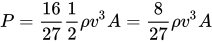
where ρ is the air density.
Wind-to-rotor efficiency (including rotor blade friction and drag) are among the factors affecting the final price of wind power.[30] Further inefficiencies, such as gearbox, generator, and converter losses, reduce the power delivered by a wind turbine. To protect components from undue wear, extracted power is held constant above the rated operating speed as theoretical power increases as the cube of wind speed, further reducing theoretical efficiency. In 2001, commercial utility-connected turbines delivered 75% to 80% of the Betz limit of power extractable from the wind, at rated operating speed.[31][32]
Efficiency can decrease slightly over time, one of the main reasons being dust and insect carcasses on the blades, which alter the aerodynamic profile and essentially reduce the lift to drag ratio of the airfoil. Analysis of 3128 wind turbines older than 10 years in Denmark showed that half of the turbines had no decrease, while the other half saw a production decrease of 1.2% per year.[33]
In general, more stable and constant weather conditions (most notably wind speed) result in an average of 15% greater efficiency than that of a wind turbine in unstable weather conditions, thus allowing up to a 7% increase in wind speed under stable conditions. This is due to a faster recovery wake and greater flow entrainment that occur in conditions of higher atmospheric stability. However, wind turbine wakes have been found to recover faster under unstable atmospheric conditions as opposed to a stable environment.[34]
Different materials have varying effects on the efficiency of wind turbines. In an Ege University experiment, three wind turbines, each with three blades with a diameter of one meter, were constructed with blades made of different materials: A glass and glass/carbon epoxy, glass/carbon, and glass/polyester. When tested, the results showed that the materials with higher overall masses had a greater friction moment and thus a lower power coefficient.[35]
The air velocity is the major contributor to the turbine efficiency. This is the reason for the importance of choosing the right location. The wind velocity will be high near the shore because of the temperature difference between the land and the ocean. Another option is to place turbines on mountain ridges. The higher the wind turbine will be, the higher the wind velocity on average. A windbreak can also increase the wind velocity near the turbine.[36]
Types
[edit]
Wind turbines can rotate about either a horizontal or a vertical axis, the former being both older and more common.[37] They can also include blades or be bladeless.[38] Household-size vertical designs produce less power and are less common.[39]
Horizontal axis
[edit]

.jpg)

Large three-bladed horizontal-axis wind turbines (HAWT) with the blades upwind of the tower (i.e. blades facing the incoming wind) produce the overwhelming majority of wind power in the world today.[4] These turbines have the main rotor shaft and electrical generator at the top of a tower and must be pointed into the wind. Small turbines are pointed by a simple wind vane, while large turbines generally use a wind sensor coupled with a yaw system. Most have a gearbox, which turns the slow rotation of the blades into a quicker rotation that is more suitable to drive an electrical generator.[40] Some turbines use a different type of generator suited to slower rotational speed input. These do not need a gearbox and are called direct-drive, meaning they couple the rotor directly to the generator with no gearbox in between. While permanent magnet direct-drive generators can be more costly due to the rare earth materials required, these gearless turbines are sometimes preferred over gearbox generators because they "eliminate the gear-speed increaser, which is susceptible to significant accumulated fatigue torque loading, related reliability issues, and maintenance costs".[41] There is also the pseudo direct drive mechanism, which has some advantages over the permanent magnet direct drive mechanism.[42]
Most horizontal-axis turbines have their rotors upwind of the supporting tower.[43] Downwind machines have been built, because they don't need an additional mechanism for keeping them in line with the wind. In high winds, downwind blades can also be designed to bend more than upwind ones, which reduces their swept area and thus their wind resistance, mitigating risk during gales. Despite these advantages, upwind designs are preferred, because the pulsing change in loading from the wind as each blade passes behind the supporting tower can cause damage to the turbine.[44]
Turbines used in wind farms for commercial production of electric power are usually three-bladed. These have low torque ripple, which contributes to good reliability. The blades are usually colored white for daytime visibility by aircraft and range in length from 20 to 80 meters (66 to 262 ft). The size and height of turbines increase year by year. Offshore wind turbines are built up to 8 MW today and have a blade length up to 80 meters (260 ft). Designs with 10 to 12 MW were in preparation in 2018,[45] and a "15 MW+" prototype with three 118-metre (387 ft) blades was planned to be constructed as of 2022.[needs update][46] The average hub height of horizontal-axis wind turbines is 90 meters.[47]
Vertical axis
[edit]Vertical-axis wind turbines (or VAWTs) have the main rotor shaft arranged vertically. One advantage of this arrangement is that the turbine does not need to be pointed into the wind to be effective,[48] which is an advantage on a site where the wind direction is highly variable. It is also an advantage when the turbine is integrated into a building because it is inherently less steerable. Also, the generator and gearbox can be placed near the ground, using a direct drive from the rotor assembly to the ground-based gearbox, improving accessibility for maintenance. However, these designs produce much less energy averaged over time, which is a major drawback.[39][49]
Vertical turbine designs have much lower efficiency than standard horizontal designs.[50] The key disadvantages include the relatively low rotational speed with the consequential higher torque and hence higher cost of the drive train, the inherently lower power coefficient, the 360-degree rotation of the aerofoil within the wind flow during each cycle and hence the highly dynamic loading on the blade, the pulsating torque generated by some rotor designs on the drive train, and the difficulty of modelling the wind flow accurately and hence the challenges of analysing and designing the rotor prior to fabricating a prototype.[51]
When a turbine is mounted on a rooftop the building generally redirects wind over the roof and this can double the wind speed at the turbine. If the height of a rooftop-mounted turbine tower is about half of the building height it is near the optimum for maximum wind energy and minimum wind turbulence. While wind speeds within the built environment are generally much lower than at exposed rural sites,[52][53] noise may be a concern and an existing structure may not adequately resist the additional stress.
Subtypes of the vertical-axis design include:
Darrieus wind turbine
[edit]"Eggbeater" turbines, or Darrieus turbines, were named after the French inventor, Georges Darrieus.[54] They have good efficiency, but produce large torque ripple and cyclical stress on the tower, which contributes to poor reliability. They also generally require some external power source, or an additional Savonius rotor to start turning, because the starting torque is very low. The torque ripple is reduced by using three or more blades, which results in greater solidity of the rotor. Solidity is measured by the blade area divided by the rotor area.
Giromill
[edit]A subtype of Darrieus turbine with straight, as opposed to curved, blades. The cycloturbine variety has variable pitch to reduce the torque pulsation and is self-starting.[55] The advantages of variable pitch are high starting torque; a wide, relatively flat torque curve; a higher coefficient of performance; more efficient operation in turbulent winds; and a lower blade speed ratio, which lowers blade bending stresses. Straight, V, or curved blades may be used.[56]
Savonius wind turbine
[edit]
These are drag-type devices with two (or more) scoops that are used in anemometers, Flettner vents (commonly seen on bus and van roofs), and in some high-reliability low-efficiency power turbines. They are always self-starting if there are at least three scoops.[48]
Twisted Savonius is a modified savonius with long helical scoops to provide smooth torque. This is often used as a rooftop wind turbine and has even been adapted for ships.[57]
Airborne wind turbine
[edit]Airborne wind turbines consist of wings or a small aircraft tethered to the ground.[58] They are useful for reaching faster winds above which traditional turbines can operate. There are prototypes in operation in east Africa.[59]
Floating wind turbine
[edit]These are offshore wind turbines that are supported by a floating platform.[60] By having them float, they are able to be installed in deeper water allowing more of them. This also allows them to be further out of sight from land and therefore less public concern about the visual appeal.[61]
Unconventional types
[edit]-
 Counter-rotating wind turbine
 -
 Vertical-axis wind turbine offshore
 -
 Light pole wind turbine


Design and construction
[edit]

Wind turbine design is a careful balance of cost, energy output, and fatigue life.
Components
[edit]Wind turbines convert wind energy to electrical energy for distribution. Conventional horizontal-axis turbines can be divided into three components:
- The rotor, which is approximately 20% of the wind turbine cost, includes the blades for converting wind energy to low-speed rotational energy.[62]
- The generator, which is approximately 34% of the wind turbine cost, includes the electrical generator,[63][64] the control electronics, and most likely a gearbox (e.g., planetary gear box),[65] adjustable-speed drive, or continuously variable transmission[66] component for converting the low-speed incoming rotation to high-speed rotation suitable for generating electricity.
- The surrounding structure, which is approximately 15% of the wind turbine cost, includes the tower and rotor yaw mechanism.[62]

A 1.5 (MW) wind turbine of a type frequently seen in the United States has a tower 80 meters (260 ft) high. The rotor assembly (blades and hub) measures about 80 meters (260 ft) in diameter.[67] The nacelle, which contains the generator, is 15.24 meters (50.0 ft) and weighs around 300 tons.[68]
Turbine monitoring and diagnostics
[edit]Due to data transmission problems, structural health monitoring of wind turbines is usually performed using several accelerometers and strain gages attached to the nacelle to monitor the gearbox and equipment. Currently, digital image correlation and stereophotogrammetry are used to measure dynamics of wind turbine blades. These methods usually measure displacement and strain to identify location of defects. Dynamic characteristics of non-rotating wind turbines have been measured using digital image correlation and photogrammetry.[69] Three dimensional point tracking has also been used to measure rotating dynamics of wind turbines.[70]
Technology
[edit]
Generally, efficiency increases along with turbine blade lengths. The blades must be stiff, strong, durable, light and resistant to fatigue.[71] Materials with these properties include composites such as polyester and epoxy, while glass fiber and carbon fiber have been used for the reinforcing.[72] Construction may involve manual layup or injection molding. Retrofitting existing turbines with larger blades reduces the task and risks of redesign.[73]
As of 2021, the longest blade was 115.5 m (379 ft), producing 15 MW.[74]
Blades usually last around 20 years, the typical lifespan of a wind turbine.[75]
Blade materials
[edit]Materials commonly used in wind turbine blades are described below.
Glass and carbon fibers
[edit]
The stiffness of composites is determined by the stiffness of fibers and their volume content. Typically, E-glass fibers are used as main reinforcement in the composites. Typically, the glass/epoxy composites for wind turbine blades contain up to 75% glass by weight. This increases the stiffness, tensile and compression strength. A promising composite material is glass fiber with modified compositions like S-glass, R-glass etc. Other glass fibers developed by Owens Corning are ECRGLAS, Advantex and WindStrand.[76]
Carbon fiber has more tensile strength, higher stiffness and lower density than glass fiber. An ideal candidate for these properties is the spar cap, a structural element of a blade that experiences high tensile loading.[72] A 100-metre (330 ft) glass fiber blade could weigh up to 50 tonnes (110,000 lb), while using carbon fiber in the spar saves 20% to 30% weight, about 15 tonnes (33,000 lb).[77]
Hybrid reinforcements
[edit]Instead of making wind turbine blade reinforcements from pure glass or pure carbon, hybrid designs trade weight for cost. For example, for an 8-metre (26 ft) blade, a full replacement by carbon fiber would save 80% of weight but increase costs by 150%, while a 30% replacement would save 50% of weight and increase costs by 90%. Hybrid reinforcement materials include E-glass/carbon, E-glass/aramid. The current longest blade by LM Wind Power is made of carbon/glass hybrid composites. More research is needed about the optimal composition of materials.[78]
Nano-engineered polymers and composites
[edit]Additions of small amount (0.5 weight %) of nanoreinforcement (carbon nanotubes or nanoclay) in the polymer matrix of composites, fiber sizing or inter-laminar layers can improve fatigue resistance, shear or compressive strength, and fracture toughness of the composites by 30% to 80%. Research has also shown that incorporating small amounts of carbon nanotubes (CNT) can increase the lifetime up to 1500%.[79]
Costs
[edit]As of 2019[update], the capital cost of a wind turbine was around $1 million per megawatt of nameplate capacity, though this figure varies by location; for example, such numbers ranged from a half million in South America to $1.7 million in Asia.[80]
For the wind turbine blades, while the material cost is much higher for hybrid glass/carbon fiber blades than all-glass fiber blades, labor costs can be lower. Using carbon fiber allows simpler designs that use less raw material. The chief manufacturing process in blade fabrication is the layering of plies. Thinner blades allow reducing the number of layers and thus the labor and in some cases, equate to the cost of labor for glass fiber blades.[81]
Offshore has significantly higher installation costs.[82]
Non-blade materials
[edit]Wind turbine parts other than the rotor blades (including the rotor hub, gearbox, frame, and tower) are largely made of steel. Smaller turbines (as well as megawatt-scale Enercon turbines) have begun using aluminum alloys for these components to make turbines lighter and more efficient. This trend may grow if fatigue and strength properties can be improved. Pre-stressed concrete has been increasingly used for the material of the tower, but still requires much reinforcing steel to meet the strength requirement of the turbine. Additionally, step-up gearboxes are being increasingly replaced with variable speed generators, which requires magnetic materials.[71]
Modern turbines use a couple of tons of copper for generators and cables and such.[83] As of 2018[update], global production of wind turbines use 450,000 tonnes (990 million pounds) of copper per year.[84]
Material supply
[edit]
A 2015 study of the material consumption trends and requirements for wind energy in Europe found that bigger turbines have a higher consumption of precious metals but lower material input per kW generated. The material consumption and stock at that time was compared to input materials for various onshore system sizes. In all EU countries, the estimates for 2020 doubled the values consumed in 2009. These countries would need to expand their resources to meet the estimated demand for 2020. For example, the EU had 3% of world supply of fluorspar, and it would require 14% by 2020. Globally, the main exporting countries are South Africa, Mexico, and China. This is similar with other critical and valuable materials required for energy systems such as magnesium, silver and indium. The levels of recycling of these materials are very low, and focusing on that could alleviate supply. Because most of these valuable materials are also used in other emerging technologies, like light emitting diodes (LEDs), photo voltaics (PVs) and liquid crystal displays (LCDs), their demand is expected to grow.[85]
A 2011 study by the United States Geological Survey estimated resources required to fulfill the US commitment to supplying 20% of its electricity from wind power by 2030. It did not consider requirements for small turbines or offshore turbines because those were not common in 2008 when the study was done. Common materials such as cast iron, steel and concrete would increase by 2%–3% compared to 2008. Between 110,000 and 115,000 metric tons of fiber glass would be required per year, a 14% increase. Rare-earth metal use would not increase much compared to available supply, however rare-earth metals that are also used for other technologies such as batteries which are increasing its global demand need to be taken into account. Land required would be 50,000 square kilometers onshore and 11,000 offshore. This would not be a problem in the US due to its vast area and because the same land can be used for farming. A greater challenge would be the variability and transmission to areas of high demand.[86]
Permanent magnets for wind turbine generators contain rare-earth metals such as neodymium (Nd), praseodymium (Pr), terbium (Tb), and dysprosium (Dy). Systems that use magnetic direct drive turbines require greater amounts of rare-earth metals. Therefore, an increase in wind turbine manufacture would increase the demand for these resources. By 2035, the demand for Nd is estimated to increase by 4,000 to 18,000 tons and for Dy by 200 to 1,200 tons. These values are a quarter to half of current production. However, these estimates are very uncertain because technologies are developing rapidly.[87]
Reliance on rare earth minerals for components has risked expense and price volatility as China has been main producer of rare earth minerals (96% in 2009) and was reducing its export quotas.[86] However, in recent years, other producers have increased production and China has increased export quotas, leading to higher supply, lower cost, and greater viability of large-scale use of variable-speed generators.[88]
Glass fiber is the most common material for reinforcement. Its demand has grown due to growth in construction, transportation and wind turbines. Its global market might reach US$17.4 billion by 2024, compared to US$8.5 billion in 2014. In 2014, Asia Pacific produced more than 45% of the market; now China is the largest producer. The industry receives subsidies from the Chinese government allowing it to export cheaper to the US and Europe. However, price wars have led to anti-dumping measures such as tariffs on Chinese glass fiber.[89]
Wind turbines on public display
[edit]

A few localities have exploited the attention-getting nature of wind turbines by placing them on public display, either with visitor centers around their bases, or with viewing areas farther away.[90] The wind turbines are generally of conventional horizontal-axis, three-bladed design and generate power to feed electrical grids, but they also serve the unconventional roles of technology demonstration, public relations, and education.[91]
The Bahrain World Trade Center is an example of wind turbines displayed prominently for the public. It is the first skyscraper to integrate wind turbines into its design
Small wind turbines
[edit]
Small wind turbines may be used for a variety of applications including on- or off-grid residences, telecom towers, offshore platforms, rural schools and clinics, remote monitoring and other purposes that require energy where there is no electric grid, or where the grid is unstable. Small wind turbines may be as small as a fifty-watt generator for boat or caravan use. Hybrid solar- and wind-powered units are increasingly being used for traffic signage, particularly in rural locations, since they avoid the need to lay long cables from the nearest mains connection point.[92] The U.S. Department of Energy's National Renewable Energy Laboratory (NREL) defines small wind turbines as those smaller than or equal to 100 kilowatts.[93] Small units often have direct-drive generators, direct current output, aeroelastic blades, and lifetime bearings and use a vane to point into the wind.[94]
Wind turbine spacing
[edit]On most horizontal wind turbine farms, a spacing of about 6–10 times the rotor diameter is often upheld. However, for large wind farms, distances of about 15 rotor diameters should be more economical, taking into account typical wind turbine and land costs. This conclusion has been reached by research[95] conducted by Charles Meneveau of Johns Hopkins University[96] and Johan Meyers of Leuven University in Belgium, based on computer simulations[97] that take into account the detailed interactions among wind turbines (wakes) as well as with the entire turbulent atmospheric boundary layer.
Research by John Dabiri of Caltech suggests that vertical wind turbines may be placed much more closely together so long as an alternating pattern of rotation is created allowing blades of neighbouring turbines to move in the same direction as they approach one another.[98]
Operability
[edit].jpg)
Maintenance
[edit]Wind turbines need regular maintenance to stay reliable and available. In the best case turbines are available to generate energy 98% of the time.[99][100] Ice accretion on turbine blades has been found to greatly reduce the efficiency of wind turbines, which is a common challenge in cold climates where in-cloud icing and freezing rain events occur.[101] Deicing is mainly performed by internal heating or in some cases, by helicopters spraying clean warm water on the blades.[102]
Modern turbines usually have a small onboard crane for hoisting maintenance tools and minor components. However, large, heavy components like generators, gearboxes, blades, and so on are rarely replaced, and a heavy lift external crane is needed in those cases. If the turbine has a difficult access road, a containerized crane can be lifted up by the internal crane to provide heavier lifting.[103]
Repowering
[edit]Installation of new wind turbines can be controversial. An alternative is repowering, where existing wind turbines are replaced with bigger, more powerful ones, sometimes in smaller numbers while keeping or increasing capacity.[104]
Demolition and recycling
[edit]Some wind turbines which are out of use are recycled or repowered.[105][106] 85% of turbine materials are easily reused or recycled, but the blades, made of a composite material, are more difficult to process.[107]
Interest in recycling blades varies in different markets and depends on the waste legislation and local economics. A challenge in recycling blades is related to the composite material, which is made of fiberglass with carbon fibers in epoxy resin, which cannot be remolded to form new composites.[108]
Wind farm waste is less toxic than other garbage. Wind turbine blades represent only a fraction of overall waste in the US, according to the wind-industry trade association, American Wind Energy Association.[109]
Several utilities, startup companies, and researchers are developing methods for reusing or recycling blades.[107] Manufacturer Vestas has developed technology that can separate the fibers from the resin, allowing for reuse.[110] In Germany, wind turbine blades are commercially recycled as part of an alternative fuel mix for a cement factory.[107] In the United Kingdom, a project will trial cutting blades into strips for use as rebar in concrete, with the aim of reducing emissions in the construction of High Speed 2.[111] Used wind turbine blades have been recycled by incorporating them as part of the support structures within pedestrian bridges in Poland[112] and Ireland.[113]
Comparison with other power sources
[edit]Advantages
[edit]Wind turbines is one of the lowest-cost sources of renewable energy along with solar panels.[114] As technology needed for wind turbines continued to improve, the prices decreased as well. In addition, there is currently no competitive market for wind energy (though there may be in the future), because wind is a freely available natural resource, most of which is untapped.[115] The main cost of small wind turbines is the purchase and installation process, which averages between $48,000 and $65,000 per installation. Usually, the total amount of energy harvested amounts to more than the cost of the turbines.[116]
Wind turbines provide a clean energy source,[117] use little water,[2] emitting no greenhouse gases and no waste products during operation. Over 1,400 tonnes (1,500 short tons) of carbon dioxide per year can be eliminated by using a one-megawatt turbine instead of one megawatt of energy from a fossil fuel.[118]
Disadvantages
[edit]Wind turbines can be very large, reaching over 260 m (850 ft) tall with blades 110 m (360 ft) long,[119] and people have often complained about their visual impact.
.svg)
Environmental impact of wind power includes effect on wildlife, but can be mitigated if proper strategies are implemented.[121] Thousands of birds, including rare species, have been killed by the blades of wind turbines,[122] though wind turbines contribute relatively insignificantly to anthropogenic avian mortality (birds killed by humans). Wind farms and nuclear power plants are responsible for between 0.3 and 0.4 bird deaths per gigawatt-hour (GWh) of electricity while fossil fuel power stations are responsible for about 5.2 fatalities per GWh. In comparison, conventional coal-fired generators contribute significantly more to bird mortality.[123] A study on recorded bird populations in the United States from 2000 to 2020 found the presence of wind turbines had no significant effect on bird population numbers.[124]
Energy harnessed by wind turbines is variable, and is not a "dispatchable" source of power; its availability is based on whether the wind is blowing, not whether electricity is needed. Turbines can be placed on ridges or bluffs to maximize the access of wind they have, but this also limits the locations where they can be placed.[115] In this way, wind energy is not a particularly reliable source of energy. However, it can form part of the energy mix, which also includes power from other sources. Technology is also being developed to store excess energy, which can then make up for any deficits in supplies.[125]
Wind turbines have blinking lights that warn aircraft, to avoid collisions.[126] Residents living near windfarms, especially those in rural areas, have complained that the blinking lights are a bothersome form of light pollution.[126] A light mitigation approach involves Aircraft Detection Lighting Systems (ADLSs) by which the lights are turned on, only when the ADLS's radar detects aircraft within thresholds of altitude and distance.[126]
Records
[edit]
See also List of most powerful wind turbines
| Record | Model/Name | Location | Constructor/Manufacturer |
|---|---|---|---|
| Largest and most powerful | MYSE18.X-20MW | Hainan, China | Mingyang Wind Power |
| Largest vertical-axis | Éole[127] | Cap-Chat, Québec, Canada | NRC, Hydro-Québec |
| Largest one-blade turbine | Monopteros M50[128] | Jade Wind Park | MBB Messerschmitt |
| Largest two-blade turbine | SCD6.5[129] | Longyuan Wind Farm | Mingyang Wind Power |
| Most rotors | Four-in-One[130] | Maasvlakte, Netherlands | Lagerwey |
| Highest-situated | 2.5[131] | Pastoruri Glaicer | WindAid |
| Largest offshore | MySE18.X-20MW | Hainan, China | Mingyang Wind Power |
| Tallest | Schipkau GICON Wind Turbine | Schipkau, Germany | Vensys, GICON |
See also
[edit]


References
[edit]- ^ "World wind capacity at 650,8 GW, Corona crisis will slow down markets in 2020, renewables to be core of economic stimulus programmes" (Press release). WWEA. 16 April 2020. Retrieved 1 September 2021.
Wind power capacity worldwide reaches 650,8 GW, 59,7 GW added in 2019
- ^ a b Evans, Annette; Strezov, Vladimir; Evans, Tim (June 2009). "Assessment of sustainability indicators for renewable energy technologies". Renewable and Sustainable Energy Reviews. 13 (5): 1082–1088. Bibcode:2009RSERv..13.1082E. doi:10.1016/j.rser.2008.03.008.
- ^ "Installing and Maintaining a Small Wind Electric System". Energy.gov. Retrieved 22 May 2023.
- ^ a b Righter, Robert W. (2011). Windfall: wind energy in America today. Norman: University of Oklahoma Press. ISBN 978-0-8061-4192-3.
- ^ "Heron's Inventions includes Holy Water Dispenser and the Aeolipile". explorable.com. Retrieved 19 May 2023.
- ^ al-Hassan, Ahmad Y.; Hill, Donald R. (1992). Islamic Technology: An Illustrated History. Cambridge University Press. p. 54. ISBN 978-0-521-42239-0.
- ^ Hill, Donald, "Mechanical Engineering in the Medieval Near East", Scientific American, May 1991, pp. 64–69. (cf. Hill, Donald, Mechanical Engineering Archived 25 December 2007 at the Wayback Machine)
- ^ a b Morthorst, Poul Erik; Redlinger, Robert Y.; Andersen, Per (2002). Wind energy in the 21st century: economics, policy, technology and the changing electricity industry. Houndmills, Basingstoke, Hampshire: Palgrave/UNEP. ISBN 978-0-333-79248-3.
- ^ "Austrian was First with Wind-Electric Turbine Not Byth or de Goyon". WIND WORKS. 25 July 2023. Retrieved 26 August 2023.
- ^ Windkraft, I. G. (2 August 2023). "Sensation: Österreicher baute bereits vor 140 Jahren das erste Windrad". www.igwindkraft.at (in German). Retrieved 26 August 2023.
- ^ "Die internationale elektrische Ausstellung Wien 1883: unter besonderer Berücksichtigung der Organisation, sowie der baulichen und maschinellen Anlagen / von E. R. Leonhardt". www.e-rara.ch. 1884. Retrieved 26 August 2023.
- ^ "This Month in Physics History". www.aps.org. 4 June 2023. Retrieved 4 June 2023.
- ^ a b c Price, Trevor J. (2004). "Blyth, James (1839–1906)". Oxford Dictionary of National Biography (online ed.). Oxford University Press. doi:10.1093/ref:odnb/100957. (Subscription, Wikipedia Library access or UK public library membership required.)
- ^ A Wind Energy Pioneer: Charles F. Brush. Danish Wind Industry Association. Archived from the original on 8 September 2008. Retrieved 28 December 2008.
- ^ "Quirky old-style contraptions make water from wind on the mesas of West Texas". Archived from the original on 3 February 2008.
- ^ "History of wind power". U.S. Energy Information Administration (EIA). Retrieved 21 May 2023.
- ^ "The Unlikely Birth of Modern Renewable Energy On A Mountain Top in Vermont – 75 Years Ago Today". Stanford Law School. 19 October 2016. Retrieved 21 May 2023.
- ^ Reicher, Dan (19 October 2016). "Reicher: Grampa's Knob 75th Anniversary". Vermont Public. Retrieved 6 June 2023.
- ^ "Tiny Islands, Big Energy: How Orkney, Scotland Is Fighting Climate Change". Pulitzer Center. Retrieved 19 May 2023.
- ^ "Marching Activists: Transnational Lessons for Danish Anti-Nuclear Protest". Environment & Society Portal. 21 June 2017. Retrieved 20 May 2023.
- ^ "WindExchange: Wind Energy Policies and Incentives". windexchange.energy.gov. Retrieved 20 May 2023.
- ^ Hesse, Nicole (November 2021). "Visible winds: The production of new visibilities of wind energy in West Germany, 1973–1991". Centaurus. 63 (4): 695–713. doi:10.1111/1600-0498.12420.
- ^ "Spain's Wind Power Miracle". The Wind Power Story. 2019. pp. 223–235. doi:10.1002/9781118794289.ch15. ISBN 978-1-118-79418-0.
- ^ Overland, Indra (1 March 2019). "The geopolitics of renewable energy: Debunking four emerging myths". Energy Research & Social Science. 49: 36–40. Bibcode:2019ERSS...49...36O. doi:10.1016/j.erss.2018.10.018.
- ^ "NREL: Dynamic Maps, GIS Data, and Analysis Tools – Wind Maps". Nrel.gov. 3 September 2013. Retrieved 6 November 2013.
- ^ Appendix II IEC Classification of Wind Turbines. Wind Resource Assessment and Micro-siting, Science and Engineering. 2015. pp. 269–270. doi:10.1002/9781118900116.app2. ISBN 978-1-1189-0011-6.
- ^ Kalmikov, Alexander (2017). Wind Power Fundamentals. Academic Press. pp. 17–24. ISBN 978-0-12-809451-8.
- ^ "The Physics of Wind Turbines Kira Grogg Carleton College, 2005, p. 8" (PDF). Archived from the original (PDF) on 9 September 2013. Retrieved 6 November 2013.
- ^ Betz, A. (2013) [20 September 1920]. "The Maximum of the Theoretically Possible Exploitation of Wind by Means of a Wind Motor". Wind Engineering. 37 (4): 441–446. Bibcode:2013WiEng..37..441B. doi:10.1260/0309-524X.37.4.441.
- ^ "Wind Energy Basics". Bureau of Land Management. Archived from the original on 9 May 2019. Retrieved 23 April 2016.
- ^ "Enercon E-family, 330 kW to 7.5 MW, Wind Turbine Specification" (PDF). Archived from the original (PDF) on 16 May 2011.
- ^ Burton, Tony; Sharpe; Jenkins; Bossanyi (12 December 2001). Wind Energy Handbook. John Wiley & Sons. p. 65. ISBN 978-0-471-48997-9.
- ^ Wittrup, Sanne (1 November 2013). "11 års vinddata afslørede overraskende produktionsnedgang" [11 years of wind data shows surprising production decrease]. Ingeniøren (in Danish). Archived from the original on 25 October 2018.
- ^ Han, Xingxing; Liu, Deyou; Xu, Chang; Shen, Wen Zhong (2018). "Atmospheric stability and topography effects on wind turbine performance and wake properties in complex terrain". Renewable Energy. 126. Elsevier BV: 640–651. Bibcode:2018REne..126..640H. doi:10.1016/j.renene.2018.03.048.
- ^ Ozdamar, G. (2018). "Numerical Comparison of the Effect of Blade Material on Wind Turbine Efficiency". Acta Physica Polonica A. 134 (1): 156–158. Bibcode:2018AcPPA.134..156O. doi:10.12693/APhysPolA.134.156.
- ^ Garisto, Dan (30 July 2021). "Windbreaks May Improve Wind Farm Power". Physics. Vol. 14. p. 112.
- ^ "Wind Energy Basics". American Wind Energy Association. Archived from the original on 23 September 2010. Retrieved 24 September 2009.
- ^ Stinson, Elizabeth (15 May 2015). "The Future of Wind Turbines? No Blades". Wired.
- ^ a b Paul Gipe (7 May 2014). "News & Articles on Household-Size (Small) Wind Turbines". Wind-works.org. Archived from the original on 28 August 2022. Retrieved 29 September 2016.
- ^ "How a Wind Turbine Works – Text Version". Energy.gov. Retrieved 26 May 2023.
- ^ Bywaters, G.; Mattila; Costin; Stowell; John; Hoskins; Lynch; Cole; Cate; C. Badger; B. Freeman (October 2007). "Northern Power NW 1500 Direct-Drive Generator" (PDF). National Renewable Energy Laboratory. p. iii.
- ^ Neves, C. G. C.; Flores Filho, A. F.; Dorrel, D. G. (2016). "Design of a Pseudo Direct Drive for Wind Power Applications". 2016 International Conference of Asian Union of Magnetics Societies (ICAUMS). pp. 1–5. doi:10.1109/ICAUMS.2016.8479825. ISBN 978-1-5090-4383-5.
- ^ Khare, Vikas; Khare, Cheshta; Nema, Savita; Baredar, Prashant (2019). "Introduction to Energy Sources". Tidal Energy Systems. pp. 1–39. doi:10.1016/B978-0-12-814881-5.00001-6. ISBN 978-0-12-814881-5.
- ^ Bortolotti, Pietro; Kapila, Abhinav; Bottasso, Carlo L. (31 January 2019). "Comparison between upwind and downwind designs of a 10 MW wind turbine rotor". Wind Energy Science. 4 (1): 115–125. Bibcode:2019WiEnS...4..115B. doi:10.5194/wes-4-115-2019.
- ^ "MHI Vestas Launches World's First* 10 Megawatt Wind Turbine". CleanTechnica. 26 September 2018.
- ^ "World's biggest wind turbine shows the disproportionate power of scale". 22 August 2021.
- ^ "Wind Energy Factsheet". Center for Sustainable Systems. Retrieved 21 May 2023.
- ^ a b Tummala, Abhishiktha; Velamati, Ratna Kishore; Sinha, Dipankur Kumar; Indraja, V.; Krishna, V. Hari (April 2016). "A review on small scale wind turbines". Renewable and Sustainable Energy Reviews. 56: 1351–1371. Bibcode:2016RSERv..56.1351T. doi:10.1016/j.rser.2015.12.027.
- ^ Michael Barnard (7 April 2014). "Vertical Axis Wind Turbines: Great In 1890, Also-rans In 2014". CleanTechnica.
- ^ Hau, E., Wind Turbines: Fundamentals, Technologies, Application, Economics. Springer. Germany. 2006
- ^ Michael C Brower; Nicholas M Robinson; Erik Hale (May 2010). "Wind Flow Modeling Uncertainty" (PDF). AWS Truepower. Archived from the original on 2 May 2013.
- ^ Piggott, Hugh (6 January 2007). "Windspeed in the city – reality versus the DTI database". Scoraigwind.com. Retrieved 6 November 2013.
- ^ "Urban Wind Turbines" (PDF). Archived from the original (PDF) on 30 May 2009. Retrieved 24 August 2011.
- ^ Möllerström, Erik; Gipe, Paul; Beurskens, Jos; Ottermo, Fredric (May 2019). "A historical review of vertical axis wind turbines rated 100 kW and above". Renewable and Sustainable Energy Reviews. 105: 1–13. Bibcode:2019RSERv.105....1M. doi:10.1016/j.rser.2018.12.022.
- ^ Eric Eggleston & AWEA Staff. "What Are Vertical-Axis Wind Turbines (VAWTs)?". American Wind Energy Association. Archived from the original on 3 April 2005.
- ^ Marloff, Richard H. (1978). "Stresses in turbine-blade tenons subjected to bending". Experimental Mechanics. 18 (1): 19–24. doi:10.1007/BF02326553.
- ^ Rob Varnon (2 December 2010). "Derecktor converting boat into hybrid passenger ferry". Connecticut Post. Archived from the original on 4 December 2010. Retrieved 25 April 2012.
- ^ Cherubini, Antonello; Papini, Andrea; Vertechy, Rocco; Fontana, Marco (November 2015). "Airborne Wind Energy Systems: A review of the technologies". Renewable and Sustainable Energy Reviews. 51: 1461–1476. Bibcode:2015RSERv..51.1461C. doi:10.1016/j.rser.2015.07.053. hdl:11382/503316.
- ^ "After a Shaky Start, Airborne Wind Energy Is Slowly Taking Off". Yale E360. Retrieved 2 June 2023.
- ^ "So, What Exactly Is Floating Offshore Wind?". www.greentechmedia.com. Retrieved 2 June 2023.
- ^ "The US has just started building floating wind turbines – how do they work?". World Economic Forum. 16 December 2022. Retrieved 2 June 2023.
- ^ a b ""Wind Turbine Design Cost and Scaling Model", Technical Report NREL/TP-500-40566, December, 2006, page 35, 36" (PDF). National Renewable Energy Laboratory. Retrieved 6 November 2013.
- ^ Navid Goudarzi (June 2013). "A Review on the Development of the Wind Turbine Generators across the World". International Journal of Dynamics and Control. 1 (2): 192–202. doi:10.1007/s40435-013-0016-y.
- ^ Navid Goudarzi; Weidong Zhu (November 2012). "A Review of the Development of Wind Turbine Generators Across the World". ASME 2012 International Mechanical Engineering Congress and Exposition. 4 – Paper No: IMECE2012-88615: 1257–1265.
- ^ "Hansen W4 series". Hansentransmissions.com. Archived from the original on 15 March 2012. Retrieved 6 November 2013.
- ^ Gardner, John; Haro, Nathaniel & Haynes, Todd (October 2011). "Active Drivetrain Control to Improve Energy Capture of Wind Turbines" (PDF). Boise State University. Archived from the original (PDF) on 7 March 2012. Retrieved 28 February 2012.
- ^ Bauer, Lucas. "GE General Electric GE 1.5s – 1,50 MW – Wind turbine". en.wind-turbine-models.com. Retrieved 23 May 2023.
- ^ "Nacelles | How are they manufactured?". Windpower Engineering & Development. Retrieved 23 May 2023.
- ^ Baqersad, Javad; Niezrecki, Christopher; Avitabile, Peter (2015). "Full-field dynamic strain prediction on a wind turbine using displacements of optical targets measured by stereophotogrammetry". Mechanical Systems and Signal Processing. 62–63: 284–295. Bibcode:2015MSSP...62..284B. doi:10.1016/j.ymssp.2015.03.021.
- ^ Lundstrom, Troy; Baqersad, Javad; Niezrecki, Christopher; Avitabile, Peter (4 November 2012). "Using High-Speed Stereophotogrammetry Techniques to Extract Shape Information from Wind Turbine/Rotor Operating Data". In Allemang, R.; De Clerck, J.; Niezrecki, C.; Blough, J.R. (eds.). Topics in Modal Analysis II, Volume 6. Conference Proceedings of the Society for Experimental Mechanics Series. Springer New York. pp. 269–275. doi:10.1007/978-1-4614-2419-2_26. ISBN 978-1-4614-2418-5.
- ^ a b Ancona, Dan; Jim, McVeigh (2001), Wind Turbine – Materials and Manufacturing Fact Sheet, CiteSeerX 10.1.1.464.5842
- ^ a b Watson, James; Serrano, Juan (September 2010). "Composite Materials for Wind Blades". Wind Systems. Archived from the original on 11 November 2017. Retrieved 6 November 2016.
- ^ Jossi, Frank (4 February 2021). "Wind developers are retrofitting newer projects with bigger, better blades". Energy News Network. Retrieved 2 June 2023.
- ^ Venditti, Bruno (3 June 2022). "Animation: The World's Biggest Wind Turbines". Visual Capitalist. Retrieved 20 May 2023.
- ^ "What happens to end-of-life wind turbine blades?". www.ny1.com. 19 August 2022. Retrieved 4 June 2023.
- ^ "Materials and Innovations for Large Blade Structures: Research Opportunities in Wind Energy Technology" (PDF). windpower.sandia.gov. Archived from the original (PDF) on 13 August 2017. Retrieved 27 February 2018.
- ^ "Wind turbine blades: Glass vs. carbon fiber". www.compositesworld.com. Retrieved 12 November 2016.
- ^ Vries, Eize de. "Turbines of the year: Rotor blades". www.windpowermonthly.com.
- ^ Panduranga, Raghu; Alamoudi, Yasser; Ferrah, Azzeddine (2019). "Nanoengineered Composite Materials for Wind Turbine Blades". 2019 Advances in Science and Engineering Technology International Conferences (ASET). pp. 1–7. doi:10.1109/ICASET.2019.8714217. ISBN 978-1-5386-8271-5.
- ^ "IntelStor expects wind turbine prices to recover 5% in next two years". Windpower Engineering & Development. 22 October 2019.
- ^ Ong, Cheng-Huat & Tsai, Stephen W. (1 March 2000). "The Use of Carbon Fibers in Wind Turbine Blade Design" (PDF). energy.sandia.gov.
- ^ "Onshore vs offshore wind energy: what's the difference?". National Grid Group. Retrieved 23 May 2023.
- ^ Frost and Sullivan, 2009, cited in Wind Generator Technology, by Eclareon S.L., Madrid, May 2012; www.eclareon.com; Available at Leonardo Energy – Ask an Expert; Fernando Nuno (30 May 2012). "Ask an expert". Leonardo ENERGY. Archived from the original on 26 November 2012. Retrieved 12 December 2012.
- ^ "Fast pace of growth in wind energy driving demand for copper". Riviera Maritime Media.
- ^ Kim, Junbeum; Guillaume, Bertrand; Chung, Jinwook; Hwang, Yongwoo (February 2015). "Critical and precious materials consumption and requirement in wind energy system in the EU 27". Applied Energy. 139: 327–334. Bibcode:2015ApEn..139..327K. doi:10.1016/j.apenergy.2014.11.003.
- ^ a b Wilburn, David R. (2011). Wind Energy in the United States and Materials Required for the Land-Based Wind Turbine Industry from 2010 through 2030 (Scientific Investigations Report 2011-5036) (PDF). USGS. Retrieved 15 January 2023.
- ^ Buchholz, Peter; Brandenburg, Torsten (January 2018). "Demand, Supply, and Price Trends for Mineral Raw Materials Relevant to the Renewable Energy Transition Wind Energy, Solar Photovoltaic Energy, and Energy Storage". Chemie Ingenieur Technik. 90 (1–2): 141–153. doi:10.1002/cite.201700098.
- ^ Yap, Chui-Wei (5 January 2015). "China Ends Rare-Earth Minerals Export Quotas". Wall Street Journal.
- ^ "Glass fiber market to reach to US$17 billion by 2024". Reinforced Plastics. 60 (4): 188–189. July 2016. doi:10.1016/j.repl.2016.07.006.
- ^ Young, Kathryn (3 August 2007). "Canada wind farms blow away turbine tourists". Edmonton Journal. Archived from the original on 25 April 2009. Retrieved 6 September 2008.
- ^ Rudgard, Olivia (20 February 2023). "Despite perception as eyesore, wind turbine tourism takes off". The Japan Times. Retrieved 2 June 2023.
- ^ Anon. "Solar & Wind Powered Sign Lighting". Energy Development Cooperative Ltd. Retrieved 19 October 2013.
- ^ Small Wind Archived 15 November 2011 at the Wayback Machine, U.S. Department of Energy National Renewable Energy Laboratory website
- ^ Castellano, Robert (2012). Alternative Energy Technologies: Opportunities and Markets. Archives contemporaines. ISBN 978-2-8130-0076-7.
- ^ Meyers, Johan (2011). "Optimal turbine spacing in fully developed wind farm boundary layers". Wind Energy. 15 (2): 305–317. Bibcode:2012WiEn...15..305M. doi:10.1002/we.469.
- ^ "New study yields better turbine spacing for large wind farms". Johns Hopkins University. 18 January 2011. Retrieved 6 November 2013.
- ^ M. Calaf; C. Meneveau; J. Meyers (2010). "Large eddy simulation study of fully developed wind-turbine array boundary layers". Phys. Fluids. 22 (1): 015110–015110–16. Bibcode:2010PhFl...22a5110C. doi:10.1063/1.3291077.
- ^ Dabiri, John O. (July 2011). "Potential order-of-magnitude enhancement of wind farm power density via counter-rotating vertical-axis wind turbine arrays". Journal of Renewable and Sustainable Energy. 3 (4) 043104. arXiv:1010.3656. doi:10.1063/1.3608170.
- ^ van Bussel, G.J.W.; Zaaijer, M.B. (2001). "Reliability, Availability and Maintenance aspects of large-scale offshore wind farms" (PDF). Delft University of Technology. p. 2. Archived from the original (PDF) on 12 April 2016. Retrieved 30 May 2016.
- ^ "Iberwind builds on 98% availability with fresh yaw, blade gains". 15 February 2016. Retrieved 30 May 2016.
- ^ Barber, S.; Wang, Y.; Jafari, S.; Chokani, N.; Abhari, R. S. (February 2011). "The Impact of Ice Formation on Wind Turbine Performance and Aerodynamics". Journal of Solar Energy Engineering. 133 (1) 011007. doi:10.1115/1.4003187.
- ^ Nilsen, Jannicke (1 February 2015). "Her spyler helikopteret bort et tykt lag med is". Tu.no (in Norwegian). Teknisk Ukeblad. Archived from the original on 20 January 2021.
These work .. by blowing hot air into the rotor blades so that the ice melts, or by using heating cables on the front edge of the rotor blades where the ice sticks. No chemicals are added to the water, in contrast to aircraft de-icing, which often involves extensive use of chemicals. The price tag for de-icing a wind turbine is equivalent to the value of two days' turbine production.
- ^ Morten Lund (30 May 2016). "Dansk firma sætter prisbelønnet selvhejsende kran i serieproduktion". Ingeniøren. Archived from the original on 31 May 2016. Retrieved 30 May 2016.
- ^ "Wind Repowering Helps Set the Stage for Energy Transition". Energy.gov. Retrieved 23 May 2023.
- ^ Jeremy Fugleberg (8 May 2014). "Abandoned Dreams of Wind and Light". Atlas Obscura. Retrieved 30 May 2016.
- ^ Tom Gray (11 March 2013). "Fact check: About those 'abandoned' turbines …". American Wind Energy Association. Archived from the original on 8 June 2016. Retrieved 30 May 2016.
- ^ a b c "Wind Turbine Blades Don't Have To End Up In Landfills". The Equation. 30 October 2020. Retrieved 23 January 2022.
- ^ "Wind Turbine Blades Can't Be Recycled, So They're Piling Up in Landfills". Bloomberg.com. 5 February 2020. Retrieved 7 June 2023.
- ^ "Turbines Tossed Into Dump Stirs Debate on Wind's Dirty Downside". Bloomberg. 31 July 2019. Retrieved 6 December 2019.
- ^ Barsoe, Tim (17 May 2021). "End of wind power waste? Vestas unveils blade recycling technology". Reuters. Retrieved 23 January 2022.
- ^ "New HS2 pilot project swaps steel for retired wind turbine blades to reinforce concrete". High Speed 2. Retrieved 12 March 2021.
- ^ Mason, Hannah (21 October 2021). "Anmet installs first recycled wind turbine blade-based pedestrian bridge". CompositesWorld.
- ^ Stone, Maddie (11 February 2022). "Engineers are building bridges with recycled wind turbine blades". The Verge.
- ^ "Renewable Power Remains Cost-Competitive amid Fossil Fuel Crisis". www.irena.org. 13 July 2022. Retrieved 19 May 2023.
- ^ a b "Advantages and Disadvantages of Wind Energy – Clean Energy Ideas". Clean Energy Ideas. 19 June 2013. Retrieved 10 May 2017.
- ^ "WINDExchange: Economics and Incentives for Wind". windexchange.energy.gov. Retrieved 19 May 2023.
- ^ Rueter, Gero (27 December 2021). "How sustainable is wind power?". Deutsche Welle. Retrieved 28 December 2021.
An onshore wind turbine that is newly built today produces around nine grams of CO2 for every kilowatt hour (kWh) it generates ... a new offshore plant in the sea emits seven grams of CO2 per kWh ... solar power plants emit 33 grams CO2 for every kWh generated ... natural gas produces 442 grams CO2 per kWh, power from hard coal 864 grams, and power from lignite, or brown coal, 1034 grams ... nuclear energy accounts for about 117 grams of CO2 per kWh, considering the emissions caused by uranium mining and the construction and operation of nuclear reactors.
- ^ "About Wind Energy: Factsheets and Statistics". www.pawindenergynow.org. Retrieved 10 May 2017.
- ^ "How Big Are the Blades of a Wind Turbine?". 24 August 2023.
- ^ "Threats to Birds / Top Threats to Birds (U.S. only. Ordered by Median Estimate of Bird Mortality Annually. As of 2017.)". U.S. Fish and Wildlife Service. 2017. Archived from the original on 13 February 2025.
- ^ Parisé, J.; Walker, T. R. (2017). "Industrial wind turbine post-construction bird and bat monitoring: A policy framework for Canada". Journal of Environmental Management. 201: 252–259. Bibcode:2017JEnvM.201..252P. doi:10.1016/j.jenvman.2017.06.052. PMID 28672197.
- ^ Hosansky, David (1 April 2011). "Wind Power: Is wind energy good for the environment?". CQ Researcher.
- ^ "How Harmful is Renewable Energy to Birds? | Article | EESI". www.eesi.org. Retrieved 2 June 2023.
- ^ Katovich, Erik (9 January 2024). "Quantifying the Effects of Energy Infrastructure on Bird Populations and Biodiversity". Environmental Science & Technology. 58 (1): 323–332. Bibcode:2024EnST...58..323K. doi:10.1021/acs.est.3c03899. PMID 38153963.
- ^ "Grid-Scale Storage – Analysis". IEA. Retrieved 2 June 2023.
- ^ a b c Lewis, Michelle (29 September 2023). "A new wind farm in Kansas trailblazes with light-mitigating technology". Electrek. Archived from the original on 29 September 2023.
- ^ "Wind Energy Power Plants in Canada – other provinces". Power Plants Around the World Photo Gallery. industcards. 5 June 2010. Archived from the original on 4 September 2012. Retrieved 24 August 2010.
- ^ "MBB Messerschmitt Monopteros M50 – 640,00 kW – Wind turbine". wind-turbine-models.com. Archived from the original on 9 July 2023.
- ^ "Ming Yang completes 6.5MW offshore turbine". Windpower Monthly. 1 July 2013. Retrieved 6 June 2023.
- ^ "When More is More: Multi-Rotor Turbines". UTM Consultants. 2022. Archived from the original on 8 April 2024. Retrieved 31 May 2023.
- ^ "Highest altitude wind generator". Guinness World Records. 19 June 2013. Retrieved 6 June 2023.
Further reading
[edit]- Tony Burton, David Sharpe, Nick Jenkins, Ervin Bossanyi: Wind Energy Handbook, John Wiley & Sons, 2nd edition (2011), ISBN 978-0-470-69975-1
- Darrell, Dodge, Early History Through 1875, TeloNet Web Development, Copyright 1996–2001
- Robert Gasch, Jochen Twele (ed.), Wind power plants. Fundamentals, design, construction and operation, Springer 2012 ISBN 978-3-642-22937-4.
- Erich Hau, Wind turbines: fundamentals, technologies, application, economics, Springer, 2013 ISBN 978-3-642-27150-2 (preview on Google Books)
- Siegfried Heier, Grid integration of wind energy conversion systems, John Wiley & Sons, 3rd edition (2014), ISBN 978-1-119-96294-6
- Peter Jamieson, Innovation in Wind Turbine Design. Wiley & Sons (2011), ISBN 978-0-470-69981-2
- J. F. Manwell, J. G. McGowan, A. L. Roberts, Wind Energy Explained: Theory, Design and Application, John Wiley & Sons, 2nd edition (2012), ISBN 978-0-47001-500-1
- David Spera (ed,) Wind Turbine Technology: Fundamental Concepts in Wind Turbine Engineering, Second Edition (2009), ASME Press, ISBN 978-0-7918-0260-1
- Alois Schaffarczyk (ed.), Understanding wind power technology, John Wiley & Sons, (2014), ISBN 978-1-118-64751-6
- Hermann-Josef Wagner, Jyotirmay Mathur, Introduction to wind energy systems. Basics, technology and operation. Springer (2013), ISBN 978-3-642-32975-3
- G. A. Mansoori, N. Enayati, L. B. Agyarko (2016), Energy: Sources, Utilization, Legislation, Sustainability, Illinois as Model State
External links
[edit]
- Global Wind Energy Council
- World's Largest Wind Turbine
- Harvesting the Wind (45 lectures about wind turbines by professor Magdi Ragheb


| International | |
|---|---|
| National | |
| Other | |

Wind turbine
View on GrokipediaBasic Principles
Physical Operation and Energy Conversion
Wind turbines convert the kinetic energy of moving air into electrical power through aerodynamic and electromechanical processes. The rotor blades, designed as airfoils, interact with oncoming wind to generate lift and drag forces; the net aerodynamic torque arises primarily from lift exceeding drag, causing the blades to rotate and drive the rotor hub.[11] This rotation occurs at a low angular speed, typically 10-20 revolutions per minute for large turbines, due to the blade tip-speed ratio optimized for energy extraction, which balances rotational speed against wind velocity to maximize power coefficient.[12] The theoretical maximum power extractable from wind passing through the rotor's swept area is , where is air density (approximately 1.225 kg/m³ at sea level) and is undisturbed wind speed; this cubic dependence on velocity underscores why power output scales nonlinearly with wind strength. However, complete extraction would halt airflow, violating continuity; Albert Betz derived in 1919 that no turbine can exceed a power coefficient of this incident power, assuming inviscid, incompressible flow and uniform axial induction across an actuator disk model.[12] Practical turbines achieve values of 40-50% at rated conditions, limited by viscous losses, tip vortices, and non-uniform wind profiles that induce blade stall or feathering at high speeds. Mechanically, the rotor's torque drives a low-speed shaft connected to a gearbox (in geared designs) that steps up rotation to 1000-1800 rpm for synchronous generators, or directly to a low-speed generator in direct-drive configurations using permanent magnets or wound rotors.[13] Electromagnetic induction in the generator converts this mechanical input to alternating current, with efficiency typically 90-95% under load, though overall system efficiency from wind to grid averages 35-45% due to aerodynamic and drivetrain losses.[13] Downstream of the rotor, a wake forms where velocity deficits persist for several rotor diameters, reflecting partial momentum transfer and influencing array layouts to minimize interference.[12]Efficiency and Performance Metrics
The maximum theoretical efficiency of a wind turbine rotor in converting wind kinetic energy to mechanical power is governed by Betz's law, which derives a power coefficient limit of .[14][15] This limit arises from fluid dynamics principles, requiring undisturbed airflow downstream of the rotor to satisfy mass and momentum conservation, preventing full extraction of wind energy without stalling the flow.[16] Practical wind turbines operate below this limit due to aerodynamic losses, mechanical friction, and generator inefficiencies, with modern horizontal-axis designs achieving peak values of 40-50% at optimal tip-speed ratios of 6-8.[17][18] Vertical-axis turbines generally exhibit lower , often 30-40%, owing to altered flow patterns and structural constraints. Overall system efficiency, accounting for drivetrain and electrical conversion losses, typically ranges from 35-45% in operational conditions.[3] Performance is characterized by the power curve, relating output to wind speed: cut-in speeds of 3-4 m/s initiate rotation and power generation; rated speeds of 11-15 m/s yield nominal capacity via pitch or stall control; and cut-out speeds of 22-25 m/s trigger shutdown to avert structural damage from excessive loads.[19][20] Capacity factor, the ratio of actual annual energy output to rated capacity, averages 35-40% for onshore turbines and 40-50% for offshore, influenced by site-specific wind regimes, turbulence, and curtailment.[17][21][22]| Metric | Onshore Typical Value | Offshore Typical Value | Notes |
|---|---|---|---|
| Capacity Factor (%) | 35-40 | 40-50 | 2023-2024 global averages; varies by location and technology.[17][21] |
| Peak Power Coefficient (Cp) | 40-45% | 45-50% | Below Betz limit; offshore benefits from steadier winds.[17][18] |
| Cut-in Speed (m/s) | 3-4 | 3-4 | Minimum for viable power onset.[19] |
| Rated Speed (m/s) | 11-13 | 11-15 | Full power threshold.[20] |
| Cut-out Speed (m/s) | 22-25 | 25+ (with upgrades) | Safety shutdown; modern designs extend via controls.[19][23] |
Historical Development
Early Uses and Pre-Industrial Designs
The earliest documented windmills originated in Persia around the 7th century AD, featuring a vertical-axis design with woven reed blades arranged around a central tower to harness prevailing winds for grinding grain and pumping water in arid regions like Sistan.[24] These panemone-style mills, constructed from clay, straw, and wood, relied on the wind's force turning vertical sails connected to a grinding mechanism below, demonstrating an early application of aerodynamic lift and drag for mechanical power conversion.[25] Surviving examples in Nashtifan, Iran, estimated at over 1,000 years old, underscore their durability and efficiency in low-wind-speed environments through passive orientation to wind direction.[26] In China, rudimentary wind-powered devices for water pumping appeared by 200 BC, evolving into vertical-axis mills with sail-like blades by the Eastern Han Dynasty (25–220 AD), primarily for irrigation in agricultural settings.[27] These designs, often integrated with chain-and-bucket systems, prioritized torque over speed and were adapted to variable monsoonal winds, though they remained less widespread than water wheels due to geographic and climatic constraints.[28] European adoption began in the 12th century with horizontal-axis post mills, introduced likely via crusaders from the Middle East, where the entire mill body pivoted on a central post to face the wind for tasks like grain milling.[29] By the 13th–14th centuries, fixed-tower variants emerged in regions like the Netherlands, employing geared sails with adjustable canvas strips to optimize power output for land reclamation and drainage, reflecting iterative improvements in structural stability and transmission efficiency.[30] Pre-industrial designs culminated in smock and tower mills by the 16th–18th centuries, featuring fantails for automatic wind orientation and compound gearing to multiply torque, enabling broader applications in industry while limited by inconsistent wind availability and manual maintenance demands.[31]20th-Century Commercialization
In the early 1920s, brothers Marcellus and Joe Jacobs developed and commercialized small-scale wind turbines for rural electrification in the United States, addressing the lack of grid access on farms. Their Jacobs Wind Electric Company, established around 1928 with production scaling in Minneapolis by 1931, produced durable three-bladed turbines rated at 1-3 kW, capable of charging batteries for lighting and appliances; by the 1930s, thousands of units were sold annually, peaking at over 20,000 installations before rural grid expansion reduced demand in the late 1940s.[32][33] A pioneering effort at utility-scale commercialization occurred in 1941 with the Smith-Putnam wind turbine, a 1.25 MW two-bladed machine installed on Grandpa's Knob in Vermont, which became the first to feed alternating current directly into a utility grid on October 19 of that year. Standing 175 feet tall with 176-foot blades, it generated power intermittently for about four years but suffered blade failure from fatigue and storm damage in 1943 and 1945, leading to project abandonment amid high costs and technical unreliability, highlighting early challenges in scaling beyond small systems.[34] Commercial development stagnated mid-century as grid electrification supplanted off-grid wind plants, but the 1970s oil crises prompted renewed government involvement, including U.S. federal research funding and the 1978 Public Utility Regulatory Policies Act (PURPA), which mandated utilities to purchase power from qualifying small-scale renewable facilities at avoided-cost rates, enabling independent producers to enter the market without owning generation assets. In Denmark, state-backed testing and cooperative ownership models supported local manufacturers, fostering prototypes like 20-55 kW machines tested at Risø National Laboratory from 1977.[35][36] The 1980s marked the onset of widespread utility-scale commercialization, driven by U.S. federal investment tax credits offering up to 25% for renewables and California's avoidance of PURPA buyback rates exceeding $0.04/kWh, spurring the "California Wind Rush." By 1985, over 15,000 turbines—mostly Danish imports like Vestas models and U.S. designs under 100 kW—were installed in sites such as Altamont Pass (starting 1981 with 500+ MW) and Tehachapi, achieving about 1 GW total capacity but plagued by frequent breakdowns, low capacity factors below 20%, and eventual decommissioning of many due to poor reliability and subsidy expiration. Danish firms, benefiting from export booms to California, consolidated into leaders like Vestas and Bonus (later Siemens Gamesa), producing asynchronous generator turbines that proved more robust, with Denmark installing 400 MW domestically by 1989 through policy-mandated grid integration.[5][37]Post-2000 Expansion and Scaling Challenges
Global installed wind power capacity expanded dramatically after 2000, rising from approximately 13.6 GW in 2000 to over 1,000 GW by 2023, with annual additions reaching record levels such as 117 GW in 2023.[38][39] This growth was propelled by government subsidies, renewable portfolio standards, and declining costs per megawatt-hour, though much of the expansion relied on production tax credits and feed-in tariffs that have totaled billions annually, with U.S. wind subsidies equating to about 48 times those for oil and gas per unit of electricity generated.[40] To capture more energy in variable winds, manufacturers scaled turbine sizes, with average new U.S. onshore installations reaching 3.4 MW in 2023—375% larger than in 1998–1999—and rotor diameters exceeding 150 meters, enabling higher capacity factors but introducing engineering hurdles like structural stresses and aerodynamic instabilities at extreme scales.[41] Logistical barriers intensified, as blades over 100 meters long and weighing hundreds of tons necessitate specialized transport convoys, oversized roads, and port upgrades, often delaying projects and inflating costs by up to 20% in remote or infrastructure-limited areas.[42][43] Reliability challenges emerged with scaling, as larger turbines exhibit failure rates of 2–9 incidents per unit annually, predominantly in electrical, hydraulic, and control systems, leading to downtime averaging 5–10% and elevating operations and maintenance expenses that can comprise 20–30% of lifetime costs.[44][45] Supply chain vulnerabilities compound these issues, particularly dependence on rare earth elements like neodymium for permanent magnet generators, where China controls over 80% of processing, exposing expansion to geopolitical risks and price volatility amid export restrictions.[46] Intermittency poses systemic scaling limits, as wind generation fluctuates unpredictably, necessitating backup capacity and grid reinforcements that add 10–50% to integration costs, while subsidies have not proportionally boosted output—U.S. wind production dipped in 2023 despite rising incentives.[47][48] These factors, alongside blade material recycling difficulties from composite waste, hinder unsubsidized viability and constrain further proliferation without technological breakthroughs in storage or overbuild strategies.[49][50]Types and Configurations
Horizontal-Axis Wind Turbines
![HAWT and VAWTs in operation medium.gif][float-right] Horizontal-axis wind turbines (HAWTs) feature a rotor shaft oriented horizontally and parallel to the prevailing wind direction, mounted atop a tower with the nacelle housing the generator and other components. This configuration allows the blades to rotate in a plane perpendicular to the wind, optimizing aerodynamic lift for energy extraction. HAWTs typically employ three blades designed as airfoils to maximize lift-to-drag ratios, connected to a hub that drives the rotor shaft.[51] The dominant upwind configuration positions the rotor facing into the wind, requiring a yaw mechanism—typically electric or hydraulic—to actively orient the nacelle against wind direction changes, ensuring consistent alignment. Downwind variants place the rotor behind the tower, allowing passive yaw via wind deflection and potentially lighter structures due to coning flexibility, though they suffer from reduced efficiency caused by tower shadow effects and cyclic loading. Upwind designs prevail in commercial applications for their higher power coefficients, often achieving 40-50% efficiency in converting wind kinetic energy to mechanical power, compared to the theoretical Betz limit of 59.3%.[51][52][53] HAWTs outperform vertical-axis alternatives in efficiency and scalability, with power output scaling as the cube of rotor diameter and proportional to wind speed cubed, enabling multi-megawatt capacities from larger swept areas. Modern utility-scale models, such as those installed in 2023, feature average rotor diameters exceeding 133 meters and hub heights up to 150 meters, yielding rated powers from 3 to 15 MW per turbine under rated wind speeds of 11-13 m/s. Advantages include reliable operation across a broad wind speed range (cut-in around 3-4 m/s to cut-out at 25 m/s) and proven durability from decades of refinement, though they necessitate elevated maintenance access and face challenges like gearbox wear in high-wind environments.[54][41][55]Vertical-Axis Wind Turbines
Vertical-axis wind turbines (VAWTs) feature rotors with blades oriented perpendicular to the ground, allowing the main shaft to rotate vertically rather than horizontally as in horizontal-axis wind turbines (HAWTs).[56] This configuration enables VAWTs to capture wind from any direction without requiring a yaw mechanism to orient the rotor.[57] Primary types include the Darrieus design, which uses curved, airfoil-shaped blades relying on lift forces for rotation, and the Savonius design, characterized by drag-based, scooped blades resembling a half-cylinder split vertically.[58] Hybrid variants combine elements of both to address limitations such as poor self-starting in Darrieus types.[59] VAWT operation depends on aerodynamic principles where wind interacts with blades to generate torque along the vertical axis. Darrieus VAWTs achieve higher tip-speed ratios (TSR) of around 3-4, producing low torque at high speeds, while Savonius rotors operate at lower TSRs (0.8-1.2) with higher starting torque suitable for low winds.[60] Empirical studies report maximum power coefficients (Cp) for Darrieus VAWTs approaching 0.35-0.40 under optimal conditions, though real-world values often fall to 0.20-0.30 due to structural and flow complexities; Savonius types typically yield Cp below 0.25.[61] In contrast, HAWTs routinely exceed Cp of 0.45, highlighting VAWTs' efficiency drawbacks stemming from uneven blade loading and wake interference across the rotor height.[63] Hybrid Darrieus-Savonius configurations have demonstrated Cp up to 0.204 at TSR 3.51 in controlled tests, with Savonius aiding startup but limiting peak efficiency. Advantages of VAWTs include omnidirectional operation in turbulent or variable winds, such as urban environments, where they perform comparably or better than HAWTs without directional alignment losses.[64] Ground-level placement of generators and gearboxes simplifies maintenance and reduces tower structural demands, potentially lowering costs for smaller units.[65] They also allow denser array spacing in wind farms, as downstream wakes recover faster vertically, enabling up to 20 VAWTs per HAWT site in modeling studies to boost overall output.[66] However, disadvantages persist: Darrieus designs suffer cyclic bending stresses from alternating forces, accelerating fatigue, while overall aerodynamic efficiency lags HAWTs by 25% or more in direct comparisons.[67] VAWTs struggle with self-starting in Darrieus forms below 4-5 m/s winds and scale poorly beyond 100 kW due to increased material stresses and reduced Cp at larger diameters.[68] Field tests at sites like Clark University showed HAWTs generating 55% more energy than equivalent VAWTs over extended periods.[69] Commercial deployment remains niche, with VAWTs comprising under 5% of installed capacity globally as of 2025, focused on small-scale (300 W to 10 kW) urban or offshore applications rather than utility-scale farms dominated by HAWTs.[70] Examples include Aeolos VAWTs for residential use and experimental Flowind 300 kW units, though large-scale projects like Canada's Éole Darrieus prototype (4 MW, 1980s) faced reliability issues leading to decommissioning.[71] [72] Recent advancements target floating offshore VAWTs for deep waters, leveraging stability advantages, with prototypes testing vortex-induced wake recovery for farm efficiency gains up to 15%.[73] Market projections estimate VAWT growth to $9.87 billion by 2032, driven by urban integration and hybrid designs, but empirical data underscores persistent challenges in surpassing HAWT economic viability without breakthroughs in materials or aerodynamics.[70] [74]Offshore and Specialized Variants
Offshore wind turbines are installed in marine environments, primarily oceans and large lakes, to exploit stronger and more consistent wind speeds typically found beyond coastal boundaries. Fixed-bottom foundations, such as monopiles or jackets, support turbines in water depths up to approximately 60 meters, while floating substructures— including semi-submersibles, spar-buoys, and tension-leg platforms—enable operations in deeper waters exceeding 100 meters where fixed structures become uneconomical.[39][75] As of mid-2025, global installed offshore wind capacity reached 83 gigawatts, powering an estimated 73 million households, with annual additions projected to surpass 30 gigawatts by 2030.[76][21] These systems offer higher capacity factors—often 40-50% compared to 25-40% for onshore—due to elevated wind shear and reduced turbulence over water, but face elevated levelized costs of energy, estimated at around $74-132 per megawatt-hour in recent assessments, driven by complex installation logistics, corrosion from saltwater exposure, and specialized maintenance requiring vessels or helicopters.[77][78] Reliability models derived from onshore data indicate higher failure rates for offshore components like gearboxes and electrical systems, exacerbated by limited access during storms, though advancements in predictive maintenance and direct-drive generators aim to mitigate downtime.[10] Supply chain constraints, including vessel shortages and raw material demands, have delayed projects, as documented in U.S. and European market reports.[75] Specialized offshore variants include floating vertical-axis wind turbines (VAWTs), which rotate around a vertical axis and offer potential advantages in deep-water deployments such as omnidirectional wind capture without yaw mechanisms, reduced structural loads from blade mass distribution, and compatibility with floating platforms that self-align with waves.[79][80] Concepts like the 5-megawatt DeepWind VAWT and tilting-blade designs from innovators such as World Wide Wind and SeaTwirl target cost reductions through simplified scaling and higher array densities, with prototypes demonstrating feasibility in harsh conditions.[81][82] However, VAWTs remain pre-commercial for large-scale offshore use, with challenges including lower aerodynamic efficiency at high tip-speed ratios and unproven long-term reliability in floating arrays.[83] Notable projects illustrate these variants: the Provence Grand Large floating wind farm in France, operational since 2025 with three 8-megawatt Siemens Gamesa turbines on tension-leg platforms, marks a milestone in Mediterranean deep-water demonstration.[84] Fixed-bottom examples include the Thornton Bank farm off Belgium, featuring 48 turbines totaling 548 megawatts commissioned between 2009 and 2013. Emerging floating VAWT pilots, such as those under ARPA-E funding, prioritize low-cost composites and control co-design to address deep-water scalability.[85] These developments underscore ongoing engineering efforts to balance energy yield gains against the inherent risks of marine operations.Design and Engineering
Core Structural Components
The core structural components of a horizontal-axis wind turbine (HAWT), excluding blades which are addressed separately, primarily include the rotor hub, main shaft, nacelle frame or bedplate, and associated drive train supports. These elements form the load-bearing skeleton that transmits aerodynamic forces from the rotor to the generator while maintaining structural integrity under dynamic wind loads, fatigue, and gravitational stresses.[86] The rotor hub, typically constructed from high-strength cast iron or forged steel, secures the blades to the low-speed main shaft and enables individual blade pitch control via hydraulic or electric actuators to optimize energy capture and mitigate loads.[11] [87] The main shaft, a robust steel component often supported by spherical roller bearings, connects the rotor hub to the gearbox or directly to the generator in direct-drive configurations, enduring torsional, bending, and axial forces from rotor rotation at speeds around 10-20 rpm for large turbines.[11] [88] Within the nacelle, the bedplate—a welded steel girder or cast structure—serves as the primary chassis, mounting the gearbox, generator, yaw drive, and braking systems while transferring rotor thrust and torque to the tower top interface.[86] [89] Nacelle designs vary: geared systems employ planetary or parallel gearboxes to step up rotational speed from ~15 rpm to ~1500 rpm for the generator, whereas permanent magnet direct-drive turbines eliminate the gearbox, using larger, low-speed generators to reduce maintenance but increasing nacelle mass by up to 30%.[11] [90] These components must withstand cyclic loading exceeding 10^8 cycles over a 20-25 year lifespan, with materials selected for high fatigue resistance; steel dominates (comprising 66-79% of total turbine mass), supplemented by cast iron for hubs and copper windings in generators.[91] [92] Finite element analysis and modal testing validate designs against resonance and extreme events, as demonstrated in structural dynamics studies of utility-scale turbines where nacelle and shaft misalignments can amplify loads by 10-20%.[86] Direct-drive innovations, like those using permanent magnet generators, alter load paths by removing gearbox elasticity, potentially lowering peak torques but requiring reinforced bedplates to handle heavier components.[90]Blade Aerodynamics and Materials
Wind turbine blades generate aerodynamic forces primarily through lift, which acts perpendicular to the incoming wind flow, and drag, which acts parallel to it, enabling the conversion of kinetic wind energy into rotational torque.[93] The blades are shaped as airfoils, analogous to aircraft wings, where the curved upper surface causes air to travel faster than over the flatter lower surface, creating lower pressure above and thus lift via the Bernoulli principle and Coandă effect.[11] Optimal performance requires maintaining a consistent angle of attack along the blade span, achieved through geometric twist and taper, as blade speed increases from hub to tip, with tip speeds often reaching 6-8 times the wind speed for maximum power coefficient.[94] Airfoil selection emphasizes high lift-to-drag ratios at Reynolds numbers typical of wind turbines (2-6 million), low sensitivity to surface roughness from erosion or dirt, and delayed stall for variable wind conditions.[95] The National Renewable Energy Laboratory (NREL) developed specialized families such as the S-series (e.g., S809 for mid-span sections) and DU-series, which provide 8-35% higher annual energy capture compared to older NACA airfoils by prioritizing gentle stall and insensitivity to leading-edge contamination.[96] Blade element momentum theory integrates local airfoil data with momentum conservation to predict loads and power, guiding designs that balance axial and tangential induction factors for efficiencies approaching the Betz limit of 59.3% under ideal conditions.[97] Modern blades consist mainly of glass fiber-reinforced polymer (GFRP) composites, comprising 60-70% E-glass fibers embedded in an epoxy resin matrix, often with balsa wood or foam cores for shear stiffness and sandwich structures to withstand bending moments.[98] Carbon fibers are increasingly incorporated in spar caps of larger blades (>50 m) to reduce weight by up to 20% and enable lengths exceeding 100 m, as their higher modulus (230 GPa vs. 70 GPa for glass) counters gravitational loads without excessive thickness.[99] These thermoset composites excel in fatigue resistance under cyclic aeroelastic loads but pose end-of-life challenges, as non-recyclable resins lead to landfilling or incineration, with global blade waste projected to reach 43 million tons by 2050.[100] Recent advances include thermoplastic resins, which allow remelting for recycling—unlike brittle epoxies—while maintaining comparable strength; NREL demonstrations in 2020-2025 show potential for 10-15% cost reductions and easier repairs via localized reheating.[101] Hybrid nanoengineered composites with additives like graphene enhance erosion resistance against rain and hail, which can reduce annual energy production by 5-20% if unaddressed, though scalability remains limited by processing costs.[98] Leading-edge protection via polyurethane tapes or metallic erosion shields is standard, extending blade life from 20 to 25+ years under IEC Class I-III wind regimes.[102]Towers, Foundations, and Scale Considerations
Wind turbine towers, which elevate the nacelle and rotor hub to capture higher wind speeds, are predominantly constructed from tubular steel sections tapered toward the top and assembled on-site, using structural grades such as S235 or S355 for strength and weldability.[103] Typical onshore tower heights range from 60 to 120 meters for turbines rated 1.5 to 5 MW, with hub heights—measured from ground to nacelle center—averaging 80 to 100 meters in the United States to optimize energy yield amid wind shear.[104] Alternative designs include lattice steel towers for smaller or older installations due to material efficiency in moderate loads, concrete towers for corrosion resistance in harsh environments, and hybrid steel-concrete structures for hub heights exceeding 120 meters, as employed by manufacturers like Enercon and Max Bögl to reduce transport constraints on heavy sections.[105] Offshore towers often feature thicker, higher-grade steel to withstand marine corrosion and dynamic loads, with monopile-integrated designs common up to 150 meters in total structure height.[106] Foundations anchor turbines against overturning moments, cyclic fatigue, and soil interactions, with designs varying by location and geotechnical conditions. Onshore foundations typically comprise shallow spread footings or gravity bases—reinforced concrete slabs 15 to 25 meters in diameter pouring 400 to 1,000 cubic meters of concrete—or deep pile systems driven 20 to 50 meters into soil for unstable terrains, ensuring gapping control under extreme loads as turbine masses exceed 500 tons.[107] [108] Offshore, monopiles dominate in water depths up to 30 meters, consisting of 6- to 11-meter diameter steel cylinders hammered into the seabed, while jackets or tripods suit 30- to 60-meter depths for load distribution, and floating platforms like spar buoys or semi-submersibles enable deployment in over 60 meters where fixed bases become uneconomical due to scour and wave forces.[109] Foundation costs represent 4% to 10% of total project expenses onshore, rising with scale as larger turbines demand stiffer designs to mitigate resonance and settlement.[110] Scaling turbine dimensions enhances power output via cubic wind speed scaling and larger rotor areas—yielding levelized costs reductions up to 20% per doubling of size historically—but imposes engineering trade-offs in towers and foundations.[111] Taller towers, such as Vestas' 199-meter hub height onshore prototype in 2022 or Nordex's 179-meter hybrid in 2025, access stronger winds but amplify blade tip loads, necessitating advanced damping and thicker steel grades that increase mass by 50% or more per MW, straining manufacturing limits.[112] [113] Foundations must counter escalated moments—up to 100 MNm for 15 MW units—leading to 2-3 times larger footprints and material use, with geotechnical risks like soil liquefaction in seismic zones complicating designs.[114] Logistical barriers, including road transport restrictions for sections over 5 meters wide and crane capacities below 1,500 tons, cap practical scaling, as evidenced by specialized convoys for blades exceeding 100 meters, while offshore upscaling demands vessels for 200-meter-plus assemblies amid supply chain bottlenecks for rare earths in hybrid materials.[105] [106] Despite innovations like modular concrete towers reducing steel dependency, empirical data indicate diminishing returns beyond 15-20 MW per turbine due to fatigue accumulation and wake effects in arrays, prioritizing site-specific optimization over indefinite enlargement.[41]Manufacturing and Supply Chain
Material Requirements and Sourcing
Wind turbines require substantial quantities of metals, composites, and other materials, with steel comprising 66-79% of total turbine mass, primarily for towers and nacelle components.[91] Fiberglass reinforced with resins or plastics accounts for 11-16%, mainly in blades, while iron or cast iron forms 5-17% of the structure, and copper makes up about 1% for wiring and generators.[91] Blades consist of 80-90% composite materials by mass, with 60-70% reinforcing fibers such as glass or carbon and 30-40% resins like epoxy or polyester.[115] Per megawatt of capacity, onshore turbines demand approximately 100-120 metric tons of steel, escalating to nearly 1,000 tons for high-capacity models exceeding 10 MW.[116] A typical 3 MW turbine incorporates around 9 tons of copper, equivalent to 3 tons per MW, underscoring the material intensity of electrical components.[117] Rare earth elements, including neodymium and dysprosium, are essential for permanent magnet synchronous generators in many modern designs, comprising up to 600 kg per MW in offshore variants, though usage varies by drivetrain type.[118] [119] Sourcing these materials faces geopolitical and supply chain vulnerabilities, particularly for rare earths, where over 80% of global production is concentrated in China as of 2023, leading to price volatility and potential shortages exacerbated by export restrictions.[120] [119] Offshore wind projects are disproportionately affected by rare earth magnet constraints due to higher reliance on direct-drive systems, while steel and copper demands, though recyclable, compete with broader industrial needs and face inflation from energy costs and tariffs.[119] [121] Composite blade materials involve a fragmented supply chain for fibers and resins, with limited domestic production in regions like the U.S. and Europe, prompting efforts to diversify amid rising demand projections.[122] [123] Recycling remains challenging, recovering only about 3% of steel and minimal rare earths from end-of-life turbines due to design and economic barriers.[124]Production Processes and Constraints
Wind turbine production involves specialized manufacturing of key components including blades, towers, nacelles, and hubs, typically at dedicated facilities. Blades, the largest components, are primarily produced using vacuum-assisted resin transfer molding (VARTM), where dry fiber reinforcements such as fiberglass or carbon fiber are laid into molds, infused with resin under vacuum, cured, and then the upper and lower shells bonded with internal spars and webs.[98] Towers are fabricated from rolled steel plates welded into cylindrical sections, often in segments for transport, with increasing use of high-strength low-alloy steels to support taller designs up to 150 meters or more.[125] Nacelles, housing the gearbox, generator, and controls, are assembled from castings, forgings, and electronics, with direct-drive permanent magnet generators gaining prevalence for efficiency in larger turbines.[125] Final turbine assembly often occurs at ports or sites, integrating components via cranes.[126] Production constraints arise from material dependencies, logistical challenges, and supply chain vulnerabilities. Blades rely on composite materials like epoxy resins and glass fibers, with global supply concentrated in Asia, leading to price volatility; for instance, resin costs rose significantly post-2021 due to petrochemical disruptions.[127] Towers face transport limitations, as U.S. highway underpasses cap section heights at around 4.3 meters, restricting hub heights and necessitating on-site welding or segmented designs for taller turbines exceeding 120 meters.[125] Nacelle generators, particularly permanent magnet types in over 90% of direct-drive turbines by 2025, depend on rare earth elements like neodymium and dysprosium, with China controlling over 80% of processing, exacerbating risks from export restrictions imposed in December 2023 that delayed global supply chains.[120] [128] Scaling turbine sizes amplifies these issues, as rotor diameters surpassing 150 meters strain manufacturing precision and increase defect rates in blade infusion processes, while tower mass grows disproportionately, elevating steel demands amid 2023-2024 commodity inflation of up to 30%.[129] [127] Fragmented supply chains, with Tier 1 suppliers often sourcing subcomponents globally, result in lead times extending to 18-24 months, hindering deployment targets; for example, U.S. onshore wind faced delays in 2024 due to gearbox and magnet shortages.[130] [129] Efforts to diversify, such as European targets for 40% domestic rare earth magnet production by 2030, remain nascent amid high capital costs for refining.[131] Energy-intensive processes, including autoclave-free curing for blades and arc welding for towers, primarily draw on electricity, natural gas, or coal—particularly for steel production—not petroleum combustion, with direct diesel use in onsite machinery and logistics comprising a small fraction; these contribute to high embodied carbon footprints, with one study estimating 10-15 tons of CO2 per megawatt of turbine capacity during manufacturing, underscoring causal trade-offs between production scale and environmental impacts.[132][133] Skilled labor shortages in composites and welding further constrain output, with U.S. facilities operating below capacity in 2025 despite over 500 component plants.[125] These factors collectively limit global production to around 1 million megawatts annually as of 2024, falling short of tripling targets set by international agreements.[129]Installation and Operational Setup
Siting Factors and Spacing
Siting wind turbines requires evaluating multiple interdependent factors to maximize energy yield while minimizing risks and costs. Primary among these is the wind resource, assessed through long-term measurements of speed, direction, and shear at hub height, typically using met masts, sodars, or lidars for at least one year to capture seasonal variations. Viable sites generally exhibit annual average wind speeds exceeding 6.5 m/s at 80-100 m hub heights, as lower speeds yield uneconomic capacity factors below 25%. Terrain influences airflow; flat, unobstructed landscapes reduce turbulence intensity below 15%, whereas complex topography like hills or forests can increase it, degrading turbine performance and lifespan by inducing uneven loads.[134][135] Geotechnical and infrastructural considerations include soil stability for foundations, which must support turbine masses exceeding 500 tons for modern multi-megawatt units, often requiring site-specific borings to assess bearing capacity and seismic risks. Proximity to transmission lines—ideally within 10-20 km—limits interconnection costs, which can constitute 10-15% of project capital if distant upgrades are needed. Environmental and regulatory factors impose setbacks: U.S. guidelines often mandate 1.1-1.5 times tip height from residences to mitigate noise (typically <45 dB at 300-500 m) and shadow flicker (<30 hours/year per observer). Bird and bat collision risks necessitate avoidance of migration corridors, with empirical studies showing higher mortality rates near ridges.[134] In wind farms, turbine spacing mitigates wake effects, where downstream rotors experience reduced wind speeds and increased turbulence, causing 10-20% aggregate power losses if unoptimized. Empirical models indicate optimal downwind spacing of 7-10 rotor diameters (D) for wake recovery, with crosswind spacing of 3-5 D to balance land use and array efficiency; closer arrangements amplify fatigue loads by 5-15%. For a 100 m D turbine, this translates to 700-1000 m separations, varying by prevailing wind rose—tighter in uniform onshore flows, wider offshore due to persistent wakes. Optimization tools incorporating computational fluid dynamics confirm that non-uniform layouts aligned with wind directions can reduce losses by 5-10% over grids.[136][137][138]Onshore vs. Offshore Deployment
Onshore wind turbines are sited on terrestrial locations, typically in rural or open areas with suitable wind resources, whereas offshore turbines are installed in marine environments, either fixed to the seabed or floating in deeper waters. As of 2024, global onshore wind capacity reached 1,053 GW, dwarfing offshore capacity at 79.4 GW, reflecting onshore's dominance due to lower deployment barriers and costs.[139] Offshore installations benefit from stronger, more consistent winds, yielding higher capacity factors—42% globally compared to 34% for onshore—enabling greater energy output per installed megawatt.[140] Capital expenditures for onshore projects average $1,041/kW globally in 2024, significantly below offshore's $2,852/kW, driven by simpler foundations, land-based logistics, and reduced material needs.[140] Levelized cost of energy (LCOE) follows suit, with onshore at $0.034/kWh versus $0.079/kWh for offshore, though regional variations exist—such as lower U.S. onshore LCOE estimates around $0.042/kWh reflecting site-specific factors.[140][78] Offshore fixed-bottom systems incur higher costs from monopile or jacket foundations and subsea cabling, while floating variants escalate further to over $7,000/kW due to mooring and station-keeping requirements.[78] Installation for onshore relies on road transport and crane erection, contrasting offshore's dependence on specialized vessels and marine operations, which amplify risks from weather delays and supply chain constraints.[141] Operational and maintenance (O&M) challenges diverge markedly: onshore access facilitates routine inspections and repairs, keeping annual O&M costs low at 1-2% of CAPEX, whereas offshore demands helicopter or vessel support, elevating costs to 3-5% amid corrosion, biofouling, and harsh conditions.[142] Environmental considerations include onshore's potential for habitat fragmentation and wildlife collisions, particularly bats and birds, versus offshore's impacts on marine mammals from noise during piling and electromagnetic fields from cables, though offshore avoids terrestrial land-use conflicts.[141] Deployment trends show onshore scaling rapidly in regions like China due to cost advantages, while offshore growth lags, constrained by high upfront investments and grid interconnection hurdles, despite policy pushes in Europe and Asia.[39]| Metric | Onshore (Global 2024) | Offshore (Global 2024) |
|---|---|---|
| Installed Capacity (GW) | 1,053 | 79.4 |
| Capacity Factor (%) | 34 | 42 |
| Total Installed Cost ($/kW) | 1,041 | 2,852 |
| LCOE ($/kWh) | 0.034 | 0.079 |
Grid Integration Requirements
Wind turbines connect to electrical grids via power conditioning units, such as inverters, which convert variable-frequency AC output to grid-compatible electricity, ensuring compatibility with synchronous grid standards.[143] These systems must adhere to grid codes mandating low-voltage ride-through (LVRT) capability, where turbines remain connected and supply reactive power during voltage dips below 0.15 per unit for up to 150 milliseconds, preventing cascading disconnections that could destabilize the grid.[144] High-voltage ride-through (HVRT) requirements similarly demand sustained operation during overvoltages, with modern codes—evolved in Europe since the early 2000s—requiring wind plants to inject or absorb reactive power to support voltage recovery within seconds of faults.[145] Frequency regulation poses distinct challenges, as asynchronous wind generators lack inherent inertia provided by synchronous machines, necessitating synthetic inertia via power electronics to mimic rotational stability and dampen frequency excursions.[146] Grid codes, such as those from the North American Electric Reliability Corporation (NERC), require wind facilities to provide primary frequency response, reducing active power output proportionally to frequency deviations above 59.8 Hz in 60 Hz systems, with full compliance within 6 seconds.[147] Reactive power control is also compulsory, enabling turbines to operate within power factors of 0.95 leading to 0.95 lagging, dynamically adjusting to maintain grid voltage stability amid fluctuating wind speeds.[148] The intermittent nature of wind generation—characterized by rapid ramps up to 20% of rated capacity per minute—imposes requirements for accurate forecasting and reserve margins, with studies indicating that grids with over 20% wind penetration, like ERCOT in Texas, experience increased curtailment and stability risks without compensatory measures such as battery storage or flexible gas peakers.[149] Power quality standards from IEC 61400-21 and IEEE dictate limits on harmonics (total harmonic distortion below 5%), flicker (short-term severity under 1.0), and voltage unbalance, as wind variability can otherwise degrade grid reliability and equipment lifespan.[150] Offshore integrations add transmission-specific demands, including high-voltage direct current (HVDC) links for distances beyond 80 km, where subsea cables must handle dynamic reactive compensation to mitigate commutation failures.[145] Integration at scale requires grid reinforcements, with empirical data from high-wind regions showing needs for 1.5-2 times the installed capacity in transmission upgrades to accommodate variability, as undiluted intermittency drives system-wide costs for balancing services estimated at 10-20% of levelized wind energy costs in unmitigated scenarios.[151] Compliance testing, including factory acceptance and on-site verification, ensures adherence, but lapses in older turbines—pre-2010 designs often lacking full LVRT—have contributed to events like the 2006 European grid disturbances, underscoring causal links between inadequate wind integration and broader stability threats.[144]Performance and Reliability
Real-World Capacity Factors
The capacity factor of a wind turbine measures the ratio of its actual energy output over a given period to the energy it would produce if operating continuously at full rated capacity, reflecting the intermittency of wind resources, maintenance downtime, wake losses in turbine arrays, and curtailment due to grid constraints. In practice, onshore wind turbines achieve capacity factors typically between 25% and 40%, while offshore installations average 35% to 50%, with variations driven primarily by local wind speeds, turbine hub height, rotor size, and site-specific terrain effects.[17][152] These figures fall well below those of dispatchable sources like natural gas combined-cycle plants (50-60%) or nuclear reactors (over 90%), necessitating substantial overcapacity and complementary generation to meet demand reliability.[153] In the United States, the fleet-wide average capacity factor for onshore wind reached 36% in 2022 but declined to 33.5% in 2023 amid below-average wind speeds, with newer plants (built in 2022) performing at 38.2% due to larger rotors and higher hubs capturing stronger winds.[154] By 2024, the national average stood at 34.6%, influenced by regional variations such as lower outputs in the Midwest during calm periods.[153] Globally, onshore capacity factors are often lower in regions like parts of China and India, where deployments include lower-quality wind sites, pulling weighted averages toward 25-35%; empirical data from European fleets, with more selective siting, align closer to U.S. figures at 30-38%.[17] Offshore wind benefits from steadier, higher-speed winds, yielding capacity factors 10-20 percentage points above onshore equivalents, though real-world performance is tempered by higher maintenance needs and array-induced wakes reducing output by 5-15%.[152] Limited global empirical data for 2023-2024 shows averages around 40-45% for mature European projects, with newer fixed-bottom farms in the North Sea exceeding 50% in high-resource areas before accounting for downtime (typically 3-5%).[155] Floating offshore prototypes report similar ranges but face added variability from platform motion. Trends indicate modest gains—about 1-2% per decade—from technological refinements, yet inherent wind intermittency caps sustained output, as evidenced by seasonal dips (e.g., U.S. summer factors below 30%) and the need for storage or backups to mitigate reliability gaps.[156][154]Monitoring, Maintenance, and Downtime
Wind turbines employ supervisory control and data acquisition (SCADA) systems integrated with sensors to monitor operational parameters such as vibration, temperature, and wind speeds in real time.[157] These systems collect data from multiple sensors, enabling operators to detect anomalies and schedule interventions.[158] Advanced condition monitoring systems (CMS) extend this capability by using predictive analytics to forecast component degradation, potentially reducing unplanned downtime.[159] Maintenance encompasses preventive, corrective, and predictive strategies, with operations and maintenance (O&M) costs constituting 16-25% of lifetime expenses for offshore turbines and a significant portion onshore.[160] Gearboxes and bearings represent critical failure points, with 76% of gearbox failures attributed to bearing issues, often due to axial cracking despite meeting design standards.[161] Blade failures, the most frequent overall, arise from manufacturing defects, lightning strikes, or erosion, necessitating up-tower repairs to minimize downtime.[162] Predictive maintenance via CMS can cut maintenance costs by up to 30% and downtime by 40% compared to reactive approaches.[163] Turbine availability, a measure of operational uptime excluding planned maintenance, typically averages 97% for onshore installations and 95% for offshore under contractual guarantees, though real-world figures vary due to weather, logistics, and component reliability.[164] Offshore downtime is exacerbated by access challenges, with repair delays extending outages; gearbox replacements can require weeks and crane vessels costing millions.[165] Electrical and control system faults contribute to shorter downtimes but higher frequency, impacting overall capacity factors which, while influenced by wind variability, are reduced by 2-5% from maintenance-related unavailability in mature farms.[165]Repowering and Lifespan Limitations
Wind turbines are typically designed for an operational lifespan of 20 to 25 years, after which structural fatigue, component wear, and efficiency declines necessitate either major refurbishment or replacement.[166][167] Blades, exposed to cyclic loading from wind gusts and turbulence, experience fatigue cracking and delamination, often limiting their durability to around 20 years despite composite materials like fiberglass-reinforced epoxy. Drivetrain components, including gearboxes and main bearings, exhibit high failure rates due to torsional loads and lubrication issues, contributing to unplanned downtime that accelerates overall degradation.[168] While towers and foundations can endure beyond 30 years with proper maintenance, the integrated system's reliability diminishes as cumulative fatigue exceeds design thresholds, with real-world data indicating premature aging in some cases from manufacturing defects or extreme weather.[169][170] Repowering addresses these limitations by replacing aging turbines with modern, higher-capacity models on existing sites, leveraging pre-approved infrastructure to boost output without new permitting hurdles.[171] This process often involves taller hubs and larger rotors, enabling capacity doublings or more— for instance, upgrading from 1-2 MW to 4-6 MW units—while reducing turbine density and visual impact.[172] Economic analyses favor full repowering over life extensions like reblading, yielding net present values up to €702,093 per MW installed due to improved capacity factors and lower long-term maintenance.[173] By 2025, over 180 GW of global wind capacity will exceed 15 years, prompting repowering in regions like Europe (projected 4.4 GW from 2021-2026) and the U.S., where it extends asset life by another 20-25 years and aligns with grid needs for firmer power.[174][175] Decommissioning remains an alternative when repowering proves uneconomical, involving turbine removal and site restoration, but it forgoes potential revenue from upgraded production.[169] The global decommissioning market is expanding at a 21% CAGR through 2035, driven by first-generation farms installed in the 1990s-2000s reaching end-of-life, yet repowering dominates where land leases and subsidies incentivize continuity.[176] Limitations persist post-repowering, as new turbines inherit site-specific challenges like soil erosion or avian risks, underscoring that lifespan extensions do not eliminate inherent vulnerabilities to variable winds and material degradation.[177]Economic Realities
Capital, Operational, and Levelized Costs
Capital costs for onshore wind installations, encompassing turbine procurement, balance-of-plant components such as foundations and cabling, and project development, typically range from $1,300 to $1,900 per kW of capacity in 2024 estimates. [178] Offshore wind capital expenditures are markedly higher at $3,750 to $5,750 per kW, driven by requirements for fixed or floating foundations, subsea transmission infrastructure, and marine installation logistics. [178] [78] These figures reflect reference project data adjusted for recent inflationary pressures and supply chain constraints, with National Renewable Energy Laboratory analyses reporting $1,968 per kW for land-based systems and $5,411 per kW for fixed-bottom offshore in 2022 dollars updated for 2024 conditions. [78] Operational and maintenance costs primarily comprise fixed expenses for inspections, repairs, insurance, and staffing, with variable costs minimal for wind technologies. Onshore facilities incur $25 to $43 per kW-year, focusing on gearbox and blade servicing amid typical wear from environmental exposure. [178] [78] Offshore operations demand $60 to $135 per kW-year, incorporating specialized vessel access, corrosion mitigation, and higher component failure rates in saline conditions. [178] [78] Recent benchmarking of U.S. wind plants confirms these levels, noting that operational expenditures have stabilized after historical reductions but face upward trends from labor and parts inflation as of 2023-2024. [179] The levelized cost of energy (LCOE) metric calculates the net present value of total lifetime costs divided by annual energy output, incorporating capital recovery, operations, financing at weighted average costs of capital around 7-10%, and assumed project lives of 20-30 years. Unsubsidized LCOE for onshore wind stands at $27 to $73 per MWh in 2024, predicated on capacity factors of 30% to 55% and excluding transmission upgrades or intermittency backups. [178] Offshore wind LCOE ranges from $74 to $139 per MWh under similar financing assumptions but with capacity factors of 45% to 55%. [178] NREL's 2024 review aligns with a $42 per MWh for onshore reference projects at 46.9% capacity factor and $117 per MWh for fixed-bottom offshore at 49% capacity factor, highlighting that actual costs vary by site-specific wind resources and do not account for decommissioning liabilities. [78] Despite decade-long declines, 2024 data indicate onshore LCOE rises for the third consecutive year amid material and permitting cost escalations. [180]| Cost Component | Onshore Wind | Offshore Wind (Fixed-Bottom) | Source |
|---|---|---|---|
| CAPEX ($/kW) | 1,300–1,900 | 3,750–5,750 | Lazard 2024 [178] |
| OPEX ($/kW-year) | 25–43 | 60–135 | Lazard/NREL 2024 [178] [78] |
| LCOE ($/MWh, unsubsidized) | 27–73 | 74–139 | Lazard 2024 [178] |
Role of Subsidies and Market Distortions
In the United States, wind energy has primarily benefited from the federal Production Tax Credit (PTC), enacted in 1992 and periodically extended, which provides an inflation-adjusted credit of up to 2.6 cents per kilowatt-hour for the first 10 years of a turbine's operation.[181] The PTC, alongside the Investment Tax Credit (ITC) allowing up to 30% of project costs as a credit, has driven significant deployment, with combined subsidies for renewables reaching $15.6 billion in fiscal year 2022, more than double the 2016 figure, of which wind comprised a substantial share after quadrupling from $846 million.[182][183] In Europe, feed-in tariffs (FITs) and contracts for difference have historically guaranteed above-market prices for wind-generated electricity, with Germany's EEG surcharge funding such supports at peaks equivalent to 6-7 euro cents per kilowatt-hour added to consumer bills until reforms shifted toward auctions.[184] These subsidies have lowered the effective levelized cost of energy (LCOE) for wind, with unsubsidized onshore wind LCOE estimated at $24-75 per megawatt-hour in recent analyses, but the PTC alone can reduce this by 20-30% depending on production levels and tax equity financing.[185] Without such incentives, wind projects often face higher hurdles, as evidenced by deployment pauses following PTC expirations, such as in late 2020 before extensions.[186] Globally, wind subsidies totaled tens of billions annually in the early 2020s, far exceeding those per unit of output compared to dispatchable sources like natural gas, which received primarily tax deductions rather than direct production payments.[183] Subsidies distort markets by artificially inflating wind's economic viability relative to its intermittent output, leading to overinvestment in capacity that exceeds grid needs during peak generation, resulting in curtailments and negative wholesale prices in high-penetration regions like Texas and Germany.[40] This favoritism suppresses incentives for baseload alternatives and storage solutions, as subsidized wind bids low to secure contracts, crowding out unsubsidized competitors and necessitating costly grid upgrades for intermittency—estimated at billions in system integration costs not captured in standard LCOE metrics.[187] Empirical analyses indicate that output-based subsidies like the PTC can reduce actual generation efficiency by 10-12% compared to investment subsidies, as developers prioritize credit-claiming over optimal siting or operations. The ongoing dependency is evident in projections: U.S. PTC and ITC costs are forecasted to exceed $400 billion through the 2030s under current extensions, transferring risks from developers to taxpayers while enabling wind to capture market share disproportionate to its capacity factors of 30-40%.[188] Phase-out attempts, such as proposed executive actions in 2025, highlight how subsidies perpetuate inefficiency, with wind's unsubsidized competitiveness waning amid rising material costs and supply chain issues, pushing LCOE up nearly 40% for U.S. onshore projects from 2021 to 2023.[189][190]Decommissioning Expenses and Waste Management
Decommissioning of wind turbines typically involves the removal of above-ground structures, including towers, nacelles, blades, and associated infrastructure such as roads and transmission lines, followed by site restoration to approximate pre-construction conditions. Costs vary by turbine size, location, and site accessibility, with onshore estimates ranging from $30,000 to $650,000 per turbine before salvage value credits, averaging around $100,000 to $200,000 net after recovering metals from towers and generators.[191] For offshore projects, decommissioning expenses are estimated at roughly half the installation costs, often 2.5% to 7.5% of total capital expenditure, due to marine operations and vessel requirements.[192][193] Many jurisdictions mandate financial assurances to cover these costs, as turbine lifespans of 20-25 years often precede operator solvency or project transfer. U.S. states like Montana require decommissioning plans with bonds posted within the first 15 years, scaled to estimated removal expenses, while the Bureau of Land Management sets minimums at $10,000 per turbine for federal lands.[194][195] Surety bonds or letters of credit are common instruments, ensuring funds availability without tying up developer capital excessively, though critics note that underestimations or bond inadequacies could shift burdens to taxpayers or landowners if operators default.[196][197] Waste management presents distinct challenges, primarily from non-metallic components like fiberglass-reinforced epoxy blades, which comprise 5-10% of turbine mass but resist economical recycling due to heterogeneous composites and lack of scalable infrastructure. While up to 90% of total turbine mass (e.g., steel towers, copper wiring) is recyclable via established metallurgy, blades are frequently landfilled in the U.S., with transportation costs—often exceeding $1,600 miles to facilities—adding $100,000+ per blade in remote areas.[198][199] Emerging methods like mechanical shredding for cement additives or pyrolysis yield low-value outputs, with recycling rates below 10% globally as of 2023, versus landfilling's lower upfront costs despite long-term environmental externalities.[200][201] Projections underscore escalating waste volumes: cumulative global blade waste is forecasted to reach 43 million metric tons by 2050, with annual discards hitting 2.9 million tons, concentrated in China (40%), Europe (25%), and the U.S. (around 15-20%).[202] These figures assume 20-year blade lifespans and continued deployment growth, amplifying pressure on disposal sites where space constraints and leachate risks from composites could impose unaccounted societal costs not reflected in levelized energy pricing.[203] Policy responses, such as EU mandates for recyclable blades by 2040, remain nascent and unproven at scale, highlighting discrepancies between turbine recyclability claims and practical end-of-life realities.[204]Environmental and Ecological Effects
Wildlife Mortality and Habitat Disruption
Wind turbines cause direct mortality to birds primarily through collisions with rotating blades, with empirical studies estimating 4 to 11 bird fatalities per megawatt of installed capacity per year in the United States.[205] A 2013 peer-reviewed analysis extrapolated national bird collision mortality at U.S. wind facilities to between 214,000 and 368,000 annually during the early 2010s, based on carcass surveys adjusted for detection biases such as scavenger removal and searcher inefficiency.[206] These figures represent a fraction of total anthropogenic bird deaths, which exceed 1 billion annually from sources like domestic cats and building collisions, though wind impacts are disproportionately higher for certain species such as raptors and migratory songbirds.[207] Raptor populations have shown avoidance behaviors and localized declines following wind farm installations, as documented in a 2024 systematic review of 195 studies.[208] Bat fatalities from wind turbines are substantially higher than bird deaths in many regions, with hundreds of thousands reported annually in the U.S. due to collisions and barotrauma from rapid air pressure changes near blades.[209] Migratory tree bats, such as the hoary and eastern red bats, comprise a large share of victims, with post-construction surveys indicating pronounced negative effects compared to passerine birds.[210] In Europe, estimates exceed 300,000 bat deaths per year in Germany alone, highlighting risks to population viability for species with low reproductive rates.[211] Mitigation strategies like turbine curtailment—reducing blade rotation speeds during low-wind periods—can decrease bat fatalities by up to 80% with minimal energy yield loss of 1% or less, as confirmed in a 2024 meta-analysis of curtailment studies.[212][213] Beyond direct mortality, wind farms disrupt habitats through construction-related clearing, road networks, and operational factors like noise and shadow flicker, leading to behavioral avoidance and reduced habitat quality.[214] Wildlife species exhibit displacement up to several kilometers from turbine arrays, with shrubland and woodland ecosystems showing heightened effects on birds, bats, and terrestrial mammals due to fragmentation and altered connectivity.[215] Offshore installations introduce underwater noise and electromagnetic fields that may alter marine mammal migration and fish behavior, though empirical data on long-term population impacts remains limited.[216] These indirect effects compound direct fatalities, potentially exacerbating declines in vulnerable taxa, as turbines cumulatively destroy habitats and sever aerial corridors despite occupying relatively sparse footprints compared to fossil fuel infrastructure.[217]Resource Extraction and Lifecycle Emissions
Modern utility-scale wind turbines demand extensive raw materials for construction, including approximately 90-120 tonnes of steel per megawatt (MW) of capacity for onshore models, primarily for towers, nacelles, and foundations.[218][219] Concrete requirements for onshore foundations can exceed 400 tonnes per MW, while offshore installations require even greater volumes for monopile or jacket structures, alongside aluminum, copper, fiberglass composites for blades, and polymers.[123] Direct-drive turbines, which avoid gearboxes, incorporate permanent magnet generators reliant on rare earth elements such as neodymium and dysprosium, with global wind sector demand projected to rise significantly under expanded deployment scenarios.[220] Resource extraction for these materials entails substantial environmental burdens. Iron ore mining and steel production, which account for the majority of turbine mass, involve open-pit operations generating tailings and energy-intensive smelting processes. Rare earth mining, concentrated in China where over 80% of global supply originates, produces vast toxic wastes—including acidic tailings laden with heavy metals, ammonia nitrogen, and radioactive thorium/uranium byproducts—for each tonne of refined elements, often contaminating water sources and soil without stringent mitigation due to lax regulatory enforcement.[221][222] Quarrying for concrete aggregates disrupts habitats and emits dust/particulates, while fiberglass production relies on silica sand extraction and resin synthesis from petrochemicals. Empirical analyses indicate that scaling green energy production, including wind, accelerates rare earth reserve depletion by about 0.18% per 1% increase in output, alongside upstream greenhouse gas (GHG) emissions from processing.[223] Lifecycle GHG emissions for wind turbines, assessed from cradle-to-grave via standardized life cycle assessment (LCA) methodologies, range from 2 to 86 grams of CO2-equivalent per kilowatt-hour (g CO2eq/kWh) across studies, with medians around 12 g CO2eq/kWh for onshore and higher (up to 23 g CO2eq/kWh) for offshore due to intensified material use.[224][225] Manufacturing dominates, comprising 75-85% of total emissions, driven by steel production's reliance on coal-based reduction (emitting ~1.8 tonnes CO2 per tonne of steel) and composite curing.[226] Transport and installation contribute 10-15%, operations and maintenance under 5%, and decommissioning/recycling minimal but challenged by blade landfill disposal.[227] These figures derive from peer-reviewed LCAs but may understate impacts from opaque supply chains in rare earth processing, where data from high-emission regions like China predominate.[228] Offshore variants exhibit elevated footprints from corrosion-resistant alloys and larger foundations.[229]Land, Sea, and Visual Footprints
Onshore wind farms occupy extensive land areas primarily due to the need for spacing turbines 5 to 10 rotor diameters apart to reduce aerodynamic wake effects and optimize energy capture, resulting in average nameplate capacity densities of 1 to 3 MW per km² across U.S. facilities.[230] The direct physical footprint, encompassing turbine foundations, access roads, and substations, averages 0.3 to 0.8 hectares per MW (0.74 to 2 acres per MW), representing less than 5% of the total project area.[230] However, the full leased or disturbed area, including inter-turbine spacing, spans approximately 70 to 85 acres per MW, with much of this land compatible for concurrent agricultural or grazing uses, though fragmentation from infrastructure can limit such dual-use in practice.[17] Empirical assessments indicate wind's total land-use intensity exceeds that of nuclear power by factors of 50 to 100 times when accounting for full spacing and lifetime energy output, as nuclear facilities require under 1 acre per MW total.[231] Offshore wind installations similarly demand substantial seabed areas, with average capacity densities of 4 to 5 MW per km² for fixed-bottom projects, implying 0.2 to 0.25 km² per MW exclusive of array cables and export infrastructure.[232] Foundations, typically monopiles or jackets covering 0.1 to 0.5 acres per turbine, combined with scour protection and inter-array cabling, disturb localized seabed habitats, while the broader array footprint excludes fishing or navigation zones over hundreds of square kilometers for multi-gigawatt farms like Hornsea One (1,218 MW over ~407 km²).[233] Floating offshore concepts, emerging post-2020, may achieve comparable densities but require larger mooring spreads, potentially increasing sea surface exclusion areas by 20-50% due to dynamic positioning.[234] These footprints compete with marine spatial uses, including commercial fishing grounds yielding higher biomass densities per unit area than wind-derived energy equivalents.[235] Wind turbines exert a pronounced visual footprint, altering horizons and skylines due to their height (80-150 m hub, plus 100+ m blades) and linear arrays, with empirical visibility extending beyond 58 km under clear conditions and blade motion discernible up to 39 km.[236] Within 2 km, turbines dominate open landscapes as prominent features; at 2-5 km, they remain noticeable intrusions; and beyond 20 km, they contribute to cumulative clutter in viewsheds, particularly in low-relief or scenic terrains where contrast with natural elements amplifies perceived discord.[236] Studies quantify negative aesthetic impacts, with surveys indicating reduced scenic beauty ratings by 10-30% in turbine-proximate areas, and hedonic analyses showing 1-2% property value depreciation within full viewsheds, effects persisting despite mitigation like burial of cables or aviation lighting.[237] [238] Offshore arrays visible from shorelines (up to 26-40 km) similarly degrade coastal vistas, as documented in U.K. and U.S. assessments, where turbine clusters eclipse baseline seascapes without compensatory horizon blending. These impacts drive community opposition, with empirical data from siting disputes revealing visual dominance as a primary causal factor in 40-60% of U.S. project delays or cancellations.[239]Controversies and Criticisms
Human Health and Community Opposition
Residents living near wind turbines have reported symptoms including sleep disturbance, headaches, and vertigo, often collectively termed "wind turbine syndrome," though controlled experimental studies have not established a direct causal link between turbine emissions and these effects beyond perceptual annoyance from audible noise.[240] [241] Peer-reviewed reviews, including those from Health Canada in 2019 and Australia's National Health and Medical Research Council in 2015, analyzed epidemiological data and found that while self-reported annoyance correlates with proximity and noise levels above 35-42 dB(A), objective measures of health outcomes like blood pressure or stress hormones show no consistent elevation attributable to turbines.[242] [243] Infrasound levels from modern turbines, typically below 20 Hz and under 60 dB at residences, do not exceed perceptual thresholds for most individuals and have demonstrated no physiological impacts in blinded exposure trials lasting up to 72 hours.[240] [244] Shadow flicker, caused by rotating blades interrupting sunlight, affects fewer than 1% of nearby homes under typical siting guidelines limiting exposure to 30 hours annually, with scant evidence linking it to health risks such as epileptic seizures beyond rare photosensitive cases; annoyance from flicker, however, contributes to broader dissatisfaction in surveys of exposed residents.[245] [246] Laboratory simulations and field studies indicate that wind turbine noise, particularly amplitude-modulated components, can elevate annoyance in 10-20% of neighbors, associating with poorer self-reported sleep quality in dose-response patterns where levels exceed 40 dB(A) at night, though polysomnography reveals no disruption to sleep architecture in non-annoyed subjects.[247] [248] These effects appear mediated by psychological factors, including visibility and pre-existing attitudes, rather than solely acoustic exposure, as evidenced by higher annoyance rates in visible turbine scenarios even at equivalent noise levels.[249] Community opposition to wind turbine installations frequently stems from concerns over audible noise, visual intrusion, and perceived health risks, with surveys indicating that 20-40% of neighbors in U.S. projects express strong dissatisfaction, often prioritizing landscape preservation over energy benefits.[250] [251] Empirical analyses of property values reveal mixed but generally small impacts, with a 2024 study of over 1.2 million U.S. home sales finding a 2-3% temporary dip within 1-2 km of turbines due to visibility, recovering post-construction, while meta-regressions of 13 hedonic pricing studies since 2009 report no statistically significant long-term devaluation in rural areas.[238] [252] Opposition correlates with amenity loss, as agricultural communities with high scenic value show higher rejection rates—up to 70% in some Scottish surveys—driven by fears of tourism decline and habitat alteration, leading to project delays in 50% of cases and cancellations in 33% per developer reports from 2024.[253] [251] These dynamics reflect place-protective responses rather than blanket rejection of renewables, with support rising when locals receive direct economic benefits like lease payments exceeding $10,000 annually per turbine.[250]Intermittency and System Reliability Issues
Wind power generation is inherently intermittent, as turbine output depends on variable and unpredictable wind speeds that fluctuate on timescales from seconds to seasons, preventing wind from serving as a reliable baseload source without supplementary measures.[47] Empirical data indicate that global onshore wind capacity factors— the ratio of actual energy produced to maximum possible output—typically range from 25% to 40%, with averages around 30-35% in recent years, far below the 80-90% for nuclear or fossil fuel plants.[140] Offshore wind achieves higher factors of 40-50% due to steadier winds, but remains subject to similar variability.[254] This intermittency necessitates overbuilding capacity by factors of 2-3 times the peak demand it is intended to meet to achieve comparable reliability, escalating system-wide costs.[255] Integrating intermittent wind into grids imposes reliability challenges, including rapid ramps in output that strain frequency regulation and require additional balancing services such as spinning reserves or fast-ramping gas turbines.[256] Studies exploiting exogenous variations in wind output, such as in Texas' ERCOT market, demonstrate that higher intermittency elevates operational costs by 1-3 EUR per MWh through increased balancing needs and deviations from forecasts, while reducing overall wind value due to timing mismatches with demand.[47] [255] In high-penetration scenarios, grid operators face "Dunkelflaute" periods—prolonged low-wind, low-solar conditions—as observed in Europe during winter 2022-2023, where wind generation fell 20-30% below norms, forcing reliance on imported fossil fuels and elevating emissions.[257] Curtailment during overproduction events further undermines efficiency, with up to 5-10% of potential wind output wasted in regions like Germany to avoid grid overloads.[258] Real-world grid instabilities linked to wind intermittency include the 2016 South Australia blackout, where sudden wind farm disconnections amid high penetration (over 40% of supply) contributed to system collapse affecting 850,000 customers, highlighting voltage and inertia deficits in inverter-based generation.[259] In Texas' 2021 Winter Storm Uri, wind turbines underperformed at 10-20% of capacity due to icing—below forecasts—exacerbating a 52 GW shortfall alongside failures in thermal plants, though the event underscored the need for weather-resilient backups in variable renewable-heavy systems.[260] Empirical analyses confirm that while short-term forecasting mitigates some uncertainty, inherent variability still amplifies supply-demand imbalances, with forecast errors alone imposing grid costs greater than baseline intermittency in some models.[261] Addressing these requires costly firming via storage, demand response, or dispatchable power, with integration costs estimated at 5-15% of wind's levelized price, rising nonlinearly with penetration levels beyond 20-30%.[258] [262]Overstated Benefits and Policy Critiques
Proponents of wind energy often cite low levelized cost of energy (LCOE) figures to argue its economic competitiveness, yet this metric has been critiqued for failing to capture system-level integration costs associated with intermittency, such as backup generation and grid reinforcements needed for variable renewables like wind.[263] [180] Analyses indicate that LCOE comparisons overlook these externalities, leading to overstated claims of cost parity with dispatchable sources and misguided policy prioritization.[263] Wind farm output is frequently overestimated due to unaccounted aerodynamic wake effects, where downstream turbines experience reduced wind speeds, diminishing aggregate capacity factors below isolated turbine projections. A 2013 study found that large wind farms produce up to 50% less energy than models predict, with power density realities 5 to 20 times lower than prior estimates when scaling to national levels.[264] This discrepancy contributes to inflated projections of wind's grid contribution, as empirical data from operational farms reveal effective capacity factors averaging 25-35% onshore, further eroded by spacing requirements.[265] Environmental benefits, including emissions reductions, are similarly overstated when ignoring lifecycle land demands and local climatic alterations. Large-scale deployment could necessitate 5-20 times more land than assumed, with U.S.-wide wind farms potentially raising average surface temperatures by 0.24°C through turbine-induced atmospheric mixing, an immediate effect that offsets gradual CO2 abatement gains over the first century.[266] Subsidies for wind development, such as production tax credits, distort energy markets by favoring intermittent sources over reliable alternatives, resulting in inefficient resource allocation and suppressed incentives for storage or baseload improvements. In the U.S., these interventions have elevated consumer electricity prices by 10.9-11.4% in subsidized regions while yielding net job losses in displaced sectors like coal mining (49,000 jobs from 2008-2012).[267] [40] Renewable portfolio standards (RPS) mandating wind integration have driven cost escalations and reliability vulnerabilities in adopting states, with aggressive targets correlating to sustained price hikes and heightened blackout risks absent adequate dispatchable backups. For instance, states enforcing RPS policies exhibit inefficient carbon intensity reductions alongside elevated wholesale prices, as intermittency necessitates fossil fuel ramping, exemplified by California's 2020-2022 rolling blackouts amid high renewable penetration.[268] [269] Such mandates prioritize deployment quotas over holistic system needs, amplifying economic burdens without proportional reliability or emissions gains.[268]Comparisons with Other Energy Sources
Relative Advantages in Select Metrics
Wind turbines demonstrate advantages in levelized cost of energy (LCOE) relative to fossil fuel alternatives, particularly in unsubsidized scenarios. Lazard's 2024 LCOE analysis reports onshore wind LCOE at 45-108/MWh) and coal facilities ($69-159/MWh), reflecting economies from technological maturation and scale despite rising supply chain costs.[178] [178] IRENA data corroborates this, indicating that 91% of utility-scale renewable projects commissioned in 2024, including wind, generated electricity below the cost of the cheapest new fossil fuel-fired options, enabling USD 467 billion in avoided fossil fuel expenditures globally that year.[140] [140] Lifecycle greenhouse gas emissions intensity for wind power is minimal, typically 7-20 gCO₂eq/kWh, far below coal (around 820 gCO₂eq/kWh) and natural gas combined cycle (410 gCO₂eq/kWh), with emissions arising primarily from manufacturing and installation rather than operations.[270] This positions wind comparably to nuclear (approximately 12 gCO₂eq/kWh) but with faster deployment timelines, as wind projects can achieve commercial operation in 2-3 years versus 5-10 for nuclear.[270] [271] Operational fuel costs for wind are zero, insulating it from commodity price volatility that affects fossil fuels; for instance, natural gas price spikes in 2022 increased combined cycle costs by over 50% in some markets, while wind marginal costs remained negligible. Over a 20–30 year lifetime, a typical wind turbine displaces the equivalent of hundreds of thousands to millions of gallons of diesel or oil equivalent, particularly when offsetting diesel generators in remote areas or contributing to grid decarbonization; for example, a 2 MW turbine at 35% capacity factor yields ~150 GWh over 25 years, equating to ~10-12 million gallons of diesel at ~80 gallons/MWh generator efficiency.[271] Fraunhofer ISE's 2024 study reinforces wind's edge in regions with favorable wind resources, where LCOE falls below €40/MWh, outperforming unsubsidized gas peakers (€100+/MWh).[272] These metrics highlight wind's economic viability for baseload supplementation when paired with storage or diverse renewables, though site-specific wind speeds dictate realization.Inherent Disadvantages and Backup Needs
Wind turbines inherently produce variable output dependent on fluctuating wind speeds, which follow non-dispatchable patterns uncorrelated with electricity demand, necessitating overcapacity installation to meet peak needs—typically requiring 2-3 times the nameplate capacity of reliable baseload sources like nuclear to achieve equivalent annual energy production.[273] Onshore wind capacity factors, measuring actual output against maximum potential, averaged 38% in the United States as of recent assessments, far below nuclear plants' 90-92% or combined-cycle natural gas at 50-60%.[17] Offshore wind achieves slightly higher factors of around 40-50% due to steadier winds but remains weather-limited and geographically constrained.[39] This intermittency undermines grid reliability, as evidenced by North American Electric Reliability Corporation (NERC) assessments showing increased reserve margins and vulnerability to outages in regions with rising wind penetration, where sudden drops in generation can exceed 50% of output within hours.[274] Backup systems—such as fast-ramping natural gas peaker plants, hydroelectric reserves, or battery storage—are essential to fill gaps, but these add substantial costs and emissions; for instance, integrating high wind shares demands "spinning reserves" kept idle yet synchronized, inflating operational expenses by 10-20% in affected grids.[275] Real-world examples illustrate the scale: In Germany, with over 60 GW of wind capacity contributing to 25-30% of electricity in peak years, the grid relies on coal and gas imports or exports for balancing, with net exports turning to imports during low-wind periods, exposing systemic dependence on fossil backups despite Energiewende policies.[276] Similarly, California's high renewable mix, including 10+ GW of wind, exacerbates the "duck curve" phenomenon, where midday overgeneration forces curtailment followed by evening ramps from gas plants to meet demand, requiring billions in storage investments that remain insufficient for full reliability without dispatchable support.[277] These requirements highlight that wind's variability imposes a hidden multiplier on total system capacity, often 2-4 times that of dispatchable alternatives for equivalent firm power, per engineering analyses of grid stability.[47]Recent Developments
Technological Advances Post-2020
Since 2020, wind turbine manufacturers have prioritized scaling rotor diameters and hub heights to capture more energy from lower wind speeds, with average onshore rotor diameters exceeding 130 meters and hub heights reaching 140 meters by 2023, enabling access to stronger winds aloft. Offshore, turbines like GE Vernova's Haliade-X 12-13 MW model, featuring a 220-meter rotor diameter and 150-meter hub height, entered commercial operation in 2023 at the Dogger Bank project, generating up to 67 GWh annually per unit under rated conditions.[278] Chinese firms such as Goldwind and Envision have accelerated introductions of 5-6 MW onshore and 10-16 MW offshore models, with Goldwind installing 19.3 GW globally in 2024 alone, often emphasizing cost reductions through modular designs over Western focuses on reliability standardization.[279] [280] Floating offshore platforms have advanced to enable deployment in water depths over 60 meters, where fixed-bottom foundations are uneconomical, with semi-submersible and spar-buoy designs achieving levelized costs competitive with shallow-water fixed turbines by 2024 through improved mooring systems and dynamic cable technologies.[39] Installed floating capacity grew from 100 MW in 2020 to over 200 MW by 2024, with projects like Scotland's Kincardine (50 MW, operational 2021) demonstrating viability using Volturnus semi-submersibles adapted for 15 MW turbines.[281] Predictive maintenance via AI and digital twins has reduced downtime by 20-30% in fleets post-2021, integrating sensor data for real-time fault detection in gearboxes and blades, as implemented in Vestas' systems.[282] Blade manufacturing innovations, including additive processes for lightweight composites and recyclable thermoplastic resins, emerged in pilots by 2023, aiming to address end-of-life disposal while increasing stiffness-to-weight ratios for longer spans.[283] These developments, per NREL analysis, could expand U.S. viable wind sites by 80% by 2025 through combined low-speed rotor optimizations and height extensions.Global Capacity Trends Through 2025
Global installed wind capacity expanded from 743 GW at the end of 2020 to 1,021 GW by the end of 2023, reflecting annual additions that averaged around 93 GW during this period, predominantly onshore and led by installations in China.[17] [284] In 2023, additions reached 116.6 GW, with onshore comprising the majority at approximately 105 GW. The pace accelerated slightly in 2024, with a record 117 GW installed globally—109 GW onshore and 8 GW offshore—elevating total capacity to 1,135 GW (1,052 GW onshore and 83 GW offshore) by year-end.[285] [286] [284] China dominated these additions, accounting for over 60% of global installations, while Europe and North America faced headwinds from supply chain disruptions, permitting delays, and policy uncertainty.[287] [285] Offshore wind growth remained modest at under 10% of total additions, constrained by higher costs and technical challenges compared to onshore deployments. Through mid-2025, installations continued at an elevated rate, with projections indicating up to 170 GW added for the full year—more than 45% above 2024 levels—potentially pushing cumulative capacity beyond 1,300 GW by December 2025.[288] This surge is anticipated despite ongoing barriers such as grid integration limitations and raw material shortages, with China expected to maintain its outsized role in driving global totals.[285] [287] Overall, post-2020 trends demonstrate robust capacity expansion averaging over 100 GW annually since 2023, though uneven regionally and heavily reliant on state-supported markets.[17][289]| Year | Annual Additions (GW) | Cumulative Capacity (GW, year-end) |
|---|---|---|
| 2023 | 116.6 | 1,021 |
| 2024 | 117 | 1,135 |
| 2025 | 170 (projected) | >1,300 (projected) |
References
- https://tfaws.[nasa](/page/NASA).gov/wp-content/uploads/TFAWS2020-ID-512-El-Nenaey-Paper.pdf