Hubbry Logo
HundunHundunMain
Open search
Hundun
Community hub
Hundun
logo
8 pages, 0 posts
0 subscribers
Be the first to start a discussion here.
Hundun
Hundun
from Wikipedia
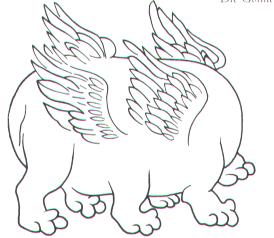
The faceless Sovereign Jiang (帝江) described in the Shanhaijing

Hundun (Chinese: 混沌; pinyin: Hùndùn; Wade–Giles: Hun4-tun4; lit. 'muddled confusion') is both a "legendary faceless being" in Chinese mythology and the "primordial and central chaos" in Chinese cosmogony, comparable with the world egg.

Linguistics

[edit]

Hundun 混沌 was semantically extended from a mythic "primordial chaos; nebulous state of the universe before heaven and earth separated" to mean "unintelligible; chaotic; messy; mentally dense; innocent as a child".

While hùndùn "primordial chaos" is usually written as 混沌 in contemporary vernacular, it is also written as 渾沌—as in the Daoist classic Zhuangzi—or 渾敦 —as in the Zuozhuan. Hùn "chaos; muddled; confused" is written either hùn (; 'abundantly flowing', 'turbid water', 'torrent', 'mix up/in', 'confuse', 'thoughtless', 'senseless') or hún (; 'sound of running water', 'muddy', 'muddled', 'confused', 'dull', 'stupid'). These two are interchangeable graphic variants read as hún (; 'muddy', 'dirty', 'filthy') [a]) and hùn (; 'nebulous', 'stupid') (渾沌; hùndùn). Dùn ("dull; confused") is written as either dùn (; 'dull', 'confused', 'stupid') or dūn (; 'thick', 'solid', 'generous', 'earnest', 'honest', 'sincere').

Isabelle Robinet outlines the etymological origins of hundun.

Semantically, the term hundun is related to several expressions, hardly translatable in Western languages, that indicate the void or a barren and primal immensity – for instance, hunlun (混淪), hundong (混洞), kongdong (空洞), menghong (蒙洪), or hongyuan (洪元). It is also akin to the expression "something confused and yet complete" (混成; huncheng) found in the Daode jing 25, which denotes the state prior to the formation of the world where nothing is perceptible, but which nevertheless contains a cosmic seed. Similarly, the state of hundun is likened to an egg; in this usage, the term alludes to a complete world round and closed in itself, which is a receptacle like a cavern (; dong) or a gourd (; hu or 壺盧; hulu).[1]

A shrimp wonton

Most Chinese characters are written using "radicals" or "semantic elements" and "phonetic elements". Hùndùn (混沌) is written with the "water radical" or and phonetics of kūn () and tún (). Hùndùn "primordial chaos" is cognate with Wonton (餛飩; húntun) "wonton; dumpling soup" written with the "eat radical" . Note that the English loanword wonton is borrowed from the Cantonese pronunciation wan4tan1. Victor H. Mair suggests a fundamental connection between hundun and wonton: "The undifferentiated soup of primordial chaos. As it begins to differentiate, dumpling-blobs of matter coalesce. … With the evolution of human consciousness and reflectiveness, the soup was adopted as a suitable metaphor for chaos".[2] This last assertion appears unsupported, however, since wonton soup is not attested in Chinese sources dating earlier than the Han dynasty,[3] although the linguistic connection of the soup to the larger concept certainly appears real.[3][4][5]

Hundun 混沌 has a graphic variant 混淪; hunlun (using ; lún; 'ripples', 'eddying water', 'sink down' see the Liezi below), which etymologically connects to the mountain name Kunlun 崑崙 (differentiated with the "mountain radical" ). Robinet says "Kunlun and hundun are the same closed center of the world."[6]

Girardot quotes the Chinese philologist Lo Mengci 羅夢冊, who says that reduplicated words like hundun "suggest cyclic movement and transformation", and speculates:[7]

Ritually mumbling the sounds of hun-tun might, therefore, be said to have a kind on incantatory significance that both phonetically and morphologically invokes the mythological and ontological idea of the Tao as the creatio continua process of infinitely repeated moments of change and new creation.

The Shuowen Jiezi does not contain dun () (which apparently lacked a pre-Han Seal script). It defines hun () as fengliu (豐流; 'abundantly flow'), hun () as the sound of hunliu (混流) "abundantly-flowing flow" or "seemingly impure", dun () as "anger, rage; scolding" or "who", and lun () as "ripples; eddies" or "sink into; disappear".

English chaos is a better translation of hundun in the classical sense of Chaos or Khaos in Greek mythology meaning "gaping void; formless primordial space preceding creation of the universe" than in the common sense of "disorder; confusion". The latter meaning of hundun is synonymous with Chinese luàn (; 'chaos', 'revolt', 'indiscriminate', 'random', 'arbitrary'). Their linguistic compound hùnluàn (混亂; 'chaos-chaos'; "chaos; disorder; confusion") exemplifies the "synonym compound" category in Chinese morphology.

Early textual usages

[edit]

In the Chinese written record, hundun first appears in classics dating from the Warring States period. The following summary divides them into Confucianist, Daoist, and other categories, and presents them in roughly chronological order, with the caveat that many early textual dates are uncertain.

Confucian texts

[edit]

Hundun only occurs in one Confucian classic, the Zuo zhuan commentary to the Spring and Autumn Annals. Most early Confucianist ancient texts (Lunyu, Book of Documents, I Ching, etc.) do not use hun, with four exceptions. One, the Mengzi, uses hun in its original meaning "sound of flowing water". Mencius explains why Confucius praised water, "There is a spring of water; how it gushes out!".[8] The other three use hun as what Girardot calls "a term of opprobrium and condemnation related to the suppression of the "barbarians" or the "legendary rebels"."[9]

The Shijing (237) mentions Hunyi (混夷) "ancient Hunni tribe in Turan". When King Wen of Zhou opened up the roads, "The hordes of the Keun [sic] disappeared, Startled and panting".[10] The Chunqiu mentions the Luhun 陸渾 tribe of the Rong people, "the Jung of Luh-hwăn"[11] The Zuozhuan commentary to the Chunqiu notes they were originally from western Gansu and forced into northern Henan.

Another Zuozhuan context refers to Hundun (渾敦) as a worthless son of the Yellow Emperor, one of the mythical Sixiong (四凶) "Four Perils" banished by Shun.

The ancient emperor Hung [Hwang-te] had a descendant devoid of ability [and virtue]. He hid righteousness from himself, and was a villain at heart; he delighted in the practice of the worst vices; he was shameless and vile, obstinate, stupid, and unfriendly, cultivating only the intimacy of such as himself. All the people under heaven called him Chaos. … When Shun became Yaou's minister, he received the nobles from the four quarters of the empire, and banished these four wicked ones, Chaos, Monster, Block, and Glutton, casting them out into the four distant regions, to meet the spite of the sprites and evil things.[12]

The other "Perils" are Qiongqi (窮奇), Taowu (檮杌), and Taotie (饕餮). Legge notes this passage "is worthy of careful study in many respects."

Girardot contrasts these rare Confucian usages of hundun pejoratively suggesting the forces thwarting civilization, "the "birds and beasts," barbarian tribes, banished ministers, and legendary rebels)" with the common Daoist usages in a "paradise lost theme".[13]

Taoist texts

[edit]

Hundun commonly occurs in classics of philosophical Taoism. The Daodejing does not mention hundun but uses both hun graphic variants. One section uses hun (; 'bemuddle'): "The sage is self-effacing in his dealings with all under heaven, and bemuddles his mind for the sake of all under heaven".[14] Three other sections use hun (; 'bound together', 'muddled', 'featureless'):

  • "These three cannot be fully fathomed, Therefore, They are bound together to make unity".[15]
  • "plain, as an unhewn log, muddled, as turbid waters, expansive, as a broad valley"[16]
  • "There was something featureless yet complete, born before heaven and earth"[17]

The Zhuangzi (ca. 3rd-2nd centuries BCE) has a famous parable involving emperors Hundun (渾沌), Shu (; 'a fish name', 'abrupt', 'quick'), and Hu (; 'ignore', 'neglect', 'sudden').[18] Girardot cites Marcel Granet on Shu and Hu synonymously meaning "suddenness; quickness" and "etymologically appear to be linked to the images of lightning and thunder, or analogously, flaming arrows."[19] The "Heavenly Questions" chapter of the Chu Ci uses Shu and Hu as one name: "Where are the hornless dragons which carry bears on their backs for sport? Where is the great serpent with nine heads and where is the Shu-Hu?"[20]

The emperor of the South Sea was called Shu [Brief], the emperor of the North Sea was called Hu [Sudden], and the emperor of the central region was called Hun-tun [Chaos]. Shu and Hu from time to time came together for a meeting in the territory of Hun-tun, and Hun-tun treated them very generously. Shu and Hu discussed how they could repay his kindness. "All men," they said, "have seven openings so they can see, hear, eat, and breathe. But Hun-tun alone doesn't have any. Let's trying boring him some!" Every day they bored another hole, and on the seventh day Hun-tun died.[21]

Compare Watson's renderings of the three characters with other Zhuangzi translators.

  • Change, Suddenness, Confusion (or Chaos) — Frederic H. Balfour
  • Shû, Hû, Chaos — James Legge
  • Change, Uncertainty, Primitivity — Yu-Lan Fung
  • Shu, Hu, Hun Tun — Herbert Giles
  • Immediately, Suddenly, Undifferentiation — James R. Ware
  • Light, Darkness, Primal Chaos — Gia-Fu Feng and Jane English
  • Fast, Furious, Hun-t'un — A.C. Graham
  • Lickety, Split, Wonton — Victor H. Mair[22]
  • Change, Dramatic, Chaos — Martin Palmer
  • Helter, Skelter, Chaos — Wang Rongpei

Two other Zhuangzi contexts use hundun. Chapter 11 has an allegory about Hong Meng 鴻蒙; "Big Concealment" or "Silly Goose", who "was amusing himself by slapping his thighs and hopping around like a sparrow", which Girardot interprets as shamanic dancing comparable with the Shanhaijing below. Hong Meng poetically reduplicates hunhun-dundun (渾渾沌沌; 'dark and undifferentiated chaos') in describing Daoist "mind-nourishment" meditation.[23]

"You have only to rest in inaction and things will transform themselves. Smash your form and body, spit out hearing and eyesight, forget you are a thing among other things, and you may join in great unity with the deep and boundless. Undo the mind, slough off spirit, be blank and soulless, and the ten thousand things one by one will return to the root – return to the root and not know why. Dark and undifferentiated chaos – to the end of life none will depart from it. But if you try to know it, you have already departed from it. Do not ask what its name is, do not try to observe its form. Things will live naturally and of themselves."[24]

Chapter 12 tells a story about the Confucian disciple Zigong becoming dumbfounded after meeting a Daoist sage. He reported back to Confucius, who denigrated Hundun Shi zhi shu (渾沌氏之術; "the arts of Mr. Chaos [Hundun]"):

"He is one of those bogus practitioners of the arts of Mr. Chaos. He knows the first thing but doesn't understand the second. He looks after what is on the inside but doesn't look after what is on the outside. A man of true brightness and purity who can enter into simplicity, who can return to the primitive through inaction, give body to his inborn nature, and embrace his spirit, and in this way wander through the everyday world – if you had met one like that, you would have had real cause for astonishment. As for the arts of Mr. Chaos, you and I need not bother to find out about them."[25]

The Huainanzi has one occurrence of hundun (渾沌) in a cosmological description.

Heaven and earth were perfectly joined [tung-t'ung 洞同], all was chaotically unformed [hun-tun wei p'u 渾沌為樸]; and things were complete [ch'eng ] yet not created. This is called [the time or condition] of the Great One. [t'ai-i 太一]. All came from this unity which gave to each thing its differences: the birds, fish, and beasts. This is called the lot [or division, fen ] of things.[26]

Three other Huainanzi chapters use hun, for example, the compound hunhun cangcang (渾渾蒼蒼; 'pure and unformed', 'vast and hazy')

The world was a unity without division into classes nor separation into orders (lit: a disorganised mass): the unaffectedness and homeliness of the natural heart had not, as yet, been corrupted: the spirit of the age was a unity, and all creation was in great affluence. Hence, if a man with the knowledge of I [羿 A mythical person of great powers] appeared, the world had no use for him.[27]

The Liezi uses hunlun (渾淪) for hundun, which is described as the confused state in which qi (; 'pneuma', 'breath'), xing (; 'form', 'shape'), and zhi (; 'matter', 'substance') have begun to exist but are still merged as one.

There was a Primal Simplicity, there was a Primal Commencement, there were Primal Beginnings, there was a Primal Material. The Primal Simplicity preceded the appearance of the breath. The Primal Beginnings were the breath beginning to assume shape. The Primal Material was the breath when it began to assume substance. Breath, shape and substance were complete, but things were not yet separated from each other; hence the name "Confusion." "Confusion" means the myriad things were confounded and not yet separated from each other.[28]

Other texts

[edit]

The Shanhaijing collection of early myths and legends uses hundun (渾敦) as an adjective to describe a shen (; 'spirit', 'god') on Tian Shan (天山; "Heaven Mountain").

There is a god here who looks like a yellow sack. He is scarlet like cinnabar fire. He has six feet and four wings. He is Muddle Thick. He has no face and no eyes. He knows how to sing and dance. He is in truth the great god Long River.[29]

In the above passage, 渾敦 is translated as "Muddle Thick", and the name of the god Di-Jiang (帝江) is translated as "great god Long River". Toshihiko Izutsu[30] suggests that singing and dancing here and in Zhuangzi refers to shamanic trance-inducing ceremonies, "the monster is said to be a bird, which is most probably an indication that the shamanistic dancing here in question was some kind of feather dance in which the shaman was ritually ornamented with a feathered headdress."

The Shen yi jing (神異經; "Classic of Divine Wonders") records a later variation of Hundun mythology. It describes him as a divine dog who lived on Mt. Kunlun, the mythical mountain at the center of the world.

It has eyes but can't see, walks without moving; and has two ears but can't hear. It has the knowledge of a man yet its belly is without the five internal organs and, although having a rectum, it doesn't evacuate food. It punches virtuous men and stays with the non-virtuous. It is called. Hun-tun.

Quoting the Zuo zhuan, Hun-tun was Meng-shih's untalented son. He always gnaws his tail, going round and round. Everyone ridiculed him.[31]

A poem in the Tang dynasty collection Hanshan refers to the Zhuangzi myth and reminisces about Hundun.

How pleasant were our bodies in the days of Chaos, Needing neither to eat or piss! Who came along with his drill And bored us full of these nine holes? Morning after morning we must dress and eat; Year after year, fret over taxes. A thousand of us scrambling for a penny, We knock our heads together and yell for dear life.[32]

Note the addition of two holes (anus and penis) to the original seven (eyes, ears, nostrils, and mouth).

Interpretations

[edit]

Hundun myths have a complex history, with many variations on the "primordial chaos" theme and associations with other legends.

The sociologist and historian Wolfram Eberhard analyzed the range of various hundun myths.[33] He treated it as a world egg mythic "chain" from the southern Liao culture, which originated in the Sichuan and Hubei region.

  1. Hundun creation myths involving humanity being born from a "thunder-egg" or lump of flesh, the son of an emperor, the Thunder god represented as a dog with bat wings, localized with the Miao people and Tai peoples.
  2. The animal Lei[b] "is a creature like a lump, without head, eyes, hands, or feet. At midnight it produces noises like thunder."[3]
  3. The hundun dumplings, etymologically connected with "round", "unorganized; chaotic", and perhaps the "round mountain" Kunlun.
  4. The world-system huntian 渾天 in ancient Chinese astronomy conceptualized the universe as a round egg and the earth as a yolk swimming within it.
  5. The sack and the shooting of the god connects sack-like descriptions of hundun, perhaps with "sack" denoting "testicles", legends about Shang dynasty king Wu Yi who lost a game of chess with the god Heaven and suspended a sack filled with blood and shot arrows at it, and later traditions of shooting at human dolls.
  6. Pangu (盤古) is the mythological creator of the universe, also supposedly shaped like a sack, connected with dog mythologies, and who grew into a giant in order to separate Heaven and Earth.
  7. Heaven and earth as marital partners within the world-egg refers to the theme of Sky father and Earth Mother goddess.
  8. Zhongli (重黎/融黎) is identified with Zhu Rong 祝融 "god of fire", which is a mythology from the southern state Chu, with variations appearing as two gods Zhong and Li.
  9. Zhongli (重黎) clan, which has variant writings, originated in the Ba (state), near present-day Anhui.
  10. The brother-sister marriage is a complex of myths explaining the origins or mankind (or certain families), and their first child is usually a lump of flesh, which falls into pieces and populates the world. In later mythology, the brother Fu Xi and sister Nüwa, who lived on Mt. Kunlun, exemplify this marriage.

Norman J. Girardot, professor of Chinese religion at Lehigh University, has written articles and a definitive book on hundun. He summarizes this mythology as follows.

  1. The hun-tun theme in early Taoism represents an ensemble of mythic elements coming from different cultural and religious situations.
  2. The symbolic coherence of the hun-tun theme in the Taoist texts basically reflects a creative reworking of a limited set of interrelated mythological typologies: especially the cosmic egg-gourd, the animal ancestor-cosmic giant, and primordial couple mythologies. The last two of these typologies are especially, although not exclusively, linked to what may be called the deluge cycle of mythology found primarily in southern local cultures.
  3. While there may also be a cultural connection between the southern deluge cycle and the cosmogonic scenario of the cosmic egg (i.e., via the "thunder-egg," "origin of ancestors [culture hero] from egg or gourd," and "origin of agriculture and mankind from gourd" myths), the fundamental linkage for all these typologies is the early Taoist, innovative perception of a shared symbolic intention that accounts for, and supports, a particular cosmogonic, metaphysical, and mystical vision of creation and life.[34]

Interpretations of Hundun have expanded from "primordial chaos" into other realms. For instance, it is a keyword in Neidan "Chinese internal alchemy".[6] explains that "Alchemists begin their work by "opening" or "boring" hundun; in other words, they begin from the Origin, infusing its transcendent element of precosmic light into the cosmos in order to reshape it."

[edit]

In the 2013 film Pacific Rim, the second kaiju to make landfall was named Hundun, though only a brief glimpse of it is seen and it doesn't have a major role in the plot. However, concept art of the film does show it with a rounded body akin to the mythological Hundun.

In the Marvel Cinematic Universe movie Shang-Chi and the Legend of the Ten Rings, the character Morris (vocal effects provided by Dee Bradley Baker) is a Hundun and acts as a companion of Trevor Slattery at the time when he was a jester for Wenwu. As Morris entered Ta Lo in a car with Shang-Chi, Xialing, Katy, and Trevor Slattery, he appeared excited to see other Hunduns and they waved their wings at each other.[35]

A Hundun is featured as an optional final boss in the video game Spelunky 2. In the game, Hundun takes the form of a large egg with two legs, two wings, a snake head, a bird head, and a large eye in the center of the egg. Hundun's interpretation in Spelunky 2 is comparable to a world egg, as his body contains the final and largest world of the game.

The Hundun is referenced in episode 11 and 12 of the anime Lazarus.

See also

[edit]

Notes

[edit]

References

[edit]

Sources

[edit]
[edit]
Revisions and contributorsEdit on WikipediaRead on Wikipedia
from Grokipedia
Hundun (Chinese: 混沌; : Hùndùn), commonly translated as "chaos," is a foundational concept in ancient and Daoist , representing the primordial, amorphous state of the prior to differentiation and order. In this undifferentiated condition, Hundun embodies the creative potential from which all things emerge, akin to an original or vital energy containing the seeds of the universe. The concept originates in early Daoist texts from the period (circa 7th–2nd centuries BCE), with its most vivid depiction in the Zhuangzi, a seminal philosophical work attributed to the sage . There, Hundun is personified as the Emperor of the Central Region, a faceless entity lacking sensory orifices—eyes, ears, mouth, and nostrils—symbolizing a state of perfect, spontaneous wholeness without the disruptions of perception or action. A key in Zhuangzi Chapter 7 illustrates Hundun's significance: the Emperor of the South Sea, Shu (Brief), and the Emperor of the North Sea, Hu (Sudden), frequently visited Hundun, who hosted them generously despite his formless nature. Grateful, Shu and Hu decided to repay him by boring seven orifices into his body—one each day for seven days—to enable him to see, hear, eat, and breathe like other beings; however, on the seventh day, Hundun died, marking the transition from primordial chaos to the structured world of , , and myriad things. This narrative underscores core Daoist principles, such as (non-interference or effortless action), warning against artificial impositions that disrupt the natural harmony of the chaotic origin, and emphasizing a return to Hundun-like simplicity as a path to sagehood and cosmic unity. Hundun recurs in other classical works, including the Daode jing (Chapter 25, describing a "thing formed in chaos" as the ) and the , where it links to cosmogonic motifs like the or gourd, portraying chaos as both a creative source and an ambivalent force in the cycle of creation, fall, and restoration.

Etymology and Linguistics

Linguistic Origins

The term "Hundun" (混沌, hùndùn) derives from two Chinese characters that evoke a state of primal indistinctness. The first character, 混 (hún), carries the meaning of "turbid," "mixed," or "blended," often associated with murky s or undifferentiated mixtures, as indicated by its composition with the radical (氵) and the phonetic component 昆 (kūn). The second character, 沌 (dùn), signifies "muddled," "embryonic," or "turbid chaos," similarly structured with the radical and the phonetic 屯 (tún), which implies congestion or primal obscurity. Together, these elements form a compound suggesting "muddy confusion" or "primal mixture," reflecting a literal origin in natural phenomena like sediment-laden s before evolving into an abstract concept of undifferentiated unity. Historical variants of the term include 渾敦 (húndūn) and 渾沌 (húndùn), where 渾 (hún) serves as an archaic synonym for "turbid" or "all-encompassing," often interchangeable with 混 in early writings. These forms arise from phonetic shifts in , preserving the term's auditory and semantic core across dialects. Such variations appear in pre-Qin literature, underscoring the word's flexibility in ancient orthography. The earliest attestations of "hundun" occur in texts (circa 475–221 BCE), such as the Zhuangzi and , where it denotes a concrete sense of murky disorder before shifting to a metaphysical primordial state of wholeness without distinctions. This semantic evolution marks a transition from tangible chaos, akin to obscured waters, to an abstract cosmic origin, influencing later Taoist cosmology. Etymologically, "hundun" connects to the food term (餛飩 or 馄饨, húndùn), which shares the root implication of a formless, mixed filling in , as evidenced in early culinary records like the 5th-century Shiwu zhi (Record of Foods) that initially rendered wonton as 渾沌 to evoke its chaotic, undifferentiated essence. Hundun (混沌) is linguistically linked to several synonyms and variants that elaborate on its core meaning of primordial chaos and undifferentiated unity. One prominent variant is hunlun (渾淪), which evokes a primal void or eddying, undifferentiated state prior to the separation of heaven and , often appearing in early Daoist cosmogonies to describe the initial, formless condition of the . In contrast, hundong (渾洞) emphasizes vast and immensity, portraying an expansive, hollow chaos that underscores spatial boundlessness rather than mere confusion, as seen in alchemical and cosmological texts where it denotes the infinite potential before manifestation. These terms distinguish nuances: hunlun highlights fluid, swirling disorder akin to rippling waters, while hundong stresses cavernous depth and void-like expanse. The concept of hundun also associates with natural phenomena through terms like hunyuan (混元), which signifies the mixed primordial origin and parallels the cosmic egg motif in ancient Chinese cosmology. Hunyuan represents an embryonic, holistic state of unity containing all potentialities, from which the differentiated universe hatches, much like the chaotic enclosure in creation myths where yin and yang begin to segregate. This linkage underscores hundun's role in envisioning pre-cosmic gestation, evoking embryonic forms that encapsulate the nascent cosmos in a shell of undifferentiated essence. Phonetically and semantically, hundun belongs to a of terms rooted in ideas of and mixture, with the character 混 (hún) combining the radical (氵) and phonetic elements suggesting clouded or muddled fluids, evoking semantic ties to "muddle" or obscured clarity in compound phrases for pre-creation obscurity. Though direct attestations in inscriptions are absent—reflecting hundun's later textual prominence in Warring States —its components appear in early scripts denoting watery confusion, reinforcing its use in phrases like "huncheng er cheng" (渾成而成), meaning a confused yet complete primordial wholeness. Hundun's influence extended into the later lexicon, evolving in dictionaries to encompass broader notions of disorder and innocence. In the (說文解字), compiled by Xu Shen around 100 CE, 混 is defined as "turbid" or "muddled" (渾也), with 沌 similarly glossed as an extension of chaotic mixture, facilitating its application in classical literature to denote mental fog or societal disarray beyond cosmological contexts.

Historical and Textual Appearances

In Confucian Texts

In the Zuo Zhuan (Commentary of Zuo), a key Confucian text compiled around the 4th century BCE, (渾敦) is portrayed as one of the (Sì Xiōng, 四凶), malevolent figures symbolizing profound moral failings that threaten social order. Specifically, Hundun is depicted as the untalented son of the ancient ruler Emperor Hong (Dì Hóng shì, 帝鴻氏), who concealed , harbored criminals, delighted in injurious conduct, and associated with the wicked, earning the disdain of the people as a embodiment of sloth, deception, and ethical corruption. This narrative frames Hundun not as a primordial force but as a human-like antagonist whose actions foster chaos, contrasting sharply with the virtuous emperors who banish such perils to the kingdom's borders. The employs Hundun allegorically to underscore the dangers of moral disorder and societal disharmony, serving as a against behaviors that undermine trust, , and communal —core tenets of Confucian li (禮), or ritual propriety and . In the account, the sage-king Shun, serving under Yao, exiles Hundun alongside the other Perils (Qiongqi, Taowu, and ) to the four extremities of the realm to repel evil influences and protect the populace, illustrating how enlightened restores balance by eliminating sources of vice. This portrayal reinforces Confucian priorities of and hierarchical order, using mythological elements to critique the moral decay observed in the turbulent . Hundun's appearances in Confucian literature remain sparse beyond the Zuo Zhuan, with brief allusions in other Warring States-era texts such as the Shangshu (Book of Documents) linking similar chaotic figures to failed rulership and cosmic imbalance, where unchecked vice leads to dynastic downfall and disarray. These references highlight Hundun as a for the perils of negligent , rather than a celebrated entity. During the (ca. 475–221 BCE), Confucian compilers repurposed earlier mythological motifs—like those potentially drawn from pre-Confucian oral traditions—into didactic tools for advocating stable governance, transforming Hundun from a vague chaotic into a symbol of political and ethical peril to promote ideals of harmony and moral rectitude.

In Taoist Texts

In the foundational Taoist text Zhuangzi, compiled during the 4th century BCE in the , Hundun appears as a central figure in a renowned from Chapter 7, "Fit for Emperors and Kings." The story depicts the Emperor of the South Sea as Shu (Sudden), the Emperor of the North Sea as Hu (Sudden), and the Emperor of the Central Sea as Hundun (Chaos), a faceless, formless being who treats the other two with great hospitality whenever they meet in his realm. Grateful for this kindness, Shu and Hu decide to repay Hundun by reshaping him in their own image, boring seven orifices—one each day for eyes, ears, nostrils, and mouth—but on the seventh day, Hundun dies. This narrative illustrates the destructive consequences of imposing artificial distinctions and order on the natural, undifferentiated state, serving as a critique of human interference that disrupts primordial harmony. The Daodejing, attributed to Laozi and dating to around the late 6th or early 4th century BCE, does not explicitly name Hundun but evokes its essence in descriptions of as an undifferentiated, formless origin. In Chapter 25, the text portrays as "something formless yet complete" that predates heaven and earth, existing in a state of serene and solitude, unchanging and infinite, from which all things emerge as from a mother. This portrayal aligns Hundun conceptually with 's primordial unity, where the absence of features or boundaries represents the natural, pre-cosmic wholeness before differentiation into the myriad things. Later Taoist compilations from the expand Hundun's role, portraying it as both a sage-like and the cosmic origin point, underscoring the value of returning to chaos for spiritual insight. In the (c. 139 BCE), a syncretic text associated with , Hundun is invoked in cosmological accounts as the initial state of undifferentiated (vital energy), where and earth were fused in a chaotic unity before separating into ordered forms; this emphasizes Hundun as the source from which the unfolds through natural processes. Similarly, the (compiled around the 4th century BCE but with Han-era additions) uses variants like hunlun to describe Hundun as a confused, boundless state encompassing form, substance, and , urging sages to emulate its undifferentiated nature to achieve enlightenment and transcend conventional perceptions. Across these texts, Hundun evolves from a mythical, personified chaos in the Warring States-era Zhuangzi—symbolizing vulnerability to imposed structure—into a more abstract philosophical metaphor by the in works like the and , where it embodies the principle of (non-action or effortless action). This shift reflects broader Taoist developments, transforming Hundun from a narrative emblem of natural balance into a conceptual tool for cultivating harmony by aligning with the spontaneous flow of the cosmos rather than enforcing artificial order.

In Other Ancient Texts

In the Classic of Mountains and Seas (Shanhaijing), compiled between the 4th century BCE and the 1st century CE, Hundun appears as a mythical known as Dijiang, residing in the Great Wilderness of the North on Celestial Mountain. It is described as having the shape of a yellow sack emitting a red glow like , with six legs and four wings, but lacking a face, eyes, ears, , or ; it emits a sound resembling a baby's cry and governs the central region of the cosmos, embodying a state of primal formlessness. Another passage places a similar entity in the Great Wilds of the north, reinforcing its association with undifferentiated chaos. The Classic of Divine Marvels (Shen yi jing), a 4th-century CE text, portrays Hundun as a divine dog inhabiting Mount Kunlun, the mythical at the world's center. This version depicts it with eyes that cannot see, ears that cannot hear, and the ability to walk without progressing; it possesses human knowledge yet lacks internal organs, evacuates no waste, and gnaws its tail in endless circles while befriending the vicious and striking the virtuous, highlighting its role as a guardian of chaotic realms. Hundun is also linked to the (Si xiong), a group of malevolent entities including (gluttony), Qiongqi (deviousness), and Taowu (), all regarded as disruptors of cosmic and in some traditions described as sons of ancient rulers such as , though Hundun is specifically the son of Emperor Hong in the Shiji. In this context, Hundun specifically embodies chaos, punished and exiled by the sage-king Shun to the world's edges to contain its destabilizing influence. Geographical myths further tie Hundun to liminal, embryonic-like domains, such as the watery expanses of the Eastern Sea or the misty heights of Kunlun, where it dwells in isolation as a primordial guardian. These associations appear in regional lore, suggesting significance in warding off disorder through invocations or symbolic banishment in shamanic practices.

Philosophical and Cosmological Interpretations

As Primordial Chaos

In Chinese , Hundun represents the foundational state of primordial chaos, an initial undifferentiated void encompassing all potential forms before the emergence of structured reality. This amorphous entity, often likened to a in its enclosed and self-contained structure, gives rise to and earth through a process of spontaneous differentiation, alongside the complementary forces of . As the archetypal origin point, Hundun embodies a holistic unity where opposites are not yet separated, serving as the generative matrix for the without implying a deliberate by an external agent. Within Chinese mythic traditions, Hundun parallels the creation narrative, where it precedes and contextualizes the giant's role in cosmic separation. In this framework, Hundun manifests as the enveloping chaos—a dark, boundless mass—from which the hatches, allowing to wield his axe and divide the mingled elements of heaven and , thereby initiating the ordered . This linkage underscores Hundun's position as the pre-separation phase, essential to the transformative dynamics of elemental emergence rather than a standalone entity. Scholarly analyses highlight Hundun's multifaceted cosmogonic significance. Wolfram Eberhard connected Hundun myths to traditions of egg-born deities, interpreting them as part of a mythic chain involving thunder-eggs or primordial lumps of flesh that symbolize humanity's and the world's chaotic , particularly in southern Chinese local cultures. Complementing this, Norman J. Girardot synthesized Hundun as a unifying motif in early Daoist , weaving together chaos as the undifferentiated source, ancestral primacy, and androgynous wholeness to explain the origins and cyclical renewal of existence. Pre-Qin concepts frame Hundun within a non-linear temporal structure, positioning it as the perpetual starter of eternal cosmic cycles rather than a singular event in a progressive timeline. Evident in Eastern Zhou texts, this view emphasizes ongoing processes of coalescence and dispersal, aligning with Daoist notions of spontaneous transformation over teleological creation.

Symbolic Roles in Taoism

In Taoist philosophy, Hundun symbolizes the ideal state of the sage, who emulates its faceless form to transcend sensory biases and social distinctions, thereby achieving impartiality and alignment with the natural flow of the Dao. The Zhuangzi's parable of Hundun illustrates this by portraying the entity as a harmonious, undifferentiated being whose demise results from imposed human-like features, underscoring the sage's pursuit of ziran (spontaneity) as a return to primordial wholeness. This symbolism extends to Neidan, or internal alchemy, where Hundun represents the precosmic unity from which cultivation begins; practitioners refine essence (jing), breath (qi), and spirit (shen) to dissolve dualistic distinctions and revert to this inchoate state, ultimately attaining immortality through the formation of the Golden Elixir. In Neidan texts, the process reverses cosmic generation, reintegrating components into Non-Being to recover the One Breath, with Hundun embodying the sealed, undifferentiated origin that alchemists seek to restore within the body. Ethically, Hundun critiques the corrupting influence of , exemplified by the "seven orifices" bored into it—symbolizing sight, hearing, , and —which represent artificial complexities that erode natural purity and lead to exhaustion or death. This narrative promotes Taoist virtues of and non-interference (wuwei), warning against the Confucian emphasis on moral cultivation and as disruptive to innate . Later Taoist ideas influenced Song-Ming , where Hundun's chaotic unity blended with concepts of li (principle) emerging from formless origins, informing metaphysical views of cosmic order arising from undifferentiated potential without direct reference to the mythic figure.

Comparisons to Global Mythologies

Hundun, as the embodiment of primordial chaos in Chinese cosmogony, bears striking parallels to the Greek concept of Chaos described in Hesiod's , where it represents a yawning gap or formless void from which the ordered emerges through generative processes. In both traditions, this initial state is not mere emptiness but a fertile, undifferentiated potential that births the elements of creation, such as , , and deities, highlighting a universal motif of transition from formlessness to structure. Within other Asian mythologies, Hundun shares conceptual similarities with Hindu Prakriti, the primordial material nature in philosophy that serves as the unmanifest substrate from which the manifest universe arises through interaction with , much like Hundun's role as the central, chaotic origin preceding differentiation. Similarly, in Japanese Shinto cosmology, Ame-no-Minakanushi emerges as a hidden, central deity from an initial state of formless chaos, paralleling Hundun's position as the undifferentiated core that precedes the separation of heaven and earth in the . In Abrahamic traditions, Hundun echoes the Hebrew tohu wa-bohu of Genesis 1:2, depicting the as formless and void before divine ordering imposes structure, emphasizing an initial undifferentiated beginning that invites creation. Scholar Norman J. Girardot, in his analysis of Hundun as a mythic , explores shared motifs across Indo-European and Sino-Tibetan traditions, suggesting underlying universal patterns in chaos symbolism that connect Eastern and Western cosmogonies. However, notable differences arise in : Hundun's faceless, amorphous form contrasts with more personified chaos figures elsewhere, such as the goddess Chaos in Greek lore, underscoring cultural variations in depicting the primordial state.

Cultural Impact and Modern Representations

Influence in Traditional Chinese Culture

Hundun found literary extension in Tang-Song poetry as a for emotional turmoil or the sublime beauty of undifferentiated nature. For instance, the Tang poet Hanshan evoked the Zhuangzi myth in a nostalgic reflection on primordial existence: "How pleasant were our bodies in the days of Chaos, / Needing neither ears nor eyes. / When Shu and Hu tried to repay our kindness, / They drilled holes in us and we died." This usage highlighted Hundun's enduring appeal as a symbol of pre-social innocence lost to human intervention. The cultural legacy of Hundun is reflected in the term's linguistic extension to the (húntun), a staple in folk cuisine symbolizing primordial unity; consuming wontons during rituals signified invoking chaos's creative potential for renewal and good fortune.

Depictions in Contemporary Media

In contemporary media, Hundun has been reimagined as a symbol of chaotic destruction in , often drawing on its mythological roots as a faceless primordial entity. In the 2013 , directed by , Hundun appears as the second to emerge from an interdimensional breach, attacking in the and embodying relentless, storm-fueled disorder before being neutralized by a . Similarly, in the 2021 Marvel Cinematic Universe , the creature Morris is directly inspired by Hundun (also known as Dijiang), depicted as a six-legged, four-winged, eyeless beast from ancient Chinese lore that represents pre-creation chaos; here, it serves as a neutral yet formidable primordial guardian in the mystical realm of Ta Lo. In the 2015 animated Chinese Monkey King: Hero is Back, a loose of , the antagonist Hun Dun is portrayed as an immortality-seeking demon king who transforms into a massive, rampaging monster, sacrificing children to fuel his chaotic ambitions until defeated by the Monkey King. Video games have featured Hundun as a formidable boss or antagonist, emphasizing its association with unpredictable turmoil. In Spelunky 2 (2020), developed by , Hundun serves as the final boss in the level, manifesting as a massive, egg-like entity with wings and legs that summons chaotic environmental hazards like spikes and ghosts, requiring players to navigate its erratic attacks to achieve victory. The 2014 tie-in game , based on the animated series, casts Hundun as the primary villain, a conjoined twin earthbender and chi-blocker who manipulates chaos to oppose the Avatar, blocking bending abilities through ancient knowledge of energy flow. Other titles, such as Warriors Orochi 3 Ultimate (2014), include Hundun as a playable warrior who thrives on disorder, using aerial assaults and energy blasts to disrupt battles across dimensional realms. In and , Hundun symbolizes existential voids or invasive threats, often tied to themes of disorder in modern narratives. The 2021 young adult novel by reimagines Hundun as alien invaders—faceless, metallic husks that ravage an alternate called —forcing pilots into mechs for defense; these creatures represent overwhelming chaos, harvested for technology in a critique of patriarchal exploitation. In the 2025 series Lazarus, produced by for , the "Hundun Project" refers to a secretive Chinese bioweapon initiative involving superhuman enhancements and chaos-inducing experiments, central to the plot's conspiracy involving assassins and global threats. Post-2021 adaptations have extended this into digital formats, such as references in Chinese webtoons like Zhong Tian Zhou (2021 onward), where Hundun appears among the Four Fiends as a chaotic demon in mythological battles, and emerging VR experiences exploring surreal chaos themes, though specific Hundun integrations remain niche as of 2025.

References

Add your contribution
Related Hubs
User Avatar
No comments yet.