Hubbry Logo
HydroxytyrosolHydroxytyrosolMain
Open search
Hydroxytyrosol
Community hub
Hydroxytyrosol
logo
8 pages, 0 posts
0 subscribers
Be the first to start a discussion here.
Contribute something
Hydroxytyrosol
Hydroxytyrosol
from Wikipedia

Hydroxytyrosol
Hydroxytyrosol
Hydroxytyrosol
Names
Preferred IUPAC name
4-(2-Hydroxyethyl)benzene-1,2-diol
Other names
3-Hydroxytyrosol
3,4-dihydroxyphenylethanol (DOPET)
Dihydroxyphenylethanol
2-(3,4-Di-hydroxyphenyl)-ethanol (DHPE)
3,4-dihydroxyphenolethanol (3,4-DHPEA)[1]
Identifiers
3D model (JSmol)
ChEBI
ChEMBL
ChemSpider
DrugBank
ECHA InfoCard 100.114.418 Edit this at Wikidata
EC Number
  • 600-704-3
UNII
  • InChI=1S/C8H10O3/c9-4-3-6-1-2-7(10)8(11)5-6/h1-2,5,9-11H,3-4H2 checkY
    Key: JUUBCHWRXWPFFH-UHFFFAOYSA-N checkY
  • InChI=1/C8H10O3/c9-4-3-6-1-2-7(10)8(11)5-6/h1-2,5,9-11H,3-4H2
    Key: JUUBCHWRXWPFFH-UHFFFAOYAM
  • Oc1ccc(cc1O)CCO
Properties
C8H10O3
Molar mass 154.165 g·mol−1
Appearance colorless solid
5 g/100 ml
Hazards
Occupational safety and health (OHS/OSH):
Main hazards
Causes skin irritation.

Causes serious eye irritation. May cause respiratory irritation.

GHS labelling:[2]
GHS07: Exclamation mark
Warning
H315, H319, H335
P261, P264, P271, P280, P302+P352, P304+P340, P305+P351+P338, P312, P321, P332+P313, P337+P313, P362, P403+P233, P405, P501
Safety data sheet (SDS) [1]
Related compounds
Related alcohols
benzyl alcohol, tyrosol
Except where otherwise noted, data are given for materials in their standard state (at 25 °C [77 °F], 100 kPa).
☒N verify (what is checkY☒N ?)

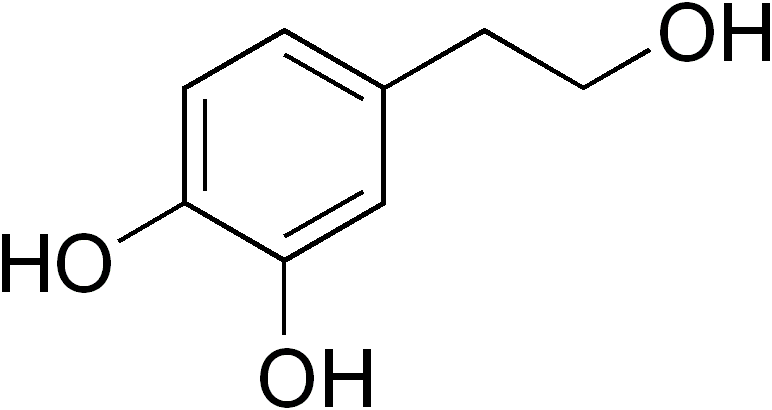
Hydroxytyrosol is an organic compound with the formula (HO)2C6H3CH2CH2OH. It is a phenylethanoid, i.e. a relative of phenethyl alcohol. Its derivatives are found in a variety of natural sources, notably olive oils and wines. Hydroxytyrosol is a colorless solid,[3][4] although samples often turn beige during storage. It is a derivative, formally speaking, of catechol.

Hydroxytyrosol and its derivatives occur in olives and in wines.[5][6]

Occurrence

[edit]

Olives

[edit]
Oleuropein, bitter compound, an ester of hydroxytyrosol found in green olive skin

The olives, leaves, and olive pulp contain large amounts of hydroxytyrosol derivative oleuropein, more so than olive oil.[1] Unprocessed, green (unripe) olives contain between 4.3 and 116 mg of hydroxytyrosol per 100 g of olives, while unprocessed, black (ripe) olives contain up to 413.3 mg per 100 g.[7] The ripening of an olive substantially increases the amount of hydroxytyrosol.[8] Processed olives, such as the common canned variety containing iron(II) gluconate, contain little hydroxytyrosol, as iron salts are catalysts for its oxidation.[9]

Food safety

[edit]

Hydroxytyrosol is considered safe as a novel food for human consumption, with a no-observed-adverse-effect level of 50 mg/kg body weight per day, as evaluated by the European Food Safety Authority (EFSA).[10]

In the United States, hydroxytyrosol is considered to be a safe ingredient (GRAS) in processed foods at levels of 5 mg per serving.[11]

Function and production

[edit]
Hydroxytyrosol is produced by the breakdown of oleuropein

In nature, hydroxytyrosol is generated by the hydrolysis of oleuropein that occurs during olive ripening. Oleuropein accumulates in olive leaves and fruit as a defense mechanism against pathogens and herbivores. During olive ripening or when the olive tissue is damaged by pathogens, herbivores, or mechanical damage, the enzyme β-glucosidase catalyzes hydroxytyrosol synthesis via hydrolysis from oleuropein.[12]

Metabolism

[edit]

Shortly after olive oil consumption, 98% of hydroxytyrosol in plasma and urine appears in conjugated forms (65% glucuronoconjugates), suggesting extensive first-pass metabolism and a half-life of 2.43 hours.[13]

Mediterranean diet

[edit]

Mediterranean diets, characterized by regular intake of olive oil, have been shown to positively affect human health, including reduced rates of cardiovascular diseases.[5][14][15] Research on consumption of olive oil and its components includes hydroxytyrosol and oleuropein, which may inhibit oxidation of LDL cholesterol – a risk factor for atherosclerosis, heart attack or stroke.[16] The daily intake of hydroxytyrosol within the Mediterranean diet is estimated to be between 0.15 and 30 mg.[17]

Regulation

[edit]

Europe

[edit]

The EFSA has issued a scientific opinion on health claims in relation to dietary consumption of hydroxytyrosol and related polyphenol compounds from olive fruit and oil, and protection of blood lipids from potential oxidative damage.[18]

EFSA concluded that a cause-and-effect relationship existed between the consumption of hydroxytyrosol and related compounds from olives and olive oil and protection of blood lipids from oxidative damage,[18] providing a health claim for consumption of olive oil polyphenols containing at least 5 mg of hydroxytyrosol and its derivatives (oleuropein complex and tyrosol) per 20 g of olive oil.[18]

See also

[edit]

References

[edit]
Revisions and contributorsEdit on WikipediaRead on Wikipedia
from Grokipedia
Hydroxytyrosol, chemically known as 2-(3,4-dihydroxyphenyl)ethanol, is a naturally occurring phenylethanoid and phenolic compound renowned for its potent properties. It is primarily derived from the olive tree (Olea europaea), where it forms through the of , a major secoiridoid present in olive fruits, leaves, and oil. As one of the most powerful natural s—second only to —hydroxytyrosol exhibits radical-scavenging activity that is ten times greater than that of green tea catechins and twice that of , making it highly effective against in both aqueous and lipid environments. This compound's bioavailability reaches up to 99%, allowing efficient absorption and integration into the , which contributes to its wide range of health-promoting effects. Hydroxytyrosol demonstrates , , antiproliferative, and apoptotic activities, with particular promise in preventing cardiovascular diseases by protecting (LDL) from oxidation, reducing platelet aggregation, and modulating inflammatory cytokines such as IL-6 and TNF-α. It also shows potential in mitigating risks of cancer, , neurodegeneration, and other chronic conditions through its ability to inhibit cyclooxygenases and enhance endothelial function. The (EFSA) has approved a linking olive oil polyphenols, including hydroxytyrosol, to the protection of from oxidative damage at a daily of at least 5 mg. Hydroxytyrosol is most abundant in extra-virgin (EVOO) and virgin (VOO), with concentrations ranging from 0.9 to 161.5 mg/kg, as well as in table s (up to 3750 mg/kg in some varieties) and, to a lesser extent, in and olive byproducts like leaves and mill wastewater. In the , average dietary intake is estimated at 1.97 mg per day for adults, with higher levels in Mediterranean countries like (6.82 mg/day) and (5.79 mg/day), primarily from s, , and wine. Due to its stability and efficacy, hydroxytyrosol is increasingly explored as a natural in products, such as , to replace synthetic antioxidants while enhancing nutritional value.

Chemical Properties

Structure and Nomenclature

Hydroxytyrosol is an with the molecular formula C₈H₁₀O₃ and a of 154.165 g/mol. Its IUPAC name is 4-(2-hydroxyethyl)benzene-1,2-diol, while common alternative names include 3,4-dihydroxyphenylethanol, 2-(3,4-dihydroxyphenyl)ethanol, and simply hydroxytyrosol. Structurally, hydroxytyrosol is a phenylethanoid derived from , featuring a ring with a moiety—two adjacent phenolic hydroxyl groups at positions 3 and 4 relative to the ethyl —and a terminal hydroxyl group on the ethyl chain (–CH₂CH₂OH) attached at position 1 of the ring. This arrangement positions the hydroxyl groups ortho to each other on the aromatic ring, contributing to its chemical reactivity, while the extends the molecule's polarity. Hydroxytyrosol is classified as a within the tyrosol family of phenylethanoids, specifically recognized as a derived from secoiridoid precursors.

Physical and Chemical Characteristics

Hydroxytyrosol appears as a colorless to white crystalline solid or powder under standard conditions. Its is reported to be around 55–56°C, with a of approximately 265°C at . Due to its hygroscopic nature, commercial forms may exhibit slight variations in appearance, ranging from white to off-white, and it is typically handled as a solid for and industrial purposes. The compound exhibits high solubility in polar solvents, dissolving readily in at concentrations exceeding 25 g/L at 25°C and showing good solubility in (up to several grams per 100 mL depending on ). In contrast, it displays low solubility in non-polar solvents such as or , reflecting its hydrophilic character driven by the multiple hydroxyl groups. These solubility properties facilitate its extraction from aqueous olive-derived matrices and its incorporation into water-based formulations. Hydroxytyrosol is sensitive to oxidation, particularly in the presence of air, light, or elevated temperatures, which can lead to or degradation products; thus, it is recommended to store it in the at low temperatures (e.g., ) under inert atmospheres for long-term stability, with shelf life extending at least three years under optimal conditions. The pKa values of its phenolic hydroxyl groups are approximately 9.45 for the first (more acidic ortho-hydroxy) and higher for the second (around 13–14, though less commonly reported), conferring moderate acidity suitable for its role in systems. As a strong reducing agent, hydroxytyrosol's reactivity stems from its ortho-dihydroxy (catechol) structure, enabling efficient scavenging of free radicals primarily through hydrogen atom transfer mechanisms, which donate a hydrogen from one of the phenolic hydroxyls to neutralize reactive oxygen species. This process is enhanced by the stability of the resulting phenoxyl radical due to resonance delocalization across the aromatic ring.

Natural Occurrence

In Olives and Olive-Derived Products

Hydroxytyrosol is a major phenolic compound present in olives (Olea europaea), where it occurs both in free form and as part of more complex structures like glycosides. In table olives, concentrations of free hydroxytyrosol can reach up to 4,133 mg/kg, with mean values around 629 µg/g across various samples. Green olives typically contain 4.3–116 mg/100g, while ripe olives exhibit higher levels, up to 413 mg/100g, due to progressive accumulation during maturation. In olive-derived products, hydroxytyrosol levels are notably elevated in extra virgin (EVOO), where it ranges from 0.1 to 41 mg/kg, compared to lower amounts (under 2 mg/kg) in refined oils. A typical serving of (10–15 g) may provide 0.01–0.6 mg of hydroxytyrosol, primarily as free form resulting from during extraction. These concentrations contribute to the sensory qualities and stability of the oil. Hydroxytyrosol is primarily derived from the enzymatic and acid hydrolysis of , a secoiridoid abundant in unripe , which occurs naturally during , post-harvest processing, and storage. This degradation pathway releases hydroxytyrosol through the cleavage of the glucose moiety and subsequent reactions, enhancing its in processed products. It is also present in olive leaves (up to 10–50 mg/kg) and olive mill . Variations in hydroxytyrosol content are influenced by , with, for example, the Edincik variety showing significantly higher levels (up to 48 mg/kg in oil) than others. Maturity stage also plays a key role, as later harvest increases hydroxytyrosol through accelerated breakdown, while early-stage olives retain more precursors. Extraction methods further affect levels; cold-pressing for EVOO preserves higher phenolic content compared to heat-intensive processes, which degrade phenolics. Historically, olives have been preserved through traditional Mediterranean methods like and , practices dating back millennia in the region, which inadvertently promote hydroxytyrosol formation via microbial and acidic of during curing. These techniques, central to the , have sustained olive consumption as a staple for preservation and nutrition.

In Other Plants and Foods

Hydroxytyrosol occurs in trace amounts in various plant-derived foods and beverages outside of olives and olive products, primarily through microbial metabolism or minor biosynthetic pathways in plants. In red and white wines, it is synthesized by yeast during fermentation via the Ehrlich pathway from tyrosine, with concentrations ranging from 0.05 to 9.6 mg/L depending on the variety and origin. For instance, average levels in red grape wines are approximately 0.53 mg/100 mL, while white wines contain about 0.21 mg/100 mL, and rosé wines around 0.61 mg/100 mL. These levels are notably lower than in olive-derived sources, where hydroxytyrosol can exceed 100 mg/kg in high-quality extra virgin olive oil. Argan oil represents another minor dietary source, where hydroxytyrosol has been identified in low concentrations, such as approximately 1.6 mg/kg in samples from Algerian regions. This presence likely stems from phenolic profiles in the argan (Argania spinosa), though overall contributions remain limited compared to products. The dietary intake from these non-olive sources is generally minor, estimated at 0.022–0.186 mg/day from wine consumption in certain European populations, providing an additive benefit in polyphenol-rich diets alongside primary sources. Quantification of hydroxytyrosol in such foods typically employs (HPLC) with diode-array detection (DAD) or fluorescence, often coupled with liquid chromatography-mass spectrometry (LC-MS/MS) for enhanced , achieving limits of detection as low as 0.5 µg/L.

Biosynthesis and Production

Biological Synthesis in Plants

Hydroxytyrosol is biosynthesized in , particularly in olive trees (Olea europaea), through the enzymatic of , a major secoiridoid abundant in and leaves. This process is catalyzed by β-glucosidase enzymes, such as (OeGLU, E.C. 3.2.1.206), which cleave the during fruit maturation or in response to cellular disruption. The pathway is activated as olives ripen, where levels peak in young drupes (up to 14% dry weight) and subsequently decline, correlating with increased hydroxytyrosol accumulation in mature black . The key steps involve the deglycosylation of , an linkage between hydroxytyrosol and elenolic acid glucose, yielding the unstable aglycone intermediate. This aglycone spontaneously hydrolyzes to release free hydroxytyrosol and elenolic , often triggered by wounding or maturation-induced activity. , encoded by a single-copy in the , is localized in the nucleus and acts upon vacuolar or cytosolic upon cell rupture, ensuring rapid conversion under stress conditions. Genetic studies, including virus-induced (VIGS) of OeGLU, demonstrate that reducing its expression by over 80% abolishes deglycosylation by approximately 66%, halting downstream secoiridoid production and confirming its pivotal regulatory role. Biosynthesis is tightly regulated by developmental stages and environmental cues in Olea europaea. During fruit development, genes involved in hydroxytyrosol and oleuropein pathways, including those for activity, show peak expression in early stages (60–90 days after flowering), aligning with metabolite profiles where hydroxytyrosol rises via catabolism in later maturation. Stress factors, such as attack or mechanical wounding, induce OeGLU activation through feedback mechanisms, enhancing hydroxytyrosol release as part of a broader secoiridoid network involving upstream enzymes like iridoid synthase (OeISY). This regulation underscores genetic adaptations in olive cultivars, like , where transcriptional control links to fruit and stress resilience. Evolutionarily, hydroxytyrosol functions as a key defense compound in , mitigating from (ROS) generated during pathogen interactions or environmental pressures. The derived aglycones from hydrolysis act as protein-denaturing agents against herbivores, contributing to olive tree survival in Mediterranean ecosystems. This role highlights hydroxytyrosol's integration into phytoalexin-like responses, distinct from its direct synthesis pathways via observed in other plant contexts.

Industrial and Microbial Production Methods

Hydroxytyrosol can be produced industrially through methods, primarily involving the reduction of 3,4-dihydroxyphenylacetic acid (DOPAC) using lithium aluminum hydride (LiAlH4) as a , which yields hydroxytyrosol in a direct one-step process. Another chemical route oxidizes to hydroxytyrosol using in a biocatalyzed flow system, enabling selective monooxygenation at the para position with high and yields up to 90% under optimized conditions. These methods provide high-purity product but often require expensive precursors or harsh conditions, limiting scalability compared to biological approaches. Microbial production leverages engineered microorganisms for de novo biosynthesis from simple carbon sources like glucose. In , metabolic engineering with overexpressed 4-hydroxyphenylacetate 3-monooxygenase (HpaBC) and pathways has achieved titers of 6.97 g/L hydroxytyrosol via fed-batch , representing the highest reported microbial yield to date. strains engineered with -phenol lyase (TPL), L-amino acid dehydrogenase, and α-keto acid decarboxylase enable cascade conversion from , producing up to 1.4 g/L hydroxytyrosol through cofactor-balanced pathways. These systems mimic pathways but use genetic modifications for enhanced flux and reduced byproducts. Recent biotechnological advances from 2023 to 2025 have focused on optimization and pathway integration to boost yields. of the HpaB hydroxylase in E. coli improved catalytic up to 3-fold, resulting in a hydroxytyrosol of 7.43 g/L compared to strains with wild-type . Microbial consortia strategies, combining engineered E. coli and for sequential from , achieved 9.2 mM (approximately 1.4 g/L) hydroxytyrosol with integrated cofactor recycling via NADPH regeneration , minimizing external inputs. These optimizations enhance process and for industrial applications. Commercially, microbial methods are increasingly scaled for hydroxytyrosol in dietary supplements and functional foods, offering cost advantages over plant extraction from , where yields are typically below 1 g/kg and purification is labor-intensive. Biosynthetic routes reduce dependency on seasonal harvests, with engineered platforms demonstrating potential scalability and simpler downstream processing. This shift supports growing market demand for supplement applications.

Metabolism in Humans

Absorption and Bioavailability

Hydroxytyrosol is primarily absorbed in the via passive following oral . Peak plasma concentrations are typically reached within 1–2 hours post-, with times varying slightly based on the delivery form, such as 30 minutes for emulsions or up to 2 hours for encapsulated supplements. The of hydroxytyrosol is relatively low, estimated at 10–20%, largely attributable to extensive first-pass involving rapid conjugation to sulfates and glucuronides in the intestinal mucosa and liver. This process results in conjugated metabolites predominating in plasma, with free hydroxytyrosol levels remaining minimal. The food matrix significantly modulates absorption; for instance, with extra virgin yields higher plasma concentrations (e.g., 3.79 ng/mL at 30 minutes) compared to refined oils or other sources, likely due to enhanced and delayed gastric emptying. Once absorbed, hydroxytyrosol circulates primarily bound to plasma albumin, facilitating its distribution to tissues. It can cross the blood-brain barrier in trace amounts via endogenous transport pathways, though human data on brain accumulation remain limited. is further influenced by dose, showing linear up to 25 mg, as evidenced by proportional increases in urinary excretion of metabolites between 5 mg and 25 mg doses, and by , which contribute to in the colon.

Biotransformation and Excretion

Following absorption into the bloodstream, hydroxytyrosol undergoes extensive phase II metabolism primarily in the intestinal mucosa and liver, where approximately 98% is conjugated through glucuronidation or sulfation processes. These conjugations enhance the compound's water solubility for easier elimination, with glucuronidation being the dominant pathway at typical dietary doses. The major circulating and excreted metabolite is hydroxytyrosol-3'-O-glucuronide, alongside notable sulfate forms such as hydroxytyrosol-3'-O-sulfate. In human plasma, hydroxytyrosol exhibits an elimination of approximately 2.43 hours, reflecting its rapid clearance after conjugation. Free unconjugated hydroxytyrosol is rarely detectable in plasma due to this swift , with conjugated forms predominating shortly after ingestion. of hydroxytyrosol and its metabolites occurs mainly via the , with around 90% eliminated within 24 hours post-ingestion, often peaking within the first 8 hours. A smaller fraction is excreted fecally, where unabsorbed hydroxytyrosol and its conjugates reach the colon. There, deconjugate the phase II metabolites and further metabolize hydroxytyrosol into simpler , such as phenylacetic acids, contributing to its overall elimination.

Health Effects

Antioxidant and Anti-Inflammatory Activities

Hydroxytyrosol exhibits potent activity primarily through direct radical scavenging and inhibition of oxidative damage to biomolecules. In cell-free assays, it effectively neutralizes radicals with an value of approximately 15 μM, demonstrating its capacity to donate hydrogen atoms and stabilize free radicals. This mechanism extends to protecting (LDL) particles from oxidation; at concentrations around 10 μM, hydroxytyrosol nearly completely inhibits copper-induced conjugated diene formation in LDL, preventing the propagation of chains that contribute to atherogenesis. In vitro studies further illustrate hydroxytyrosol's cytoprotective effects against . It safeguards various cell types, such as vascular endothelial cells and renal cells, from (H2O2)-induced damage by reducing accumulation and maintaining cellular viability. Additionally, hydroxytyrosol upregulates the Nrf2 signaling pathway, promoting nuclear translocation of Nrf2 and subsequent expression of enzymes like oxygenase-1 (HO-1), which enhances the cellular defense against oxidative insults in models of H2O2 exposure. Beyond antioxidation, hydroxytyrosol modulates inflammatory responses by targeting key signaling pathways. It suppresses activation in stimulated macrophages and mast cells, thereby reducing the transcription of pro-inflammatory genes and limiting production. Specifically, in (LPS)-induced models, hydroxytyrosol decreases secretion of interleukin-6 (IL-6) and tumor factor-α (TNF-α) in a dose-dependent manner, with significant inhibition observed at concentrations of 10–50 μM. Recent investigations (2023–2025) highlight the role of hydroxytyrosol's gut microbial metabolites in bolstering intestinal epithelial integrity. Metabolites such as and homovanillic acid, generated by colonic bacteria, activate the (AhR), which in turn upregulates the Nrf2 pathway to enhance protein expression (e.g., and ZO-1) and restore barrier function disrupted by inflammatory challenges like LPS. These mechanisms contribute to hydroxytyrosol's broader support for metabolic health by mitigating oxidative and inflammatory stress in the gut.

Effects on Metabolic and Cardiovascular Health

Hydroxytyrosol exhibits beneficial effects on metabolic health by improving insulin sensitivity, particularly in individuals with or metabolic disturbances. Additionally, hydroxytyrosol modulates the to counteract the dysbiotic effects of high-fat diets, thereby alleviating and . In high-fat diet-induced obese mouse models, hydroxytyrosol administration altered microbial composition, increased beneficial bacteria such as , and strengthened intestinal barrier integrity, leading to reduced body weight and improved glucose homeostasis. In the cardiovascular domain, hydroxytyrosol mitigates , a critical early event in and progression. and studies demonstrate that hydroxytyrosol protects vascular endothelial cells from oxidative and inflammatory insults, restoring bioavailability and reducing adhesion molecule expression. It also lowers in models by promoting and inhibiting activity. For instance, in spontaneously hypertensive rats, chronic hydroxytyrosol supplementation at 10 mg/kg/day decreased systolic by approximately 15% over 8 weeks, alongside reduced vascular . Clinical evidence supports hydroxytyrosol's role in cardiovascular protection, including the (EFSA)-approved health claim that consumption of providing at least 5 mg of hydroxytyrosol and its derivatives (e.g., complex and ) per 20 g dose helps protect (LDL) particles from oxidative damage, thereby maintaining healthy blood lipid levels. Emerging 2025 research further highlights its protection against hyperglycemia-induced erythrocyte damage, where hydroxytyrosol at concentrations of 10–50 μM restored calcium , inhibited activity, and prevented externalization in human red blood cells exposed to high glucose. Dosages of 5–50 mg/day have been deemed safe in human studies, with no observed adverse effects in subchronic trials up to 500 mg/kg body weight in rodents, extrapolated to human equivalents. These benefits align with the broader cardiovascular risk reductions observed in interventions, where polyphenol-rich extra-virgin intake lowered by 30% in high-risk populations. Such outcomes are underpinned by hydroxytyrosol's mechanisms that scavenge and modulate inflammatory pathways.

Regulation and Applications

Safety and Regulatory Approvals

Hydroxytyrosol has been evaluated for through multiple toxicological studies, establishing a (NOAEL) of 50 mg/kg body weight per day based on a subchronic oral toxicity study in rats, where no adverse effects were observed at this dose, though higher doses led to minor changes in organ weights. This NOAEL has been referenced in subsequent assessments, including a 2023 review confirming the absence of concerns at relevant intake levels. , hydroxytyrosol has received (GRAS) status from the for use as an at levels up to 5 mg per serving in various food categories, including beverages, fats, and sauces, based on estimated daily intakes well below the NOAEL. In 2025, the FDA affirmed GRAS status under Notice 1182 for hydroxytyrosol as an in foods such as butter, oils, salad dressings, and beverages at up to 5 mg per serving, with estimated mean daily exposure of 8.4 mg for the U.S. population aged 2 years and older. Toxicity assessments indicate no evidence of , with in vitro studies showing hydroxytyrosol does not induce DNA damage or mutations in bacterial or mammalian cell assays. Similarly, no carcinogenicity has been observed in available data, as long-term exposure studies and weight-of-evidence evaluations from regulatory bodies report no tumor-promoting effects. At high doses exceeding 100 mg per day, minor gastrointestinal effects such as transient discomfort have been noted in some human and animal studies, but these are not considered clinically significant and resolve without intervention. Regulatory history includes the European Food Safety Authority's (EFSA) 2011 scientific opinion substantiating a for polyphenols, including hydroxytyrosol, which contributed to the European Commission's approval under Regulation (EU) No 432/2012 for protection of from oxidative damage at a minimum intake of 5 mg of hydroxytyrosol and its derivatives daily from . In 2017, EFSA authorized hydroxytyrosol as a ingredient safe for addition to fats and oils at specified levels. For , hydroxytyrosol occurs naturally in at levels typically ranging from 3.5 to 7.7 mg/kg, with no specific (ADI) established due to its history of consumption; however, it is monitored in novel foods to ensure exposures remain below the NOAEL. Limits in are tied to the threshold, requiring at least 20 g of daily to achieve the 5 mg intake for claim eligibility.

Use in Food, Supplements, and Emerging Applications

Hydroxytyrosol is widely incorporated into the as a natural to fortify products and extend , particularly in edible oils and beverages. In oils such as refined and echium oils, fortification at concentrations of 200 mg/kg has been shown to increase antioxidant capacity by up to 1.4-fold and reduce peroxide values during storage, thereby preventing lipid oxidation and rancidity. Similarly, in beverages like red , supplementation at 60–120 mg per 750 mL bottle preserves color, limits acetic acid formation, and maintains stability against oxidation for up to 6 months post-bottling, offering a synthetic-free alternative to preservatives like . These applications leverage hydroxytyrosol's ability to neutralize free radicals, enhancing both product quality and nutritional value in functional foods. In dietary supplements, hydroxytyrosol is commonly available in capsule form, with typical dosages ranging from 10 to 50 mg per serving, often derived from extracts standardized to 25% purity. These supplements are marketed primarily for anti-aging benefits, supported by evidence of hydroxytyrosol's protective effects on human dermal fibroblasts against ultraviolet A-induced , including reduced and markers. Daily intakes in this range align with thresholds established by regulatory bodies, promoting cellular health and without adverse effects. Emerging applications of hydroxytyrosol from 2023 to 2025 highlight its versatility beyond traditional uses. In animal reproduction, inclusion in extenders at 1.25–2.5 μg/mL has improved post-thaw (up to 55%), viability, integrity, and DNA fragmentation resistance in stallion , potentially enhancing outcomes in protocols. In , a non-destructive screening method using pocket-sized photonic devices enables rapid quantification of hydroxytyrosol in leaves, facilitating on-site quality assessment for breeding and harvest decisions without sample destruction. Additionally, research indicates potential for preventing (CKD)-induced , as hydroxytyrosol alongside from leaves attenuates and in affected models, supporting renal and muscular health. These innovations underscore hydroxytyrosol's expanding role in and preventive medicine. Challenges in hydroxytyrosol's commercial use include its susceptibility to oxidation and degradation in formulations, with losses of 20–30% observed after three months at 25–37°C, leading to discoloration and reduced efficacy. Strategies such as co-formulation with antioxidants like ascorbic acid derivatives and chelators (e.g., EDTA) have mitigated these issues, limiting degradation to under 10% in hydrogels and creams. Market projections reflect growing adoption, with the global hydroxytyrosol sector valued at approximately USD 2.5 billion in 2024 and forecasted to reach USD 4.7 billion by 2032 at a of about 8%, driven by demand for natural ingredients in functional foods and nutraceuticals.

References

Add your contribution
Related Hubs
Contribute something
User Avatar
No comments yet.